

Crypto World
Aptos’ APT price jumps 10% but still trades 94% below ATH after regulatory clarity

Aptos’ APT price jumps off record lows as volume spikes, regulatory clarity lands, and network usage hits new highs, but the token still trades near the bottom of its historical range.
Summary
- APT changes hands around $1.03–$1.04, up roughly 8.6–10% in 24 hours, with daily volume near $205–$239 million.
- Market cap sits around $824.5 million after Aptos bounced off an all‑time low of $0.7926 set in late February 2026.
- The move comes as Aptos processes about 10 million daily transactions and wins a key U.S. regulatory decision classifying APT as a commodity.
Aptos (APT) price is trading near $1.03 today, with CoinMarketCap showing APT up 8.57–10.20% over the last 24 hours and a 24‑hour trading volume of roughly $238.56 million. CMC’s latest analysis notes that APT is up 9.93% to $1.04 in 24 hours, driven by a “high‑conviction volume surge” as spot trading volume jumps 175.51% to about $204.96 million, far above its 7‑day average. Despite this bounce, Aptos remains deeply depressed versus history: the token printed an all‑time low of $0.7926 on February 23, 2026 and still trades more than 94% below its all‑time high around $19.90.
Aptos is a high‑performance Layer 1 blockchain built by former Meta engineers from the Diem/Move initiative, designed for security, scalability and mainstream adoption. According to CoinMarketCap, the network now clears close to 10 million daily transactions with average fees as low as $0.00007, a level of throughput that contrasts sharply with the token’s depressed price. Proposal 183, ratified by the community on March 1, 2026, set a hard supply cap of 2.1 billion APT and permanently directed gas fees to be burned, introducing structural deflation as on‑chain activity grows.
On‑chain and macro news flow has turned more supportive even as price lags. Recent CMC coverage highlights three major developments: the U.S. SEC has classified APT as a commodity, Binance is preparing to delist APT perpetual futures on March 25, 2026, and the network’s 10‑million‑transactions‑per‑day milestone is now paired with deflationary tokenomics. The removal of APT perps from Binance could temporarily sap derivatives liquidity and speculative open interest, but it also pushes price discovery back toward spot markets at a moment when volume is surging and the token is trading near historical capitulation levels.
In the wider smart‑contract sector, Aptos is still underperforming: CoinGecko data shows APT down about 9.90% over the past week, compared with a 0.70% rise in the global crypto market and a 1.70% gain for similar smart‑contract platforms, underscoring how sharp today’s bounce is relative to a still‑bearish medium‑term trend.



Morgan Stanley’s spot bitcoin ETF has completed its first month without a single day of net outflows, even as larger rival funds posted repeated redemption sessions during the same period.
Summary
- Morgan Stanley’s MSBT recorded no daily net outflows during its first month of trading.
- The bitcoin ETF crossed $103 million in inflows within six trading sessions after launching on April 8.
- SoSoValue data showed MSBT continued attracting inflows while BlackRock and Fidelity funds posted outflow days.
SoSoValue data reviewed by crypto.news showed Morgan Stanley’s MSBT continued attracting fresh capital every trading day since its April 8 launch, while the broader U.S. spot bitcoin ETF market alternated between large inflow and outflow sessions. On May 7 alone, MSBT added $5.7 million as BlackRock’s IBIT lost $27.2 million, Fidelity’s FBTC shed $97.6 million, and ARKB recorded $26.6 million in outflows.
Launching into a weak session for the ETF sector, MSBT drew $30.6 million in first-day inflows and roughly $34 million in trading volume while the broader category saw $94 million leave spot bitcoin funds.
Bloomberg Senior ETF Analyst Eric Balchunas later said the debut ranked among the top 1% of ETF launches.
Within six trading sessions, the fund had crossed $103 million in cumulative inflows, overtaking WisdomTree’s BTCW, which has operated since January 2024 and has gathered roughly $86 million in total net inflows over its lifetime.
Low fee strategy gains traction
MSBT entered the market with a 0.14% sponsor fee, the lowest among all U.S. spot bitcoin ETFs. Grayscale’s Bitcoin Mini Trust charges 0.15%, Bitwise’s BITB charges 0.20%, ARKB charges 0.21%, while both IBIT and FBTC sit at 0.25%. Grayscale’s legacy GBTC fund still carries a 1.50% fee.
The pricing difference appears marginal for smaller investors but scales quickly for institutions, with an 11 basis point gap between MSBT and IBIT translating to roughly $1.1 million annually on a $1 billion allocation.
Trading activity also pointed to sustained demand pressure. SoSoValue data showed MSBT traded at a 0.24% premium to net asset value on May 7, above IBIT’s 0.18% and FBTC’s 0.13%.
Morgan Stanley’s crypto expansion has extended beyond ETFs. As crypto.news previously reported, the bank launched a pilot crypto trading service on ETrade on May 6 with a flat 0.5% transaction fee for bitcoin, ether, and solana trades executed through Zerohash infrastructure.
Bloomberg reported that Morgan Stanley is below Coinbase, Fidelity, and Charles Schwab on retail crypto trading costs.
Eric Balchunas said competitors were unlikely to leave the pricing unchanged and compared the situation to the fee compression battle that followed the launch of spot bitcoin ETFs.
Advisors yet to fully enter
Almost all early inflows into MSBT came from self-directed investors rather than Morgan Stanley’s advisory network.
“Almost all of that first week or two of activity was self-directed, meaning it was not our advisors that were selling this,” Amy Oldenburg, Morgan Stanley’s head of digital assets, said at the Consensus conference in Miami.
Morgan Stanley oversees roughly $9.3 trillion in client assets through roughly 16,000 financial advisors, although the bank had not yet opened MSBT access across its wealth management platform during the fund’s first weeks.
Once integrated into that channel, the ETF would gain access to one of the largest distribution systems tied to a U.S. financial institution. Morgan Stanley is also developing a proprietary digital wallet expected later in 2026 that would hold cryptocurrencies alongside tokenized stocks, bonds, and real estate assets.
MSBT’s first month coincided with renewed demand across the U.S. spot bitcoin ETF sector. SoSoValue data showed the 13-spot bitcoin funds attracted more than $3 billion across six straight weeks through May 8, the longest positive streak since mid-2025. Total assets across the category reached $106.6 billion, equal to 6.67% of bitcoin’s market capitalization, while cumulative inflows since launch climbed to $59.3 billion.
Balchunas projected MSBT could eventually reach $5 billion in assets under management during its first year, though he indicated advisor-driven flows would likely need to accelerate for the fund to maintain its current pace.


Indian Prime Minister Narendra Modi urged citizens to cut fuel use and revive work-from-home practices.
The remarks come as the Strait of Hormuz closure tightens global oil supplies and raises the risk of sharper price spikes and shortages.
Modi Urges India to Cut Fuel Use, Revive Work-From-Home as Hormuz Closure Bites
Speaking in Hyderabad, the prime minister called on citizens to curb petrol and diesel consumption, increase the use of electric vehicles, shift freight transport to railways, and revive work-from-home practices seen during the COVID-19 pandemic.
“In this time of global crisis, we have to make a resolution keeping duty paramount and fulfil it with complete dedication. A big resolution is to use petrol and diesel sparingly,” he said. “In the current situation, we must place great emphasis on saving foreign exchange.”
He also urged Indians to postpone foreign travel and gold purchases for a year, reduce cooking oil consumption, and asked farmers to cut fertilizer use by up to 50%, framing the measures as a national duty
Follow us on X to get the latest news as it happens
Governments Worldwide Take Measures as Oil Crisis Escalates
India isn’t the only country seeking to reduce fuel consumption. Several governments have rolled out comparable measures, according to the IEA’s tracker. In March, the Philippines declared a national energy emergency.
Bangladesh shut public and private universities to conserve electricity and fuel. Pakistan switched government workers to a four-day workweek and temporarily closed schools.
Meanwhile, South Korea asked private vehicle owners to refrain from driving 1 day per week. Some countries have also encouraged temperature limits on air conditioners, including Cambodia and Malaysia.
The measures highlight growing global efforts to counter the economic fallout from the US-Iran conflict and the resulting strain on global energy markets.
Subscribe to our YouTube channel to watch leaders and journalists provide expert insights
The post India’s Prime Minister Calls for National Fuel Savings Amid The Iran-US Conflict appeared first on BeInCrypto.

Sui network’s native token, SUI, has climbed 50% over the past seven days after a Nasdaq-listed company staked a large portion of the token’s supply and developers announced upcoming features, including zero-fee stablecoin transfers and private transactions.
SUI traded around $0.94 on May 4 before climbing to $1.41 on Sunday, according to CoinGecko. Over the same timeframe, trading volume surged from more than $213 million to over $2.5 billion.
Ryan McMillin, co-founder and chief investment officer of Australian crypto investment manager Merkle Tree Capital, told Cointelegraph the rally has likely been driven by multiple reinforcing catalysts.
He pointed to a “meaningful supply squeeze” as the “clearest near-term trigger” after Nasdaq-listed SUI Group Holdings revealed Friday that its entire SUI treasury of more than 108 million tokens, worth over $143 million, has been staked.
Sui launched its mainnet in May 2023, aiming to be scalable and process transactions fast enough for financial institutions. African payments infrastructure company Paga Group announced at Consensus 2026 in Miami on Thursday that it has partnered with Sui to develop blockchain‑powered cross‑border transfers and stablecoin products.
Private fee-free stablecoin promise
Adeniyi Abiodun, a co-founder of Mysten Labs, the developers behind the Sui network, also announced at Consensus 2026 that zero-fee stablecoin transfers would roll out soon and reiterated plans to add a private transaction feature.
Privacy-focused cryptocurrency Zcash (ZEC) spiked by more than 70% last week as crypto traders started paying closer attention to privacy-focused projects. Privacy had been a significant investment theme for crypto in 2025, with privacy-focused tokens surging despite a broader downturn in the rest of the market.

Source: Adeniyi Abiodun
“This positions Sui as low-friction rails for payments and liquidity and also attractive to agentic AI payments. The Nasdaq angle is also notable: it puts SUI in the same public company treasury/equity market access group as BTC, ETH, SOL and others, signaling growing institutional comfort,” McMillin added.
“Sui is shifting from promising L1 or high-beta play to actual adoption story. The combo of institutional staking, zero-fee ambition and regulated futures access is rare among alts. Watch on-chain metrics post-announcement for confirmation.”
At the same time, Abiodun said Friday the Sui network’s prediction market DeepBook Predict was going live on the testnet. A March report from Bitget Wallet and Polymarket found that prediction markets are among the most active on-chain applications, with $25.7 billion in trading volume that month.
Rally’s success depends on execution, rollout
SUI has settled at around $1.31 as of Monday. McMillin said that in the short term, the token could extend its rally because supply shocks and product news generally sustain momentum.
“We are also in an environment where we are seeing green shoots all over the crypto ecosystem and it looks more and more likely the bear market hibernation is over,” he said.
“Medium-term: more uncertain but constructive. Success depends on execution, actual zero-fee rollout, Paga integration traction in Nigeria and stablecoin volume growth. Sui has real tech edges and usage momentum, but token unlocks and broader crypto cycles remain risks.”
Magazine: Guide to the top and emerging global crypto hubs — Mid-2026
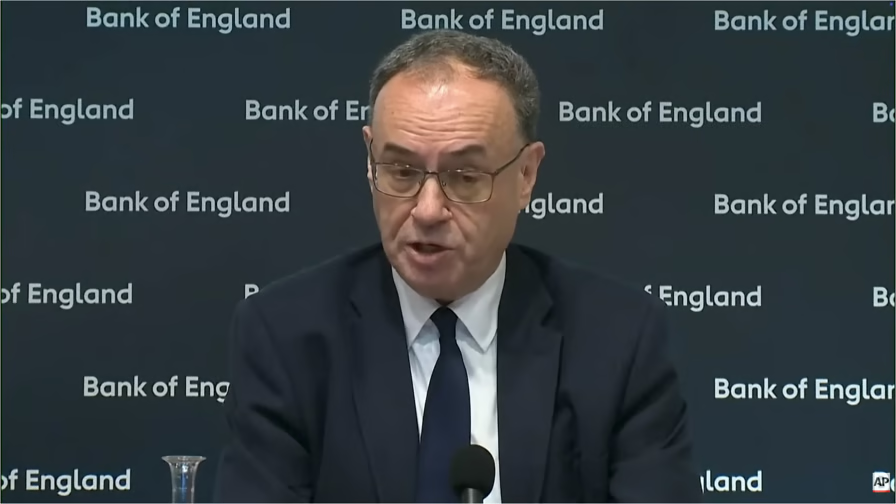
Bank of England Governor Andrew Bailey said international regulators will have to “wrestle” with the US over global rules for stablecoins, which are largely denominated in and backed by US dollars.
“If we want stablecoins to be part of the architecture of payments globally […] they’re only going to work if we have international standards,” Bailey said at a conference on Friday, according to Reuters.
“Frankly, that, I think, is going to be a coming wrestle with the [US] administration,” he added.
US President Donald Trump has the goal of attracting the crypto industry to the US and has promoted the use of stablecoins through the GENIUS Act, which gave a regulatory framework to stablecoin issuers.
Other regulators are looking into greater oversight and control of stablecoins compared to the US, seeing them as a lighter-regulated alternative to the banking system that could impose systemic risks.
The stablecoin market is currently valued at more than $317 billion, according to CoinGecko, with the largest stablecoins by market capitalization dominated by tokens pegged to the US dollar, most of which use US Treasury bills and US dollars as backing assets.
Bailey, who chairs the Financial Stability Board, an international body that aims to coordinate regulation, said he sees stablecoins as a potential threat to financial stability.

Andrew Bailey at a press conference in February after a meeting of the Bank of England’s Monetary Policy Committee on interest rates. Source: YouTube
Bailey added that he was concerned some stablecoins could not be readily converted to cash without the use of a crypto exchange, which could limit their convertibility in changing market conditions.
He said if stablecoins are widely used for cross-border payments, then the US dollar tokens that are hard to convert could flow to other countries, like the UK, which is planning to have strong laws around converting stablecoins.
“We know what would happen if there was a run on a stablecoin; they’d all turn up here,” Bailey said.
Related: US Senator questions Mark Zuckerberg on Meta’s stablecoin plans
US banking groups have raised similar concerns about stablecoins with Congress and have pushed for a Senate crypto market structure bill to include a ban on third-party platforms, such as crypto exchanges, offering yield payments on stablecoins.
Crypto and banking groups failed to come to an agreement on the ban after months of negotiations, and the latest version of the bill, released earlier this month, prohibits stablecoin rewards on idle balances while allowing crypto platforms to “offer other forms of customer rewards.”
The Senate Banking Committee, which indefinitely postponed a vote on advancing the bill in January, has scheduled a markup of the bill on Thursday.
Magazine: How crypto laws changed in 2025 — and how they’ll change in 2026
Bitcoin held near the $80,000 mark on Monday after President Donald Trump rejected Iran’s latest response to a U.S. peace plan.
Summary
- Bitcoin defended $80,000 as Trump’s Iran rejection fueled fast swings across weekend crypto markets again.
- Short liquidations jumped after BTC rebounded above $82,000, showing leveraged traders remain exposed to headlines.
- Traders now watch $85,000, while $78,000 remains the key downside level for Bitcoin bulls.
The move kept traders focused on the conflict, oil prices, and the Strait of Hormuz. Trump called the Iranian counterproposal “TOTALLY UNACCEPTABLE” after Tehran pushed for compensation, sanctions relief, an end to the blockade, and recognition of its control over the strait.
Bitcoin (BTC) first fell from $81,430 to $80,520 within 45 minutes of Trump’s post, then climbed to $82,347 less than three hours later, according to crypto.news data. The rebound wiped out nearly $410 million over 24 hours, based on Coinglass data.
Hormuz tensions keep risk assets on edge
The Strait of Hormuz remains central to the market reaction. Reuters reported that the waterway carried one-fifth of global oil and liquefied natural gas flows before the war began on February 28.
Oil prices jumped more than $4 a barrel after Trump rejected Iran’s proposal, showing that energy markets are still reacting quickly to each new statement from Washington or Tehran.
The dollar also gained for a second day in Asian trading as strong U.S. jobs data and safe-haven demand supported the currency. Brent crude rose 4.5% to $105.85 a barrel after the rejection. That mix of higher oil, a stronger dollar, and war uncertainty left Bitcoin trading in a tight but volatile range.
Repeated pattern
Recent crypto.news coverage had already linked Bitcoin’s $80,000 test to Iran headlines. On May 1, crypto.news reported that BTC rose toward $78,700 after Iran sent a revised peace proposal through Pakistani mediators, easing some oil pressure and improving risk sentiment. The report cited 21Shares chief market strategist Adrian Fritz, who said $80,000 was “quite a resistance” and that a move above $85,000 could show early signs of a broader reversal.
Crypto.news also reported on May 4 that Bitcoin climbed to $80,529 after Trump announced “Project Freedom,” an effort linked to cargo ships affected by the Strait of Hormuz closure.
In an earlier report, crypto.news said Bitcoin’s sharp moves showed how geopolitical headlines continue to drive short-term crypto price action.
Traders watch $85K as next upside test
Analysts are now watching whether Bitcoin can turn $80,000 into support. Crypto Tony posted that there was a 79% chance Bitcoin could hit $85,000 this month, while CoinsProbe said a channel breakout placed the $85,000 target in play.
The downside level remains clear. Several traders are watching $78,000 as the first major support if Bitcoin fails to hold the $80,000 area.
A confirmed move above $82,450 could support another attempt toward $85,000, but a fresh breakdown in U.S.-Iran talks may keep BTC exposed to fast reversals.
Disclosure: This article does not represent investment advice. The content and materials featured on this page are for educational purposes only.
Crypto World
Bitcoin (BTC) mining pools with 75% of hashrate back open standard for block construction
The biggest decentralization move bitcoin mining has seen in years just happened quietly, with seven of the largest pools agreeing to back the same open standard.
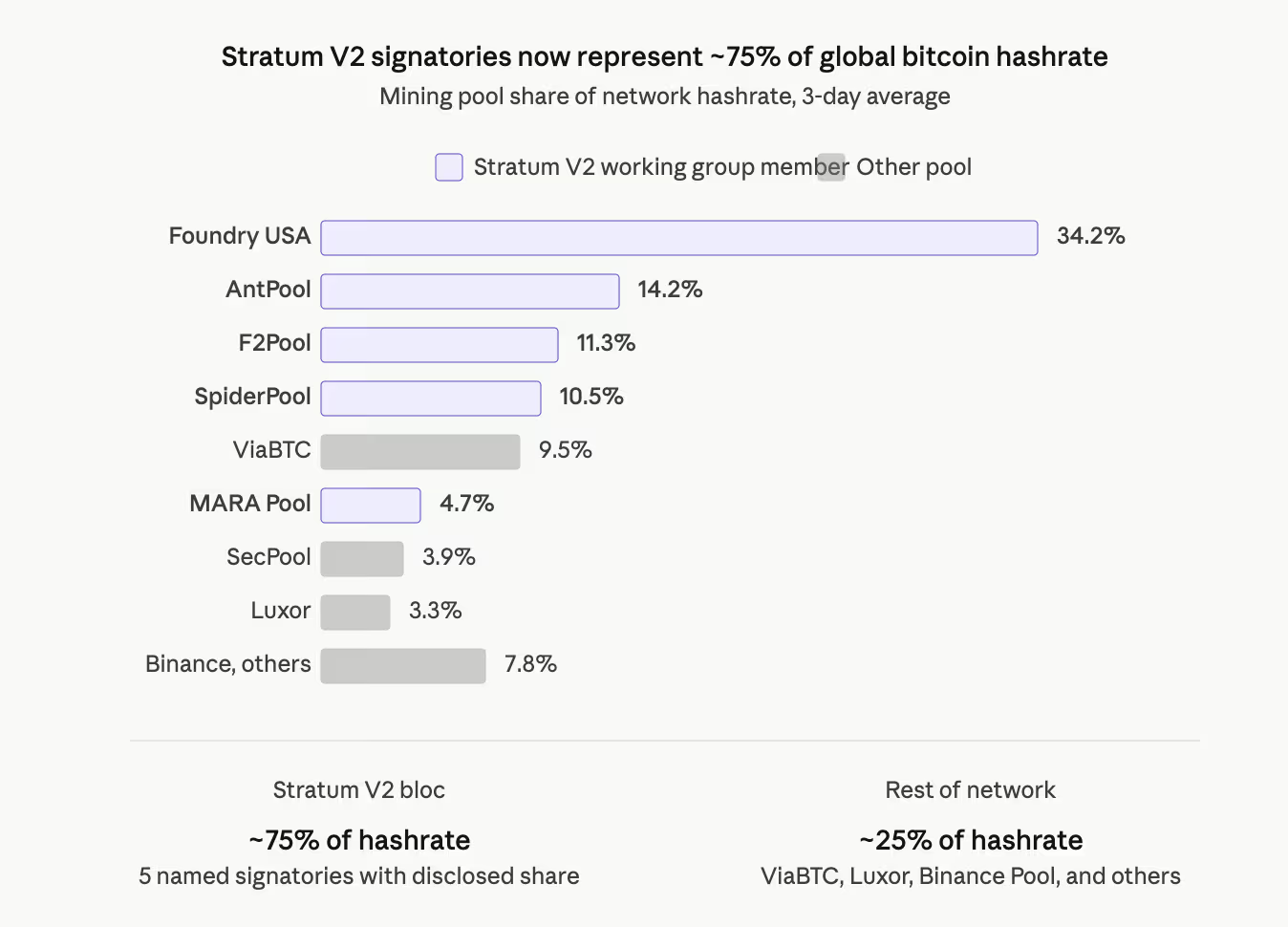
Foundry, AntPool, F2Pool, SpiderPool, MARA Pool, Block Inc, and DMND have all joined the Stratum V2 working group, the group announced last week.
Stratum V2 is an open-source protocol governing how mining pools communicate with the individual miners in those pools. The biggest practical change it introduces is letting individual miners construct their own block templates, meaning the choice of which transactions get included in each new block sits with the miner rather than whoever operates the pool.
Foundry alone controls 34.2% of global bitcoin hashrate, AntPool another 14.2%, F2Pool 11.3%, and SpiderPool 10.5%, with MARA Pool adding 4.7%, per Hashrate Index data. Together with the rest of the Stratum V2 signatories, the seven pools now backing the standard represent close to 75% of all bitcoin hashrate.

Under the current Stratum V1 standard, the transaction selection for nearly every new block sits with the pool operators rather than the individual miners actually doing the work. That concentration has been the loudest structural concern about modern mining for the past two years.
Stratum V2 does not change hashrate concentration, but it does change who decides what goes into each block, which is the part the Bitcoin community actually worries about.
A single pool controlling more than 30% of hashrate is less than ideal, as the same pool deciding the transaction order for that share of blocks is the actual risk people point to.
The protocol has existed since 2022, when Braiins and Spiral co-founded the working group. Until now it had been treated as a niche side project with limited adoption. Foundry and AntPool joining gives it real reach, with the working group framing the move as the start of a new phase of accelerated deployment.
The timing also matches what the broader mining cohort is dealing with. CoinShares estimates up to 20% of miners are currently unprofitable, with hashprice (the revenue a miner earns per unit of computing power) sitting at $38.57 per petahash per second per day, at or near breakeven for operators running mid-generation hardware.
Difficulty is set to rise again on May 15 from 132.47T to 135.64T, per CoinWarz. Network hashrate now sits at 998 exahash per second.
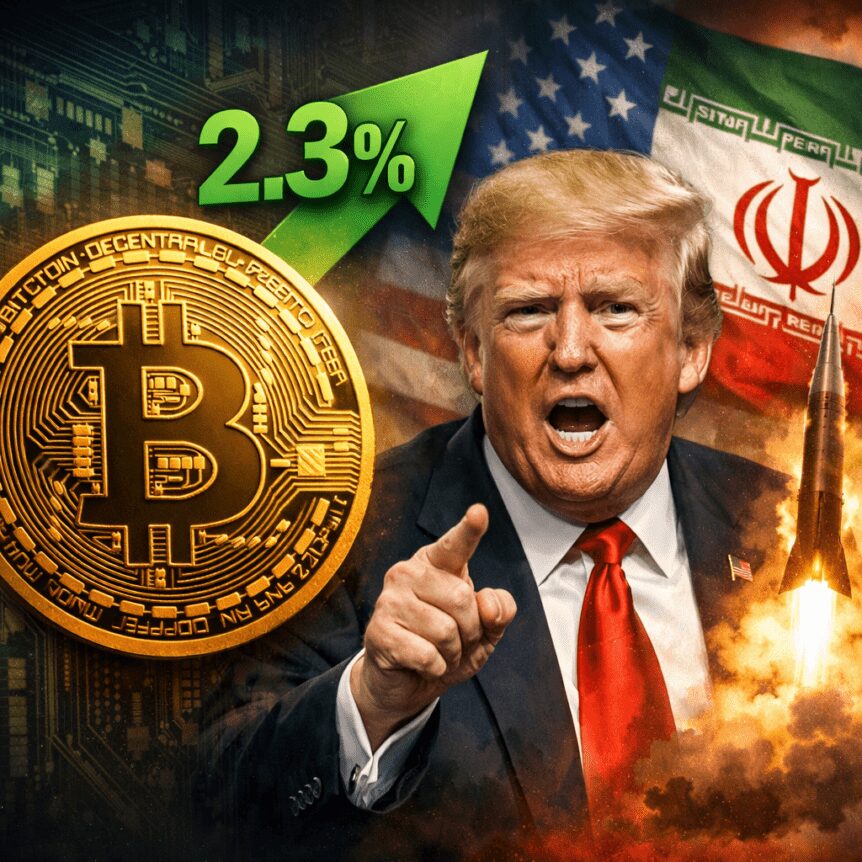
Bitcoin traded in a choppy session as geopolitical headlines dominated sentiment, with a dramatic swing after President Donald Trump rejected Iran’s counteroffer to a peace deal. The cryptocurrency briefly dipped below the 81,000 level before reclaiming ground and punching above 82,000 in a matter of hours.
Price data from CoinGecko show BTC slipping from around 81,430 to about 80,520 within 45 minutes, then rallying to a high near 82,347 less than three hours later. Derivatives data from Coinglass indicated roughly $64 million worth of short positions were liquidated in the four-hour window surrounding the move, underscoring the speed and sensitivity of markets to headlines. The broader backdrop remains a tense US-Iran dynamic, with oil prices advancing and U.S. stock futures nudging higher as the day progressed. Trump characterized Iran’s proposal as “totally unacceptable” in a Truth Social post addressing the offer.
The political flare-up sits atop a longer-running narrative around Middle East risk, the Strait of Hormuz, and the way macro forces translate into crypto and conventional assets. Oil prices rose about 4.6% to roughly $98.7 per barrel after Trump’s comments, while the S&P 500 futures index edged higher by about 0.13% in early trading. The headlines also intersect with regional instability and its potential to influence global risk sentiment, complicating an already nuanced environment for investors and traders in digital assets.
Key takeaways
- Bitcoin briefly dipped to around 80.5k and rebounded to about 82.3k within hours following Trump’s rejection of Iran’s counteroffer, showcasing BTC’s sensitivity to geopolitical headlines.
- About $64 million worth of short positions were wiped out in a four-hour window as the price moved higher, according to Coinglass data.
- Oil rose roughly 4.6% to near $98.7 per barrel, while U.S. equity futures showed modest gains, illustrating a broader risk-off/risk-on dynamic around the same headlines.
- Two potential catalysts in the U.S. Senate this week could inject regulatory clarity into the crypto sector: the confirmation vote for Kevin Warsh as Federal Reserve chair and the CLARITY Act markup.
- Bitcoin has climbed about 29.7% since the US-Iran conflict began on Feb. 28, outperforming the S&P 500 and gold over the same period, according to available market tallies.
Market pulse after headlines
The price action around BTC underscores how sensitive digital assets remain to real-time geopolitical developments. After a sharp downward move on the initial volley of headlines, Bitcoin’s bounce back above 82,000 signals persistent demand at the higher end of the trading range, even as risk sentiment flickers between caution and appetite for allocation in non-traditional assets. While some traders have continued to ride the volatility, others have used the volatility as an opportunity to adjust hedges or recalibrate risk exposure.
From a liquidity perspective, the short-covering burst highlighted in Coinglass’ data is notable: liquidations can amplify near-term moves as market participants recalibrate positions in response to headlines and evolving risk signals. In the same moment, the oil market’s reaction—the 4.6% jump to around $98.7 per barrel—reflects how macro shocks and geopolitical risk translate into both commodity and crypto markets, underscoring the interconnectedness of energy, equities, and digital assets.
Regulatory momentum could shape the Bitcoin roadmap
Beyond the immediate headlines, market observers say this week could mark an inflection point for regulatory clarity around digital assets in the United States. Markus Thielen, CEO of 10x Research, highlighted two upcoming Senate actions as potential catalysts that could “lean bullish” for Bitcoin by reducing institutional friction and smoothing the path for policy transitions.
“Two catalysts stand out this week: a Senate vote on Monday for Kevin Warsh’s confirmation as Federal Reserve chair and the Senate Banking Committee’s markup on the CLARITY Act on Thursday. Warsh is widely regarded as more hawkish on inflation than the current chair, Jerome Powell, but his confirmation could remove an overhang of uncertainty. The CLARITY Act represents what many in the industry view as the most significant crypto-legislation in years, potentially paving a clearer regulatory path for digital assets.”
Thielen’s view points to a broader narrative: regulatory clarity can lower the friction for institutional participation and foster a more predictable operating environment for crypto markets. In this framing, the two events could complement monetary policy dynamics, reducing policy uncertainty that often weighs on risk assets during leadership transitions and major legislative reviews.
Bitcoin’s resilience through the US-Iran conflict
Since the onset of the crisis — marked by events in late February that intensified after a U.S. airstrike targeted Iranian leadership figures — Bitcoin has advanced roughly 29.7%. That recovery places BTC ahead of the S&P 500 and gold over this span, suggesting that investors view digital assets as a potential hedge or diversification instrument even as traditional markets wrestle with geopolitical risk. The price trajectory adds a layer to a longer-running debate about Bitcoin’s role in macro risk-off or risk-on environments, and whether the asset can sustain a narrative of resilience during heightened tensions.
Looking back, Bitcoin’s volatility in response to geopolitical headlines is not a new phenomenon, but the current episode reinforces how macro shocks can intersect with sector-specific narratives around custody, liquidity, and regulatory clarity. If the regulatory tailwinds materialize in the coming weeks, the market could see a more stable path for institutional flows, potentially supporting a broader adoption arc for digital assets beyond a purely risk-on or speculative cycle.
As markets digest both diplomacy-focused headlines and policy signals, investors will be watching how the central bank’s leadership transition unfolds and what lawmakers deliver on crypto legislation. The coming days may reveal whether the combination of macro resilience and regulatory certainty can sustain Bitcoin’s momentum or whether volatility will reassert itself as geopolitical headlines evolve.
Readers should stay tuned for the next wave of regulatory updates and any fresh color on Fed leadership’s approach to inflation and market stability, as these factors will likely shape crypto volatility and institutional participation in the weeks ahead.


Digital Asset Holdings is reportedly raising about $300 million at a valuation near $2 billion, according to Bloomberg.
Summary
- Digital Asset’s reported $300 million round could become its largest funding raise to date.
- a16z crypto’s lead role points to rising venture interest in privacy-focused institutional blockchains.
- Canton Network’s recent Visa and DTCC links strengthen its pitch to regulated finance firms.
The round is said to be led by Andreessen Horowitz’s crypto arm, a16z crypto, and could close in the coming weeks.
The company is known for developing Canton Network, a blockchain built for financial institutions. Bloomberg cited people familiar with the matter, while Digital Asset and a16z crypto did not comment on the report.
Canton Network draws institutional attention
Canton Network is designed for tokenized assets, payments, and settlement activity where privacy is required. Its model allows institutions to share selected transaction data while keeping sensitive details private.
That privacy focus has helped Canton attract major financial names. Visa joined Canton Network as a Super Validator in March 2026 and added Canton to its stablecoin settlement pilot in April.
Additionally, the reported round would follow Digital Asset’s $135 million raise in June 2025. That funding was backed by DRW Venture Capital, Tradeweb Markets, Goldman Sachs, Citadel Securities, DTCC, and other financial firms.
Digital Asset also raised $50 million in December 2025 from investors including BNY Mellon, Nasdaq, S&P Global, and iCapital, according to prior reports. The new round would mark a larger vote of confidence in Canton’s role in institutional blockchain infrastructure.
DTCC and tokenized assets add context
The funding talks come as DTCC prepares to test tokenized securities activity. As previously reported, DTCC has said it plans to pilot tokenized versions of some assets it custodies, with testing expected in July and a wider launch targeted for October.
Canton has also gained links with Moody’s, Japan Securities Clearing Corporation, and Swiss crypto bank Amina. These moves show how Digital Asset is positioning Canton for regulated finance rather than retail crypto trading.
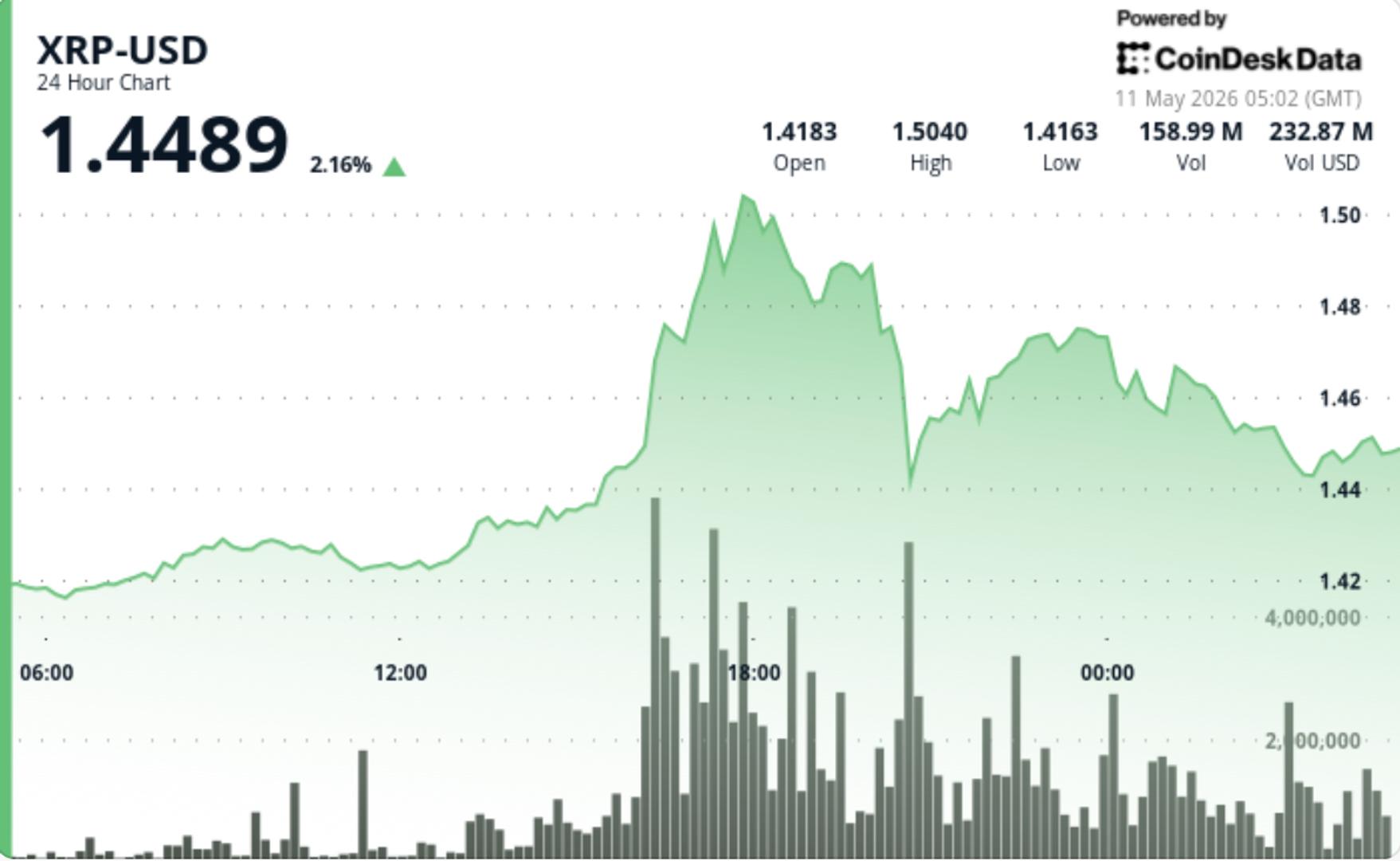
XRP finally forced its way through the $1.45 area that had capped rallies for weeks, and the move came fast. Volume arrived all at once during the breakout, which usually points to larger positioning rather than retail chasing, though the rally started losing momentum as price approached the psychological $1.50 level.
News Background
• Traders had been watching XRP’s tightening range for days as multiple analysts pointed to bull flag and triangle formations building beneath resistance.
• Thin liquidity conditions across major exchanges added to expectations that any confirmed breakout could produce exaggerated moves in either direction.
Price Action Summary
• XRP climbed from $1.4176 to $1.4524 during the 24-hour session, trading within a 6.5% range.
• The breakout accelerated during the May 10 16:00–17:00 window, when volume surged above 169M and pushed price through $1.4450.
• XRP later reached a session high of $1.5073 before pulling back toward the $1.45 area as traders locked in profits.
Technical Analysis
• The move above $1.45 matters because that level had repeatedly rejected upside attempts since April.
• Breakout volume was unusually strong, suggesting real participation behind the rally rather than a thin squeeze higher.
• Momentum cooled quickly near $1.50, where sellers stepped back in and triggered short-term liquidation pressure.
• Despite the pullback, XRP is still holding above the prior breakout zone, keeping the broader bullish structure intact for now.
What traders should watch
• $1.44-$1.45 is now the key support area. Holding above it keeps the breakout structure alive.
• $1.50 remains the immediate resistance level after the sharp rejection from session highs.
• A sustained move above $1.50 could reopen momentum toward $1.56 and potentially the $1.80 area highlighted by several analysts.
• Failure back below $1.44 would increase the risk of a retracement toward the $1.38-$1.40 range.
A crypto whale, Garrett Jin, has transferred $1.35 billion in Ethereum (ETH) to Binance, sparking concerns of a sell-off amid swelling exchange reserves.
The deposits, tracked by Lookonchain, coincide with institutional outflows and exchange inflow spikes that have pushed Binance’s ETH holdings to nearly a quarter of the centralized supply.
Whale Sends $1.35 Billion in ETH to Binance Over Just 4 Days
Lookonchain data shows Jin moved the entire 577,896 ETH position to Binance over four days. Most of these tokens were swapped from Bitcoin (BTC) eight months ago. At the time, the second-largest cryptocurrency was trading around $4,591.
“He is now down ~$1.3 billion,” the post added.
Meanwhile, asset managers added to the pressure. BlackRock and Fidelity sent more than 35,000 ETH into Coinbase Prime last week.
Follow us on X to get the latest news as it happens
While transfers to exchanges do not always indicate imminent selling, they often raise market concerns about potential liquidation pressure.
The pattern among large holders has added to these concerns. An analyst flagged a series of hourly spikes in Ethereum inflows on Binance in May.
The analyst noted that Binance now holds around 3.62 million ETH, accounting for roughly 24.6% of all centralized exchange ETH supply.
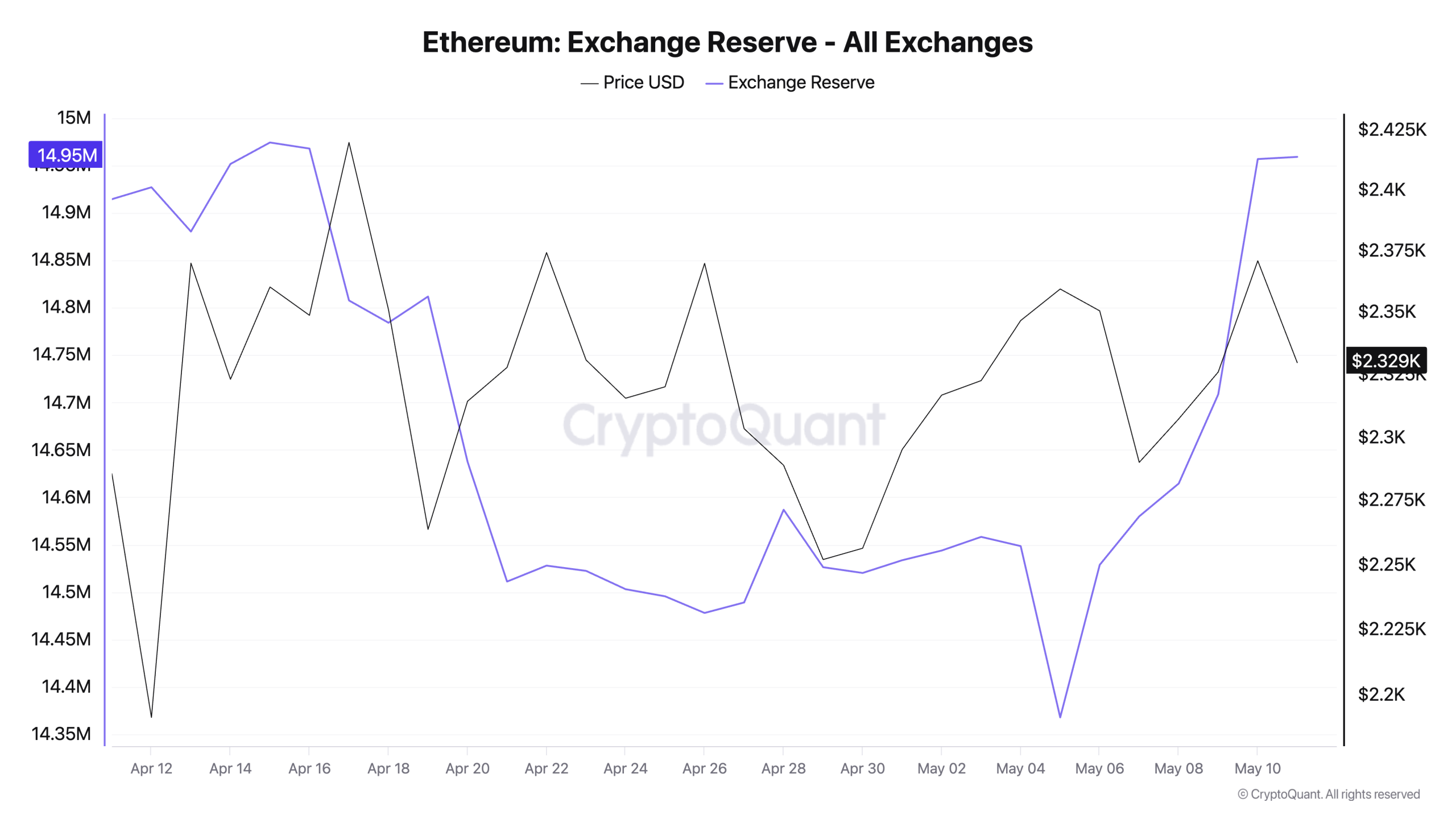
According to CryptoQuant data, total exchange reserves have also climbed from 14.36 million ETH on May 5 to 14.95 million ETH.

Whether these deposits become outright sales remains to be seen. Whales sometimes move funds for collateral or liquidity management rather than immediate disposal.
Still, the convergence of whale activity and rising reserves leaves a heavier supply overhang.
Subscribe to our YouTube channel to watch leaders and journalists provide expert insights
The post Ethereum Faces Sell-Off Risk as Whale Moves $1.35 Billion in ETH to Binance appeared first on BeInCrypto.

After Wemby’s ejection, Spurs coach calls out refs for how star center is officiated

Morgan Stanley’s MSBT avoids outflows through the first month of trading

OnePlus Nord CE 6 Series Arrives in India: Price, Features, Availability

Manchester United reach agreement with Casemiro over contract clause amid transfer speculation

US brings back mandatory military draft registration

Steven Gerrard disagrees with Gary Neville over ‘shock’ Chelsea and Arsenal claim | Football


-
 Crypto World3 days ago
HarrisX Poll Found 52% of Registered Voters Support the CLARITY Act
-

 Crypto World4 days ago
Upbit adds B3 Korean won pair as Base token gains Korea access
-

 Fashion3 days ago
Weekend Open Thread: Marianne Dress
-

 Tech6 days ago
Image AI models now drive app growth, beating chatbot upgrades
-
 NewsBeat4 days ago
NCP car park operator enters administration putting 340 UK sites at risk of closure
-
 Business2 days ago
Ignore market noise, India’s long-term story intact, say D-Street bulls Ramesh Damani and Sunil Singhania
-

 Politics2 days ago
Politics Home Article | Starmer Enters The Danger Zone
-
 Sports7 days ago
2026 NHL playoff picks: Second-round predictions, series odds, Stanley Cup bracket
-

 Crypto World6 days ago
UAE Free Zone Deploys Blockchain IDs to Verify Registered Firms
-

 Crypto World5 days ago
BlackRock CEO Larry Fink Discusses a New Asset Class
-

 Crypto World4 days ago
Robinhood says Wall Street is building onchain
-

 Tech5 days ago
Apple and Samsung are dominating smartphone sales so thoroughly that only one other company makes the top 10
-
Entertainment6 days ago
Serena Williams hits Met Gala in metallic dress after GLP-1 reveal
-

 Politics6 days ago
Met Gala 2026: Madonna’s Dramatic Red Carpet Look Steals The Show
-

 Fashion4 days ago
The Best Work Pants for Women in 2026
-
 Sports7 days ago
Hearts v Rangers LIVE: Prediction, team news and line-ups as Scottish Premiership title rivals meet at Tynecastle
-

 Entertainment7 days ago
Skai Jackson Responds To AI Baklash After Viral Snapchat Photos
-

 Tech5 days ago
I tested the Xiaomi 17 Ultra’s camera and I don’t think I’ll ever go back to an iPhone
-
Crypto World4 days ago
The FOMO Is Back: Why Bitcoin’s Latest Rally Has Analysts Flashing Warning Signs
-
 Tech4 days ago
AI agents are missing all the discussions your team is having. SageOX has an answer: agentic context infrastructure
You must be logged in to post a comment Login