

Crypto World
As Nikkei Bleeds, Kioxia’s Boom-to-Bust Highlights Dangers of This AI Cycle

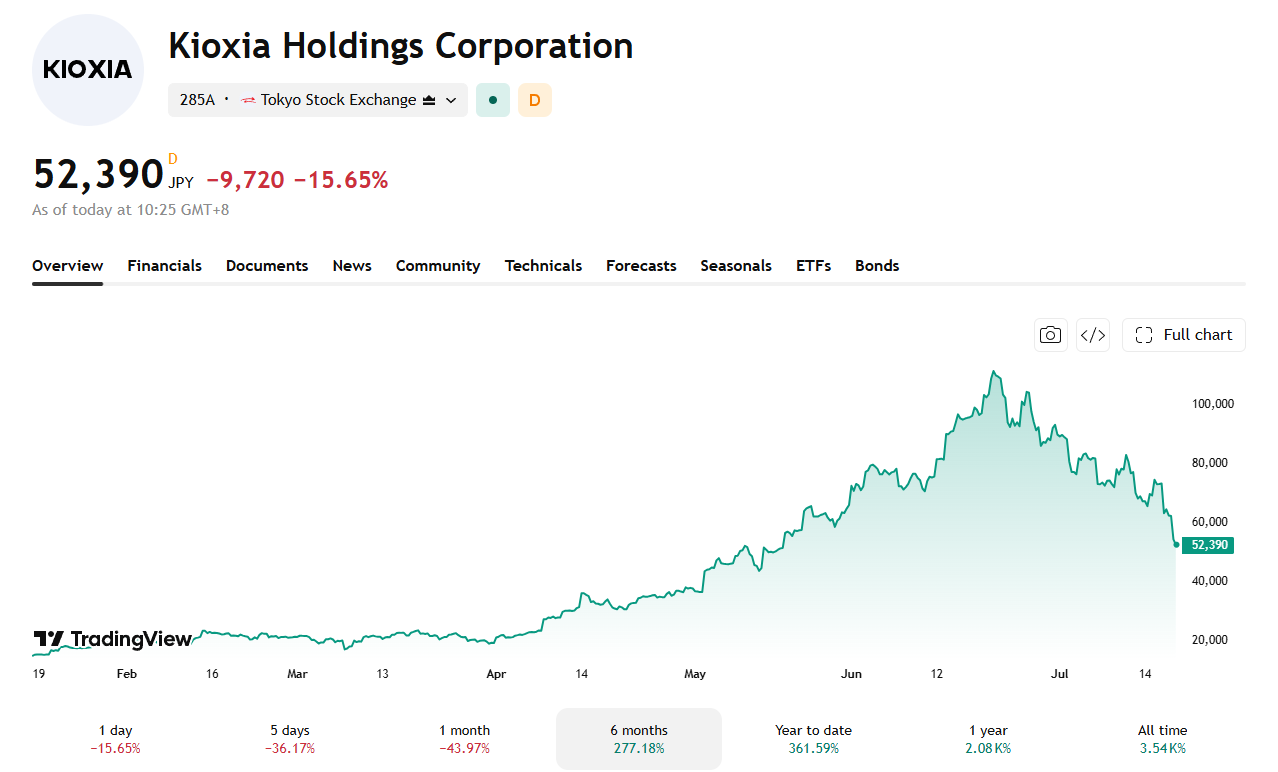
Japan’s Nikkei 225 sank as much as 4.4% on Friday, July 17, leading a broad Asian tech selloff. Investors dumped chip stocks tied to the artificial intelligence boom. The index fell to 63,896.48, extending losses from earlier in the week.
Chip-equipment maker Advantest and tech investor SoftBank each lost around nine percent. Taiwan’s Taiex shed four percent as TSMC retreated more than three percent, even after posting record quarterly profit. However, the big story for Japanese stocks is Kioxia
Kioxia’s Reversal
Kioxia, the memory chipmaker plunged near 16% on Friday alone. That extends a slide that has erased 44% of its value in a single month.

A rally of more than 600% since January pushed Kioxia briefly past Toyota to become Japan’s most valuable company in mid-June. It has since dropped to fourth place. The slide has wiped out roughly ¥30 trillion, or $185 billion, in market value.
Daiwa Securities chief strategist Yugo Tsuboi said the chip sector remains prone to boom-bust cycles.
“The chip sector is vulnerable to the silicon cycle, and we’ve seen this pattern many times before.”
Tsuboi pointed to rising scrutiny of Chinese memory chipmakers as one factor. He also noted signs that global memory prices may be stabilizing, which makes further earnings upgrades harder to justify.
Cracks Beneath the Rally
Other factors are adding to the pressure that Kioxia has faced in the relative short term. Last week, Bain Capital exited its entire position in the memory chipmaker. Many investors saw that as a signal that the chip cycle is peaking. Japanese retail traders also hold heavy leveraged positions, which leaves the stock exposed if selling accelerates.
Kioxia only listed in 2024. Since then, its shares became the best performer on the MSCI World Index before this month’s reversal.
Despite the collapse, analysts still forecast roughly a 118% return for Kioxia over the next 12 months. The Topix index’s October reshuffle should also draw fresh passive fund inflows into the stock.
A Warning for the Wider AI Trade
Kioxia’s reversal mirrors a broader repricing across the sector. A Wall Street gauge of chip stocks slumped more than four percent Thursday and concerns over TSMC’s AI spending overshadowed an otherwise solid earnings outlook.
Traders have grown more skeptical of the AI trade in recent months. They are rotating out of richly valued chip names and into sectors that have lagged. The episode follows a similar pattern to Japan’s broader AI selloff earlier this month.
The Nikkei has shed trillions of yen in value over three weeks.
The post As Nikkei Bleeds, Kioxia’s Boom-to-Bust Highlights Dangers of This AI Cycle appeared first on BeInCrypto.

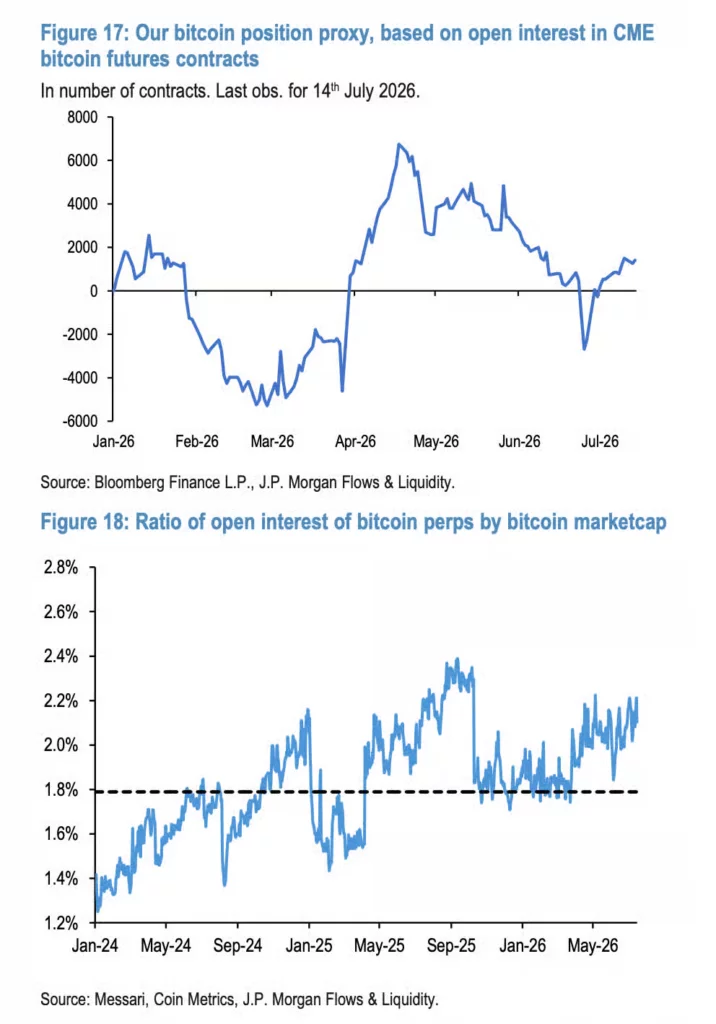
Strategy has strengthened its cash position to $3 billion as JPMorgan has identified the move alongside steady bitcoin futures inflows as positive developments for Bitcoin despite continued volatility in spot ETF demand.
Summary
- JPMorgan said Strategy’s larger cash reserves and steady bitcoin futures inflows support the Bitcoin outlook despite uneven spot ETF flows.
- Strategy increased its dollar reserves to $3 billion, enough to cover about 20 months of preferred dividend payments.
- Institutional demand stayed firm in bitcoin futures even as spot Bitcoin ETFs recorded fresh outflows.
JPMorgan said in a Wednesday research note that Strategy’s larger U.S. dollar reserves and continued inflows into bitcoin futures have offered encouraging signs for Bitcoin even as spot bitcoin exchange-traded fund flows have turned inconsistent in recent weeks.
The bank said spot Bitcoin ETFs recorded inflows last week before reversing into outflows this week. In contrast, leveraged ETFs linked to Strategy continued attracting positive inflows for a seventh straight week, a trend JPMorgan attributed largely to retail investors.
According to the report, those purchases have supported Strategy’s share price and helped prevent its common stock from trading below the net asset value of the company’s Bitcoin holdings.
Strategy has also increased its cash reserves from $2.55 billion to $3 billion, enough to cover roughly 20 months of dividend payments on its preferred shares. JPMorgan said the larger reserve reduces concerns that the company could eventually need to sell Bitcoin to meet those obligations.
The bank had previously argued that building enough cash to fund two to three years of preferred dividends would ease worries about forced Bitcoin sales. While the analysts said it remains difficult to determine whether the latest cash increase has directly improved investor sentiment, they described the reserve build-up as another constructive signal for Bitcoin.
Bitcoin futures stay firm as ETF flows fluctuate
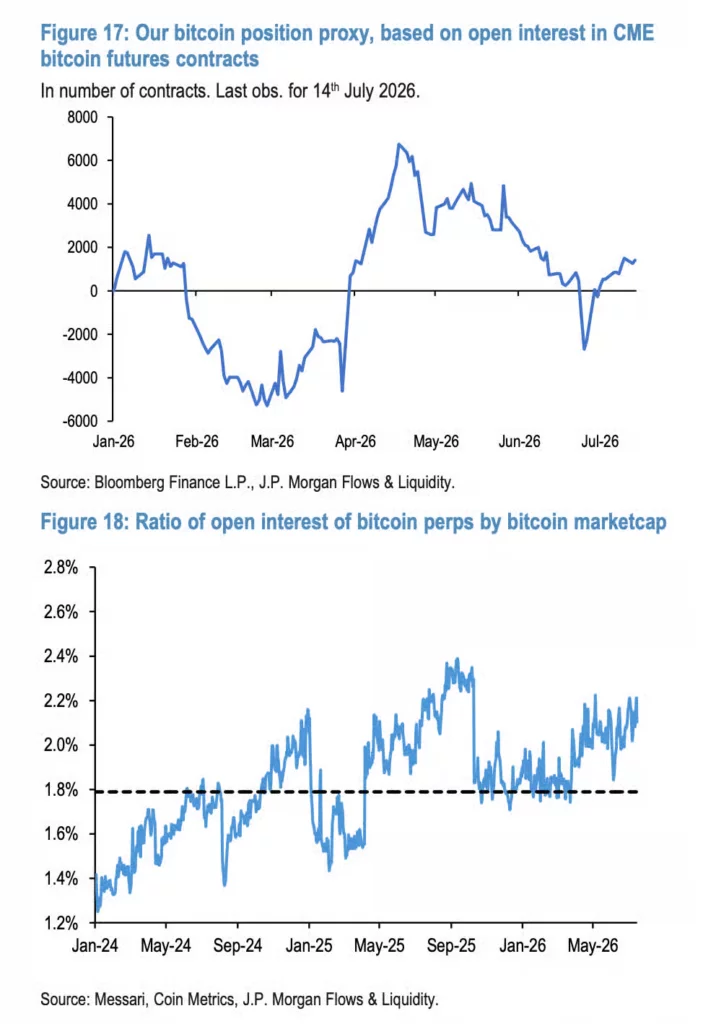
Alongside the stronger balance sheet, JPMorgan found it encouraging that bitcoin futures continued attracting positive flows this week despite withdrawals from spot Bitcoin ETFs.
The report said buying activity remained positive across both Chicago Mercantile Exchange Bitcoin futures and perpetual futures, markets that JPMorgan considers more representative of institutional participation than retail trading.
The divergence comes as derivatives markets continue to show measured positioning rather than aggressive directional bets. As crypto.news reported on July 17, roughly $1.43 billion worth of Bitcoin and Ethereum options expired with Bitcoin’s put-call ratio at 0.9 and a maximum pain level of $63,000, while Bitcoin remained largely confined to the $60,000-$65,000 range that has held for more than a month.
Greeks.live said Bitcoin gamma exposure remained concentrated around the $64,000 and $70,000 strike prices, indicating traders continue watching those levels for signs of the next larger move. The firm also noted that the latest weekly expiry represented only about 5% of total open interest, limiting the likelihood of a major spot-market reaction.
Earlier this month, JPMorgan said Strategy is not the primary structural risk facing Bitcoin. Instead, the bank argued that broader adoption of permissioned blockchain systems, which operate without relying on public blockchain tokens, could pose a more significant long-term challenge to the digital asset ecosystem.
Strategy, meanwhile, has reaffirmed its commitment to expanding its Bitcoin holdings. President and Chief Executive Officer Phong Le said earlier this week that the company intends to remain Bitcoin’s largest buyer for the foreseeable future and has no plans to change its long-term accumulation strategy.
Le also said Strategy’s balance sheet remains secure and that debt-related risks would only become a consideration if Bitcoin were to fall to around $8,000 to $10,000. He added that the company plans to issue additional STRC preferred shares once they return to their $100 par value, with proceeds potentially allocated to further Bitcoin purchases and additional cash reserves.
Bitcoin was trading near $64,250 at the time of writing, down about 1% over the previous 24 hours.

[PRESS RELEASE – Willemstad, Curaçao, July 17th, 2026]
Cryptocurrency has become one of the fastest-growing categories within prediction markets, as traders and investors increasingly look beyond price charts to speculate on major industry milestones.
Reflecting this trend, international betting brand 1win has expanded its Markets product with a series of new cryptocurrency prediction markets covering some of the sector’s most closely watched digital assets.
The new crypto-themed forecasts on 1win Markets allow users to speculate on topics, including
- What price will HYPE reach by the end of 2026?
- Will HYPE surpass Solana (SOL) in market capitalization before December 31, 2026?
- What price will XRP reach in 2026?
- What price will Dogecoin (DOGE) reach by the end of the year?
“Crypto-related forecasts are becoming a natural extension of prediction markets, giving users another way to engage with some of the biggest narratives in the crypto industry. Though on 1win Markets, we have made it an interactive and easy-to-understand format,” says Mike Danshin, CMO 1win Crypto.
1win Markets uses a simple binary format. Instead of selecting from complex betting lines, users answer straightforward “Yes” or “No” questions or choose between clearly defined outcomes. It is a fun and interactive way to think about life events, even for those unfamiliar with classic betting.
This crypto-focused expansion on 1win Markets reflects the growing convergence between crypto communities and binary predictions. Users are increasingly interested in predicting not only sports or political outcomes but also changes across the digital asset industry.
By adding cryptocurrency-focused markets alongside existing categories – sports, politics, technology, entertainment, and global events – 1win continues to broaden the scope of its crypto-driven ecosystem.
About 1win
Founded in 2016, 1win is a crypto entertainment platform in the global gaming industry. Operating across Asia, Latin America, and Africa, 1win offers a wide range of entertainment products adapted to regional audiences. The brand has active collaborations with international public figures, including football legend Luis Suarez, martial artist Jon Jones, and Olympic champion and UFC fighter Gable Steveson. In 2026, 1win welcomed rapper Tyga and UFC legend Ilia Topuria as new members of the 1win VIP community. Football legend Luis Suarez will be the official 1win football expert throughout the 2026 FIFA World Cup.
The post 1win Expands Its Prediction Markets with Crypto Forecasts appeared first on CryptoPotato.


Circle has integrated its Gateway and Circle Payments Network with Fireblocks, giving institutional customers new ways to manage USDC across blockchains and settle cross-border payments.
Summary
- Circle and Fireblocks integrate Gateway and CPN, giving institutions USDC settlement across multiple blockchain networks.
- Fireblocks customers can use unified USDC balances and send local fiat payouts across 50-plus countries.
- Stablecoins account for 69% of Fireblocks transaction volume, showing growing institutional demand for digital settlement.
The services are now available directly through Fireblocks’ existing infrastructure, including its transaction controls, approval systems and audit records.
The integration targets trading firms, neobanks and payments companies that use stablecoins for treasury operations and international settlement. According to Fireblocks, stablecoins accounted for 69% of all digital asset transaction volume on its platform during the second quarter of 2026. The company also said USDC became its leading stablecoin earlier this year.
Circle Gateway allows institutions to maintain one virtual USDC balance across supported networks instead of keeping separate pools on each blockchain. Funds can move to supported chains when required, while incoming USDC can automatically return to the unified balance. Fireblocks said the system also reduces the need to hold separate gas tokens for destination networks.
Circle Payments Network connects USDC with local fiat payouts
The second part of the integration brings Circle Payments Network, or CPN, into the Fireblocks Network for Payments. Customers can send USDC and route payments to recipients who receive local fiat currency through supported providers in more than 50 countries. The companies said settlement can take minutes rather than relying on multi-day correspondent banking processes.
Meanwhile, Fireblocks will apply its existing policy controls to Gateway transfers and CPN payouts. These include transaction approvals, counterparty lists, sanctions screening and Travel Rule processes. The aim is to let institutions use stablecoin payment rails without building a separate control system for each network or payment corridor.
The rollout builds on a partnership Circle and Fireblocks announced in September 2025. At the time, the companies said Fireblocks customers would gain access to Circle products, including Gateway and CPN, as financial institutions increased their use of stablecoins for payments and treasury operations.
As crypto.news previously reported, Circle expanded CPN in April with Managed Payments, a service designed to let banks and fintech companies use USDC-based settlement without directly managing digital assets or blockchain infrastructure. That service handles parts of the stablecoin process while participating institutions continue sending and receiving fiat currency.
Moreover, Circle added Nium to CPN in May, connecting USDC settlement with payout infrastructure spanning more than 190 countries and 100 currencies. The Fireblocks integration now adds another institutional access point to the network.
Fireblocks said stablecoin transaction volume reached $33 trillion across the wider market in 2025, up 72% year over year. With Gateway and CPN now available inside its platform, customers can manage cross-chain USDC liquidity and fiat payouts under the same operating and compliance controls they already use for other digital asset transactions.

Bitcoin Ordinals advocate Leonidas has proposed building an alternative open-source Bitcoin client designed to loosen specific protocol and relay constraints that, according to its creator, have limited certain “Runes” and “Ordinals” transaction patterns on the network.
In a post on X on Friday, Leonidas outlined what he calls “Bitcoin $DOG Mode,” arguing it would reduce barriers for sending inscriptions and Runes while challenging long-standing default settings used by widely deployed Bitcoin software.
Key takeaways
- Leonidas’ proposed “Bitcoin $DOG Mode” would raise the maximum individual transaction size to 3.9 million weight units (WU), versus Bitcoin Core’s 400,000 WU.
- The client would lower the dust limit to 1 satoshi, from Bitcoin Core’s commonly cited range of 294–546 sats, changing how small outputs can be handled economically.
- Supporters say these changes would make it easier to batch larger Ordinals inscriptions and Runes into single transactions, while critics have called such activity “spam.”
- Leonidas positions the proposal as an alternative to Bitcoin Core and Bitcoin Knots, aiming to force broader policy reconsideration through user adoption.
What Leonidas wants to change
Leonidas’ proposal centers on two rules he says are unnecessarily restrictive relative to what he views as Bitcoin’s intent. First, he targets the maximum size of an individual transaction. In his description, “Bitcoin $DOG Mode” would allow transactions up to 3.9 million WU, compared with Bitcoin Core’s 400,000 WU setting.
Second, he proposes reducing the dust limit to 1 satoshi. Leonidas frames this as a way to eliminate the need for users to pad outputs—an issue associated with whether certain tiny outputs remain economical to include and whether nodes relay them under default policies.
In the same post, Leonidas argued that these adjustments would directly improve usability for projects built around inscriptions and token-like transfers on Bitcoin, including Ordinals and Runes, which have been debated within the broader Bitcoin community.
Why transaction size and dust limits matter
For Ordinals and Runes, the practical challenge is often not just whether the network can technically include data or outputs, but whether standard relay and policy behaviors make certain transaction constructions inconvenient or difficult to broadcast.
Leonidas’ proposed higher transaction size limit would be particularly relevant for users who want to bundle much larger pieces of content into one transaction. The larger the single transaction the client permits, the more data can be placed into one on-chain action—potentially even nearing the capacity of an entire block.
On the relay side, lowering the dust limit is meant to change the economics and mechanics of outputs. Dust limits define the smallest output amounts that can be sent economically, typically tied to whether the network and default node software treat those outputs as non-viable or non-relayable. By pushing the dust threshold down to 1 satoshi, Leonidas suggests users would no longer have to add extra value to make transactions acceptable to default Bitcoin Core nodes.
“Rules that Bitcoin itself does not have,” Leonidas says
Leonidas’ argument is explicitly political as well as technical. He claims that Bitcoin Core and Bitcoin Knots—two of the most commonly used Bitcoin clients—have “spent years enforcing rules that Bitcoin itself does not have,” positioning his $DOG Mode as a corrective.
According to Leonidas, the initiative is not just about supporting Ordinals and Runes, but about removing what he characterizes as “permission” requirements imposed by mainstream software operators and maintainers. He casts the effort as a bid to widen the set of acceptable transaction behaviors without needing users to seek approval through existing default implementations.
While Ordinals and Runes are often described as Bitcoin’s approach to non-fungible and fungible token concepts, the methods have remained controversial. Critics have argued that large-scale inscription or runes-related activity resembles network “spam” and may degrade overall usefulness or impose additional burdens. Leonidas’ proposal directly targets the infrastructure choices that enable or limit such activity, turning a community debate into an engineering proposal.
A strategy to pressure Bitcoin Core policy
Leonidas said “Bitcoin $DOG Mode” is intended to operate as an alternative to Bitcoin Core and Bitcoin Knots. His stated goal goes beyond shipping a fork-like client: he wants to attract enough users that Bitcoin Core would eventually face pressure to loosen its own restrictions.
This approach matters because Bitcoin Core’s policy and configuration choices influence what transactions are easiest to propagate through the network, particularly for nodes using default settings. A competing client with meaningfully different limits could shift practical behavior: if more users and services adopt it, standard assumptions about what transactions can be relayed efficiently might change.
At the same time, the proposal raises questions readers may want to watch closely—especially around where boundaries would end. If larger transaction sizes and lower dust limits become widely used, it could lead to new tradeoffs involving bandwidth, verification workload, and network-level resource consumption. Leonidas’ plan also depends on adoption: without broad usage, Bitcoin Core’s policies may remain unchanged.
Next, investors and builders watching Bitcoin’s on-chain asset ecosystem should pay attention to whether $DOG Mode attracts real-world adoption and how the proposal is received by other parts of the Bitcoin software ecosystem, particularly around relay behavior and policy settings that affect everyday transaction broadcasting.


Airbnb CEO Brian Chesky has confirmed that hackers compromised his X account earlier this week after the profile published a lengthy thread about blockchain-based real-world asset tokenization.
Summary
- Brian Chesky confirmed his X account was hacked after it posted a crypto tokenization thread.
- Airbnb treated the incident as a high-profile compromise and worked with X to secure access.
- The deleted posts praised asset tokenization, prompting questions because they did not promote scams directly.
The posts later disappeared, and Chesky has now responded with a joke about the unexpected audience the incident brought to his account.
In a July 17 post on X, Chesky wrote, “To the person who hacked my account earlier this week: thanks for all the new crypto followers.” He then added, “To my new crypto followers: I’m going to be a very disappointing follow.” His statement confirmed that the earlier tokenization posts did not represent commentary he intended to publish.
Chesky confirms hack after unusual tokenization thread
The deleted thread attracted attention because it presented detailed arguments about tokenized real-world assets rather than promoting Airbnb’s core business. It discussed blockchain-based ownership and financial markets in a way that initially led some observers and publications to treat the posts as genuine comments from the Airbnb chief.
According to Fortune’s report on the incident, Airbnb treated the episode as a high-profile account compromise and moved to secure the profile with X. However, the nature of the posts caused confusion because the thread focused on tokenization rather than pushing a meme coin, fake presale or cryptocurrency giveaway.
The episode differs from many recent social media hacks linked directly to token schemes. As crypto.news reported this week, attackers also compromised SpaceX’s X presence in an incident linked to the SCATMAN token, renewing concerns about criminals using trusted brands to attract crypto traders.
Earlier, as crypto.news reported in May, hackers used Keith Gill’s verified Roaring Kitty account to promote and dump a Solana-based token. The incident reportedly left traders with $2.8 million in losses after users trusted posts coming from the well-known market personality’s account.
By contrast, available reports have not identified a token sale, wallet-draining link or fraudulent giveaway connected to Chesky’s deleted posts. Instead, the compromised account published commentary that users could have mistaken for a genuine shift in the Airbnb CEO’s public position on crypto. That makes the episode different from attacks built around immediate token promotion.
High-profile X profiles remain attractive targets because their established audiences can give unfamiliar crypto claims instant credibility. As previously reported by crypto.news, attackers have compromised accounts belonging to executives, companies, entertainers and market personalities to promote fraudulent tokens, fake airdrops and phishing links.


Bitcoin and Ethereum options worth about $1.43 billion expired on July 17 as crypto markets remained within established trading ranges.
Summary
- Bitcoin options worth $1.2 billion expired as BTC remained inside its month-long trading range Friday.
- Ethereum’s 1.61 put-call ratio showed persistent demand for puts as traders remained sharply divided Friday.
- Greeks.live said bullish block trades increased, while overall options activity stayed muted amid low volatility.
According to Greeks.live data, 19,000 Bitcoin options worth $1.2 billion expired with a put-call ratio of 0.9 and a maximum pain point of $63,000.
Meanwhile, 123,000 Ethereum options worth $230 million expired with a put-call ratio of 1.61. The maximum pain level stood at $1,800. The elevated ratio showed that put positions continued to outweigh calls, extending a trend that Greeks.live said has lasted for about a month.
Bitcoin remained above $60,000 during the week and has traded mainly between $60,000 and $65,000 for more than a month. Despite sharp moves in parts of the U.S. stock market, crypto volatility remained relatively subdued. The latest weekly expiry represented only about 5% of outstanding options, while open interest declined slightly amid fewer short-term trading opportunities.
Ethereum options show deeper divide as Bitcoin volatility stays low
Greeks.live said Bitcoin gamma exposure remained concentrated around the $64,000 and $70,000 strikes. Ethereum’s exposure was more widely spread between $1,825 and $2,000 as some traders used shallow out-of-the-money options to position for a possible rebound. The firm also said large bullish trades increased, led mainly by short-term bull spreads.
However, Ethereum’s put-call ratio continued to show strong demand for downside positions. “The proportion of put options has exceeded 1 for a consecutive month and continues to rise,” Greeks.live said, describing the current positioning as unusually divided between bullish and bearish traders.
The latest expiry follows several weeks of cautious derivatives positioning. As previously reported by crypto.news, Bitcoin and Ethereum options worth about $1.75 billion expired on July 10, with Bitcoin’s maximum pain level at $62,000 and Ethereum’s put-call ratio at 1.26.
A week earlier, $1.9 billion in Bitcoin options expired while traders continued to watch the $60,000 area. Ethereum already showed heavier demand for downside protection at that time, with its put-call ratio standing at 1.29.
The July 17 expiry was smaller than major monthly and quarterly settlements, reducing the likelihood that the event alone would drive a large spot-market move. Still, Bitcoin traded close to its $63,000 maximum pain level, while Ethereum’s growing put exposure showed that traders remained divided over its near-term direction.
Greeks.live said overall market activity remained subdued despite the increase in bullish block trades. With Bitcoin still locked inside its month-long range, traders continue to watch the $64,000 and $70,000 options concentrations for signs of the next broader move.
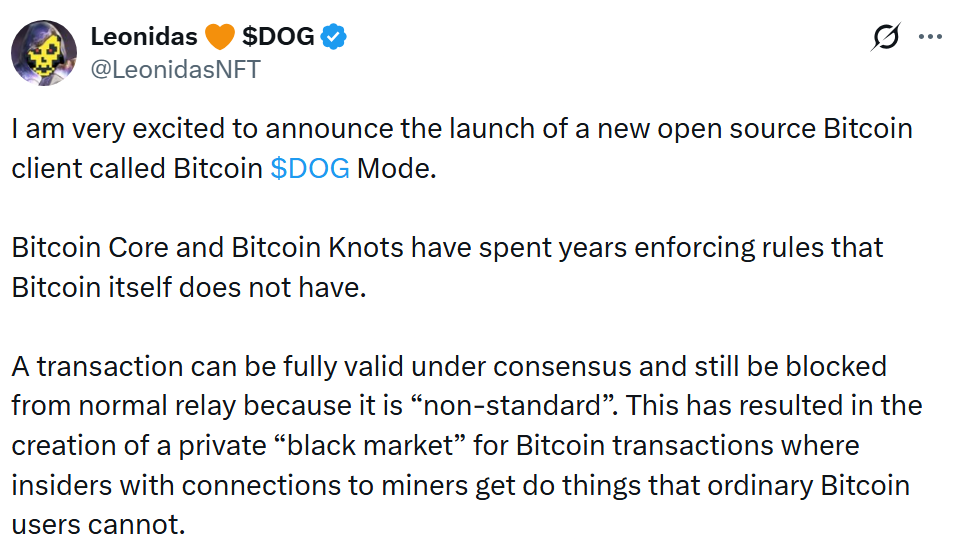
Bitcoin Ordinals advocate Leonidas has proposed developing a new open-source Bitcoin client, aimed at removing restrictions affecting Runes and Ordinals transactions.
In a post to X on Friday, Leonidas called the proposed client “Bitcoin $DOG Mode,” which would lift the maximum individual transaction size to 3.9 million weight units (WU), compared to Bitcoin Core’s 400,000 WU, and lower the dust limit to 1 satoshi (sats) from 294-546 sats.
The changes would make it easier to send Ordinals inscriptions and Runes, which have been described as Bitcoin’s take on fungible and non-fungible tokens. Both have been controversial within the Bitcoin community, with critics arguing they amount to “spam” on the Bitcoin network.
“Bitcoin Core and Bitcoin Knots have spent years enforcing rules that Bitcoin itself does not have,” Leonidas said in a statement. “The $DOG Army is done asking for permission. It is time to remove even more of these frivolous restrictions.”
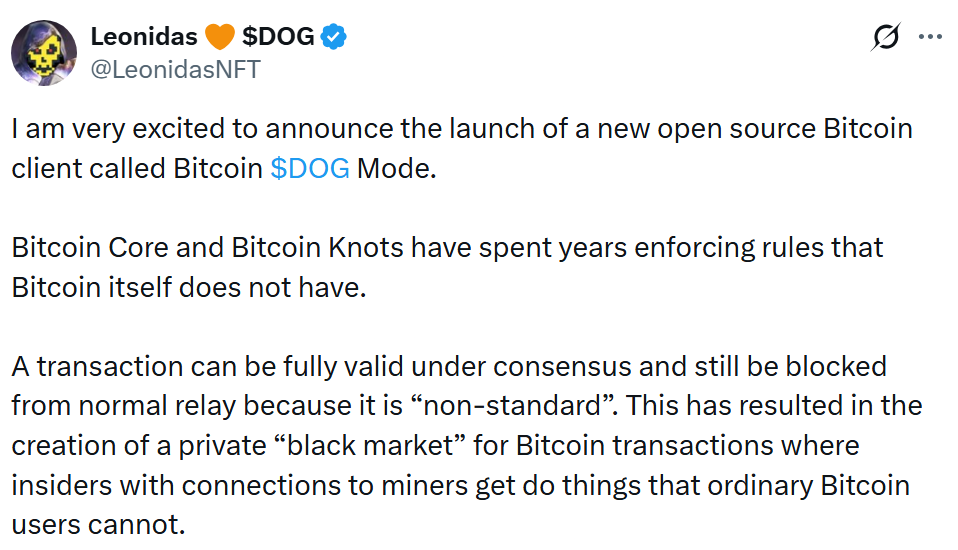
Source: Leonidas
Increasing the maximum transaction size would make it easier for Ordinals users to place much larger files or collections into one transaction, even ones that take up nearly an entire block.
Meanwhile, the dust limit is a rule on the Bitcoin network defining the smallest transaction amount, or UTXO, that can be economically sent. Lowering the dust limit would stop users from having to “pad” outputs to get their transaction broadcast on default Bitcoin Core nodes.
Related: Bitcoin bulls Michael Saylor, Adam Back slam BIP-110 Ordinals proposal
Bitcoin $DOG Mode would be an alternative to Bitcoin Core and Bitcoin Knots, the two most widely used Bitcoin clients.
Leonidas said the goal is to attract enough users to the new client that Bitcoin Core would eventually have to loosen its own policy restrictions.
Magazine: Bitcoin nearing late stages of bear market: Jamie Coutts, Real Vision


MegaETH is shutting down its Mega Mafia accelerator after two years, saying the program helped startups raise substantial capital but failed to keep enough value inside its ecosystem.
Summary
- MegaETH ends Mega Mafia after most successful incubated applications stopped building on its blockchain network.
- Two accelerator cohorts supported about 20 teams that collectively raised approximately $80 million from investors.
- MegaETH will redirect funding toward first-party consumer apps and products designed specifically for its infrastructure.
Core team member Shuyao Kong said on X that most successful applications backed by the program are no longer being built on MegaETH.
The accelerator supported about 20 teams across two cohorts, which collectively raised roughly $80 million from pre-seed through Series A rounds. MegaETH selected teams to work closely with its core developers and provided technical, management and market-making support. However, the network did not take equity, governance rights or ownership positions in the projects it helped build.
MegaETH shifts resources toward first-party applications
Kong said MegaETH originally believed founders would remain aligned with the network without formal ownership arrangements. That approach produced successful startups, but many later chose different technical paths. “Very little of that value has trickled to Mega,” she wrote, while announcing that there will be no Mega Mafia 3.0 cohort.
Several projects show how that model changed. Global Token Exchange, or GTE, decided to build its own chain after participating in the first accelerator cohort.
Social attention market Noise later chose Base, while HelloTrade moved toward Monad. Meanwhile, stablecoin project Cap launched on MegaETH but has pursued a broader multichain strategy.
The decision comes only months after Mega Mafia applications helped MegaETH reach a key network milestone.MegaETH launched its MEGA token on April 30 after 10 ecosystem applications met the first performance target required to trigger the token generation event. The milestone tied the accelerator directly to the network’s early growth strategy.
MegaETH has since expanded the economic systems around its blockchain. As crypto.news reported in May, the MegaETH Foundation started a MEGA token buyback program funded by net income generated by the USDm stablecoin issuer. The structure connects stablecoin activity with recurring token purchases as MegaETH develops high-speed onchain applications.
However, ending Mega Mafia changes how the team plans to build future demand. Kong said MegaETH will focus resources on “OMEGA” applications, meaning products designed around capabilities that the team believes are specific to MegaETH. The network also plans to invest more directly in first-party consumer applications.
Under the new approach, MegaETH expects to build direct relationships with users instead of depending mainly on independent startups to create products and eventually return value to the network. Kong said first-party development would also give the team greater responsibility for product results.
The change comes after Mega Mafia played a central role in MegaETH’s move from development into mainnet activity and its MEGA token launch. The network is now testing whether building more consumer-facing products itself can keep users, activity and economic value closer to its core ecosystem.


While BIP 110 wants to restrict data through a consensus change and has almost no miner support, a new DOG Mode client wants the opposite and requires no vote at all.

Crypto trader Ansem has questioned whether token buybacks can create lasting value on their own, pointing to the wide valuation gap between Hyperliquid’s HYPE and Pump.fun’s PUMP.
Summary
- Ansem argues recurring token buybacks cannot overcome weak community trust or poor alignment with users.
- HYPE trades at a far richer valuation than PUMP despite both platforms using profit-funded buybacks.
- Pump.fun’s delayed airdrop remains central to Ansem’s view that PUMP lacks Hyperliquid’s trust premium.
In a July 17 X post, he argued that both businesses generate large revenues and regularly repurchase their tokens, yet the market values them very differently.
According to Ansem’s figures, Hyperliquid generates about $800 million in annualized revenue and carries a fully diluted valuation near $65 billion. Pump.fun, by comparison, generates roughly $440 million in annualized revenue while PUMP trades at an FDV of about $1.4 billion. He said the contrast challenges the view that recurring buybacks alone determine crypto valuations.
“I have a thesis that buybacks don’t actually work,” Ansem wrote.
His broader argument was that market confidence, community alignment and a project’s record of delivering on commitments can create an additional “trust premium” that financial metrics cannot fully measure.
Hyperliquid and Pump.fun show different results from buybacks
Ansem pointed to Hyperliquid as a platform that built strong confidence among core users. He said the team focused on shipping products without overpromising and rewarded users according to measurable activity. In his view, that approach strengthened trust and helped HYPE command a higher valuation relative to revenue.
Hyperliquid also operates one of crypto’s largest token repurchase programs. As previously reported by crypto.news, its Assistance Fund directs most protocol fees toward continuous open-market HYPE purchases. By May 2026, the mechanism had spent more than $1.3 billion on buybacks.
Pump.fun has also committed substantial resources to supporting PUMP. However, its token has struggled despite aggressive repurchases and burns. As crypto.news reported ahead of the July vesting event, the platform had spent $233 million buying back 62.2 billion PUMP by early January and later carried out a large token burn.
Meanwhile, Pump.fun distributed 57.279 billion PUMP worth about $86.49 million to 121 team and investor wallets on July 15, beginning a three-year vesting cycle after a one-year lockup. The transfers made the tokens available to move but did not confirm that recipients sold them.
Ansem argued that the missing factor is community trust. He pointed to Pump.fun’s previously discussed user airdrop, which has not yet been delivered, as a source of weaker alignment with its core audience. Pump.fun co-founder Alon Cohen said in July 2025 that an airdrop remained planned but would not arrive in the immediate future.
Therefore, Ansem said Pump.fun could potentially close part of its valuation gap by improving communication and delivering the distribution expected by users. That remains his market thesis rather than a guarantee of future price performance. He estimated that stronger community alignment could raise PUMP’s valuation and activity.
He also cited Bitcoin as an example of what he views as an extreme trust premium. Bitcoin produces no business revenue, yet its fixed 21 million supply and established network rules support a far larger valuation.

Stocks to Watch Today | HCL Tech, Wipro, Jio Financial & More

Kai Rooney’s perfect three-word Man United message as ban officially lifted

Volunteering at Sheffield food charity saved me from loneliness

Renter of Home in Anne Heche Crash Denies Settlement With Son

No Jackpot Winner as $257 Million Prize Rolls Over to $269 Million Monday Draw

Weekend Open Thread: Staud – Corporette.com
Stocks to Watch Today | HCL Tech, Wipro, Jio Financial & More

GTA 5 ONLINE MONEY GLITCH! Truco DINERO INFINITO en GTA ONLINE (PS4/PS5/XBOXONE/SERIES/PC)

Kevin Warsh and The Federal Reserve: Crypto Conflict of Interest #shorts
-

 Fashion6 days ago
Weekend Open Thread: Nutriplenish Leave-In Conditioner
-
 NewsBeat15 hours ago
London Mayor Sadiq Khan handed a peerage by Keir Starmer alongside 15 other Labour figures… just days before the PM leaves No10
-

 Crypto World1 day ago
CFTC blocks Kalshi from unwinding Michigan trades after court order
-

 Sports7 days ago
Super Eagles star Moses Simon opens up on Liverpool transfer regret
-

 Business1 day ago
Nvidia Stock Slips After Big Tuesday Rally as Huang Confirms Vera Rubin Chip Is Now in Production Today
-

 Politics2 days ago
Young campaigners urge incoming PM to act on outdoor junk food ads
-

 News Videos2 days ago
XRP BOMBSHELL… XRP OMBOARDED FOR TRANSACTIONS!!!
-

 Tech3 days ago
Get Your ESP32 Sunny Side Up With This Solar Dev Board
-
 Entertainment2 days ago
Disney’s Most Ambitious Failed Star Wars Attraction Is Coming to SDCC
-

 Tech2 days ago
Dark Secrets Emerge When Jailbreaking LLMs
-

 Crypto World10 hours ago
Injective Submits SEC Transfer-Agent Registration to Onchain Ownership Records
-
 Sports1 day ago
New Cornerback Enters Vikings Trade Rumor Mill
-

 Business5 hours ago
Banco Bilbao Vizcaya Argentaria, S.A. (BBVA) Discusses Global Macro Environment and Economic Outlook for Core Markets Transcript
-

 News Videos4 days ago
how to make coin bank box with cardboard #scienceproject #money #diy #shorts
-
 Tech3 days ago
Cloudflare Precursor Watches Your Mouse and Keyboard To Decide If You Are Human
-
Crypto World3 days ago
Ripple, Coinbase, Circle Join Linux x402 Foundation to Help Shape AI Payments
-
 Entertainment2 days ago
Vicki Gunvalson Defends Discussing Heather Dubrow’s Money
-
Business6 hours ago
Nephros, Inc. (NEPH) Discusses Evolving Water Safety Strategies and Expansion Beyond Filtration Transcript
-

 Crypto World8 hours ago
Claude Fable 5 Slips to Second in AI Coding Leaderboard
-

 Business2 days ago
ACCC warns AI could lift insurance costs in risk-prone areas
You must be logged in to post a comment Login