
Crypto World
Asia’s Crypto Landscape Shifts as Governments Tighten Control and Institutions Expand Adoption


TLDR:
- Crypto ecosystem in Iran hit $7.78B in 2025, with IRGC controlling over 50% of all inflows.
- Russia’s new law lets courts seize Bitcoin and virtual assets classified as intangible property.
- South Korea’s NTS accidentally leaked a seed phrase, leading to a suspected $4.8M crypto loss.
- Japan’s Progmat plans to migrate $2B in tokenized securities to Avalanche by end of June 2026.
Crypto activity across Asia reached new levels in early 2025, with governments and institutions responding in varied ways.
From Iran’s $7.78 billion ecosystem to South Korea’s stablecoin regulatory gaps, the region is shifting fast. Russia’s court-ordered confiscation law and Japan’s corporate Bitcoin purchases also mark major moves.
Together, these developments paint a clearer picture of where Asian crypto policy and adoption are heading this year.
Iran and Russia Reshape Crypto Through Government Control
Iran’s crypto ecosystem reached $7.78 billion in 2025, according to blockchain analytics firm Chainalysis. The country has built a parallel financial system centered on Bitcoin mining and stablecoins. This system allows Iran to operate outside the U.S. dollar framework.
Addresses linked to the Islamic Revolutionary Guard Corps accounted for over 50% of crypto inflows. The IRGC received more than $3 billion throughout the year. Iran’s central bank also accumulated at least $507 million in USDT, likely to stabilize the rial and settle trade.
Meanwhile, Russian President Vladimir Putin signed a law allowing courts to seize virtual currencies in criminal cases.
The law formally classifies virtual currencies as intangible assets. Law enforcement can transfer seized assets to designated safe addresses via hardware wallets.
South Korea and Japan Advance Crypto Frameworks at Different Speeds
South Korea’s National Tax Service accidentally exposed a hardware wallet seed phrase in a news photo. Blockchain data showed that around 4 million PRTG tokens were subsequently transferred. The estimated value of the transfer was approximately $4.8 million.
The Bank of Korea renewed its call for commercial banks to lead Korean won stablecoin issuance. The central bank warned that private issuance could pose risks to monetary policy and foreign exchange stability. It recommended prioritizing banks subject to capital and compliance regulations.
As South Korea delayed stablecoin rules, Tether and Circle moved to expand in the Korean market. Tether began recruiting local staff, including government relations and public relations roles.
Circle’s USDC also reached around 10% market share on South Korean crypto exchanges.
🇯🇵 Japan FSA announced support for private-sector AML crypto trials running March–May 2026. The project, submitted by Hitachi, involves exchanges, stablecoin firms, and blockchain analytics providers. — FSA Japan, Feb. 27
Japan and China Push Crypto Into Institutional and Legal Arenas
Japan’s Financial Services Agency announced support for anti-money laundering proof-of-concept trials in crypto. The trials are scheduled to run from March to May 2026. They will test an industry-wide wallet-sharing framework for suspicious activity monitoring.
Japan’s largest security token platform, Progmat, plans to migrate over $2 billion in tokenized assets to Avalanche.
The migration covers tokenized real estate and corporate bonds currently on the Corda platform. The Avalanche L1 integration is expected to complete by the end of June 2026.
In addition, Japanese listed company Daido Tokushu Metal announced board approval to purchase Bitcoin worth up to 1 billion yen.
The purchase is part of a mid-term management plan running through March 2029. The company cited Bitcoin’s limited supply and low correlation with traditional assets as key reasons.
China’s Supreme People’s Court also stated plans to study judicial responses to virtual currency cases. The court aims to strengthen financial judicial protections for new asset classes.
A report from Artemis and Stablecon placed China second in global stablecoin inflow volume, receiving around $71 billion monthly.



Irish authorities said they have gained access to one Bitcoin wallet tied to convicted drug dealer Clifton Collins, years after the recovery phrase was believed lost.
Summary
- Irish authorities accessed a lost Bitcoin wallet tied to Clifton Collins with Europol’s technical support.
- The seized wallet held 500 Bitcoin and formed part of Collins’ larger 6,000 Bitcoin stash.
- Blockchain data showed the recovered wallet moved funds to Coinbase Prime after years of silence.
The wallet held 500 Bitcoin, and the seizure followed support from Europol’s European Cybercrime Centre.
Ireland’s Criminal Assets Bureau said on Tuesday that it had “gained access to and seized a cryptocurrency wallet” linked to an earlier criminal case. The bureau said the wallet contained 500 Bitcoin, valued at more than $35 million at current market prices.
The agency said Europol supported the operation through meetings in The Hague and by providing technical help. CAB said Europol offered “highly complex technical expertise and decryption resources vital to the success of the operation.” Authorities did not explain how they gained access to the wallet.
The Irish Times reported that the recovered wallet was one of 12 wallets once linked to Collins. Those wallets reportedly held a combined 6,000 Bitcoin bought in late 2011 and early 2012 using proceeds from a cannabis operation.
According to earlier reports, Collins stored the wallet keys on a single sheet of A4 paper. He hid that paper inside the aluminum cap of a fishing rod case kept at his rented home. The paper later went missing, and access to the Bitcoin was widely believed to be gone.
Moreover, blockchain intelligence platform Arkham labeled one wallet “Clifton Collins: Lost Keys.” On Tuesday, that wallet moved 500 Bitcoin to Coinbase Prime, more than a decade after the coins were first deposited.
Arkham also lists Collins as controlling 14 addresses with total holdings of about 5,500 Bitcoin. Based on current prices, those holdings are worth more than $391 million. Cointelegraph said it contacted CAB and An Garda Síochána for more details on the recovery.
Case dates back to Collins arrest in 2017
The Guardian reported that police arrested Collins in 2017 after searching his car and finding cannabis. He was later sentenced to five years in prison for growing and selling the drug.
After the arrest, Collins said the fishing rod case had been stolen before his landlord cleared out the rental property. Authorities, however, later lost access to the wallets after the printed codes disappeared. The newly seized 500 Bitcoin wallet now marks a rare case where law enforcement recovered access to funds once thought unreachable.
Crypto World
There’s a huge $14 billion bitcoin options expiry this Friday and it points to $75,000 as price magnet
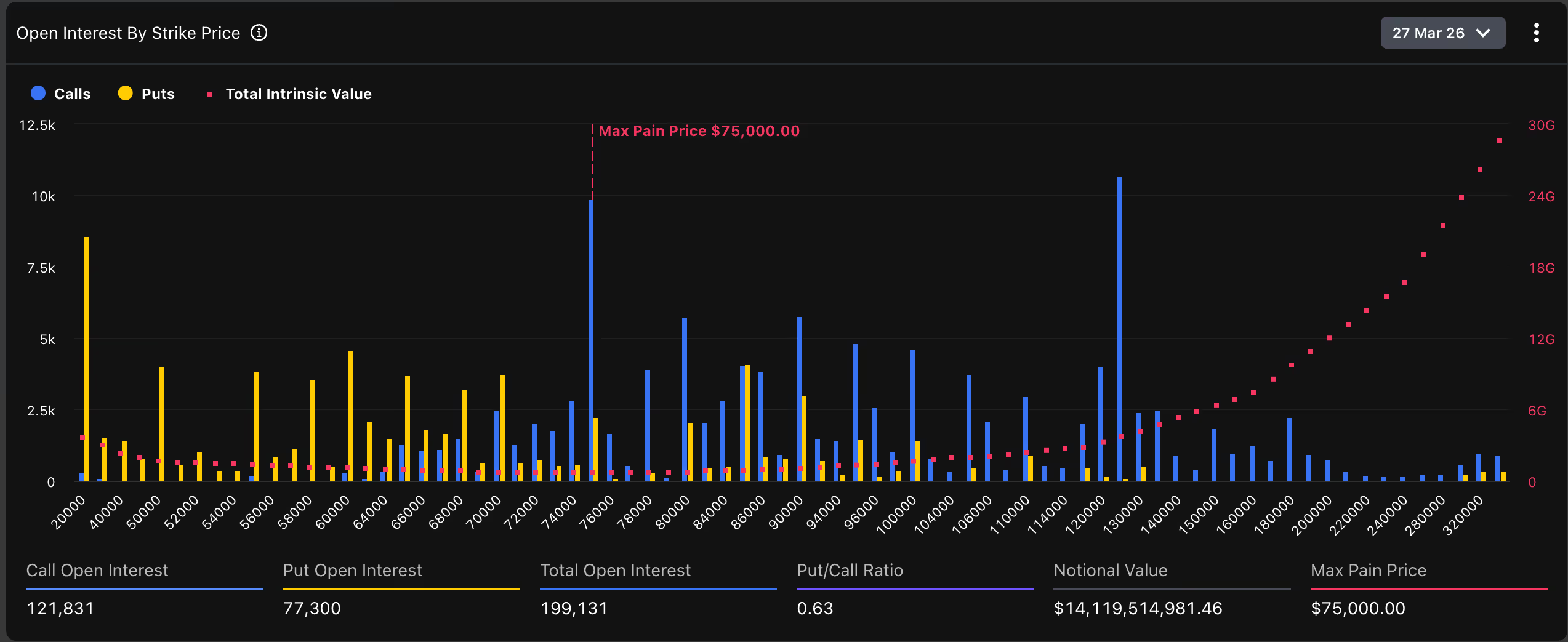
On Friday, bitcoin options or derivative contracts worth billions will expire on crypto exchange Deribit. Traders might want to note that the dynamics of the expiry are such that BTC’s market price could be lifted toward a very specific point: $75,000.
Deribit, the world’s largest crypto options exchange, will settle bitcoin options contracts worth $14.16 billion on Friday at 08:00 UTC. This means nearly 40% of all open interest – the dollar value of all active contracts on the exchange – ware set to expire in roughly 48 hours. On Deribit, one options contract represents one BTC.
Options are contracts that let you bet on whether the price of an asset, such as BTC, will go up or down. A call option is a bet that the price will go up, and a put option is a bet that it will go down. Traders buy options to try to profit from price swings, or write (short) options to earn income while taking on the risk that prices move in favor of the buyer.
Here’s why the expiry matters
According to Deribit’s data, the ‘max pain’ price — the level where the most contracts would expire worthless (lottery tickets that don’t win) — sits right at $75,000.
As such, this level could act as a magnet, according to Deribit’s Chief Commerical Officer Jean-David Péquignot.
“With Bitcoin currently trading near $71k, the $75k Max Pain price represents a gravitational pull. Historically, this encourages delta-hedging by market makers that can drive prices toward the strike where the most options expire worthless,” Péquignot told CoinDesk.

Here’s how it works. As per the max pain theory, option writers — typically large funds, institutions, or market makers with ample capital — control or influence the spot price toward the pain point to limit payouts to buyers and thereby inflict maximum damage on them. This happens through normal trading in the spot or futures markets, rather than as a guaranteed manipulation.
This mechanical buying and selling often pulls the spot price closer to the max pain level, which is $75,000 in bitcoin’s case.
While max pain is well-known in traditional markets, its influence on crypto remains debated. Deribit, however, flags the level as a potential magnet. Adding to the intrigue, several analysts have identified $75,000 as key resistance, above which bitcoin could go into a full-bull mode.
Controlled expiry
Quarterly expiries typically spark massive position adjustments and hedging flows. Still, the impending expiry is likely unfold normally, without an outsized volatility surge.
That’s evident from the decline in the implied volatility index.
“Over the last sessions, we have witnessed an implied volatility (IV) compression, with both BTC and ETH DVOL dropping by ~6 points. This suggests the market is pricing in a controlled expiry rather than an immediate explosion in volatility,” Péquignot said.
He added that the market data suggests that traders aren’t chasing a breakout as geopolitical uncertainty in the form of Iran war lingers. He specifically pointed to call writing by institutions at higher strikes (levels above going spot price) as the evidence of measured bullish sentiment. Traders typically write overhead calls to collect premiums on top of their spot market holdings.
“The Put/Call ratio for Bitcoin options remains healthy (0.63), but the concentration of sell-side calls suggests a ceiling of institutional resistance as traders have been overwriting their positions to bank premium while waiting for the geopolitical clock to run out,” he noted.
All in all, the big expiry with $75,000 acting as a magnet comes at an intriguing juncture: bitcoin has held up remarkably well through the Iran war turbulence, maintaining strength even as equities wobble and energy markets remain fickle.

TLDR:
- Saudi Arabia lost $300 billion in stock market value within 25 days of Gulf conflict escalating regionally.
- Brent crude trading at $90–$110 per barrel turns infrastructure losses into net windfall revenue for Riyadh.
- Saudi’s Red Sea bypass pipeline positions the kingdom as the dominant exporter while Hormuz stays closed.
- MBS continues lobbying Washington for Iran strikes despite Iranian drones hitting Saudi refineries each night.
Saudi Arabia has lost $300 billion in stock market value across 25 days of Gulf conflict. The Tadawul index fell 12 percent in the opening week.
Iranian drone strikes shut down Ras Tanura, the kingdom’s largest refinery, which processes 550,000 barrels daily. Regional output losses reached 10 million barrels per day by March 12.
Despite this damage, Crown Prince Mohammed bin Salman continues pushing Washington for more action against Tehran. The kingdom now serves as the conflict’s victim, beneficiary, and accelerant at once.
Saudi Arabia Bears the Costs While Oil Revenue Climbs
Saudi Arabia’s Vision 2030 megaprojects are currently under formal government review. Capital outflows have risen, and investor confidence has declined sharply in recent weeks.
The Crown Prince spent a decade building the very infrastructure now absorbing nightly drone strikes. Eastern Province oil fields have also taken direct hits alongside the Ras Tanura shutdown.
Analyst Shanaka Anslem Perera described the situation on X with pointed directness. He wrote that Saudi Arabia is “simultaneously the war’s victim, its beneficiary, and its accelerant.”
Interceptor stockpiles defending Saudi airspace are drawing down at a steady pace. Each successful Iranian strike raises fresh questions about the kingdom’s long-term air defense capacity.
Meanwhile, Brent crude is trading between $90 and $110 per barrel on global markets. Saudi Arabia’s national budget was originally calculated on oil at $65 to $70 per barrel.
Every barrel sold above that level adds windfall revenue to the Saudi treasury. At $110 Brent, the kingdom earns a surplus on every barrel it can still export.
Goldman Sachs had forecast a widening fiscal gap before the conflict began. At $80 Brent, that deficit narrows to between 3 and 3.5 percent of GDP.
The war damaging Saudi refineries is simultaneously pushing oil prices well above budget assumptions. Both the losses and the gains appear on the same national balance sheet at once.
Saudi Arabia Gains Structural Ground as Hormuz Stays Contested
Saudi Arabia holds between 2 and 3 million barrels per day of spare production capacity. It also operates an East-West pipeline that bypasses the Strait of Hormuz entirely.
That pipeline routes crude directly to the Yanbu terminal on the Red Sea. Kuwait, Bahrain, and Qatar have no comparable alternative export infrastructure available.
Qatar’s Ras Laffan facility cannot be rebuilt or restored for at least five years. Saudi Arabia’s Red Sea route has become the most critical active export pipeline in the world.
The New York Times reported that MBS sees a “historic opportunity to remake the region.” Saudi Arabia’s Foreign Minister has also publicly stated that the kingdom’s patience is “not unlimited.”
MBS has called Trump multiple times, lobbying for continued military pressure on Iran. Each American strike generates fresh Iranian retaliation against Gulf energy infrastructure in response.
That retaliation pushes oil prices higher, which funds the next Saudi lobbying push in Washington. This cycle has no exit point while MBS continues treating the conflict as strategic opportunity.
Saudi Arabia is positioned to dominate the post-war energy market as regional rivals weaken. A diminished Iran cuts OPEC competition for Riyadh directly going forward.
Qatar’s delayed North Field expansion benefits Saudi gas over the medium term. Every producer dependent on Hormuz concedes further competitive ground to Saudi Arabia’s Red Sea route.

Irish authorities have recovered a portion of a long-dormant Bitcoin stash tied to a convicted drug dealer, signaling a rare success in unlocking a decades-old cryptographic puzzle. The Criminal Assets Bureau (CAB) announced on Tuesday that it had gained access to and seized a cryptocurrency wallet containing 500 BTC, valued at more than $35 million, with crucial assistance from Europol’s European Cybercrime Centre.
Cabinet-level cooperation appears to have been pivotal. Europol reportedly hosted operational briefings at its headquarters in The Hague and supplied specialized technical expertise and decryption resources that supported CAB investigators and analysts in bringing the operation to fruition.
The wallet is part of a cluster of 12 addresses holding a total of about 6,000 BTC once linked to Clifton Collins, a drug dealer who received a five-year prison sentence for cannabis cultivation and distribution. The keys to these wallets were believed to be irretrievable after the paper containing them vanished from a fishing-rod case at Collins’ rental home.
“CAB gained access to and seized a cryptocurrency wallet” containing 500 BTC, the agency said, with support from Europol’s European Cybercrime Centre.
The disclosure underscores the evolving landscape of crypto asset recovery, where authorities increasingly combine off-chain investigations with on-chain tracing to locate and recover illicit funds long after their acquisition.
Key takeaways
- A 500 BTC wallet, one of 12 tied to Clifton Collins, has been seized by Irish authorities with Europol’s help, valued at over $35 million.
- The broader stash comprises about 6,000 BTC spread across 12 wallets, deposited by Collins in 2011–2012 and guarded by a paper key hidden in a fishing-rod case.
- Blockchain analytics firm Arkham has linked a wallet labeled “Clifton Collins: Lost Keys” to recent movement in the wallet cluster, including a transfer to Coinbase Prime.
- Arkham’s data indicate Collins controls 14 addresses with a total of roughly 5,500 BTC, valued at more than $391 million, highlighting the persistence and scale of his holdings despite prior legal actions.
- The case illustrates how cross-border law enforcement collaboration and decryptive capabilities can unlock “lost” crypto memories that were once deemed inaccessible.
Tracing a decade-old stash and its implications
The seizure traces back to a long-running narrative of how crime proceeds were converted into Bitcoin more than a decade ago. The 6,000 BTC in question reportedly flowed to multiple wallets in late 2011 and early 2012. Police describe the storage as an audacious yet ultimately fragile arrangement: private keys scattered across 12 wallets, and crucially, paper-based credentials hidden inside an aluminum cap within a fishing-rod case. When Collins was arrested in 2017, authorities say the landlord cleared out the rental home and discarded many belongings, complicating any effort to recover the keys.
While this story has a long tail in public reporting, the latest development shows that some of those “lost keys” can still unlock real value under the right circumstances. The Guardian’s coverage of Collins’ case provides the background on the criminal operation and the 2017 arrest, underscoring how a single possession—an apparently ordinary fishing-rod case—could become a cryptographic Achilles’ heel decades later.
Fresh on-chain activity and what it signals
Beyond the 500 BTC seizure, on-chain observers have noted movements linked to the Clifton Collins wallet cluster. Arkham, a blockchain analytics platform, traces a transfer of 500 BTC to Coinbase Prime from a wallet labeled “Clifton Collins: Lost Keys” on a recent Tuesday. Arkham’s explorer shows Collins as the controller of 14 addresses holding a combined 5,500 BTC, currently valued at more than $391 million.
The development has several practical implications. For investors and fund managers, it highlights that even “cold” assets tied to past criminal activity can re-enter the market or be moved to regulated custodians, potentially affecting liquidity and spot availability in sensitive coins. For traders and risk managers, it underscores the ongoing risk of asset provenance concerns—an issue that can influence compliance checks, KYC/AML workflows, and the perception of who ultimately controls large, long-dormant holdings.
Context and what to watch next
The case sits at the intersection of criminal finance, digital asset forensics, and international enforcement. It underscores the growing role of institutional-grade assistance in crypto asset recovery, including decryption resources and cross-border coordination. While only a portion of Collins’ original stash has been recovered to date, authorities have signaled that the collaboration with Europol will continue to pursue the remaining wallets where possible.
Readers should monitor further updates from the CAB and Europol as the investigation unfolds. The Arkham disclosures also warrant attention, as additional wallets in the cluster could surface new movements that shed light on the ultimate disposition of the roughly 6,000 BTC tied to Collins’ operations. The broader takeaway is clear: the line between traditional crime and digital assets is continually being redrawn as investigators apply both on-chain analytics and cooperative legal channels to recover illicit proceeds.
In the coming weeks, observers should watch for any additional wallet recoveries, updates on the status of the 12-wallet cluster, and whether more of Collins’ holdings surface in public or institutional custody. The episode serves as a reminder that even long-standing crypto hoards can be traced, unlocked, and, in some cases, repurposed for asset recovery and restitution.


Ripple is moving ahead with new payment plans tied to its RLUSD stablecoin as it targets faster cross-border trade settlement.
Summary
- Ripple and Unloq are testing RLUSD in Singapore to automate trade payments on XRP Ledger.
- BLOOM gives Ripple a regulated sandbox to test settlement tied to shipment verification and financing.
- The pilot adds to Ripple’s broader payments expansion in Asia and planned Australian licensing push.
According to the announcement, the company is working with supply chain finance firm Unloq to test a trade finance model on the XRP Ledger through BLOOM, a sandbox run by the Monetary Authority of Singapore.
Meanwhile, the pilot will examine whether RLUSD can replace manual payment steps that have slowed trade finance for years. Ripple and Unloq said the system can release payments “automatically when predefined conditions are met, such as shipment verification.”
Ripple plans to use RLUSD as the settlement asset in a pilot built with Unloq’s SC+ platform. The project aims to combine trade obligations, settlement rules, and financing workflows in one execution layer on the XRP Ledger.
The companies said current trade finance still depends on manual checks, documentary credits, and correspondent banking links that often take days or weeks to complete. They said the new model seeks to reduce delays by automating payment release once agreed trade conditions are verified.
The pilot will run inside BLOOM, which stands for Borderless, Liquid, Open, Online, Multi-currency. MAS launched the initiative in October 2025 to expand settlement options for tokenized bank liabilities and regulated stablecoins.
Ripple said the test will focus on whether RLUSD can replace manual processes that have “slowed cross-border trade for decades.” The companies also said the model could give firms better visibility into settlement risk while helping smaller businesses access trade-finance services.
RLUSD growth supports Ripple’s wider payments plan
Ripple launched RLUSD in December 2024 with institutional use as its main target. The stablecoin has grown to a market value near $1.5 billion, placing it among the largest stablecoins by market capitalization.
The BLOOM pilot comes less than four months after Ripple said MAS approved an expanded scope of payment activities for Ripple Markets APAC in December 2025. That approval added to Ripple’s push to deepen its role in regulated payment infrastructure in Asia.
As previously reported, Ripple has also outlined plans to expand in Australia through an Australian Financial Services License. The company said it aims to obtain that license by acquiring BC Payments Australia Pty Ltd., subject to the final completion process.


- Bitcoin price rebounds above $71,000 amid cautious market sentiment.
- Exchange outflows suggest long-term accumulation by investors.
- Geopolitical signals and Bitcoin transfers shape near-term trends.
Bitcoin has bounced back above $71,000 after a week of mixed signals in the market.
The move comes as investors closely watch geopolitical developments, particularly efforts to ease tensions in the Middle East.
Notably, a peace proposal between the United States and Iran has sparked cautious optimism, lifting risk assets and sending Bitcoin higher.
Despite the rebound, sentiment remains cautious, with the Fear & Greed Index at 35, signalling that investors are still in the “Fear” zone.
This suggests that while the price has recovered, many market participants are hesitant to commit fully, waiting for clearer direction.
Exchange outflows signal an accumulation phase
Recent on-chain data shows that more bitcoins have been leaving crypto exchanges than entering them.
This trend is often interpreted as a sign of accumulation.
Investors appear to be moving coins into private wallets for long-term holding rather than selling immediately.
The persistent outflows indicate confidence in Bitcoin’s fundamentals and a willingness to weather short-term price swings.
This accumulation behaviour can help reduce selling pressure in the market.
When coins leave exchanges, fewer are available for immediate trading, which often supports the price even during periods of uncertainty.
Bhutan Government moves $37 BTC
Adding another layer to the market dynamic, the Royal Government of Bhutan recently moved roughly $37 million worth of Bitcoin from government-controlled wallets, according to Arkham Intelligence data.
Analysts see this as a structured transfer rather than a sudden liquidation, suggesting careful treasury management.
While the exact motives are not fully public, such large-scale movements highlight that governments and large holders can influence liquidity.
These actions can affect market psychology, especially when combined with broader investor accumulation trends.
Bitcoin price forecast for the coming days
Overall, the market is in a consolidation phase, seeking a catalyst to define the next sustained move.
Exchange outflows, government movements, and geopolitical developments are all factors that could influence the next direction.
The recent Bitcoin price movements suggest that it may have recently hit bottom around $67,500, even though the broader picture is still uncertain.
But whether the current recovery signals a true bottom or just a temporary rebound remains to be seen, although the combination of accumulation behaviour, controlled government movements, and cautious optimism on geopolitical developments has created an environment where Bitcoin can maintain support and potentially build momentum.
A daily close above $73,000 could signal strength and potentially push the price toward $75,000, according to analysts.
Conversely, a break below $70,000 might prompt a retest of $67,500 support, marking a critical line for short-term investors.
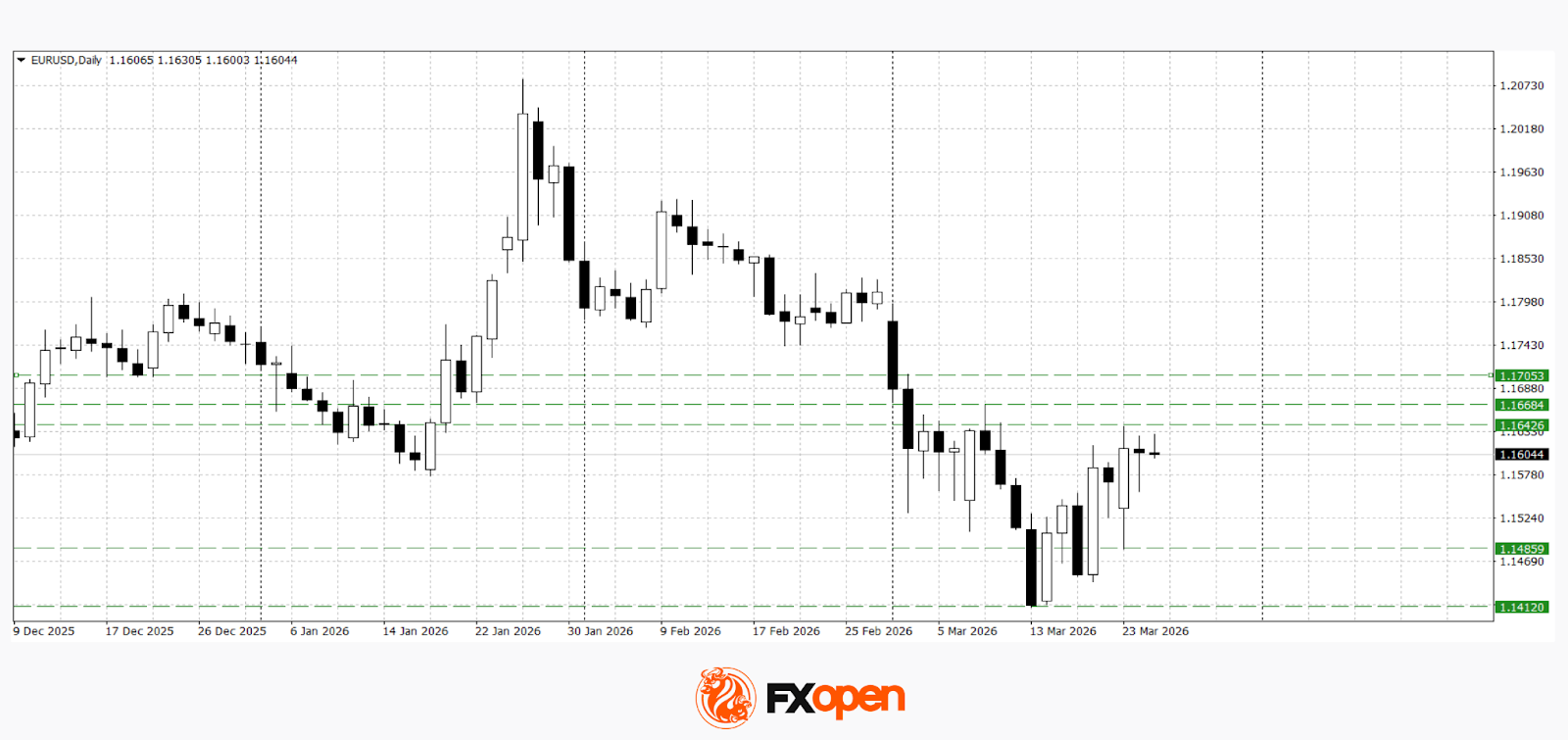
European currencies are trading without a clear direction against the US dollar, remaining in a consolidation phase following the earlier decline driven by USD strength. At the start of the week, both EUR/USD and GBP/USD attempted a recovery, but the upside proved limited, and the pairs are now testing the upper boundaries of their short-term trading ranges.
Market participants are adopting a wait-and-see approach ahead of the release of key macroeconomic data, which could determine the next direction for the dollar and major currency pairs. Geopolitical uncertainty in the Middle East remains an additional factor weighing on sentiment. Reports of ongoing tensions and risks to energy supply disruptions continue to support elevated oil prices, fuelling inflation expectations and prompting investors to reassess the outlook for central bank policy.
Today, the focus is on business activity and inflation data from Europe and the UK, as well as housing market and consumer activity figures from the US. These releases could significantly impact interest rate expectations, prompting traders to refrain from opening large positions ahead of the data.
EUR/USD
At the start of the week, EUR/USD tested key support near 1.1480 before rebounding above 1.1600. Technical analysis suggests a range-bound market: a rejection from the key resistance level at 1.1640 could lead to a renewed test of recent lows in the 1.1420–1.1480 area. Conversely, a firm break above 1.1640 and a move out of the range could open the way for further gains towards 1.1680–1.1710.
Key events for EUR/USD:
- Today at 11:00 (GMT+2): Germany business expectations index
- Today at 13:00 (GMT+2): Bundesbank monthly report
- Today at 14:30 (GMT+2): US current account balance
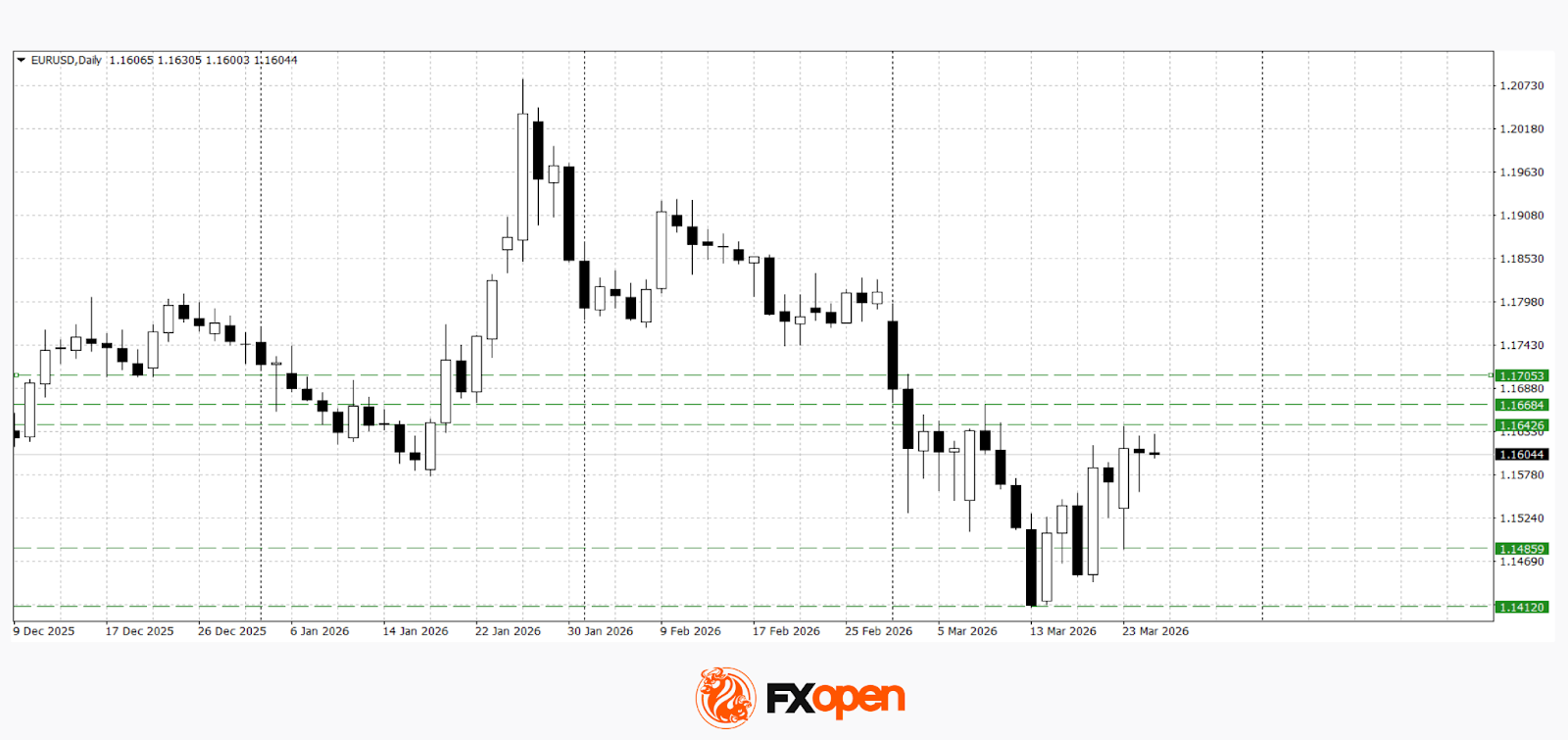
GBP/USD
GBP/USD is also trading within a range. Following last week’s Bank of England meeting, the pair strengthened towards 1.3480 but failed to sustain upward momentum, retreating to 1.3250 on Monday. Technical analysis points to the potential for a retest of the recent high; however, in the event of weak UK data, a move lower towards the 1.3350–1.3250 area is equally possible.
Key events for GBP/USD:
- Today at 09:00 (GMT+2): UK Consumer Price Index (CPI)
- Today at 11:30 (GMT+2): UK house price index
- Tomorrow at 11:30 (GMT+2): Speech by Bank of England Financial Policy Committee member Sarah Breeden
Trade over 50 forex markets 24 hours a day with FXOpen. Take advantage of low commissions, deep liquidity, and spreads from 0.0 pips (additional fees may apply). Open your FXOpen account now or learn more about trading forex with FXOpen.
This article represents the opinion of the Companies operating under the FXOpen brand only. It is not to be construed as an offer, solicitation, or recommendation with respect to products and services provided by the Companies operating under the FXOpen brand, nor is it to be considered financial advice.
Crypto World
Cardano (ADA) Price: Historic Bullish Indicators Emerge as Token Tests Key Support Level
TLDR
- The 365-day MVRV metric for Cardano has plummeted to -43%, entering what market analysts identify as an accumulation zone
- ADA funding rates on Binance have hit their lowest point since June 2023, indicating extreme bearish positioning
- Total Value Locked on Cardano increased 3% over 24 hours to reach 525.44 million ADA, signaling sustained network activity
- Both metrics last converged at these levels in mid-2023, preceding an approximate 300% price increase over the next year and a half
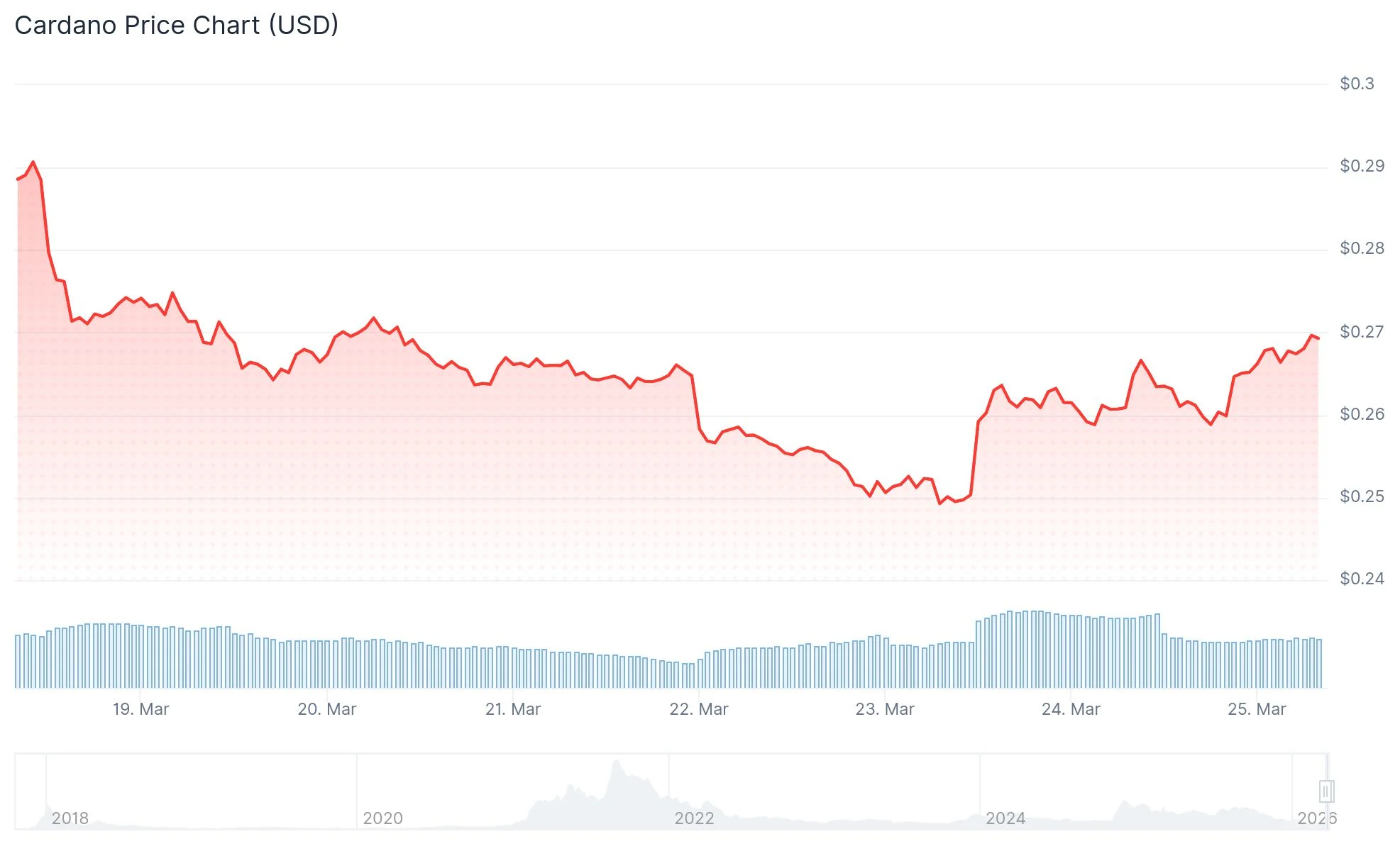
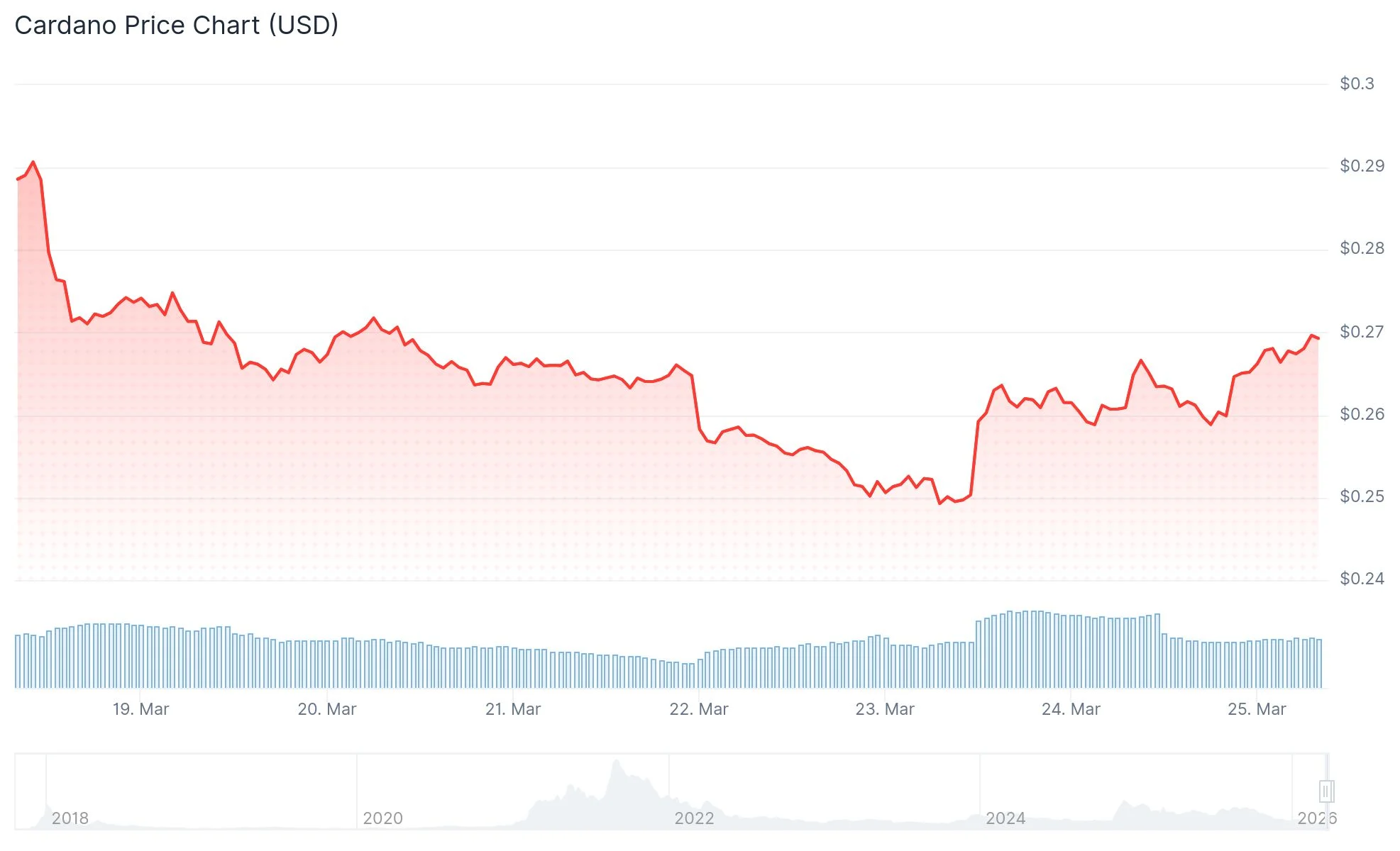
- Current ADA price stands around $0.26, reflecting a weekly decline of 7% and a 71% drop from September highs
Cardano is currently exchanging hands near the $0.26 mark following a 4% intraday recovery on Monday. A combination of two historically significant indicators from on-chain analytics and derivatives markets has simultaneously activated, mirroring conditions that previously signaled major price reversals.
The 365-day Market Value to Realized Value metric for Cardano has declined to -43%. This negative reading indicates that network participants who have been active over the previous 12 months are currently experiencing unrealized losses averaging 43%. Blockchain analytics provider Santiment categorizes this territory as the “opportunity zone.” Historical data suggests that when MVRV reaches such deeply negative values, the majority of weak-handed sellers have typically already capitulated.

The MVRV indicator measures the average profit or loss position of market participants across a defined timeframe and has historically demonstrated mean-reversion characteristics. When this metric falls significantly below zero, the remaining holders typically consist of long-term believers or investors who have already reconciled themselves to current losses. This dynamic substantially reduces the probability of additional capitulation events.
Concurrently, Binance’s weekly average funding rate for ADA perpetual futures has plunged to its most bearish level since June 2023. Funding rates in perpetual swap markets represent the cost exchange between long and short position holders. An extremely negative funding rate indicates that short sellers dominate the market and must compensate long position holders to maintain their bearish bets.
Why Short Crowding Matters
When bearish positioning reaches such extreme concentration levels, even modest upward price movements can catalyze cascading liquidations. Short positions get forcibly closed, requiring traders to purchase the underlying asset to cover their exposure, which subsequently drives prices higher and triggers additional liquidation events.
Market participants refer to this phenomenon as a short squeeze. For Cardano specifically, periods of extremely negative funding rates have more frequently preceded sharp upward price movements rather than continued downward trends.
The previous instance when both the MVRV indicator and funding rate metrics converged at comparable extreme levels occurred in mid-2023. At that juncture, ADA was trading near $0.25 before subsequently appreciating approximately 300% throughout the subsequent 18-month period.
According to DeFiLlama analytics, Cardano’s Total Value Locked experienced a 3% increase within a 24-hour window, climbing to 525.44 million ADA. The TVL measurement has exhibited a predominantly upward trajectory since the market correction that began in September.
Technical Levels to Watch
From a technical perspective, ADA continues to defend the $0.2436 support threshold, which previously served as a testing point on February 5. The upper boundary of the current range is established at $0.2991, last contacted on February 26.
Cardano remains positioned beneath its 50-day, 100-day, and 200-day Exponential Moving Averages, all of which maintain bearish downward trajectories. The Relative Strength Index registers at 45, marginally below the 50-level neutral threshold. The MACD indicator has crossed back underneath its signal line.
ADA has depreciated approximately 71% from its September zenith and trades roughly 7% lower across the weekly timeframe.


OpenAI has started shutting down the Sora app, a move that marks a sharp pullback from its consumer video push.
Summary
- OpenAI started shutting down the Sora app and said timelines for users would follow soon.
- Reports said OpenAI is winding down more video products beyond the consumer-facing Sora app too.
- Sora grew quickly, but deepfake concerns and a stalled Disney deal added pressure over time.
On Tuesday, the Sora app account said, “We’re saying goodbye to the Sora app,” and added that more details would follow on timelines for the app, the API, and ways users can preserve their work.
The move came just days after OpenAI’s own help pages described Sora 2 and the Sora app as active products. A March 23 safety page said “The Sora 2 model and the Sora app” were available, while March 19 release notes announced new editing tools on iOS and web.
The Wall Street Journal reported that Chief Executive Sam Altman told staff OpenAI would wind down products built around its video models. Reuters, citing sources familiar with the matter, said that includes the consumer app and other video-related offerings as the company shifts resources to coding, enterprise tools, robotics, and broader AI goals.
OpenAI has not yet posted a full product blog on its main site explaining the broader change. Its current developer documentation still lists Sora 2 and Sora 2 Pro among OpenAI’s video generation models, which shows some public pages had not yet caught up with Tuesday’s decision.
Sora gained users but also drew criticism
OpenAI launched the Sora app on September 30, 2025, starting with invite-only iOS access before expanding further. The company described it as a new app for short video creation, while outside reports said it reached 1 million downloads within five days of launch.
The product also faced pressure over deepfakes, copyrighted characters, and other misuse concerns. The Associated Press reported that OpenAI restricted some public-figure content after protests from families and entertainment groups, while OpenAI’s own safety material said it used watermarks, moderation systems, and provenance tools inside Sora.
In addition, the shutdown also affects a planned Disney tie-up that had drawn market attention. The Disney arrangement did not close and that no funds changed hands, even though the proposed deal had included licensed characters and a large equity component.
Key Takeaways
- Irish authorities and Europol successfully accessed a Bitcoin wallet inactive for almost ten years
- Approximately 500 BTC valued at roughly $35 million was transferred to Coinbase on March 24, 2026
- The cryptocurrency belonged to Clifton Collins, a convicted cannabis cultivator who concealed his private keys in a fishing rod container
- Authorities believed the keys were permanently lost when Collins’ possessions were disposed of in a landfill after his 2017 detention
- Law enforcement officials are confident the technique used can unlock the other 11 wallets containing over €330 million
The Criminal Assets Bureau (CAB) of Ireland, working alongside Europol, has gained access to a Bitcoin wallet that remained untouched for close to ten years. The wallet contained 500 BTC, currently valued at approximately $35 million, which was moved on-chain and deposited into Coinbase on March 24.
The cryptocurrency belonged to Clifton Collins, a Dublin resident who was found guilty of operating large-scale cannabis growing operations spanning several Irish counties over more than a decade. Before his criminal enterprise, Collins worked in security and beekeeping.
Between 2011 and 2012, Collins purchased 6,000 Bitcoin when the digital currency was trading for just a few dollars. He financed these acquisitions using profits from his cannabis business.
Collins divided his 6,000 BTC holdings evenly among 12 separate wallets, placing 500 BTC in each one. He printed all the private keys onto a single piece of paper and concealed this document inside a fishing rod case at his rented residence in Galway.
In 2017, law enforcement arrested Collins following the discovery of cannabis during a routine vehicle inspection. Subsequently, his landlord cleared out the property and discarded Collins’ belongings at a landfill site.
The fishing rod case containing the sole copy of the private keys was almost certainly destroyed in the process. Collins later indicated that a burglary at the property might have also played a role.
In 2020, an Irish High Court mandated the seizure of the Bitcoin. At the time, the 6,000 BTC was valued at approximately €53 million. Today, that same amount is worth roughly €360 million.
Despite the court’s ruling, CAB had no method to access the cryptocurrency without the private keys. Both law enforcement and Collins assumed the Bitcoin was irretrievably lost.
The Method Behind the Breakthrough
CAB and Europol have not revealed the specific method used to access the wallet. Europol stated only that it supplied “highly complex technical expertise and decryption resources.”
One hypothesis suggests Collins may have stored his keys in an encrypted file secured by a weak password, which investigators could have cracked using brute force techniques.
An alternative explanation is that Collins employed a defective tool to create all 12 key pairs. A compromised random number generator could have produced predictable keys, enabling investigators to recreate them.
Authorities reportedly have high confidence that the identical approach can be used on the other 11 wallets.
Outstanding Holdings
Collins still possesses 5,500 Bitcoin, currently worth approximately $389 million based on Arkham intelligence.
Should CAB successfully unlock all remaining wallets with the same methodology, recovering the complete 6,000 BTC would represent the largest single asset confiscation in the bureau’s operational history.
The 500 BTC transferred on March 24 represents the first verified access to any of Collins’ wallets since his apprehension nine years ago.

Irish police crack lost Bitcoin wallet tied to drug dealer
Copy Rihanna’s Chocolate Brown Sweater Style an Under-$45 Pick

Greggs and easyJet team up to launch 5 new sausage roll dips


-
 Crypto World4 days ago
NIO (NIO) Stock Plunges 6.5% as Shelf Registration Sparks Dilution Worries
-

 Fashion5 days ago
Weekend Open Thread: Adidas – Corporette.com
-

 Politics5 days ago
Jenni Murray, Long-Serving Woman’s Hour Presenter, Dies Aged 75
-

 Crypto World3 days ago
Best Crypto to Buy Now: Strategy Just Spent $1.57 Billion on Bitcoin During Fear While Early Investors Quietly Enter Pepeto for 150x Potential
-

 News Videos7 days ago
RBA board divided on rate cut, unusually buoyant share market | Finance Report | ABC NEWS
-

 Crypto World3 days ago
Bitcoin Price News: Bhutan Sells $72 Million in BTC Under Fiscal Pressure, but the Smart Money Entering Pepeto Sees What the Market Does Not
-

 Politics7 days ago
The House | The new register to protect children from their abusers shows Parliament at its best
-

 Tech5 days ago
inKONBINI Lets You Spend Summer Days Behind the Register
-

 Crypto World7 days ago
Canada’s FINTRAC revokes registrations of 23 crypto MSBs in AML crackdown
-

 Sports2 days ago
Remo Stars and Kano Pillars Strengthen Survival Hopes in NPFL
-
 NewsBeat6 days ago
Residents in North Lanarkshire reminded to register to vote in Scottish Parliament Election
-

 News Videos7 days ago
PARLIAMENT OF MALAWI – PAC MEETING WITH REGISTRAR OF FINANCIAL ON AMARYLLIS HOTEL – INQUIRY LIVE
-

 Politics6 days ago
Gender equality discussions at UN face pushbacks and US resistance
-

 Business3 days ago
No Winner in March 21 Drawing as Prize Rolls to $133 Million for Next
-

 Business7 days ago
Who Was Alex Pretti? 5 Key Facts About the ICU Nurse Killed by Federal Agents in Minneapolis
-

 Sports2 days ago
Gary Kirsten Accuses Pakistan Cricket Board Of ‘Interference’, Mohsin Naqvi Responds
-

 Tech3 days ago
Give Your Phone a Huge (and Free) Upgrade by Switching to Another Keyboard
-

 Tech7 days ago
Inventec’s bizarre VeilBook laptop hides its touchpad under a sliding keyboard just to give cooling fans a little breathing room
-

 Sports5 days ago
2026 Kentucky Derby horses, odds, futures, preview, date: Expert who nailed 12 Derby-Oaks Doubles enters picks
-
Sports6 days ago
Vikings Free Agency Enters Phase 2 with Key Questions
You must be logged in to post a comment Login