

Crypto World
Irish Authorities Crack Drug Dealer’s Bitcoin Wallet After Nearly a Decade


Key Takeaways
- Irish authorities and Europol successfully accessed a Bitcoin wallet inactive for almost ten years
- Approximately 500 BTC valued at roughly $35 million was transferred to Coinbase on March 24, 2026
- The cryptocurrency belonged to Clifton Collins, a convicted cannabis cultivator who concealed his private keys in a fishing rod container
- Authorities believed the keys were permanently lost when Collins’ possessions were disposed of in a landfill after his 2017 detention
- Law enforcement officials are confident the technique used can unlock the other 11 wallets containing over €330 million
The Criminal Assets Bureau (CAB) of Ireland, working alongside Europol, has gained access to a Bitcoin wallet that remained untouched for close to ten years. The wallet contained 500 BTC, currently valued at approximately $35 million, which was moved on-chain and deposited into Coinbase on March 24.
The cryptocurrency belonged to Clifton Collins, a Dublin resident who was found guilty of operating large-scale cannabis growing operations spanning several Irish counties over more than a decade. Before his criminal enterprise, Collins worked in security and beekeeping.
Between 2011 and 2012, Collins purchased 6,000 Bitcoin when the digital currency was trading for just a few dollars. He financed these acquisitions using profits from his cannabis business.
Collins divided his 6,000 BTC holdings evenly among 12 separate wallets, placing 500 BTC in each one. He printed all the private keys onto a single piece of paper and concealed this document inside a fishing rod case at his rented residence in Galway.
In 2017, law enforcement arrested Collins following the discovery of cannabis during a routine vehicle inspection. Subsequently, his landlord cleared out the property and discarded Collins’ belongings at a landfill site.
The fishing rod case containing the sole copy of the private keys was almost certainly destroyed in the process. Collins later indicated that a burglary at the property might have also played a role.
In 2020, an Irish High Court mandated the seizure of the Bitcoin. At the time, the 6,000 BTC was valued at approximately €53 million. Today, that same amount is worth roughly €360 million.
Despite the court’s ruling, CAB had no method to access the cryptocurrency without the private keys. Both law enforcement and Collins assumed the Bitcoin was irretrievably lost.
The Method Behind the Breakthrough
CAB and Europol have not revealed the specific method used to access the wallet. Europol stated only that it supplied “highly complex technical expertise and decryption resources.”
One hypothesis suggests Collins may have stored his keys in an encrypted file secured by a weak password, which investigators could have cracked using brute force techniques.
An alternative explanation is that Collins employed a defective tool to create all 12 key pairs. A compromised random number generator could have produced predictable keys, enabling investigators to recreate them.
Authorities reportedly have high confidence that the identical approach can be used on the other 11 wallets.
Outstanding Holdings
Collins still possesses 5,500 Bitcoin, currently worth approximately $389 million based on Arkham intelligence.
Should CAB successfully unlock all remaining wallets with the same methodology, recovering the complete 6,000 BTC would represent the largest single asset confiscation in the bureau’s operational history.
The 500 BTC transferred on March 24 represents the first verified access to any of Collins’ wallets since his apprehension nine years ago.


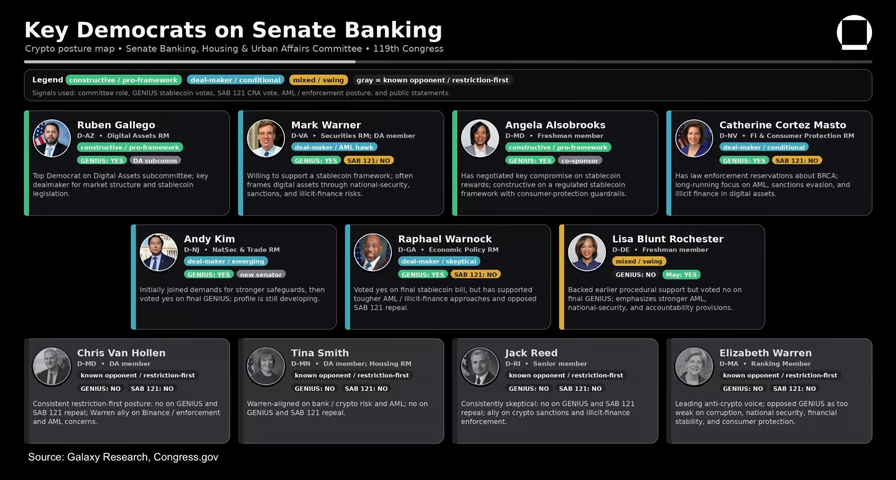
Crypto investment firm Galaxy Digital said seven Democratic lawmakers on the US Senate Banking Committee could be key to advancing the Digital Asset Market Clarity Act when it goes to markup on Thursday, sending it to the Senate for a vote.
In an X post on Sunday, Galaxy Digital labeled Democratic lawmakers Ruben Gallego and Angela Alsobrooks as “constructive/pro-framework” when it comes to crypto. Four other lawmakers are seen as “deal-makers,” while one lawmaker is seen as “mixed.”
“If Democrats vote for the bill in markup, likelihood of ultimate passage on the Senate floor increases significantly,” Galaxy Digital said.
Passing the CLARITY Act through the Senate and into law would create clearer federal rules for the US crypto industry, potentially reducing years of regulatory uncertainty and encouraging more projects to build in the country.

Galaxy Digital speculates that seven Democrats on the US Senate Banking Committee could be swayed to approve the CLARITY Act. Source: Galaxy Digital
Galaxy listed Mark Warner, Catherine Cortez Masto, Andy Kim and Raphael Warnock as “deal-maker/conditional,” saying they have shown support for a crypto framework and voted to pass the GENIUS Act.
Galaxy said they also want stronger safeguards against illicit finance and money laundering risks.
Lisa Blunt Rochester, who was labeled “mixed,” is considered a possible swing vote because she has backed the crypto framework but voted against the GENIUS Act.
At least four are likely to vote against the bill
Jack Reed, Elizabeth Warren, Tina Smith and Chris Van Hollen all voted against the GENIUS Act, and Galaxy predicts they will follow a similar path on the CLARITY Act based on past statements.
The CLARITY Act has been scheduled for markup on Thursday. To pass through the Senate Banking Committee, at least half of the 24-member group, which is made up of 13 Republicans and 11 Democrats, will need to approve it.
After passing through the committee, the bill heads to the Senate floor for scheduling, debate and possible further amendments before a vote. Kara Calvert, vice president of US policy at crypto exchange Coinbase, told attendees at the Consensus 2026 conference that the bill needs at least 60 votes to pass in the Senate and bipartisan support to become law.
Stand With Crypto, a US crypto advocacy and tracking platform that scores politicians on their crypto stance based on past statements and actions, lists Warner, Cortez Masto, and Alsobrooks as strongly supportive of crypto.
Related: ‘Visible flaws’ in Bitcoiners’ mid-bear market forecast: Analyst
Kim is considered neutral, and Reed, Warren and Smith are all considered strongly opposed to crypto. Warnock, Blunt Rochester, Gallego, and Van Hollen are not ranked due to insufficient data, according to Stand With Crypto.
The CLARITY Act, introduced in July 2025, was expected to progress but stalled in January after Coinbase withdrew its support for the legislation, citing concerns over a lack of legal protections for open-source software developers, a prohibition on stablecoin yields and decentralized finance regulations.
Magazine: Guide to the top and emerging global crypto hubs — Mid-2026


Tokenized gold trading has moved past last year’s total in only three months.
Summary
- Tokenized gold volume hit $90.7B in Q1 as PAXG and XAUT led spot trading activity.
- CoinGecko data shows Q1 volume already passed 2025’s full-year total of $84.6B by March 31.
- The tokenized gold market is expanding beyond trading, with new blockchain launches, bank-backed products, and industry infrastructure plans.
CoinGecko’s RWA Report 2026 said spot trading volume for tokenized gold reached $90.70 billion in Q1 2026, above the $84.64 billion recorded for the full year of 2025.
The report linked the growth to demand from crypto traders seeking exposure to gold and easier access across exchanges. CoinGecko also said centralized exchanges account for most tokenized asset spot trading, showing that large trading venues still lead activity in this market.
PAXG and XAUT remain the main drivers
PAXG and XAUT remain the leading names in tokenized gold activity. CoinGecko said PAXG accounted for 34.2% to 82.5% of monthly tokenized gold spot volume over the last 15 months, while XAUT accounted for 14.8% to 64.6%.
Tokenized commodities also grew from $1.43 billion to $5.55 billion in market value over the same period. CoinGecko said XAUT and PAXG accounted for 89.1% of that expansion, adding $1.87 billion and $1.80 billion respectively.
Moreover, recent crypto.news coverage shows that tokenized gold is moving beyond basic trading. On March 30, Tether launched XAUt on BNB Chain, with each token backed 1:1 by one troy ounce of physical gold stored in Swiss vaults. Tether CEO Paolo Ardoino described the move as “integrating gold into the digital financial system with instant settlement.”
As crypto.news reported, Singapore’s OCBC launched GOLDX on Ethereum and Solana in April. The token gives institutional investors access to the LionGlobal Singapore Physical Gold Fund, which held about $525 million in assets as of April 16.
Institutions test gold on-chain
The World Gold Council has also proposed a “Gold as a Service” platform to support tokenized gold issuance and operations. Its plan seeks to connect physical custody with digital systems used for issuance, compliance, reconciliation, and redemption.
The wider RWA market gives the gold trend more context. CoinGecko said tokenized real-world assets reached $19.32 billion by March 31, 2026, up from $5.42 billion at the start of 2025. Tokenized commodities held 28.7% of the sector by the end of Q1, behind tokenized Treasuries but ahead of tokenized stocks and ETFs.
The market remains tied to gold prices, exchange access, and demand for assets that can move on-chain. crypto.news reported in March that PAXG and XAUT gained attention during Middle East tensions, while Bitcoin and other major tokens weakened. That contrast may explain why traders continue to watch gold-backed tokens during risk-off periods.
Still, CoinGecko’s month-by-month data shows uneven activity. Tokenized gold spot volume climbed to $21.38 billion in October 2025 as gold reached new highs, then eased to $14.07 billion the next month. The latest numbers show fast growth, but trading remains sensitive to market conditions.
Bank of England Governor Andrew Bailey warned that international regulators will need to “wrestle” with the United States over global rules for stablecoins, which are largely denominated in and backed by U.S. dollars. The comment reflects growing calls for harmonized standards as central banks and financial authorities contemplate stablecoins as potential payment rails beyond the traditional banking system.
“If we want stablecoins to be part of the architecture of payments globally, they’re only going to work if we have international standards,” Bailey said, signaling that alignment with U.S. policy will be a central hurdle in any global framework. “Frankly, that, I think, is going to be a coming wrestle with the [U.S.] administration,” he added. These remarks were reported by Reuters at a conference address, underscoring the cross-border regulatory tensions surrounding stablecoins.
In the United States, the policy landscape features an emphasis on attracting crypto activity while imposing oversight. The GENIUS Act—promoted as a vehicle to bring the crypto industry to the U.S.—is cited as a framework to regulate stablecoin issuers. Regulators outside the U.S. are pursuing stricter controls on stablecoins relative to traditional banking, given concerns that these tokens could introduce systemic risk if not properly regulated. The sector remains dynamic as lawmakers and regulators weigh how to balance innovation with financial stability and consumer protection. The market for stablecoins has grown rapidly, with the largest projects pegged to the U.S. dollar and backed by USD-denominated assets. CoinGecko estimates the stablecoin sector at more than $317 billion in value, reflecting a broad mix of USD-pegged tokens and liquidity arrangements anchored in U.S. Treasuries and dollars.
Bailey, who chairs the Financial Stability Board, indicated that stablecoins could pose a threat to financial stability if left without robust international oversight. He stressed concerns about convertibility in stressed conditions, noting that some stablecoins might not be easily redeemable for cash without the involvement of crypto exchanges. The implication is that cross-border use—especially in cross-border payments—could shift capital flows toward jurisdictions with stringent convertibility rules, such as the United Kingdom, which has signaled it intends to implement strong laws governing stablecoin conversion. Bailey warned of potential knock-on effects from a run on a stablecoin, arguing that liquidity crises could push flows toward jurisdictions perceived as having tougher safeguards.
Key takeaways
- Global standards for stablecoins are increasingly viewed as a prerequisite for widespread use in international payments, with potential friction anticipated between the U.K./EU approaches and U.S. policy positions.
- The U.S. stance on stablecoins—informing a framework for issuers under the GENIUS Act—will shape the pace and nature of international regulatory alignment, especially as the Senate weighs a crypto-market structure bill.
- Market size signals broad adoption: stablecoins are currently valued in the hundreds of billions of dollars, with most assets backed by U.S. dollars and U.S. Treasuries, raising implications for central banks, clearing rails, and banking integration.
- Convertibility risk remains a core concern: if stablecoins cannot be readily redeemed for cash in stressed market conditions, regulatory authorities worry about stability and consumer protections, particularly in cross-border contexts.
- Regulatory dynamics will influence institutions’ licensing, oversight obligations, and cross-border operations, including how exchanges, banks, and investors interact with USD-pegged tokens across jurisdictions.
Global standards vs. national frameworks: regulatory tensions and practical implications
International standard-setting bodies and national regulators are contending over how to treat stablecoins as an infrastructural element of global payments. Bailey’s comments, as reported by Reuters, emphasize a view that credible, interoperable standards are essential for stablecoins to mature as legitimate payment rails rather than speculative or siloed financial products. The Financial Stability Board’s mandate to coordinate macroprudential oversight places additional pressure on harmonized rules that can withstand cross-border capital flows and potential liquidity stress scenarios.
Beyond theory, practical considerations loom for regulators and firms. If stablecoins become widely used for cross-border settlement, divergent convertibility standards could lead to a concentration of flows in jurisdictions with favorable or robust frameworks, potentially exposing less-prepared markets to rapid shifts in liquidity or regulatory direction. The United Kingdom’s stated aim of imposing stringent convertibility rules further underscores the policy divergence that international regulators must reconcile to avoid systemic fragmentation.
U.S. policy developments and the legislative horizon
The U.S. policy narrative around stablecoins centers on balancing innovation with safeguards. The GENIUS Act has been cited as a policy pathway to clarify the regulatory status of stablecoin issuers, aiming to attract the crypto sector while providing a framework that reduces ambiguity for market participants. As part of broader congressional oversight, the Senate Banking Committee has scheduled a markup of related legislation, signaling ongoing scrutiny of how stablecoins should be integrated within the existing financial regulatory system.
Disagreement persists on specific provisions, including whether third-party platforms should be restricted from offering yield-bearing services on stablecoins. A recent version of the related bill would ban stablecoin rewards on idle balances, while permitting other forms of customer rewards. The legislative process remains fluid, with lawmakers weighing the balance between consumer protections and the attractiveness of the U.S. regulatory environment for digital-asset firms. This dynamic is likely to influence how other jurisdictions calibrate their own frameworks, particularly in areas of licensing, AML/KYC compliance, and supervisory oversight of stablecoin issuers and their networks.
Market structure, risk, and institutional considerations
From a risk-management perspective, the stablecoin space highlights several critical considerations for financial institutions and policymakers. The market’s USD-centric backing structure—largely funded by U.S. dollars and U.S. Treasuries—creates interdependencies with banking and custody infrastructure. In stressed conditions, convertibility and liquidity become central concerns for risk officers, compliance teams, and regulators seeking to prevent liquidity spirals or runs that could spill over into the broader financial system.
For banks and crypto-asset service providers, the evolving regulatory landscape will determine licensing requirements, permissible activities, and the nature of cross-border settlement arrangements. As authorities sharpen their focus on stablecoins as potential systemic assets, firms must align their risk governance, liquidity management, and customer-on-boarding procedures with anticipated regulatory expectations—particularly around AML/KYC standards and protections against consumer harm. The regulatory emphasis also reinforces the need for transparent reserve disclosures, auditability of backing assets, and robust contingency planning for fast-moving market conditions.
In parallel, policymakers are weighing broader policy implications—how stablecoins intersect with monetary sovereignty, cross-border banking relationships, and the resilience of payment infrastructures. While the United States positions itself as a hub for crypto innovation, other economies are pursuing stricter controls on conversion, custody, and exchange activity, potentially shaping a fragmented but interconnected global playfield. The resulting policy mosaic will require ongoing monitoring by financial institutions, auditors, and compliance teams to ensure alignment with evolving standards and supervisory expectations.
Overall, the trajectory suggests that international collaboration will be essential to meaningful, durable regulation of stablecoins. The coming years are likely to feature continued tension between national interests and the push for harmonization that can support trusted, interoperable payment ecosystems while safeguarding financial stability.
Closing perspective: As regulatory dialogues advance, institutions should anticipate a steadily tighter, more coordinated framework for stablecoins that emphasizes safety, transparency, and cross-border compatibility, with real implications for licensing, reporting, and cross-jurisdiction operations.
Global regulators are increasingly positioning stablecoins as a test case for cross-border payments, with Bank of England Governor Andrew Bailey saying any workable framework will require international standards. Speaking at a conference, Reuters reported, Bailey warned that the architecture around dollar-denominated stablecoins must be anchored in coordinated rules, or the financial system could face new forms of risk as these tokens scale globally. He also signaled that the regulatory tussle with the United States is likely to intensify as both sides shape how stablecoins are issued, used, and supervised.
Bailey, who chairs the Financial Stability Board, cautioned that stablecoins could threaten financial stability if their use expands beyond local markets without robust guardrails. He emphasized the risk that a sector-wide run on a stablecoin could disrupt liquidity and conversion pathways, particularly for tokens designed to be easily exchanged for cash. In his view, the lack of readily redeemable cash equivalents could complicate a rapid unwind during stressed market conditions, potentially drawing users and capital toward jurisdictions with stronger convertibility rules—such as the United Kingdom—while raising questions about where the dollars backing these tokens ultimately reside.
The conversation unfolds as the global stablecoin market remains dominated by tokens pegged to the U.S. dollar. CoinGecko estimates the sector’s total value at more than $317 billion, a figure that underscores the material stake regulators have in ensuring resilience and transparency behind these assets. The majority of USD-pegged stablecoins rely on Treasury securities and dollar-denominated assets to maintain their pegs, a structure that heightens the importance of stable and reliable settlement channels across borders.
Bailey’s remarks come amid broader regulatory debates about how to supervise stablecoins compared to the traditional banking system. He warned that if stablecoins are used extensively for cross-border payments, dollar tokens with limited convertibility could migrate to other markets, prompting domestic authorities to tighten conversion controls. “We know what would happen if there was a run on a stablecoin; they’d all turn up here,” Bailey said, highlighting a potential concentration of risk within the domestic financial system even as technology and digital liquidity routes expand globally.
Key takeaways
- International standards are seen as essential for stablecoins to function as part of a global payments architecture, setting up a potential regulatory fork with U.S. approaches.
- The stablecoin market sits at roughly $317 billion in value, with the bulk of USD-pegged tokens backed by U.S. Treasuries and dollars, anchoring confidence in their pegs but also tying them to U.S. monetary policy.
- Convertibility risk is a central concern: if some tokens cannot be redeemed for cash quickly, they may face heightened liquidity pressures in stressed market conditions.
- Regulatory momentum in the United States—via the GENIUS Act and ongoing debates around the Clarity Act and related bills—could shape how issuers operate internationally and how cross-border flows are managed.
- The UK signals it will pursue strict conversion rules for stablecoins, potentially creating friction with U.S.-led regulatory frameworks and influencing where stablecoins are used for cross-border settlements.
Global rules in the balance: Bailey’s warning and the US-UK dynamic
Bailey’s call for international standards reflects a broader tension in the crypto policy landscape. The Bank of England governor argued that stablecoins will only achieve widespread use in payments if there is a coherent set of global guidelines that govern reserve backing, liquidity, disclosure, and convertibility. The Reuters report quotes him as describing an inevitable “wrestle” with the U.S. administration over how these tokens should be regulated, especially given the United States’ own efforts to nurture the crypto sector while tightening oversight of stablecoins.
The rhetoric dovetails with recent U.S. policy signals. Former President Donald Trump has championed a pro-innovation agenda for crypto and has advocated for a regulatory pathway around stablecoins through the GENIUS Act, which is framed as giving issuers a structured framework. Supporters argue that clear rules can unlock legitimate use cases—ranging from cross-border remittances to on-chain settlement—while critics warn of regulatory metaphorical walls that could stifle innovation or push activities offshore. The divergence in policy philosophy between the U.S. and the U.K. underscores a broader question: will global stablecoin activity be steered by American market access ambitions or by a broader, harmonized regulatory regime?
Regulatory rails in motion: U.S. bills, hearings, and cross-border concerns
Beyond the GENIUS Act, U.S. policymakers are actively weighing additional measures to govern stablecoins. Banking groups have pressed Congress to advance a framework, including proposals to ban “yield-bearing” features on idle stablecoin balances, while permitting other forms of customer rewards. The debate centers on whether yield opportunities should be accessible on stablecoins, potentially altering the risk and return profile of these tokens and influencing how users deploy them in everyday payments and liquidity management.
On the legislative front, the U.S. Senate Banking Committee has been moving pieces of the regulatory puzzle forward. After delays earlier this year, the committee scheduled a markup on updates to the so-called Clarity Act, a draft bill aimed at clarifying the regulatory status of crypto assets, including stablecoins. The outcome of these proceedings will help determine whether stablecoins face stricter supervision, more explicit reserve requirements, or tighter restrictions on programmatic features like staking or rewards. The resulting policy mix will shape how issuers structure reserves, disclosures, and redemption mechanics across international markets.
In parallel, global regulators are watching the U.S. approach closely, mindful that a lighter regulatory touch in one jurisdiction can attract activity that undermines stability elsewhere. The BoE’s warning about convertibility risk echoes a larger concern: stablecoins that are easy to deploy across borders could accelerate capital flows, while gaps in convertibility could create de facto regional friction, complicating cross-border settlement and potentially amplifying shocks in periods of stress.
Market structure, adoption, and the path forward
The current scale of stablecoins—measured in hundreds of billions of dollars—means any shift in the regulatory regime carries real market consequences. If major jurisdictions converge on robust reserve standards, transparent disclosure, and enforceable redemption guarantees, stablecoins could become a more trusted complement to traditional settlement rails. Conversely, a fragmented regulatory environment or a stiffer U.S. stance could drive issuers to reconfigure their operations, potentially concentrating activity in markets with more favorable rules or prompting a quicker retreat from the cross-border use-case altogether.
For investors and builders, the implications are clear. Stablecoins remain a critical liquidity layer for DeFi, cross-border payments, and institutional settlement demonstrations. The outcome of policy debates—particularly around convertibility, reserve quality, and consumer protections—will influence how and where stablecoins are deployed, the cost of on-ramps and off-ramps, and the resilience of the broader crypto ecosystem in times of market stress.
As the regulatory horizon unfolds, market participants should watch two intertwined threads: first, how international coordination evolves to prevent regulatory arbitrage and preserve financial stability; second, how the U.S. and the U.K. implement concrete rules around conversion and redemption to ensure stablecoins remain reliable for everyday use. The balance between encouraging innovation and safeguarding systemic integrity will shape the next phase of stablecoin adoption and the willingness of institutions to participate in cross-border digital payments.
Source-linked context and ongoing coverage indicate that the dialogue around stablecoins will intensify through 2026, with regulatory bodies seeking practical benchmarks that can be implemented globally. For readers tracking policy risk, developments in the U.S. Senate markup, the GENIUS Act’s evolution, and the BoE’s stance on cross-border convertibility will be crucial signals of where the market is headed next. In the coming months, investors and users should expect sharper clarity around what constitutes an acceptable reserve, how quickly redemptions can be honored, and where the line is drawn between innovation and systemic risk.
What remains uncertain is how quickly international consensus can be achieved in a landscape marked by competing national interests. Bailey’s warnings suggest that, while the technology will continue to mature, the rules of the road for stablecoins—and the incentives for cross-border use—will be shaped as much by political negotiation as by technical evolution.
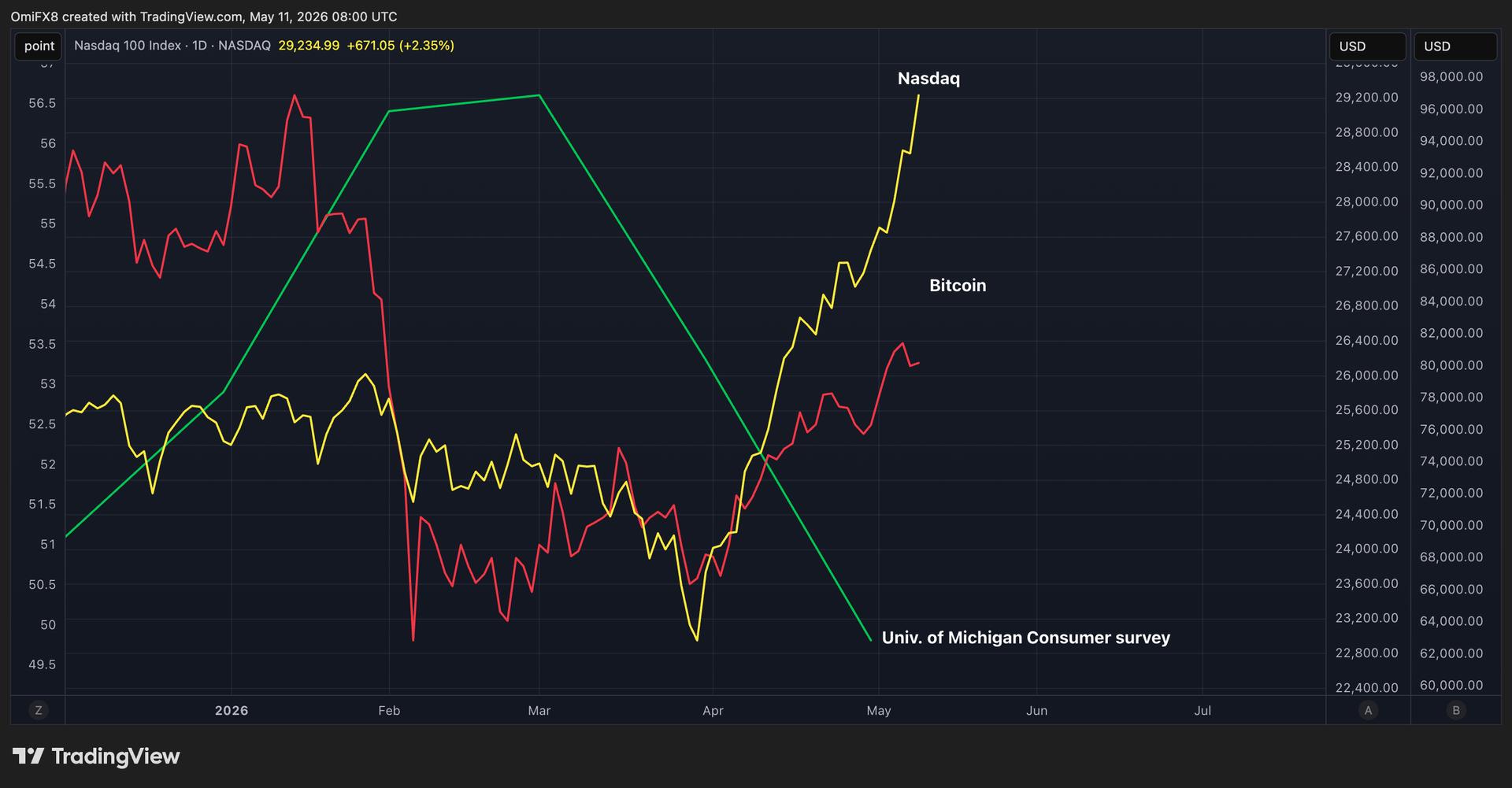
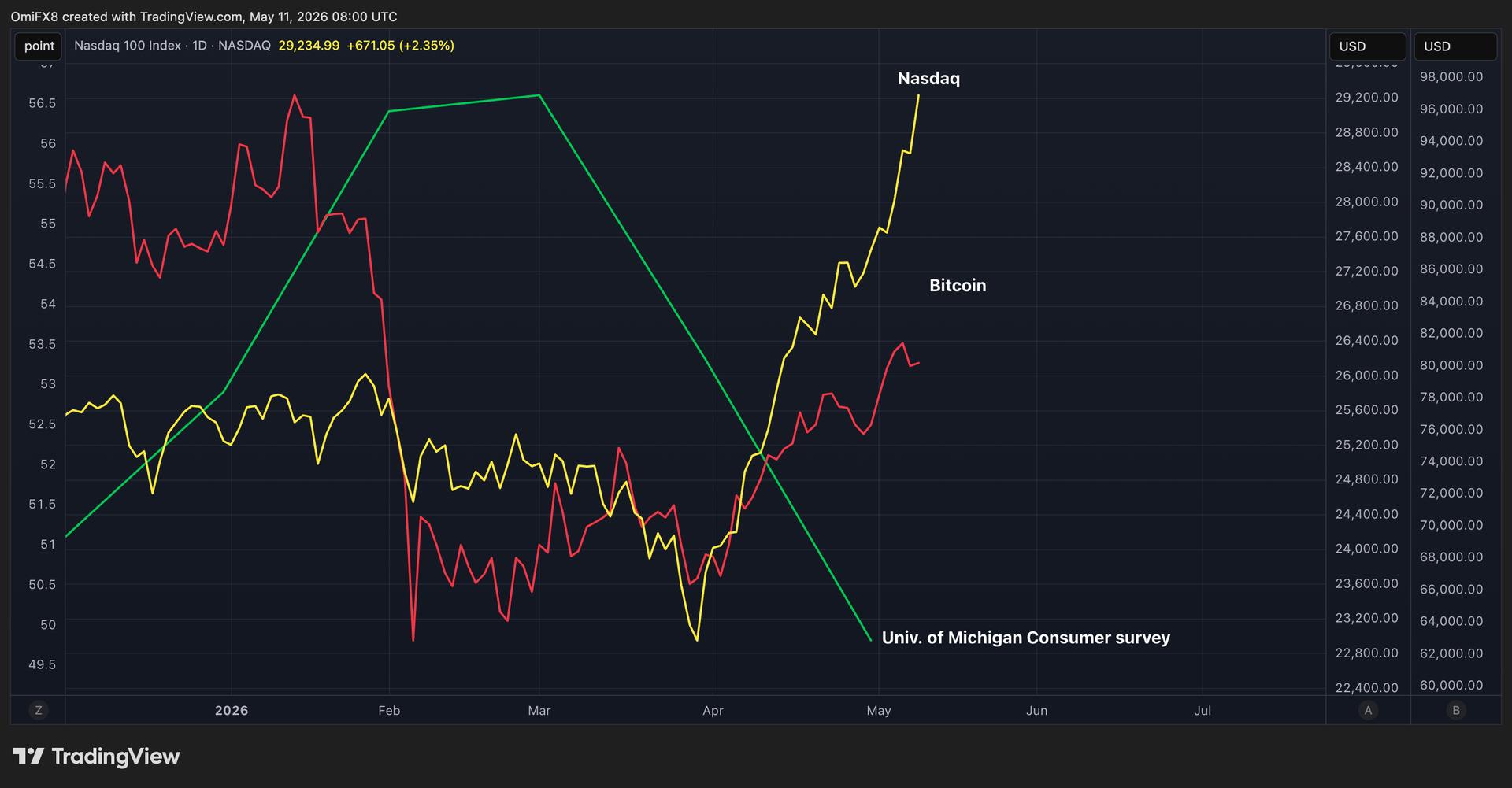
Major financial assets and the American consumer are moving in opposite directions, telling two very different stories about the U.S. economy.
Bitcoin, the leading cryptocurrency by market value and a macro asset, jumped 11.8% last month, the largest gain since April 2025 and has since extended the rally by nearly 6% to $80,700, CoinDesk data show.
This upswing has come alongside record risk-taking on Wall Street, as the tech-heavy Nasdaq index has jumped 22% since April 1, hitting a lifetime high of 23,235 points. The broader index, S&P 500, has rallied over 12% to 7,398 points, according to data source TradingView.
The combined rally in stocks and crypto is normally expected to lift the spirits of the American consumer, who is known to invest in both assets. Reports suggest approximately 30% of American adults, or 70.4 million people, own cryptocurrency. Further, on average, 62% of adults have owned stocks since 2023.
But that’s not the case, as highlighted by the University of Michigan’s closely watched survey of consumers released Friday. The survey posted a preliminary record-low reading of 48.2 points, down 7.7% from a year ago and extending the decline from April’s reading of 49.8 points.
In simple terms, the American consumer is more downbeat than ever, and it’s mainly due to inflation fears. One-third of respondents cited gas prices as the biggest concern, and another one-third cited tariffs.
The growing disconnect between Wall Street and Main Street reflects two very different economic realities, according to Alvin Kan, COO at Bitget Wallet.
“Institutional capital continues flowing into AI, semiconductors, and digital assets, pushing the Nasdaq and Bitcoin higher as markets price in long-term productivity growth and technological transformation. At the same time, consumer confidence remains weak as households continue dealing with inflation, high living costs, and economic uncertainty. In effect, markets are trading the future while consumers are still focused on present-day financial pressure,” Kan told CoinDesk.
An AI capex boom and strong corporate earnings from mega-cap tech companies have driven the Nasdaq rally, stoking demand for other emerging technologies such as bitcoin. The U.S.-listed spot ETFs have pulled in billions in recent weeks amid the Nasdaq rally.
“This divergence is being driven by strong tech earnings, sustained ETF and institutional inflows into Bitcoin, and the growing role of digital assets as both growth and diversification plays. It also shows how crypto is increasingly tied to macro liquidity and innovation cycles instead of purely retail sentiment,” Kan said.
Bitcoin and Nasdaq are known to share a strong positive correlation. The crypto market began as a grassroots movement, often moving independently of Wall Street and traditional financial markets. But the rapid institutionalization following the launch of spot ETFs two years ago has made its price action increasingly correlated with broader equity markets.
That shift in how investors view BTC, decoupling it from Main Street sentiment, is evidence of the fading promise of financial democratization, according to Markus Thielen, founder of 10x Research.
“The democratization of finance was once one of crypto’s defining promises, yet reality has moved in the opposite direction. Wealth remains heavily concentrated in the hands of a small minority, a trend that is even more pronounced in the US stock market, where gains have increasingly accrued to the wealthiest participants,” Thielen told CoinDesk.
What next?
When rising costs squeeze households, it may seem natural to expect markets to align with the dour sentiment on Main Street. But that’s not necessarily promised.
“This gap is expected to persist,” Gracy Chen, CEO of Bitget, said.
She added that digital assets are increasingly diverging from traditional cycles and attracting fresh capital seeking asymmetric returns, suggesting promising long-term structural growth.
“While risks such as monetary policy tightening, geopolitical macro events, or regulatory shifts could add near-term pressure. However, the emerging ecosystem is maturing and becoming a core tool for diversification and active risk management in volatile markets,” she noted.


Capital B has raised €15.2 million ($17.8 million) from institutional investors, including Blockstream CEO Adam Back and French asset manager TOBAM.
Summary
- Capital B raised €15.2 million from institutional investors including Adam Back and TOBAM.
- Company estimates show the latest funding could increase its bitcoin holdings to 3,125 BTC.
- Warrant exercises linked to the private placement could unlock another €99.1 million in capital.
According to Capital B’s May 11 press release, the company issued 23 million shares with attached warrants at €0.66 per ABSA through a private placement reserved for institutional investors in the U.S., Europe, and other jurisdictions. The company said the offering was subscribed by global investors, with Maxim Group acting as lead placement agent and Marex serving as co-manager.
Net proceeds from the transaction are expected to reach about €14.4 million ($17 million) after fees, according to the company. Capital B said the funds, together with existing operations, could support the purchase of another 182 BTC and raise its total holdings to 3,125 BTC. The firm currently holds 2,943 BTC, according to bitcointreasuries.net data cited in earlier company disclosures.
Each newly issued share carries four warrants split across three exercise price levels. Capital B stated that two Warrant 2026-03 instruments can be exercised at €0.86 per share, while Warrant 2026-04 and Warrant 2026-05 carry exercise prices of €1.12 and €1.46, respectively. If all warrants are exercised, the company said it could secure an additional €99.1 million through the issuance of more than 92 million new shares.
Fresh participation from Adam Back adds to an existing position that has grown steadily over recent months. Earlier in May, Capital B disclosed that Back subscribed to 10 million warrants worth €1.1 million ($1.28 million), with each warrant carrying a share purchase right at €0.84.
Following the latest raise, Capital B said Back is expected to control 13.43% of the company on an ordinary basis, while Blockstream Capital Partners, advised by Back, would hold 14.42%. TOBAM’s ownership would rise to 4.20% after completion of the transaction.
Company filings also show the placement of diluted existing shareholders. Capital B clarified that an investor holding 1% of the company before the issuance would see that stake reduced to 0.92% on a non-diluted basis after the placement closes. Full warrant exercise would reduce the same holding to 0.71%, according to the filing.
Originally operating as The Blockchain Group, the company rebranded to Capital B in July 2025 after restructuring around a bitcoin treasury model. Its stated strategy focuses on increasing the amount of bitcoin held per fully diluted share over time.
Recent disclosures across listed bitcoin treasury firms have shown mixed approaches toward balance sheet management.
While Capital B and UK-listed Connecting Excellence Group both raised capital with backing from Adam Back in recent weeks, Nasdaq-listed Nakamoto disclosed in April that it had launched a derivatives strategy tied to its bitcoin reserves after previously reporting the sale of 284 BTC in an SEC filing.
Meanwhile, Genius Group said in February that it liquidated its entire bitcoin treasury to repay debt obligations.
Key Takeaways
- AI agents perform complete tasks autonomously, going far beyond traditional chatbots that simply respond to queries
- Deloitte reports approximately 85% of enterprises plan to develop customized AI agents tailored to their specific operations
- Anthropic introduced Claude-based agents specifically designed for financial institutions, focusing on modeling, analytics, and due diligence tasks
- AWS collaborated with Coinbase and Stripe to enable AI agent payment capabilities through Amazon Bedrock AgentCore
- Cryptocurrency wallets and stablecoins are emerging as preferred payment infrastructure for autonomous AI agents
AI agents represent one of 2026’s most significant technological developments. But what actually distinguishes them from the AI applications already in widespread use?
A typical chatbot provides answers to questions. You submit a query, receive a response, and handle everything else yourself. An AI agent operates on an entirely different level. It can strategize, leverage multiple tools, access various data sources, and execute a series of coordinated steps to achieve specific objectives.
Consider this practical example: a chatbot informs you about available hotels in Lisbon. An agent independently searches options, evaluates pricing across platforms, analyzes guest reviews, aligns choices with your budget parameters, and facilitates the actual booking process.
This fundamental distinction is generating substantial interest from both corporate decision-makers and investment communities.
The Rapid Enterprise Shift Toward AI Agents
According to consulting powerhouse Deloitte, artificial intelligence is transitioning from experimental projects to full-scale corporate deployment. Approximately 60% of employees now utilize sanctioned AI tools in their daily work.
Deloitte’s research further indicates that autonomous agents are being rapidly integrated into enterprise environments. Roughly 85% of organizations anticipate developing or adapting agents for their particular business requirements.
This data reveals the velocity of market transformation. Organizations have moved beyond questioning whether AI can generate text. The current focus centers on whether it can manage entire workflow segments.
Anthropic unveiled Claude-based agents specifically targeting financial services firms. Applications span financial modeling, complex data operations, and comprehensive customer due diligence. This represents a strategic entry into industries where automation delivers maximum value.
Developers are simultaneously building agents for software development, prospect identification, document analysis, market surveillance, and numerous other functions. Effective agents require more than sophisticated language models. They demand memory systems, tool integration, data connectivity, and well-defined operational parameters.
Cryptocurrency Integration with AI Agent Payments
A particularly significant development for cryptocurrency investors involves payment capabilities.
If AI agents operate independently online, they inevitably require payment functionality. AWS recently unveiled Amazon Bedrock AgentCore Payments, developed in partnership with Coinbase and Stripe. This system enables agents to purchase web content, access APIs, and procure various digital services.
The underlying payment infrastructure comes from Coinbase and Stripe. This creates a direct connection between autonomous AI agent operations and cryptocurrency infrastructure.
Stablecoins are emerging as particularly well-suited for agent payment systems. They enable rapid transactions, function seamlessly across international boundaries, and accommodate microtransactions efficiently.
This explains why cryptocurrency investors view AI agents as potentially significant drivers of stablecoin adoption moving forward.
Agents currently face genuine limitations. They can produce errors, misinterpret directives, or execute unintended actions. Issues surrounding privacy protection, security protocols, and accountability frameworks remain under development.
Organizations implementing agents require transaction limits, authorization protocols, and comprehensive audit capabilities.
The Coinbase and Stripe collaboration with AWS demonstrates that substantial infrastructure is actively being constructed. The critical questions now center on adoption velocity and which platforms will establish themselves as industry standards.


Australia’s Labor government has proposed replacing the country’s long-standing capital gains tax discount with an inflation-indexed model that could raise tax liabilities for crypto investors holding assets over extended periods.
Summary
- Australia plans to replace its 50% capital gains tax discount with an inflation-indexed model from July 2027.
- Long-term crypto and share investors could face higher tax bills under the proposed changes reported by the Australian Financial Review.
The Australian Financial Review reported on Sunday, citing people familiar with the fiscal year 2027 budget, that the Albanese government plans to remove the current 50% capital gains tax discount as part of a wider package of tax changes tied to investment and housing policy. Under the existing system, Australians who hold assets for more than 12 months can reduce taxable capital gains by half.
Instead of the discount model, the proposed framework would tax inflation-adjusted real gains across the full holding period of an asset. Long-term investors with modest inflation-adjusted returns could end up paying more tax, particularly higher-income earners with exposure to shares, crypto, and commercial assets.
Changes outlined in the federal budget are expected to take effect from July 2027, according to the AFR report. Assets purchased after May 10 would receive a one-year transition arrangement before the new rules fully apply. Investments acquired before that date would retain partial access to the current discount system, with tax treatment calculated proportionally based on how long the asset was held under each regime.
Criticism from market participants surfaced shortly after details of the proposal emerged. Chris Joye, portfolio manager at Coolabah Capital Investments, argued that the changes would discourage investment across productive sectors of the economy.
“After the budget doubles the capital gains tax on productive businesses and assets from about 23.5% to 46-47%, investors will understandably pull money from businesses, shares, commercial property and rental housing and plough it into their tax-free owner-occupied home,” Joye said.
Joye added that owner-occupied housing would become “the single biggest winner from the budget” because investors would redirect capital toward tax-advantaged property instead of business or market investments.
Scott Phillips, chief investment officer at investment advice firm The Motley Fool, took a different view. In comments posted on X, Phillips said investors affected by the changes would still have strong incentives to pursue long-term growth opportunities because profitable investments would continue generating substantial returns even with higher tax obligations.
The proposed tax overhaul arrives as Australian policymakers continue shaping rules around digital assets and tokenized finance. In April, a draft payments vision co-developed by the Account-to-Account Payments Roundtable identified stablecoins and tokenized liabilities as technologies moving “from experimentation to adoption.”
Members of the roundtable include AusPayNet, Australian Payments Plus, the Reserve Bank of Australia, and the Commonwealth Treasury. The draft stated that account-to-account payment infrastructure may eventually need to support interoperability between traditional bank money and tokenized fiat representations.
U.S. Federal Reserve changes, inflation data and earnings dominate the week’s calendar, with markets weighing bitcoin’s newfound strength against a packed macro slate.
“The market is entering a phase where liquidity is becoming more selective rather than purely speculative,” Jake Seltzer, CEO of Quantix Finance, told CoinDesk in an emailed statement. “Bitcoin continuing to strengthen at these levels is important because it’s reinforcing confidence across the broader digital asset market, particularly among institutional allocators that were previously sitting on the sidelines.”
This week will see inflation data coupled with earnings from many crypto companies.
“Near term, markets will still be driven by macro conditions, ETF flows, and global liquidity, so volatility is expected,” Seltzer said. “But structurally, the industry feels much healthier than previous cycles.”
Seltzer said capital is starting to favor “real infrastructure, sustainable yield models, and platforms with actual risk management behind them rather than short-term narratives alone.”
That shift will also put infrastructure in focus. Azul, an upgrade for the Base blockchain, is expected to go live on mainnet, Ronin is set to move back to Ethereum, and several DAOs are voting on treasury, recovery and MEV-related proposals as the ecosystem recovers from the largest exploit of the year to date.
What to Watch
(All times ET)
- Crypto
- May 11: U.S. Senate expected to hold a procedural vote on Kevin Warsh’s Federal Reserve nomination package.
- May 13: Base Azul expected to go live on mainnet.
- May 14: U.S. Senate Banking Committee markup scheduled for the Digital Asset Market Clarity Act of 2025.
- May 15: Jerome Powell’s term as Federal Reserve Chair officially ends; his board term continues until Jan. 31, 2028.
- Macro
- May 12, 01:00 a.m.: Germany Inflation Rate Final for April YoY est. 2.9% (Prev. 2.8%); MoM est. 0.5% (Prev. 1.2%)
- May 12, 05:30 a.m.: India Inflation Rate YoY for April est. 3.8% (Prev. 3.4%); MoM (Prev. 0.26%)
- May 12, 07:30 a.m.: U.S. Core CPI MoM for April est. 0.4% (Prev. 0.2%); YoY (Prev. 2.6%)
- May 12, 07:30 a.m.: U.S. CPI MoM for April est. 0.6% (Prev. 0.9%); YoY (Prev. 3.3%)
- May 13, 07:30 a.m.: U.S. PPI MoM for April est. 0.4% (Prev. 0.5%); YoY (Prev. 4.0%)
- May 13, 07:30 a.m.: U.S. Core PPI MoM for April (Prev. 0.1%); YoY (Prev. 3.8%)
- May 14, 01:00 a.m.: U.K. GDP Growth Rate Q1 Prel. QoQ (Prev. 0.1%); YoY (Prev. 1.0%)
- May 14, 07:30 a.m.: U.S. Retail Sales MoM for April (Prev. 1.7%)
- May 14, 07:30 a.m.: U.S. Initial Jobless Claims for period ending May 9 (Prev. 200K)
- (Prev. 11)
- May 15, 08:15 a.m.: U.S. Industrial Production MoM for April (Prev. -0.5%)
- May 17, 09:00 p.m.: China Industrial Production YoY for April (Prev. 5.7%); Retail Sales YoY (Prev. 1.7%); Fixed Asset Investment YTD YoY (Prev. 1.7%); Unemployment Rate (Prev. 5.4%)
- Earnings (Estimates based on FactSet data where available)
- May 11: MARA Holdings (MARA), post-market, –$0.45
- May 11: CleanSpark (CLSK), post-market, -$0.23
- May 11: Circle Internet Group (CRCL), pre-market, $0.17
- May 11: Exodus Movement (EXOD), post-market, $0.01
- May 11: Bakkt (BKKT), post-market, -$0.10
- May 11: Sharplink (SBT), pre-market, $0.01
- May 12: EToro Group (ETOR), pre-market, $0.69
- May 12: Coincheck Group (CNCK), post-market, -$0.01
- May 12: TON Strategy Company (TONX), pre-market, -$1.42
- May 13: Bitgo Holdings (BTGO), post-market, -$0.01
- May 14: Bullish (BLSH), pre-market, $0.16
- May 14: Rumble (RUM), post-market, -$0.09
- May 14: Gemini Space Station (GEMI), post-market, -$1.13
- May 14: Bitdeer Technologies (BTDR), pre-market, -$0.33
- May 14: Applied Materials (AMAT), post-market, $2.66
Token Events
- Governance votes & calls
- 1inch DAO is voting to allocate $155,000 USDC for its 2026 public policy and regulatory advocacy program, funding trade group memberships and direct U.S. lawmaker engagement. Voting ends May 11.
- Compound DAO is voting to contribute about 1,860 ETH to the DeFi United rsETH recovery effort. The funds will be sourced exclusively from the attacker’s recovered position on Compound rather than the broader treasury, ensuring the DAO does not profit from the exploit. Voting ends May 11.
- Balancer DAO is voting to distribute a one-time 500,000 USDC airdrop to veBAL holders as compensation for discontinued incentives, replacing a planned six-month payout. Voting ends May 12.
- GnosisDAO is voting to let holders burn GNO for a pro-rata share of the treasury’s liquid assets and a synthetic claim token for illiquid investments. Voting ends May 12.
- QuickSwap DAO is voting to integrate the MEV-X Homelander plugin to capture backrunning MEV from its liquidity pools and redistribute the profits back to the protocol and its liquidity providers. Voting ends May 12.
- ShapeShift DAO is voting to formalize its Treasury Signer role as a paid position of $1,000 per month in FOX and update the selection committee’s rules for appointing signers privately. Voting ends May 13.
- Decentraland DAO is voting to remove the peer.kyllian.me catalyst node following its owner’s removal from the Security Advisory Board. Voting ends May 14.
- Unlocks
- May 12: Avalanche (AVAX) to unlock 0.31% of its circulating supply worth $16.55 million.
- May 15: Connex (CONX) to unlock 1.49% of its circulating supply worth $17.99 million.
- May 16: Arbitrum (ARB) to unlock 1.71% of its circulating supply worth $13.23 million.
- Token Launches
- May 11–17: First full week of Pump.fun’s revised tokenomics.
- May 12: Ronin officially moves back to Ethereum.
Conferences

Cryptocurrency staking has become one of the most popular ways for investors to earn passive income in the digital asset market. Many blockchains now encourage users to “stake” their coins in exchange for rewards, often advertising attractive annual returns that appear far higher than traditional savings accounts.
But beneath the promise of passive earnings lies a more technical system involving validators, network security, lock-up periods, and risk management. Understanding how staking actually works is essential before committing funds to any blockchain protocol.
This article breaks down the fundamentals of crypto staking simply and practically.
What Is Crypto Staking?
Crypto staking is the process of locking cryptocurrency into a blockchain network to help support its operations. In return, participants receive rewards from the network.
Staking is commonly associated with blockchains that use a mechanism called Proof of Stake (PoS).
Unlike Bitcoin’s Proof of Work system, where miners use computing power to validate transactions, Proof of Stake networks rely on users who commit coins to the network. These users help verify transactions and maintain blockchain security.
Popular staking networks include:
- Ethereum
- Solana
- Cardano
- Avalanche
- Polkadot
When you stake crypto, you are essentially helping the blockchain remain decentralized and operational.
The Role of Validators
Validators are the backbone of Proof of Stake blockchains.
A validator is responsible for:
- Confirming transactions
- Producing new blocks
- Securing the network
- Preventing fraudulent activity
To become a validator, users usually need to stake a significant amount of cryptocurrency. For example, Ethereum validators require 32 ETH to operate independently.
Because running a validator can be technically demanding, many users instead delegate their tokens to professional validators through staking platforms or wallets.
Here is the simplified process:
- You stake your tokens
- Your tokens are delegated to a validator
- The validator participates in securing the network
- Rewards are distributed among participants
The more stake a validator controls, the greater the chance they are selected to validate transactions and earn rewards.
Where Do Staking Rewards Come From?
Many beginners assume staking rewards are “free money.” In reality, rewards come from several blockchain mechanisms.
These usually include:
1. Newly Issued Tokens
Some blockchains create new coins over time to incentivize validators and stakers.
This works similarly to how central banks issue currency, except blockchain issuance follows programmed rules.
2. Transaction Fees
Users pay transaction fees whenever they interact with the blockchain.
Part of those fees may be distributed to validators and delegators.
3. Network Incentives
Certain protocols offer additional incentives to encourage participation during early growth stages.
This is why newer projects sometimes advertise unusually high staking returns.
Understanding Lock-Up Periods
One of the most misunderstood aspects of staking is liquidity restriction.
When you stake crypto, your assets are often locked for a certain period of time.
This means:
- You may not be able to sell immediately
- You may need to wait days or weeks to unstake
- Market volatility can affect your holdings during the lock-up
For example:
- Some networks allow flexible staking with instant withdrawals
- Others impose “bonding” periods ranging from several days to several weeks
This matters because crypto markets move quickly. A token’s price can rise or collapse while your funds remain locked.
Investors should always check:
- Unstaking periods
- Withdrawal delays
- Early exit penalties
- Liquidity conditions
before committing funds.
The Main Risks of Staking
Staking is often promoted as low-risk passive income, but it still carries significant risks.
1. Price Volatility
The largest risk is often not staking itself, but the cryptocurrency’s price movement.
Example:
- You earn 8% annual staking rewards
- But the token loses 40% of its market value
In that case, the staking yield does not offset the capital loss.
2. Validator Failure
If a validator behaves maliciously or experiences downtime, penalties may occur.
This process is known as slashing.
Slashing can reduce the validator’s stake — and potentially affect delegated users as well.
3. Smart Contract Risks
Some staking platforms rely on smart contracts.
If vulnerabilities exist, funds could be exploited or lost.
This is particularly important in decentralized finance (DeFi) ecosystems.
4. Centralization Risks
Large staking providers can accumulate excessive control over networks.
If too much stake becomes concentrated among a few entities, blockchain decentralization weakens.
5. Liquidity Risk
Locked funds may prevent investors from reacting to sudden market conditions.
This becomes especially dangerous during major market crashes.
The Truth About APR and APY
One of the biggest misconceptions in crypto staking involves advertised returns.
You will often see platforms promoting:
- 15% APR
- 40% APY
- Even triple-digit yields
These numbers can be misleading.
APR vs APY
- APR (Annual Percentage Rate) = simple yearly return without compounding
- APY (Annual Percentage Yield) = includes compounding rewards
Higher APY figures often assume rewards are continuously restaked.
Why High APR Does Not Always Mean High Profit
A high-stakes APR does not guarantee real gains.
Several factors can reduce profitability:
- Token inflation
- Falling token prices
- Reward dilution
- Temporary promotional incentives
For example:
A project may offer 80% staking rewards, but if the token loses 85% of its value, stakers still lose money overall.
This is why experienced investors evaluate:
- Token fundamentals
- Network adoption
- Inflation rate
- Validator quality
- Long-term sustainability
Instead of focusing only on reward percentages.
Is Staking Safe?
Staking is generally considered safer than speculative trading, but it is not risk-free.
The safety of staking depends on:
- The quality of the blockchain
- Validator reliability
- Platform security
- Market conditions
- Smart contract design
Major established networks tend to carry lower operational risk than smaller experimental projects.
However, even reputable ecosystems can experience technical failures, governance issues, or severe price declines.
Liquid Staking: A Growing Trend
To solve liquidity problems, many platforms now offer liquid staking.
Liquid staking allows users to:
- Stake assets
- Continue earning rewards
- Receive a tokenized representation of their staked assets
These tokenized assets can sometimes be traded or used in DeFi applications while the original funds remain staked.
Although convenient, liquid staking introduces additional smart contract and counterparty risks.
Final Thoughts
Crypto staking plays a critical role in modern blockchain networks. It helps secure decentralized systems while allowing users to earn rewards for participation.
However, staking is far more complex than simply “locking coins for passive income.”
Validators maintain network integrity, rewards are tied to economic incentives, lock-up periods affect liquidity, and high APR figures can sometimes create unrealistic expectations.
For beginners, the most important lesson is this:
Staking rewards should never be evaluated in isolation. The long-term value of the underlying asset, the security of the network, and the sustainability of the reward model matter far more than headline percentages.
As Proof of Stake ecosystems continue expanding, staking will likely remain a central pillar of the cryptocurrency economy — but informed participation will always be more important than chasing the highest yield.
REQUEST AN ARTICLE

How AI Is reshaping cross-border accounting & financial advisory

The Best Financial Advisory video you will see. The 3 Most Important Plates of your Finances

High Street chain could enter administration in weeks

Manchester United reach agreement with Casemiro over contract clause amid transfer speculation

US brings back mandatory military draft registration

Steven Gerrard disagrees with Gary Neville over ‘shock’ Chelsea and Arsenal claim | Football


-
 Crypto World3 days ago
HarrisX Poll Found 52% of Registered Voters Support the CLARITY Act
-

 Crypto World4 days ago
Upbit adds B3 Korean won pair as Base token gains Korea access
-

 Fashion3 days ago
Weekend Open Thread: Marianne Dress
-

 Tech7 days ago
Image AI models now drive app growth, beating chatbot upgrades
-
 NewsBeat4 days ago
NCP car park operator enters administration putting 340 UK sites at risk of closure
-

 Politics2 days ago
Politics Home Article | Starmer Enters The Danger Zone
-
 Business2 days ago
Ignore market noise, India’s long-term story intact, say D-Street bulls Ramesh Damani and Sunil Singhania
-
 Sports7 days ago
2026 NHL playoff picks: Second-round predictions, series odds, Stanley Cup bracket
-

 Crypto World6 days ago
UAE Free Zone Deploys Blockchain IDs to Verify Registered Firms
-

 Tech2 hours ago
GM Agrees To Pay $12.75 Million To Settle California Lawsuit Over Misuse Of Customers’ Driving Data
-

 Crypto World5 days ago
BlackRock CEO Larry Fink Discusses a New Asset Class
-

 Crypto World4 days ago
Robinhood says Wall Street is building onchain
-

 Tech1 day ago
Auto Enthusiast Carves Functional Two-Stroke Engine from Solid Metal
-
Entertainment6 days ago
Serena Williams hits Met Gala in metallic dress after GLP-1 reveal
-

 Tech5 days ago
Apple and Samsung are dominating smartphone sales so thoroughly that only one other company makes the top 10
-

 Entertainment7 days ago
Skai Jackson Responds To AI Baklash After Viral Snapchat Photos
-

 Politics6 days ago
Met Gala 2026: Madonna’s Dramatic Red Carpet Look Steals The Show
-

 Fashion4 days ago
The Best Work Pants for Women in 2026
-
 Sports7 days ago
Hearts v Rangers LIVE: Prediction, team news and line-ups as Scottish Premiership title rivals meet at Tynecastle
-

 Tech5 days ago
I tested the Xiaomi 17 Ultra’s camera and I don’t think I’ll ever go back to an iPhone
You must be logged in to post a comment Login