
Crypto World
BeInCrypto 100 Institutional Awards Nomination: Zodia Custody for Best Digital Asset Custody Provider



Institutional digital asset custody has long forced firms to choose between safety and flexibility. Cold storage protects assets but slows trading, while faster market access can add counterparty, prefunding, and operational risks.
Zodia Custody is building around that gap. The firm is nominated for Best Digital Asset Custody Provider at the BeInCrypto Institutional 100 Awards 2026.
Founded
Backed By
Offices
Jurisdictions
Employees
Regulatory Footprint
2020
5 banks
7
15+
150+
5
Zodia Custody Infrastructure Snapshot
The nomination centers on the launch of Zodia Switch, a custody-native asset swap product announced in February 2026 in partnership with LMAX Group.
Zodia Switch allows institutional clients to initiate asset-to-asset swaps directly from their secure custodial wallets.
The product supports ERC-20 assets including ETH, wrapped BTC, RLUSD, USDC, and USDT, without requiring clients to pre-fund an LMAX trading account or move assets off-platform.
That matters because portfolio rebalancing is still one of the most awkward parts of institutional crypto operations. Firms often need to move assets from custody to an external trading venue just to adjust exposure. That creates delays, additional approvals, and more points of operational risk.
Zodia Switch keeps that workflow inside the custody environment. Pricing and execution come from LMAX through infrastructure embedded into Zodia’s platform, while clients retain governance controls, permissioned AML screening, and audit trails.
Bringing Trading Closer to Custody
Zodia Custody was established in late 2020 by SC Ventures, Standard Chartered’s innovation unit, and Northern Trust. The firm was built to bring banking-grade custody standards into digital assets.
Its shareholder base now includes Standard Chartered, Northern Trust, SBI Holdings, National Australia Bank, and Emirates NBD. Emirates NBD became the fifth traditional financial institution to back the company through a strategic investment in December 2024.
The bank-backed structure is central to Zodia’s positioning. Custody is one of the few parts of digital asset infrastructure where institutions still expect familiar controls: segregation, governance, auditability, compliance, and clear legal accountability.
Zodia Switch extends that model from safekeeping into portfolio activity. The product does not turn Zodia into a trading venue. Instead, it lets institutions access liquidity from inside their custody setup.
That is a practical shift. It reduces the need to choose between keeping assets protected and making them usable.
A Wider Institutional Product Stack
Zodia Switch builds on a wider custody and settlement suite.
The firm already offers Interchange, its off-exchange settlement product with LMAX. It also offers Solutions by Zodia Custody, a white-label custody infrastructure product for banks, alongside services for government and law enforcement clients.
Zodia has also become part of Europe’s regulated digital asset product market. Its custody mandates include 21Shares’ physically backed ABTC ETP, Invesco’s European Physical Bitcoin ETP, and Bitwise, formerly ETC Group. Invesco states that each Physical Bitcoin ETP certificate is secured by Bitcoin held offline in cold storage by Zodia Custody.
The firm is also connected to new post-trade infrastructure. ClearToken’s CT Settle, a delivery-versus-payment settlement service for cryptoassets, stablecoins, and fiat currency, used Zodia Custody as the sole digital custodian in its first settlement cycle. The platform is powered by Nasdaq Eqlipse Clearing technology.
Zodia’s regulatory footprint has also expanded. In January 2026, French market regulator AMF listed Zodia Custody Europe S.A. as a MiCA-licensed CASP passporting from Luxembourg, authorized for custody and administration of crypto-assets on behalf of clients and crypto-asset transfer services.
Standard Chartered Moves Closer
Zodia’s nomination also comes as Standard Chartered appears to be bringing digital asset custody deeper into its institutional banking strategy.
On April 8, 2026, reports suggested that Standard Chartered was seeking to merge parts of majority-owned Zodia Custody with one of its digital asset operations. The report said the bank planned to integrate Zodia’s crypto custody business into a division inside its corporate and investment bank that provides similar services.
That move would underline the direction of the market. Digital asset custody is no longer a side product for financial institutions. It is becoming part of the same infrastructure stack as trading, settlement, collateral management, and tokenized asset services.
For Zodia, the timing strengthens the nomination. The firm already sits at the intersection of bank ownership, regulated custody, ETP servicing, and institutional trading workflows. Zodia Switch gives that position a sharper product story.
The BeInCrypto Institutional 100 Awards recognize firms building the systems that could define the next phase of digital finance. Zodia Custody’s nomination reflects its role in moving institutional custody from passive safekeeping toward controlled, auditable asset activity.
The post BeInCrypto 100 Institutional Awards Nomination: Zodia Custody for Best Digital Asset Custody Provider appeared first on BeInCrypto.


TLDR:
-
- Ondo Finance holds roughly 70% of the tokenized stock market share, with over $825M in total value locked.
- Holders of 250+ tokenized stocks and ETFs can now participate in proxy voting through Broadridge’s network.
- Voting recommendations are weighted proportionately based on each token holder’s onchain ownership stake.
- Ondo tokenized stocks are live on Solana, Ethereum, and BNB Chain, backed by Binance, MetaMask, and Ledger.
- Ondo Finance holds roughly 70% of the tokenized stock market share, with over $825M in total value locked.
Ondo Finance has announced a partnership with Broadridge to bring proxy voting to holders of tokenized stocks and ETFs.
Through this integration, holders of over 250 tokenized products can now access corporate governance tools. Broadridge serves more than 10,000 public companies and connects issuers with investors globally.
The collaboration adds a meaningful layer of functionality to Ondo’s growing platform for onchain securities. This development comes as tokenized asset markets continue to expand.
Connecting Onchain Holders to Corporate Governance
Ondo Finance will allow token holders to participate in proxy voting for underlying securities. Holders can also access prospectuses, regulatory filings, and issuer communications through Broadridge’s established infrastructure.
Voting recommendations will be weighted proportionately based on each holder’s token ownership. This structure ensures governance participation reflects actual onchain holdings accurately.
Broadridge will aggregate token holder preferences alongside votes from traditional market participants. This aggregation requires consent from Ondo Global Markets before any votes are consolidated.
As a result, onchain investors gain access to governance tools previously available only to conventional shareholders. The integration also preserves blockchain benefits such as 24/7 trading and free token transferability.
Ondo Finance announced the development through its official channels, writing: “Ondo is partnering with Broadridge to enable holders of tokenized stocks and ETFs to participate in proxy voting and access regulatory filings and issuer communications for underlying securities.”
Matthieu de Vergnes, MD and Global Head of Institutional at Ondo Finance, addressed the announcement directly.
He stated that the partnership enables onchain tokenized stock holders to access governance and voting capabilities.
He added that corporate governance participation is another step toward delivering institutional-quality products onchain. The firm views this as a natural extension of its core design goals.
Doug DeSchutter, President of Investor Communication Solutions at Broadridge, also commented on the collaboration.
He said the partnership helps define the next generation of market infrastructure. He described it as a bridge between investor protections in traditional finance and the programmability of public blockchains. Both parties anticipate further developments as the integration progresses.
Ondo’s Position in the Tokenized Stock Market
Ondo Finance currently holds roughly 70% of total tokenized stock market share. At its peak, the platform recorded over $825 million in total value locked.
This spans more than 250 tokenized stocks and ETFs across the platform. Tens of thousands of asset holders use Ondo’s onchain securities products today.
The platform operates across Solana, Ethereum, and BNB Chain. It is supported by leading wallets, exchanges, custodians, and protocols.
Binance, Bitget, MetaMask, Ledger, and Blockchain.com are among the key supporting partners. This broad ecosystem support reflects the platform’s reach across the broader crypto market.
The Broadridge partnership builds directly on this existing infrastructure. It adds governance access that was previously unavailable to onchain investors.
As tokenized assets gain wider adoption, proxy voting becomes an increasingly relevant feature. This collaboration reinforces Ondo’s ongoing goal of matching traditional market standards on the blockchain.



Best Market Predictions Solution is an award category within The BeInCrypto Institutional 100, an annual research-driven program recognising institutional digital asset excellence across 26 categories and six pillars.
This category sits in Pillar 1: Retail to Crypto Bridge. The 15 firms below are its longlist, drawn from venues, broker-and-wallet integrations, decentralised protocols, and specialist liquidity infrastructure that powered institutional and retail participation in event-contract and prediction markets between April 2025 and March 2026.
During this period, the prediction market sector grew from roughly $1.2 billion in monthly notional volume to over $25 billion. A shortlist will be named in May 2026, and the winner will be announced at Proof of Talk in Paris on June 2–3, 2026.
- Longlist: 15 firms, covering CFTC-regulated DCM exchanges, broker and wallet-distributed event contract platforms, on-chain crypto-native prediction markets, DEX-integrated prediction protocols, sports-and-reputation specialists, and specialist prediction-market liquidity infrastructure
- Candidates screened: Starting pool of 34 prediction-market platforms and infrastructure providers across the institutional event-contract stack; 15 advanced to this longlist, with 5 additional firms held in the outreach pool.
- Scoring (Track B): Editorial quantitative 30% | Expert Council 50% | Disclosed 20%
- Criteria assessed: Market depth, liquidity, resolution quality, user base, regulatory standing, institutional relevance, technical infrastructure
- Sources: Regulator filings (CFTC Designated Contract Market and Derivatives Clearing Organization registers, CFTC Futures Commission Merchant and Introducing Broker rolls, ESMA event-contract guidance, FCA temporary registrations), on-chain volume data via Dune Analytics and DefiLlama, firm-published transparency reports, exchange listing disclosures, audited financial filings of public-listed parent companies, and private-market data platforms including PitchBook, Tracxn, and Crunchbase, supplemented by mainstream financial press.
| # | Firm | Sub-Segment | HQ | Scale Signal | Core Product | Representative Work |
|---|---|---|---|---|---|---|
| 1 | Polymarket | On-chain venue | New York, USA | $10B+ monthly volume $1.6B ICE commitment |
On-chain event contracts | ICE data distribution agreement Largest on-chain prediction market |
| 2 | Kalshi | CFTC-regulated DCM | New York, USA | $22B valuation $10B+ monthly volume |
Event contract exchange | First regulated US prediction market Launched crypto perpetuals (2026) |
| 3 | Robinhood Predictions | Broker distribution | Menlo Park, USA | 12B+ contracts traded 26.8M funded accounts |
In-app prediction hub | Largest retail distribution layer MIAXdx acquisition (2026) |
| 4 | Coinbase Predict | Broker distribution | United States | 100M+ users Nationwide rollout (2026) |
App-based event contracts | Integrated with Kalshi backend Regulatory litigation strategy |
| 5 | Backpack Predictions | Exchange integration | United States | $363B lifetime exchange volume Unified portfolio launched |
Cross-margined predictions | One-account system across spot and perps MiFID II access via FTX EU |
| 6 | Crypto.com Derivatives | CFTC-regulated DCM | Singapore / USA | 100M+ users 40x prediction growth |
Event contract exchange | White-label backend for multiple platforms Sports and finance markets |
| 7 | Limitless | On-chain venue | Cayman Islands | $1B+ monthly volume $2B+ cumulative |
CLOB prediction markets | Fastest growth among on-chain platforms BNB Chain expansion |
| 8 | Opinion | On-chain venue | BNB ecosystem | $158M TVL $14M+ fees generated |
Decentralized predictions | Second-largest DeFi prediction market AI-generated market rules |
| 9 | Fanatics Markets | Sports specialist | United States | 200M+ users (parent) Live in 24 states |
Sports prediction markets | Crypto.com backend integration Multi-category expansion planned |
| 10 | Manifold Markets | Reputation-based | United States | Thousands of markets Strong calibration metrics |
Play-money predictions | Widely used in research communities Open API forecasting |
| 11 | Metaculus | Reputation-based | United States | 3.5M+ predictions 20K+ active questions |
Scientific forecasting | Used by research institutions High calibration accuracy |
| 12 | Azuro | DEX infrastructure | Decentralized | 30+ frontend platforms Multi-chain deployment |
Liquidity infrastructure | Liquidity Tree model Protocol-as-infrastructure design |
| 13 | Thales Markets | DEX protocol | Decentralized | Multi-chain deployment Synthetix integration |
Binary options + sports | Longest-running Optimism protocol Overtime sports vertical |
| 14 | DraftKings Predictions | Sports specialist | United States | $14B market cap (parent) 38-state launch |
Event contract platform | CME settlement infrastructure Railbird acquisition |
| 15 | Raven Trading | Liquidity infrastructure | Bulgaria | Backed by Wintermute, Coinbase Ventures $2.7M seed round |
Market making, liquidity | Provides institutional liquidity layer Supports multi-venue depth |
About This List
The BeInCrypto Institutional 100 — Prediction Markets (2026 Long List) identifies the platforms and infrastructure enabling institutional and retail participation in event-contract markets. This includes regulated exchanges, broker integrations, on-chain venues, and supporting liquidity providers.
Methodology
This category is evaluated under Track B of the BIC 100 methodology: 30% quantitative metrics, 50% Expert Council scoring, and 20% disclosed data.
Assessment spans seven criteria: market depth, liquidity, resolution quality, user base, regulatory standing, institutional relevance, and technical infrastructure.
Data was verified using regulatory filings, on-chain analytics platforms, and private-market sources, including PitchBook and Tracxn. Figures reflect the most recent available data at publication.
The post BeInCrypto Institutional Research: 15 Growing Prediction Market Platforms appeared first on BeInCrypto.


Acting Attorney General Todd Blanche and FBI Director Kash Patel told the Bitcoin 2026 Conference in Las Vegas on April 27 that Bitcoin developers who write code without knowingly helping third parties commit crimes will not be investigated or charged, marking the clearest public statement on developer liability from the nation’s top law enforcement officials since the Tornado Cash prosecutions began.
Summary
- Blanche said the DOJ has “fundamentally changed the game” and that developers who are not knowingly helping users commit crimes are not going to be investigated or charged, while noting that laundering money or violating sanctions remains criminal regardless of whether the actor is a coder.
- Patel told the audience that the FBI’s focus has shifted toward crypto fraud networks including pig-butchering scam centers tied to foreign adversaries, with plans to travel to Cambodia, Myanmar, and Thailand this summer to conduct related enforcement work.
- Both Blanche and Patel appeared via videoconference rather than in person because they were needed in Washington DC after an assassination attempt at the White House Correspondents’ Dinner on Saturday night.
Bitcoin developers received the clearest federal reassurance in years when Acting AG Blanche and FBI Director Patel addressed the Bitcoin 2026 Conference on April 27 via videoconference, moderated by Coinbase Chief Legal Officer Paul Grewal. Bitcoin Magazine reported that Blanche told the audience: “If you are developing software, if you are a coder, if you are part of that process and you are not the third-party user and you are not helping and knowing the third party is using what you develop to commit crimes, you are not going to be investigated and not going to be charged.” Patel said Bitcoin “isn’t going anywhere” and framed it as economic infrastructure alongside other assets that power everyday life.
Bitcoin Developers Get a Federal Assurance Built on a Specific April 2025 Memo
The policy Blanche described at the conference is grounded in a memo he issued in April 2025 as Deputy Attorney General, which directed the DOJ to end “regulation by prosecution” in crypto cases and disbanded the National Cryptocurrency Enforcement Team. As crypto.news reported, that memo explicitly directed prosecutors away from cases targeting developers who create neutral tools later used by third parties, and the DOJ cited it when narrowing the charges against Tornado Cash co-founder Roman Storm ahead of his trial. Blanche was careful to draw the line precisely: writing code is protected, but knowingly facilitating money laundering or sanctions violations is not. “The mere fact that you happen to be a coder doesn’t excuse you from criminal liability,” he said. He added that developers who receive subpoenas should feel comfortable having their lawyers communicate directly with prosecutors and with him personally if they believe the case is inconsistent with his memo.
What the Blanche Remarks Mean for the Samourai Wallet and Roman Storm Cases
The clearest test of whether Blanche’s statement translates into changed outcomes will be the Roman Storm retrial. As crypto.news documented, Storm was convicted in August 2025 of operating an unlicensed money transmitter but the jury deadlocked on the two more serious charges of money laundering and sanctions violations, which carry up to 40 years in federal prison. SDNY prosecutors subsequently filed for an October retrial on those two unresolved counts. Blanche acknowledged “lingering” and “procedurally complicated” cases at the conference without naming them specifically, saying “we’re continuing to deal with” such cases while emphasizing the policy shift is real. As crypto.news tracked, the trial demonstrated that even within the existing prosecution framework, jurors struggled with the technical distinction between writing code and criminally conspiring to facilitate its misuse.
What Patel’s Enforcement Redirect Means for Crypto Fraud Victims
Patel’s message was distinct from Blanche’s developer-focused framing. Patel described pig-butchering scam networks operated out of Southeast Asia as the FBI’s primary crypto enforcement priority, saying he plans to travel to Cambodia, Myanmar, and Thailand this summer to coordinate enforcement with local authorities. As crypto.news noted, the DeFi Education Fund sent a letter to White House crypto czar David Sacks on April 28, 2025, asking Trump to discontinue what it called the “Biden-era DOJ’s lawless campaign to criminalize open-source software development,” and the industry has been watching whether Blanche’s April 2025 memo would actually change outcomes rather than just rhetoric. Grewal summarized the combined message from both officials as “crime is criminal; code alone shouldn’t be,” a framing the industry has sought from federal law enforcement for three years.
Peter Van Valkenburgh of Coin Center said the message is a step forward but that the key question remains unanswered: exactly how the DOJ draws the line between publishing open-source code and actionable knowledge of wrongdoing. The Roman Storm retrial in October will be the first real test of whether the policy shift Blanche described changes the outcome of a case already in the system.
More than 70% of crypto investors believe that Bitcoin (BTC) is undervalued, according to a recent Global Investor Survey conducted by Coinbase and Glassnode.
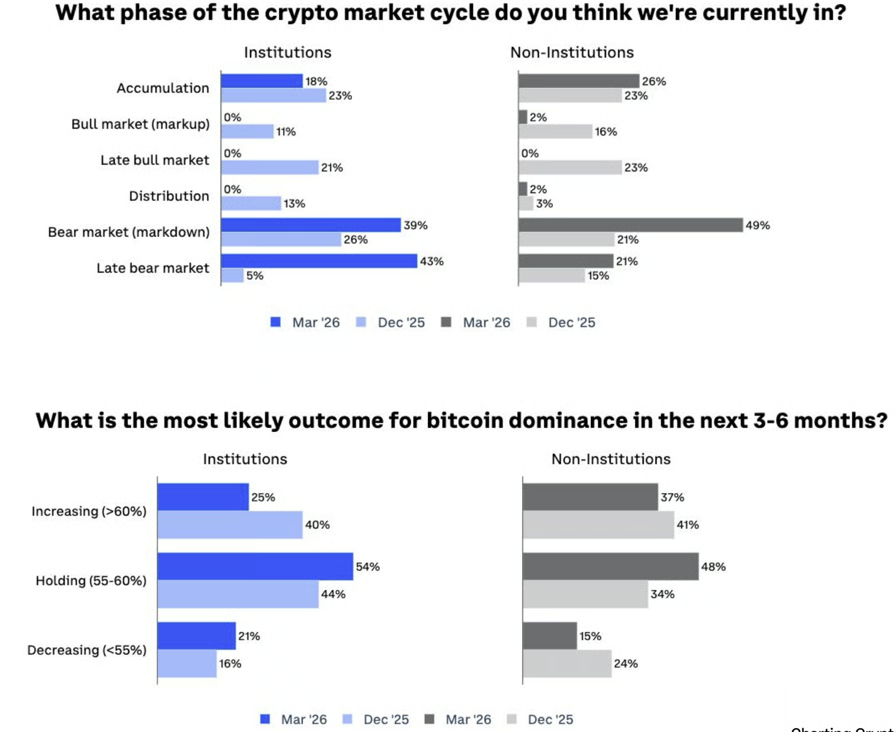
The survey found that 82% of institutions and 70% of non-institutions classify the market as a late bear cycle markdown phase, while onchain indicators suggest BTC is entering a “value-accumulation zone.”
Bitcoin is in a late bear phase as undervaluation persists
Coinbase Institutional Research surveyed 91 global investors between March 16 and April 7, including 29 institutions and 62 non-institutions. The responses show a sharp shift in perceptions for the current BTC market.
Around 82% of institutions and 70% of non-institutions now classify the market as a late bear or a markdown phase, up from roughly one-third in December.
Bitcoin investor survey data. Source: Coinbase
At the same time, the valuation views held steady. About 75% of institutions and 61% of non-institutions consider Bitcoin undervalued. Only a small share flagged it as overpriced.
The survey also noted a shift in expectations for Bitcoin dominance. The share of institutions expecting dominance to rise dropped to 25% from 40%. About 54% now expect it to remain near the current level of 58.1%, while 21% expect a decline.
Related: Bitcoin, stocks risk ‘months’ of losses as Kevin Warsh Becomes Fed chair
Onchain signals flag value zone for Bitcoin
Onchain data echo the valuation stance for Bitcoin. Crypto analyst Woominkyu’s Bitcoin Combined Market Index (BCMI) aggregates MVRV, NUPL, SOPR, and investor sentiment into a single reading. The index recently jumped to 0.37 from 0.26, a level historically linked with deep undervaluation phases.
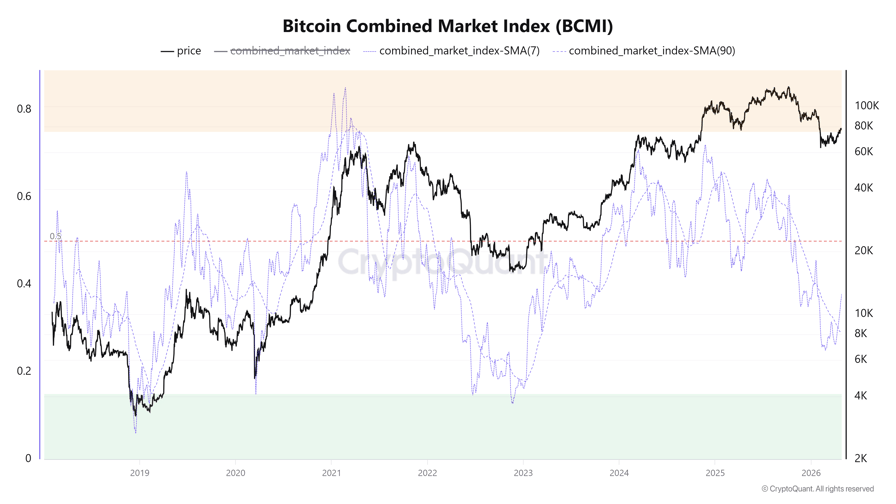
Bitcoin Combined Market Index. Source: CryptoQuant
The MVRV compares market value to realized value, while NUPL tracks net unrealized profit and loss across holders. The SOPR measures whether coins are sold at a profit or a loss. Combined, the indicators frame both the pricing and investor behavior from a single viewpoint.
The BCMI’s 90-day average continues to trend downward, suggesting ongoing selling pressure. However, earlier this month, Woominkyu said,
“We are entering a “Value-Accumulation Zone.” The data suggests the downside is becoming limited compared to the long-term upside.”
The short-term holder activity adds context. The realized cap UTXO age bands for one-week to one-month holders fell to 3.91%, matching October 2023 levels when BTC traded near $27,000. This metric tracks the share of recently moved coins, acting as a proxy for short-term liquidity and price speculation.
Historically, Bitcoin has formed cycle lows within three to six months of similar readings since 2021. Market analyst Crypto Dan noted in March that the indicator has dropped significantly, placing the BTC market near undervalued territory without confirming a final bottom.
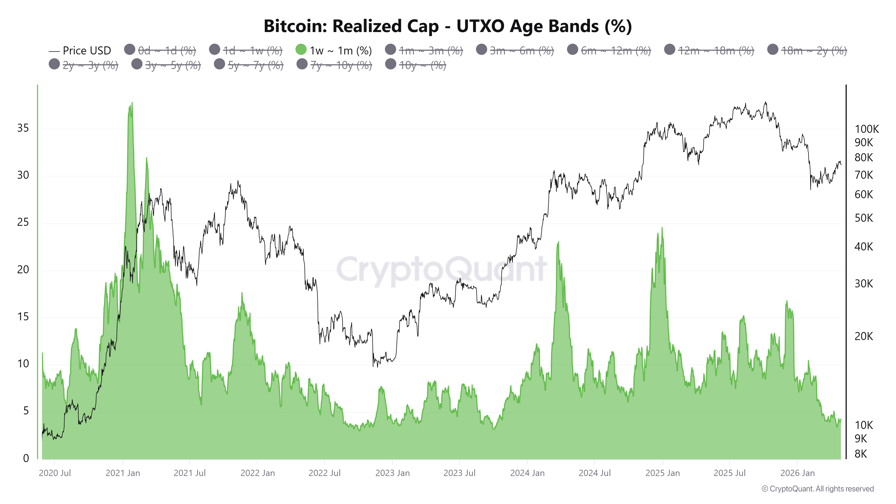
Bitcoin realized cap: UTXO age bands (1 week to 1 month). Source: CryptoQuant
Related: Bitcoin’s recent rally is largely fueled by Strategy purchases: Bitwise’s Hougan
The bank’s digital assets team argues the post-Kelp coalition response and structural fixes around bridges leave DeFi stronger, not weaker, ahead of the Ethereum Economic Zone going live this summer.
Standard Chartered’s digital assets research team says the DeFi industry’s response to the April 18 Kelp DAO bridge exploit could prove to be an “antifragile moment” for the sector, arguing the crisis has accelerated structural fixes that will leave decentralized lending more resilient over the medium term.
In a note published Wednesday titled “DeFi: Bent, not broken,” Global Head of Digital Assets Research Geoff Kendrick wrote that the $292 million theft and its knock-on effects on Aave have not derailed the bank’s longer-term thesis on DeFi growth. Standard Chartered is maintaining its projection that tokenized real-world assets (RWAs) will reach a $2 trillion market cap by the end of 2028, up from roughly $35 billion in October 2025.
‘Bank Run’ Contained
Kendrick laid out the mechanics in familiar terms. Once the market realized that stolen rsETH had been supplied as collateral on Aave (76% of the stolen assets ended up on the protocol, per the report), the lender lost $17 billion in deposits, equivalent to 38% of its total, and $5.5 billion in active loans, or 31%. Yields spiked and net deposits in several stablecoin markets fell to zero in what Standard Chartered described as a classic bank run.
The response was the DeFi United coalition, which has now committed more than $300 million to restore rsETH’s backing ratio and execute controlled liquidations of the exploiter’s remaining positions. Yields on Aave have since started to come back down, and net deposits are rising again.
“This could be DeFi’s ‘antifragile moment,’” Kendrick wrote. “The more pressure that is applied to something, the stronger it gets.”
Risk Mismatch
The note flagged a structural vulnerability that amplified the damage. An analysis after the theft found that 98% of Kelp DAO’s rsETH collateral on Aave was concentrated in a single looping trade, where participants deposit an asset, borrow against it at maximum loan-to-value, and recycle the proceeds into more complex tokens to maximize yield.
Standard Chartered’s broader concern is the asset-liability mismatch on lending protocols: deposits skew more heavily toward complex tokens (wrapped, bridged, liquid-staked, liquid-restaked) than the active loan book does, and complexity tends to introduce bridge dependencies. Bridges, the report noted, have been the attack vector in most of the largest crypto hacks, including the Kelp incident.
Structural Fixes
Kendrick pointed to two specific developments that should reduce reliance on bridges. The first is Aave V4, which launched in late March with a hub-and-spoke architecture designed to share liquidity across participating Layer 2s rather than siloing it on individual chains. The second is the Ethereum Economic Zone (EEZ), unveiled at the Ethereum Community Conference in Cannes earlier this year and scheduled to go live on mainnet this summer.
The EEZ aims to make assets composable and synchronous across the Ethereum ecosystem within a single block, enabled by recent advances in real-time zero-knowledge proof technology. Once both are operational, Standard Chartered argues, Aave will be able to bypass the bridges that have historically been DeFi’s softest target.
“Despite the concerns raised by the recent cyberattack, we think the recent DeFi coalition and longer-term structural solutions both point to greater DeFi resilience going forward,” Kendrick concluded.
This article was written with the assistance of AI workflows. All our stories are curated, edited and fact-checked by a human.
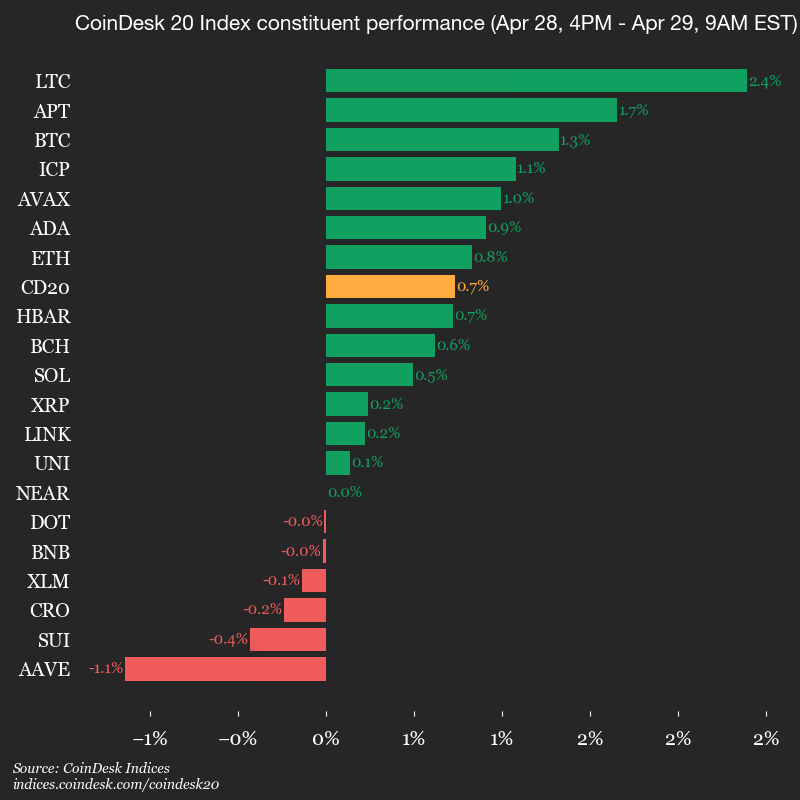
CoinDesk Indices presents its daily market update, highlighting the performance of leaders and laggards in the CoinDesk 20 Index.
The CoinDesk 20 is currently trading at 2093.01, up 0.7% (+15.25) since 4 p.m. ET on Tuesday.
Fourteen of 20 assets are trading higher.

Leaders: LTC (+2.4%) and APT (+1.7%).
Laggards: AAVE (-1.1%) and SUI (-0.4%).
The CoinDesk 20 is a broad-based index traded on multiple platforms in several regions globally.


PUMP briefly rallied today on news that the platform has burned ~36% of the token’s circulating supply from previous buybacks.
Solana memecoin launchpad pumpfun announced Monday evening on X that it has burned approximately $370 million worth of previously bought-back PUMP tokens — roughly 36% of the circulating supply — and is pivoting to a programmatic buyback-and-burn policy funded by 50% of all future revenue for one year.
PUMP briefly rallied 5% on the news today, before retracing and is now flat over the past 24 hours.
The move marks a significant structural shift for the platform. Since launching, pumpfun had been directing 100% of revenue toward PUMP buybacks, but the approach drew persistent community criticism over a lack of transparency — specifically around what would happen to repurchased tokens and whether buybacks would continue long-term.
Now, rather than accumulating bought-back tokens in a treasury, pumpfun will burn 100% of all future buyback purchases immediately upon acquisition, the company explained. The 50% buyback allocation covers net revenue from its Bonding Curve, PumpSwap, and Terminal products. The remaining 50% will fund operations, hiring, and strategic investments, pumpfun said in the X post.
In a separate post on X, co-founder Alon framed the change as essential for long-term sustainability, explaining the need to cut the buyback rate in half to 50% to leave revenue for the project to invest in growth, stating: “I am extremely confident that 50% of the business we’re building toward will dwarf 100% of the business we have today.”
Pumpfun has generated over $1 billion in gross protocol revenue since launching in early 2024 and remains one of DeFi’s top fee-generating protocols.
The platform raised $500 million in its July ICO in just 12 minutes, and another $400 million in private token sales.
This article was written with the assistance of AI workflows. All our stories are curated, edited and fact-checked by a human.
Crypto World
Stable Sea Taps WisdomTree to Bring Tokenized Treasury Yield to Business Operating Cash
The collaboration lets non-crypto-native finance teams sweep idle dollars into WisdomTree’s WTGXX alongside their stablecoin payments, with daily dividend accrual and 24/7 liquidity.
Stable Sea on Wednesday announced a strategic partnership with WisdomTree to embed access to the asset manager’s tokenized funds inside its business treasury platform, opening a new distribution channel for onchain dollar yield beyond crypto-native users.
The integration begins with the WisdomTree Treasury Money Market Digital Fund (WTGXX), which currently holds about $855 million in tokenized U.S. Treasuries and ranks as the sixth-largest tokenized money market fund tracked by RWAxyz. Eligible Stable Sea Terminal users can establish a limited-scope broker-dealer relationship with WisdomTree Securities to route orders into select WisdomTree tokenized funds directly from the Stable Sea interface.
For users, that means daily dividend accrual, continuous yield allocation based on intra-day holdings, and daily liquidity through WTGXX, plus the option to set rules that automatically sweep idle balances into the fund and unwind back to stablecoins when liquidity is needed.
“US businesses collectively hold more than $5 trillion in cash and cash equivalent accounts that earn minimal to no interest,” said Tanner Taddeo, CEO and co-founder of Stable Sea. “This collaboration with WisdomTree brings institutional-grade cash management and 24/7/365 yield exposure into a technology product built for modern operators.”
From Stablecoin Off-Ramps to Treasury Stack
Founded in 2024, San Francisco-based Stable Sea originally pitched itself as a fix for the “final mile” of stablecoin utility, building enterprise-grade off-ramps that let fintechs, payment service providers, and global businesses convert stablecoins into local fiat in single trades of up to $50 million, replacing the patchwork of OTC desks and Telegram-based dealer relationships that businesses had been stitching together.
Stable Sea Terminal launched in May 2025 as the productized version of that workflow, combining stablecoin purchasing, conversion, and global payouts in a single API and dashboard. The WisdomTree deal extends the platform further, layering tokenized money market exposure on top of payments and custody.
Tokenized MMFs Push Beyond DeFi
The deal also extends WisdomTree’s recent run of WTGXX integrations into a different distribution lane: business treasury workflows rather than DeFi protocols.
Last week, pre-launch lender Lotus tapped WTGXX for its LotusUSD vault reserves, and in March, Plume launched a payroll pilot routing employee salaries into the fund. Last November, Plume also integrated WisdomTree tokenized funds via OpenTrade into its Nest staking vaults.
“Treasury management use cases have been a leading driver of the adoption we have seen of our tokenized money market fund WTGXX in the past year,” said Will Peck, Head of Digital Assets at WisdomTree.
Tokenized U.S. Treasury and money market funds have grown from under $1 billion in early 2024 to roughly $15 billion across 76 assets today, per RWAxyz, led by Circle’s USYC, BlackRock’s BUIDL, and Ondo’s U.S. Dollar Yield funds. WTGXX itself surged more than 700% between May and August last year. WisdomTree manages approximately $160 billion across its businesses.
This article was written with the assistance of AI workflows. All our stories are curated, edited and fact-checked by a human.
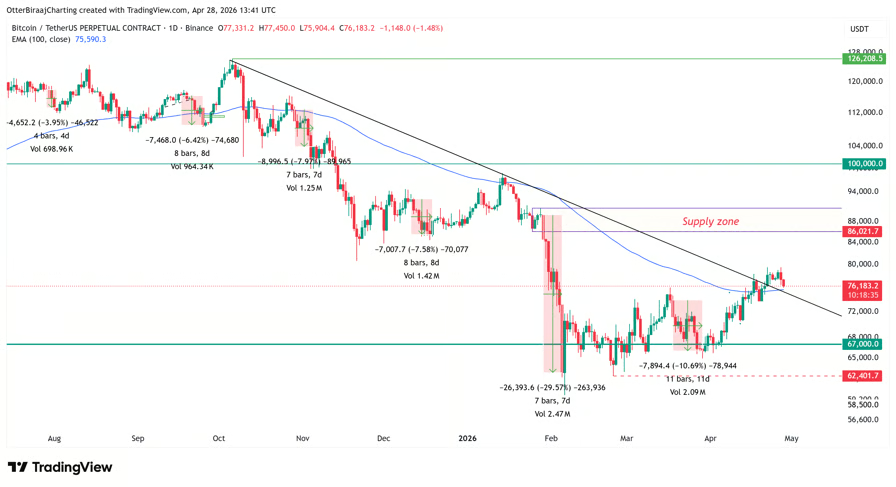
Bitcoin (BTC) fell from its local high at $79,500 as traders repositioned ahead of the Federal Open Market Committee (FOMC) meeting on Wednesday.
Historical data shows that since the start of 2025, BTC has corrected seven out of 10 times after an interest rate cut.
Bitcoin’s reaction to interest rate cut decisions in 2025 and 2026 shows a clear pattern. The price often moved higher in the days before the meeting, followed by negative returns afterward, as illustrated in the chart.
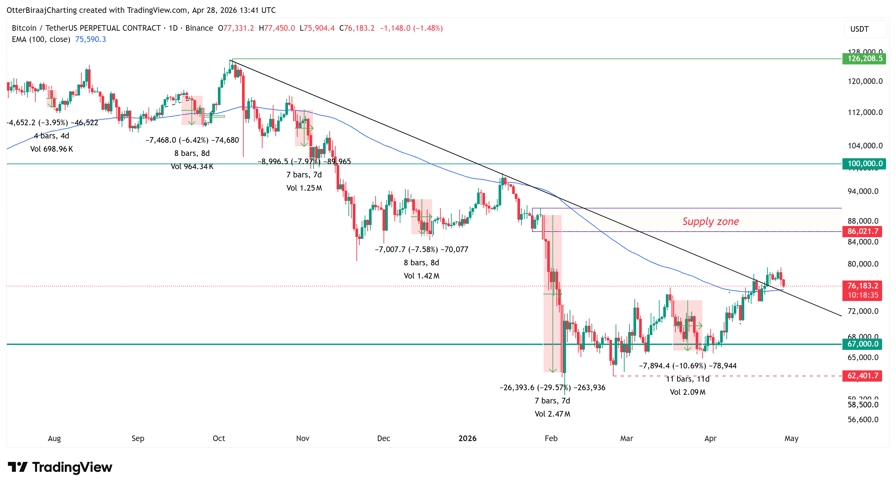
BTC price reaction post FOMC meet. Source: Cointelegraph/TradingView
The seven-day returns ranged from +6.92% to –29.57% across 10 FOMC meetings.
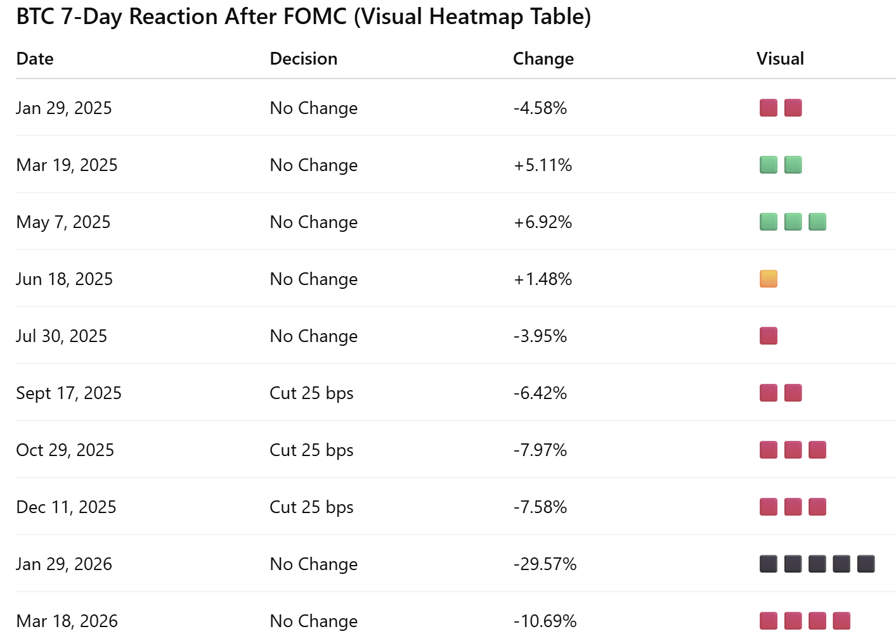
BTC 7-day reaction after FOMC (visual heatmap table). Source: Cointelegraph
Over the past two years, the post-FOMC price action has been driven less by the rate outcome and more by shifts in liquidity and leverage conditions.
During the Jan. 29–Feb 5 drawdown, when BTC fell roughly 30%, derivatives data highlighted the extent of this dynamic. Futures open interest declined sharply, falling to $49 billion from around $61 billion over the course of a week, signaling an aggressive unwind of leveraged positions.
This deleveraging phase triggered an estimated $2.5 billion in BTC-specific liquidations, with total crypto liquidations reaching $4.5 billion over the same period.
MN Capital founder Michael van de Poppe said that the setup was typical pre-FOMC behavior from the traders. The view frames the pullback as a routine correction tied to the policy uncertainty, with van de Poppe adding,
“It almost always happens prior to the event, as there’s still a lot of fear for FED policies from the markets.”
The analyst noted that as long as the price holds above $73,000, the higher range may remain intact in the near term.
Related: Three Bitcoin charts say BTC price may rally toward $82K
Strategy buying BTC offsets the weak sentiment
While short-term price action reflects caution around macro events, the broader demand picture suggests a strong structural bid beneath the market.
Corporate BTC accumulation continues to play a key role. Strategy has significantly expanded its Bitcoin holdings in 2026, increasing its total balance to 818,334 BTC from 672,497 on Jan. 1, adding 145,837 BTC.
The purchases are partly funded through Stretch (STRC) offerings, in which the firm raises capital via equity-linked instruments and allocates the proceeds to Bitcoin.
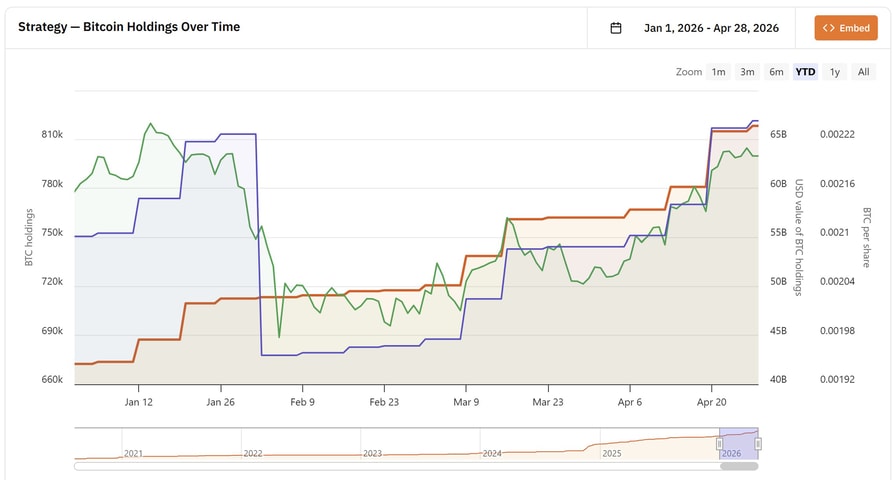
Strategy BTC holdings in 2026. Source: bitcointreasuries.net
Bitcoin macro researcher Ecoinometrics noted that the pace mirrors the late-2024 accumulation, though current conditions are less bullish.
At the same time, spot Bitcoin ETF flows have turned positive again, with roughly $3.5 billion in net inflows over the past two months. This resurgence signals renewed institutional participation, even as the short-term sentiment remains cautious.
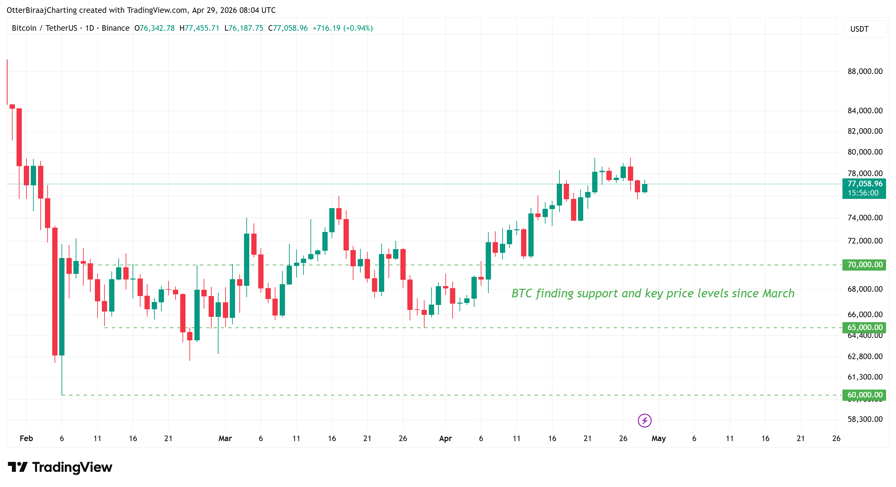
BTC is finding support at key price levels. Source: Cointelegraph/TradingView
Since March, the return of institutional demand for BTC has coincided with the crypto asset forming support levels at key price ranges, such as $60,000, $65,000 and $70,000.
While macro-driven events like the FOMC continue to trigger short-term volatility and risk-off behavior, this underlying demand base is helping cushion deeper drawdowns and support a more resilient long-term market structure for Bitcoin.
Related: Bitcoin price drops below $76K as onchain data sends mixed signals
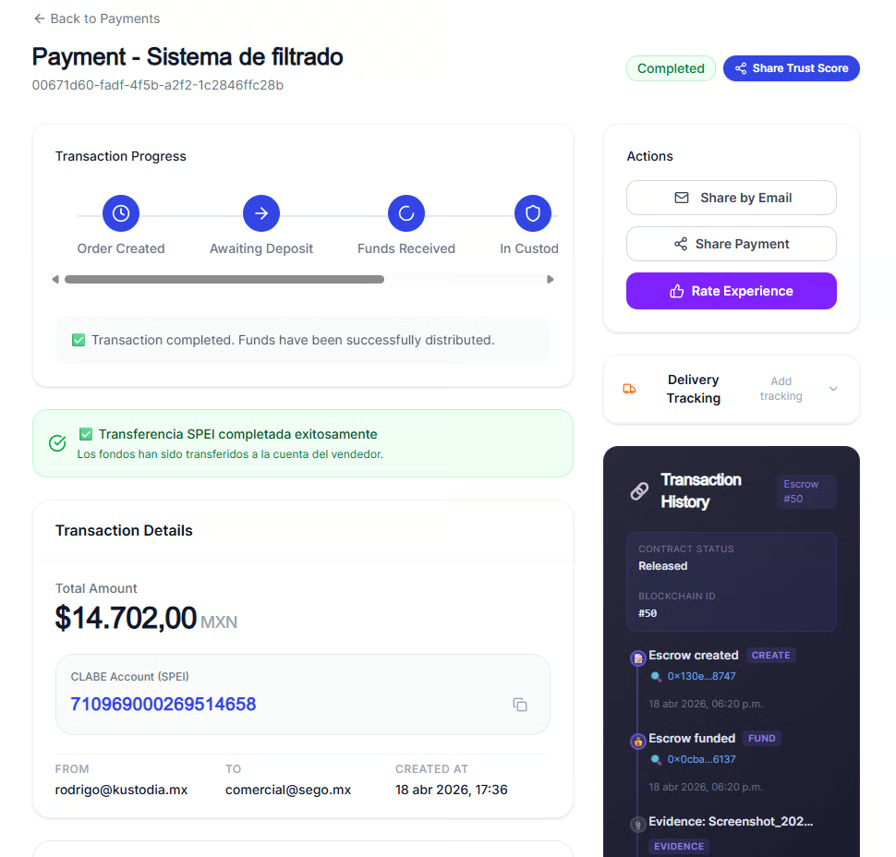
Mexico’s first peso-denominated blockchain escrow goes live on SPEI for high-value P2P transactions.
Mexico City, April 29, 2026 — Kustodia, a programmable escrow platform for Latin America’s high-value economy, today announced the public launch of its smart contract escrow service in Mexico. Buyers and sellers can now protect any transaction — from used vehicles to real estate deposits to B2B contracts — using SPEI, Mexico’s instant payment rail. Funds are held in audited smart contracts until both parties confirm delivery, with no human intermediary involved.
Payment fraud stripped $44.3 billion from the global economy in 2024, according to Juniper Research. Latin America has the world’s highest fraud rate, with 20 percent of merchant revenue lost annually. In Mexico, every dollar of fraud costs $4.08 in total economic damage — representing approximately $600 million USD in annual losses, according to data from Cloudflare and Mexico Business News.
‘I lost money to fraud in a peer-to-peer transaction in 2021,’ said Rodrigo Jimenez, Founder and CEO of Kustodia. ‘I spent three years building the infrastructure that should have existed. Mexico’s $60 billion used vehicle market runs almost entirely on stranger-to-stranger transactions with no protection for either side. We changed that.’
How it works — no app, no crypto knowledge needed
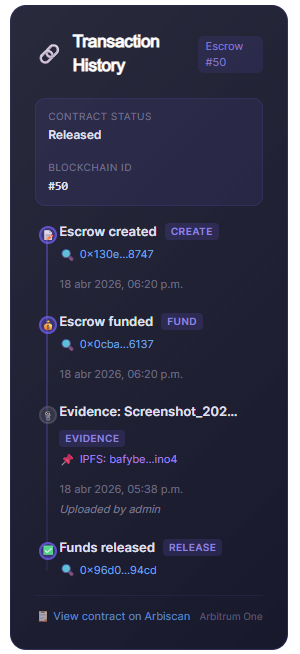
Kustodia works entirely through SPEI and WhatsApp. The buyer deposits pesos to a unique account number generated by Kustodia. Those pesos are immediately locked in a smart contract on the Arbitrum blockchain — neither party can access them. The seller delivers. Both parties confirm. The funds are released to the seller’s bank account in pesos. The blockchain operates invisibly; users interact only through WhatsApp.
The platform uses MXNB, a 1:1 Mexican peso-backed stablecoin issued by Juno and audited by a Big Four accounting firm, as its escrow settlement layer. This means users never experience cryptocurrency price volatility — they send pesos and receive pesos. Every completed transaction is publicly verifiable on Arbitrum’s blockchain explorer at no cost to anyone.
Users never pay blockchain fees. Kustodia absorbs and bundles these costs automatically, so the only fee a user sees is the escrow commission — 3 percent for standard transactions, lower for volume partners. Compared to traditional escrow agents that charge 3 to 6 percent and take 5 to 7 days to settle, Kustodia settles near-instantly.
From used cars to real estate to AI agents
Kustodia’s initial focus is the Mexican used vehicle market, where the average transaction is $15,000 USD and fraud risk is highest. The platform includes integrated vehicle history verification powered by Truora, KYC identity checks, and webhook-based notifications for marketplace integrations.
The platform also supports AI agents through its dedicated agent infrastructure at kustodia.app/ai-agents, enabling autonomous systems to create and manage escrow contracts programmatically. Web3 native escrow is available at kustodia.app/web3, supporting USDC and MXNB on Arbitrum and Injective.
Real estate rental deposits, crowdfunding, and marketplace integrations are live as additional verticals. USD Wire is supported for cross-border US-to-Mexico transactions. Brazilian real (BRL) via Pix is in development for the company’s planned 2027 Brazil expansion.
Source: Kustodia
Built for developers and platforms
Kustodia offers a full API and webhook system for marketplace integration. Developers can explore documentation and test the platform at kustodia.app/demo/marketplace. The platform currently works alongside SPEI, USD Wire, and USDC — and compares favourably to MercadoPago and Stripe Mexico, neither of which offers true escrow, blockchain verification, or integrated vehicle checks.
Source: Kustodia
About Kustodia
Kustodia is programmable escrow infrastructure for Latin America and emerging markets. The platform protects high-value transactions across vehicles, real estate, services, and crowdfunding using smart contracts on Arbitrum and Injective, with SPEI and USD Wire as fiat rails. Available at kustodia.app.
Media contact:
Ondo Finance and Broadridge Unite to Bring Proxy Voting to Tokenized Stocks

Floyd Mayweather ranks one heavyweight above Muhammad Ali

Sony’s Latest PlayStation Update Sparks DRM Fears: What We Know

Manchester United reach agreement with Casemiro over contract clause amid transfer speculation

US brings back mandatory military draft registration

Steven Gerrard disagrees with Gary Neville over ‘shock’ Chelsea and Arsenal claim | Football


-

 Tech2 days ago
Register Renaming | Hackaday
-

 Fashion5 days ago
Weekend Open Thread – Corporette.com
-
Crypto World4 days ago
Hyperliquid $HYPE Rally Builds Momentum as AI Sector Enters Prove-It Phase
-

 Business6 days ago
Patterson-UTI Energy, Inc. (PTEN) Q1 2026 Earnings Call Transcript
-
 Sports4 days ago
IPL 2026: Ruturaj Gaikwad registers slowest fifty of the season, enters all-time unwanted list | Cricket News
-

 Politics2 days ago
Drax board avoid their own AGM, accused of greenwashing & environmental racism
-

 NewsBeat4 days ago
LK Bennett closes all stores after entering administration
-

 Crypto World6 days ago
Michael Saylor says BTC winter is over. Market analyst disagrees, says bitcoin was in a pullback
-
 Sports7 days ago
Tim Bradley names the current best in the world: “Better than Inoue and Usyk”
-

 Fashion1 day ago
Kylie Jenner’s KHY Enters a New Era with ‘Born in LA’
-
Entertainment7 days ago
Michael B. Jordan and Austin Butler's “Miami Vice” movie will bring the action back to the '80s
-
 Entertainment4 days ago
Mariah Carey Slams Deposition Claims In Brother’s Lawsuit
-

 Tech2 days ago
Images of Samsung’s rumored smart glasses have leaked
-
Business7 days ago
Altimmune prices $225 million public offering at $3 per share
-
Entertainment7 days ago
Russell Brand Had Sex With 16 Year Old When He Was 30
-

 Business1 day ago
Most Commercial Energy Audits Miss the Real Losses
-
Crypto World6 days ago
Is Algorand One of the Few Quantum-Resistant Blockchains? Here’s What the Data Shows
-
 NewsBeat6 days ago
Trump threatens to review UK’s claim to Falkland Islands and punish Nato allies over Iran war disagreement
-

 Sports7 days ago
2026 NFL Draft tonight: Time, TV channel, where to watch, order
-

 Sports7 days ago
Bayern Munich on the brink of historic ‘double treble’
You must be logged in to post a comment Login