

Crypto World
Best Crypto Presale to Buy Now as Crypto Market Crashes, Gruntle Passes $100k Raised


Bitcoin dropped 3.4 percent over the last 24 hours, pulling the flagship asset down to $74,598 and dragging the broader cryptocurrency sector into a severe sell-off. The total market capitalisation shed 3.3 percent, erasing over $80 billion in value overnight as retail buyers scrambled for liquidity across major exchanges. The charts have burned, and institutional support levels are failing to hold the line against the selling pressure. For those scanning the wreckage, Coinbase’s Bitcoin price data confirms a sharp rejection at the $77,000 resistance zone, leaving traders to brace for further downside. The market has collapsed, and the noise is deafening as portfolios take heavy hits across the board.
Ethereum and Solana Extend Losses in Broader Sell-Off
The damage extends deep into the altcoin sector, proving that few assets are immune to the sudden shift in macroeconomic sentiment. Ethereum fell 4.5 percent to $2,025, pushing its 14-day relative strength index down to an oversold 28.9 level, signaling extreme bearish momentum. Solana suffered a heavier 6 percent drop, hitting $81.96 as CoinGecko’s Solana tracking shows trading volumes spiking past $4.4 billion amid panic selling. The global meme coin category retreated 2.5 percent, leaving chart survivors exhausted by the relentless volatility and unpredictable price swings. Most speculative tokens are bleeding heavily, offering little refuge for investors caught in the downtrend as the broader market searches for a definitive floor.
$GRUNTLE Presale Provides a Deadpan Alternative to Market Chaos
While the rest of the market promises impossible recoveries to mask structural decay, Gruntle ($GRUNTLE) offers a deadpan alternative. The project is a survival instrument that allocates 20 percent of its 5 billion token supply to the Deep Mud Reserve for tactical buybacks, providing a deflationary counterweight to the market chaos. There is no fake urgency or influencer hype here. The brand positioning is strictly low hype and high signal, treating the market crash as a simple fact of existence rather than a temporary setback. It is a digital refuge built for those who have accepted the current state of the charts, offering a quiet space away from the frantic trading of liquid spot assets.
Check Out the Gruntle Website to Join the Presale
Round 5 Nears $111.6k Target With 10,766% Variable APY
The intake terminal remains fully operational regardless of spot market conditions, providing a fixed entry point while liquid assets swing wildly. Round 5 is currently 93.35 percent filled, having processed $104,175 of its $111,600 current round target. Terminal-grade citizens entering Gruntle’s intake terminal secure an entry price of $0.000625 before the next price tier opens at $0.000627. Furthermore, the system includes a Hibernation Staking protocol that currently pays a 10,766 percent APY. This yield is strictly variable and computed from a 250 million token pool, meaning the APY decays as more survivors stake their tokens. The early window captures the highest yield, providing a mathematical advantage to those who enter the mud early and wait for the Phase 3 decentralised exchange listing.
Market Volatility Continues as the Presale Intake Remains Open
Analysts suggest the current bearish momentum could push major assets lower before finding a bottom, leaving many traders on the sidelines. The world stays loud, and the charts remain red. The $GRUNTLE presale stays open at $0.000625 with Hibernation Staking currently paying 10,766 percent APY (variable, decays as more enter) and the Phase 3 DEX listing roadmapped.
Secure your allocation before the cap closes the current pricing window.
FAQs
What is the Gruntle presale?
Gruntle is a deadpan meme coin built for exhausted crypto market survivors. The presale offers a structured entry point into the $GRUNTLE ecosystem before public trading begins on decentralised exchanges.
How can I participate in the intake?
Buyers can enter the presale using ETH, USDT, USDC, BNB, or card payments via Web3Payments. The intake terminal is accessible directly at the gruntle.io website.
What comes after the presale concludes?
Phase 3 of the roadmap triggers the decentralised exchange (DEX) listing and initiates applications for CoinMarketCap and CoinGecko tracking. Phase 4 will then pursue centralised exchange listings.
Is the Gruntle smart contract audited?
Yes, the Gruntle smart contract was fully audited by CredShields on May 13, 2026.
This article is for informational purposes only and does not constitute financial advice. $GRUNTLE is a meme coin with no intrinsic value. Cryptocurrency investments carry significant risk. Always conduct your own research before investing.
Disclaimer: This is a Press Release provided by a third party who is responsible for the content. Please conduct your own research before taking any action based on the content.


Iran has suspended a 60-day negotiation process with the United States less than 24 hours after signing a new agreement, while warning that Israeli strikes could trigger a renewed Strait of Hormuz blockade.
Summary
- Iran suspended a 60-day negotiation process with the U.S. less than 24 hours after signing a new agreement.
- Tehran accused Washington of violating the deal after Israeli military operations in southern Lebanon.
- Iran warned that further escalation could lead to retaliatory strikes and another Strait of Hormuz blockade.
According to The Hormuz Letter, citing reports from Fars and Al-Mayadeen, Tehran halted the entire negotiation framework less than 24 hours after the agreement was electronically signed.
Iranian officials argued that Israeli military operations in southern Lebanon violated the first clause of the memorandum, which they said was intended to halt hostilities and protect Lebanese sovereignty.
Israeli forces carried out overnight operations in southern Lebanon, according to reports cited by Iranian media. Tehran subsequently accused the United States of failing to ensure compliance with the agreement and rejected suggestions that Israel’s actions should be viewed separately from Washington’s responsibilities under the deal.
Iranian officials also warned that the country would not unilaterally fulfill its own obligations under the memorandum until it receives assurances that Israeli military activity has stopped and that the U.S. has adhered to the agreement’s terms, according to The Hormuz Letter.
The dispute quickly disrupted diplomatic efforts. Reports indicated that an Iranian delegation had already been preparing to travel to Switzerland for the first round of negotiations before Tehran decided to suspend the entire process.
The planned talks were expected to begin a 60-day diplomatic track between U.S. Vice President JD Vance and Iranian Parliament Speaker Mohammad Bagher Ghalibaf. With the negotiations now paused, uncertainty has returned to a process that had only just begun.
Oil supply concerns return to financial markets
Attention has increasingly shifted toward the Strait of Hormuz, a critical route for global energy exports. Iranian threats to close the waterway have renewed concerns about potential disruptions to oil shipments despite recent declines in crude prices.
Market participants have closely monitored the route because a significant share of the world’s seaborne crude exports passes through the narrow passage connecting the Persian Gulf to international markets. Any interruption could tighten energy supplies and reverse the recent drop in oil prices toward the $75-per-barrel range.
Analysts have long warned that higher oil prices can fuel inflation pressures, complicating expectations for future monetary policy decisions. A renewed surge in energy costs could affect sentiment across equities, commodities, and other risk-sensitive assets.
Crypto traders react to rising geopolitical tensions
Digital asset markets moved lower as investors assessed the latest developments. Bitcoin fell below $63,000 on Thursday and briefly traded near the $62,000 level as traders reduced exposure to risk assets amid growing uncertainty in the Middle East.
The decline extended across the broader cryptocurrency market, where concerns over a possible Hormuz disruption added to existing macroeconomic risks. Traders have also been weighing how higher energy costs could influence inflation and interest-rate expectations.
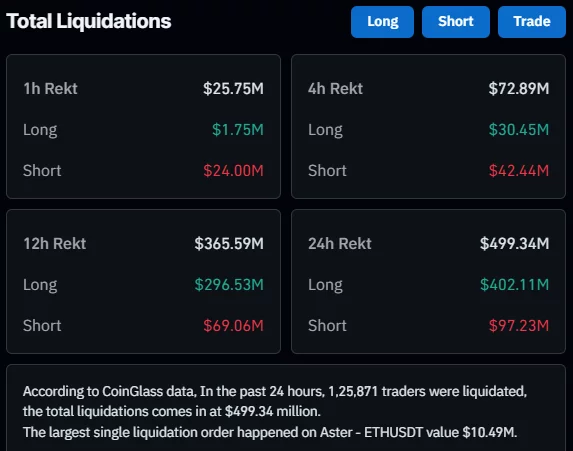
Rising geopolitical tensions also triggered a wave of liquidations across crypto derivatives markets. According to CoinGlass data, approximately $499.34 million in positions were liquidated over the past 24 hours, with long traders accounting for $402.11 million of the losses. More than 125,000 traders were liquidated during the period as Bitcoin fell below $63,000 and broader market volatility increased.
With negotiations suspended and Tehran warning of additional retaliatory measures, investors are likely to remain focused on developments surrounding the U.S.-Iran agreement, Israeli military activity in Lebanon, and the future of shipping through the Strait of Hormuz.
Disclosure: This article does not represent investment advice. The content and materials featured on this page are for educational purposes only.
Crypto World
Backpack's Tokenized SpaceX Token on Solana Crosses 10,000 Holders, Nearly Double xStocks' SPCXx
Backpack's tokenized SpaceX share token has crossed 10,000 onchain holders on Solana, six days after listing alongside the company's Nasdaq debut. The milestone widens the holder gap with rival xStocks' SpaceX product and lands as Backpack chief executive Armani Ferrante stakes out a structural… Read the full story at The Defiant
The ‘SpaceX exit liquidity’ narrative is everywhere since the IPO last week. Critics argue that the huge demand for SpaceX shares could let early investors, employees, or insiders sell stock at very high valuations while new buyers, especially retail investors, take the risk.
However, the S-1 filing, the lock-up calendar, and crypto futures positioning suggest the opposite, at least for now.
Who Can Sell SpaceX Shares Early?
It is critical to start with the supply side of the exit liquidity question. The offering sells only newly issued SpaceX shares. The company raised about $75 billion from 555.6 million new Class A shares, and the S-1 confirms that no existing holder sells at listing.
Every dollar goes to SpaceX itself, largely to fund its AI buildout. Many readers asking how to buy SpaceX IPO shares assume insiders sell to them directly. They do not.

Want more insights like this? Sign up for Editor Harsh Notariya’s Daily Newsletter here.
Insiders keep roughly 95.8% of the equity. Elon Musk and certain significant investors agreed to a 366-day lock-up, an agreement that blocks sales for a set period. Employees face restrictions too.
Lower-tier staff, such as welders, became paper millionaires this week, but their equity stays frozen until the first release window after Q2 earnings. They cannot dump SpaceX stock today, no matter how much they want to.
The one true carve-out is a directed share program covering up to 5% of the IPO shares for individuals selected by executives. Even they reportedly sell only after the first earnings report, and they buy fresh stock at the offer price.

So if nobody connected to SpaceX can sell today, who wants to sell later, and when does the door open?
The Billionaires Want Out, but the Lock-Up Sets the Date
The sellers in waiting are real, and this is where the SpaceX IPO exit liquidity story finds its grain of truth. Google or Alphabet holds about 5% of the company after the xAI merger diluted its earlier 6.11% stake.
That position could be worth up to $100 billion, a roughly 100x gain on its 2015 investment. They might want to liquidate some of that.
Early venture backers sound the same alarm.
Space Capital founder Chad Anderson told Fortune:
“We’ve been invested for almost ten years, it’s our business to return capital to investors.”
Yet, their exit runs through the SpaceX lock-up schedule. Up to 20% of eligible insider shares unlock after Q2 earnings, expected between mid July and September. Another 10% unlocks if SPCX holds 30% above the offer price for five of ten sessions. Five 7% tranches follow at 70, 90, 105, 120, and 135 days, with 28% more after Q3 earnings and full release at 180 days.

That metered supply meets a scheduled buyer. Nasdaq’s fast entry rule and MSCI’s early inclusion push index funds, and the retirement accounts behind them, to buy SpaceX stock within weeks of listing.
Passive inflows become standing demand for whatever insiders release. The financials explain why some may hurry.
SpaceX reported $18.7 billion in 2025 revenue with a $4.9 billion net loss, as Starlink’s $4.4 billion operating profit funded a $6.4 billion xAI loss. The SpaceX valuation sits near 94 times trailing sales, and Facebook’s staggered 2012 lock-up still ended 40% below its offer price.
Selling pressure is therefore scheduled, not imaginary.
Whether retail stands beneath it depends on who actually received the allocation.
Retail Was Cut Back, Not Loaded Up
If insiders planned to unload on small investors, the allocation should have maximized the retail bag. The opposite happened. Retail investors submitted more than $100 billion in orders to buy SpaceX IPO shares, exceeding the $75 billion deal size, and total demand reached 3.5 to 4 times the available stock.
SpaceX then cut the retail allocation to the low 20% range from a planned 30% because institutional appetite was strong. BlackRock alone ordered at least $5 billion, while sovereign funds took allocations of more than $1 billion each.
Mechanics weaken the bag-holder framing further. Fills were random or pro rata, depending on the broker, and brokers’ debit cash only for shares actually received. Anyone who failed to buy SpaceX shares in the offering simply keeps their money.

The exit liquidity story only works if retail ends up as the bag holder. That requires one of two traps. Either retail holds shares it cannot sell, or it got handed shares nobody else wanted.
SPCX retail escaped both, since it can sell from day one and received fewer shares than it ordered.
The post Is SpaceX the Ultimate Exit Liquidity for Billionaires? appeared first on BeInCrypto.
Crypto World
Ondo Finance Adds 173 Tokenized Stocks and ETFs, Taking Catalog Past 430 Assets Across Three Chains
Ondo Finance added 173 tokenized stocks and ETFs to Ondo Global Markets on Tuesday, pushing its catalog past 430 assets available across Ethereum, Solana, and BNB Chain. Ondo Finance's official X account announced the expansion on June 17. The batch spans some of the most capital-intensive corners… Read the full story at The Defiant
The CME Group has said that it will sue the Commodity Futures Trading Commission (CFTC) over its decision to approve perpetual futures in the U.S.
CEO Terrence Duffy told CNBC on Wednesday that the firm plans to file the lawsuit on Thursday, saying its case will be based on the argument that perpetual futures are swaps under the Dodd-Frank Act.
Perpetuals Should Be Classified As Swaps
Duffy said CME believes the products should be treated as swaps instead of futures contracts, adding that the company’s benchmark licensing agreements mean providers offering them would need to work through the exchange.
“We have an exclusive license with every single provider of the benchmarks. So all of these would have to go through CME regardless of the perpetual,” said Duffy.
Perpetual futures are contracts that do not have an expiration date and allow traders to speculate on an asset’s price without directly owning it.
The development follows the CFTC’s May approval of Kalshi to offer BTC perpetual futures, making it the first time the product was greenlighted for the U.S. market. Meanwhile, the offering has already been widely used in international markets, with the prediction market platform already making plans to expand its range to include other cryptocurrencies.
Last year, Coinbase also became the first exchange to offer these derivatives to American investors through its Coinbase Financial Markets (CFM) platform.
Duffy Says CME is Ready for the Dispute
The CEO said the company has been preparing for the legal battle with its board for the past eight months and is prepared to proceed with the challenge.
“I’ve never shied away from one, and I won’t shy away from this…And that’s why I wanted to announce on your show that we will be filing this litigation tomorrow, because we are not taking this lightly,” he said.
Elsewhere, CFTC Chair Michael Selig has defended the agency’s decision to approve perpetual futures in the U.S., saying the move was aimed at allowing regulated products without expiration dates to become available domestically while ensuring they operate under American oversight.
The post CME Group to Sue CFTC Over Approval of Bitcoin Perpetual Futures appeared first on CryptoPotato.
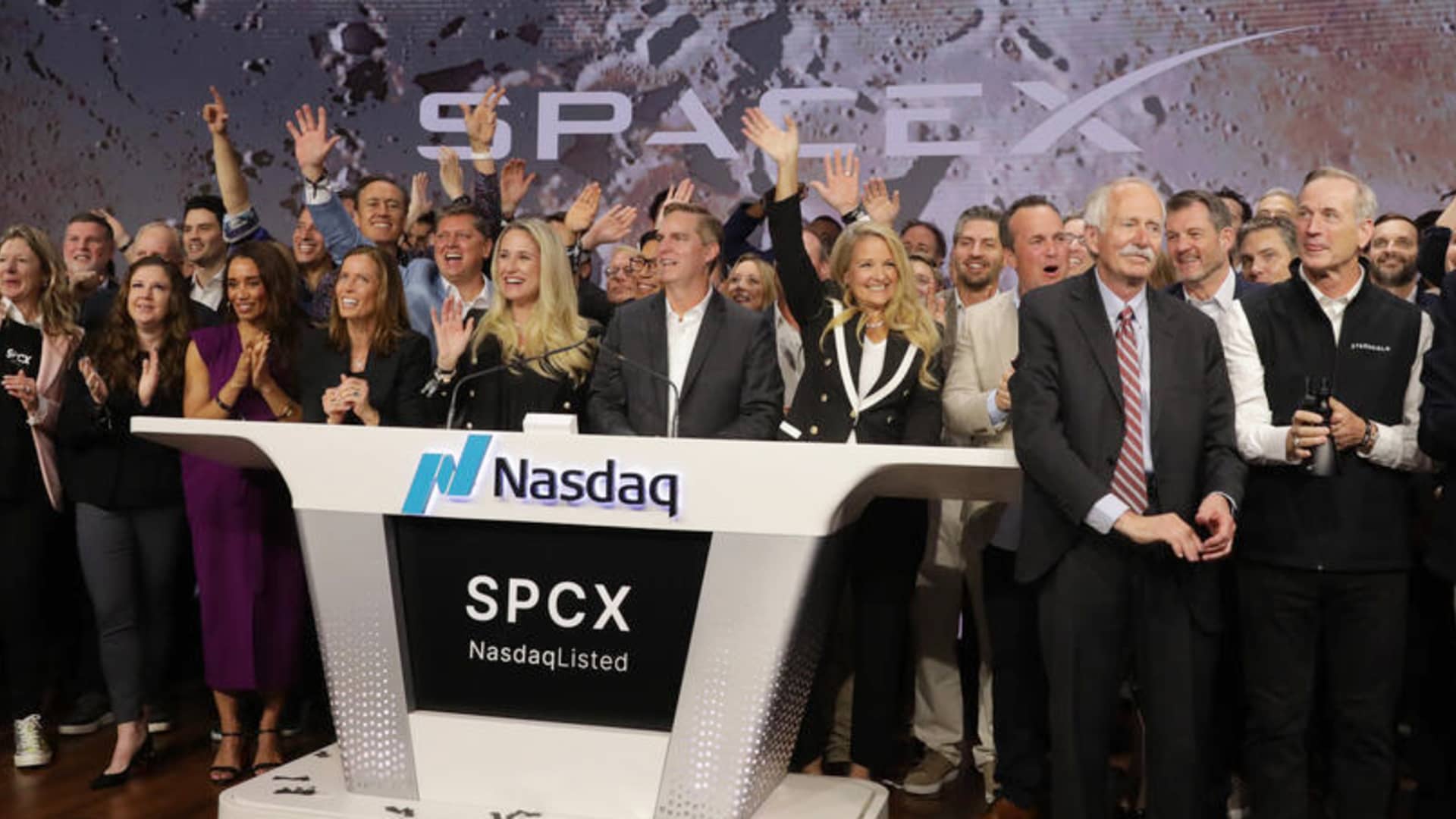
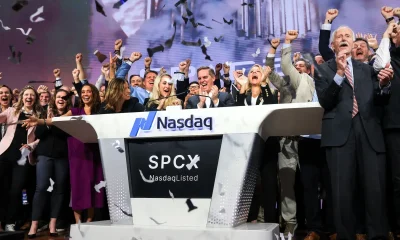
SpaceX celebrates their IPO at the Nasdaq on June 12th, 2026.
Adam Jeffery | CNBC
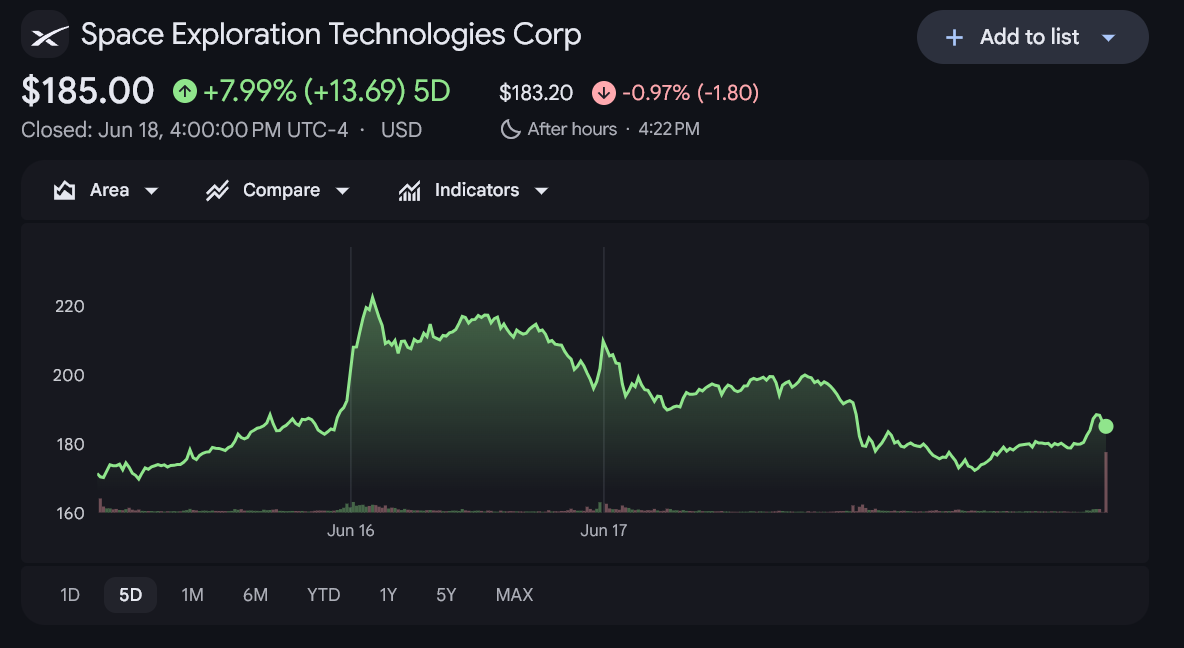
The average investor who bought SpaceX shares in the open market after its debut has seen nearly all of their gains disappear as a sharp pullback erased a large chunk of the stock’s post-IPO surge.
Shares of SpaceX fell 3.6% Thursday to just under $184.98 a share. The stock’s five-day volume-weighted average price, or VWAP, is $181.71 a share. VWAP measures the average price a security has traded throughout the day, weighted by trading volume and is widely used by traders to gauge investors’ positioning.
The move suggests the average post-IPO buyer is now approximately breaking even.
The stock soared from its $135 IPO price to an intraday high above $225 on Tuesday as investors piled into one of the most anticipated public offerings in years. Since then, however, shares have retreated 20%, wiping out much of the gains accumulated after the debut. It’s now back to where it was trading on day two, Monday..
The decline has also narrowed the profits for thousands of retail investors who gained access to the IPO through brokerage platforms including Robinhood, Fidelity and SoFi. While many individual investors received only a fraction of the shares they requested — in some cases just one or a handful of shares — those allocations were purchased at the $135 offering price, leaving them with gains even after the recent pullback.
The reversal underscores how quickly sentiment has shifted following the company’s blockbuster debut. After briefly pushing SpaceX’s market value close to $3 trillion, investors have begun reassessing whether the stock’s rapid advance can be justified by fundamentals.
— CNBC’s Chris Hayes and Deena Zaidi contributed to the story.

Key Highlights
- Intel stock soared following news of a strategic chip collaboration with Apple centered on domestic U.S. production facilities
- Major semiconductor names like Nvidia, Micron, and Broadcom staged a powerful comeback following recent weakness
- SpaceX experienced its most significant drop since its blockbuster public debut as early investors locked in returns
- Crude oil retreated on optimism surrounding potential diplomatic progress between the United States and Iran
- Apple cautioned investors that escalating memory and storage component expenses may necessitate higher device pricing
Intel’s shares surged during Wednesday’s trading session following revelations that Apple intends to partner with the chipmaker on design and production initiatives within American borders. The strategic alliance between these tech giants is anticipated to focus on semiconductor projects as the nation intensifies efforts to expand domestic chip manufacturing capabilities.
This development arrives as welcome news for Intel during a critical transformation period. The company has been aggressively expanding its contract manufacturing operations—referred to internally as its foundry business—in an effort to challenge industry leaders such as TSMC and Samsung.
Semiconductor Sector Mounts Impressive Comeback
The wider chip industry experienced a robust trading day. Nvidia, Micron, Broadcom, and Marvell Technology each recorded significant advances following several challenging weeks.
Market participants had been stepping away from semiconductor investments amid worries about elevated valuations and interest rate dynamics. Numerous investors viewed the recent decline as an attractive entry point to rebuild positions.
Artificial intelligence continues serving as the primary catalyst for sector demand. Corporations are allocating substantial capital toward AI processors, data center infrastructure, and network equipment, with industry observers projecting this momentum to persist.
SpaceX Experiences Profit-Taking Pressure Following Historic Public Offering
SpaceX endured one of its most challenging trading sessions since its market debut earlier in the year. Shares declined as initial investors capitalized on profits following the company’s unprecedented IPO performance.
The SpaceX public offering set records as the largest ever completed. The enterprise’s diversified operations spanning rocket technology, satellite broadband services, artificial intelligence, and defense contracting generated substantial early enthusiasm among market participants.
Industry analysts note that post-IPO price swings are typical following high-profile market entries. The stock is projected to exhibit continued volatility in coming sessions as market forces establish appropriate valuation levels.
Crude Prices Decline on Diplomatic Optimism
Oil prices retreated as market participants grew increasingly hopeful regarding potential diplomatic breakthrough between Washington and Tehran. Should Iran resume greater oil exports to international markets, global supply would expand and prices would face additional downward pressure.
Decreasing crude costs typically provide relief for aviation companies, logistics firms, and end consumers. They can also alleviate pressure on monetary authorities working to contain inflationary forces.
Apple Signals Potential Device Price Increases
Apple informed the investment community that escalating expenses for memory and storage elements may result in price adjustments for upcoming product releases. The technology leader has been impacted by robust demand for AI-focused semiconductors, which has elevated costs for critical components within its supply chain.
Market watchers are monitoring whether potential price hikes will impact unit sales volumes and the company’s profitability metrics.
Apple’s cost warnings underscore how artificial intelligence investment is creating cascading effects throughout the broader technology landscape, influencing everything from enterprise computing infrastructure to consumer-facing electronics products.
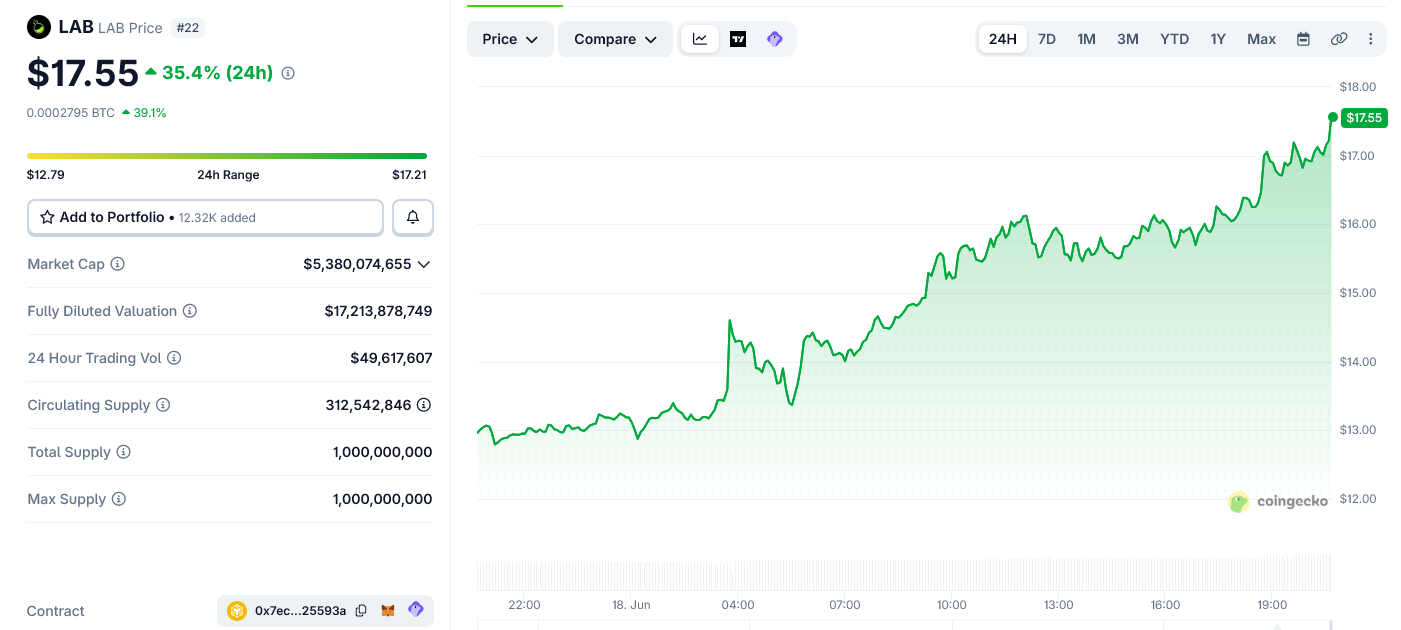
LAB jumped more than 19% in a single day, reclaiming the $17 area as whale wallets stacked fresh long positions. A parabolic curve on lower timeframes now points the token toward $19.
The move extends a recovery off the $7 support band, where larger holders defended price and printed a higher low. On-chain positioning and momentum readings now suggest buyers still hold the advantage.

Whale Wallets Pile Into LAB Longs
Whale positioning leans heavily bullish. The notional long-to-short ratio is 260.67%, indicating long exposure outweighs shorts by roughly 2.6 times across 214 tracked whales.
The 129 long whales hold $27.58 million in positions at an average entry of $10.25. That cohort shows 92.24% profitability and $4.73 million in unrealized gains.

The 85 short whales tell the opposite story. They hold $10.58 million at an average entry of $10.85, yet only 4.70% sit in profit, with $1.30 million in unrealized losses.
Short-term flow confirms the same bias. Over the past hour, 67 whales bought against 35 sellers, with net buy volume of $490,000 versus $179,000 in net selling.
This accumulation echoes recent whale buying across other altcoins. A sustained move below the $13 zone would be the first sign that longs are unwinding.
RSI Climbs Toward Overbought Territory
On the daily chart, LAB reclaimed the $16 area with a daily candle up more than 19%, extending the uptrend that began at the May 29 low after the price bounced off the $7 support band and printed a higher low (blue circle).
The token now tests the 0.5 Fibonacci retracement at $16.03 as resistance, with the 0.382 level near $18.84 standing as the next upside target if buyers hold control.

Momentum supports the whale bias, though it carries a warning. The daily Relative Strength Index (RSI) reads near 65 and is rising into bullish territory.
On the hourly chart, RSI trades inside an ascending parallel channel and sits just above the midline. That structure leaves room for a push toward the channel’s overbought extreme.

However, the advance comes on thin volume. A parabolic move into overbought conditions on weak participation often precedes sharp pullbacks. Therefore, the same readings that look bullish now could flip quickly if buyers fail to follow through.
LAB Price Prediction and the $13 Line
The hourly chart shows LAB tracking a steepening parabolic curve since the May 29 low. The token trades near $15.46 and is testing the 0.5 Fibonacci retracement at $16.03 as immediate resistance.
A clean break opens the path to the 0.382 Fibonacci level near $18.84, just below $19. That target is roughly 22% above the current price and aligns with the rally’s next logical resistance level.

Momentum favors that scenario in the near term. However, parabolic structures rarely hold for long, and the thin volume behind this leg keeps the risk of a fast reversal elevated.
The critical support is the 0.618 Fibonacci level at $13.21, the same $13 zone whales are watching. Losing it would invalidate the bullish thesis and expose the 0.786 level near $9.20.
Fundamentals add risk to the setup. A scheduled unlock of 282 million tokens in August could pressure a market still recovering from its June crash, when LAB fell 77% from its record high of $27.96.
For now, LAB price holds above support and eyes $19, but $13 remains the level that decides the trend.
The post BNB Chain’s LAB Token Keeps Exploding in a Parabolic Rally: What’s Next? appeared first on BeInCrypto.


Michael Saylor’s bitcoin (BTC) treasury company Strategy has lost 40 years of forecasted dividend coverage in just seven months.
On November 20, the company announced, “At current BTC levels, we have 71 years of dividend coverage assuming the price stays flat.”
However, on Thursday morning, it admitted, “We have 32 years of dividend coverage through our BTC Reserve.” A few hours later, the counter on its homepage ticked down to 31.
Things aren’t going well for Strategy. As of writing time, the company’s common stock, MSTR, is within 7% of its 52-week low and its largest dividend-paying stock, STRC, hit an all-time low today.
Strategy loses four decades of dividend coverage
Strategy calculates Dividend Coverage using elementary division, dividing the market value of its BTC holdings by its forecasted year of dividend payments.
Obviously, the lower the price of BTC, the fewer years Strategy can pay dividends by hypothetically selling its BTC.
Moreover, years decrease even with a flat BTC price as Strategy increases its annual dividend obligations by issuing more dividend-paying shares.
This second cause, also known as dilution, is the primary reason for Strategy’s shortened runway.
Indeed, the company has aggressively diluted shares of its preferred stocks, especially STRC. On November 20, 2025, the total face value of STRC was $2.8 billion. Today, it’s $10.5 billion.
All of those extra preferred shares pay dividends.
Read more: Saylor distances himself from STRC-backed DeFi after stablecoin wobble
STRC hit an all-time low today
STRC, according to dubious claims about its stability and comparisons to savings accounts or money markets, pays a variable 11.5% annualized dividend rate and is supposed to trade near its $100 par value.
In fact, it trades at wildly lower prices than that Saylor’s intention. Today, for example, STRC fell to an all-time low of $82.53, 17.5% below its intended price.
As the price of BTC dropped from about $90,000 in mid-November to roughly $63,000, a decline of 30%, smaller numerator reduced Strategy’s dividend coverage.
Over the same time period, Strategy ran up its dividend bill. Annual preferred obligations have increased by hundreds of millions of dollars, and they all require USD cash.
Over the last seven months, the company kept diluting preferred shareholders, manufacturing more obligations that never end, in order to fund one-time purchases of BTC that are almost entirely underwater as the BTC bear market has continued lower.
Got a tip? Send us an email securely via Protos Leaks. For more informed news and investigations, follow us on X, Bluesky, and Google News, or subscribe to our YouTube channel.


The punishments of Alexander Mashinsky, the imprisoned former chief of Celsius until its high-profile collapse, continue with a formal banishment from any ability to seek business with the U.S. Commodity Futures Trading Commission or the trading it oversees.
The derivatives regulator didn’t pile any new fines onto Mashinsky, who previously pleaded guilty to accusations he misled the public about the health of his failing crypto firm as it was imploding, but the agency added an expected registration and trading ban, according to a Thursday statement. That’s a minor addition to the 12-year prison sentence imposed in his criminal case, in which he pleaded guilty to fraud, was hit with a $50,000 fine and ordered to return $48 million.
The CFTC’s arrangement, which “permanently restrained, enjoined and prohibited” him from any commodities activity, has been recorded in U.S. District Court for the Southern District of New York, according to the filing, and was approved by a judge on Thursday, the court docket shows.

John Stones ‘suffers’ and Marc Guehi plays waiting game after World Cup surprise

Apple patches eavesdropping vulnerability in Beats Studio Buds

The Next Crypto BULL MARKET Begins…FIND OUT HERE!


-

 Business4 days ago
No Jackpot Winner as $257 Million Prize Rolls Over to $269 Million Monday Draw
-

 Fashion6 days ago
Weekend Open Thread: Tuckernuck – Corporette.com
-
Crypto World4 days ago
Zimbabwe Requires Crypto Businesses to Register Annually Under New FIU Regulations
-

 Crypto World6 days ago
Bitget enters Argentina’s regulated crypto market through PSAV registration
-

 Tech6 days ago
NanoClaw integrates JFrog registries to secure AI agent downloads
-

 Tech6 days ago
This Week In Security: Microsoft On Microsoft, Register Your Domains, Linux On ARM, And FreeBSD Joins The File Cache Club
-

 NewsBeat7 days ago
El Nino has formed in the Pacific and could set records, forecasters say
-

 NewsBeat6 days ago
FBI searches office of Ohio voter registration group
-
 Tech7 days ago
Anthropic is spending $150M to embed 1,000 AI fellows inside nonprofits. No degree required.
-
 Entertainment7 days ago
‘The Pitt’s Fan-Favorite Doctor Confirms Noah Wyle Gave His Blessing to Return [Exclusive]
-
 Tech7 days ago
Former AWS CEO Adam Selipsky to lead new $10B AI data center venture
-
 Crypto World7 days ago
Ripple and Bitso Bring MXNB Stablecoin to XRP Ledger
-
 Entertainment4 days ago
Matt Damon’s Viral Sci-Fi Thriller Has Taken Over HBO Max
-

 Business4 days ago
Anthropic staff to meet White House officials next week, Axios reports
-

 Business7 days ago
Justin Bieber Prepares for 2026 Tour Return with New Music and Promoter Talks
-
 Tech4 days ago
As AI companies race to go public, who else is along for the ride?
-
 Crypto World4 days ago
Bitcoin could crash to $48,000, if this historical pattern is triggered
-
 Tech7 days ago
Euro-Office 1.0 Arrives To Open-Source Infighting: ‘Compatibility Is Not Sovereignty’
-

 Politics4 days ago
“Israel’s” ban on ICRC visits ruled illegal, but Knesset moves to stop them permanently
-
Entertainment7 days ago
Ana Navarro unleashes explosive tirade on ex-Trump aide, Disney Channel star in epic on-air fight: 'Have you no shame?'
You must be logged in to post a comment Login