

Crypto World
Binance eyes Mesh round at $2B as payments race heats up



Binance is reportedly set to lead a new funding round for Mesh, a crypto payments and settlement company, at a valuation of up to $2 billion.
Summary
- Binance’s planned lead role could double Mesh’s valuation from $1B to as much as $2B.
- Mesh’s payments network targets digital asset transfers across wallets, exchanges, stablecoins, and fiat rails globally.
- Growing stablecoin rules and tokenization demand are pushing investors toward crypto settlement infrastructure providers.
The deal was reported by Axios, citing people familiar with the matter. The report said demand for digital asset-to-fiat transfer tools, payment systems, and settlement infrastructure is rising.
Meanwhile, that demand comes as stablecoin rules become clearer and tokenization moves deeper into financial markets. The round has not been formally announced by Binance or Mesh.
Mesh valuation could double
The reported round would mark a sharp rise in Mesh’s valuation. As crypto.news reported, Mesh raised a $75 million Series C in January at a $1 billion valuation. That round was led by Dragonfly Capital, with backing from Paradigm, Moderne Ventures, Coinbase Ventures, SBI Investment, and Liberty City Ventures.
Mesh was formerly known as Front Finance. The company builds payment infrastructure that connects wallets, exchanges, digital assets, and fiat rails. It aims to make crypto payments easier for users while letting merchants receive stablecoins or fiat without handling complex blockchain steps.
Stablecoin rules lift demand
Stablecoins have become a major focus for payment companies, exchanges, and banks. Banking Circle launched regulated stablecoin settlement services after receiving approval in Luxembourg. The bank now supports USDC, USDG, and its own EURI for institutional fiat and crypto conversion.
The market is also moving toward tokenized bank deposits. As crypto.news reported, major U.S. banks are backing a tokenized deposit network through the Clearing House, with a launch targeted for early 2027. That system would let banks settle tokenized deposits around the clock while keeping customer deposits inside regulated banking channels.
Funding race turns to settlement
Mesh sits in the middle of this shift because it focuses on the movement of value between assets, wallets, and payment systems. Its model addresses a common issue in crypto payments: users may hold one asset, while merchants or platforms may want settlement in another asset or in fiat currency.
The company has also worked to expand access through partnerships. Moreover, Mesh partnered with Italy’s crypto wallet Conio in 2024, giving Conio users access to several crypto exchanges and withdrawal options through Mesh’s connection layer.
A Binance-led round would show that large exchanges still see payment and settlement infrastructure as a core growth area. It would also place Mesh closer to the center of the stablecoin and tokenization race, where firms are trying to connect crypto rails with everyday payments, institutional transfers, and fiat settlement.
The reported valuation also reflects a wider shift in crypto funding. Investors have moved beyond trading apps and tokens toward systems that can support regulated payments, cross-border transfers, and asset settlement.
If the round closes near the reported level, Mesh would have doubled its valuation in about six months, showing continued demand for infrastructure that links digital assets with traditional money.



Brazil has approved new prudential rules that will require virtual asset service providers to meet capital, risk management, and disclosure standards from 2027.
Summary
- Brazil has approved new prudential rules requiring crypto service providers to meet capital, risk management, and disclosure standards from 2027.
- Virtual asset firms will move into Brazil’s S4 regulatory segment by mid 2028, while smaller S5 institutions will no longer be allowed to offer crypto services.
- The new requirements extend Brazil’s ongoing crypto regulatory framework, following recent licensing audits and foreign exchange rules.
According to a local media report, Brazil’s Central Bank has approved a new set of prudential requirements for virtual asset service providers (SPSAVs), bringing them closer to the regulatory framework applied to securities brokers and distributors. The rules were approved on July 1 and will take effect on Jan. 1, 2027, as part of the country’s ongoing implementation of its cryptoasset legal framework.
Once the rules come into force, companies offering cryptocurrency and other virtual asset services will have to maintain minimum capital reserves, establish formal risk management policies, and periodically disclose information about their financial and operational condition. The Central Bank said the measures are intended to strengthen the financial system and reduce risks for customers and the market.
The report stated that firms providing crypto brokerage, custody, and transfer services will now be classified as Type 3 institutions together with the economic groups they lead. According to the Central Bank, the classification follows the principle that activities carrying similar risks should be subject to similar regulatory standards.
Another part of the framework introduces a phased transition into Brazil’s banking supervision structure. The report said all virtual asset service providers will be placed in Segment 4 (S4) by June 30, 2028, regardless of their size, giving them additional time to comply with the full prudential requirements.
At the same time, institutions classified under Segment 5 (S5), which follows a simplified regulatory regime for smaller financial institutions, will no longer be permitted to provide virtual asset services because the Central Bank considers those activities incompatible with lighter supervisory standards.
Latest step in Brazil’s crypto oversight
The new requirements add to a series of regulatory measures introduced over the past year. In November 2025, the Central Bank published the first operating rules for virtual asset service providers, establishing standards covering governance, anti-money laundering controls, foreign exchange participation, and operational requirements.
Earlier this year, Brazil’s National Monetary Council required crypto platforms to follow confidentiality rules comparable to those imposed on traditional financial institutions, including compliance with Complementary Law 105 on bank secrecy.
The latest prudential framework also follows a June rule requiring crypto companies seeking authorization or license renewals to submit independent audit reports prepared by professionals registered with Brazil’s securities regulator.
As previously reported, the audits review anti-money laundering controls, counter terrorism financing procedures, customer asset segregation, internal risk management, and employee compliance programs before licensing decisions are made.
Regulators have also tightened oversight in other areas during 2026. In May, Brazil’s Central Bank prohibited regulated cross-border electronic foreign exchange providers from using crypto assets to settle international payments, while still allowing digital assets to be traded and transferred outside the supervised payment system.
More recently, federal prosecutors reminded political parties that cryptocurrency donations remain prohibited in election campaigns because campaign finance rules require donors to be clearly identified.

FUNToken continues to make accessing the $FUN ecosystem simpler by expanding its supported deposit options. Users can now deposit SOL and receive $FUN automatically through the platform’s seamless conversion process.
The addition of SOL provides users with another convenient way to acquire $FUN without the need for manual token swaps. All supported non-$FUN deposits are automatically converted into $FUN with 0% conversion fees, creating a faster and more streamlined onboarding experience.
A Simpler Way to Access the $FUN Ecosystem
As the FUNToken ecosystem continues to grow, providing users with flexible and accessible funding options remains a key priority.
With SOL now supported, users can fund their accounts through a straightforward deposit process. Once deposited, SOL is automatically converted into $FUN, eliminating unnecessary steps while ensuring users can quickly begin exploring everything the ecosystem has to offer.
Whether users are playing $FUN Games, staking their tokens, or participating in future ecosystem features, accessing $FUN has become even more convenient.
Seamless Conversion with 0% Fees
The deposit process has been designed to be simple and efficient.
Users can now deposit SOL, with funds automatically converted into $FUN at 0% conversion fees. By removing the need for additional swaps, FUNToken continues to reduce friction and make participation in the ecosystem more accessible.
The expansion of supported deposit assets reflects FUNToken’s ongoing commitment to improving the user experience while providing more ways for the community to engage with the platform.
About FUNToken
FUNToken powers a growing Web3 gaming ecosystem designed to make digital rewards more accessible and engaging. Through $FUN Games, staking, community incentives, and an expanding range of supported deposit assets, FUNToken continues to simplify how users access the ecosystem while creating more opportunities to play, earn, and participate.
Disclaimer: This is a Press Release provided by a third party who is responsible for the content. Please conduct your own research before taking any action based on the content.

Bitcoin price traded near $61,700 on July 3, according to crypto.news price data, after recovering from the sub-$60,000 area.
Summary
- Bitcoin price rebounded near $61,700 after ETF inflows ended a 10-day negative streak.
- Analysts say BTC must reclaim $62,800 and $65,000 to confirm stronger bullish momentum.
- On-chain data shows accumulation improving, but technical indicators still need clearer trend confirmation.
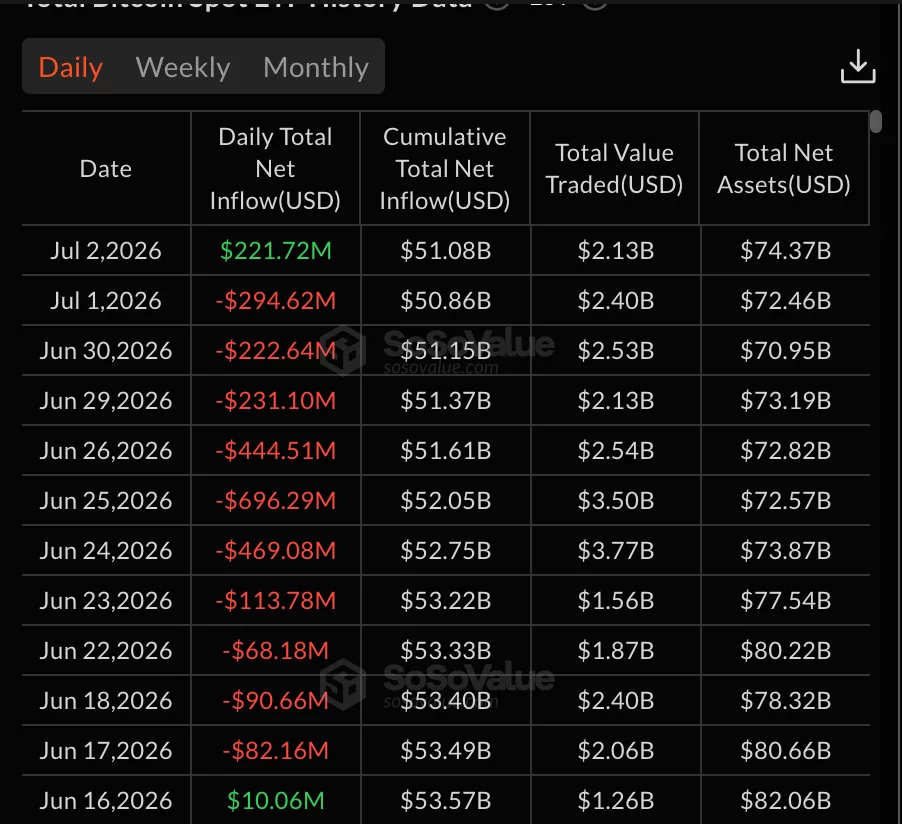
The move came as U.S. spot Bitcoin ETFs returned to net inflows for the first time since June 16.
U.S.-listed spot Bitcoin ETFs recorded $221.7 million in net inflows on July 2, according to SoSoValue data. Fidelity’s FBTC led with about $166 million in inflows, while Ark Invest and 21Shares’ ARKB added $91.8 million. VanEck’s HODL saw $4.4 million in inflows.
The rebound ended a 10-day negative streak that removed more than $2.7 billion from the products. June was also the weakest month for U.S. spot Bitcoin ETFs since their 2024 launch, with about $4.5 billion in total net outflows.
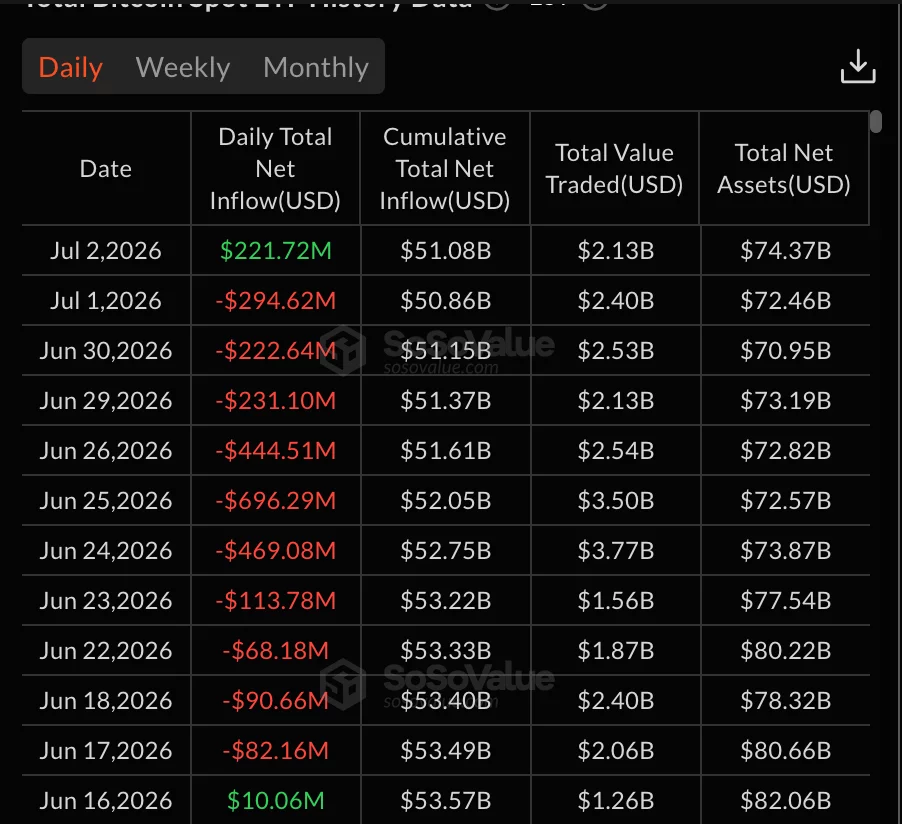
Bitcoin fell below $59,000 afterJune ETF outflows hit a record $4.5 billion. That selling wave kept pressure on BTC and raised doubts over whether the $60,000 region could hold.
Bitcoin faces $62,800 and $65,000 tests
The crypto has improved, but the chart has not confirmed a clean bullish reversal. BTC is trading slightly below the Bollinger middle band near $62,296. The upper band sits near $66,844, while the lower band is around $57,748.
This means the token has moved away from the lower end of the range, but it has not regained full control. A daily move above the middle band would strengthen the short-term setup and show that buyers are taking back momentum.
Market analyst Ted said Bitcoin is close to the $62,000 level and needs to reclaim $62,800 and $65,000 for a stronger rally this month. Those levels match earlier resistance zones watched by traders after the June selloff.
Previously, BTC needed to reclaim the$62,800 to $65,000 range to show that buyers were gaining short-term control. That area remains the key technical barrier.
Momentum improves, but not fully
The Awesome Oscillator remains negative near -3,085.64, showing that broader momentum is still weak. However, recent green histogram bars show that bearish pressure is easing compared with deeper negative readings from June.
That setup points to stabilization rather than full recovery. BTC needs the Awesome Oscillator to move closer to zero or above it before traders can call stronger bullish momentum.
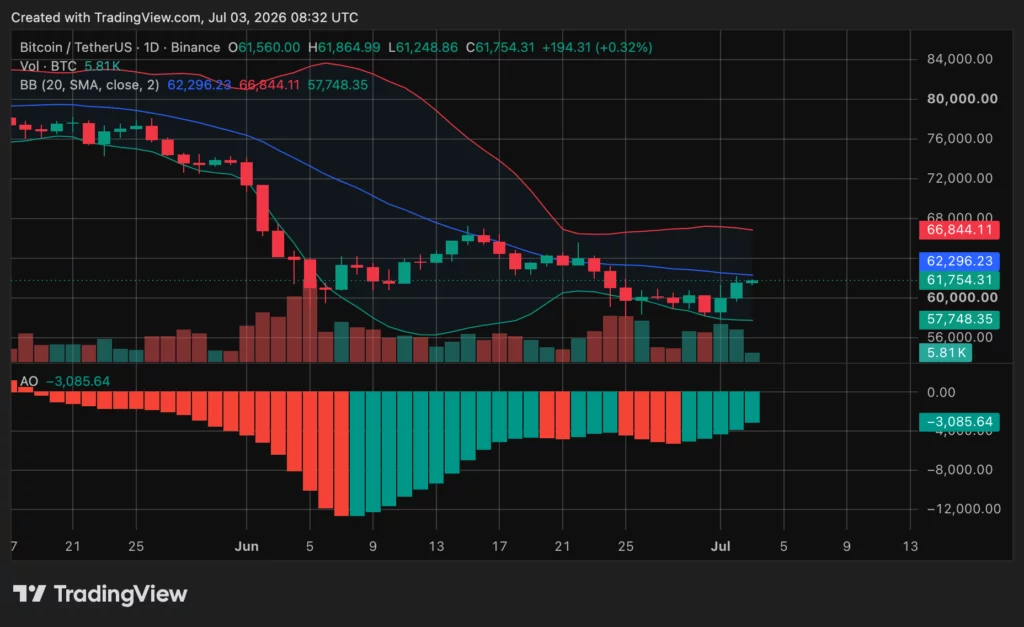
The Bollinger Bands also remain wide after June’s decline, showing that volatility is still high. Price holding above the lower band is constructive, but the current position below the middle band shows that the market is still in repair mode.
As previously reported, Bitcoin’s earlier move above $60,000 lacked fresh buying fuel because stablecoin growth and spot demand remained weak. The latest ETF inflow helps that case, but one positive day is not enough to confirm a sustained trend.
On-chain data points to accumulation
Crypto analyst Ali Charts said Bitcoin’s Investor Price sits near $48,300. He described that level as a long-term cost-basis zone that has marked major cycle bottoms in past bear markets. If BTC drops toward that area, he said it may offer a high-conviction accumulation signal for long-term buyers.
Ali Charts also said wallet behavior has shifted over the past 30 days. Retail wallets, mid-sized holders, and large entities holding between 1,000 and 100,000 BTC have moved back toward net buying. He said this coordinated demand can help create a stronger price floor.
CryptoQuant analyst CryptoZeno gave a similar on-chain view. The analyst said Bitcoin’s adjusted sell-side risk ratio has entered a historical accumulation zone. Low readings often show that realized profits and losses are small compared with market value, meaning investors are less willing to sell at current prices.
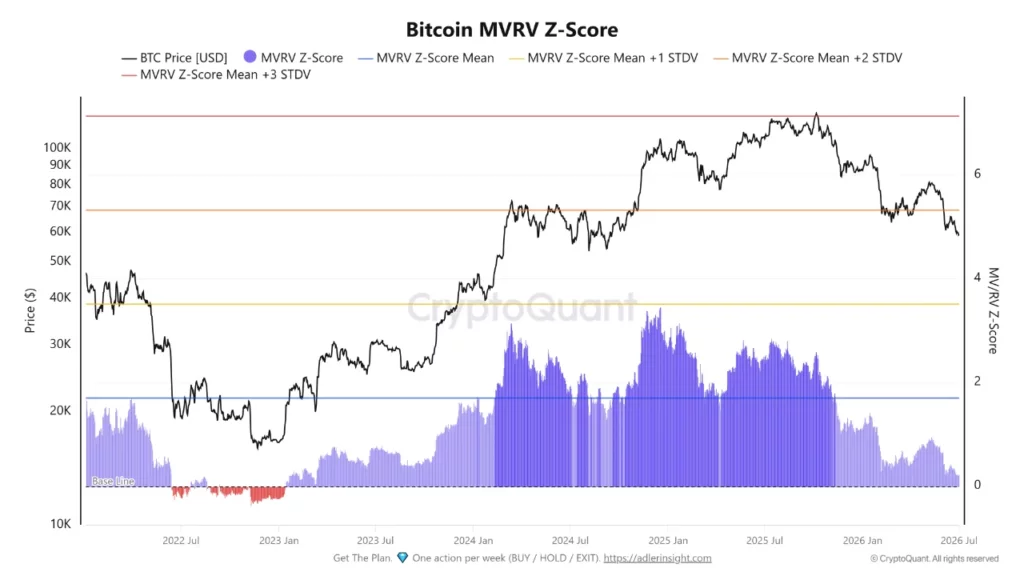
The same analyst also said Bitcoin’s MVRV Z-Score has fallen below the +2 standard deviation level. That suggests the valuation premium is cooling, but it does not yet show deep undervaluation or a classic cycle-top structure.
ETF rebound does not remove risk
The return of ETF inflows gives the crypto its strongest short-term support in weeks. It also helps explain the move back toward $62,000 after June’s heavy outflows weakened institutional demand.
Still, traders will need more than one day of ETF buying. If inflows continue, BTC could challenge $62,800 first, then $65,000. A clean break above $65,000 would improve the recovery case and may open the way toward the upper Bollinger band near $66,800.
If BTC fails to reclaim $62,800, the rebound may remain a relief move. A drop below $60,000 would put $57,700 and $55,000 back in focus, especially if ETF flows turn negative again.
Disclosure: This article does not represent investment advice. The content and materials featured on this page are for educational purposes only.

Key Takeaways
- Wall Street analysts at JPMorgan warn that Strategy’s updated Bitcoin liquidation policy creates “avoidable two-way risk” for cryptocurrency investors
- The company can now liquidate Bitcoin holdings to cover preferred shareholder dividends and optimize its financial position
- Strategy controls approximately 4.2% of all Bitcoin in circulation and has purchased between $8.2B and $13.7B in digital assets this year, representing roughly 70% of total net inflows
- According to JPMorgan analysts, Strategy requires cash buffers sufficient for 24–36 months of dividend payments — substantially more than its present ~17-month coverage
- Bitcoin gained 3.4% to reach $62,127 on Thursday; STRC shares remain down approximately 75% year-over-year
Strategy has long cultivated its identity as the unwavering Bitcoin accumulator. That perception is now facing serious challenges.
A recent analysis from JPMorgan raises concerns that Michael Saylor’s financial restructuring at Strategy Inc. has fundamentally altered Bitcoin market mechanics. Analysts at the investment bank suggest the transformation has converted crypto’s most prominent accumulator into a potential liquidity provider — a development that’s creating uncertainty among market participants.
Strategy’s shares experienced a substantial rally of approximately 20% following Monday’s restructuring disclosure. Despite this bounce, the equity remains down roughly 75% from levels seen twelve months ago.
Bitcoin extended its recovery streak on Thursday, advancing up to 3.4% and touching $62,127. The cryptocurrency’s gains were largely attributed to weaker-than-anticipated employment data from the United States, which sent shorter-maturity Treasury yields declining.
Strategy’s Policy Transformation
Strategy unveiled what it’s branding as the BTC Monetization Program this week. Under this framework, the corporation has authorized itself to liquidate as much as $1.25 billion in Bitcoin holdings to strengthen cash balances, satisfy preferred equity dividend commitments, service debt obligations, and execute security repurchases.
The firm has also established a minimum liquidity threshold that must cover no less than 12 months of preferred dividend requirements. Current cash reserves stand at approximately $2.55 billion, providing coverage for about 17 months of scheduled payments.
JPMorgan’s research team, headed by managing director Nikolaos Panigirtzoglou, considers this insufficient. Their analysis suggests Strategy requires reserves spanning 24 to 36 months to adequately assure market participants that Bitcoin asset sales won’t be necessary.
“We believe a higher coverage of 24–36 months would be needed to make investors more comfortable with the idea that Strategy would not need to sell bitcoins in the foreseeable future,” the analysts wrote.
Market Implications for Bitcoin
Strategy represents the world’s largest institutional Bitcoin holder. The company’s treasury contains approximately 4.2% of Bitcoin’s entire circulating supply. Throughout the current year, Strategy has accounted for an estimated 70% of net digital asset capital inflows, accumulating somewhere between $8.2 billion and $13.7 billion in cryptocurrency purchases.
Given this extraordinary market presence, any indication of potential selling activity carries disproportionate weight. When Strategy revealed the disposal of merely 32 Bitcoin — valued at $2.5 million — on June 1, the disclosure contributed to a prolonged selloff that drove Bitcoin down over 50% from its peak valuation.
JPMorgan’s analysts described the situation bluntly: “The possibility that Strategy would be selling bitcoins introduces two-way risk into crypto markets, inducing more uncertainty and volatility for bitcoin prices that could have been avoided.”
Strategy’s preferred securities have experienced downward pressure as well. The company’s Stretch preferred instruments were changing hands around $87.50 on Thursday — remaining beneath the $100 nominal value required to profitably issue additional securities.
The JPMorgan analysis noted that improved cryptocurrency market performance in the second half will likely require Congressional approval of the US market structure legislation, commonly referred to as the Clarity Act. Should both prerequisites materialize — enhanced cash reserves and regulatory advancement — analysts indicated that prevailing negative sentiment might represent a contrarian entry opportunity.


There are other advantages too. Tokenization enables different forms of digital money, such as tokenized bank deposits, fiat-pegged stablecoins, and tokenized central bank reserves to function seamlessly as settlement assets on the same ledger.
It also allows high-quality assets to be quickly deployed across platforms as collateral.
But all this is not without risk.
The hidden danger
The delays that tokenization eliminates aren’t just inefficiencies, Adrian wrote. They also give banks, regulators and risk managers time to catch problems before they spread.
Remove this buffer, and a market shock, a coding error, or a sudden wave of automated selling could ripple through the system before anyone can intervene.
“Liquidity demands materialize in real time, collateral calls can be automated, and failures can propagate faster than institutions or supervisors can respond,” he wrote. “Risk [sic] that once were borne by the balance sheet of individual institutions behind a transaction become increasingly concentrated in the platforms and code that govern these transactions.”
Adrian also flagged concentration risk. Tokenization tends to funnel activity onto fewer, larger platforms. “When infrastructure becomes the central hub,” he warned, “governance failures become systemic events.”
On cybersecurity, he warned that consolidation onto shared ledgers “amplifies the importance of operational resilience, cybersecurity, and crisis management.”

Ireland’s Criminal Assets Bureau (CAB) confirmed the seizure of another 500 Bitcoin, currently worth about 27 million euros ($30.9 million), in collaboration with Europol’s European Cybercrime Centre.
That brings the total Bitcoin seized by CAB in 2026 to 1,500 BTC, worth about $92.4 million, the law enforcement agency said in a social media post on Thursday. CAB said Europol had provided operational coordination, technical expertise and decryption support during the investigation.
The agency did not disclose the identity of the wallet owner or details of the underlying investigation, adding that it had no further comment.
The latest seizure comes months after CAB said it had gained access to and seized a cryptocurrency wallet containing 500 Bitcoin, which Irish media linked to a convicted drug dealer.

CAB seized another 500 BTC. Source: Criminal Assets Bureau
Collins-linked Bitcoin wallet becomes active
Following the previous seizure, The Irish Times reported that the wallet authorities accessed in March was one of 12 holding about 6,000 BTC once owned by Clifton Collins, a convicted drug dealer. The paper containing the wallet’s private keys was reportedly lost.
While authorities haven’t confirmed whether the latest seizure is linked to Collins, a wallet address associated with him moved 500 Bitcoin to an unknown address on Thursday. Wallets associated with Collins still hold 4,500 Bitcoin, currently worth about $277 million, as of Friday.
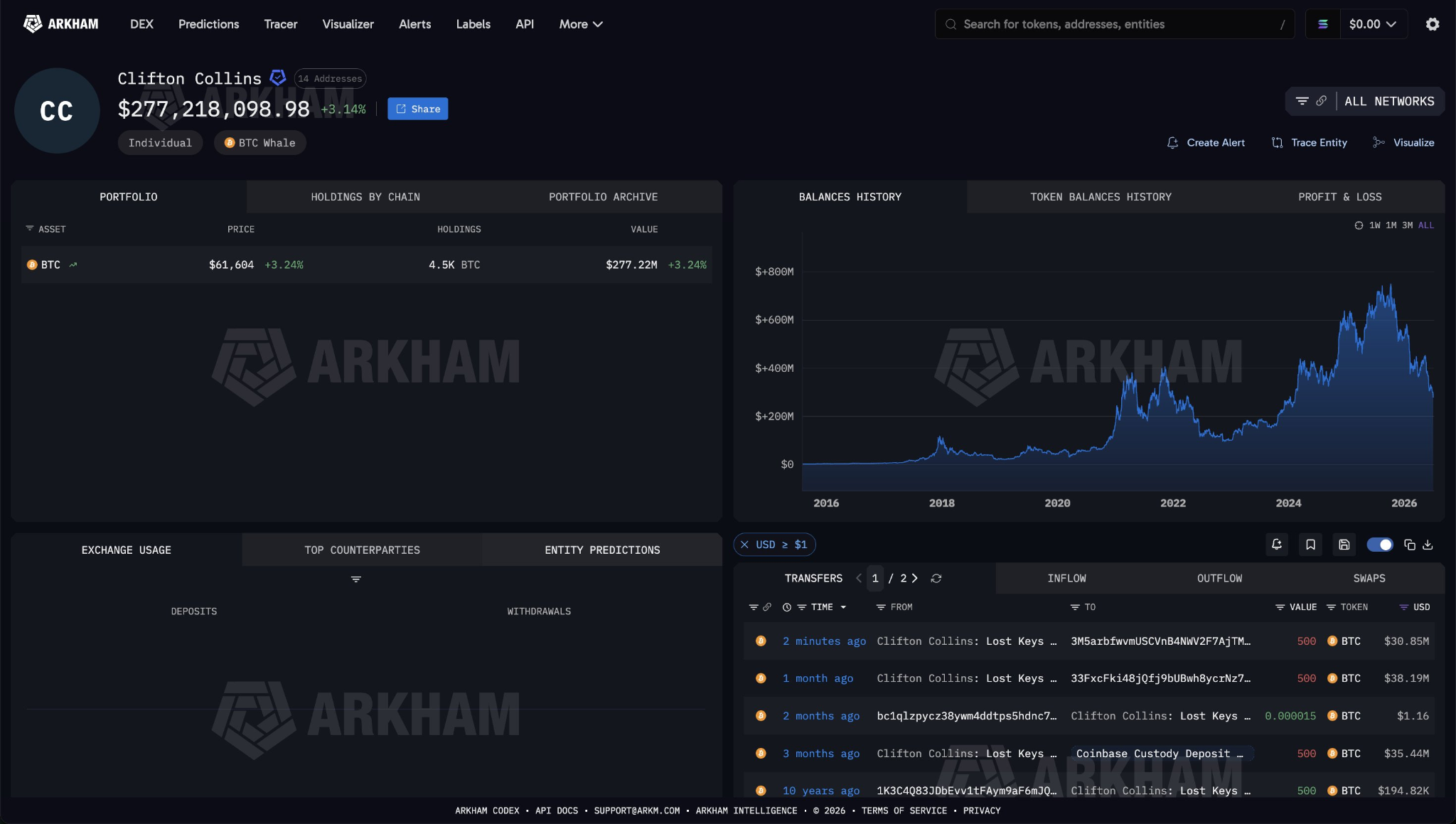
Source: Arkham
Related: US sanctions Sinaloa cartel-linked Ethereum addresses
Collins was arrested in 2017 after police searched his car and found a stash of cannabis, according to the Guardian.
Police said Collins used proceeds from his drug operation to purchase 6,000 Bitcoin in late 2011 and early 2012, spreading the holdings across 12 wallets. He stored the wallet keys on a single sheet of A4 paper, hidden inside the aluminum cap of a fishing rod case at his rental home.
Collins’ landlord allegedly discarded his belongings after his arrest. Collins claimed the fishing rod case was stolen before the landlord entered the property.
Magazine: How crypto laws changed in 2025 — and how they’ll change in 2026


Bitget, the world’s largest Universal Exchange (UEX), has launched US stock options, giving users direct access to trade options on leading US-listed companies. This makes Bitget the only major crypto exchange currently offering US stock options alongside crypto and CFD markets covering gold, forex, commodities and indices.
Active features include long call and long put strategies for eligible users. Calls allow traders to take a bullish position on a stock, while puts can be used to express a bearish view or manage downside exposure. Risk for buyers is limited to the premium paid, although an option may expire without value if the expected price movement does not occur.
The launch expands Bitget’s stock product line, following the introduction of tokenized stocks, its position as a leading venue for tokenized-stock trading, and pre-IPO access to private market opportunities. Stock options add another widely used Wall Street instrument to the Stock+ offering, giving active traders more ways to approach market movements, earnings cycles and portfolio risk.
Stock options expand the platform’s Stock+ product, with direct-access venue for traditional US equities, built for traders familiar with established stock market products and regulated market infrastructure. The addition aligns with Bitget’s wider goal of bringing crypto, stocks, commodities and other global assets into one multi-asset trading environment for users worldwide.
Demand for listed options has reached record levels. The US options market processed more than 15.2 billion contracts in 2025, an average of roughly 60 million contracts per trading day. The growth indicates wider use of options by retail and institutional participants for directional trading, hedging and capital management.
“We have consistently moved first to connect stock opportunities with our users,” said Gracy Chen, CEO at Bitget. “This has been rewarding to us and users alike. From tokenized stocks to now options, we are executing on convergence. This is innovation crypto was born to push, our products are way ahead of its time in providing advanced trading access to stocks, gold, crypto and worldwide assets.”
The initial release focuses on single-leg options buying to provide a clear entry point for users. Additional functionality, including more advanced multi-leg strategies, is planned as the Stock+ options product develops.
To mark the launch, eligible users completing their first US stock options trade may receive $15 worth of NVIDIA stock, subject to the campaign terms and regional availability.
Options trading involves significant risk and may not be suitable for all users. Product availability, supported securities and promotional rewards may vary by jurisdiction. Users should review the relevant product disclosures and understand the potential loss of the full premium before trading.
To know more about stock options trading on Bitget, visit here.
About Bitget
Bitget is the world’s largest Universal Exchange (UEX), serving over 125 million users and offering access to over 2M crypto tokens, 500+ tokenized stocks, ETFs, commodities, FX, and precious metals such as gold. The ecosystem is committed to helping users trade smarter with its AI agent, which co-pilots trade execution. Bitget is driving crypto adoption through strategic partnerships such as MotoGP™. Aligned with its global impact strategy, Bitget has joined hands with UNICEF to support blockchain education for 1.1 million people by 2027. Bitget currently leads in the tokenized TradFi market, providing the industry’s lowest fees and highest liquidity across 150 regions worldwide.
For more information, visit: Website | X | Telegram | LinkedIn | Discord
Risk Warning: Digital asset prices are subject to fluctuation and may experience significant volatility. Investors are advised to only allocate funds they can afford to lose. The value of any investment may be impacted, and there is a possibility that financial objectives may not be met, nor the principal investment recovered. Independent financial advice should always be sought, and personal financial experience and standing carefully considered. Past performance is not a reliable indicator of future results. Bitget accepts no liability for any potential losses incurred. Nothing contained herein should be construed as financial advice. For further information, please refer to our Terms of Use.
The post Bitget Launches Crypto Industry’s First Ever US Stock Options Trading appeared first on BeInCrypto.
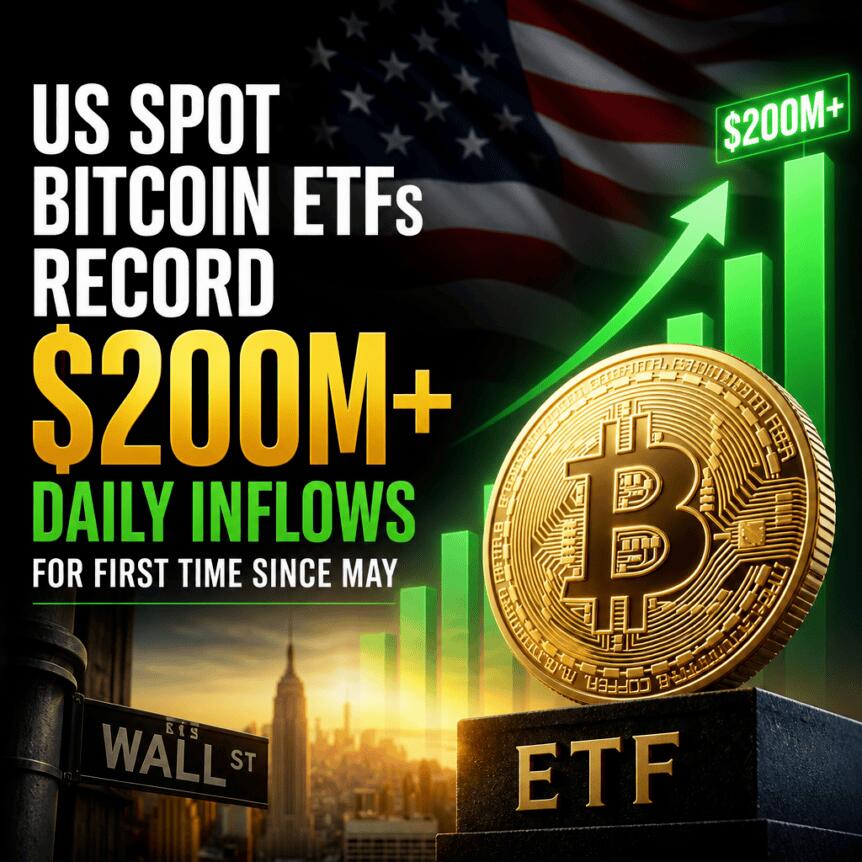
US-listed spot Bitcoin exchange-traded funds snapped back into positive territory this week, recording their first daily net inflow above $200 million since early May. The shift marks a notable interruption to a prolonged outflow cycle that has been weighing on inflows for much of the year.
According to SoSoValue data, the ETFs pulled in $221.7 million in net inflows on Thursday. That ended a 10-day streak of net outflows totaling more than $2.7 billion, following what many market participants have described as one of the weakest periods for US spot Bitcoin ETF demand in 2024.
Key takeaways
- US spot Bitcoin ETFs recorded $221.7 million in net inflows on Thursday, ending a 10-day outflow run totaling over $2.7 billion.
- June stood out as a particularly tough month for flows, with net outflows reaching a record $4.5 billion, according to earlier coverage cited by the report.
- Fidelity’s Wise Origin Bitcoin Fund (FBTC) led the rebound with $166 million in net inflows, accounting for about 75% of the day’s total, per Farside Investors.
- BlackRock’s iShares Bitcoin Trust (IBIT) continued to see outflows, with $40.4 million leaving the fund on Thursday and over $2.2 billion lost across an 11-session streak since June 17.
- While Bitcoin flows improved, sentiment remained fragile, with the Fear & Greed Index reading “extreme fear” as Bitcoin recovered above $61,000.
Bitcoin ETF demand reverses after a prolonged outflow stretch
The most immediate story behind Thursday’s turnaround is the magnitude of the inflow itself. After weeks in which spot Bitcoin ETF balances were consistently reduced by withdrawals, investors added risk back to the funds—at least for a day—bringing net inflows above the $200 million threshold that had not been seen since early May.
SoSoValue’s tracking shows Thursday’s $221.7 million inflow broke a 10-day streak of net outflows. In context, the report also points to June as a low point: US spot Bitcoin ETFs logged a record $4.5 billion in net outflows during the month, underscoring how difficult the demand backdrop has been.
Market conditions appear to be part of the catalyst. At the same time as ETF flows improved, Bitcoin regained the $61,000 area after briefly dipping below $59,000. The day’s broader sentiment remained cautious, however, with Alternative.me’s Fear & Greed Index sitting at an “extreme fear” reading on Friday.
One notable viewpoint referenced in the report comes from Bitwise Chief Investment Officer Matt Hougan, who suggested that the market could be nearing a bottom, reflecting a growing contingent of investors interpreting the recent selloff as potentially late-cycle rather than early-cycle.
Fidelity leads inflows; BlackRock’s IBIT remains under pressure
Thursday’s inflow rebound was not evenly distributed across issuers. Fidelity’s Wise Origin Bitcoin Fund (FBTC) stood out as the primary driver of the positive day, pulling in $166 million in net inflows. Farside Investors data cited in the report indicates this represents roughly 75% of the total inflow.
Other funds contributed smaller amounts. ARK 21Shares’ Bitcoin ETF (ARKB) added $91.8 million in net inflows, while the VanEck Bitcoin ETF (HODL) attracted $4.4 million and Valkyrie’s Bitcoin Fund (BRRR) recorded $1.7 million.
However, the rebound did not extend to the largest issuer in a way that would suggest a full marketwide reversal of investor caution. BlackRock’s iShares Bitcoin Trust (IBIT)—the largest US spot Bitcoin ETF by assets—continued to post net outflows. On Thursday, IBIT recorded $40.4 million in net outflows.
According to the report, IBIT has now lost more than $2.2 billion during an 11-session outflow streak that began on June 17. For investors watching ETF flows as a proxy for institutional appetite, the divergence is important: even as some funds see renewed inflows, persistent withdrawals from a dominant player can limit how quickly overall sentiment can stabilize.
Altcoin ETFs also see inflows as crypto market cap rises
The flow recovery extended beyond Bitcoin. The report notes that US spot Ether ETFs posted net inflows on Thursday, attracting $29.1 million—after $14.9 million in inflows the previous day.
XRP ETFs also returned to positive territory, adding $6.6 million after two consecutive sessions of net outflows. Together, these developments suggest that the rebound in risk appetite—however uneven—was not limited strictly to the largest asset in the space.
Broader market metrics aligned with the improved tone in flows. The report states that global crypto market capitalization increased by 2.4% over the past 24 hours to $2.22 trillion, based on CoinGecko data, while Bitcoin recovered above $61,000.
What traders and investors should monitor next
Thursday’s inflow figure is a meaningful signal, but it’s also a single day in a still-fragile pattern. With IBIT continuing to bleed out and overall sentiment still described as “extreme fear,” the next few sessions will matter most: investors will likely watch whether inflows persist across multiple days and whether outflows from the largest fund begin to slow, or if Thursday’s rebound turns out to be temporary.
Key Highlights
- Securitize (SECZ) launched on the New York Stock Exchange following a SPAC merger with Cantor Fitzgerald
- The firm made history by tokenizing its stock on both Solana and Avalanche blockchains on its first trading day
- Launch day saw $295 million worth of tokenized SECZ shares held by investors
- The public offering generated $400 million in capital, pushing the company’s valuation beyond $1 billion
- Industry analysts at Citigroup forecast the tokenization sector could balloon to $5.5 trillion-$8.2 trillion by decade’s end
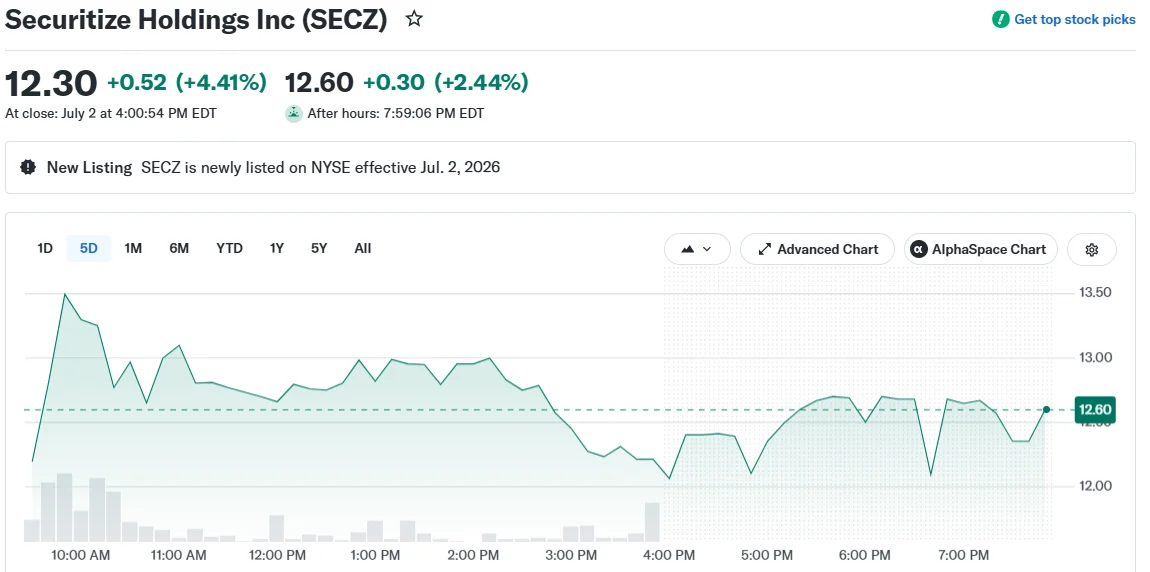
On Thursday, Securitize officially began trading on the New York Stock Exchange with the ticker symbol SECZ. The company’s public market entry came through a combination with a special-purpose acquisition company supported by Cantor Fitzgerald, generating $400 million in proceeds and achieving a valuation exceeding $1 billion.
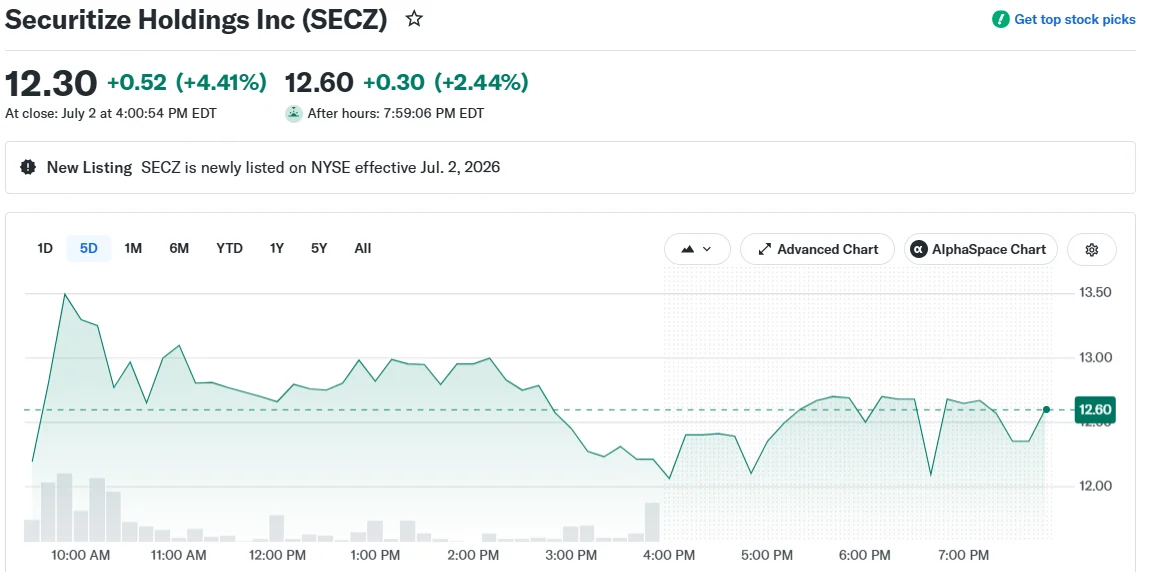
The shares concluded their inaugural trading session with a 4.4% gain, settling at $12.30 after reaching an intraday peak of $13.70. Extended trading hours saw additional momentum, with shares advancing another 2.4% to close at $12.60.
In an unprecedented move coinciding with its market debut, Securitize converted its own equity into digital tokens on both the Solana and Avalanche blockchain networks. This milestone marked the first instance of a newly listed public company tokenizing its stock immediately upon going public.
Blockchain analytics from RWA.xyz revealed that investors possessed $295 million in tokenized SECZ equity on the opening day. According to the company, these digital tokens correspond to the identical common stock available on the NYSE, rather than constituting a distinct security class.
The Unique Nature of This Tokenization
Most tokenized equity offerings currently available come from third-party issuers or operate beyond U.S. jurisdiction. Securitize emphasizes that its approach is issuer-sponsored, granting the company direct oversight of the tokenization mechanism.
Qualified U.S. investors can obtain the tokenized equity through Securitize’s digital platform following identity verification procedures and compliance with securities regulations.
“SECZ is not a synthetic token or offshore wrapper,” said CEO Carlos Domingo. “It is issuer-sponsored tokenization of the same common stock trading on the NYSE.”
The U.S. Securities and Exchange Commission announced in January that issuer-sponsored tokenized securities fall under existing U.S. securities regulations. Reports from May indicated the SEC was developing an exemption framework for tokenized equity trading, though the initiative was postponed following objections from traditional exchange operators.
Securitize’s Position in Tokenization Infrastructure
Established in 2017, Securitize has developed tokenization technology for leading financial institutions such as BlackRock, Apollo, KKR, Hamilton Lane, and VanEck.
The platform counts BlackRock and Morgan Stanley among its institutional investors.
In March, Securitize formed a strategic alliance with Intercontinental Exchange, the parent organization of the NYSE, to build infrastructure supporting tokenized equity securities. Additional partnerships with transfer agents Computershare and Continental aim to facilitate blockchain-based share issuance for public corporations.
Current Market Landscape
The aggregate value of tokenized real-world assets has surpassed $43 billion. Tokenized money market instruments dominate this space, while tokenized commodities represent approximately $7 billion and tokenized equities account for $1.6 billion, based on Token Terminal data.
Citigroup’s recent analysis suggests the tokenization industry could expand to a range of $5.5 trillion to $8.2 trillion by 2030. Boston Consulting Group and Ripple offer an even more optimistic projection, estimating $18.9 trillion by 2033.
Securitize’s market entry establishes it as a significant participant in this anticipated expansion, with its own equity immediately accessible on two leading blockchain platforms from the outset.
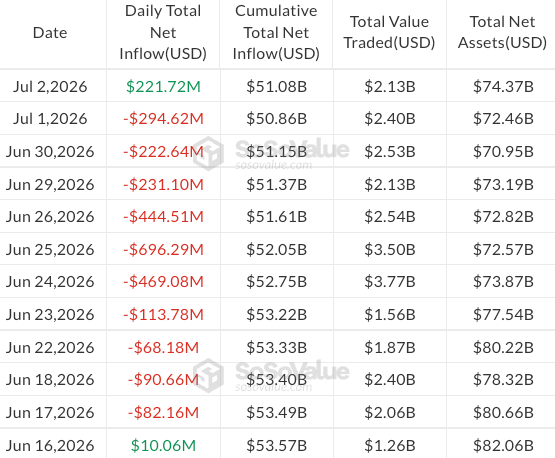
US-listed spot Bitcoin exchange-traded funds (ETFs) recorded their first daily net inflow above $200 million since early May, snapping weeks of sustained withdrawals.
The funds attracted $221.7 million in net inflows on Thursday, according to SoSoValue data, ending a 10-day streak of net outflows that totaled more than $2.7 billion.
The rebound follows one of the weakest stretches for US spot Bitcoin ETFs this year, with the funds posting a record $4.5 billion in net outflows in June.
Daily flows in US-listed spot Bitcoin ETFs. Source: SoSoValue
The inflows came as Bitcoin reclaimed the $61,000 level after briefly falling below $59,000, with some investors, including Bitwise chief investment officer Matt Hougan, suggesting the market could be nearing a bottom. Crypto market sentiment on Friday was measured at an “extreme fear” reading by the Fear & Greed Index from Alternative.me.
Fidelity leads ETF rebound as BlackRock outflows continue
Fidelity’s Wise Origin Bitcoin Fund (FBTC) led Thursday’s rebound with $166 million in net inflows, accounting for roughly 75% of the day’s total, according to Farside Investors data.
ARK 21Shares Bitcoin ETF (ARKB) followed with $91.8 million in inflows, while the VanEck Bitcoin ETF (HODL) and Valkyrie Bitcoin Fund (BRRR) attracted $4.4 million and $1.7 million, respectively.
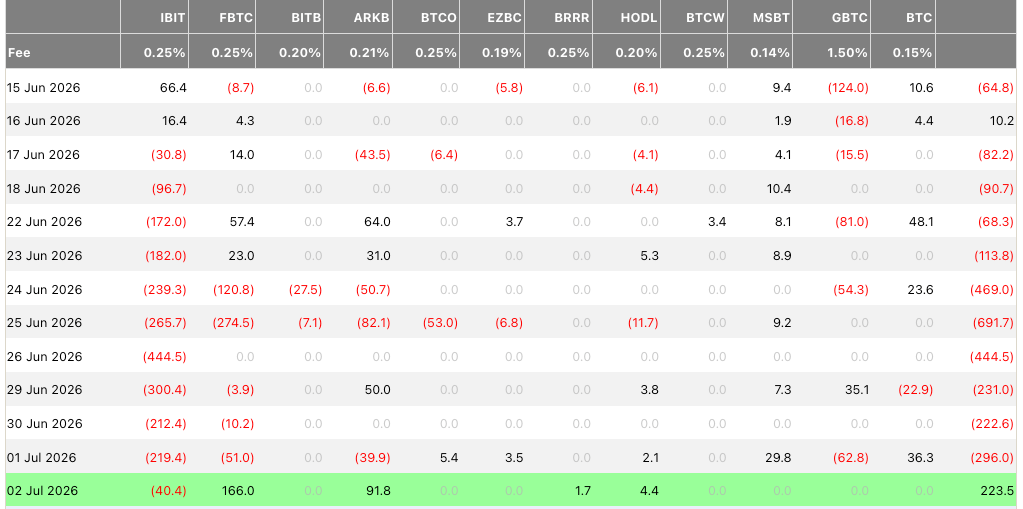
Source: Farside Investors
Meanwhile, BlackRock’s iShares Bitcoin Trust (IBIT), the largest US spot Bitcoin ETF by assets, continued to bleed, posting $40.4 million in net outflows on Thursday. The fund has lost more than $2.2 billion during an 11-session outflow streak since June 17.
Altcoin ETFs post inflows as sentiment stays in fear
The recovery in ETF flows extended beyond Bitcoin, with altcoin investment products also posting net inflows on Thursday.
US spot Ether ETFs attracted $29.1 million on Thursday, following $14.9 million in inflows a day earlier. XRP ETFs also returned to net inflows, attracting $6.6 million after two consecutive sessions of outflows.
Related: Swan’s Cory Klippsten sees record Bitcoin holder supply revealing early bottom
The global crypto market cap climbed 2.4% to $2.22 trillion over the past 24 hours as Bitcoin recovered above $61,000, according to CoinGecko data.
Magazine: Bitcoin slides to $58K, XRP hits $1 but onchain data promising: Market Moves

Driver travelling over 100mph came ‘dangerously close’ to head-on crash

Rates Spark: Resumed Steepening Impulse

Brazil tightens crypto oversight with new capital rules for exchanges


-

 Fashion7 days ago
Weekend Open Thread: Staud – Corporette.com
-

 Crypto World3 days ago
Strategy authorizes up to $1.25B in Bitcoin sales under new capital plan
-

 News Videos5 days ago
MAJOR BITCOIN & MARKET UPDATE!!!! (MUST WATCH ASAP!!!)
-

 Tech3 days ago
Anonymous researcher drops 0-day ‘exploitarium’ repo
-

 Crypto World6 days ago
Coinbase, Circle Deepen Crypto Stock Losses Despite Resilient S&P 500
-

 Business3 days ago
Australia treasurer says alleged access of prime minister’s bank data ’incredibly concerning’
-

 Crypto World6 days ago
Kraken's xStocks Opens Bending Spoons IPO Registration to EEA Retail
-

 Tech5 days ago
Claude Code turned every engineer into three. Now companies need more product thinkers
-

 Sports7 days ago
FIH Pro League: India defeat Pakistan 7-1, register biggest win of campaign | Other Sports News
-

 Tech5 days ago
Bluekit phishing kit adopts browser-in-the-middle for login theft
-

 Tech6 days ago
Russian hackers now target Signal backup recovery keys
-
Crypto World7 days ago
Hyperliquid Named on Singapore MAS Investor Alert Register
-

 Crypto World7 days ago
RTX holders must register wallets before token distribution begins
-
 Business4 days ago
The AI boom won’t burst all at once. It will pop in ‘rolling bubbles’: Macquarie
-

 Sports2 days ago
Broncos roster: OL Ben Powers (No. 74) entering final year of contract
-

 Tech6 days ago
Silicon Valley paid to kill AI regulation, now it wants the rules back
-

 NewsBeat2 days ago
Presenter Caroline Flack’s brother Paul Flack dies aged 55
-

 Crypto World1 day ago
Binance stock trading tops $1B in first month after launch
-
 NewsBeat1 day ago
New exhibition reflects five decades of movement between island of Ireland and GB
-

 Tech6 days ago
OpenAI mulls delaying IPO over valuation concerns
You must be logged in to post a comment Login