
Crypto World
Binance launches 24/7 FX perpetuals with 100x leverage



Binance has expanded its derivatives platform into the $9.6 trillion-a-day foreign exchange market with a 24/7 US dollar-Brazilian real perpetual contract offering up to 100x leverage.
Summary
- Binance will launch its USDBRLUSDT perpetual futures contract on Sept. 21.
- The USDT-settled product will remain tradable during weekends and public holidays.
- Binance will use external price feeds during regular hours and orderbook data when FX markets close.
- Bybit and Kraken have also introduced perpetual contracts linked to major currency pairs.
Binance said in a Friday announcement that the USDBRLUSDT contract will begin trading on Monday, giving eligible users continuous exposure to movements between the U.S. dollar and Brazilian real without requiring them to own either currency.
The perpetual contract will settle in Tether’s USDT stablecoin and support leverage of up to 100x. Unlike dated futures, perpetual contracts have no fixed expiry, allowing a trader to keep a position open while meeting the platform’s margin requirements and paying or receiving applicable funding charges.
Access will depend on Binance’s regional restrictions and account requirements. The exchange said users should review their local rules before trading, while its standard futures risk controls and eligibility conditions will apply to the new product.
Binance FX perpetuals will trade through weekend closures
Traditional institutional FX trading generally runs around the clock from Monday through Friday, but liquidity providers and major venues close for the weekend. Binance has designed a dual pricing system to keep the USDBRLUSDT contract operating during that gap.
During standard foreign exchange hours, Binance said the contract’s index price will draw on a weighted group of third-party market data providers. The index is intended to track the underlying USD/BRL exchange rate while those external reference markets are open.
Once regular FX markets close for a weekend or public holiday, Binance will switch to a mechanism derived from its own orderbook. The exchange said an exponentially weighted moving average will calculate prices during those periods, giving more weight to recent observations while smoothing short-lived movements.
Orderbook pricing means the weekend contract price could be shaped by activity taking place solely on the Binance venue while the underlying institutional currency market is closed. When regular FX trading resumes, the contract will again reference external data under the exchange’s stated pricing process.
Binance head of derivatives Shunyet Jan said the structure extends price discovery beyond the operating hours followed by conventional currency venues. According to Jan, the product also gives traders a way to hedge currency exposure or take a directional position at any time.
The Brazilian real can react to domestic interest-rate decisions, fiscal policy, commodity prices, and changes in demand for emerging-market assets. Binance’s contract gives eligible crypto traders a USDT-based instrument for trading such moves, although leverage increases both gains and potential losses.
At 100x leverage, a trader can control a position worth 100 times the collateral committed to it. Binance’s futures risk disclosures warn that adverse price changes can trigger liquidation when the collateral supporting a position falls below the required maintenance margin.
Crypto exchanges are adding traditional market derivatives
Binance’s FX launch follows its earlier expansion into perpetual futures linked to equities and other conventional assets. In May, the exchange added TradFi perpetuals tied to Oracle, Disney, Uber, Cisco and Home Depot, alongside Litecoin.
The May contracts were also settled in USDT but offered leverage of up to 10x, compared with the 100x ceiling announced for USD/BRL. According to the exchange at the time, the equity-linked products were designed to place exposure to traditional and digital markets within the same futures interface.
Binance Wallet separately introduced onchain perpetuals in April. Powered by derivatives venue Aster, the wallet feature covered cryptocurrency pairs, major stocks, exchange-traded funds and commodities through a keyless interface on BNB Smart Chain.
Competition in foreign exchange derivatives has also grown among other centralized exchanges. Bybit introduced 24/7 perpetual contracts tracking EUR/USD, GBP/USD and USD/JPY less than two weeks before Binance’s announcement. Bybit’s contracts settle in USDT and offer maximum leverage of 100x.
Kraken entered the segment earlier, launching FX perpetuals in April 2025 for the euro, British pound, Australian dollar, Japanese yen and Swiss franc. The exchange capped leverage at 50x and built the products on an existing currency business that had offered spot FX trading since 2020.
Kraken reported $5.7 billion in spot foreign exchange volume during the first part of 2025. Its derivatives expansion allowed customers to trade currency price movements without taking delivery of the currencies referenced by each contract.
A similar product expansion has reached self-custodial trading applications. As crypto.news recently reported, Coinbase Wallet launched Pulse Mode for simplified mobile perpetual trading through Hyperliquid, covering eligible crypto, stock, and commodity-linked markets.
Coinbase stated that its wallet-based perpetual service is restricted to non-U.S. users in selected jurisdictions. The company has not announced U.S. access to Pulse Mode or filed a related product notice with the Commodity Futures Trading Commission.
U.S. users face separate derivatives restrictions
Binance’s global announcement does not state that the new FX contract will be available to U.S. residents. Binance.com does not serve U.S. users, while the separate Binance.US platform does not offer the same global futures lineup.
American access carries added regulatory weight because leveraged retail commodity and derivatives products fall within CFTC rules under applicable circumstances. The agency requires certain intermediaries and derivatives venues serving U.S. customers to register and follow rules covering customer protection, reporting, and market conduct.
In November 2023, the CFTC announced a $2.85 billion settlement with Binance and former CEO Changpeng Zhao over allegations that the exchange had illegally operated a digital asset derivatives platform and evaded U.S. law. The federal court order required Binance to pay $1.35 billion in disgorgement and a $1.35 billion civil monetary penalty, while Zhao agreed to pay a separate $150 million penalty.
The CFTC said at the time that Binance had offered futures, options, swaps and leveraged retail commodity transactions to U.S. customers without the required registration. Under the settlement, Binance also agreed to strengthen its compliance controls and prevent U.S. customers from accessing its global platform.
For eligible users outside restricted markets, the USD/BRL product provides synthetic exposure rather than ownership of dollars or reais. Contract gains and losses will be calculated and settled in USDT under Binance’s futures terms.
Foreign exchange remains the world’s largest financial market by turnover. According to the Bank for International Settlements’ triennial survey, global over-the-counter FX trading averaged $9.6 trillion per day in April 2025, up 28% from $7.5 trillion in April 2022.
The BIS found that FX swaps remained the largest segment, accounting for $4 trillion in daily turnover. Spot transactions averaged $3 trillion, while outright forwards generated $1.8 trillion per day during the survey period.



dtcpay has completed a $25 million Series A on Sept. 18 after SBI Group joined the Singapore stablecoin payments company as a strategic investor alongside existing and new backers.
Summary
- dtcpay completed its $25 million Series A after SBI Group joined as a strategic investor.
- SBI invested through SBI Ventures Asset and the SBI-NTU-Kyobo Digital Innovation Fund in Singapore directly.
- Vertex Ventures Southeast Asia and India led dtcpay’s $10 million Series A tranche in March.
- MAS lists dtcpay as a Major Payment Institution authorized for six regulated payment services currently.
- dtcpay plans to use new funding for products, merchant expansion, and regulated international market growth.
dtcpay said SBI participated through SBI Ventures Asset Pte. Ltd. and the SBI-NTU-Kyobo Digital Innovation Fund, extending a funding round that began with a $10 million tranche led by Vertex Ventures Southeast Asia & India earlier in 2026.
The company did not disclose how much SBI invested, the ownership stake attached to the transaction or a new valuation. Genedant Capital and existing investor Kwee Liong Tek participated in the completed round, according to dtcpay.
dtcpay Series A grows from $10 million to $25 million
Vertex Ventures announced the initial $10 million Series A on March 17, with the capital intended for product development, infrastructure work and entry into newly licensed jurisdictions. dtcpay’s Sept. 18 announcement now puts the entire Series A at $25 million.
The two disclosed totals show another $15 million was added after the first tranche, but public materials do not allocate that amount among SBI, Genedant Capital, Kwee or any other participant. SBI Ven Capital’s current portfolio page lists dtcpay as an investment dated Sept. 18 and identifies both SBI Ventures Asset and the SBI-NTU-Kyobo Digital Innovation Fund among its investment vehicles.
Founded by Alice Liu and Band Zhao, dtcpay provides infrastructure for accepting, holding, converting and transferring stablecoins alongside fiat currencies. The company plans to spend the fresh capital on its payment products, merchant network and international operations.
Through the remaining months of 2026, dtcpay said its product roadmap includes a redesigned business portal for enterprise clients and new functions inside its consumer app. It did not give individual launch dates for those features.
Liu said the company raised the money to “fundamentally change how money moves across borders.” Chairman Band Zhao described the next stage as being “about scale,” citing infrastructure, financial-institution partnerships and regulated-market expansion among its priorities. Both statements describe management’s plans, not guaranteed business outcomes.
Singapore license covers six payment services
dtcpay operates in Singapore through Digital Treasures Center Pte. Ltd., which the Monetary Authority of Singapore currently lists as a Major Payment Institution. MAS records show authorization for account issuance, domestic money transfers, cross-border money transfers, merchant acquisition, e-money issuance and digital payment token services.
The regulatory record independently confirms the Major Payment Institution status cited in dtcpay’s funding announcement. MAS states that major payment institutions face requirements beyond those applied to standard payment institutions because they can operate above specified transaction or stored-value thresholds.
In Europe, dtcpay says its Luxembourg subsidiary holds an Electronic Money Institution license. A Bank of Lithuania regulatory register identifies dtcpay Luxembourg S.A. as an EU electronic money institution permitted to provide services in Lithuania without establishing a branch, while CSSF rules require Luxembourg entities issuing electronic money or providing covered payment services to hold written authorization.
Vertex’s March funding announcement said the Luxembourg EMI authorization was intended to support regulated services across the European Economic Area. The funding release separately said dtcpay maintains licenses or registrations in Hong Kong, Australia, the U.S. and Canada, though the exact permissions differ by jurisdiction.
Singapore’s own stablecoin rules remain under development. As reported in recent Singapore stablecoin regulation coverage, MAS proposed Payment Services Act changes this month covering stablecoin issuers, reserve requirements and foreign-issued tokens. dtcpay’s payment-services license should not be treated as evidence that every stablecoin processed through its platform carries an MAS-regulated stablecoin designation.
SBI adds another stablecoin payments investment
SBI’s dtcpay investment comes as the Japanese financial group builds several businesses around blockchain settlement and digital payments.
In June, SBI Remit partnered with Fasset on stablecoin infrastructure for international remittances and payment services. As SBI Remit stablecoin infrastructure coverage previously reported, the companies said the work could extend into wallets, cards and settlement products across international corridors.
A month later, SBI Holdings reached an agreement with the Solana Foundation covering stablecoins, tokenized assets and payments in Japan and other Asian markets. SBI and Solana partnership coverage reported that the planned work includes cross-border payments and institutional onchain services, though separate regulatory approvals may be required for individual products.
SBI’s new dtcpay investment does not come with a publicly announced joint product or launch timetable. Eiichiro So, CEO of SBI Ven Capital, described the transaction as the start of a strategic partnership and said SBI wants to develop digital-asset links between Japan and Southeast Asia.
Neither dtcpay nor SBI disclosed whether their partnership will lead to a Japan-specific stablecoin payment product, an SBI-branded card or a dedicated settlement corridor.
dtcpay already connects stablecoins to retail payments
Before closing the Series A, dtcpay had built merchant and card integrations around stablecoin spending.
WalletConnect confirmed in October 2025 that dtcpay became its first Major Payment Institution partner for point-of-sale payments. WalletConnect said its network supported more than 700 wallets, allowing compatible users to connect existing wallets to merchant checkout flows.
The integration has since moved into retail deployment across Asia, according to WalletConnect. Its payment documentation says dtcpay merchants can accept assets including USDC and USDT through existing point-of-sale equipment without requiring customers to install a separate payment app.
dtcpay separately launched its Digital Treasures Visa Infinite card in February 2025. The company said the card converts supported stablecoin balances for fiat settlement when customers spend through Visa’s network. Its original release cited more than 150 million merchant locations.
Visa’s own network figures have since increased. A May 2026 Visa report put its global acceptance network above 175 million merchant points, while a September update said more than 160 stablecoin-linked card programs were operating globally during Visa’s fiscal second quarter.
As recent Visa stablecoin card coverage reported, Visa said payment volume across those programs had risen nearly 200% year over year and its stablecoin settlement activity had passed a $20 billion annualized rate. Those figures cover Visa’s global stablecoin business, not dtcpay specifically.
For physical retail, dtcpay says Singapore department-store operator Metro accepts stablecoins including USDT and USDC through its infrastructure. The company’s March 2025 case study identifies Metro Paragon as one location using the payment service.
The firm has worked with other institutional infrastructure providers as it expands. In June, BitGo Singapore agreed to provide custody and digital-asset infrastructure for dtcpay’s payment operations. As earlier BitGo and dtcpay coverage reported, the companies said the arrangement would support dtcpay’s operations and asset-security processes while it expands its payment network.
dtcpay’s funding announcement claims its real-time swap engine can settle stablecoin and fiat transactions faster and more cheaply than conventional correspondent banking. The release does not publish a transaction sample, average settlement cost or independently audited comparison supporting the phrase “at a fraction of the cost.”
The company’s current Global Pay product page says transfers can reach more than 100 countries, with supported fiat currencies including USD, SGD, GBP, EUR and HKD and stablecoins including USDT and USDC. It describes transfers as generally completing within the same day and says fees and exchange rates are displayed before transactions are confirmed.
No public valuation accompanied the $25 million Series A completion, and dtcpay did not disclose revenue, payment volume, merchant count or a timetable for a future funding round in its Sept. 18 announcement.


Bolivia has committed to developing a regulatory and supervisory framework for cryptocurrencies as part of its economic program with the International Monetary Fund, with the government seeking to limit illicit capital outflows through digital asset markets.
Summary
- Bolivia has committed to developing a regulatory and supervisory framework for virtual assets under its IMF economic program.
- The planned rules are intended to curb illicit capital outflows through crypto markets, but no implementation deadline has been set.
- USDT use has grown amid dollar shortages, while the government is considering formally integrating the stablecoin into the national payment system.
- Bolivia remains under FATF monitoring as authorities work to strengthen anti money laundering and financial supervision controls.
The Bolivian Ministry of Economy and Public Finance set out the commitment in its Sept. 10 Memorandum of Economic and Financial Policies, grouping virtual asset oversight with reforms covering monetary and foreign exchange markets, pension risks and anti money laundering controls.
The document calls for a “robust” framework for regulating and supervising virtual assets to reduce the risk of improper capital outflows and protect financial resilience. It does not provide a deadline for introducing the rules or identify a single agency that would oversee the sector.
Bolivia’s crypto plans form part of a 36 month economic program agreed with the IMF. Staff from the fund and Bolivian authorities reached an agreement in July on an Extended Fund Facility, subject to approval by the IMF Executive Board. The program covers fiscal policy, foreign exchange reforms, international reserves, financial supervision and measures to strengthen anti money laundering controls.
Bolivia crypto regulation targets capital outflows
Under the memorandum, authorities plan to strengthen supervision of virtual assets alongside changes to the country’s monetary and exchange rate systems.
The government said the crypto framework would be designed to prevent illicit capital leakage through digital asset markets while supporting financial stability. Details on licensing, reporting requirements or rules for crypto exchanges and other service providers were not specified.
No decision has been disclosed on whether the framework will be introduced through legislation, an executive decree or administrative regulations. The document similarly does not identify which regulator would take primary responsibility for virtual assets.
Bolivia is pursuing the changes while dealing with severe pressure on its public finances and access to foreign currency. Government officials have described the economic conditions inherited by the current administration as the country’s most serious crisis since the 1980s.
The IMF program is intended to rebuild international reserves, reduce fiscal and external vulnerabilities and modernize monetary and exchange rate frameworks. IMF staff said in July that financial sector reforms would cover stronger supervision, monitoring of banking and systemic risks, crisis preparation and closer coordination between government agencies.
Bolivia’s government has put the financing package at roughly $1.9 billion over 36 months. The accompanying economic program includes plans to reduce the fiscal deficit and continue moving toward a market based exchange rate system.
USDT use has grown during Bolivia’s dollar shortage
Crypto use has expanded as Bolivia has faced shortages of U.S. dollars and pressure on its foreign currency reserves.
USDT has become particularly visible as residents and businesses look for dollar denominated alternatives. Tether CEO Paolo Ardoino said in August that use of the stablecoin was increasing in Bolivia and several other economies experiencing monetary instability.
As crypto.news previously reported, Bolivia’s central bank publishes a reference USDT exchange rate based on weighted peer to peer trading activity on Binance. The country recorded an estimated $14.8 billion in crypto activity between July 2022 and June 2025, according to Chainalysis data cited in the report on USDT adoption in Bolivia.
The government has meanwhile been considering a more formal role for the stablecoin. Officials have been evaluating a plan that could allow USDT to operate within the national payment system alongside the boliviano and U.S. dollar.
A proposal reported in July would permit USDT as a payment option, while local lenders Banco Unión and Banco FIE were already providing services linked to the stablecoin. Authorities had not published final implementation rules at the time.
State involvement with crypto predates the payment proposal. In March 2025, state owned energy company YPFB received government authorization to use crypto for fuel imports as the shortage of U.S. dollars made conventional payments more difficult.
Capital controls face pressure from stablecoins
Bolivia’s concern over capital movements comes as international financial institutions examine how dollar backed stablecoins interact with foreign exchange restrictions in emerging economies.
Research covered in July found that stablecoin inflows across economies showed little response to conventional capital controls. Bank for International Settlements researchers examined flows across more than 130 economies and compared stablecoin activity with foreign currency bank deposits.
The findings pointed to growing use of dollar backed tokens in countries facing inflation, weak domestic currencies or limited access to foreign exchange. Stablecoins can be transferred through blockchain networks without relying on the same banking channels used for conventional foreign currency transactions.
The IMF raised a related issue in August, warning that locally issued stablecoins could make access to digital dollars easier if users can move between domestic tokens and dollar backed assets onchain. Nearly 99% of stablecoins were denominated in U.S. dollars, according to figures cited by the fund in its assessment of stablecoin dollar adoption.
For Bolivia, the planned virtual asset framework sits alongside commitments covering foreign exchange policy and financial supervision. The government has not specified whether future crypto rules would place restrictions on stablecoin transactions, introduce limits on conversions or establish reporting requirements for transfers.
Bolivia faces FATF monitoring over financial controls
Anti money laundering reforms are another part of the government’s financial sector commitments.
Bolivia remains under increased monitoring by FATF, commonly referred to as the FATF grey list. The country made a high level political commitment in June 2025 to work with FATF and the Financial Action Task Force of Latin America to address weaknesses in its anti money laundering and counter terrorism financing system.
FATF said in its June 2026 review that Bolivia had made progress but still needed to complete several measures. Authorities were asked to strengthen risk based supervision in designated nonfinancial sectors, enforce sanctions for breaches of beneficial ownership requirements and increase money laundering investigations and prosecutions in line with the country’s risks.
The organization’s standards for virtual assets require countries to identify and address money laundering and terrorism financing risks linked to the sector.
Bolivia’s memorandum calls for improving the effectiveness of the country’s anti money laundering and counter terrorism financing system while financial regulators strengthen oversight of virtual assets.
The government has yet to publish the institutional structure, legislative route or implementation timetable for the planned crypto framework.
Crypto World
XRP Power expands cloud computing services as digital asset users explore accessible mining solutions

Disclosure: This article does not represent investment advice. The content and materials featured on this page are for educational purposes only.
XRP Power is developing a cloud-based computing platform aimed at making blockchain participation more accessible to digital asset users.

As digital assets continue to develop, access to computing infrastructure has become an increasingly important part of blockchain-related activities. For users interested in participating in the digital asset ecosystem without purchasing and maintaining physical mining equipment, cloud-based computing power offers an alternative approach.
XRP Power is building its platform around this model, combining digital asset services with cloud-based computing power solutions designed to provide users with a more accessible way to participate in blockchain activities.
Bringing computing power services to digital asset users
Established in 2023 and headquartered in the United Kingdom, XRP Power describes itself as a technology platform focused on digital assets and computing power services. The platform integrates global computing resources with intelligent systems through its website and mobile service ecosystem.
Rather than requiring users to purchase mining machines or deploy their own hardware, XRP Power allows users to select a suitable computing power contract through its platform.
The company says it handles computing power scheduling, equipment management, and maintenance, while revenue settlement is completed according to predefined rules. This model is designed to reduce some of the technical and operational requirements traditionally associated with running mining hardware.
A cloud-based approach to computing power
The cloud-based model allows users to access computing power without directly managing physical mining equipment.
For users exploring digital asset-related computing services, this approach can provide a simpler entry point by moving equipment deployment, maintenance, and operational management to the platform.
XRP Power says its service ecosystem is designed to lower the barrier to entry while improving the overall efficiency of computing power services.
The platform also states that it works with partners to promote the use of renewable energy sources, including solar, wind, and hydropower, while optimizing computing equipment configuration and operational efficiency through resource integration and supply-chain coordination.
Security and platform infrastructure
As cloud-based digital services increasingly handle user accounts and service information, security remains an important consideration.
According to XRP Power, the platform uses EV SSL encryption technology and multi-layer network protection mechanisms to support secure data transmission and stable system operation. The company also says it operates in accordance with relevant laws and regulations.
These measures form part of the platform’s broader approach to providing users with access to digital asset and computing power services through an online environment.
Access through web and mobile services
XRP Power has developed a service ecosystem that extends beyond its website.
The platform provides mobile access through applications for both Android and iOS, allowing users to manage their accounts and access available services from mobile devices.
For users who prefer managing digital services through mobile devices, this provides another way to interact with the platform without being tied to a desktop environment.
Lowering the barrier to computing power services
The growing interest in digital assets has also increased attention around the infrastructure supporting blockchain networks.
For many users, operating mining equipment independently can involve hardware costs, technical setup, electricity management, and ongoing maintenance. Cloud computing power services approach these requirements differently by allowing users to access computing resources through contracts while the platform manages the underlying equipment and operations.
XRP Power’s model is built around this approach, providing users with a way to explore computing power services without directly purchasing or deploying mining machines.
About XRP Power
XRP Power was established in 2023 and is headquartered in the United Kingdom. The company describes its platform as focused on digital assets and computing power services, integrating global computing resources with intelligent systems.
According to the company, XRP Power has served more than 3 million users worldwide and continues to develop its technology, infrastructure, and service ecosystem.
The platform provides cloud-based computing power solutions, with equipment scheduling, management, and maintenance handled by the platform according to its service model.
Users can learn more about XRP Power, review available services, and access its mobile applications through the company’s official website.
For more information, visit the official website.
Disclosure: This content is provided by a third party. Neither crypto.news nor the author of this article endorses any product mentioned on this page. Users should conduct their own research before taking any action related to the company.


Ethereum Institutional has backed a proposal to cut Ethereum’s 12 second block time as developers consider bringing the first reduction to 10 seconds through the Hegotá upgrade.
Summary
- Ethereum Institutional backed EIP 8198 as developers consider cutting block times from 12 seconds to 10 seconds.
- Ethlabs said feedback from 20 DeFi founders showed broad support for Quick Slots and its potential inclusion in Hegotá.
- EIP 8198 remains under consideration, with further implementation work and testing required before inclusion in the upgrade.
- Solana and Zcash are pursuing their own block or slot time reductions as networks work to speed up confirmations.
Ethereum Institutional said Friday that Ethereum needs to become faster as more financial activity moves onto public blockchains, throwing its support behind Ethlabs’ work on EIP 8198, known as Quick Slots.
“Make Ethereum faster,” the nonprofit wrote on X, arguing that shorter block times are becoming more important as “more institutional activity moves onchain.”
EIP 8198 would make Ethereum’s slot duration configurable, allowing developers to gradually shorten the time between blocks instead of committing the network to a large reduction at once. Ethlabs is initially pushing for a move from 12 seconds to 10 seconds, with further reductions possible after developers assess network performance.
Support from Ethereum Institutional follows feedback gathered by Ethlabs from 20 decentralized finance founders. The research group said Thursday that the responses showed broad support for Quick Slots and its potential inclusion in Hegotá.
Ethereum block time proposal moves toward Hegotá
EIP 8198 was authored in March and formally proposed for Hegotá during an Ethereum core developer meeting on Aug. 6.
Ethlabs has since begun merging the proposal’s specifications into Ethereum’s main codebase while examining dependencies that could affect implementation. The group said the work is intended to help Quick Slots “meaningfully enter Hegotá’s scope.”
Hegotá is Ethereum’s planned upgrade following Glamsterdam. Ethereum developers have been sorting through proposals for the upgrade, covering block production, account abstraction, privacy, validator economics and Layer 1 scaling.
As crypto.news previously reported, Ethlabs placed Quick Slots among its priorities for Hegotá alongside censorship resistance, native account abstraction and continued Layer 1 scaling.
At the time, EIP 8198 used eight seconds as a placeholder slot duration, while Ethlabs said Ethereum could initially reach 10 second slots through Hegotá. The exact timing remains subject to testing and agreement among Ethereum client teams.
Quick Slots has not been confirmed for Hegotá. Ethereum developers were still narrowing the upgrade scope in August, when FOCIL remained the only proposal formally scheduled for inclusion and EIP 8198 was still under consideration.
Reducing slot duration would increase how frequently Ethereum can produce blocks. Under the existing design, Ethereum uses 32 slots per epoch, meaning a shorter slot time could reduce the duration of each epoch if the number of slots remains unchanged.
Institutional Ethereum activity drives support
Ethereum Institutional’s backing brings an institutional adoption group into the debate over Ethereum’s execution speed.
The organization launched in July as an independent nonprofit focused on helping banks, asset managers, custodians, fintech companies, market infrastructure providers and sovereign institutions use Ethereum and its Layer 2 ecosystem.
BitMine Immersion Technologies, SharpLink and Ethereum co founder Joe Lubin were among the contributors supporting the organization at launch. Its work covers institutional education, market intelligence, standards, technical requirements and events.
Ethereum Institutional said at the time that Ethereum hosted around $180 billion in stablecoins on mainnet, representing roughly 60% of total stablecoin supply, along with around two thirds of tokenized real world assets.
Institutional use has continued developing alongside Ethereum’s technical roadmap. Ethereum researchers this week reported sub one second propagation for a simulated 1 MiB execution payload under EIP 8411, compared with roughly five seconds when the same payload was transmitted as a single message.
EIP 8411 takes a separate approach from Quick Slots. The draft networking proposal divides execution payloads into smaller chunks that nodes can verify and forward before receiving the entire payload. Tests involved 500 simulated nodes and prototype client code, meaning the results were not measurements from Ethereum mainnet.
Glamsterdam comes before Hegotá
Ethereum developers are currently focused on Glamsterdam, the network upgrade scheduled ahead of Hegotá.
Glamsterdam is designed to increase Layer 1 capacity and change parts of Ethereum’s block construction process. Developers confirmed this week that the upgrade is set to activate on Sepolia on Oct. 6, following testing on private development networks.
Devnet 11 completed its Glamsterdam transition while raising its gas limit from 60 million to 200 million for testing. The network used 84,000 validators across multiple clients, although developers excluded deliberate attacks from the test and kept adversarial experiments on the longer running Platåberget environment.
Client teams have been asked to release Sepolia ready software by Sept. 29. Developers have not confirmed a mainnet activation date for Glamsterdam, while earlier discussions have considered a possible December rollout.
Hegotá development would follow Glamsterdam, leaving EIP 8198 subject to further testing and decisions by Ethereum’s core development teams before any shorter slot configuration could reach mainnet.
Rival networks are already cutting block times
Ethereum’s discussion comes as other Layer 1 networks pursue shorter block or slot intervals.
Solana reduced its target slot time from 300 milliseconds to 250 milliseconds on Sept. 18, increasing targeted slot production from roughly 3.3 to four slots per second. The latest Solana speed upgrade forms the third stage of SIMD 0525, which started from a 400 millisecond target and is intended to eventually reach 200 milliseconds.
The nearly 17% reduction does not produce a corresponding increase in Solana’s overall transaction capacity because computation and data limits are reduced proportionally as slots become shorter.
Solana began the staged rollout in August by cutting slots to 350 milliseconds before moving through the 300 millisecond and 250 millisecond stages. Each reduction uses a separate feature activation so developers and validators can assess network behavior before advancing to the next setting.
At 250 milliseconds, a validator’s four slot leader window has fallen to one second from 1.2 seconds under the previous configuration. Solana has not set a mainnet date for the final reduction to 200 milliseconds.
Zcash is considering a similar change on a different scale. A majority of ZEC holders this week backed reducing the network’s target block time from 75 seconds to 25 seconds as part of discussions surrounding its NU7 upgrade.
Ethereum’s EIP 8198 remains a draft proposal, with its initial 10 second target dependent on further implementation work, testing and approval before it can become part of Hegotá.

Space Exploration Technologies Corp. (NASDAQ:SPCX) is increasingly confident it can reach a $100 billion annual revenue run rate by year-end. The company’s CFO said there is now “even more conviction” around the target. A new AI hosting agreement worth $13 billion on an annualized basis adds significant support to that outlook and reflects how quickly SpaceX’s compute business is scaling. But the financial picture behind that growth is less straightforward. The same AI division that management is relying on to help reach that target posted a $1.3 billion loss in the latest quarter alone. The loss wiped out what would have otherwise been a profitable quarter, while the company generated roughly negative $25 billion in free cash flow during the first half of 2026.

A New AI Hosting Deal Strengthens SpaceX’s Conviction
CFO Bret Johnsen said SpaceX has “even more conviction” that it can reach a $100 billion annual revenue run rate. The outlook is supported by a newly signed AI hosting agreement worth $1.11 billion per month beginning in December, or roughly $13 billion on an annualized basis. The company plans to end the year with a little over 2 gigawatts of terrestrial AI-computing capacity and scale to between 5 and 10 gigawatts in 2027. Orbital computing remains a longer-term option for overcoming power constraints. Its current agreements include a $6.7 billion cloud-services contract that is scheduled to ramp up in October. Existing arrangements with Google and Anthropic are worth more than $2 billion per month combined. Reaching the $100 billion target would require monthly revenue to more than triple from second-quarter’s pace.
The Segment Driving Growth Is Also Driving Losses
SpaceX’s rocket and Starlink businesses generated roughly $1.1 billion in combined operating income in the second quarter. But the AI division’s $1.3 billion loss more than wiped out that profit. The company also generated roughly negative $25 billion in free cash flow during the first half of 2026. The stock declined more than 5% after the second-quarter results despite a revenue beat.
The AI contract pipeline is clearly expanding and gaining momentum. However, the $100 billion target is a revenue run-rate measure rather than a profitability target. At the same time, the division driving this expansion remains the company’s largest contributor to both both operating losses and capital spending, making the growth opportunity financially costly for now.
SpaceX had 119 hedge funds among its institutional holders at the end of the second quarter of fiscal 2026. Meanwhile, short interest stood at just 2.76% of float as of August 31, 2026. The ownership and the short interest figures show that institutional sentiment remains broadly constructive and toward the company’s long-term outlook.


The Commodity Futures Trading Commission has sent a proposed framework for crypto transactions and markets to the White House for review, moving ahead with rulemaking days after the CLARITY Act failed to advance in the Senate.
Summary
- CFTC submitted proposed rules for crypto transactions and markets to the White House for review on Sept. 17.
- The filing came two days after the Senate failed to advance the CLARITY Act in a 49 to 50 procedural vote.
- CFTC Chair Michael Selig had directed staff to develop a crypto market framework using the agency’s existing authority.
- The proposal must return to the CFTC for a vote before publication and public comment.
According to a filing with the Office of Information and Regulatory Affairs, the CFTC submitted a rule titled “Regulation Crypto Asset Transactions and Regulation Crypto Asset Markets” on Sept. 17. OIRA, which sits within the Office of Management and Budget, reviews significant federal regulations before agencies can move toward publication.
Details of the proposal have not been released, and the CFTC declined to comment on its contents. The filing begins an executive review process that could result in changes before the measure is returned to the commission.
CFTC Chairman Michael Selig had already instructed staff to prepare a crypto market structure framework that could operate under the agency’s existing authority if Congress failed to pass new legislation.
CFTC crypto rules move forward after Senate vote
The filing came two days after the Senate failed to advance the Digital Asset Market CLARITY Act, which would have given the CFTC a central role in regulating digital commodity markets.
The procedural vote ended 49 to 50, falling short of the 60 votes needed to begin debate. Seven Senate Democrats who opposed cloture have since indicated that negotiations could continue, leaving the legislation unresolved following the vote.
As crypto.news previously reported, the failure to advance the bill left the SEC and CFTC with a larger role in developing digital asset rules through their existing statutory powers while Congress remains divided over a federal market structure law.
The CLARITY Act would establish statutory divisions between the SEC and CFTC and create registration requirements for crypto trading platforms and other market participants. Qualifying digital commodities and their spot markets would fall primarily under CFTC oversight, while securities related activity would remain within the SEC’s jurisdiction.
Selig had prepared for the possibility that Congress would not complete the legislation. Speaking at an agency event on Aug. 20, he said he had directed staff to examine how the CFTC could “codify a CFTC market structure for crypto assets” through powers it already holds.
Under the framework described by Selig at the time, existing CFTC registrants and crypto exchanges that are not currently registered could potentially be designated as a form of designated contract market known as a crypto asset market.
“This could enable current registrants as well as non-registrant crypto exchanges to be designated by the CFTC” as crypto asset markets, Selig said.
Such venues could then offer leveraged or margined crypto trading under rules administered by the CFTC.
Selig’s August comments had made clear that the agency was preparing crypto rules before the Senate vote. He said the CFTC would use its existing authority to establish a digital asset market regime if the legislation remained stalled.
White House review comes before a CFTC vote
OIRA review represents an early stage of the federal rulemaking process and does not make the proposed framework effective.
Under the Trump administration, independent agencies including the CFTC and Securities and Exchange Commission have been required to submit significant regulatory actions to the Office of Management and Budget for review before publication.
Once OIRA completes its review, the proposal can be returned to the CFTC with potential revisions. The commission would then have to vote before releasing the proposal for public comment.
Selig is currently the sole commissioner on a body designed to have five members. The vacancies leave him as the only vote at the commission while the agency works through its crypto agenda.
The staffing issue predates the latest proposal. The CFTC operated with roughly 556 employees at the end of fiscal 2025, compared with 708 a year earlier, while Selig has remained the only confirmed commissioner since taking office in December 2025.
Following publication of the proposal, the agency would collect public comments and could revise the framework based on feedback. A final rule would require another commission vote before taking effect.
CFTC uses existing powers as CLARITY talks continue
The White House submission forms part of a series of regulatory steps taken by federal agencies following the Senate vote.
On Sept. 17, CFTC staff issued a no action position covering certain software developers whose products facilitate access to regulated derivatives markets. The relief means staff will not recommend enforcement action against qualifying passive software providers for failing to register as introducing brokers when they meet specified conditions.
Under the CFTC developer relief, qualifying providers must satisfy 10 conditions. Their software can connect users to registered derivatives exchanges, brokers and futures commission merchants without triggering an enforcement recommendation over certain registration requirements.
The treatment of developers has been one of the issues surrounding federal crypto market structure legislation. Sections of the CLARITY Act sought protections for noncustodial software developers, wallet providers and validator operators under specified conditions.
The SEC has been moving through its own crypto rulemaking agenda. On Sept. 17, the securities regulator released its long anticipated innovation exemption for eligible tokenized securities activity, providing a regulatory route for certain onchain trading models.
Former CFTC Chairman J. Christopher Giancarlo said after the Senate vote that regulators did not need to wait for Congress to continue developing digital asset frameworks. He said Selig and SEC Chairman Paul Atkins could use authority already available to their agencies while lawmakers continued debating legislation.
The comments followed the CLARITY Act vote and came as both agencies pursued separate measures affecting crypto exchanges, developers and tokenized markets.
CLARITY Act negotiations remain open
The Senate setback has not formally ended work on the CLARITY Act.
Seven Democratic senators who voted against cloture said after the vote that negotiations were not over. The measure could return if lawmakers reach an agreement capable of securing the 60 votes required to advance legislation in the Senate.
Ethics provisions involving elected officials and digital asset interests were among the disputed areas during negotiations. Democratic lawmakers had raised concerns about President Donald Trump’s crypto holdings and businesses linked to his family as the administration pursued new digital asset rules.
Developer protections have been another point of contention during negotiations, with lawmakers debating the extent to which people who write or maintain noncustodial software should face financial regulatory requirements.
The bill would establish a federal market structure covering token classification, trading platforms and regulatory responsibilities between the CFTC and SEC. Its House version passed in July 2025 before the legislation moved through the Senate process.
For now, the CFTC proposal remains under White House review. Once OIRA completes that process, the measure can return to the commission for a vote, followed by publication and a public comment period before any final rule can take effect.
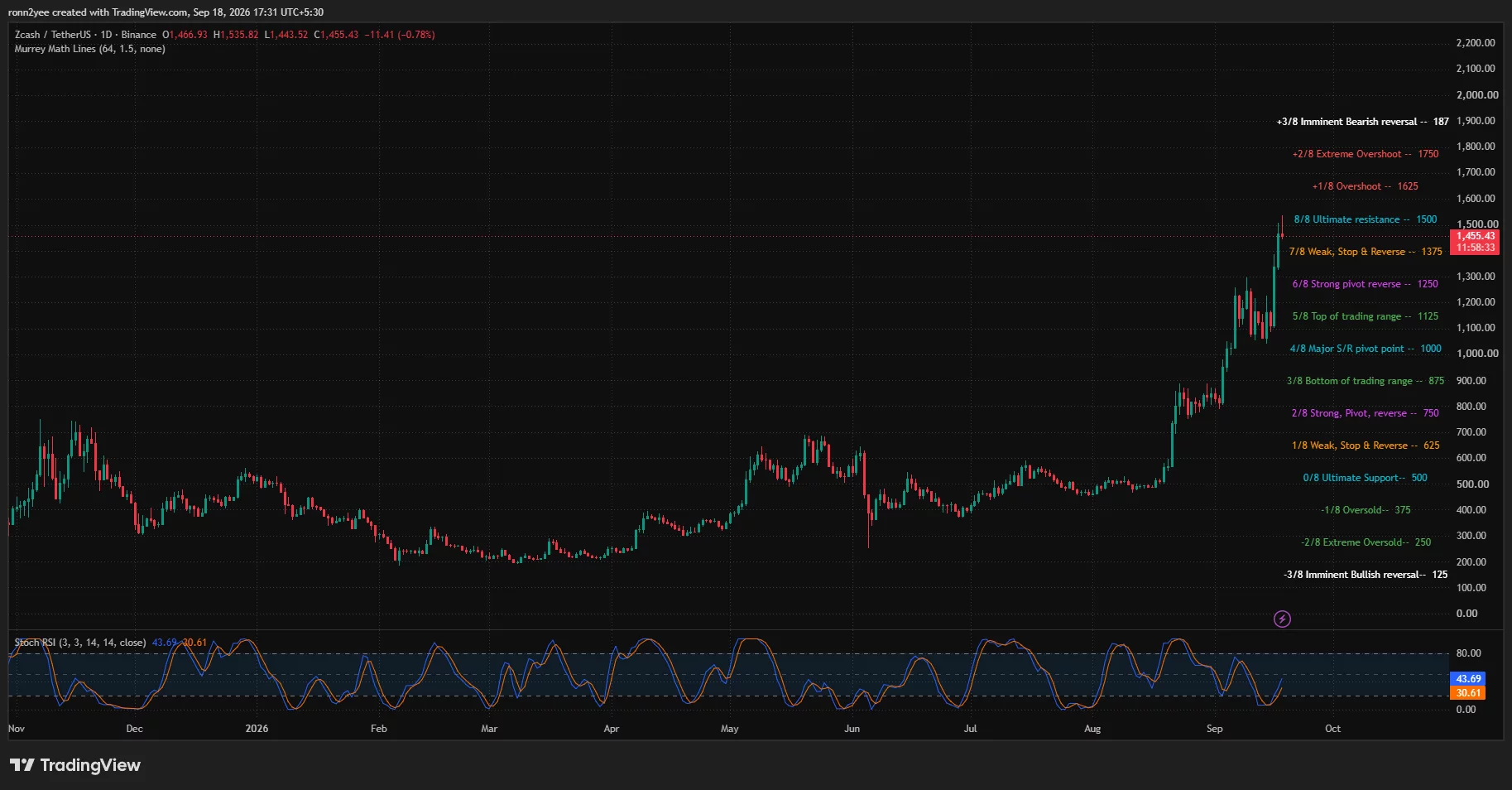
Zcash price traded near $1,455 on Sep. 18 after retreating from an intraday high of $1,535, while technical indicators and liquidation data pointed to continued volatility around the $1,500 level.
Summary
- Zcash price fell about 5.2% from its $1,535 intraday high to trade near $1,455.
- The 4-hour RSI remained bullish at 68.35 but moved below its signal average.
- Liquidation data showed major liquidity near $1,420 and between $1,540 and $1,550.
- Analysts said ZEC was entering price discovery but warned that a 10%–15% correction remained possible.
Zcash price action today
Zcash (ZEC) price rose as high as $1,535.82 before sellers pushed the token back below $1,500, according to the daily chart. ZEC traded at approximately $1,455 at the time of writing, down 0.78% during the current daily session.
The pullback came after an accelerated advance from the $1,100 area. ZEC broke above $1,250 and $1,375 with limited consolidation before testing the $1,500 Murrey Math resistance level.
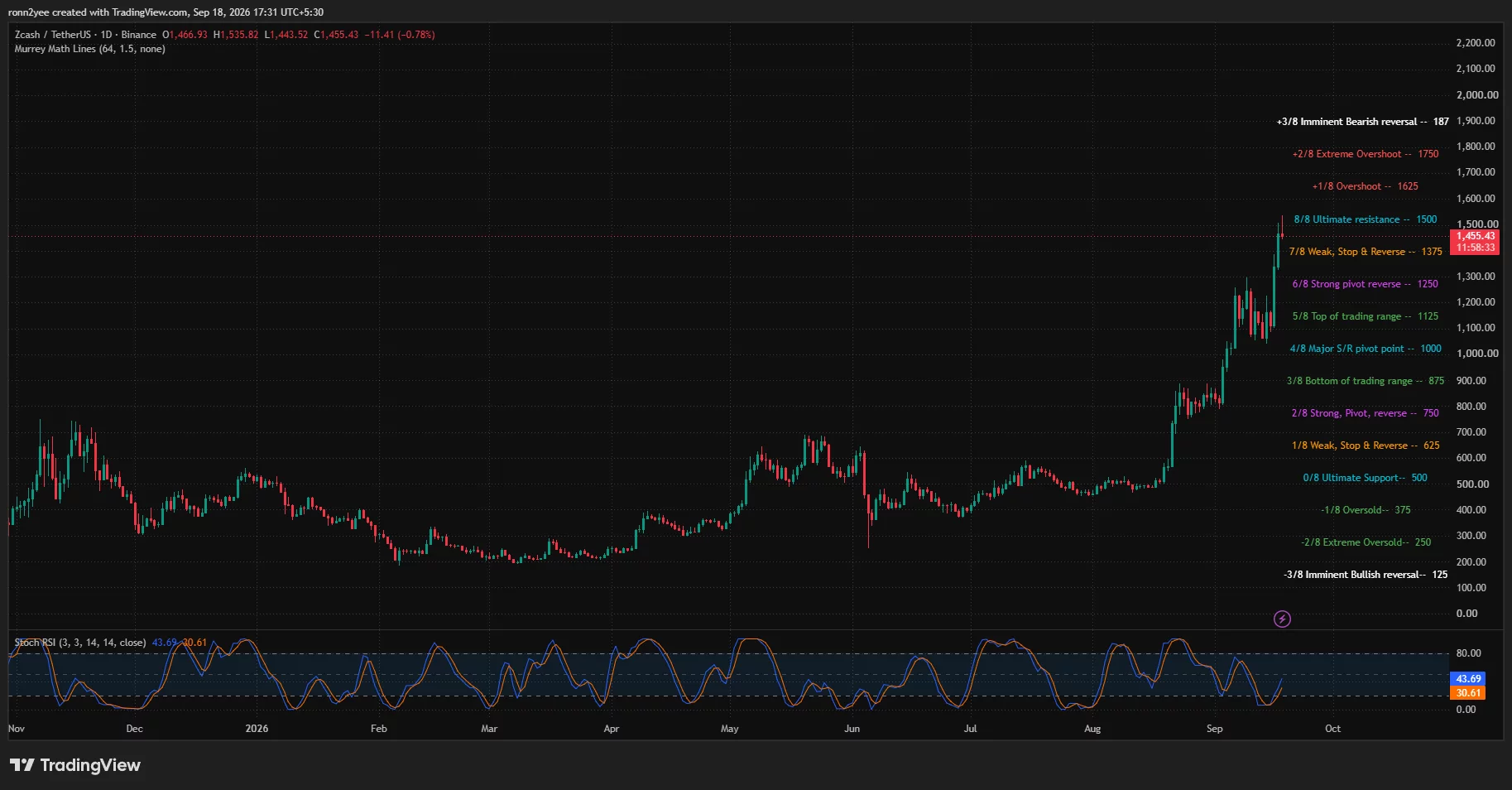
Price has gained more than 190% since trading near $500 in August. ZEC has also established a sequence of higher highs and higher lows across the daily and 4-hour charts, keeping its wider uptrend intact despite the latest retreat.
The daily Stochastic RSI started recovering from lower levels, with the faster line at 43.69 and the signal line at 30.61. The crossover showed that daily momentum was rebuilding after the indicator cooled during an earlier consolidation.
However, the rejection above $1,500 showed that sellers remained active near the psychological level. ZEC would need a confirmed daily close above that zone to reduce the risk of a deeper pullback.
What is driving the ZEC rally?
The rally followed the Zcash community’s vote on proposals tied to the Network Upgrade 7 roadmap. Nearly 99.9% of participating ZEC reportedly backed reducing the network’s target block time from 75 seconds to 25 seconds, while 98.9% supported keeping its current halving schedule.
The proposed change would shorten transaction confirmation times without increasing daily issuance because the block reward would be adjusted for the faster schedule.
Paradigm co-founder Matt Huang also disclosed the venture firm’s exposure to Zcash in a Sep. 16 post. Huang discussed the network’s development funding and said Paradigm considered the fund important to Zcash’s future.
The disclosure added an institutional element to a rally already supported by the governance vote and renewed interest in privacy-focused cryptocurrencies.
US investors can also access regulated ZEC exposure through Grayscale’s Zcash ETF, which trades on NYSE Arca under the ticker ZCSH. The product gives brokerage customers exposure without requiring them to hold ZEC directly, though its market price can differ from the value of its underlying assets.
Zcash technical indicators remain bullish
The 4-hour chart showed that ZEC’s momentum remained positive even as the token retreated from its latest high.
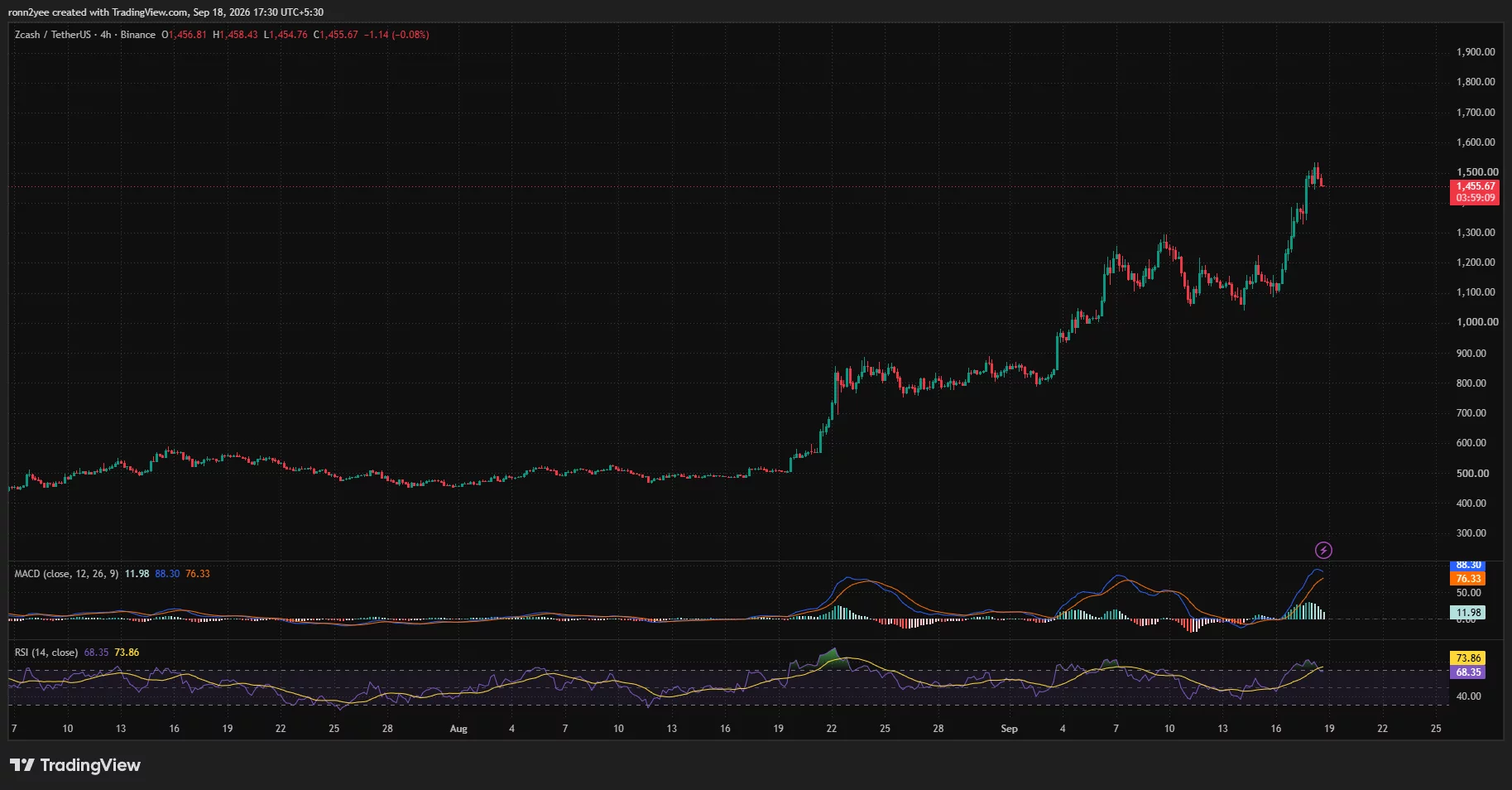
The moving average convergence divergence indicator stood at 88.30, above its signal line at 76.33. Its positive histogram reading of 11.98 indicated that buyers still controlled the broader momentum trend.
However, the histogram had begun to contract. A continued decline would show that the speed of the rally was slowing, increasing the possibility of consolidation or a short-term correction.
The 4-hour relative strength index stood at 68.35, just below overbought territory. The RSI had also fallen below its moving average at 73.86, showing that short-term buying pressure had eased after the move above $1,500.
ZEC’s immediate resistance sits between $1,500 and the intraday high of $1,535. A 4-hour close above $1,535 could open a move toward the next Murrey Math targets at $1,625 and $1,750.
The first important support lies near $1,420, followed by the former breakout level at $1,375. A close below $1,375 could expose $1,250, which previously acted as a major reversal level.
Liquidation clusters frame the next move
The 24-hour liquidation heatmap showed a dense concentration of leveraged positions around $1,420. The band was the strongest nearby liquidity pool below the market and could attract price if the current pullback continues.
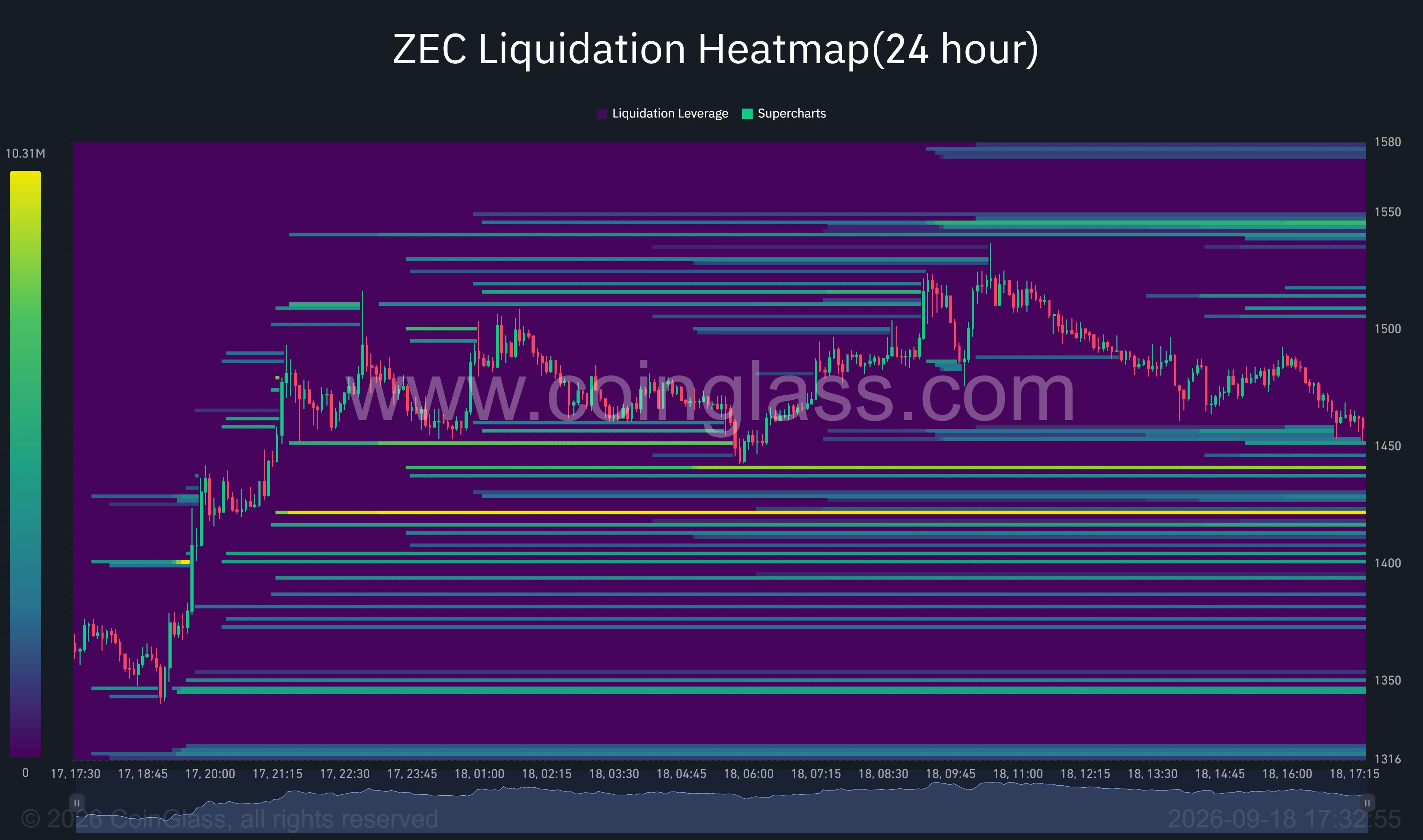
Additional liquidity appeared between $1,440 and $1,460, placing ZEC near an area where forced closures could increase short-term price swings.
Above the market, the largest nearby concentration sat around $1,540 to $1,550. A recovery above $1,500 could push ZEC toward that zone as short positions become vulnerable.
A larger but more distant liquidity area was visible around $1,580. On the downside, notable clusters appeared near $1,400, $1,375 and $1,345.
The distribution leaves ZEC between sizable liquidity pools on both sides. A break below $1,440 would favor a test of $1,420, while reclaiming $1,500 could bring the $1,540–$1,550 area back into focus.
What analysts are saying
Pseudonymous trader Altcoin Sherpa described ZEC as the strongest asset in the market but said the rally could still experience a sharp correction.
“Would like to see some chop and then another leg up to 2K,” the analyst wrote, adding that a 10%–15% decline could offer another entry if the wider trend remained intact.
A correction of that size from $1,500 would place ZEC between approximately $1,275 and $1,350. The range overlaps the $1,250 Murrey Math support and the previous breakout area near $1,375.
Another pseudonymous analyst, Scient, said ZEC was “practically into price discovery” after moving beyond its previous chart resistance. The analyst identified the former highs near $800 as a potential long-term support area if ZEC experiences a much larger correction later in the cycle.
For the shorter-term setup, $1,420 remains the level separating a limited pullback from a possible test of $1,375. Bulls must reclaim $1,500 and clear $1,535 to restore momentum toward $1,625.
Disclosure: This article does not represent investment advice. The content and materials featured on this page are for educational purposes only.
Coinbase has filed to list perpetual futures tied to more than 50 major U.S. stocks, including Nvidia, Microsoft and Tesla, with 24/5 trading and no fixed expiration dates.
Summary
- More than 50 proposed contracts would track individual U.S.-listed companies.
- The products would trade 24 hours a day from Monday through Friday.
- Regulatory clearance is required before Coinbase can offer the contracts.
- Traders would gain leveraged price exposure without owning the underlying shares.
Coinbase said in a Sep. 18 announcement that it had submitted the proposed contracts for listing on its regulated U.S. derivatives exchange, calling the planned range the first single-stock perpetual futures offering in the country.
“Crypto was first, now it’s time for stocks,” the company said.
The filing covers more than 50 stocks, with Nvidia, Microsoft and Tesla among the names disclosed by the exchange. Coinbase plans to let customers trade the contracts around the clock on weekdays, extending access beyond the regular U.S. stock market session.
Unlike conventional futures, the proposed contracts would have no set expiry date. Traders could maintain a position while meeting the exchange’s margin rules and any funding obligations attached to the product.
Coinbase has not started offering the contracts, and their listing remains subject to the U.S. regulatory process.
Coinbase stock perpetuals would provide price exposure without shares
Single-stock perpetuals track the price of an individual company but do not give the trader ownership of its shares. A customer holding an Nvidia perpetual, for example, would gain exposure to movements in Nvidia’s stock price without becoming a shareholder through the contract.
The distinction matters because shareholders may receive voting rights, dividends, and other corporate benefits. Futures traders instead hold an agreement whose value changes with the referenced stock, subject to the terms set by the exchange.
Perpetual contracts use recurring funding payments to keep their prices close to the underlying market. Depending on market conditions, traders holding long positions may pay short sellers, or short sellers may pay long holders.
Coinbase also plans to permit leverage, allowing customers to open positions larger than the capital posted as margin. Leverage can increase returns when a trade moves in the expected direction, but it also raises losses and may lead to liquidation when a customer’s collateral falls below the required level.
The proposed 24/5 schedule would cover periods when the underlying shares are not trading during the regular session. U.S. stock exchanges generally run their main sessions from 9:30 a.m. to 4 p.m. Eastern Time on weekdays, although brokers may also support premarket and after-hours trading.
Because prices can move when liquidity is lower outside the main session, the contracts’ trading rules, funding system, and reference pricing would affect how closely they follow the underlying shares. Coinbase had not disclosed the full contract specifications, leverage limits or launch timetable in its initial announcement.
US approval would extend Coinbase’s regulated derivatives business
Coinbase already offers cryptocurrency perpetual futures through its regulated U.S. derivatives operation. Its stock filing would extend the same basic contract structure from digital assets to individual public companies if regulators allow the listings.
For American customers, the proposal would place single-stock perpetuals inside a regulated domestic market rather than requiring them to use an offshore exchange or an onchain trading venue. Coinbase described the planned products as a U.S. first, although their availability will depend on the filing review and any conditions attached to approval.
The contracts differ from tokenized equities, another product category that crypto companies have pursued. A perpetual future is a derivative tied to a stock’s price, while a tokenized share can represent ownership or a claim backed by securities, depending on its structure.
Coinbase CEO Brian Armstrong recently argued that tokenized stocks should be backed by real securities and carry the rights associated with the underlying shares. He made the comments as the exchange sought to connect global customers with the U.S. equity market, which he valued at more than $70 trillion.
The proposed perpetuals would not provide that ownership model. Instead, they would give traders a leveraged contract settled under the exchange’s derivatives rules, leaving the underlying company’s shareholder register unchanged.
U.S. regulators have also been considering how blockchain infrastructure could support securities markets. As crypto.news previously reported, the Securities and Exchange Commission proposed a transfer agent overhaul that would allow approved blockchain systems to serve as official records of securities ownership.
The SEC proposal addresses the ownership register rather than synthetic instruments that only follow an asset’s price. Coinbase’s perpetual filing falls on the derivatives side of the market, where the regulatory review focuses on the contract and the venue offering it.
Nasdaq secured SEC approval in March to test tokenized stock trading, providing another route for applying blockchain-based systems to U.S. equities. Nasdaq’s model involves securities trading, while Coinbase’s proposed contracts would track stocks without transferring the shares themselves.
Coinbase has been adding stocks beyond its crypto business
Outside the United States, Coinbase has started expanding direct access to traditional equities. The company recently began rolling out 24/5 trading in nearly 4,000 U.S. stocks for eligible customers in the United Kingdom.
Coinbase’s U.K. service gives customers access to shares rather than perpetual futures, making it a separate product from the contracts proposed for the U.S. derivatives exchange. The weekday trading schedule, however, follows the company’s plan to make financial markets available beyond standard exchange hours.
The exchange has also added services that place crypto and traditional financial products inside the same platform. Its product range now covers spot crypto trading, regulated derivatives, prediction markets and stock access in selected jurisdictions.
In the Middle East, Coinbase recently received Financial Services Permission from the Financial Services Regulatory Authority of Abu Dhabi Global Market. The company said it plans to use Abu Dhabi as an international base for developing tokenization services outside the United States.
Abu Dhabi’s approval covers a separate regional operation and does not authorize the proposed U.S. single-stock perpetuals. Coinbase must complete the domestic review before customers can trade the contracts on its American derivatives venue.
The initial stock list includes several of the most actively traded U.S. companies, but Coinbase has not published all the proposed contracts or confirmed which ones would become available first. The exchange also has not provided a launch date, saying the products remain subject to regulatory clearance.
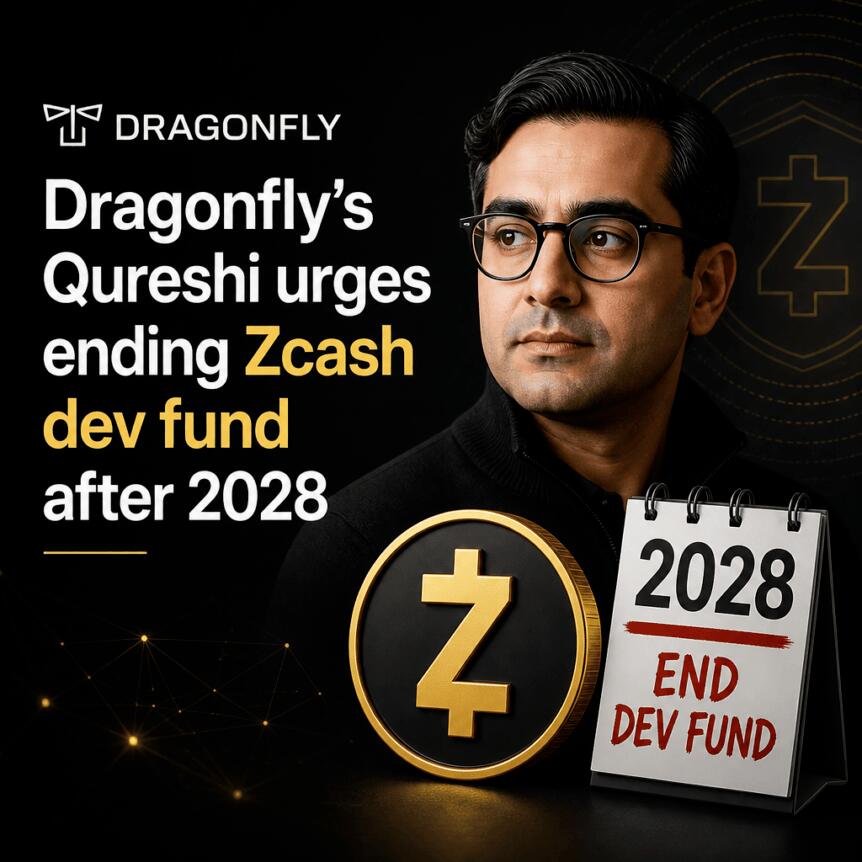
Dragonfly managing partner Haseeb Qureshi has urged the Zcash community to wind down the protocol’s ZEC development fund after it expires under current rules in 2028, arguing the fund has grown large enough to cover remaining work while also becoming increasingly vulnerable to “politicization” as its size nears $100 million.
The proposal lands amid a broader internal debate over how (and whether) the development fund should be controlled—an issue that has intensified as the ZEC token’s rally boosted the fund’s value. At press time, ZecStats reported the fund held 63,962 Zcash (ZEC) tokens, worth roughly $95 million.
Key takeaways
- Haseeb Qureshi argues the Zcash development fund should be treated as a final “dev fund,” ending when it expires in 2028.
- Based on ZecStats data, the fund’s balance is about $95 million and sits outside circulation until governance disburses it.
- Supporters say the fund is crucial for sustained development amid fast-evolving threats, including AI and quantum risks.
- The community is split not only on whether the fund should continue, but also on whether control should move toward token-holder voting.
- Critics including Maxime Desalle argue that ending the fund could eliminate governance disputes and potential security or dependency risks.
Why Qureshi wants the dev fund to end in 2028
Qureshi’s position, laid out in a Friday post on X, is focused on timing, size, and governance risk. He said the current development fund should be the last one, since it is already large enough to fund remaining Zcash work before the fund expires under existing rules in 2028.
In his view, however, the more the fund grows, the more it risks being drawn into political dynamics rather than purely technical decision-making. That concern is particularly salient as the fund approaches a value threshold of about $100 million, according to the ZecStats-reported balance.
For investors and builders, the core question is whether a large, semi-autonomous treasury mechanism improves continuity for development—or whether it creates governance friction that can slow priorities or erode long-term consensus.
How the Zcash development fund works
The ZEC development fund is designed as a protocol development allocation that accrues 0.1875 ZEC per block. Under the NU6 upgrade, that amount is described as representing 12% of the block subsidy. The fund’s holdings are kept outside normal token circulation, only becoming available when governance processes authorize disbursement.
Because it is built into the protocol’s block subsidy economics, the fund’s size is not simply a matter of community fundraising—it naturally expands with ongoing block production until its rules expire. That structural feature is part of why the current debate has intensified: a rising ZEC price increases the dollar value of locked assets without changing the number of tokens held.
A split on governance: token voting versus hybrid councils
Beyond the timing of any wind-down, Qureshi also challenged how the fund should be governed. He argued that control should not shift to “pure token holder voting,” while still supporting a partial approach in which token holders elect temporary councils.
Paradigm founder Matt Huang supported the broader idea of avoiding purely token-holder-driven control, arguing in a Wednesday post on X that pure token governance may introduce “unpredictability” and reduce long-term trust in Zcash as a monetary asset. Huang’s proposed alternative is a hybrid governance model that combines multiple forms of oversight rather than relying exclusively on token-weighted voting.
These arguments reflect a common tension in protocol treasuries: token-weighted systems can align governance with market incentives, but they may also be vulnerable to volatility-driven shifts in voting behavior. Hybrid systems, by contrast, aim to stabilize decision-making while still preserving a pathway for community influence.
Calls to eliminate the fund altogether
Not everyone agrees the fund should be preserved—even temporarily. Maxime Desalle, an investment analyst at Winklevoss Capital, suggested in a Thursday X post that the Zcash community should “completely get rid” of the development fund. He framed the elimination of the mechanism as a way to resolve governance disputes outright.
Desalle previously argued that the fund could hurt Zcash’s security and recreate the kinds of dependencies and bureaucracies that, in his view, many welfare-state systems face. While his critique focuses on governance structure, it also implies a more fundamental concern: that continuously accumulating value into a locked treasury can create incentives to capture decision-making rather than improve protocol resilience.
On the other side, Zcash founder Zooko Wilcox emphasized the historical role of development governance. In an earlier post on Sept. 1, he pointed to the Zcash Community Grants Committee as a major reason Zcash “has survived and grown to where it is today.” Later, on Sept. 14, Wilcox clarified that the committee accounts for only 40% of the development fund—an important detail for readers trying to map how much of the treasury is actually tied to grants versus other protocol-linked allocations.
What Zcash holders should watch next
The immediate uncertainty is whether Qureshi’s “final dev fund” framing will gain traction, and—separately—what governance model the community ultimately favors for any remaining disbursements before 2028. With the fund’s dollar value near $100 million based on ZecStats, governance decisions are likely to become more contentious, making the next proposals and voting outcomes crucial for anyone tracking Zcash’s long-term development runway.
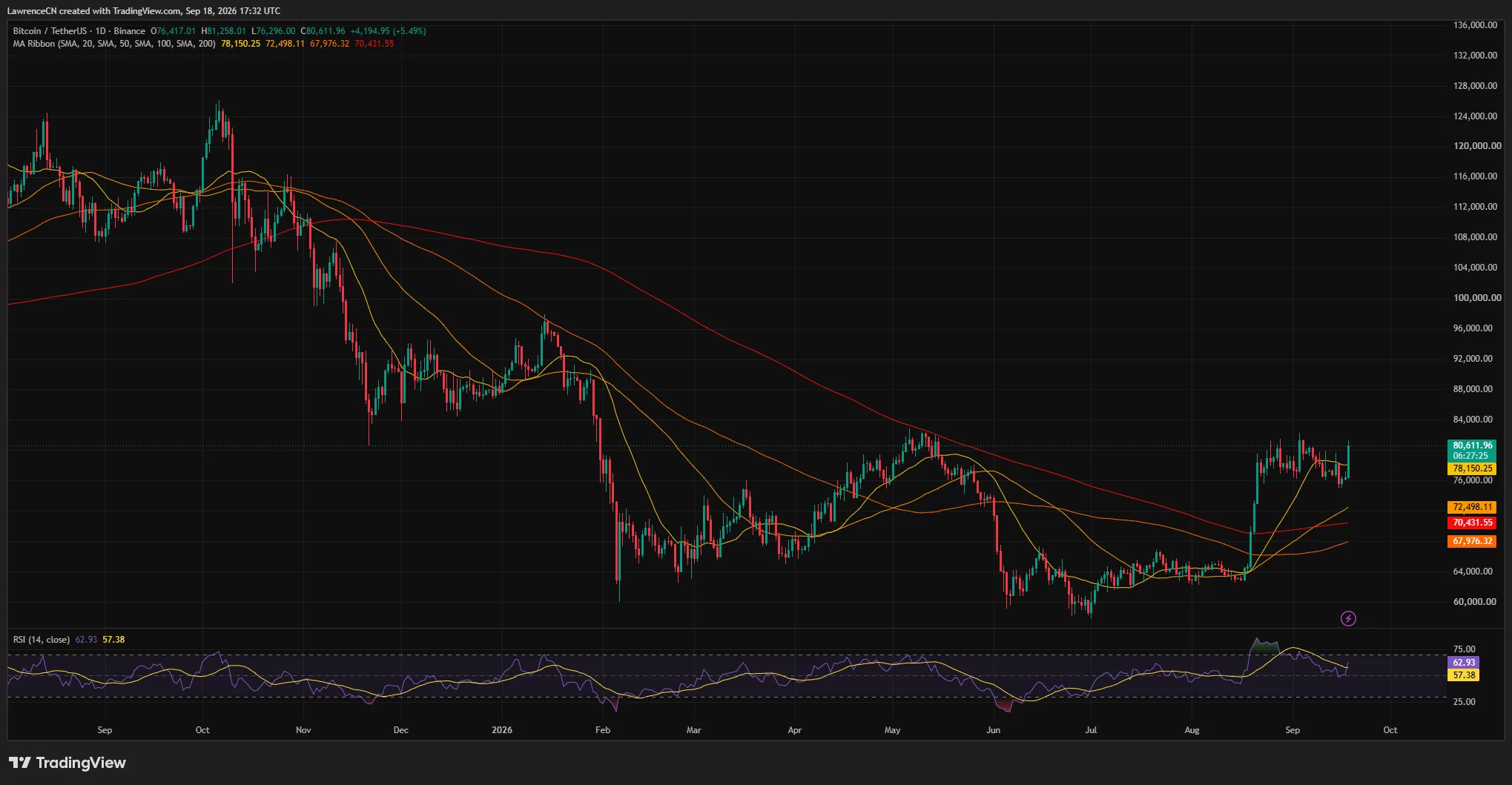
Bitcoin price surged more than 5% on Sep. 18, breaking above $80,000 as a 4-hour trend reversal and concentrated short liquidations accelerated the recovery from $75,560.
Summary
- Bitcoin price gained 5.49% and reached an intraday high of $81,258.
- Price now trades above the 20-, 50-, 100-, and 200-day moving averages.
- 4-hour Aroon Up reached 100%, while the Supertrend flipped bullish.
- Liquidation clusters near $81,500–$82,000 could shape Bitcoin’s next move.
Bitcoin price rebounds from $75,560
According to data from crypto.news, Bitcoin (BTC) price was trading near $80,600 at the time of writing after opening the daily session at $76,417. The 5.49% advance reversed most of the losses recorded during the earlier decline from the $80,000 area.
The move followed a drop to about $75,560, Bitcoin’s lowest level this month. Buyers first stabilized the price around $76,000 before pushing it through the $78,000 and $80,000 levels in two rapid advances.
Bitcoin briefly touched $81,258 during the rally but pulled back below $81,000, showing that sellers remain active near the upper end of its recent range. Even so, the daily candle remains strongly positive, with its real body covering more than $4,000.
The recovery also returned Bitcoin to the range it held before the Sep. 15 sell-off. Price must now remain above $80,000 to turn the former resistance level into support and reduce the risk of another retreat into the high-$70,000 area.
The rally came after bearish positioning increased during Bitcoin’s fall below $76,000. The supplied market data showed that forced buying from short liquidations helped speed up the rebound once the price began clearing nearby resistance.
Daily indicators support the Bitcoin breakout
Bitcoin has moved above all four moving averages displayed on the daily chart. The 20-day simple moving average sits at $78,150, making it the closest dynamic support following the breakout.
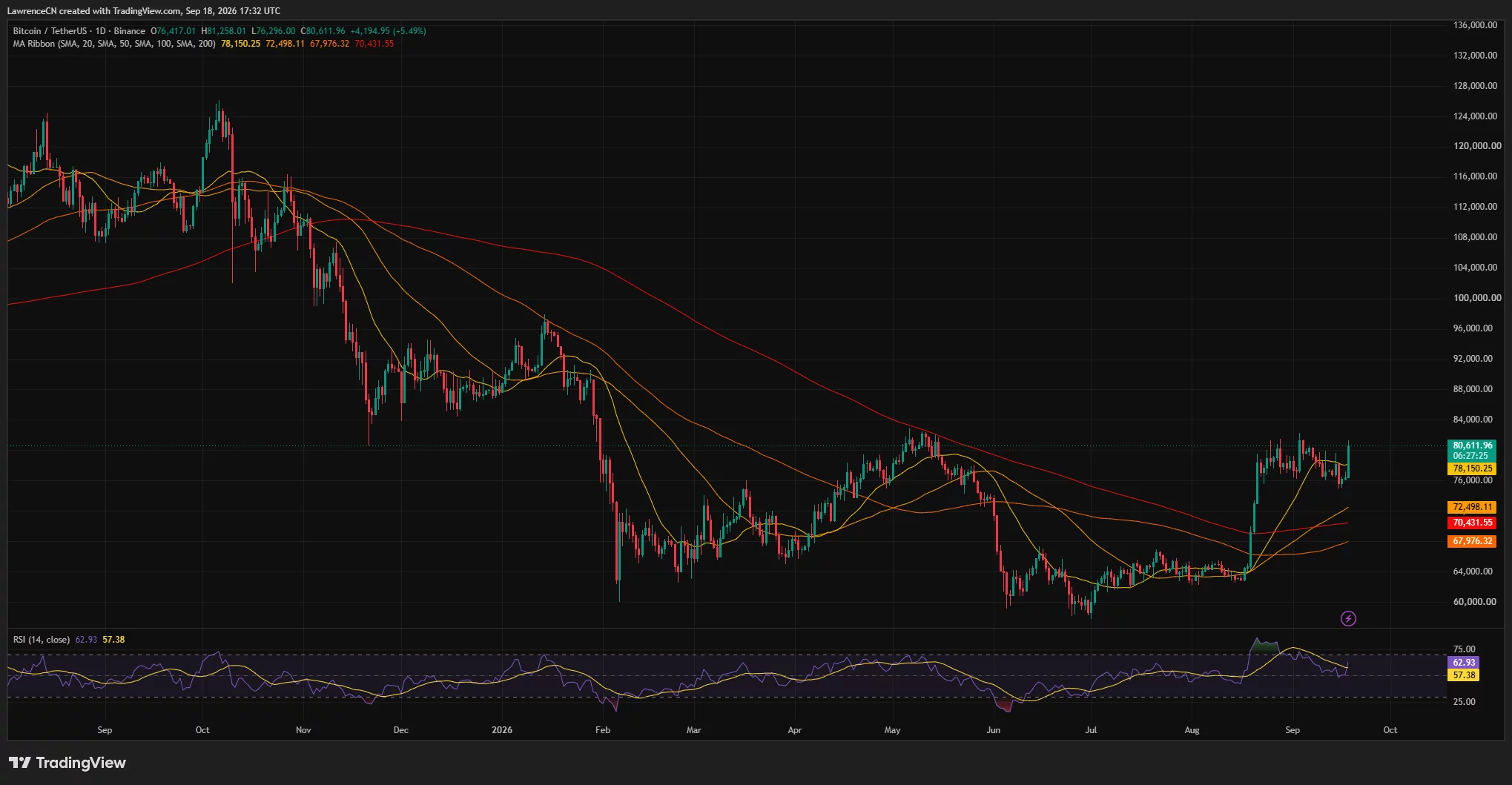
The 50-day SMA stands at $72,498, while the 200-day and 100-day averages are near $70,432 and $67,976, respectively. Bitcoin’s position above those longer-term averages keeps the wider recovery structure intact despite the volatility recorded during September.
The daily relative strength index rose to 62.93, above its moving average of 57.38. An RSI above 50 shows that upward momentum has strengthened, while the current reading remains below the commonly watched overbought level of 70.
Bitcoin is therefore gaining momentum without showing an extreme daily RSI reading. A move above 70 would signal stronger buying pressure, but it could also increase the risk of a short-term pullback if price reaches resistance near $82,000.
The daily structure still leaves Bitcoin below the local May high and the upper boundary of its recent trading range. Bulls need a daily close above approximately $82,000 to establish a higher high and provide stronger evidence that the September correction has ended.
4-hour Bitcoin chart flips bullish
Bitcoin’s 4-hour chart recorded a bullish Supertrend shift during the latest advance. The indicator now places trend support near $77,828, while price has also cleared the previous bearish Supertrend line around $78,597.
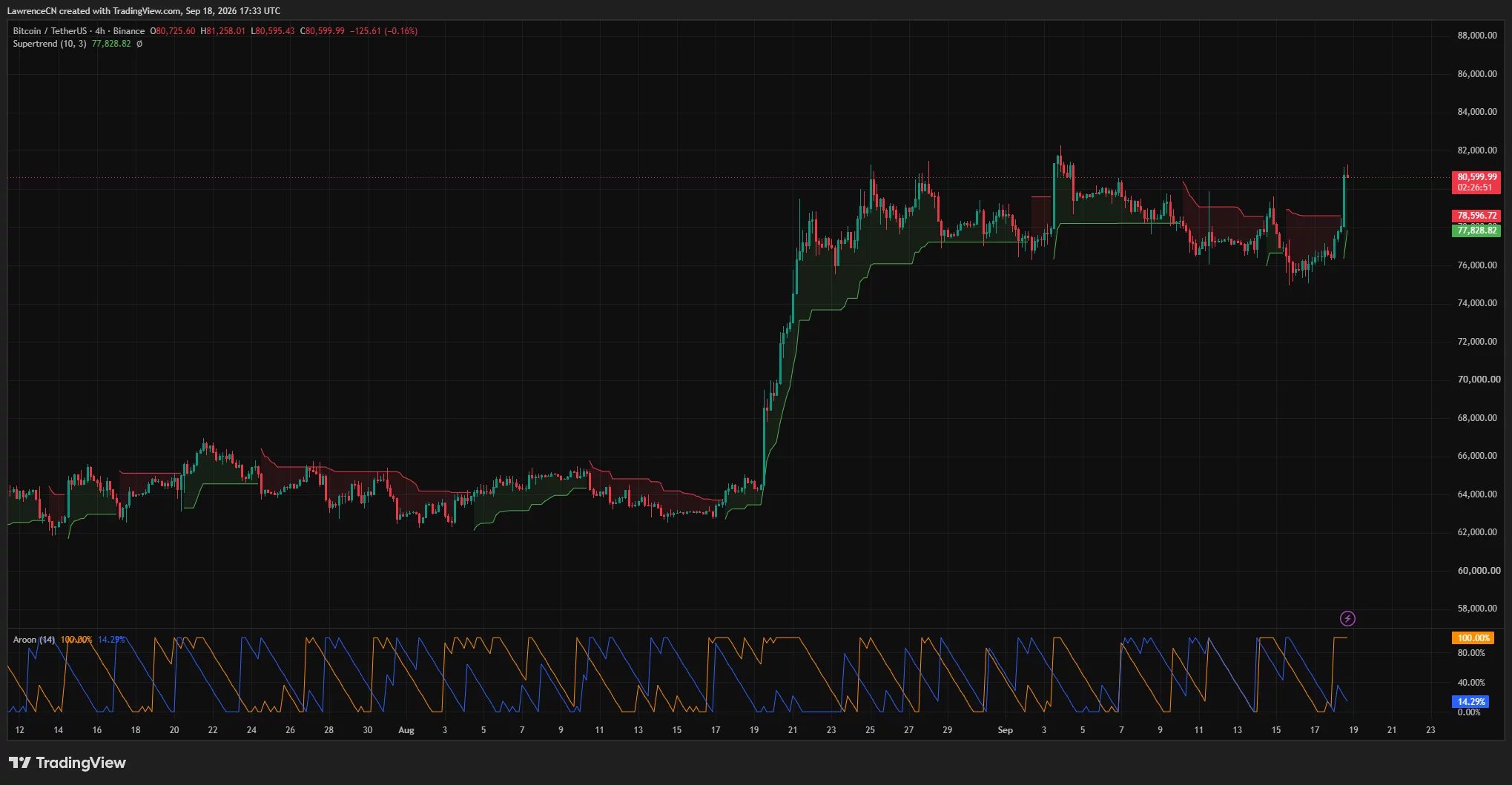
A 4-hour close above that former resistance strengthens the breakout because it shows that buyers held control beyond the initial price spike. The $78,600 area could now act as support during any retest.
The Aroon indicator also shows a sharp change in short-term momentum. Aroon Up reached 100%, while Aroon Down fell to 14.29%, indicating that the period’s most recent high occurred much later than its latest low.
Bitcoin remains exposed to a cooling period after its near-vertical 4-hour advance. A pullback that holds between $78,600 and $80,000 would preserve the new bullish structure, while a drop below the Supertrend support at $77,828 would weaken it.
A close below $77,800 could send Bitcoin back toward $76,000 and the monthly low near $75,560. Losing that low would invalidate the immediate recovery setup and reopen the path toward the daily moving-average cluster between $72,500 and $70,400.
Liquidation map puts $82,000 in focus
CoinGlass’ 24-hour Bitcoin liquidation heatmap shows several leveraged-position clusters above the current price. The nearest large concentrations appear around $81,500 and $82,000, with additional liquidity extending toward $84,000.
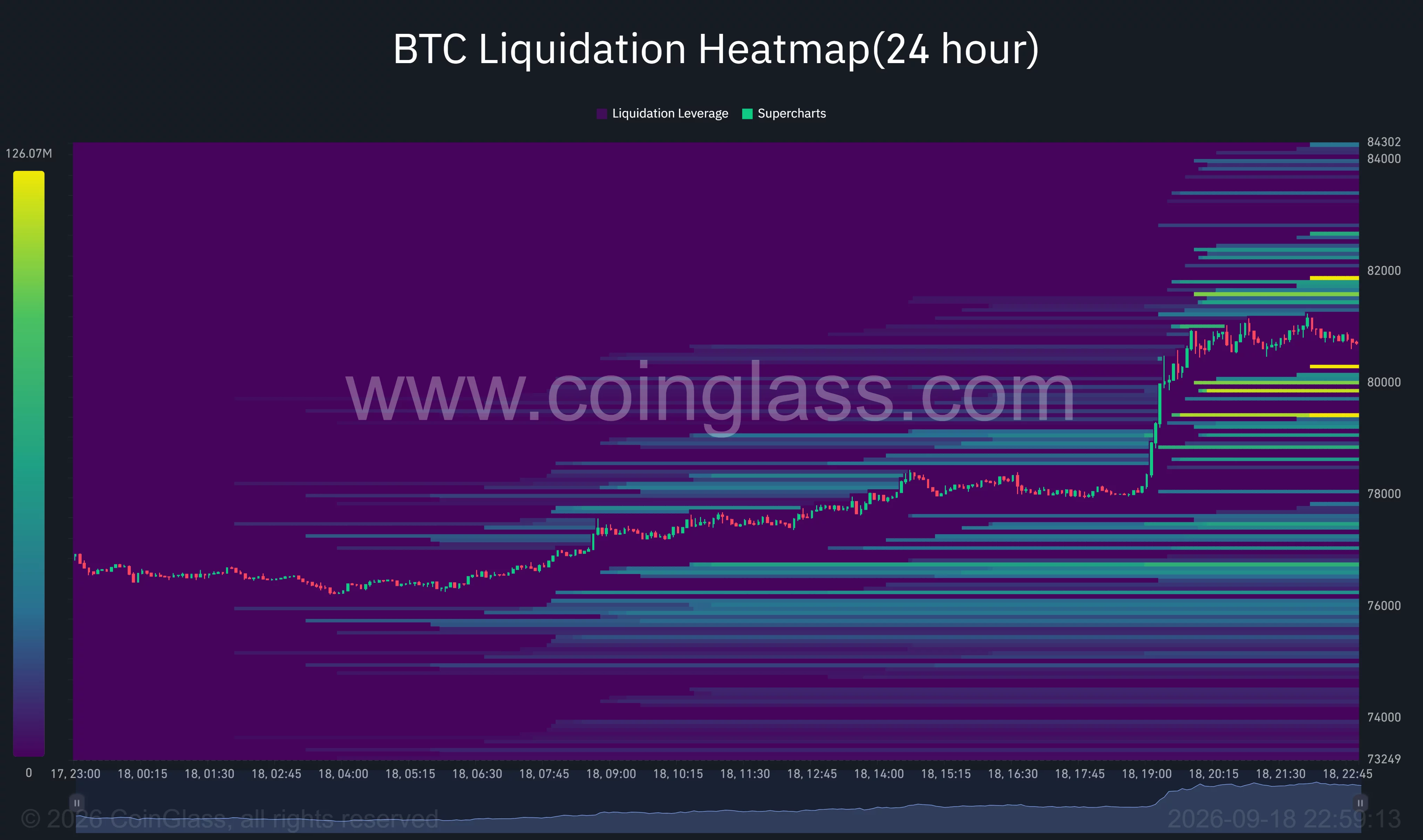
Leveraged short positions can face forced closure when Bitcoin rises into those zones. Such liquidations create market buy orders, which may add momentum if price breaks above $81,500 with sufficient volume.
The heatmap also shows liquidity below the market around $80,000 and $79,300. Larger bands are visible between roughly $76,000 and $77,500, making that region a possible target if Bitcoin fails to hold its breakout.
Liquidity concentrations do not guarantee that price will reach a given level. They identify areas where leveraged positions may be vulnerable, making volatility more likely when Bitcoin approaches them.
The immediate bullish path requires a break above the intraday high at $81,258, followed by a sustained move through the $81,500–$82,000 liquidity zone. A successful breakout would leave approximately $84,000 as the next visible area of concentrated liquidations.
Analyst sees descending-channel breakout
Crypto analyst Batman said Bitcoin had broken out of a descending-channel formation similar to an earlier setup that preceded a 24% gain. His chart compared the latest September structure with a channel that formed before Bitcoin’s August advance.
“$BTC just broke the same descending channel setup that led to a 24% move last time,” the analyst wrote.
Batman said the latest breakout had further continuation potential, although the earlier 24% move does not guarantee that Bitcoin will repeat the same performance. Confirmation still depends on whether the price can hold above the channel and clear the nearby $82,000 resistance.
For U.S. traders, the next test will also depend on how the rally holds through the next session, when deeper spot and derivatives liquidity can either confirm the breakout or expose it as a short-covering move. Until Bitcoin records a daily close above $82,000, the charts support a short-term bullish reversal rather than a confirmed breakout from the wider range.
Disclosure: This article does not represent investment advice. The content and materials featured on this page are for educational purposes only.

dtcpay closes $25M Series A with SBI investment
Maybe the Minnesota Vikings’ OL Isn’t So Bad After All

Tech enables transformation, people achieve it




-

 Tech6 days ago
The Latest Weird Thing to Play Doom Is the Mapped-Out Brain of a Fruit Fly
-

 Crypto World4 days ago
Kraken Lets xStocks Holders Earn Yield Through DeFi
-

 Crypto World2 days ago
US Charges Robinhood Engineers Over Crypto Listing Trades
-

 Crypto World6 days ago
Can AI Build a Startup in 72 Hours? Elon Musk's Team Will Livestream the Test
-

 Crypto World3 days ago
What Is the Status of the U.S.-Iran Peace Talks? Here's What Both Sides Are Saying
-

 Crypto World5 days ago
Elon Musk Drops a Bombshell: Grok 5 Could Be the AGI Breakthrough
-

 Business6 days ago
Rivals Sam Altman and Elon Musk Rally Behind Dario Amodei’s Call for a Slowdown in AI Development
-
 Crypto World5 days ago
New Tesla Roadster Uses SpaceX Tech. Will It Impact the Stock Price?
-
 NewsBeat4 days ago
‘Sick conspiracy’: Trump says only guardrails AI needs is ‘a strong and smart (High IQ!) president’ in all-caps rant
-

 Crypto World7 days ago
Robinhood Chain Never Stopped But its Blobs Did Stop Reaching Ethereum For 14 Minutes
-

 Crypto World4 days ago
NVIDIA Analysis: Attempted Rising Wedge Breakout Amid Pressure on the AI Sector
-

 Business7 days ago
Marvell: Most Potent Setup Of The AI Factory Decade
-

 Crypto World4 days ago
Revolut Attackers Warn of Ongoing Daily Customer Data Leaks
-
 Crypto World5 days ago
3 Token Unlocks to Watch in the Third Week of September 2026
-
Crypto World4 days ago
Can Circle’s Arc Repeat Robinhood Chain’s Meme Coin Boom?
-

 Crypto World4 days ago
DOJ Seeks to Seize $61M in Iran Oil Funds From Binance Accounts It Vouched For
-

 Crypto World7 days ago
Bitcoin ETFs lose $462.7M as Ethereum funds gain $196.9M
-
Business4 days ago
SK Hynix ADRs Fall More Than 6% as Memory Rally Breaks on Fears of Slower AI Spending
-

 Crypto World5 days ago
AI Safety Burden Falls on Chief Executives as Trump Prioritizes China Race
-
 NewsBeat6 days ago
Last Night of the Proms pays moving tribute to Dolly Parton as Sheridan Smith wears a gold sequin jumpsuit in memory of the Queen of Country
You must be logged in to post a comment Login