
Crypto World
Binance launches PONS and Hajimi perpetual futures

Binance Futures launched two USDT-settled perpetual contracts on Sept. 6, adding markets for Pons (PONS) and the Chinese meme coin 哈基米, commonly rendered as Hajimi.
Summary
- Binance Futures launched PONSUSDT and HajimiUSDT perpetual contracts on September 6, settled entirely in USDT.
- Both contracts trade continuously, require five USDT minimum notionals and settle funding every four hours.
- PONS previously joined Binance Alpha, while neither futures launch guarantees a Binance Spot listing afterward.
- Binance’s announcement conflicts on PONS leverage, publicly showing both twenty times and three times limits.
- Hajimi rose about 248% in the initial snapshot, while PONS gained approximately 24% daily.
The PONSUSDT contract opened at 06:45 UTC. HajimiUSDT followed at 07:15 UTC, according to Binance’ announcement. Both products allow eligible traders to take leveraged positions without owning the underlying tokens.
The launches followed sharp price increases for both assets. At the time of the initial report, PONS traded near $0.891 after gaining about 23.9% over 24 hours. Hajimi was quoted near $0.0584 following an approximately 248.5% increase.
Later information on Binance Alpha showed Hajimi near $0.070 and up more than 330% over 24 hours. The difference reflects the token’s rapid movement and the timing of each price snapshot. These figures describe past trading conditions and do not establish a continuing trend.
Binance futures contracts use USDT settlement
PONSUSDT and HajimiUSDT are USDⓈ-margined perpetual contracts settled in USDT. Perpetual contracts have no scheduled expiration date. They use recurring funding payments to help keep their prices aligned with the relevant underlying markets.
Binance set the minimum order at one token for each contract. Each order must have a notional value of at least 5 USDT. The PONSUSDT tick size is 0.0001, while HajimiUSDT uses a smaller 0.00001 tick.
Both markets operate continuously, subject to maintenance and risk controls. Their funding rates are initially capped at positive or negative 2%, with funding settled every four hours. The cap does not mean traders will always pay or receive 2%. The applicable rate changes according to conditions in each market.
Multi-Assets Mode is supported. This feature lets eligible traders use approved assets other than USDT as margin, subject to Binance’s collateral haircuts and account rules. Binance said it would also make the contracts available for Futures Copy Trading within 24 hours of their launch.
Binance’s PONS leverage details contain a conflict
The published material provides inconsistent information about maximum PONSUSDT leverage. Its introductory summary says PONSUSDT offers up to 20x leverage and HajimiUSDT offers up to 3x.
However, the contract specifications table lists 3x as the maximum for both markets. That discrepancy remains material because leverage determines the amount of collateral required and how quickly an adverse price movement can trigger liquidation.
Until Binance corrects or clarifies the notice, traders should check the leverage and margin brackets displayed on the live PONSUSDT trading interface. Those operational settings determine which positions users can actually open.
Binance also reserves the right to change leverage, initial margin, maintenance margin, funding rates and tick sizes in response to market risk. Any later adjustment could therefore replace the limits shown in the launch announcement.
Even 3x leverage can create substantial losses in highly volatile markets. A roughly 33% adverse move can theoretically consume the starting margin of a fully leveraged 3x position before fees and maintenance requirements are considered. Liquidation can occur earlier because exchanges require positions to retain maintenance margin.
PONS futures follow its earlier Binance Alpha addition
Pons describes itself as a non-custodial token launchpad built on Robinhood Chain, an Ethereum Layer 2 network. Its native PONS token was added to Binance Alpha several days before the futures launch.
The Alpha addition gave Binance Wallet users access to the token but did not amount to a regular Binance Spot listing. The new perpetual contract also does not change that status. Binance explicitly says that futures and spot listing decisions are separate.
Pons had already recorded fast growth before the derivatives announcement. The protocol reported $5.95 million in daily fees in early September, while its token reached a then-record price above $0.52. The project also recorded more than $719 million in cumulative decentralized exchange volume at the time.
The figures were covered when Binance Alpha added PONS and FLORK. PONS subsequently climbed above the level reported in that earlier coverage. Crypto.com showed the token near $0.890 with approximately $200 million in daily trading volume on Sept. 6, broadly supporting the price cited around the Binance futures launch.
In related coverage, Uniswap Labs purchased PONS without disclosing the size, price or structure of the purchase. That transaction should not be interpreted as a guarantee of demand or future performance.
Hajimi’s rapid rally raises liquidation risk
Hajimi is a meme coin whose name is written as 哈基米 in Binance’s contract specifications. The announcement describes it simply as a Chinese meme coin and does not identify additional utility, revenue or governance functions.
Binance Alpha data showed Hajimi trading near $0.070 after the derivatives market opened. Its recorded 24-hour range extended from about $0.016 to $0.145. That spread demonstrates the difficulty of relying on a single price when an asset is moving rapidly.
The same data showed approximately $30.3 million in 24-hour volume and an estimated $70 million market capitalization. Those figures are snapshots and can change quickly. Market capitalization is also based on reported supply and token price, rather than cash held by the project.
A futures listing can increase access to an asset by allowing traders to take long or short exposure. It does not show that the exchange has endorsed the token’s value, security or long-term prospects. It may also increase volatility as leveraged positions build and liquidations produce forced orders.
Previous meme coin futures launches have produced similarly abrupt market moves. For example, Fartcoin rose following a Binance futures announcement, although historical reactions cannot predict how PONS or Hajimi will trade.
Funding rates and leverage updates are the next checks
The first operational data to watch are open interest, trading volume and four-hour funding rates. Positive funding generally means long positions pay short positions. Negative funding normally reverses that transfer. Extreme rates can show that positioning has become concentrated on one side.
Binance may alter the funding interval or capped rate during volatile conditions. It may also change position limits and margin tiers. Traders should use the live contract page rather than the original announcement when the two provide different specifications.
Futures Copy Trading support was scheduled to arrive within 24 hours of launch. Binance did not announce conventional Spot listings for either asset. PONS and Hajimi therefore remain separate cases from tokens admitted to Binance’s main spot exchange.
Regional restrictions also apply. Binance said the announced products may not be available in every jurisdiction. Users remain responsible for checking whether derivatives trading is permitted where they live.



Uniswap V4 held $59.1 million in tokenized stock deposits as of Sept. 6, making it the largest decentralized finance venue for the category, according to Token Terminal.
Summary
- Uniswap V4 held $59.1 million in tokenized stock deposits, leading Token Terminal’s latest market snapshot.
- Kamino Lend ranked second with $41.7 million, while Uniswap V3 held another $20.9 million overall.
- The three platforms controlled approximately 63% of the category’s reported $192.6 million DeFi TVL combined.
- Solana hosted $79.1 million in deposited tokenized stocks, the largest blockchain total reported overall currently.
- Robinhood-issued stocks contributed $73.1 million, while xStocks supplied $63.9 million across DeFi venues combined overall.
Solana-based Kamino Lend ranked second with $41.7 million. Uniswap V3 followed with $20.9 million, Token Terminal’s data showed. Together, the three venues accounted for $121.7 million, or approximately 63.2% of the measured category.
Total tokenized stock DeFi TVL stood at approximately $192.6 million. The figure measures equity-linked tokens deposited into decentralized exchanges, lending markets and related applications. It does not represent the total value of tokenized equities issued across blockchains.
Token Terminal defines total value locked as the value of onchain deposits and, in some cases, the tokenized value of user deposits made offchain. The metric changes when assets enter or leave protocols and when the prices of the underlying shares move.
Uniswap V4 leads through tokenized stock liquidity
Uniswap V4’s $59.1 million primarily represents tokenized shares supplied to liquidity pools. Users deposit paired assets into these pools so other participants can trade without relying on a conventional order book.
Uniswap V3 held another $20.9 million, bringing the two versions’ combined tokenized stock deposits to $80 million. That equals approximately 41.5% of the $192.6 million measured by Token Terminal.
The comparison between Uniswap and Kamino requires context. Uniswap is a decentralized exchange, meaning its deposited assets primarily support token swaps and market liquidity. Kamino Lend is a lending protocol where tokenized stocks can serve as supplied assets or collateral.
Both activities count toward DeFi TVL, but they perform different functions. Exchange liquidity supports trading. Lending deposits let holders borrow against their positions or receive interest from borrowers. TVL alone does not measure trading volume, borrowing demand or revenue.
The growth forms part of a broader rise in productive uses for tokenized assets. Real-world asset deposits across decentralized applications increased from $2.3 billion to $7.4 billion between the second quarters of 2025 and 2026. During that period, tokenized asset spot volume grew approximately 220% even as wider decentralized exchange activity declined.
Tokenized stock DeFi TVL remains concentrated
The three leading venues controlled more than three-fifths of the measured category. All remaining applications collectively held approximately $70.9 million in tokenized stock deposits.
That concentration creates operational dependencies. A technical failure, pricing problem or major liquidity withdrawal at one leading venue could affect a considerable portion of the market. However, the deposits remain distributed across separate smart contracts and blockchains.
Token Terminal’s network breakdown showed that Solana hosted $79.1 million in tokenized stock DeFi deposits, the largest total among tracked blockchains. Kamino accounted for a substantial share, alongside other Solana trading and lending applications.
Robinhood Chain and Ethereum also hosted material deposits. Robinhood launched its mainnet in July as an Ethereum Layer 2 supporting equity-linked tokens and decentralized applications. Eligible users can trade tokenized stocks and deploy them within DeFi, including through lending pools and decentralized exchanges.
Token Terminal’s issuer data showed another form of concentration. Robinhood-issued stocks contributed $73.1 million to DeFi TVL, while xStocks accounted for $63.9 million.
Together, Robinhood and xStocks supplied $137 million, or approximately 71.1% of the category total. Other issuers and tokenization providers accounted for the remaining $55.6 million.
Issuer concentration has also appeared in ownership data. In July, the number of tokenized equity holders across five platforms reached 752,000, following 92% growth over 30 days. Robinhood held a 44% share of those users, while Ondo and xStocks led by issued asset value.
Deposits do not always provide direct share ownership
Tokenized stocks use different legal structures. Some are backed by conventional shares held with custodians. Others are structured as debt instruments or contractual claims designed to track an equity’s economic value.
Owning a token therefore does not always provide voting rights, dividends or the legal status of a conventional shareholder. Rights depend on the issuer’s terms, reserve structure, jurisdiction, custody arrangements and redemption process.
Token Terminal describes Robinhood’s tokenized SoFi product as providing one-to-one price exposure to the U.S.-listed company. Its description of Ondo’s tokenized ASML product says the asset is structured as a debt instrument whose payable value changes with the underlying security.
Robinhood’s products have attracted scrutiny over this distinction. AMC Entertainment CEO Adam Aron said his company had no role in Robinhood’s AMC-linked token. The products provide economic exposure without giving holders direct ownership in the represented companies, as AMC sought legal advice over unauthorized stock tokens.
Other providers are developing models intended to confer stronger ownership rights. Base and Coinbase have said they are preparing tokenized equities backed one-to-one by underlying shares. However, key custody and transfer details remain undisclosed, and no launch date has been confirmed.
These differences matter when tokens enter lending pools. Users assume the smart-contract risk of the DeFi venue alongside the custody, legal and counterparty risks attached to the underlying token.
DeFi deposits remain below total equity issuance
The $192.6 million held in DeFi represents only part of the broader tokenized stock market. CoinShares and Token Terminal estimated that approximately $2.2 billion in equities had been tokenized during the second quarter.
The difference shows that most issued tokenized equities have not been deposited into decentralized lending or trading applications. Assets may remain in customer wallets, centralized platforms or issuer-controlled systems.
Tokenized stocks were already one of the fastest-growing real-world asset categories by holder count. However, onchain equities remain small beside global stock markets, which are valued in excess of $100 trillion.
FWDI and SPYx ranked among the largest individual assets deposited across the tracked venues, according to Token Terminal’s asset breakdown. Their positions indicate that both individual-company and broad-market products can attract onchain liquidity.
Trading has also become concentrated in particular products. Tokenized QQQ generated much of the category’s decentralized trading activity in July, when tokenized stock volume increased by 288%.
More tokenized equities could enter DeFi
The range of assets available to DeFi applications is expected to grow. Payward plans to tokenize the 100 largest London-listed equities through its xStocks framework.
The London Stock Exchange intends to support the products through its planned LSE 24 venue, subject to regulatory approval. The collaboration will also examine issuer-sponsored equity tokens. The London Stock Exchange and Payward partnership could expand xStocks beyond its existing U.S., European and Asian-linked products.
The new London-listed xStocks are expected to appear on Kraken and other supporting platforms before the planned exchange integration. They are not currently available to U.K. investors, and their addition does not guarantee immediate deposits into Uniswap or lending protocols.
Future data will show whether Uniswap V4 retains its lead or whether lending markets capture more tokenized equity deposits. Relevant measures include pool liquidity, borrowing demand, collateral performance, trading volume and issuer concentration.
There was no verified market reaction directly attributable to Token Terminal’s report. UNI and KMNO respond to wider market conditions, while the deposited assets do not represent revenue belonging to either token’s holders.

Hyperliquid repurchased and burned approximately 9,730 HYPE tokens during the 24 hours ending Sept. 6, according to blockchain data published by Onchain Lens.
Summary
- Hyperliquid bought and burned 9,730 HYPE worth approximately $829,500 during the latest 24-hour reporting period.
- The purchases averaged $85.27 per HYPE, according to Onchain Lens’s public blockchain tracking data snapshot.
- Cumulative burns reached approximately 48.42 million HYPE, equal to 4.84% of maximum token supply overall.
- HYPE traded near $86 after the report, remaining below its latest record high price level.
- Hyperliquid’s Assistance Fund converts most eligible trading fees into automated open-market HYPE purchases and burns.
The transactions were worth about $829,500 at an average purchase price of $85.27 per token. The latest activity increased the amount of HYPE classified as burned to approximately 48.42 million tokens.
That total represents about 4.84% of HYPE’s original maximum supply of 1 billion tokens. At a price of roughly $85.50, the cumulative balance would be valued near $4.14 billion.
The $4.14 billion figure is a mark-to-market calculation. It does not represent the amount Hyperliquid spent acquiring the tokens. The Assistance Fund purchased HYPE at different prices over time, and Onchain Lens did not publish a cumulative acquisition cost in its latest update.
Hyperliquid burns HYPE through its Assistance Fund
Hyperliquid uses an automated mechanism called the Assistance Fund to direct most eligible protocol fee revenue toward open-market HYPE purchases. The tokens are then removed from circulating and total supply under the network’s burn framework.
The protocol’s current documentation states that HYPE held by the Assistance Fund is burned permanently. Hyperliquid’s validators formally recognized the fund’s accumulated HYPE as burned following a governance process in December 2025.
Before that decision, the Assistance Fund accumulated tokens at a system address that lacked a conventional private key. Although market observers often treated those tokens as removed from circulation, the governance decision formally committed validators against approving an upgrade that could restore access.
The mechanism links token purchases directly to activity on Hyperliquid. Greater trading volume and fee generation provide more resources for HYPE purchases. Lower activity reduces the amount available. The program therefore has no fixed daily repurchase level.
An earlier examination of Hyperliquid’s fee-funded buyback mechanism found that roughly 97% to 99% of applicable protocol fees were directed to the Assistance Fund, depending on the market and fee category.
Priority fees follow a different process and are burned directly. The Assistance Fund should also not be confused with HLP, the protocol’s separate market-making vault.
The 48.42 million HYPE figure needs context
Multiplying 48.42 million HYPE by the reported $85.27 average produces approximately $4.13 billion. However, $85.27 was the average price for the latest 9,730-token purchase, not the historical average cost of all burned tokens.
The reported $4.14 billion total instead reflects what the cumulative tokens would be worth at current market prices. It can rise or fall without additional burns because HYPE’s market value changes continuously.
The supply calculation is more direct. Dividing 48.42 million by the original 1 billion maximum supply produces 4.842%, matching the approximately 4.84% reported by Onchain Lens.
Current data providers may display a maximum or total supply below 1 billion because previously burned tokens have already been deducted. CoinGecko, for example, listed HYPE’s fully diluted supply near 955 million tokens on Sept. 6 rather than the original maximum.
Those differences do not mean additional tokens disappeared without explanation. They reflect whether a data provider uses the original authorized maximum or a burn-adjusted supply figure. Writers comparing burn percentages should specify which denominator they use.
The burn also does not transfer cash directly to HYPE holders. HYPE is not company stock, and token ownership does not provide a legal claim on Hyperliquid Labs’ revenue. The mechanism reduces token supply and creates open-market demand, but it does not guarantee a higher price.
HYPE traded near its record after the burn
HYPE traded around $86 on Sept. 6, according to market data from CoinGecko. It gained approximately 2.6% over 24 hours and remained less than 2% below its reported record of $88.06.
CoinGecko recorded about $865 million in 24-hour trading volume and placed HYPE’s circulating market capitalization near $19.2 billion. Other platforms showed prices between approximately $85 and $87 during the same period, reflecting normal differences between venues and collection times.
The price increase occurred alongside the latest burn, but the timing alone does not prove that the 9,730-token purchase caused the movement. HYPE also responds to derivatives activity, broader market conditions, token unlocks, demand for network staking and expectations surrounding protocol revenue.
At an average price of $85.27, the latest $829,500 purchase represented a small fraction of HYPE’s daily trading volume. Its immediate price effect therefore cannot be isolated from other orders without more detailed market data.
The broader buyback program is more material because it operates repeatedly. Research published in May found that the Assistance Fund had been buying approximately $1 million in HYPE per day on average, although the amount varied with protocol revenue and token prices.
Crypto projects collectively spent a record amount on repurchases during 2026, with Hyperliquid and Pump.fun accounting for most tracked buybacks. The programs differ in funding sources, implementation and treatment of repurchased tokens.
Additional revenue could fund future HYPE burns
Hyperliquid added another potential source of Assistance Fund revenue through its aligned quote asset framework in August. AQAv2 directs most cost-adjusted reserve yield from eligible stablecoins toward the protocol.
For USDC, approximately 90% of cost-adjusted reserve income is expected to reach the Assistance Fund. Coinbase acts as the treasury deployer, while Circle provides the stablecoin’s issuance and cross-chain infrastructure.
The USDC reserve-yield arrangement began operating in August, but the first payment is scheduled for Oct. 3 because of an initial grace period and the framework’s settlement schedule.
The payment amount remains unknown. It will depend on the USDC supply deployed on Hyperliquid, prevailing reserve yields, operating costs and other terms. Any estimate before the first transfer would be forward-looking.
Until then, trading fees remain the main observable driver of Assistance Fund purchases. Daily burn totals will continue to change with platform activity and HYPE’s market price. A higher token price allows the same dollar amount to purchase fewer HYPE tokens, while a lower price increases the number removed for an equal expenditure.
Future burn reports should therefore be assessed through three separate measures: the number of HYPE removed, the money spent during the period and the token’s prevailing price. Combining them into a single dollar figure can obscure how the mechanism is performing.


Ripple has added former Reserve Bank of India Governor Raghuram Rajan to the opening program for Swell 2026, its annual conference focused on payments, digital assets and financial infrastructure.
Summary
- Raghuram Rajan will open Ripple Swell week during an invitation-only institutional summit on October 27.
- Swell 2026 runs from October 27 through 29 at The Shed in Manhattan, New York.
- Ripple will combine Swell and XRPL Apex for the first time across three conference stages.
- Organizers expect more than 1,500 attendees, 75 speakers and 50 sessions across the three-day program.
- Rajan co-leads a Federal Reserve task force reviewing costs and benefits of balance sheet policy.
The company announced on Sept. 4 that Rajan will participate in the Institutional Summit on Oct. 27. The invitation-only gathering will open Swell week before the wider conference program runs through Oct. 29.
Swell 2026 will take place at The Shed in New York City. Ripple is combining Swell with its developer-focused XRPL Apex conference for the first time, bringing institutional finance and XRP Ledger development into one event.
Ripple has not disclosed Rajan’s discussion topic, session time or appearance format. The event website lists him as a speaker but does not indicate whether he will deliver a keynote, join a panel or participate in a moderated discussion.
Ripple Swell begins with an institutional summit
The Institutional Summit is scheduled for Oct. 27 and requires prospective attendees to request an invitation. Ripple is positioning the program toward representatives of banks, asset managers, payment companies and other financial institutions.
Rajan brings experience spanning central banking, international finance and academic research. He led the Reserve Bank of India from September 2013 until September 2016 and previously served as chief economist of the International Monetary Fund.
He is currently the Katherine Dusak Miller Distinguished Service Professor of Finance at the University of Chicago Booth School of Business. Ripple’s official lineup identifies Rajan by his academic position.
His addition gives the summit a direct central banking perspective as financial institutions examine stablecoins, tokenized assets and blockchain-based settlement. However, Ripple has not said whether Rajan will address any of those specific subjects.
The speaker announcement also does not indicate that Rajan is advising Ripple, endorsing XRP or supporting any company product. His confirmed involvement is limited to participating in the conference program.
Rajan also co-leads a Federal Reserve policy review
Rajan’s appearance comes as he serves as one of three external leaders of the Federal Reserve’s Balance Sheet Policy task force. Harvard professors Karen Dynan and Jeremy Stein are the other leaders.
The Federal Reserve established the group to examine the costs, benefits and institutional consequences of its current balance sheet regime. The central bank said the task force would operate independently with support from Federal Reserve staff.
Its findings are intended for the Federal Open Market Committee. The group is one of five task forces examining areas including monetary policy communication, inflation frameworks, economic data, productivity and employment.
Rajan’s position on the task force does not make him a Federal Reserve official or policymaker. He serves as an external adviser alongside other economists, former central bankers and business leaders.
The task force role nevertheless adds a current U.S. monetary policy connection to his Swell appearance. The Federal Reserve’s balance sheet affects bank reserves and financial-market liquidity, subjects that overlap with institutional discussions about new settlement infrastructure.
No official source has connected Rajan’s Federal Reserve work with his participation at Swell. Any suggestion that his appearance represents Federal Reserve involvement in Ripple’s conference would therefore be unsupported.
Swell 2026 combines institutional and developer programs
Ripple expects more than 1,500 people to attend Swell 2026. The organizer is advertising more than 75 speakers and over 50 sessions across three stages.
Those figures are conference projections and may change before October. Ripple continues to add speakers, while the complete session-by-session schedule has not yet been published.
The 2026 program will combine Swell and XRPL Apex. Swell has traditionally focused on institutional payments, regulation and capital markets. XRPL Apex has centered on developers, researchers and companies building on the XRP Ledger.
Bringing the events together gives institutional participants access to technical sessions while allowing developers to hear directly from banks, exchanges and market-infrastructure providers.
The announced subjects include stablecoins, tokenization, payments, exchange-traded funds, decentralized finance, privacy, artificial intelligence, quantum computing and XRP Ledger development.
The combined Swell and XRPL Apex program will also feature actor and Water.org co-founder Matt Damon. Ripple previously named Damon as a keynote speaker but has not disclosed the subject or timing of his address.
Ripple’s lineup spans banking, markets and technology
Ripple CEO Brad Garlinghouse, President Monica Long and CTO Emeritus David Schwartz are included in the speaker lineup. Their session topics have not all been published.
Other listed speakers include Bullish Chairman and CEO Tom Farley, Tradeweb CEO Billy Hult and Susquehanna Crypto CEO Chase Lax. BNY Global Head of Markets Laide Majiyagbe and Intercontinental Exchange executive Michael Blaugrund are also scheduled to participate.
Robinhood’s crypto business will be represented by Johann Kerbrat. The roster also includes Jenny Just, co-founder of financial technology company PEAK6, and Gary White, CEO and co-founder of Water.org.
The official speaker page lists Nasdaq Chair and CEO Adena Friedman, New York State Department of Financial Services official John Melican and U.S. Representative Ritchie Torres. Patrick Witt, executive director of the White House President’s Council of Advisors for Digital Assets, is also listed.
Participants from the XRP Ledger ecosystem include representatives of the XRPL Foundation, XRPL Commons and related development organizations. Academics from Chicago Booth, Columbia, Cornell, Carnegie Mellon, Wharton and several European universities appear on the roster.
Their inclusion does not indicate endorsement of Ripple or its products. It reflects the range of speakers that Ripple has scheduled for discussions across finance, policy and blockchain development.
The complete Swell agenda remains pending
The next confirmed step is publication of the detailed conference agenda. Ripple still needs to disclose Rajan’s session title, timing and format.
The same uncertainty applies to several other announced speakers. Conference listings confirm their planned participation but do not reveal what they will discuss.
Swell 2026 begins with the Institutional Summit on Oct. 27. The main conference and XRPL Apex sessions will continue through Oct. 29 at The Shed, located in Manhattan’s Hudson Yards district.
Standard registration is listed through Oct. 5, followed by a final registration period ending Oct. 20. Access to the Institutional Summit is handled separately through an invitation request.
Rajan’s participation adds a former central bank governor and current Federal Reserve task force adviser to Ripple’s expanding lineup. The substance of his appearance will become clearer once Ripple publishes the full agenda.


Binance founder Changpeng “CZ” Zhao said on Sept. 4 that YZi Labs’ recent investments could become some of the firm’s best performers because it deployed capital during a broad crypto market downturn.
Summary
- CZ says YZi Labs investments made during recent market weakness could become top performers eventually.
- YZi Labs manages more than $10 billion and invests across Web3, artificial intelligence and biotechnology ventures.
- RoboForce secured $52 million while AEON raised $8 million in separate rounds led by YZi Labs recently.
- Predict.fun received follow-on funding alongside Susquehanna Crypto after reporting $1.8 billion in cumulative trading volume.
- TermMax received an undisclosed investment after joining EASY Residency, taking total funding above $8 million overall.
“I strongly believe the YZi Labs investments over the last few months will be some of the best performing because those investments were done during the depth of the crypto winter,” Zhao wrote.
The statement is Zhao’s opinion, not a verified performance result. Neither Zhao nor YZi Labs published acquisition prices, current valuations or investment returns supporting the prediction.
Publicly verified YZi Labs investments during 2026 include robotics company RoboForce, digital asset custodian BitGo, prediction market Predict.fun, artificial intelligence payments protocol AEON and fixed-rate lending platform TermMax. Several deal values remain undisclosed.
YZi Labs expanded beyond conventional crypto investments
YZi Labs describes itself as an investment vehicle focused on Web3, artificial intelligence and biotechnology. The organization emerged from the rebranding of Binance Labs and says it manages more than $10 billion in assets.
The firm operates independently from Binance and manages capital associated with Zhao and Binance co-founder Yi He. It invests across multiple business stages and also runs the EASY Residency incubation program for early-stage founders.
Zhao previously said Web3 still represented roughly 70% to 80% of YZi Labs’ portfolio. However, the firm has increased its exposure to technologies connecting blockchain systems with artificial intelligence, robotics and institutional finance.
In May, Zhao said YZi Labs preferred investing in infrastructure that supports artificial intelligence rather than competing directly with heavily funded AI model developers. That approach was reflected in the firm’s robotics and autonomous-payment investments.
His latest comments connect the investment strategy to market timing. Crypto valuations came under pressure during the first half of 2026 as Bitcoin and other digital assets traded well below their previous peaks.
Bitcoin was trading near $79,945 on Sept. 6, based on current market data. It had recovered from lower levels recorded earlier in 2026, but remained below its prior record. That recovery alone does not establish whether YZi Labs’ private investments have appreciated.
RoboForce received the largest disclosed 2026 round
YZi Labs led RoboForce’s $52 million financing round in March. The robotics company said the oversubscribed transaction raised its total funding to $67 million.
RoboForce develops physical AI systems for industrial work in sectors including solar power, data centers, manufacturing, mining and logistics. The company is building robots designed to perform labor-intensive tasks in challenging environments.
The $52 million figure represents the entire funding round rather than YZi Labs’ individual contribution. Neither company disclosed how much capital YZi Labs provided, the valuation assigned to RoboForce or the equity stake received.
RoboForce also said it had secured letters of intent covering more than 11,000 robots. That figure represents prospective demand claimed by the company, not completed deliveries or recognized revenue.
The investment is different from YZi Labs’ traditional blockchain portfolio because RoboForce is primarily an industrial robotics company. However, it matches Zhao’s stated interest in businesses supplying infrastructure for artificial intelligence.
Whether the investment becomes a leading performer will depend on RoboForce converting prospective orders into commercial deployments. No independently audited revenue or return figures accompanied the funding announcement.
YZi Labs backed custody and prediction-market infrastructure
YZi Labs also invested in BitGo around the digital asset custodian’s January listing on the New York Stock Exchange. The investment amount and purchase terms were not disclosed.
The firm said regulated custody infrastructure would become increasingly important as institutional capital entered digital assets. BitGo’s public listing offered YZi Labs exposure to a regulated U.S. financial infrastructure provider rather than an early-stage token project.
The investment accompanying BitGo’s NYSE debut also created a clearer route to price discovery than YZi Labs’ privately held investments. Publicly traded shares can be valued continuously, while private holdings depend on financing rounds, secondary sales or company disclosures.
In April, YZi Labs announced a follow-on investment in Predict.fun alongside Susquehanna Crypto. Predict.fun had previously participated in the second season of YZi Labs’ EASY Residency program.
The parties did not disclose the investment amount or Predict.fun’s valuation. YZi Labs said the platform had processed more than four million orders and surpassed $1.8 billion in cumulative volume.
Predict.fun operates a self-custodial prediction market on BNB Chain. Users trade contracts linked to outcomes involving politics, sports, cryptocurrency prices and economic events.
The platform has continued developing its infrastructure since the investment. It introduced a self-service developer dashboard in September for generating application programming interface keys, monitoring usage and managing trading limits.
However, its reported growth beyond $1.8 billion in volume supports YZi Labs’ description of expanding activity. Volume, however, does not establish profitability or the current value of the investor’s position.
AEON and TermMax extend the portfolio into payments and lending
YZi Labs led an $8 million pre-seed financing round for AEON in May. IDG Capital, HashKey Capital, Stanford Blockchain Builders Fund and several other investors participated.
AEON is developing payment infrastructure intended to let artificial intelligence agents execute and settle transactions. The company describes its product as a settlement layer connecting autonomous software with blockchain-based and real-world payment systems.
The $8 million represents the complete round. AEON did not disclose its valuation, YZi Labs’ individual investment or the ownership received by participating investors.
TermMax received a separate strategic investment from YZi Labs in August. The fixed-rate lending protocol previously joined EASY Residency Season 3 and has raised more than $8 million across its financing rounds.
TermMax operates fixed-rate lending markets across several Ethereum-compatible blockchains. It offers lending pools, strategy vaults and products designed to give borrowers and lenders more predictable rates than variable-rate DeFi markets.
The amount supplied by YZi Labs was not disclosed. Recent crypto venture funding disclosures therefore exclude the TermMax transaction from funding totals that require confirmed deal values.
CZ’s performance forecast remains untested
Zhao’s argument rests on the idea that lower market valuations create better entry prices for long-term investors. That can improve future returns when selected companies survive the downturn and grow. It does not ensure that every investment made near a market low will succeed.
Private investment performance also cannot be measured from token prices alone. YZi Labs may hold equity, warrants, tokens or other contractual rights, depending on each transaction. Most of those terms have not been made public.
The five publicly identified investments cover substantially different markets. RoboForce depends on industrial adoption. BitGo competes in custody and financial infrastructure. Predict.fun relies on prediction-market liquidity, while AEON and TermMax target payments and lending.
No common performance benchmark can accurately measure all five businesses. YZi Labs would need to disclose entry valuations, subsequent financing prices, exits or realized distributions before Zhao’s view could be tested.
The firm has not announced when it will publish portfolio performance information. Its next measurable developments will come from financing rounds, public filings, product adoption figures and possible liquidity events involving individual portfolio companies.

The correlation between the leading cryptocurrency and the largest financial asset, gold, has climbed to its highest level since the 2020 pandemic, while its relationship with the Nasdaq has weakened significantly.
The shift comes as concerns about debt, deficits, and currency debasement return to the spotlight after the latest developments in the US.
Closer to Gold
The change started to occur following the mid-August rally, which was propelled by the US Treasury Department’s announcement that it would at least double the maximum size of liquidity-support buybacks for longer-dated government debt, going from $2 billion to $4 billion per operation.
BTC rocketed from under $65,000 to over $80,000 within days, while the bullion went from $4,350/oz to $4,700/oz before it was rejected.
The analysts at the Kobeissi Letter argued that BTC’s increasing correlation with the precious metal accelerated following the Treasury’s move, with investors increasingly treating both as protection against currency debasement, even though gold has lost a major chunk of its gains.
Grayscale’s Head of Research, Zach Pandl, supported this narrative, noting recently that the bitcoin-gold correlation has climbed from near zero at the beginning of the year to over 50%. At the same time, the Nasdaq relationship has moved in the opposite direction.
US federal debt going past $40 trillion, persistent government deficits still existing, and concerns about the long-term purchasing power of fiat currencies have brought the so-called “debasement trade” back into focus.
Both BTC and gold have limited supply characteristics that can make them attractive under that thesis, despite the cryptocurrency’s infamous volatility.
Further Away From Nasdaq
The other part of the equation could be equally important since BTC’s 90-day correlation with the Nasdaq 100 has fallen from over 60% to around 30%-33%. This is a major change from earlier periods, when the cryptocurrency frequently behaved like a high-beta tech asset, jumping alongside growth stocks when financial conditions eased and vice versa.
The August rally was a striking example of the opposite, with BTC gaining over 20% in days, while US equities struggled. As previously reported, bitcoin had underperformed the S&P 500 on roughly two-thirds of trading days over the preceding three months before it suddenly reversed that trend.
This divergence suggests investors are increasingly valuing bitcoin for its scarcity and monetary properties rather than simply treating it as a speculative risk asset.
However, this substantial trend change does not mean that the relationship with equities has fully flipped. The Friday reaction to the strong US jobs report hinted at a higher correlation between the two as both asset classes slipped.
The post Bitcoin’s Link to Gold Hits a 6-Year High as Tech Correlation Fades: Why It Matters appeared first on CryptoPotato.

The monetary landscape in the United States changed in the past week or so, first after the hawkish stance taken by the current Federal Reserve Chairman, Kevin Warsh, and then following last Friday’s strong US jobs report.
As such, the expectations have changed, with investors and experts pricing in a potential rate hike for the next FOMC meeting scheduled to take place on September 15-16. After answering how this could impact BTC, we turned our focus to XRP, whose case was described as “arguably more interesting than bitcoin’s,” by ChatGPT.
What Happens to XRP Then?
With the current odds on prediction markets at well over 50% for a rate hike in September, the warning signs for risk-on assets are fully flashing. This was felt on Friday briefly after the jobs report, with BTC dropping by $3,000 and XRP slumping from $1.45 to under $1.40, where it found support.
ChatGPT estimated that the cross-border token is likely to react “more violently to a Fed hike” even though it has two cushions: strong ETF demand and the CLARITY Act process. The initial reaction to a 25 bps increase on September 16 would be a 4%-8% decline, the AI predicted. From the current levels, this would materialize in a dip below $1.30.
The situation could worsen in the following days and weeks, with $1.20 emerging as the first major support to be tested. If Warsh takes an even more hawkish approach in his post-FOMC meeting speech, XRP could “fall further toward $1.05-$1.15.”
One of the cushions mentioned above, the CLARITY Act, has not made any real progress lately. It was delayed once again in early August, and its September vote, scheduled for just a day before the conclusion of the FOMC meeting, is no longer guaranteed after the latest developments. As such, XRP could be primed for even more painful performance in case of a rate hike.
The Dark Horse
ChatGPT believes that the spot XRP ETFs could be the silver lining for the underlying asset, as they have remained relatively solid even during market distress, and their performance has picked up after the August rally. The cross-border token could quickly bounce after the initial shock if the Fed signals no immediate second hike and the ETF demand is still intact.
If that’s the case, $1.50-$1.60 will come into focus as this level has halted many of XRP’s previous breakout attempts. However, if the Fed surprises the market and raises rates by 50 bps, while Warsh goes fully hawkish, the altcoin’s future could quickly deteriorate, with another leg down to and even below $1.00, ChatGPT warned.
The post Fed Rate Hike Could Hit XRP Hard: ChatGPT Reveals How Low Ripple’s Price Could Go appeared first on CryptoPotato.

Novartis (NVS) said late Friday its Ionis Pharmaceuticals (IONS)-partnered Lp(a) blocker, pelacarsen, failed in Phase 3 testing. The results sent Novartis and Ionis stocks tumbling in after-hours action. Lp(A), or lipoprotein A, is an emerging cardiovascular marker. Companies are working to lower the cholesterol-carrying particle in the blood. Unlike LDL cholesterol and triglycerides, diet and exercise do little to impact…
Copyright ©2026 Investor’s Business Daily, LLC. All rights reserved. 87990cbe856818d5eddac44c7b1cdeb8
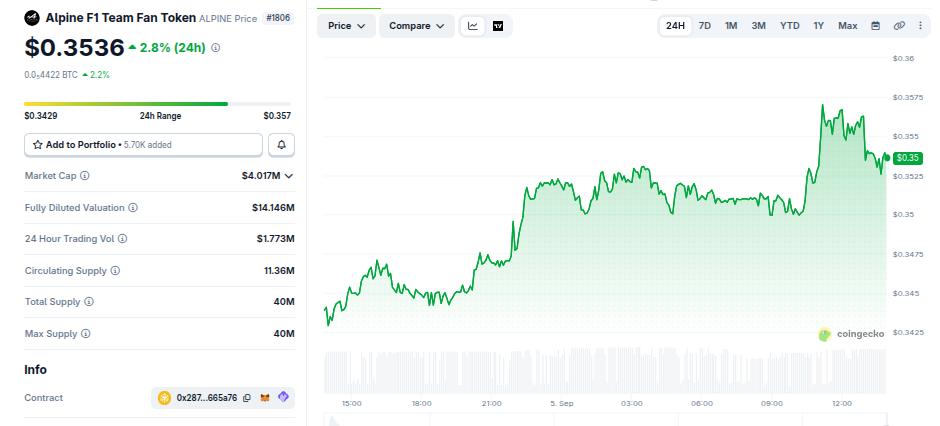
The Alpine F1 Team Fan Token climbed on September 5, trading near $0.3557 with a 24-hour gain of roughly 3.6%.
The move coincided with a stunning qualifying result at the Italian Grand Prix in Monza, where Pierre Gasly claimed his first career pole position for Alpine.

How Gasly’s Pole Put Alpine Back on the Map
Gasly stunned the Formula 1 field by edging Mercedes’ George Russell by just 0.060 seconds with a lap of 1:21.786. Oscar Piastri finished third for McLaren.
The result marked Alpine’s first pole in years and came at the same circuit where Gasly scored his sole career F1 victory back in 2020. With a market capitalization near $4 million and solid 24-hour trading volume, ALPINE continues to attract attention from motorsport and crypto enthusiasts alike.
Follow us on X to get the latest news as it happens.
Fan tokens give holders access to team-related voting, exclusive rewards, digital collectibles, and enhanced engagement. ALPINE, launched via Binance, is a BEP-20 utility token tied to the BWT Alpine F1 Team.
Why Fan Tokens React to On-Track Results
Positive on-track results often generate short-term interest in such assets. That pattern showed up again in the modest uptick in price and volume following Gasly’s performance.
Social media buzz, meanwhile, centered heavily on the Frenchman’s emotional reaction and Alpine’s unexpected pace. Direct commentary linking the token’s rise specifically to the pole, though, remained limited.
Fan tokens have grown in relevance across sports generally, particularly around major global events. That utility for fan engagement and community decisions was on full display during this summer’s 2026 FIFA World Cup.
As a result, national team and club tokens saw heightened trading activity around high-stakes matches. That pattern reflected real-world performance and sentiment throughout the tournament.
Subscribe to our YouTube channel to watch leaders and journalists provide expert insights.

That model, already established in football and motorsport, positions tokens like ALPINE as bridges between fans and teams beyond race weekends.
Gasly’s Monza pole provided a timely boost, illustrating how unexpected F1 moments can influence sports token markets even if gains remain measured relative to the token’s historical peaks.
The post Alpine F1 Fan Token Rises After Italian GP Drama appeared first on BeInCrypto.
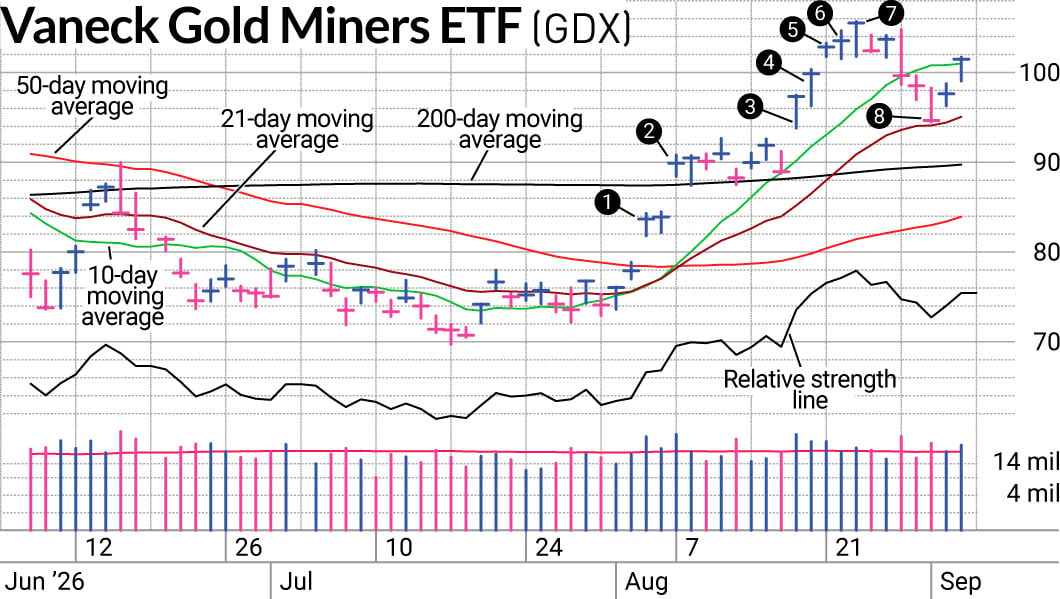
It’s no secret that the 1849 gold rush bankrupted far more people than it made rich. It’s a lesson that is aptly applied to gold stocks today or any stock for that matter. The fear of missing out (FOMO) might be a modern acronym but the emotion is ancient. In the stock market, it’s a dangerous and sneaky emotion. In…
Copyright ©2026 Investor’s Business Daily, LLC. All rights reserved. 87990cbe856818d5eddac44c7b1cdeb8
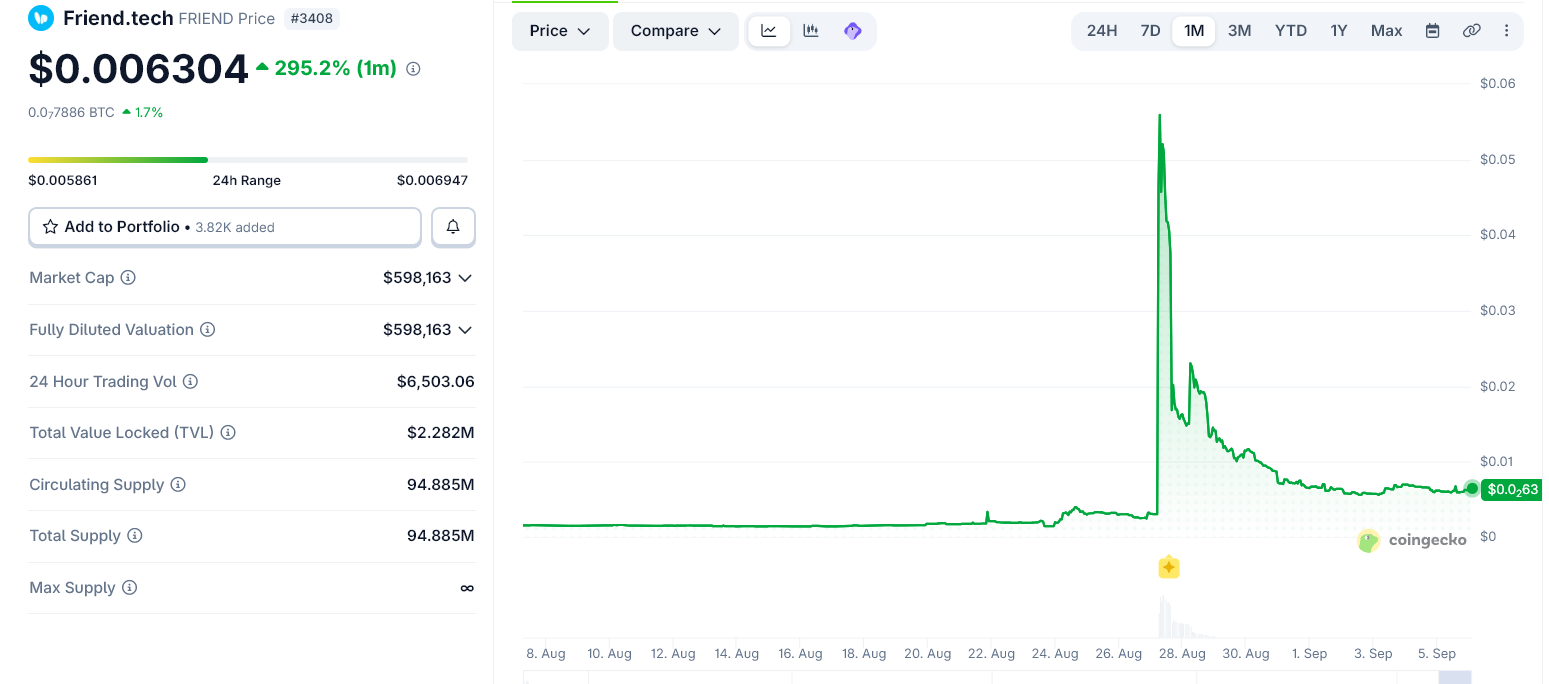
Crypto investor Machi Big Brother has pulled his $1 million bid for Friend.tech and named venture firm Paradigm as the likely obstacle.
Instead, he urged co-founder Racer to relaunch the Web3 social app on Robinhood Chain. The reversal comes nine days after his original offer, sending FRIEND up more than 1,500%.

Machi Big Brother Friend.tech Bid Collapses After 9 Days
Machi Big Brother, whose real name is Jeffrey Huang, opened the bid on Aug. 27. His $1 million buyout offer asked only for the project’s X account and web address.
Friend.tech launched on Base in 2023, allowing users to trade shares with each other. Paradigm led a seed round into the startup that same year.
However, Huang offered no evidence and framed the claim as a guess. He also has a history here. He bought 11 million FRIEND for roughly 5,200 ETH, and the position later shed over $16 million.
The original team gave up control of the smart contracts in September 2024. Therefore, it remains unclear what a buyer would own.
The FRIEND token price now sits near $0.0069, up roughly 5% in the past 24 hours. Its market value of about $659,000 trails the $4.89 million peak from the August rally. Over 90 days, however, the token still holds a 382% gain.
Robinhood Chain Emerges as Racer’s Next Option
Huang closed his post with a pivot. He told Racer to rebuild the app on Robinhood Chain and promised his backing.
Robinhood Chain went live on July 1 as an Arbitrum-based layer-2 network. Since then, it has surpassed Ethereum in volume on decentralized exchanges and absorbed heavy meme-coin flows.
Meanwhile, that mix worries some analysts. Jon Ma of Artemis warned that the meme coin boom risk could undercut Robinhood’s tokenized-stock ambitions.
FRIEND held its 24-hour gain despite the withdrawal. Racer had not responded publicly by Saturday afternoon, and his answer will decide whether Friend.tech returns.
The post Machi Big Brother Sent FRIEND Up 1,500%. Then Ditched $1M Deal appeared first on BeInCrypto.

Crypto Investors Await Clarity Act as Bitcoin, Ethereum Hold Rally

Anak Krakatau: Volcano eruption triggers flight suspensions at Indonesia’s main airport

Boeing Needs To Come Down From Orbit (NYSE:BA)





-

 Fashion2 days ago
Weekend Open Thread: Beyond Yoga
-
 Crypto World2 days ago
Bitcoin price stalls near $82K as key resistance holds
-

 Politics2 days ago
Best Gaming Laptops, CPUs, TVs, And Keyboards To Upgrade Your Set Up For GTA VI
-

 Tech2 days ago
The Birds Outside, Drawn For You Automatically
-

 Crypto World2 days ago
IMF Says El Salvador’s Post-Review Bitcoin Purchases Used No Public Funds
-
 Crypto World2 days ago
U.S. added stronger than expected 162,000 jobs in August as labor market bounced back
-

 Sports2 days ago
Alexandre Pato consortium’s Northampton Town investment approved
-

 Sports2 days ago
Commanders’ Chig Okonkwo is a top breakout fantasy football candidate
-

 Sports2 days ago
Golden Eaglets Drawn in Group B for 2026 WAFU B U17 Championship
-
 Crypto World2 days ago
XRP price breaks falling channel as bulls target $1.53
-

 Politics2 days ago
A new European chapter for Gibraltar
-

 Politics2 days ago
How To Avoid Winter Colds: 4 Everyday Habits That Spread Germs, Says Pharmacist
-

 Politics2 days ago
The House | Bin the lectures, bring gossip and be ready to banter: how the new PM should prepare for his Trump encounter
-

 Crypto World2 days ago
From warning to listing: UK’s largest retail investment platform opens access to crypto ETNs
-

 Crypto World2 days ago
FinCEN flags $12.7B tied to Southeast Asia crypto investment scams
-

 Tech2 days ago
A Worthy Android Ereader, With Some Tradeoffs
-

 Crypto World2 days ago
Trezor Data Breach Impacts 67,000 More US Customers
-

 Politics2 days ago
33 Cosy Autumn Home Decor Ideas: Blankets, Pumpkin Decorations, And Candles
-

 Tech2 days ago
How To Edit Claude’s Memory
-

 Sports2 days ago
Seven wickets in 21 balls: Sri Lanka’s Chamari Athapaththu scripts history with record-breaking spell
You must be logged in to post a comment Login