

Connect with us

Business

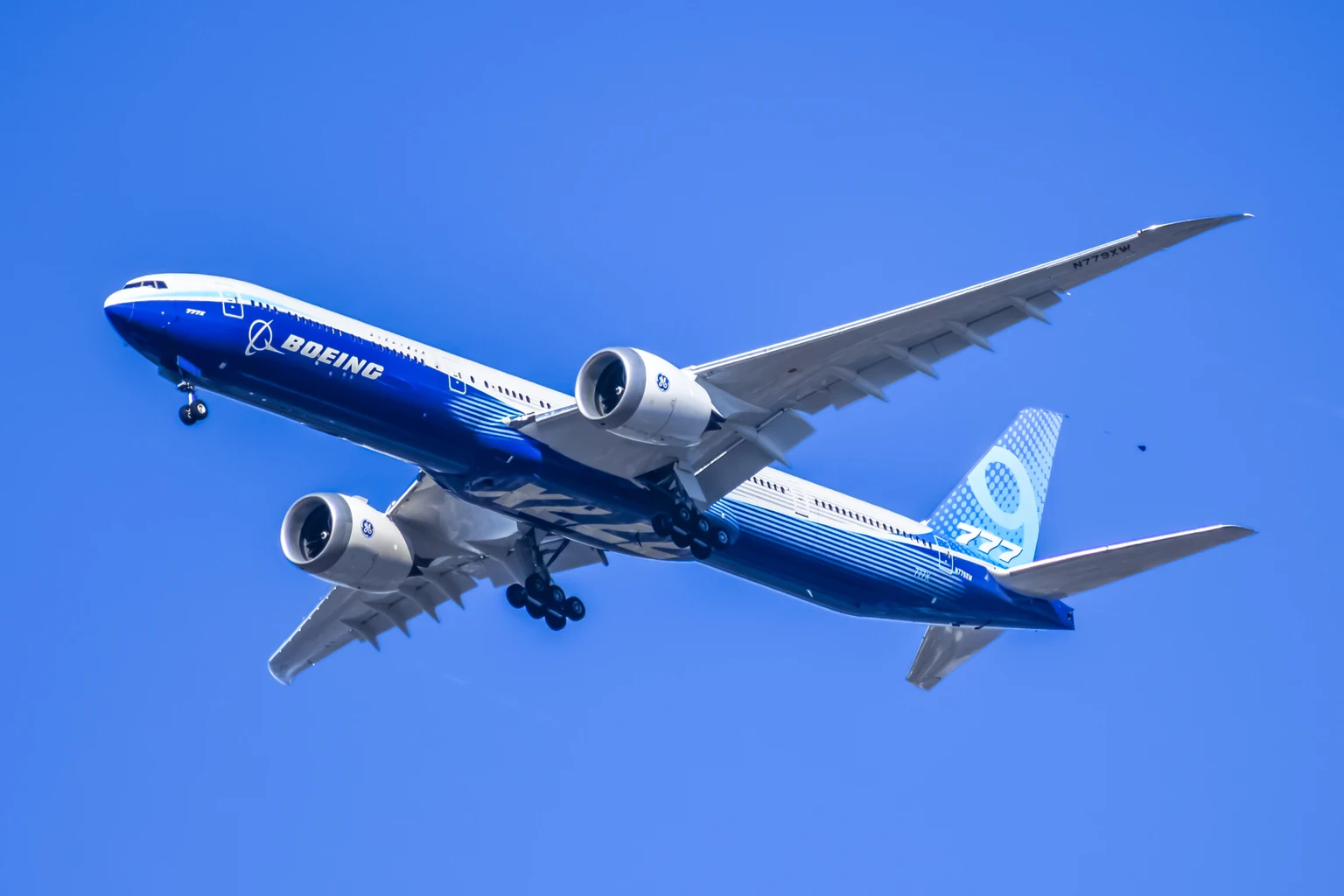
Boeing Needs To Come Down From Orbit (NYSE:BA)

Published

on

Boeing Needs To Come Down From Orbit (NYSE:BA)

This article was written by

Daniel is an avid and active professional investor.
He runs Crude Value Insights, a value-oriented newsletter aimed at analyzing the cash flows and assessing the value of companies in the oil and gas space. His primary focus is on finding businesses that are trading at a significant discount to their intrinsic value by employing a combination of Benjamin Graham’s investment philosophy and a contrarian approach to the market and the securities therein. Learn more.

Analyst’s Disclosure: I/we have no stock, option or similar derivative position in any of the companies mentioned, and no plans to initiate any such positions within the next 72 hours. I wrote this article myself, and it expresses my own opinions. I am not receiving compensation for it (other than from Seeking Alpha). I have no business relationship with any company whose stock is mentioned in this article.

Seeking Alpha’s Disclosure: Past performance is no guarantee of future results. No recommendation or advice is being given as to whether any investment is suitable for a particular investor. Any views or opinions expressed above may not reflect those of Seeking Alpha as a whole. Seeking Alpha is not a licensed securities dealer, broker or US investment adviser or investment bank. Our analysts are third party authors that include both professional investors and individual investors who may not be licensed or certified by any institute or regulatory body.

Advertisement
Continue Reading
Click to comment

You must be logged in to post a comment Login

Leave a Reply

Business

OPEC+ set to hold oil output policy steady for October – Reuters

Published

on


OPEC+ set to hold oil output policy steady for October – Reuters

Continue Reading

Business

Top 30 Products To Check Out From This Year’s Massive Tech Show Everyone’s Talking About

Published

on

Acer's Project DualPlay Mini Concept Turns Gaming Handheld Into Tiny

BERLIN — IFA 2026, Europe’s largest consumer electronics trade show, has drawn hundreds of exhibitors and thousands of attendees to Messe Berlin this week, with artificial intelligence woven into nearly every category on the show floor, from smartphones and TVs to toothbrushes and exoskeletons. Here are 30 of the most notable products and technologies unveiled at this year’s show.

Laptops and PCs

  1. Acer Vero 16. A sustainability-focused laptop offering tool-free access to its main components, a replaceable battery and a swappable solid-state drive, paired with an OLED display and configurations ranging up to a Core Ultra X9 processor.
  2. Lenovo Project AeroBlade. A concept 14-inch laptop built around Frore’s fanless AirJet cooling chip, weighing just 1.83 pounds while running an Intel Core Ultra 200 processor, with a shipping version potentially arriving as soon as 2027.
  3. Lenovo Yoga Pro 9n. A premium creator laptop powered by Nvidia’s RTX Spark platform, aimed at demanding AI development, content creation and local software workloads.
  4. Lenovo Yoga 9n. A 360-degree convertible 2-in-1 combining RTX Spark performance with dual-surface pen input for creative professionals.
  5. Lenovo Project Swan. A rollable-screen concept that transforms a 14-inch ThinkBook laptop into a widescreen ultrawide display at the press of a button.
  6. Acer Swift Blade 14. An ultralight laptop weighing just 1.76 pounds, pairing an 1800p OLED display with a new Wildcat Lake processor, notably lighter than Apple’s MacBook Air.
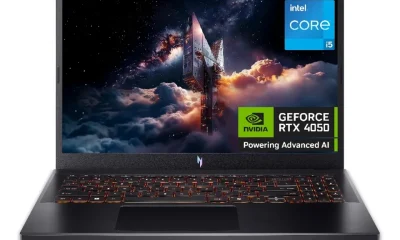
  7. Acer Project DualPlay Mini. A concept 8-inch Windows gaming handheld that flips open and swivels to reveal a hidden keyboard, transforming into a miniature laptop.
  8. Acer SFF RTX Spark Mini Workstation. Positioned between a mini PC and full tower, this system pairs Nvidia’s Blackwell RTX graphics with a Grace CPU and up to 128GB of unified memory, letting users run AI models locally without cloud subscriptions.

Monitors and Displays

  1. Alienware AW2527HX. A 24.5-inch, 1080p OLED esports monitor capable of a 560Hz refresh rate while retaining OLED’s deep contrast and fast pixel response, developed with input from esports organization Team Liquid.
  2. Acer Nitro XV275U Z2. A $329 Mini-LED monitor offering 1,000 nits of peak HDR brightness and refresh rates reaching 275Hz at 1440p, avoiding OLED’s burn-in risk at a notably accessible price.
  3. Alienware AW3226Q. A 32-inch 4K OLED gaming monitor using new “RGB Stripe” technology to improve text clarity, combining a 165Hz refresh rate with factory color calibration covering 99% of the DCI-P3 color space.
  4. Canvas HiFi S99H. A collaboration between audio brand Canvas and Samsung, integrating Canvas’s wooden-slat speaker design directly around Samsung’s flagship S99H OLED television to visually merge the TV and sound system into a single furniture piece.

Smartphones and Concepts

  1. Xiaomi 18 Fold. A wide “mid-fold” smartphone launching in China on Sept. 7, featuring a 5.38-inch cover screen, a 7.58-inch inner display and Xiaomi’s new self-designed XRing O3 chipset.
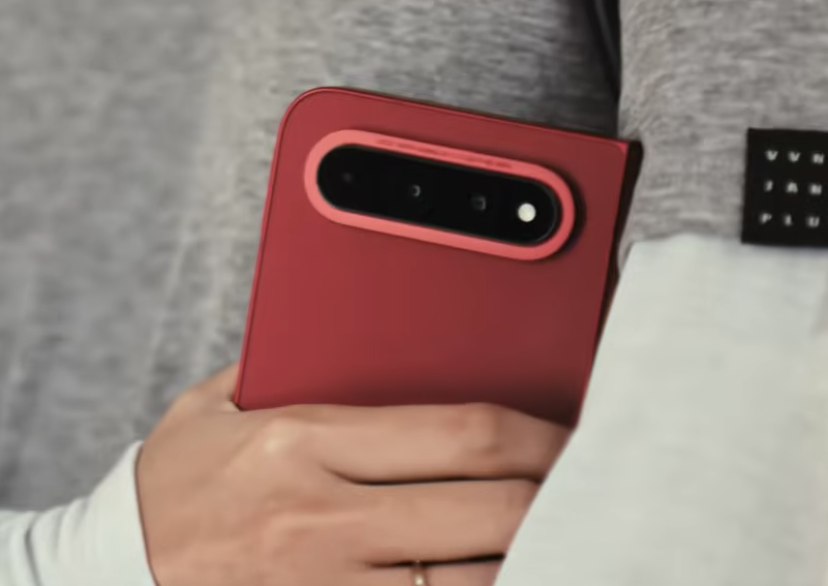
  2. TECNO Next-Gen Bezelless Concept Phone. A concept device with genuinely zero-millimeter bezels, presented at the show’s ShowStoppers event as a bold preview of where smartphone design may be heading.

Software and AI Tools

  1. Nvidia RTX PAIR. A free application for Windows, macOS and Linux that pools the graphics processing power of every compatible PC in a household to distribute AI workloads faster across multiple machines.
  2. LG ThinQ Claw. A new conversational AI agent for LG’s smart home ecosystem, built in part on the company’s Homey acquisition, designed to understand context and coordinate tasks across connected devices.
  3. Govee AI Lighting Bot 2.0. A system letting users create personalized smart lighting scenes through natural-language voice or text prompts rather than manually adjusting colors and brightness.

Wearables and Personal Tech

  1. Moto Watch Ultra. A smartwatch featuring Pantone-certified color options, a 1.5-inch OLED display, Google Wear OS, an LTE variant with independent cellular connectivity, and expanded sleep tracking developed with Polar.
  2. Plaud One. A pair of AI-powered earbuds functioning as a full-context wearable assistant that users can talk to throughout the day, connect to other services, and use to summarize daily activity, supported by eSIM connectivity.
  3. Beyerdynamic Aventho Y. New over-ear headphones from the century-old German audio manufacturer, featuring replaceable ear cups for long-term repairability and a design echoing premium consumer headphones.
  4. JLab ANC Earbuds. Budget-friendly active noise-canceling earbuds incorporating proprietary technology compatible with Apple’s Find My network, letting the charging case double as a location tracker.

Health and Sleep Tech

  1. Anker SleepLab Pro. A bedside speaker using 60GHz radar to track sleep stages, heart rate and breathing without a wearable device, doubling as a sleep aid with more than 180 built-in sounds and no required subscription.
  2. Dyson CameraJet. Dyson’s first electric toothbrush, combining an AI-powered camera that tracks brushing patterns with an integrated water flosser that activates automatically between teeth.

Home and Cleaning Robots

  1. Ecovacs Deebot X12S. A quiet, super-suction robot vacuum whose Omni Station pressure-washes and rinses the robot’s mop rollers after every cleaning cycle, recharging while it self-cleans to minimize downtime.

Cameras and Creator Gear

  1. Hohem EyePic. A 2-in-1 gimbal camera featuring a magnetic camera unit that detaches from its three-axis handle to become a wearable action camera, recording 4K video at 60 frames per second and waterproof to 33 feet.
  2. XGIMI Aura 3. A home projector combining high brightness output with 4K resolution at a smooth 120Hz refresh rate, aimed at sports and gaming content.

Networking

  1. TP-Link Archer 8 Ultra. A tri-band router built around the still-unfinalized Wi-Fi 8 standard, designed to address everyday connectivity problems rather than simply chasing faster theoretical speeds.
  2. TP-Link Deco 8 Ultra. A companion mesh networking system using the same emerging Wi-Fi 8 standard for whole-home coverage.

Mixed Reality and Robotics

  1. XREAL Aura. Mixed reality glasses running Google’s Android XR platform, offering a lighter alternative to headsets like Apple’s Vision Pro, with a release targeted before the end of 2026.
  2. Hypershell exoskeleton. A revamped, more powerful version of the company’s mobility exoskeleton, designed to assist with walking, hiking and physical exertion.

Beyond these individual standouts, several broader trends defined this year’s show. Samsung and LG dominated IFA’s official innovation awards, collectively winning 11 honors across categories spanning AI-powered appliances, next-generation displays and audio technology, with LG additionally claiming the show’s top overall “Best Brand” honor. Battery technology also drew attention, with early-stage semi-solid-state battery developments on display that could eventually enable smaller, more energy-dense and safer batteries across smartphones, laptops, wearables and smart home devices if the technology proves reliable and economical at scale.

Wearable technology in particular has had a strong year heading into this show, following earlier 2026 launches including screen-free trackers from Fitbit and Garmin, a first-of-its-kind on-wrist breathing emergency detection feature from Google, and the slim flagship Oura Ring 5, setting a high bar for the wearable announcements that followed at IFA itself.

IFA CEO Leif Lindner emphasized during the show’s opening that exhibitors continue pushing forward with AI-driven innovation despite broader industry headwinds, including a well-documented global memory chip shortage that has driven up component costs across smartphones, laptops and other connected devices throughout the year. That pricing pressure has not slowed the pace of announcements, with companies across categories continuing to race toward differentiating their products through AI integration, whether through on-device processing, conversational assistants, or personalized automation features.

Advertisement

Not every product unveiled this week is guaranteed to reach consumers in its current form. Concepts including Acer’s Project DualPlay Mini, Lenovo’s Project AeroBlade and Project Swan, and Nvidia’s RTX Spark-powered mini workstation remain unconfirmed for mass production, with some industry observers expressing skepticism about whether certain concepts will ever ship in their showcased configurations. Other products, including the Alienware monitors, Acer’s Nitro display, the Xiaomi 18 Fold and the Swift Blade laptop, are expected to reach store shelves within the coming months, offering a clearer near-term path from trade-show demonstration to consumer purchase.

With IFA 2026 running through Sept. 8 at Messe Berlin, additional product reveals and hands-on demonstrations are expected throughout the remainder of the show, as exhibitors continue introducing new devices spanning smart home technology, health and wellness gadgets, gaming hardware and home entertainment systems to the hundreds of thousands of attendees expected to pass through the venue before the event concludes.

Continue Reading

Business

Germany moves to strengthen drone and cyber defenses after airport attack

Published

on


Germany moves to strengthen drone and cyber defenses after airport attack

Continue Reading

Business

Magnitude 3.2 Earthquake Rattles Compton Area In Los Angeles County, Hundreds Report Feeling It Sunday

Published

on

Magnitude 3.2 Earthquake Rattles Compton Area In Los Angeles County,

LOS ANGELES COUNTY, Calif. — A preliminary magnitude 3.2 earthquake struck near Compton in Los Angeles County just after midnight Sunday, according to the U.S. Geological Survey, marking the latest in a series of small tremors to hit Southern California in recent weeks.

The quake struck at 12:13 a.m. Sunday, with its epicenter located approximately 2 miles south-southeast of Compton and about 6.1 miles north of Long Beach, according to the USGS. The tremor occurred at a depth of roughly 8 miles, a relatively shallow depth that can contribute to shaking being felt more widely at the surface even for a modest-magnitude event.

As of early Sunday, 623 people had submitted reports through the USGS’s “Did You Feel It?” online form, indicating they had experienced weak shaking from the quake. Residents reporting the tremor came from a range of communities across the region, including La Habra, Seal Beach, Los Angeles, Bell and La Mirada, reflecting how far the shaking was perceptible even though the earthquake itself registered as relatively minor on the magnitude scale.

Advertisement

Sunday’s quake follows a similar magnitude 3.2 earthquake recorded near Ontario, in neighboring San Bernardino County, on Sept. 2, part of a broader pattern of low-level seismic activity that has continued across the greater Los Angeles basin in recent weeks. A separate magnitude 3.4 quake was also recorded near Ontario, about 12.5 miles east of Riverside, earlier in the same period.

The Compton area, along with the broader Los Angeles basin, sits atop a network of active fault systems that make the region one of the most seismically monitored areas in the country. According to seismic data compiled over more than five decades of record-keeping, the Compton area experiences an average of roughly 2,400 earthquakes of all magnitudes each year, though the vast majority of those events are too small to be felt by residents. Earthquakes of magnitude 3 or higher occur in the area at a rate of roughly 19 per year on average, while quakes reaching magnitude 5 or greater occur closer to once every two years, based on historical data.

Beneath the Compton area lies the Compton blind thrust fault, a concealed fault system that does not reach the surface but has been identified by seismologists as capable of producing significantly larger earthquakes than the one recorded early Sunday. Research conducted through the Southern California Earthquake Center has found geological evidence that the Compton thrust fault has generated at least six large-magnitude earthquakes, estimated between magnitude 7.0 and 7.4, over the past 14,000 years. Because the fault lies directly beneath the densely populated Los Angeles metropolitan area, researchers have identified it as posing one of the more significant deterministic seismic risks in the United States, even though large ruptures on the fault occur only rarely on a human timescale.

Southern California’s broader seismic activity has drawn increased attention from researchers in recent years. Geophysicist Dr. Lucy Jones, a prominent seismologist who has studied the region extensively, has previously noted that certain stretches of heightened earthquake activity reflect an ongoing, connected process occurring along the region’s fault systems, rather than a series of entirely unrelated, isolated events. Southern California has, at various points over the past several years, experienced stretches of earthquake activity exceeding typical historical averages, prompting seismologists to closely monitor whether individual clusters of smaller quakes might be connected to broader stress patterns building along the region’s numerous fault lines.

Advertisement

Sunday’s earthquake was far too small to cause damage, and no injuries or damage were reported in connection with the tremor. Earthquakes in the magnitude 3 range are generally felt only as brief, mild shaking by people located relatively close to the epicenter, and such quakes rarely, if ever, cause structural damage to buildings or infrastructure under normal circumstances.

The USGS continues to encourage residents who experience earthquakes, even minor ones, to submit reports through its “Did You Feel It?” system, which helps the agency gather real-time data on the geographic extent and intensity of shaking associated with individual seismic events. That crowdsourced reporting data, combined with the agency’s network of seismic monitoring stations, allows researchers to build a more complete picture of how a given earthquake was experienced across different communities, information that can prove valuable for both immediate response purposes and longer-term seismic hazard research.

Southern California residents are routinely reminded by emergency management officials to maintain basic earthquake preparedness measures regardless of how minor recent seismic activity may have been, given the region’s well-documented exposure to the risk of a significantly larger earthquake at some point in the future. Recommended preparedness steps commonly cited by state and local emergency agencies include securing an emergency supply kit with food, water and basic medical supplies, developing a family communication and evacuation plan, and securing heavy furniture and other objects within the home that could pose a hazard if they were to fall during stronger shaking.

Sunday’s tremor adds to a broader recent pattern of minor seismic activity affecting the greater Los Angeles region, following the earlier September quakes near Ontario. While none of these recent events has approached a magnitude capable of causing significant damage, seismologists have continued to monitor the broader pattern of activity across Southern California’s interconnected fault systems, given the region’s history of both frequent minor tremors and, less commonly, more significant and potentially damaging earthquakes tied to the same underlying geological structures.

Advertisement

The USGS has not indicated any specific connection between Sunday’s Compton-area quake and the earlier Ontario-area tremors recorded in the preceding days, and officials have not issued any elevated warning regarding the likelihood of further seismic activity in the immediate aftermath of Sunday’s event. As is standard practice following any earthquake in the region, residents are advised to continue monitoring official USGS updates and local emergency management communications for any further developments.

Continue Reading

Business

Lam Research Legal Chief Sold $1.5 Million as AI Chip Demand Booms. Is the Signal Bearish?

Published

on

Lam Research Legal Chief Sold $1.5 Million as AI Chip Demand Booms. Is the Signal Bearish?

Lam Research chief legal officer Ava Harter sold 5,000 shares at $302.46 on August 31, generating about $1.51 million and leaving her with 42,462 shares. The filing says the sale followed a Rule 10b5-1 plan adopted on April 28. On August 6, CEO Timothy Archer exercised 30,000 options at $30.033 and sold 30,000 shares at $300 under a plan adopted on February 24. Lam Research Corporation (NASDAQ:LRCX) has benefited from an AI-driven semiconductor equipment cycle, making the sales relevant even though they do not, by themselves, predict a peak.

Lam Research Legal Chief Sold $1.5 Million as AI Chip Demand Booms. Is the Signal Bearish?

Wichy/Shutterstock.com

The opportunity begins with the physical requirements of advanced chips. More AI accelerators and high-bandwidth memory require complex deposition, etch, and packaging steps, areas where Lam’s equipment is deeply embedded in customer road maps. Once a tool is qualified for a manufacturing process, switching can be costly and risky. Industry spending on AI infrastructure also extends beyond one product generation because data centers refresh hardware repeatedly.

Preset trading plans weaken the case for reading either sale as a fresh reaction to operating conditions. Neither Form 4 establishes that the trades responded to weakening orders. Still, investors should not ignore cycle risk. Semiconductor equipment demand can change quickly when customers overbuild capacity. China restrictions, customer concentration, and a premium valuation add pressure. A strong AI cycle can be real while the stock discounts too much of it.

Hedge funds became considerably more numerous in the latest quarter. Insider Monkey tracked 139 funds holding Lam Research Corporation (NASDAQ:LRCX) at the end of Q2, up from 123 in Q1. Arrowstreet Capital reported 12,269,198 shares as of June 30, while Coatue Management reported 9,441,603. The rising holder count shows broader participation, and the manager figures provide scale without revealing either firm’s current view.

Advertisement

Short interest remains modest. The August 14 settlement showed 28.42 million shares short, or 2.28% of float, up 5.4% from 26.96 million on July 31, with 3.3 days to cover. Reported short positions increased, though the total remains too small to make a squeeze central to the thesis.

Harter’s sale is best treated as a valuation prompt. It does not invalidate Lam’s exposure to AI chip manufacturing, yet it arrives after substantial optimism entered the shares. Future returns depend on order durability, memory spending, China revenue, and margins. If those stay strong, the sale will look routine; if they weaken together, it may appear better timed in hindsight. Deferred revenue and customer-capital budgets should provide earlier evidence than insider activity about where the equipment cycle is heading.

Advertisement
Continue Reading

Business

SSR Mining: The Cash Is In, And Shares Are Still Cheap

Published

on

SSR Mining: The Cash Is In, And Shares Are Still Cheap

SSR Mining: The Cash Is In, And Shares Are Still Cheap

Continue Reading

Business

U.S.-Iran tanker war escalates as Hormuz disruption deepens

Published

on


U.S.-Iran tanker war escalates as Hormuz disruption deepens

Continue Reading

Business

Robotics manufacturer Tharsus continues to invest as challenging year knocks profits

Published

on

Business Live

Despite difficult trading conditions the business invested in its core engineering and manufacturing capabilities

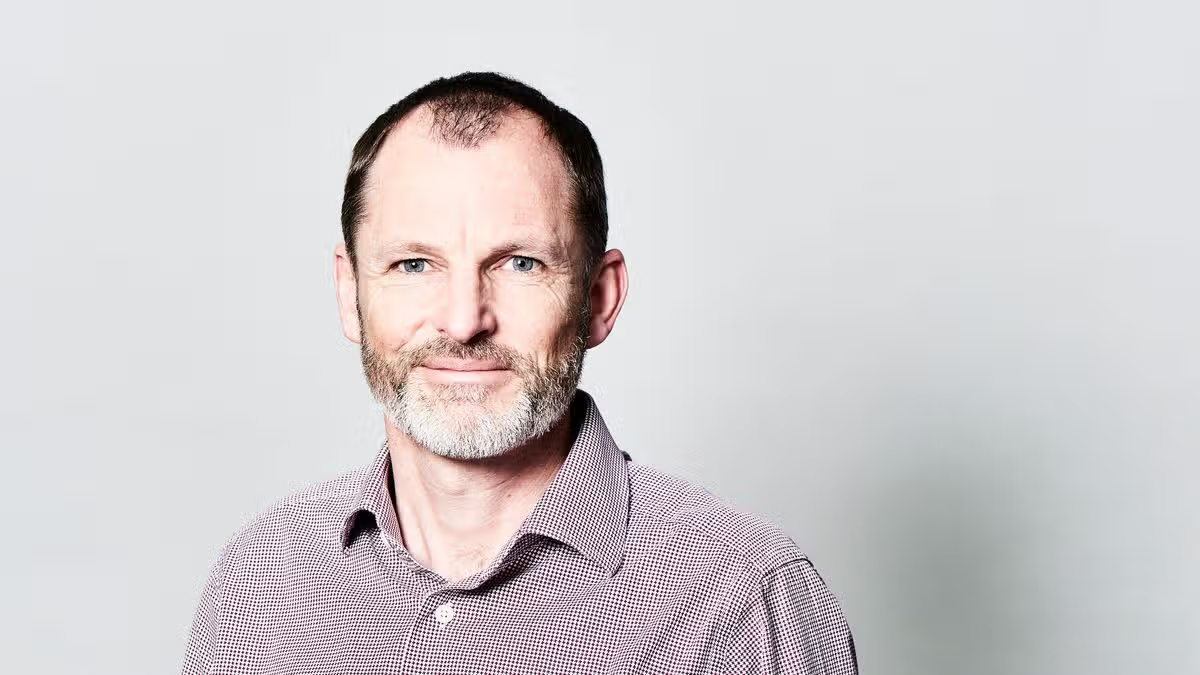
Brian Palmer, CEO of Tharsus

Brian Palmer, founder of Tharsus(Image: Recognition PR)

Northumberland robotics manufacturer Tharsus has continued to invest despite seeing revenue and profits fall in testing times.

Tharsus Group – the holding company of a group of engineering-led businesses including Tharsus and Universal Wolf – manufactures its products from three Blyth factories, employing more than 200 staff. While Tharsus provides a full product design, manufacture and aftermarket service to customers developing advanced machines and automation systems, Universal Wolf is a specialist provider of complex metal fabrication and engineered assemblies.

Tharsus also develops logistics automation products under its VersaTile platform. The business – a former Company of the Year at the North East Business Awards – worked with online grocer Ocado on its warehouse automation project for 10 years, during which time it manufactured thousands of robots to pick groceries for delivery. That contract came to an end in its 2023 financial year.

The group has now published accounts for its 2025 financial year in which it fell to a loss in a challenging year, with lower than anticipated revenue driven by delays and “non-progression of certain customer programmes”. Revenues fell from £24.5m to £18.6m, while Ebitda fell from profit of £800,000 to a loss of £1.5m.

Advertisement
Tharsus CEO Brian Palmer (right) welcomes news of the Ocado deal extension

Tharsus CEO Brian Palmer (right) at the Blyth business(Image: Tharsus)

The 2024 pre-tax profit of £400,000 was also converted to a loss of £1.99m. The overall loss for the year was £1.5m, down from profit of £371,975. Employee numbers also dropped slightly, from an average of 233 to 218.

A report within the accounts, by founder Brian Palmer highlighted its challenges as well as its investments.

It said: “During the year, management focus was directed toward stabilising the group following a period of reduced revenue, while ensuring that the underlying capabilities required to support future growth were retained. Actions were taken at subsidiary level to control costs, manage working capital and protect liquidity.

“Tharsus Limited experienced a challenging year, with lower than anticipated revenue driven by delays and non-progression of certain customer programmes. Restructuring activity was undertaken during the year to reduce costs and protect liquidity.

Advertisement

“Despite the difficult trading conditions, the business continued to invest in its core engineering and manufacturing capabilities and in the development of its VersaTile product platform.

“Universal Wolf Limited also experienced a softer trading year compared with the prior period, reflecting reduced demand from a number of established customers. The business maintained operational discipline and developed its core skills and capability, positioning it to support improved performance as customer programmes mature.”

Tharsus said the group continued to invest in the development of its VersaTile logistics automation platform – systems developed by the group under its own intellectual property – during the year.

It added: “A successful trial of the Grid system was completed during the year at a major grocer’s site, providing additional validation of the system’s performance in a chilled distribution environment. The business is in discussions with several major UK grocers, third party logistics providers and integrators about the commercial applications of VersaTile.”

Advertisement

Following publication of the accounts, the group told BusinessLive that Tharsus, Universal Wolf and VersaTile Automation has felt the impact of increased National Insurance costs, high interest rates and geopolitical uncertainty. These factors have made customers and their funders more cautious regarding innovation expenditure, resulting in the reduced total revenue and overall loss.

CEO and founder Mr Palmer added: “2025 was an important year of transition for Tharsus Group. While market conditions remained difficult in some areas, the business made clear progress in improving its commercial focus and positioning the Group for sustainable growth. We remain confident in the future opportunity for Tharsus Group, underpinned by the quality of our people, our engineering capability and the strength of the customer relationships we are building.

“I am grateful to all our Tharsus, Universal Wolf and VersaTile colleagues for their effort and resilience throughout 2025. Personally, I believe that there is no-one better placed to deal with the challenges of developing and commercialising new technology hardware in the UK than Tharsus Group.”

Advertisement
Continue Reading

Business

Credo's Selloff Is Missing The Bigger AI Opportunity

Published

on

Hammond Power Solutions: Capacity Has Arrived Just As AI Power Demand Accelerates

Credo's Selloff Is Missing The Bigger AI Opportunity

Continue Reading

Business

Germany’s far-right AfD seeks landmark state victory as Saxony-Anhalt votes

Published

on


Germany’s far-right AfD seeks landmark state victory as Saxony-Anhalt votes

Continue Reading

Trending

Copyright © 2025