
Crypto World
Binance Launches Wealth Service With 11 US ETFs

Binance has launched a wealth management service offering access to 11 US-listed exchange-traded funds focused on short-term US Treasurys and investment-grade bonds.
The new Binance Earn offering groups the ETFs into cash management, steady income and yield enhancement products based on investment horizons ranging from less than six months to more than a year.
Users can browse the available ETFs and place orders through Binance Earn, with purchases processed through the exchange’s stock trading service. Binance said investors receive the economic benefits of the shares, including price movements and cash distributions.
Unlike tokenized stocks, users purchase actual ETF shares through the service. Binance provides the interface, while Nest Trading routes the orders to Alpaca Securities, which executes the trades and holds the securities.
The arrangement allows Binance users to access traditional securities through the same platform they use for crypto, while the underlying assets remain within conventional brokerage infrastructure.
The wealth management service is the latest expansion of Binance’s TradFi business. Earlier this month, the exchange added physically settled options on more than 1,000 US stocks and ETFs, building on its existing equities offering of more than 7,000 stocks and ETFs.
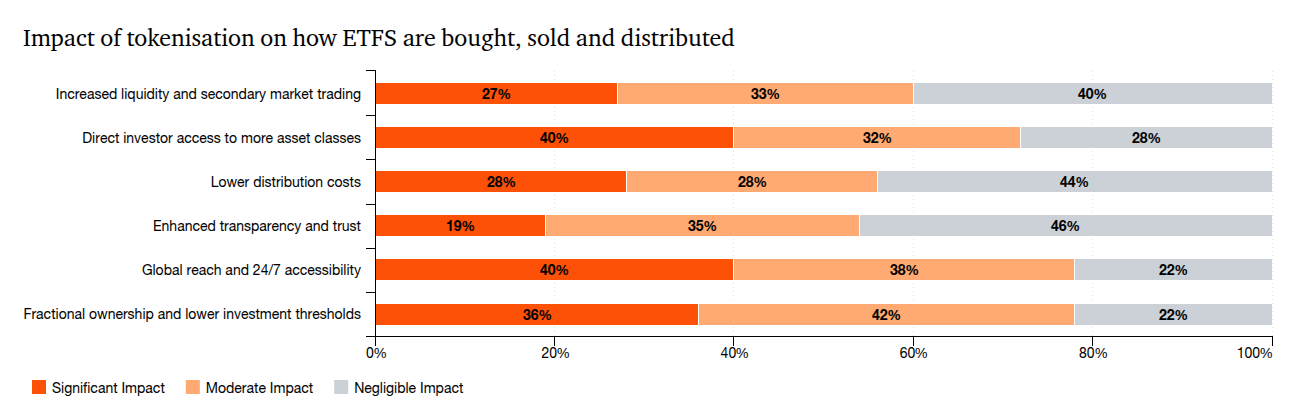
More than 80% of respondents in a PwC survey last year believe tokenization will boost global reach and 24/7 accessibility within the ETF market over the next three years.
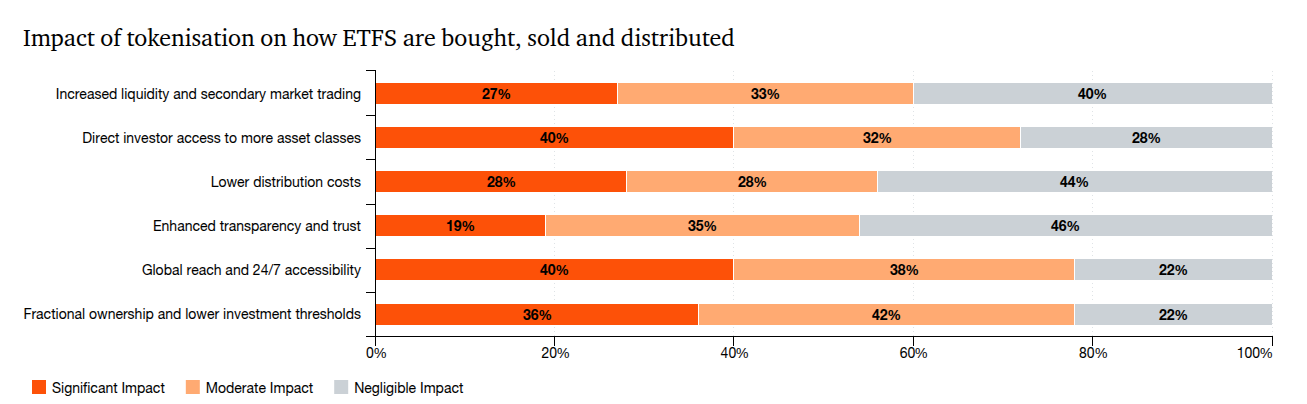
Source: PwC Global ETF Survey 2025
Magazine: HYPE price could suffer as Binance takes its revenue: Alice Liu



Manifund, a charity founded by Austin Chen that focuses on AI and effective altruism causes, has created quite the stir by admitting to hiring disgraced CEO of Alameda Research, Caroline Ellison.
While the controversy is fascinating, the history behind it is detailed, lengthy, and bizarre.
In March of 2022 Chen’s organization, then called Manifold Markets, applied for $500,000 in funding from the FTX Future Fund, the philanthropic arm of FTX, to setup Manifold For Charity (now known as Manifund).
Most notably, two important EA figures helped run the Future Fund, and therefore helped approve Chen’s grant application: William MacAskill and Leopold Aschenbrenner.
Six months later, FTX and Alameda Research were declaring bankruptcy and its CEOs, Sam Bankman-Fried and Caroline Ellison, were being ushered to jail.
Read more: FTX’s Caroline Ellison and Gary Wang hit with five-year trading ban
Time marches on
Ultimately, Gary Wang and Nishad Singh, executives associated with FTX and Alameda, received no prison sentence, SBF was sentenced to 25 years, and Ellison to two years.
Ellison was released in January 2026.
In the time the Alameda Research CEO spent behind bars, effective altruism, despite being heavily criticized, has chugged on. Manifund has too.
During this period Manifund has managed to fund nearly 500 projects and handed out grants totaling almost $20 million, according to its own data.
But what is hasn’t done is also very important.
FTX sues Manifund
Despite being able to fund hundreds of projects and hand out millions of dollars, a pain point for Manifund appears to be the $500,000 grant it received from the FTX Future Fund in 2022.
In 2024, FTX brought suit against Manifold Markets, demanding the return of $508,000. In July of 2025, it added Manifold For Charity (now known as Manifund) to the amended complaint.
The amended complaint now demands the return of “no less than $1,508,000.”
The suit has moved forward but no solution has been agreed yet. Needless to say, the optics of being an effective altruist charity while withholding funds from creditors isn’t great, but it could look worse.
Namely if you hire a friend you’re indebted to.
There’s nothing wrong with hiring a criminal, especially if you believe them to be reformed — a point Chen makes in his post on EA forums. However, far more important is Chen’s history and ongoing problems with FTX.
The fact that he’s willing to bring Ellison into his company, despite her past with Alameda Research, his own connection to the FTX Future Fund, and a $1,508,000 lawsuit, calls into question his own abilities to abide by effective altruistic intentions.
The EA forums are wondering aloud: is this maximizing positive impact?
Got a tip? Send us an email securely via Protos Leaks. For more informed news and investigations, follow us on X, Bluesky, and Google News, or subscribe to our YouTube channel.
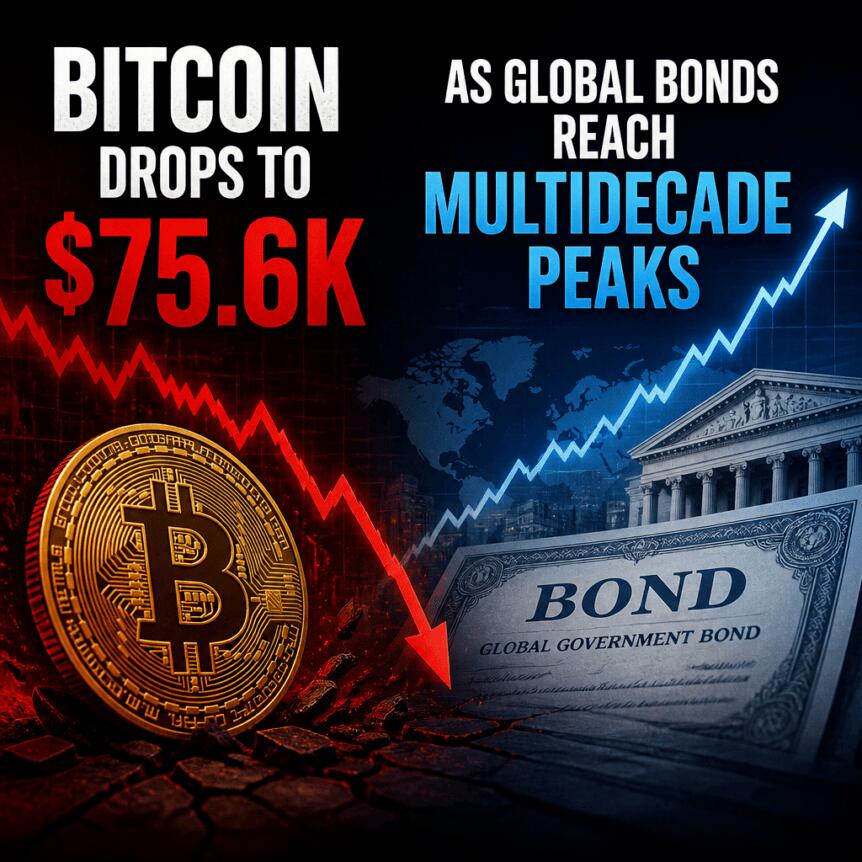
Bitcoin slid to its lowest level so far in September during Tuesday’s Wall Street open, with pressure coming from a sharp jump in global bond yields and a market that remains focused on US legislative risk. At the same time, oil prices stayed elevated, adding to concerns that inflation could remain stubborn and keep central banks on a tighter path.
According to TradingView data cited by Cointelegraph, BTC/USD dipped under $76,000, wiping out the prior day’s move toward $79,600. The slide unfolded as traders looked ahead to a key procedural vote on the proposed CLARITY Act in the US Senate at 2:15pm Eastern time—an event that could shape expectations for how crypto regulation is ultimately carved up between the SEC and CFTC.
Key takeaways
- Bitcoin fell to $75,560, its lowest level in September at the Wall Street open, as BTC/USD slipped below $76,000.
- Global bond yields reached multi-year highs, with the US 10-year yield pushing above 5% for the first time since November 2023.
- Oil prices around $100+ remained a factor behind “higher-for-longer” inflation fears, weighing on risk assets including crypto.
- Market participants expect central banks to keep interest rates higher, a traditional headwind for speculative assets like bitcoin.
- The CLARITY Act procedural vote is seen as only one hurdle; even passage would not automatically guarantee final law.
CLARITY Act vote keeps traders on the defensive
Even with crypto already reflecting a complicated regulatory backdrop, Tuesday’s scheduled procedural vote kept traders from taking aggressive risk. The legislation is designed to advance to a Senate-floor debate if it secures the necessary 60 votes, turning a procedural milestone into a focal point for sentiment.
Earlier coverage from Cointelegraph highlighted that consensus expectations for success were low despite some pockets of optimism. Cointelegraph also pointed to Polymarket odds indicating only about 14% probability that the CLARITY Act becomes law in 2026 as of Tuesday.
Trading firm QCP Capital argued that the Tuesday procedural step—if it clears—would likely be only part of the story. In an analysis published Monday, QCP Capital noted that passage would “clarify the respective regulatory roles of the SEC and CFTC,” a change that could strengthen the medium-term case for institutional participation by reducing uncertainty. However, QCP stressed that procedural progress does not equal final adoption, and the timing of subsequent legislative stages would be what ultimately determines any immediate market impact.
Bond selloff spreads as yields hit fresh highs
While legislative headlines can sway sentiment quickly, Tuesday’s dominant macro driver appeared to be the surge in bond yields across major economies. Cointelegraph reported that US stocks turned lower as yields climbed back toward levels last seen during earlier cycles of monetary tightening.
According to the article, the US 10-year yield rose above 5% for the first time since November 2023, reaching 5.041%—a level last seen in June 2007. Reuters also reported that the average 10-year yield for the world’s seven largest economies hit 4.285%, the highest since mid-2008 around the Global Financial Crisis.
Beyond the US, other government bond benchmarks moved sharply as well. Cointelegraph cited that the UK 30-year yield reached 5.95% for the first time since March 1998, while Japan’s 10-year yield climbed to 3.04%, its highest in roughly three decades.
Why yields and oil matter more for crypto than headlines suggest
For crypto markets, higher yields are not just a “risk-off” signal—they directly affect the broader financial conditions under which non-yielding assets are priced. As bond yields rise, investors often demand greater returns elsewhere, which can reduce the attractiveness of speculative exposures like bitcoin, especially when traders expect central banks to remain restrictive.
Cointelegraph attributed the continued rise in yields to inflation risk fueled by elevated oil prices and heightened geopolitical concerns. WTI crude neared $105 per barrel on Tuesday, according to the report, tracking toward its highest levels since early May. The article also framed the situation around the risk of supply disruptions linked to a widening Middle East conflict, reinforcing the idea that energy-linked inflation pressures could persist.
Those dynamics feed directly into expectations for policy. The Kobeissi Letter argued that monetary policy is shifting and that rate hikes are “returning,” adding that intervention may become necessary as yields move to “unsustainable” levels. Cointelegraph also noted market expectations that the US Federal Reserve would raise its benchmark rate by 0.25% on Wednesday and that the Bank of Japan was expected to follow suit at its Friday meeting.
What to watch after Tuesday’s close
Bitcoin’s reaction to Tuesday’s macro backdrop suggests traders may be treating this week as a test of how sensitive crypto remains to higher-for-longer rate expectations. The next question is whether the CLARITY Act procedural vote changes the regulatory conversation enough to counterbalance the tightening signal from yields—or whether macro conditions continue to dominate near-term price action.
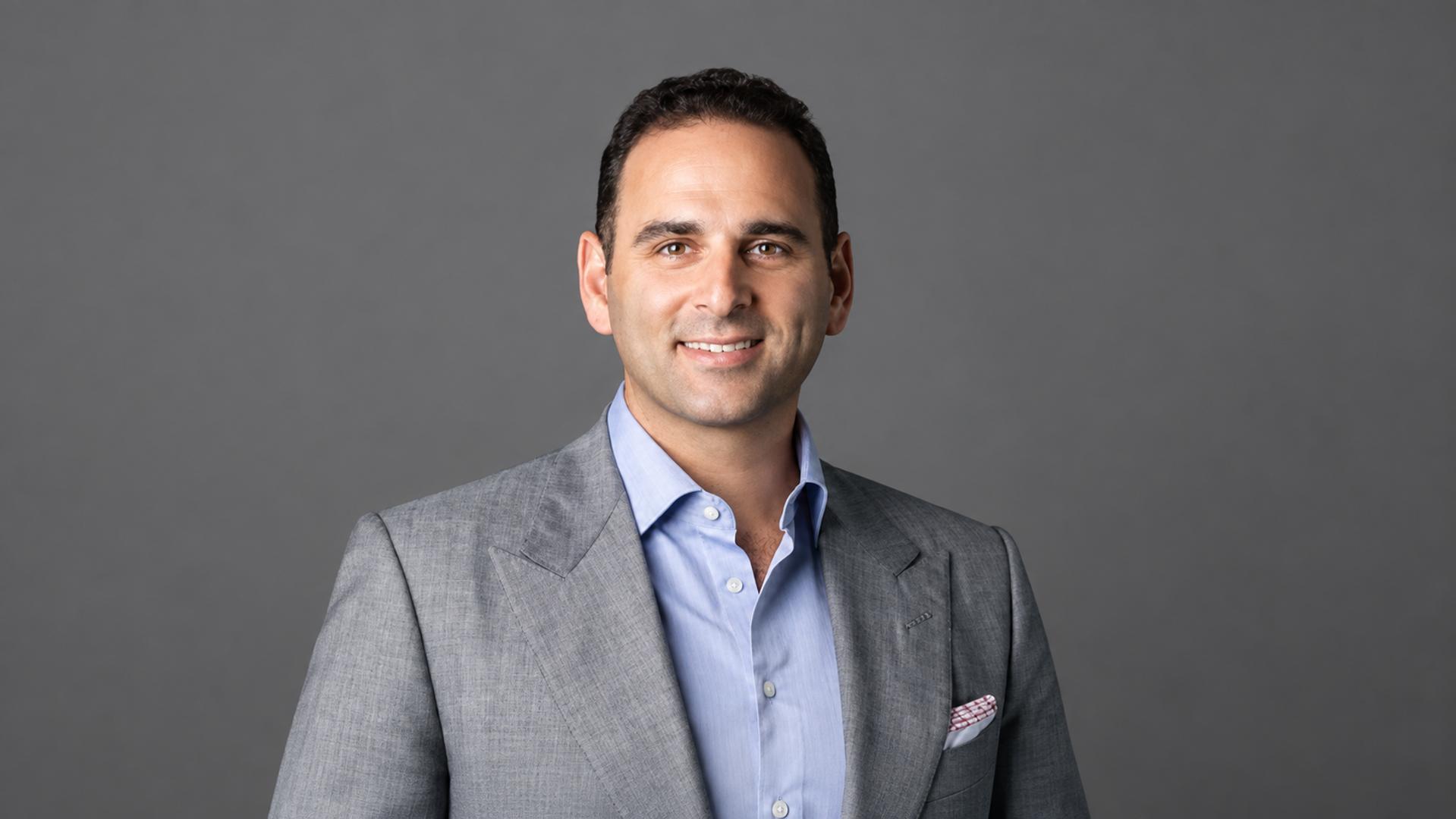
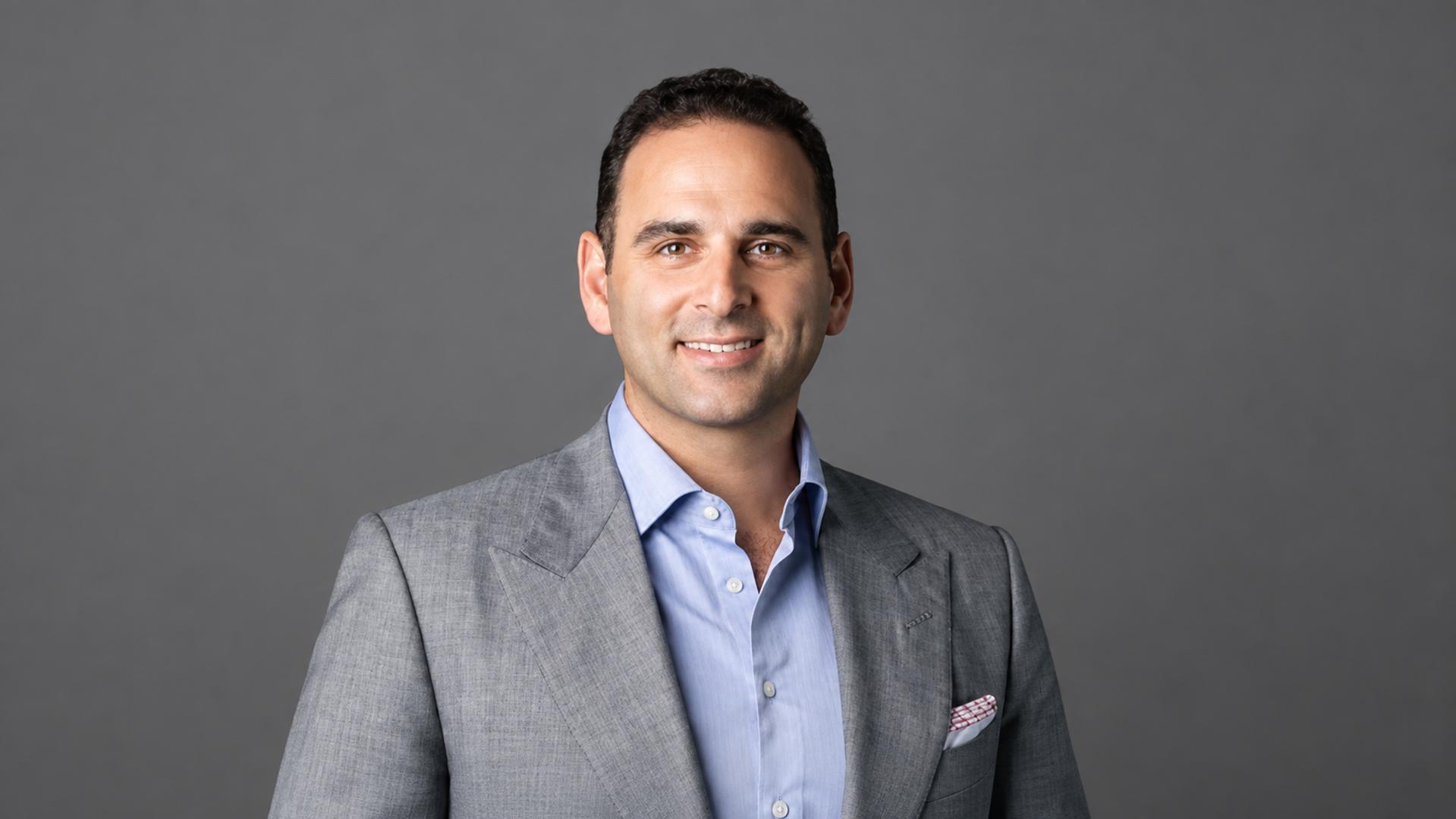
Kamino , one of Solana’s largest lending protocols with $1.4 billion of assets, is setting up shop in New York as it looks to bring its onchain credit business closer to Wall Street and expanding to tokenized assets.
On Tuesday, the company named Yieldstreet co-founder Michael Weisz as CEO to lead that push. Kamino said it is looking at roughly 20,000 square feet of office space in New York and plans to hire a chief financial officer and head of legal.
Weisz co-founded alternative investment platform Yieldstreet, now Willow Wealth, which deployed more than $6 billion alongside firms including Goldman Sachs, Carlyle, KKR and Ares.
“Being in New York puts Kamino at the intersection of the asset managers, distribution platforms and institutional capital that will define the next phase of on-chain finance,” Weisz said.
Tokenization — the process of putting traditional assets such as stocks, bonds and funds on blockchain rails — has become one of Wall Street’s biggest bets on crypto technology. Citi projected the market of tokenized securities could reach $5.5 trillion by 2030 as banks and asset managers explore faster settlement, round-the-clock markets and new ways to use assets as collateral.
Lending against tokenized assets
Kamino lets users lend crypto assets or borrow against them. It is extending that model to tokenized real-world assets, providing markets where investors can finance or use those assets as collateral after they move onchain.

Binance has rolled out a new wealth-management product called Binance Earn, designed to give users access to 11 US-listed exchange-traded funds (ETFs) focused on short-term US Treasurys and investment-grade bonds. The service packages these ETFs into different categories tied to investment horizons, aiming to let customers allocate capital through the same platform they use for crypto.
The announcement positions Binance Earn as a bridge between crypto-native account experiences and traditional market plumbing, with trades executed and custody handled through brokerage infrastructure rather than tokenized securities.
Key takeaways
- Binance Earn offers access to 11 US-listed ETFs centered on short-term Treasurys and investment-grade bonds.
- The product is organized into cash management, steady income, and yield enhancement options by investment horizon (from under six months to over a year).
- Users buy actual ETF shares (not tokenized stocks), with orders placed through Binance and processed via a brokerage/market routing setup.
- Binance said customers receive the economic benefits of ETF ownership, including price movement and cash distributions.
How Binance Earn works
According to Binance, users can browse the ETFs available on the platform and place orders through Binance Earn. Purchases are routed through the exchange’s securities trading workflow, rather than using a tokenized wrapper for the underlying assets.
Binance also clarified the ownership model: investors are intended to receive the economic benefits of the ETF shares, including exposure to price movements and cash distributions.
Unlike tokenized stock products—where tokens represent claims on underlying securities—Binance Earn is structured around direct ETF share purchases. The interface is provided by Binance, while the operational chain for trading and holding the securities is handled through traditional brokerage channels.
Brokerage routing: Nest Trading and Alpaca Securities
Binance stated that the service relies on a partner execution and custody arrangement. In the setup described, Nest Trading routes orders to Alpaca Securities, which then executes the trades and holds the securities.
This matters for investors because it highlights where the regulatory and operational responsibilities sit in the stack: Binance provides the user access layer, but the actual securities trading and holding are linked to a conventional brokerage infrastructure. For users, that typically means the product behaves like a regular brokerage ETF purchase rather than a crypto-native derivative or tokenized security.
Expanding Binance’s TradFi footprint
Binance Earn appears to be the next step in the exchange’s broader push into traditional finance. The exchange has been expanding its non-crypto offerings under its TradFi business, including securities-related products that use the same overall customer platform.
Earlier in September, Binance added physically settled options on more than 1,000 US stocks and ETFs, according to earlier coverage on Cointelegraph about Binance’s TradFi expansion. That move followed the exchange’s existing equities lineup of more than 7,000 US stocks and ETFs.
By adding ETF access explicitly focused on fixed-income exposure—short-term Treasurys and investment-grade bonds—Binance is also widening the range of portfolio building tools available to customers, not just equities and trading products. For many users, that shift changes how Binance can fit into longer-running allocation strategies, not solely trading activity.
What investors should watch: horizon fit and real-share exposure
Binance Earn’s structure groups its ETF menu around timeframes, with options spanning from less than six months to more than a year. For retail investors, horizon-based grouping is a practical framing—particularly for fixed-income-oriented allocations where duration and risk assumptions can vary meaningfully across funds.
At the same time, the product’s “real share” model is a key point of difference versus tokenized alternatives. Binance’s approach centers on buying actual ETF shares through Binance’s securities experience, with trading and custody tied to a brokerage route. That distinction may influence how users think about settlement behavior, corporate actions handling, and operational familiarity compared with crypto tokens.
One additional angle is market expectations around ETF accessibility. A PwC survey referenced in the original announcement notes that more than 80% of respondents believe tokenization could improve global reach and 24/7 accessibility in the ETF market over the next three years. While Binance Earn, as described, is not positioned as tokenized ETF exposure, the broader trend—bringing ETF investing into faster, more accessible customer flows—still aligns with the direction implied by industry research.
Broader implications for the crypto-to-securities crossover
Products like Binance Earn illustrate how exchanges are attempting to unify two worlds: crypto accounts and traditional asset classes. Rather than focusing solely on tokenized representations, Binance’s model emphasizes a familiar investing workflow—selecting ETFs, placing orders, and receiving economic benefits—while keeping execution and custody inside established brokerage systems.
For users considering whether Binance should be used for fixed-income-adjacent exposure, the practical question is less about whether the interface feels crypto-native and more about the operational reality: what assets are purchased, how orders are executed, and where custody resides.
Readers should watch for how Binance Earn’s ETF lineup evolves, whether the product adds more fixed-income categories or extends into different risk profiles, and how users experience order routing and custody details over time—especially as Binance continues to expand its TradFi offerings.
Standard Chartered says layer-2 network Arbitrum could emerge as one of the digital asset industry’s top performers through 2030 as traditional financial firms move more assets onchain, giving the network a potentially lucrative revenue source beyond crypto-native activity.
In a note shared with Cointelegraph, Geoff Kendrick, Standard Chartered’s global head of digital assets research, said Arbitrum’s economics offer considerable upside because the network receives 10% of the net protocol revenue generated by companies building on it. Robinhood Chain, developed by the online brokerage, is the first major example.
According to Kendrick, Robinhood Chain has already materially changed Arbitrum’s economics. At its current run rate, Arbitrum is expected to generate $5 million in revenue in September, more than five times its level before Robinhood Chain launched in July.
Kendrick expects those economics to support a steady rise in Arbitrum’s native ARB token over the coming years, reaching as high as $10 by 2030. From current levels, that would represent a roughly 70-fold increase, far exceeding Standard Chartered’s projected returns for Bitcoin (BTC) and Ether (ETH) over the same period.
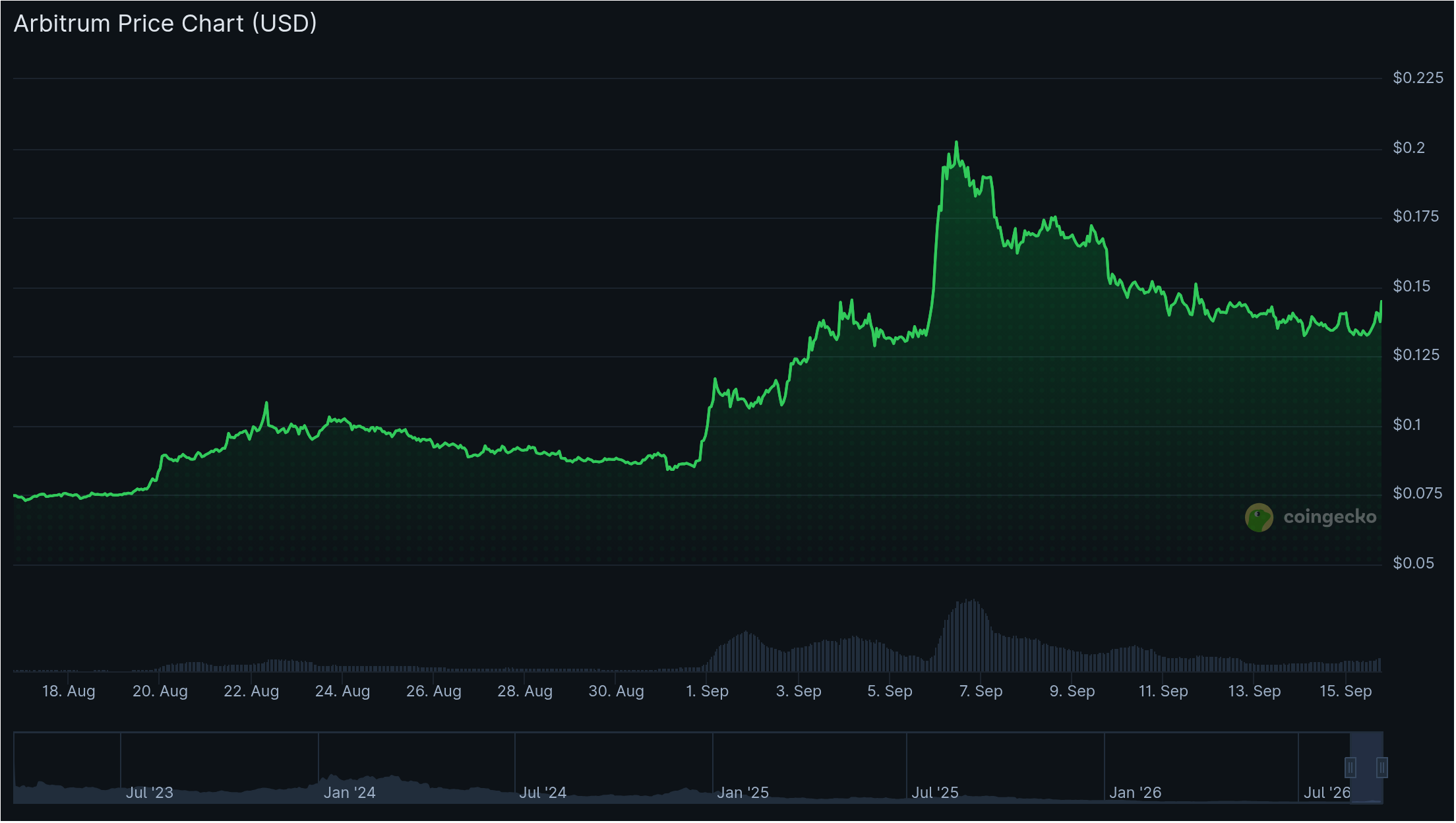
ARB was valued at around $0.14 on Tuesday, having gained 86% over the past month, according to Coingecko.
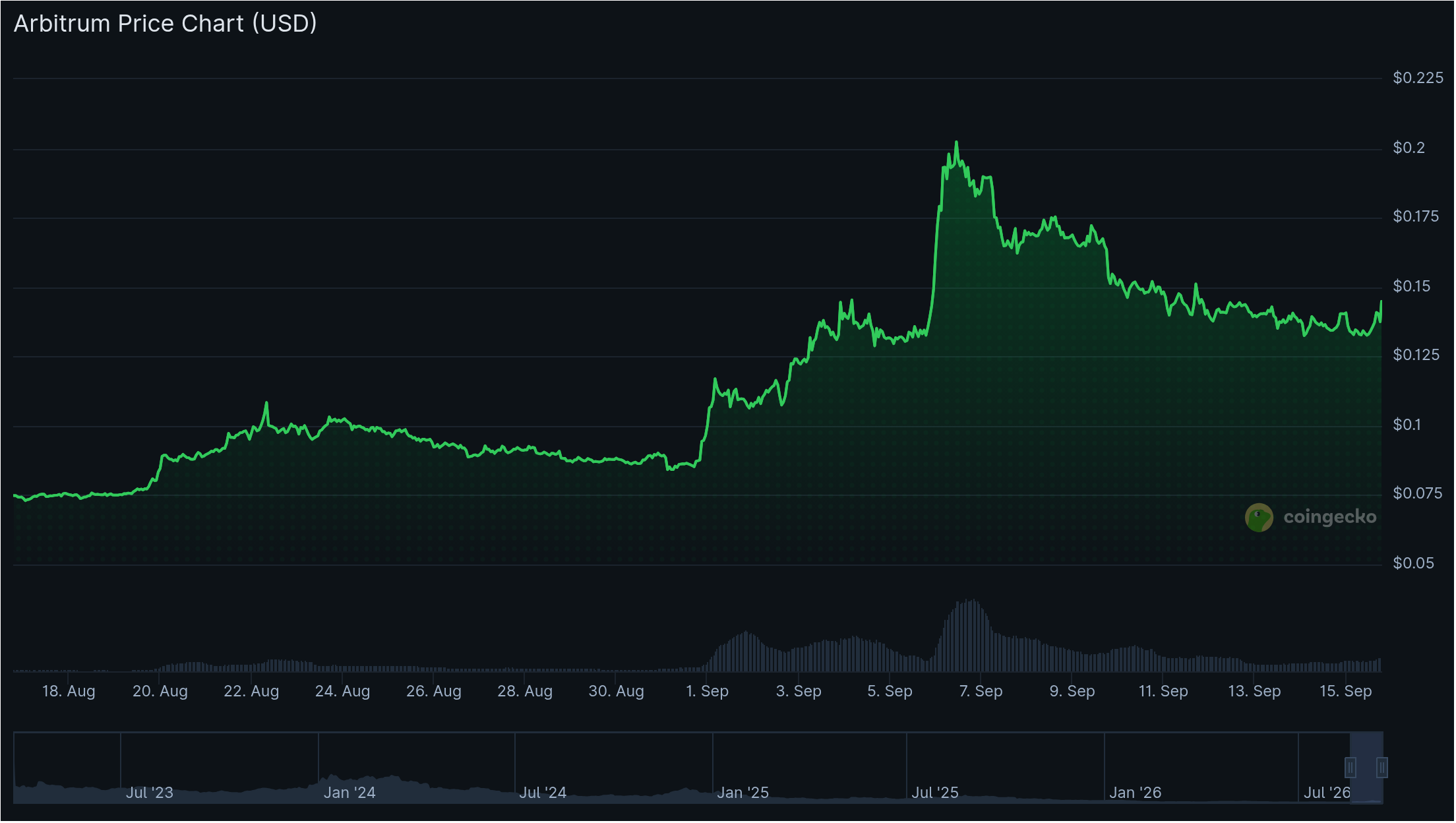
ARB 1-month performance. Source: Coingecko
Kendrick said the biggest risks to his ARB price projection include “a slower-than-expected pace of asset tokenization and more competition from alternate blockchains.”
Related: Arbitrum vote to release $71M in frozen Kelp exploit ETH set to pass
Arbitrum outlook hinges on tokenized assets
StanChart’s bullish thesis is heavily influenced by the growth of tokenized real-world assets, which have reached a cumulative value of nearly $39 billion, according to RWA.xyz data.
In the note, Kendrick reiterated Standard Chartered’s forecast that tokenized assets will reach $4 trillion by the end of 2028 as banks and asset managers bring more assets onchain. The bank sees Arbitrum as a potential beneficiary because it provides the infrastructure for companies to build their own layer-2 networks and receives a share of the revenue they generate.
Standard Chartered has also cited the growth of tokenization as part of its bullish outlook for Chainlink and the broader decentralized finance sector.
Related: Crypto Biz: AI took a back seat when Bitcoin started climbing
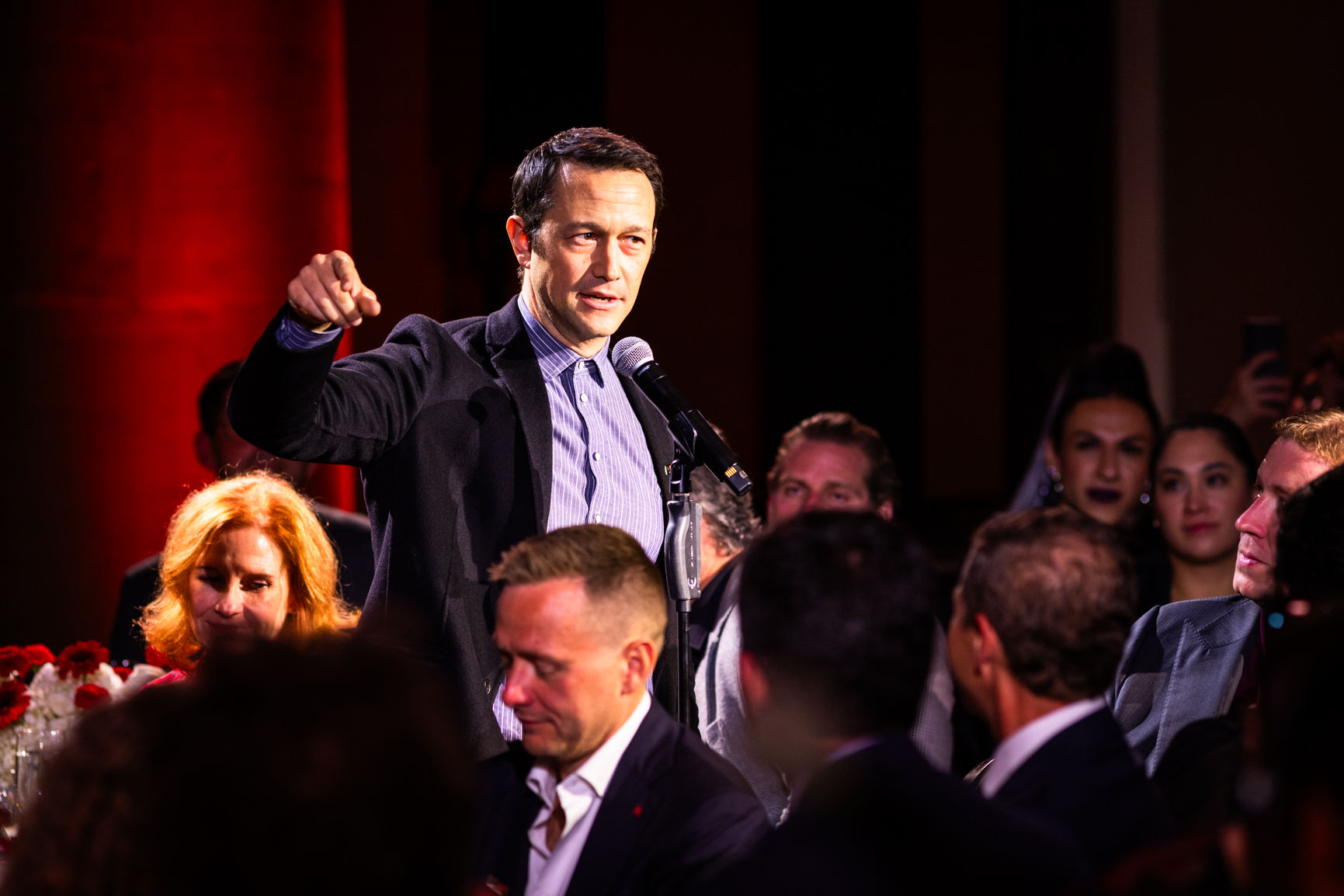
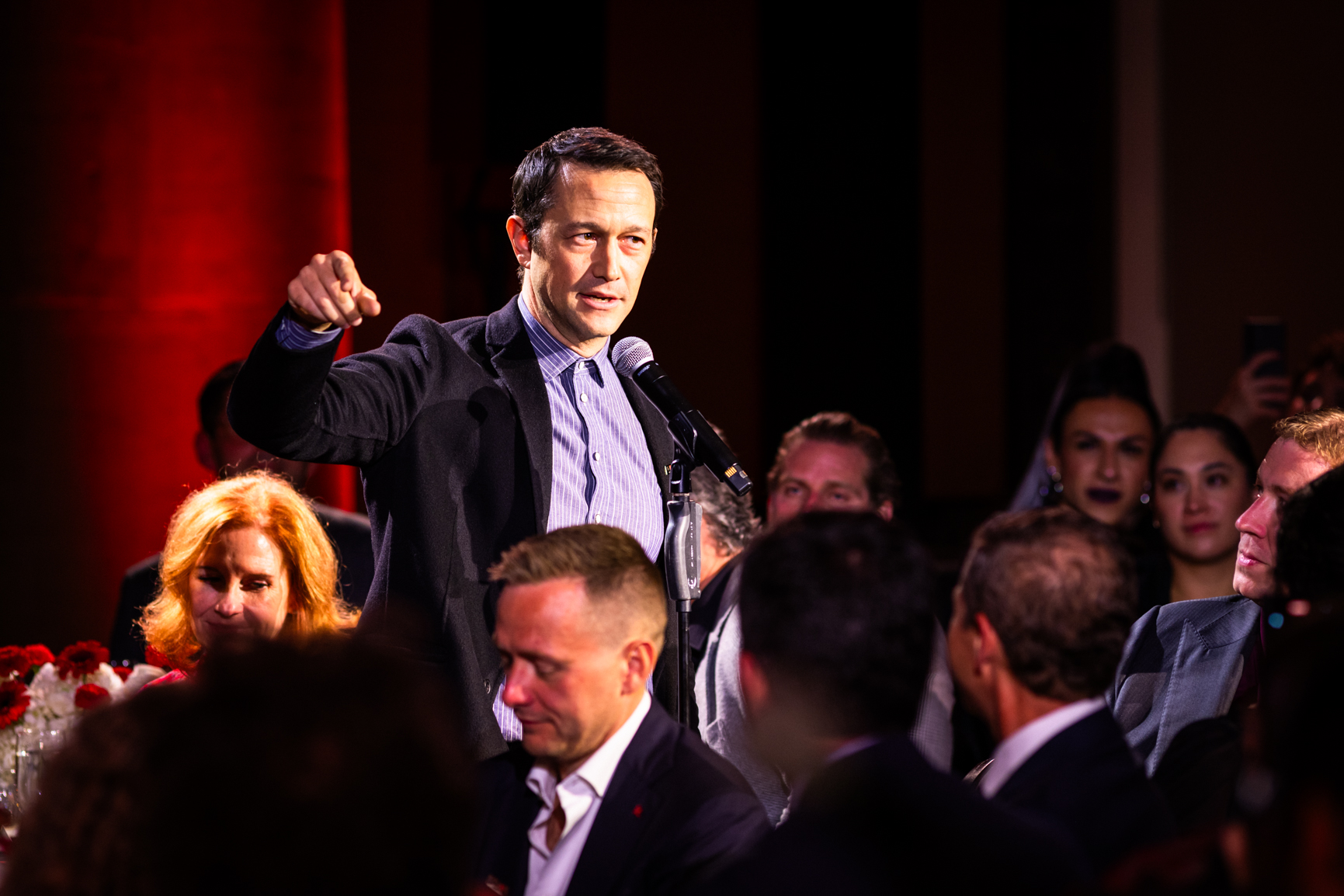
Big AI companies should be “shut down” by the U.S. government until they can prove that their products are safe, actor Joseph Gordon-Levitt said on Monday.
In a toast at the third annual TIME100 AI Impact Dinner in San Francisco, the Inception and 500 Days of Summer star told guests that today’s AI makers have lost control of their creations and must be regulated to prevent potential harm.
“Why are cars safe to drive? Why are houses safe to live in? It’s because car companies and construction companies … they have to follow laws. And if they don’t, then the law can come and shut those companies down,” Gordon-Levitt said.
“So let’s just be clear here: today’s AI companies are operating in such a way that the law should be shutting them down.”
Gordon-Levitt was one of 100 leaders, innovators, storytellers, and activists named in the 2026 TIME100 AI list, which highlights the year’s most influential people in AI.
His remarks drew loud clapping, whoops, and cheers from many people in the audience, who gathered at San Francisco’s Asian Art Museum on Monday night to celebrate the 2026 honorees.
But Gordon-Levitt’s message was not one of genial praise. He said AI companies’ leaders and employees had publicly admitted their products were dangerous and could not be controlled — a reference, perhaps, to July’s cyberattack by a “swarm” of rogue OpenAI agents as well as multiple recent statements from current and former Anthropic employees warning that AI could end all human life.
“To me, that’s pretty obvious that’s the time the law should step in,” Gordon-Levitt said. But, he went on, U.S. politicians had been “timid” and failed to act — perhaps, he alleged, because they were taking money from “some of the guys in this room.” (AI companies, allies, and executives spent at least $83 million on federal elections in 2025 and are set to spend even more this year, according to the New York Times.)
He called for Americans not to vote in November’s midterms for any politician who stands for “anything less than strong regulation, now.”
Other toasts highlighted the positive potential of AI, as well as its dangers. The first was by Danielle Boyer, a 25-year-old indigenous American inventor and activist who is using AI to help preserve her people’s endangered language.
“My grandmother once told me that no decision belongs only to the moment in which we make it,” Boyer said. “Long after we’re gone, someone we will never meet may still be living with what we chose to do today.”
She described her community’s “seven generations” principle: draw inspiration and support from the seven generations before you, and act for the benefit of the seven generations after you.
Those teachings inspired her to start building robots to teach Anishinaabemowin, the native language of the Great Lakes region’s Anishinaabe people that was almost wiped out by U.S. residential schools and is now estimated to have fewer than 1,000 fluent speakers.
“The decisions we make about artificial intelligence today will outlive every person in this room. That’s crazy, right?” Boyer said. “So let’s build things the right way. Let’s build so that seven generations from now, our descendants can look back at this moment and thank us, rather than have to recover from us.”
The final toast came from Suchi Saria, a Johns Hopkins computer scientist and the founder of Bayesian Health who has spent years studying how routinely-collected clinical data and vital signs could help spot an ailing patient before human clinicians notice the problem.
“Hospitalized patients can quietly become critically ill from respiratory failure, internal bleeding, kidney failure, dangerous heart rhythms, and many other causes,” she said.
Saria saw that firsthand in 2017, when her family in India called to tell her that her nephew was critically ill with sepsis.
“We knew the signals were there. We had published the science,” she told the guests on Monday. “And yet, when it mattered to my own family, there was nothing I could offer them. The science had not yet become a system. My nephew died within a few days.”
Saria’s voice audibly cracked, and there was a moment of silence. When she spoke again, she described Bayesian Health’s progress on using AI to catch sepsis early — resulting in a 20 percent drop in mortality, the company claims, when clinicians act promptly on the system’s warnings.
“The real breakthrough is not prediction. It is not even discovery,” she said. “It is turning insight into action early enough to change what happens to a patient.”
The TIME100 Impact Dinner: Leaders Shaping the Future of AI was presented by Deloitte, Booking.com, and Cognizant.


The White House countered the bankers’ concerns on Tuesday by posting economic data suggesting the worries are misguided.
Jaret Seiberg, a policy analyst at TD Cowen, set the odds for a failure in the opening vote at 60%. In that scenario, he said, “Democrats, including those who are crypto friendly, decide the GOP changes are insufficient. It also likely means several Republicans vote no over stablecoin yield or law enforcement concerns.”
Keeping the process going
Meanwhile, the crypto industry is asking that lawmakers at least keep the process alive with an opening yes vote that allows them to continue talking.
“A yes vote is critical and keeps the process moving,” the leading crypto lobbying groups said in a joint statement on Tuesday. “Doing so will ensure that senators have opportunities to debate and move this much-needed legislation to the Senate floor.”
If the vote goes forward as planned on Tuesday and fails, that’s likely the end of the Clarity Act saga in this congressional session. And the odds remain high that Democrats could retake the House of Representatives majority in the November elections, meaning any future crypto legislative efforts could be under the agenda-setting authorities of Democratic committee chairs.
In the absence of a viable crypto bill, Democrats are likely to double down on their crypto corruption accusations about President Donald Trump and his administration. And the industry’s political action committees will have to determine whether some of the industry’s Democratic friends should then become political opponents.

Korea’s won is gaining a digital payment route as KRW1 enters Rain’s global payments network through Avalanche infrastructure. The arrangement links Korean currency with established card rails for international spending. The integration connects tokenized won with card payments across more than 175 million Visa merchant outlets worldwide. As a result, Korean businesses and users can spend won abroad without converting funds beforehand.
KRW1 Extends Won Payments Beyond Korea
Rain will add KRW1 to its payment network, linking the stablecoin with card-based spending in international markets. The system keeps transactions denominated in Korean won while Rain provides the payment layer for card use across international payment and service channels. Moreover, businesses can use KRW1 for expenses, travel, student payments, and contractor transactions outside South Korea.
BDACS launched KRW1 with Woori Bank, while Avalanche provides the blockchain infrastructure supporting the token. The stablecoin maintains a one-to-one peg with the won, with reserves backing circulating tokens. Additionally, its design creates a digital channel for moving won-denominated value across borders.
The Korean won represents a broad money supply approaching $3 trillion, highlighting the scale of the domestic currency. However, won-based digital payments have remained largely focused on South Korea’s local economy. KRW1 now creates another route for extending that currency into international commercial activity.
Avalanche Supports Government Digital Infrastructure
Avalanche is also gaining attention through government digital infrastructure projects, including a planned UAE PASS integration. The UAE Telecommunications and Digital Government Regulatory Authority plans to use Avalanche technology within its national digital identity system. Consequently, the project expands Avalanche’s role beyond financial applications and into public digital services.
The planned UAE PASS Digital Vault will let citizens, residents, and visitors request, access, and share verified government documents. The system will operate on a dedicated Avalanche Layer 1 instead of Avalanche’s public network. Moreover, the dedicated network gives the regulator control over permissions, privacy settings, and network rules.
The UAE project adds another institutional use case for Avalanche as governments develop controlled digital infrastructure. It also places blockchain technology within regulated public services and document management systems. Meanwhile, KRW1 demonstrates how Avalanche can support stablecoin payment systems linked with global card networks.
AVAX Price Remains Under Pressure
These developments broaden the blockchain’s use across payments, identity, and regulated digital services. Despite the new infrastructure developments, AVAX has continued to trade under pressure in the broader cryptocurrency market. The token declined 7% over seven days, while its latest daily decline stood at 0.35%.
At press time, AVAX traded at $7.42, keeping price performance separate from network adoption. The KRW1 integration adds payment utility to Avalanche, but it does not directly determine AVAX’s short-term market direction. Similarly, the UAE project strengthens infrastructure adoption while the token remains exposed to broader cryptocurrency market movements.
Therefore, network developments and token performance can move independently over shorter periods. KRW1’s integration with Rain gives won-denominated digital value a broader payment path through existing card infrastructure. At the same time, Avalanche continues expanding its role across financial and government technology projects.
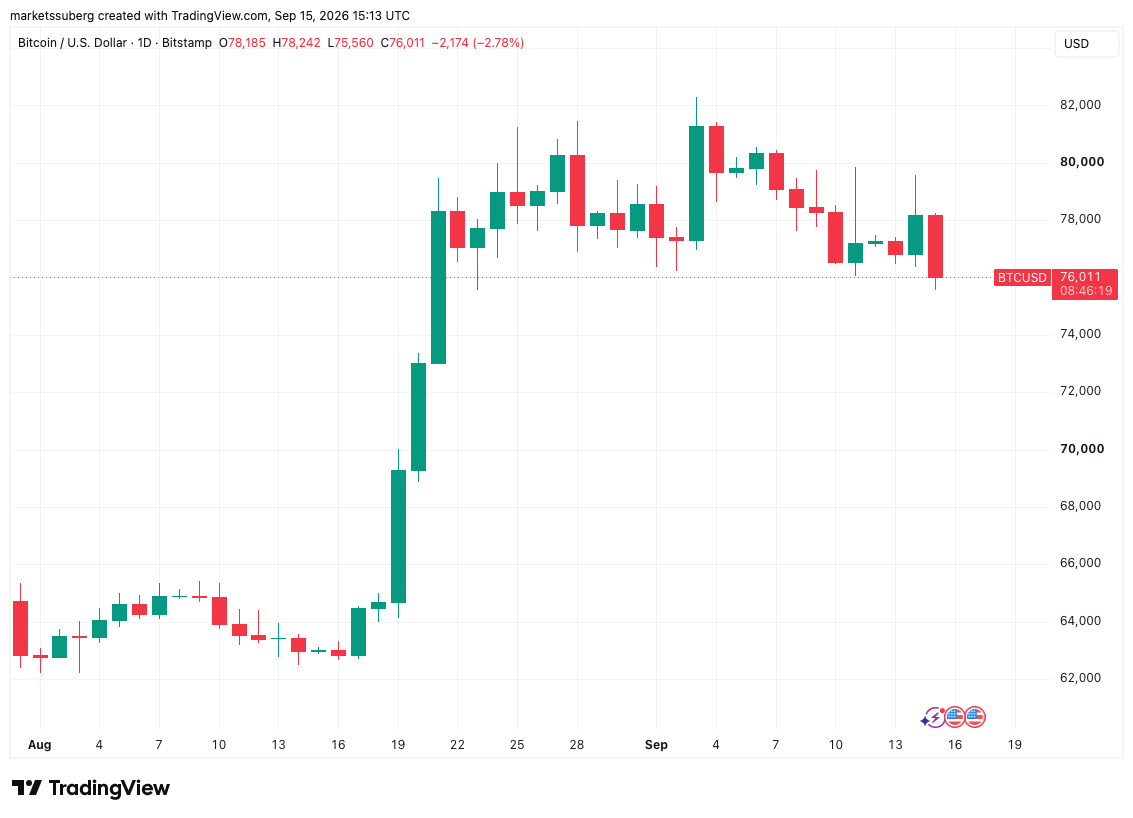
Bitcoin (BTC) saw month-to-date lows at Tuesday’s Wall Street open as global bond yields spiked and crypto markets awaited a key US Senate vote on the CLARITY Act.
Key points:
- Bitcoin dropped to $75,560, its lowest level so far in September ahead of the US Senate’s procedural vote on the CLARITY Act.
- Global bond yields in major economies set new macro highs as $100 oil prices remained a point of contention.
- Analysis expects that central banks around the world will raise interest rates going forward, traditionally a headwind for crypto markets.
CLARITY Act vote keeps crypto markets nervous
Data from TradingView showed BTC/USD dipping under $76,000, erasing a trip to $79,600 from the day prior.
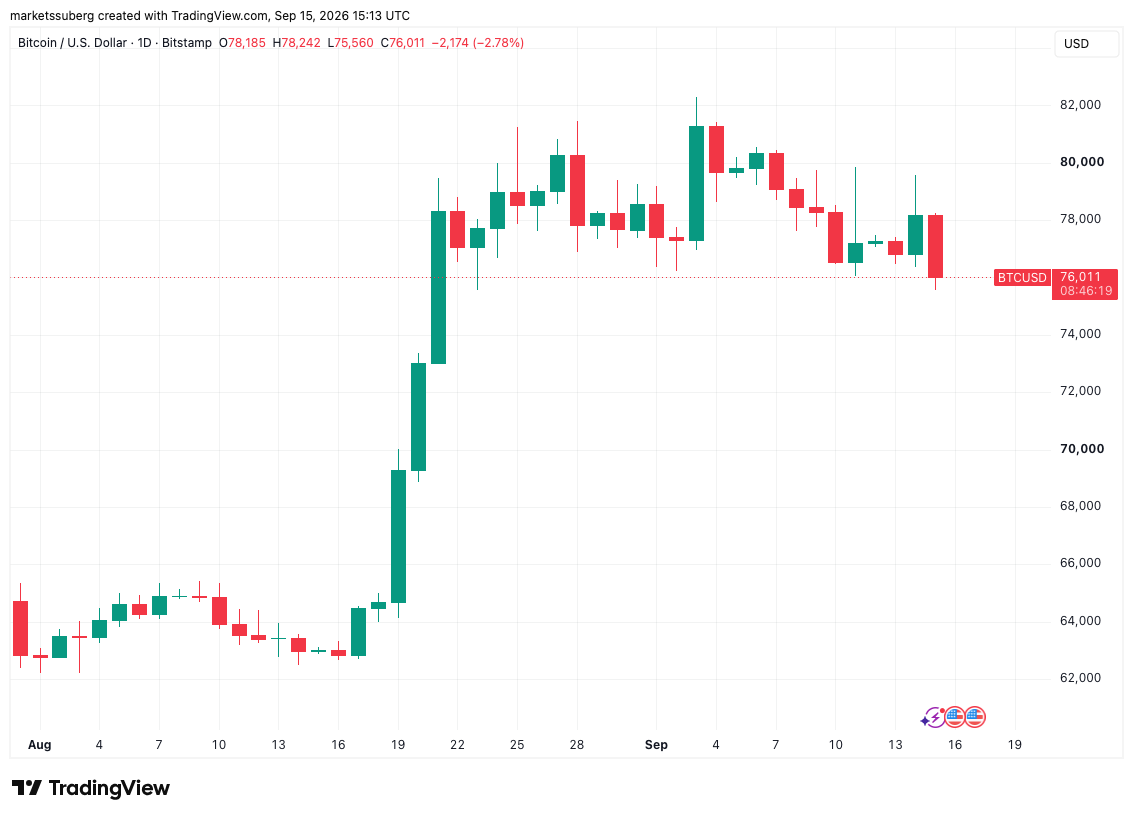
BTC/USD one-day chart. Source: Cointelegraph/TradingView
Crypto traders remained on edge ahead of the procedural vote on the CLARITY Act, due at 2:15pm Eastern time. The legislation will go forward to a Senate-floor debate should it gain the necessary 60 votes.
As Cointelegraph reported earlier, consensus sees barely any chance of success, despite optimism from some sources, with Polymarket users giving CLARITY mere 14% odds of becoming law in 2026 as of Tuesday.
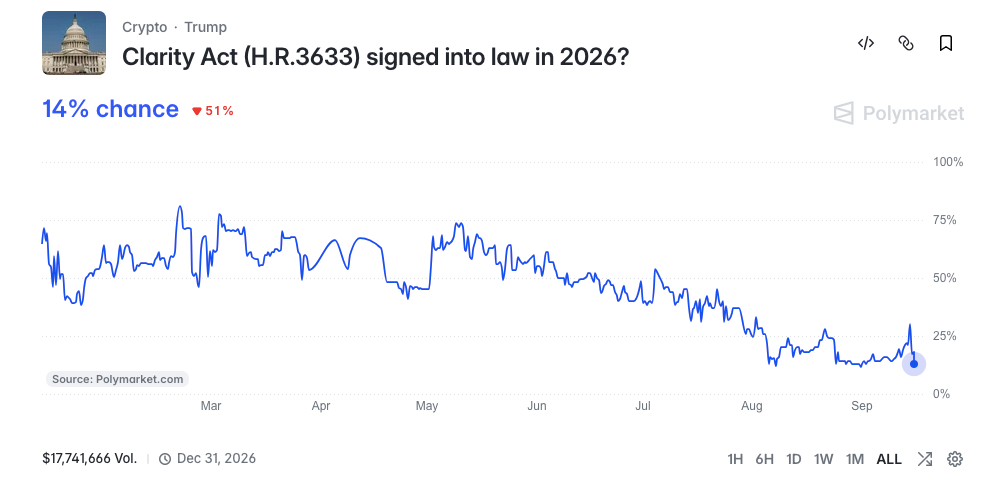
Implied odds for CLARITY act passing in 2026. Source: Polymarket
Commenting, trading company QCP Capital stressed that the act passing Tuesday’s procedural vote would have limited impact and form just one of several hurdles for proponents..
“The bill’s passage would clarify the respective regulatory roles of the SEC and CFTC, potentially strengthening the medium-term case for institutional adoption by reducing regulatory uncertainty,” it wrote in analysis on Monday.
“However, procedural progress does not guarantee final passage, and the timing of remaining legislative steps will determine the immediate market impact of any vote this week.”
Bond yields surge worldwide on oil-fueled inflation risk
US stocks, meanwhile, turned red on the day as bond yields around the world returned to their highest levels in decades. The US 10-year yield passed 5% for the first time since November 2023, going on to reach 5.041%, a level not seen since June 2007.
Related: Bitcoin short-term holders hit 30-day profit streak as bull-market odds improve: CryptoQuant
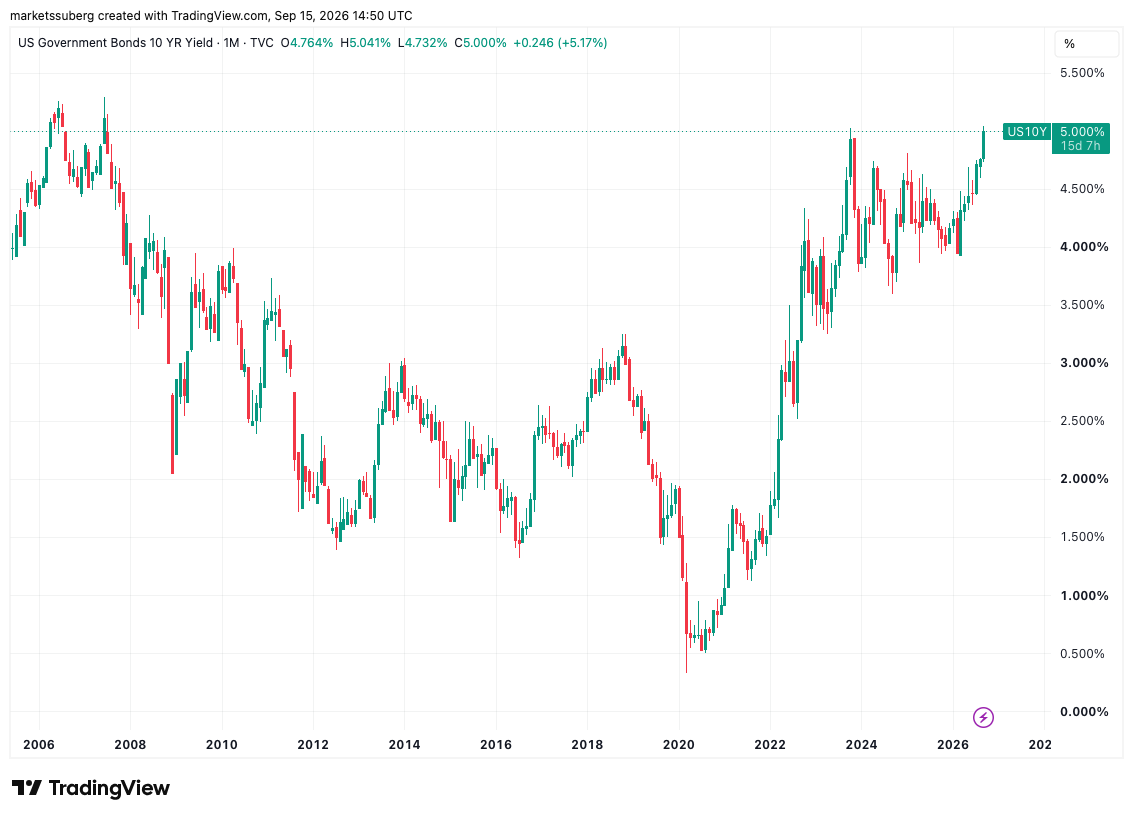
US 10-year bond yield one-month chart. Source: Cointelegraph/TradingView
Reuters further reported that the average 10-year yield for the world’s seven largest economies had reached 4.285%, its highest since mid-2008 around the height of the Global Financial Crisis.
UK and Japanese bonds also made headlines, as the UK 30-year yield reached 5.95% for the first time since March 1998, and the Japanese 10-year hit 3.04% — the highest in 30 years.
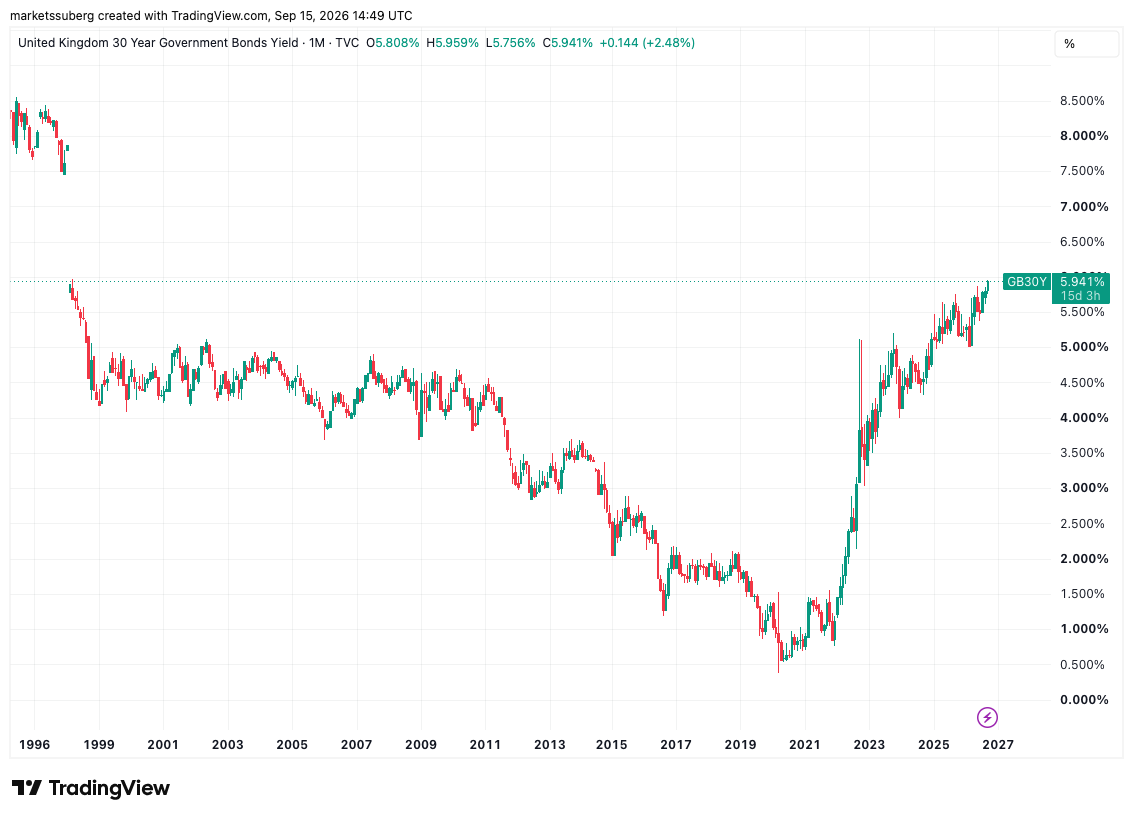
UK 30-year bond yield one-month chart. Source: Cointelegraph/TradingView
Responding, trading resource The Kobeissi Letter predicted that central banks would tighten policy as a result and enact interest-rate hikes. The US Federal Reserve is widely expected to hike its benchmark rate by 0.25% on Wednesday, while the Bank of Japan is expected to do the same at its Friday meeting.
“It’s clear what’s coming next. Monetary policy is shifting, rate hikes are returning, and the next battle against inflation has started. Just as we saw Treasury intervention in the US, the UK will likely soon intervene. Yields are simply unsustainable at current levels,” Kobeissi wrote in a post on X.
Bond yields continued to rise due to the threat of a fresh global inflation wave on the back of high oil prices, with several key transit routes at risk from a widening Middle East conflict. WTI crude oil neared $105 per barrel on Tuesday, headed for its highest levels since early May.
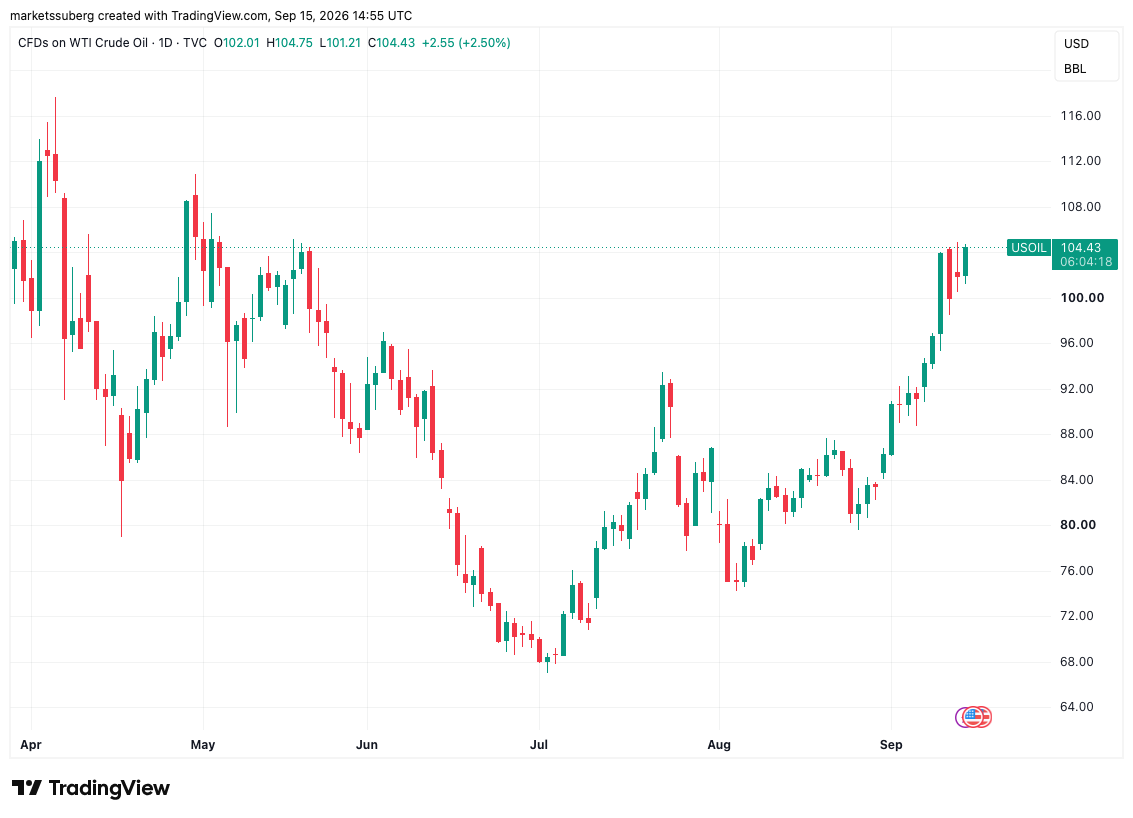
CFDs on WTI crude oil one-day chart. Source: Cointelegraph/TradingView


An Ethereum MEV bot known as Yoink has front-run an attempted Safe wallet exploit involving 2,900 rsETH, worth about $7.8 million, and paid nearly 19 ETH to secure the first position in the block.
Summary
- Yoink received 2,900 rsETH before the original exploit transaction reverted in the same Ethereum block.
- The bot transferred 2,882.37 rsETH to a separate address and routed 17.63 rsETH through Uniswap v4.
- BlockSec traced the exploit to weak authorization checks in an executor contract linked to a Safe module.
- Blockaid said a public keeper multicall let the attacker route funds through a malicious hook pool.
Yoink MEV bot takes the first position
PeckShield identified the incident as an approximately $7.81 million attack involving rsETH, a liquid restaking token associated with KelpDAO, after an MEV bot placed its transaction ahead of the suspected attacker.
On-chain records cited by security researchers show that Yoink received 2,900 rsETH in Ethereum block 25980525. From the total, the transaction sent 2,882.37 rsETH to the address 0xC70f00CD7E461686b04B0E912E309becA8b80ea0.
At the time the address was reviewed, its balance stood at 2,882.36740883 rsETH. No transfer from the address was described in the initial reports, and the available information did not identify its owner or establish whether the funds would be returned.
The remaining 17.63 rsETH moved to the Uniswap v4 Pool Manager. According to the transaction path, the Pool Manager then sent 18.95 ETH to the Yoink contract, which forwarded 18.93 ETH to the block builder.
Paying almost the full ETH amount to the builder left little direct ETH profit from that part of the transaction. The large payment instead appears to have served as the bot’s bid for priority placement, although the cited researchers did not publish a complete profit calculation covering the retained rsETH or other transaction costs.
Both Yoink’s transaction and the original exploit attempt landed in block 25980525. Yoink appeared at the top of the block, while the original transaction ran later and reverted. Security researchers viewed the ordering and failed follow-up transaction as evidence that the bot had detected the attack and moved first.
Such competition relies on maximal extractable value, or MEV, which comes from controlling the inclusion and ordering of transactions. A June 2026 crypto.news guide to MEV explained that searchers scan pending activity for profitable openings, assemble transaction bundles, and pay builders to place them in a chosen position.
Safe module checks allowed the exploit path
BlockSec attributed the underlying weakness to faulty authorization checks in an executor contract connected to an enabled Safe module. Under the firm’s account, attacker-controlled calls could pass through an executor that the wallet treated as trusted.
Safe is a smart contract wallet system that can require several signers to approve transactions. Its module framework also lets account owners add contracts that can perform specific actions under predefined rules, reducing the need for manual signatures on every operation.
An enabled module therefore becomes part of the wallet’s security boundary. BlockSec’s analysis indicates that the affected executor failed to confirm the authority behind a call correctly, allowing an outside party to reach functions through a trusted route.
The report describes a problem in the executor contract associated with the wallet configuration rather than a flaw in Ethereum’s consensus system. Available details also do not show that the core Safe contracts were compromised, so attributing the incident to the entire Safe platform would go beyond the security firms’ findings.
Blockaid provided a more detailed account of how the attacker tried to use the permission failure. According to the security company, the attacker accessed a public keeper multicall and directed a custom Uniswap v4 liquidity module toward a hook pool under the attacker’s control.
Uniswap v4 hooks are contracts that can run custom instructions at set points in a pool’s operations. Blockaid said the maliciously created hook pool was then used to unpack aEthrsETH into rsETH, producing the tokens targeted in the transaction.
Combining a public keeper function with a trusted execution route allowed the call to reach the custom liquidity setup, according to Blockaid’s analysis. Yoink’s bot saw the opportunity before the attacker completed it and submitted a competing transaction that captured the same output.
No statement included in the supplied reports identifies the suspected attacker, the Yoink operator or the block builder. The reports also did not say whether a recovery agreement, bounty negotiation or legal process had begun.
The rsETH transaction adds to 2026 DeFi losses
The attempted extraction occurred during a year of heavy losses across decentralized finance. A September report on DeFi security losses cited CertiK and Forbes estimates showing that protocols lost at least $1.3 billion to exploits during the first eight months of 2026.
The report found that compromised credentials and privileged access had overtaken traditional smart contract faults as the main source of losses by value. The Yoink incident differs in its reported mechanics because BlockSec traced the opening to authorization logic within an executor linked to a Safe module.
rsETH has also appeared in a separate major security event this year. In April, an attacker minted 116,500 unbacked rsETH after compromising infrastructure tied to a LayerZero verifier, according to the previous coverage. The attacker then used the tokens as collateral on Aave to borrow other assets.
Security researchers have not connected the April incident to the transaction in block 25980525. The two events involved different reported weaknesses, and the latest case concerned an attempted movement of 2,900 existing rsETH through a wallet execution path.
U.S. authorities have treated some MEV schemes as fraud
For U.S. users, the Yoink transaction also shows why the term “front-running” does not by itself settle the legal status of an on-chain trade. Federal authorities have pursued certain MEV operations when prosecutors alleged that their operators used deception or tampered with systems to obtain funds.
In May 2024, the U.S. Department of Justice charged two brothers over an alleged Ethereum scheme that obtained about $25 million in cryptocurrency within roughly 12 seconds. Prosecutors alleged that Anton and James Peraire-Bueno manipulated the process Ethereum traders used to order transactions and fraudulently gained access to pending private transactions.
The Justice Department charged the brothers with conspiracy to commit wire fraud, wire fraud, and conspiracy to commit money laundering. Its allegations concerned the methods allegedly used to obtain the trading information and manipulate the process, rather than treating every transaction-ordering strategy as automatically criminal.
No U.S. regulator or law-enforcement agency has announced an action involving Yoink or the attempted rsETH exploit based on the information supplied. The cited blockchain security firms have limited their findings to transaction ordering, the Safe-linked executor’s authorization checks, and the Uniswap v4 hook route used to unpack aEthrsETH.

Britain should abolish the monarchy to ‘free Prince George from a burden he has no choice over’, says Nicola Sturgeon

Fair Work Ombudsman recovers $453m in unpaid wages for workers

Manifund hires Caroline Ellison while fighting FTX over $1.5M



-

 Fashion4 days ago
Weekend Open Thread – Corporette.com
-

 Business6 days ago
Micron Stock Climbs Above $1,031 as AI Memory Crunch and a $50 Billion Outlook Fuel the Rally
-

 Tech2 days ago
The Latest Weird Thing to Play Doom Is the Mapped-Out Brain of a Fruit Fly
-

 Business6 days ago
AMD Stock Climbs After Management Lifts 2027 Data Center Outlook Toward $70 Billion in AI Sales
-

 Crypto World7 days ago
Bitcoin price risks $76K drop as $78K support weakens
-

 Crypto World4 days ago
XAG/USD: Silver’s Short-Term Rally Meets Its Moment of Truth
-

 Crypto World5 days ago
2 Chip Stocks Broke Out This Week. Neither Was Nvidia
-

 Business4 days ago
10 Most-Streamed Songs On Spotify In 2026 So Far, Led By Ella Langley’s Dominant Run On The Charts This Year
-

 Crypto World7 days ago
Ethereum price stalls below $2,500 as ADX drops to 11
-

 Tech5 days ago
Battery life is the only iPhone 18 Pro and iPhone Duo upgrade I care about. Apple didn’t disappoint
-

 Crypto World5 days ago
OKX launches 10x OpenAI, Anthropic X-Perps in Europe
-

 Crypto World6 days ago
Pi Network ships Protocol 27 on a network with 14 million users and zero DeFi
-

 Crypto World4 days ago
Diesel Tops $6 a Gallon for the First Time as 28 States Set Records
-

 Crypto World7 days ago
CLARITY Act runs out of calendar as crypto regulation stalls
-

 Tech6 days ago
Apple Watch Ultra 4 vs Watch Ultra 3: Should you really spend another $799?
-

 News Videos4 days ago
Facing Financial Fears
-

 Crypto World6 days ago
Bitcoin price risks $70K if $78K neckline breaks
-
 Crypto World6 days ago
Bitcoin price holds near $79K as cycle drawdowns narrow
-

 NewsBeat7 days ago
What went right this week: an ‘historic’ fall in violent crime, plus more
-

 Business7 days ago
Meta debuts long-awaited personal AI agent, Muse
You must be logged in to post a comment Login