

Crypto World
Binance moves ahead in Philippines as SEC clears BlockShoals sandbox testing



Binance has moved a step closer to returning to the Philippine market after the country’s Securities and Exchange Commission granted final approval for its local partner BlockShoals Technologies to begin regulatory sandbox testing.
Summary
- The Philippine SEC has granted final sandbox approval to BlockShoals, moving Binance closer to a regulated return to the local market.
- BlockShoals will complete a 90 day integration with a licensed local provider before Binance backed user onboarding begins.
- The approval covers SEC sandbox testing, while separate BSP licensing requirements for crypto services remain in place.
In a post on X, Binance co-founder and Chief Customer Service Officer Yi He said the exchange had officially entered the Philippine market, while an accompanying SEC document showed that BlockShoals Technologies Inc. had received final approval to launch financial product and service testing under the Commission’s Strategic Regulatory Sandbox (Stratbox) framework.
SEC approves sandbox rollout
Under the approval, BlockShoals will operate using a crypto-asset intermediary model that allows users in the Philippines to access selected products and services through its global crypto-asset service provider partner, Binance.
The SEC document stated that BlockShoals must first complete system integration with a local virtual asset service provider during an initial 90-day phase before proceeding with the approved testing program.
Once that integration is completed, the testing plan will move forward under regulatory oversight and applicable safeguards, including user registration and onboarding through Binance as its global CASP partner, according to the SEC approval.
The final approval follows the SEC’s earlier clearance of BlockShoals’ Stratbox application in November 2025, after the company fulfilled the remaining regulatory requirements set by the Commission.
BSP licensing question remains
The latest SEC approval comes weeks after the Bangko Sentral ng Pilipinas clarified that neither Binance nor BlockShoals currently holds a Virtual Asset Service Provider license required for certain crypto payment and transaction services.
As previously reported by crypto.news, the BSP said participation in the SEC’s Stratbox program does not replace the need for a separate central bank license because the two regulators oversee different parts of the country’s financial sector. The central bank also noted that BlockShoals would need to integrate with a licensed domestic VASP before onboarding users through Binance’s infrastructure could begin.
While Yi He described the development as Binance’s official entry into the Philippines, the SEC approval itself authorizes BlockShoals to begin sandbox testing and identifies Binance as its global CASP partner. The document does not state that Binance has obtained a Philippine VASP license.
Binance has been working to strengthen its regulatory position in several jurisdictions. On July 1, the exchange told affected European Union users that withdrawals and other account options would remain available as MiCA-related service changes took effect, while it continued pursuing authorization to operate under the bloc’s new crypto rules.

Key Highlights
- Securitize (SECZ) launched on the New York Stock Exchange following a SPAC merger with Cantor Fitzgerald
- The firm made history by tokenizing its stock on both Solana and Avalanche blockchains on its first trading day
- Launch day saw $295 million worth of tokenized SECZ shares held by investors
- The public offering generated $400 million in capital, pushing the company’s valuation beyond $1 billion
- Industry analysts at Citigroup forecast the tokenization sector could balloon to $5.5 trillion-$8.2 trillion by decade’s end
On Thursday, Securitize officially began trading on the New York Stock Exchange with the ticker symbol SECZ. The company’s public market entry came through a combination with a special-purpose acquisition company supported by Cantor Fitzgerald, generating $400 million in proceeds and achieving a valuation exceeding $1 billion.
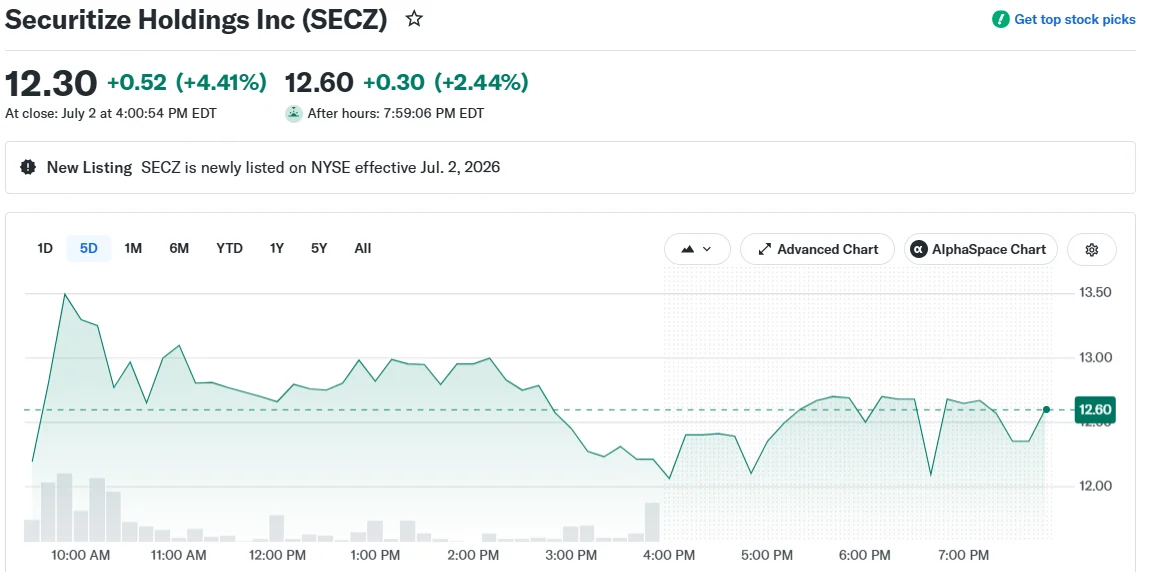
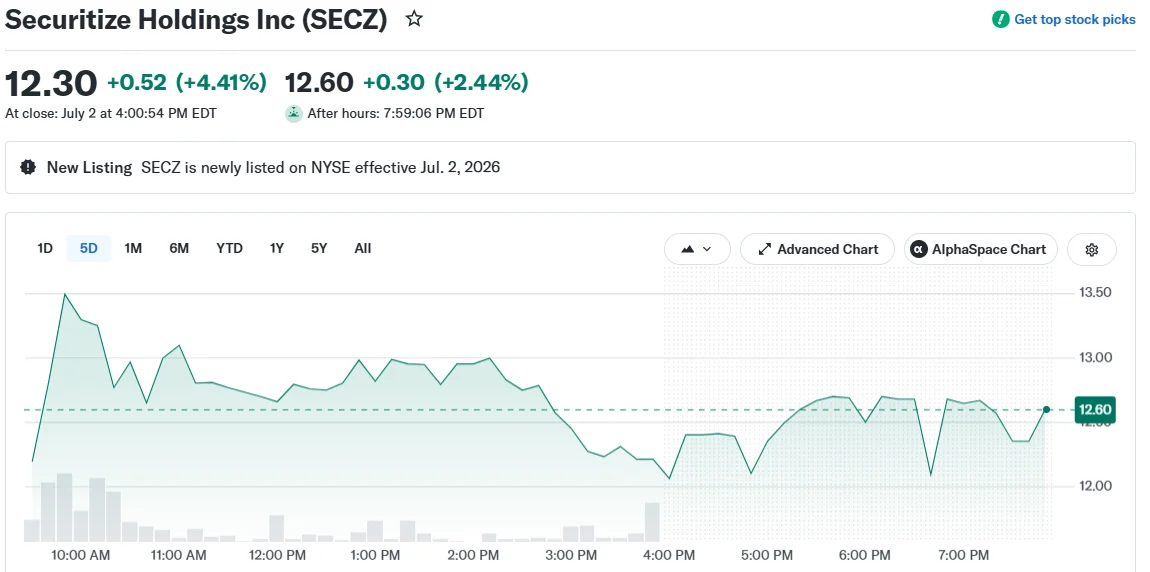
The shares concluded their inaugural trading session with a 4.4% gain, settling at $12.30 after reaching an intraday peak of $13.70. Extended trading hours saw additional momentum, with shares advancing another 2.4% to close at $12.60.
In an unprecedented move coinciding with its market debut, Securitize converted its own equity into digital tokens on both the Solana and Avalanche blockchain networks. This milestone marked the first instance of a newly listed public company tokenizing its stock immediately upon going public.
Blockchain analytics from RWA.xyz revealed that investors possessed $295 million in tokenized SECZ equity on the opening day. According to the company, these digital tokens correspond to the identical common stock available on the NYSE, rather than constituting a distinct security class.
The Unique Nature of This Tokenization
Most tokenized equity offerings currently available come from third-party issuers or operate beyond U.S. jurisdiction. Securitize emphasizes that its approach is issuer-sponsored, granting the company direct oversight of the tokenization mechanism.
Qualified U.S. investors can obtain the tokenized equity through Securitize’s digital platform following identity verification procedures and compliance with securities regulations.
“SECZ is not a synthetic token or offshore wrapper,” said CEO Carlos Domingo. “It is issuer-sponsored tokenization of the same common stock trading on the NYSE.”
The U.S. Securities and Exchange Commission announced in January that issuer-sponsored tokenized securities fall under existing U.S. securities regulations. Reports from May indicated the SEC was developing an exemption framework for tokenized equity trading, though the initiative was postponed following objections from traditional exchange operators.
Securitize’s Position in Tokenization Infrastructure
Established in 2017, Securitize has developed tokenization technology for leading financial institutions such as BlackRock, Apollo, KKR, Hamilton Lane, and VanEck.
The platform counts BlackRock and Morgan Stanley among its institutional investors.
In March, Securitize formed a strategic alliance with Intercontinental Exchange, the parent organization of the NYSE, to build infrastructure supporting tokenized equity securities. Additional partnerships with transfer agents Computershare and Continental aim to facilitate blockchain-based share issuance for public corporations.
Current Market Landscape
The aggregate value of tokenized real-world assets has surpassed $43 billion. Tokenized money market instruments dominate this space, while tokenized commodities represent approximately $7 billion and tokenized equities account for $1.6 billion, based on Token Terminal data.
Citigroup’s recent analysis suggests the tokenization industry could expand to a range of $5.5 trillion to $8.2 trillion by 2030. Boston Consulting Group and Ripple offer an even more optimistic projection, estimating $18.9 trillion by 2033.
Securitize’s market entry establishes it as a significant participant in this anticipated expansion, with its own equity immediately accessible on two leading blockchain platforms from the outset.

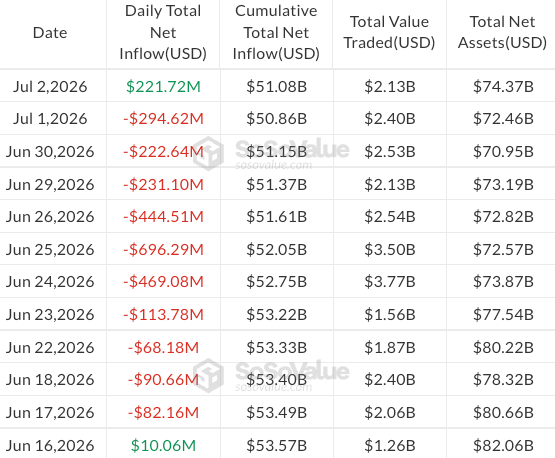
US-listed spot Bitcoin exchange-traded funds (ETFs) recorded their first daily net inflow above $200 million since early May, snapping weeks of sustained withdrawals.
The funds attracted $221.7 million in net inflows on Thursday, according to SoSoValue data, ending a 10-day streak of net outflows that totaled more than $2.7 billion.
The rebound follows one of the weakest stretches for US spot Bitcoin ETFs this year, with the funds posting a record $4.5 billion in net outflows in June.
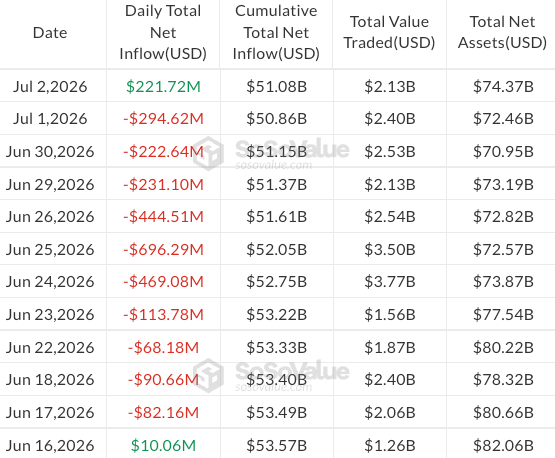
Daily flows in US-listed spot Bitcoin ETFs. Source: SoSoValue
The inflows came as Bitcoin reclaimed the $61,000 level after briefly falling below $59,000, with some investors, including Bitwise chief investment officer Matt Hougan, suggesting the market could be nearing a bottom. Crypto market sentiment on Friday was measured at an “extreme fear” reading by the Fear & Greed Index from Alternative.me.
Fidelity leads ETF rebound as BlackRock outflows continue
Fidelity’s Wise Origin Bitcoin Fund (FBTC) led Thursday’s rebound with $166 million in net inflows, accounting for roughly 75% of the day’s total, according to Farside Investors data.
ARK 21Shares Bitcoin ETF (ARKB) followed with $91.8 million in inflows, while the VanEck Bitcoin ETF (HODL) and Valkyrie Bitcoin Fund (BRRR) attracted $4.4 million and $1.7 million, respectively.
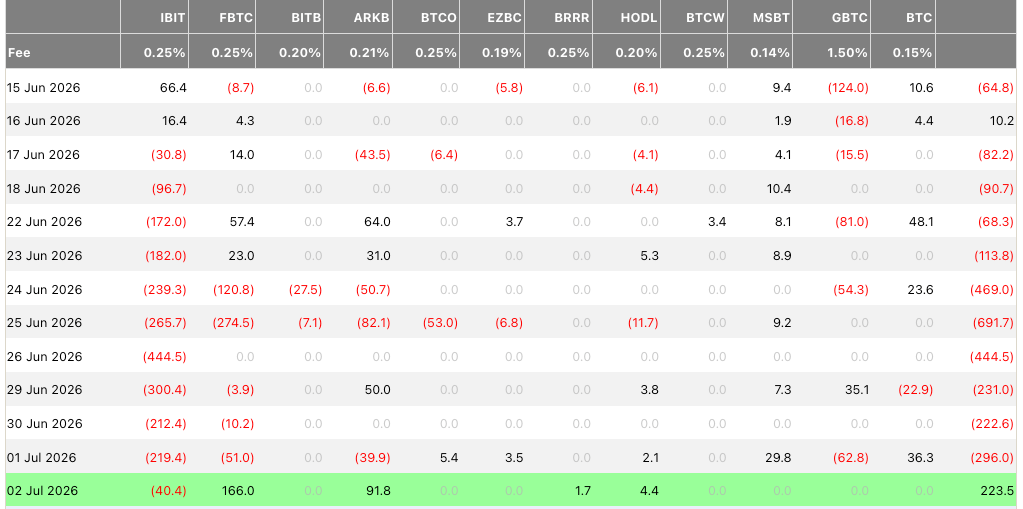
Source: Farside Investors
Meanwhile, BlackRock’s iShares Bitcoin Trust (IBIT), the largest US spot Bitcoin ETF by assets, continued to bleed, posting $40.4 million in net outflows on Thursday. The fund has lost more than $2.2 billion during an 11-session outflow streak since June 17.
Altcoin ETFs post inflows as sentiment stays in fear
The recovery in ETF flows extended beyond Bitcoin, with altcoin investment products also posting net inflows on Thursday.
US spot Ether ETFs attracted $29.1 million on Thursday, following $14.9 million in inflows a day earlier. XRP ETFs also returned to net inflows, attracting $6.6 million after two consecutive sessions of outflows.
Related: Swan’s Cory Klippsten sees record Bitcoin holder supply revealing early bottom
The global crypto market cap climbed 2.4% to $2.22 trillion over the past 24 hours as Bitcoin recovered above $61,000, according to CoinGecko data.
Magazine: Bitcoin slides to $58K, XRP hits $1 but onchain data promising: Market Moves
Key Takeaways
- Analysts project a probability-weighted XRP price of approximately $7.90 by 2031
- The most likely scenario places XRP in the $5 to $8 range, representing a market capitalization between $325 billion and $520 billion
- By early 2026, spot XRP exchange-traded funds in the United States had attracted more than $1.5 billion in net inflows
- Institutional players such as Goldman Sachs have revealed holdings in XRP ETF products
- Pessimistic projections suggest $1–$2, while optimistic forecasts reach as high as $15–$25
As one of the most prominent digital assets by market capitalization globally, XRP faces an uncertain but potentially lucrative future. A comprehensive five-year analysis presents three distinct price trajectories for the cryptocurrency, spanning from $1 to $25 by 2031, with a weighted average settling near $7.90.
The forecast methodology applies a 50% likelihood to the moderate scenario, while allocating 25% probability each to both the pessimistic and optimistic outcomes.
Unlike Bitcoin and Ethereum, which appeal broadly to retail investors, XRP’s value proposition centers on enterprise-level adoption. Its primary use cases revolve around institutional financial services rather than individual consumer transactions.
The analysis identifies Ripple’s payment network, the underlying XRP Ledger technology, and the expanding RLUSD stablecoin infrastructure as fundamental growth catalysts. Improved regulatory frameworks and increased tokenization of real-world assets complete the list of favorable conditions.
Exchange-Traded Funds Attract $1.5 Billion-Plus
The introduction of regulated spot XRP exchange-traded funds in the United States has fundamentally altered the token’s market dynamics. By March 2026, these investment vehicles had collectively drawn over $1.5 billion in capital.
A diverse group of prominent asset management firms now provides XRP ETF access, including Franklin Templeton, Bitwise, Grayscale, Canary Capital, and 21Shares. The disclosure of XRP ETF holdings by Goldman Sachs signals expanding acceptance among traditional financial institutions.
Continued demand through these regulated investment products is anticipated to remain a critical factor influencing XRP’s valuation throughout the forecast period.
The moderate scenario—projecting $5 to $8—envisions steady expansion driven by increasing institutional integration across cross-border payment systems, tokenized securities, and compliance-focused investment channels.
Downside Risks and Upside Potential
The optimistic projection targets a price band of $15 to $25. Achieving this outcome would require significant adoption of XRP infrastructure by banking institutions, wealth managers, and payment processors for transaction settlement and liquidity management. This scenario also assumes sustained ETF capital flows and reduced exchange supply as institutional custody increases.
The pessimistic outlook confines XRP to the $1 to $2 range. The primary vulnerability centers on execution risk: Ripple’s commercial operations might expand without generating corresponding demand for the native XRP token.
Additional headwinds include intensifying competition from Ethereum, Solana, fiat-backed stablecoins, and proprietary settlement systems operated by financial institutions. Despite recent improvements, regulatory ambiguity continues to pose challenges.
The analysis emphasizes that XRP now enjoys advantages including institutional market participation, multiple regulated ETF offerings, and growing real-world asset tokenization applications on its native ledger.
The probability-adjusted price target for the five-year horizon stands at roughly $7.90 by 2031. Through March 2026, XRP ETF products from various issuers had accumulated inflows surpassing $1.5 billion.

Key Takeaways
- Leading cryptocurrency exchange Binance is preparing to anchor a major funding round for crypto payments infrastructure provider Mesh
- The anticipated investment could establish Mesh’s valuation at $2 billion, representing a 100% increase from its $1 billion worth in January 2026
- In January, Mesh secured $75 million in Series C financing spearheaded by Dragonfly Capital, with support from Paradigm and Coinbase Ventures
- The company specializes in creating bridges between digital wallets, trading platforms, stablecoins, and traditional financial systems
- Neither Binance nor Mesh has publicly confirmed the transaction details
Binance is moving forward with plans to spearhead a significant funding round for Mesh, a cryptocurrency payments and settlement infrastructure provider, according to a recent report from Axios. Sources close to the situation indicate the round could value the company at approximately $2 billion.
Both parties have yet to issue official statements regarding the transaction.
Extraordinary Valuation Surge for Payment Startup
Earlier this year in January 2026, Mesh successfully closed a $75 million Series C financing round that valued the company at $1 billion. Dragonfly Capital served as the lead investor, joined by notable participants including Paradigm, Moderne Ventures, Coinbase Ventures, SBI Investment, and Liberty City Ventures.
Should this latest funding round complete at the anticipated $2 billion mark, Mesh would achieve a remarkable doubling of its enterprise value within approximately half a year.
Previously operating under the name Front Finance, Mesh develops critical infrastructure that enables seamless connections between cryptocurrency wallets, exchange platforms, digital currencies, and conventional fiat payment rails.
The company addresses a persistent challenge in cryptocurrency commerce: users frequently possess one type of digital asset while merchants or service providers prefer receiving payment in different assets or traditional currency. Mesh provides the essential conversion and settlement infrastructure that bridges this gap.
Stablecoin Expansion Fueling Infrastructure Investment
Surging interest in stablecoin technology is directing investment capital toward crypto settlement infrastructure companies. Analysts point to increasingly clear regulatory frameworks for stablecoins and expanding tokenization initiatives across financial markets as key drivers behind this trend.
Financial institution Circle recently introduced regulated stablecoin settlement capabilities following regulatory approval in Luxembourg. The institution now facilitates USDC, USDG, and its proprietary EURI token for enterprise-level fiat-to-crypto conversions.
Meanwhile, prominent U.S. financial institutions are collaborating on a tokenized deposit infrastructure through the Clearing House initiative, with an expected rollout in early 2027. This framework will enable banks to process tokenized deposits continuously within established regulatory parameters.
Mesh occupies a strategic position within this transformation. The company concentrates on facilitating value transfer across various assets, wallets, and payment networks—precisely where institutional capital is concentrating.
Strategic partnerships have also driven the company’s expansion. During 2024, Mesh formed an alliance with Italian cryptocurrency wallet provider Conio, delivering users enhanced access to multiple exchange platforms and withdrawal capabilities through Mesh’s connectivity infrastructure.
A Binance-anchored investment round would signal that major cryptocurrency exchanges recognize payment and settlement infrastructure as a critical growth vertical.
Investment capital has increasingly shifted away from basic trading applications and token projects toward platforms supporting compliant payments, international transfers, and asset settlement operations.
Mesh’s reported valuation demonstrates this market evolution. Upon confirmation, the transaction would position Mesh as a central player within the expanding stablecoin and asset tokenization ecosystem.
The funding round’s anticipated completion timeline remains undisclosed.


Bridge has secured both a Markets in Crypto-Assets (MiCA) crypto-asset service provider authorization and an Electronic Money Institution (EMI) license in Luxembourg, giving it a regulated framework to offer services across all 27 European Union member states.
Summary
- Bridge has secured MiCA authorization and an EMI license, allowing it to offer regulated services across all 27 EU member states.
- The approvals enable businesses to issue euro backed stablecoins, provide named IBANs, and expand cross border payment services.
- The licenses come as Europe enforces MiCA rules, with more firms seeking regulatory approval while noncompliant stablecoins exit regulated platforms.
According to Bridge, the dual licensing allows the company to operate under the European Union’s MiCA framework while expanding its stablecoin and euro payment services for businesses and developers throughout the bloc.
The company said the approvals were granted in Luxembourg and cover all EU member states under a single regulatory regime that includes requirements for capital reserves, custody, and operational safeguards.
The licenses also introduce new products for companies building on Bridge’s infrastructure. Businesses will be able to issue custom euro-backed stablecoins, create virtual IBANs in customers’ names, and offer euro accounts that work across the European Union without establishing separate banking relationships in each country, according to the announcement.
New payment tools for European businesses
Bridge said fintech companies can use the platform to provide named IBANs and cross-border euro accounts through one integration. Businesses launching loyalty programs, rewards systems, on and off ramps, or in-app payment products will also be able to issue their own EUR-backed stablecoins without building reserve management and regulatory infrastructure themselves.
The company added that enterprises can use custom stablecoins to transfer funds between subsidiaries instead of relying on correspondent banking networks. Banks, meanwhile, can settle transactions between institutions through stablecoin infrastructure rather than conventional interbank messaging systems.
“A business in the EU can now issue its own euro stablecoin and pair it with named IBANs and named EUR payouts across all 27 member states, on a single integration,” Mai Leduc Blount, Head of Product at Bridge, said in an accompanying statement.
Bridge has already been expanding its regulated payments business outside Europe as well. In March, Visa announced it was extending its partnership with the Stripe-owned company to bring stablecoin-backed Visa cards to more than 100 countries by the end of 2026.
Europe tightens stablecoin rules under MiCA
The approvals come days after the European Union completed the final phase of its MiCA transition on July 1, requiring regulated crypto platforms to support only compliant stablecoins.
While companies such as Bridge and CACEIS continue securing MiCA authorization to expand regulated services across the bloc, other market participants have been scaling back operations that no longer meet the framework.
As previously reported by crypto.news, Coinbase, Kraken, and Crypto.com removed USDT trading for European users after Tether chose not to seek MiCA authorization.
Crypto exchange Binance has also implemented MiCA-related service changes and said affected users would continue to have access to options previously communicated by the exchange, including withdrawals and transfers where applicable.


Peter Stokes, a 19-year-old dual U.S.-Estonian national, has been extradited to the United States over charges tied to Scattered Spider, a hacking group linked to crypto ransom demands.
Summary
- Stokes faces U.S. charges over a jewelry retailer breach and failed $8M crypto ransom demand.
- The DOJ says Scattered Spider has caused over $100M in ransom payments through corporate intrusions.
- The case shows phishing, help-desk impersonation, and crypto extortion remain key risks for companies.
The U.S. Department of Justice said in a July 1 statement that Finnish authorities arrested Stokes in April under an Interpol Red Notice.
Stokes appeared in federal court in Chicago after his extradition last week. Prosecutors charged him with conspiracy, cyber intrusion, fraud, and related offenses. The DOJ said the charges remain allegations, and Stokes is presumed innocent unless proven guilty in court.
Jewelry retailer resisted ransom demand
The complaint centers on a May 2025 intrusion at a luxury jewelry retailer. Prosecutors allege Stokes and others used phishing calls to the company’s technology help desk while pretending to be employees who needed password resets. The attackers allegedly compromised employee accounts, including accounts with higher access rights.
The DOJ said the group stole company data and demanded about $8 million in cryptocurrency. The retailer removed the intruders from its network and did not pay, but prosecutors said the company still suffered at least $2 million in losses from business disruption, investigation, and response work.
Scattered Spider tied to wider crypto theft cases
Scattered Spider is also known as Octo Tempest, UNC3944, and 0ktapus. The DOJ said the group has been linked to “over 100 network intrusions” and more than $100 million in ransom payments. Prosecutors say the group uses social engineering, account takeovers, data theft, and crypto extortion against corporate victims.
As previously reported, U.S. prosecutors in 2024 charged five people linked to Scattered Spider in a separate case involving alleged phishing, SIM swapping, and at least $11 million in stolen cryptocurrency. That earlier case involved victims at companies and a crypto exchange, showing how the group’s methods crossed from corporate data theft into direct digital asset theft.
Crypto ransom cases remain under pressure
The Stokes case arrives as ransomware groups keep using crypto for payments, even as more victims refuse to pay. Chainalysis found that ransomware cashouts fell 35% in 2024 as law enforcement actions, sanctions, and stronger recovery plans disrupted criminal networks.
Chainalysis later said in its 2026 ransomware report that ransomware actors received more than $820 million in on-chain payments in 2025, down about 8% from 2024, while claimed attacks rose 50%. That mix shows fewer payments but continued pressure from cyber extortion groups targeting companies.
Law enforcement focuses on tracing funds
The case also shows why blockchain tracing remains central to cybercrime probes. As previously reported, blockchain forensics can help authorities track crypto transactions by linking wallets, exchange records, and transaction flows to real-world activity. Those methods do not stop every ransom demand, but they can help build cases after an attack.
Recent enforcement actions have also targeted laundering networks used by cybercriminals. As crypto.news reported, U.S. prosecutors charged alleged operators of AudiA6, a crypto laundering network accused of processing more than $389 million in transactions.
The DOJ said the Stokes case is part of Operation Riptide, an FBI effort targeting cybercrime actors, infrastructure, and financial networks. Prosecutors say foreign-based suspects can still face U.S. charges when attacks hit American businesses or their customers. That stance may shape future cybercrime cases.
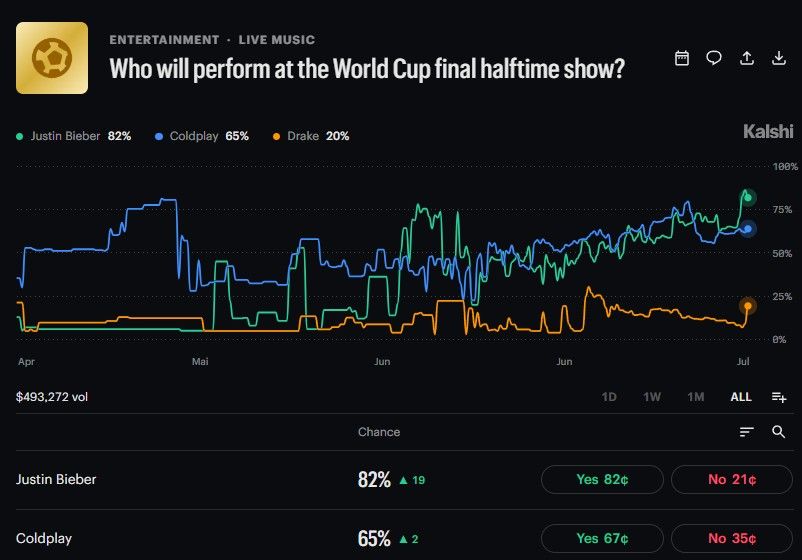
FIFA President Gianni Infantino has teased an unnamed “super-mega top global artist” for the FIFA World Cup halftime show on July 19. Prediction markets already treat Justin Bieber as the clear favorite for the secret slot.
Madonna, Shakira, and BTS will headline the first halftime show in World Cup history at MetLife Stadium. Coldplay frontman Chris Martin curates the Global Citizen production.
The stage matches the stakes. MetLife Stadium holds 80,663 fans, and FIFA expects up to five billion TV viewers. Attendance has already passed the 1994 record, with more than 5.3 million stadium visitors so far.
Bieber Dominates FIFA World Cup Halftime Show Odds
Infantino dropped the tease, promising one more act for the FIFA lineup. Traders reacted immediately.
On Kalshi, Bieber contracts last traded at 82 cents, an implied probability of 82%. Polymarket prices him at 70%, with more than $213,000 wagered across the event.
Coldplay ranks as the clear second favorite at both venues. Martin curates the lineup, so traders expect extra songs from his band. Meanwhile, traders treat confirmed headliner Shakira as a near lock after she opened the tournament and co-wrote its official song, Dai Dai.

Among the wildcards, Bad Bunny stands out as the strongest dark horse, ahead of Drake and The Weeknd. Peso Pluma and Camila Cabello also draw steady interest, while Kalshi lists everyone from AC/DC to Zach Bryan. Consequently, the frenzy keeps producing new prediction market platforms.
Taylor Swift remains a long shot on Polymarket despite her global reach. Instead, bettors have poured millions into wedding markets tied to her engagement with Travis Kelce.
Billions Flow Into World Cup Prediction Markets
The mystery-artist market is a sideshow within a record wave of trading. Kalshi and Polymarket handled $5.4 billion in World Cup volume during the tournament’s first week alone Forbes reported.
Kalshi’s $2.9 billion that week topped both March Madness and the Champions League. Moreover, its total World Cup volume has since climbed to $14.6 billion.
Traditional bookmakers expected a surge as well. Research firm Eilers & Krejcik Gaming projected $4.4 billion in US online sportsbook wagers for the tournament, up from $1.8 billion in 2022.
Who Will Win the $50 Million FIFA Prize Money?
On the pitch, France holds a commanding 34% implied probability to lift the trophy on Kalshi. Defending champion Argentina follows near 21%, well ahead of Spain and England. The champion collects $50 million in FIFA prize money along with the title.
Both venues had backed France early when the knockout rounds opened. However, upsets in a single-elimination bracket can reprice the entire board within minutes.
The tournament keeps generating trades far beyond football, from an unlikely Tinder rally in Match Group stock to Kalshi’s World Cup partnership with ADI Predictstreet. Whether the mystery act justifies Infantino’s superlatives will become clear in East Rutherford on July 19.
The post Prediction Markets Reveal Odds for FIFA’s Mystery ‘Super-Mega Top Global Artist’ appeared first on BeInCrypto.

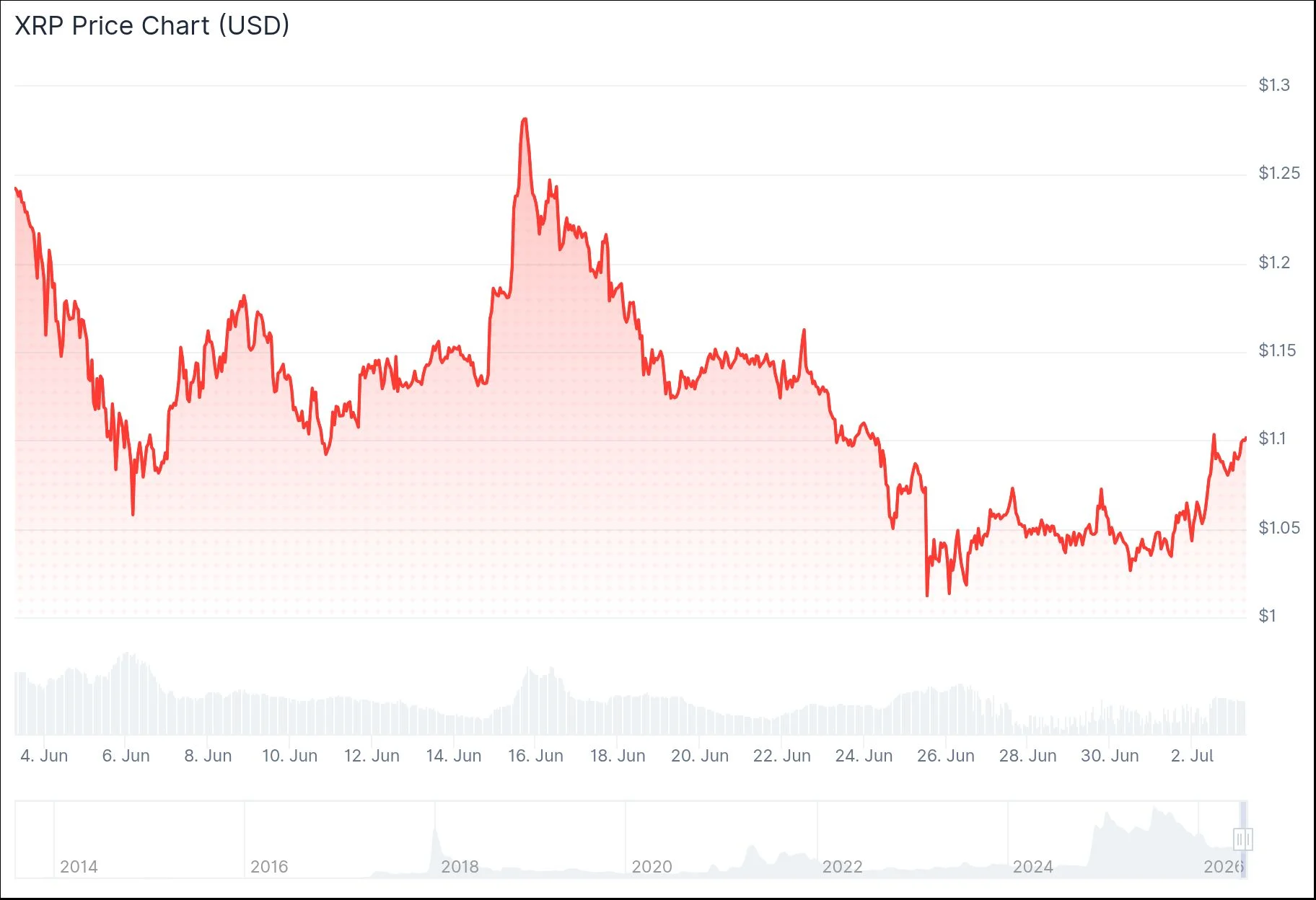
XRP climbed roughly 5% over the past 24 hours, which helped the token reclaim the $1.10 level. Despite the short-term recovery, it remains down more than 50% compared with its value a year ago.
Fresh on-chain data suggests the prolonged decline has pushed key holder metrics to historically extreme levels.
Lower-Risk Buying Window
According to Santiment, XRP holders are experiencing some of the weakest average returns in the asset’s history. Its 30-day MVRV has fallen to -45%, while its 365-day MVRV stands at -47%, which signals that both short-term and long-term holders are deeply underwater.
For the first time in XRP’s nearly 12-year history, both short- and long-term holders are facing record-low average returns, which demonstrates that fear and frustration have reached unusually high levels. Santiment said this does not rule out the possibility of further price declines if the broader crypto market remains under pressure.
However, from a risk-reward perspective, it believes buying or increasing exposure to XRP now carries less risk than usual because much of the downside has already been absorbed by existing holders, a condition that has historically coincided with stronger market setups.
Meanwhile, crypto analyst Ali Martinez said the SuperTrend indicator has flashed its first buy signal on XRP since mid-June. He explained that the previous buy signal was followed by a 14% rally, while the indicator also successfully identified the last two major declines of 19% and 16%.
XRP’s network activity has also picked up, according to his earlier analysis. Daily active addresses have increased from 23,000 on June 14 to nearly 40,000, indicating stronger on-chain participation.
Inflows After Brief Pullback
On the institutional side of things, US-based spot XRP ETFs attracted more than $59 million in net inflows throughout June. After two consecutive days of outflows, the funds returned to positive territory on July 3, bringing in $6.55 million.
Data from SoSoValue revealed that Bitwise’s ETF accounted for the largest share of the day’s inflows.
The post This XRP Signal Has Never Looked Worse, But is That the Setup? (Analyst) appeared first on CryptoPotato.


Alibaba has banned employees from using Anthropic’s Claude Code in workplace environments from July 10 over alleged security concerns involving embedded backdoors, according to a person familiar with the decision.
Summary
- Alibaba will block employees from using Claude Code in workplace environments from July 10 over alleged security concerns.
- The reported restriction comes weeks after JPMorgan and Goldman Sachs limited access to Anthropic’s Claude models in Hong Kong.
- Anthropic recently restored its newest AI models after U.S. authorities lifted export restrictions and approved new safety measures.
According to a source familiar with the matter, the restriction will apply across Alibaba’s internal work environments and takes effect on July 10. The person said the company reached the decision because of alleged security risks linked to embedded backdoors in the coding assistant.
As of publication time, Alibaba has not issued an official statement, and no further details about the alleged security concerns or the scope of the restriction were disclosed.
Claude faces another enterprise setback
The latest development comes just weeks after Anthropic’s Claude models lost access to another major enterprise customer group in Hong Kong. In June, the Financial Times reported that JPMorgan had stopped employees in Hong Kong from selecting Claude models from the bank’s approved list of large language models because of Anthropic’s licensing terms governing where the models could be used.
The report said Goldman Sachs had previously introduced a similar restriction after determining that Anthropic’s terms of service excluded use across Greater China, including Hong Kong. Anthropic later told the Financial Times that Claude had never been officially supported in Hong Kong, while JPMorgan declined to comment.
Those restrictions added to concerns among some financial institutions in Hong Kong as advanced AI tools become more deeply integrated into software development, research, and financial services workflows, according to the Financial Times.
Anthropic recently restored its newest models
The Alibaba decision also follows a turbulent few weeks for Anthropic’s latest AI systems. On July 1, the company restored public access to its Claude Fable 5 and Mythos 5 models after U.S. authorities lifted export restrictions that had forced Anthropic to suspend them in June.
Anthropic said it resumed deployment after what it described as productive discussions with U.S. officials and added new classifiers designed to detect and block more cybersecurity-related tasks. The company said the additional safeguards addressed government concerns over possible misuse through jailbreak techniques.
While defending its technology, Anthropic argued that the reported jailbreak involved a limited method rather than a universal bypass of the models’ safety protections. The company also announced expanded cooperation with the U.S. government on model testing, safety evaluations, misuse tracking, and information sharing related to jailbreak risks.
This Friday, we examine Ethereum, Ripple, Cardano, Binance Coin, and Hyperliquid in greater detail.
Ethereum (ETH)
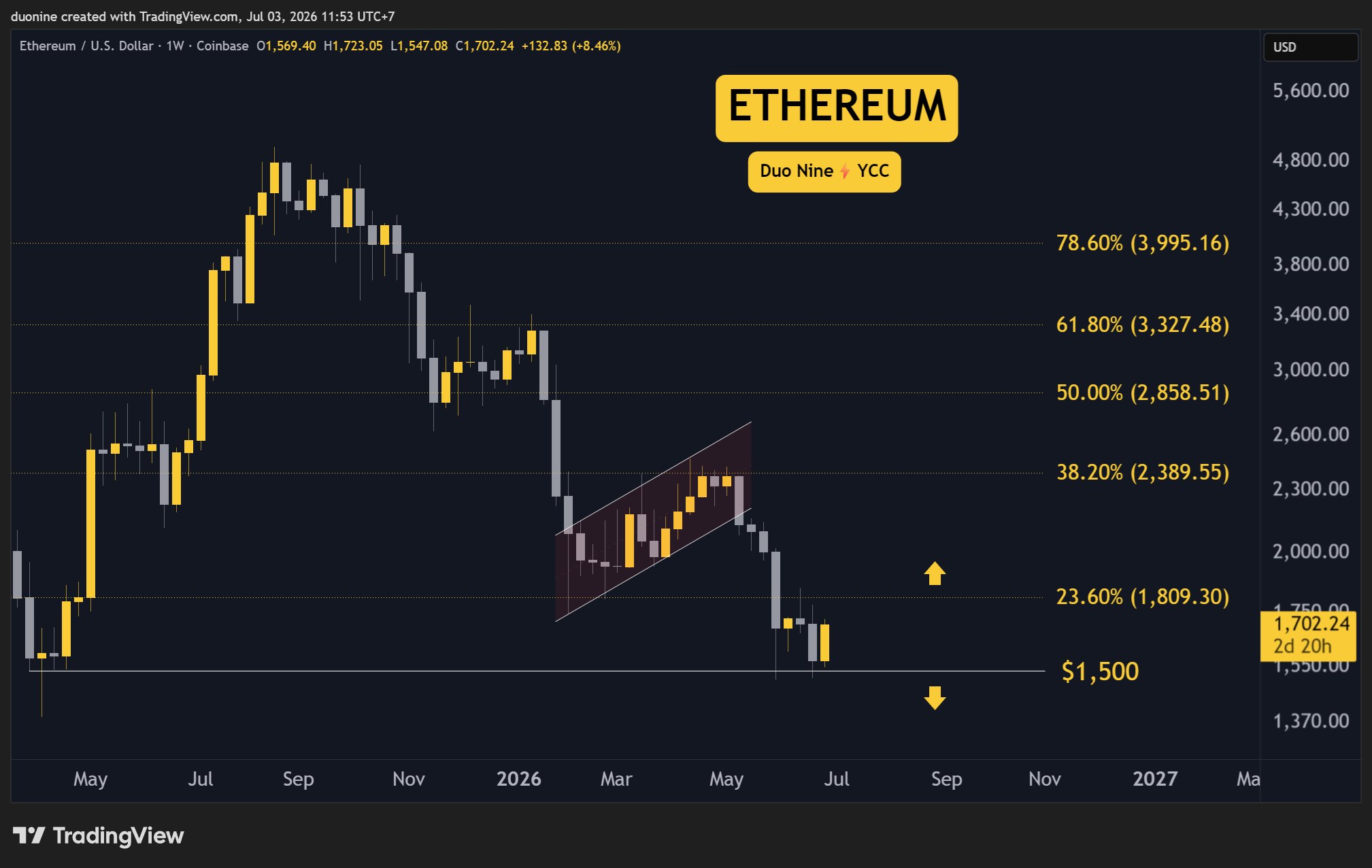
Ethereum managed to bounce off support at $1,500 and recovered last week’s losses. This is also why it closed the week with an impressive 10% rally, as buyers regained control of price action.
To be confident in a sustained recovery, the price will need to eventually break the current resistance at $1,800. Anything less than that would only be a short relief before sellers return to dominate.
Looking ahead, Ethereum has a real chance here to set a local bottom and attempt a rally. The question is if buyers have the volume and strength to sustain it and break the key resistance in the days and weeks to come.
Ripple (XRP)
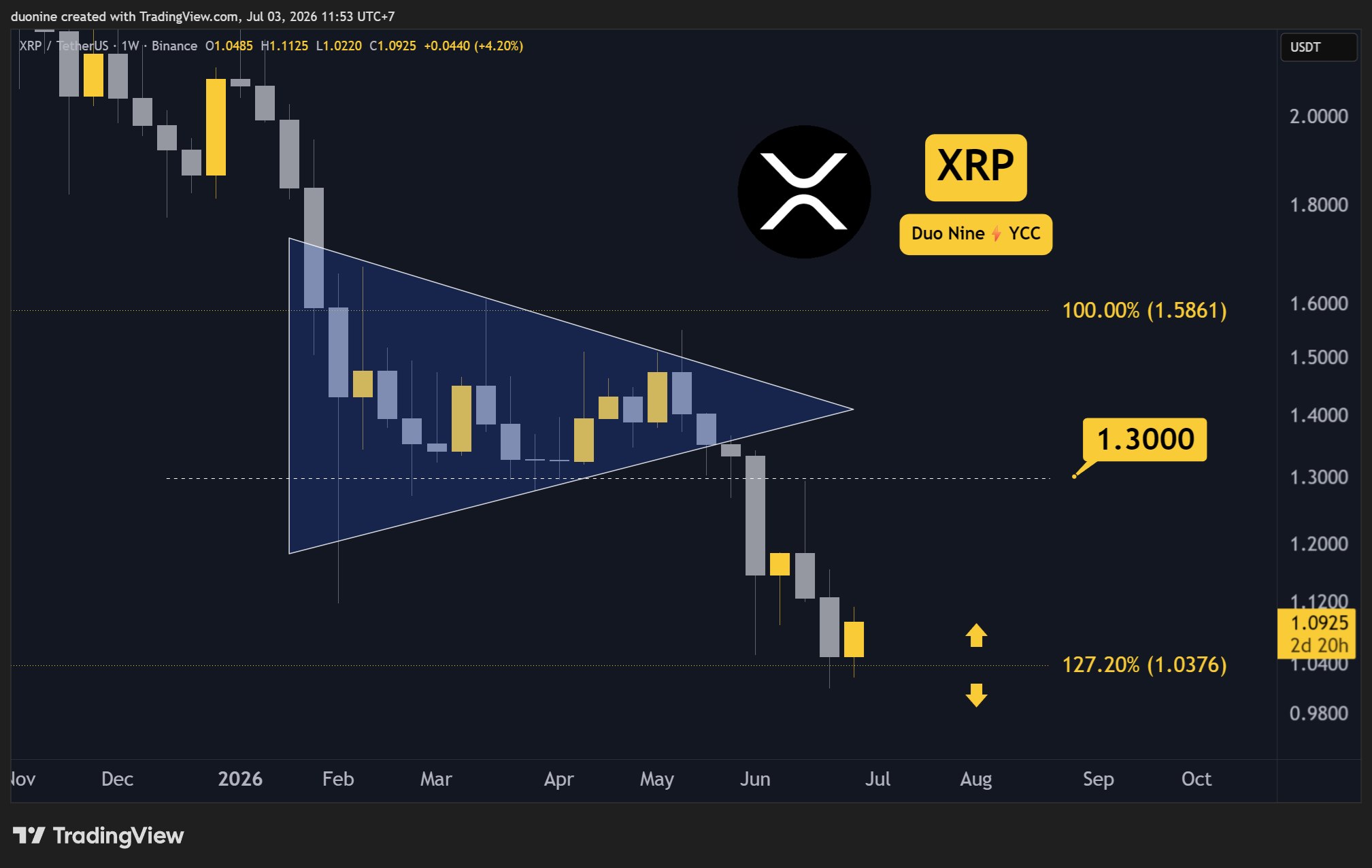
This week, buyers managed to defend $1, sending the price 6% higher. However, there is resistance at $1.1, which has managed to hold off the bulls, at least as of this post.
Similarly to Ethereum, XRP needs to make the best of this bounce and turn it into a sustained rally if it wants to break away from its current downtrend. Even if the $1.1 resistance falls, the price still has to claim $1.3 to confirm a breakout.
Looking ahead, the price reaction at $1 was somewhat expected since it’s a key psychological level. If buyers fail to capitalize on this in the coming days and weeks, then sellers will likely return to put pressure again.
Cardano (ADA)
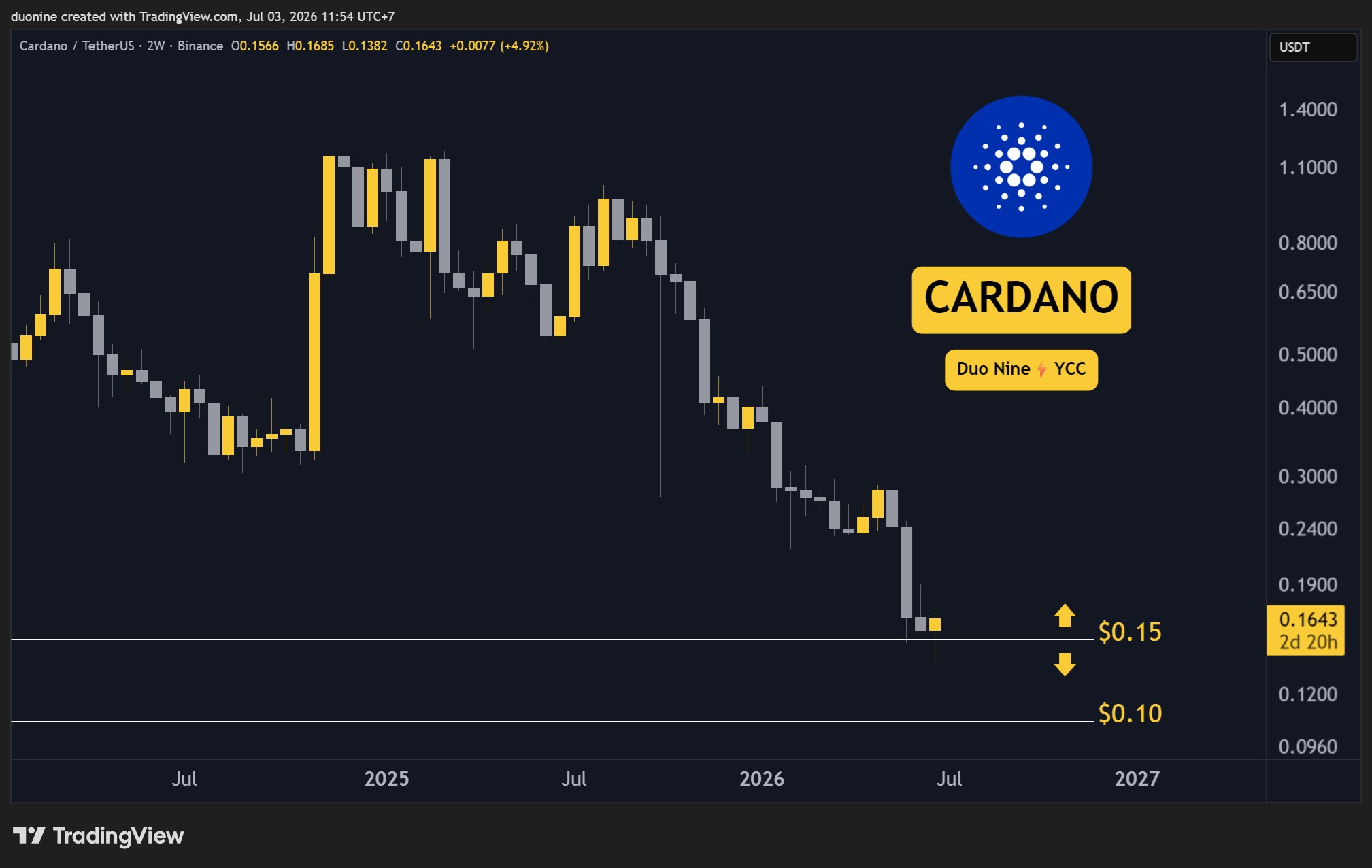
This week, ADA impressed with a 16% bounce after the price briefly fell under the $0.15 support. With the support secured, this cryptocurrency has a good shot at moving higher. However, as of this post, the price formed a lower high.
To be confident in a sustained recovery, Cardano will have to move beyond its previous high of 19 cents. Anything less than that would make this a bearish bounce, eventually leading to ADA falling lower.
Looking ahead, sentiment across the crypto market has improved with the start of July, but the month is only just beginning, and it is too early to say whether the current price action will be sustained. At a macro level, ADA remains bearish.
Binance Coin (BNB)
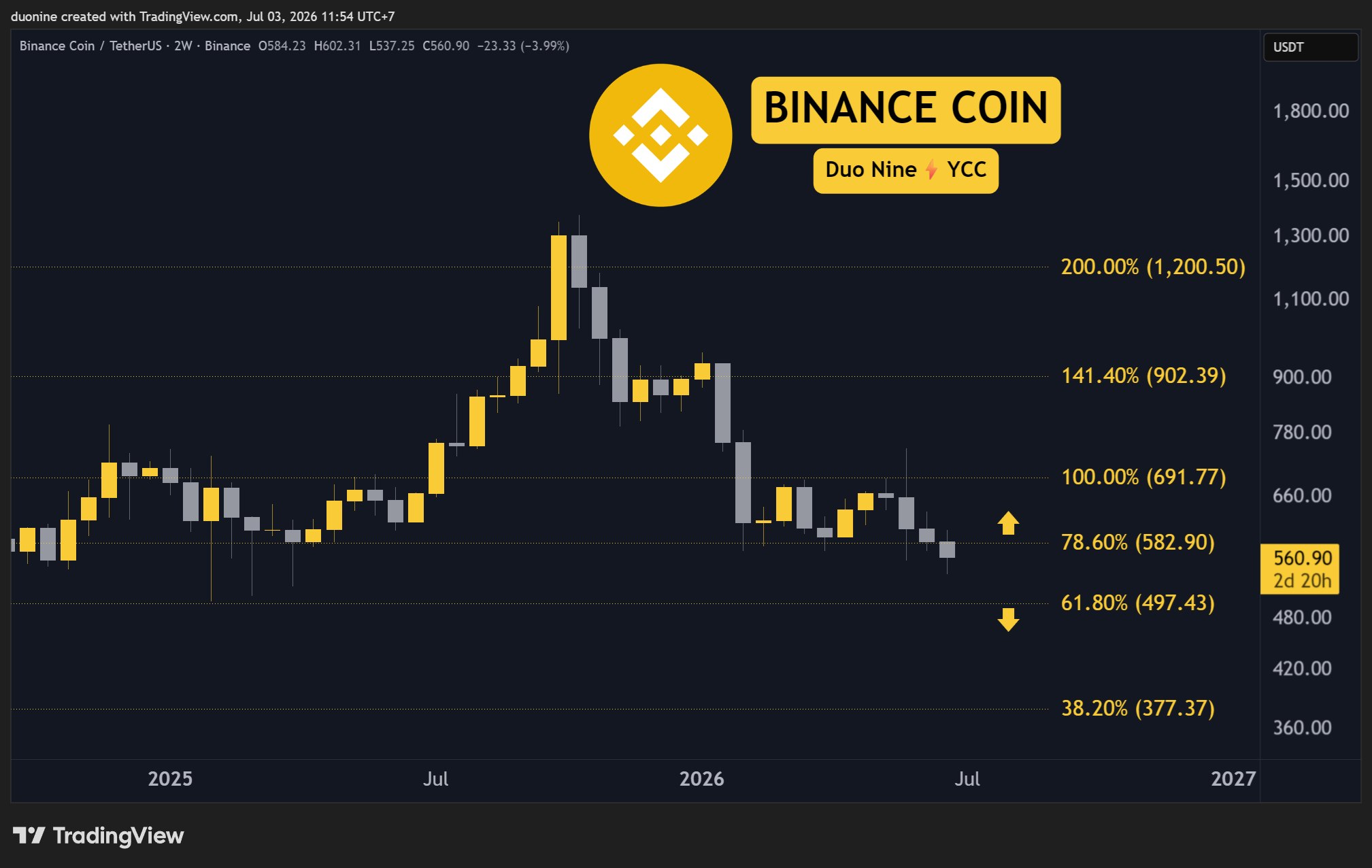
Compared to the other coins on our list, Binance Coin remained flat this week. This is atypical and rather bearish because the price failed to reclaim its support at $580. Because of that, sellers retain the upper hand and may aim for $500 next.
The $500 support hasn’t been tested yet, but it’s the next major level if bears continue to dominate the chart. Moreover, Binance failed to secure a MICA license in the EU at the start of July, which made it lose a key market to competitors.
Looking ahead, any weakness for Binance, the exchange, will likely translate to its token, BNB. The current chart seems to confirm this, as it remains in a bearish trend with no bounce or recovery in sight.
Hype (HYPE)
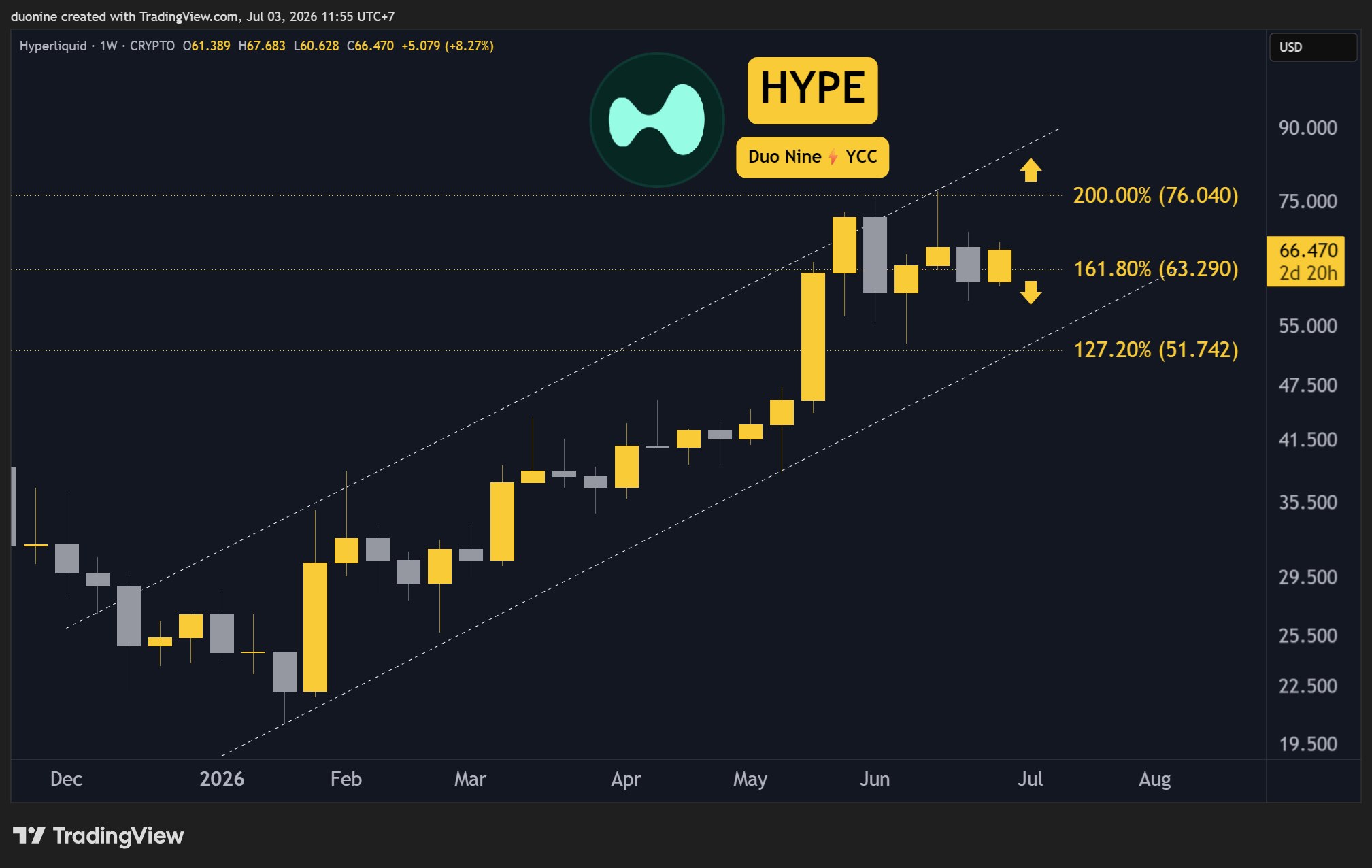
HYPE found good support above $60 and bounced by 6% this week. This has placed it in flat price action since early June. This consolidation is also forming a large pennant. Once that is resolved, we will know where this cryptocurrency is headed next.
When a pennant forms, the price tends to respect the underlying trend, which, in this case, is bullish. Therefore, the higher probability is for the price to break away and aim for new highs.
Looking ahead, HYPE will have to secure $68 as a key support and hold above it if it wants to challenge the current all-time high at $77. Anything less than that, or a break below $60, would be a bearish signal with lower lows likely.
The post Crypto Price Analysis July-03: ETH, XRP, ADA, BNB, and HYPE appeared first on CryptoPotato.

World Cup 2026: Portugal knock out Croatia and will face Spain

Tesla’s Model Y L Finally Comes To The US With Six Seats And A $62,000 Price Tag
America at 250: still a ‘democratic experiment’


-

 Fashion7 days ago
Weekend Open Thread: Staud – Corporette.com
-

 Crypto World3 days ago
Strategy authorizes up to $1.25B in Bitcoin sales under new capital plan
-

 News Videos5 days ago
MAJOR BITCOIN & MARKET UPDATE!!!! (MUST WATCH ASAP!!!)
-

 Tech3 days ago
Anonymous researcher drops 0-day ‘exploitarium’ repo
-

 Crypto World6 days ago
Coinbase, Circle Deepen Crypto Stock Losses Despite Resilient S&P 500
-

 Business3 days ago
Australia treasurer says alleged access of prime minister’s bank data ’incredibly concerning’
-

 Crypto World6 days ago
Kraken's xStocks Opens Bending Spoons IPO Registration to EEA Retail
-

 Tech5 days ago
Claude Code turned every engineer into three. Now companies need more product thinkers
-

 Sports7 days ago
FIH Pro League: India defeat Pakistan 7-1, register biggest win of campaign | Other Sports News
-

 Tech5 days ago
Bluekit phishing kit adopts browser-in-the-middle for login theft
-

 Tech6 days ago
Russian hackers now target Signal backup recovery keys
-
Crypto World7 days ago
Hyperliquid Named on Singapore MAS Investor Alert Register
-

 Crypto World7 days ago
RTX holders must register wallets before token distribution begins
-
 Business4 days ago
The AI boom won’t burst all at once. It will pop in ‘rolling bubbles’: Macquarie
-

 Sports2 days ago
Broncos roster: OL Ben Powers (No. 74) entering final year of contract
-

 Tech6 days ago
Silicon Valley paid to kill AI regulation, now it wants the rules back
-

 NewsBeat2 days ago
Presenter Caroline Flack’s brother Paul Flack dies aged 55
-

 Crypto World1 day ago
Binance stock trading tops $1B in first month after launch
-
 NewsBeat1 day ago
New exhibition reflects five decades of movement between island of Ireland and GB
-

 Tech6 days ago
OpenAI mulls delaying IPO over valuation concerns
You must be logged in to post a comment Login