

Crypto World
Binance Partners With STOP THE TRAFFIK to Fight Crypto Use in Human Trafficking



Cointelegraph is committed to providing independent, high-quality journalism across the crypto, blockchain, AI, and fintech industries.
All news, reviews, and analyses are produced with full journalistic independence and integrity. For more details on our standards and processes, please read our Editorial Policy.



Q. Not all tokenized equity products are the same. What is the most important distinction to understand?
The central question is what the token actually represents. In the strongest model, the token is the share itself, meaning ownership, voting rights and dividends travel with it. In a synthetic wrapper, the investor owns a contractual claim against another entity, not the underlying share, introducing counterparty risk, tracking risk and the possibility that corporate actions do not pass through correctly.
Two tokens with the same ticker can represent very different instruments. The SEC’s January 2026 staff statement drew this distinction explicitly. For advisors evaluating these products, the structure is not a technical detail. It determines what rights the holder actually has.
Q. How developed is the regulatory framework at this point?
More developed than most people realize, but with gaps remaining. In the past eight months, the SEC issued a no-action letter for DTC tokenization services, published a staff statement establishing ownership taxonomy and approved Nasdaq’s proposal to trade tokenized securities alongside conventional shares. DTCC completed its first live production transactions this month.
Despite the progress, uncertainty still exists. Tokenized equities remain largely restricted to non-U.S. or accredited investors, the CLARITY Act has not been enacted, and third-party synthetic models carry more legal uncertainty than issuer-sponsored structures. The framework is building in a clear direction, but there is still much to accomplish to drive confidence and adoption.
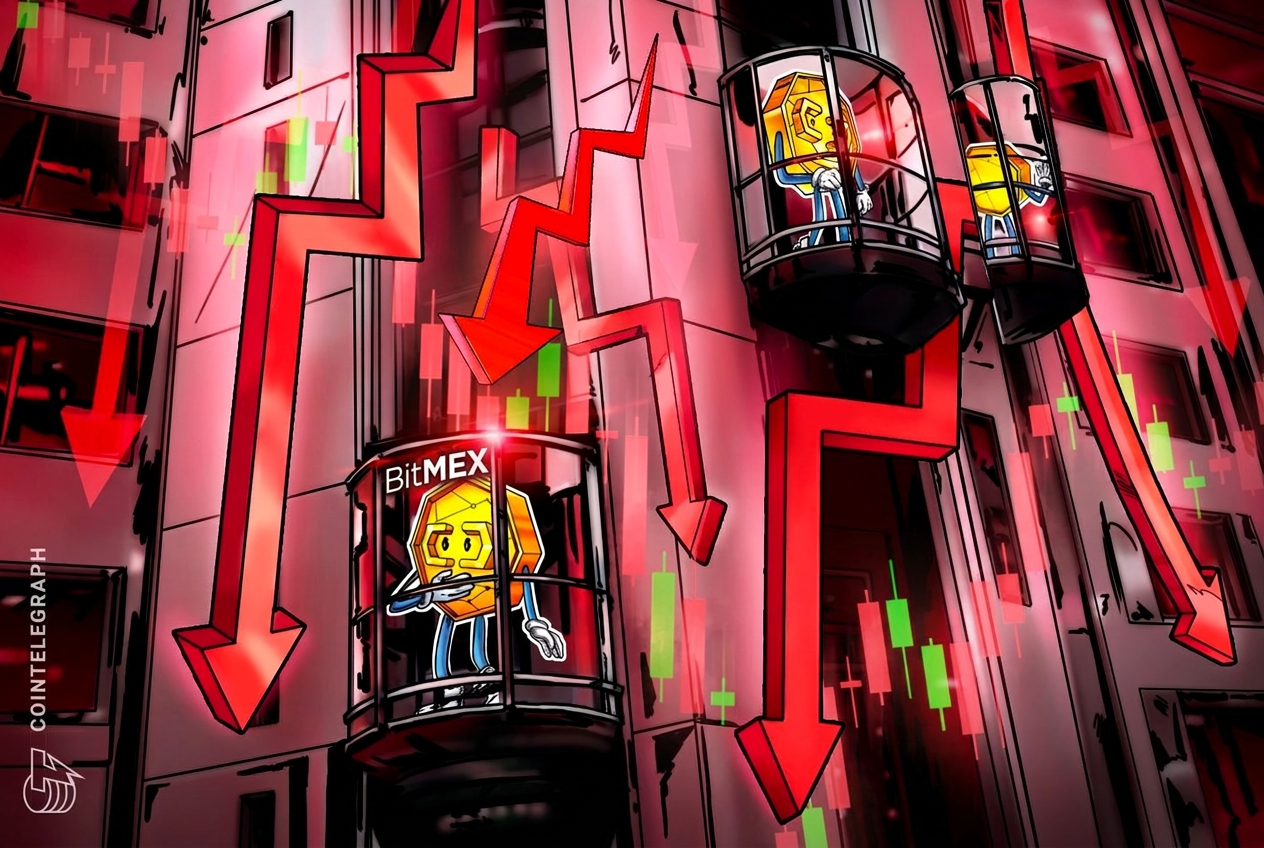
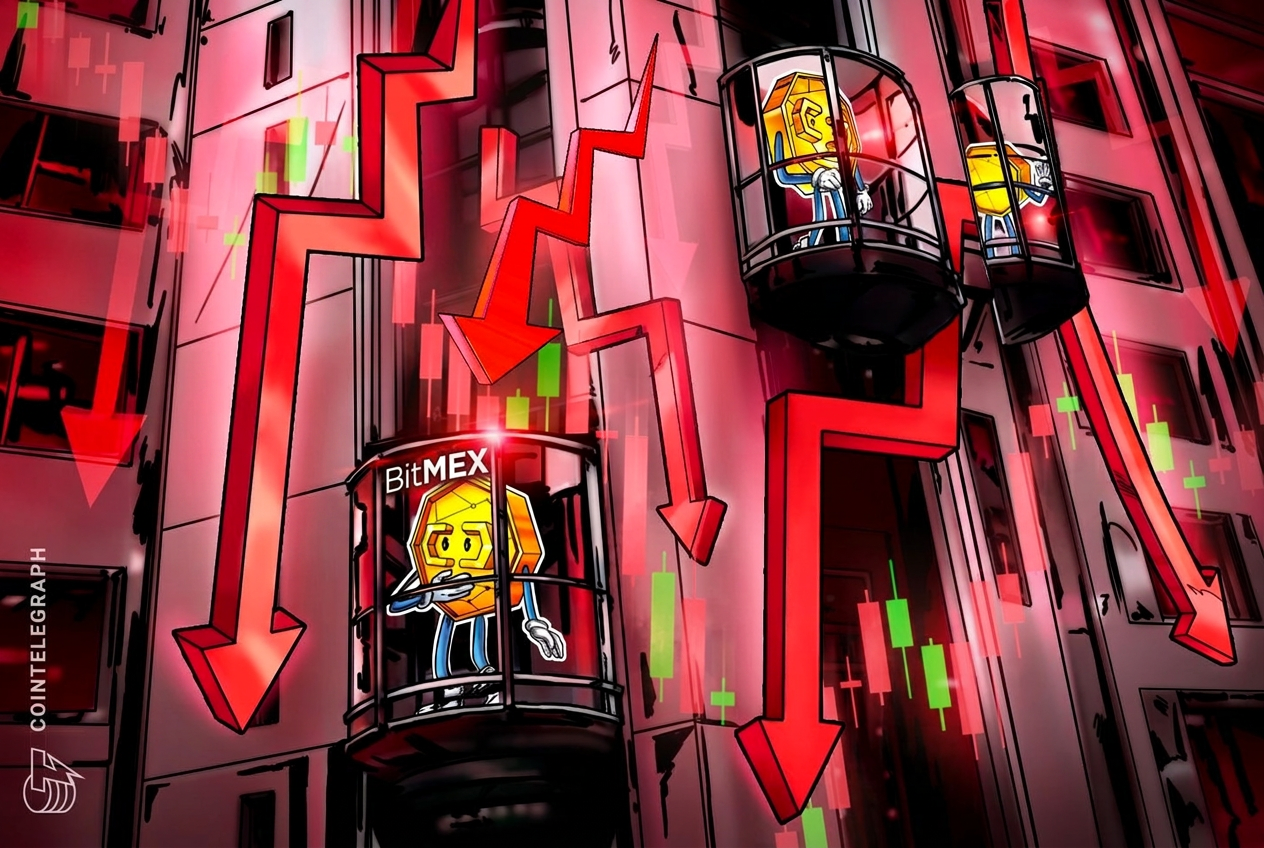
BitMEX’s BMEX token plunged about 90% after the exchange announced plans to shut down, ending nearly 12 years in business as its Bitcoin futures market share shrank.


Michael Saylor’s Strategy has joined eight financial firms in pledging $15 million over three years to protect Bitcoin, starting with preparations for potential quantum-computing threats.
Summary
- Strategy and eight financial firms pledged $15 million to strengthen Bitcoin’s long-term security.
- BlackRock, Coinbase, ARK Invest and others will independently fund developers and researchers.
- Quantum readiness will be the consortium’s first focus despite uncertain threat timelines.
Strategy announced the Bitcoin Security Consortium in a press release, naming Anchorage Digital, ARK Invest, BlackRock, Block, Blockstream, Coinbase, Fidelity Digital Assets and Galaxy Digital as its other founding members.
Drawn from several parts of the institutional Bitcoin market, the coalition includes exchange-traded fund issuers, custodians and infrastructure companies. BlackRock, Fidelity and ARK Invest issue spot Bitcoin ETFs, while Anchorage Digital and Coinbase provide custody services. Block, Blockstream and Galaxy Digital operate businesses tied to Bitcoin infrastructure and financial products.
Rather than combining the $15 million under a central fund, each founding member will choose which developers, researchers and organizations receive its share, according to Strategy. The model allows the companies to finance different projects while coordinating their security work through the consortium.
Brink Executive Director Mike Schmidt will coordinate the consortium’s daily operations in a volunteer capacity, Strategy stated. Addressing concerns about his independence, Schmidt wrote on X that he will receive no compensation and will continue running Brink separately from the founding firms.
“I continue to run Brink, independent of any Consortium member. I’ve committed to a year in this role, maybe I’d do two, but ultimately I see it as a seat that should rotate to other participants over time. My commitment is to Bitcoin, and that doesn’t change.”
Wall Street funding targets Bitcoin security research
Under its initial plan, the consortium will support developers and researchers already working on Bitcoin security, with quantum readiness serving as its first focus, according to Strategy. Schmidt added that the group could finance other security projects if the initial program proves effective.
Protocol decisions will remain outside the consortium’s control. In his X post, Schmidt stated that the group will not adopt collective positions on Bitcoin upgrades, leaving members to direct their funding independently while developers use the network’s existing review process.
Galaxy Digital had committed separate funds to the field before joining the consortium. As crypto.news reported earlier this week, the company opened applications for a $5 million Bitcoin Quantum Readiness Initiative supporting quantum-resistant signatures, wallet migration tools and independent security audits.
According to Galaxy, introducing post-quantum protections would require years of cooperation among Bitcoin Core developers, exchanges, wallet providers, infrastructure companies and users. Its grant program also invites other institutions to contribute money and research to the effort.
Galaxy’s initiative and the consortium pledge have placed $20 million behind the two disclosed programs. The commitments remain separate, however, as Strategy’s consortium allows every member to control its own grants.
Bitcoin’s quantum exposure carries a market cost
Future quantum computers could threaten Bitcoin if they become capable of breaking the elliptic curve cryptography that protects its wallets, according to the companies and researchers behind the programs. Galaxy noted that current machines cannot perform such an attack and most experts do not expect an immediate danger.
Despite the uncertain timeline, Galaxy argued that preparations must start early because deploying new protections across Bitcoin could take years. The company has prioritized alternative signature algorithms, tools that help users transfer funds into safer wallets and audits that test proposed defenses.
CryptoQuant research cited by Galaxy estimated that around 6.9 million BTC could become exposed if a sufficiently powerful quantum computer broke Bitcoin’s existing cryptography. Using market prices from its announcement, Galaxy valued those potentially vulnerable holdings at about $461 billion.
Citi has reached a similar estimate, according to an earlier crypto.news report. The bank calculated that between 6.5 million and 6.9 million BTC may already have public keys visible on-chain, creating a pool of coins that researchers consider more vulnerable to a future quantum attack.
Lost wallets pose another problem because their owners cannot transfer the coins to addresses protected by updated cryptography. Quantus warned in a previously reported assessment that quantum development may be advancing faster than earlier estimates, which could leave dormant and inaccessible holdings without a practical migration route.
Concern over the issue has also entered Bitcoin valuation models. As crypto.news reported in early June, Capriole Investments founder Charles Edwards estimated that Bitcoin was trading at a 28% “quantum discount” compared with his projected valuation path toward $120,000.
Bitcoin traded near $62,099 following a sharp selloff when Edwards presented the model. He attributed the discount to investor concern over what he described as slow progress among Bitcoin Core developers on post-quantum signature planning.
Prediction-market traders remain less worried about the immediate timeline. Polymarket data placed the probability of quantum computing breaking Bitcoin by December 2027 at 14%.
With Strategy coordinating institutional participation and Galaxy already accepting grant applications, the funding gives researchers additional resources before quantum computers pose a proven threat. The consortium’s first test will be whether independently directed grants produce usable security tools without influencing Bitcoin’s protocol governance.
Ripple’s XRP remains trapped beneath a major technical barrier despite recovering from its late June lows. The recent rebound has improved short-term sentiment, but the price is now approaching an area where buyers must absorb significant overhead supply before a broader trend reversal can be considered.
Ripple Price Analysis: The Daily Chart
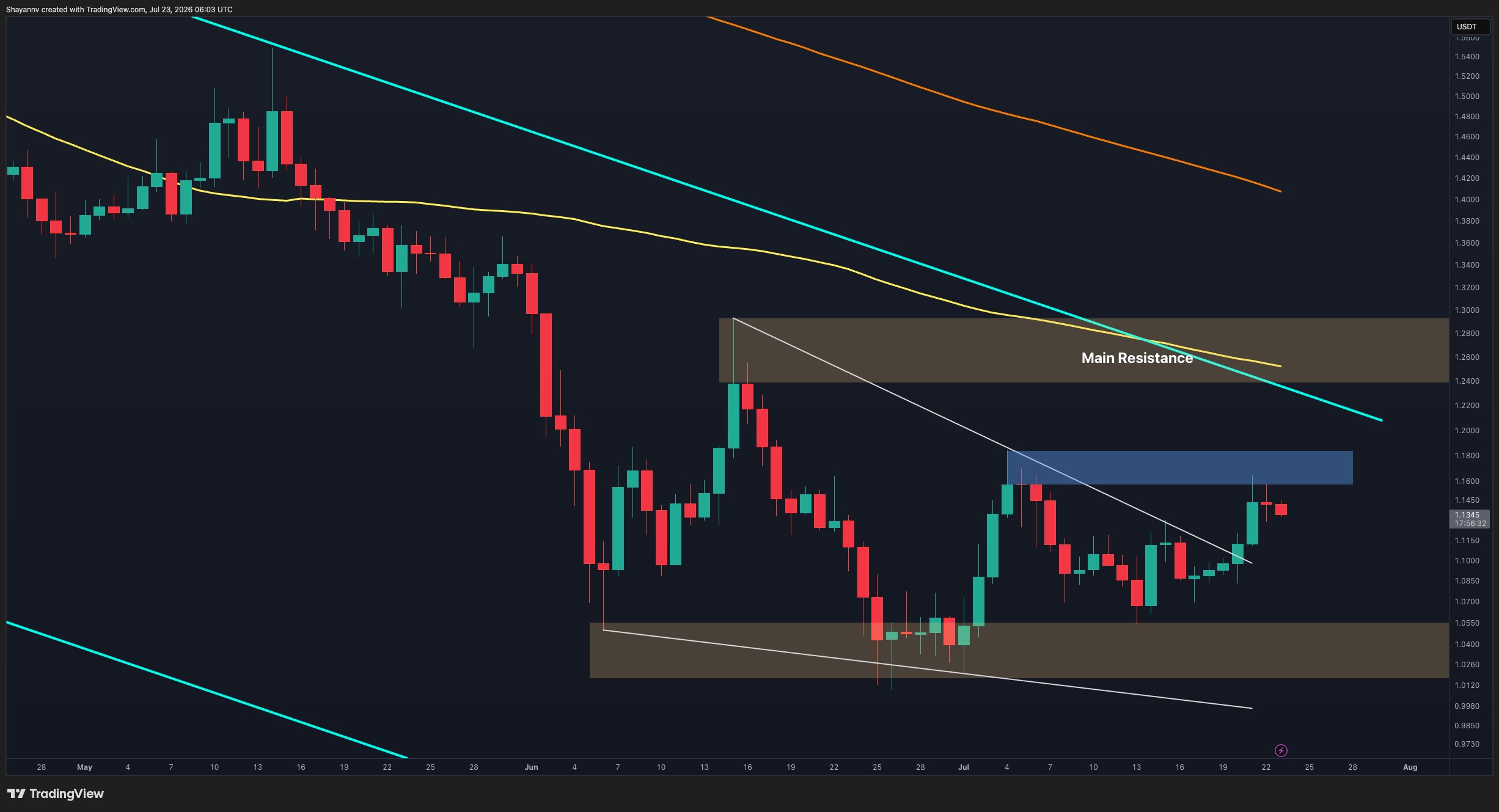
The daily chart shows XRP continuing to trade within a well-defined long-term descending channel. Although the recent rebound has lifted the asset away from the $1.02 to $1.05 demand zone, the broader structure still favors sellers while the asset remains below the channel’s upper boundary and the major moving averages.
The immediate hurdle sits inside the $1.24 to $1.29 resistance zone, where the upper channel boundary converges with the 100-day moving average. This confluence makes the area particularly important, as a rejection here would reinforce the prevailing downtrend.
A successful breakout above this region would expose the 200-day moving average next, but buyers first need to reclaim the current resistance cluster before a more constructive outlook can develop.
On the downside, the $1.02 to $1.05 demand zone remains the primary support. Losing this area would likely shift momentum back toward the broader bearish trend.
XRP/USDT 4-Hour Chart
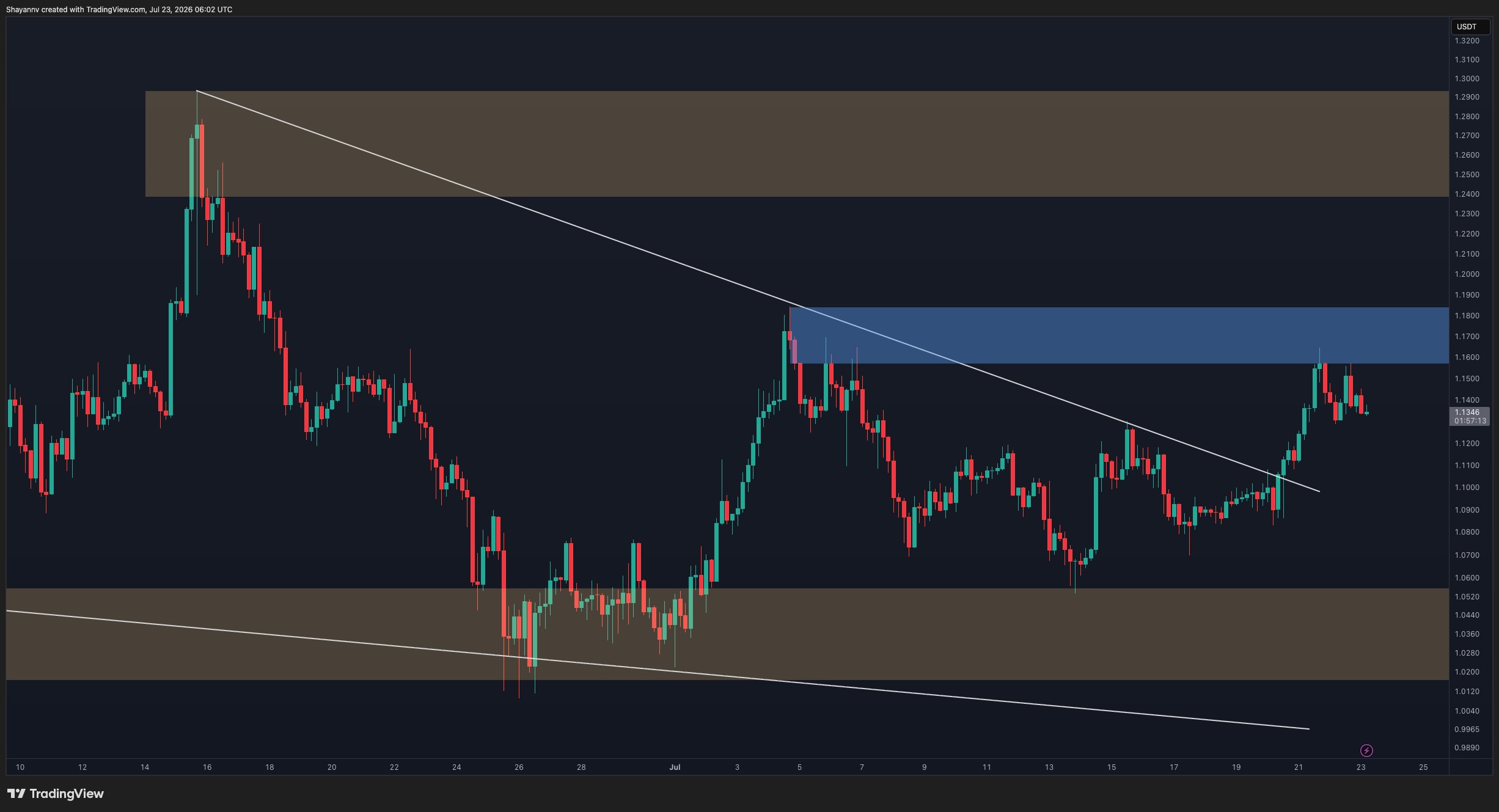
The 4-hour chart paints a more constructive short-term picture. XRP has managed to reclaim the descending trendline that capped the price action throughout July and is now consolidating directly beneath the $1.16 to $1.18 supply zone.
This resistance has repeatedly rejected bullish attempts in recent weeks, making it the key level to monitor. A decisive breakout above $1.18 could trigger a move toward the daily resistance around $1.24 to $1.29, while another rejection would likely send the price back to retest the broken trendline as initial support.
As long as the asset continues to hold above the reclaimed trendline, buyers retain a modest short-term advantage. However, the broader trend will remain neutral to bearish until the price establishes acceptance above the overhead resistance cluster.
The post Ripple Price Analysis: XRP’s Recovery Is a Trap Until This Happens appeared first on CryptoPotato.

Bernstein reiterated that it is still overweight on Bitcoin mining, arguing that the sector’s expanding partnerships are increasingly tied to the power needs of AI data centers. In a Thursday research note shared with Cointelegraph, the firm pointed to a steady stream of AI-related deals throughout July—evidence, it said, that access to electricity is becoming the decisive constraint for AI infrastructure buildouts.
According to Bernstein’s Bitcoin mining industry deal tracker, the number of AI-related transactions recorded in July averaged at least one per week. Combined, those deals total more than 7.5 gigawatts of capacity, or the contracted equivalent of $150 billion across multi-year agreements.
Key takeaways
- Bernstein says Bitcoin miners’ third-party computing capacity remains valuable as AI growth is constrained more by power availability than by software or hardware supply.
- In July, Bernstein’s tracker recorded AI-related deal flow at roughly a weekly pace, totaling over 7.5 GW and the equivalent of $150 billion in multi-year contracted value.
- Recent announcements from Hut 8 and IREN linked mining firms to large-scale AI infrastructure and cloud revenue models.
- Bernstein also highlighted political pushback in the US that could slow new data center construction—making contracted capacity sourced from miners and other providers harder to replicate.
Why Bernstein still favors miners
The core of Bernstein’s argument is that AI data center development is increasingly bottlenecked by electricity access. As power becomes harder to secure, miners and other third-party computing providers—already operating energy-intensive facilities—may be better positioned to supply the incremental capacity AI companies need.
Bernstein’s note framed this as a structural opportunity rather than a short-term market trade. The firm linked the attractiveness of the mining sector to the growing number of partnerships that allow AI-focused operators to secure power and compute capacity through contracted arrangements.
July deal momentum and what it signals
Public market interest in the “AI-miner” theme accelerated after Bitcoin mining companies announced major infrastructure and cloud deals. On Monday, shares tied to AI infrastructure moves posted double-digit gains, following announcements from Hut 8 and IREN.
Hut 8 disclosed a 15-year, $9.8 billion lease for its AI data center campus. IREN, meanwhile, announced $2.8 billion in cloud services contracts with AI developers. Bernstein’s upbeat framing aligns with a broader investor focus on miners converting their physical capacity into more predictable, contract-based revenue streams.
As Seeking Alpha contributor The Curious Analyst wrote in a Thursday commentary, IREN appears to be turning an infrastructure advantage into “contracted and more predictable revenue,” while noting execution risk as the key potential downside.
Beyond those two names, other publicly traded miners also expanded their AI ambitions. Earlier in July, MARA Holdings said it planned to acquire a Texas site with up to 2 gigawatts of capacity to support its AI and digital infrastructure business. TeraWulf signed a 20-year data center lease with AI startup Anthropic, which the company said could generate roughly $19 billion in contract revenue. Bitdeer has also moved into AI cloud services and high-performance computing.
Bernstein’s ratings, as reported in the research note shared with Cointelegraph, include an outperform stance on all of the stocks it discussed except MARA, which it rates as market perform. Sector performance reflected the same narrative: CoinShares Bitcoin Mining ETF (WGMI) was up ahead of the Nasdaq open, with several miner stocks also higher in premarket activity.
US political friction could raise the value of contracted capacity
Bernstein’s analysis also tied the AI-miner alignment to a policy environment that could complicate new data center construction. The firm said bipartisan political pushback is increasingly shaping the timeline and feasibility of building additional facilities, especially amid concerns about local impacts such as water use and electricity costs.
In Texas, a report by the Houston Chronicle said a proposal backed by Democratic Senate candidate James Talarico would strengthen local approval processes and repeal certain tax breaks for AI data centers. In Oregon, US Senator Ron Wyden has publicly raised concerns about water scarcity during drought conditions, arguing that large data centers can consume up to 5 million gallons of water per day and asking operators to explain how they would reduce groundwater withdrawals to protect local supplies.
At the federal level, the Trump administration published a “Ratepayer Protection Pledge” aimed at expanding AI infrastructure without increasing electricity bills for households and small businesses. Separately, state governors released plans to expand the grid to meet rapidly growing AI data center demand, while emphasizing that new facilities should bear the costs they create instead of shifting them to existing residential and small business customers.
For investors, the implication is straightforward: if political and infrastructure constraints delay new capacity coming online, the market may increasingly reward entities that already have power access and can lock in compute demand through multi-year contracts.
What to watch next
With Bernstein pointing to both deal volume and policy headwinds, the next signal for the sector is whether miners can sustain the rate of AI-linked contracting and translate that into longer-term revenue visibility—especially as regulators and local communities continue to scrutinize data center construction.
Bitcoin’s latest rally has carried the asset back into an area where sellers have previously regained control. The coming sessions should reveal whether this recovery has enough strength to continue or if another rejection is waiting around the corner.
Bitcoin Price Analysis: The Daily Chart
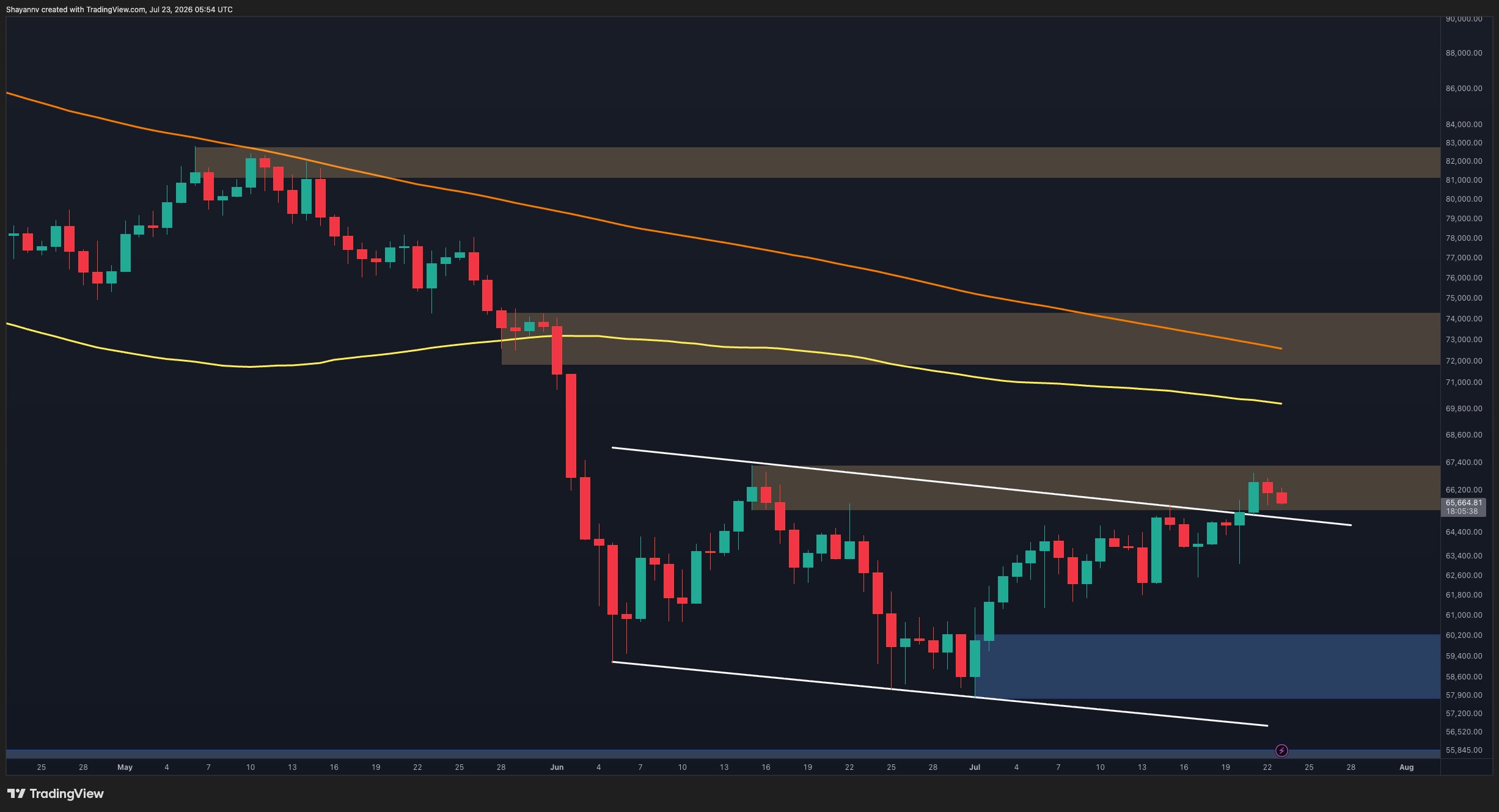
On the daily timeframe, BTC has extended its recovery into the $65.5K-$66.7K supply zone after successfully reclaiming the descending trendline that had capped the price action for weeks. While this breakout represents a notable improvement in market structure, the broader trend remains constrained beneath the declining 100-day moving average, with the 200-day moving average positioned even higher.
The current resistance zone also coincides with a previous distribution area, increasing the likelihood of seller activity around current levels. A decisive daily close above $66.7K would strengthen the bullish case and expose the next resistance around $72K-$74K.
On the downside, the former breakout area near $63K-$64K now serves as the first demand zone. As long as BTC holds above this region, buyers remain in short-term control. Losing this support would shift attention back toward the broader demand zone around $58K-$59.5K, where the latest impulsive rally originated.
BTC/USDT 4-Hour Chart
The 4-hour chart highlights a clear shift in momentum after Bitcoin broke above the descending trendline and rallied directly into the overhead supply zone around $65.5K-$66.7K. The market is now consolidating beneath resistance after rejecting the upper boundary of the range.
This pause appears consistent with profit-taking rather than a confirmed trend reversal, especially since the previous resistance trendline has already been reclaimed. If buyers manage to absorb the current supply, a breakout above $66.7K could trigger another impulsive leg higher.
However, failure to sustain current levels would likely result in a pullback toward the $63K-$64K demand zone, which aligns with the recently broken trendline and could serve as the next area for buyers to defend before another attempt higher.

Sentiment Analysis
The one-year Binance liquidation heatmap shows a notable concentration of short-side liquidity around the $88K region, standing out as one of the largest untouched liquidity pools above the current market price.
From a market structure perspective, this aligns with the broader idea that Bitcoin may eventually be drawn toward that liquidity. However, until price sweeps the $90K cluster and successfully establishes acceptance above it, it is difficult to argue that the higher-timeframe trend has fully transitioned into a bullish market.
As a result, the current recovery should still be viewed with caution. Although the technical structure has improved over the short term, every bullish leg can still be interpreted as corrective within the broader bearish context until the major overhead liquidity is cleared and price stabilizes above that region.

The post Bitcoin Price Analysis: BTC Rally Loses Steam as Historical Resistance Comes Into Play appeared first on CryptoPotato.
Crypto World
Goldman Sachs CEO backs Clarity Act despite banking industry’s concerns over stablecoin rules


Solomon’s endorsement contrasts with growing opposition from other major banking executives, including JPMorgan Chase CEO Jamie Dimon, who have argued that the legislation could put traditional banks at a competitive disadvantage by allowing crypto companies to offer yield-bearing stablecoin products that resemble bank deposits without being subject to the same regulatory framework.
Speaking to Fox Business in May, Dimon said he was dissatisfied with the latest version of the bill because “it allows them to effectively pay interest on deposits, stablecoins or something like that, without protection that they should have.”
“The banks will not accept it that way,” Dimon said. “I’m not worried about stablecoins but if it happened I’m telling you I will have nothing to do with it and it will eventually blow up.”
JPMorgan has also warned that crypto legislation should close regulatory gaps rather than create new ones. In a blog post published in June, executives at the bank argued that firms offering products that function like traditional bank accounts should face comparable oversight and consumer protections.
The debate over stablecoin rewards has become one of the biggest sticking points in negotiations over the CLARITY Act. Coinbase CEO Brian Armstrong has argued that banks are lobbying lawmakers to restrict stablecoin rewards because they threaten banks’ deposit-based business models, while banking executives contend that crypto firms offering bank-like products should be regulated like banks.


Uniswap (UNI), one of the largest and longest-running decentralized exchanges, is making a deeper push into tokenized assets, introducing a feature designed to let regulated securities trade on the venue without sacrificing compliance requirements.
The decentralized exchange’s developer, Uniswap Labs, is rolling out “Permissioned Pools” on Thursday, a piece of infrastructure that allows issuers of tokenized funds, equities and other regulated assets to restrict trading to approved investors while still using the protocol’s automated market maker.
That “gives issuers a flexible way to enforce their own compliance rules without building separate trading infrastructure,” Ken Ng, head of ecosystem at Uniswap Labs, explained to CoinDesk.
“The next generation of value coming onchain, and it’s trading on Uniswap,” he said.
Launch partners include tokenization firms Securitize (SECZ) and Superstate, along with European digital securities platform Dowgo, all of which plan to use the framework for regulated onchain assets.
Tokenization trend enters DeFi
The move fits into a broader shift across decentralized finance (DeFi), where protocols originally built for open, permissionless trading and lending are increasingly adapting to the needs of financial institutions bringing traditional, regulated real-world assets (RWA) onto blockchain rails. One example for that is Aave, the largest decentralized lender, which rolled out Horizon, an institutional lending venue for tokenized assets.
The primary cryptocurrency has staged a minor resurgence over the past week, with its valuation briefly rising to nearly $67,000 and now hovering around $65,000.
However, some analysts warn that this is unlikely to mark the start of a new bull run, envisioning a major collapse in the near future.
Same as 2022?
BTC, which plunged below $58,000 at the end of June, has rebounded by double digits in the following several weeks. And while bulls eagerly await the end of the bear market, the analyst who uses the X moniker BATMAN shut down that optimism.
They believe the cryptocurrency’s recent price increase mirrors the one from the autumn of 2022, which was followed by a massive crash to roughly $16,000.
“Side by side, this level looks concerning. It mirrors a similar bullish pump from 2022 that led to nothing afterward. History might not repeat itself, but it sure does rhyme,” they stated.
Of course, one should keep in mind that the drop below $20K at that time was driven largely by the meltdown of the once-prominent crypto exchange FTX: something that sent shockwaves through the entire digital asset sector.
For their part, X user Kabuki believes that the latest price setup represents a classic bull trap. They think BTC could dump to as low as $47,000 by August before starting a major uptrend move that could take it to over $200,000 by the start of next year.
Monitoring These Vital Levels
X user Ted also gave his two cents, noting the decline from the local high of almost $67K to the current $65K. At the same time, he emphasized the importance of the lower target, arguing that BTC could surge to $67,500-$68,000 if it stays above.
Meanwhile, Bitfinex’s analysts pointed to a key reaction zone between $67,900 and $68,300, where the short-term holder realized price and the second-quarter opening level have lined up. They believe a decisive breakout above or below that range could determine the asset’s direction in the near future.
It is important to note that the renewed institutional interest gives hope that Bitcoin hasn’t completely lost its momentum and might soon post fresh gains. According to SoSoValue, the inflows into spot BTC ETFs have surpassed outflows in the past seven consecutive days, something unseen since April.
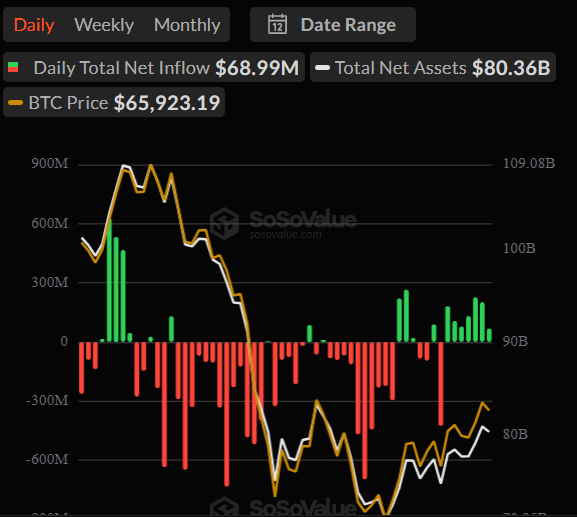
The development shows that pension funds, hedge funds, and other conservative investors have increased their exposure to the asset, prompting BlackRock, Fidelity, and many other financial giants that have launched such products to purchase Bitcoin, thereby backing their shares. The situation was much different toward the end of June, when spot BTC ETFs saw a weekly outflow of around $1.8 billion.
The post 2022 vs. 2026: Analyst Warns Bitcoin’s Recent Rally Could End in a Massive Crash appeared first on CryptoPotato.
Senate Republicans circulated a revised 616-page Crypto Bill draft on July 22 that includes a White House-backed ethics provision, but no Democrat has publicly endorsed the latest text. Senate Majority Leader John Thune said he wants to move the bill to the Senate floor before the August recess, although it remains unclear whether Republicans can secure the 60 votes needed to advance the legislation.
- The ethics provision bars the president, vice president, members of Congress, senior executive branch officials, and their spouses from issuing or sponsoring certain digital assets while in office.
- The provision designates the U.S. attorney general as the primary enforcement authority and does not authorize state attorneys general to enforce the ethics rules.
- The ethics restrictions would expire in 2029 unless extended by Congress.
- Republicans hold 53 Senate seats, meaning they would likely need support from at least seven Democrats if all senators vote.
The ethics language was negotiated between Senate Republicans and the White House and reflects a compromise the Trump administration was willing to support.
Under the proposal, crypto platforms could be required to avoid listing digital assets issued or sponsored in violation of the ethics rules, while the attorney general could pursue civil enforcement against officials and parties that knowingly violate the provision.
For many Democrats, however, the enforcement structure remains the central concern. They argue that relying solely on the Department of Justice provides insufficient independent oversight, particularly given President Donald Trump’s crypto-related business interests. Those concerns intensified after Trump’s annual financial disclosure reported substantial income tied to crypto ventures, including World Liberty Financial and his memecoin-related businesses.
Discover: The Best Token Presales
Alsobrooks Calls DOJ Only Enforcement ‘An Unserious Offer’
Sen. Angela Alsobrooks (D, Md.), one of the Democrats who has participated in negotiations on crypto legislation, said this week that any enforcement mechanism limited to the Department of Justice is “an unserious offer.” She added that she could not support the bill under its current ethics language while leaving room for further negotiations before a floor vote.
— Coin Bureau (@coinbureau) July 21, 2026
 UPDATE: Sen. Angela Alsobrooks said that the White House proposal to have the DOJ enforce the CLARITY Act’s ethics provisions is an “unserious offer.”
She also said she will not support the bill if it is the only enforcement option, per Eleanor Terrett. pic.twitter.com/Cb0TwfACeR
The main disagreement is over enforcement. Democrats have repeatedly sought to give state attorneys general independent authority to enforce the ethics provisions. The revised Republican draft instead reserves enforcement authority to the U.S. attorney general, preventing states from bringing their own actions under that section of the bill. Democratic lawmakers have argued for months that stronger and more independent oversight is necessary.
A group of Democratic senators, including Alsobrooks, Cory Booker, Ruben Gallego, and Mark Warner, has also said the current CLARITY Act draft remains inadequate on ethics, consumer protection, illicit finance, and market integrity. Their support could prove critical if Republicans hope to advance the legislation.
Discover: The Best Crypto to Diversify Your Portfolio
Thune’s Floor Timeline Puts Pressure on Both Sides of the Crypto Bill
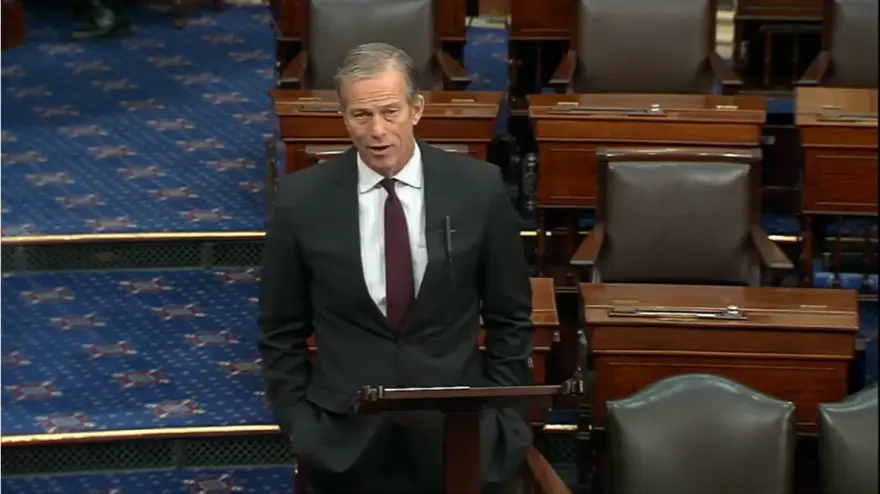
Thune’s plan to pursue a floor vote before the August recess appears designed to increase pressure on negotiators rather than signal that the bill already has sufficient bipartisan backing. When asked whether the legislation was ready, Thune said he was hopeful but acknowledged that further discussions and possible revisions could still be necessary.
— Coin Bureau (@coinbureau) July 23, 2026
 UPDATE: The CLARITY Act is heading toward a Senate vote, even without Democratic support.
Senate Majority Leader John Thune plans to bring the crypto bill to the floor as soon as next week, even if no deal is reached with Democrats, per Bloomberg.
The Senate now has just 12… https://t.co/smqbz9EhuQ
The strategy could force lawmakers to either reach a compromise quickly or publicly demonstrate that bipartisan support remains out of reach. If the bill fails to advance before the Senate leaves for the August recess, negotiations could resume later in the year, although the legislative timeline would become less predictable.
The broader crypto regulation package would establish clearer jurisdiction between the SEC and CFTC, create a regulatory framework for digital assets, and include provisions affecting decentralized finance developers and blockchain infrastructure participants. While Republicans hoped the revised ethics language would attract Democratic support, negotiations remain ongoing, and the bill’s prospects are still uncertain.
Trade Crypto Before The Crypto Bill Passes on Bybit and Get a Chance to Win Our $1,000 USDT Airdrop
The post Crypto Bill Stalls as Democrats Reject DOJ-Only Ethics Enforcement appeared first on Cryptonews.

It’s time for tokenization to get to work

Toast Reworn: Sustainable Fashion Through Renew, Exchange & Repair

‘Our baby died four years ago and we still don’t know how or why’


-

 Fashion6 days ago
Weekend Open Thread – Corporette.com
-
 NewsBeat7 days ago
London Mayor Sadiq Khan handed a peerage by Keir Starmer alongside 15 other Labour figures… just days before the PM leaves No10
-

 Politics5 days ago
The House | The City of London can help the new chancellor deliver growth in every postcode
-

 Crypto World5 days ago
Ripple Payments Joins MiCA With 14 Firms, Does It Mean Anything For XRP?
-
 Crypto World6 days ago
Two July Windows Left: The CLARITY Act’s Senate Fight and What Failure Means
-

 Politics4 days ago
Democrats look to World Cup watch parties to register thousands of voters
-

 Crypto World6 days ago
Ripple wins EU-wide access as ESMA adds it to MiCA register
-

 Crypto World2 days ago
Grayscale Files For Worldcoin ETF, WLD Registers Sharp Rise
-

 NewsBeat3 days ago
Unregistered fitter used Gas Safe logo on business flyers
-

 Tech3 days ago
Sail Virtually Aboard The “Itanic” With IA-64 Emulator
-

 Crypto World7 days ago
Injective Submits SEC Transfer-Agent Registration to Onchain Ownership Records
-
 Tech2 days ago
Turtle Beach Command Series KB7 review: a nifty screen-equipped gaming keyboard
-

 NewsBeat6 days ago
Registration is now open for March for Men with Kev 2026
-
 Business1 day ago
New Jersey voter registration controversy explained: How 6,600 noncitizens got on the rolls, and what happens next
-
 Crypto World7 days ago
Claude Fable 5 Slips to Second in AI Coding Leaderboard
-

 News Videos6 days ago
Money | Class 12 Economics | CBSE Board Exam 2026-27
-

 Business7 days ago
Banco Bilbao Vizcaya Argentaria, S.A. (BBVA) Discusses Global Macro Environment and Economic Outlook for Core Markets Transcript
-

 Crypto World5 days ago
Kaspersky exposes OkoBot’s 20-module crypto wallet attack
-

 News Videos4 days ago
Big Money Is Entering XRP
-

 Business6 days ago
Airlines warn Sunshine Protection Act could disrupt flight scheduling
You must be logged in to post a comment Login