

Crypto World
Bitcoin as revolutionary as smartphone, according to CoinDesk

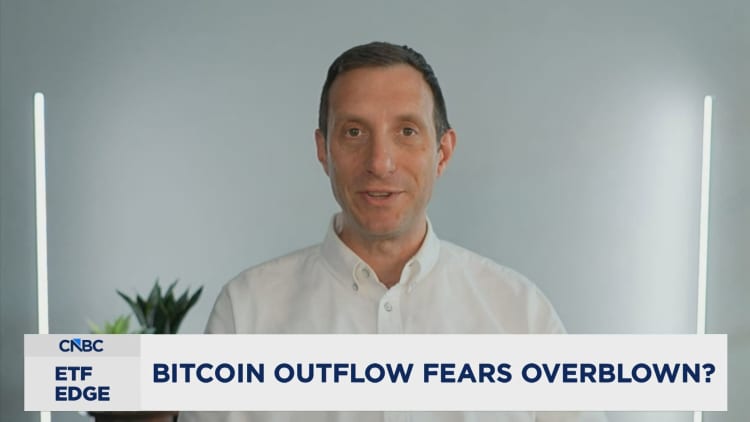

CoinDesk’s president of indices and data has a message for investors: Don’t count out bitcoin.
“When I got my first smartphone, which is a great example of a disruptive technology that has been incorporated into my life, I didn’t get the smartphone and say, ‘This thing is garbage because I can’t get a taxi in front of my home whenever I want it.’ I was very excited that I didn’t have to carry an MP3 player and my cellphone at the same time,” David LaValle told CNBC’s “ETF Edge” on Monday.
LaValle’s call comes during a rough time for bitcoin. The cryptocurrency is off almost 2% over the shortened holiday week. Plus, bitcoin is down almost 50% since its all-time high of $126,279 hit on Oct. 6, 2025, as of Thursday’s close.
Bitcoin crossed over the key level of $65,000 on Monday, but by Thursday it dipped back into the $63,000 range.

Bitcoin performance
Despite the losses, LaValle thinks the downturn, which is often referred to as a “crypto winter,” won’t permanently discourage institutional and retail investors from boosting exposure to the asset.
“As it pertains to the future of the digital asset, a lot has transpired, and there have been downdrafts over the past eight years,” he said. “Unlike previous crypto winters, this is like, ‘Hey, when do I get back in as opposed to whether or not there’s a future.’ We look at this as a point of credibility.”
TMX VettaFi’s head of research and editorial, Todd Rosenbluth, sees a promising trend among bitcoin ETF investors. He finds they’re largely holding onto them despite the ongoing market uncertainty, which is a sign of optimism.
The iShares Bitcoin Trust ETF (IBIT) “actually just crossed into the net outflows, despite bitcoin itself having been down for much of the year,” Rosenbluth said in the same interview. “So, people were still holding on, and in fact buying IBIT through the initial downdraft. That’s encouraging to me that people were holding on.”
He pointed to a VettaFi survey of 104 financial advisors in early May. According to Rosenbluth, it revealed where the firm’s clients stand on digital assets. It showed almost half of them were watching the stock from the sidelines while just 22% were actively investing or building.
“A [crypto] pullback has created a buying opportunity for some people. Others, it might reinforce that they don’t want to be near it when something sells off too strongly,” Rosenbluth said. “But I do think we’re going to see continued evolution of the demand.”
Meanwhile, the losses have been impacting some of the largest bitcoin ETFs, which includes the iShares Bitcoin Trust ETF and Grayscale Bitcoin Trust ETF (GBTC). They’ve fallen 40% over the past 52 weeks.



Coinbase is allowing businesses to accept USDC payments from autonomous AI agents as part of a wider expansion of its agent-focused financial tools.
Summary
- Coinbase Business will accept USDC payments initiated by AI agents through its native x402 support.
- Coinbase for Agents adds live market views and conditional actions controlled by user-defined trading guardrails.
- Developers can add agent payment acceptance to online services using Coinbase’s streamlined CDP x402 SDK.
The exchange announced the rollout on July 23, 2026, alongside new trading commands for users and a developer kit for adding x402 payments to online services.
Coinbase said software-generated traffic exceeded human traffic on its Base documentation pages for the first time in June. The company argued that most online payment systems still assume “a human clicking the button,” leaving businesses and developers without a simple way to serve autonomous software.
Coinbase Business adds agent payments
Beginning this week, Coinbase Business users can accept USDC payments sent by AI agents. Coinbase Payments powers the feature, while native x402 support handles internet-based, pay-per-use transactions. Businesses can receive, track, reconcile and cash out agent payments from the same account used for other payment activity.
Coinbase Business also offers rewards on eligible idle USDC balances. Its current business page lists a 3.35% annual reward rate, although Coinbase says rates can vary by region and may change. The company also states that USDC payments do not carry chargeback risk because Coinbase does not act as a party to transactions between businesses and their customers.
New commands expand Coinbase for Agents
Coinbase also added real-time market views and conditional actions to Coinbase for Agents. The new commands let an agent stream open orders, view an asset’s order book and watch live price and volume data. Users can set a condition that triggers a planned action, including a buy, sale or order cancellation.
The company presented examples such as selling assets when Bitcoin falls below a set level or cancelling an order after a fixed period. Users define those instructions and related guardrails.Coinbase for Agents already allowed authorised AI tools to trade, manage portfolios and complete financial workflows through linked Coinbase accounts.
CDP x402 SDK targets developers
Coinbase Developer Platform introduced a new CDP x402 SDK that lets developers add agent payments to an API, Model Context Protocol server or web service with a small code setup. Coinbase said the kit arrives preconfigured with its preferred infrastructure and extensions, reducing the manual work previously required to choose payment middleware and service providers.
The x402 standard uses the HTTP 402 “Payment Required” response to send payment instructions directly between an online service and a client. An AI agent can receive the request, sign a stablecoin payment and retry access with proof of payment. Coinbase launched the open standard in May 2025 for APIs, applications and autonomous agents.
The latest products extend a series of agent-payment releases from Coinbase. As previously reported, Amazon added Coinbase x402 to Bedrock AgentCore Payments in May, allowing agents to pay for services in USDC. Coinbase-backed x402 also launched Agentic.market in April to help agents discover and purchase compatible online services.
The company has not disclosed payment volumes expected from the feature.Coinbase said the three updates cover businesses receiving payments, people directing financial agents and developers building agent services. The rollout remains tied to user-set controls, supported regions and product availability. Coinbase Business currently operates in the U.S. and Singapore, while individual features and USDC reward rates may differ by market.


Bitcoin held near $65,000 in Asia morning hours on Friday, barely moving while nearly $800 billion evaporated from the biggest U.S. technology stocks – a rare stretch of independence for an asset that has tracked the AI trade all month.
The largest cryptocurrency traded at about $65,400, down less than 1% on the day and up 3% on the week. Ether slipped 3% to $1,879, and the rest of the majors leaned red. Dogecoin was the worst of them, down 5% on the day to $0.069 and 4% on the week. XRP fell 2% to $1.11, Solana lost 3% to $76, and Hyperliquid’s HYPE dropped to $58, down 4% over seven sessions. The moves were losses, but modest ones against what was happening in equities.
The Magnificent Seven, a colloquial term for the megacap group that has driven U.S. stocks for three years, fell 4.8% on Thursday and shed $797 billion in market value in their worst day since the tariff selloff of April 2025, according to Bloomberg.
The drop dragged the S&P 500 down 1.2% and the Nasdaq 100 down 1.9%, and it left the group 11% below its late-May record, erasing $2 trillion.


Binance has added Across Protocol (ACX), Lisk (LSK) and Stacks (STX) to its Monitoring Tag list after completing its latest project reviews.
Summary
- ACX, LSK and STX now carry Binance’s Monitoring Tag and face regular listing reviews ahead.
- Binance will assess liquidity, development, security, communication and token supply before changing each token’s status.
- STX fell sharply after the announcement, while ACX showed a smaller daily decline on Binance.
The change took effect on July 24, 2026, and places the three tokens under closer checks for volatility, liquidity, development activity and operational risk. The decision does not stop spot trading or related services.
The exchange said Monitoring Tag assets carry higher volatility and risk than other listed tokens. However, the tag does not mean Binance has decided to remove ACX, LSK or STX. The company said the tokens are “at risk of no longer meeting our listing criteria and being delisted” if later reviews find continued concerns.
Binance expands its risk review list
Binance reviews tagged projects at regular intervals. Its assessment covers team commitment, development quality, trading volume, liquidity, network security and smart contract stability. The exchange also checks public communication, responses to due diligence requests and any major changes to token supply or tokenomics.
The review also considers evidence of fraud, negligence or conduct that may harm the wider market. Binance did not give a project-specific reason for adding each token. It also said other services linked to ACX, LSK and STX would remain available, while the new tags would appear shortly after the notice. Binance can later remove the tag or move toward delisting after further checks. The exchange said the process aims to ensure listed assets continue to meet its current compliance standards.
ACX, LSK and STX face market pressure
Market data showed different reactions across the three assets. At the time of writing, Binance listed STX near $0.150, down about 10.4% over 24 hours. ACX traded near $0.041 after a 2.6% decline. Separate market data placed LSK near $0.085 as traders assessed the announcement. Prices may continue to change as trading activity develops.
ACX joined Binance in December 2024 with a Seed Tag and rose about 147% after the listing announcement. More recently, Across Protocol approved a plan that gives holders a route to exchange ACX for equity in a new U.S. company or accept a USDC buyout. Binance did not say whether that restructuring influenced its decision.
Projects continue separate development plans
Lisk has also changed its network structure in recent years. The project moved from its original layer-1 model to the Optimism Superchain. As crypto.news reported, its community later considered whether to burn 100 million LSK, equal to 25% of the planned supply, or place the tokens in a long-term DAO fund.
Stacks, meanwhile, continues to develop Bitcoin-based smart contract products. The network uses STX for fees, smart contract execution and miner rewards. In 2025, digital asset custodian Hex Trust added support for STX and sBTC, expanding institutional access to the Stacks ecosystem.
The Monitoring Tag now makes Binance’s future reviews the main listing test for all three tokens. A project can later lose the tag if the exchange finds that conditions have improved. It can also face delisting if Binance decides it no longer meets the platform’s standards.
Trading remains available, and Binance said other services will not be affected. The exchange plans to update the Monitoring Tag labels after publication. It did not set a date for the next review or give a timetable for a delisting decision.
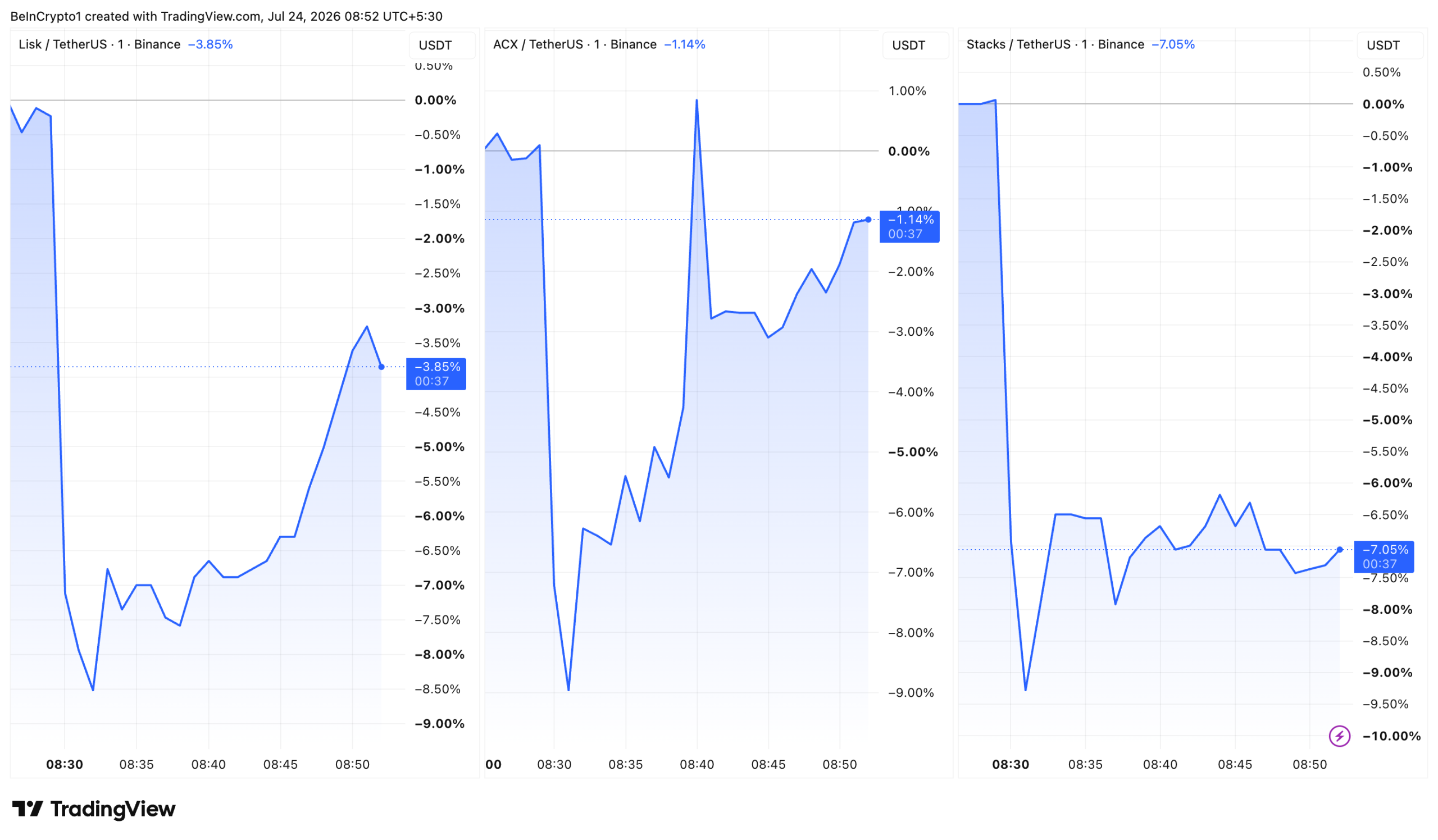
Binance added Across Protocol (ACX), Lisk (LSK), and Stacks (STX) to its Monitoring Tag on July 24, signaling all three now carry delisting risk on the world’s largest crypto exchange.
The tag marks tokens that show higher volatility and risk than other listed assets. Binance reviews these projects regularly and can delist them if they fail to meet its criteria.
Why the Binance Monitoring Tag Matters
The Monitoring Tag is Binance’s warning system for assets it deems higher risk. It does not remove a token right away.
Instead, it puts projects on notice. Binance weighs team commitment, development activity, trading volume, network stability, and tokenomics changes during each review. Evidence of fraud or negligence can also trigger the tag.
“These tokens are closely monitored, with regular reviews conducted. Keep in mind that tokens with the Monitoring Tag are at risk of no longer meeting our listing criteria and being delisted from the platform,” the exchange said.
Follow us on X to get the latest news as it happens
Token Prices Slide Amid Binance Delisting Threat
All three tokens fell sharply after the news before paring some losses. Lisk dropped to $0.074 on Binance, an all-time low.

At press time, LSK traded down 3.85% on the day. Across Protocol slid to an intraday low of $0.035, its weakest level since March.
ACX had recovered to a 1.14% loss by press time. Stacks fell to an intraday low of $0.143, its lowest since late 2020. STX showed the steepest drop of the three, down 7.05% at press time.
The tag does not guarantee removal. Still, it serves as a warning signal. The exchange added it to Beefy.Finance (BIFI) and Measurable Data Token (MDT) in June 2025.
FunToken (FUN) and Orchid (OXT) received it in March 2026. All four were confirmed for delisting from Binance in April 2026, alongside FIO Protocol (FIO) and Wanchain (WAN).
Subscribe to our YouTube channel to watch leaders and journalists provide expert insights
The post 3 Altcoins Decline as Binance Flags Delisting Risk appeared first on BeInCrypto.

A federal court is set to review whether a $5 million settlement between the US Commodity Futures Trading Commission (CFTC) and Gemini should be reversed, even as Gemini co-founder Cameron and Tyler Winklevoss have directed substantial Bitcoin donations to political groups supporting President Donald Trump. The latest development comes from a new disclosure by the MAGA Inc. Super PAC.
In a Federal Election Commission (FEC) filing dated Monday, MAGA Inc. Super PAC reported receiving two Bitcoin contributions exceeding $5 million each on June 19—totaling $10 million in BTC—sent by the Winklevoss-run Gemini Trust Company. The donation timing overlaps with the period when the CFTC and Gemini are seeking to revisit the earlier enforcement outcome in federal court.
Key takeaways
- MAGA Inc. Super PAC’s July FEC report says Gemini Trust Company sent two Bitcoin contributions of more than $5 million each on June 19.
- The payments were made about three weeks after the CFTC and Gemini jointly filed a motion to reverse a January 2025 settlement.
- CFTC Chair Michael Selig previously characterized the original enforcement as politically targeted under the prior administration.
- A CFTC spokesperson told Cointelegraph in June that, if the court grants relief, the $5 million penalty would not be returned to Gemini.
- Separately, lawmakers have pushed the Trump White House to nominate additional CFTC commissioners as the agency prepares to oversee broader crypto-market rules.
Bitcoin donations disclosed amid court fight over Gemini settlement
According to the MAGA Inc. Super PAC report filed with the FEC, Gemini Trust Company made two separate transfers of Bitcoin on June 19. Each contribution was valued at more than $5 million, bringing the disclosed total to $10 million.
The filing indicates the super PAC can use the funds for independent expenditures supporting Trump. That matters because super PAC spending can influence elections indirectly—by funding advertising and other political activities—rather than making direct coordination with candidates.
The June 19 contributions came roughly three weeks after the CFTC and Gemini jointly moved in federal court to revisit a settlement dated to January 2025. In that earlier case, the CFTC alleged Gemini made false or misleading statements. The current joint filing seeks a reversal of that settlement in the US District Court for the Southern District of New York.
When the CFTC and Gemini filed their joint motion, Cointelegraph reported that CFTC Chair Michael Selig argued at the time that the enforcement during the Biden administration “politically targeted” the Winklevosses. The broader implication is that the dispute is not only about legal interpretation of statements, but also about whether the CFTC’s enforcement posture should be treated as politically motivated.
What’s known about the CFTC-Gemini motion—and what remains unanswered
While the joint motion was filed in May, Cointelegraph reported that no decision has yet been posted to the public docket. That means the court’s view on whether the settlement should be reversed is still pending.
Cointelegraph also said it reached out to the CFTC and Gemini’s counsel, Avi Perry, for comment on the $10 million contribution but did not receive an immediate response. A CFTC spokesperson, however, provided context in June about the penalty outcome: both sides “agreed that the $5 million penalty will not be returned to Gemini” if the court grants the reversal.
This point is important for market watchers because it separates two possible outcomes. Even if the settlement is overturned, the agency’s position (as relayed by a spokesperson) suggests the immediate financial consequence may not change in Gemini’s favor. In other words, the court fight may affect precedent or regulatory record more than it affects the transfer of funds already paid.
The dispute is occurring as crypto regulation in the US continues to evolve—especially around how regulators determine what constitutes improper statements and how they translate market-facing communications into enforcement actions.
Winklevoss political support spans multiple BTC donations
The MAGA Inc. disclosure is the latest entry in a broader pattern of political involvement by the Winklevoss brothers and Gemini leadership.
Cointelegraph reported that both brothers donated $1 million each to Trump’s 2024 election campaign and supported the then-candidate through social media posts. After Trump took office in January 2025, the twins attended a stablecoin payments bill signing ceremony for the GENIUS Act. They also supported American Bitcoin, a crypto mining venture associated with Trump’s sons, and contributed $21 million in Bitcoin to the Digital Freedom Fund PAC, according to earlier coverage.
These actions do not establish any legal relationship to the CFTC-Gemini case on their own. But they do intensify political attention on the timing and dynamics between regulatory enforcement, court strategy, and high-profile political backing—particularly when lawmakers are already debating the degree of independence regulators should maintain.
Concerns from lawmakers and a CFTC shaped by a lone chair
Criticism of the CFTC’s joint approach to reversal has come from members of Congress. Cointelegraph reported that Senator Elizabeth Warren, in a June letter to CFTC Chair Selig, described the joint motion for reversal and other factors as “concerning signs” of a commission influenced by political pressures and aligned interests, rather than governed strictly by rule of law and a duty to protect investors and market integrity.
At the same time, the CFTC’s internal composition remains a central policy issue. Cointelegraph noted that Selig remains the sole commissioner leading the agency, with no additional nominations announced as of Thursday. The CFTC is usually governed by a bipartisan set of five commissioners, so a one-person board structure can shape both enforcement priorities and how quickly the agency can adopt new regulatory approaches.
Many lawmakers have been urging the Trump administration to nominate additional commissioners. That pressure coincides with congressional work on crypto market structure legislation, including the Digital Asset Market Clarity (CLARITY) Act, which—per Cointelegraph’s reporting—is expected to expand the CFTC’s authority in regulating and overseeing digital assets.
With the White House not yet announcing nominations, Selig effectively directs the agency’s agenda for now. That matters to investors and market participants because the CFTC’s leadership and regulatory posture can influence which enforcement theories are pursued, how compliance expectations are interpreted, and what rulemaking momentum looks like in practice.
Separately, Cointelegraph reported that as of June 30, MAGA Inc. had received more than $397 million. That figure underscores the scale of political fundraising activity around the election cycle, even as individual disclosures like the June 19 BTC transfers keep drawing scrutiny to the intersection of crypto wealth, regulation, and politics.
As the court considers whether the Gemini settlement should be reversed, the key watchpoints are whether the docket produces a ruling soon, how the CFTC frames the reversal in legal terms if relief is granted, and whether additional CFTC commissioner nominations are announced—developments that could determine how aggressively the agency’s crypto oversight evolves next.

Japan is moving closer to allowing Bitcoin exchange-traded funds (ETFs). The country’s first product could potentially arrive in 2028 if planned regulatory changes move forward, according to the latest Nikkei report.
The development comes after amendments approved by lawmakers that bring crypto assets under the Financial Instruments and Exchange Act, prompting the Financial Services Agency (FSA) to begin revising investment-fund rules so investment trusts and ETFs can directly hold digital assets.
The transition also means that crypto oversight will move away from the Payment Services Act.
Bitcoin ETF Momentum Builds in Japan
Some estimates suggest Japanese Bitcoin ETFs could attract up to JPY 3 trillion by fiscal 2028. However, it is important to note that no such investment vehicle has been cleared for launch. Before any such product reaches the market, Japan must complete further regulatory revisions to permit funds offering exposure to crypto assets. Major financial firms such as SBI Holdings and Nomura are reportedly developing crypto investment products.
Community reaction was quick. One member said that the development is a “quiet policy U-turn” for Japan, which had taken a cautious approach to the industry since the collapse of Mt. Gox. A regulated spot Bitcoin ETF could eventually provide Asian investors with an easier way to gain exposure to the asset and end up influencing other countries in the region, such as South Korea, which often looks to Tokyo when shaping financial policies.
Meanwhile, the new legislation imposes harsher penalties on unregistered crypto operators. The maximum prison term has increased from three years to 10 years, while the highest fine has been raised from 3 million yen ($18,500) to 10 million yen. It also expands disclosure requirements and introduces stricter insider trading rules.
Corporate Adoption
The regulatory push also comes as corporate interest in the asset class continues to grow in Japan. Earlier this month, SBI VC Trade said more companies are adding not just Bitcoin but also XRP to their treasury holdings as the weakening yen encourages businesses to diversify their reserves. The exchange also reported higher adoption of crypto for shareholder benefit programs and growing demand for its institutional services.
Japan remains one of XRP’s strongest markets, with SBI playing a crucial role through its partnership with Ripple on cross-border payments. It recently launched Ripple’s RLUSD stablecoin after regulatory approval and has filed for a product that could become the country’s first XRP ETF.
The post Bitcoin ETFs Edge Closer in Japan as Regulators Tighten Crypto Oversight appeared first on CryptoPotato.
Crypto World
Wall Street Analyst Says AI Spending Arms Race Is at 15% After Tesla and Google Selloff


Wedbush Securities managing director Dan Ives says the artificial intelligence spending buildout is still in its early stages. He pushed back against Thursday’s selloff in Tesla and Alphabet shares.
Ives made the case on CNBC’s “Power Lunch.” Both companies had just posted revenue beats, yet investors punished them for heavier AI capital spending.
“Only 15% of the Way Through”
Ives called the pullback a timing problem, not a valuation problem. Tesla (TSLA) stock fell 14.5% Thursday. Alphabet (GOOGL) slid nearly 7%, even though Google Cloud revenue jumped 82% to $24.8 billion. Ives said:
“This is an arms race that’s playing out and we’re only 15% of the way through.”
He likened the hyperscalers’ spending to early Las Vegas Strip construction. The buildings came first, he argued, and the payoff followed later. That framing runs counter to growing AI bubble fears elsewhere in tech.
Patience Wearing Thin, Not Broken
On Tesla specifically, Ives said investor patience is fading. The AI story, autonomous driving, and Optimus robotics haven’t delivered near-term payoff yet. He called Tesla’s capex spending a “gut check moment” rather than grounds to abandon the thesis.
Ives also weighed in on Musk’s broader corporate structure. He estimates better-than-80% odds that SpaceX eventually acquires Tesla, running ahead of the market. Kalshi’s prediction market currently prices around a 69% chance of a merger before 2028.
Intel reported earnings the same evening. Ives’ framing sets up a real test for next week’s Big Tech reports. Investors will find out soon whether demand data backs his “early innings” call or the market’s more skeptical read wins out.
The post Wall Street Analyst Says AI Spending Arms Race Is at 15% After Tesla and Google Selloff appeared first on BeInCrypto.


Jim Cramer laid out a framework for judging stock market crashes on Mad Money on Thursday. He said most selloffs are mechanical malfunctions worth buying, while only a handful pose real economic threats.
Cramer, the CNBC host who has traded through four decades of market cycles, compared three events to make his case. He cited Black Monday in 1987, the 2010 flash crash and the 2007-2009 financial crisis.
Mechanical Selloffs Look Scarier Than They Are
Cramer pointed to the Dow Jones Industrial Average’s 508-point drop on October 19, 1987, as his clearest example. That 22.6% single-day plunge became known as Black Monday.
He blamed a flawed hedging strategy called portfolio insurance for turning a bad week into a historic crash. The strategy used futures contracts to try to cap losses automatically.
He reached a similar conclusion about the 2010 flash crash. The Dow fell nearly 1,000 points in about 36 minutes on May 6, 2010. It recovered most of that loss the same day.
Cramer said a nearly identical pattern played out during the market’s sharp opening plunge in August 2015. He blamed futures-market malfunctions, not weakening fundamentals, for both events.
Systemic Crises Demand a Different Read
Cramer called the 2007-2009 financial crisis a different animal entirely. The Dow fell from its October 2007 peak above 14,000 to roughly 6,470 by early March 2009. That marked a decline of more than 54%. The index did not fully recover until 2013.
Cramer, whose own market calls have had mixed results recently, said the difference comes down to real economic damage. He cited failing banks, rising job losses and a Federal Reserve that moved too slowly at first. He credited the Fed’s later shift toward aggressive intervention with helping the market eventually find its footing.
Cramer’s takeaway is straightforward. Investors should check whether a selloff coincides with genuine economic deterioration before assuming the worst. Mechanical declines have historically reversed within months, while systemic ones can take years.
The post Jim Cramer Shares His Framework for Telling a Buyable Crash From a Real One appeared first on BeInCrypto.

Bitcoin may be nearing a more stable trading base, but at least one prominent asset manager says investors shouldn’t pin the next major upside cycle on the same drivers that defined earlier booms. In a new write-up, Bitwise chief investment officer Matt Hougan argues that the next bull market will be powered by deeper TradFi-to-crypto integration—specifically by platforms that can bring crypto’s 24/7 trading features into mainstream financial workflows.
Hougan points to Hyperliquid’s widening footprint and Robinhood’s push into crypto infrastructure as two concrete examples. In parallel, Bitwise data cited by Hougan and a separate X post from Bitwise research head Andre Dragosch suggest that “apparent demand” for BTC may be starting to improve after a prolonged period of weakness.
Key takeaways
- Matt Hougan (Bitwise) says the next crypto bull market is more likely to be driven by TradFi integrations than by purely crypto-native catalysts.
- He highlights Hyperliquid’s growing use cases across conventional assets and product expansion as a sign of broader convergence.
- Hougan sees Robinhood-related infrastructure as another bridge that could help “lift” a wide range of crypto assets.
- Bitwise’s framework for “apparent demand” indicates BTC demand may be “re-accelerating,” even as spot demand remains a recurring concern.
Why Bitwise thinks the next cycle starts in TradFi
Hougan framed his positioning thesis around the idea that the market’s next sustained expansion will come from crypto benefits becoming easier to access for traditional investors. In a blog post published Wednesday, he asked how to begin positioning for what he expects to be a new bull market and answered with a pair of entities he believes represent convergence from opposite directions.
“By looking at two entities that are leading this convergence from opposite sides: Hyperliquid and Robinhood.”
The underlying premise is that crypto’s structure—particularly constant markets and instant settlement—creates advantages that traditional finance has historically lacked. For Hougan, the key question is not whether Bitcoin will bottom, but whether new demand channels will be able to scale once mainstream firms and familiar interfaces adopt crypto trading patterns.
On Hyperliquid, Hougan emphasized that the platform’s activity is not confined to crypto pairs. According to his description, nearly half of Hyperliquid’s volume is tied to “conventional assets like oil, silver, and the S&P 500,” and the venue is reportedly expanding into spot commodities, prediction markets, and options.
That mix matters because it signals an appetite for trading experiences that look and feel familiar while still operating with crypto-native mechanics. If those flows continue to grow, Hougan argues that the effect should reach beyond isolated tokens and instead support the broader sector.
The “rising tide” thesis for majors and crypto equities
Hougan also ties his outlook to the competitive pressure from traditional financial players entering the crypto ecosystem through infrastructure and distribution. He referenced Robinhood’s “Chain layer-2 network” as an example of how legacy finance might become more directly connected to crypto market dynamics.
“I suspect the coming bull market will be big enough to lift most of the sector.”
From there, he lays out a portfolio-style approach: he says he remains bullish on major assets such as Bitcoin, Ethereum, and Solana, while also expressing optimism about crypto equities. The common thread in his argument is that broadening participation tends to support liquidity across the market, not just the most narrative-driven names.
Hougan’s positioning aligns with his broader tone entering 2026. Earlier this year, he argued that the end of the “crypto winter” could arrive sooner than expected, and he maintained that view while markets continued to work through weakness.
BTC: “apparent demand” shows a possible reversal
While Hougan’s thesis focuses on what could power the next cycle, the day-to-day question for traders is whether Bitcoin’s demand backdrop is stabilizing. Cointelegraph previously reported that many market participants were looking for bottoming signals, but also suggested the bear phase could still have months left depending on how spot demand evolves.
In that context, the spotlight has remained on the question of whether spot buying is returning—particularly on shorter time frames where demand can appear fragile even when longer-term conditions are improving.
However, Bitwise is pointing to a different metric that may be shifting. According to an X post on Thursday by Andre Dragosch, Bitwise’s European head of research, BTC “apparent demand” is “re-accelerating.” Dragosch’s post frames the change as a meaningful departure from the prior slowdown.
What “apparent demand” means: it measures the difference between newly mined BTC and the supply that has remained inactive for at least one year. In effect, it provides a way to infer whether recently produced coins are being absorbed rather than circulating from dormant holdings.
That distinction matters for investors because a sustained improvement in apparent demand can indicate that the market is finding new buyers—even if spot volumes are not yet fully convincing across every trading window. Still, the metric is not identical to spot demand, and it won’t resolve instantly the question of where a bottom will form on price alone.
What to watch next as TradFi integration and demand signals collide
Hougan’s argument implies that even if Bitcoin’s near-term chart shows gradual stabilization, the bigger inflection point will likely depend on how quickly mainstream access and crypto trading mechanics begin to reinforce each other. Hyperliquid’s ability to attract volume tied to conventional assets and its expansion into additional derivatives-style products could provide one path, while Robinhood-related ecosystem development is another.
At the same time, BTC investors appear to be watching for whether the “re-accelerating” apparent demand signal persists beyond a short burst. If apparent demand continues to improve while broader spot demand recovers, the market may be closer to a durable transition than “bottom” headlines alone would suggest.
On Wednesday, Senate Republicans released the proposed text for the CLARITY Act, which has been met with pushback from Democrats regarding ethics provisions.

Meesho shares crack 5% as weak Q2 outlook spooks Street; Citi, Morgan Stanley react

Ryan Fox wasted no time hitting his Open-winning putt. Here’s why

This 85-inch LG mini LED TV has just fallen below $1000


-

 Fashion6 days ago
Weekend Open Thread – Corporette.com
-

 Politics6 days ago
The House | The City of London can help the new chancellor deliver growth in every postcode
-

 Crypto World6 days ago
Ripple Payments Joins MiCA With 14 Firms, Does It Mean Anything For XRP?
-
 Crypto World7 days ago
Two July Windows Left: The CLARITY Act’s Senate Fight and What Failure Means
-

 Politics5 days ago
Democrats look to World Cup watch parties to register thousands of voters
-

 Crypto World6 days ago
Ripple wins EU-wide access as ESMA adds it to MiCA register
-

 Crypto World3 days ago
Grayscale Files For Worldcoin ETF, WLD Registers Sharp Rise
-

 NewsBeat4 days ago
Unregistered fitter used Gas Safe logo on business flyers
-

 Tech3 days ago
Sail Virtually Aboard The “Itanic” With IA-64 Emulator
-
 Tech3 days ago
Turtle Beach Command Series KB7 review: a nifty screen-equipped gaming keyboard
-

 NewsBeat7 days ago
Registration is now open for March for Men with Kev 2026
-

 News Videos4 days ago
Big Money Is Entering XRP
-
 Business2 days ago
New Jersey voter registration controversy explained: How 6,600 noncitizens got on the rolls, and what happens next
-

 News Videos7 days ago
Money | Class 12 Economics | CBSE Board Exam 2026-27
-

 Crypto World6 days ago
Kaspersky exposes OkoBot’s 20-module crypto wallet attack
-

 Business6 days ago
Airlines warn Sunshine Protection Act could disrupt flight scheduling
-
 Entertainment2 days ago
Johnny Depp’s R-Rated Gothic Cult Classic Gets New Release Ahead of Sydney Sweeney Remake
-

 NewsBeat6 days ago
Durham County Council to send out electoral registration emails
-

 Crypto World6 days ago
MiCA Licensing Faces Delays as ESMA Adds 14 CASPs to Register
-

 Crypto World1 day ago
Ethics, other provisions in crypto Clarity Act to be further discussed
You must be logged in to post a comment Login