
Crypto World
Bitcoin Believers Who Lasted 16 Months Just Sold Every Coin to Survive

Genius Group (GNS) sold its entire Bitcoin (BTC) treasury of 84.15 BTC on April 1, 2026, fully repaying $8.5 million in debt and leaving the company with zero BTC on its balance sheet.
The Singapore-based AI-powered education company adopted its Bitcoin-first strategy on November 12, 2024, just days after the US presidential election, committing to hold 90% or more of its reserves in BTC.
Genius Group Moves From 440 BTC to Zero
The exit marks the end of a 16-month run as one of the earliest post-election corporate BTC treasury adopters.
Genius Group’s BTC accumulation peaked at approximately 440 BTC by early 2025. Based on current rankings, this would place the firm among the top 70 public companies holding BTC.
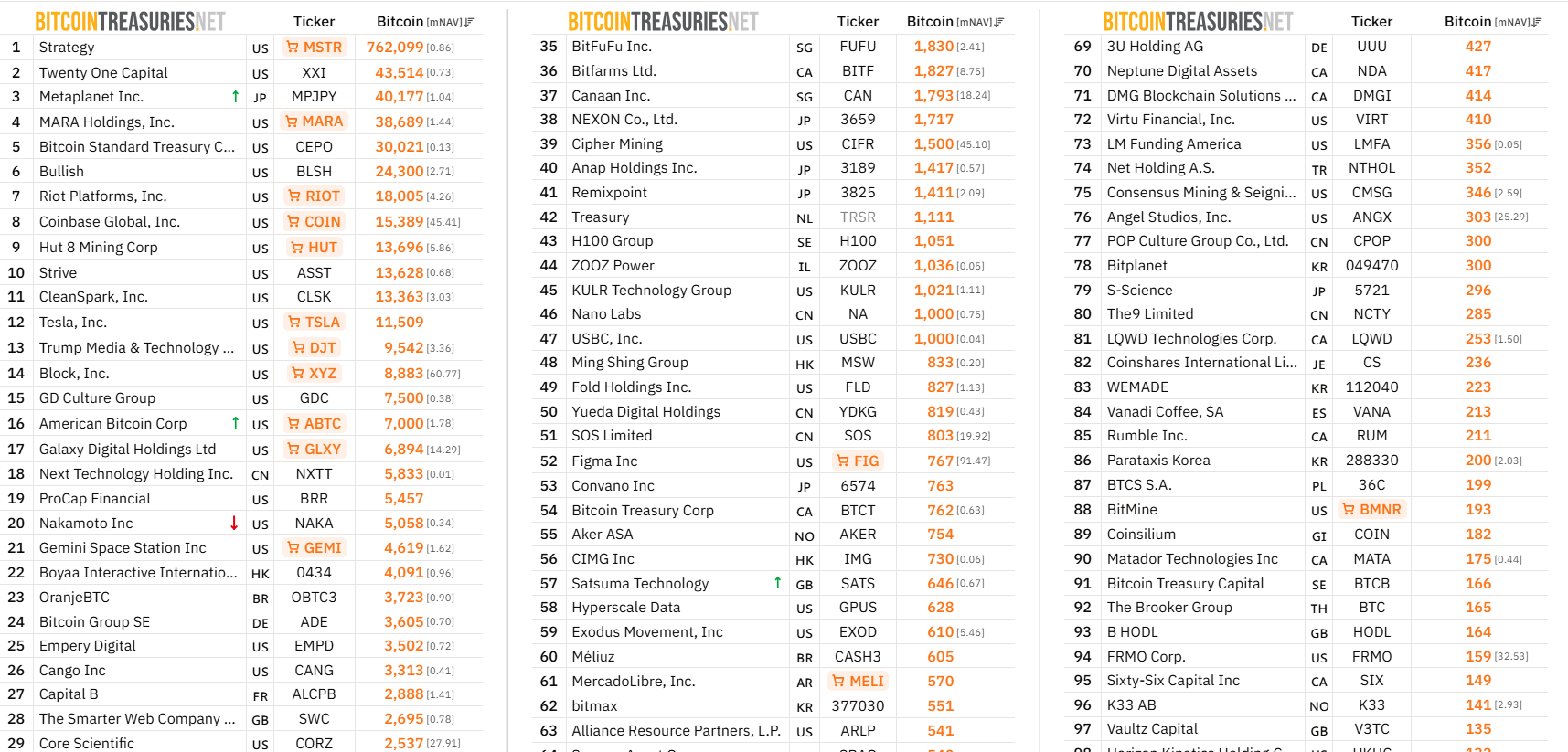
The company tied its treasury strategy directly to its identity as an AI-powered education group. They framed BTC as its primary reserve asset alongside workforce training and experiential learning programs.
The unraveling began when a US court order blocked the company from raising capital or issuing new shares.
That legal constraint removed the company’s ability to fund operations without tapping its BTC holdings. Sales proceeded in stages rather than in a single transaction.
By February 6, 2026, Genius Group held exactly 84.15 BTC after selling approximately 96 BTC between late December 2025 and early February 2026.
The partial sales reduced a BTC-backed loan from roughly $8.5 million to around $3.3 million before the final liquidation cleared the balance entirely.
Debt Pressure Forces the Exit
The final BTC sale occurred during Q1 2026 and was completed before March 31. The company announced zero holdings on April 1 alongside its Q1 results, confirming the full debt repayment.
The exit came at a loss. Genius Group’s average BTC cost basis sat near $102,000 per coin from earlier accumulation. Meanwhile, prices during the Q1 sale period ran softer, around $66,500.
Despite the treasury wipeout, the company’s core operations showed growth. Q1 2026 operational revenue reached $3.3 million, up 171% from $1.2 million in Q1 2025.
Gross profit grew 228% to $2.0 million, and gross margin improved to 62% from 52% a year earlier. Adjusted EBITDA from operations turned positive at $600,000, compared to negative $400,000 in Q1 2025.
CEO Roger Hamilton attributed the operational improvement to a strategic focus on higher-margin education programs across Genius School, Genius Academy, and Genius Resorts.
“Our first quarter marks a significant milestone for Genius Group. It shows that our focus on three revenue drivers – Genius School, Genius Academy, and Genius Resorts – is paying off, with our operational revenue getting close to tripling year-on-year,” read an excerpt in the announcement, citing founder and CEO Roger
A Pause, Not an Exit
Genius Group framed the BTC liquidation as a temporary measure rather than a permanent reversal of strategy.
The company stated it will recommence building its Bitcoin treasury when it believes market conditions are more favorable.
Hamilton has accumulated 5.5 million company shares since 2024, a signal management cited as a sign of confidence in the company’s longer-term direction.
The company also pointed to continued expansion of its Genius City project in Bali, a combined education and residential hub, as part of its broader Southeast Asia growth plan.
Whether the company can rebuild a BTC treasury position without the fundraising constraints that forced the selldown will depend on the resolution of its ongoing legal proceedings and BTC price conditions at the time of any renewed accumulation.
The post Bitcoin Believers Who Lasted 16 Months Just Sold Every Coin to Survive appeared first on BeInCrypto.


Coinbase has secured conditional approval from the Office of the Comptroller of the Currency for a national trust charter. The decision signals progress toward federal oversight of its custody business and strengthens its position in institutional crypto infrastructure.
Coinbase Moves Toward Federal Custody Framework
Bitcoin traded near $68,000 as markets absorbed regulatory developments in the United States. Meanwhile, Coinbase advanced its institutional strategy with a key approval milestone. The company aims to expand federally supervised custody services.
The OCC granted conditional approval for Coinbase National Trust Company after reviewing its application. The regulator outlined requirements that Coinbase must meet before receiving full authorization. These conditions include compliance systems, governance frameworks, and risk controls.
The approval does not permit deposit-taking or lending activities under the trust structure. Instead, Coinbase will focus on custody, staking, and fiduciary services for institutions. This model aligns with existing trust company frameworks used in financial markets.
Conditions Highlight Compliance and Risk Controls
Coinbase must satisfy several operational and regulatory conditions before launching the trust entity. These include anti-money laundering programs and know-your-customer procedures. The company must also meet capital and liquidity standards set by regulators.
Additionally, Coinbase needs to demonstrate strong governance and internal risk management systems. The OCC requires an operating agreement that defines oversight and reporting obligations. Only after meeting these conditions will the regulator grant full approval.
The timeline for completion remains uncertain, although similar approvals took several months. Coinbase filed its application in October 2025, and the review extended beyond earlier cases. The scale of assets under custody likely influenced the extended review process.
Institutional Demand Drives Charter Strategy
Ethereum traded near $3,400 as institutional participation continued to expand across digital asset markets. Meanwhile, Coinbase reported hundreds of billions in assets under custody. This scale highlights its importance in institutional crypto infrastructure.
The company already serves as custodian for several U.S. spot Bitcoin exchange-traded funds. A federal charter would enhance its credibility among pension funds and asset managers. These clients often require federally regulated counterparties for custody services.
Moreover, the charter enables Coinbase to operate under a unified national regulatory framework. This reduces reliance on state-level licensing systems such as those in New York. It also simplifies compliance across multiple jurisdictions.
Regulatory Context and Industry Competition
Ripple Labs, Circle, and Paxos have also received similar conditional approvals. The OCC has expanded its oversight of crypto-native firms through these charters. Each company must independently meet pre-opening conditions before operating.
At the same time, Binance continues to lead in global trading volumes. However, Coinbase holds a significant share of institutional custody assets. This distinction reinforces its focus on regulated financial infrastructure.
The broader regulatory environment remains complex, with ongoing debates in Congress over digital asset legislation. Coinbase has also engaged in legal actions to defend certain product offerings. These developments reflect evolving oversight across the crypto sector.
Tether is pressuring investors to commit to a fundraising round at a $500 billion valuation within the next two weeks, saying that it may delay the raise if demand falls short.
The El Salvador-based firm has been seeking fresh capital since late last year but has faced resistance from investors wary of the valuation, The Information reported Friday, citing unnamed sources. If commitments fall short of expectations, the company is likely to delay the raise.
The $500 billion target would place Tether among the world’s largest financial firms, exceeding every US bank except JPMorgan Chase. JPMorgan, the largest bank in the world, has a market capitalization of about $794.55 billion, while the second-largest bank in the country, Bank of America, has a market cap of $352.86 billion.
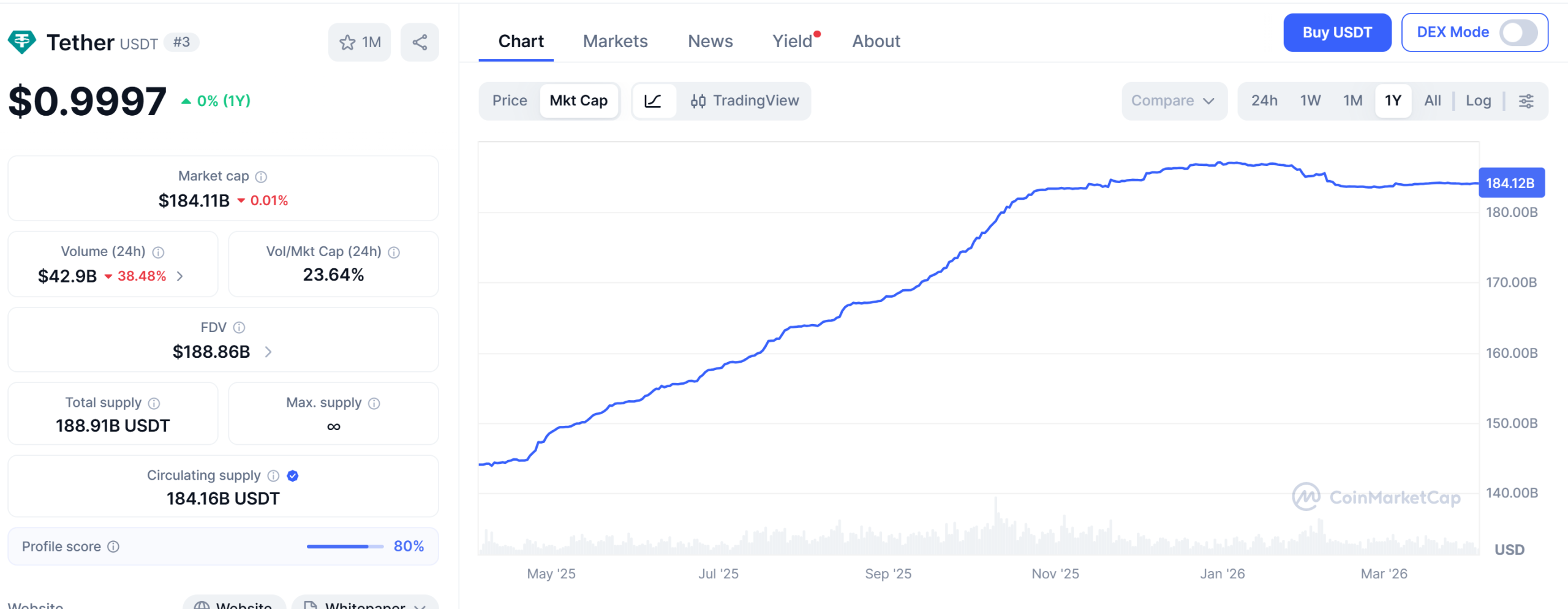
Tether’s USDt (USDT) stablecoin, the world’s largest stablecoin, currently has a market cap of $184 billion. The company’s other top products include Tether Gold (XAUt) and Tether EURt (EURt), pegged to the euro.

Related: Stablecoin supply reaches $315B in Q1 as USDC rises, USDT declines
Tether explores fundraising
In September last year, Bloomberg reported that Tether was exploring a fundraising round of up to $20 billion that could value the company at around $500 billion. The firm was considering raising $15 billion to $20 billion through a private placement for roughly a 3% stake, with Cantor Fitzgerald acting as lead adviser.
Following the report, CEO Paolo Ardoino said on X that the company was exploring a raise from a select group of investors to expand across “existing and new business lines (stablecoins, distribution ubiquity, AI, commodity trading, energy, communications, media) by several orders of magnitude.”
However, in a comment to Cointelegraph in February, Ardoino denied reports that it planned to raise up to $20 billion, saying earlier figures were hypothetical scenarios rather than an active fundraising plan. Still, he defended the $500 billion valuation, comparing the company’s profits to AI platforms such as OpenAI.
Cointelegraph reached out to Tether for comment, but did not get a response by publication.
Related: Tether says ‘Big Four‘ firm to handle first full audit of USDT reserves
Tether taps KPMG for first full audit od USDt
Meanwhile, Tether has reportedly hired KPMG to conduct its first full audit of USDt’s financial statements, with PwC assisting in preparing internal systems, according to the Financial Times. The move follows years of relying on reserve attestations from BDO Italia rather than a comprehensive audit.
A full audit would go beyond reserve snapshots to examine assets, liabilities and internal controls across Tether’s balance sheet.
Magazine: Bitcoin may take 7 years to upgrade to post-quantum — BIP-360 co-author
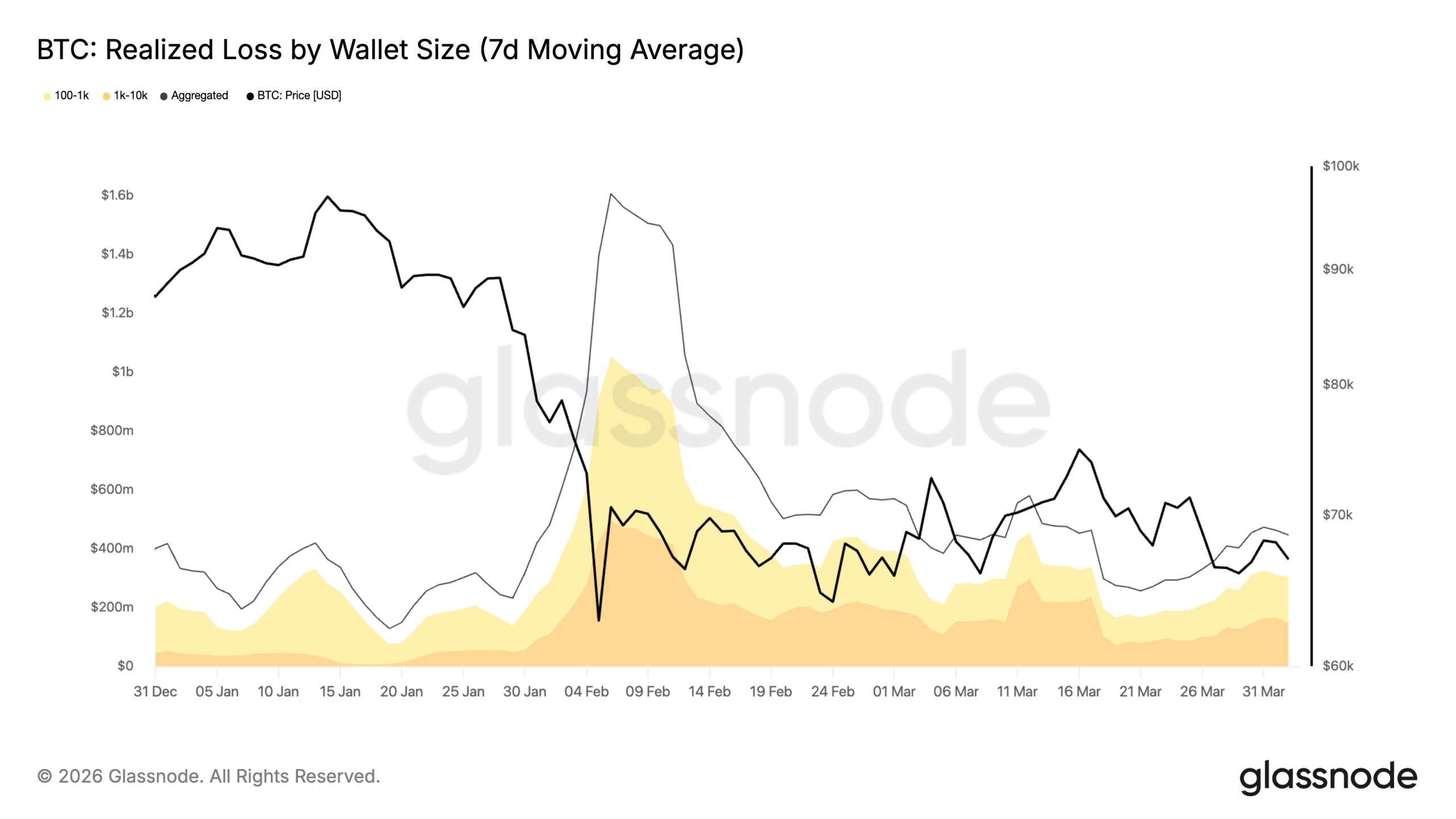
Bitcoin (BTC) traders holding 100–10,000 BTC realized losses at an average of $337 million per day in Q1 2026, the worst quarter since 2022, according to data from Glassnode.
Key takeaways:
-
Bitcoin dropped more than 20% after whales last realized losses at a comparable pace in 2022.
-
Long-term holders are also selling at a loss, indicating capitulation and potentially more downside in price.
BTC whales, sharks realized $30.91 billion loss in 2026
Realized Loss tracks the total dollar value of losses locked in when BTC is sold on-chain below its purchase price. In 2026, two significant wallet cohorts show signs of capitulation.
They are addresses holding 100–1,000 BTC, or “sharks” that often represent mid-sized funds or wealthy investors, and those holding 1,000–10,000 BTC, which are considered whale-sized entities.
In Q1, Bitcoin’s sharks (yellow) realized losses at an average of $188.5 million per day, while whales (orange) comprised another $147.5 million daily.

Combined, these large entities have locked in roughly $30.91 billion in realized losses so far in 2026.
Bitcoin’s realized losses in Q1 2026 for these high-net-worth entities rank among the most severe on record, trailing only Q2 2022’s roughly $396 million daily average.

In Q2 2022, BTC’s price dropped by over 50% and another 20% by the year’s end. It kept falling as the Terra collapse, Celsius freeze, and Three Arrows failure triggered panic across crypto, draining liquidity and confidence.

In 2026, pressure on Bitcoin has come from different sources, including Iran war-driven inflation fears, quantum-security risk, and broader stress in the AI-led risk trade.
Related: Bitcoin supply in profit heads to ‘true bear market’ levels
Therefore, whales and sharks are cutting their losses now because they expect the Bitcoin price to drop further as macro risks mount. This sentiment raises the odds of a 2022-like bear market, with a bottom in Q4 2026.
Bitcoin’s long-term holders add to downside risks
Another sign that Bitcoin’s sell-off may not be over comes from Glassnode’s Long-Term Holder Realized Loss chart, which tracks losses locked in by investors who held coins for more than six months before selling.
That figure remains elevated at around $200 million per day on a 30-day average basis since November 2025.

“A meaningful cooldown toward levels below $25M per day would represent a more compelling signal of exhaustion in selling pressure,” Glassnode analysts said in their weekly report published on Wednesday, adding:
“A prerequisite for the base formation that historically precedes a sustainable bull market transition.”
Together, these headwinds have already fueled calls for a deeper BTC correction, with some analysts pointing to the $40,000–$50,000 range as a possible bottom.
This article is produced in accordance with Cointelegraph’s Editorial Policy and is intended for informational purposes only. It does not constitute investment advice or recommendations. All investments and trades carry risk; readers are encouraged to conduct independent research before making any decisions. Cointelegraph makes no guarantees regarding the accuracy or completeness of the information presented, including forward-looking statements, and will not be liable for any loss or damage arising from reliance on this content.
Crypto World
Coinbase CEO Brian Armstrong Pledges Direct Involvement in Bitcoin’s Quantum Defense Strategy

Quick Overview
- A recent Google Quantum AI study indicates next-generation quantum machines could extract Bitcoin private keys from public keys in approximately 9 minutes
- Approximately 6.9 million BTC (nearly one-third of total circulation) remain in addresses with publicly visible keys, creating significant exposure
- With Bitcoin’s typical block validation taking ~10 minutes, attackers could have roughly a 41% success rate intercepting transactions
- Brian Armstrong, Coinbase’s CEO, has committed to direct involvement in developing quantum-resistant Bitcoin protocols with urgency
- Cryptocurrencies built with quantum resistance saw substantial gains: QRL climbed 51%, while Algorand rose 42% within a week
A groundbreaking study released by Google this week suggests that advanced quantum computing technology could potentially compromise the cryptographic foundations securing Bitcoin wallets. The research, issued by Google’s Quantum AI team on March 31, triggered significant concern across cryptocurrency communities.
[[EMBED_0]]
Bitcoin’s price hovered around $66,900 when the study became public knowledge. Market sentiment deteriorated sharply, with the Crypto Fear and Greed Index plummeting to 11—firmly within “extreme fear” range.
The vulnerability stems from Bitcoin’s transaction architecture. During a transaction, your wallet generates a cryptographic signature using your private key. This process necessarily reveals your public key to the network, where it remains visible in the mempool—a waiting area for unconfirmed transactions.
Currently, reversing a private key from its public counterpart remains computationally impossible within practical timeframes. However, Google’s findings suggest that sufficiently powerful quantum computers employing established algorithms could accomplish this feat in roughly nine minutes.
Bitcoin transaction confirmations average approximately 10 minutes per block. This narrow window creates a theoretical vulnerability where quantum-equipped attackers would possess about a 41% probability of intercepting funds during transaction processing.
According to Google’s calculations, executing such an attack would require under 500,000 physical qubits. Currently, the most sophisticated quantum processors contain approximately 1,000 qubits.
The More Pressing Danger: Permanently Visible Keys
While the nine-minute attack scenario captures attention, cybersecurity experts emphasize that a more immediate risk already exists on the blockchain itself.
Research suggests that roughly 6.9 million Bitcoin—representing about one-third of total supply—reside in addresses where public keys remain permanently exposed. This category encompasses legacy-era addresses and any wallet that has recycled addresses.
These holdings face heightened vulnerability because attackers wouldn’t face time constraints. Instead, they could systematically target exposed keys without deadline pressure.
Bitcoin’s Taproot implementation in 2021 inadvertently expanded this risk by defaulting to on-chain public key visibility, thereby increasing the pool of susceptible wallets.
Among these exposed assets are approximately 1.1 million BTC believed to belong to Satoshi Nakamoto, Bitcoin’s enigmatic founder.
How the Crypto Sector Is Responding
Brian Armstrong, CEO of Coinbase, issued a response within hours of the paper’s publication. He announced his personal commitment to addressing the challenge and emphasized the need for action “sooner rather than later.” Coinbase is currently organizing a coalition of Bitcoin core developers to facilitate transitioning toward quantum-secure cryptographic standards.
Blockstream Research highlighted ongoing post-quantum initiatives already in development on the Liquid sidechain network.
Not all industry figures view the situation as critical. Grayscale characterized the quantum concerns as a “red herring,” arguing that quantum computers capable of breaking Bitcoin’s security would equally compromise global banking systems and internet infrastructure. Changpeng Zhao, former Binance CEO, expressed confidence that cryptocurrency would “adapt and survive.”
The National Institute of Standards and Technology has already released post-quantum cryptographic standards that Bitcoin developers could implement. Bitcoin Improvement Proposal BIP-360 provides a potential migration framework, though implementing consensus changes across Bitcoin’s decentralized architecture presents considerable challenges.
Bitcoin’s proof-of-work mining relies on SHA-256, an algorithm that remains resistant to quantum computing attacks using known methodologies. Block production would continue unaffected.
Cryptocurrencies designed with quantum resistance experienced notable price appreciation following the announcement. QRL surged 51% over the past seven days. Algorand, referenced 32 times in Google’s paper for its post-quantum research contributions, gained 42% during the same period.



Blockchain investigator ZachXBT has publicly accused Circle of failing to freeze stolen USDC as it moved through the company’s own cross-chain infrastructure during the $285 million Drift Protocol exploit on April 1, 2026 — raising pointed questions about when and why the stablecoin issuer chooses to exercise its freeze authority.
Summary
- The Drift Protocol hack on April 1 is the largest DeFi exploit of 2026, draining over $285 million from the Solana-based perpetual futures exchange
- The attacker bridged approximately $232 million in USDC from Solana to Ethereum via Circle’s CCTP across more than 100 transactions over six consecutive hours with no action from Circle
- ZachXBT’s broader filing lists 15 cases totaling over $420 million in alleged Circle compliance failures since 2022
The April 1 attack on Drift, a Solana-based decentralized perpetuals exchange, was flagged by security firm PeckShield. Using a manipulated oracle and compromised admin key, the attacker drained Drift’s main vault in approximately 12 minutes, according to blockchain analytics firm Arkham. Drift’s total value locked fell from roughly $550 million to under $300 million within an hour. The DRIFT token dropped more than 40%. Over ten additional Solana protocols reported disruption.
After converting most of the stolen assets to USDC, the attacker used Circle’s Cross-Chain Transfer Protocol (CCTP) to bridge approximately $232 million from Solana to Ethereum across more than 100 transactions — over six consecutive hours during U.S. business hours.
“Circle was asleep while many millions of USDC were swapped via CCTP from Solana to Ethereum for hours from the 9-figure Drift hack during US hours,” ZachXBT wrote on X.
The criticism cuts sharper given the timing. Just nine days earlier, on March 23, Circle froze USDC across 16 unrelated business hot wallets — including one belonging to the DFINITY Foundation — as part of a sealed U.S. civil case. ZachXBT called that freeze “potentially the single most incompetent” action he had witnessed in five years of on-chain investigations.
The contrast — aggressive action against legitimate businesses, inaction during a confirmed nine-figure exploit transiting Circle’s own bridge — has reignited debate over how centralized stablecoin governance actually works in practice. Security researcher Specter noted the attacker deliberately avoided converting funds to Tether’s USDT, appearing confident Circle would not intervene.
Circle’s Defense
Circle responded: “Circle is a regulated company that complies with sanctions, law enforcement orders, and court-mandated requirements. We freeze assets when legally required, consistent with the rule of law and with strong protections for user rights and privacy.”
Salman Banei, general counsel at Plume, warned that freezing assets without authorization could expose Circle to legal liability. Ben Levit, CEO of stablecoin ratings agency Bluechip, described the situation as “a gray area,” noting this was an oracle exploit rather than a clean hack. Blockchain analytics firm Elliptic identified multiple indicators suggesting North Korean hackers were responsible for the Drift exploit.
As crypto hack losses had moderated significantly in the months preceding this incident, the $285 million Drift hack marks a stark reversal — and the Circle debate it has sparked may have lasting implications for how the broader stablecoin regulatory framework is written, particularly around freeze authority and issuer accountability.


Tether is again in focus after a report said it may delay a planned fundraising round if investors do not support a $500 billion valuation.
Summary
- Tether is seeking investor commitments for a fundraising round at a reported $500 billion valuation.
- The company may delay the raise if investor demand does not meet expectations, reports said.
- Reports also said Tether hired KPMG for its first full audit of USDt financial statements.
The reported timeline and target have added fresh attention to the stablecoin issuer’s growth plans, valuation goals, and audit efforts.
A Friday report said Tether is pushing investors to commit to a fundraising round at a $500 billion valuation within the next two weeks. The report added that the company may postpone the raise if demand does not meet expectations.
The El Salvador-based firm has reportedly been seeking new capital since late 2025. However, some investors have shown caution over the proposed valuation. The reported target would place Tether among the world’s largest financial firms if the raise moves forward on those terms.
The reported $500 billion valuation would place Tether above every US bank except JPMorgan Chase. JPMorgan’s market value stands near $794.55 billion, while Bank of America’s market value is about $352.86 billion, based on figures cited in the report.
Tether’s main product, USDt, remains the largest stablecoin by market value, with a market cap of about $184 billion. The company also offers other products, including Tether Gold and Tether EURt. The fundraising talks show how Tether is trying to expand beyond stablecoins into several other business areas.
In September 2025, Bloomberg reported that Tether was exploring a raise of up to $20 billion. That report said the company was looking at a private placement for about a 3% stake, with Cantor Fitzgerald acting as lead adviser.
Later, Tether chief executive Paolo Ardoino said on X that the company was exploring a raise from a select group of investors to grow across “existing and new business lines.” In February, Ardoino pushed back on claims that Tether had an active plan to raise up to $20 billion, saying earlier figures reflected hypothetical scenarios.
Audit effort adds another layer
At the same time, reports said Tether has hired KPMG for its first full audit of USDt’s financial statements. PwC is helping the company prepare its internal systems for that process.
Tether has long relied on reserve attestations from BDO Italia rather than a full audit. A full audit would examine assets, liabilities, and internal controls across the balance sheet, rather than only providing reserve snapshots. The reported move comes as the company faces close scrutiny over both its valuation plans and financial reporting.


Charles Schwab has confirmed it remains on track to launch direct spot trading for Bitcoin and Ether in the first half of 2026, opening one of the largest pools of investor capital in the world to direct crypto access for the first time.
Summary
- Schwab confirmed a spot Bitcoin and Ether trading launch in H1 2026 through its Charles Schwab Premier Bank unit
- The firm manages nearly $12.2 trillion in client assets across approximately 46 million brokerage accounts and has opened a waitlist for early access
- CEO Rick Wurster first signaled the move in mid-2025 and confirmed a phased Q2 rollout in March 2026 remarks to Barron’s
A Schwab spokesperson confirmed to multiple outlets: “We remain on track to launch our spot crypto offer in the first half of 2026, starting with bitcoin and ether.” The service, branded as “Schwab Crypto,” will be operated through Charles Schwab Premier Bank, SSB — a regulated banking subsidiary.
Clients will trade Bitcoin and Ether directly within their standard brokerage accounts, without a separate wallet or third-party exchange. Schwab will process orders internally. The rollout will be phased: internal employee testing first, followed by invited clients, before full public availability. Early access is currently limited to U.S. residents, excluding New York and Louisiana.
Yahoo Finance reports that Bitcoin was trading near $66,864 at the time of the announcement, down approximately 47% from its all-time high of $126,080. Ether changed hands near $2,052, roughly 59% below its August 2025 peak.
TradFi Moves In
Schwab has been working toward this moment for several years, citing regulatory uncertainty as the primary obstacle. With the Trump administration rolling back SEC accounting restrictions and the Federal Reserve loosening bank crypto guidelines, the path cleared. Schwab reported a 400% increase in traffic to its crypto site in 2025, with 70% coming from non-clients — a signal of untapped demand the firm is now moving to capture.
The competitive implications for the crypto exchange landscape are significant. Analysts have noted that Schwab’s scale could allow it to undercut competitors on fees, potentially reshaping the retail crypto trading market. Morgan Stanley is also preparing a comparable launch through its E*TRADE platform. Schwab has additionally indicated plans to introduce a stablecoin product following the passage of the GENIUS Act.
Market Relevance
The firm already offers cryptocurrency-linked ETFs, Bitcoin futures contracts, and the Schwab Crypto Thematic Index ETF. Spot trading is the next step in a deliberate, regulated build-out. CEO Wurster said the company is “ready to compete in spot Bitcoin and Ethereum trading,” a statement that carries weight given Schwab’s 46 million existing brokerage relationships — a potential distribution advantage that no crypto-native exchange can replicate.
Key Takeaways
- Cybercriminals extracted $285 million from the Drift protocol, transferring $232 million in USDC between blockchains via Circle’s native CCTP system
- On-chain detective ZachXBT criticized Circle for not acting quickly enough to freeze the stolen stablecoin during the breach
- Circle maintains it only freezes digital assets when mandated by legal authorities or law enforcement agencies
- According to ZachXBT, Circle has declined to freeze approximately $420 million in questionable USDC movements spanning 15 incidents since 2022
- Legal professionals caution that freezing funds without proper legal backing could leave Circle vulnerable to lawsuits
The stablecoin issuer Circle is under intense scrutiny following its response to this week’s $285 million theft from the Drift protocol.
The perpetrators initially drained approximately $71 million in USDC tokens directly from Drift’s platform. Following the conversion of most other stolen digital assets into USDC, the attacker utilized Circle’s Cross-Chain Transfer Protocol (CCTP) to relocate roughly $232 million worth of USDC from the Solana blockchain to Ethereum.
This cross-chain movement significantly complicated recovery efforts. It also placed Circle squarely in the crosshairs of industry criticism.
On-chain investigator ZachXBT emerged as a prominent voice challenging Circle’s response. He contended that Circle possessed the technical capability to blacklist addresses and immobilize funds but failed to deploy these measures swiftly during the ongoing attack.
“Why should crypto businesses continue to build on Circle when a project with nine-figure TVL could not get support during a major incident?” he posted on X.
Circle’s Official Response
Circle issued a firm rebuttal to the accusations. A company representative informed CoinDesk that as a regulated entity, Circle exclusively freezes assets when legally mandated through judicial orders or official law enforcement directives.
“We freeze assets when legally required, consistent with the rule of law and with strong protections for user rights and privacy,” the spokesperson said.
Salman Banei, who serves as general counsel for tokenized asset platform Plume, supported Circle’s stance. He emphasized that freezing cryptocurrency without proper legal authorization could subject issuers to significant legal exposure. He advocated for legislators to establish legal protections enabling issuers to respond more rapidly in unambiguous theft scenarios.
Not everyone in the cryptocurrency sector views this incident through a simple lens. Ben Levit, who heads stablecoin evaluation firm Bluechip, characterized the Drift incident as involving market and oracle manipulation rather than a conventional hack, positioning it within a murky legal territory.
“Any action by Circle becomes a judgment call, not just a compliance decision,” Levit said.
ZachXBT Alleges Systemic Pattern
ZachXBT escalated his critique by releasing data suggesting that Circle has declined to freeze or blacklist approximately $420 million in suspicious USDC transactions spanning 15 distinct incidents dating back to 2022.
Within this collection of cases, he alleges Circle refused to freeze $9 million from the GMX exchange breach in July 2025, and that addresses associated with the $200 million Cetus DEX theft only received blacklist treatment after the stolen funds had already been exchanged out of USDC.
He emphasized that the $420 million estimate encompasses only prominent public incidents and that actual losses likely exceed this figure substantially.
Circle had previously investigated “reversible” USDC functionality in September 2025, a mechanism potentially enabling the rollback of transactions in theft situations. The company has historically frozen USDC holdings, notably funds connected to Tornado Cash wallets sanctioned by US authorities in 2022.
Cybersecurity experts tracking blockchain threats have attributed the Drift exploit to hacking groups affiliated with North Korea’s government.
Key Highlights
- Direct spot trading for Bitcoin and Ethereum will debut in H1 2026 at Charles Schwab
- Schwab Crypto accounts will operate through Charles Schwab Premier Bank
- Early access waitlist is currently available ahead of the full public launch
- The brokerage oversees $11.9 trillion across approximately 46 million client accounts
- Schwab-backed EDX Markets is pursuing a national bank charter through the OCC
Charles Schwab is set to introduce direct cryptocurrency trading capabilities, enabling clients to purchase and hold Bitcoin and Ethereum through newly created “Schwab Crypto” accounts. The launch timeline targets the first six months of 2026.
On April 3, 2026, the brokerage giant validated these plans to CoinDesk. An early access waitlist has been activated for interested customers.
Charles Schwab Premier Bank, SSB will handle the service operations. According to CEO Rick Wurster, a select group of clients may receive access during the current quarter, followed by a comprehensive rollout.
Wurster initially revealed the cryptocurrency trading initiative last July. His stated objective was enabling clients to consolidate their crypto holdings with traditional investments like equities and fixed income in a unified view.
The platform currently provides crypto-related investment products, including digital asset ETFs, bitcoin futures contracts, and micro bitcoin futures. Schwab has also introduced the Schwab Crypto Thematic ETF, designed to track companies engaged in the blockchain and digital currency ecosystem.
The forthcoming Schwab Crypto account represents a significant advancement by facilitating direct asset ownership of bitcoin and ether, distinguishing it from indirect exposure through ETFs or derivative instruments.
Traditional Finance Firms Rush Into Digital Assets
Schwab isn’t alone among legacy financial institutions embracing this strategic shift. Morgan Stanley has similarly revealed intentions to provide cryptocurrency trading via its E*TRADE platform, featuring Bitcoin, Ethereum, and Solana.
These developments signal a widespread movement among established financial organizations to integrate direct crypto access for their customer bases. Schwab’s massive scale provides an immediate advantage with its substantial existing clientele.
As of 2025, the firm managed $11.9 trillion in client assets. With approximately 46 million accounts under management, this represents a potentially enormous audience for cryptocurrency adoption.
EDX Markets Pursues National Banking Status
EDX Markets, a cryptocurrency exchange with Schwab backing, has filed a separate application for a national bank charter through the Office of the Comptroller of the Currency.
The platform aims to join Ripple and Coinbase, both recipients of conditional approvals for trust charter requests.
EDX CEO Tony Acuña-Rohter has stated that mainstream crypto growth will be driven by major banking institutions. He views national trust charter status as essential for EDX to effectively partner with these financial entities.
Schwab’s phased implementation strategy begins with internal employee testing, progresses to a limited client pilot program, and culminates in full public availability.
Pricing structures and additional specifications for the Schwab Crypto account remain unannounced. Interested parties can join the waitlist through the company’s website.


Elon Musk is requiring banks, law firms, and auditors competing for roles on SpaceX’s upcoming IPO to purchase subscriptions to Grok, his artificial intelligence chatbot — a mandate the New York Times reported Friday that some Wall Street firms have already agreed to, spending tens of millions of dollars annually.
Summary
- Musk has made Grok subscription purchases a condition of participation in SpaceX’s record-breaking IPO, according to the New York Times citing four people with knowledge of the arrangements
- Some banks have agreed to spend tens of millions of dollars per year on Grok and have begun integrating it into their internal IT systems
- The requirement comes as SpaceX targets a $1.75 trillion valuation and a raise of up to $75 billion for a planned June Nasdaq listing
The demand is not a suggestion. Four people familiar with the confidential discussions confirmed to the Times that Musk insisted on it. The leverage is precisely calibrated: access to advisory and underwriting roles on what could be the largest IPO in financial history.
According to Benzinga, the five active bookrunners — Bank of America, Citigroup, Goldman Sachs, JPMorgan Chase, and Morgan Stanley — are the lead banks managing the deal. International institutions including Royal Bank of Canada, Mizuho Financial Group, and Macquarie Group are also participating, focused on share distribution in their respective markets.
Musk separately asked the banks to advertise on X, though people familiar with the matter said he was considerably less insistent on that point.
SpaceX acquired xAI in an all-stock deal in February 2026, folding the Grok chatbot and the X social network into its corporate structure. xAI was valued at $250 billion at the time of the transaction. Grok currently ranks fourth in the AI chatbot market, behind OpenAI’s ChatGPT, Anthropic’s Claude, and Google’s Gemini.
The subscription mandate effectively turns the IPO process into a forced distribution mechanism for xAI’s commercial product. With 21 banks involved across the deal, the financial institutions committing to subscriptions represent a significant and captive customer base that Musk appears to view as a distribution channel as much as a capital-raising partner.
It is not the only unconventional feature of the offering. Bankers involved in the deal are also reportedly considering waiving the traditional 180-day lock-up period that typically prevents insiders from selling shares immediately after listing — an arrangement that has drawn concern from some market observers about potential conflicts of interest.
Context
SpaceX is targeting a June Nasdaq listing at up to $1.75 trillion, with a raise of up to $75 billion. Despite nearly 23 years of operation, the company reported zero net earnings as of early 2026. IPO proceeds are earmarked for orbital data centers, a lunar base, and crewed Mars missions.
The SpaceX brand has historically been exploited in crypto markets through impersonation scams and copycat token launches, but the Grok subscription clause puts the company squarely in the center of a different kind of market conversation. As major institutions have accelerated capital movements across both traditional and digital asset classes, the SpaceX offering is now emerging as a defining test of how Wall Street adapts to Musk’s increasingly integrated financial, AI, and infrastructure empire.

Charlton Athletic: The WSL 2 club defying odds in promotion race

Anthropic cuts off the ability to use Claude subscriptions with OpenClaw and third-party AI agents

Husband pleads not guilty to brutal murder of Scots lawyer wife in LA apartment


-

 NewsBeat2 days ago
Steven Gerrard disagrees with Gary Neville over ‘shock’ Chelsea and Arsenal claim | Football
-

 Business1 day ago
No Jackpot Winner and $194 Million Prize Rolls Over
-
Entertainment5 days ago
Fans slam 'heartbreaking' Barbie Dream Fest convention debacle with 'cardboard cutout' experience
-

 Fashion14 hours ago
Weekend Open Thread: Spanx – Corporette.com
-

 Crypto World3 days ago
Gold Price Prediction: Worst Month in 17 Years fo Save Haven Rock
-

 Tech5 days ago
The Pixel 10a doesn’t have a camera bump, and it’s great
-
 Entertainment6 days ago
Lana Del Rey Celebrates Her Husband’s 51st Birthday In New Post
-
Crypto World4 days ago
Dems press CFTC, ethics board on prediction-market insider trades
-

 Tech5 days ago
Avatar Legends: The Fighting Game comes out in July and it looks pretty slick
-

 Sports4 days ago
Tallest college basketball player ever, standing at 7-foot-9, entering transfer portal
-

 Fashion6 days ago
Amazon Sundays: Soft Spring Layers
-

 Tech4 days ago
EE TV is using AI to help you find something to watch
-

 Business2 days ago
Login and Checkout Issues Spark Merchant Frustration
-

 Tech6 days ago
Elon Musk’s last co-founder reportedly leaves xAI
-

 Tech4 days ago
How to back up your iPhone & iPad to your Mac before something goes wrong
-

 Politics5 days ago
Should Trump Be Scared Strait?
-

 Crypto World4 days ago
U.S. rule change may open trillions in 401(k) funds to crypto
-

 Tech5 days ago
Apple will hide your email address from apps and websites, but not cops
-

 Fashion5 days ago
The Best Spring Trends of 2026
-

 Tech4 days ago
Flipsnack and the shift toward motion-first business content with living visuals
You must be logged in to post a comment Login