
Crypto World
Bitcoin Crash To $35,000? This Is What Analysts Reveal

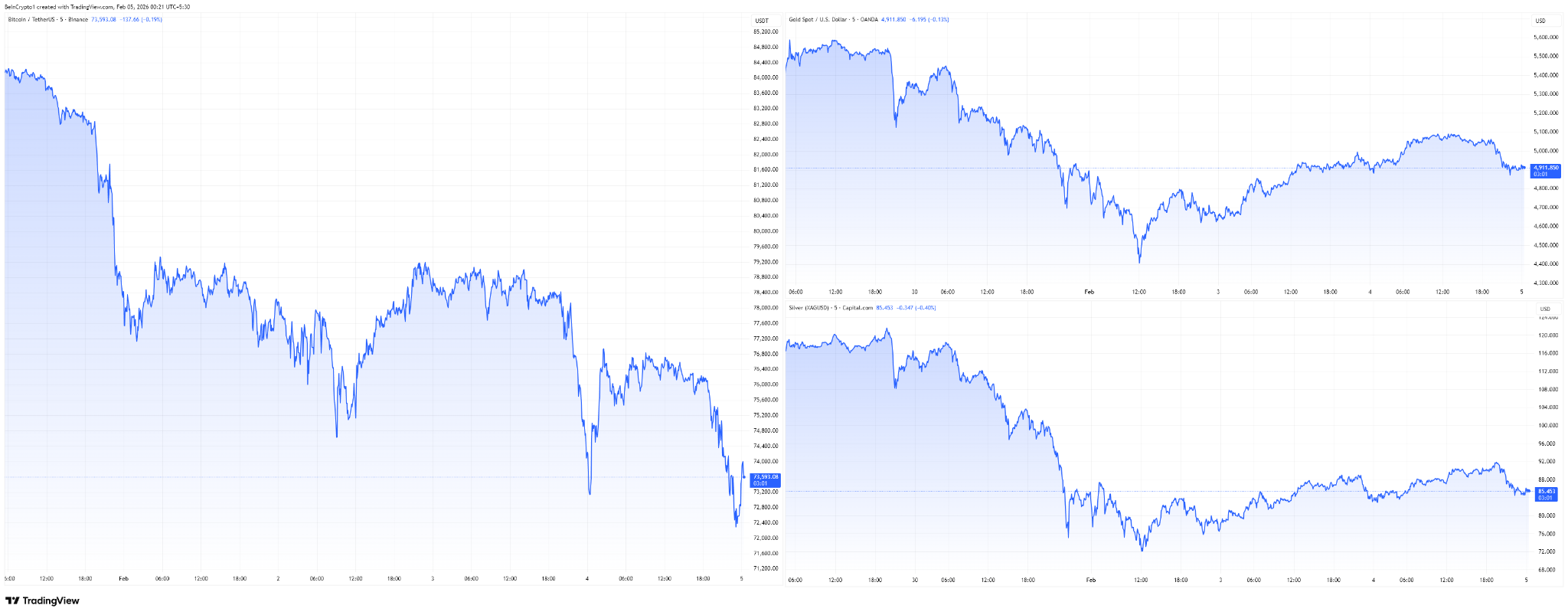
Bitcoin fell sharply to $73,000 on February 3, extending a broader bearish trend that has now erased 41% from its October 2025 all-time high above $126,000. The drawdown has intensified debate over whether the market is approaching a cyclical bottom—or entering a deeper corrective phase.
The sell-off mirrors rising anxiety across traditional markets. US equity indices weakened amid concerns about artificial intelligence-driven disruption and escalating geopolitical risks, prompting investors to rotate away from risk assets.
In that environment, capital flowed back into traditional safe havens such as gold and silver, while Bitcoin failed to attract defensive demand.
Sponsored
Sponsored
Macro and Geopolitical Stress Push Investors Toward Traditional Havens
Bitcoin’s volatility continues to reflect macro sensitivity rather than isolation from global markets. The latest leg down coincided with renewed tensions between the United States and Iran after an Iranian drone was reportedly shot down near a US aircraft carrier.
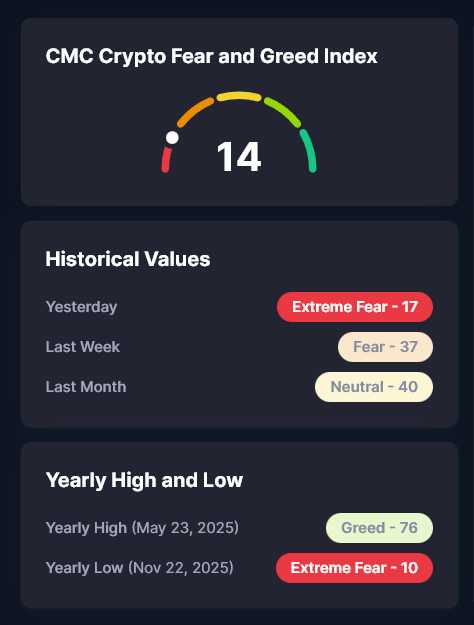
The incident pushed the VIX up roughly 10% and drove the Crypto Fear & Greed Index into “extreme fear” territory.
At the same time, developments in artificial intelligence—including new announcements around Anthropic’s Claude chatbot—sparked renewed concerns about disruption across the tech sector.
That uncertainty weighed on major technology stocks and further reduced appetite for speculative assets.
While Bitcoin declined, gold rose 6.8% and silver gained 10%, reinforcing their role as preferred hedges during periods of monetary and geopolitical stress.
Speaking to CNN, Gerry O’Shea, Global Head of Market Insights at Hashdex, noted that the divergence between Bitcoin and gold suggests investors still view precious metals as the primary safe haven during periods of uncertainty.
That shift has weakened Bitcoin’s short-term refuge narrative and added downside pressure.
Analysts Warn of Deeper Drawdowns and a Potential Bull Trap
Market participants remain divided, but several analysts are openly warning that the correction may not be over.
Sponsored
Sponsored
Crypto analyst Benjamin Cowen argued that Bitcoin’s near-term path is critical:
Other analysts are more pessimistic. Nehal, a widely followed trader on X, suggested the current structure resembles a classic bull trap, warning that the move lower may only be halfway complete.
According to Nehal’s historical comparison, Bitcoin’s previous cycles ended with drawdowns of 86% in 2018 and 78% in 2021.
Applying a similar framework to the current cycle implies a potential 72% decline, which would place Bitcoin near $35,000.
This cyclical perspective remains influential despite structural changes in the market, including ETF adoption and greater institutional participation.
Sponsored
Sponsored
On-Chain Data Signals “Bottom Discovery” Phase
On-chain indicators are adding another layer to the debate. Analyst CryptOpus noted that Bitcoin has entered what he describes as a “bottom discovery” phase for the first time this cycle.
At the 2025 peak, roughly 19.8 million BTC were held in profit. That figure has now dropped to 11.1 million BTC, a 40% reduction in profitable supply.
Historically, similar conditions have marked transitions from corrective phases toward cycle resets. In 2018, Bitcoin remained in this state for roughly eight months before stabilizing.
Key Technical Levels Under Scrutiny
From a technical standpoint, downside risks remain clearly defined. Nic, CEO of Coin Bureau, highlighted that Bitcoin has remained under pressure since breaking below the 50-week moving average in November.
Bitcoin is currently trading near MicroStrategy’s cost basis and close to the April lows around $74,400.
“If we break lower, the next major level is $70,000, just above the previous all-time high of $69,000. A clean break below that opens the door to a bear market target in the $55,700–$58,200 range, between realized price and the 200-week moving average,” Nic warned.
Sponsored
Sponsored
Conflicting Views on Whether a Bottom Is Near
Not all analysts agree with the bearish outlook. Michaël van de Poppe believes Bitcoin may already be nearing the end of its downturn.
Meanwhile, analyst David Battaglia focused on liquidation dynamics, describing current conditions as increasingly irrational.
Battaglia noted that below $85,000, liquidity gaps were significant, meaning panic sellers—whether institutional or whales—likely exited at suboptimal prices.
He contrasted this with the October 10 crash tied to Binance, which he described as structurally cleaner.
“Between $90,000 and $100,000, there’s massive short density and a 14:1 puts-to-calls imbalance, which under normal conditions already signals a strong bottom,” Battaglia said.
In Summary
Bitcoin’s drop to $73,000 has reignited fears of a deeper correction. Macro uncertainty, geopolitical tension, and mixed on-chain signals leave the market split between expectations of further downside and signs of an emerging bottom.
The coming weeks will likely determine whether this move represents a temporary pause—or the foundation of a new trend for 2026.



Goldman Sachs has filed for a Bitcoin Premium Income ETF that aims to turn BTC’s volatility into yield via a covered‑call strategy built on spot ETF exposure.
Summary
- Goldman Sachs files with the SEC for a Bitcoin Premium Income ETF.info.
- The fund aims to generate yield from Bitcoin using a covered call strategy.news.
- Filing underscores Wall Street’s shift toward structured Bitcoin income products.
Goldman Sachs has filed a registration statement with the U.S. Securities and Exchange Commission (SEC) to launch a Bitcoin Premium Income exchange‑traded fund, marking one of the 157‑year‑old investment bank’s most direct moves into crypto to date.
According to the preliminary prospectus, the Goldman Sachs Bitcoin Premium Income ETF is designed to provide “current income with a secondary objective of capital appreciation,” giving investors Bitcoin exposure while generating additional yield through options.
The filing, made under the Goldman Sachs ETF Trust on April 14, 2026, proposes that the offering become effective 75 days after submission, which would put the earliest potential launch in late June or early July if regulators sign off.
Goldman Sachs will not hold Bitcoin directly in the new fund but will instead gain exposure through shares of spot Bitcoin ETFs and related instruments, mirroring structures used by rivals such as the iShares Bitcoin Premium Income ETF.
As explained in a breakdown by Arkham Research, a Bitcoin covered‑call ETF “is designed to transform Bitcoin from a passive asset into an income‑generating asset” by holding BTC exposure and then selling call options on that position to collect premiums.
Goldman’s registration statement says the fund will “sell call options generally representing 40% to 100% of the Fund’s exposure to Bitcoin,” a range that caps upside during sharp rallies but allows the ETF to harvest option income in sideways or modestly trending markets.
The proposal comes after the bank quietly ramped up its Bitcoin exposure via existing spot products, with earlier SEC filings showing Goldman holding roughly $1.27 billion of the iShares Bitcoin Trust ETF, an 88% increase on the previous quarter, according to TheStreet.
Industry outlets note that the move aligns Goldman with a broader Wall Street rush into yield‑enhanced Bitcoin vehicles, following similar covered‑call or premium income products from BlackRock and other issuers looking to monetise Bitcoin’s volatility for income‑focused clients.
Bitcoin‑linked structured products and ETFs have already been a recurring theme in crypto.news coverage of the spot ETF trade, with previous story pieces tracking how inflows into BTC funds and their derivatives have influenced the Bitcoin price, options skew and liquidity across major venues.
Investors tracking the implications of Goldman’s ETF filing on the underlying asset can monitor real‑time moves on the Bitcoin market‑cap page, alongside comparable data for Ethereum and other major tokens on their respective price pages as institutional product design around BTC continues to evolve.


Kraken co-CEO Arjun Sethi confirmed Tuesday that the cryptocurrency exchange has filed confidentially for an initial public offering with the SEC.
Sethi made the disclosure at the Semafor World Economy summit in Washington, D.C. The filing had first been submitted around November 2025, shortly after Kraken raised $800 million at a $20 billion valuation.
Valuation Slides as IPO Plans Hold
An April 2026 investment round valued Kraken at $13.3 billion, roughly a 33% decline from its late-2025 peak. The round involved a $200 million secondary share purchase by Deutsche Börse Group, the operator of the Frankfurt Stock Exchange.
The deal gives Deutsche Börse a roughly 1.5% fully diluted stake and is expected to close in Q2 2026. It builds on a strategic partnership announced in December 2025, focused on bridging traditional finance and crypto through trading, custody, and tokenized assets.
Kraken had previously paused its public listing plans in March 2026 because of difficult market conditions. Sethi’s comments suggest the confidential filing remains active while the company waits for a more favorable window.
Sethi Outlines Retail Trading Mission
At the summit, Sethi framed Kraken’s broader ambition as making institutional-grade tools available to everyday traders.
“What they want at the end of the day is what Citadel and Jane Street have, or JPMorgan has, and they want it accessible to them. That’s our mission: How do we make all these products open?” Semafor reported, citing Arjun Sethi, Kraken co-CEO.
The exchange has made several moves to support that vision, including its acquisition of NinjaTrader for $1.5 billion and securing direct Federal Reserve master account access earlier this year.
Those steps position Kraken alongside a growing wave of crypto firms pursuing public listings in 2026.
Whether Kraken moves forward with its IPO may depend on how quickly market sentiment recovers in the months ahead.
Meanwhile, as Kraken moves towards a public listing, its industry peer, Coinbase, is celebrating 5 years since its 2021 IPO.
Since Coinbase’s public listing in April 2021, the first time IPO investors were in profit was in July 2025.
The post Kraken Confirms Confidential IPO Filing Despite Valuation Drop appeared first on BeInCrypto.
The Chainlink price narrative shifted this week when the protocol upgraded its Data Streams infrastructure to deliver near-real-time pricing for US stocks and ETFs on a 24/5 basis, giving DeFi protocols access to the same equity data that covers roughly $80 trillion in global market value.
Summary
- Chainlink’s 24/5 US Equities Streams launch on April 12 delivers fast and secure market data for US equities and ETFs across all trading sessions including after-hours and overnight, going live across more than 40 blockchains using the Chainlink Data Standard.
- DEXs including Lighter and ApeX, and the exchange BitMEX, have already signed on to integrate the streams, with Lighter CEO Vladimir Novakovski saying the integration enables the platform “to extend our fair, low-latency perp execution beyond regular market hours without compromising data integrity.”
- The upgrade arrives as the tokenized real-world asset sector hit $27 billion in 2026, with Chainlink positioned as the primary oracle infrastructure for the growing pipeline of institutions tokenizing equities, funds, and bonds on-chain.
CoinMarketCap’s April 12 coverage of the upgrade notes that most existing on-chain data solutions provide only a single price point for equities during standard trading hours from 9:30 AM to 4:00 PM ET, creating a gap where on-chain markets cannot reliably replicate market conditions at all hours. Chainlink’s 24/5 streams eliminate that gap, enabling synthetic equities, automated trading, collateral management, and lending markets to function with live pricing data rather than stale snapshots. The protocol is already embedded in the infrastructure of institutions including Swift, Euroclear, JPMorgan, Mastercard, UBS, and Fidelity International.
LINK was trading around $9.14 to $9.25 on Tuesday, up from recent lows but still down roughly 34 percent over the past year.
The LINK token’s value accrual thesis depends on growing demand for Chainlink’s oracle services. Every DeFi protocol that integrates the new equity data streams creates a new source of ongoing fee revenue paid in LINK. The 40-plus blockchains where the streams are live represent a wide distribution of potential demand, and the institutional adoption profile of Chainlink’s existing partners means this is not purely a retail DeFi story. When JPMorgan and Fidelity are building on your infrastructure, the demand base is more durable than typical crypto-native integrations.
What the RWA Market Growth Means for Chainlink’s Position
The tokenized RWA sector reaching $27 billion is a validation of the infrastructure play that Chainlink has been building for years. Every tokenized stock, bond, or fund needs reliable real-world pricing data to function safely, and Chainlink’s oracle network is the established standard for that service. The equities streams upgrade extends that standard directly into the equity market, the largest asset class in the world. If tokenized equities grow toward the scale that institutional forecasts suggest, Chainlink’s data infrastructure becomes increasingly difficult to displace.
What Traders Are Watching on the LINK Chart
LINK has been in a structural downtrend with its 200-day SMA acting as resistance and the 50-day SMA below the 200-day, a configuration that typically signals ongoing bearish control. A clean breakout above $9.50, which analysts identified as the near-term resistance, would require both price momentum and the kind of sustained institutional adoption signal that the equity data streams launch represents. The broader macro environment for infrastructure tokens in 2026 remains tied to whether the Iran war eases and risk appetite returns to digital assets alongside the traditional market tailwinds Chainlink is now plugged into.
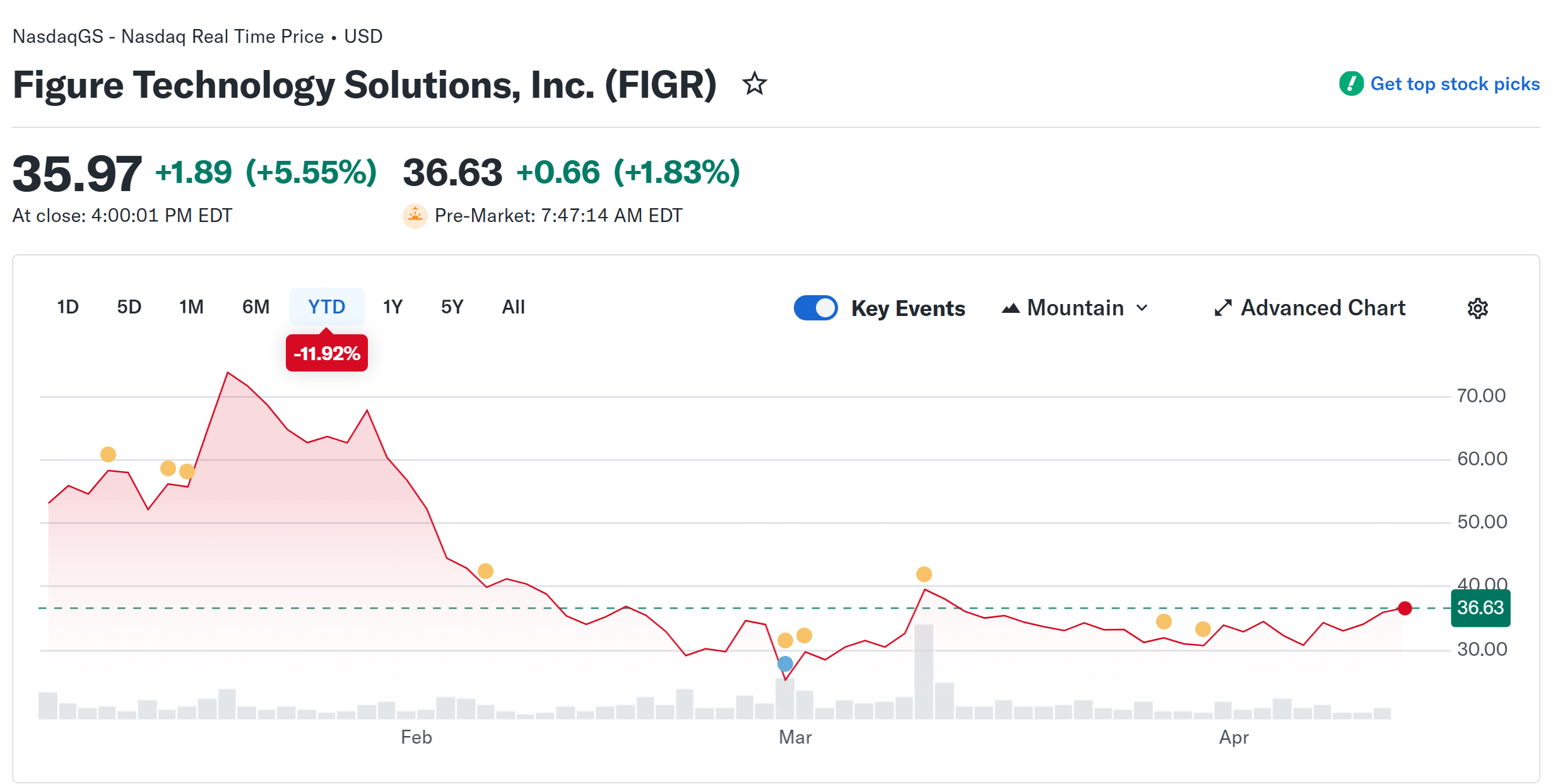
Blockchain-based lender Figure Technology Solutions and Hastra, its onchain credit platform, are adding auto loans to their tokenized credit marketplace, broadening the real-world assets (RWAs) available to decentralized finance (DeFi) investors beyond home equity products.
Democratized Prime, a decentralized lending marketplace on Figure Markets, is adding auto finance as its first new asset class as part of its plan to build a marketplace where different types of consumer credit can be issued, traded and funded onchain, according to a Tuesday announcement shared with Cointelegraph.
“We’ve been purposefully building toward this,” Michael Tannenbaum, CEO of Figure, said, adding that the platform has originated over $22 billion in onchain loans.
The move marks an early test of whether tokenized private credit can expand beyond home-equity products into mainstream consumer lending, a shift that could widen DeFi’s access to real-world yield but also import the credit risks of subprime-style loan markets.
Figure launched Hastra in 2025, with its public debut and rollout occurring later that year. The platform, which initially launched on Solana (SOL), was built as an extension of Figure’s lending ecosystem, using its loan origination and credit infrastructure to bring RWAs onchain.
Related: Nauru taps Bitcoiner Dadvan Yousuf for trade role in digital asset push
Hastra expands to EVM chains
At the same time, Hastra is expanding to Ethereum-compatible (EVM) chains, opening access to a larger DeFi ecosystem and bringing its existing credit system, including home equity loan exposure, to new chains.
A Figure spokesperson told Cointelegraph that Hastra will start with Ethereum (ETH) as part of its push into EVM chains. They also confirmed that the auto finance product will first launch on Solana before rolling out on Ethereum around June.

Still, bringing consumer loans onchain does not remove the underlying risks tied to those assets. Non-prime auto loans can carry higher default rates, especially in weaker economic conditions.
There are also questions around regulation, transparency and how these blockchain-based credit products would perform under stress or during volatile market conditions.
Related: Circle to launch cirBTC wrapped Bitcoin, challenging BitGo and Coinbase
Figure gains bullish outlook from Bernstein
Earlier this month, Bernstein analysts said Figure may be undervalued, assigning the blockchain-based lender an “Outperform” rating and a $67 price target, nearly double its recent trading price. The bullish outlook follows growth in its tokenized lending business, with loan originations surpassing $1.2 billion in March and first-quarter volumes reaching $2.9 billion.
Figure went public on Sept. 11, 2025, listing on the Nasdaq under the ticker symbol FIGR.
Big questions: Would Bitcoin survive a 10-year power outage?
Visa has launched a validator node on the Tempo blockchain, taking a direct role in verifying and processing transactions on a network designed for real-time stablecoin payments.
Visa said the node is operated in-house using its own infrastructure and was developed over six months working with Tempo’s engineering team, positioning the company as an “anchor validator” alongside early participants including Stripe and Zodia Custody.
The role places Visa in the transaction validation layer, where it helps order and confirm payments while supporting network security and performance during the network’s early phase.
Tempo is a Layer 1 blockchain designed for real-time payments and stablecoin-based transactions, with validators responsible for confirming transactions and maintaining the network’s ledger.
Validators on the network can earn stablecoin-denominated rewards when selected to package transactions into blocks, according to the announcement. However, a company spokesperson told Cointelegraph that “Visa’s primary focus in this phase is on the strategic and technical role of operating a validator, rather than on economics.”
The move adds to Visa’s existing blockchain activity, including its recently announced role as a validator on the Canton Network, where it works with financial institutions on privacy-focused onchain payment systems.
Related: Euro stablecoins dominate non-dollar market, Visa-backed report finds
Payment companies expand stablecoin infrastructure
As stablecoins gain traction in payments, major payment companies are expanding infrastructure that connects traditional finance with blockchain-based settlement.
In October 2024, Stripe finalized a $1.1 billion agreement to acquire stablecoin platform Bridge. The following year, it introduced stablecoin-based accounts for clients in more than 100 countries, allowing businesses to send, receive and hold US-dollar stablecoins similar to traditional bank balances.
Last month, Mastercard agreed to acquire stablecoin infrastructure company BVNK in a deal valued at up to $1.8 billion. BVNK enables businesses to send and receive stablecoin payments, convert between fiat and crypto, and operate across more than 130 countries.
Meanwhile, Visa has focused on building and operating its own systems. In July, the company expanded its settlement platform to support tokens such as PayPal USD (PYUSD) and Euro Coin (EURC), as well as networks including Stellar (XLM) and Avalanche (AVAX).
In March, it also expanded its stablecoin card partnership with Bridge to 18 countries, with plans to reach more than 100 markets by year-end.
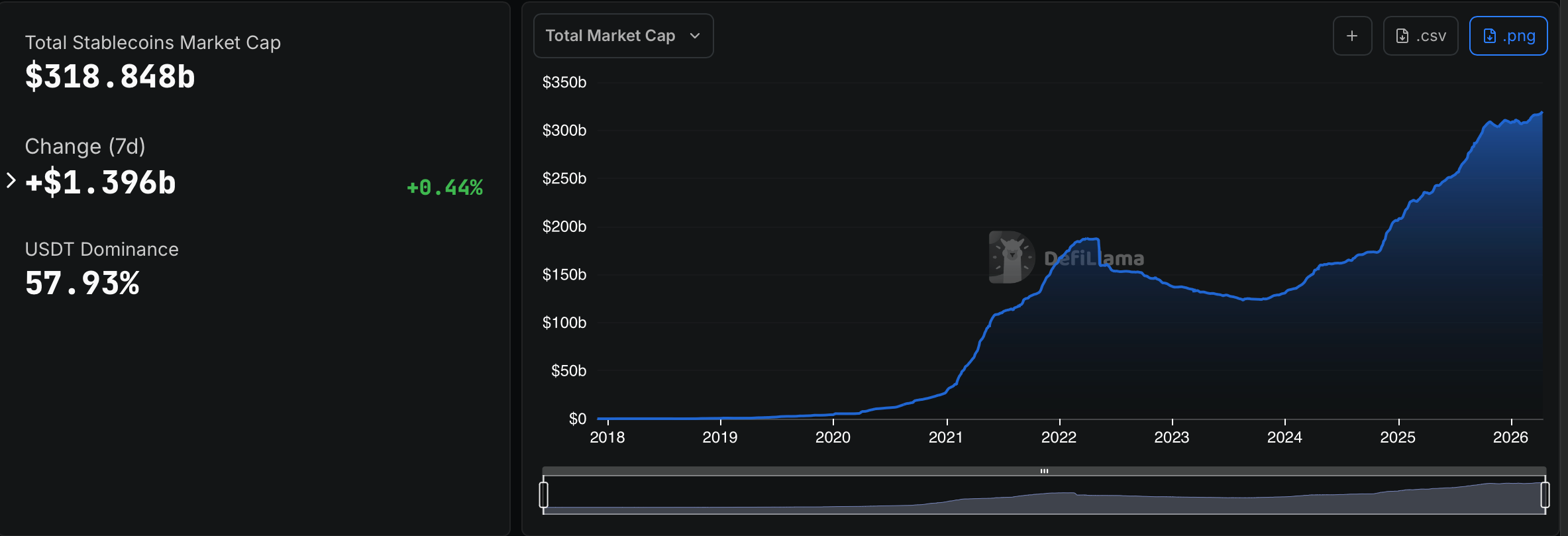
According to DefiLlama data, stablecoin market capitalization stood at nearly $319 billion at the time of writing, up from about $307.5 billion at the start of the year.

Magazine: Singapore is no ‘crypto hub’ — but it is serious about stablecoins: StraitX CEO


Austan Goolsbee has warned the Federal Reserve may need to keep interest rates on hold until 2027 if the Iran war keeps oil prices high and inflation stuck above target.
Summary
- Chicago Fed chief Austan Goolsbee says rate cuts might not arrive until 2027 if oil stays elevated.
- War‑driven energy prices threaten the Fed’s path back to 2% inflation and could even force fresh hikes.
- Markets that once priced multiple 2026 cuts now face a longer “higher for longer” regime.
Austan Goolsbee has warned the Federal Reserve may need to keep interest rates on hold until 2027 if the Iran war keeps oil prices high and inflation stuck above target.
Speaking at the Semafor World Economy conference on Tuesday, the Chicago Federal Reserve president said “it’s our job to get inflation back to 2%,” and stressed that persistently expensive energy could “start pushing” potential rate cuts “out of ’26.”
Before the conflict, Goolsbee had expected tariff‑driven inflation to ease this year and saw room for “even multiple rate cuts in 2026,” but he told AP that the longer inflation “stays up, realistically, I think that starts pushing it out of ’26.”
The Fed is currently holding its benchmark federal funds rate in a 3.50%–3.75% range after leaving policy unchanged at its March meeting, even as war‑related supply disruptions sent oil toward triple‑digit levels.
Minutes from that March meeting showed officials worried that the Iran war’s impact on energy could keep inflation above the 2% target for longer and “could call for rate hikes” if price pressures fail to ease.
In recent projections, Fed policymakers lifted their 2026 inflation forecast to around 2.7%, acknowledging that gasoline and other energy costs threaten to slow the disinflation process that markets had hoped would justify earlier cuts.
Traders who once priced four 2026 rate cuts have already slashed expectations to a single move after oil briefly spiked to about $115 per barrel during the Iran conflict, pushing headline inflation back toward 3%.
Goolsbee underlined that if inflation were to “stay elevated” and the Fed “never got to see the decrease in inflation,” any optimism around near‑term easing would fade, and officials would need to keep borrowing costs restrictive.finance.
That stance echoes Fed Chair Jerome Powell, who recently cautioned that with the Iran war clouding the outlook, the central bank has “limited flexibility” to cut until there is clearer evidence inflation is moving sustainably to 2%.


X introduced a new cashtag feature enabling users to tag and discuss stocks and cryptocurrencies directly on the platform.
X launched a new cashtag feature on Tuesday, April 14, 2026, expanding its capabilities to include tagging for both stocks and cryptocurrencies. The feature allows users to reference assets using cashtag notation, similar to existing stock market discussion tools on social platforms. The announcement was made via the official WatcherGuru account on X.
The cashtag feature builds on X’s existing infrastructure for financial discussions, enabling users to easily reference and track conversations around specific crypto assets and equities. This addition positions X as a platform for broader financial discourse beyond traditional social networking.
Sources: WatcherGuru on X
This article was generated automatically by The Defiant’s AI news system from publicly available sources.


Ethereum is edging toward a high‑risk liquidation zone where a clean break above $2,451 would put an estimated $1.473 billion of short positions at risk across major centralized exchanges, according to derivatives tracker Coinglass.
Summary
- Coinglass data shows $1.47b in ETH shorts at risk if price breaks $2,451.
- A drop below $2,220 could trigger $1.10b in long liquidations on major CEXs.
- Ethereum trades just below these key bands as leverage builds across futures markets.
Ethereum is edging toward a high‑risk liquidation zone where a clean break above $2,451 would put an estimated $1.473 billion of short positions at risk across major centralized exchanges, according to derivatives tracker Coinglass.
The same data set shows that if Ethereum reverses and falls below $2,220, roughly $1.099 billion in long positions could be flushed out in a cascading sell‑off as exchanges force‑close underwater trades.
As of late Tuesday, ETH is trading around $2,375, leaving both levels within striking distance and underscoring how tightly leveraged the market has become around current prices.
On its Ethereum liquidation dashboard, Coinglass states that “if ETH breaks through $2,451, the cumulative short liquidation intensity on major CEXs will reach $1.473 billion,” flagging the zone as a potential short‑squeeze pocket for futures traders.
Coinglass adds that “if ETH falls below $2,220, the cumulative long liquidation intensity on major CEXs will reach $1.099 billion,” marking out a mirrored risk area where over‑leveraged longs could be forced out.
The platform’s liquidation heatmaps aggregate futures and perpetual swap positioning from venues such as Binance, OKX and Bybit to show where “large‑scale liquidation events may occur” once spot price collides with stacked leverage.
These clustered bands can act as both magnets and accelerants: once triggered, forced buying or selling often drives price beyond the initial level, a behavior seen repeatedly in past Ethereum liquidation cascades covered in a previous crypto.news story on derivatives stress.
The build‑up of leverage on Ethereum comes as the network remains a core settlement layer for stablecoins and tokenized real‑world assets, sectors that regulators and banks are now moving to bring on‑chain in size.
In a recent crypto.news story on Animoca‑backed Anchorpoint’s planned HKDAP stablecoin, Hong Kong officials described their new Stablecoins Ordinance as a way to create “a secure tokenised medium of exchange for the digital economy and to facilitate international payments and capital flows,” while avoiding the opacity that has plagued some dollar‑pegged tokens as supply has climbed above $300 billion.
Animoca Brands group president Evan Auyang told Chinese outlet National Business Daily that “stablecoins are the bridge between native and enterprise Web3” and argued that “mainland assets going global need a Hong Kong dollar stablecoin,” calling such a coin “crucial for Hong Kong’s financial infrastructure” and vital to “games, trade, and 24/7 financial settlement.”
As explored in earlier crypto.news coverage of stablecoin rails and card payments, deep, always‑on dollar and HKD liquidity now serves as collateral and margin across perpetual futures platforms, meaning liquidation clusters like the current $2,451 and $2,220 bands can reverberate beyond traders into DeFi funding and cross‑border payment flows built on Ethereum.
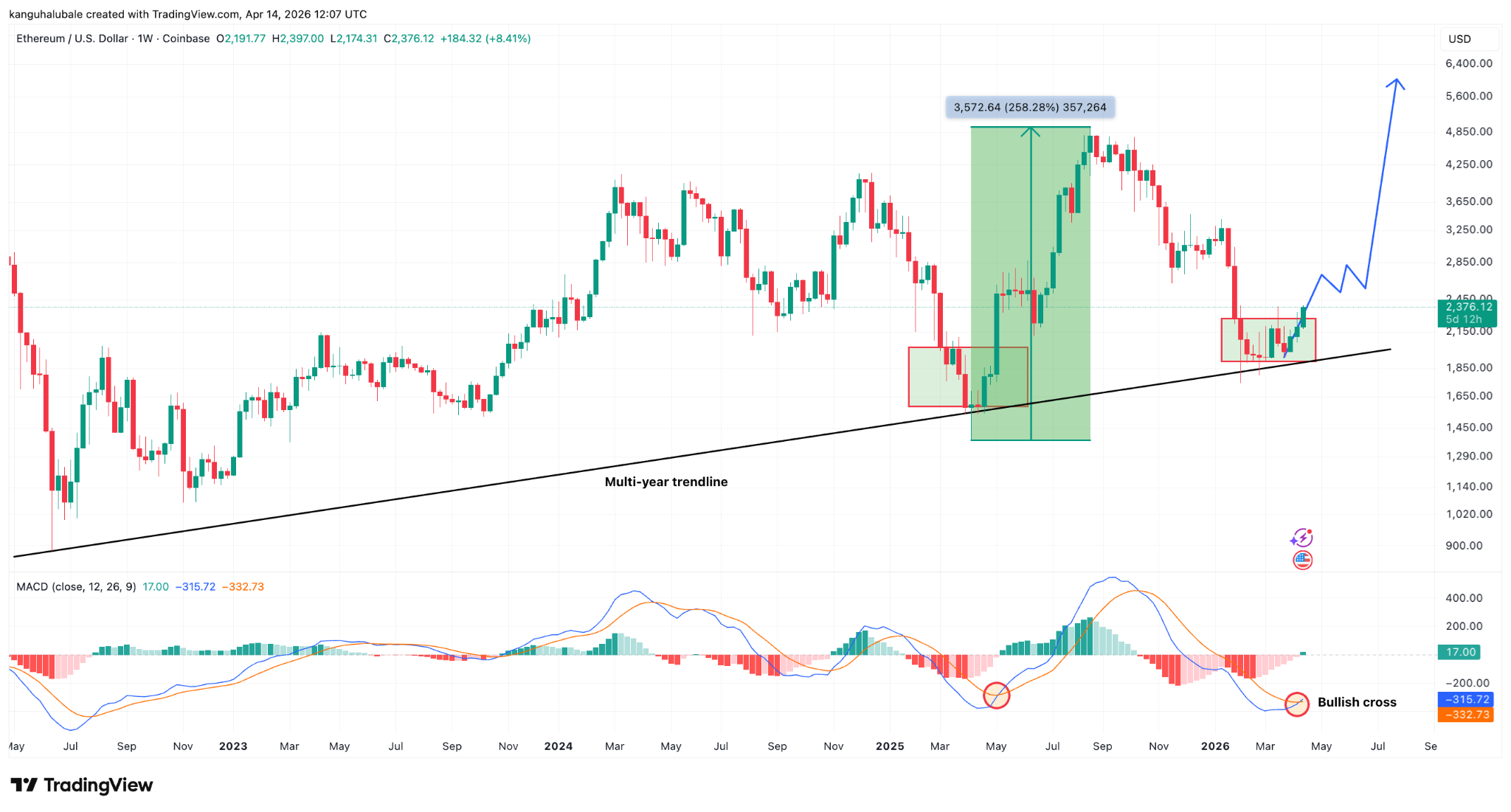
Ether bounced off multi-year support, while a bullish MACD crossover could signal that ETH is on the path to new highs.
Ether (ETH) is currently displaying a technical pattern that follows a 2025 fractal, in which Ether gained 250%. The weekly timeframe chart shows Ether retesting an ascending trend line that has supported the price since 2022.
A bullish cross from the moving average convergence divergence (MACD) indicator also confirmed the price bottom.

Ether’s current price action is following a similar pattern, with the price again bouncing off the same structural support and a confirmed bullish MACD crossover.
“Similar structure. Similar dump. Similar consolidation,” analyst Max Crypto said in an X post on Tuesday, adding:
“What if $ETH repeats the Q2/Q3 2025 rally?”
If history repeats itself, ETH may rally by more than 250% toward $6,300. Further confirmation of a trend reversal now hinges on Ether “crossing the key $2,400 range,” fellow analyst Cryptorand said, adding:
“If it manages to consolidate over, it will trigger the bullish reversal.”

Ether’s apparent demand hits a 90-day high
Ether’s apparent demand turned positive after rising to its highest level since Dec. 31, 2025, as hopes for a deal between the US and Iran boosted investor sentiment.
Capriole Investment’s Ethereum Apparent Demand metric reveals that the demand for Ether has been positive since April 8, rising to a high of 24,111 ETH on April 14.

The surge in Ether’s apparent demand could be attributed to rising US demand, as measured by the Coinbase premium index.
The ETH Coinbase premium index measures the price difference between the ETH/USD pair on Coinbase and Binance’s ETH/USD equivalent.
The chart below shows that the index has flipped positive, rising to 0.055, its highest level since October 2025.
“The index’s rise to 0.055 reflected a significant influx of institutional liquidity, ” CryptoQuant analyst Arab Chain said in a Quicktake analysis on Tuesday, adding:
“It typically signals increased demand from institutional investors, particularly in the US market.”

Meanwhile, spot Ethereum ETFs have recorded net inflows for three consecutive days, totaling $160 million.

Global Ether exchange-traded products (ETPs) also recorded $196.5 million of inflows last week, reinforcing increased demand for ETH among institutional investors.
This article is produced in accordance with Cointelegraph’s Editorial Policy and is intended for informational purposes only. It does not constitute investment advice or recommendations. All investments and trades carry risk; readers are encouraged to conduct independent research before making any decisions. Cointelegraph makes no guarantees regarding the accuracy or completeness of the information presented, including forward-looking statements, and will not be liable for any loss or damage arising from reliance on this content.
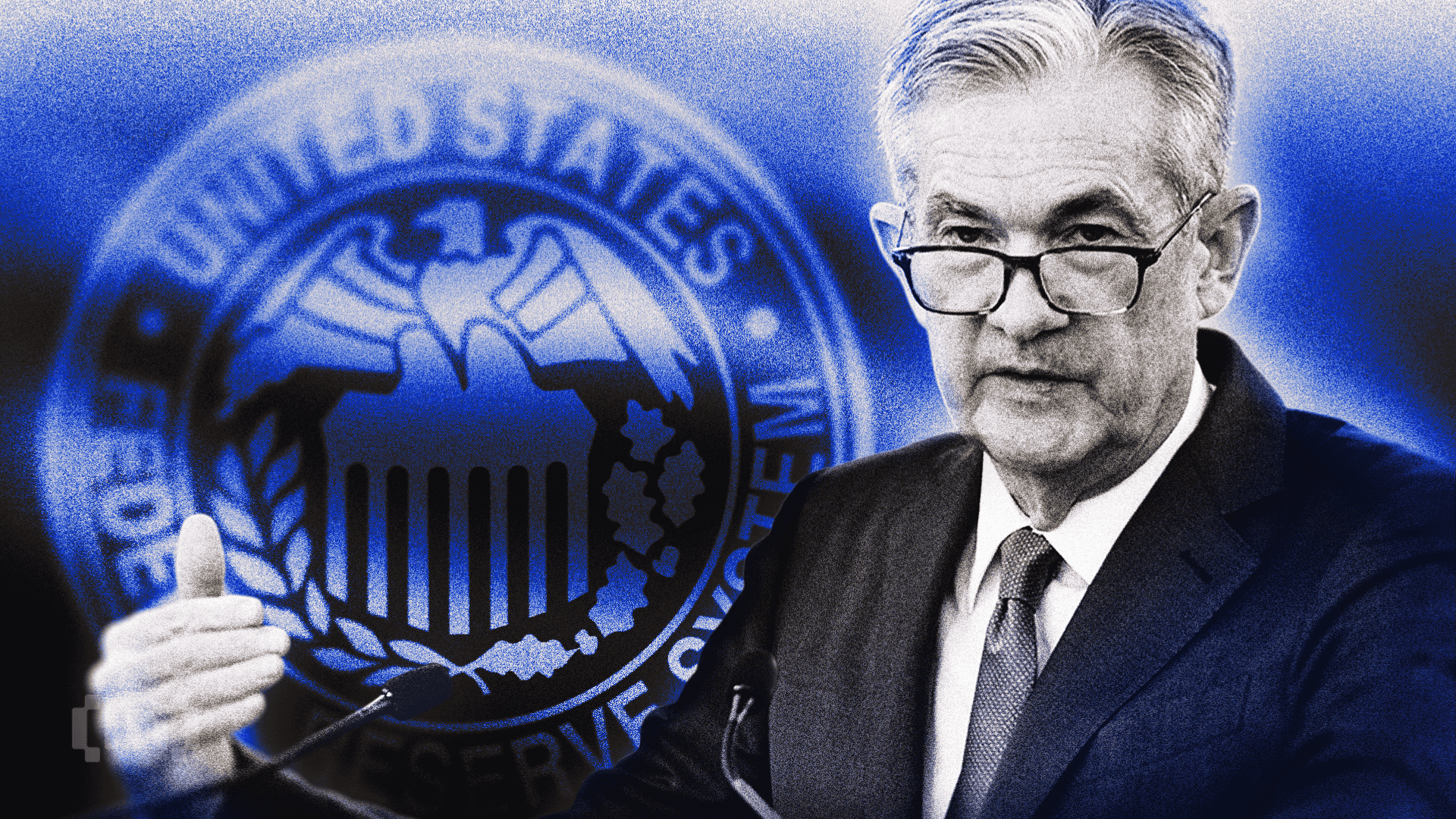
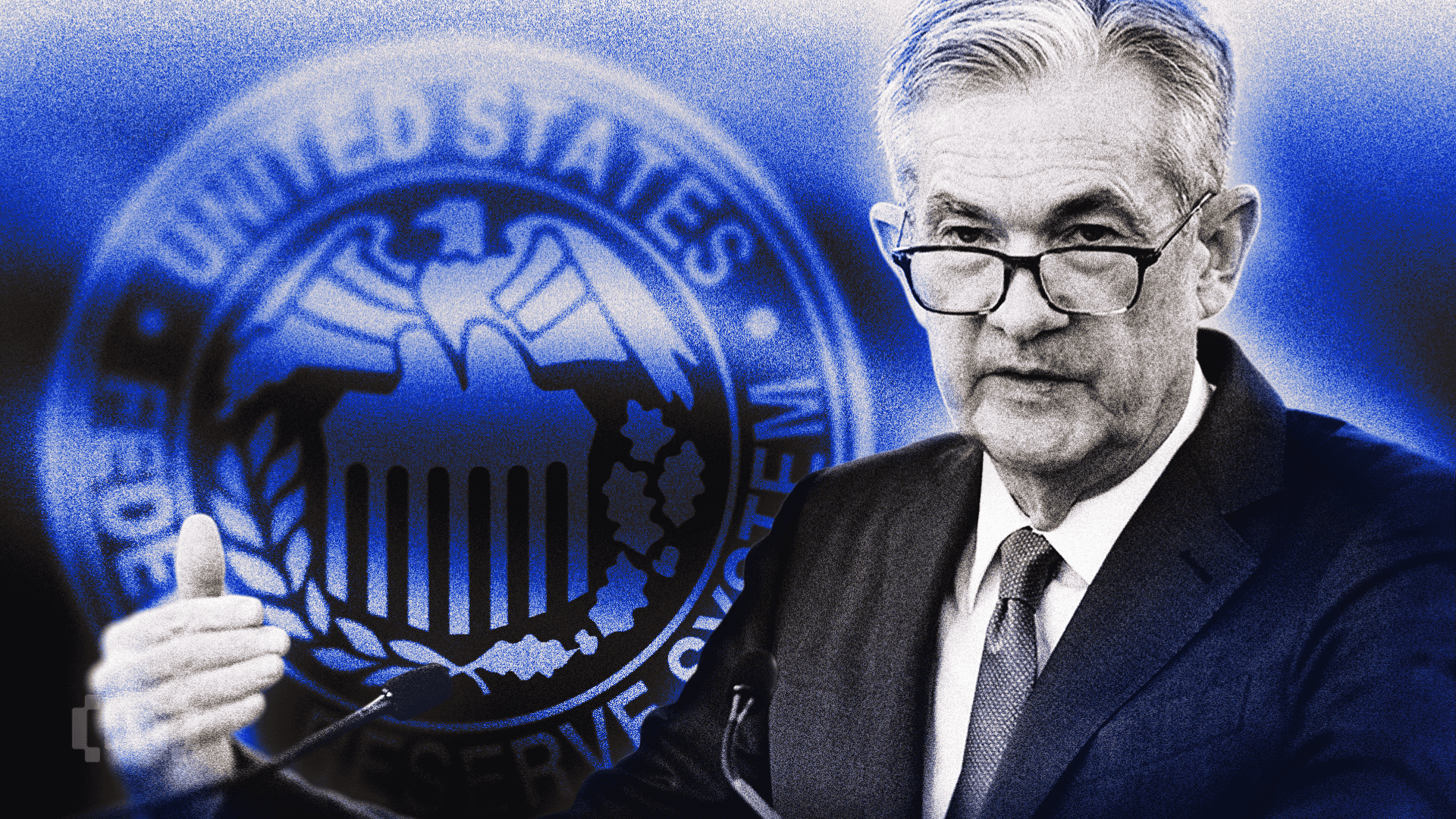
The Federal Reserve released minutes from its February and March discount rate meetings, confirming all 12 Reserve Banks voted to hold the primary credit rate at 3.75%.
The minutes cover Board meetings on February 9 and March 18, 2026. Both sessions ended with no sentiment expressed for changing the rate.
Why the Fed Held Federal Reserve Interest Rate Steady
At the March 18 joint meeting with the Federal Open Market Committee (FOMC), officials maintained the federal funds target range at 3.5% to 3.75%. The Board also approved keeping interest on reserve balances at 3.65%.
Federal Reserve Bank directors reported stable economic conditions across most districts. Labor markets showed limited hiring, low turnover, and modest wage growth. However, several districts flagged difficulty hiring for specialized roles, particularly in healthcare.
Directors also noted sustained business investment in technology and AI to boost efficiency. Yet AI’s direct impact on labor remained limited so far.
Tariff Pressures Ease, but Costs Linger
While tariff-related price pressures had moderated compared to earlier assessments, directors highlighted rising nonlabor costs in healthcare and energy.
The Board renewed existing formulas for secondary and seasonal credit programs, keeping the secondary rate at 4.25%, or 50 basis points above primary credit.
Chair Jerome Powell, Vice Chair Philip Jefferson, and all present governors voted unanimously at both meetings.
Governors Christopher Waller and Stephen Miran were absent from the February session but participated in March.
The continued rate hold signals the Fed remains cautious about easing further despite market expectations for cuts later this year.
Traders will now watch upcoming inflation data to gauge whether the FOMC shifts its stance at future meetings.
The post US Fed Finally Reveals Why It’s Refusing to Move Rates appeared first on BeInCrypto.

Mark Goldbridge’s real name, net worth, spat with pundits and Gary Neville’s U-turn

HAL Trust: Still Trading At A Discount

Goldman Sachs files for Bitcoin Premium Income ETF

Why Israel is blocking foreign journalists from entering

Bitcoin: We’re Entering The Most Dangerous Phase

Alan Cumming Brands Baftas Ceremony A ‘Triggering S**tshow’

Will Bitcoin Skyrocket When Iran War Ends?

Financial crises agya h.kya apne Emergency fund bnaya h ya nahi? #Financetips #Emergencyfund #shorts

Would you be interested in working with the FBl’s Financial Crimes Unit? | #catchmeifyoucan
-

 Politics4 days ago
US brings back mandatory military draft registration
-
 Sports4 days ago
Man United discover Nico Schlotterbeck transfer fee as defender reaches Dortmund agreement
-

 Fashion4 days ago
Weekend Open Thread: Veronica Beard
-

 Politics5 days ago
Malcolm In The Middle OG Turned Down ‘Buckets Of Money’ To Appear In Reboot
-

 Politics3 days ago
World Cup exit makes Italy enter crisis mode
-

 Crypto World6 days ago
Canary Capital Files SEC Registration for PEPE ETF
-

 Business4 days ago
Tesla Model Y Tops China Auto Sales in March 2026 With 39,827 Registrations, Beating Cheaper EVs and Gas Cars
-

 Crypto World1 day ago
The SEC Conditionalises DeFi Platforms to Be Avoided for Broker Registration
-

 Crypto World1 day ago
SEC Signals Exemption for Crypto Interfaces From Broker Registration
-

 Crypto World7 days ago
Bitcoin recovers as US and Iran Agree a Ceasefire Deal
-
 NewsBeat2 days ago
Pep Guardiola and Gary Neville agree over Arsenal title problem that benefits Man City
-

 Business5 days ago
OpenAI Halts Stargate UK Data Centre Project Over Energy Costs and Copyright Row
-

 Business3 days ago
Ireland Fuel Protests Enter Day 5 as Blockades Spark Shortages and Government Prepares Support Package
-

 Politics5 days ago
LBC Presenter Mocks Trump Over Iran War Failures
-

 Crypto World4 days ago
Federal judge blocks Arizona from bringing criminal charges against Kalshi
-
 NewsBeat3 days ago
JD Vance announces ‘no agreement’ with Iran over nuclear weapons fear
-

 Tech5 days ago
A version of Windows 10 released a decade ago is now eligible for additional security patches
-

 Crypto World22 hours ago
SEC Proposes Certain Crypto Interfaces Don’t Need to Register as Brokers
-

 Business4 days ago
IMF retains floor for precautionary balances at SDR 20 billion
-

 NewsBeat18 hours ago
Trump and Pope Leo: Behind their disagreement over Iran war
You must be logged in to post a comment Login