
Crypto World
Bitcoin, Ethereum, XRP and SOL enter CME’s new crypto index futures

CME Group has launched Nasdaq CME Crypto Index futures, giving traders exposure to eight large cryptocurrencies through one regulated contract.
Summary
- CME’s new index futures combine eight major cryptocurrencies through a single cash-settled, regulated derivatives contract.
- Standard and micro contracts give traders broader crypto exposure without directly holding the underlying assets.
- The launch extends CME’s crypto expansion after adding more altcoin futures and continuous trading access.
Trading began on June 8, while CME confirmed the launch on June 9.
The product tracks Bitcoin, Bitcoin Cash, Ether, Solana, XRP, Cardano, Chainlink and Stellar Lumens. It expands CME’s digital asset range beyond futures linked to individual cryptocurrencies.
CME Crypto Index Futures Begin Trading
The contracts settle in cash against the Nasdaq CME Crypto Settlement Price Index. The benchmark measures the performance of large, actively traded cryptocurrencies using a market-cap-weighted structure.
CME offers a standard contract under the NCI ticker and a micro version under MCI. The standard contract equals $10 times the index value, while the micro contract equals $1 times the index.
As of June 9, the index includes BTC, BCH, ETH, SOL, XRP, ADA, LINK and XLM. The basket gives traders broader market exposure without requiring them to buy, store or transfer each token.
Bitcoin and Ether remain the largest assets in the group. The addition of SOL, XRP, ADA, LINK, XLM and BCH also gives the contract exposure to payment networks, smart-contract platforms and blockchain data services.
CME Targets Portfolio Hedging and Broader Exposure
Giovanni Vicioso, CME Group’s global head of cryptocurrency products, said investors want diversified access while using a regulated derivatives market.
“These contracts give clients a cost-efficient tool to hedge their risk,” Vicioso said.
Nasdaq index product management head Sean Wasserman said demand is growing for digital asset benchmarks with established governance and transparent rules.
“Futures linked to the index are a natural extension,” Wasserman said.
Because the contracts settle financially, traders receive or pay the difference in cash at expiration. They do not take delivery of the cryptocurrencies included in the index.
Launch Extends CME’s Crypto Derivatives Expansion
The index futures follow CME’s earlier move into contracts tied to Bitcoin, Ether, SOL, XRP, ADA, LINK, XLM, Avalanche and Sui. The exchange also introduced Bitcoin volatility futures in June.
CME now offers cryptocurrency futures and options on a 24/7 schedule, apart from maintenance windows. That timetable gives global traders weekend access and brings the regulated market closer to crypto’s continuous spot trading structure.
As crypto.news reported in May, the index product would become CME’s first market-cap-weighted cryptocurrency futures contract. The publication also covered CME’s addition of Avalanche and Sui futures as the exchange widened its regulated altcoin offering.
The launch gives funds, advisers and other market participants one contract for managing broad crypto exposure. Contract prices still depend on the combined movement of the index members, so gains in one asset may be offset by losses elsewhere in the basket during each session.

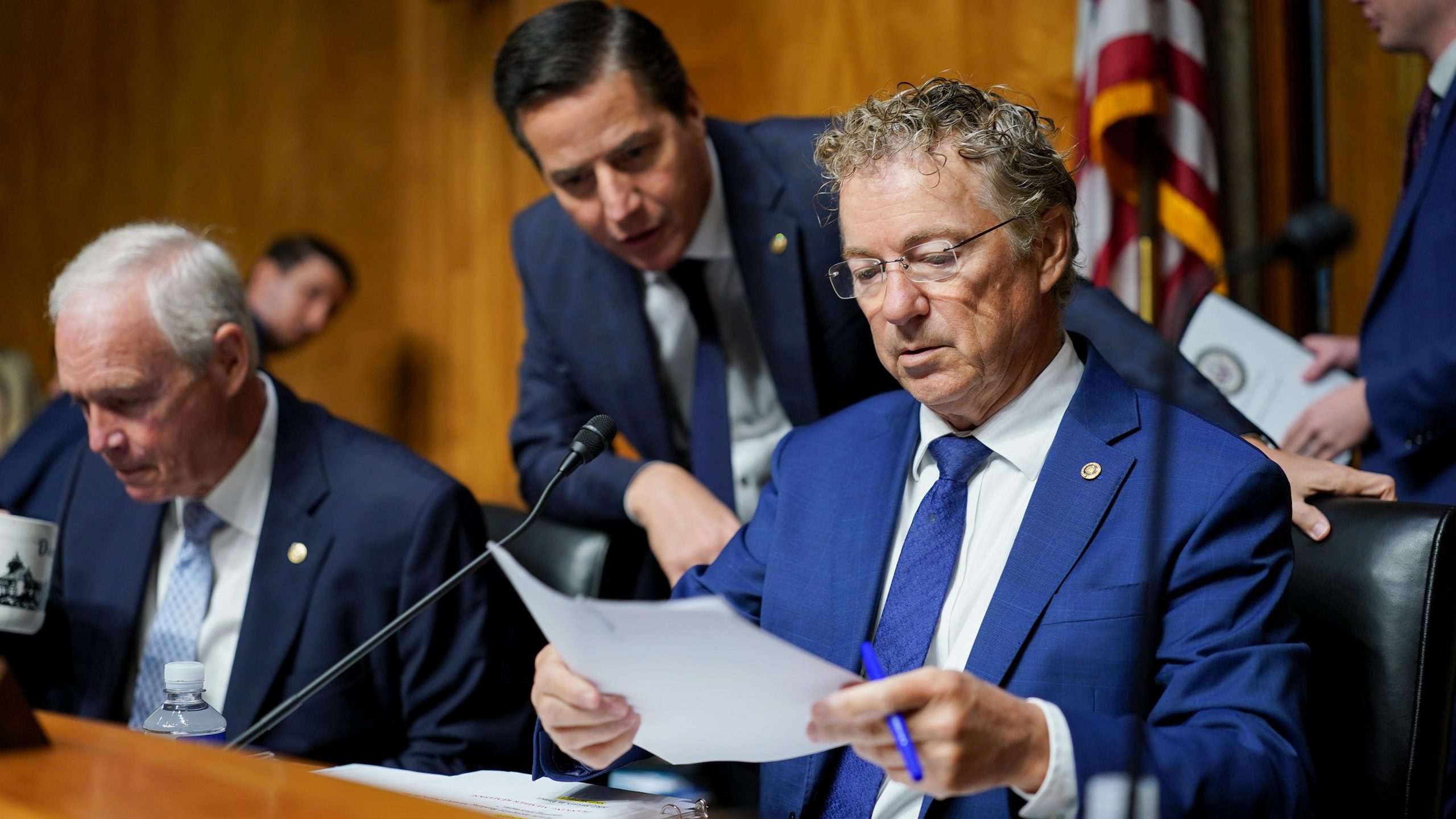
A key section of the bill states that “not later than 30 days after the date of the enactment of this Act, the President shall, notwithstanding any other provision of law, increase the rate of duty for all goods, including oil, natural gas, liquefied natural gas, petroleum, petroleum products, petrochemical products, coal, and coal products, imported into the United States from the Russian Federation to a rate of up to 500 percent ad valorem.”
Regarding the President’s tariff authority, if the bill were to become law, it would allow Trump to place tariffs of up to 100% on the top five purchasers of Russian oil and natural gas, among other penalties.
Graham announced during a visit to Kyiv, just shortly before his death, that he had secured the White House’s approval on his revised text.
The latest iteration also includes a last-minute addition of extended sanctions against Iran, at the request of Trump. Following Graham’s passing, and amid the resumption of the Iran war, Trump said on July 19: “Republicans should add Iran to the Russian Sanctions Bill. That’s what Lindsey wanted to do, and it was going to happen.”


Iranian hacker collective CyberAv3ngers is the main suspect in a series of cyber attacks that hit 30 different water companies across the state of Minnesota this week.
That’s according to security research firm Tenable, which claims the attacks are consistent with CyberAv3ngers’ past exploits.
Meanwhile, Minnesota’s state IT agency claimed the disruption was the result of a “coordinated cyberattack.”
Tenable not only believes the attack to be the work of CyberAv3ngers, but also says the timing of the attack is “significant” given a July 22 report from the US Cybersecurity and Infrastructure Security Agency (CISA).
In it, the CISA warned that Iranian actors were actively targeting internet-connected devices, such as programmable logic controllers, across US water, energy, and government sectors.
Read more: Nobitex hackers threaten to ‘destroy’ pro-Iran institutions
Tenable also warned that the US war with Iran means “Iranian cyber operations have escalated in parallel with kinetic hostilities, with confirmed targeting of U.S. critical infrastructure.”
It’s worth noting that US authorities are yet to attribute the attack.
Cybersecurity firm Sophos reports that CyberAv3ngers has claimed responsibility for a 2020 Israeli cyber attack that targeted 150 railway system servers and 28 railway stations.
Three years later, the group appeared to try to sell the data stolen from the railway hack for four BTC, worth $108,000 at the time of the data listing.
In 2025, internal CyberAv3nger documents were leaked that included domain registrations, BTC transactions, and European virtual private server hosting.
Tenable says these details overlapped with another group called Moses Staff, and revealed CyberAv3ngers’ structure as a “single coordinated effort directed by the state” instead of multiple Iranian individuals.
Got a tip? Send us an email securely via Protos Leaks. For more informed news and investigations, follow us on X, Bluesky, and Google News, or subscribe to our YouTube channel.


Disclosure: This article does not represent investment advice. The content and materials featured on this page are for educational purposes only.
Expanding crypto tax reporting rules are pushing investors to maintain accurate transaction records across exchanges, wallets, staking, and DeFi.
Summary
- Crypto tax reporting now extends beyond exchange exports as DeFi, staking, and wallet transfers complicate recordkeeping.
- Expanding IRS crypto reporting rules make accurate wallet-level transaction records more important for tax compliance.
- DeFi, staking, and self-custody are reshaping crypto tax reporting as investors face stricter IRS recordkeeping requirements.
For a long time, many crypto investors treated tax preparation as a year-end export. Download a CSV from an exchange, send it to tax software, and deal with the result before the filing deadline.
That approach can still work for someone who bought a few assets on one platform and never moved them. It becomes unreliable once the portfolio includes self-custody, staking, decentralized finance, NFTs, or transfers among several exchanges. At that point, the hard part is not filling in a tax form. It is rebuilding an accurate transaction history.
The distinction matters more now because broker reporting is expanding. US brokers began reporting gross proceeds from digital asset dispositions on Form 1099-DA for the 2025 tax year. Basis reporting for covered assets starts with 2026 transactions. The IRS will receive more information directly from brokers, but those reports may still show only part of an investor’s financial history.
One wallet can create several tax questions
A centralized exchange records activity inside its own system. It can usually identify a purchase made on the platform and a later sale from the same account. It cannot automatically know what happened before an asset arrived from a hardware wallet, another exchange, or a decentralized application.
Consider an investor who buys ETH on one exchange, transfers it to a wallet, stakes part of it, uses the rest in a liquidity pool, and later sends several tokens to a different exchange to sell. The final exchange sees the deposit and sale. It may not know the original purchase date, acquisition cost, staking history, or what happened inside the liquidity pool.
Those missing details affect more than one number. They can change basis, holding period, income recognition, transaction classification, and the amount of gain or loss. A CSV from the final exchange cannot supply facts the exchange never had.
DeFi records describe mechanics, not tax treatment
On-chain records are public, but public does not mean tax-ready. A block explorer shows contract calls, token movements, and transaction hashes. It does not explain the investor’s intent or label each event for a federal return.
A single DeFi interaction can produce deposits, receipt tokens, reward tokens, fees, and later withdrawals. Some activity may represent a transfer of ownership, while other activity may simply change how an asset is held. The tax analysis depends on the transaction’s substance and the available guidance, not on the number of lines in a wallet export.
Staking adds a separate layer. IRS Revenue Ruling 2023-14 generally treats staking rewards as income when a cash-method taxpayer has dominion and control over them. The fair market value used for income can also establish a basis for a later disposition. If the receipt value is missing, the eventual capital gain calculation can be wrong even when the sale proceeds are correct.
NFT activity creates similar recordkeeping problems. A mint can involve the purchase price, gas paid in crypto, and a later sale on a different marketplace. Royalties and creator income may need different treatment from an investor’s capital transaction. Marketplace exports often cover only the activity inside that marketplace.
Cost basis now has a wallet-level dimension
The final digital asset basis regulations moved taxpayers toward wallet-by-wallet or account-by-account identification beginning in 2025. Revenue Procedure 2024-28 provided a safe harbor for allocating previously unattached basis to wallets or accounts as of January 1, 2025, subject to its requirements.
This change makes portfolio-wide recordkeeping more important, not less. An investor can no longer assume that a universal pool of basis will always produce the correct answer across every location. Records need to show which units and basis lots sit in each wallet or account, then preserve that history when assets move.
Transfers between wallets owned by the same taxpayer generally are not sales. Yet a transfer can still break the data trail if the receiving platform does not receive the acquisition history. Even a network fee paid in crypto can create a small disposition that needs to be considered.
Broker reports are a checkpoint, not a completed return
For 2025 transactions, Form 1099-DA generally reports gross proceeds without cost basis. Gross proceeds are not profit. A trader who repeatedly buys and sells with the same capital can have proceeds far above the amount ever deposited, while the taxable result is based on proceeds minus supported basis.
Beginning with 2026 transactions, brokers report basis for certain covered assets. In general, that means assets acquired after 2025 in a custodial account with the broker and held there until disposition. Crypto transferred in from elsewhere is generally noncovered, so the broker may still report proceeds without basis.
This creates a predictable mismatch. The IRS receives the sale amount, the taxpayer has the purchase history, and the return has to connect the two. If missing basis is treated as zero, gain can be overstated. If proceeds are omitted because a wallet export was incomplete, the return may not match broker reporting.
What specialized review actually adds
The useful work begins before tax preparation. It includes collecting exchange files, wallet addresses, and income records, then building one timeline across the portfolio. Transfers need to be paired so they are not mistaken for sales. Duplicate entries need to be removed. Missing basis must be traced to original acquisitions. DeFi and NFT activity needs transaction-level classification.
Software is valuable for calculation and scale, but its output depends on the inputs and labels it receives. A polished report can still be wrong if imported transfers were treated as income, token swaps were missed, or receipt tokens were counted as new wealth.
Count On Sheep describes its crypto tax accountant work as reconciliation first: human specialists review multi-wallet and multi-chain activity, including staking, DeFi, and NFTs, then produce reports that clients can use with their own CPA or preferred filing platform. That boundary is useful. Reconstruct the data first, then prepare the return from a record that can be explained.
The right time to get help
Complexity is a better trigger than portfolio value. Someone with a modest balance spread across bridges and protocols may have a harder reporting problem than a large holder who bought once and never moved the asset.
Warning signs include unexplained zero basis, negative balances, large proceeds that do not resemble economic gains, missing wallet history, and results that change sharply when one data source is added. Multi-year gaps also deserve attention because an incorrect opening balance can carry forward into every later year. The expanding reporting regime does not mean every broker form will be complete. It means inconsistencies will be easier to spot. For investors with activity beyond a single exchange, careful reconciliation is becoming a normal part of tax.
Disclosure: This content is provided by a third party. Neither crypto.news nor the author of this article endorses any product mentioned on this page. Users should conduct their own research before taking any action related to the company.

Secours Populaire Français
Secours Populaire Français, a French nonprofit dedicated to combating poverty, is soliciting volunteers and donations to support the people severely affected by the wildfires in Gironde, Landes, and everywhere else in the country where the blazes are raging.
“The immediate crisis is real, but it will also be a long-term challenge,” the organization wrote. “Once the fires are extinguished, families will still need help rebuilding their lives and navigating the necessary procedures, isolated individuals will need support, and local businesses will need to resume their activities.”
You can make a donation here.
Sud Ouest Solidarité
Sud Ouest Solidarité, the charitable arm of one of France’s largest regional newspapers, has launched a fundraising campaign to collect donations for people affected by the fires and the firefighters working to combat them.
Binance will launch USDT-settled options on gold and silver through its Abu Dhabi-regulated exchange, expanding its lineup of traditional financial products alongside cryptocurrencies.
The contracts will be listed through Nest Exchange Limited, Binance’s Abu Dhabi Global Market-regulated Recognized Investment Exchange (ADGM). The options allow traders to gain exposure to movements in gold and silver prices without taking delivery of the underlying metals.
Retail users will only be able to buy options, while eligible institutional users and liquidity providers can also write contracts. According to Binance, restricting retail users to buying options limits downside risk to the premium paid, while eligible institutional participants can write options to collect premiums.
The launch builds on Binance’s gold and silver perpetual futures, introduced in January, as the exchange expands regulated access to traditional assets through crypto-native trading products.
Related: Goldman Sachs cuts year-end gold target by $500, doubting rate cuts
Crypto firms expand commodity offerings
Binance’s new options add to a growing range of commodity-linked crypto products. While the exchange is offering derivatives tied to gold and silver prices, companies such as Tether and Paxos have focused on tokenizing physical bullion.
Tether’s XAUt, which represents one troy ounce of gold stored in Swiss vaults, recently received Shariah certification from Amanah Advisors, a move aimed at expanding adoption among Islamic financial institutions.
Earlier this month, ADGM also recognized XAUt as an accepted spot commodity, allowing regulated firms to offer services tied to the tokenized gold asset.
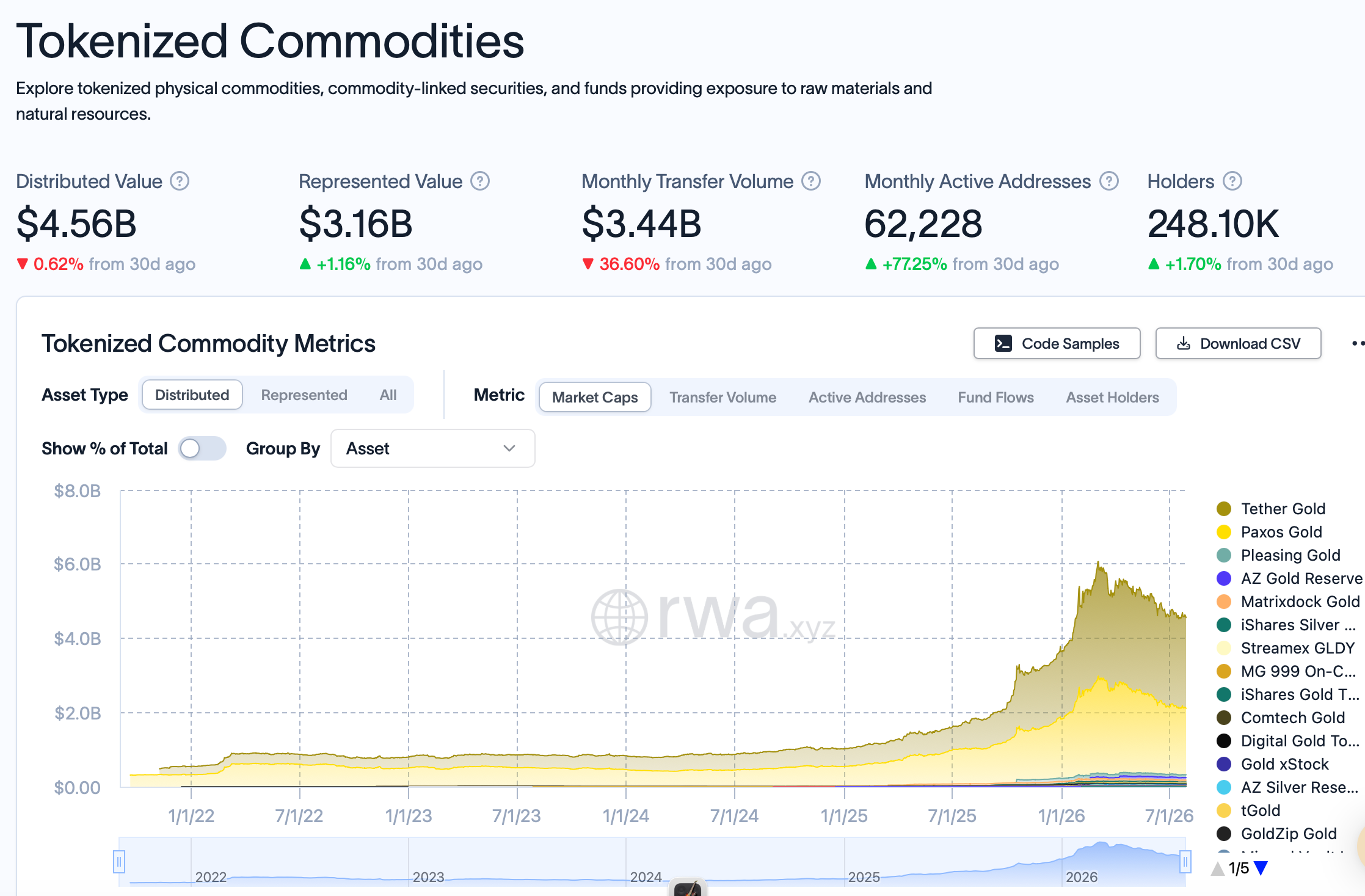
According to RWA.xyz, the tokenized commodities sector has grown to about $4.56 billion in distributed value, with Tether Gold and Paxos Gold accounting for more than 90% of the market.
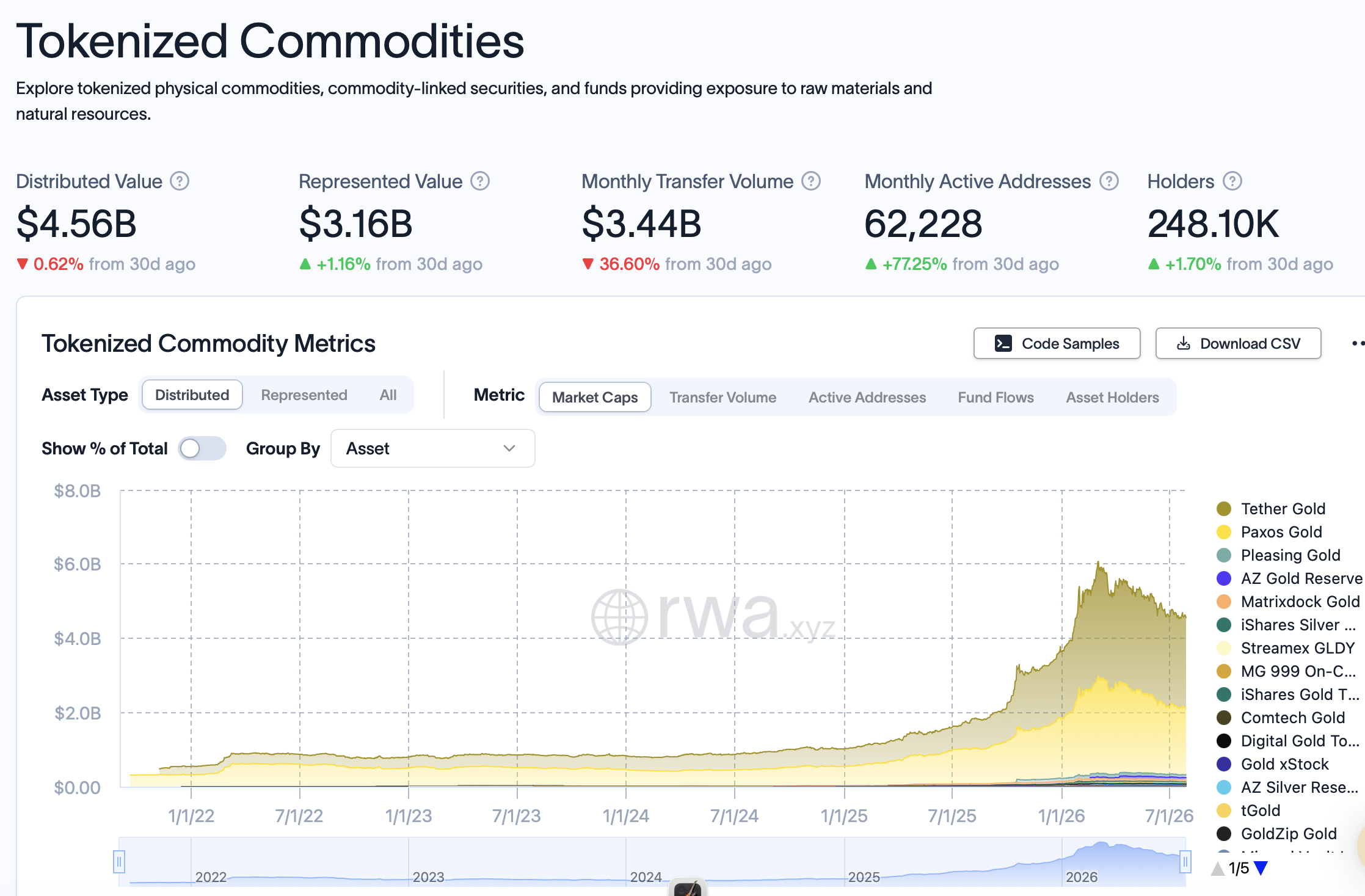
Tokenized commodities. Source: RWA.xyz
Magazine: The 100x obsession: Fundamentals grow in importance as crypto matures
Solana’s native token has been underperforming during the persistent bear market, but some analysts view the current levels as great buying opportunities.
Others believe the asset is at a critical turning point, suggesting that a further 30% crash is not out of the question.
More Bleeding?
SOL has been in a major decline lately, with X user WIZZ noting that it has logged nine consecutive red months and is at risk of closing a tenth – something unseen in its history. Ivan on Tech said people should respect the trend and take it as a warning that the price could slip further in the near future.
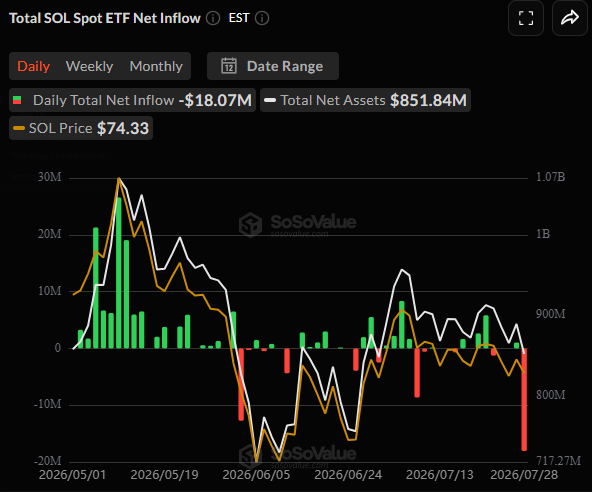
As of this writing, it trades at around $74 or very close to the $73.75 mark, which the popular analyst Ali Martinez labeled a “make-or-break” moment. He outlined that more than 50 million SOL were bought around that level, making it the most critical support on the map. Martinez thinks that a sustained close under the key zone might trigger additional selling pressure, with $60 becoming the next major downside target.
“Below that, there is little meaningful support until $50,” he added.
Shortly after, the analyst claimed that SOL has lost its rising channel, arguing that if bears maintain control, the price could move south toward $60.
The waning institutional interest also signals that the token may experience a further pullback. SoSoValue’s data show that spot SOL ETFs remain unattractive to pension funds, hedge funds, and other investors. In fact, the daily total net inflow for July 28 dropped to -$18.07 million, the largest single-day red candle since December last year.
Time to Buy?
Others remain predominantly optimistic despite the ongoing depression. X user Crypto Zenkai opined that buying SOL at its current level below $80 is like investing in BTC in 2010. Their post drew mixed reactions, with many commentators saying the comparison was inappropriate.
Lucky is also among the bulls. The X user, who has almost 2 million followers, first wondered whether SOL’s plunge under $75 is “a juicy dip” that could be followed by a potential rally to roughly $160. Later on, the analyst called the asset a “go-to pick” for the next six months, grouping it together with ETH, LINK, TAO, and SUI.
The post Why Solana Could Be Heading for a Crash to $50 appeared first on CryptoPotato.


Every guide on the subject tells you the same thing: locked liquidity means the team cannot rug you, so the token is safer. That was true when the only exit was draining the pool. On modern launchpads the lock has become the scam’s revenue engine, and the checkmark you are looking for is the thing paying the attacker.
Summary
- Locked liquidity means the tokens representing a trading pool’s assets are held in a time-locked contract the creator cannot withdraw from, which blocks the classic rug pull where a team drains the pool and disappears.
- Nearly every explainer treats that as a safety signal, and in the narrow sense it is: the specific attack it prevents is real and was once the dominant way memecoin buyers lost money.
- Modern launchpads pair locked liquidity with claimable creator fees, so the pool that cannot be drained still pays its creator a share of every trade, indefinitely.
- That combination converts a one-time theft into a permanent income stream, and it means an attacker has no reason to rug, because not rugging is more profitable than rugging.
- Locked liquidity also says nothing about supply concentration, contract permissions, the identity of the team, or whether anyone will still be trading the token next week.
There is a checkbox that appears on token screeners, launchpad interfaces, and every safety checklist written for memecoin traders: liquidity locked. Finding it is presented as one of the essential steps before buying an anonymous token, and the reasoning behind that advice is sound as far as it goes. A liquidity lock genuinely does prevent the single most destructive attack in decentralized finance, the rug pull, in which a token’s creator removes the assets backing the trading pool and leaves holders with something they cannot sell. The guides are unanimous. One says verifying the lock is not optional but essential. Another says it reassures investors the project is safe to engage with. A third says it gives investors a sense of security. All of them are describing a real protection, and all of them are incomplete in a way that has become expensive. Because on the launchpads where most new tokens now originate, the same lock that stops the creator draining the pool also guarantees the creator a cut of every trade in it, forever, and that changes what the checkbox means.
What a liquidity lock actually does
Start with the mechanism, because the protection is real and understanding it precisely is what lets you see the gap.
When a token launches on a decentralized exchange, someone must supply the pool that lets people trade it. That means depositing the new token alongside something valuable, typically a stablecoin or the chain’s native asset, into a pool contract. In exchange, the depositor receives liquidity provider tokens, which are the claim ticket on that deposit. Whoever holds the provider tokens can redeem them and take the pool’s contents back out.
That claim ticket is the entire vulnerability. A creator holding it can wait for buyers to arrive, watch the pool fill with real money, then redeem the tickets, withdraw everything of value, and leave the token with nothing behind it. The price collapses to zero because there is nothing to sell into. That is the rug pull, and it accounted for an enormous share of memecoin losses across several years.
A liquidity lock sends the provider tokens into a separate time-locked contract instead of leaving them in the creator’s wallet. Locker services hold them for a stated period, publish the lock on chain so anyone can verify it, and refuse to release the tokens before the expiry. The creator cannot redeem what they no longer hold. The classic exit is mechanically foreclosed.
Two clarifications that catch people out. A locked pool still trades normally; the lock restricts withdrawal of the pool’s contents, not buying and selling against it. And liquidity locking is different from token locking, which restricts the team’s own supply through a vesting schedule. A project can do one without the other, and the checkbox you are reading usually covers only the first.
What the guides get right
Before the criticism, credit where it is due, because dismissing the lock entirely would be its own error.
The evidence on unlocked pools is genuinely alarming. Analysis of a thousand memecoins on one major chain found that over ninety percent had not locked liquidity, leaving them structurally exposed to exactly the attack described above. Industry estimates put memecoin scam losses in the hundreds of millions of dollars in a single year, with pool draining as a leading method. Against that baseline, a project that locks its liquidity has removed a real and common failure mode, and the difference between a locked and unlocked pool is not cosmetic.
The lock also carries a signalling function that is worth something. A team willing to give up the ability to withdraw the pool is a team accepting a constraint, and constraints accepted voluntarily tend to correlate with intentions that survive contact with a falling price. That correlation is weak, and weak correlations still carry information.
So the guides are not wrong about what a lock does. They are wrong about what a lock implies, and the gap between those two things is where the current generation of scams operates.
The inversion
Here is the change that the safety literature has not absorbed.
Launchpads in the Pump.fun lineage — the machinery underneath — automated token creation and solved the rug pull structurally: when a token graduates from its launch curve to a trading pool, the platform locks the liquidity itself, permanently, in a contract nobody can drain. That is a real improvement, and it is the basis for these platforms describing themselves as rug-resistant.
The same platforms also pay creator fees. A locked pool still generates trading fees on every swap, and those fees are claimable by the address that created the token. The arrangement is defensible on its face: it rewards builders whose tokens sustain real volume, and it gives creators a reason to keep supporting a project rather than dumping and leaving.
Now combine the two properties and follow the incentive. A creator who cannot drain the pool has lost one revenue source. A creator who receives fees on every trade has gained another, and the second one does not require the token to succeed, only to be traded. Volume from panicked selling pays exactly as well as volume from enthusiastic buying. Volume from holders trying to exit a token they now recognize as worthless pays exactly as well as either.
What the lock removed was the exit. What it did not remove was the extraction, and it converted extraction from an event into a subscription.
This is not a theoretical concern. When attackers compromised a prominent executive’s social account and launched a token on the venue where the design ran off the credibility, the operation ran on precisely this design: liquidity permanently locked, trading fees claimed repeatedly within the first hours, and no rug pull at any point, because rugging would have ended a stream the attacker had every reason to keep collecting. The token could not be drained. It also did not need to be. Coverage of the incident put it plainly: locked liquidity let the scam pose as a legitimate token. For the reporting behind this argument, the $VLAD case documented the full extraction sequence.
Why the checkbox now misleads
The practical damage is not that locks are useless. It is that they are load-bearing in a mental model that no longer describes the risk.
A trader running the standard checklist sees liquidity locked, checks the box, and treats one category of danger as resolved. That is correct. But the same trader typically treats the checkmark as a broader legitimacy signal, because that is how every guide frames it, and on a launchpad where locking is automatic and universal it carries no information about the project at all. When every token on a platform has locked liquidity by default, the presence of a lock distinguishes nothing. It is not a filter; it is a floor.
Worse, it inverts the usual scam-detection heuristic. Historically, a suspicious token looked suspicious: no lock, anonymous team, contract with a mint function, supply concentrated in a few wallets. A launchpad token created for the purpose of harvesting fees looks clean by the most-cited measure, because the platform made it clean automatically. The design that makes the attack profitable is the same design that makes the attack pass inspection.
What a lock does not tell you
Five things sit entirely outside what a liquidity lock covers, and each has ended more positions than pool draining has in recent cycles.
Supply concentration. A lock covers the pool, not the tokens held by insiders. A creator holding a large share of supply can sell into the pool continuously, which is a slower rug producing the same outcome for holders. Check the top-holder distribution separately.
Contract permissions. Mint functions, transfer restrictions, blacklists, and modifiable fee parameters live in the token contract, not the pool. A locked pool attached to a contract whose owner can mint unlimited supply is not protected in any meaningful sense.
Lock duration and terms. Locks expire. A thirty-day lock on a token marketed as a long-term project tells you when the risk returns. Read the expiry, and read whether the locker allows early withdrawal under any conditions.
Creator fee arrangements. The subject of this guide. If the platform pays fees to token creators, understand that a flagged, publicly known scam continues earning for its operator every time someone trades it, including when you sell.
Whether anyone will trade it tomorrow. The most common way to lose money on a new token is not a rug at all. It is buying into a pool that becomes illiquid within days, leaving a position that can only be exited at a catastrophic price. No lock addresses this.
The screener’s blind spot
Most traders never read a locker contract. They read a screener, which condenses everything above into icons, and understanding what the screener can and cannot see is more practical than understanding the underlying mechanics.
Screeners are good at what is observable on chain and mechanical to check. Whether liquidity provider tokens sit in a known locker contract, when the lock expires, whether the token contract’s ownership has been renounced, whether a mint function exists, how supply is distributed across the largest holders, and how much liquidity backs the pool. These are facts with definite answers, and a screener that reports them accurately has done its job.
What a screener cannot see is intent and arrangement. It cannot tell you whether the creator is still claiming trading fees, because that is an ordinary contract call indistinguishable from any other in a summary view. It cannot tell you whether the wallet that deployed the token belongs to someone who has done this eleven times before, unless the addresses are linked and someone has labelled them. It cannot tell you that the token’s name and imagery were lifted from a compromised account an hour earlier, because that fact exists off chain entirely.
The gap matters because the current generation of extraction is built precisely in it. Everything the screener checks comes back clean, because the launchpad made it clean by default, and everything that would identify the problem lives in transaction history, social context, and fee-claim patterns that no icon summarises. A trader who treats a clean screener as an all-clear has outsourced a judgment the tool was never built to make.
The practical adjustment is small. Use the screener for what it measures well, which is contract permissions and supply distribution, and treat the liquidity-lock icon as background, not as a verdict. Then spend thirty seconds on the things it cannot see: where the token came from, who is promoting it, and whether anyone has flagged the contract.
How to assess a token properly
Replace the single checkbox with a short sequence. None of this takes more than a few minutes, and it survives the design changes that broke the old heuristic.
Read the holder distribution first, not the lock. If a small number of wallets hold most of the supply, the lock is irrelevant, because the exit does not need the pool.
Check the contract’s permissions. Screeners flag mint authority, ownership status, and transfer restrictions. An unrenounced contract with an active mint function is a larger risk than an unlocked pool.
Assume the lock, then ask what it costs you. On launchpad tokens, locking is standard. The relevant question is not whether liquidity is locked but who receives the trading fees and whether the creator is still claiming them.
Treat flagged tokens as permanently flagged. If an explorer marks a contract as a likely scam, trading it does not merely risk your capital; on fee-paying platforms it pays the operator. There is no version of participating that is neutral.
Size for illiquidity. Ask what exiting a position would cost if volume fell ninety percent tomorrow, because for most new tokens it will.
The uncomfortable summary is that the industry solved one attack extremely well and the attackers moved. Locked liquidity remains a genuine protection against the specific thing it protects against, and treating it as a general safety signal is now the mistake it was designed to prevent.
The pattern this fits
Step back from tokens and the episode illustrates something that recurs across crypto security, which is worth naming because it will happen again.
Security engineering in this industry tends to be adversarial and specific. A particular attack causes enough losses to become notorious, builders design a mechanism that forecloses it precisely, the mechanism becomes standard, and the ecosystem treats the presence of that mechanism as evidence of general safety. Then attackers, who have read the same documentation, design around it. The mechanism keeps working exactly as specified. The safety inference stops holding.
The same sequence produced the audit badge, which certifies that specific code was reviewed and gets read as certifying that a project is legitimate. It produced renounced ownership, which removes an administrator’s ability to alter a contract and gets read as removing risk, while saying nothing about a contract written maliciously in the first place. It produced multisignature custody, which prevents a single compromised key from draining funds and gets read as institutional-grade safety, while saying nothing about who holds the keys. In each case the mechanism is real and valuable, universally adopted, and eventually uninformative — a pattern of mechanism design meeting adversaries that repeats across the industry for exactly the reason it succeeded: once everyone has it, having it distinguishes nobody.
The corollary is practical. Any security signal that becomes a checkbox is on a timer, and the timer runs from the moment the signal becomes standard rather than from the moment an attack defeats it. A checkbox present on every project in a category has stopped being a filter, whatever it still prevents. The useful question is never whether a token has the standard protections but which risks those protections were never designed to touch, and that list is always longer than the checklist.
A closing note on how to think about the lock going forward, because the mechanism is not going away and neither is the design built on top of it.
The right mental model is a lock on a shop door. It stops one specific thing, which is somebody carrying the inventory out at night, and it is genuinely worth having. It tells you nothing about whether the shop sells anything useful, whether the owner is honest, whether the prices are fair, or whether the business will exist next month. Nobody would walk into an unfamiliar shop, observe that the door has a lock, and conclude the merchandise is good. That is roughly the inference the standard token checklist encourages, and the launchpads have made it worse by fitting every door with the same lock automatically.
What changes the assessment is knowing who benefits from you being inside. On a platform where the token’s creator collects a fee from every transaction in the shop, including the transaction where you sell what you regret buying, the lock on the door is not there for you. It is there because it makes the arrangement durable, and durability is what the operator needed. Reading it that way costs nothing and prevents the specific mistake this guide exists to describe.
Frequently asked questions
What does locked liquidity mean?
The liquidity provider tokens representing a trading pool’s deposited assets are held in a time-locked contract the creator cannot withdraw from for a stated period. This prevents a rug pull, in which a creator redeems those tokens, removes the pool’s valuable assets, and leaves holders with a token that cannot be sold. The lock is verifiable on chain through the locker platform.
Does locked liquidity mean a token is safe?
No. It means one specific attack is blocked. It says nothing about how supply is distributed among holders, what permissions the token contract grants its owner, how long the lock lasts, who receives the pool’s trading fees, or whether the token will have enough liquidity next week for you to exit at a reasonable price.
Can a token with locked liquidity still be a scam?
Yes, and increasingly the design is built around the lock rather than despite it. On launchpads that pay trading fees to token creators, a permanently locked pool generates a continuing income stream for whoever created the token, including when the token is publicly flagged as fraudulent and holders are selling. The creator has no incentive to rug because collecting fees pays better.
Why do launchpads lock liquidity automatically?
Because it removes the most damaging and most common failure mode, which helps the platform’s reputation and lets traders participate with one category of fear removed. That is worth something. The consequence is that a lock on a launchpad token carries no information about that specific project, since every token on the platform has one.
What is the difference between locked liquidity and locked tokens?
Locked liquidity restricts withdrawal of the assets backing the trading pool. Locked tokens restrict the team’s own holdings through a vesting schedule, limiting how fast insiders can sell. They address different risks, well-run projects generally do both, and a safety checkbox usually refers only to the first.
Can I still buy and sell a token with locked liquidity?
Yes. The lock applies to withdrawing the pool’s underlying assets, not to trading against the pool. Buying and selling continue normally, and every one of those trades generates fees, which on some platforms are claimable by the token’s creator.
What should I check instead?
Holder concentration among the top wallets, the token contract’s permissions including mint authority and ownership status, the lock’s expiry date and terms, who receives trading fees, and realistic exit liquidity. Screeners surface most of this in under five minutes, and any one of them will disqualify more bad tokens than the lock check will. This is educational information, not financial advice.
Disclaimer: This article is for information and educational purposes only and does not constitute financial or investment advice. Token launches carry substantial risk of total loss, platform mechanics vary and change, and no verification checklist eliminates that risk. Always do your own research. Information is accurate as of July 29, 2026.


“I think we’re going to see a lot of mainstream impact from something tokenized that people can buy that they used to have a hard time getting access to,” Galindo said.
“I think that’ll probably be the first way crypto hits the people that aren’t just in it all the time and thinking about it all the time. It’s going to be some kind of tokenized product.”
Galindo also said wealth management clients are becoming more comfortable with digital assets as investment options continue to expand beyond bitcoin.
“A lot of people just stopped at bitcoin and said, ‘I’ve got that covered. I don’t want to get it more complicated,’” he said. As more exchange-traded funds and tokenized products become available, he expects investors to spend more time deciding how digital assets fit within broader portfolios.
Ali Wallace, Morgan Stanley Investment Management’s global head of capital markets and ETF strategy, said product development is already evolving in response to investor demand. She pointed to growing interest in multi-currency digital asset ETFs as the next stage of innovation.
“There really is an interest for multi-currency, multi-product” ETFs, Wallace said, describing them as the next evolution of digital asset investment products.
Graseck expects the transition to take years rather than months. Still, she believes the direction is clear.
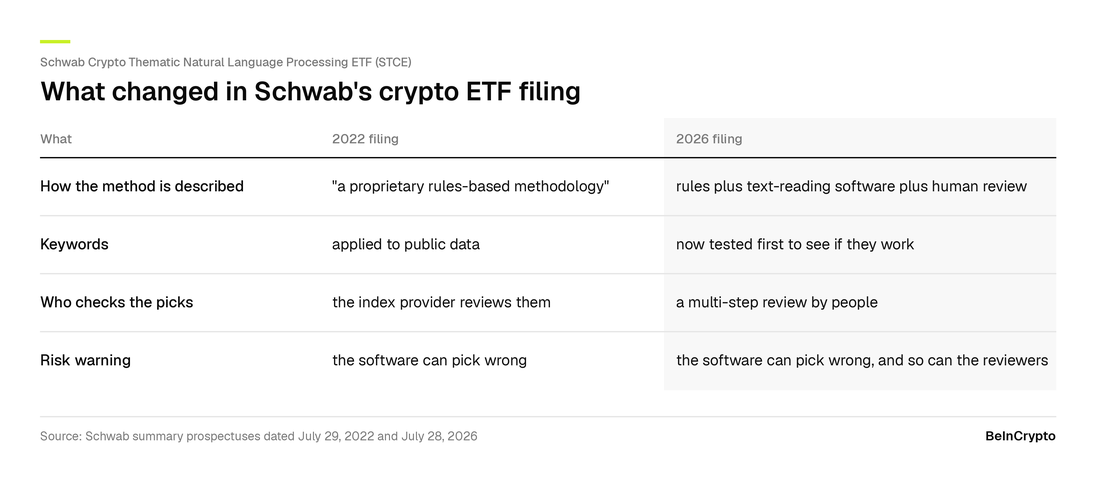
Schwab renamed its crypto stock ETF on July 28. The new name points to the software that picks the holdings. That software’s second-largest pick was Trump Media & Technology Group.
The ticker stayed STCE, while the fee stayed at 0.30%, but the fund’s new legal filing added something the old one lacked. People now double-check what the software chooses.
What Is the Schwab Crypto ETF?
STCE is an exchange-traded fund, or ETF. It started trading on August 4, 2022, does not buy Bitcoin but can buy shares in companies tied to crypto. Miners, exchanges, and payment firms.
The filing bans the fund from owning crypto directly. Schwab reported $298.2 million in assets and 43 holdings as of June 23. It sits alongside a growing shelf of Bitcoin miner ETF products.
The old name was the Schwab Crypto Thematic ETF. The new one adds three words. Natural Language Processing (NLP). That phrase means software that reads text. It hunts for keywords in company filings and reports.
What Actually Changed in the Filing?
Most of it did not change. Same goal, same fee, and same stock list, called the Schwab Crypto Thematic Index.
But read the 2022 and 2026 filings side by side. Three things are new.

The 2022 filing buried the software in one step. The 2026 filing puts it front and center.
Schwab also added a fresh warning. The human review can miss the mark too. That line does not appear in 2022.
The holdings drifted as well. Software companies grew from 27.3% of the list to 61% in four years. Finance firms fell from 40.8% to 26%. The fund swapped out 62% of its portfolio last year.
Some of that tracks how mining stocks chased AI contracts.
Why Did Schwab Rename It Now?
Schwab has not said. But the regulator’s calendar lines up neatly.
The SEC has a rule about fund names. If a name promises a focus, the fund must put 80% of its money there. The agency updated that rule in September 2023.
In March 2025, the SEC pushed the deadline for big fund families to June 11, 2026.
Then came the useful part. On Feb. 18, 2026, SEC staff published new guidance. It said names that describe a method do not trigger the 80% rule. Terms like long/short or hedged.
Natural language processing is a method. It is not a holding.
Schwab filed the name change on July 13. That is about a month after the deadline.

One caution here. Schwab has not linked these events. The rule did not force the change. This is a timeline, not a proven cause.
Why Is Trump Media the No. 2 Holding?
Schwab publishes the stock list. The July 28 version is public.
Bitdeer Technologies sits first at 5.96%. Trump Media comes second at 5.77%. CleanSpark, Core Scientific, and Hut 8 follow.
The list holds just 35 names. The rules allow up to 50. Five weeks earlier, Schwab reported 43 holdings.
So why is Trump Media there? The company runs Truth Social. It also built a bitcoin treasury. Its disclosed Trump Media bitcoin holdings give a keyword scan plenty to find.
The filing admits this can happen. It warns the method may pick companies whose main business has little to do with crypto.
Miners fill most of the rest. Anyone comparing crypto mining stock returns with owning coins gets a social media stock in the same basket.
The stock list gets rebuilt every three months. The next rebuild is the first with the human check written into the rules.
Two questions stay open. Will Trump Media hold second place? And will Schwab explain a rename it has only announced?
The post Schwab Crypto ETF Adds AI Label, Trump Media Climbs to No. 2 appeared first on BeInCrypto.

Food-safety experts stress that people should continue to buy and consume produce—whether at the grocery store or the farmers’ market—despite Cyclospora fears. “Don’t quit eating fruits and vegetables,” Rohde says. But people can take precautions to limit their risk of Cyclospora and other foodborne pathogens.
Bill Marler, a food-safety lawyer, recommends buying intact heads of lettuce and whole fruits and vegetables over bagged, boxed, or pre-cut produce. Centralized chopping, washing, mixing, and packaging can spread contamination from a relatively small amount of produce across a much larger batch, he says.
Experts also advise washing produce thoroughly under running water, scrubbing hard fruits and vegetables such as melons and cucumbers, and following other food-safety practices, such as keeping raw meat and vegetables separate when cooking.
Cooking food to an internal temperature of at least 158°F can kill Cyclospora. Rohde says he has been cooking most of his veggies lately and has been washing produce “more vigorously than usual.”

Why Lone Republican Sen. Rand Paul Voted Against Russia Sanctions Bill

FIFA charge Argentina over Falklands banner and World Cup final brawl

Giants training camp live updates from Day 1 in West Virginia

Renter of Home in Anne Heche Crash Denies Settlement With Son

No Jackpot Winner as $257 Million Prize Rolls Over to $269 Million Monday Draw

Weekend Open Thread: Staud – Corporette.com

Inside an ATM Machine | How Cash Is Counted#shorts #viralshorts #atm #money #reels #hello #factory

The CLARITY Act Is Done, Here’s What Happens to XRP Now

Now You Can Buy Airline Tickets with Cryptocurrency | Hum News | Pakistan
-

 Fashion5 days ago
Weekend Open Thread: Brooks Brothers
-
 Sports3 days ago
Commonwealth Games boxing: Jadumani Singh seals dominant 5-0 win over Pakistan’s Sumama Rehman to enter quarter-finals | Commonwealth Games News
-

 Tech3 days ago
Intel is reversing course and bringing hyper-threading back to its server chips
-

 Crypto World7 days ago
Ethics, other provisions in crypto Clarity Act to be further discussed
-

 Politics2 days ago
Luke Littler dismantles Gerwyn Price to retain title in Blackpool
-

 Crypto World4 days ago
Ripple bought a bank in pieces. The $4 billion audit
-
 Entertainment5 days ago
A New Post-Apocalyptic Gundam Anime Series Blasts Into SDCC
-

 Sports6 days ago
2026 3M Open leaderboard: Scottie Scheffler finds putter in Round 1, sits three back
-

 News Videos3 days ago
BITCOIN JUST ENTERED THIS CRITICAL ZONE…
-

 Fashion6 days ago
16 Dresses for the High Summer Event
-

 Politics1 day ago
The Part of the Electric Transition Nobody Wants to Discuss
-

 News Videos6 days ago
The Peugeot Family: How 200 Years of an “Old Money” Dynasty Died in A Boardroom
-

 Business13 hours ago
Major shareholder moves on Canyon
-

 Politics3 days ago
Spain sweeps the board at 2026 World Cup with individual awards
-

 Crypto World3 days ago
XRP Ledger adds $2.6B as RWA inflows rank second
-

 Crypto World6 days ago
Uniswap (UNI) pushes deeper into tokenized RWAs with permissioned trading pools
-

 Tech5 days ago
Anthropic launches Claude Opus 5, a cheaper AI model for coding, agents and enterprise workflows
-
 Entertainment23 hours ago
‘Stargate’ Creator’s New Sci-Fi Series Returns for Season 3 Tomorrow
-
Crypto World6 days ago
SEC Agrees to Overhaul Recordkeeping After Settling Coinbase Lawsuit Over Gensler’s Lost Texts
-

 Entertainment4 days ago
Sara Gilson Killed By Husband After Viral “Pedophile” TikTok Video
You must be logged in to post a comment Login