
Crypto World
Bitcoin Faces Fed Message Test as Kalshi Hike Odds Reach 79%

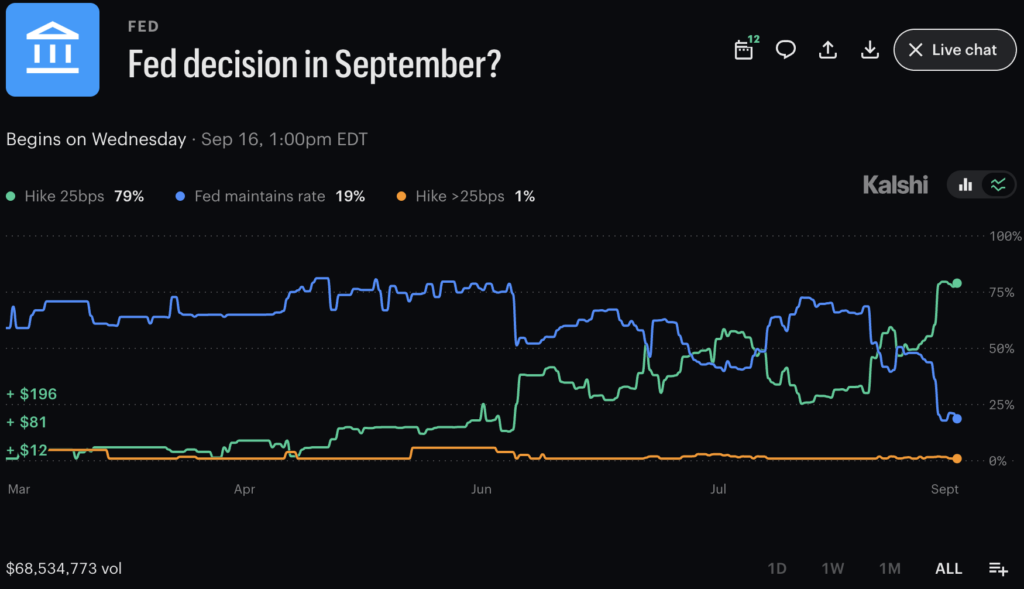
Kalshi traders assign a 79% probability to a 25-basis-point Fed hike at the Wednesday, September 16, 2026, FOMC meeting, with 19% pricing in no change and less than 1% split between a 50-basis-point move or either a 25-basis-point or 50-plus-basis-point cut, according to Kalshi markets.
That’s a market-implied probability, not a confirmed decision. Our call is that the Fed delivers the hike and pairs it with a higher-for-longer message, a combination that could pressure Bitcoin even if the rate move itself is already priced in.
The tension for traders isn’t really whether the Federal Reserve hikes. At 79%, that outcome is close to consensus. The tension is whether the FOMC’s accompanying language locks in expectations for further tightening or leaves room for a pause, and that distinction is what typically moves liquidity-sensitive assets in the hours after the statement drops.

What Is Driving the Hike Call on Kalshi?
The macro backdrop gives the Fed cover to move. The US Bureau of Labor Statistics reported that the Consumer Price Index rose +0.4% month over month in August and +3.4% over the trailing 12 months, a re-acceleration from July’s +0.1% monthly print.
Core CPI, which strips out food and energy, climbed 0.3% for the month and 2.4% year over year, still running well above the Fed’s 2% target.
Energy did much of the heavy lifting. BLS data show energy prices up 2.1% in August and 16.3% year over year, with gasoline alone up +3.9% for the month and +27.4% annually.
That’s a separate data point from the FOMC decision itself: the CPI release landed September 11, five days before the rate call, but it’s the clearest evidence the inflation fight isn’t over, and the strongest input behind the hike thesis.
For a deeper look at how that print maps onto specific price zones, see this breakdown of August CPI and Bitcoin levels.
Why the Decision May Matter Less Than the Message
— Eleanor Terrett (@EleanorTerrett) September 14, 2026
 NEWS: Senate Republicans have released new Clarity Act text featuring a revised ethics proposal agreed to by President Trump.
The text also contains changes to the sections on the Blockchain Regulatory Certainty Act (BRCA), stablecoin yield, and the so-called “Ag title.”…
A 79% probability suggests on Kalshi the hike is largely priced in, meaning Bitcoin and other risk assets often don’t react significantly to such anticipated outcomes.
Real market moves typically come from details like the statement’s tone, the dot plot, and any voting dissents, which current pricing doesn’t reflect.
Traders focus more on the Fed’s guidance than the actual hike, as a hawkish stance could tighten financial conditions and reduce risk appetite.
Conversely, signaling that the tightening cycle is nearing its end could change the market’s reaction to the same 25-basis-point hike. Essentially, traders are betting on which message the Fed will convey rather than the hike itself.
If the Fed Hikes, What Happens Next?
Three scenarios shape the near-term outlook, each representing forecasts rather than definitive outcomes.
Base Case: The Fed hikes by 25 basis points and issues hawkish guidance, likely pressuring Bitcoin and liquidity-sensitive assets, as this often strengthens real yields and the dollar.
Second Scenario: If the Fed hikes but clearly indicates it’s the final move in the tightening cycle, markets may view this as supportive for Bitcoin, turning a rate hike into a bullish signal based on the accompanying language.
Third Scenario: The Fed holds rates steady, currently assigned a 21% probability. This outcome would challenge the base case and likely create volatility, as it would be a surprise against strong hike expectations. The low odds of a 50-basis-point hike or a cut suggest limited potential for drastic shifts.
Don’t Miss: The Hottest Meme Coin Opportunities Silently Climbing the Crypto Ranks in September
The post Bitcoin Faces Fed Message Test as Kalshi Hike Odds Reach 79% appeared first on Cryptonews.

Crypto World
White House Agrees to Major Crypto Ethics rules in a last-minute push to save the CLARITY Act

Senate Republicans have released another round of revisions to the CLARITY Act as they seek Democratic support ahead of a September 15 procedural vote on the cryptocurrency market-structure bill.
The latest version runs to 635 pages, adds provisions on ethics, enforcement, stablecoin yields, and digital-asset market operations, and represents a last-ditch bid to pass the CLARITY Act this year.
BREAKING: — Bull Theory (@BullTheoryio) September 14, 2026
 White House agrees to major crypto ethics rules in a last-minute push to save the CLARITY Act.
Senate Republicans just released a revised 635-page CLARITY Act ahead of Tuesday’s critical vote.
Major changes:
1. The new text includes Trump-backed ethics rules that… pic.twitter.com/77kWxZ6i6y
The CLARITY Act is a proposed framework for digital commodities. According to the Congressional Research Service summary of the House bill, it would generally give the Commodity Futures Trading Commission responsibility for regulating digital-commodity transactions.
This includes exchanges, brokers, and dealers. The measure also assigns the Securities and Exchange Commission a role in specified digital-commodity activities and transactions.
What Changed in the Revised 635 Page CLARITY Act Draft?
The revised text incorporates an ethics framework supported by President Donald Trump, restricting public officials from engaging in digital assets.
Under this framework, officials with significant crypto holdings must divest or place assets in a blind trust. Both the Department of Justice and state attorneys general will enforce these ethics rules, addressing previous Democratic concerns.
The Blockchain Regulatory Certainty Act now focuses on Bank Secrecy Act compliance and removes protections for criminal proceedings.
The bill includes miners and validators in these narrowed protections. The bill also introduces a circuit-breaker mechanism for stablecoins, allowing federal regulators to intervene during significant withdrawals from community banks.
Additionally, the bill proposes stricter limits on vertical integration, including rules on affiliate trading and potential conflicts at digital commodity exchanges, while state consumer protection laws remain unchanged. Developer protections will not override derivatives regulations or alter rules for prediction markets.
Make Your CLARITY Act Prediction Count With $25 For Free on Kalshi
Lummis Frames the Bill as Finished
Senate Banking Digital Assets Subcommittee Chair Cynthia Lummis said the bill followed a year of intense daily bipartisan negotiations and described it as ready. She said Trump had voluntarily agreed to ethics restrictions that she characterized as among the toughest applied to federal officials in U.S. history.
Lummis argued that Democrats had received the concessions they sought and should support the measure. Her comments came with the release of the final CLARITY Act text and focused on the ethics provisions added during negotiations.
Coinbase CEO Brian Armstrong also voiced support for the CLARITY Act ahead of the Senate vote. Speaking on CNBC’s Squawk Box Asia on September 10, Armstrong said the bill was ready for approval and cited support from law-enforcement groups, banks, and crypto companies.
Armstrong said the revisions addressed Coinbase’s main concerns with the legislation. Coinbase had previously raised several issues that it considered essential, according to reporting on the company’s position.
Supercharge Your Trading in 2026 With BloFin AI Trading Bots
What Does the Vote Actually Decide?

The September 15 event is a procedural vote tied to the CLARITY Act. It follows Senate Republicans’ latest changes as they seek Democratic backing for the cryptocurrency market-structure measure.
The legislation itself would establish a regulatory framework for digital commodities, which it defines as digital assets that rely on a blockchain for their value.
Under the bill summary, the CFTC would generally regulate digital-commodity transactions, while the SEC would retain jurisdiction over certain activities and transactions involving digital commodities.
The framework also includes requirements for trade monitoring, recordkeeping, and the commingling of customer assets. It would subject digital-commodity exchanges, brokers and dealers to the Bank Secrecy Act for anti-money-laundering and related purposes.
The Senate’s consideration of the revised text therefore centers on a bill that combines market-structure provisions with the newly revised ethics and enforcement measures.
Earn $50 and Enter $300K Prize Draw on EdgeX
The post White House Agrees to Major Crypto Ethics rules in a last-minute push to save the CLARITY Act appeared first on Cryptonews.

Leopold Aschenbrenner of hedge fund Situational Awareness has returned after losing billions of dollars in July — and he’s already losing money again.
CNBC broke the news Friday morning, six weeks after Aschenbrenner’s historic blow-up, that Situational Awareness was re-buying AI stocks and leveraged options on tech stocks.
By Monday’s open, every one of the six tickers tied to his fund had already collapsed, down as much as 8% from Friday’s close.
Situational Awareness is the fund Aschenbrenner still runs after a July collapse in AI valuations erased billions of assets from his portfolio.
Despite one of the most spectacular and well-publicized implosions of any fund manager in history, Situational Awareness quietly bought options tied to AMD, Bloom Energy, and CoreWeave this month. It also bought leveraged exposure to other AI names like SK Hynix, SanDisk, and the Roundhill Memory ETF.
CNBC sources dated those purchases between September 2-10.
The day after that news broke, those six names opened to negative returns of 5-8% amid a broad AI sell-off this morning.
Read more: Vibe coders faced with frontier AI outage
Leopold Aschenbrenner is losing money in AI again
Those six tickers didn’t fall because of Aschenbrenner but rather a viral, apocalyptic essay from Anthropic CEO Dario Amodei who believes that AI will take over the internet within 6-12 months.
Elon Musk said he agreed with it, and Sam Altman also backed the idea.
Broad Monday market coverage framed the resulting sell-off as a rotation out of crowded AI trades. Even Donald Trump weighed in on the debate.
The world found out Aschenbrenner was re-buying Friday, and all of his stocks were down by Monday.
- AMD closed for trading at $516.13 the day CNBC’s story ran; it opened Monday around $486, down roughly 6%.
- Bloom Energy fell 7%.
- CoreWeave and SanDisk each fell roughly 7%.
- SK Hynix and the Roundhill Memory ETF each fell about 8%.
Aschenbrenner, a former OpenAI researcher, launched Situational Awareness in 2024 with about $225 million.
Backers included Stripe co-founders Patrick and John Collison, former GitHub chief exec Nat Friedman, and investor Daniel Gross.
Using leverage as high as 400%, Aschenbrenner grew his portfolio and attracted follow-on financing to manage more than $45 billion by the start of July.
Then he suddenly lost the majority within weeks.
In July, AI stocks retraced a substantial amount of the price appreciation they had enjoyed during the first half of 2026.
Shares of Nebius, SanDisk, Micron, and CoreWeave each fell by more than one-third that month, forcing margin calls and an unwind across tech funds.
Liquidated in a fire sale, moved prime brokers
Ken Griffin’s Citadel bought the bulk of Situational Awareness’ portfolio at a substantial discount — reportedly after its holdings had sunk to roughly $10 billion, in what the Financial Times called the largest dollar loss in hedge fund history.
JPMorgan Chase, which had financed the fund’s leverage, cut the fund off afterward. Aschenbrenner moved his prime brokerage relationship to another boutique, Clear Street.
The comeback trade this month was supposed to look different. Rather than traditional margin, the fund has reportedly been using “flex options,” i.e. fully paid contracts that cap losses at the premium paid.
The shift in those instruments is tied to Aschenbrenner’s promise of a more conservative risk model that doesn’t seem to be particularly well-timed, given this weekend’s sell-off, regardless of its leverage ratio.
Got a tip? Send us an email securely via Protos Leaks. For more informed news and investigations, follow us on X, Bluesky, and Google News, or subscribe to our YouTube channel.
A Wall Street strategist warned on Sunday that the stock market could crack within 30 days. By Monday morning, one stock had ignored him completely.
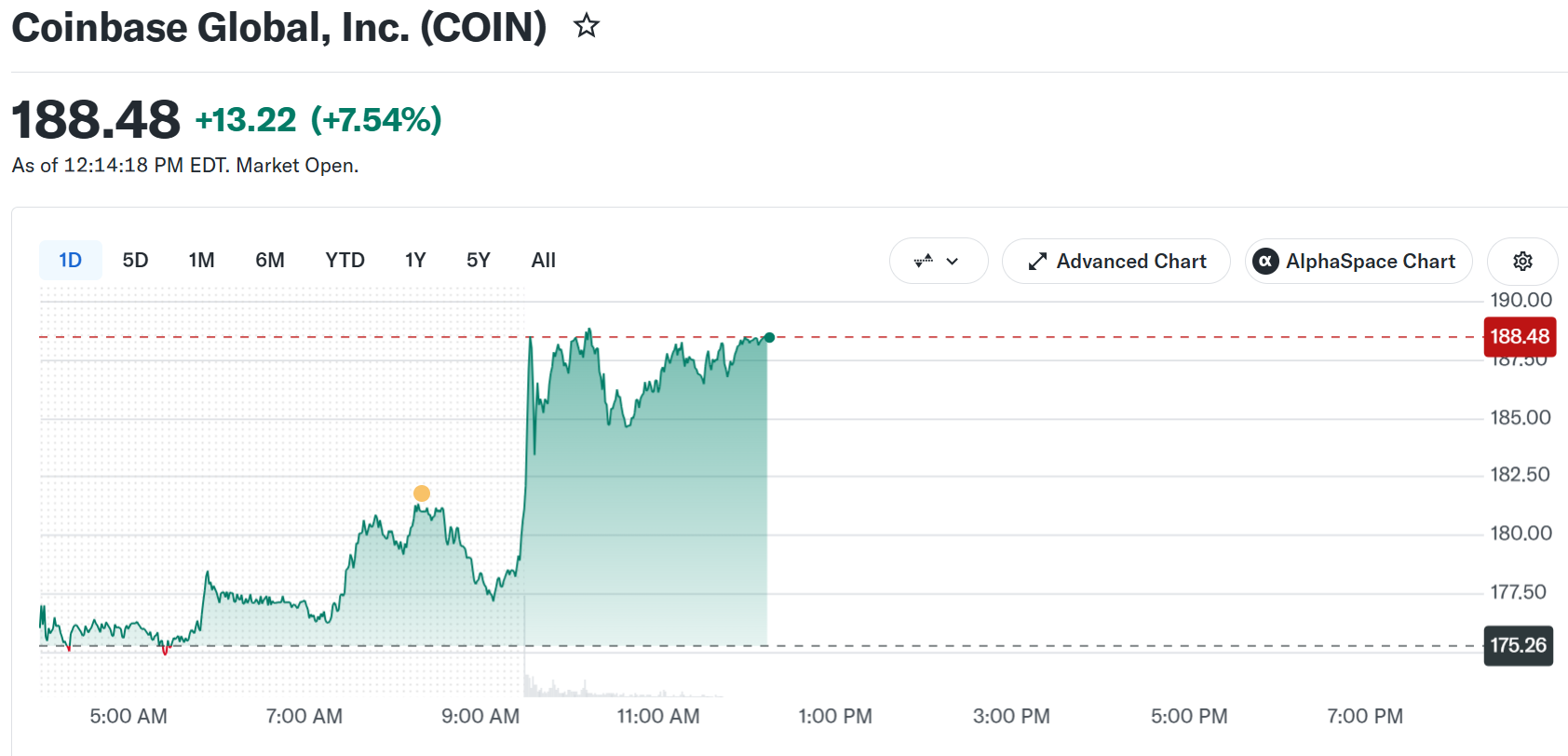
Coinbase (COIN) jumped almost 8% and kept climbing, trading near $188.50. The fund tracking the 500 biggest US companies fell 0.8% in the same hours.

The Bear Who Moved the Stock
The warning came from Mike Wilson, Morgan Stanley’s chief US equity strategist. He told clients the danger was oil, not artificial intelligence (AI).
“I do think in the next 30 days, if oil goes to $120, $130, $140, that’s a drain on liquidity”
BeInCrypto covered that crash warning on Sunday. Coinbase shrugged it off a day later.
The lift came from Compass Point, a Washington firm that trades on politics. Analyst Ed Engel moved Coinbase from sell to neutral.
Amid his neutral bias, it is imperative to note that he did not say buy. Engel’s new target is $177. Coinbase cleared it on the open.
The Vote He Expects to Lose
Engel’s case rests on the Digital Asset Market Clarity Act. The Senate votes this week. The bill would decide which regulator polices crypto.
For Coinbase, that is the whole game. A rulebook means listing tokens without waiting to be sued. The bill slipped to September once already, and this is the last vote before November.
Engel expects it to fail.
So investors bought on a bearish note, chasing a bill that analyst thinks dies this week.
Wall Street Cannot Agree Either
MARA Holdings (MARA) went the other way, falling 2% after JPMorgan cut it to underweight over a data center venture with Starwood.
This has happened before, when Morgan Stanley ran near-identical math in May, investor relations chief Robert Samuels hit back.
“If you actually read the note, the math appears incorrect regarding the Starwood JV, even after we provided an illustrative example of how the economics work.”
Morgan Stanley is no bear here. It opened coverage on September 10 at $250, far above the $201 average across 28 analysts covering Coinbase.

Those targets run from $95 to $330. Monday answered the lowest voice in the room.
The post This One Stock Looks Bullish Amid Morgan Stanley's 30-Day Crash Warning appeared first on BeInCrypto.

The traditional hedge that stocks and bonds have provided against each other is breaking down. So, let’s consider an alternative that involves the USO ETF. The S&P 500 and long-term Treasurys have shown a positive correlation of 0.35 in 2026 — and more concerning, that correlation has spiked during this year’s drawdowns, leaving investors facing losses across their entire portfolio…
Copyright ©2026 Investor’s Business Daily, LLC. All rights reserved. 87990cbe856818d5eddac44c7b1cdeb8

“The surface of your flooring makes an enormous difference,” says Alessandra Leri, professor of chemistry and biology at the school and the lead author of the study. “If you have carpets, they function as a reservoir of bacteria.” But no matter the interior floor surface, she says, “shoe soles are a serious vector of transmission of fecal bacteria from the outdoor environment to the indoor environment.”
Shoes track in more than germs
PFAS, the “forever chemicals” so named for how long they linger in the environment and our bodies, are regularly picked up by shoes and used in manufacturing the soles. Lead dust, which can often be stirred up and released into the air during remodeling of older homes and other buildings, can cling to shoes as well. Pesticides, used both on farms and in home gardens, are similarly free-riders on our shoes.
Where shoe-removal matters most
In most homes in which people do not remove their shoes upon entering, the area nearest the front door is generally the most contaminated. “We found that the first four steps at the entrance to the household are the germiest floor area in the home,” says Gerba. “We also did tracer studies putting dye and tracer viruses on the bottom of shoes and could see how they left a trail on the floor.”

Investors are fleeing AI names in favor of the very industries AI was supposed to decimate. On Monday, the rotation out of AI stocks continued, as industry leaders spent the weekend calling for increased industry regulation amid fears the technology could be becoming too powerful to control. As a result, investors yanked money out of AI stocks and pumped it…
Copyright ©2026 Investor’s Business Daily, LLC. All rights reserved. 87990cbe856818d5eddac44c7b1cdeb8


Bitmine Immersion Technologies added to its Ether holdings last week while projecting hundreds of millions of dollars in annual staking revenue, highlighting how its massive ETH treasury could generate income even during volatile market conditions.
In a Monday announcement, Bitmine said it acquired 27,180 ETH last week, bringing its holdings to more than 5.95 million ETH, worth roughly $15.4 billion and representing about 4.9% of Ether’s circulating supply. Including cash and other crypto assets, Bitmine reported total holdings of approximately $15.8 billion.
Bitmine said more than 5.06 million ETH is now staked, generating an estimated $334 million in annualized staking revenue at current rates.
With roughly 85% of its ETH now staked, Bitmine is turning its crypto treasury into a potentially significant source of recurring revenue. For comparison, Grayscale Ethereum Staking ETF (ETHE), the first spot Ether US exchange-traded product, has 84.6% of its Ether holdings staked, according to the fund’s webpage.
The company’s strategy also offers a key advantage over Bitcoin treasury companies, whose core BTC holdings do not generate native staking yield.
Bitmine shares were little changed on Monday, trading just below $25 in morning trading. The stock has gained nearly 38% over the past month but remains down year to date, according to Yahoo Finance data.
Related: Bitmine buys 28k ETH, completes 97% of treasury accumulation goal
Strategy skipped Bitcoin purchases last week
While Bitmine continued adding to its Ether treasury, Michael Saylor’s Strategy went a second consecutive week without buying Bitcoin (BTC), directing capital toward its preferred stock instead.
Strategy repurchased about 1.42 million shares of its STRC preferred stock for $139.3 million between Sept. 8 and Sept. 13. The company also bought back $176.3 million worth of STRC the previous week, according to a Monday filing.
Strategy’s Bitcoin holdings remained unchanged at 845,050 BTC as of Sept. 13. Its last purchase came in late August, when the company acquired 4,603 BTC for $369.7 million.
In the final week of August, Strategy purchased 4,603 BTC for roughly $370 million, marking its first Bitcoin purchase since June. The subsequent pause, alongside the significant STRC buybacks in recent weeks, shows how the company is balancing Bitcoin accumulation with support for its preferred stock.
Related: Crypto Biz: AI took a back seat when Bitcoin started climbing

S&P Global has led a strategic investment in Kaiko, extending the Paris-based crypto market data provider’s Series B funding to $110 million as it expands its data infrastructure for tokenized financial markets.
The round also included BNP Paribas, Bpifrance, Broadridge, Canton Foundation, Coinbase Ventures, DRW Venture Capital, Nasdaq Ventures, Royal Bank of Canada, Stellar and Susquehanna Private Equity Investments.
Kaiko said the funding will support its core digital asset market data business and its push into onchain financial infrastructure, including data services for tokenized Treasury bills, money market funds, equities and bonds.
The participating investors will also join a Kaiko-led industry working group focused on developing data and infrastructure for tokenized financial products.
Kaiko CEO Ambre Soubiran said the investors span several key areas of digital asset markets, including pricing, trading, capital allocation and blockchain development, and would serve as partners in building infrastructure for institutional onchain finance.
The funding follows a series of moves by Kaiko to expand its institutional data business. The company acquired MiCA-regulated onchain infrastructure provider Cometh in May and US digital asset data provider Amberdata in June, after partnering with Bloomberg in February to bring licensed financial data onchain.
Related: Kaiko flags possible front-running before Robinhood token listings
Wall Street moves closer to tokenization
Kaiko’s funding comes as major US market operators and financial infrastructure firms expand their use of blockchain technology for trading, settlement and collateral management.
In March, New York Stock Exchange parent Intercontinental Exchange (ICE) signed an agreement with Securitize to develop infrastructure and standards for tokenized securities. The agreement builds on ICE’s January plan for a tokenized securities trading platform designed to support 24/7 trading and instant settlement.
That same month, Nasdaq received SEC approval to pilot trading of tokenized stocks and ETFs alongside traditional securities. Nasdaq also partnered with Kraken parent Payward to develop infrastructure connecting regulated equity markets with onchain tokenized equities.
In July, the Depository Trust & Clearing Corporation (DTCC) conducted production trades using DTC-tokenized assets with more than 30 financial firms ahead of a planned October launch of its tokenization service. DTC, a DTCC subsidiary, provides custody and asset servicing for $114 trillion in securities.
The push toward round-the-clock markets has drawn attention from US regulators. The SEC is scheduled to hold a roundtable on Sept. 17 on preparations for 24-hour trading in US equities, including market readiness, operational resilience, investor protections and potential future expansion toward 24/7 trading.

One of three SEC panels scheduled for Sept. 17. Source: SEC
Crypto World
Bitcoin or Ethereum: Which Will Rally More if CLARITY Act Moves to Senate? 3 AIs Analyze

The landmark crypto legislation, known as the CLARITY Act, seeks to establish a clear regulatory framework for digital assets in the USA, and many industry participants view it as a potential game-changer.
The Senate’s cloture vote on the bill is scheduled for tomorrow (September 15), and advancing the debate will require at least 60 votes. Although lawmakers recently revised the legislation to attract more Democratic support, the outcome remains far from certain.
Still, we wanted to check whether Bitcoin (BTC) or Ethereum (ETH) will pump more if the CLARITY Act formally moves to the Senate. To do so, we asked three of the most widely used AI-powered chatbots for their take, and here are their answers.
ChatGPT + Perplexity
OpenAI’s platform claimed that ETH is more likely to rally harder in percentage terms if the bill advances. It predicted that BTC would benefit from the broader sentiment improvement, but added that the asset already has relatively clear commodity status and the legislation would not fundamentally change its regulatory position.
ChatGPT also suggested that ETH has considerably more to gain because the CLARITY Act will reduce uncertainty over whether the asset and other network tokens could be treated as securities. In conclusion, the chatbot estimated that BTC could jump 5-10% after a potential successful vote, while the second-largest cryptocurrency might soar 10-20% immediately after the news.
Perplexity shared a similar thesis, projecting that ETH could print a sharp move toward the high-$2,000s to low-$3,000s after such a development. It went even further, arguing that this could set the stage for a major bull run toward a new all-time high above $5,000.
For BTC, the chatbot expects its valuation to initially surge beyond $83,000. At the same time, it warned that if the bill clearly fails, the asset could plunge to a local bottom of around $55,000.
Gemini’s Take
Google’s chatbot also picked ETH, arguing that it is generally expected to experience a larger percentage rally than BTC if the CLARITY Act clears its hurdles.
“While both assets stand to gain from regulatory progress, the structural dynamics of the CLARITY Act favor ETH for sharper upside potential,” it explained.
Gemini suggested the bill would generally benefit altcoins more than BTC, noting that their lower relative market capitalization (compared to the industry leader) means the same volume of institutional capital inflow triggers larger percentage price swings.
Meanwhile, you can find all details regarding the upcoming vote in our video below.
The post Bitcoin or Ethereum: Which Will Rally More if CLARITY Act Moves to Senate? 3 AIs Analyze appeared first on CryptoPotato.

Anthropic Chief Executive Dario Amodei called for a slowdown in developing leading artificial intelligence capabilities over the weekend, leaving investors to sort out on Monday what that could mean for cloud leaders Amazon (AMZN), Google parent Alphabet (GOOGL) and Microsoft (MSFT). Amazon stock was lower while Google and Microsoft were higher in morning trades. Amodei, whose company is pursuing a…
Copyright ©2026 Investor’s Business Daily, LLC. All rights reserved. 87990cbe856818d5eddac44c7b1cdeb8
White House Agrees to Major Crypto Ethics rules in a last-minute push to save the CLARITY Act

Ari Fletcher Reacts To “Deadbeat” Mom & Yosohn Comments

Indian shooters have earned respect and awe from rivals says Swapnil Kusale | Other Sports News


-
 Tech6 days ago
Memory prices are slowing because buyers ran out of money
-

 Tech1 day ago
The Latest Weird Thing to Play Doom Is the Mapped-Out Brain of a Fruit Fly
-

 Business5 days ago
Micron Stock Climbs Above $1,031 as AI Memory Crunch and a $50 Billion Outlook Fuel the Rally
-

 Business5 days ago
AMD Stock Climbs After Management Lifts 2027 Data Center Outlook Toward $70 Billion in AI Sales
-

 Fashion3 days ago
Weekend Open Thread – Corporette.com
-
 Crypto World6 days ago
Bitcoin price risks $76K drop as $78K support weakens
-

 Crypto World6 days ago
Robinhood Stock: How To Take Advantage With Reduced Risk
-

 Crypto World3 days ago
XAG/USD: Silver’s Short-Term Rally Meets Its Moment of Truth
-

 Crypto World4 days ago
2 Chip Stocks Broke Out This Week. Neither Was Nvidia
-
 Crypto World6 days ago
Ethereum price stalls below $2,500 as ADX drops to 11
-

 Business3 days ago
10 Most-Streamed Songs On Spotify In 2026 So Far, Led By Ella Langley’s Dominant Run On The Charts This Year
-

 NewsBeat6 days ago
England up in reading, maths and science rankings as Scotland and Wales dip
-

 Tech4 days ago
Battery life is the only iPhone 18 Pro and iPhone Duo upgrade I care about. Apple didn’t disappoint
-

 Crypto World4 days ago
OKX launches 10x OpenAI, Anthropic X-Perps in Europe
-

 Crypto World3 days ago
Diesel Tops $6 a Gallon for the First Time as 28 States Set Records
-
 Crypto World6 days ago
Intel Stock Jumps 9% on Chip Price Hike Report, US Stake Gains $36 Billion
-
 Crypto World5 days ago
Bitcoin price risks $70K if $78K neckline breaks
-

 News Videos3 days ago
Facing Financial Fears
-

 NewsBeat6 days ago
What went right this week: an ‘historic’ fall in violent crime, plus more
-

 Tech5 days ago
Apple Watch Ultra 4 vs Watch Ultra 3: Should you really spend another $799?
You must be logged in to post a comment Login