

Crypto World
Bitcoin gets bullish signals from inflation breakevens



“That’s when the deflationary impulse from falling oil prices should remind everyone that the Fed isn’t going to hike and that – if anything – the next move will be a cut,” Robin Brooks, a senior fellow at the Brookings Institution and former chief economist at the Institute of International Finance, said in a report.
If the currency’s strength is under question, then the barrier to bitcoin rising further also looks weaker. The two are known to be inversely correlated.
Some observers, however, are calling for caution, saying the market is overestimating the impact of oil prices on inflation. Elevated price pressures, they say, are now a structural issue.
“The Fed can’t declare victory simply because gasoline prices move lower. Sticky service-sector inflation is exactly why policymakers are likely to keep rates higher for longer, even if headline CPI continues moderating,” YCC Macro said on X.
Markets betting on aggressive easing may be underestimating how persistent underlying inflation really is,” YCC Macro added. Stay alert!
Read more: For analysis of today’s activity in altcoins and derivatives, see Crypto Markets Today . For a comprehensive list of events this week, see CoinDesk’s “Crypto Week Ahead.”
What’s trending



Strategy sold 3,588 Bitcoin for roughly $216 million between June 29 and July 5, using the proceeds to pay dividends on its preferred stock and replenish its cash reserve, according to a Form 8-K filed with the U.S. Securities and Exchange Commission on Monday. Chairman Michael Saylor confirmed the… Read the full story at The Defiant

Ripple has received full authorization under the European Union’s Markets in Crypto-Assets (MiCA) framework after Luxembourg’s financial regulator granted the company a Crypto Asset Service Provider (CASP) license. The approval follows Ripple’s preliminary CASP approval earlier this year and, according to the company, completes its transition into the “post-transitional” MiCA regime.
The CASP authorization, combined with Ripple’s existing Electronic Money Institution (EMI) license, allows the blockchain payments firm to provide regulated crypto-asset services across the European Economic Area (EEA) under EU rules.
Key takeaways
- Ripple secured a CASP license in Luxembourg, completing its full MiCA authorization after preliminary approval in June.
- The authorization enables regulated crypto-asset services across the EEA, supported by Ripple’s existing EMI license.
- Ripple says it is among a relatively small group of firms fully authorized under MiCA.
- MiCA enforcement has begun across the EU, with ESMA maintaining an updated register of licensed providers and national regulators handling supervision.
- ESMA’s latest CASP register shows licensed providers rising to 280 after 37 firms were added following the July 1 transition deadline.
Ripple’s MiCA authorization and what it enables
Ripple said it has now obtained full authorization under MiCA after Luxembourg’s regulator granted it a CASP license. The company previously received preliminary approval in June, and Ripple framed the new authorization as the end of its transition period under the EU framework.
In a statement, Cassie Craddock, Ripple’s managing director for the United Kingdom and Europe, said the CASP authorization means Ripple is “fully compliant” with MiCA and prepared to scale its operations.
For market participants, the practical significance of a MiCA CASP license is that it positions a crypto-asset service provider to operate as a regulated entity inside the EU’s MiCA system. Ripple’s mention of its additional EMI license is notable because it reflects that the company is not relying solely on the crypto-asset authorization path; instead, it brings together licensing coverage that can support a broader regulated service offering.
From transition to enforcement: MiCA’s July 1 deadline
Ripple’s authorization comes after the EU’s MiCA transition period ended on July 1. Under the framework, firms offering regulated crypto-asset services in the bloc needed authorization; otherwise, they were expected to stop offering such services.
MiCA also introduces an important structural change for authorized providers: in many cases, a single authorization can support “passporting” across the EEA, reducing the need for separate approvals in each member state. That is the mechanism Ripple is effectively leaning on, given its statement that it can offer regulated crypto-asset services across the EEA.
While licensing outcomes have improved since the deadline, the enforcement phase is now active. ESMA coordinates aspects of supervision through the register of authorized entities, but the day-to-day regulatory enforcement is carried out by national authorities—meaning implementation and pressure levels can differ across EU member states.
ESMA register update: licensed CASPs rise to 280
According to ESMA’s updated register, the number of licensed crypto-asset service providers stands at 280. The figure increased from 243 a week earlier after 37 additional companies were added, including Standard Chartered, FalconX and Sygnum Europe, as reported in the coverage linked from Cointelegraph.
This incremental jump matters for investors and counterparties because ESMA’s register acts as a key reference point for determining which entities are authorized to operate under MiCA. However, the register’s growth also highlights the uneven pace of authorization as firms work through licensing processes close to major deadlines.
Not all major players secured authorization before July 1. The source notes that Binance withdrew its MiCA application in Greece ahead of the transition and said it would pursue authorization elsewhere while working toward compliance.
Regulators step up: Belgium highlights unauthorized providers
With MiCA moving into enforcement, regulators at the member-state level have begun taking action. Belgium’s Financial Services and Markets Authority (FSMA) has already started applying the new rules.
On Monday, FSMA identified six crypto-asset service providers that it said were operating without authorization and added them to its list of unauthorized crypto-asset service providers, according to the coverage linked from Cointelegraph. The regulator also issued warnings to consumers and market participants about unauthorized platforms, underscoring that the transition is no longer a planning phase—it is an active compliance test.
For users and institutions working with EU-facing crypto service providers, this is a reminder that regulatory status is becoming a central operational variable. Authorization and supervision may be decisive factors for risk management, counterparties, and product availability.
Looking ahead, the key watch items are how quickly the authorization gap closes across remaining providers, how national regulators interpret and apply MiCA enforcement in practice, and whether additional major exchanges and service platforms reach full CASP authorization under the EU framework.

Bitcoin miner TeraWulf is moving further into the artificial intelligence infrastructure race, signing a long-term data center deal with AI firm Anthropic and restructuring its ownership in a separate AI campus venture. The company said it expects the agreement to generate about $19 billion in contract revenue over 20 years.
In a separate transaction, TeraWulf also announced plans to sell its majority stake in an AI data center joint venture in Texas, with proceeds intended for reinvestment into wholly owned AI infrastructure projects. Following the announcements, TeraWulf shares rose by roughly 12% in Monday morning trading, extending a year-to-date gain of about 107%, according to Yahoo Finance data at the time of writing.
Key takeaways
- TeraWulf signed a 20-year data center lease with Anthropic, expected to bring roughly $19 billion in contract revenue.
- The Anthropic campus will be built at TeraWulf’s Justified Data site in Hawesville, Kentucky, with initial operations targeted for the second half of 2027 and full buildout in early 2028.
- TeraWulf plans to monetize its 50.1% stake in the Abernathy AI data center joint venture in Texas and reinvest the returned capital into wholly owned projects.
- The broader shift reflects how AI demand for power, cooling, and high-performance compute is creating new opportunities—and new capital requirements—for Bitcoin miners.
Anthropic deal ties up TeraWulf’s Kentucky capacity
Under the new agreement, Anthropic will lease a purpose-built AI data center campus at TeraWulf’s Justified Data facility in Hawesville, Kentucky. The site, which TeraWulf acquired in February, is designed to support 401 MW of critical IT capacity.
TeraWulf’s announcement outlines a phased ramp-up: initial operations are expected in the second half of 2027, with the full buildout targeted for early 2028. For investors, the timeline matters as it defines when revenue streams associated with the expansion can begin translating into cash flow, rather than relying solely on the pace of construction progress.
While AI data centers rely on different hardware from crypto mining, the underlying infrastructure requirements overlap in important ways—especially around power access and the ability to operate energy-hungry computing at scale.
Reinvesting by selling the Abernathy stake
Alongside the Anthropic lease, TeraWulf disclosed it has agreed to sell its 50.1% stake in the Abernathy joint venture. The Abernathy project is positioned as an AI data center development in Texas.
The buyer is an investor group led by Fluidstack, acting through the joint venture arrangement. TeraWulf said it expects the sale to return roughly $450 million of its investment, which the company plans to reinvest into AI infrastructure projects it owns outright.
From a strategy perspective, this move suggests TeraWulf is attempting to balance partnerships with majority control: monetizing some exposure through the sale, while channeling capital toward projects where it can hold full ownership and capture a larger share of long-term economics. Still, readers may want to track how management defines “wholly owned projects,” including their construction stages and financing assumptions, because capital structure and timing can materially affect risk.
Why AI is reshaping Bitcoin mining’s infrastructure playbook
TeraWulf’s shift arrives at a moment when demand for AI infrastructure is outpacing available computing capacity. Training and running large AI models require data centers equipped with high-performance chips, advanced cooling systems, and reliable electricity—conditions that can make power-rich locations increasingly valuable.
Bitcoin miners have an advantage in that they often already operate or control grid-connected sites, power arrangements, and related infrastructure built for energy-intensive workloads. That has encouraged a wave of diversification into AI and high-performance computing (HPC), even though the end-use hardware differs from typical crypto mining setups.
But the pivot to AI is not frictionless. Blocksbridge Consulting, in a June estimate cited by the article, suggested public Bitcoin miners pursuing AI infrastructure may require roughly $50 billion in near-term capital. The implication is straightforward: AI buildouts can demand materially higher spending than traditional mining facilities, increasing the importance of securing long-term contracts, managing construction schedules, and maintaining access to financing.
Industry momentum and the funding gap narrative
The broader pattern shows up in other miner-adjacent deals. Earlier coverage noted that HIVE Digital signed a three-year, $220 million agreement to supply GPU cloud infrastructure for Cohere through Bell Canada’s AI Fabric. In another example of miners tying up new power for AI-era workloads, IREN acquired Spanish data center developer Nostrum Group, a move that added about 490 MW of secured, grid-connected power as it pushed into the European AI market.
Taken together, these moves underline the tension in the sector: the same power and data center capabilities that make miners attractive for AI also make them targets for substantial reinvestment. With AI infrastructure costs high and timelines long, contract-backed revenue—such as TeraWulf’s Anthropic lease—can become a key differentiator in proving that miners can scale beyond speculation and into durable customer demand.
For now, the most important things to watch are execution milestones—especially whether the Kentucky campus stays on track for initial operations in the second half of 2027—and how TeraWulf deploys the capital returned from selling the Abernathy stake into new, wholly owned projects. The market will likely focus on whether miners can close the funding gap highlighted by analysts while converting AI infrastructure plans into steady, contracted cash flows.
Bitmine Immersion Technologies’ stock has climbed more than 4% after the company expanded its Ethereum treasury with another 42,197 ETH, even as Strategy shares slipped following a Bitcoin sale.
Summary
- Bitmine stock gained over 4% after the company expanded its Ethereum treasury with another 42,197 ETH.
- The firm’s ETH holdings now total 5.74 million coins, with 85% staked to generate annual yield.
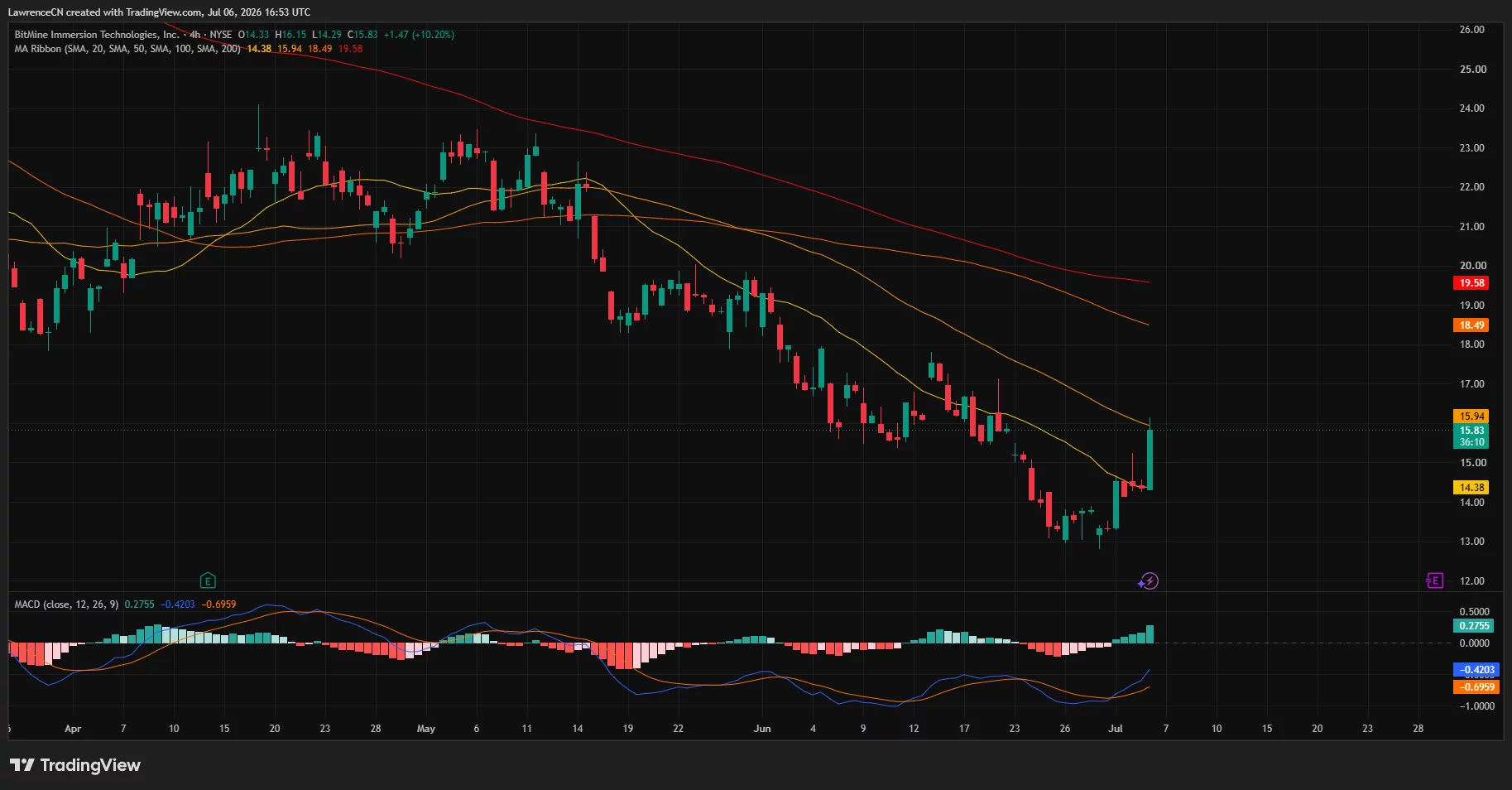
- BMNR’s technical outlook has improved after a bullish MACD crossover, with the 20 SMA acting as the next resistance.
According to Bitmine, the company purchased 42,197 ETH between June 29 and July 3, increasing its treasury to 5,742,237 ETH. The company said those holdings now account for about 4.8% of Ethereum’s circulating supply, reinforcing its position as one of the largest corporate holders of the cryptocurrency.
The latest acquisition also expanded Bitmine’s staking portfolio. The company disclosed that 4,879,157 ETH, roughly 85% of its treasury, is currently staked, generating an estimated annual staking yield of around $235 million.
Investors welcomed the update, sending Bitmine’s shares up 4.28% to $14.98 at the time of writing after the stock traded as high as $15.04 during the session. The gains came despite weakness elsewhere among crypto-linked equities.
By contrast, Strategy fell 1.17% after selling 3,588 BTC to repurchase its STRC preferred stock. The opposite moves in the two companies suggest investors favored Bitmine’s expanding Ethereum treasury strategy while reacting cautiously to Strategy’s latest capital allocation decision.
Bitmine’s Ethereum strategy continues to attract investor attention
Bitmine has steadily positioned itself as an Ethereum-focused treasury company rather than a traditional mining business. Alongside growing its ETH reserves, management has continued increasing the portion of those assets committed to staking to generate recurring on-chain income.
The latest purchase comes ahead of Bitmine’s earnings report covering the April through June 2026 quarter, scheduled for July 29. According to Wall Street estimates, the company is expected to report about $45 million in revenue.
Separately, Bitmine Chairman Tom Lee has maintained an optimistic outlook for U.S. equities. Speaking during CNBC’s Squawk Box, Lee said companies reporting third-quarter earnings later this month are likely to exceed Wall Street expectations, adding that such results could support another leg higher for stocks.
Lee also reiterated his expectation that the S&P 500 could climb from around 7,500 to 8,000 before the end of 2026.
Technical indicators point to improving momentum
BMNR has staged a strong rebound after breaking above its recent consolidation range near $14.30. The latest rally has pushed the stock to the doorstep of its 20-period simple moving average around $15.94, which now serves as the first major resistance level.
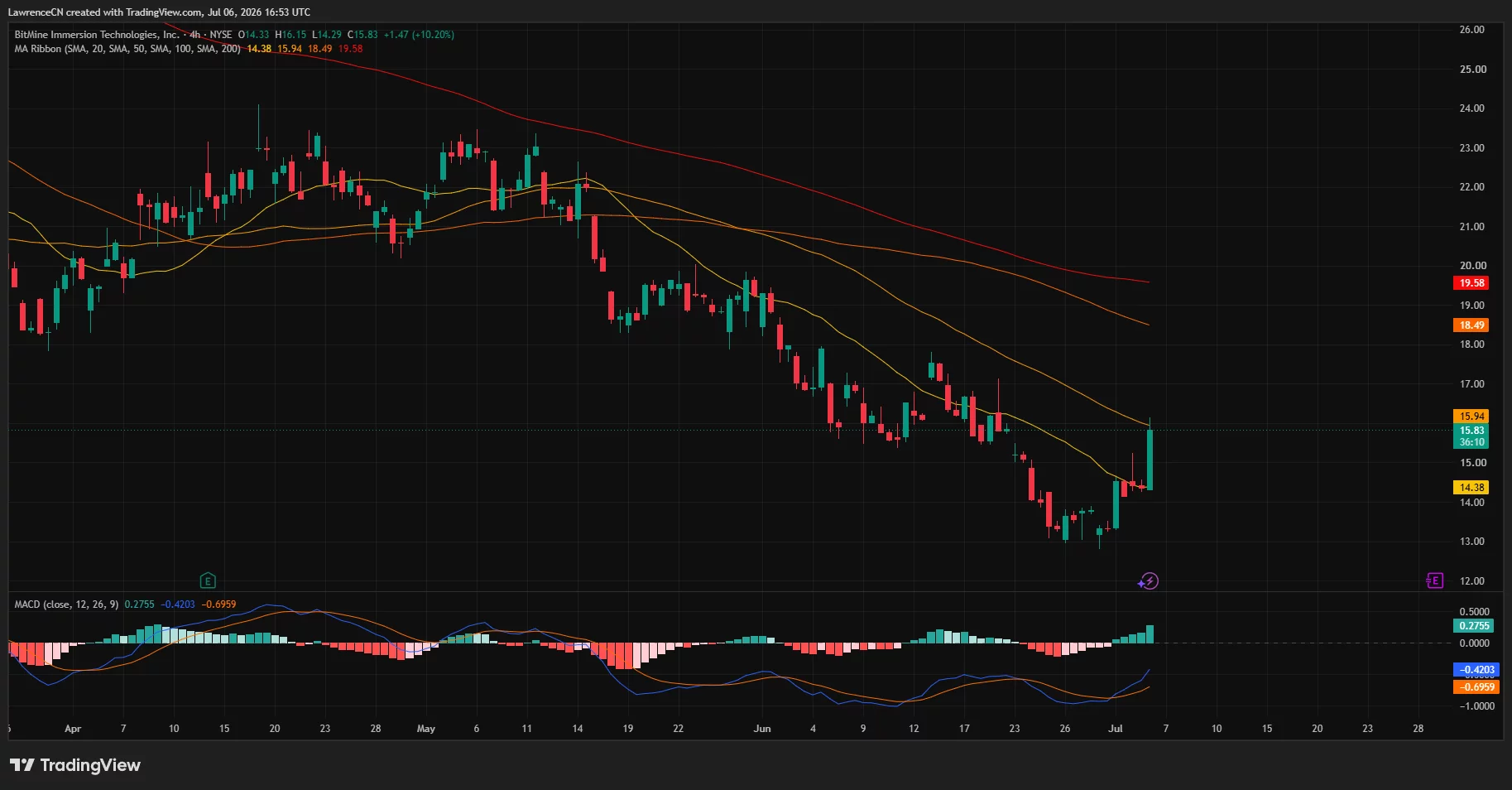
A sustained move above that average could open the way toward the 50-period moving average near $18.49. Even so, the stock remains below its 100- and 200-period moving averages, indicating that the longer-term trend has not yet turned bullish.
Momentum indicators have strengthened alongside the price recovery. The 4-hour MACD has completed a bullish crossover, while expanding green histogram bars indicate buying pressure has accelerated following the breakout.
Failure to hold above the recent breakout area near $15 could invite profit-taking and send the stock back toward support around $14.30, with the recent swing low near $13 remaining the next significant downside level if sellers regain control.
Disclosure: This article does not represent investment advice. The content and materials featured on this page are for educational purposes only.
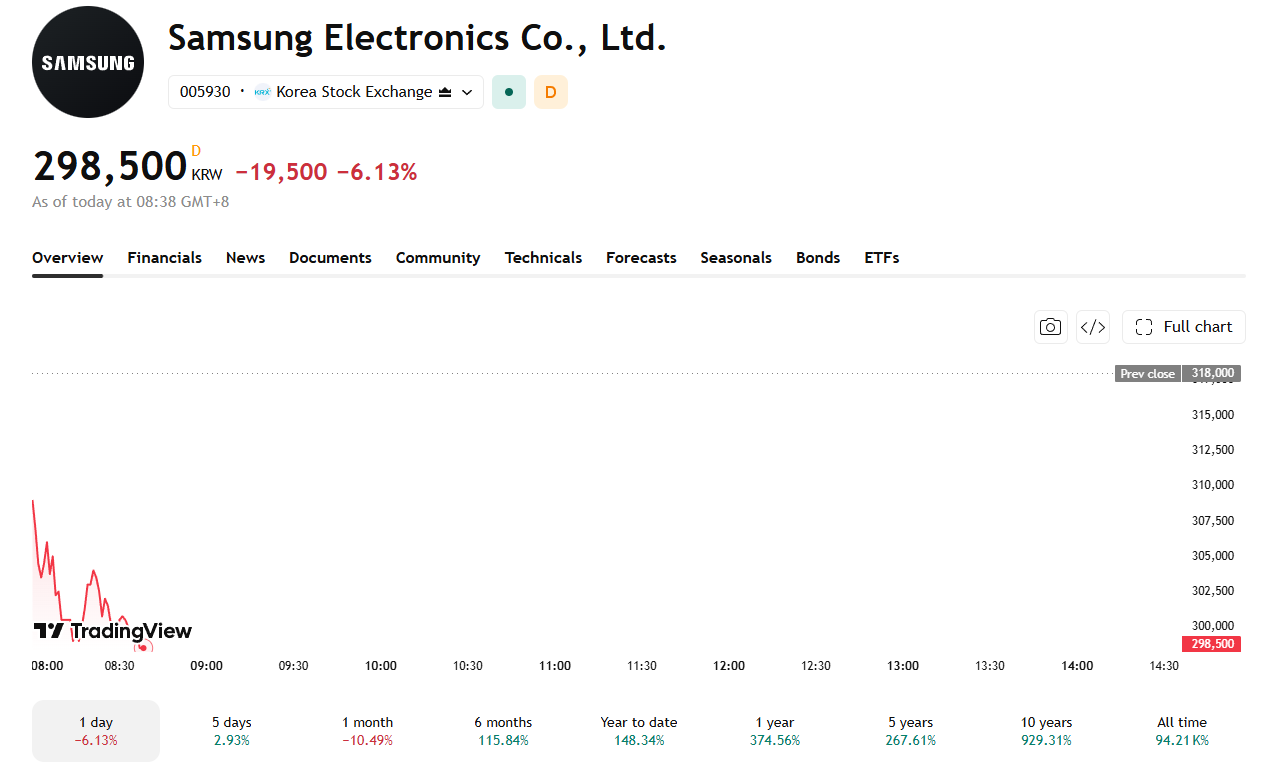
Samsung Electronics forecast a 19-fold jump in second-quarter operating profit to 89.4 trillion won ($58.4 billion) today, July 7. The estimate beat analyst forecasts and marked Samsung’s third straight record quarter.
However, Shares still fell over 6% in early trading, extending a pullback from the stock’s fivefold rally over the past year.
AI Demand Fuels Record Profit
Samsung’s guidance topped the 87.3 trillion won LSEG SmartEstimate. It also beat the 84.4 trillion won FnGuide consensus, according to Reuters.
Samsung expects revenue to climb 129% year over year to 171 trillion won. However, that figure actually fell short of analyst forecasts of 173.3 trillion won, according to Korea JoongAng Daily.
Citi Research found DRAM prices climbing 44% quarter over quarter, while NAND flash prices rose 53% in the same stretch. Analysts tied the increase to AI spending pushing beyond high-bandwidth memory into conventional chips for phones, PCs and servers.
Booming HBM production has increasingly squeezed the supply of standard memory chips, keeping prices elevated. Customers have also started seeking longer-term supply contracts, a shift analysts say could keep prices high well into next year.

Additionally, Samsung agreed to a wage deal with workers in May. The deal ties semiconductor worker bonuses to operating profit, and Samsung set aside funds for those bonuses this quarter.
Analysts estimate operating profit would have only topped 100 trillion won without those bonus provisions.
Why Are Shares Falling Anyway?
Samsung stock climbed fivefold over the past year, but Tuesday’s drop looks like profit-taking after that run, as some investors sold into the earnings beat rather than chase the stock higher.
Analysts expect widening losses at Samsung’s foundry and logic chip units, since bonus costs spread across the whole semiconductor division.
The pullback also fits a broader pattern across chip stocks, where sentiment has split sharply by company. Memory glut fears have hit some suppliers in recent weeks, even as Micron’s AI-driven surge pushed others higher over the same stretch. That divide has fed recent warnings about an AI bubble, with some investors growing wary of how far the rally can run.
Samsung will release a full divisional breakdown on July 30. It also pledged 2,100 trillion won for domestic investment through 2040, though it will adjust that spending to market conditions.
Some analysts argue the memory boom looks increasingly structural, since new fabrication plants take years to build and limit supply growth. A slowdown in AI data center spending remains the clearest risk to that outlook.
The post Samsung Forecast a 19-Fold Profit Jump Today: So Why is Stock Down 6%? appeared first on BeInCrypto.

MicroStrategy peer Strategy has continued its capital reshuffle, selling 3,588 Bitcoin for $216 million to support preferred stock dividend payments and replenish cash reserves, according to a Monday SEC filing. The move reduces the company’s total Bitcoin holdings to 843,775, as Strategy seeks to balance shareholder payouts with ongoing exposure to the asset class.
The transaction also adds a new datapoint to the debate over whether major Bitcoin buyers will eventually be forced to liquidate holdings. Earlier this year, Strategy disclosed its first reported Bitcoin sale since a 2022 tax-loss transaction—raising scrutiny about what, if anything, could trigger further sales.
Key takeaways
- Strategy sold 3,588 BTC for $216 million, cutting its holdings to 843,775, per an 8-K filed with the SEC.
- The sales were executed in two price windows: 1,363 BTC at an average $59,256 and 2,225 BTC at an average $60,773.
- Strategy says the purpose was to fund preferred stock dividends and restore cash reserves, keeping payout obligations covered.
- Analyst coverage from Bernstein previously argued the company was unlikely to be compelled to sell due to its liquidity position.
Strategy’s latest Bitcoin liquidation and what it funds
In its 8-K, Strategy states that it sold 3,588 Bitcoin for proceeds totaling $216 million. After the sale, the company reported remaining holdings of 843,775 BTC. The filing frames the sell-down as part of a broader effort to manage near-term corporate obligations while maintaining a large Bitcoin position.
Strategy also broke out portions of the sales by timing and average execution price. It sold 1,363 BTC at an average price of $59,256 between last Monday and Tuesday, then sold 2,225 BTC at an average price of $60,773 between Wednesday and Sunday. Those details matter for investors assessing whether the company is selling opportunistically across specific windows or responding to cash needs that require market timing.
Why the sale matters for investors watching “forced selling” risk
Bitcoin sales by large holders can move sentiment—even when they are not tied to distress. The key question for the market has been whether Strategy’s capital plan could eventually lead to compelled liquidation, or whether the company has enough liquidity to prevent that outcome.
That question has been addressed in prior research cited by the article, including a report from Bernstein. Bernstein argued that Strategy was unlikely to be forced to sell its holdings, pointing to the company’s liquidity position and cash reserves. The report also estimated that Strategy had 17 months of cash coverage for dividend obligations and interest payments and described Strategy as a “balancing force” in a market where other major Bitcoin-related players have been net sellers.
From an investor’s perspective, this framing reduces the immediacy of “death spiral” style fears—though the latest sale shows Strategy is willing to convert some Bitcoin exposure into cash when the corporate calendar requires it. What remains uncertain is whether future dividend cycles or funding needs would lead to additional sell-offs, or whether this was a contained adjustment.
From Strategy’s first sale to a broader read-through
Earlier coverage noted that Strategy disclosed the sale of 32 Bitcoin in early June, described as its first reported Bitcoin sale since a 2022 tax-loss transaction. The updated 8-K expands the story from a small exception into a far larger cash-generating action.
The market implication is not automatically bearish. Large holders can sell for operational reasons without changing their long-term thesis, especially when they hold substantial Bitcoin inventories and manage liquidity through a mix of cash and structured funding. Still, the direction and size of future transactions will likely influence how traders interpret Strategy’s role in the broader Bitcoin flow picture.
What to watch next
Going forward, investors should track whether Strategy repeats similar sell-downs in subsequent dividend periods and whether additional SEC disclosures clarify the cadence of its cash-management plan. The most important signal will be how Strategy’s reported liquidity coverage and dividend funding needs evolve relative to the timing and scale of future Bitcoin sales.
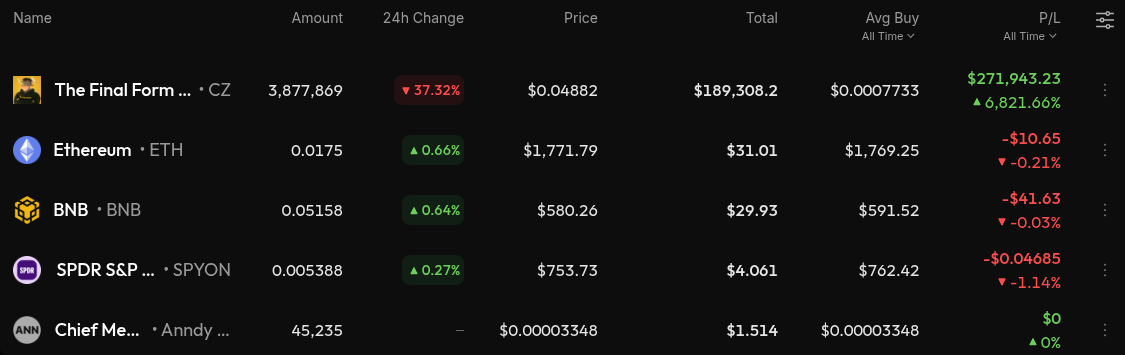
An anonymous trader turned a $754 bet into roughly $271,000 in under 48 hours, scoring a 357x return. The windfall came from CZ, a BNB Chain meme coin tied to Binance founder Changpeng Zhao.
Here is how the trade unfolded, what powers the token, and why the story is both inspiring and risky.
How the Trader Scored a Staggering 357x Return With a CZ Meme Coin
A meme coin is a cryptocurrency built around an internet joke, personality, or cultural reference rather than a specific technical use case. The CZ token, known as “The Final Form Bull,” leans entirely on that formula across the BNB Smart Chain.
On-chain platform Lookonchain reported the details. The wallet acquired roughly 5.1 million CZ tokens across three transactions totaling $754.49. Furthermore, the average entry price sat near $0.000147 per token during the early accumulation phase.
Follow us on X to get the latest news as it happens.
The payoff was explosive at its peak. As the token surged, the position’s value skyrocketed to around $271,100. However, the meme coin has since pulled back from 0.0592 to $0.0418, according to GeckoTerminal.
As a result, the holder’s unrealized gains have eased to roughly $246,000, though the trader still holds 100% of the position without selling a single token.
The token itself draws direct inspiration from a viral CZ tweet. On January 17, 2021, Zhao wrote, “Everyone knows I’m a bull. You haven’t even seen my final form yet,” alongside a muscular bull image. As a result, that phrase became legendary crypto folklore.
Launched recently via the Four.Meme platform, CZ meme coin now holds a market capitalization of around $41 million. Furthermore, its 24-hour trading volume briefly topped $80 million during the rally’s peak, reflecting intense speculative interest.
Why This 357x Win Comes With Real Warnings
The trade looks glamorous, but the trader’s history reveals the harsh reality of meme coins. Over the past two months, the wallet made roughly 260 trades with just a 31.88% win rate. Most positions ended in losses.
That context matters enormously. This single outlier dramatically offset a long string of failures. As a result, a single successful bet can mask the fact that most speculative meme coin trades do not pay off in the long run.
Subscribe to our YouTube channel to watch leaders and journalists provide expert insights.

The CZ phenomenon also reflects the ongoing popularity of Binance-themed meme coins. Low fees and fast transactions on BNB Chain continue to attract retail traders seeking high-volatility opportunities amid an increasingly crowded speculative market.
However, experts caution that such extreme returns remain rare. Meme coins can pump violently and then correct just as sharply. Sustainable success requires discipline, risk management, and the understanding that most participants never achieve life-changing results.
The post Trader Makes 357x Gains With CZ Meme Coin Born From a Viral Post appeared first on BeInCrypto.
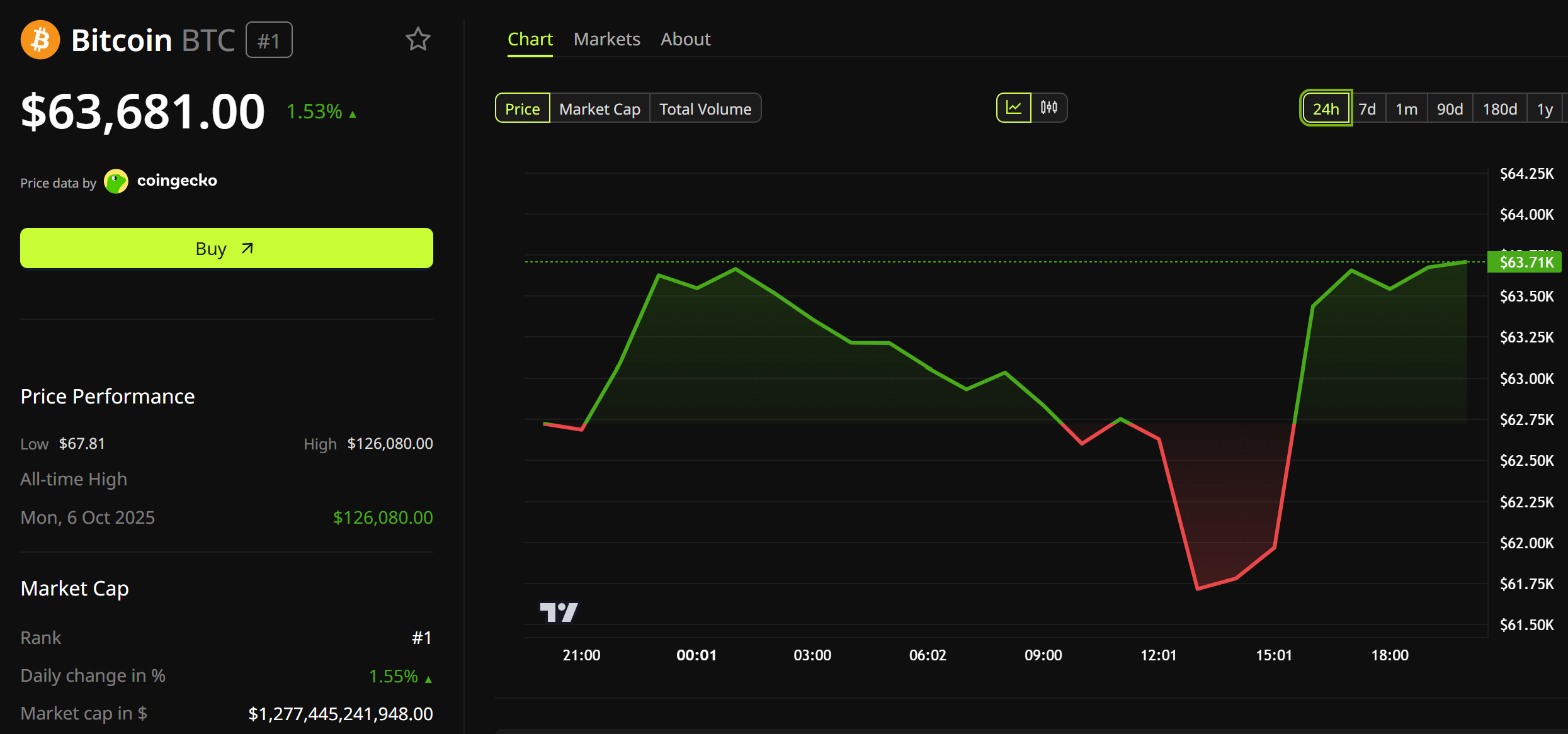
Blockstream CEO Adam Back says crypto keeps repeating the custody failures that destroyed FTX and Mt. Gox. His Bitcoin advice cuts against the noise. Separate trading from custody, skip leverage, and HODL through every downturn.
Back speaks from experience. By his own account, he lost coins in the Mt. Gox bankruptcy after redepositing funds to chase a 10% arbitrage spread that proved to be a risk premium in disguise.
The Custody Mistake Crypto Refuses to Fix
In a Blockstream interview at BTC Prague 2026, Back argued that both collapses shared a common flaw. Exchanges held customer funds while trading against them.
The cost of that flaw compounds for years. Mt. Gox lost about 850,000 BTC in 2014, and its Japanese bankruptcy trapped creditors for nearly a decade. Its estate still moves markets, and a $739 million transfer in June helped push Bitcoin below $70,000.
FTX repeated the pattern in 2022. Its creditors received a $2.2 billion fourth round of repayments in March 2026, more than three years after the exchange failed.
Back sees progress, though. Institutional traders increasingly demand trilateral agreements, which park assets with independent custodians while exchanges extend trading credit. If a platform fails, he noted, possession is nine-tenths of the law.
Adam Back’s Bitcoin Advice for a Volatile Market
For individuals, the prescription is blunt. Keep long-term holdings in self-custody, and never borrow against bitcoin to buy more. That trade, Back warned, carries a surprising liquidation risk because the collateral and the asset fall together.
Successfully timing markets is difficult for a similar reason. Back estimates that roughly 12 trading days deliver each year’s gains, so sitting out is costlier than it looks.
“The problem is it’s very very hard to time these markets or to second guess them… being out of market is like palpably dangerous.”
Back said this while defending the HODL strategy, which began as a drunken misspelling on a 2013 forum. By his count, he has held through three 85% drawdowns, earning the nickname “cucumber” for staying cool.
Bitcoin’s current price near $63,681, up 1.5% in 24 hours, sits just above the 200-week moving average. Back placed that average near $61,000 and treats it as the asset’s dependable value floor.

Back is betting his own capital on that conviction through his pending BSTR bid. The open question is whether exchanges adopt custody separation before the next stress test, or whether the old playbook runs again.
The post Adam Back Says One Bitcoin Mistake Could Cost Traders Again appeared first on BeInCrypto.
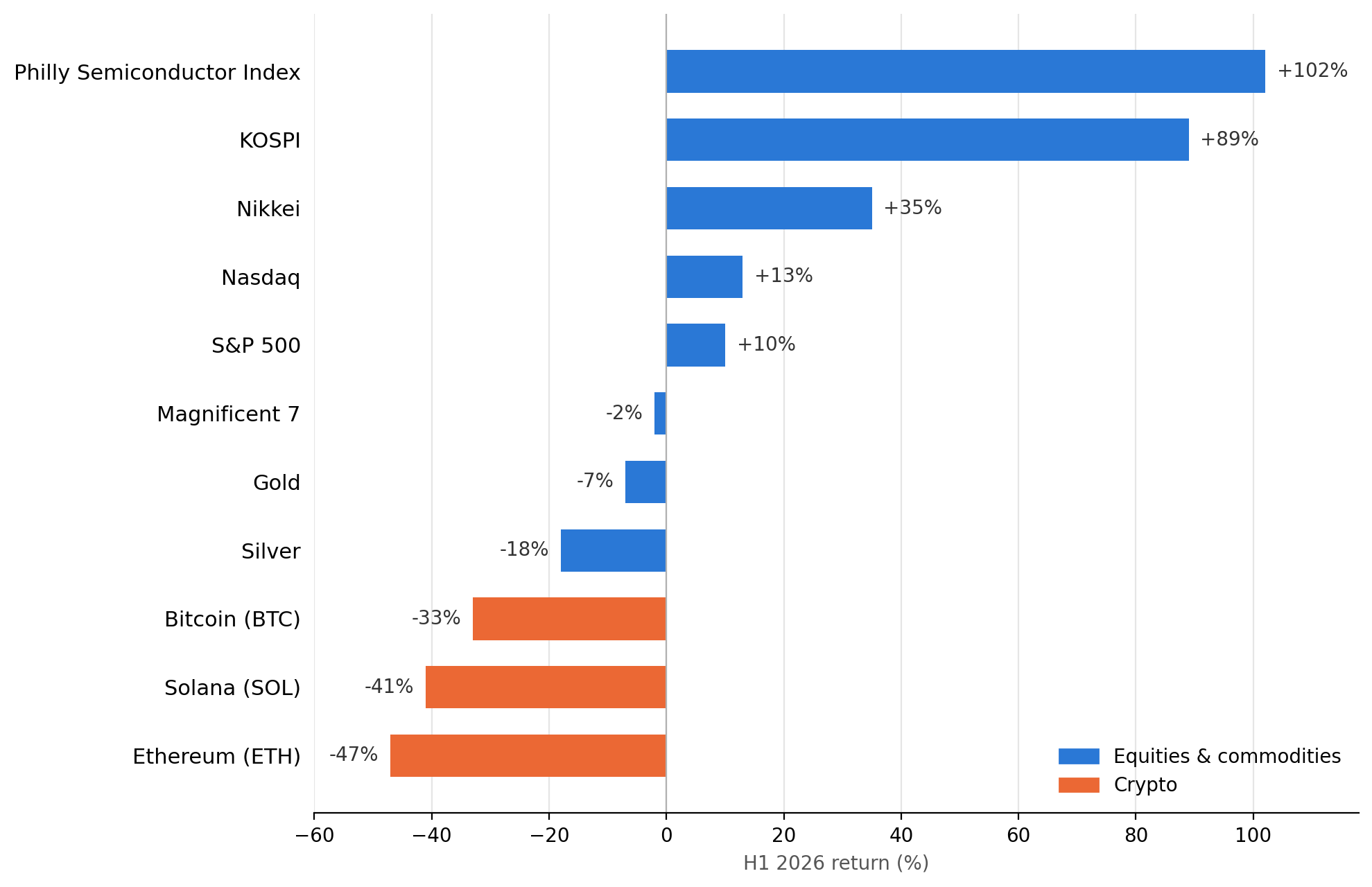
Semiconductor stocks beat both Big Tech and crypto in the first half of 2026. The Philadelphia Semiconductor Index gained 102%, while the Magnificent Seven fell 2% and Bitcoin (BTC) lost 33%, according to Deutsche Bank and CoinGecko data.
Wall Street banks now disagree about the second half. Goldman Sachs expects investors to keep backing chipmakers, while Morgan Stanley argues the trade has already started to unwind.
How Semiconductors Beat Big Tech and Crypto in H1 2026
Deutsche Bank’s half-year scoreboard ranked the Philadelphia Semiconductor Index as the best-performing major asset in the world. The benchmark gained 102% between January and June, according to a chart shared by Schaeffer’s Investment Research.
Korea’s chip-heavy KOSPI followed with an 89% gain, while Japan’s Nikkei added 35%. In contrast, the Nasdaq rose just 13% and the S&P 500 slightly under 10%.
The Magnificent Seven, the group that carried US markets for two years, ended the half 2% lower.

Crypto fared even worse. Bitcoin slid 33% in the first half, falling from roughly $87,500 to below $59,000, CoinGecko data shows. Ether (ETH) dropped 47%, and Solana (SOL) fell 41%. Traditional hedges offered no shelter either, as gold slipped 7% and silver lost 18%.
ETF flows tell the same story. The VanEck Semiconductor ETF climbed 72%, and the iShares Semiconductor ETF gained 99%, while the Roundhill Magnificent Seven ETF declined slightly.
Meanwhile, a shortage of memory and storage has led chipmakers to raise prices as the industry approaches $1 trillion in annual revenue.

Goldman Backs the Earners While Crypto Trades Like a Spender
Goldman Sachs derivatives specialist Brian Garrett explained the divergence in a client note last week, as reported by Stocktwits.
“One of the reasons for the decrease in Mag7 exposure seems almost too simple as it’s been hiding in plain sight for months. The market is rightly rewarding the names that earn (capex beneficiaries, semiconductors, etc) while at the same time questioning the names that spend (hyperscalers).”
Hyperscalers such as Microsoft, Amazon, Meta, and Google pour hundreds of billions of dollars into data centers. Markets increasingly treat that spending as a cost without a proven payoff.
Meanwhile, companies that sell chips, memory, and equipment recognize revenue today.
That logic hits crypto hardest. Bitcoin earns nothing from the AI buildout, so it traded alongside the spenders rather than the earners. The pressure intensified after Michael Burry’s bubble warning sent memory stocks sliding this month.
The same split appeared inside the crypto market. Render (RNDR) gained 17%, and NEAR Protocol (NEAR) added 18% in the first half, while most majors fell over 30%, per CoinGecko. Both tokens sell exposure to computing power, the scarcest resource of this cycle. However, the pattern is not universal, as Bittensor (TAO) and Fetch.ai (FET) still declined.

Bitcoin miners occupy the middle ground. Riot Platforms keeps selling BTC while funding its AI pivot, and rival miners chase similar data center deals.
Morgan Stanley Sees the Chip Trade Turning
Morgan Stanley strategist Michael Wilson argued on Monday that chip momentum is fading as investors rotate toward hyperscalers, Bloomberg reported. The Philadelphia index has dropped almost 14% from its June record, though it remains 123% higher since September.
Cracks appeared before July. A blowout Micron forecast failed to sustain the rally, and the KOSPI triggered circuit breakers in June. Wilson, therefore, favors hyperscalers in the near term and expects them to soften spending plans.
JPMorgan strategist Mislav Matejka believes the rally will broaden beyond technology in the second half.
“AI is unlikely to be the only story in town.”
For crypto, this debate matters more than it appears. If capital exits the crowded chip trade and hunts laggards, Bitcoin ranks among the largest liquid laggards available. The token trades near $61,626 after a weekend short squeeze briefly lifted it toward $64,000.
Still, no major bank has named digital assets as the next rotation target. The coming weeks will show whether hyperscaler earnings confirm the turn, and whether any freed capital finds its way back to crypto.
The post Semiconductors Beat Big Tech and Crypto in H1: Is the Trade Turning? appeared first on BeInCrypto.

Richard Heathcote, the former chief investment officer of Tether, is reportedly looking to sell part of his stake in the stablecoin issuer, according to a Bloomberg report citing people familiar with the matter. Heathcote holds 1.26% of Tether, and the planned transaction would involve only a portion of that ownership.
Tether, which issues USDt (USDT), remains privately held despite operating as one of crypto’s most profitable businesses. The reported partial sale is notable not only because of Heathcote’s senior role, but also because it would be among the few glimpses into ownership at a company that underpins a large share of the stablecoin market.
Key takeaways
- Bloomberg reports that former Tether CIO Richard Heathcote plans to sell part of his 1.26% stake, offering rare insight into Tether ownership.
- USDT remains the dominant stablecoin by market capitalization, with DefiLlama data placing its circulating supply around $184 billion (about 59% market share).
- The potential sale comes as Tether faces increased regulatory pressure in Europe, including platform delistings after Tether did not align with the EU’s MiCA framework.
- Broader IPO chatter continues in crypto, even as exchanges weigh listing paths amid regulatory and operational constraints.
Why Heathcote’s stake sale matters
Bloomberg’s report focuses on the planned sale by Richard Heathcote, who stepped away from the role of Tether’s chief investment officer in March. The report says he moved into an advisory capacity after overseeing the company’s investment portfolio.
For markets, transactions involving insiders in key stablecoin issuers are often watched closely—even when only partial. Tether’s scale means its ownership structure and governance are relevant to traders and institutions that rely on USDT’s liquidity. While the report does not specify deal size beyond the portion of the stake, it underscores that influential executives at stablecoin issuers are not necessarily bound to long-term illiquidity, despite the asset’s centrality to crypto settlement and exchange activity.
Heathcote’s stake also highlights the challenge of assessing control and incentives in privately held crypto firms. With Tether not publicly listed, investors and observers have fewer direct market signals about internal changes. A reported sale, even a partial one, can become a data point for how senior stakeholders view holding periods, risk, and governance in a fast-changing regulatory environment.
USDT’s market position remains central
Any ownership move at Tether inevitably ties back to USDT’s dominance. According to DefiLlama data, USDT has a circulating supply of roughly $184 billion and accounts for approximately 59% of the stablecoin market by market capitalization.
This matters because USDT is not just a retail token—it is deeply embedded in the infrastructure of exchanges, trading pairs, and on-chain activity. When large portions of market liquidity are concentrated in a single issuer, stakeholders tend to pay particular attention to credible updates on that issuer’s financial posture, governance, and regulatory standing.
At the same time, the reported sale is not automatically a signal about USDT’s strength or weakness. Stablecoins can remain widely used even as regulatory constraints limit where they are permitted. The more meaningful question for investors is whether Tether’s regulatory path and distribution access continue to affect demand for USDT in key jurisdictions.
Regulatory pressure in Europe intersects with business uncertainty
The Heathcote sale report arrives as Tether faces heightened scrutiny in Europe. Earlier coverage from Cointelegraph noted that USDT has been delisted by an increasing number of platforms operating under MiCA authorizations after Tether chose not to comply with the EU’s crypto framework.
That tension has been visible in operator decisions. Cointelegraph previously reported that Revolut would remove USDT from its platform, reflecting how regulatory alignment—or lack of it—can translate into immediate distribution losses for a stablecoin issuer.
For market participants, this creates a split reality: USDT may remain dominant by market size, but issuer exposure to regulation can change the on-ramps and availability that sustain that market share in Europe. In that context, insider ownership moves may be read less as a market bet on USDT itself and more as an adjustment to the broader uncertainty around compliance, platform access, and long-term growth channels.
IPO speculation continues elsewhere in crypto
While Tether’s executives have publicly indicated the company does not need to go public, crypto’s IPO debate appears to be broadening beyond stablecoins. Several other firms have reportedly explored listing routes.
Cointelegraph previously highlighted that Kraken has taken steps that could lead toward an IPO. Fortune reported in September 2025 that Kraken raised $500 million at a $15 billion valuation, fueling expectations that the exchange was positioning for a public listing. Kraken also announced it had confidentially filed a draft registration statement with the US Securities and Exchange Commission in November 2025 for a proposed initial public offering.
However, Bloomberg later reported that Kraken’s IPO timeline could slip into 2027 after layoffs tied to the company’s increasing use of artificial intelligence. The implication for readers is that even when a path to liquidity exists, operational restructuring and market conditions can delay capital-market milestones.
In South Korea, Cointelegraph reported that Bithumb delayed its IPO until after 2028. The exchange said it was working to strengthen accounting policies and internal controls after earlier regulatory setbacks, underscoring how compliance process—not only investor demand—can shape public-market timing for crypto firms.
Separately, Cointelegraph has also published coverage focusing on anonymity-related risks and how AI may be used to identify hidden identities in crypto activity, reflecting the broader environment in which regulators, exchanges, and compliance teams are operating.
What to watch next
For Tether, the next signals likely won’t come from ownership headlines alone. Investors should track whether additional European platforms follow through on delistings under MiCA and how Tether responds operationally and commercially in regions tightening stablecoin rules. Meanwhile, Bloomberg’s reported stake sale may prompt renewed attention to how insiders manage liquidity in privately held firms as crypto firms weigh—or postpone—public listings.

John Terry says England must ‘stop’ Arsenal star from destroying World Cup dream | Football

HNIs turn to hybrid debt funds, SIFs for higher post-tax returns

Strategy Sells 3,588 Bitcoin for $216M to Fund Dividend Payments


-

 Fashion3 days ago
Weekend Open Thread: High Hopes
-

 Politics4 days ago
The House | “Reframing the debate from a binary discussion of winners and losers”: Yuan Yang reviews ‘We Are Not Machines’
-

 Fashion9 hours ago
Open Thread: What Great Books Have You Read Recently?
-

 Crypto World7 days ago
Strategy authorizes up to $1.25B in Bitcoin sales under new capital plan
-

 News Videos7 days ago
How to Build INSANE Live Financial Dashboards With Claude
-
 NewsBeat2 days ago
Taylor Swift and Travis Kelce wedding staffer hilariously struggles to keep her cool while checking in megastars
-

 Business7 days ago
Australia treasurer says alleged access of prime minister’s bank data ’incredibly concerning’
-
 Crypto World6 days ago
Airdrop Registration Becomes Key Focus For Remittix As RTX Launch Updates Approach
-

 Sports6 days ago
Broncos roster: OL Ben Powers (No. 74) entering final year of contract
-

 Crypto World5 days ago
Binance stock trading tops $1B in first month after launch
-

 NewsBeat6 days ago
Presenter Caroline Flack’s brother Paul Flack dies aged 55
-

 Crypto World5 days ago
Alibaba-affiliate Ant Group enters the humanoid robot market with 12 deals
-

 Crypto World3 days ago
Standard Chartered Secures MiCA License as ESMA Adds 37 New Crypto Firms
-

 Crypto World1 day ago
South Africa proposes crypto tax guidance under existing rules
-

 News Videos10 hours ago
Best Time to Enter Small Caps Right Now? Another Bull Run? | Financially Free
-
 NewsBeat5 days ago
New exhibition reflects five decades of movement between island of Ireland and GB
-

 Business5 days ago
Meta Platforms Stock Jumps 7% Today as Bloomberg Reports Company Plans to Enter the Cloud Business
-

 Tech2 days ago
Lenovo laptops are now shipping with YMTC SSDs, a sign of Chinese NAND entering the mainstream
-

 Business4 days ago
What a 10 Percent Drop Means for Buyers, Sellers and Renters
-

 News Videos13 hours ago
Avoid entering in FOMO #bitcoin #cryptocurrency #trading #scalping
You must be logged in to post a comment Login