
Crypto World
Bitcoin Hodlers ‘Selling Less’ As Sell-Side Risk Returns To Lows

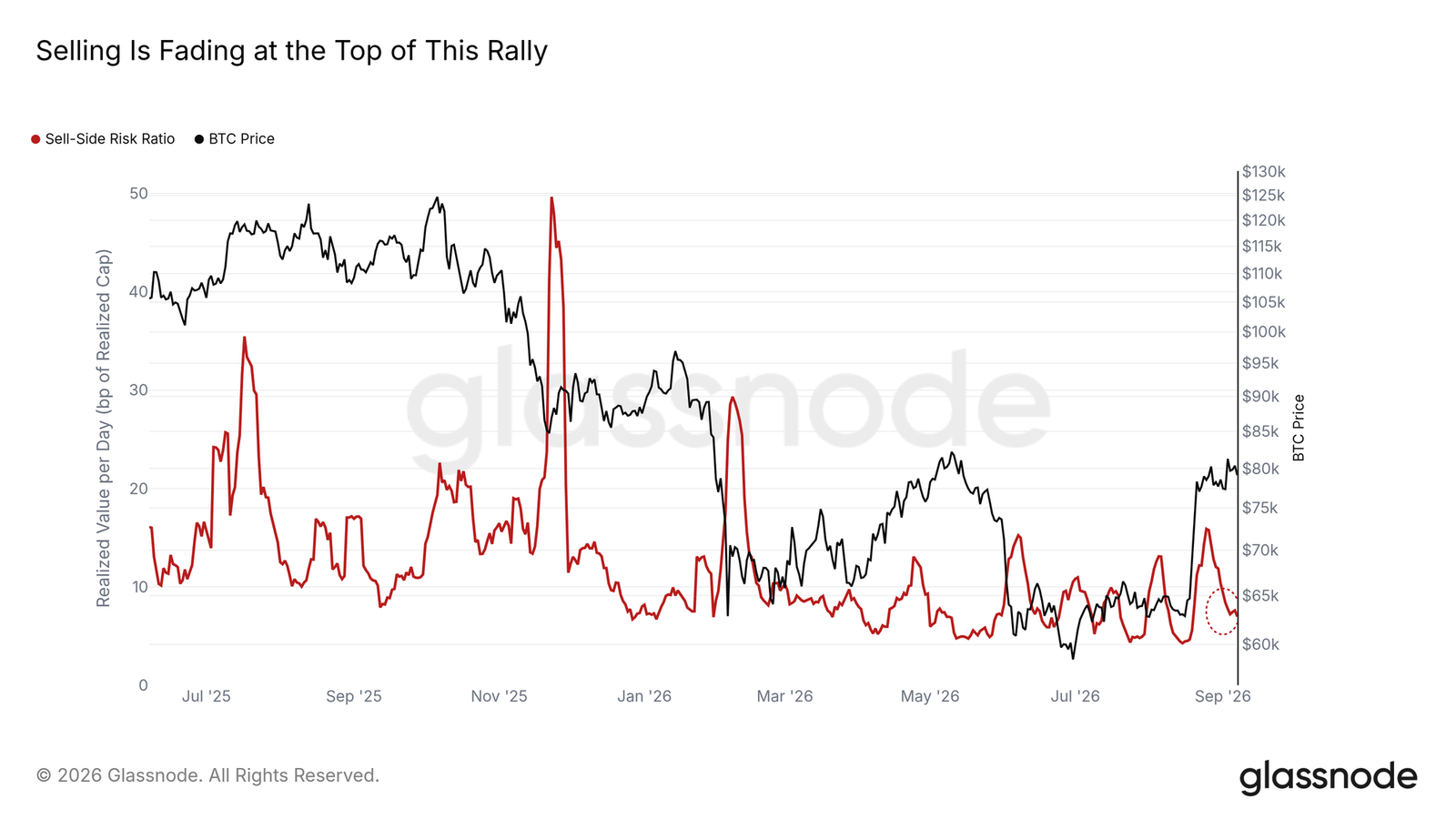
Bitcoin (BTC) sell-side risk remains near historic lows as August profit-taking cools, new data shows.
Key points:
- Bitcoin’s sell-side risk ratio fell to seven from 16 in September, placing it among its lowest-ever readings.
- Selling pressure eased while Bitcoin held most of its 25% August gains.
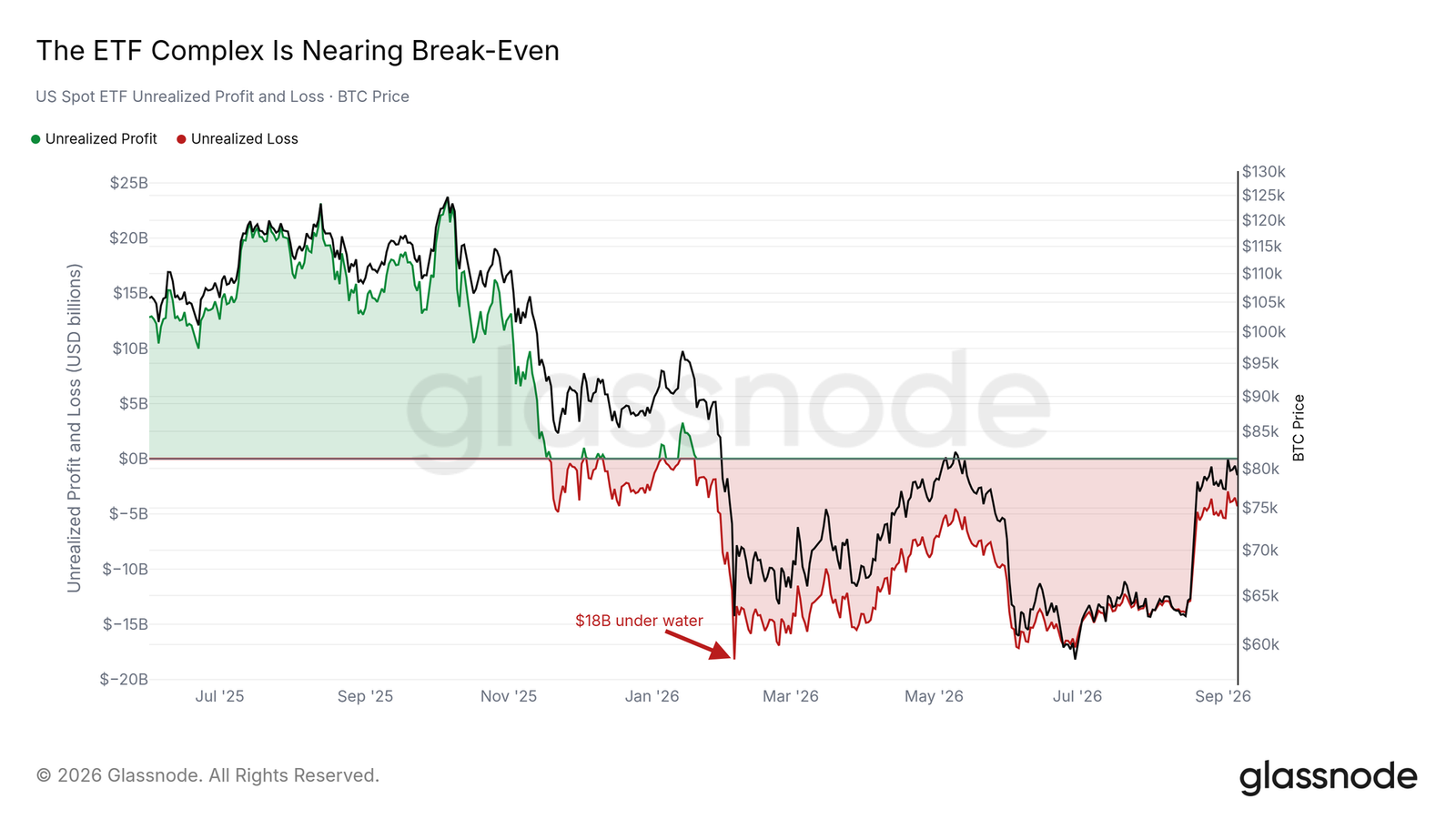
- Bitcoin ETF investors have spent 229 sessions below their aggregate breakeven level near $86,000.
Bitcoin hodlers are “selling less” in September, Glassnode says
In the latest edition of Glassnode’s The Week Onchain newsletter, the crypto analytics platform said Bitcoin’s sell-side risk ratio (SSRR) had reset lower.
Sell-side risk sums total onchain realized profits and losses and divides that figure by Bitcoin’s realized market cap. The result is a snapshot of the US dollar value realized over a given period relative to realized cap.
Glassnode describes lower values as signals of “macro market bottoms, accumulation phases and relatively low sell-side risk environments.”
SSRR reached 16 as Bitcoin’s price hit multimonth highs above $80,000 in late August. As of this week, however, the metric has more than halved to 7, one of the lowest readings on record.
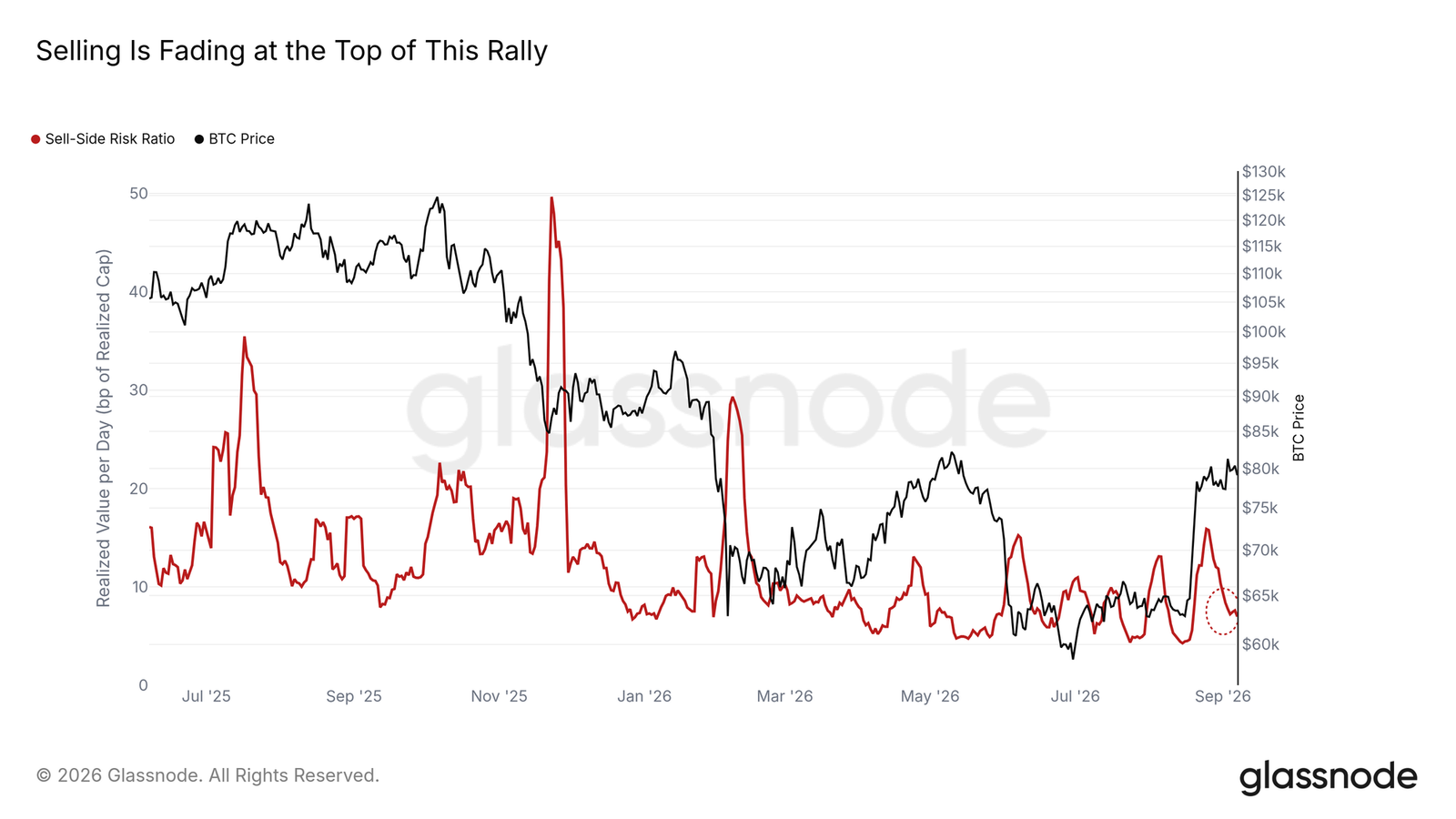
Glassnode said the August Bitcoin price rebound had “drawn little supply,” as measured by onchain activity.
“At the July 2025 and October 2025 highs the same measure spiked to 35 and 23 basis points. Only a small share of days in the past year have run lower than today,” it noted.
Data also shows that long-term holders — defined as wallet entities that hold a UTXO without spending it for at least six months — are realizing profits onchain at a lower rate this month.
“Long-term holders’ share of realized profit has fallen to 47% from 88% at the August peak, and September’s realized profit spike on September 3, 2026 was under half the size of August’s,” Glassnode continued.
“The sellers this month are recent buyers, and even they are selling less.”
Bitcoin ETF buyers eye breakeven point
The SSRR reading may ease concerns that even a modest Bitcoin price correction could trigger panic selling.
Related: New Bitcoin whales spark sell-side risk as unrealized gains hit $9B
Bitcoin investor cohorts have returned to aggregate profit after Bitcoin reclaimed $80,000, potentially increasing the temptation to sell if the price retraces further. As Cointelegraph reported, the spent output profit ratio (SOPR) has remained in net profit for its longest stretch of 2026.
SOPR reflects the net profitability of spent coins, with 1 representing breakeven. Sustained readings above 1 can support a bullish long-term trend change.
Glassnode added that US spot Bitcoin exchange-traded fund (ETF) investors would return to aggregate profit at $86,000. Bitcoin has closed below that level for the past 229 sessions, with ETF investors’ paper losses currently around $3.9 billion.

Crypto World
India’s Financial Intelligence Unit Issues Non-Compliance Notices To 15 Crypto Platforms
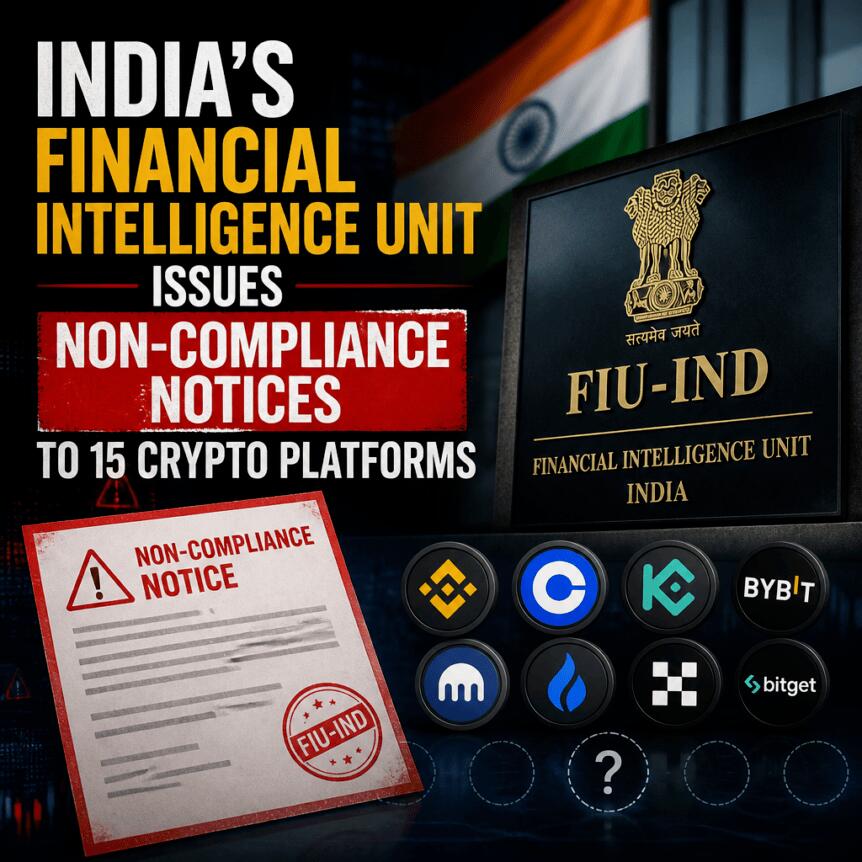
The Financial Intelligence Unit (FIU) has issued non-compliance notices to 15 crypto platforms, or what it calls Virtual Digital Asset Service Providers (VDA SPs), under the Prevention of Money Laundering Act (PMLA).
The notified entities could face access blocks in the country, with the FIU directing them to take down their applications and URLs.
India’s FIU Cracks Down On Crypto Entities
According to the Financial Intelligence Unit, the platforms failed to comply with several provisions of the PMLA and were operating illegally in the country. The platforms included in the list are Weex, Blofin, Bitunix, DigiFinex, Toobit, Razorex, XT.com, Latoken, WOO X, Pionex, ChangeNow, SimpleSwap, FixedFloat, WhiteBIT, and Guardarian.
India expanded its anti-money laundering and counter-financing of terrorism framework in 2023, bringing VDA service providers in India under the ambit of FIU registration and PMLA obligations.
The PMLA mandates that companies registered as reporting entities with the Financial Intelligence Unit must report transactions and keep detailed records. These requirements are not contingent on whether the platform has a physical presence in the country. The agency stated in its press release,
“These obligations are activity-based, and are not contingent on the physical presence of the entity in India. The regulation casts reporting, record-keeping, and other obligations on the VDA SPs under the PMLA Act, which also includes registration with the FIU-IND.”
Prior Notices
Several cryptocurrency platforms have previously restricted operations in India for failing to comply with regulatory requirements. Bybit operations in India were temporarily restricted in January 2025. Access to Bybit services was fully restored once the platform completed its FIU registration. Coinbase, which suspended operations after failing to comply with regulatory requirements, returned to the Indian market after registering with the FIU, and Binance returned in 2024 after paying a $2.25 million penalty.
Investor Impact
The FIU and Ministry of Finance also cautioned against NFTs and other crypto products, stating they remain unregulated and carry substantial risk.
“There may be no regulatory recourse for any loss from such transactions.”
India’s Financial Intelligence Unit is responsible for monitoring suspicious financial transactions and reporting them to relevant agencies. Ankit Ghosh, Partner at King Stubb & Kasiva, Advocates and Attorneys, explained how crypto entities fell under the FIU, stating,
“FIU-IND has always looked at the activity rather than the place of incorporation, so an offshore exchange serving Indian users comes within the reporting framework wherever it is based. Alongside the Section-13 notice, FIU-IND directed that the apps and URLs be removed under Section 79(3)(b) of the IT Act, and that directly affects user access.”
Cryptocurrency platform WazirX called the FIU’s compliance requirements critical for protecting users, stating,
“FIU-IND’s compliance standards are critical to protecting users and preventing the misuse of VDA platforms and illegal fund transfers. Measures like KYC, AML, geotagging, and liveness verification have made India’s VDA system safer over the years, and the same rules must apply to every platform serving Indian users, whether it operates from India or overseas.”
Disclaimer: This article is provided for informational purposes only. It is not offered or intended to be used as legal, tax, investment, financial, or other advice.
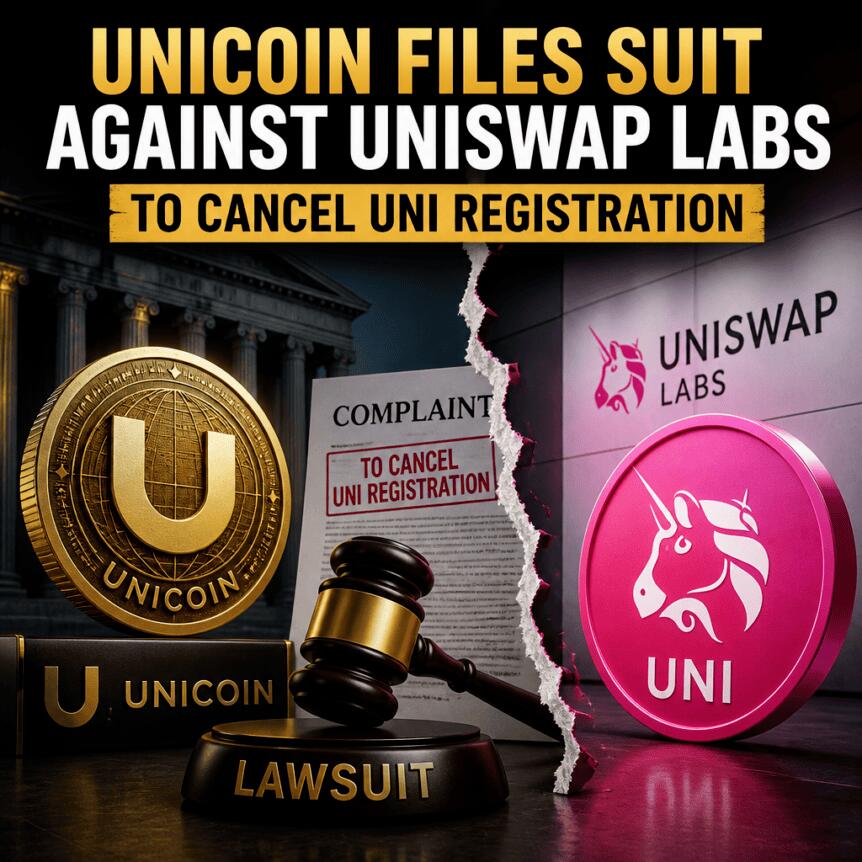
A company behind the Unicoin brand has filed a lawsuit in the Southern District of New York against Uniswap Labs, seeking a court ruling that its UNICOIN trademark does not infringe or dilute Uniswap’s asserted marks. TransparentBusiness Inc., which does business as Unicoin, is also asking the court to cancel a US trademark registration for UNI.
The dispute centers on trademark claims and alleged brand misuse that Uniswap’s representatives raised through a series of demand letters sent over several months. Unicoin’s complaint, filed Tuesday, requests declarations on non-infringement and non-dilution, along with determinations related to whether Unicoin’s domain names violate US anti-cybersquatting laws.
Key takeaways
- TransparentBusiness Inc. (Unicoin) sued in New York federal court seeking declarations that UNICOIN does not infringe or dilute Uniswap’s claimed marks.
- The complaint asks the court to cancel a US trademark registration for “UNI,” which Uniswap alleges it owns or has rights to.
- Uniswap’s counsel reportedly sent three demand letters—June 3, July 17, and Aug. 14—accusing Unicoin of infringement, dilution, cybersquatting, and unfair competition.
- Unicoin is also challenging claims tied to its “unicoin.com” and “unicoin.org” domains under the federal Anti-Cybersquatting Consumer Protection Act.
- The legal filing comes shortly before a listed Sept. 28 public launch date for Unicoin’s UNCN token.
Unicoin’s lawsuit targets Uniswap’s asserted trademark rights
According to Unicoin’s complaint filed in the Southern District of New York, TransparentBusiness Inc. is seeking court declarations that its UNICOIN mark does not infringe or dilute Uniswap’s claimed marks, including UNI, UNISWAP, and UNICHAIN.
The company further requests cancellation of a US trademark registration for UNI. That request is significant because it directly challenges the scope of whichever trademark rights Uniswap is asserting. If the cancellation is granted, it could narrow or remove a foundation for future enforcement arguments tied to the “UNI” branding.
The filing also asks for a legal declaration that the company’s “unicoin.com” and “unicoin.org” domains do not violate the federal Anti-Cybersquatting Consumer Protection Act (ACPA). That portion of the case targets whether the domains were acquired or used in a manner that meets the federal standard for cybersquatting.
Demand letters frame Uniswap’s allegations
Unicoin’s complaint states that Uniswap’s counsel issued three demand letters on June 3, July 17, and Aug. 14. In those letters, Uniswap reportedly accused Unicoin of trademark infringement, trademark dilution, cybersquatting, and unfair competition.
The demand letters, as described in the lawsuit, required several actions from Unicoin, including:
- Stopping use of “UNICOIN” and other “UNI”-formative marks.
- Transferring the “unicoin.com” and “unicoin.org” domains.
- Providing an accounting of revenue and profits.
- Reimbursing Uniswap’s legal fees.
These demands indicate Uniswap’s approach extended beyond stopping trademark use to seeking financial disclosures and fee reimbursement. That broad enforcement posture is part of why the litigation matters: court outcomes could shape how aggressively Uniswap and similar brands police overlaps in naming and web presence.
Cointelegraph reached out to Uniswap for comment regarding the lawsuit.
Why trademark cases matter in crypto branding
While the dispute is framed in legal trademark terms, it has practical implications for crypto projects because naming and domain strategy are tightly connected to user discovery, marketing, and community recognition. In markets where tokens and apps proliferate quickly, brand identifiers and web domains often become the first point of contact for users who are looking for official services, documentation, and liquidity.
In this case, Unicoin is contesting both trademark infringement and trademark dilution. In plain terms, that puts two different legal theories in play: whether Unicoin’s use of its mark is likely to cause confusion with Uniswap’s asserted marks, and whether it nonetheless harms or weakens those marks even absent direct confusion. Unicoin’s inclusion of dilution and cybersquatting claims suggests it is treating Uniswap’s enforcement threats as multi-pronged.
Investors and builders will likely watch how the court approaches similarity between the “UNI” family of terms and whether the case turns on marketplace confusion, the strength of Uniswap’s claims to the cited marks, or the specific use of the Unicoin domains.
Timing: filing before Unicoin’s listed token launch
The lawsuit was filed weeks before a Sept. 28 public launch date that Unicoin lists on its website for the UNCN token.
This timing may matter for participants evaluating execution risk and operational continuity. Token launches in crypto frequently depend on marketing, websites, and community onboarding—areas that can become collateral in trademark and domain disputes. Although the filing itself does not indicate the launch will be delayed, the presence of active federal litigation is the kind of uncertainty that can affect planning, partner relationships, and user-facing communications.
Separately, Unicoin’s competitive context can also provide background for why enforcement attention might intensify around well-known brands. At the time of writing, DeFiLlama ranked the Uniswap protocol first among decentralized exchanges by 24-hour volume, with more than $3.9 billion. A leading position in the DeFi trading stack can make brand-related enforcement more consequential, since other services may be measured against widely recognized naming and user expectations.
What to watch next in the case
The next developments to track are how Unicoin and Uniswap argue the legal standards for infringement, dilution, and ACPA-related domain issues, and whether the court addresses the requested cancellation of the UNI trademark registration. With a token launch date already on the calendar and multiple demand letters documented in the complaint, the litigation’s pace and interim rulings could determine how both sides manage branding and online presence going forward.
Crypto World
PONS Plunges Further, BTC Retreats to $78K Ahead of First US Inflation Data: Market Watch
Just hours before the first of many major macro events scheduled to unfold in the following week or so, the US PPI data, bitcoin’s price has slipped toward $78,000 once again after it was rejected at $80,000 earlier this week.
The altcoins have followed suit, with some major losses from the likes of BNB, DOGE, XLM, LINK, UNI, CRO, and many others.
BTC Slips to $78K
The primary cryptocurrency had an eventful end to the previous business week, as it had dropped to over $76,800 by Wednesday before the bulls picked up the pace. Instead of dumping further, the asset went on the offensive hard. It skyrocketed by several grand within less than a day and jumped past $82,400 for the first time in well over three months.
However, it couldn’t maintain its run and quickly declined to $81,000. The US jobs report, which was much stronger than anticipated, intensified the selling pressure on Friday, and BTC slipped to $78,800.
It rebounded over the weekend, and even charged at $80,000 on Monday morning, where it was stopped once again. The subsequent rejection unfolded gradually and culminated on Tuesday with a dip to $77,600. Its rebound was halted at $79,600, and BTC now struggles at $78,000 in what is expected to be another eventful end to a business week. It starts today with the PPI numbers and, more importantly, continues tomorrow with the CPI data.
For now, its market cap has calmed at $1.560 trillion, while its dominance over the alts stands at 59% on CMC.

Alts Bleed Out
Ethereum has fared rather well during today’s correction, dipping by just 1.5% to under $2,500. In contrast, BNB has slumped by 5% to under $720, XRP is below $1.40 again, SOL is struggling to maintain the $100 level, while DOGE, XLM, LINK, CRO, MNT, and ONDO have marked major 5%-7% losses.
PONS has dumped the most from the largest 100 alts, plunging by over 26% to under $0.60. DASH (-14%), LIT (-13%), ARB (-13%), PUMP (-11%), TRUMP (-11%), and UNI (-11%) follow suit.
The cumulative market cap of all crypto assets has declined by over 2% in the past day, and it’s down to $2.660 trillion on CMC.

The post PONS Plunges Further, BTC Retreats to $78K Ahead of First US Inflation Data: Market Watch appeared first on CryptoPotato.
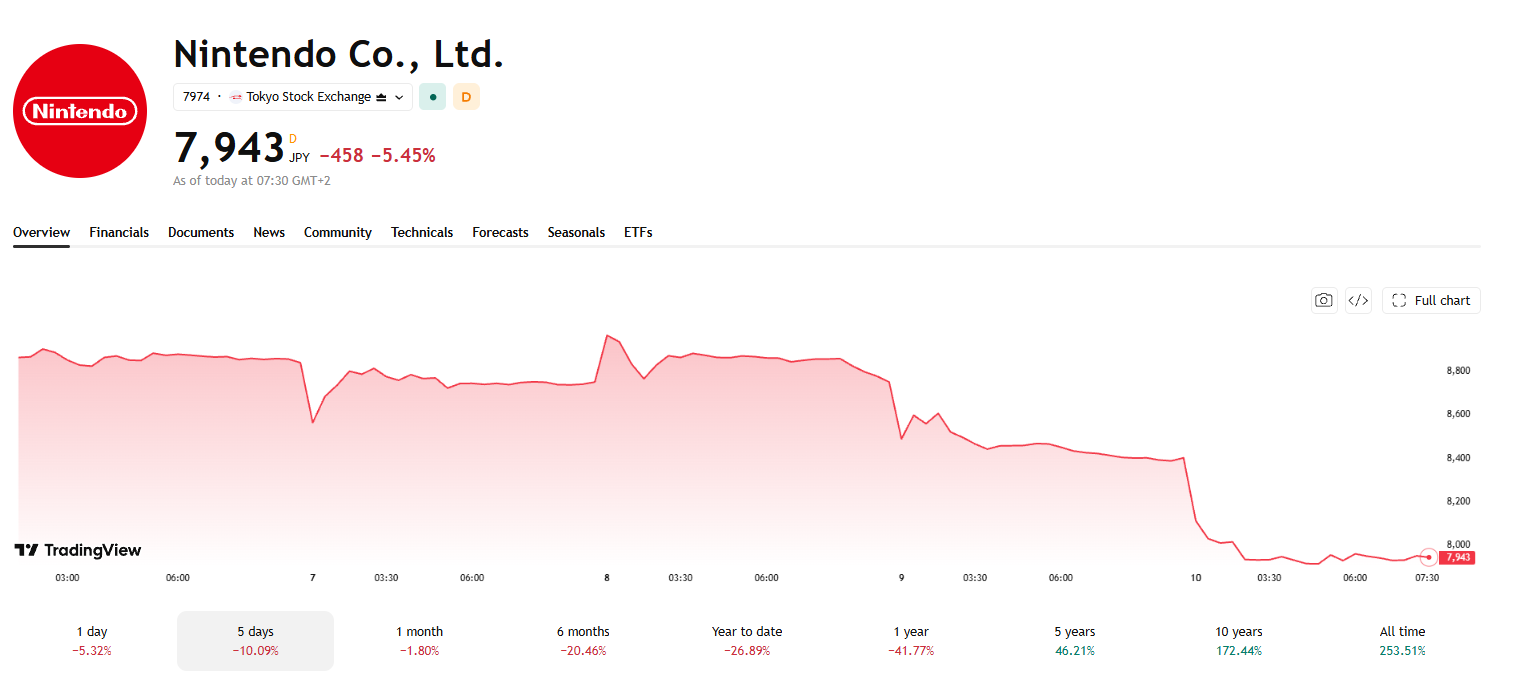
The Nintendo stock drop ran into a second session on Thursday. Shares traded 5.45% lower at 7,943 yen in Tokyo, leaving Nintendo down more than 10% over five days.
Investors wanted more from the Zelda showcase and Wednesday’s Nintendo Direct. Players reacted very differently, and so did one prominent chief executive.
What Is Driving the Nintendo Stock Drop
Nintendo filled both broadcasts with release plans. A Direct marking Zelda’s 40th anniversary gave the Ocarina of Time remake a November 5 launch. Wednesday’s showcase then laid out the winter slate.
Much of that slate revisits old ground. Pikmin 4 and Xenoblade Chronicles 3 return as upgraded Switch 2 Editions of games from 2023 and 2022. Hyrule Warriors comes back in a definitive edition.
Other titles sit further out. Metroid Ravenous and a 3D Kirby game arrive in 2027. Monster Hunter Wilds and three Resident Evil remakes also reach the console, though both launched elsewhere years ago.
That mix sits at the center of the criticism. No new 3D Mario game appeared, and remasters plus Switch 2 Editions now carry the holiday quarter.
Analysts wanted an exclusive that moves hardware. Upgrades of game owners are already finished, but they rarely do that job. Therefore, the console outlook looks softer than the share price assumed.

OpenAI CEO Sam Altman Books Two Days for Ocarina of Time
Players read the same reveals very differently. Sam Altman, chief executive of ChatGPT maker OpenAI, called the remake the best news he had heard in a long time. He then wiped November 5 and 6 from his calendar and said he needed a case of Mountain Dew.
Altman rarely mentions gaming, though he does use X for offbeat enthusiasms, including the room-temperature superconductor hunt he endorsed this week.
Meanwhile, gaming keeps proving a jumpy trade for large tech names. Microsoft cut 3,200 gaming roles in July. Apple’s incoming chief executive met the Pokémon team at Apple Park weeks later.
Nintendo now needs November 5 to turn that enthusiasm into holiday sales. Until then, the Nintendo stock drop reflects the games investors did not get.
The post Why Is Nintendo Stock Falling After Zelda? Look at What Wasn't Announced appeared first on BeInCrypto.


Arya.ag is using Avalanche technology to tokenize grain deposits to help lenders verify crops backing agricultural loans.


Former Bank of England and Bundesbank officials have joined Fnality’s UK and European boards as the bank-backed blockchain payments company prepares to expand its central bank money settlement network beyond sterling.
Summary
- Former BoE Deputy Governor Jon Cunliffe will chair Fnality’s UK board, while former Bundesbank executive Jochen Metzger joins its European supervisory board.
- Fnality operates a blockchain based wholesale payment system that allows banks to settle obligations using central bank backed money.
- The company launched its regulated sterling payment system in 2023 and is seeking approvals for dollar and euro versions.
- Fnality is backed by major financial institutions including Goldman Sachs, UBS, Santander, Bank of America and Citigroup.
Fnality said Thursday that former Bank of England Deputy Governor Jon Cunliffe will chair the board of its UK entity, while former Deutsche Bundesbank payments executive Jochen Metzger has been appointed to the supervisory board of Fnality Europe and is expected to become its chair.
Ron Berndsen, who previously served as head of oversight and head of market infrastructures policy at De Nederlandsche Bank, is joining the supervisory board of the Germany-based European business.
The appointments bring three former central bank officials into Fnality’s governance structure as banks and other financial institutions develop infrastructure for settling tokenized securities and moving digital forms of money across blockchain networks.
Fnality brings former central bankers into its payments network
Cunliffe previously served as the Bank of England’s deputy governor for financial stability, where his responsibilities included oversight of financial market infrastructure and payment systems.
Metzger served as director general for payments and settlement systems at Deutsche Bundesbank, while Berndsen previously worked on oversight and market infrastructure policy at the Dutch central bank.
Their appointments come as Fnality works to extend its wholesale payment infrastructure into additional currencies and jurisdictions.
The London-based company operates a blockchain-based wholesale payment system that allows participating financial institutions to settle obligations using funds backed by central bank money. Its sterling payment system launched in 2023 and is regulated by the Bank of England.
Fnality is now seeking regulatory approvals for dollar- and euro-denominated versions of the network.
“It is really important that we find a way to get central banks and central bank money at the heart of the new technologies that were pioneered in the crypto world,” Cunliffe said in an interview.
“Some of those technologies are coming to the mainstream world of finance because they offer better functionality and speed.”
Fnality was founded in 2019 and is backed by banks and financial market infrastructure companies including Goldman Sachs, UBS, Banco Santander, Bank of America and Citigroup.
The company raised $136 million in Series C funding in September 2025, with crypto.news previously reporting that WisdomTree, Bank of America, Citi, KBC Group, Temasek and Tradeweb led or participated in the round alongside existing investors including Goldman Sachs, Santander, UBS and Euroclear.
That financing took Fnality’s total funding since 2019 to more than $280 million. The company said at the time that the capital would support expansion of the Sterling Fnality Payment System into additional currencies, alongside liquidity management tools and connections with stablecoins and tokenized deposits.
Fnality had earlier raised $95 million in Series B funding in 2023 in a round led by Goldman Sachs and BNP Paribas. Euroclear, DTCC, WisdomTree and Nomura were among the participants, while Santander, BNY Mellon, Barclays, ING, Lloyds Banking Group, State Street and UBS were among its existing backers.
Tokenized assets are creating demand for digital settlement
Banks are increasing work on tokenization, where conventional assets such as stocks and bonds are represented and transferred through blockchain-based infrastructure.
Moving securities onto digital networks creates a corresponding requirement for the cash side of transactions to operate on compatible systems. Fnality’s model uses central bank-backed money for wholesale settlement, allowing participating institutions to complete transactions involving digital assets without relying solely on stablecoins or commercial bank deposits.
Its live sterling system has been used for cases including real-time settlement of tokenized securities through delivery versus payment, foreign exchange transactions using payment versus payment and repo transactions.
Similar projects are developing across the banking sector.
Swift moved its blockchain ledger into deployment in July with 17 global banks preparing to test tokenized deposit payments for round-the-clock cross-border settlement. Participants included HSBC, Citi, BNP Paribas, UBS, ANZ, DBS and Standard Chartered.
The system coordinates tokenized deposits between banks while retaining existing compliance, risk and control processes. Tokenized deposits are digital representations of commercial bank deposits, meaning the underlying funds remain on the issuing bank’s balance sheet.
In August, HSBC and Standard Chartered completed the first live interbank transaction through Swift’s blockchain ledger. The banks connected their separate tokenized deposit systems through the shared network, which matched and netted payment obligations before final settlement occurred through existing banking infrastructure.
Seventeen banks across six continents are participating in the wider Swift pilot.
Banks are testing several forms of digital money
Fnality is developing its central bank money model alongside other forms of blockchain-based cash being tested by banks, including tokenized deposits and stablecoins.
Stablecoins are generally issued by companies and backed by reserve assets, while tokenized deposits represent deposits held at commercial banks in digital form. Fnality instead provides wholesale settlement using money linked to central bank balances.
“Multiple models of digital money will co-exist,” Fnality Group CEO Michelle Neal said in an interview. “Our differentiation is that this is regulated wholesale settlement.”
Banks are developing infrastructure around more than one of those models.
Wells Fargo said in August that it planned to launch tokenized deposits for selected corporate and commercial clients, initially supporting U.S. dollar-to-British pound transactions. The bank plans to use blockchain infrastructure for 24-hour transfers, settlement and programmable payments before adding more clients, currencies and countries during 2027.
JPMorgan, Citigroup, Bank of America and Wells Fargo are separately working through The Clearing House on a shared network that would allow corporate customers to move tokenized deposits around the clock, with a launch targeted for the first half of 2027.
The development of digital cash is taking place alongside efforts to put securities settlement on distributed ledgers.
Mitsubishi UFJ Financial Group said in August that four MUFG companies would work with Digital Asset and Progmat on a blockchain settlement test for Japanese government bond repo transactions using Canton Network.
The project is designed to synchronize existing JGB book-entry records with blockchain infrastructure, while tokenized deposits or stablecoins are being considered for the cash side of settlement. Japan’s Financial Services Agency selected the project under its Payment Innovation Project pilot program in February.
Fnality’s sterling network uses a different settlement structure by placing central bank-backed money directly within its wholesale payments framework. With its UK system already operating, the company is working through the regulatory process required to extend that structure to dollar and euro payments.
Crypto World
Zamanat Targets GCC’s $250 Billion SME Financing Gap With Up to $100 Million Tokenized Private Credit Fund

[PRESS RELEASE – Dubai, UAE, September 10th, 2026]
Zamanat Fund CEIC Limited is the company’s first live proof point for regulated fund tokenization on ZIGChain focused on GCC private credit.
Zamanat today announced its sponsorship of Zamanat Fund CEIC Limited (the “Fund”), a DIFC-domiciled tokenized private credit fund with a target size of up to USD 100 million. The Fund targets the GCC’s estimated $250 billion SME financing gap, with only 11 percent of SMEs across the region having access to credit.
Closing a $250 billion structural gap in GCC SME credit
Across the GCC, SMEs are central to economic growth yet remain significantly underserved by traditional financing. In the UAE, SMEs generate more than half of GDP and employ the majority of the private-sector workforce, yet receive less than 10 percent of total bank lending.
The Fund will invest in private credit across the region, directing capital towards strong homegrown companies whose financing needs are not fully met through traditional lending channels. The strategy supports national ambitions to expand SME participation, private-sector growth and access to alternative financing, including priorities set out under Saudi Arabia’s Vision 2030 and the UAE Centennial 2071.
“Strong businesses across the GCC still struggle to access growth capital despite sound fundamentals. Zamanat sponsored the Fund to create a credible route between those businesses and institutional capital. With a target size of up to USD 100 million and interests issued as Investment Tokens, it is our first live proof point for bringing GCC private credit into a regulated digital structure for Professional Clients,” said Umair Tariq, Founder and CEO of Zamanat.
Bringing GCC private credit into digital markets
Tokenization expands the infrastructure around traditionally hard-to-access private-market assets without changing the underlying investment or credit profile.
The Fund combines a regional private credit strategy, a DIFC fund structure, institutional administration and digital issuance on ZIGChain. It provides a first live demonstration of how regional private credit can be brought into a DFSA-regulated tokenized structure for Professional Clients.
The Fund is a DFSA-regulated closed-ended fund registered as an Exempt Fund and classified as a Credit Fund. It is managed by Truleum Venture Partners Limited and administered by Apex Group. Fund interests will be issued as ZM1 Investment Tokens on ZIGChain within a regulated, whitelisted environment.
As sponsor, Zamanat brings its regional private credit, investment structuring and institutional partnership expertise to the Fund’s development. Truleum retains responsibility for all regulated fund-management activities.
The ZM1 Investment Token structure provides a blockchain-native ownership and settlement layer within the Fund’s regulated framework. It also allows qualifying investors who meet the DFSA Professional Client criteria to participate alongside institutional investors.
Zamanat is backed by Disrupt.com, a MENA-based, operator-led AI-native venture builder and lead investor in the business.
Building the global market for Digital Shariah Assets
Global Islamic finance assets are projected to reach $9.7 trillion by 2029, yet demand for digital and Shariah-aligned assets is growing faster than the institutional infrastructure connecting them with global capital.
Zamanat continues to build the global market for Digital Shariah Assets. Its wider operating model combines investment structuring, Shariah expertise, regulated partner routes and digital distribution to bring real-world assets to market through traditional and digital channels.
The DIFC-domiciled Fund evidences the regulated fund-tokenization, digital ownership and partner-orchestration capability within that wider build. Zamanat is progressing a separate pipeline of Digital Shariah Assets across private credit, receivables, real estate and other asset classes.
Institutional partnerships
Apex Group acts as Fund Administrator, providing institutional fund administration and controls from the outset.
“Zamanat is supporting the creation of a new category in Digital Assets. Bringing institutional structure and digital distribution together within a DFSA-regulated framework sets the standard for how this market should be built, and this fund shows the model working at institutional scale. We are proud to support the infrastructure behind it, and we look forward to partnering further on the projects Zamanat already has in motion,” said Peter Hughes, Founder & CEO, Apex Group.
The global market for Digital Shariah Assets does not yet exist as an institutional category. Zamanat is building it.
Notes to Editors
Sources
LSEG and ICD, 2025 Islamic Finance Development Indicator Report, 14 October 2025 (global Islamic finance assets projected to reach $9.7 trillion by 2029); World Bank, Competition in the GCC SME Lending Markets: An Initial Assessment (estimated $250 billion GCC SME credit gap; 11 percent of SMEs with access to credit); Kearney, GCC Retail Banking Radar 2024.
Investor notice
This communication as related to Zamanat Fund CEIC Limited is approved by Truleum Venture Partners Limited in the DIFC (DFSA License Number: F008013).
This release is for information only. It is not an offer, invitation or recommendation to subscribe for interests in Zamanat Fund CEIC Limited or acquire ZM1 Investment Tokens. Any participation will be made only through the Fund Manager, final offering documents and applicable Professional Client eligibility requirements. For avoidance of doubt, this communication is intended for and directed only to investors who meet the requirements to be considered Professional Clients as specified under the Dubai Financial Services Authority Conduct of Business Rulebook, Rule 2.3.3. The Fund is an ‘Exempt Fund’. Accordingly, the ZM1 Investment Tokens are available only to Professional Clients.
This release and the information contained herein does not constitute, and is not intended to constitute, a public offer of securities in any other jurisdiction and accordingly should not be construed as such. The ZM1 Investment Tokens are only available to a limited number of investors from the DIFC. The ZM1 Investment Tokens have not been approved by or licensed or registered with any other relevant licensing authority or governmental agency. No transaction will be concluded in onshore UAE outside the DIFC.
The Fund is not an Islamic Fund and is not marketed as Shariah-compliant. References to Shariah in this release relate to Zamanat’s broader platform and market ambition and not to the Fund.
About Zamanat
Zamanat is building the global market for Digital Shariah Assets. The company connects asset originators with global capital through investment structuring, Shariah expertise, regulated partner routes, tokenization and distribution across traditional and digital channels.
Zamanat also sponsors and develops institutional investment products through appropriately licensed partners. Each product follows its own legal and regulatory framework and, where presented as Shariah-aligned, its own product-specific Shariah review and governance process. Website: www.zamanathq.com
The post Zamanat Targets GCC’s $250 Billion SME Financing Gap With Up to $100 Million Tokenized Private Credit Fund appeared first on CryptoPotato.

President Donald Trump has proposed a $5,000 “dividend” payment to every adult US citizen if Republicans hold Congress after the midterm elections.
Crypto traders picked up on it almost instantly, with at least one well-followed account framing the idea as the kind of liquidity shock that helped kick off the last major bull run.
Trump’s $5,000 Proposal Draws Crypto Attention
The president’s proposal would apply to roughly 245 million US citizens aged 18 and above, putting the estimated cost at about $1.2 trillion. The last time a stimulus of this magnitude was deployed was during the pandemic, when close to $4 trillion in fiscal support went out during lockdown.
Mark Chadwick, posting on X, focused on what the payment could mean for crypto:
“If this happens, and it’s a big IF – but if it does it would ignite the most insane Alt Season imaginable,” he wrote.
He compared the potential effect with the 2021 crypto market, calling it a “2021 Covid stim type catalyst” layered onto a bull market he already sees building. He closed with a nod to the president, saying, “Well played, Mr. Trump. Well played.”
But not everyone read it the same way, one of them being economist Peter Schiff, who dismissed the plan as an attempt to buy votes, writing that Trump was offering “a $5,000 bribe in exchange for their votes,” and warning that printing the money would push inflation well past anything seen under the Biden administration.
The Altcoin Setup Already Looks Shaky
Whether or not the payment materializes, it lands at an interesting moment for altcoins. Analyst Matthew Hyland has spent the past week pointing out that charts including ETH, Total 2, Total 3, and OTHERS have all broken multi-year downtrends, leading him to conclude that “the largest Altcoin Bull Run of all time is loading.”
As CryptoPotato reported earlier, that thesis leans on a ratio comparing coins outside the crypto top ten against the S&P 500, which has spent years sliding from a 2017 peak and now sits near the bottom of that range with an oversold reading to match.
The leverage building underneath that story looks less convincing, though. Altcoin perpetual futures open interest overtook Bitcoin’s this week for the first time since December 2024, with Zcash alone carrying roughly $2.4 billion in open derivatives positions, with investor Michael Bucella comparing the setup to October 2025, right before a market-wide liquidation event.
The post Trump’s $5K Proposal Could Ignite an ‘Insane’ Altcoin Season: Analyst appeared first on CryptoPotato.
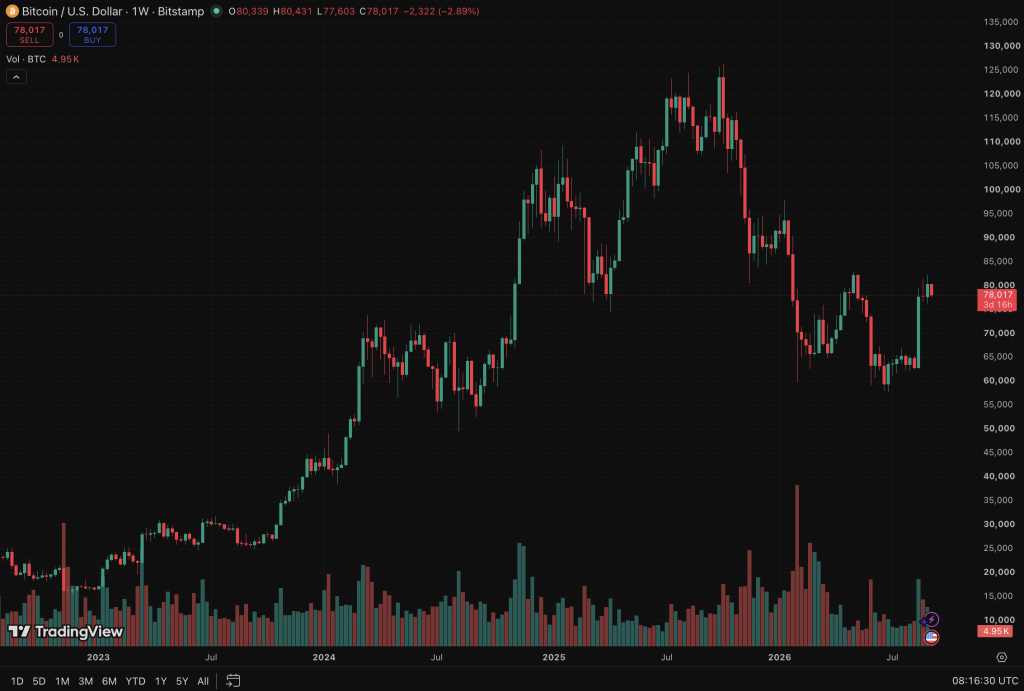
Bitcoin (BTC) sits at $78,000, down -0.6% for the day, and barely holding the line it’s held for most of the week. That kind of stubbornness after a 23% weekly surge tells its own story and is leading investors to wonder if Bitcoin Hyper is the best crypto to buy right now.
Hunter Biden’s LAPTOP memecoin briefly touched a $110 billion market cap on launch day before crashing more than 99%, according to DexScreener data. Blockchain analytics firm Bubblemaps called it a “bloodbath”; roughly 80% of traders lost money.
The project’s own Medium post blamed sniper bots and thin liquidity, promising 4 million tokens for pool incentives and a burn tied to prediction-market resolutions.
That kind of first-day carnage is a useful reminder of what “high risk” actually looks like in this market. It’s also why the broader macro setup, like Bitcoin defending support and Ethereum consolidating near resistance, deserves more attention than another memecoin implosion.
Can Bitcoin Price Hit $80K This Week?

BTC trades at $78,314, down a negligible 0.01% over 24 hours after last week’s 23% rip to near-$78k. KuCoin’s daily report flags renewed macro headwinds, Brent crude above $100, and WTI near $96 as the drag keeping bulls from pushing through.
Support has held cleanly at $77,600–$77,900, with resistance capping gains around $80,000–$82,000.
Perpetual futures volume near $421Bn is elevated enough that RSI Hunter flags leverage risk, even as long-term holder sell pressure sits at a one-month low.
Bull case: a clean break above $80k on ETF inflows reopens the run toward prior highs.
Base case: continued consolidation between $77.6k and $80k while macro noise sorts itself out.
Bear case: a slide below $77,600 with rising yields as the catalyst. For a deeper breakdown, see this Bitcoin price prediction analysis.
Earn $50 and Enter $300K Prize Draw on EdgeX
Is Bitcoin Hyper the Best Crypto to Buy Right Now as it Targets Early Mover Upside as BTC Flirts With $78K Support
At $78k and a market cap north of $1.5 trillion, the math on further multiples gets harder every week; BTC doubling from here is a very different proposition than it was in 2020. That ceiling is exactly why infrastructure plays building on top of Bitcoin, rather than just holding it, are drawing fresh attention.
Bitcoin Hyper ($HYPER) is positioning itself as the first Bitcoin Layer 2 with full SVM integration — smart contracts running at Solana-competitive speeds while settling back to Bitcoin’s base layer.
The presale has raised $33,119,143.07 so far, with tokens priced at $0.013686 and staking APY offered to early buyers. Its Decentralized Canonical Bridge aims to solve the actual problem- Bitcoin’s lack of programmability- rather than wrap it in another synthetic asset.
Gain Access to New Bitcoin Layer 2 Early Here
Discover: The Best Token Presales
The post Best Crypto to Buy Today as Bitcoin Tumbles to $78,000 appeared first on Cryptonews.
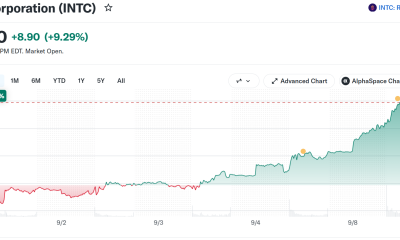
On 8 September, Northland Securities upgraded Intel to Outperform with a price target of $120, citing a shortage of server processors, progress in the company’s business turnaround and potential benefits from its involvement in the Terafab project with Tesla and SpaceX. On the same day, reports emerged that Intel was planning to raise processor prices by around 10% from October amid rising costs and limited supply across the supply chain. The combination of higher prices and a positive rating revision is helping to sustain investor interest in Intel shares against the backdrop of strong performance across the semiconductor sector.
Intel Technical Analysis
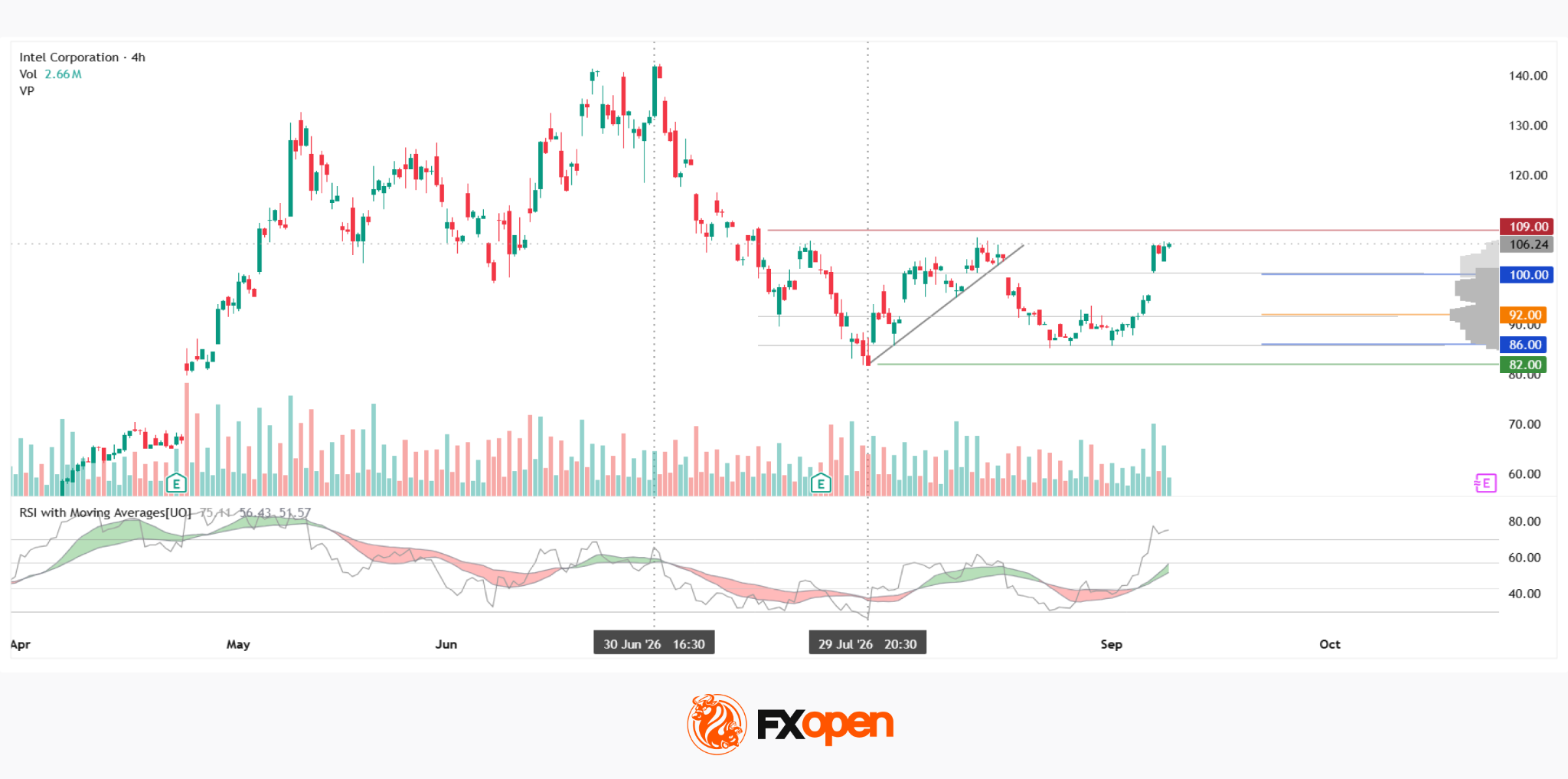
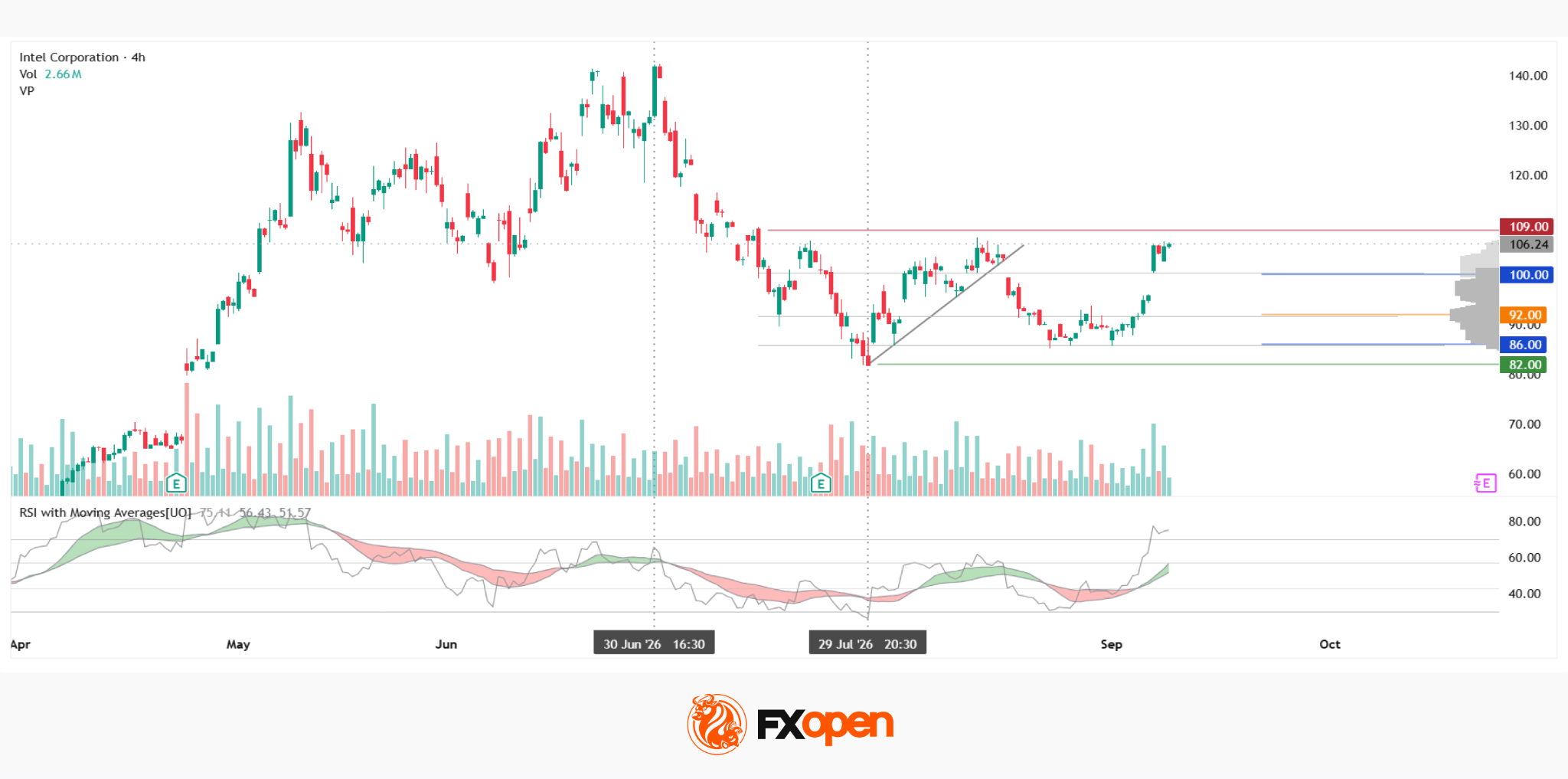
From 30 June to 29 July, a short-term trend formed on the INTC four-hour chart. Following a decline, the market corrected higher, with the rebound forming an ascending trendline. The price subsequently broke below this trendline, but the attempted breakout was not confirmed by the RSI + MAs indicator. As a result, the price reversed direction and quickly moved through the current market profile, breaking above its upper boundary at $100.00 and is now attempting to establish itself above this level.
It is worth noting that the red resistance level at $109.00 is relatively close to the current price, while the RSI + MAs indicator currently stands at 75, 56 and 51. The RSI has already entered overbought territory, while the moving averages have yet to leave the neutral zone, making the current breakout attempt look questionable. If the market produces another false breakout, a return into the market profile could bring several important levels into play, including the Point of Control (POC) at $92.00 and the lower boundary of the profile at $86.00. Below this level, and relatively close to it, lies the green support level around $82.00.
Key Takeaways
The RSI being in overbought territory while the moving averages remain in the neutral zone casts doubt on a potential breakout of the profile. The short distance to the red resistance level could also strengthen the current resistance zone. Investor reaction to the planned price increase in October could provide an additional factor influencing the stock’s price action.
Buy and sell stocks of the world’s biggest publicly-listed companies with CFDs on FXOpen’s trading platform. Open your FXOpen account now or learn more about trading share CFDs with FXOpen.
This article represents the opinion of the Companies operating under the FXOpen brand only. It is not to be construed as an offer, solicitation, or recommendation with respect to products and services provided by the Companies operating under the FXOpen brand, nor is it to be considered financial advice.

The Shards Producers Defend Finale Changes, Tease Season 2

Financial problems

Apple unveils foldable iPhone Duo and AI features under new CEO John Ternus


-
 Crypto World1 day ago
Bitcoin price risks $76K drop as $78K support weakens
-
 Tech2 days ago
Memory prices are slowing because buyers ran out of money
-

 Crypto World1 day ago
Ethereum price stalls below $2,500 as ADX drops to 11
-

 Crypto World2 days ago
Robinhood Stock: How To Take Advantage With Reduced Risk
-

 NewsBeat1 day ago
What went right this week: an ‘historic’ fall in violent crime, plus more
-
 Crypto World1 day ago
Bitcoin price holds near $79K as cycle drawdowns narrow
-

 Crypto World11 hours ago
Bitcoin price risks $70K if $78K neckline breaks
-
 Sports2 days ago
Phones confiscated, players sent home: Pakistan’s England tour turmoil revives memories of Mohammad Amir, Salman Butt and Mohammad Asif’s 2010 Lord’s spot-fixing scandal | Cricket News
-

 NewsBeat2 days ago
England up in reading, maths and science rankings as Scotland and Wales dip
-
 Crypto World2 days ago
Brent Crude Oil Moves Above $100 for the First Time in 3 Months
-

 Business1 day ago
Meta debuts long-awaited personal AI agent, Muse
-

 Crypto World2 days ago
Pump Fun and Kraken delete Hunter Biden $LAPTOP promotion
-
 Crypto World2 days ago
Visa expands stablecoin card network to 160 programs
-

 Business2 days ago
Egyptian TV Presenter Sarah Khalifa, 11 Others Sentenced To Death In Major Drug Trafficking Case In Cairo
-
 Crypto World2 days ago
Intel Stock Jumps 9% on Chip Price Hike Report, US Stake Gains $36 Billion
-
 Tech2 days ago
Strong Password Policy and Password Manager Guide
-

 Business1 day ago
ServiceTitan, Inc. (TTAN) Q2 2027 Earnings Call Transcript
-

 Tech2 days ago
Meta debuts its Muse AI agent. Will consumers trust it?
-

 Entertainment1 day ago
Big Brother Spoilers: Dee SPINS & HUSTLES Votes – Yash Questions the Pact
-

 Tech2 days ago
Google’s revived nuclear power plant gets $1.9B loan from US government
You must be logged in to post a comment Login