
Crypto World
Bitcoin Juggles $120 Oil and Fed’s ‘Most Hawkish’ Interest-Rate Pause

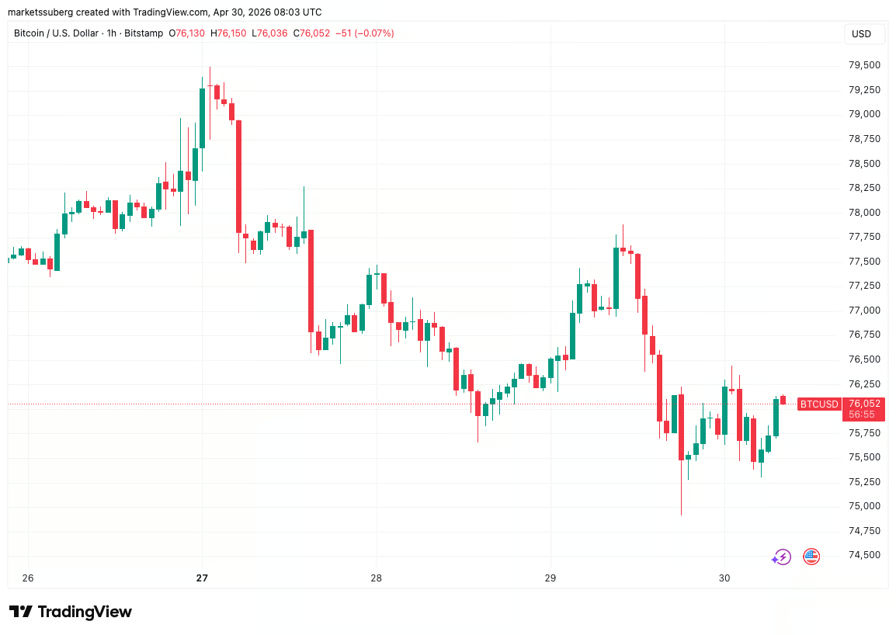
Bitcoin (BTC) failed to recover new support on Thursday as oil hit its highest levels in nearly four years.
Key points:
- Bitcoin struggles to recoup recent lost ground as geopolitical factors weigh on momentum.
- UK Brent crude oil spot markets record their highest levels since June 2022.
- The Federal Reserve’s interest-rate decision is called Chair Jerome Powell’s “most hawkish in years.”
Bitcoin falls on “most hawkish” Fed meeting
Data from TradingView showed BTC/USD circling $76,000, down around 2% from the previous day’s high.
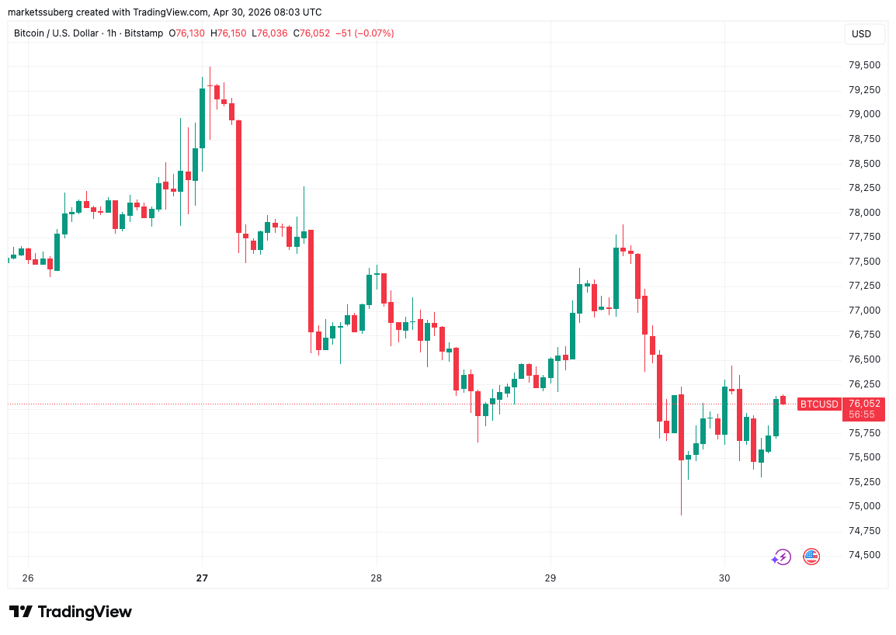
BTC/USD one-hour chart. Source: Cointelegraph/TradingView
A combination of high oil prices and the US Federal Reserve’s “most hawkish” meeting in years kept risk-asset optimism low.
Both were a result of the ongoing US-Iran war, which showed no sign of resolution.
“Iran can’t get their act together. They don’t know how to sign a nonnuclear deal. They better get smart soon!” US President Donald Trump wrote in one of his latest posts on Truth Social.

Source: Truth Social
Amid the tensions, spot Brent crude oil passed $120 per barrel for the first time since June 2022.
“Asia is facing its worst even crisis in history and Europe has just weeks worth of jet fuel left. The US is exporting record amounts of oil as a result,” trading resource The Kobeissi Letter responded in a post on X.
“Inflation is back.”
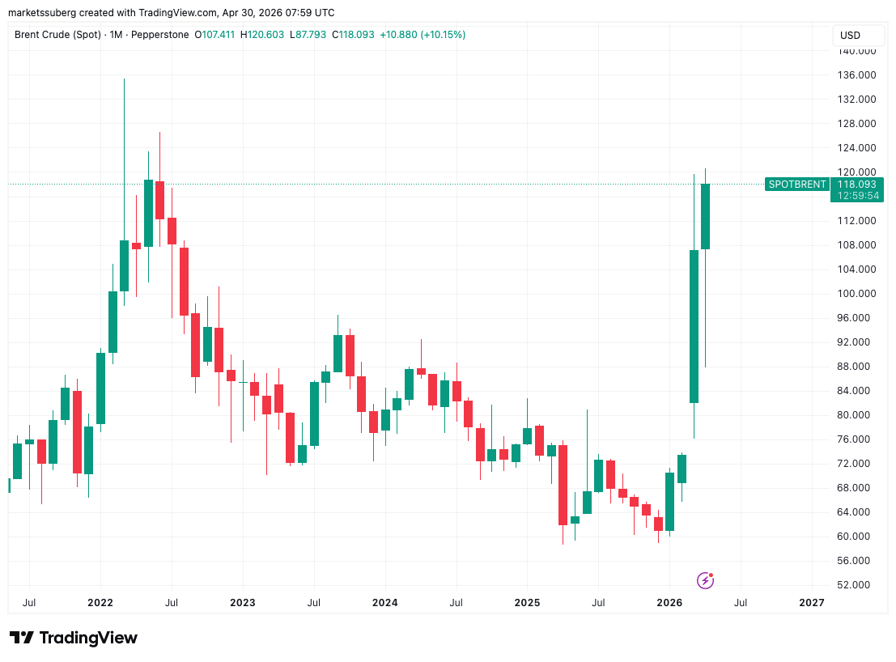
Spot Brent crude oil one-month chart. Source: Cointelegraph/TradingView
Inflation worries were among the guiding factors for Fed officials at Wednesday’s Federal Open Market Committee (FOMC) meeting, where they left interest rates unchanged.
While markets expected that outcome, commentators noted a worsening outlook for risk appetite due to changing Fed policy.
Nic Puckrin, CEO and cofounder of crypto education platform Coin Bureau, described the FOMC meeting — the last with Jerome Powell as Chair — as his “most hawkish in years.”
“For the first time since 1992, 4 Federal Reserve members dissented the decision,” he noted.
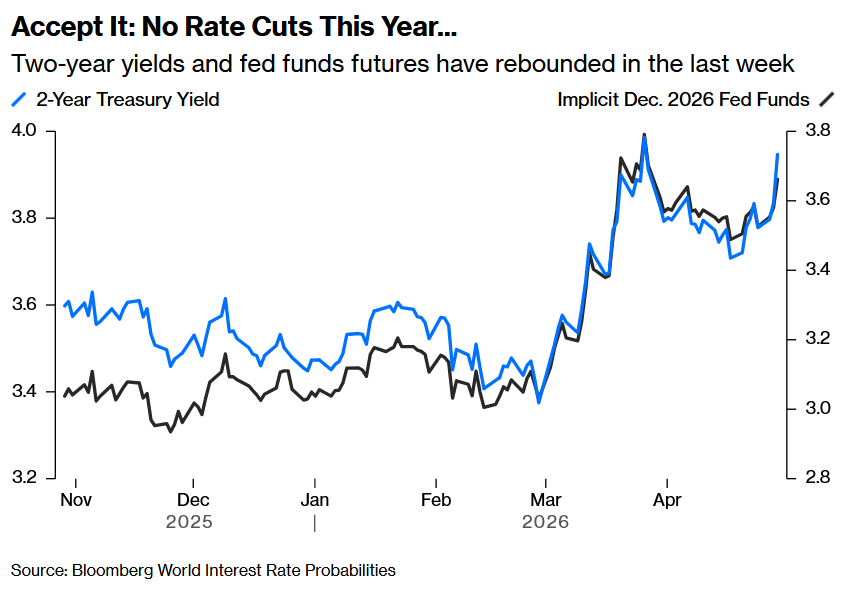
US two-year Treasury yield versus Fed funds rate futures. Source: Nic Puckrin/X
Puckrin suggested that the Fed’s “soft landing” policy on inflation had also gone.
“Rates held for the third straight meeting, but the direction of travel just changed,” he summarized.
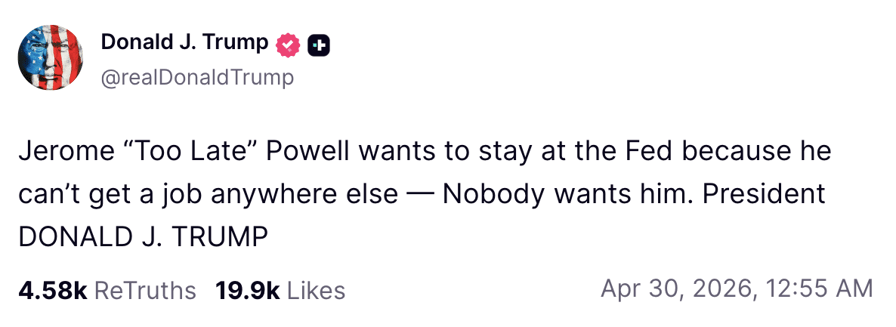
Source: Truth Social
Trump repeated attacks on Powell after the decision, calling him “too late” in cutting rates ahead of the likely takeover by Kevin Warsh.
As Cointelegraph reported, Trump said that he “would” be disappointed if Warsh did not cut rates at his first FOMC meeting in June.
BTC price 21-day trend line hangs in the balance
BTC price action still managed to respect the 21-day simple moving average (SMA) near $75,500 overnight.
Related: First 21-week trend line reclaim since October 2025: Five things to know in Bitcoin this week
That support line was the key question for trading resource Material Indicators on low time frames.
“Will support hold?” it queried in an X post alongside order-book liquidity data for Binance.
The data showed whale order classes broadly buying the dip, while smaller order classes reduced exposure.
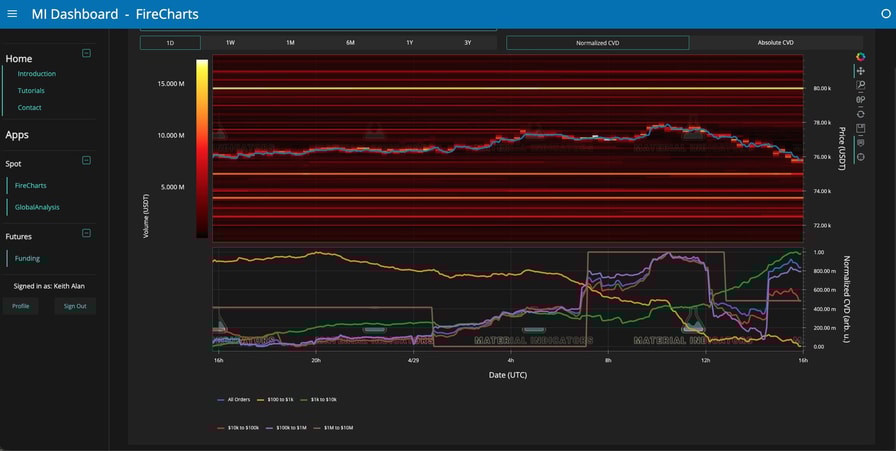
BTC/USDT order-book data (Binance) with whale orders. Source: Material Indicators/X

On 30 April, after the market close, Apple Inc. will release its financial results for the second quarter of fiscal 2026. The consensus forecast, based on estimates from 31 analysts, points to revenue of around $109.7 billion, with expected EPS of approximately $1.95. The first quarter set a high benchmark: revenue reached a record $143.8 billion, up 16% year-on-year, while EPS came in at $2.84. However, investors are focusing less on the headline figures and more on management’s outlook. The market is looking for confirmation of a strong iPhone cycle, continued growth in services, as well as signals regarding China and the company’s AI strategy. Additional uncertainty stems from trade policy: new Section 301 investigations into Chinese manufacturing continue to weigh on the company’s supply chain, while rising memory costs are increasingly acting as a headwind to growth.
Technical picture
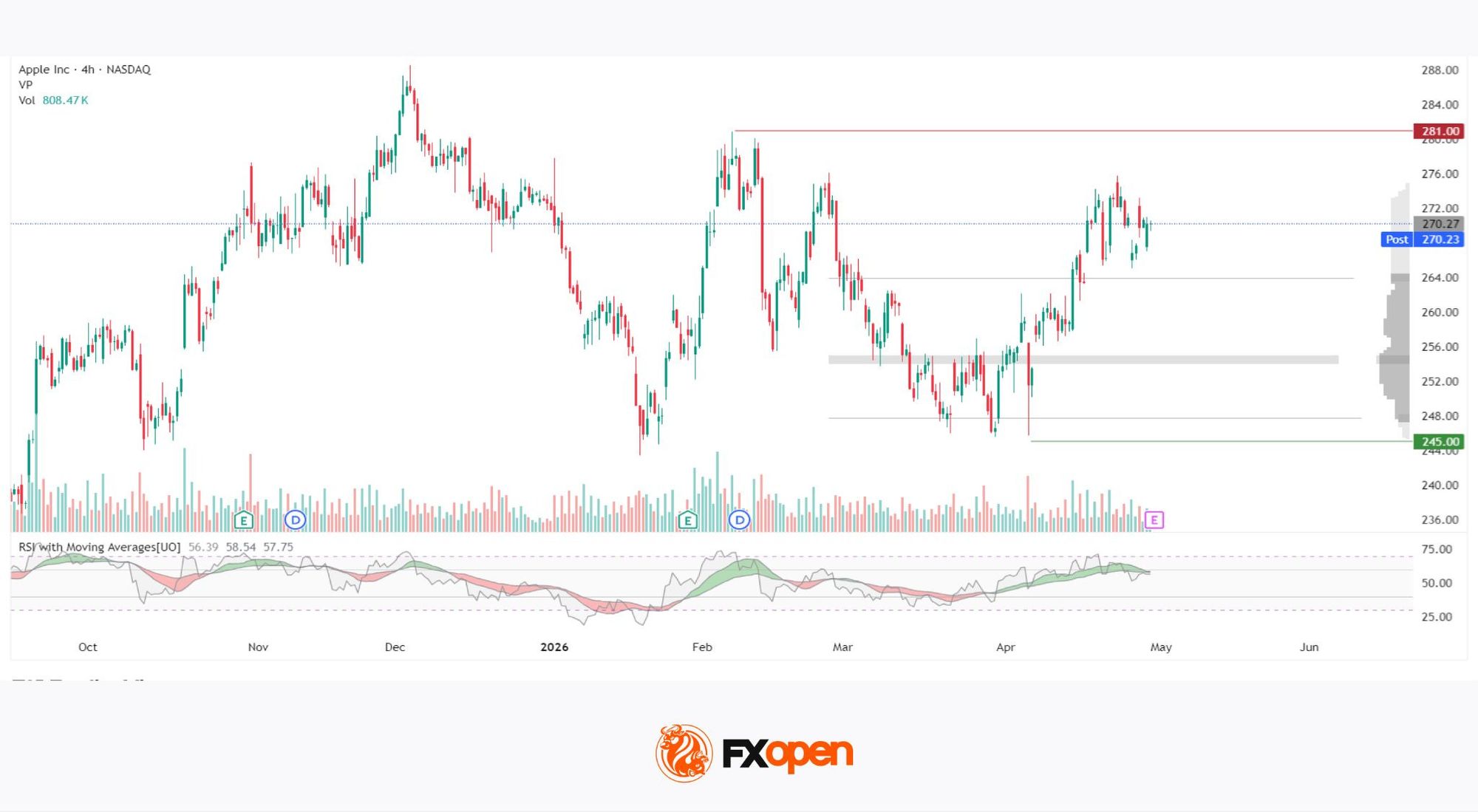
On the 4-hour chart, a broad sideways range has been in place since October last year. Strong resistance within this range is located around $280, which coincides with the February high and has repeatedly capped price advances. The lower boundary is established near $245, a level that has also seen multiple reversals. The horizontal volume balance zone spans $248–$264, with the point of control around $254–$255. The current price, near $270, is trading above this zone — in an area of lower trading activity where price movements tend to be less stable.
The vertical volume on 7 April stands out across the entire profile — this is when the price rebounded from the lower boundary of the range and, following a gap, began its recovery. The RSI + MAs indicator shows readings of 56, 58 and 57: the oscillator is positioned below both moving averages, indicating continued moderate upward pressure without signs of overheating.
Key Takeaways
The stock approaches its earnings release in a technically mixed position: the price has moved beyond the high-volume zone, while a significant gap remains before the $280 resistance level. The tone of management guidance — particularly regarding margins and China — is likely to determine whether the current momentum can be sustained or whether the price returns to the area of higher trading density.
Buy and sell stocks of the world’s biggest publicly-listed companies with CFDs on FXOpen’s trading platform. Open your FXOpen account now or learn more about trading share CFDs with FXOpen.
This article represents the opinion of the Companies operating under the FXOpen brand only. It is not to be construed as an offer, solicitation, or recommendation with respect to products and services provided by the Companies operating under the FXOpen brand, nor is it to be considered financial advice.
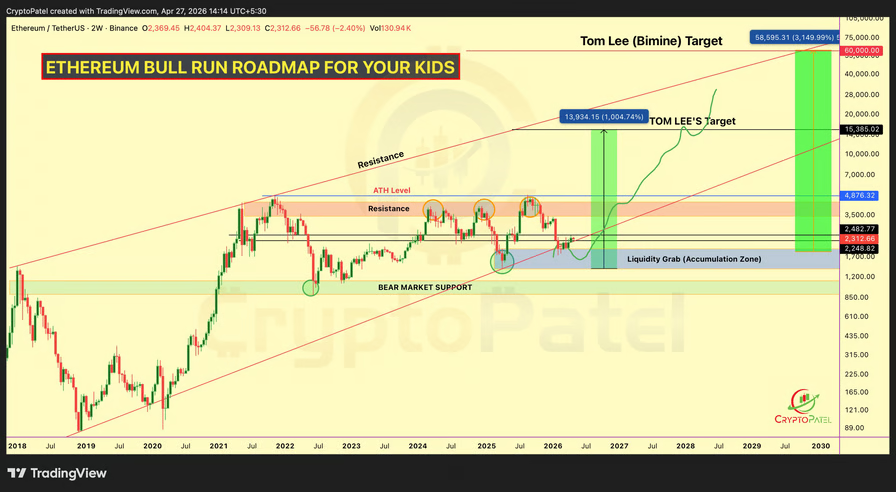
Fundstrat co-founder Tom Lee shared a “generational play” thesis for Ethereum that predicts 3,000% upside in Ether (ETH) price to $60,000.
Key takeaways:
- ETH is testing a key long-term support trend line that preceded 5,000% gains in the past.
- Tom Lee amplified the fractal setup, which projects ETH toward $60,000 by 2030.
ETH price chart: Giant ascending channel targets $60,000
On Wednesday, Lee reposted a bullish outlook shared by analyst Crypto Patel that predicted ETH’s price reaching $60,000 in the coming years.
The setup showed a long-term ascending channel that has framed ETH’s price action since 2017, with its upper and lower trend lines repeatedly acting as resistance and support across multiple market cycles.
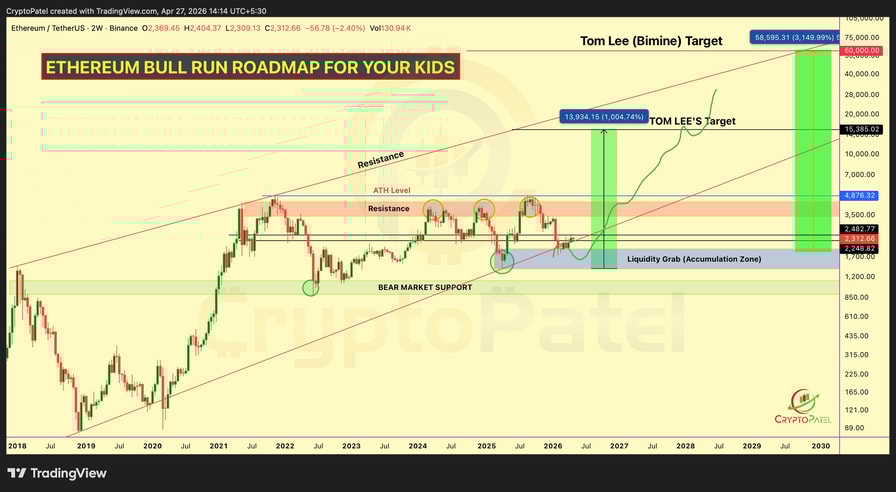
ETH/USD two-week chart. TradingView/CryptoPatel
In 2020, for example, ETH rebounded from the channel’s lower trend line before rallying roughly 5,200% toward the upper boundary, where the cycle eventually topped.
Again, as of late April, ETH’s price stabilized around the lower trend line, an “accumulation zone” spanning $1,300–$2,000.
Patel highlighted a potential multi-year price rebound in the making, calling it a “generational play” for “patient holders.” His chart projected a 1,000% rise in ETH to around $15,800 by 2028 and 3,150% to $60,000 by 2030.
Related: These 3 Ethereum metrics favor an ETH price rally to $6K
Lee reposted Patel’s bullish outlook after BitMine, the Ethereum treasury firm he chairs, purchased $235 million worth of Ether, lifting its net Ether reserves above 5 million ETH, or roughly 4% of the current Ethereum supply.
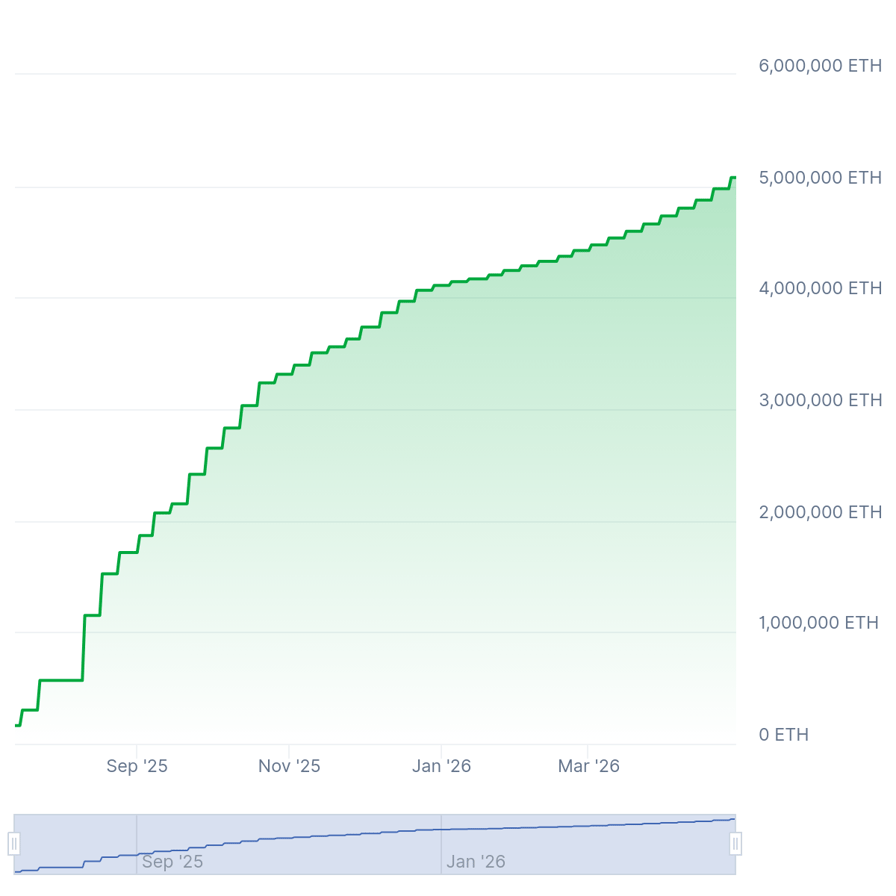
BitMine’s Ethereum holdings chart. Source: CoinGecko
The buying spree underscores BitMine’s aggressive ETH accumulation strategy, even as the company remains exposed to sharp market swings. As of late April, its unrealized losses on the investments stood at around $6.5 billion.
Ethereum bears will have other plans
Since 2021, Ether has traded inside a giant symmetrical triangle, a neutral pattern that can break in either direction. It briefly moved above the structure in July 2025, but the breakout failed, sending the price back inside the range.
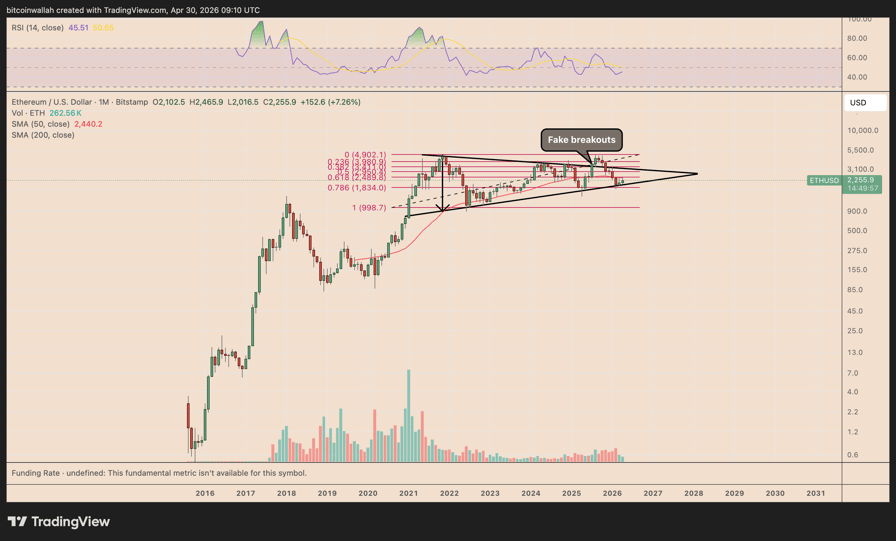
ETH/USD weekly chart. Source: TradingView
A decisive breakdown below the lower trend line, now near the 0.786 Fibonacci retracement around $1,834, would weaken the bullish case.
Losing this support could open the door to a deeper decline toward the 1.0 Fib line at around $1,000, aligning with downside targets flagged by several bearish analysts earlier this year.
In this case, BitMine could see its unrealized loss swell to roughly $13.2 billion, based on an estimated average ETH acquisition cost of around $3,600 across its holdings until April.
Still, longer-term Ethereum forecasts remain optimistic, with VanEck and Standard Chartered projecting upside targets of up to $22,000 and $40,000, respectively, in their more bullish scenarios.
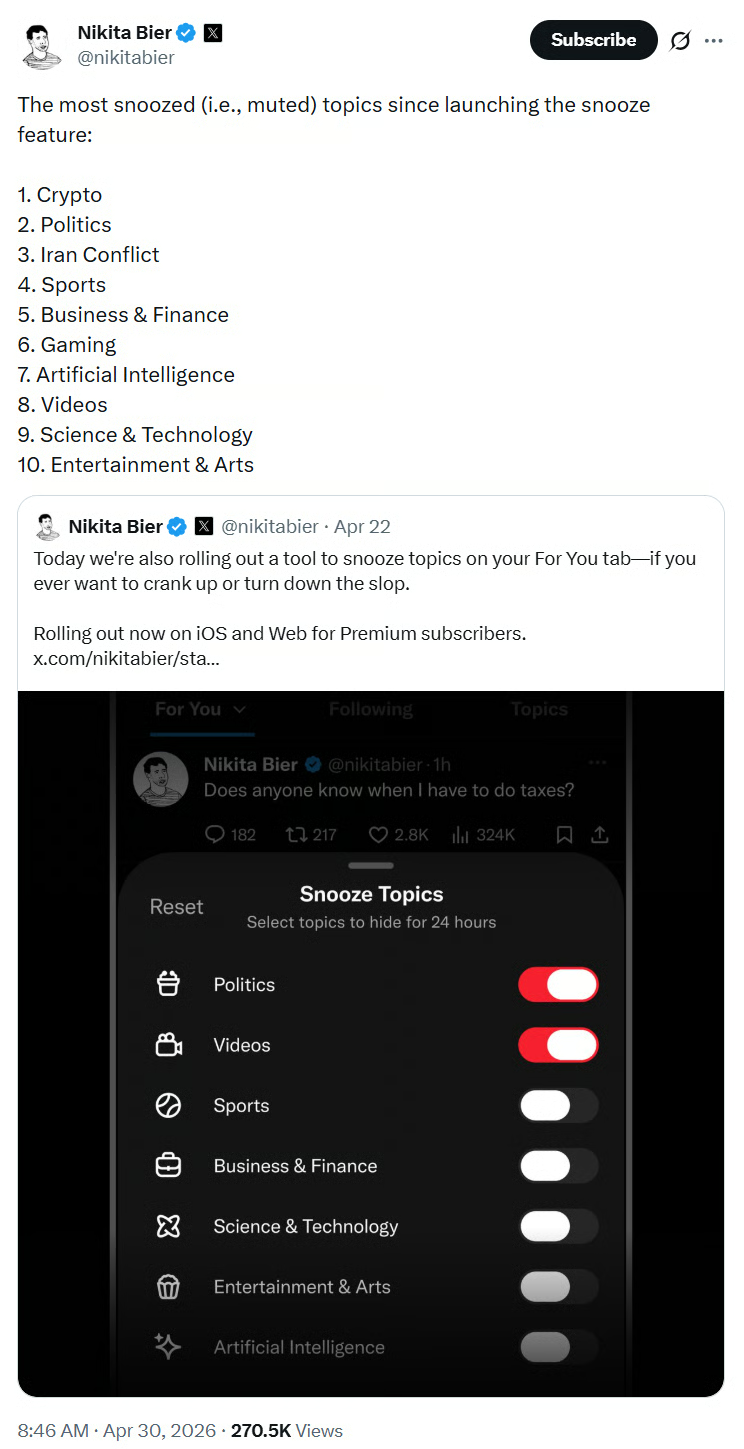
Crypto has topped the list of most-muted topics on X since the platform rolled out its snooze feature, with spam and artificial intelligence content, or “AI slop,” likely playing a major role.
On Thursday, Nikita Bier, X’s head of product, revealed that crypto has become the most-muted topic ahead of politics, the Iran conflict, sports and business and finance, a notable shift in a platform that was once the heartbeat of Crypto Twitter.
The snooze feature, which lets Premium subscribers hide topics from their For You feed for 24 hours, was launched on April 22. At the time, Bier described the tool as a way for users to “crank up or turn down the slop,” apparently a nod to the flood of low-quality content that has increasingly plagued the platform.
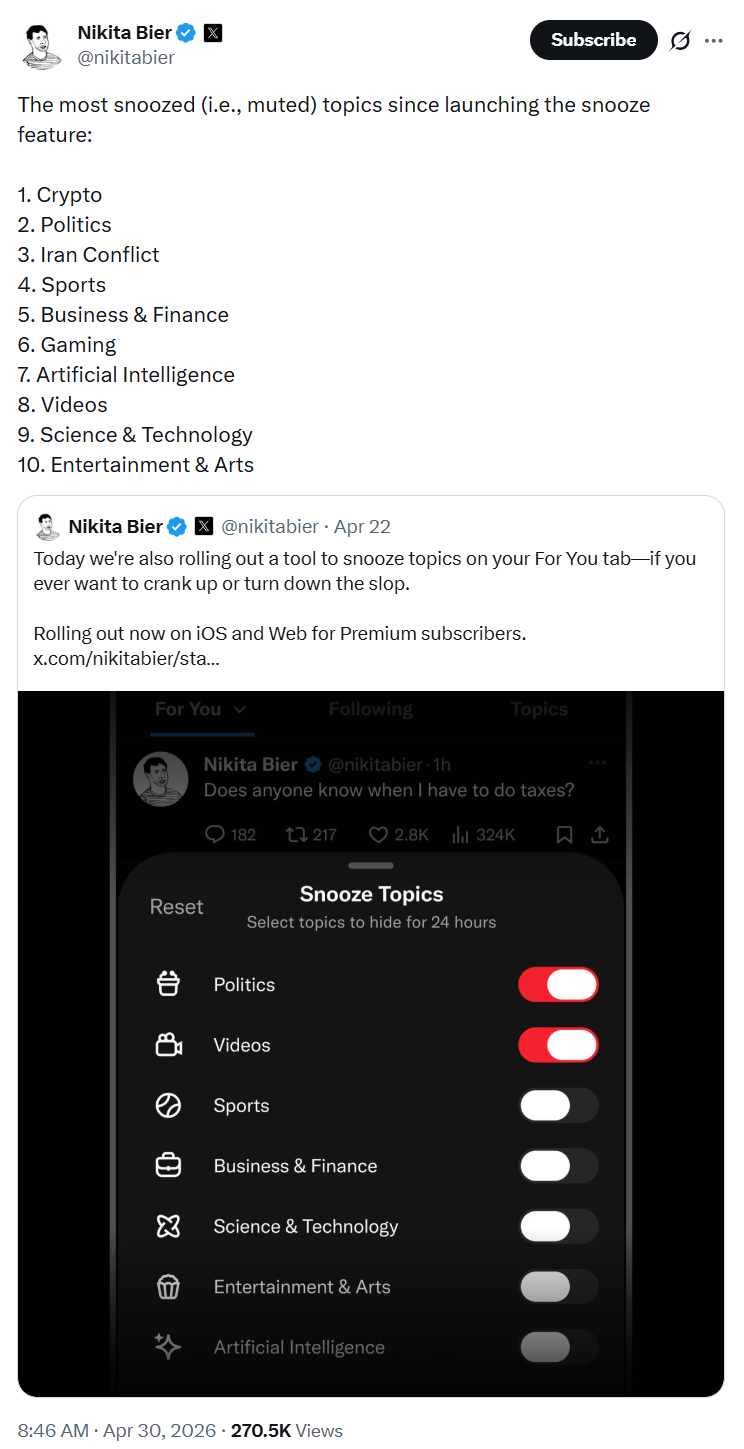
Source: Nikita Beir
Crypto content on X has come under growing scrutiny, with the platform changing its API policies in January to cut off apps that paid users to post. The move was aimed at curbing the wave of AI-generated spam and low-quality content flooding crypto feeds through so-called “InfoFi” apps that rewarded engagement.
Related: Senator Elizabeth Warren questions Elon Musk about X Money
Beir’s run-in with Crypto Twitter
Earlier this year, Bier said in a now-deleted post that Crypto Twitter’s visibility problems were largely self-inflicted, arguing that many accounts burn through their daily reach by overposting or flooding replies with low-value messages like repeated “gm” greetings, leaving little room for substantive content to land.
The remark drew a sharp response from the crypto community. CryptoQuant founder Ki Young Ju pushed back, arguing that the real problem is a flood of AI-generated spam that X’s algorithm cannot distinguish from legitimate accounts. “It is absurd that X would rather ban crypto than improve its bot detection,” Ju wrote.
Bier joined X as head of product in June 2025, shortly after taking an advisory role at the Solana Foundation in March, where he focused on helping consumer-facing apps built on the network scale and reach mainstream mobile audiences.
X also launched Smart Cashtags on April 15, allowing iPhone users in the US and Canada to view real-time price charts for stocks and crypto, including Bitcoin, Ether, XRP, and stocks like Coinbase and MicroStrategy, without leaving the app. The rollout came days after Bier teased that X would “launch something to fix” crypto’s rough year.
Related: X mulls new rules for first-time crypto posts amid tortoise scam
Crypto sentiment and search interest remain low
Crypto market sentiment remains subdued, with the Fear & Greed Index sitting at 29, or in “Fear” territory. While it is a notable recovery from last month’s Extreme Fear reading of 11, it still signals a state of investor anxiety.
Google Trends data tells a similar story. Worldwide search interest in crypto has trended sharply lower since peaking in early 2026, with interest in terms like “crypto,” “cryptocurrency” and “Bitcoin” declining heading into April.
Magazine: AI-driven hacks could kill DeFi — unless projects act now

Introduction
Decentralized Finance (DeFi) has evolved into a complex ecosystem of protocols, strategies, and financial primitives. As opportunities for yield generation expanded, so did the difficulty of navigating them efficiently. DeFi aggregators emerged as a solution—tools designed to simplify access to fragmented liquidity and automate sophisticated strategies.
While they offer convenience and optimization, aggregators also introduce layers of abstraction that can obscure underlying risks. Understanding how they function is essential for anyone allocating capital within DeFi.
What Aggregators Actually Do
At their core, DeFi aggregators act as intermediaries between users and multiple decentralized protocols. Instead of manually interacting with different platforms, users deposit assets into a single interface, and the aggregator routes those funds to strategies designed to maximize returns.
Aggregators typically perform the following functions:
- Capital Allocation: Distribute funds across lending platforms, liquidity pools, or yield farms to capture the best available returns.
- Route Optimization: Identify the most efficient paths for swaps or yield strategies, reducing slippage and improving execution.
- Strategy Automation: Continuously adjust positions based on changing market conditions, interest rates, and incentives.
- Gas Efficiency: Batch transactions or optimize execution timing to reduce costs for users.
In essence, aggregators compress multiple layers of DeFi interaction into a single user action.
Auto-Compounding Strategies
One of the most powerful features of DeFi aggregators is auto-compounding. In traditional yield farming, users must manually claim rewards and reinvest them—a process that is both time-consuming and costly due to transaction fees.
Aggregators automate this cycle:
- Harvest Rewards: Collect yield generated from underlying protocols.
- Convert Assets: Swap rewards into the base asset or optimal allocation tokens.
- Reinvest Capital: Deposit the converted assets back into the strategy.
This process occurs repeatedly, increasing the effective annual yield through compounding.
Auto-compounding provides two key advantages:
- Efficiency: Eliminates the need for constant user intervention.
- Performance: Maximizes returns by reinvesting rewards at optimal intervals.
However, this automation also means users relinquish direct control over execution timing and strategy adjustments.
Risks of Delegating Strategy Decisions
Convenience in DeFi often comes at the cost of transparency. By using aggregators, users delegate decision-making to smart contracts and predefined strategies. This introduces several risks:
1. Smart Contract Risk
Aggregators rely on complex code interacting with multiple protocols. A vulnerability in any layer—aggregator or underlying protocol—can result in loss of funds.
2. Strategy Risk
Automated strategies are designed based on assumptions about market behavior. Sudden changes in liquidity, incentives, or volatility can render these strategies ineffective or even harmful.
3. Composability Risk
DeFi’s “money lego” structure means aggregators stack multiple protocols together. Failure in one component can cascade through the system.
4. Reduced Transparency
Users may not fully understand where their funds are deployed or how strategies operate, especially when interfaces abstract away complexity.
5. Governance and Upgrade Risk
Many aggregators are governed by decentralized organizations. Changes to strategies or contract logic can occur through governance decisions that users may not actively monitor.
Delegating strategy decisions is essentially outsourcing portfolio management to code, and code does not negotiate with market chaos.
Example: Yearn Finance
One of the most prominent examples of a DeFi aggregator is Yearn Finance. It introduced the concept of “vaults,” where users deposit assets that are automatically deployed into optimized yield strategies.
Key characteristics of Yearn Finance include:
- Vault Strategies: Professionally designed and community-reviewed strategies that allocate capital across lending platforms, liquidity pools, and other yield sources.
- Active Management: Strategies are updated and rebalanced to adapt to market conditions.
- Auto-Compounding: Rewards are continuously harvested and reinvested to maximize returns.
- Risk Diversification: Funds may be spread across multiple protocols to reduce exposure to a single point of failure.
Yearn Finance demonstrates both the strengths and trade-offs of aggregators: it simplifies access to advanced strategies but requires trust in the protocol’s design, governance, and execution.
Conclusion
DeFi aggregators represent a critical layer in the evolution of decentralized finance. They transform a fragmented and technically demanding ecosystem into a more accessible and efficient environment for users.
However, this convenience masks significant complexity. Automated strategies, composability, and delegated decision-making introduce risks that are not always visible at the interface level.
The central paradox remains: aggregators make DeFi easier to use, but harder to fully understand. For participants, the challenge is not just finding yield—but understanding the machinery generating it.
REQUEST AN ARTICLE
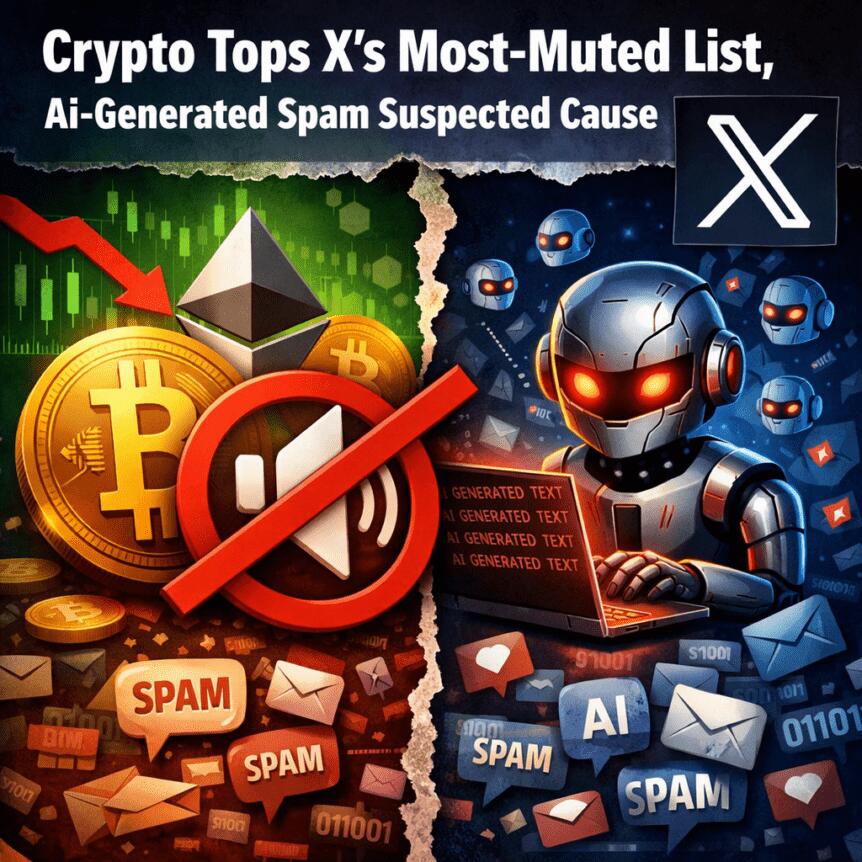
Crypto has risen to the top of X’s muted-topic list since the platform rolled out its snooze feature, signaling that moderation tools are reshaping how crypto discourse unfolds on the social network. The move comes amid renewed scrutiny of crypto content and the broader challenge of distinguishing legitimate discussion from AI-generated spam.
According to X’s head of product, Nikita Bier, crypto has become the most-muted topic, surpassing politics, the Iran conflict, sports, and business and finance. The snooze tool, launched on April 22 for Premium subscribers, lets users hide topics from their For You feed for 24 hours, a function Bier described as a way to “crank up or turn down the slop.”
That shift comes against a backdrop of heightened efforts to curb low-quality crypto content and bot-driven noise on the platform. In January, X adjusted its API policies to cut off apps that paid users to post, a move aimed at curbing AI-generated spam flooding crypto feeds through so-called “InfoFi” apps that monetize engagement. Separately, X has sought to keep crypto discourse more anchored by introducing features like Smart Cashtags, which began rolling out on April 15 and provide real-time price charts for major crypto assets and select stocks within the app for U.S. and Canadian users.
These changes sit at the intersection of product design, content integrity, and market sentiment — a dynamic that continues to define Crypto Twitter’s relevance as a live information channel for investors, traders, and builders.
Key takeaways
- Crypto became the most-muted topic on X after the snooze feature’s launch on April 22, ahead of politics and other high-profile subjects.
- The snooze tool allows Premium users to hide topics for 24 hours, reflecting an effort to dampen “slop” in the feed and improve signal quality.
- X’s policy shift in January to curb paid-post apps targets AI-generated spam and low-quality crypto content tied to InfoFi apps, shaping how crypto feeds are populated.
- Crypto-sentiment indicators remain subdued, with the Fear & Greed Index at 29 and global interest in crypto trending lower from early-2026 peaks, according to Google Trends data.
- Strategic product moves, including Smart Cashtags, accompany leadership actions at X, such as Nikita Bier’s appointment as head of product in mid-2025 and his prior Solana Foundation advisory role.
Crypto discourse under the spotlight: moderation, spam, and community response
Beir’s contemporaries on Crypto Twitter have taken note of the shifting landscape. Earlier this year, Beir suggested that Crypto Twitter’s visibility issues were largely self-inflicted, arguing that overposting and a flood of low-value replies can crowd out substantive content. The crypto community pushed back, with Ki Young Ju, founder of CryptoQuant, contending that the real problem is a flood of AI-generated spam that the platform’s algorithms struggle to distinguish from legitimate accounts — a critique that underscores tensions between moderation and open discussion on a platform central to market narratives.
Beir joined X as head of product in June 2025, after an advisory stint at the Solana Foundation in March, where he focused on helping consumer-facing apps on the Solana network scale and reach mainstream mobile audiences. His leadership role has coincided with X’s broader push to reinvent crypto presentation within the app, including the cashtag feature that integrates live price information into users’ feeds without forcing them off the platform.
From casual chats to streams of data: the market context
Market sentiment around crypto remains cautious. The Fear & Greed Index sits in the “Fear” zone at 29, a modest improvement from last month’s Extreme Fear reading but a reminder that risk appetite for digital assets has yet to regain momentum. On the search front, Google Trends data shows worldwide interest in crypto, cryptocurrency, and Bitcoin trending lower since a peak in early 2026, suggesting that broad consumer curiosity has cooled even as institutional and sector-specific developments march forward.
Against that backdrop, X’s attempts to refine crypto discourse — through snooze, policy adjustments, and new features like Smart Cashtags — gain added significance. The goal appears to be twofold: reduce clutter and bot-driven content while preserving a channel for authentic, timely crypto updates. Whether these changes improve signal-to-noise for investors and developers remains a key question for the weeks ahead.
Smart Cashtags, which rolled out to iPhone users in the U.S. and Canada, enable real-time price charts for major assets and prominent stocks directly within the app. The feature arrived shortly after Bier hinted that X would “launch something to fix” crypto’s rough year, signaling a push to re-center crypto within X’s broader content ecosystem.
As the platform courts a more disciplined crypto narrative, observers will watch not only how muting affects the visibility of crypto projects and narratives but also how advertisers, creators, and researchers adapt to a feed that prioritizes signal over noise. The tension between moderation and open discussion remains at the heart of whether X can sustain Crypto Twitter as a viable, real-time information hub.
Looking ahead, readers should watch for how these tools evolve — whether the snooze feature becomes a standard tool for users seeking to tailor their exposure, and whether improved bot detection and refined content policies restore trust in crypto discussions without sacrificing breadth and vitality on the platform. The next phase may reveal whether X can strike a balance between curbing spam and preserving a lively, informative community for crypto users and builders alike.


Prosecutors in South Korea have requested a 20-year prison sentence for Jeong Sang-ho, CEO of Delio, over alleged large-scale crypto embezzlement.
Summary
- South Korean prosecutors have sought a 20-year prison term for Delio CEO Jeong Sang-ho over alleged embezzlement of about 250 billion won from nearly 2800 users.
- Authorities told the Seoul Southern District Court that Delio halted withdrawals in June 2023 after offering up to 10.7% APR, with prosecutors accusing Jeong of deceptive promotion and misconduct.
- Victims have called for strict punishment while the defense has said it will compensate users if acquitted, with the court set to deliver its ruling on July 16.
According to Yonhap News Agency, the request was made during closing arguments at the Seoul Southern District Court on Thursday, where Jeong was charged under the Act on Aggravated Punishment of Specific Economic Crimes.
Yonhap reported that prosecutors accused Jeong of misappropriating about 250 billion won, around $168.8 million, in crypto assets from roughly 2,800 users between August 2021 and June 2023.
Authorities told the court that Delio halted withdrawals in June 2023, at the time citing market volatility and stating it would do its “best to protect the assets of our customers while quickly grasping the facts and aftermath related to this situation.”
The case traces back to Delio’s operations as a crypto deposit and lending platform that offered returns of up to 10.7% APR on assets such as bitcoin, ether, and USDT, according to the company’s earlier disclosures.
Yonhap noted that prosecutors linked the withdrawal freeze to deceptive conduct and false promotion, arguing that Jeong’s actions worsened customer losses while he avoided responsibility during the investigation.
Authorities also tied the incident to a wider disruption involving Haru Invest and B&S Holdings, where a figure surnamed Bang held a majority stake. According to the report, Jeong was indicted in April 2025, nearly a year after South Korean authorities sought an arrest warrant for Bang, who was identified as a key figure behind the suspension of withdrawals across related platforms.
Haru Invest previously stated that it had incurred losses of 350 billion won, around $236 million, due to exposure to the FTX collapse, which contributed to a chain reaction affecting services tied to Delio. Prosecutors told the court that Jeong’s conduct during this period intensified financial damage for users.
Victims affected by the freeze have urged the court to impose a severe sentence, while the defense has said it is willing to address customer losses if Jeong is acquitted. The court is scheduled to deliver its first-instance ruling on July 16.


Crypto has become the most-muted topic on X since the platform launched its snooze feature.
Summary
- Crypto ranked as the most-muted topic on X, ahead of politics, sports, and business.
- X’s snooze feature lets Premium users hide unwanted topics from For You feeds for 24 hours.
- AI-generated spam and InfoFi posting likely drove more users to mute crypto content.
The shift comes as users complain about AI-generated spam and low-quality engagement farming across Crypto Twitter.
X head of product Nikita Bier said crypto is now the most-muted topic on the platform. It ranked ahead of politics, the Iran conflict, sports, business, and finance.
The ranking follows the launch of X’s snooze feature on April 22. The tool lets Premium users hide topics from their For You feed for 24 hours.
AI slop weighs on Crypto Twitter
Bier previously described the feature as a way to “crank up or turn down the slop.” The comment pointed to growing concern over low-quality posts on the platform.
Crypto feeds have faced rising spam from AI-generated posts and InfoFi apps. These apps rewarded users for engagement, which pushed many accounts to post more often.
Additionally, X changed its API policies in January to block apps that paid users to post. The move aimed to reduce low-quality content and automated crypto engagement farming.
Bier also said some Crypto Twitter accounts hurt their own reach by overposting. He pointed to repeated low-value replies, including messages such as “gm.”
CryptoQuant founder Ki Young Ju rejected that view. He said the real issue was AI spam and wrote, “It is absurd that X would rather ban crypto than improve its bot detection.”
Crypto interest remains weak
The mute data comes as crypto market sentiment remains cautious. The Fear & Greed Index stood at 29, placing the market in “Fear” territory.
Google Trends data also shows weaker global search interest in crypto terms. Searches for “crypto,” “cryptocurrency,” and “Bitcoin” have declined since early 2026.
X has still added crypto-related tools this month. On April 15, it launched Smart Cashtags for iPhone users in the U.S. and Canada, allowing real-time charts for Bitcoin, Ether, XRP, Coinbase, and MicroStrategy inside the app.
Crypto World
Shinhan Card Partners with Solana Foundation to Pioneer Stablecoin Payments in South Korea

TLDR:
- Shinhan Card is running a proof-of-concept on Solana’s testnet to test real-world stablecoin payment systems.
- Non-custodial wallet security and stability are central to Shinhan Card’s blockchain deployment strategy this year.
- Oracle technology will connect real-world transaction data to Solana’s blockchain for smart contract deployment.
- South Korea’s pending Digital Asset Basic Act is driving financial institutions toward early blockchain partnerships.
Shinhan Card stablecoin payments are moving closer to reality following a major partnership announcement. South Korea’s Shinhan Card, one of the country’s largest credit card companies, has signed a formal agreement with the Solana Foundation.
The collaboration focuses on building a stablecoin-based payment system on the Solana blockchain. As part of the deal, Shinhan Card will run an advanced proof-of-concept on Solana’s testnet this year, targeting real-world consumer-to-merchant payment scenarios.
Testing Real-World Payment Scenarios on Solana
The proof-of-concept centers on testing payment interactions between customers and merchants on Solana’s testnet. Shinhan Card will evaluate the practical viability of blockchain technology across these everyday financial transactions.
A key part of the initiative involves validating the security and stability of non-custodial wallets. This step is essential before the company can deploy the technology at a larger scale.
Kim Young-il, executive vice president of Shinhan Card, outlined the company’s direction clearly. “Building on Solana, we plan to closely examine the practical applicability of blockchain technology and proactively explore next-generation financial models,” he said.
The statement positions Shinhan Card as a forward-looking institution ready to embrace decentralized infrastructure. It also signals a deliberate move beyond traditional card payment systems into blockchain-powered finance.
The collaboration further explores hybrid finance models combining traditional finance with decentralized finance efficiency.
These models aim to retain the reliability of conventional systems while introducing DeFi-based improvements. To support this vision, Shinhan Card intends to build its own DeFi service environments on Solana. Oracle technology will play a central role in this infrastructure development.
The press release explained that Shinhan Card will utilize “oracle technology — secure data bridges that connect real-world transaction information with blockchain networks.”
This setup will then “enable the deployment of smart contracts while ensuring operational stability through robust monitoring and governance frameworks,” the release added.
Together, these systems form a structured and scalable payment architecture. The testnet phase allows Shinhan Card to stress-test every component before a live rollout.
Regulatory Landscape Shapes Financial Innovation in South Korea
South Korea is currently developing the Digital Asset Basic Act to govern the digital asset sector comprehensively. The legislation is widely expected to be finalized within 2026.
Shinhan Card plans to evaluate its blockchain initiative results in line with this evolving regulatory environment. The broader Asia-Pacific regulatory landscape is also being closely monitored as part of this strategy.
The anticipated legislation has already prompted many South Korean financial institutions to explore blockchain partnerships. KBank, the partner bank of crypto exchange Upbit, recently announced a collaboration with Ripple.
That partnership focuses on testing cross-border remittances using blockchain infrastructure. These developments show that South Korean banks are actively preparing for a more regulated digital asset environment.
Shinhan Card’s Solana partnership adds to this growing trend among local financial firms. The company is positioning itself ahead of formal regulatory frameworks by running structured pilots now.
This proactive approach allows Shinhan Card to refine its technology before compliance requirements take full effect. It also places the firm among the early movers in South Korea’s evolving fintech landscape.
As the Digital Asset Basic Act takes shape, Shinhan Card’s testnet results could directly inform its compliance strategy.
The proof-of-concept covers security, stability, and real-world usability — all areas regulators are likely to assess carefully.
By running this pilot in 2026, Shinhan Card is building a data-driven foundation for future deployment decisions. The partnership with Solana Foundation provides the technical backbone for this entire effort.

The US dollar continues to trend upwards following the Federal Reserve meeting, drawing support from the regulator’s moderately hawkish stance and comments by Jerome Powell. Markets interpret the Fed’s rhetoric as a signal that restrictive policy is likely to remain in place for longer, supporting higher yields and sustaining demand for dollar liquidity.
Another factor is the anticipation of upcoming US macroeconomic releases, which could act as a trigger to confirm the current trend. Market participants remain cautious, assessing the outlook for inflation and overall economic conditions. This is keeping the dollar close to recent highs and creating conditions for further directional movement.
USD/JPY
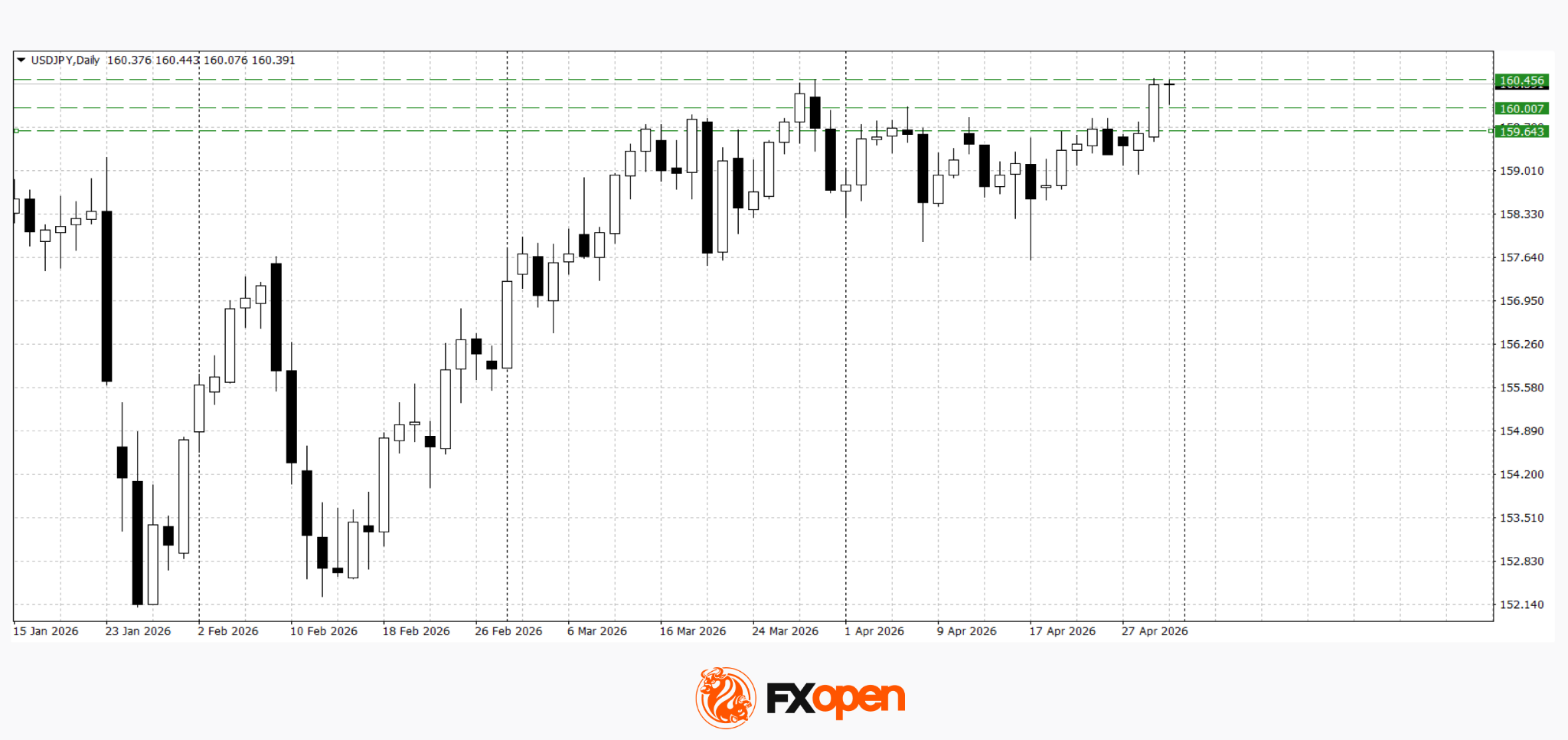
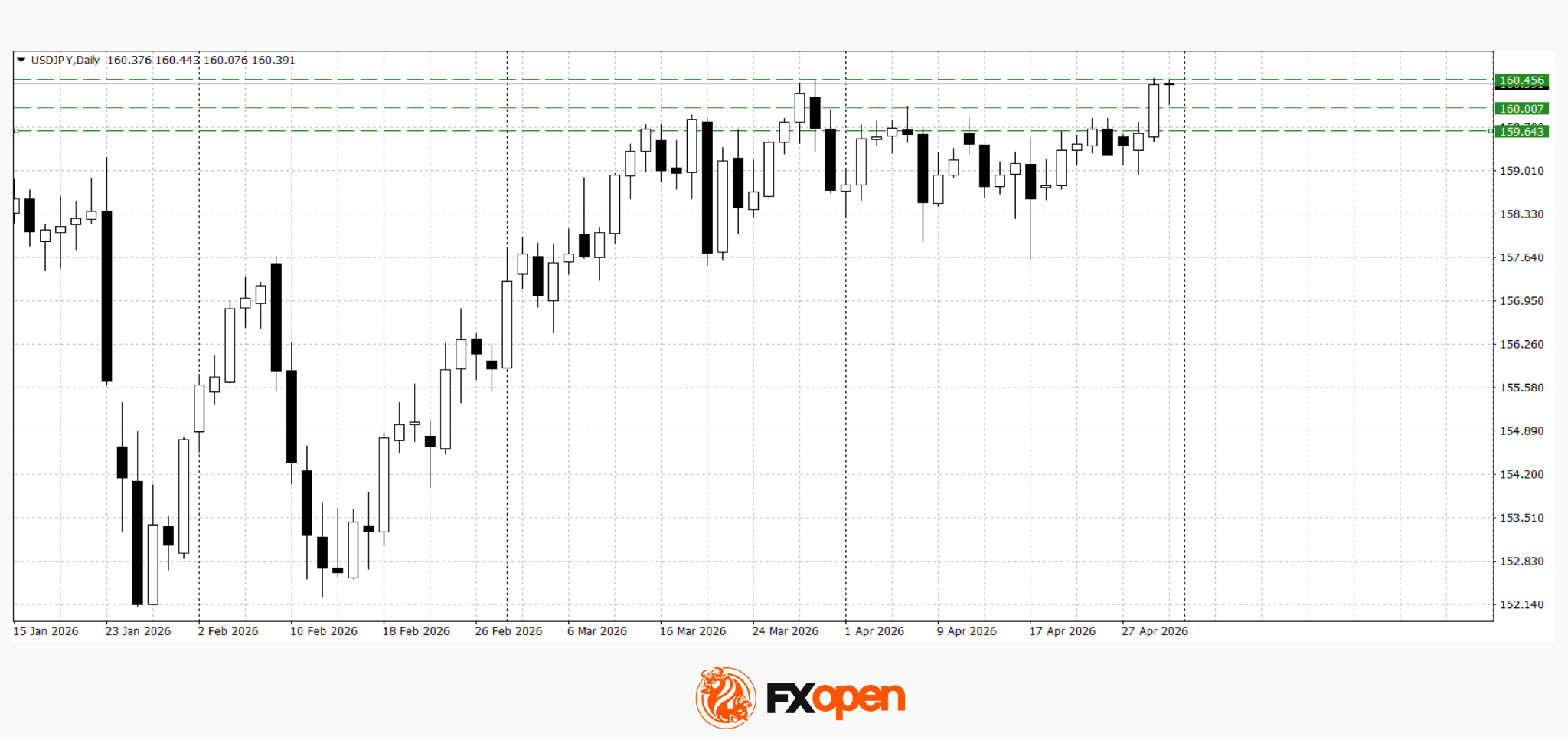
The USD/JPY pair has tested its high for the current year, underlining the continued strength of the dollar in the present market phase. The move is supported by monetary policy divergence, with the Federal Reserve maintaining a tighter stance while the Bank of Japan continues to adhere to a more accommodative approach.
In the short term, two scenarios are possible. If positive expectations for the US economy persist and there are no signs of policy easing from the Fed, the pair may extend its advance towards the 2024 highs near 162.00. On the other hand, profit-taking and caution ahead of key data releases could trigger a local correction, pulling the pair back towards the 159.60–160.00 range.
Key events for USD/JPY:
- today at 15:30 (GMT+3): US GDP;
- today at 15:30 (GMT+3): US core personal consumption expenditures (PCE) price index;
- tomorrow at 02:30 (GMT+3): Tokyo core consumer price index (CPI), Japan.
USD/CHF
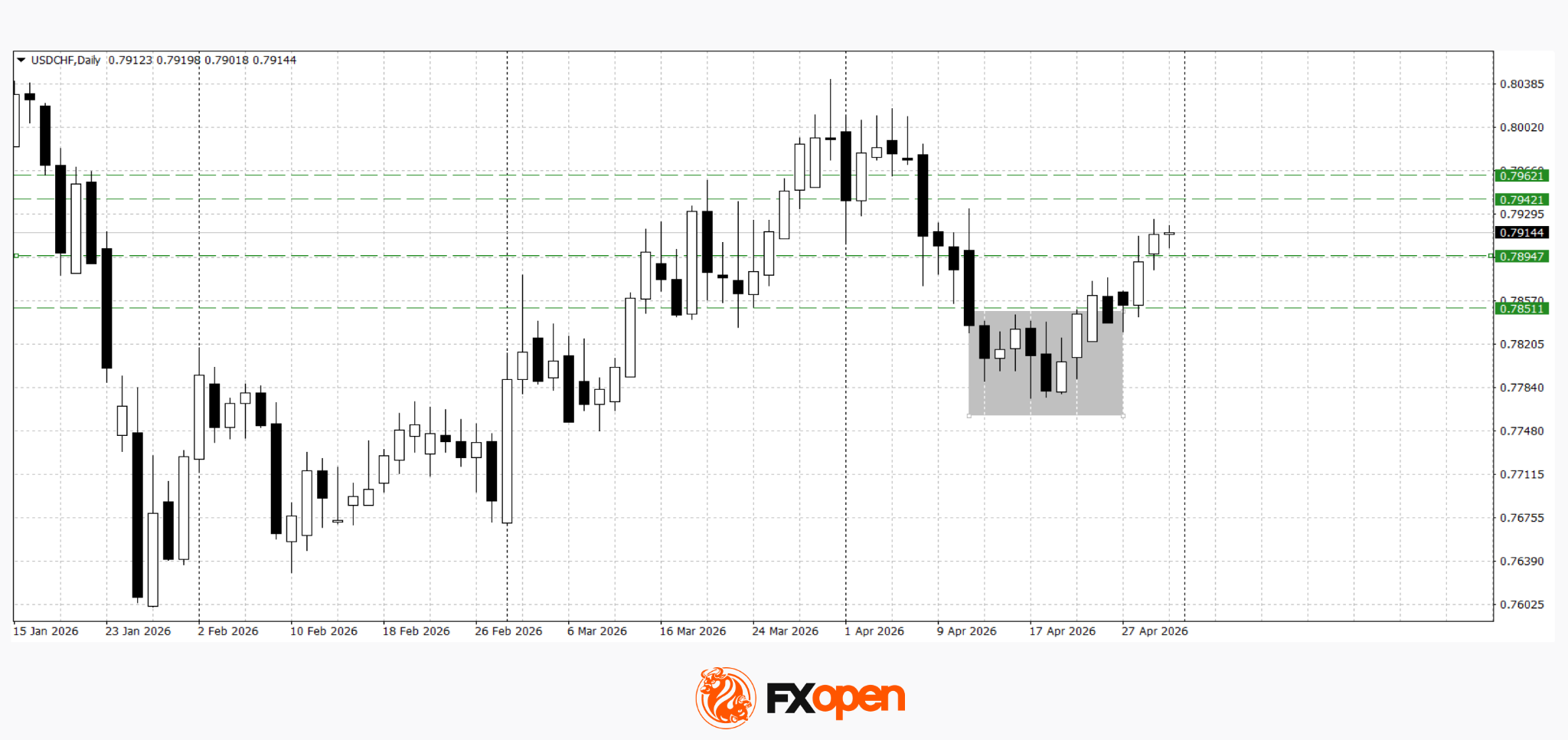
The USD/CHF pair is shifting into a corrective rebound after its previous decline, supported by the strengthening dollar. Technical analysis suggests potential growth towards 0.7940–0.7960, as a V-shaped reversal pattern has formed on the daily timeframe. However, if the pair settles below 0.7900, the downward movement may resume.
Key events for USD/CHF:
- today at 10:00 (GMT+3): Switzerland’s KOF leading economic indicator;
- today at 17:00 (GMT+3): Atlanta Fed GDPNow estimate;
- today at 23:30 (GMT+3): US Federal Reserve balance sheet.
Overall, the dollar remains in an upward phase, though its дальнейшая trajectory will depend on a combination of Fed signals and incoming data. The market is considering both the continuation of US dollar strength and the possibility of a short-term correction from current levels. The reaction to macroeconomic data will be decisive in confirming either scenario.
Trade over 50 forex markets 24 hours a day with FXOpen. Take advantage of low commissions, deep liquidity, and spreads from 0.0 pips (additional fees may apply). Open your FXOpen account now or learn more about trading forex with FXOpen.
This article represents the opinion of the Companies operating under the FXOpen brand only. It is not to be construed as an offer, solicitation, or recommendation with respect to products and services provided by the Companies operating under the FXOpen brand, nor is it to be considered financial advice.


WHITE TECH, part of the W Group ecosystem and majority-owned by Volodymyr Nosov, Founder and CEO of WhiteBIT, has received authorization from the Croatian Financial Services Supervisory Agency (HANFA) to operate as a crypto-asset service provider (CASP) under the European Union’s Markets in Crypto-Assets (MiCA) regulation.
Within the W Group ecosystem, WHITE TECH serves as a core infrastructure component, focusing on crypto exchange services, enabling seamless conversion between crypto-assets and fiat, as well as the execution of crypto-asset transfers for businesses and users.
The authorization enables WHITE TECH to provide a range of regulated crypto services, including the exchange of crypto-assets for fiat currencies and other crypto-assets, transfer services, as well as custody and administration of crypto-assets. The company will operate under HANFA supervision, in line with MiCA’s requirements for governance, risk management, and user protection.
WHITE TECH is among the first companies in Croatia to receive authorization under MiCA, entering the EU’s unified regulatory framework at an early stage. MiCA establishes consistent rules across member states, aimed at increasing market transparency and strengthening trust in the crypto-asset sector.
The milestone reflects the company’s continued growth trajectory as part of the broader W Group ecosystem, reinforcing its commitment to regulated markets.
About W Group
W Group is a global fintech ecosystem that makes blockchain and crypto easy, secure, and accessible for everyone. It is built on the values of security, professionalism, and innovation, serving 35 million users across 150 countries worldwide. At the center of W Group is WhiteBIT, the largest European crypto exchange by traffic, offering over 900 trading pairs, 340+ assets, and supporting 8 fiat currencies. WhiteBIT collaborates with Visa, FACEIT, FC Barcelona, Juventus FC, and the Ukrainian national football team.
The post W Group Advances European Expansion as White Tech Obtains MiCA Authorization appeared first on BeInCrypto.

Sticker Mule demands Google fix ‘mislabeled’ ads tied to political campaign

Apple: Earnings Day Above the Activity Zone

Lord Tom Watson reviews Liam Byrne’s ‘Why Populists Are Winning’

Manchester United reach agreement with Casemiro over contract clause amid transfer speculation

US brings back mandatory military draft registration

Steven Gerrard disagrees with Gary Neville over ‘shock’ Chelsea and Arsenal claim | Football


-

 Tech3 days ago
Register Renaming | Hackaday
-

 Fashion6 days ago
Weekend Open Thread – Corporette.com
-
Crypto World5 days ago
Hyperliquid $HYPE Rally Builds Momentum as AI Sector Enters Prove-It Phase
-

 Business6 days ago
Patterson-UTI Energy, Inc. (PTEN) Q1 2026 Earnings Call Transcript
-
 Sports4 days ago
IPL 2026: Ruturaj Gaikwad registers slowest fifty of the season, enters all-time unwanted list | Cricket News
-

 Politics3 days ago
Drax board avoid their own AGM, accused of greenwashing & environmental racism
-

 NewsBeat4 days ago
LK Bennett closes all stores after entering administration
-

 Crypto World6 days ago
Michael Saylor says BTC winter is over. Market analyst disagrees, says bitcoin was in a pullback
-

 Fashion1 day ago
Kylie Jenner’s KHY Enters a New Era with ‘Born in LA’
-

 Tech3 days ago
Images of Samsung’s rumored smart glasses have leaked
-
 Entertainment5 days ago
Mariah Carey Slams Deposition Claims In Brother’s Lawsuit
-

 Business2 days ago
Most Commercial Energy Audits Miss the Real Losses
-
Crypto World7 days ago
Is Algorand One of the Few Quantum-Resistant Blockchains? Here’s What the Data Shows
-
 NewsBeat6 days ago
Trump threatens to review UK’s claim to Falkland Islands and punish Nato allies over Iran war disagreement
-

 Sports7 days ago
2026 NFL Draft tonight: Time, TV channel, where to watch, order
-

 Business6 days ago
Jeanine Pirro announces closure of Federal Reserve building cost probe
-

 Business3 days ago
(VIDEO) Charlize Theron Climbs Times Square Billboard to Promote New Netflix Thriller ‘Apex’
-
 Crypto World7 days ago
Kraken Builds Beyond Crypto With Futures, Tokenized Stocks, and Payments
-

 Tech4 days ago
Microsoft to roll out Entra passkeys on Windows in late April
-

 Tech3 days ago
Why Blue Badges Disappeared From Toyota Hybrids
You must be logged in to post a comment Login