
Crypto World
Bitcoin Miners Own Something AI Developers Can't Build Fast Enough

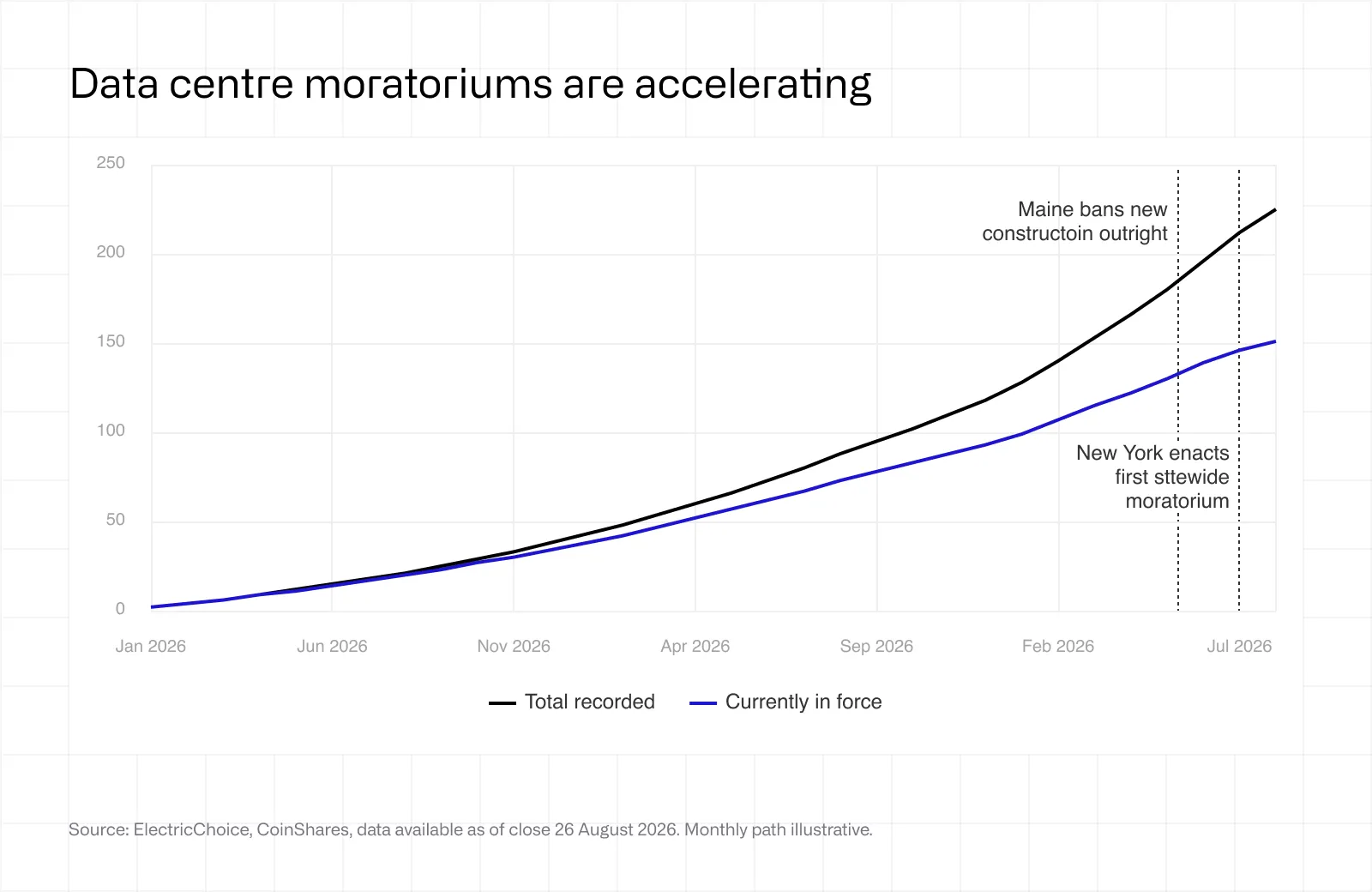
Bitcoin (BTC) mining sites have become some of the scarcest permitted power capacity in the United States. With 151 data center restrictions still active, AI developers face years of waiting to plug in anywhere new.
CoinShares cited at least 225 data center moratoriums or restrictions in its second-quarter mining report. The clampdown turns already energized capacity into a scarce asset.
States Are Closing the Door on New Power
The restrictions span 30 states, according to ElectricChoice tracking cited in the CoinShares report. Maine banned new data center construction outright in April.

CoinShares calls New York the most significant development. It paused environmental permits for facilities of 50 megawatts (MW) or more on July 14. Governor Kathy Hochul’s first statewide permit freeze runs for a year.
Restrictions have also spread at the county level across Ohio, Michigan, Georgia, and Indiana. More than a third of counties there have moved to limit development, according to the report.
Pennsylvania tightened review rules for large projects, while Texas halted new grid connections pending an audit.
New York exempted permits it had already deemed complete, and similar carve-outs are common. A finished approval is now worth something that a newcomer has no way to obtain.
Follow us on X to get the latest news as it happens
What Bitcoin Miners Own That Nobody Else Can Get
The queue behind those rules is the harder problem. The US interconnection queue holds roughly 2,600GW, about double the country’s installed capacity.
Median waits from request to operation exceeded five years for projects completed in 2025, according to research from Lawrence Berkeley National Laboratory.
Texas shows the squeeze clearly. ERCOT’s own large-load queue data put data centers at 87% of 410 GW. In PJM, projects entering service in 2025 averaged more than seven years from request to operation.
“The practical consequence is that an energised site cannot be recreated within any commercially relevant timeframe, regardless of capital available,” CoinShares added.
Existing space has tightened alongside it. CBRE recorded primary market vacancy at a record 1.4% at the end of 2025, despite supply growing by 36%, with vacancy falling to 0.3% in Northern Virginia by the first quarter of 2026.
Against that backdrop, a $3.5 billion purchase of three leased Northern Virginia AI facilities set a benchmark near $27 million per MW. Listed miners with energized but unleased capacity, in contrast, trade below $3 million per MW in some cases.
The two numbers are not directly comparable. One reflects facilities with leases in place, while the other reflects how the market values capacity that has none.
Conversion is not free. Retrofitting mining infrastructure to AI-grade costs an estimated $8 million to $15 million per MW, compared with $700,000 to $1 million to build it for mining.
“The direction of travel is clear: regulation and grid congestion have inverted the historic discount applied to mining sites, converting what was once viewed as stranded, low grade infrastructure into some of the scarcest permitted power capacity in the US,” the report mentioned.
Meanwhile, Washington has pushed back on the restrictions. President Donald Trump warned that towns that reject the facilities will end up backwards and poor, while Republicans fear a midterm backlash over the buildout.
Operators who can fund conversion and lock in tenants, therefore, stand to capture most of that premium. Grid access is the entry requirement, not the whole business.
Subscribe to our YouTube channel to watch leaders and journalists provide expert insights
The post Bitcoin Miners Own Something AI Developers Can't Build Fast Enough appeared first on BeInCrypto.

Digital asset financial services firm Two Prime unveiled a bitcoin lending vault on Pareto, targeting annual yields of 1.5% to 2% by lending to institutional borrowers.
The Axiom WBTC Yield Vault accepts wrapped bitcoin (WBTC), a token representing bitcoin that can be used on other blockchain networks.
The vault requires a minimum deposit of $250,000 in WBTC and has an initial capacity of 1,350 BTC ($104 million). Returns are subject to market conditions and are not guaranteed.
Two Prime is expanding its lending business into onchain finance, connecting bitcoin holders seeking income with institutions seeking access to bitcoin funding.
The firm, which provides institutional investment strategies and bitcoin-backed lending, has committed roughly $10 million of its own capital to absorb initial losses. The strategy targets borrowers including public companies, credit-rated entities and diversified financial institutions.
Pareto supplies the blockchain-based private credit infrastructure underpinning the vault. ICE Digital Trust and Copper Technologies will hold its assets in custody.
Read More: Ditching bonds for bitcoin: How crypto can tackle the AI-heavy portfolio dilemma
Bitcoin sits at $75,500, down by an ugly 2% since yesterday. It’s far from calm, but the bigger number that matters happened in less than 12 hours, and it could change how we see our Bitcoin price prediction. There’s more beneath the surface here than a routine pullback.
Crypto market took a fresh beating after the US Senate failed to advance the Clarity Act, the market structure bill traders had leaned on to justify a break from an 11-month malaise. Bitcoin fell 4% in US trading before stabilizing near $75,500 in London hours.
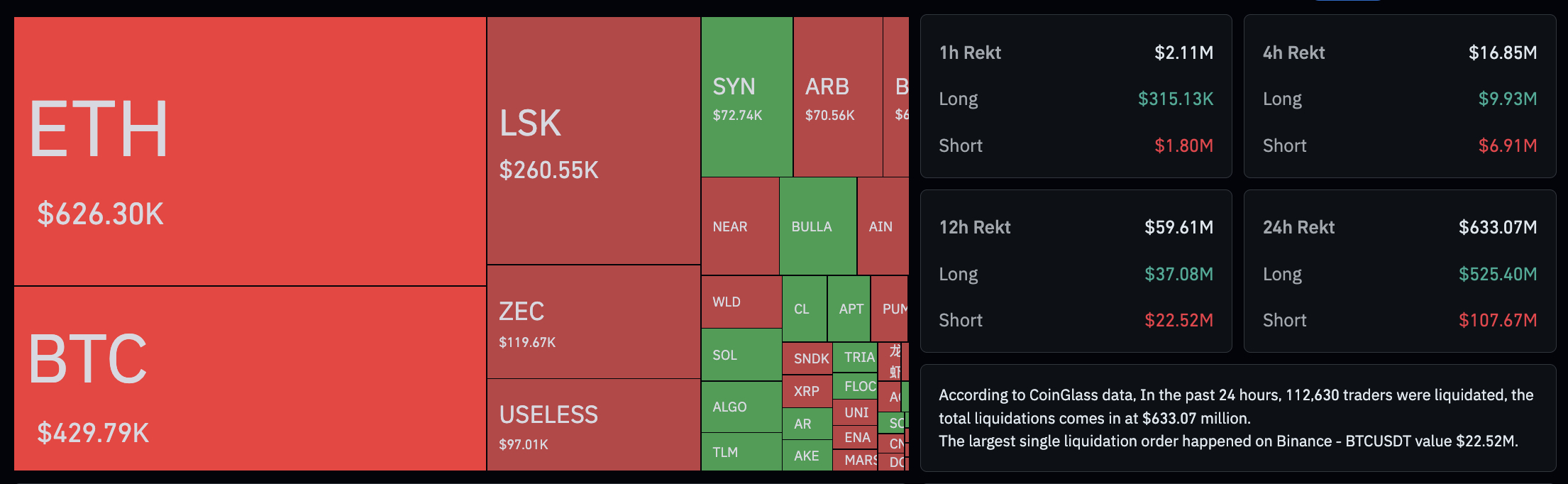
More than $525 million in bullish leveraged bets got liquidated in the last 24 hours, a forced unwind that tends to leave scar tissue on short-term sentiment. “Until investors gain more certainty on the path of rates globally, risk assets would remain under pressure,” said Pratik Kala, portfolio manager at Apollo Crypto.
The failed vote lands days before the Fed’s September 16 decision, where inflation prints and surging bond yields have traders bracing for Chairman Kevin Warsh to hike. That combination of a regulatory setback plus rate uncertainty is the real story behind the tape, and it raises the question every desk is now asking: how much of a hike is actually priced in?
Earn $50 and Enter $300K Prize Draw on EdgeX
Bitcoin Price Prediction: Can BTC Hold $75K This Week?
BTC is trading in a tight band near $75,700–$76,100, translating to a 4% decline for September after starting the month near $78,500. Volume has thinned since the failed breakout above $82,000, and momentum indicators have gone flat. Consolidation is the dominant pattern.
Support clusters at $75,000–$75,400; a decisive close below that zone opens the door to $72,500 and, in a deeper flush, the $69,000–$66,000 region where longer-term moving averages sit. Resistance stacks up at $78,000–$80,000, with a Fibonacci ceiling near $82,793.

A bounce from the $75,000 support could put Bitcoin back on track to retest $82,000, particularly if rate-hike fears prove overdone. However, BTC could remain range-bound between $72,000 and $80,000 as markets digest the Fed decision and reassess the outlook.
The key level remains $75,400, with a break below it potentially opening the door to a move toward $72,500 and weakening the near-term structure. Recent price action and technical mapping both highlight this area as an important level for traders to watch.
Discover: The Best Token Presales
Bitcoin Hyper Targets Early Mover Upside as Bitcoin Tests Key Levels
A 2% single-session drop plus $525 million in liquidations confirms what the range-bound chart has hinted at for weeks: conviction is thin, and Bitcoin at its current market cap needs a genuinely new catalyst to move meaningfully, not just a relief bounce.
For traders looking for asymmetric upside while BTC chops sideways, attention is rotating toward earlier-stage infrastructure plays built on top of Bitcoin itself.
Bitcoin Hyper ($HYPER) is building the first Bitcoin Layer 2 with SVM integration, aiming to process transactions faster than Solana while inheriting Bitcoin’s base-layer security.
Bitcoin Hyper is refining the developer experience with clearer documentation, familiar tooling, predictable APIs, and better feedback for builders. — Bitcoin Hyper (@BTC_Hyper2) September 2, 2026
The goal: make the network easier to understand, connect existing tools, and start building with less friction. 

Read the… pic.twitter.com/kAo1w7Xa06
The presale has raised $33 million at a token price of $0.0136863, with a huge 35% staking rewards live at launch for early participants. Its Decentralized Canonical Bridge targets low-cost, low-latency BTC transfers, solving the slow, non-programmable Bitcoin problem that’s dogged the network for over a decade.
Research Bitcoin Hyper before the round closes.
Trade XRP on Bybit and Get a Chance to Win Our $1,000 USDT Airdrop
The post Bitcoin Price Prediction: Another Pressure Looms, But Is a Rate Hike Priced In? appeared first on Cryptonews.


Germany’s largest bank, Deutsche Bank, is awaiting regulatory approval to launch digital asset custody solutions for institutional clients and corporations in Europe.
Deutsche Bank plans to go live with the offering for its first clients this year, subject to completion of the applicable regulatory timeline, the bank announced on Wednesday.
The bank plans to offer initial support for Bitcoin (BTC), Ether (ETH) and select stablecoins, including Circle USDC (USDC), EURC (EURC) and AllUnity EUR (EURAU). It also plans to include support for tokenized financial instruments at a later point.
Deutsche Bank is one of the institutions listed by the Financial Stability Board as a Global Systemically Important Bank,
The development marks the German institution’s latest push into crypto, confirming earlier reports that it was developing crypto custody services. In June, Deutsche Bank’s head of digital assets, Sabih Behzad, revealed that the bank was considering entering the stablecoin market, including issuing its own token.
The bank expects to receive the license for the custody offering in October, under the EU’s Markets in Crypto Assets (MiCA) framework, Heinrich Frömsdorf, a spokesperson for Deutsche Bank, told Cointelegraph.
German banks ink partnerships to pursue crypto services
The push to pursue crypto services is expected to accelerate after MiCA reached full enforcement on July 1.
Deutsche Bank first revealed plans to launch crypto custody solutions in 2023, as part of a partnership with Taurus, soon after applying for a digital asset custody license in Germany.
Other German banks are also offering similar solutions. In April 2024, Germany’s largest federal bank, the Landesbank Baden-Württemberg, started offering crypto custody solutions after partnering with the Austria-based Bitpanda for its institutional custody platform.
In December 2025, DZ Bank said it received authorization from German regulator BaFin under MiCA to operate its meinKrypto platform.
Related: USDT payments feature in Polish energy giant’s failed $230M oil deal: FT
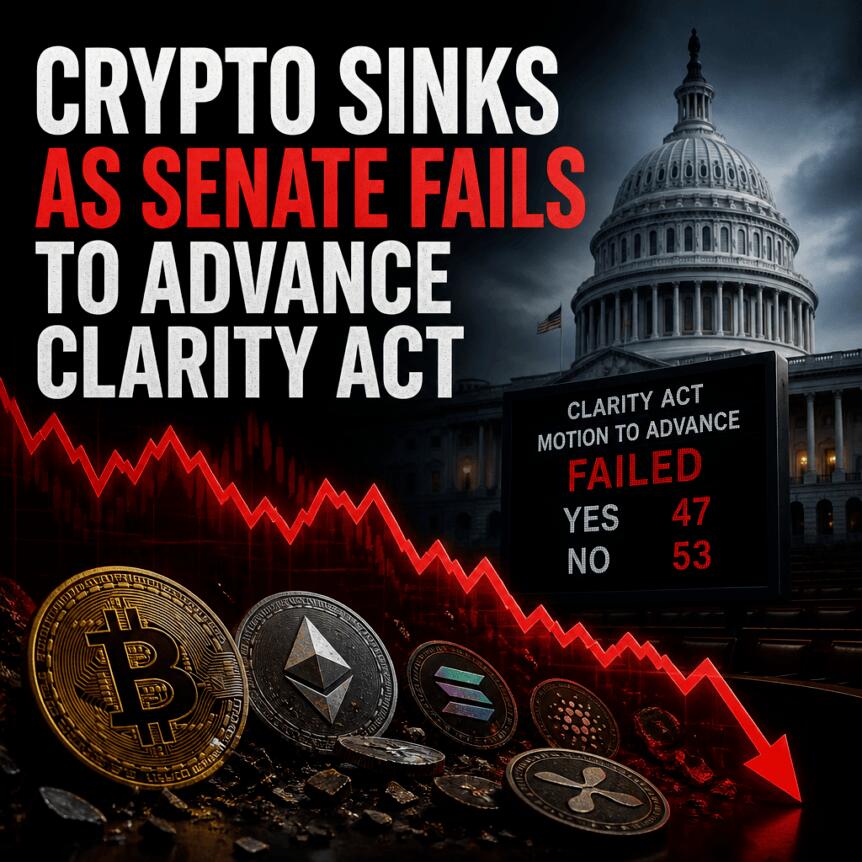
Bitcoin (BTC) and the broader crypto market fell sharply after the Senate failed to pass the CLARITY Act. Senators voted 49-50 on a key procedural vote, short of the 60 votes required for the legislation to pass.
The market reacted quickly, with BTC dropping over 3% to a low of $74,887 on Tuesday before ultimately closing at $75,584. Ethereum (ETH) recorded a bigger decline, falling nearly 5% to a low of $2,356 before closing at $2,396. Ripple (XRP) fell over 8% in 24 hours and currently trades around $1.30. Other tokens registered similar declines, with the overall crypto market cap down 2.31%.
Clarity Act Fails to Advance
The Senate’s failure to pass the crucial legislation to a cloture vote keeps the market structure bill in limbo. The CLARITY Act would have laid out a clear regulatory framework by dividing oversight between the Securities and Exchange Commission (SEC) and the Commodity Futures Trading Commission (CFTC). Several Senators across party lines withheld support for the legislation in its current form. Democratic Senators Angela Alsobrooks, Ruben Gallego, and Kirsten Gillibrand voted “No,” with several Republican Senators, including Susan Collins, Josh Hawley, Jerry Moran, and Thom Tillis, also voting against passing the legislation.
Tillis, who has previously worked on disagreements over stablecoin rewards and ethics, voted “No” and moved to recommit. This leaves the door open for another attempt to secure bipartisan support for the legislation.
Late Democratic Counteroffer
Democratic lawmakers introduced an amended version of the CLARITY Act hours before the scheduled vote. The counter addressed several ethics provisions and other provisions, and was submitted after discussions with Senate Minority Leader Chuck Schumer’s office. However, the counter was rejected by Republican lawmakers, who argued that the current version already included 126 changes requested by Democratic lawmakers.
Ethics Rules Remain Major Roadblock
Ethics concerns and disagreements remain the biggest hindrance to the bill despite President Trump accepting an amended version. The revised language put several restrictions on crypto interests and holdings held by the President, Vice President, members of Congress, federal judges, and relatives of government officials. It also allowed state Attorney Generals to pursue civil enforcement actions.
However, Democratic lawmakers argued the restrictions did not address crypto ventures linked to President Trump and his immediate family. The Democrats’ revised bill wanted to extend the rules to the children of federal officials as well. Senator Gallego accused President Trump of seeking “time to crime” and ruled out supporting the legislation in its current form.
Other provisions lawmakers failed to agree upon are stablecoin rewards, protection for developers, and event contracts that could conflict with existing state or tribal gambling rules. The banking industry has pushed back against stablecoin rewards, flagging concerns it could impact deposits in traditional financial institutions.
According to Lacie Zhang, research analyst at BitGet Wallet, markets had only partially priced in the Senate passing the CLARITY Act.
“The CLARITY Act appears to be only partially priced in. Prediction markets still imply a relatively low probability of enactment in 2026, suggesting the market is not positioned for certain passage.”
Zhang added that BTC faces far less regulatory uncertainty thanks to spot Bitcoin ETFs, which give investors regulated exposure to the asset. BTC’s custody and institutional trading systems are also more established.
“Bitcoin would likely benefit the least on a relative basis because its regulatory status, ETF access and institutional infrastructure are already comparatively clear.”
According to Zhang, Ethereum stood to benefit most if the regulation passed, given the network supports stablecoins, decentralized finance (DeFi), and tokenized assets, and faced substantial regulatory complications.
Institutions to Keep Building Under Existing Rules
Meanwhile, crypto companies and financial institutions in the industry are expected to continue building products despite the setback. However, the absence of a clear regulatory framework and legislation could hinder firms expanding their services. Jessica Martinez, policy director at Fireblocks, stated to crypto.news,
“The good news is that the market will keep moving whether Clarity passes or not. So the question becomes which entities are prepared to move with it.”
Major players in the cryptocurrency industry are already operating under current rules, while more cautious players are content with waiting things out.
Bitcoin and Crypto Take Hit
The failure to pass the CLARITY Act has had a tangible impact on the market. Data from CoinGlass revealed $668 million in total liquidations over the past 24 hours, of which $570 million were long positions, a clear sell-side tilt. Meanwhile, CoinMarketCap’s Fear & Greed Index slipped to 63, a notable decline from 71 recorded the week prior. The total crypto market cap has also slipped over 2% to $2.58 trillion.
BTC also retreated following the vote, dropping over 3% to $75,584 on Tuesday. The flagship cryptocurrency is currently trading around $75,669, maintaining a constructive bias. The price is also above the 50-day EMA around $73,566, and the 200-day EMA around $73,052, reinforcing the bullish bias. However, the Relative Strength Index (RSI) has slipped back into neutral territory, while the MACD suggests waning positive momentum.
Disclaimer: This article is provided for informational purposes only. It is not offered or intended to be used as legal, tax, investment, financial, or other advice.

Catch it at the first eye-sting
Don’t wait until the tears are already rolling. Your best chance of postponing them is to act during the early warning period, when your eyes are just starting to sting or your breathing begins to change. “Once someone starts, it’s hard to pull it back,” says Lauren Bylsma, an associate professor of psychiatry and psychology at the University of Pittsburgh who studies crying. “It’s always easier to pull back emotions when they’re in that earlier, more mild stage.”
Your emotional starting point matters, too. If you slept terribly, got into a fight with your partner before work, or are already juggling six other stressors, it might not take much to tip you into tears. “If you’re already overwhelmed with everything else going on, then it just might be harder,” Bylsma says.
In the heat of the moment, start by slowing your breathing. “My favorite is an extended exhale,” Kuehnle says. You might breathe in for four counts, hold for seven, and exhale for eight—or simply focus on breathing out slowly. “The important thing is that long exhale,” she says. Another option is two quick inhales through your nose followed by one long exhale through your mouth. The goal is to lower your level of physiological arousal before the tears gain momentum.
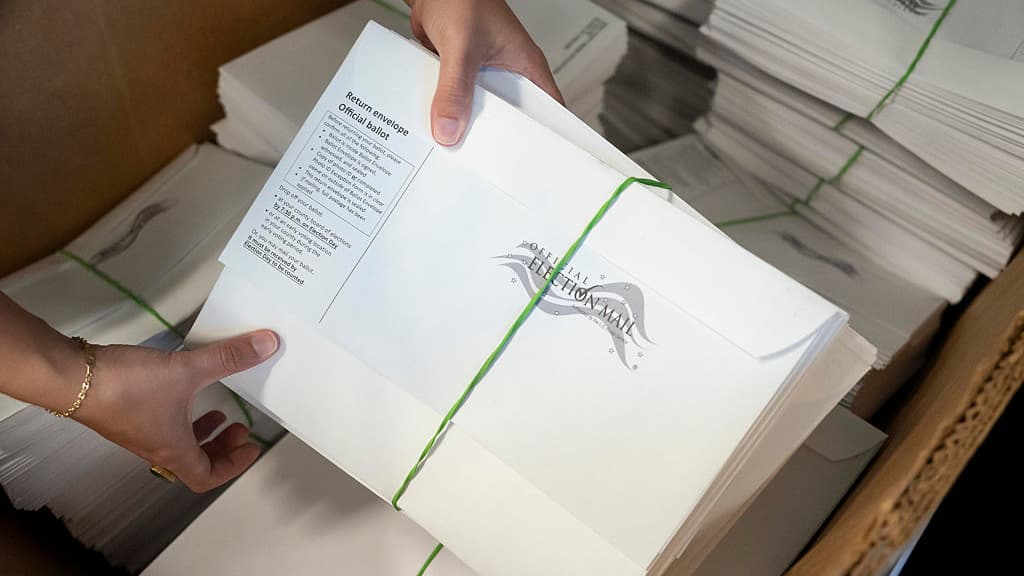
“The Court’s inability and unwillingness to do the right thing for our Country will go down, in a very negative way, in the annals of History,” Trump wrote. “This Supreme Court is bullied and cajoled by the Radical Left into making decisions that have set America back at least a hundred years.”
The President lauded Justices Samuel Alito and Clarence Thomas, who publicly dissented from the order, calling them “legends both.”
In his dissent, Alito penned that the USPS “has broad authority to regulate the mail” and likely has the power to implement Trump’s preferred limits. He also criticized the litigant states who challenged the restrictions in court ahead of the midterms, writing: “The plaintiff states cannot claim the timing of the rule tilts the equities in their favor when they, and courts hearing their claims, are responsible for so much of the delay.”
But the Supreme Court ruling is unlikely to stop Trump from trying to limit mail voting. Later Tuesday, Attorney General Todd Blanche said that while the Administration acknowledged the court’s order and would comply, “President Trump’s efforts to make sure that we have free and fair elections are not going to stop just in November or after or thereafter.”
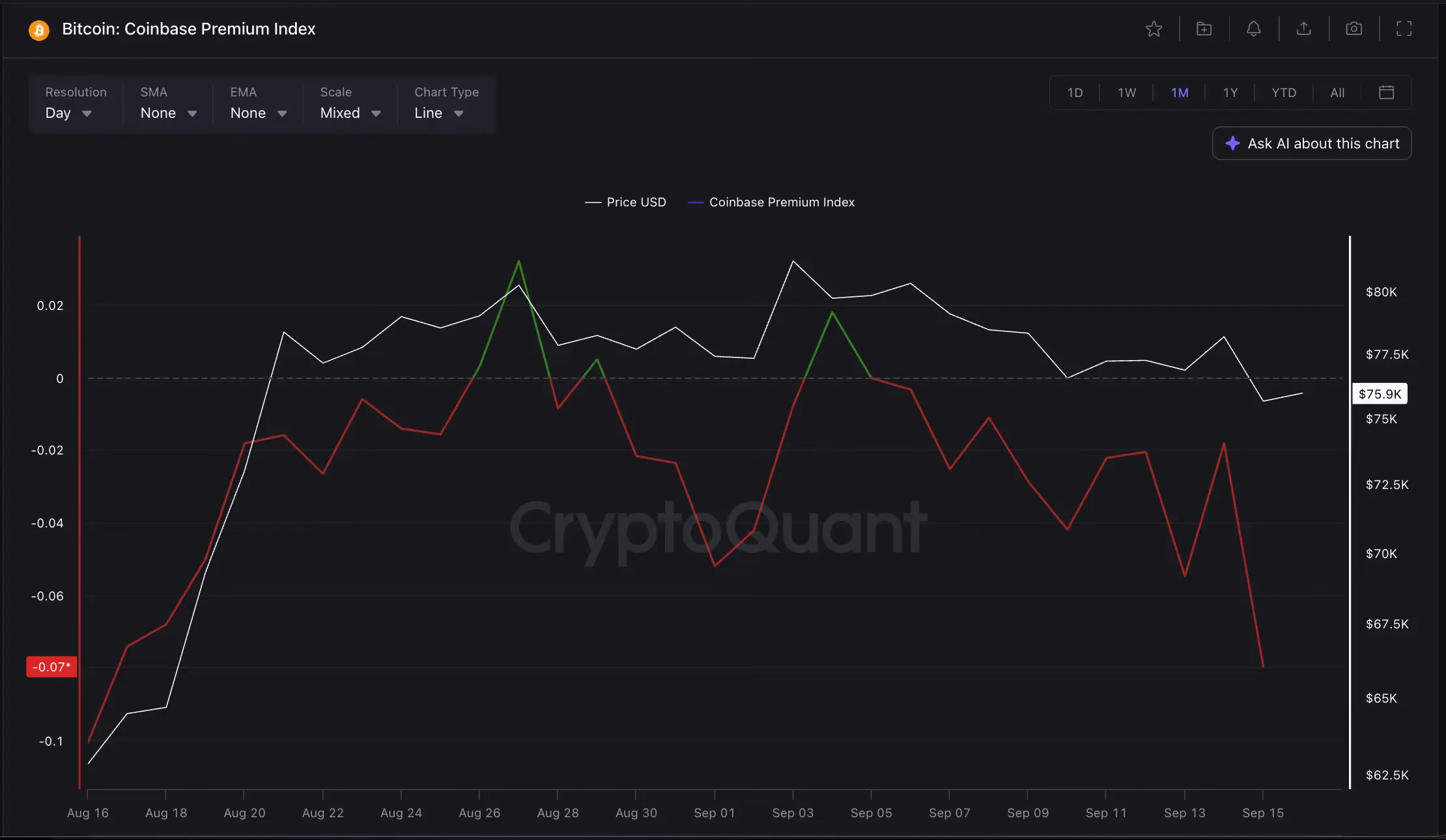
Bitcoin’s Coinbase · premium has fallen to its lowest level in four weeks, suggesting weakening U.S. demand as investors confront a setback for crypto legislation and the prospect of tighter monetary policy.
The premium measures the difference between bitcoin’s dollar price on Coinbase and its USDT price on Binance. CryptoQuant’s Coinbase Premium Index tracks that gap as a percentage of price. Tuesday’s reading of around -0.07% works out to roughly $50 on a $75,900 bitcoin – a thin margin but one that points to relatively weak buying demand on the U.S. exchange.
The discount has deepened to around -0.07% on Tuesday from roughly -0.02% a day earlier, as the Clarity Act failed to pass on Tuesday. That marks a reversal from late August and early September, when the premium turned positive for the first time in months, as bitcoin climbed towards $80,000. Bitcoin has since retreated to around $75,000.

Monetary policy presents another headwind. The Federal Reserve announces its decision later Wednesday, with markets widely expecting a 25-basis-point increase that would lift the federal funds target range to 3.75% to 4%.


The most-quoted AI agent statistics count intent, and real use in any single department is no more than 10 percent, finds a source-checked analysis by bdautomated
75 figures from 18 publishers traced to the original reports, with who was asked and what counted; the dataset is free to download
bdautomated today published “AI agent statistics 2026: every number checked at its source”, a free reference page and dataset that traces 75 widely quoted statistics about AI agents and AI use in business back to the documents they came from.
The analysis finds that the numbers disagree because they count different things. In McKinsey’s 2025 global survey, 62 percent of organizations were at least experimenting with AI agents, 23 percent had scaled one somewhere in the company, and in any single business function, no more than 10 percent had.
Surveys that count any adoption or intent report far higher figures: 79 percent of U.S. executives told PwC in April 2025 that agents were already being adopted in their companies, while a Capgemini survey that re-checked what respondents meant by “agent” found 14 percent had implemented one. Across all U.S. businesses of every size, the Census Bureau found 19.8 percent using AI in any business function as of May 2026.
The page also decodes the figure that rattled markets in 2025. MIT Project NANDA’s finding that “95 percent of organizations are getting zero return” measured profit-and-loss impact within roughly six months of a pilot, in a sample of 52 interviews, 153 conference survey responses and 300 public deployments, and its authors call the findings preliminary. It does not say that 95 percent of AI projects fail. Gartner’s prediction that over 40 percent of agentic AI projects will be canceled by the end of 2027 is a forecast from June 2025; nobody has counted the cancellations yet.
Every figure on the page passed four checks: the number appears in the original document; the exact place and a verbatim quote are recorded; what it measures is written in plain words, including who was asked, how many and when; and it is set against the other sources, with disagreements shown rather than averaged. Market-size forecasts were left out because the reports behind them are paid and cannot be checked. The dataset is published as CSV and JSON under a CC BY 4.0 licence, and the page carries a corrections address.
“Two headlines in the same week said almost nobody has AI agents running and almost everybody does, and both were quoting real surveys. We wanted the page we could not find: what each survey actually asked, so a business owner can tell which number is about a company like theirs,” said a spokesperson for bdautomated.
The page includes four charts that other publications may embed with attribution, and a table of all 75 figures with their sources, dates, samples and quotes.
Read the analysis: https://bdautomated.com/ai-agent-statistics/
Download the data: https://bdautomated.com/data/ai-agent-statistics.csv
The post AI Agent Statistics 2026: Every Number Checked at Its Source appeared first on BeInCrypto.

Solana co-founder Anatoly Yakovenko amplified a tokenized dinosaur skull sale on Wednesday, posting three dinosaur emojis as the $660,000 raise entered its final hours.
Jurassic Finance wants to move Deaton, a Triceratops prorsus skull, onto Solana as one million tradable tokens. The raise had covered 61% of its target early Wednesday.
Tokenized Dinosaur Skull Sale Passes $400,000
Contributors had committed $406,667 in USDC by Wednesday morning, the project’s dashboard showed. Roughly 13 hours remained on the clock.

The split is simple. Jurassic Finance will spend $600,000 acquiring the fossil, while $60,000 lands in its labs treasury. Each TRCH1 token costs about $0.69 and carries one-millionth of Deaton.
Ownership runs through a special purpose vehicle. Holders get economic rights to the fossil rather than direct title to the bone, the team says.
However, the offer runs on an all-or-nothing basis. Contributors get a full refund if the target falls short, and the project will not accept oversubscription.
That structure matters, because tokenized assets still face unresolved questions over what holders actually own.
A 66-Million-Year-Old Fossil With a Fresh Price Comp
Excavators pulled Deaton from the Hell Creek Formation in Slope County, North Dakota, in 1999. Preparation only finished last year.
All three original horns survive. The specimen is 60% to 65% complete by bone mass, which puts it in museum-grade territory.
Jurassic Finance leans on a recent auction result. Sofia, a comparable sub-adult Triceratops skull, fetched $840,000 on July 1 against a $600,000 to $800,000 estimate.
The team plans to place Deaton on long-term museum loan rather than in storage.
“Museums fund all operational overhead in exchange for display rights.”
Meanwhile, Solana keeps drawing unusual collectibles, from a tokenized One Piece manga to equities. The project first outlined its fossil plan in July.
The timing is awkward, though. SOL traded near $97 on Wednesday, down about 4% over 24 hours.
Whether buyers cover the remaining $253,000 before the clock runs out will test how far RWA appetite now stretches beyond stocks and bonds.
The post Solana Co-Founder Cheers $660,000 Tokenized Dinosaur Skull Sale appeared first on BeInCrypto.

U.S. prosecutors have charged two former Robinhood engineers with commodities fraud and wire fraud, alleging they used confidential information about upcoming cryptocurrency listings to profit from perpetual futures trades on the decentralized exchange Hyperliquid.
According to the U.S. Department of Justice (DOJ), Hefu Chai and Huaisong “Jerry” Xiang allegedly bought perpetual contracts linked to tokens shortly before Robinhood Crypto listings between 2025 and 2026. The DOJ says each defendant generated profits exceeding $50,000 from the trades.
Key takeaways
- The DOJ alleges Robinhood employees accessed a private Slack channel with planned listing dates and used it to trade perpetual futures on Hyperliquid.
- Prosecutors claim the defendants opened long positions ahead of listings and closed them after the tokens began trading on Robinhood.
- Prosecutors argue listing-related insider information cannot be “laundered” through derivatives—even in decentralized markets.
- Robinhood reportedly classified both engineers as “Coin Aware Individuals,” a group subject to explicit trading restrictions around announcements.
- The case draws parallels to earlier U.S. insider-trading litigation tied to token listings, but centers on perpetual futures rather than spot buying.
DOJ alleges insider info was used to trade perpetuals
In DOJ filings, prosecutors assert that Chai and Xiang had access to a private company Slack channel containing information about planned cryptocurrency listings. The core allegation is that this non-public information was then used to trade perpetual contracts tied to those tokens on Hyperliquid.
Prosecutors say the defendants traded ahead of Robinhood Crypto listing announcements by establishing long positions in advance and exiting when the contracts’ values rose following each token’s debut. According to the DOJ, profits exceeded $50,000 for each defendant.
From an investor and market-structure standpoint, the significance lies in how the alleged conduct bridges centralized listing workflows and decentralized derivatives venues. If the allegations are upheld, it suggests that the risks tied to confidential listing information extend beyond traditional spot markets and into the faster-moving perpetual futures segment.
What Robinhood’s internal policy reportedly restricted
The DOJ complaints describe how both engineers were given expanded visibility into future token listings at Robinhood. Chai worked at Robinhood from around 2021 until May 2026 and served as a technical lead responsible for new digital-asset listings. Xiang worked there from around 2024 until September 2026 as a software engineer involved in crypto listings.
Robinhood reportedly designated both men as “Coin Aware Individuals,” granting them access to the private Slack channel that prosecutors say contained planned listing dates. The company’s policy, according to the DOJ, prohibited members of this group from trading on Robinhood or any other platform during a window beginning 24 hours before a listing announcement and extending through 24 hours after.
Prosecutors allege the trading occurred anyway. The DOJ specifically cites at least 10 listing-related token announcements associated with Chai, including MEW, MOODENG, ASTER, XPL, HYPE, ENA, AERO, and others. For Xiang, prosecutors allege he began trading Popcat (POPCAT) perpetuals in March 2025 and then traded ahead of at least 10 additional listing announcements.
Derivatives markets and earlier insider-trading parallels
The DOJ’s theory echoes an earlier U.S. insider-trading case tied to token listings. Cointelegraph previously reported on a 2023 Coinbase insider-trading matter involving a former employee who allegedly used confidential information to profit by directly buying tokens slated to be listed. In that earlier dispute, the conduct involved spot acquisition of the underlying asset.
Here, the DOJ allegations extend the listing-insider concept into derivative markets. Instead of buying the underlying tokens, prosecutors say Chai and Xiang used perpetual futures contracts on Hyperliquid to capture price movement around the listing event.
This distinction matters because perpetuals can react quickly and may concentrate leverage and market impact around catalysts. If confidential information is used to time derivatives positions, regulators may argue that it produces a similar unfair advantage to spot-based insider trading—just expressed through a different instrument.
Charges, potential penalties, and the status of the case
U.S. Attorney Jamie McDonald said in connection with the charges that corporate insiders cannot evade commodities and securities laws by trading misappropriated information through perpetual futures, tokenized securities, or similar instruments.
Each defendant faces one count of violating the Commodity Exchange Act, carrying a maximum prison sentence of 10 years, and one count of wire fraud, carrying a maximum of 20 years, according to the DOJ filings. Prosecutors emphasize that the charges are allegations and that both defendants are presumed innocent unless convicted.
Cointelegraph contacted Robinhood for comment, but did not receive a response by the time of publication.
For traders and platform users, the next watch points are the court filings and any eventual rulings that clarify how U.S. prosecutors will frame insider information cases involving decentralized derivatives. The broader question—whether listing workflows, private communications, and faster perps execution can be treated consistently under commodities law—will likely shape how future enforcement efforts approach token listing intelligence.

America's Cryptocurrency 'Clarity Act' Fails Spectacularly, Despite Hundreds of Millions in Industry Lobbying

XRP TRUMP CLARITY BOMBSHELL: WHAT DOES HE KNOW?!

UUP launches independent safeguarding review into Jeffrey Donaldson



-

 Fashion5 days ago
Weekend Open Thread – Corporette.com
-

 Business6 days ago
Micron Stock Climbs Above $1,031 as AI Memory Crunch and a $50 Billion Outlook Fuel the Rally
-

 Tech3 days ago
The Latest Weird Thing to Play Doom Is the Mapped-Out Brain of a Fruit Fly
-

 Business6 days ago
AMD Stock Climbs After Management Lifts 2027 Data Center Outlook Toward $70 Billion in AI Sales
-

 Crypto World5 days ago
XAG/USD: Silver’s Short-Term Rally Meets Its Moment of Truth
-

 Business5 days ago
10 Most-Streamed Songs On Spotify In 2026 So Far, Led By Ella Langley’s Dominant Run On The Charts This Year
-

 Crypto World6 days ago
2 Chip Stocks Broke Out This Week. Neither Was Nvidia
-

 Tech6 days ago
Battery life is the only iPhone 18 Pro and iPhone Duo upgrade I care about. Apple didn’t disappoint
-

 Crypto World6 days ago
Pi Network ships Protocol 27 on a network with 14 million users and zero DeFi
-

 Crypto World5 days ago
OKX launches 10x OpenAI, Anthropic X-Perps in Europe
-

 Crypto World5 days ago
Diesel Tops $6 a Gallon for the First Time as 28 States Set Records
-

 Tech7 days ago
Apple Watch Ultra 4 vs Watch Ultra 3: Should you really spend another $799?
-

 News Videos5 days ago
Facing Financial Fears
-

 Crypto World6 days ago
Bitcoin price risks $70K if $78K neckline breaks
-

 Entertainment6 days ago
Case Sees Major Update As Jury Deliberations Begin
-

 Business3 days ago
Rivals Sam Altman and Elon Musk Rally Behind Dario Amodei’s Call for a Slowdown in AI Development
-

 Business6 days ago
Western Digital Slips 2.7% as AI Storage Rally Cools After Record Cash and Guidance
-

 Crypto World2 days ago
Elon Musk Drops a Bombshell: Grok 5 Could Be the AGI Breakthrough
-
Crypto World5 days ago
Ethereum Price Analysis: Consolidation at $2.5K Tests Momentum as On-Chain Activity Surges
-
Crypto World7 days ago
Ripple Price Prediction: What to Expect for XRP as a Major Macro Week Approaches
You must be logged in to post a comment Login