

Crypto World
Bitcoin Mining Stocks Rise as AI Infrastructure Demand Gains Steam


Bitcoin mining stocks jumped Monday as Hut 8 and IREN announced large-scale moves into AI infrastructure and cloud services, renewing investor interest in the sector’s ongoing pivot away from pure mining economics.
According to the early trading data cited in the report, shares of IREN, Cipher Digital, CleanSpark, Hut 8 and MARA Holdings each rose at least 11% on Monday. The catalyst came from two major announcements: Hut 8’s disclosure of a 15-year, $9.8 billion lease for its AI data center campus and IREN’s filing detailing $2.8 billion in cloud services contracts with AI developers (as stated in IREN’s SEC disclosure, https://www.sec.gov/Archives/edgar/data/1878848/000114036126028871/ef20078253_ex99-1.htm).
Key takeaways
- Hut 8’s $9.8 billion, 15-year AI campus lease and IREN’s $2.8 billion cloud contract disclosure helped drive broad gains across mining-related stocks.
- IREN expects its AI cloud business to exceed $4 billion in annual recurring revenue by the end of 2026.
- The rally tracked improvements in broader tech sentiment, including gains in Nasdaq and the Philadelphia Semiconductor Index.
- Industry momentum remains complicated by funding needs and investor scrutiny around insider selling.
AI infrastructure deals spark a sector-wide rerating
The Monday move wasn’t isolated to a single name. The report ties the rally to two specific, capital-intensive developments that place miners closer to demand centers tied to AI computing: large data center capacity and contracted cloud services.
Hut 8’s planned AI data center expansion is anchored by a long-term lease for a campus that, if executed as described, would materially increase its ability to host high-performance workloads. IREN’s SEC filing, meanwhile, highlights cloud services contracts with AI developers totaling $2.8 billion—an important distinction because it points not just to infrastructure buildout, but to service demand lined up in advance.
These developments build on the broader theme that has defined the sector over the past year: miners increasingly market themselves as energy and compute providers for AI-era workloads, not only as facilitators of bitcoin production. The report also notes that these companies began as bitcoin miners before accelerating that pivot as mining profitability faced sustained pressure.
Financial outlook and the AI infrastructure index
IREN’s disclosure included a forward-looking revenue target for its AI cloud unit. The report states that IREN expects the business to generate more than $4 billion in annual recurring revenue by the end of 2026. While such targets are inherently dependent on execution, contracting, and customer adoption, recurring revenue projections are typically more attractive to investors than purely speculative growth narratives—particularly for companies spending heavily to expand computing capacity.
The rally also showed up in a sector indicator maintained by The Energy Mag. The report references the TEM AI Infrastructure Growth Index, which tracks 20 companies spanning bitcoin mining, “neocloud,” and AI infrastructure. It rose 1.4% on Monday and is up more than 12% over the past week, suggesting that market optimism extended beyond a handful of headlines into a broader “AI infrastructure” trade.
Broader tech markets lift semiconductors and risk appetite
Mining stocks did not rise in a vacuum. The report links the move to a wider rebound in technology-related equities, noting that the Nasdaq Composite Index added 0.9% by midday. It also points to strength in the Philadelphia Semiconductor Index, which climbed 2% after having entered a technical bear market the prior week.
For investors positioning for AI growth, semiconductor demand is often viewed as a key upstream signal. The report defines a technical bear market as a decline of 20% or more from a recent high, underscoring that semiconductors were already in a stress phase before the bounce. Monday’s rebound in chip-related equities may have helped create a more favorable risk environment for companies perceived as beneficiaries of AI buildouts.
Volatility, funding gaps, and insider-selling scrutiny
Despite Monday’s positive reaction, the report emphasizes that the mining-to-AI transition remains a source of volatility. It highlights that bitcoin mining stocks have moved sharply this year as companies struggle with a weaker mining environment while trying to finance expensive AI and cloud initiatives.
According to the report’s reference to Blocksbridge Consulting, the AI pivot has driven a “re-rating” across the sector—but the change in narrative has also increased scrutiny, particularly around insider stock sales. The report points to a Blocksbridge-linked analysis in a Miner Weekly newsletter that flagged insider sales at TeraWulf, Riot Platforms, Core Scientific and Cipher Mining. The transactions were described as being executed under prearranged trading plans, but the concern among investors is essentially strategic: whether enthusiasm for AI growth has pushed share prices to levels that make executive selling look opportunistic.
On top of market optics, funding needs remain a central unresolved issue. The report cites Blocksbridge’s estimate that the industry will require another $50 billion to realize its AI ambitions, with IREN described as facing the largest funding gap at roughly $21.1 billion. That estimate frames the rally’s biggest tension: investors may be buying into AI-related growth claims, but companies still face the practical question of how quickly and efficiently they can raise capital and convert planned capacity into contracted revenue.
As the sector digests today’s announcements and broader tech sentiment, investors will likely focus on two things next: whether miners can translate AI infrastructure spending into durable, contracted recurring revenue, and whether scrutiny over insider selling and financing timelines intensifies as expectations rise.

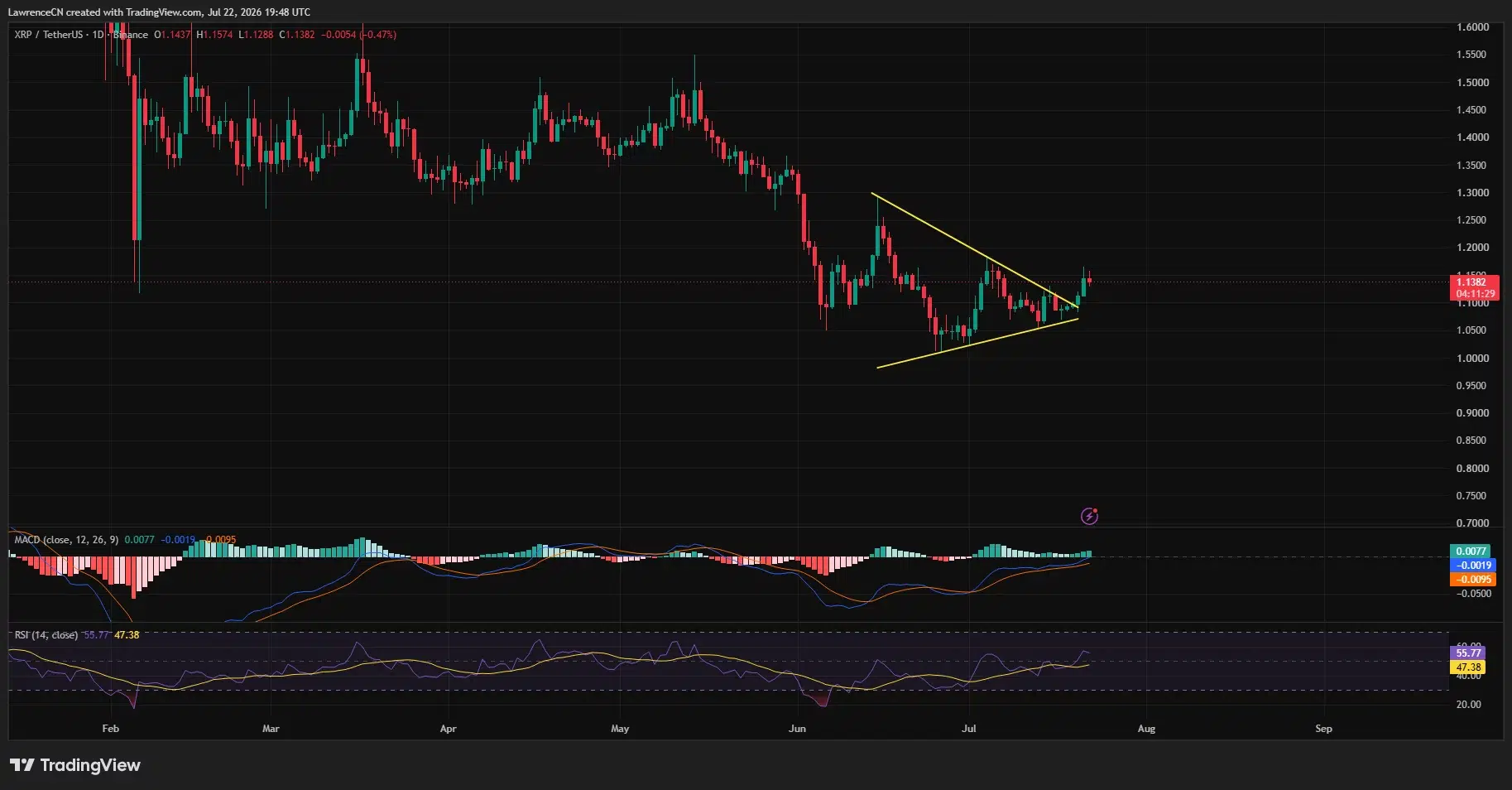
XRP price has climbed nearly 4% to a two-week high of $1.1574 as Bitcoin’s return above $65,000, whale accumulation and fresh ETF inflows have supported its latest recovery.
Summary
- XRP price reached $1.1574 after breaking above a daily symmetrical triangle.
- Whale wallets raised their holdings by 2.8% as smaller balances declined.
- XRP ETFs added $5.66 million while XRPL agentic transactions crossed 1 million.
According to data from crypto.news, XRP (XRP) price was trading near $1.14 at the time of writing, up about 2% over the past seven days, with its market value standing above $71 billion. The token had eased from its session high after sellers returned around $1.16, but prices remained above a recently broken daily resistance line.
Alongside the improvement in crypto sentiment, activity tied to artificial intelligence has supplied a network-level catalyst. XRP Ledger has processed more than 1 million agentic transactions, according to RippleX engineering head J. Ayo Akinyele, as developers test autonomous payments for data, application programming interfaces and computing services.
Agentic payments allow AI-powered software to complete transactions based on programmed instructions without requiring a person to approve each transfer. XRP Ledger can settle these payments in three to five seconds while offering predictable transaction costs, Akinyele told FinanceFeeds.
Commenting on the milestone, Akinyele projected that the transaction count could rise considerably as developers improve the tools available to autonomous agents.
“I think we’ll blast through 10 million and may even get to 100 million within the next couple of years.”
The forecast remains a projection rather than a measure of future XRP demand. Investors would still need to assess whether developers continue building agent-based services, whether those applications attract regular users and how much XRP or Ripple USD they use for settlement.
Whale buying and ETF inflows support the recovery
Santiment data showed that wallets holding between 100,000 and 100 million XRP increased their combined balances by 2.8% during the past five weeks. Over the same period, balances held by wallets containing less than 0.1 XRP fell by 5.2%.
According to Santiment, the opposing trends indicate that whale and shark wallets accumulated tokens while very small holders reduced their exposure. The analytics firm linked the change in holdings to XRP’s rebound toward $1.16, although its data does not establish that large-wallet buying alone caused the price increase.
Demand has also continued through U.S.-listed spot XRP exchange-traded funds. SoSoValue data showed the products attracted $5.66 million in net inflows on July 21, lifting their cumulative intake to about $1.49 billion.
Franklin Templeton’s XRPZ accounted for the entire daily addition, while the other listed products reported no net movement. Trading value across the funds reached $19.16 million during the session, and their combined net assets stood at approximately $1.06 billion, equal to about 1.48% of XRP’s market capitalization.
Among individual products, Bitwise managed the largest pool of assets at $333.50 million, according to the same dataset. The figures show that regulated funds continued receiving capital during XRP’s recovery, but daily flows can vary and do not guarantee sustained price gains.
Daily breakout keeps $1.20 within reach
On the daily chart, XRP has broken above the upper boundary of a symmetrical triangle that formed after its June decline. Price also moved through the descending trendline connecting the June and July swing highs before reaching $1.1574.
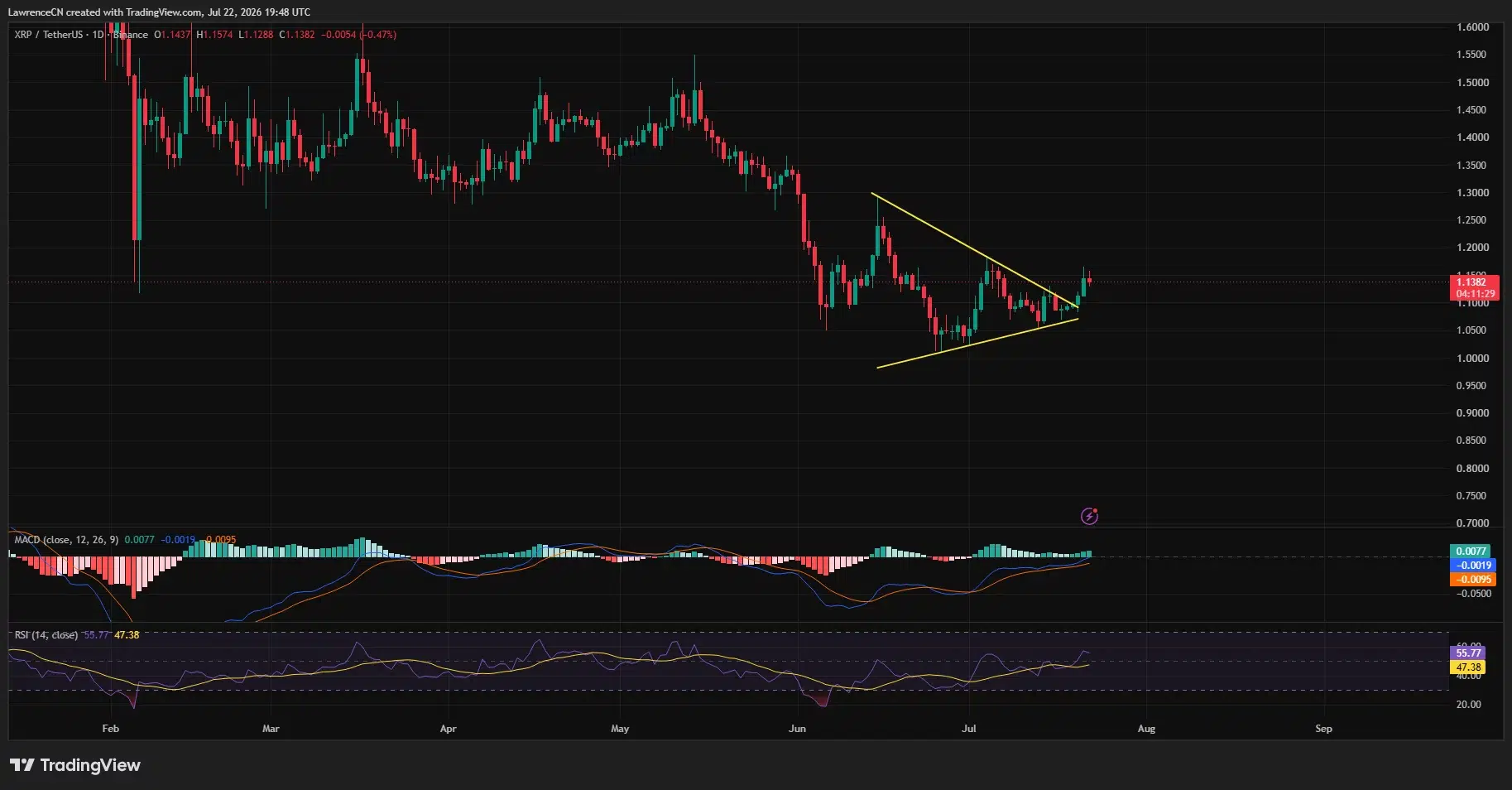
Daily momentum has improved with the breakout. The chart’s relative strength index stood at 55.77, above its moving average of 47.38 and below the overbought threshold of 70. Its moving average convergence divergence histogram had turned positive at 0.0077, while the MACD line was rising toward a possible move above the signal line.
The 4-hour chart, however, showed momentum cooling after XRP’s rejection from $1.1574. The latest candle traded near $1.1385, placing the token just above the Murrey Math trading-range ceiling at $1.1353 and the major support and resistance pivot at $1.123.
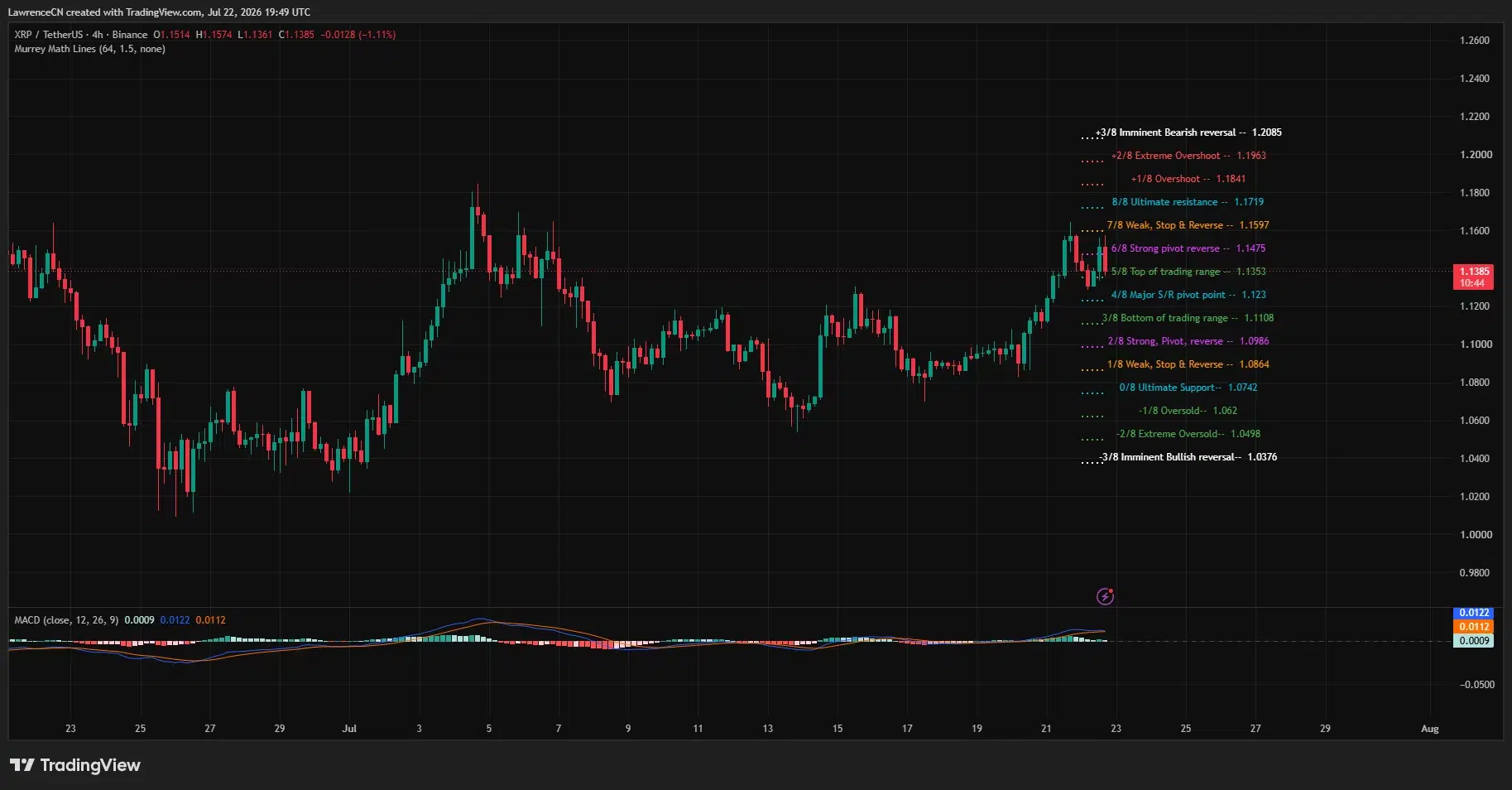
A recovery above the 4-hour strong pivot at $1.1475 would give buyers another chance to challenge $1.1597. The supplied chart places the following resistance levels at $1.1719 and $1.1841, with $1.1963 sitting just below the psychological $1.20 barrier.
4-hour MACD readings remained positive, although the shrinking histogram showed that upward momentum had slowed after the latest advance. This setup leaves buyers needing to defend the breakout instead of relying solely on the earlier impulse.
If XRP closes back below $1.123, the 4-hour chart identifies $1.1106 and $1.0986 as the next support levels. A deeper decline could expose $1.0864 and the ultimate support line at $1.0742, weakening the daily triangle breakout despite continued whale accumulation and ETF demand.
Disclosure: This article does not represent investment advice. The content and materials featured on this page are for educational purposes only.

The Digital Chamber has filed a lawsuit to block Illinois’ upcoming crypto tax.
The industry advocacy group argues that the tax unlawfully targets blockchain transactions for discriminatory reasons.
Illinois Faces Legal Challenge Over Crypto Tax Law
Illinois’ Digital Asset Tax Act (DATA), scheduled to take effect on January 1, 2027, imposes a 0.02% levy on the full value of a digital asset every time it is transferred. The tax applies to crypto exchanges, wallet providers, and custodians based in the state or ones offering services that earn more than $100,000 in Illinois receipts.
The law is the first of its kind in the U.S., with critics who oppose it saying it would impose several layers of tax on a single transaction, which would, in turn, raise costs and discourage crypto activity in Illinois. Andreessen Horowitz crypto executive Miles Jennings even went as far as calling it one of the most “anti-crypto laws” in the United States.
TDC is now asking the court to stop enforcement of the tax provision, arguing that no one should be treated differently for transacting in digital assets. Furthermore, they say that the clause was added to the legislation the night before its final consideration, leaving no room for an actual hearing.
“Today we filed a suit in Sangamon County, IL, to stop the Digital Asset Tax Act..it was slipped into the budget the night before the final vote,” they wrote.
TDC’s members also want the judge to rule that the crypto tax violates state and federal constitutions and to award reimbursement for the crypto lobbying group’s legal fees and court costs.
Crypto Tax Unfairly Targets Blockchain Transactions
The lawsuit also notes that the legislation does not distinguish between transactions that make a profit and those that result in a loss. Instead, it treats transactions differently based on the technology used to record ownership.
What this means is that digital asset transactions recorded on a blockchain are treated differently from those that use traditional financial systems, which, according to TDC, counts as unequal treatment. “No one should be taxed differently because of how ownership of digital assets is recorded or transferred,” they said.
Cody Carbone, CEO of TDC, says taxes should be carefully considered to ensure fairness of all involved, adding that the lawsuit aims to protect consumers and the group’s members.
While Illinois takes a more restrictive approach with the first crypto tax, other states like Texas and Florida are moving in the opposite direction by passing crypto-friendly legislation. In the case of Texas, it passed laws allowing Bitcoin to be held in state reserves, while Florida banned the use of Central Bank Digital Currencies (CBDCs) while also easing the rules for non-custodial crypto operators.
The post Crypto Industry Launches First Major Legal Challenge to Illinois’ Digital Asset Tax appeared first on CryptoPotato.
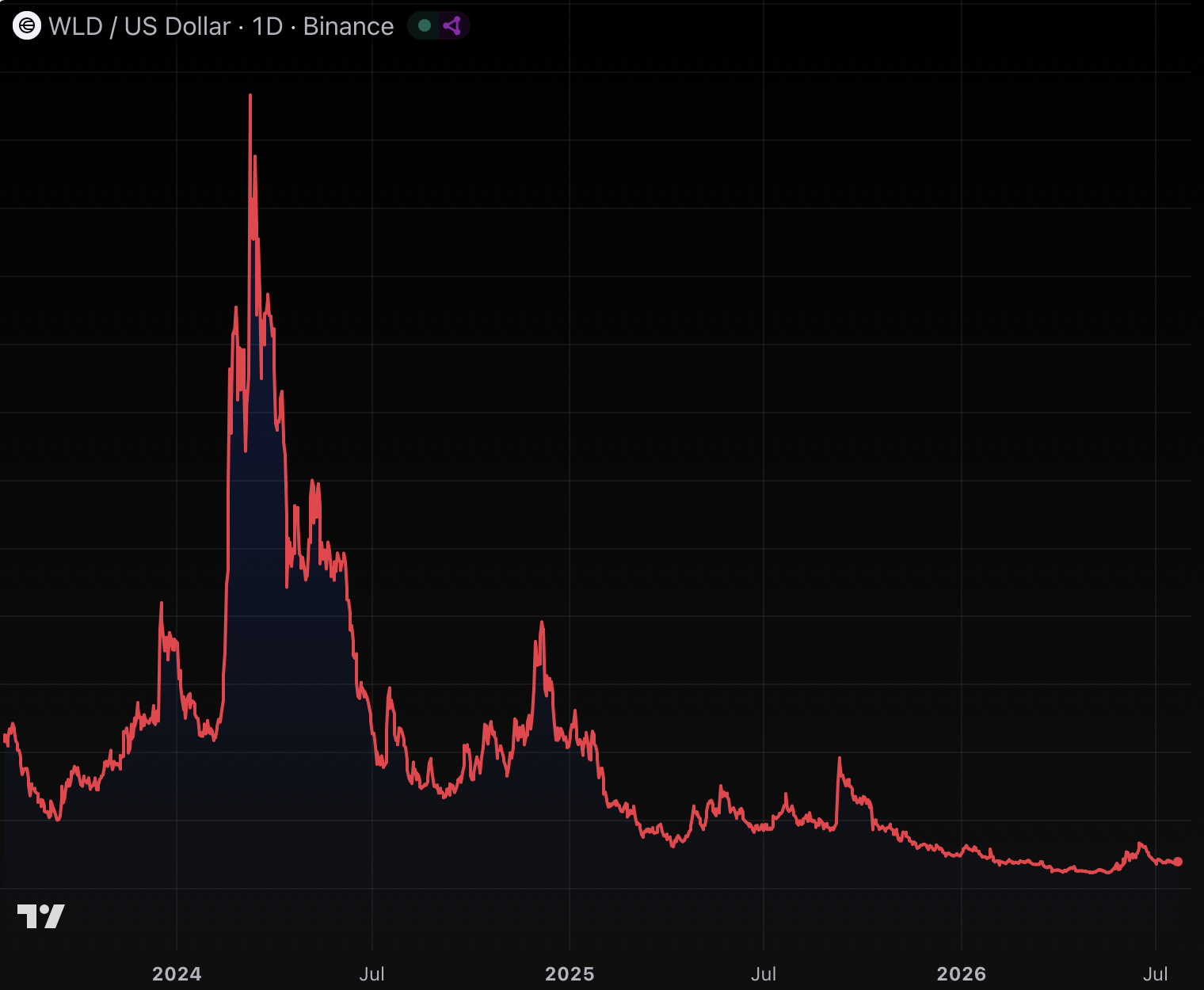
Grayscale’s new SEC filing for a Worldcoin ETF reveals that just 100 wallets hold approximately 90% of all circulating WLD — a concerning level of centralization for co-founder Sam Altman’s “coin for the world.”
These numbers contrast with the token’s whitepaper, which outlined a simple goal tied to eyeball-scanning orbs and token giveaways around the globe: “The majority of WLD tokens will be claimed by individuals simply for being verified unique humans.”
It would be bad enough if that were Worldcoin’s only decentralization failure.
Unfortunately, the filing also acknowledges the project’s dependence on a centralized sequencer, upgrade functionaries, bridge operators, and governance that rarely uses its own so-called governance token.
One of the aforementioned WLD wallets is 0x470458C91978D2d929704489Ad730DC3E3001113, the bridge between Ethereum and World Chain, and likely represents multiple users.
Grayscale discloses Worldcoin’s actual tokenomics
The admissions come not from critics but from Grayscale, a sponsor that wants to bundle up WLD tokens into a Nasdaq-listed ETF and sell shares to retail investors.
Grayscale filed its S-1 application for its ETF on July 20, proposing to list on the Nasdaq under the ticker symbol GWLD.
Its risk factors state plainly, “As of the date of this filing, the largest 100 WLD wallets held approximately 90% of the WLD in circulation.”
Worldcoin and OpenAI co-founder Sam Altman posted in October 2021 that Worldcoin “will be distributed fairly to as many people as possible.”
The project’s whitepaper forecasted, “The majority of humans alive today will claim WLD tokens, which may result in WLD becoming the most widely distributed digital currency.”
The word “may” is doing a lot of heavy lifting there.
Grayscale’s lawyers had to tally actual, rater than aspirational, numbers. Their disclaimers warn that it’s “possible, and in fact, reasonably likely, that a small group of early WLD adopters may hold a significant proportion of the WLD that’s been released to date.”
That sums it up. Altman’s coin overwhelmingly went to the 1%.
Read more: Worldcoin rebrands to World after missing eyeball target by 99.4%
Worldcoin, the non-governing governance token
WLD is nominally a governance token, but it hasn’t been particularly useful.
According to the filing, WLD “in the future may be used to participate in governance of the World Network.” Mechanisms for that future transition are “novel and untested at scale.”
For now, the filing admits, governance “remains substantially guided by the World Foundation.”
All of these legal disclaimers are certainly distinct from Worldcoin’s initial marketing materials.
In December 2023, the project boasted, “Worldcoin has a superpower for governance with its proof-of-personhood.
“This allows implementing one-person-one-vote democracies, something not previously possible.”
One person, one vote, maybe someday
The idea of one person, one vote works when each person has only one vote. This is certainly not the case with WLD’s ownership distribution.
Also, it would be helpful if community votes actually occurred.
Indeed, its 2024 whitepaper promised, “The WLD token, alongside World ID, will be used for protocol governance.”
Yet, according to Grayscale’s filing, governance votes have been mostly non-existent. “As of the date of this prospectus, governance of the World Network remains substantially guided by the World Foundation, which has stated its intention to progressively decentralize governance over time,” it says.
In other words, as it stands, governance isn’t decentralized.
Grayscale acknowledges Worldcoin’s centralization
Grayscale’s filing this week also discloses the project’s dependance on one blockchain sequencer.
“World Chain’s sequencer is operated on a centralized basis, and World Chain remains at an early stage of decentralization relative to the Ethereum network.”
Upgrade functions, the filing notes, sit under “coordinated control by a limited number of participants” tied to the World Foundation, the Worldcoin-supporting Tools for Humanity, and Optimism, the operator of the Ethereum layer 2 on which Worldcoin’s smart contracts rely.
Unveiling World Chain in April 2024, Worldcoin declared, “For World Chain to succeed it must be built, owned and governed by all of humanity.”
All of humanity, in reality, is nowhere close to governing Worldcoin.
As recently as May 2025, the foundation promised, “Our transition to full decentralization follows a precise roadmap. By late 2026, we expect to reach the final stages.”
It’s currently July 2026, and it’s not on track to achieving that deadline.
Finally, Worldcoin’s iris-scanning Orb completes the pattern of centralization today while talking about decentralization in the future tense.
Grayscale concedes that as of today, Worldcoin’s “Orb is manufactured and distributed principally by or under the direction of Tools for Humanity, and the World Foundation exercises significant influence over the protocol, the WLD treasury and ecosystem grants.”
WLD was trading near $0.40 as of publication time, 20% lower year-to-date and 96% below its March 2024 peak of $11.74.
Protos reached out to World for comment but received no reply prior to publication.
Got a tip? Send us an email securely via Protos Leaks. For more informed news and investigations, follow us on X, Bluesky, and Google News, or subscribe to our YouTube channel.
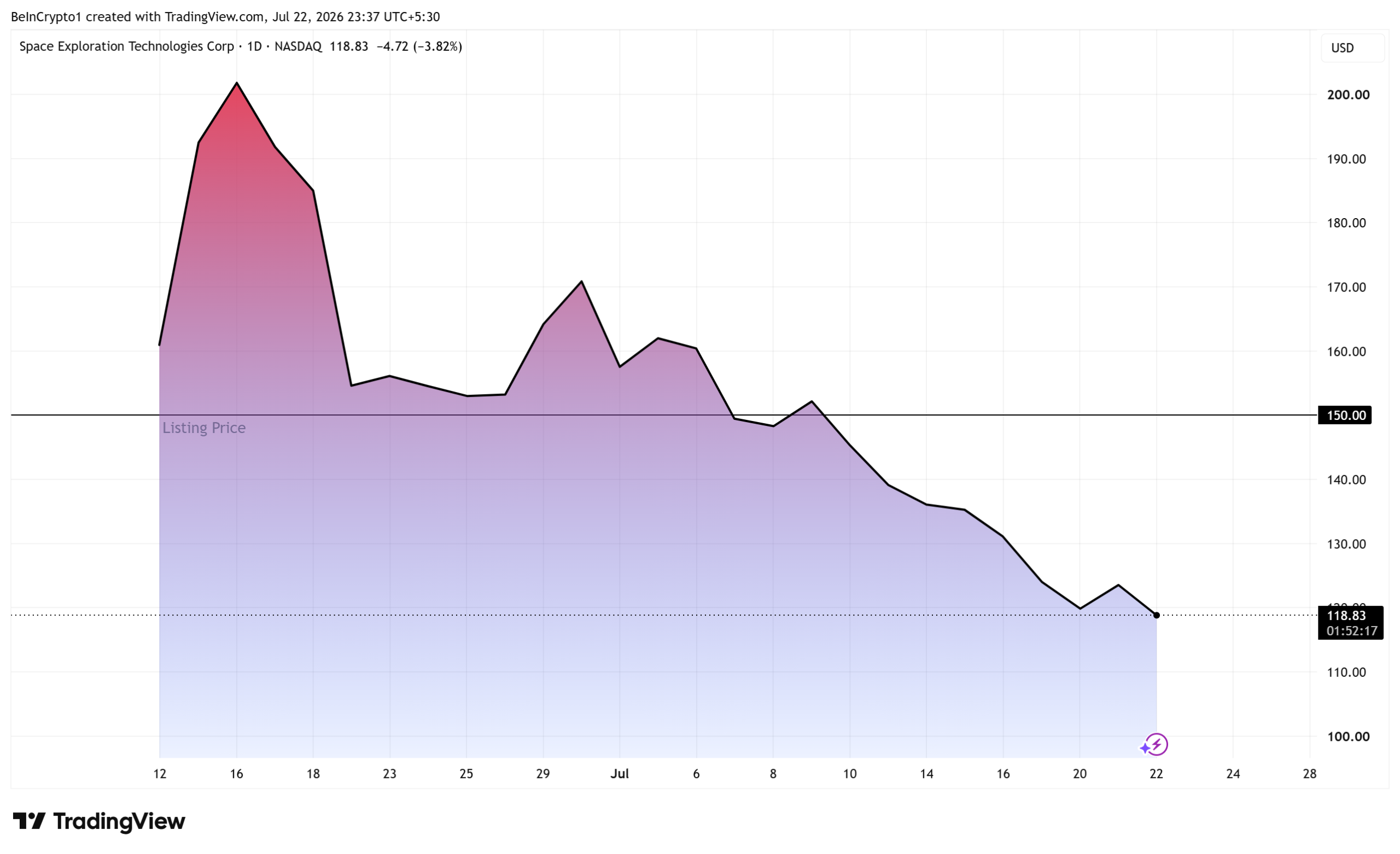
Cathie Wood just named her favorite stock. It is Elon Musk’s SpaceX (SPCX), and she says it could become the most important company in history.
That is a bold call right now. SpaceX has fallen about 40% from its peak and now trades below where it started.

SpaceX Is Wood’s Top Pick
Wood spoke in a July interview with Fox Business host Maria Bartiromo. Bartiromo asked for her favorite stock. Wood picked SpaceX right away.
“Ultimately SpaceX when they combine… the orbital data center opportunity.”
She has backed SpaceX since late 2023. When it went public, she spent $529.7 million on the first day. She sold Tesla shares to help pay for it.
This is a familiar move. ARK also bought Coinbase and CoreWeave soon after they listed. Wood likes to buy fast-growing names early.
Wood’s Boldest Prediction Yet
Then Wood made her biggest claim.
“We think this could become the most important company in history and I mean in global history.”
Her reasons are simple. SpaceX runs Starlink, which beams internet from space. Wood says it controls about 70% of all active satellites. Starlink is also the only part of SpaceX that makes money.
SpaceX rents out computing power to big AI firms too.
“In the meantime on Earth, SpaceX is renting out its data centers to Anthropic and Google and others.”
It may also feed data to xAI’s Grok models. Wood says the company is on track to make $47 billion a year.
SpaceX Stock Has Fallen Hard
But the market is not sold yet. The stock trades near $119. That is below where it started, and almost 4% lower on Wednesday.
The numbers explain the doubt. SpaceX has run up $41.3 billion in losses, its IPO filing shows. Recent Starship test delays hurt the stock too.
Wood says the sell-off misses the bigger picture.
“It has a ten year lead and the key has been reusable rockets.”
She has a point. SpaceX landed and reused a rocket back in 2015. No rival matched that for years.
Wood has been early before. She bought Tesla in 2016. She backed Bitcoin years ago. Bloomberg even named her the best stock picker of 2020.
But her record swings a lot. Her main fund fell about 78% from 2021 to 2022. Morningstar says it wiped out $7 billion for investors between 2014 and 2024.
Wood sees the drop as a chance to buy. She says SpaceX opens up huge markets.
“There are lots of opportunities and they are multi trillion dollar opportunities.”
The post Cathie Wood Reveals Her Favorite Investment With the Boldest Prediction Yet appeared first on BeInCrypto.

XRP briefly climbed above $1.16 and is being supported by accumulation from large holders rather than retail demand, according to the latest findings by Santiment.
The analytics firm found that wallets containing between 100,000 and 100 million XRP expanded their holdings by 2.8% over the past five weeks. Wallets with less than 0.01 of the token, on the other hand, cut their balances by 5.2%.
More Room For Growth
Santiment said XRP has historically tracked the behavior of key stakeholders more closely than the smallest retail wallets, which makes the divergence supportive of the recent price recovery.
The accumulation trend comes as the crypto asset continues to benefit from a stronger market narrative, including the resolution of Ripple’s SEC overhang and ongoing XRP Ledger activity tied to payments, tokenization, and RLUSD. At the same time, US-based spot XRP ETF products have continued to attract institutional interest, recording nearly $12.5 million in net inflows so far this month.
Similar periods of accumulation by stronger holders alongside declining participation from micro wallets have often created conditions that favor further upside, the firm added.
$1.13 Breakout in Focus
From a technical perspective, ChartNerd said XRP faced another rejection after testing its daily 50-day exponential moving average (EMA), the same technical level where its previous two rallies lost momentum. The price has since pulled back to around $1.13. Despite the rejection, he said the bullish outlook remains intact as long as the crypto asset holds the $1.11-$1.09 support zone.
Maintaining that range could preserve momentum for a move toward $1.25. However, the analyst warned that a break below the support area would weaken the current setup and increase the likelihood of falling back to the $1 level. He had previously rejected claims circulating on social media that XRP had already broken out of the downtrend that started in July 2025.
Offering a similar view, analyst Ali Martinez also said a decisive move above the $1.13 level could confirm XRP’s bullish breakout and open the door to further gains.
Others believe the cross-border token continues to trade within a year-long descending pattern, and only a clear break above $1.20-$1.30 soon could invalidate the setup.
The post Classic Bullish XRP Pattern Emerges as Large Wallets Keep Accumulating appeared first on CryptoPotato.

Senate Republicans have released the full proposed text for the Digital Asset Market Clarity (CLARITY) Act, a wide-ranging bill intended to establish a clearer US regulatory framework for digital assets. The 616-page document, published Wednesday, includes a particularly forceful ethics section that would bar US federal officials from issuing, sponsoring, or otherwise promoting digital assets.
According to the bill’s text—posted by Senator Cynthia Lummis—public officials, their spouses, and federal employees would be prohibited from issuing or sponsoring digital assets. In parallel, the legislation would prevent crypto platforms from listing assets that are issued or sponsored by covered federal officials. Lummis described the ethics package as “the most comprehensive and wide-ranging ethics provision in history,” language that the White House also highlighted around the proposal.
Key takeaways
- The CLARITY Act’s ethics rules would restrict covered federal officials (and their spouses) from issuing or sponsoring digital assets.
- Crypto platforms would face a related prohibition on listing assets that are issued or sponsored by those federal officials.
- The ethics ban would be temporary, ending on Jan. 20, 2029, coinciding with the end of a second presidential term.
- Enforcement would largely fall to the US Department of Justice rather than state regulators, elevating the role of federal prosecutors.
- Passage still appears uncertain because Democrats must support the bill to reach a 60-vote Senate threshold.
Ethics provisions at the center of the debate
The ethics section is the headline-grabbing part of CLARITY, largely because it attempts to directly tie conflict-of-interest rules to digital asset activity by senior federal actors. Under the proposed language, a broad group of federal officials, their spouses, and public employees would be barred from issuing or sponsoring digital assets.
The bill goes further by addressing market access: crypto platforms would be blocked from listing assets issued or sponsored by those same federal officials. That structure matters because it doesn’t just restrict official conduct—it also attempts to constrain the flow of capital and attention toward assets that would otherwise benefit from federal ties.
Senator Lummis, a key advocate for the bill, said the provisions would apply to President Donald Trump, who has faced criticism from lawmakers over the scope of his crypto-related financial interests while in office. In earlier coverage from Cointelegraph, lawmakers have pointed to reporting that Trump earned more than $1.4 billion in 2025 from his crypto ventures. Lummis framed CLARITY as applying a uniform ethics standard to everyone, including the President.
At the same time, the temporary nature of the prohibition stands out. The ban would expire on Jan. 20, 2029—described in the bill context as the day a second presidential term ends. That design could influence how both supporters and skeptics assess the bill: for supporters, it offers a near-term deterrent backed by enforcement; for opponents, it may raise questions about what happens after the expiration date.
Department of Justice enforcement and the confirmation question
Another crucial aspect of the ethics language is where enforcement would sit. The bill assigns primary responsibility to the US Attorney General and the federal Justice Department rather than leaving implementation primarily to states. As of Wednesday, reporting in the crypto space indicated that Todd Blanche—Trump’s former personal attorney and the acting Attorney General—was awaiting a Senate confirmation vote to lead the Justice Department.
That federal enforcement focus appears to be one of the reasons the bill’s ethics provisions are drawing intense scrutiny. In comments reported by Politico, Senator Angela Alsobrooks said she would not support the bill if the ethics language did not include the Justice Department behind enforcement, adding that Democrats would continue working from the Senate floor to reach an agreement that holds everyone accountable.
Lummis, speaking on behalf of the Senate Banking Committee’s digital assets subcommittee, emphasized that the proposal is not merely symbolic. She said the bill would be “backed up with real enforcement, real penalties, and a Department of Justice mandate to act.”
What’s missing—or at least not included—in the text
While the ethics rules are extensive, the bill’s boundaries are also being parsed by observers. Notably, the ethics provisions described in coverage of the proposal do not appear to include children of public officials in the temporary ban.
That omission is politically meaningful given that two of Trump’s sons are described as co-founders of a family business tied to the crypto sector. The article coverage also referenced that three of Trump’s sons are co-founders of World Liberty Financial, and that two launched a Bitcoin mining company, American Bitcoin. For Democrats who have demanded strict ethics language, the lack of coverage for children could become a focal point during negotiations—especially if lawmakers argue that indirect conflicts should be treated the same as direct ones.
Meanwhile, even supporters who back the bill’s overall ethics thrust still face a broader question: will the final package be strong enough, and structured enough, to satisfy lawmakers who have said they will not vote for any version lacking meaningful ethics reforms addressing “crypto corruption.”
Senate math and the path to a vote
CLARITY is not expected to move quickly through Congress without bargaining. The bill still requires Democratic support to achieve the 60-vote threshold in the Senate. Coverage has noted that many Democrats have explicitly tied their willingness to vote to the strength of the ethics language, suggesting that negotiations—particularly around enforcement details and who exactly is covered—could determine whether CLARITY can reach the level needed for passage.
There is also a procedural clock. Senate Majority Leader John Thune reportedly plans to put CLARITY up for a vote on the Senate floor sometime next week, according to coverage of the proposal. The Senate’s calendar is tight: the chamber has only a few weeks to hold votes before breaking for state work periods.
Political and policy observers are also framing CLARITY as more than an ethics bill. According to Kristin Smith, president of the Solana Policy Institute, the Senate version adds not only ethics and enforcement language but also a broader set of provisions, including a full disclosure regime, expanded illicit finance measures, and improved spot market regulation. That view suggests the core argument for moving forward is not limited to the ethics section—it is also about whether the overall market-structure framework can become durable, bipartisan legislation.
Whether CLARITY ultimately lands on President Trump’s desk will likely hinge on negotiations over the ethics boundaries, the enforcement mechanism, and what Democrats consider sufficient to address conflict-of-interest concerns in the digital asset industry.
For now, readers should watch the next procedural steps in the Senate—especially whether enough Democrats commit their votes before the chamber’s schedule constrains further bargaining—and closely monitor whether any amendments emerge that expand (or narrow) who is covered by the ethics restrictions and how strictly the Justice Department would be expected to enforce them.
The market for tokenized stocks reached a record $2.3 billion in market capitalization in mid-July, according to Token Terminal data, nearly doubling since March, when the sector first cleared $1 billion, and the growth is showing up across every major issuer at once. On July 21 alone, Artemis data… Read the full story at The Defiant

Coinbase has introduced SUI staking for eligible customers while Sui advances its Bitcoin-focused Hashi testnet. The rollout allows users to earn daily rewards directly through their exchange accounts. Meanwhile, Hashi gives developers and institutions a controlled environment for testing Bitcoin financial applications.
SUI Staking Opens With Daily Rewards
Coinbase said customers can begin staking with at least one SUI token. Estimated annual rewards range between 1.4% and 3.3%, depending on network conditions. The exchange distributes rewards after each 24-hour Sui network epoch.
It also automatically adds earned rewards to each customer’s staked balance. This auto-compounding process increases the amount participating in future staking periods. However, actual returns may change as network activity and validator performance shift.
The company announced the service through an official post on X. “You can now stake SUI – directly on Coinbase,” the exchange said. It also promised “Instant rewards, accumulated straight to your account.”
Regional Limits Accompany Staking Rollout
Coinbase stated that the staking service remains unavailable in certain jurisdictions. Regional regulations and account eligibility will determine which customers can access the product. The company also clarified that its announcement did not provide investment advice.
The launch arrived as Coinbase ended a long-running information dispute with the United States Securities and Exchange Commission. The SEC agreed to pay $150,000 as part of a settlement announced Wednesday. The legal matter concerned a Freedom of Information Act lawsuit involving requested agency records.
Despite these developments, Coinbase shares declined during Wednesday’s trading session. COIN stock fell 3.67% and traded near $169.40 during intraday activity. The decline continued a recent downtrend in the exchange operator’s market value.
Hashi Testnet Targets Bitcoin-Based Finance
Sui launched the Hashi testnet alongside support from more than 25 ecosystem partners. Developers, custodians, and financial institutions can test Bitcoin applications before the planned mainnet launch. The platform connects Sui’s blockchain performance with Hashi’s Guardian Layer security system.
The Guardian Layer strengthens controls surrounding Bitcoin used as collateral. It also supports transparent and programmable financial activity conducted through on-chain applications. Participants can test security features and operating processes before deploying products on the main network.
Hashi targets applications including lending, credit products, and structured yield strategies. Coinbase adds broader SUI access while the testnet expands Bitcoin’s role within the Sui ecosystem. Together, both launches mark new infrastructure developments for staking and institutional Bitcoin finance.
The second-largest cryptocurrency has staged a minor resurgence in the past few days, yet certain bullish signals suggest it could be on the verge of a further rally.
Analysts speculate that the price may soon surpass $2,300, while others warn that a potential drop to as low as $1,000 might also be on the way.
Exodus From Exchanges and More
The popular analyst Ali Martinez revealed that investors have withdrawn roughly 1 million ETH (worth almost $2 billion) from centralized platforms over the last 30 days. A deeper look on CryptoQuant shows that the total figure has plummeted to around 15.1 million, marking the lowest level in the past 10 years.
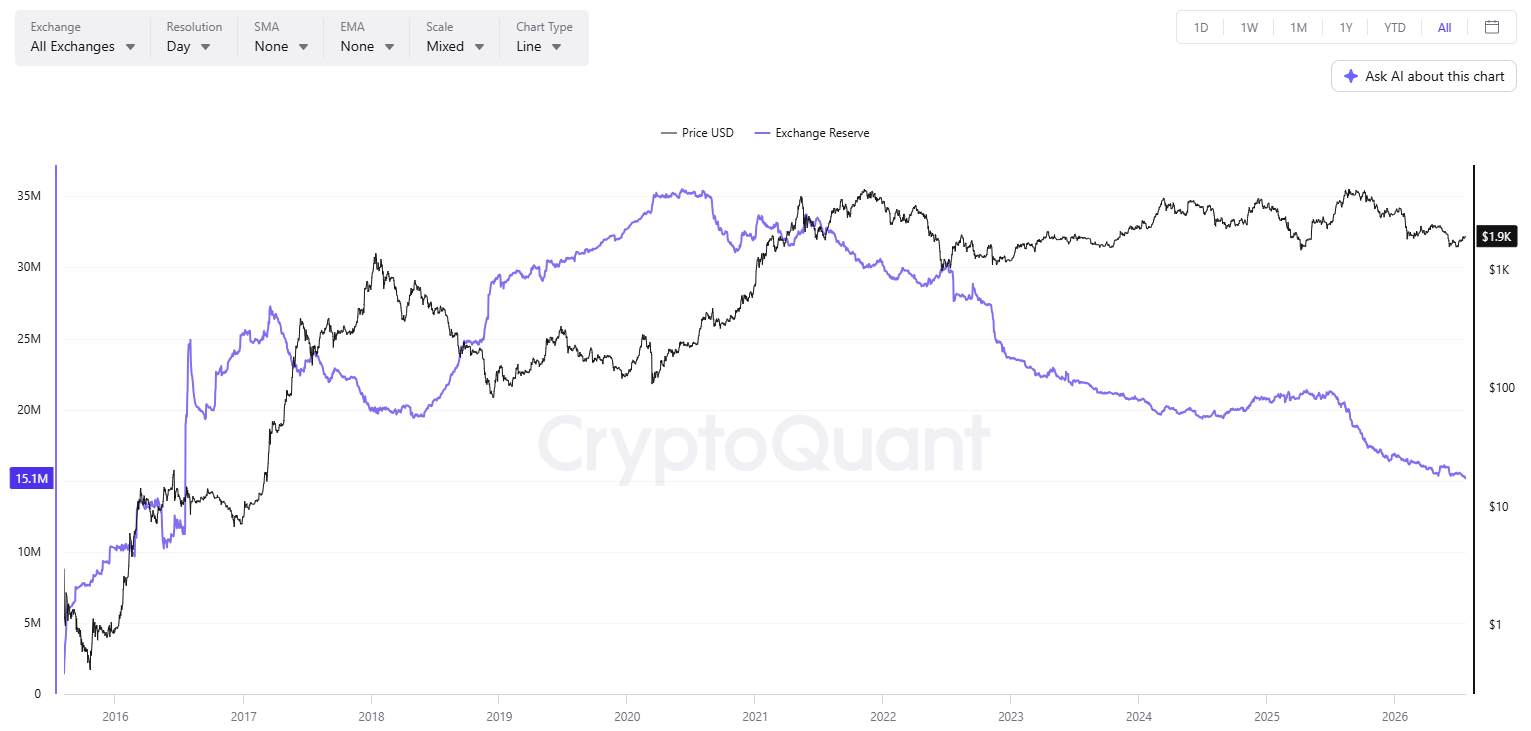
Such action is usually considered an optimistic sign for the cryptocurrency, with Martinez explaining:
“Falling exchange balances typically point to reduced sell-side pressure, a trend that supports Ethereum’s bullish outlook.”
Another positive development surrounding the asset is the return of institutional interest. According to SoSoValue, inflows into spot ETH ETFs have been dwarfing outflows on most days this month, meaning that conservative investors like pension funds and hedge funds have increased their exposure, forcing BlackRock, Fidelity, VanEck, Franklin Templeton, and other financial behemoths to back the shares with real ETH.
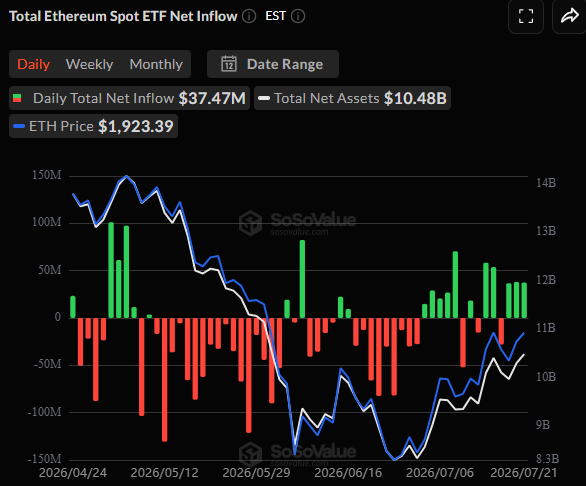
Institutions aren’t the only ones ramping up their interest in the asset, as earlier this week, Arthur Hayes (co-founder of BitMEX) spent over $2.5 million to purchase 1,332 units.
The Latest Forecasts
$2,300 appears to be a common short-term target outlined by multiple analysts. According to Ali Martinez, an increase of that magnitude is possible after the formation of a double bottom on ETH’s price chart and as long as the asset holds the $1,850 level.
For their part, KALEO envisioned a pump to $2.3K by mid-August, which could then be followed by a major drop to $1,200 and a revival in October.
Crypto Patel also gave their two cents. The analyst described a potential surge to $2,160-$2,400 as a likely scenario, going even further to predict a possible explosion to as high as $10,000 in the event of a confirmed close above $2,400. At the same time, they suggested that a rejection from the depicted range may open the door to a whopping crash to $1,500-$1,000.
The post 1,000,000 ETH in a Month: Is Ethereum Poised for a Major Rally? appeared first on CryptoPotato.
Ostium, a perpetuals trading protocol on Arbitrum, said it will reopen trading on Thursday, one week after an exploit drained its liquidity provider vault. The reopening follows what the company described as a July 15 attack that took almost 23.8 million USDC from its liquidity provider (LP) vault…. Read the full story at The Defiant

Amazon cuts jobs in AGI group as it puts more focus on customer-facing AI

The Beach Boys abruptly cancel multiple state fair performances

Site of Leicester city centre fire could be rebuilt as student flats


![Trump Just Said It... [Bitcoin Holders Pay Attention]](https://wordupnews.com/wp-content/uploads/2026/07/1784749233_maxresdefault-80x80.jpg)
-
 NewsBeat6 days ago
London Mayor Sadiq Khan handed a peerage by Keir Starmer alongside 15 other Labour figures… just days before the PM leaves No10
-

 Fashion5 days ago
Weekend Open Thread – Corporette.com
-

 Politics4 days ago
The House | The City of London can help the new chancellor deliver growth in every postcode
-
 Crypto World5 days ago
Two July Windows Left: The CLARITY Act’s Senate Fight and What Failure Means
-

 Crypto World7 days ago
CFTC blocks Kalshi from unwinding Michigan trades after court order
-

 Crypto World4 days ago
Ripple Payments Joins MiCA With 14 Firms, Does It Mean Anything For XRP?
-

 Business7 days ago
Nvidia Stock Slips After Big Tuesday Rally as Huang Confirms Vera Rubin Chip Is Now in Production Today
-

 Politics3 days ago
Democrats look to World Cup watch parties to register thousands of voters
-

 Crypto World5 days ago
Ripple wins EU-wide access as ESMA adds it to MiCA register
-

 Crypto World1 day ago
Grayscale Files For Worldcoin ETF, WLD Registers Sharp Rise
-

 NewsBeat2 days ago
Unregistered fitter used Gas Safe logo on business flyers
-

 Crypto World6 days ago
Injective Submits SEC Transfer-Agent Registration to Onchain Ownership Records
-

 Tech2 days ago
Sail Virtually Aboard The “Itanic” With IA-64 Emulator
-

 Business7 days ago
Palantir Shares Rise After Expanded Nvidia Partnership and Fresh Analyst Upgrades Ahead of Earnings Day
-
 Tech2 days ago
Turtle Beach Command Series KB7 review: a nifty screen-equipped gaming keyboard
-

 NewsBeat5 days ago
Registration is now open for March for Men with Kev 2026
-
 Sports7 days ago
New Cornerback Enters Vikings Trade Rumor Mill
-
 Business16 hours ago
New Jersey voter registration controversy explained: How 6,600 noncitizens got on the rolls, and what happens next
-

 News Videos6 days ago
Money | Class 12 Economics | CBSE Board Exam 2026-27
-

 Crypto World6 days ago
Claude Fable 5 Slips to Second in AI Coding Leaderboard
You must be logged in to post a comment Login