

Crypto World
US Officials Face Token Issuance Ban Through 2029 Under CLARITY Rules


Senate Republicans have released the full proposed text for the Digital Asset Market Clarity (CLARITY) Act, a wide-ranging bill intended to establish a clearer US regulatory framework for digital assets. The 616-page document, published Wednesday, includes a particularly forceful ethics section that would bar US federal officials from issuing, sponsoring, or otherwise promoting digital assets.
According to the bill’s text—posted by Senator Cynthia Lummis—public officials, their spouses, and federal employees would be prohibited from issuing or sponsoring digital assets. In parallel, the legislation would prevent crypto platforms from listing assets that are issued or sponsored by covered federal officials. Lummis described the ethics package as “the most comprehensive and wide-ranging ethics provision in history,” language that the White House also highlighted around the proposal.
Key takeaways
- The CLARITY Act’s ethics rules would restrict covered federal officials (and their spouses) from issuing or sponsoring digital assets.
- Crypto platforms would face a related prohibition on listing assets that are issued or sponsored by those federal officials.
- The ethics ban would be temporary, ending on Jan. 20, 2029, coinciding with the end of a second presidential term.
- Enforcement would largely fall to the US Department of Justice rather than state regulators, elevating the role of federal prosecutors.
- Passage still appears uncertain because Democrats must support the bill to reach a 60-vote Senate threshold.
Ethics provisions at the center of the debate
The ethics section is the headline-grabbing part of CLARITY, largely because it attempts to directly tie conflict-of-interest rules to digital asset activity by senior federal actors. Under the proposed language, a broad group of federal officials, their spouses, and public employees would be barred from issuing or sponsoring digital assets.
The bill goes further by addressing market access: crypto platforms would be blocked from listing assets issued or sponsored by those same federal officials. That structure matters because it doesn’t just restrict official conduct—it also attempts to constrain the flow of capital and attention toward assets that would otherwise benefit from federal ties.
Senator Lummis, a key advocate for the bill, said the provisions would apply to President Donald Trump, who has faced criticism from lawmakers over the scope of his crypto-related financial interests while in office. In earlier coverage from Cointelegraph, lawmakers have pointed to reporting that Trump earned more than $1.4 billion in 2025 from his crypto ventures. Lummis framed CLARITY as applying a uniform ethics standard to everyone, including the President.
At the same time, the temporary nature of the prohibition stands out. The ban would expire on Jan. 20, 2029—described in the bill context as the day a second presidential term ends. That design could influence how both supporters and skeptics assess the bill: for supporters, it offers a near-term deterrent backed by enforcement; for opponents, it may raise questions about what happens after the expiration date.
Department of Justice enforcement and the confirmation question
Another crucial aspect of the ethics language is where enforcement would sit. The bill assigns primary responsibility to the US Attorney General and the federal Justice Department rather than leaving implementation primarily to states. As of Wednesday, reporting in the crypto space indicated that Todd Blanche—Trump’s former personal attorney and the acting Attorney General—was awaiting a Senate confirmation vote to lead the Justice Department.
That federal enforcement focus appears to be one of the reasons the bill’s ethics provisions are drawing intense scrutiny. In comments reported by Politico, Senator Angela Alsobrooks said she would not support the bill if the ethics language did not include the Justice Department behind enforcement, adding that Democrats would continue working from the Senate floor to reach an agreement that holds everyone accountable.
Lummis, speaking on behalf of the Senate Banking Committee’s digital assets subcommittee, emphasized that the proposal is not merely symbolic. She said the bill would be “backed up with real enforcement, real penalties, and a Department of Justice mandate to act.”
What’s missing—or at least not included—in the text
While the ethics rules are extensive, the bill’s boundaries are also being parsed by observers. Notably, the ethics provisions described in coverage of the proposal do not appear to include children of public officials in the temporary ban.
That omission is politically meaningful given that two of Trump’s sons are described as co-founders of a family business tied to the crypto sector. The article coverage also referenced that three of Trump’s sons are co-founders of World Liberty Financial, and that two launched a Bitcoin mining company, American Bitcoin. For Democrats who have demanded strict ethics language, the lack of coverage for children could become a focal point during negotiations—especially if lawmakers argue that indirect conflicts should be treated the same as direct ones.
Meanwhile, even supporters who back the bill’s overall ethics thrust still face a broader question: will the final package be strong enough, and structured enough, to satisfy lawmakers who have said they will not vote for any version lacking meaningful ethics reforms addressing “crypto corruption.”
Senate math and the path to a vote
CLARITY is not expected to move quickly through Congress without bargaining. The bill still requires Democratic support to achieve the 60-vote threshold in the Senate. Coverage has noted that many Democrats have explicitly tied their willingness to vote to the strength of the ethics language, suggesting that negotiations—particularly around enforcement details and who exactly is covered—could determine whether CLARITY can reach the level needed for passage.
There is also a procedural clock. Senate Majority Leader John Thune reportedly plans to put CLARITY up for a vote on the Senate floor sometime next week, according to coverage of the proposal. The Senate’s calendar is tight: the chamber has only a few weeks to hold votes before breaking for state work periods.
Political and policy observers are also framing CLARITY as more than an ethics bill. According to Kristin Smith, president of the Solana Policy Institute, the Senate version adds not only ethics and enforcement language but also a broader set of provisions, including a full disclosure regime, expanded illicit finance measures, and improved spot market regulation. That view suggests the core argument for moving forward is not limited to the ethics section—it is also about whether the overall market-structure framework can become durable, bipartisan legislation.
Whether CLARITY ultimately lands on President Trump’s desk will likely hinge on negotiations over the ethics boundaries, the enforcement mechanism, and what Democrats consider sufficient to address conflict-of-interest concerns in the digital asset industry.
For now, readers should watch the next procedural steps in the Senate—especially whether enough Democrats commit their votes before the chamber’s schedule constrains further bargaining—and closely monitor whether any amendments emerge that expand (or narrow) who is covered by the ethics restrictions and how strictly the Justice Department would be expected to enforce them.


S&P Dow Jones Indices and Pantera Capital launched a digital asset index that tracks blockchain networks and protocols based on protocol revenue, marking a departure from crypto benchmarks built around market capitalization or token prices.
The index draws from the S&P Cryptocurrency Broad Digital Asset Index but only includes assets that meet minimum thresholds for protocol revenue, market capitalization and liquidity. Eligible networks are then ranked by aggregate protocol revenue over the previous two quarters and weighted by adjusted market capitalization, with the largest holding capped at 35% and the remaining constituents generally capped at 20%. The index is rebalanced quarterly.
According to an announcement from the companies, the benchmark is intended for institutional allocation and may serve as the basis for investment products or as a reference for actively managed digital asset portfolios. S&P said the rules-based framework is designed to distinguish established blockchain activity from speculative exposure.
The index launched with 18 constituents, with Ether (ETH), BNB (BNB), Solana (SOL), TRON (TRX) and Hyperliquid (HYPE) as its five largest holdings, according to an S&P Dow Jones Indices Indexology blog post. The blog identified Bitcoin (BTC) and XRP (XRP) as the largest non-constituents compared with the S&P Cryptocurrency Broad Digital Asset Index, reflecting the benchmark’s protocol revenue-based selection methodology.
Related: Pyth unveils continuous pricing indexes for US stocks and commodities
The launch also builds on S&P Dow Jones Indices’ broader expansion into digital asset benchmarks. Last October, the index provider introduced the S&P Digital Markets 50 Index, which combines 15 cryptocurrencies with 35 publicly traded companies tied to the crypto ecosystem.

Source: Tron DAO
Asset managers expand crypto index offerings
The debut follows a broader industry push to develop institutional-grade benchmarks for digital assets as traditional finance firms expand crypto offerings and tokenized assets gain traction.
Hashdex launched the Nasdaq Crypto Index US ETF on Feb. 14, 2025, the first multi-asset spot crypto exchange-traded fund in the United States. Franklin Templeton followed six days later with the Franklin Crypto Index ETF, a market capitalization-weighted fund tracking Bitcoin and Ether through the US CF Institutional Digital Asset Index.
The trend continued in April when MarketVector Indexes and Coinbase Asset Management launched the Coinbase Store of Value Index, a benchmark combining Bitcoin and tokenized gold using an inverse-volatility weighting model to provide diversified exposure to the assets.
In December, Bitwise chief investment officer Matt Hougan said “crypto index funds are going to be a big deal in 2026” as the market becomes more complex and investors seek broader exposure to digital assets. He argued that predicting which blockchain networks would emerge as long-term winners was increasingly difficult, making diversified index products a practical way to gain market exposure.
Magazine: The digital euro: Surveillance money, or a better alternative to cash?
The biggest meme coin, like many other leading cryptocurrencies, has been underperforming over the past several months, with its price down 73% on a yearly scale.
And while the bear market remains persistent and could linger a bit longer, some analysts have highlighted key reasons why DOGE could be gearing up for a rebound.
‘Invest When No One Else Cares’
Dogecoin has dropped to its current $0.07 (per CoinGecko), but the renowned analyst Ali Martinez outlined that the weekly TD Sequential indicator has flashed multiple consecutive buy signals. He described the trend as “a rare setup that could be warning a major bull rally is approaching.”
X user Cryptollica also chipped in. They pointed to the “dead attention” surrounding the meme coin lately, claiming that investors looking to make money should hop on the bandwagon when interest is at its weakest.
The analyst also touched on the Market Value to Realized Value (MVRV) ratio, which tumbled below 1. This development indicates that most holders are sitting at a paper loss and the asset is trading below its average cost basis. Usually, dropping to such territory appears near cycle bottoms, suggesting the bulls may soon take control.
JAVON MARKS joined the topic, too, saying DOGE could be on the verge of a major rally and could mirror its performance in past years. That said, the analyst envisioned a parabolic rise to $0.653, $0.7, and even $1.25 in the following years.
Trader Tardigrade made the most optimistic prediction, opining that DOGE has staged a massive double bottom formation that could trigger a price explosion to as high as $3.25.
The Bearish Case
It is hard to ignore other factors that suggest Dogecoin’s valuation could head south soon. The first one is the asset’s Relative Strength Index (RSI), which has risen above 70. Such high levels indicate that the meme coin has entered overbought territory and could be due for a correction. Conversely, readings below 30 are often seen as buying opportunities.

Next on the list is the lack of institutional support. Spot DOGE ETFs have not been attractive for pension funds, hedge funds, and other conservative investors, and that is no good news for the valuation. The opposite scenario would have forced the issuers of these products to buy real DOGE, thus potentially fueling a price appreciation. Since day 1, spot Dogecoin ETFs have generated a cumulative total net inflow of just $11.77 million, which is far below what spot XRP ETFs, for instance, have attracted.

The post Dogecoin (DOGE) Prints a Major Buy Signal: Big Pump on the Way? appeared first on CryptoPotato.


Tesla (TSLA) held its bitcoin holdings unchanged during the second quarter, maintaining its treasury of 11,509 BTC as the cryptocurrency’s price declined 14% over the three-month period.
The electric vehicle maker reported an after-tax impairment loss of $112 million on its digital asset holdings, according to its latest earnings release. Tesla has neither bought nor sold any bitcoin since 2022.
Bitcoin fell from about $83,000 at the start of the second quarter to roughly $58,000 by the end of June amid broader macroeconomic uncertainty and volatility across risk assets. The cryptocurrency was recently trading at $65,840.
Tesla remains one of the largest publicly traded corporate holders of bitcoin, though its holdings are significantly smaller than those of firms such as Strategy (MSTR), which has continued to aggressively accumulate the cryptocurrency.
The company’s crypto update came alongside mixed second-quarter financial results. Tesla reported non-GAAP earnings per share of $0.33, missing analyst expectations of $0.55. Revenue came in at $28.2 billion, topping consensus estimates of $27.6 billion.
Gross margin was 16.8%, while GAAP net income totaled $1.11 billion. The company also reported negative free cash flow of $1.1 billion for the quarter.


Ramp, the all-in-one corporate finance platform with $200 billion in annualized purchase volume, launched two stablecoin products on Monday. Ramp launched stablecoins as a payment option in Ramp Bill Pay, and Ramp Stablecoin Accounts for holding, earning on, and moving digital dollars. Both run on… Read the full story at The Defiant


Senate Republicans have added crypto restrictions for top elected officials to the CLARITY Act, but Democratic resistance has pushed its 2026 passage odds down 15 percentage points from their July 21 peak.
Summary
- Senate Republicans added crypto ethics rules, but Democrats still oppose the CLARITY Act’s enforcement plan.
- Polymarket passage odds fell 15 points as bipartisan negotiations remained stalled.
- Coinbase shares dropped 4% while investors assessed the bill’s uncertain Senate path.
According to reports, Democratic Senator Angela Alsobrooks opposed relying solely on the Department of Justice to enforce the ethics rules, calling the proposal “unserious.” She indicated that she would not support the CLARITY Act if the DOJ remained the only enforcement option.
Alsobrooks said she would vote against the bill if the current language reached the Senate floor. Her position matters because she was one of only two Democrats who helped advance the legislation through the Senate Banking Committee in May.
President Donald Trump accepted the ethics provision earlier this week after Democratic lawmakers made restrictions on elected officials’ crypto dealings a condition for further negotiations. Although his concession addressed one disputed issue, the enforcement fight has kept a bipartisan agreement out of reach.
According to reports from Crypto in America journalist Eleanor Terrett and Punchbowl News reporter Brendan Pedersen, the White House sent the proposed language to Republican senators on July 20. Democrats had not reviewed the wording before Trump’s agreement became public.
Democratic resistance cuts the bill’s passage odds
Under the latest draft, the president, vice president, members of Congress, federal judges and their spouses would qualify as covered elected officials. The legislation would prohibit them from issuing or sponsoring digital assets while they remain subject to the restrictions.
Covered officials would also have to sell their crypto holdings, place them in a blind trust or use both methods. According to the reported bill text, the provision would expire at noon on Jan. 20, 2029, when Trump is scheduled to leave office.
Another clause would allow a company to continue using an official’s name, image or likeness if the arrangement existed before the person entered covered status. The proposed restrictions do not appear to apply equally to every member of an official’s extended family.
Democrats had demanded ethics language after financial disclosures showed that Trump earned as much as $1.4 billion from crypto-related ventures last year. Senators Alsobrooks and Kirsten Gillibrand told colleagues earlier in July that the market structure legislation could not advance without rules addressing elected officials’ potential conflicts.
Trump’s approval initially encouraged traders to price in a better chance of passage. Polymarket odds for the CLARITY Act becoming law in 2026 climbed to about 43% on July 21, compared with 32% the previous Friday.
Those gains faded after Democrats challenged the enforcement mechanism. The contract fell to 39% and later traded near 35%, according to Polymarket, reversing the optimism created by Trump’s concession.
Coinbase shares followed the weaker legislative outlook, falling about 4% to nearly $169 on July 22. The stock had closed at $175.85 one day earlier before trading between roughly $166 and $175 during the next session.
The price decline came as investors assessed legislation that could determine how U.S. exchanges, token issuers and stablecoin businesses operate. According to Latham & Watkins’ U.S. crypto policy tracker, the Senate bill must still clear a 60-vote threshold, be reconciled with the House-approved version and receive Trump’s signature.
Republicans hold 53 Senate seats, meaning the party needs at least seven Democrats if every Republican supports the measure. Alsobrooks’ planned opposition leaves sponsors without a clear path to the supermajority required to move the legislation forward.
Enforcement disputes keep crypto regulation unsettled
Beyond the ethics section, Republicans added language intended to answer concerns raised by prosecutors and law enforcement groups. Those groups had warned that parts of the Blockchain Regulatory Certainty Act could limit their ability to pursue illicit finance involving decentralized crypto services.
Senate Banking Committee Democrats raised similar national-security concerns in May. They warned that the bill should not create exclusions that sanctions evaders, criminal groups or foreign adversaries could exploit.
Republican committee members have argued that the legislation already contains anti-money-laundering requirements and information-sharing measures for digital-asset companies. The updated text now gives law enforcement more authority to address crypto-related crime, although the provision has not resolved the separate disagreement over ethics enforcement.
Questions about regulatory resources have also reached the Commodity Futures Trading Commission. During a July 21 House Agriculture subcommittee hearing, former CFTC lawyer Carl Kennedy warned that the regulator may be “short-staffed” as it oversees fast-growing prediction markets and prepares for possible new digital-asset duties under the CLARITY Act.
Kennedy’s written testimony showed that trading volume on CFTC-registered prediction markets exceeded $25 billion in 2025. On one major platform, average daily event-contract listings increased from about 1,600 in April 2025 to nearly 162,000 in April 2026.
Although Republicans have revised the bill to address ethics and law-enforcement concerns, Alsobrooks’ response shows that the method of holding officials accountable remains unresolved. Falling Polymarket odds and weaker Coinbase shares suggest traders have not treated Trump’s concession as a completed bipartisan agreement.
Bitcoin has fallen more than 50% from its $125,000 cycle peak, but Grayscale’s Zach Pandl has argued that the cryptocurrency may have already reached its bottom if the Federal Reserve stops raising interest rates.
Summary
- Zach Pandl says Bitcoin may have bottomed if the Fed ends rate hikes and economic growth remains stable.
- Grayscale sees the CLARITY Act, Fed policy, and Strategy’s finances as key factors for Bitcoin.
- Strategy’s $216 million Bitcoin sale strengthened its cash reserve and reduced concerns about forced selling.
Grayscale Research has presented two competing views of when the current Bitcoin bear market could end, with one based on the asset’s four-year cycle and the other tied to economic growth, real interest rates and Fed policy.
Pandl, Grayscale’s head of research, favors the second explanation because Bitcoin has increasingly behaved like a mature asset affected by the same macroeconomic forces that influence other major markets. Under that view, stable growth and an end to rate hikes could allow Bitcoin’s latest low to hold.
The cycle-based model offers a less favorable timeline. According to Grayscale, Bitcoin has historically reached a bottom about one year after its cycle peak and roughly two and a half years after each halving. Previous bear markets have also produced average drawdowns of around 80%.
Following that pattern, Grayscale’s analysis indicates that Bitcoin could face more selling before forming a low in September or October. An 80% decline from the latest cycle peak would also leave the asset well below the levels reached during its recent fall under $60,000.
Grayscale does not expect the current downturn to match those earlier losses, however, because institutional participation has remained stronger than in past cycles. The asset manager believes Bitcoin’s expanding role in investment portfolios has made macro conditions more useful than halving history when assessing the market.
Fed policy may determine whether Bitcoin’s low holds
According to Pandl, previous Bitcoin bear markets often coincided with slowing economic growth or rising real interest rates. The current decline has also unfolded as investors priced in the possibility of more Fed tightening and real borrowing costs moved higher.
If policymakers finish raising rates while economic activity remains stable, Pandl believes Bitcoin may not need another major decline to complete its bear market. A renewed increase in borrowing costs would weaken that case, particularly if persistent inflation forces the Fed to keep policy restrictive.
Grayscale made a similar argument in a June market note that identified Fed policy as one of three conditions affecting Bitcoin’s chances of securing a cycle low. The other two involved progress on the CLARITY Act and an improvement in Strategy’s financial position.
Its base case assumed that the digital asset market structure bill would pass the Senate, Strategy would strengthen its balance sheet, and the Fed would avoid additional rate hikes. Grayscale warned that a failure across those areas could extend pressure on Bitcoin.
“If downside risks materialize, we could see bitcoin fall moderately further,” Pandl said.
Explaining that weaker outcome, Pandl pointed to the possibility that the CLARITY Act could fail to pass this year, digital asset treasury companies could continue deleveraging, and the Fed could raise rates because inflation remains elevated.
The CLARITY Act would establish a federal market structure for digital assets and provide rules for exchanges, developers and token issuers. According to the Senate update cited in an earlier report, the bill reached the Senate calendar after committee approval but still required floor debate, possible amendments and 60 votes.
Bitcoin’s fall below $60,000 added urgency to those risks. Previous crypto.news analysis found that spot exchange-traded fund outflows and leveraged liquidations intensified the selloff as traders tried to defend the $60,000 area.
Strategy’s cash reserve has reduced a key market risk
Since Grayscale published its June assessment, Strategy has taken steps that the asset manager views as supportive for the company’s finances and Bitcoin’s price structure.
A July 6 Grayscale Research report examined Strategy’s decision to sell 3,588 Bitcoin for about $216 million. Rather than treating the transaction as evidence of financial distress, Grayscale argued that the sale strengthened the company’s balance sheet and lowered financing pressure.
Strategy used the proceeds to meet preferred-share dividend obligations and replenish its dollar reserve. According to Grayscale, the transaction lifted that reserve to about $2.55 billion, providing enough cash to cover nearly 17 months of dividend payments under the obligations in place at the time.
Pandl wrote that Strategy’s financing structure remained well supported despite concerns from some market participants. Grayscale also argued that the larger cash buffer reduced the chance that the company would need emergency funding or additional Bitcoin sales during severe market volatility.
Under Strategy’s updated treasury framework, the company may issue shares or sell Bitcoin when needed to maintain enough dollars for dividends. Grayscale believes that policy gives the company more room to manage its obligations and removes some uncertainty surrounding its capital structure.
The announcement initially pushed Bitcoin toward $61,000 before the cryptocurrency recovered above $63,000. Grayscale interpreted the improved cash position as a factor that could help Bitcoin establish a more durable floor by reducing fears about forced selling from its largest corporate holder.
Pandl’s macro-based outlook still depends on conditions that have not been fully resolved. Grayscale’s assessment leaves the current low vulnerable if inflation triggers another Fed hike, economic growth deteriorates or policy progress stalls, while stable growth and unchanged rates would support the case that Bitcoin’s bottom is already in place.


Franklin Templeton's head of digital assets said investors chasing the artificial intelligence boom through stocks alone may miss its next phase, arguing they will need to buy cryptocurrencies and altcoins to capture the value of autonomous AI agents transacting onchain. The argument comes from… Read the full story at The Defiant


Two securities transfer groups have urged the SEC to prioritize issuer-backed tokenized stocks and ETFs while limiting unaffiliated versions that may not provide shareholders with direct ownership rights.
Summary
- Transfer agents urged the SEC to prioritize issuer-backed tokenized stocks and ETFs.
- Industry groups warned that third-party tokens may weaken ownership rights and investor protections.
- Regulated tokenization projects from NYSE, Nasdaq and DTCC continue to expand.
Continental Stock Transfer & Trust Company outlined its position in a letter to the SEC’s Crypto Task Force, supporting rules for tokenized securities while calling for tougher treatment of products created without an issuer’s approval.
The registered transfer agent backed a similar proposal from the Securities Transfer Association, an industry group representing companies that maintain shareholder records and process ownership changes. Both groups asked the SEC to draw a clear line between securities tokenized by an issuer and tokens created by an unrelated platform.
Under their proposed distinction, an issuer-sponsored token represents a security that the company has authorized for blockchain-based issuance or trading. The transfer agent can therefore record its holder as a shareholder and apply the same ownership controls used for conventional securities.
An unaffiliated token may instead track a stock’s price or represent an indirect interest in shares held by another party. According to the STA, those arrangements do not necessarily create a legal relationship between the token buyer and the company whose stock provides the reference value.
“We support innovation in the securities markets, but believe any tokenization framework must preserve investor protection, issuer authorization, accurate shareholder records, transfer controls, and market integrity,” CSTT wrote in its letter.
Issuer-backed tokens preserve shareholder rights
CSTT warned that investors could mistake third-party tokens for direct shares even when the products provide different legal and economic rights. According to the firm, unclear ownership structures may also leave buyers without adequate disclosures about custody, voting rights, dividends or claims during insolvency.
For public companies, CSTT argued that unaffiliated products could disrupt shareholder records and make it difficult to identify the owners of an issuer’s securities. Missing or unreliable information could then affect voting, dividend payments, tender offers, stock splits and other corporate actions.
The STA identified additional concerns involving insider trading, market manipulation, sanctions screening and transfer restrictions. Its letter also cited possible reputational damage when a company’s shares are used in a tokenized product without its knowledge or consent.
Based on those risks, CSTT asked the SEC to modernize registration documents in a way that gives priority to tokenization programs approved by issuers. The company also opposed granting unaffiliated stock and ETF tokens relief through an innovation exemption unless the SEC first imposes investor safeguards.
The distinction echoes an earlier warning from SEC Commissioner Hester Peirce, who stated in July 2025 that blockchain technology does not alter the legal nature of an investment product.
“As powerful as blockchain technology is, it does not have magical abilities to transform the nature of the underlying asset. Tokenized securities are still securities,” Peirce wrote in a statement reported by Reuters.
Peirce also distinguished between securities tokenized by issuers and products created by unrelated third parties. According to the commissioner, investors in third-party versions may face risks that do not exist when they purchase shares directly from an issuer or through conventional market infrastructure.
Regulated platforms are advancing tokenized trading
Demand for blockchain-based access to traditional assets has continued as crypto exchanges add stocks, ETFs and derivatives to their product lines. Coinbase, Kraken and Binance have each announced services connecting digital-asset users with traditional market products, although their structures and availability differ by jurisdiction.
Traditional market operators are pursuing tokenization through regulated infrastructure as well. In March, the New York Stock Exchange announced a partnership with Securitize to develop a platform for tokenized securities, with Securitize serving as a digital transfer agent for participating corporate and ETF issuers.
Under that arrangement, NYSE and Securitize plan to establish operating and regulatory standards for digital transfer agents. NYSE President Lynn Martin said that new tokenization systems must retain the trust, transparency and investor protections expected in established capital markets.
The SEC had also approved a Nasdaq proposal allowing certain stocks to trade and settle in tokenized form. That model keeps the tokenized shares within an exchange system governed by existing securities rules.
Depository Trust & Clearing Corporation has separately tested tokenization using assets linked to Microsoft, Circle, the Invesco QQQ Trust, State Street’s SPDR S&P 500 ETF and BlackRock’s iShares 0–3 Month Treasury Bond ETF. The trial includes stocks, index funds and short-term government debt products.
Unlike synthetic tokens produced without issuer involvement, these regulated projects use transfer agents, exchanges or established clearing infrastructure to maintain ownership records. CSTT and the STA have asked the SEC to preserve that connection as the agency develops rules governing tokenized stocks and ETFs.
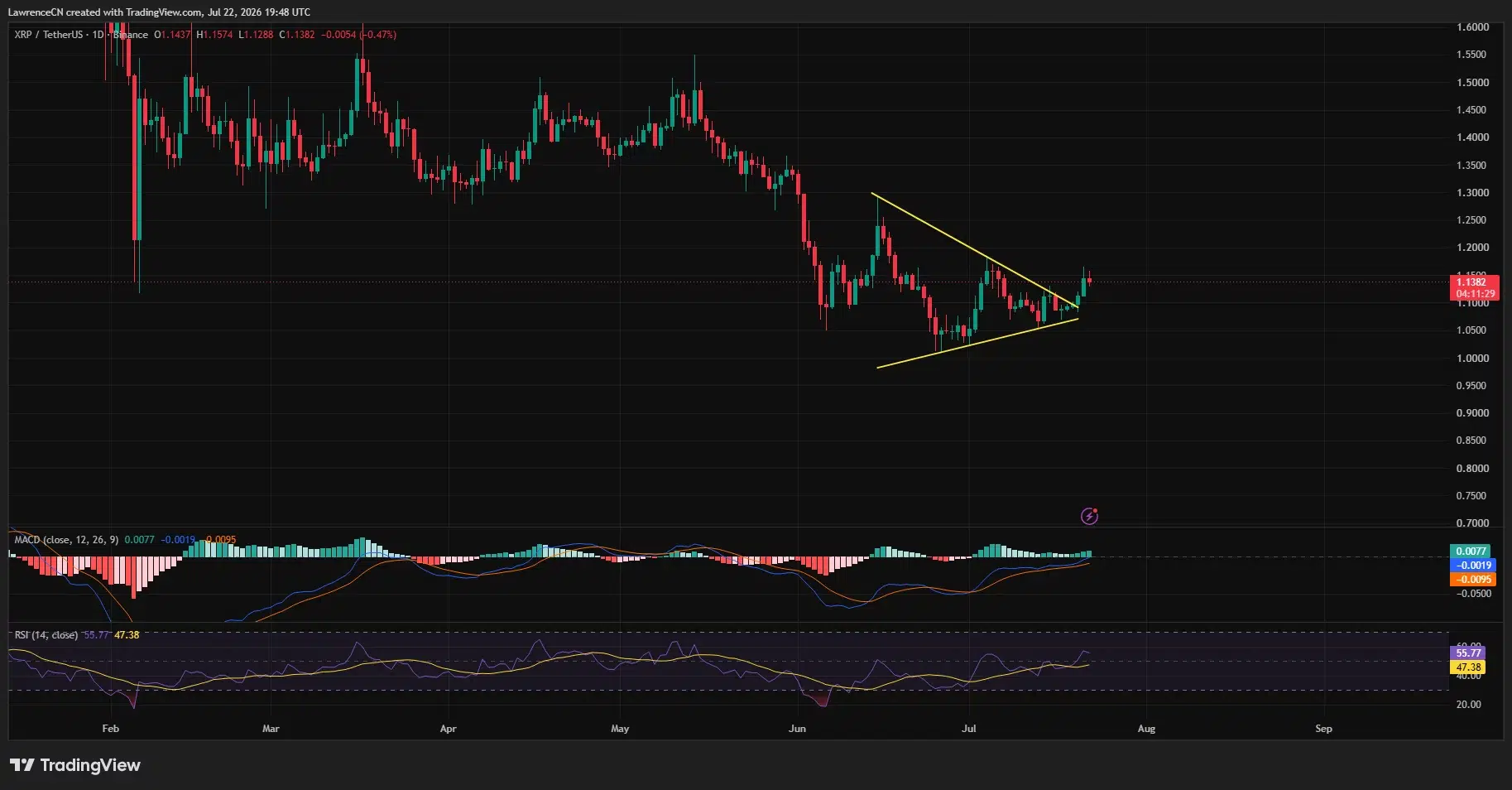
XRP price has climbed nearly 4% to a two-week high of $1.1574 as Bitcoin’s return above $65,000, whale accumulation and fresh ETF inflows have supported its latest recovery.
Summary
- XRP price reached $1.1574 after breaking above a daily symmetrical triangle.
- Whale wallets raised their holdings by 2.8% as smaller balances declined.
- XRP ETFs added $5.66 million while XRPL agentic transactions crossed 1 million.
According to data from crypto.news, XRP (XRP) price was trading near $1.14 at the time of writing, up about 2% over the past seven days, with its market value standing above $71 billion. The token had eased from its session high after sellers returned around $1.16, but prices remained above a recently broken daily resistance line.
Alongside the improvement in crypto sentiment, activity tied to artificial intelligence has supplied a network-level catalyst. XRP Ledger has processed more than 1 million agentic transactions, according to RippleX engineering head J. Ayo Akinyele, as developers test autonomous payments for data, application programming interfaces and computing services.
Agentic payments allow AI-powered software to complete transactions based on programmed instructions without requiring a person to approve each transfer. XRP Ledger can settle these payments in three to five seconds while offering predictable transaction costs, Akinyele told FinanceFeeds.
Commenting on the milestone, Akinyele projected that the transaction count could rise considerably as developers improve the tools available to autonomous agents.
“I think we’ll blast through 10 million and may even get to 100 million within the next couple of years.”
The forecast remains a projection rather than a measure of future XRP demand. Investors would still need to assess whether developers continue building agent-based services, whether those applications attract regular users and how much XRP or Ripple USD they use for settlement.
Whale buying and ETF inflows support the recovery
Santiment data showed that wallets holding between 100,000 and 100 million XRP increased their combined balances by 2.8% during the past five weeks. Over the same period, balances held by wallets containing less than 0.1 XRP fell by 5.2%.
According to Santiment, the opposing trends indicate that whale and shark wallets accumulated tokens while very small holders reduced their exposure. The analytics firm linked the change in holdings to XRP’s rebound toward $1.16, although its data does not establish that large-wallet buying alone caused the price increase.
Demand has also continued through U.S.-listed spot XRP exchange-traded funds. SoSoValue data showed the products attracted $5.66 million in net inflows on July 21, lifting their cumulative intake to about $1.49 billion.
Franklin Templeton’s XRPZ accounted for the entire daily addition, while the other listed products reported no net movement. Trading value across the funds reached $19.16 million during the session, and their combined net assets stood at approximately $1.06 billion, equal to about 1.48% of XRP’s market capitalization.
Among individual products, Bitwise managed the largest pool of assets at $333.50 million, according to the same dataset. The figures show that regulated funds continued receiving capital during XRP’s recovery, but daily flows can vary and do not guarantee sustained price gains.
Daily breakout keeps $1.20 within reach
On the daily chart, XRP has broken above the upper boundary of a symmetrical triangle that formed after its June decline. Price also moved through the descending trendline connecting the June and July swing highs before reaching $1.1574.
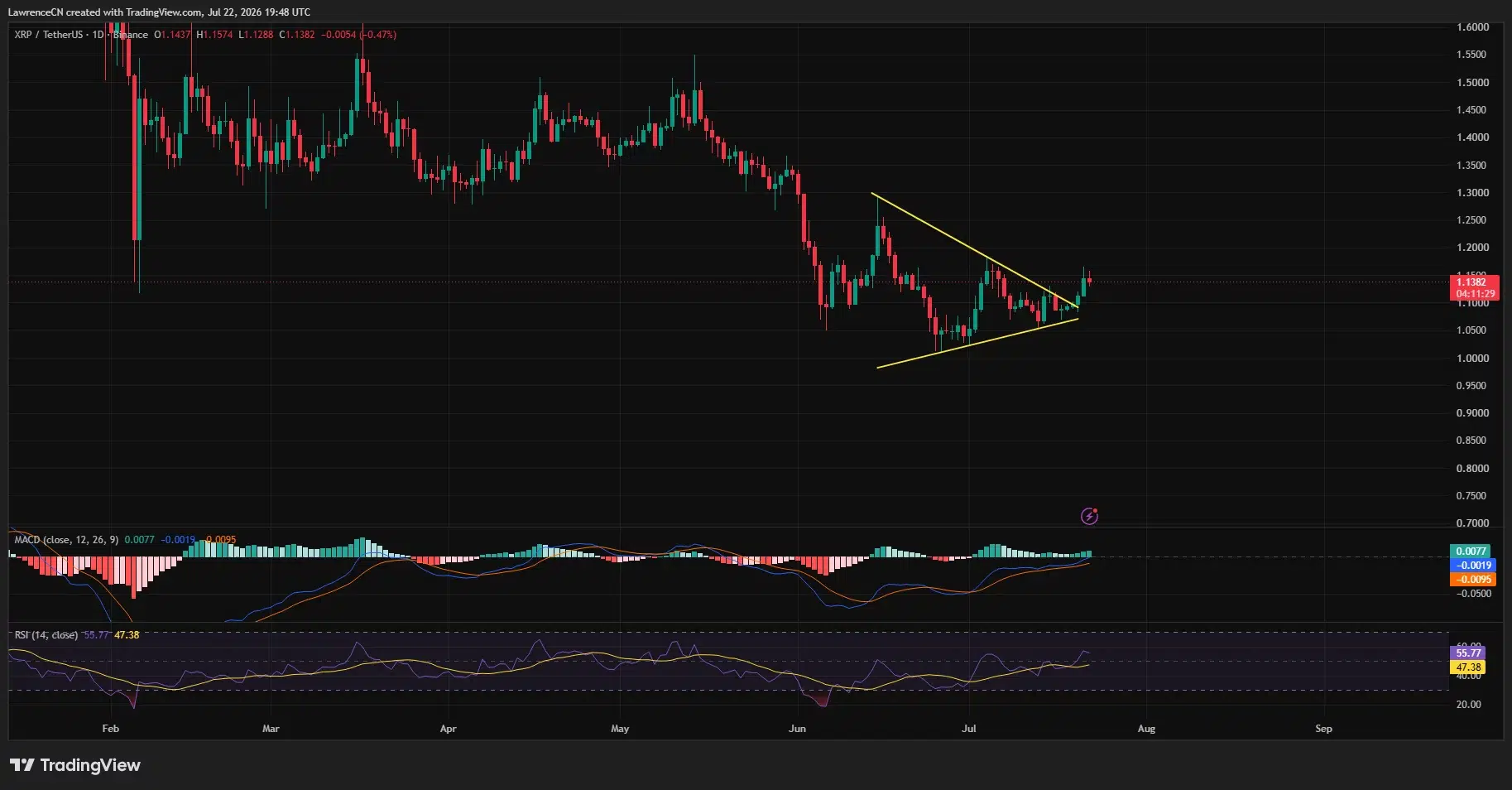
Daily momentum has improved with the breakout. The chart’s relative strength index stood at 55.77, above its moving average of 47.38 and below the overbought threshold of 70. Its moving average convergence divergence histogram had turned positive at 0.0077, while the MACD line was rising toward a possible move above the signal line.
The 4-hour chart, however, showed momentum cooling after XRP’s rejection from $1.1574. The latest candle traded near $1.1385, placing the token just above the Murrey Math trading-range ceiling at $1.1353 and the major support and resistance pivot at $1.123.
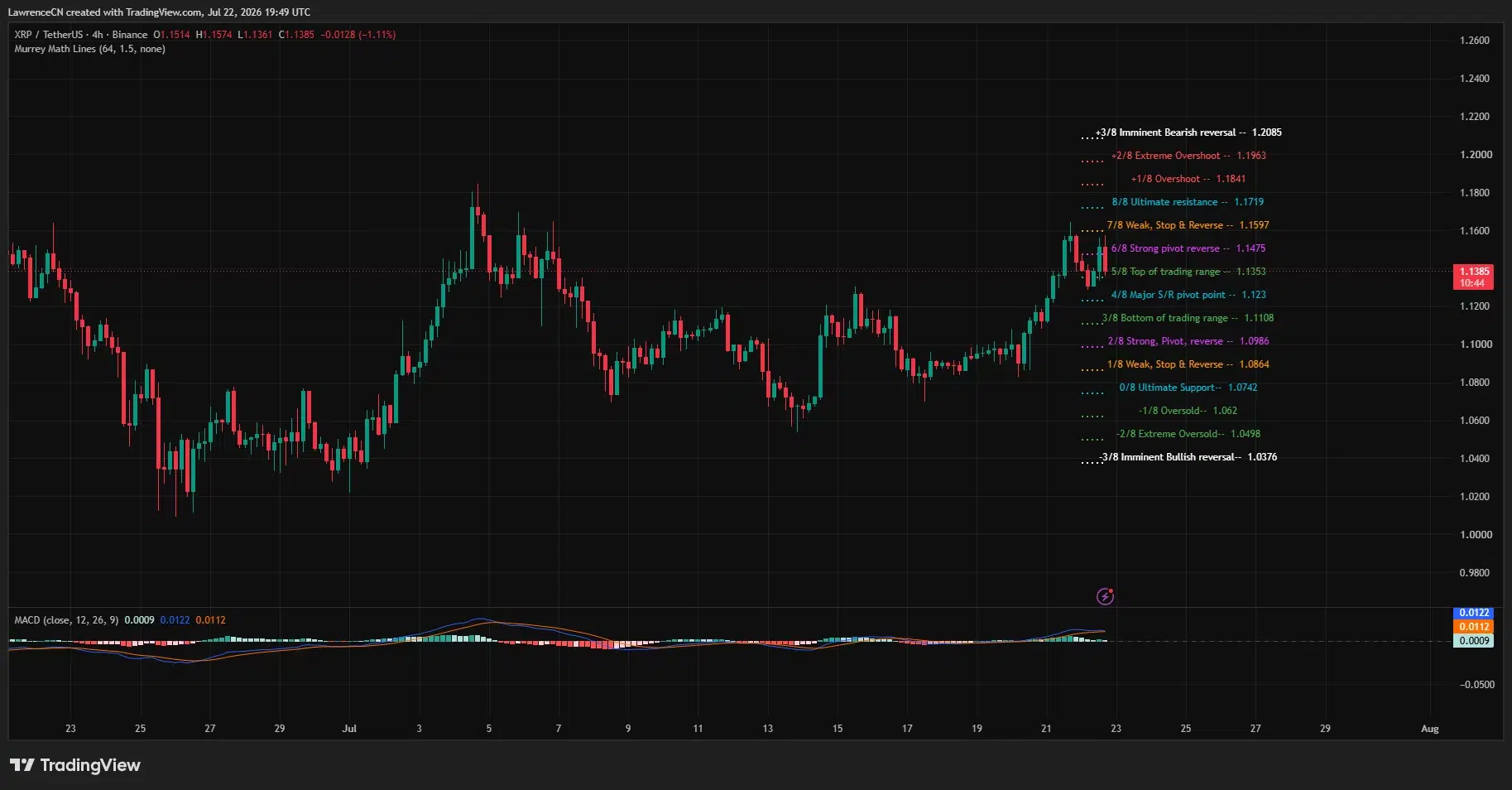
A recovery above the 4-hour strong pivot at $1.1475 would give buyers another chance to challenge $1.1597. The supplied chart places the following resistance levels at $1.1719 and $1.1841, with $1.1963 sitting just below the psychological $1.20 barrier.
4-hour MACD readings remained positive, although the shrinking histogram showed that upward momentum had slowed after the latest advance. This setup leaves buyers needing to defend the breakout instead of relying solely on the earlier impulse.
If XRP closes back below $1.123, the 4-hour chart identifies $1.1106 and $1.0986 as the next support levels. A deeper decline could expose $1.0864 and the ultimate support line at $1.0742, weakening the daily triangle breakout despite continued whale accumulation and ETF demand.
Disclosure: This article does not represent investment advice. The content and materials featured on this page are for educational purposes only.

The Digital Chamber has filed a lawsuit to block Illinois’ upcoming crypto tax.
The industry advocacy group argues that the tax unlawfully targets blockchain transactions for discriminatory reasons.
Illinois Faces Legal Challenge Over Crypto Tax Law
Illinois’ Digital Asset Tax Act (DATA), scheduled to take effect on January 1, 2027, imposes a 0.02% levy on the full value of a digital asset every time it is transferred. The tax applies to crypto exchanges, wallet providers, and custodians based in the state or ones offering services that earn more than $100,000 in Illinois receipts.
The law is the first of its kind in the U.S., with critics who oppose it saying it would impose several layers of tax on a single transaction, which would, in turn, raise costs and discourage crypto activity in Illinois. Andreessen Horowitz crypto executive Miles Jennings even went as far as calling it one of the most “anti-crypto laws” in the United States.
TDC is now asking the court to stop enforcement of the tax provision, arguing that no one should be treated differently for transacting in digital assets. Furthermore, they say that the clause was added to the legislation the night before its final consideration, leaving no room for an actual hearing.
“Today we filed a suit in Sangamon County, IL, to stop the Digital Asset Tax Act..it was slipped into the budget the night before the final vote,” they wrote.
TDC’s members also want the judge to rule that the crypto tax violates state and federal constitutions and to award reimbursement for the crypto lobbying group’s legal fees and court costs.
Crypto Tax Unfairly Targets Blockchain Transactions
The lawsuit also notes that the legislation does not distinguish between transactions that make a profit and those that result in a loss. Instead, it treats transactions differently based on the technology used to record ownership.
What this means is that digital asset transactions recorded on a blockchain are treated differently from those that use traditional financial systems, which, according to TDC, counts as unequal treatment. “No one should be taxed differently because of how ownership of digital assets is recorded or transferred,” they said.
Cody Carbone, CEO of TDC, says taxes should be carefully considered to ensure fairness of all involved, adding that the lawsuit aims to protect consumers and the group’s members.
While Illinois takes a more restrictive approach with the first crypto tax, other states like Texas and Florida are moving in the opposite direction by passing crypto-friendly legislation. In the case of Texas, it passed laws allowing Bitcoin to be held in state reserves, while Florida banned the use of Central Bank Digital Currencies (CBDCs) while also easing the rules for non-custodial crypto operators.
The post Crypto Industry Launches First Major Legal Challenge to Illinois’ Digital Asset Tax appeared first on CryptoPotato.

New McDonald’s near M5 in Somerset could create more than 120 jobs

S&P Unveils Digital Asset Index Tracking Blockchain Fundamentals

Lalit Modi gets major legal relief, says he will return to India this year | Other Sports News


-
 NewsBeat6 days ago
London Mayor Sadiq Khan handed a peerage by Keir Starmer alongside 15 other Labour figures… just days before the PM leaves No10
-

 Fashion5 days ago
Weekend Open Thread – Corporette.com
-

 Politics4 days ago
The House | The City of London can help the new chancellor deliver growth in every postcode
-
 Crypto World5 days ago
Two July Windows Left: The CLARITY Act’s Senate Fight and What Failure Means
-

 Crypto World7 days ago
CFTC blocks Kalshi from unwinding Michigan trades after court order
-

 Crypto World4 days ago
Ripple Payments Joins MiCA With 14 Firms, Does It Mean Anything For XRP?
-

 Business7 days ago
Nvidia Stock Slips After Big Tuesday Rally as Huang Confirms Vera Rubin Chip Is Now in Production Today
-

 Politics3 days ago
Democrats look to World Cup watch parties to register thousands of voters
-

 Crypto World5 days ago
Ripple wins EU-wide access as ESMA adds it to MiCA register
-

 Crypto World2 days ago
Grayscale Files For Worldcoin ETF, WLD Registers Sharp Rise
-

 NewsBeat2 days ago
Unregistered fitter used Gas Safe logo on business flyers
-

 Crypto World6 days ago
Injective Submits SEC Transfer-Agent Registration to Onchain Ownership Records
-

 Tech2 days ago
Sail Virtually Aboard The “Itanic” With IA-64 Emulator
-

 Business7 days ago
Palantir Shares Rise After Expanded Nvidia Partnership and Fresh Analyst Upgrades Ahead of Earnings Day
-
 Tech2 days ago
Turtle Beach Command Series KB7 review: a nifty screen-equipped gaming keyboard
-

 NewsBeat5 days ago
Registration is now open for March for Men with Kev 2026
-
 Business17 hours ago
New Jersey voter registration controversy explained: How 6,600 noncitizens got on the rolls, and what happens next
-

 News Videos6 days ago
Money | Class 12 Economics | CBSE Board Exam 2026-27
-

 Crypto World6 days ago
Claude Fable 5 Slips to Second in AI Coding Leaderboard
-

 Business6 days ago
Banco Bilbao Vizcaya Argentaria, S.A. (BBVA) Discusses Global Macro Environment and Economic Outlook for Core Markets Transcript
You must be logged in to post a comment Login