
Crypto World
Bitcoin Network Warning: Developers Find Nearly 5,000 Vulnerabilities

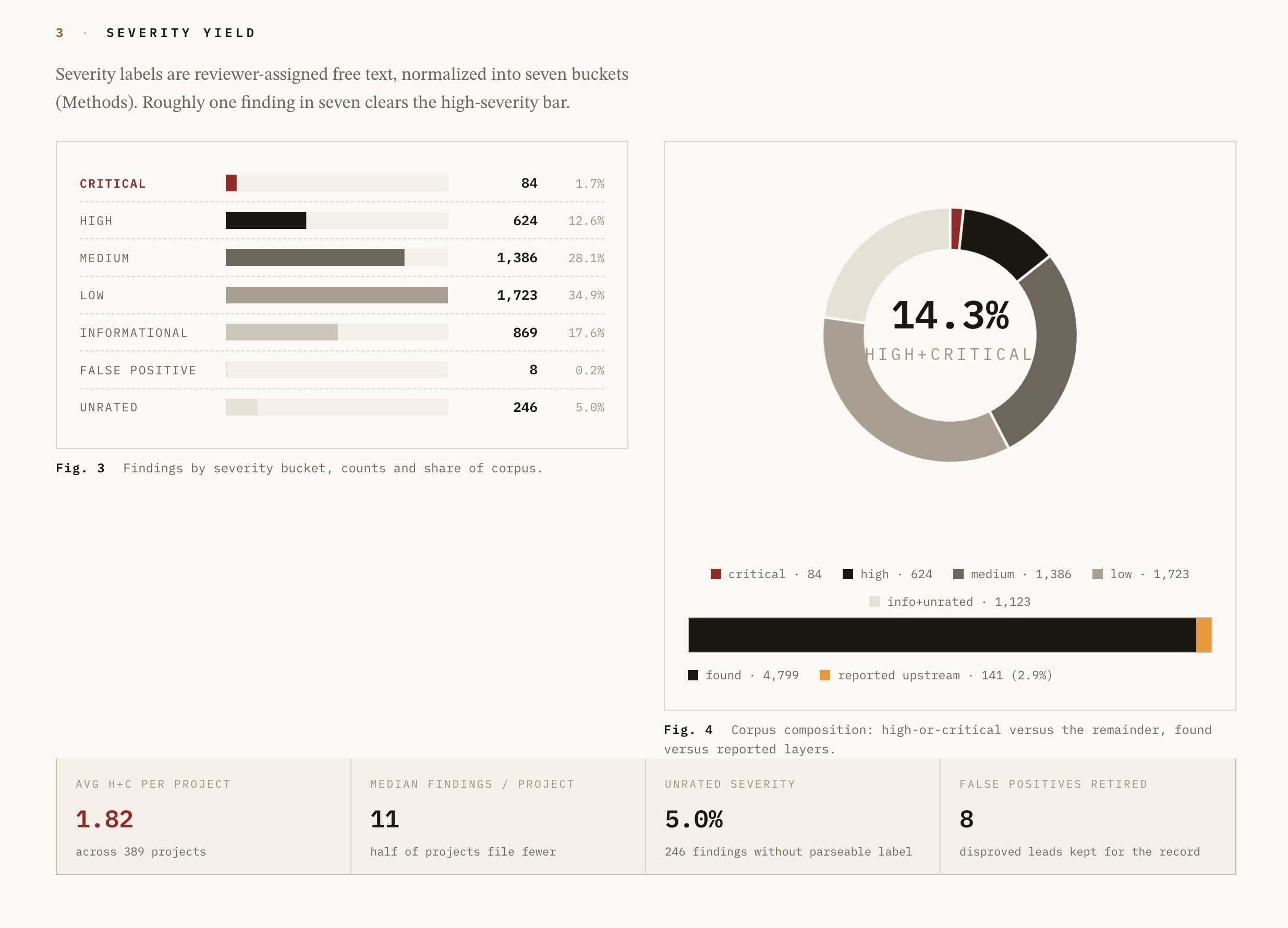
Volunteer developers filed 4,962 security findings across 390 Bitcoin projects in about 30 hours. Of the 391 codebases they reviewed, exactly one came back clean.
The group calls itself the Bitcoin Red Team. It rated 720 of those findings high or critical. Only 147 have reached the maintainers who have to fix them.
Every 1 in 7 Findings is Serious
The severity split is narrower than the raw total suggests. Reviewers logged 85 critical issues and 635 high ones.
That works out to 14.5% of everything filed. The rest sit in medium, low, or informational buckets. Another 246 findings carry no severity label at all.

Evidence quality varies too. About 21.4% came with working proof-of-concept code. Roughly 91% arrived through automated scanning. Reviewers retired just eight as false positives.
Follow us on X to get the latest news as it happens
One Hour Produced 83% of the Findings
The 30-hour framing needs a caveat. A single hour absorbed 4,101 findings. That spike was a backfill, not live scanning. Rob Hamilton, chief executive of Bitcoin insurer AnchorWatch, ran his own review before the campaign formally began.
He said he spent over $10,000 scanning more than 100 libraries.
Strip the dump out, and the pace changes sharply. Roughly 840 findings were received over the other 29 hours. That is closer to 29 an hour than the 166.3 the report advertises.
The Data Points Away From Hardware Wallets
The category breakdown carries a surprise. Hardware wallets and firmware, the group Coldcard belongs to, ranked second lowest for serious flaws at 9.6%.
Other corners fared worse. Mining pools hit 21.7%, infrastructure and tooling 21.5%, and swaps and exchanges 20.9%. Privacy tools topped the table at 24%, though reviewers covered only three of them.
Crypto libraries carried the volume instead. They produced 1,385 findings across 128 projects, more than a quarter of the corpus.
Calle, the pseudonymous physicist who created the Cashu ecash protocol, said maintainers are confirming the worst reports.
Most of the critical reports we’ve made so far were quickly verified by project owners. We know we’re hitting real targets,” they wrote.
Why the Red Team Formed After Coldcard
The sweep began because of one broken chip. Coinkite disclosed on July 30 that seed generation on affected Coldcard devices fell back to a predictable software routine.
The shortfall was severe. Only 32 bits came from the secure element, capping an attacker’s search at about 4.3 billion guesses.
Galaxy Research pegged confirmed thefts at 1,596 Bitcoin (BTC) from roughly 7,300 addresses on Aug. 4. A suspected fourth attack wave would bring the total to nearly $130 million. Galaxy stresses its address list is not definitive.
The panic showed up on-chain, where active addresses spiked to a 20-month high. Korean holders largely escaped because dice-based seeds are common there.
Weak randomness keeps returning in Bitcoin, however. The 2023 Milk Sad bug seeded Libbitcoin Explorer keys from 32 bits of clock time. In May, the Ill Bloom vulnerability drained $5.7 million from wallets built on a weak JavaScript generator.
Funding Follows the Findings
OpenSats, a nonprofit that funds Bitcoin development, launched a Code RED grant track on Thursday. It pays researchers who disclose flaws. It also refunds the artificial intelligence (AI) bills the work runs up.
Meanwhile, Bitcoin traded near $64,396 on Thursday, up 0.5% over 24 hours. The audit has not moved the market.

Context still matters for the raw number. These are findings, not confirmed exploits, and most will never be weaponized.
On the evidence so far, though, Coldcard was not an isolated failure. The data also suggests the next one will not be a hardware wallet.
The post Bitcoin Network Warning: Developers Find Nearly 5,000 Vulnerabilities appeared first on BeInCrypto.



Giving AI the ability to spend your money – are we already there? An AI agent can now book a flight, renew software, or purchase computing power for a business. The next step is allowing that agent to complete the payment on its own.
That shift is already underway. Coinbase’s x402 protocol has processed 109.6 million transactions and around $15 million in adjusted volume since May 2025.
Most were tiny payments, but on a larger scale, this creates a larger problem. Someone must confirm who controls the agent, how much it can spend, and whether the recipient is legally allowed to receive the payment.
This becomes harder when stablecoins and other blockchain payments settle within seconds and generally cannot be reversed.
Sphere Labs is building SphereNet to handle that part of the process. On August 3, the company announced that Deutsche Telekom would operate a validator from the network’s current testnet through its planned 2027 mainnet launch.
Checking the Rules Before Money Moves
Traditional financial institutions can investigate suspicious transactions after settlement. They may freeze an account, reverse a transfer, or attempt to recover the funds.
Instant blockchain settlement leaves far less time to intervene. SphereNet aims to move identity checks, sanctions screening, and jurisdictional rules directly into transaction execution. The payment reaches final settlement only after those conditions are met.
Consider an AI agent purchasing cloud storage for a company. SphereNet would need to identify the company behind the agent, confirm that the agent has permission to spend, screen the receiving business, and apply the rules governing both jurisdictions. The transfer could then settle without waiting for a manual review.
Google, Visa, and Mastercard are developing systems that help merchants recognize approved agents and confirm what users authorized them to do. SphereNet is working on the regulated settlement layer underneath those systems.
“Everyone debating agentic payments is debating the AI component,” Sphere Labs CEO Arnold Lee said. “The true constraint is trust.”
Deutsche Telekom’s Enterprise Validator Experience
A validator runs the infrastructure that checks transactions and helps the network maintain one agreed financial record. For SphereNet, that means confirming that transactions have followed the network’s rules before they become final.
Deutsche Telekom MMS already operates validator infrastructure for several established blockchain networks. SphereNet gives that experience a more specialized role: supporting a ledger designed for banks, payment companies and other regulated institutions.
The telecom group also brings considerable operating scale. Deutsche Telekom had 273 million mobile customers and a presence in more than 50 countries at the end of 2025. Its networks already connect people, companies and devices across different financial systems.
Sphere Labs has an existing payments business behind the project. The company says SpherePay processes billions of dollars in annualized cross-border volume for more than 200 businesses and institutions.
SphereNet extends that compliance model into a shared network operated with external validators.
The larger test begins when the mainnet launches. SphereNet will need licensed institutions, reliable performance and support across enough jurisdictions to make the network useful.
Deutsche Telekom gives it an experienced infrastructure partner as it moves toward that test—and toward a financial system where the next customer making a payment may be a machine.
The post Deutsche Telekom and SphereNet Is Helping Build Payment Rails for AI Agents appeared first on BeInCrypto.


Rarible has launched its NFT marketplace on Solana after months of development, naming Claynosaurz as its first featured collection.
Summary
- Rarible is now live on Solana following several months of building and testing.
- Claynosaurz became the marketplace’s first featured Solana NFT collection.
- Rarible plans to add more Solana collections and marketplace features in the coming weeks.
- The expansion comes as EU lawmakers consider clearer rules for NFTs and other crypto sectors.
Rarible expands its marketplace to Solana
Rarible announced the launch on Thursday, marking its latest expansion beyond the blockchain networks already supported by its NFT marketplace.
Claynosaurz, a Solana-based entertainment and NFT brand built around animated dinosaur characters, will serve as the first featured collection. Rarible said it would onboard additional projects from across the network over the coming days and weeks.
“We’ve actually been working on Solana for months,” the company said. “Today, we’re incredibly excited to finally say it: Rarible is now live on Solana.”
The company did not disclose how many collections would be added during the initial rollout or provide a fixed schedule for future integrations.
Rarible said its team spent several months developing and testing the Solana marketplace. It also consulted NFT communities to understand how individual projects approach their identities, cultures, and collector bases.
According to the company, feedback from those discussions shaped some of its product decisions. Rarible said it wants to create collection-specific experiences instead of merely listing assets on a standard marketplace interface.
Gacha Station previewed Rarible’s Solana plans
Rarible described its earlier Gacha Station release on Solana as an initial look at the broader integration rather than a standalone product.
Gacha Station lets users purchase randomized digital collectibles, borrowing its format from capsule-toy and loot-box systems. Its rollout gave Rarible an early way to test products and user activity on Solana before launching the wider marketplace.
The company characterized the current marketplace as a foundation for a larger expansion. Planned updates include additional collections, new features, improvements to the trading experience, editorial content and community campaigns.
Rarible did not provide transaction-volume targets or details about how it plans to compete with established Solana NFT platforms. Marketplace adoption will depend partly on the collections it secures and whether it can attract collectors already active elsewhere in the ecosystem.
Why Solana matters for Rarible
Solana offers relatively low transaction fees and faster settlement than several older blockchain networks, making it a common venue for frequent NFT trading and lower-priced digital collectibles.
Adding the network allows Rarible to reach Solana-native creators and collectors without requiring them to move assets to another blockchain. It also gives projects another marketplace through which they can present and trade their collections.
The launch comes as NFT marketplaces face pressure to distinguish themselves through creator tools, community features and collection-specific products. Trading fees have also fallen across the sector as competing platforms seek to attract liquidity.
For U.S. users, Rarible’s announcement did not identify any new geographic restrictions or changes to marketplace access. NFT regulatory treatment in the United States can depend on how a collection is marketed and structured, rather than the blockchain on which it trades.
EU lawmakers seek a review of NFT rules
Rarible’s Solana expansion also arrives as European policymakers consider whether NFTs should fall more clearly within the bloc’s crypto regulations.
In July, the European Parliament adopted a policy report calling on the European Commission to examine decentralized finance, staking, crypto lending, borrowing and NFTs following the full rollout of the Markets in Crypto-Assets regulation.
The report did not change MiCA or create immediate obligations for NFT marketplaces. However, it established Parliament’s position that areas outside the existing framework may require further review.
MiCA’s transition period ended on July 1, requiring covered crypto-asset service providers to secure EU-wide or national authorization to continue operating across the bloc. Whether future rules extend more explicitly to NFT services could affect marketplaces such as Rarible as they add networks, collections and users.
For now, Rarible plans to continue expanding its Solana marketplace gradually, with its next phase centered on onboarding projects and refining the platform using feedback from the network’s communities.


Canaan has authorized management to sell part of its Bitcoin and Ethereum holdings to finance share repurchases under an existing $30 million program.
Summary
- Canaan’s crypto treasury was worth about $130 million as of Aug. 3.
- The miner held 1,915 BTC and 3,952 ETH at the end of June.
- Canaan had spent $2 million on buybacks as of May 19.
- Its Nasdaq-listed shares must regain the $1 minimum bid price by Jan. 11, 2027.
Canaan opens crypto treasury to fund buybacks
Nasdaq-listed Bitcoin miner Canaan has authorized management to monetize part of its digital asset treasury and use the proceeds to repurchase its American depositary shares.
The purchases will fall under an existing program that allows Canaan to buy back up to $30 million of its ADSs or Class A ordinary shares during the 12 months beginning Dec. 12, 2025, according to the company’s Aug. 4 announcement.
Canaan did not disclose how much cryptocurrency it intends to sell or when any sales will occur. The company also did not commit to using the entire remaining authorization.
Canaan did not disclose how much cryptocurrency it intends to sell or when any sales will occur. The company also did not commit to using the entire remaining authorization.
Further transactions will depend on Canaan’s share price, broader market conditions, working capital requirements, and board approval. Repurchases may take place through open-market transactions, block trades, or privately negotiated deals.
As of May 19, Canaan had spent approximately $2 million to repurchase 2.8 million ADSs. This left a nominal $28 million under the authorization at the time, although the company has not disclosed whether it completed additional purchases before the latest announcement.
Crypto holdings reached $130 million
Canaan held 1,915 BTC and 3,952 ETH at the end of June. The company valued the combined portfolio at approximately $130 million using market prices from Aug. 3.
Its Bitcoin balance increased by 49 BTC in June after accounting for operating costs and BTC received as payment for mining-machine sales. Canaan mined 64 BTC during the month.
Chairman and CEO Nangeng Zhang said the company’s mining operations provide a continuing source of Bitcoin that can be used as capital.
“At current trading levels, we believe Canaan’s market value does not fully reflect the value of our digital asset holdings, cash position, and the strength of our underlying business.”
Canaan said it was trading below the combined value of its cryptocurrency holdings and the cash and cash equivalents reported at the end of March. However, the comparison does not account for the company’s liabilities or restrictions affecting parts of its treasury.
At the end of March, Canaan held $43.5 million in cash. It also reported that 905 BTC had been pledged against secured term loans, while another 100 BTC had been transferred to a fixed-term product.
Mining efficiency improves as capacity stays idle
The decision follows improvements in Canaan’s North American mining efficiency despite underused capacity.
Canaan achieved fleet efficiency of 17.9 joules per terahash across its North American non-joint venture operations in May. It marlet, an 11% improvement from the previous year and a roughly 4% gain from the 18.7 J/TH recorded in March and April.
Operating activity nevertheless remained below installed capacity. At the end of May, Canaan had 10.05 exahashes per second of installed non-joint venture capacity, while only 6.47 EH/s was operating after a hosting agreement expired.
By June, non-joint venture operating hashrate had fallen further to 3.36 EH/s. Joint venture operations recovered to 4.09 EH/s following wildfire-related disruption at facilities in West Texas.
Nasdaq compliance remains a risk
Canaan’s ADSs were trading near $0.19 on Aug. 6, well below Nasdaq’s $1 minimum bid-price requirement. Each ADS represents 15 Class A ordinary shares.
Nasdaq granted the company an additional 180 days, until Jan. 11, 2027, to regain compliance. Canaan must maintain a closing bid price of at least $1 for a minimum of ten consecutive business days.
The company has not directly linked the buyback decision to its listing deficiency. Still, repurchases could reduce the number of outstanding shares and offer price support, while selling cryptocurrency would lower the reserves available for mining operations, debt obligations, and working capital.


Fundstrat’s Tom Lee said on CNBC he expects the S&P 500 to reach 7,900 to 8,000 this month.
He also named Ethereum as an unexpected leader of the next leg higher, alongside the Magnificent Seven and software stocks.
Lee’s case for an August breakout
Lee said a deleveraging event a few weeks ago pushed cash to the sidelines. It also left investor sentiment too bearish, he said.
He added that strong earnings and cooling inflation fears are now driving a “chase” higher. AI spending also remains a strong theme, Lee said.
The anchor framed the recent pullback as froth clearing, not a fundamental shift. Lee agreed, then pointed to fresh earnings data.
This quarter’s results are running more than $15 ahead of estimates set at the quarter’s start, Lee said. He added that 2027 earnings estimates have risen $8, nearing 410, with room to reach 425 by season’s end.
Lee is no stranger to bold S&P 500 calls. He made a similarly aggressive prediction last November, and other strategists have floated comparable 8,000 targets for this year.
Ethereum’s unusual role in the bull case
Lee’s Ethereum comment came with an important caveat. He was not saying Ethereum would push the S&P 500 higher, but rather play a role on boosting DRAM, and memory stocks, the current catalyst for the entire market.
He remains bullish on semiconductor, DRAM, and memory stocks. Those groups are correcting now, but he expects a recovery similar to 1997 and 1998.
“The recovery here, I think, is going to be led by the Magnificent Seven, software and ethereum,” Lee said.
That puts Ethereum in the same sentence as mega-cap tech and software. It is a separate, forward-looking pick from his semis and memory thesis.
The comment lands as Ethereum has drawn more whale buying. ETF inflows have also picked back up in recent weeks.
A more measured take from Lee’s panelist
Fellow panelist on CNBC, Dan Greenhouse, offered a cooler view. He noted the S&P 500 was already near 7,700, so an 8,000 target is a modest percentage move.
Greenhouse also argued the earnings picture is broad, not just tech-driven. Financials, insurers, and card companies are all signaling strength, he said.
He pointed to two straight weeks of jobless claims under 200,000, a rare stretch historically. That backdrop, he said, is simply positive.
The bullish case echoes a broader debate over AI valuations. Some strategists question how far this rally can stretch.
Whether Ethereum can keep pace with the Magnificent Seven and software through August remains unproven. That answer will likely hinge on ETF flows and on-chain activity in the coming weeks.
The post Tom Lee Sees S&P 500 at 8,000, Names Ethereum the Next Rally Leader appeared first on BeInCrypto.

About 64 Bitcoin, worth $4.17 million, and 200 Ether, worth $380,000, linked to the recent Coldcard exploit were sent to cryptocurrency mixing protocols, according to blockchain security platform CertiK.
The Bitcoin transfer was from address bc1q0 to crypto mixing protocol Wasabi on Tuesday, according to blockchain data shared by CertiK.
“We think it might be a smaller exploiter. There’s likely a few copycats after the initial exploit,” a CertiK spokesperson told Cointelegraph. The 200 Ether (ETH) was transferred to Tornado Cash on Wednesday, according to CertiK’s X post.
Crypto mixing protocols such as Tornado Cash typically pool and then scramble the cryptocurrency from multiple users, breaking the publicly traceable onchain link between senders and recipients. This makes it difficult to trace the stolen funds, decreasing the chances of asset recovery.
In April, the hacker behind a $293 million Kelp DAO hack laundered about 75,700 Ether, then worth $175 million, primarily through THORChain, generating about $910,000 in fee revenue for the protocol. The attacker also used the Umbra privacy protocol.
The Coldcard exploit has now become the third-largest cryptocurrency hack so far in 2026. It drained at least $100 million in Bitcoin across three confirmed attack waves from 7,300 victim wallets, according to Galaxy Digital. The company also identified a suspected fourth wave that could bring total losses to about $130 million in BTC.

Source: CertiK
Most copycats haven’t moved stolen funds
Onchain tracing by TRM Labs showed that the majority of victim funds were still pooled in a small number of attacker-controlled addresses with limited mixing attempts, according to a Thursday report.
The blockchain intelligence company said that the “differences in transaction construction” during each attack wave hint at multiple attackers behind the exploit.
The analysis is in line with Galaxy’s previous findings that showed at least 15 different attackers who exploited the Coldcard vulnerability.
Related: AI has not triggered DeFi ‘hackpocalypse,’ Dragonfly partner says
TRM Labs said that a firmware bug from March 2021 weakened seed randomness on some Coldcard wallets, cutting key strength to 40 bits from 128 bits, making it “brute-forceable without physical access.”
Dragonfly managing partner Haseeb Qureshi wrote that roughly “$2 of AI hardening” could have prevented the Coldcard exploit, citing social media reports that some AI models rediscovered the vulnerability that led to the attack in less than 20 minutes.
Magazine: Does Botanix’s failure prove Bitcoiners don’t care about DeFi?
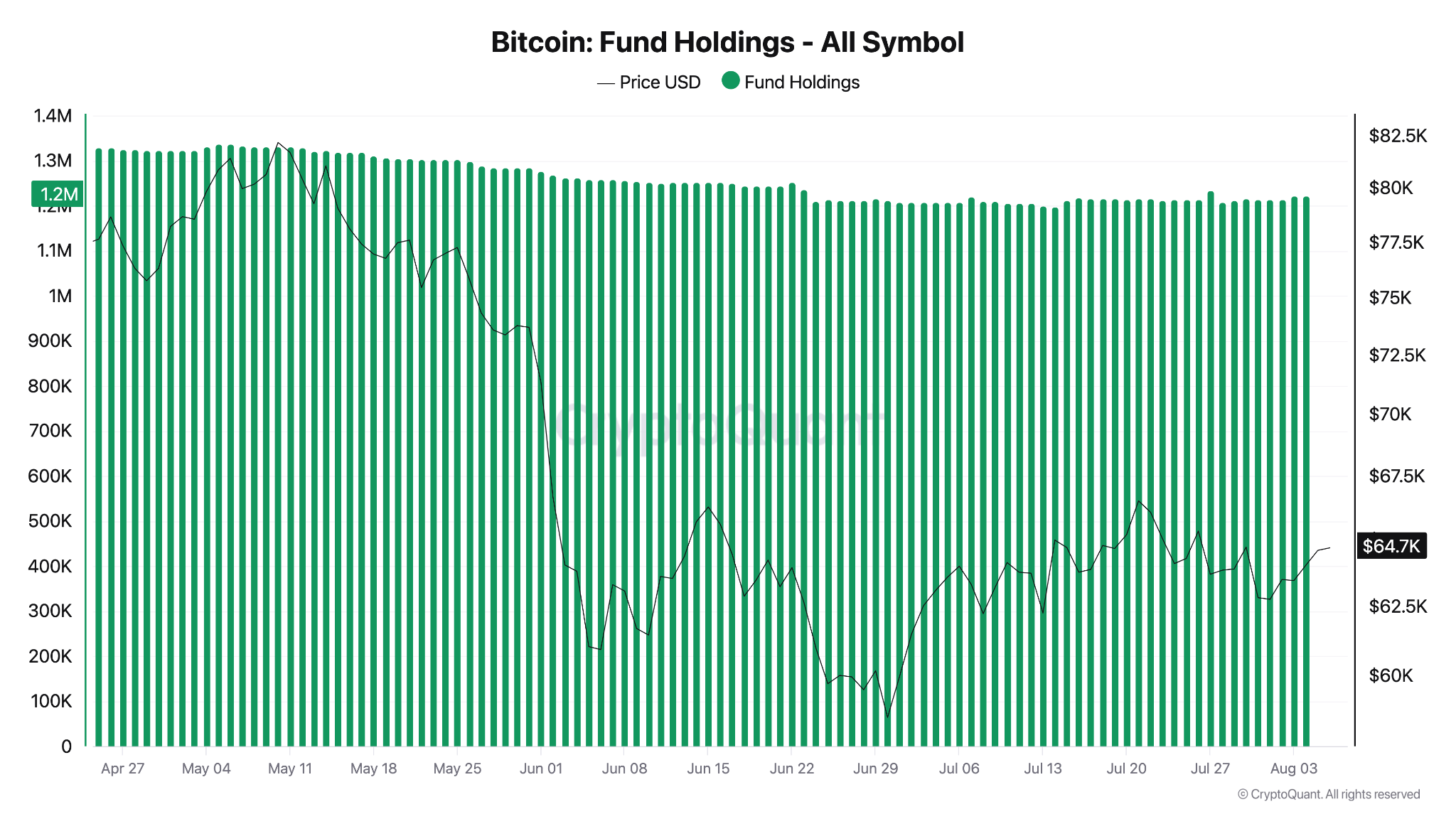
Bitcoin (BTC) institutional investment vehicles have shed 10% of their BTC holdings since May as analysis warns of a “breaking” sector.
Key points:
- Bitcoin institutional funds see a blanket 10% reduction in holdings over three months.
- Analysis says that the Bitcoin treasury model is “breaking” as company valuations fall below net asset value.
- Coinbase premium has been negative for a record 93 days.
Fund exposure drops as Bitcoin treasury companies face squeeze
Data from onchain analytics platform CryptoQuant shows that combined institutional BTC exposure, which includes trusts, exchange-traded funds (ETFs) and closed-end funds, has fallen from 1.33 million to 1.20 million BTC over three months.
Bitcoin fund holdings. Source: CryptoQuant
The drawdown comes as another major Bitcoin institutional investment vehicle, corporate treasuries, faces upheaval. Business intelligence software company Strategy, which holds the largest Bitcoin treasury of any public corporation, sold 1,638 BTC last week.
“Bitcoin treasury companies once amplified demand through a reflexive financing loop. Their shares traded above the value of their Bitcoin holdings, allowing them to issue equity or debt, buy more Bitcoin and reinforce the premium. That mechanism weakens when market capitalisations fall below net asset value, and financing becomes dilutive,” contributing analyst Novaque Research commented.
CryptoQuant highlights the plight of several Bitcoin treasury companies with stock trading below the net asset value (NAV) of their BTC holdings. In Strategy’s case, the discount disappears according to the valuation methodology used.
Basic share count puts the discount at 0.7 as of Thursday, but once the company’s $8 billion debt and liquidation preference of its STRC preferred stock is factored in, the mNAV equals 1.03.
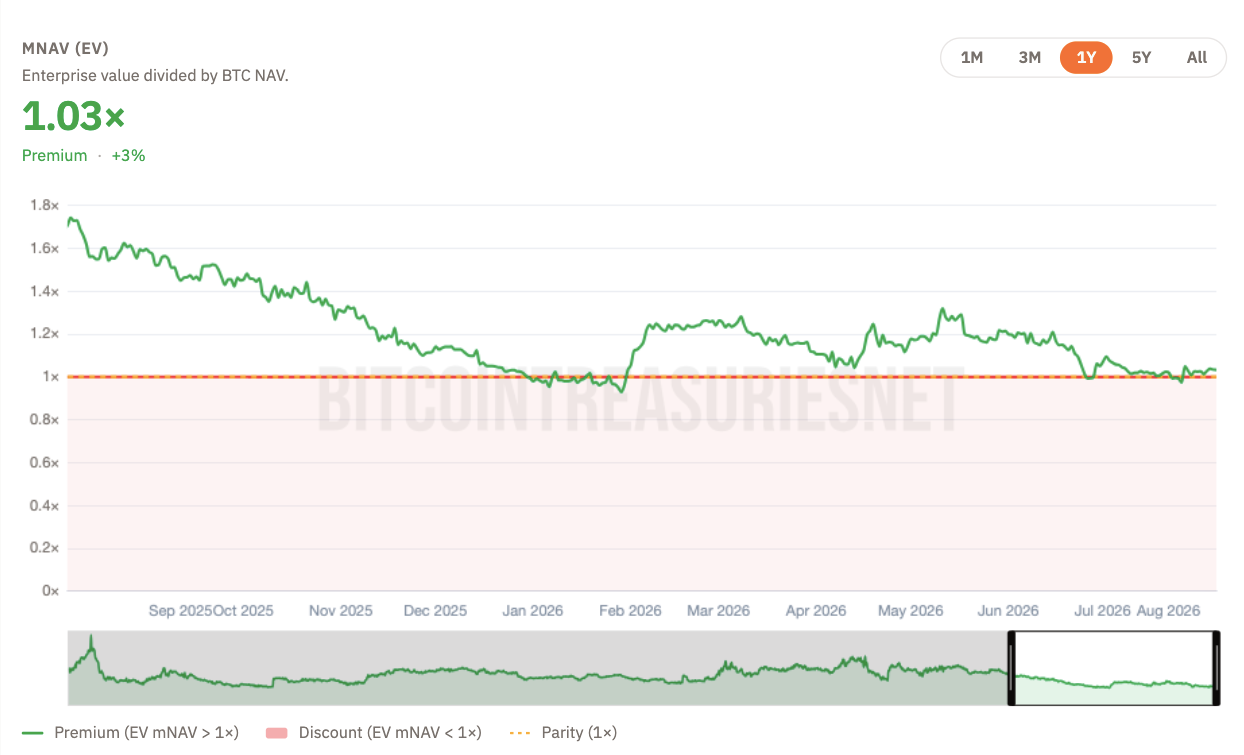
Strategy Updated mNAV. Source: Bitcoin Treasuries
“The on-chain evidence supports a loss of institutional demand, although it cannot directly isolate treasury companies,” CryptoQuant notes.
Coinbase Premium sees record negative stint
The drawdown in both fund exposure and Bitcoin treasury holdings comes as the Coinbase Premium index sees a record 93 days of negative readings.
Related: Bitcoin price-metric basket sees longest capitulation since FTX blow-up: Glassnode
As Cointelegraph reported this week, the Index, which measures the difference in price between Coinbase’s and Binance’s BTC/USDT pairs, has been negative since the start of May — a record streak.
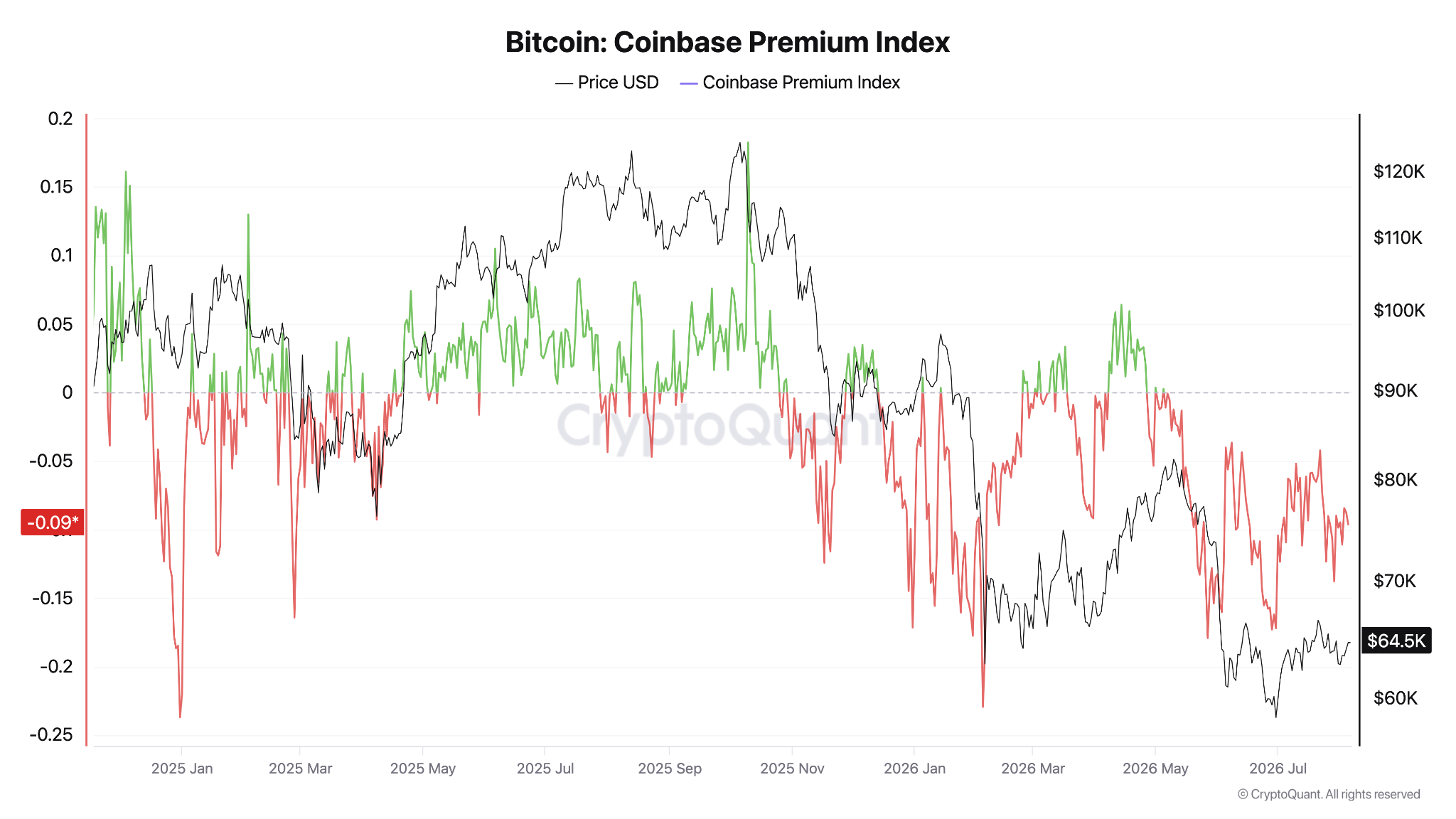
Coinbase Premium Index. Source: CryptoQuant
Analysis sees the return of the Premium as a prerequisite for a BTC price recovery. This week, Web3 marketing platform FOUR argued that the genesis of the months-long negative reading did not lie in blanket US selling pressure.
“Until the premium flips positive, institutional buying from U.S. investors appears muted—suggesting this is more of a demand shortage than aggressive selling,” it told X followers.
In a note quoted by Reuters last month, Citi highlighted ETF flows in particular as an “important driver of prices” while cutting its BTC price forecast to $53,000 through 2027.
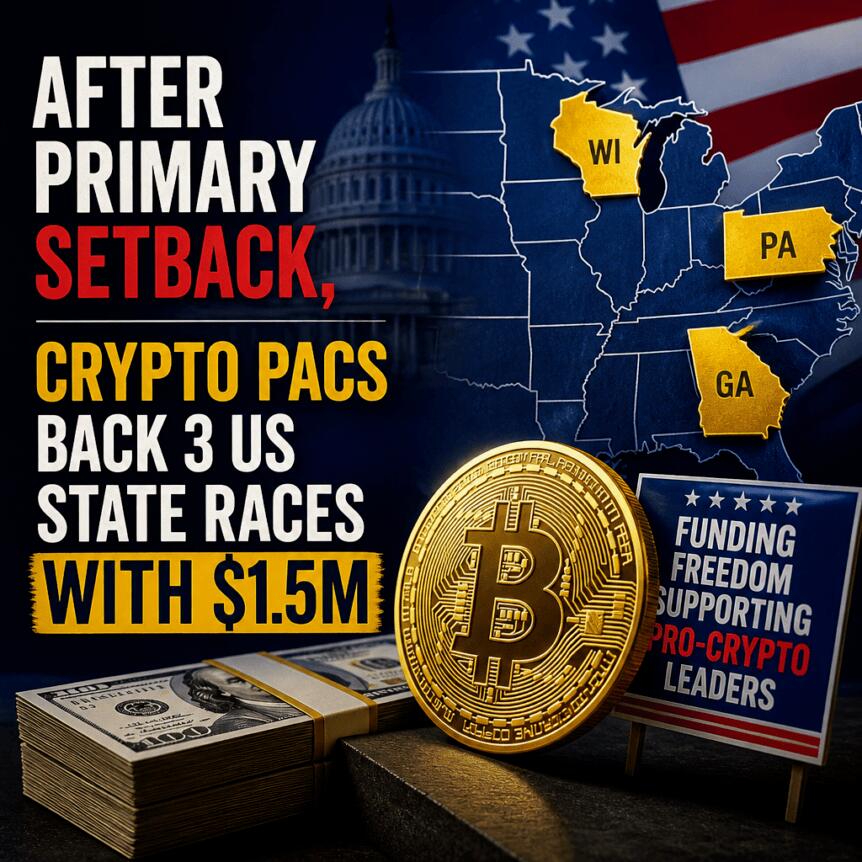
Fairshake-linked political action committee (PAC) affiliates reported new campaign spending aimed at federal primaries in several states, according to Federal Election Commission (FEC) filings reviewed as of Thursday. The disclosures include more than $1.5 million spent on media backing House and Senate candidates in Florida, Alaska and Wyoming, after a related primary loss in Michigan on Tuesday.
The latest expenditures were filed by two Fairshake-affiliated groups—Defend American Jobs and Protect Progress—each aligned with the broader push for U.S. crypto market-structure legislation. Many of the candidates supported in the new filings have voting records in favor of the Digital Asset Market Clarity (CLARITY) Act and other related proposals.
Key takeaways
- FEC filings show Fairshake PAC affiliates spent a combined more than $1.5 million on political media in Florida, Alaska and Wyoming after a Michigan primary loss.
- Defend American Jobs reported over $500,000 for Alaska’s Aug. 18 at-large GOP primary and comparable spending in Florida’s 16th district.
- Protect Progress reported more than $50,000 on Florida’s 23rd district, supporting incumbent Representative Lois Frankel.
- The spending reflects how Fairshake-aligned groups are using election cycles to reward or reinforce crypto-related legislative voting records.
Fairshake affiliates ramp up media buys for Aug. 18 primaries
FEC filings as of Thursday indicate that Defend American Jobs and Protect Progress spent together more than $1.5 million on media related to federal contests in Florida, Alaska and Wyoming. The figure is tied to primary elections scheduled for Aug. 18 in multiple states.
In Alaska’s at-large congressional district, Defend American Jobs reported spending more than $500,000 on media supporting the re-election of Representative Nick Begich. In Florida, the same group spent about $500,000 backing Republican candidate Sydney Gruters in Florida’s 16th district.
For Wyoming’s political calendar, the reported spending also references a contest connected to the state’s upcoming Senate vacancy. Protect Progress-affiliated activity backed Representative Harriet Hageman, a candidate now running for the soon-to-be-vacant Senate seat currently held by Cynthia Lummis. Like Alaska and Florida, Wyoming’s primary is also listed as occurring on Aug. 18.
Michigan defeat follows heavy pre-election spending
The new disclosures come immediately after Protect Progress-supported activity appeared to backfire in Michigan’s 13th Congressional District. On Tuesday, Democratic incumbent Shri Thanedar lost a primary to State Representative Donavan McKinney, according to earlier coverage from Cointelegraph.
In connection with that Michigan race, Protect Progress previously reported spending more than $2 million on media supporting Thanedar. Thanedar’s current term in Congress ends in January 2027, making the outcome consequential for the district’s future representation.
While the FEC numbers in the Michigan race indicate substantial investment, the primary result underscores that large independent political spending does not guarantee electoral success—particularly in competitive districts where local dynamics and voter preferences can override national legislative alignment.
Who the PAC backs: CLARITY and GENIUS voting records in focus
Beyond the election cycle’s tactical spending, the disclosures highlight a recurring theme in U.S. crypto politics: PACs and advocacy-aligned groups appear to target candidates based on their legislative history. The filing-related reporting notes that Begich, Frankel and Hageman voted in favor of the GENIUS Act and the CLARITY Act during their time in Congress.
On the Democratic side, Protect Progress reported spending more than $50,000 to support the re-election of Lois Frankel in Florida’s 23rd district. Frankel’s voting alignment with GENIUS and CLARITY places her within the group of lawmakers that crypto-aligned backers have previously tried to reinforce with campaign support.
By contrast, the reporting indicates that Gruters did not appear to have made public statements about crypto or blockchain in the same manner as some other candidates, with one exception: she reportedly supported the crypto market structure bill in a questionnaire response conducted by the advocacy organization Stand With Crypto.
Those distinctions matter because they show how crypto-aligned groups may weigh both formal voting records and documented position statements when deciding where money goes—an approach that can help explain variations in spending patterns across candidates and parties.
Why these filings could matter for the 2026 cycle
The most important implication of these disclosures may be less about the immediate primaries and more about how lawmakers understand what their votes mean electorally. While it remained unclear as of Thursday whether the U.S. Senate would hold a vote on the CLARITY Act before a month-long recess, the pattern of independent spending suggests crypto-aligned groups are preparing for a broader political push heading into the 2026 midterms.
All 435 House seats are up for election in 2026, and 33 Senate seats are also on the ballot. As a result, how members vote on crypto market-structure legislation can potentially influence whether candidates face better or worse chances of receiving aligned support.
In January, Stand With Crypto said its “primary goal” for 2026 was to get crypto market-structure legislation through Congress. Earlier reporting also indicates the organization’s community director, Mason Lynaugh, told Cointelegraph in November that lawmakers’ votes on relevant bills could affect their re-election chances. Stand With Crypto reportedly rates candidates on a scale ranging from “strongly supports crypto” to “strongly against crypto,” using voting records and public statements—inputs that PACs and advocacy groups may use when deciding how to allocate resources.
Taken together, the new FEC filings show Fairshake-affiliated groups continuing to convert legislative alignment into campaign strategy, while also reacting quickly after electoral setbacks in earlier races.
With multiple primaries scheduled for Aug. 18 and the 2026 midterm picture already taking shape, readers should watch whether candidates’ crypto-related legislative histories translate into measurable primary outcomes—and whether subsequent disclosures show a shift in spending priorities after the Michigan result.
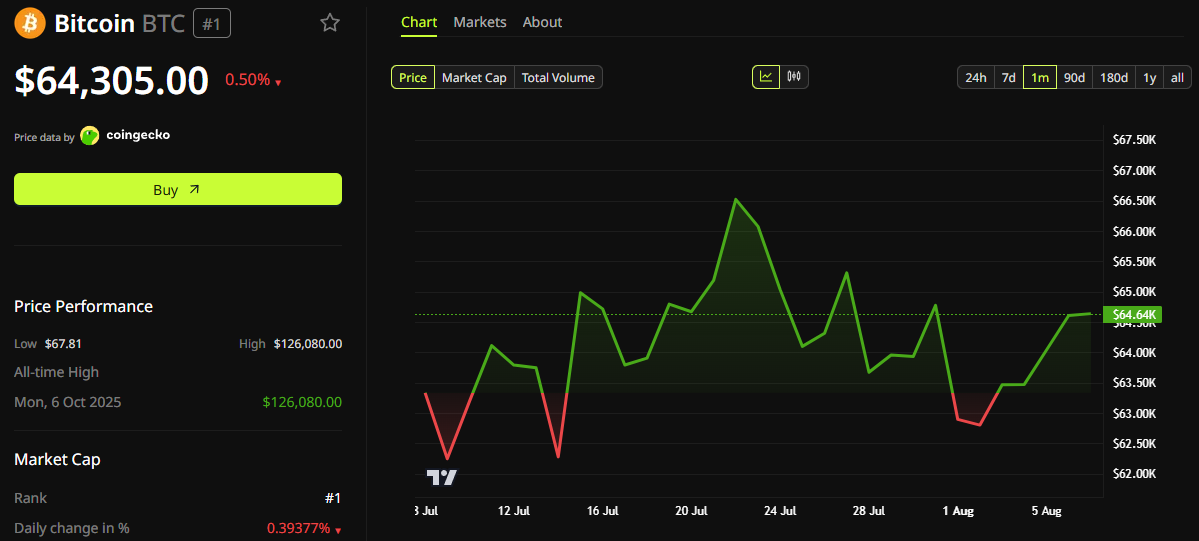
The US Bureau of Labor Statistics releases July’s nonfarm payrolls report today, with economists forecasting a gain of just 83,000 jobs and unemployment steady at 4.2%. Bitcoin (BTC) traders are wondering whether the reaction will mirror June’s report.
June’s report showed just 57,000 new jobs, a miss that sent Bitcoin jumping 4% before the rally faded within weeks. That pattern is worth noting ahead of today’s print.
What Happened Last Time
June’s payrolls came in far below the roughly 110,000 economists had forecast. Weak hiring data typically revives bets that the Federal Reserve will hold off on rate hikes, since lower rates ease liquidity conditions that support Bitcoin.
That played out almost immediately. Bitcoin jumped 4% to near $62,000 the day the June report landed, then climbed toward $64,000 over the following weekend as traders priced out a near-term hike.
The rally did not hold. Bitcoin slipped roughly 3% by the end of July, trading near $63,080, after three Fed policymakers dissented in favor of a rate hike at their latest meeting. Thirty-year Treasury yields climbed to their highest level since 2007 that same week.
A Pattern That Cuts Both Ways
June was not an isolated case. A stronger-than-expected May jobs report weakened rate cut hopes and pressured Bitcoin, as the economy added 172,000 jobs against lower forecasts.

A January report that nearly doubled expectations produced the same effect, pushing Bitcoin toward $65,000 support as Treasury yields rose. An unusually weak August 2025 report, just 22,000 jobs against forecasts of 75,000, sent Bitcoin near $113,000 on revived rate cut bets.
Why Today Could Break The Pattern
Forecasts for July diverge sharply. Vanguard’s 401(k) data points to a payroll gain of just 18,000, a miss that would likely echo June’s rally. Citigroup holds an out-of-consensus call for three rate cuts between now and January 2027.
Federal Reserve Governor Lisa Cook struck a more cautious tone this week.
“Although the hiring rate is low, the unemployment rate remains steady because layoffs are also low. The low-hire, low-fire equilibrium hits some groups, including new entrants, especially hard and may restrain worker sentiment for good reason.”
Cook added that she would support a rate hike if inflation fails to improve, the same hawkish undertone that cut short June’s rally within weeks.
Bitcoin traded at $64,305 at time of writing, up 0.50% over 24 hours. Whether today’s print triggers a repeat of June’s move, or gets overtaken by the same hawkish signals that followed it, may depend on how the Fed frames the data as much as the headline number itself.
The post July Jobs Report Due Today: Will Bitcoin React Like Last Time? appeared first on BeInCrypto.
Criminals stole more than $30 million through physical attacks on crypto holders in the first half of this year, putting the year on pace to surpass the record $58 million stolen in 2025.
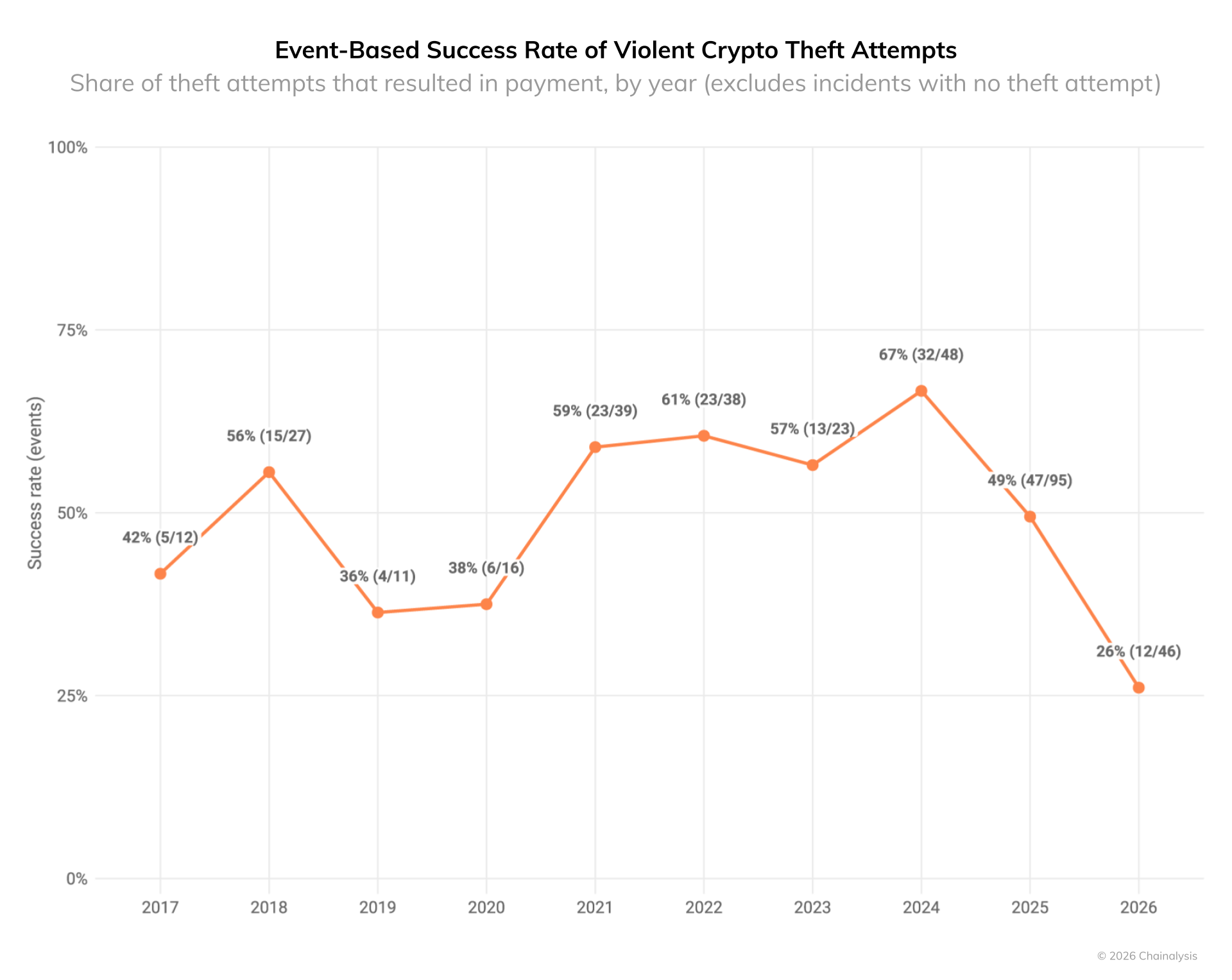
In a Chainalysis report released Thursday, the blockchain analytics firm said that 46 violent crypto-related incidents had been documented globally through late June, up from 40 during the same period in 2025. The incidents include kidnappings, home invasions and hostage situations, collectively known as “wrench attacks.”
The findings suggest wrench attacks are increasing, expanding the risks facing crypto holders beyond custody and asset management to their physical safety, homes and families.
According to the report, only 12 of the 46 attempts resulted in payment, giving attackers a 26% success rate, down from 49% in 2025. However, the report acknowledged that known cases likely understate the scale of the problem, as many attacks go unreported.
Chainalysis said the “tradecraft tends to be amateur at the point of violence, but professional at both ends,” with victims often selected through data leaks, social media or insider information before low-skilled crews carry out the attacks.
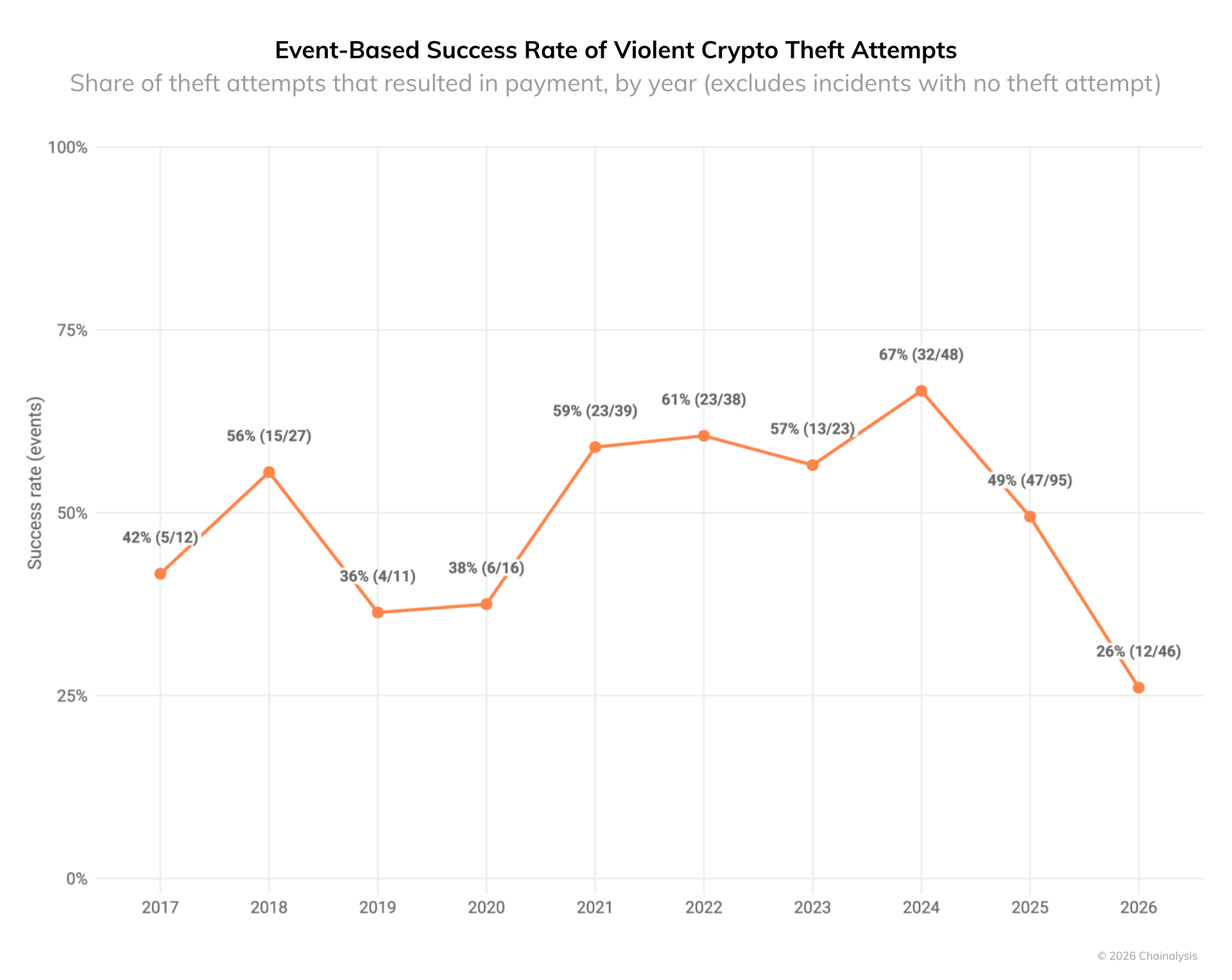
Success rate of crypto wrench attacks by year. Source: Chainalysis
France remains wrench attack hotspot
According to Chainalysis, France recorded 30 publicly known incidents by midyear, compared with 19 throughout 2025. The report noted that French authorities have counted more than 70 incidents, indicating the actual total may be substantially higher.
Related: Spain arrests suspect in 2025 kidnapping of Ledger co-founder
In July, Interior Minister Laurent Nuñez put the first-half count at 77 kidnappings, extortions or attempted extortions, up from 45 in all of 2025. In response, the government has introduced a rapid-alert and protection system and promised greater intelligence-sharing and coordination with the crypto industry.
Chainalysis said in the Thursday report that the alleged misuse of French tax records was the likeliest driver of the surge. A French tax official allegedly accessed and sold information about crypto investors to criminals, while a separate breach at crypto tax-reporting company Waltio reportedly exposed data belonging to about 50,000 users.
Onchain activity also showed varying levels of sophistication. Some attackers sent stolen funds directly to centralized exchanges, while others used bridges, decentralized exchanges and laundering services. Chainalysis said the most advanced cases showed links to broader criminal networks.
Magazine: Do the Coldcard attacks mean all hardware wallets are now insecure?


The self-custodial Bitcoin Lightning Network wallet disabled infrastructure after an incident and founder Evan Kaloudis said no customer funds were lost and no Lightning vulnerability was found.

More human skeletons found amid major Cambridgeshire city centre roadworks

Wall St dips as investors monitor Iran talks, earnings

Why Martha Reeves And More Didn’t Hit The Notes


-

 Fashion6 days ago
Weekend Open Thread: Wit & Wisdom
-

 Politics6 days ago
Meta enters AI-training agreement with far-right ‘propaganda rag’ Newsmax
-

 Politics4 days ago
Zack Polanski: an incitement to murder Nigel Farage?
-

 Crypto World5 days ago
MicroStrategy Post-Earnings CLARITY Act Push Could Add New Catalyst for Its Stock
-

 Crypto World6 days ago
XRP Ledger v3.3.0 brings five institutional features
-

 Crypto World6 days ago
New York sues Kalshi over prediction market gambling
-

 Crypto World5 days ago
Crypto PAC spending tops $2M in Michigan House race
-

 Business4 days ago
DTCR: Deleveraging And A Hedge Fund Collapse Point To A Possible AI Bottom
-

 Business6 days ago
Trump Announces Hamas Disarmament Agreement as Iran Strikes Kuwait Air Base and US Attacks Pause Overnight
-
 Crypto World6 days ago
3 Fed Officials Just Explained Their Rate Hike Vote: Is Inflation Winning?
-

 Tech5 days ago
ESET tracks rise in malicious AI skills and adaptable malware
-
Crypto World4 days ago
XRP Ledger urges node upgrade after manifest flood
-

 Tech7 days ago
Gemini Spark can now use Chrome logins and saved passwords to run errands on your behalf
-

 Tech7 days ago
Building A Reproduction PlayStation Motherboard
-

 Sports6 days ago
France Cricket implodes: letters hidden in a drawer and a board at war
-

 Crypto World6 days ago
Moneyflip CEO charged in $40K murder-for-hire plot
-
 Sports6 days ago
Bruno Fernandes decision made as Man United ‘discuss’ striker transfer option
-

 News Videos5 days ago
Financial Crash Expert: The 90-Day Collapse Timeline They Are Desperately Hiding.
-

 NewsBeat7 days ago
Spain sending troops as thousands enter enclave of Ceuta from Morocco
-

 Sports6 days ago
Commonwealth Games 2026 Live Updates | Day 9 CWG 2026: Lovlina Borgohain, Sachin Siwach Enter Final After Indian Judokas Script History
You must be logged in to post a comment Login