

Crypto World
Bitcoin ‘Plunge Protection Team’ Returns As BTC Price Drops Under $64,000

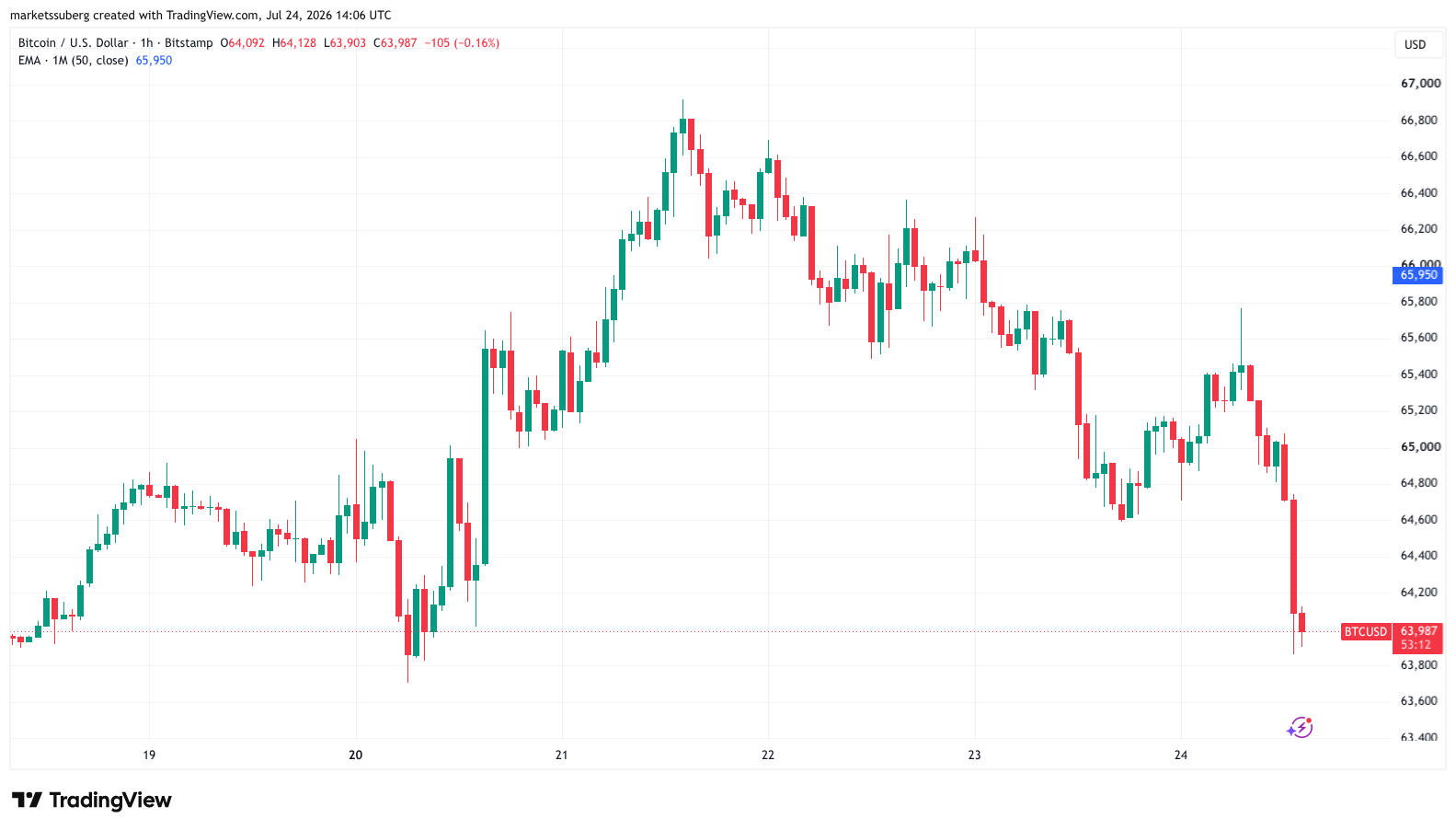
Bitcoin (BTC) fell more than 1.6% on Friday as its latest price correction accelerated after Wall Street opened.
Key points:
- Bitcoin price downside pressure mounts on the back of multiple macro headwinds.
- US bond yields further a hawkish pivot in Fed interest-rate expectations.
- BTC price analysis sees a Binance “plunge protection team” attempting to shore up the market.
Analysis warns US bond yields now “well above” target
Data from TradingView showed BTC/USD approaching $64,000 as bulls struggled to preserve recent gains.
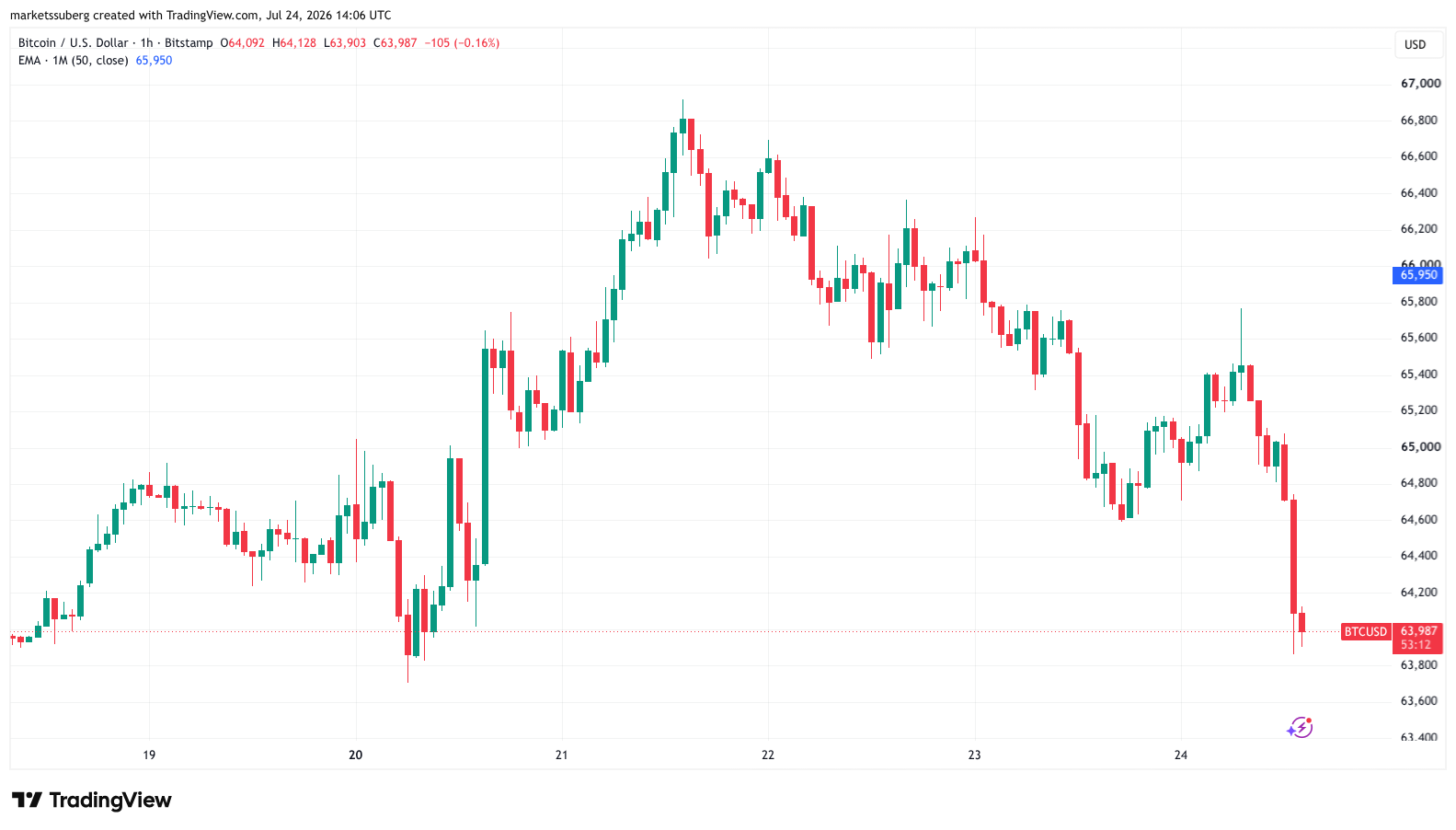
BTC/USD one-hour chart. Source: Cointelegraph/TradingView
Geopolitical tensions and macroeconomic headwinds weighed on crypto markets as appetite for risk assets faded.
Trading firm Mosaic Asset Company said rising US Treasury yields were a key driver of the sell-off.
“Massive moves are underway across the yield curve despite a weaker than expected consumer inflation report,” it wrote, referring to the latest US Consumer Price Index (CPI) report.
Mosaic said the two-year yield was particularly prone to influence the outlook on Federal Reserve interest-rate changes, with risk assets suffering as a result of additional hikes.
“The 2-year yield that tends to lead fed funds is now at 4.31% and sits well above the Federal Reserve’s target range,” it continued.
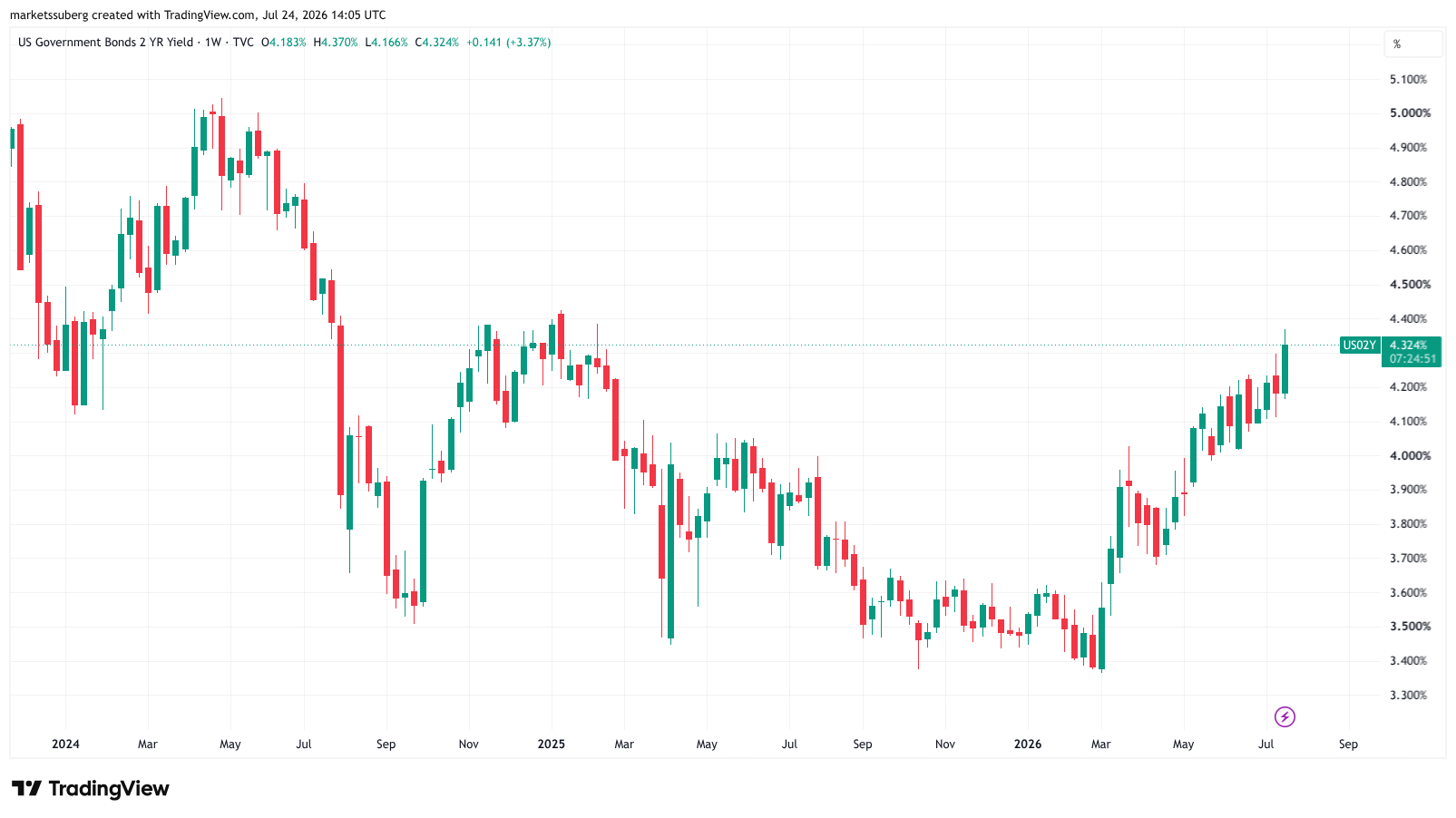
US two-year Treasury yield one-week chart. Source: Cointelegraph/TradingView
The latest data from CME Group’s FedWatch Tool showed that markets still expected the Fed to leave rates unchanged next week, while pricing in a 0.25% hike in September as one of two increases expected before the end of 2026.
Mosaic added that those expectations were “placing downward pressure on stock indexes.”
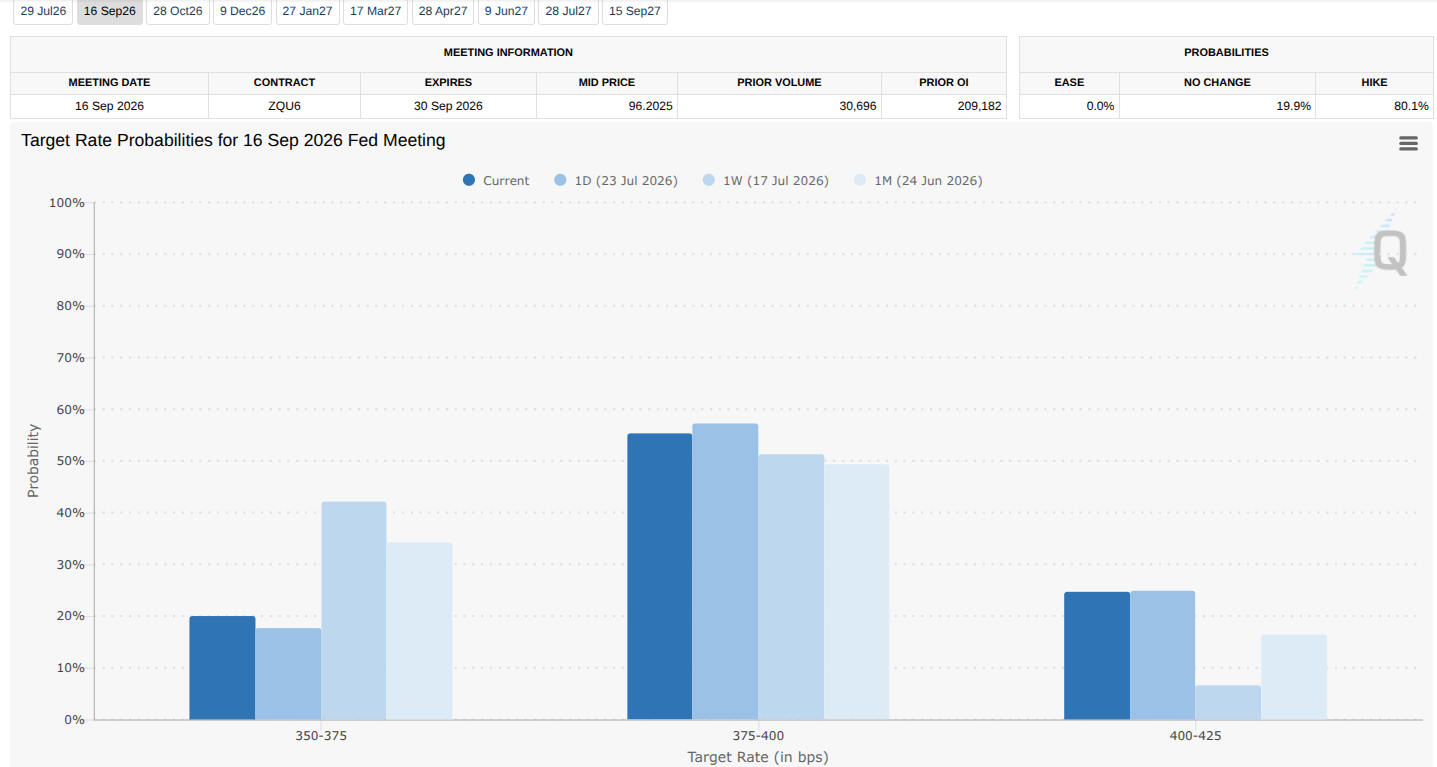
Fed target-rate probability comparison for September FOMC meeting (screenshot). Source: CME Group
Bitcoin price “plunge protection team” returns
In ongoing market monitoring, crypto trader Killa said BTC was repeating a familiar short-term trading pattern.
Related: BTC supply in profit eyes 60%, but analysis hints recovery may ‘roll back over’
“Textbook setup on $BTC. Seen this occur numerous times,” they said on X, repeating a post from early June in which they identified a “plunge protection team” active on the largest crypto exchange Binance.
A chart accompanying the post showed layers of bid liquidity below the spot price, with its owners potentially not planning for the positions to be filled.
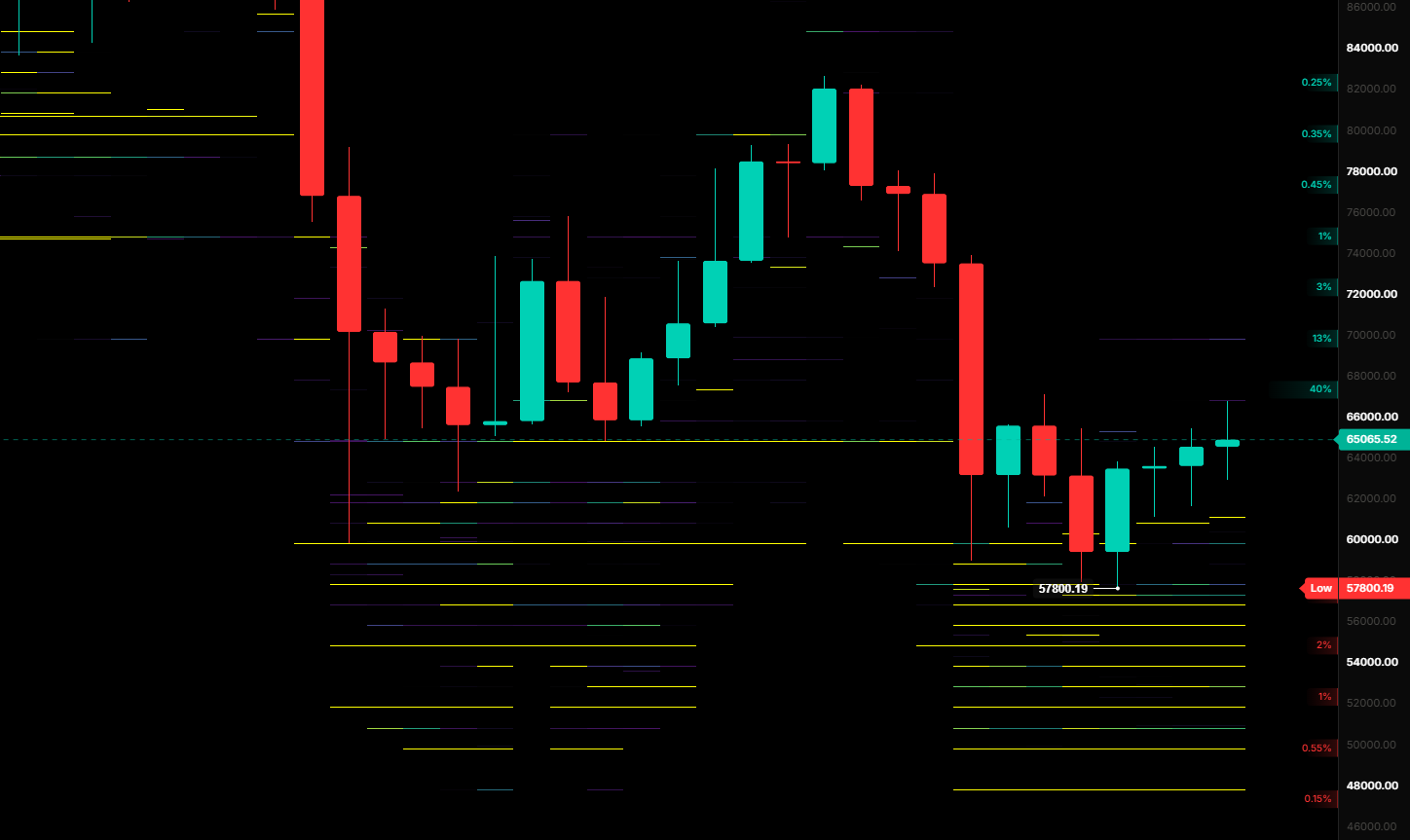
BTC/USDT chart with order-book liquidity data. Source: Killa on X.com
Analytics account Wealthmanager focused on $64,000, warning that a break below that level would “invalidate” the low-timeframe market structure.
Trader and analyst Rekt Capital, meanwhile, doubled down on the theory that BTC/USD was repeating behavior from its 2022 bear market, rejecting from the 50-month exponential moving average (EMA) at $65,950.
“Bitcoin hasn’t really offered any evidence to the contrary. Still following 2022 historical tendencies,” he summarized.
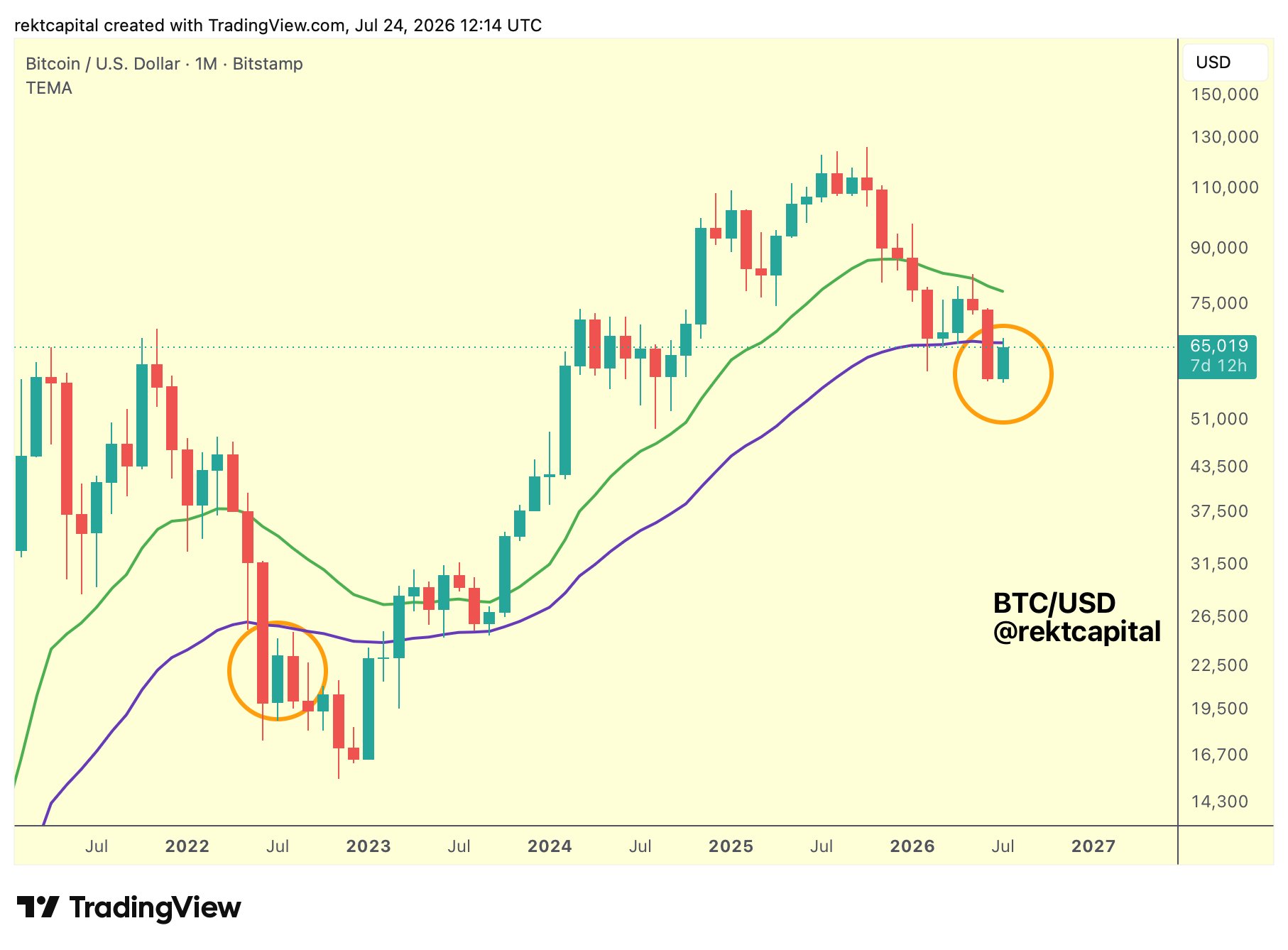
BTC/USD one-month chart with 21, 50EMA. Source: Rekt Capital on X.com



Coinbase has replaced or reassigned four senior leaders after cutting 14% of its workforce, as the exchange builds a platform spanning crypto, stocks, derivatives and prediction markets.
Summary
- Coinbase is replacing or reassigning four senior leaders during its multi-asset expansion.
- Dominique Baillet is expected to succeed Lawrence Brock as chief people officer.
- Stocks and prediction markets are growing as weak crypto conditions pressure COIN.
A Coinbase regulatory filing states that Chief People Officer Lawrence Brock will leave his position on Aug. 17 and remain with the company through Sept. 1 to transfer his duties. Coinbase expects to appoint Dominique Baillet as Brock’s successor, placing her in charge of the company’s hiring, retention and workplace operations during a period of product expansion.
Brock will continue providing advice from Sept. 2 through Nov. 30 under an agreement signed on July 23, according to the filing. The arrangement gives him a payment equal to three months of his current base salary after the advisory period, along with continued vesting of restricted stock units scheduled for Nov. 20. Coinbase’s filing does not give a reason for his departure.
His exit follows several changes across Coinbase’s legal, institutional and Base teams. CertiK Pulse reported that Greg Tusar, co-head of Coinbase Institutional, has moved into a policy-focused position after working on the company’s prime brokerage, custody, financing and exchange products.
Paul Grewal also plans to leave his role as chief legal officer and corporate secretary on July 31 after six years at Coinbase. Vice President of Legal Molly Abraham will become general counsel and secretary, while Ryan VanGrack will serve as Coinbase’s first vice chair and head of corporate affairs.
Grewal will remain an adviser and retain his seat on the board of Coinbase National Trust Company, Reuters reported. During his tenure, Grewal helped Coinbase respond to the Securities and Exchange Commission’s 2023 lawsuit and supported the crypto industry’s campaign for new market legislation in Washington.
Coinbase is cutting layers while adding products
Changes at the executive level have arrived less than three months after Coinbase announced plans to eliminate about 700 positions, equal to 14% of its workforce. CEO Brian Armstrong linked the May decision to volatile crypto markets and productivity gains from artificial intelligence, while Coinbase estimated restructuring costs of $50 million to $60 million.
Armstrong told employees that Coinbase needed smaller and more efficient teams, according to a company letter reported by Business Insider. The exchange also planned to reduce management layers and test team structures in which fewer workers handle tasks that previously required several specialized roles.
At Base, Jesse Pollak has stepped back from leading the network’s consumer app and handed control to Jordan Fish, widely known as Cobie. Pollak acknowledged that his focus on social applications and creator coins had failed to produce the adoption he expected, according to CoinDesk.
Pollak will instead focus on developing Base as a blockchain for global finance, with trading, payments and tokenization taking priority. Coinbase has kept the Base app under its control, while the leadership change separates work on the consumer product from Pollak’s role in developing the underlying network.
Alongside the personnel changes, Coinbase describes its business as an “Everything Exchange” that gives customers access to crypto, equities, derivatives and event contracts from one platform. The company has opened commission-free stock and exchange-traded fund trading to all eligible U.S. users, offering access 24 hours a day on five weekdays, according to a Coinbase announcement.
Prediction markets have become an early revenue source within that model. Coinbase reported that the product reached more than $100 million in annualized revenue during March, after operating nationwide for two full months. Its first-quarter results also placed annualized retail derivatives revenue above $200 million and crypto trading-volume market share at a record 8.6%.
Weak crypto conditions test the expansion
Coinbase’s product expansion is proceeding as its research unit maintains a neutral outlook for the third quarter. Coinbase Institutional and Glassnode reported that total crypto market capitalization, excluding stablecoins, contracted by about 12% during the second quarter.
Their joint “Charting Crypto Q3 2026” report found early signs of Bitcoin accumulation but concluded that tighter liquidity, the U.S.–Iran conflict and weak exchange-traded fund demand continued to limit the market. Record stablecoin supply suggested that some sellers moved capital into dollar-linked tokens instead of removing it from crypto entirely, according to Coinbase Institutional.
COIN traded at $158.50 on July 24, down 1.65% from its previous close, with an intraday range of $153.80 to $163.50. The latest move left Coinbase with a market value of about $42 billion, while its shares remained under pressure after falling 31.9% during 2026 and 59.4% over the preceding year.
Baillet’s expected appointment therefore places Coinbase’s People team at the center of two competing demands: managing a smaller workforce and supporting new asset categories. Investors can next assess that execution when Coinbase publishes its second-quarter financial results after the market closes on July 30.

Singapore-based Bitcoin mining pool operator Poolin and two US affiliates have filed for Chapter 11 bankruptcy in a New Jersey court, according to a court filing accessible via PACER Monitor. The move marks a further sign of stress inside parts of the mining sector as margins are squeezed by electricity costs and infrastructure expenses.
In the filing, Poolin Technology PTE Ltd estimates liabilities in a range of $100 million to $500 million, assets of $1 million to $10 million, and 10,001 to 25,000 creditors. The company also asked the court for permission to sell two West Texas mining sites to Thor CALAP LLC through a proposed stalking-horse bid.
Key takeaways
- Poolin and US affiliates have entered Chapter 11 in New Jersey, citing a wide gap between estimated liabilities and assets.
- Poolin is seeking approval to sell its Tarbush and Pyote West Texas mining facilities for a combined $52 million under a stalking-horse process.
- A court-supervised auction is planned, with a bid deadline of Sept. 8 under the proposed procedures.
- The case reflects broader industry pressure, with other miners restructuring or pivoting toward AI and high-performance computing.
Bankruptcy filing and proposed West Texas asset sale
Poolin’s bankruptcy petition is tied to court-supervised efforts to reorganize and monetize remaining assets. The company’s filing includes estimates of $100 million to $500 million in liabilities against assets estimated between $1 million and $10 million, alongside a creditor count in the 10,001 to 25,000 range.
In addition to seeking Chapter 11 protection, Poolin requested permission to sell two mining sites in West Texas to Thor CALAP LLC. The proposed stalking-horse bid values the deal at $52 million, split into:
- $37 million for the Tarbush assets, including assumed liabilities.
- $15 million for the Pyote site, including power rights, equipment, and other assets related to the mining facilities.
The filing further states that the sale would be subject to a court-supervised auction, with a Sept. 8 bid deadline under the proposed bidding procedures.
Poolin’s market position has shifted
Poolin’s bankruptcy comes at a time when its relative standing in the mining industry has declined. According to Hashrate Index, Poolin is currently the 17th largest Bitcoin mining pool operator by hashrate, with about 0.2% market share.
The filing’s outcome is therefore not just a case-specific story: it underscores how the competitive landscape has evolved since Poolin’s peak. The company was once reported as the world’s largest Bitcoin mining pool in 2019, but its hashrate share has since fallen as other operators scaled and diversified.
Industry pressure: restructuring and an AI pivot
Poolin’s bankruptcy fits a broader pattern in which Bitcoin miners increasingly look for restructuring pathways—or new lines of business—to manage operating constraints. The source reporting notes that financial pressure has been driven in part by rising electricity costs, with some mining operations shutting down while others seek additional revenue.
Earlier examples highlighted in the broader reporting include a Chapter 11 filing by NFN8 Group and two affiliates in February, in which those entities sought bankruptcy protection in the Western District of Texas. Other miners have pursued different strategies, including a shift toward AI and high-performance computing infrastructure.
For instance, the reporting notes that in November 2025, Bitfarms initiated a complete wind-down of its Bitcoin mining operations to pivot toward AI and high-performance computing data centers. More recently, it cites major AI-related infrastructure announcements from publicly traded miners:
- Hut 8 announced a 15-year lease worth $9.8 billion for an AI data center campus.
- IREN disclosed $2.8 billion in cloud services contracts with AI developers.
The same reporting also references MARA Holdings plans to acquire a Texas site with up to 2 gigawatts of capacity to expand AI and digital infrastructure ambitions.
In its coverage, the source further points to comments attributed to Bernstein, stating that AI companies may need deals with third-party providers—such as Bitcoin miners—to overcome computing power limits of AI data centers.
Why this Chapter 11 case matters to the market
For investors and industry participants, Poolin’s filing is notable not only because of what happens inside a bankruptcy court, but because it may influence how mining supply and hosting capacity evolve during a period when many operators are recalibrating their strategies.
The proposed sale of specific West Texas mining sites—along with included power rights and equipment—also highlights where value is being concentrated. In practical terms, power access and deployable infrastructure are often the decisive factors in mining economics, particularly when energy prices and equipment costs challenge profitability.
Meanwhile, the broader shift toward AI infrastructure suggests a deeper restructuring of demand for compute. While Bitcoin mining is tied to network incentives, AI data center expansion depends on long-term capacity planning. That difference helps explain why some miners are attempting to convert physical assets and energy contracts into a different revenue model—yet Poolin’s bankruptcy indicates that not every operator can make that transition fast enough or on terms favorable to creditors.
One watchpoint is the timing and outcome of the court-supervised auction. The filing proposes a Sept. 8 bid deadline, which could determine whether competing bids emerge beyond the stalking-horse valuation or whether the Thor CALAP LLC offer becomes the baseline for a broader asset disposition.
Readers should monitor the bankruptcy docket for updates on the auction process, any competing bids, and the ultimate disposition of the Tarbush and Pyote sites. Just as importantly, the case may provide another data point on how quickly—if at all—mining operators can reposition energy- and infrastructure-heavy businesses toward AI-related compute demand.

Bitcoin’s mid-week price rally that drove it to a monthly peak of $67,000 came to a halt, and the asset dipped below $64,000 earlier today, erasing essentially all the gains it had recorded.
Here are the two possible reasons behind this nosedive.
ETF Investor Exodus
At first, we begin with the spot exchange-traded funds tracking the largest cryptocurrency. They were on a seven-day roll that began last Tuesday and had attracted roughly $1 billion within that timeframe for the first time since April. However, investors changed their minds once again on Thursday, pulling out over $200 million worth of BTC. This coincided with the asset’s initial retracement that drove it toward $65,000.
More recent on-chain data from today, though, claimed that BlackRock has continued to dispose of BTC for its clients, sending approximately $203 million to Coinbase Prime, which it always uses when it liquidates some of its ETF positions.
Of course, the actual damage for the entire day will be announced tomorrow when data providers such as SoSoValue update their numbers. For now, though, the uncertainty remains relatively high given the latest trend shift.
BlackRock moved 3.126K $BTC (~$203M) from its IBIT Bitcoin ETF wallet to Coinbase Prime.
The movement was executed across multiple transactions, including several 300 $BTC batches and one 126.168 $BTC transfer.@blackrock @coinbase pic.twitter.com/hD4ty5YARy
— Onchain Lens (@OnchainLens) July 24, 2026
Trump Threatens With New Tariffs
Ever since he returned to the White House, President Donald Trump has made numerous attempts to impose tariffs on essentially all countries at one point. What’s particularly interesting is the fact that nations within the EU have become the main target, even though they are supposed to be allies.
History shows that the darkest hours of tariff threats have impacted BTC severely, including last April when the asset tanked. The past few hours brought another example of this, which coincided with the asset’s retreat to just under $63,000.
He blamed the bloc for imposing substantial penalties on some of the largest US companies, such as Apple, Meta, and Google, and warned that his administration will “immediately initiate a 301 Investigation into the practice of “ROBBING” American Companies and, in turn, the American Taxpayer.” In addition, he outlined an upcoming wave of tariffs.
“The European Union will pay a very big price for this illegal and highly unethical conduct, which I have consistently warned them about. The penalties will be entirely reversed and, we anticipate, a substantial TARIFF to be placed on them at the earliest possible moment,” reads the message.
The post Here’s Why Bitcoin Dipped Below $64K Today appeared first on CryptoPotato.
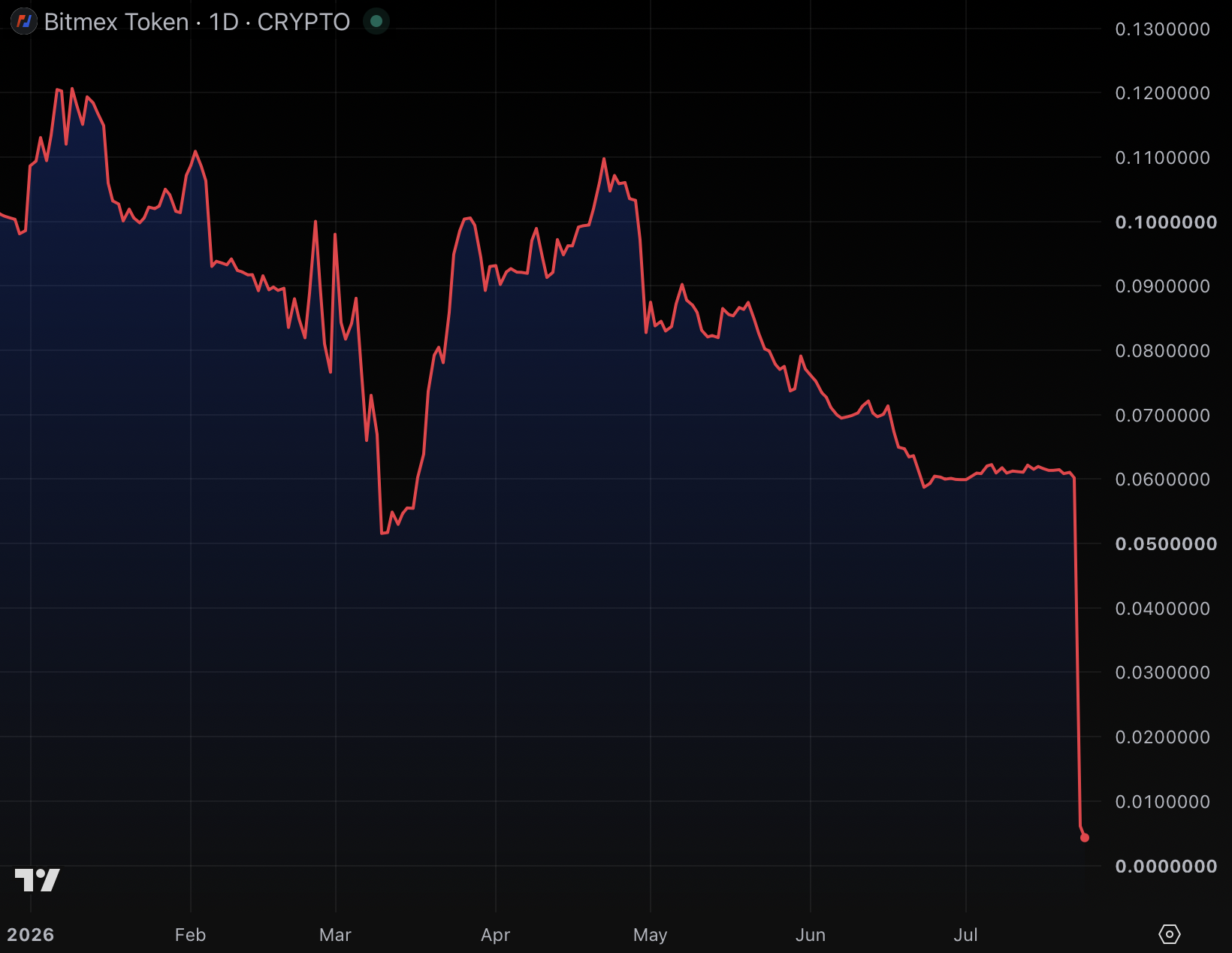
Crypto exchange BitMEX is winding down with roughly $270 million sitting in a house insurance fund that customers now suspect its owners will simply keep.
The fund holds about $239 million worth of BTC and $31 million in USDT. A lot of that came from customers’ trading losses.
The exchange hasn’t disclosed where the money will go after its doors close on September 23 and BitMEX declined to comment on its plans for the fund.
To be clear, the fund is owned by BitMEX, not customers, and the exchange never told customers what it would do with the fund if it ultimately closed for business.
Moreover, the fund has paid out to customers during certain loss events, honoring the exchange‘s original promise.
Still, plenty of people are upset given the substantial size of the fund and a November 2025 rebalancing that drained it of the overwhelming majority of its assets at the time.
The exchange’s proprietary token also seems to have little promise of retaining much value after September. It’s already lost 96% of its value year-to-date after a steep crash on the closure news.
BitMEX’s insurance fund goes viral
Speculation about BitMEX owners overtaking the insurance fund is rampant on social media, as allegations earned hundreds of thousands of impressions on the trending topic.
For context, BitMEX’s use of the word insurance is repurposed, a common practice by the crypto industry. Its borrowed name doesn’t actually mean insurance by conventional understanding.
Rather than funding it with policyholders’ insurance premiums or stockholders’ paid-in capital, by and large, BitMEX funded its so-called insurance fund with liquidated assets from customers who lost money trading using BitMEX-provided leverage.
Immediately incensed, plaintiffs filed a proposed class action the same day as BitMEX’s closure announcement.
Plaintiffs alleged that BitMEX’s fund grew quickly during downside volatility and times of stress when customers would have appreciated insurance payouts.
Instead of shrinking during adverse events to offset losses as other insurance funds might have, the fund grew as BitMEX force-closed leveraged bets by its customers.
Although no court has reviewed the allegations, plaintiffs BKX Services and David Namdar say the exchange liquidated their positions. The two say they lost over 622 BTC between them and want to add claims representing similarly situated US customers who traded on BitMEX since July 2018.
Like other lawsuits before, they are seeking the return of their assets plus fees. Prior lawsuits have ended in dismissal, such as a 2020 class action led by Brett Messieh.
Read more: The history of crypto exchanges trading against their own customers
From 36,400 BTC to 3,600
This week’s new lawsuit piles on allegations, describing an in-house trading desk with what it calls “God access” to hidden orders and customers’ liquidation points.
In-house traders, plaintiffs allege, were uniquely able to trade during the server freezes that locked out most other customers.
A civil complaint is merely a document making allegations. Readers shouldn’t interpret claims by plaintiffs seeking money as true nor probable until a court adjudicates the evidence.
For years, the insurance fund held tens of thousands of BTC, peaking above 36,400 during the March 2020 crash. Then came the crypto crash of October 10-11, 2025.
A surprise 100% China tariff threat and flash-crash prices on several Binance trading pairs helped erase more than $19 billion in leveraged positions industry-wide. BitMEX said its fund absorbed only about $2 million in losses during the incident, sailing through relatively unscathed.
Weeks later, it shrank the fund by roughly 90%.
Specifically, on November 18, 2025, BitMEX announced it would rebalance its insurance fund to “approximately 3,600 BTC and just over 30,000,000 USDT” to “better reflect the risks in its markets.” The rebalancing, it promised, would have “no impact on our traders.”
It didn’t say what happened to the tens of thousands of BTC it supposedly no longer needed after that rebalancing.
The math is unforgiving. At today’s BTC price near $64,000, the old fund would have been worth $2 billion. The rebalanced version is worth about $270 million — and it’s going away entirely after September.
At the 52-week high of BTC above $126,000, the value of BitMEX’s pre-rebalanced insurance fund topped $4.5 billion.
Taking their money after taking their money
“There used to be 36,000 BTC in the BitMEX insurance fund, now 3,600. Are they the ones selling I wonder,” posted one skeptic.
“I guess last year they ‘rebalanced’ the insurance fund down from 13-14k to 3,600 ie they pocketed 10k BTC,” alleged another.
The business closure news sharpened suspicions. “Wow.. Arthur Hayes and his partners will profit around $270 million bucks Is this the reason BitMex is shutting down? To collect this Insurance Fund cash?” asked Aaron Bennett.
Neither BitMEX nor Arthur Hayes have answered their questions.
Protos previously documented how the exchange ran a for-profit market maker and paid a $100 million settlement with the Commodity Futures Trading Commission.
Founders Hayes and Benjamin Delo later pleaded guilty to a Bank Secrecy Act violation, before a Trump pardon erased their legal jeopardy.
None of this is new to the courts. Traders have sued and lost against BitMEX over market-manipulation claims before, and the founders remain free men.
What is new is the deadline. After September 23, 2026, the customers who filled the insurance fund one liquidation at a time will have no exchange left to ask where their BTC went.
Got a tip? Send us an email securely via Protos Leaks. For more informed news and investigations, follow us on X, Bluesky, and Google News, or subscribe to our YouTube channel.
Crypto World
VAP Group Announces Global Trading Show, The Most Influential Unified Multi-Asset Trading Show

Abu Dhabi, UAE — VAP Group today announced the Global Trading Show from 15-16 December 2026 at Emirates Palace, Abu Dhabi. Powered by Times Of Trading, the event brings together the full spectrum of the trading world, including the most influential 5,000+ market movers together such as ultra-HNW investors, brokers, regulators, exchanges, institutional desks, high-volume traders, influencers and leading financial key opinion leaders, all under one roof at one of the region’s most prestigious venues.
Until now, the region’s trading events have focused on individual markets, while the Global Trading Show unites every asset class, trading technologies, and trader communities, making it a truly cross-asset event for every type of trader.
The Global Trading Show is built on three pillars designed to give attendees direct access to the entire investment universe and the people driving it.
Multi-Asset Trading Floor
Brokers, exchanges, and trading platforms will showcase their products side by side, giving traders and institutions a single vantage point across every major asset class and removing the need for fragmented, single-market events.
Live Trading Tournament
A live trading tournament executed on regulated infrastructure, with a fully transparent prize pool. The competition puts skill on public display in real time, offering sponsors and platforms a high-visibility stage to demonstrate execution quality and reliability under pressure.
KOLs & Creators
Global Trading Show recognizes that today’s markets move as much through influence as through infrastructure. The event convenes leading financial KOLs and creators alongside institutional players, bridging the gap between the trading floor and the platforms where retail and professional audiences increasingly get their market intelligence.
The two-day event will spotlight the next evolution of trading through dedicated AI & Quant, Web3 & DeFi, Retail Education, and Institutional Liquidity zones, complemented by live trading challenges, expert-led masterclasses, and exclusive institutional forums with closed-door sessions and open panels for hedge funds, prime brokers, liquidity providers, sovereign wealth funds and family offices.

“Capital today moves across forex, crypto, gold, AI-driven strategies and more, all at once, yet the industry still meets in silos. We are proud to announce that the Global Trading Show is the region’s only event to bring seven asset classes under one umbrella, where the entire ecosystem converges. Abu Dhabi is where institutional money and emerging assets now meet, so this conversation belongs here, in one of the most significant sovereign-grade venues in the region” – Vishal Parmar, Founder and CEO, VAP Group.
The Global Trading Show highlights how rapidly evolving technology is reshaping market structures by bridging institutional finance with high-velocity retail trading. It serves as a collaborative and intersectional hub for legacy banking compliance, decentralized blockchain networks, and cross-market portfolios.
For sponsorship opportunities, speaker applications, and delegate registration details, visit globaltradingshow.com.
For media queries reach out at media@globaltradingshow.com.
About VAP Group
With 13+ years of expertise, VAP Group is a premier global consulting and media powerhouse driving the next wave of technology-led growth.
Through its media ecosystem and flagship events, including the Global AI Show, Global Games Show, and Global Blockchain Show, VAP Group connects policymakers, enterprises, and innovators worldwide, enabling strategic communications, ecosystem-building, and talent solutions.
Media Contact:
Email: media@globaltradingshow.com
For more information: https://www.globaltradingshow.com/
Crypto World
Minfin.com.ua Expands Crypto Exchanger Monitoring as Ukraine Aligns With MiCA-Style Regulation

[PRESS RELEASE – Kyiv, Ukraine, July 24th, 2026]
Minfin.com.ua, a Ukrainian financial media platform covering banking, currency, and crypto markets, has expanded its online cryptocurrency exchanger tracking service as regulatory standards across Eastern Europe move closer to the EU’s MiCA (Markets in Crypto-Assets) framework. The expansion is aimed at giving retail and institutional users a clearer, verified picture of the exchanger market at a moment when regional oversight is tightening.
Regional Context: A Market Moving Out of the Shadows
Over the past several years, Ukraine’s crypto exchanger market operated with limited formal oversight, relying heavily on word-of-mouth reputation and informal community feedback. As Ukraine and several neighboring Eastern European countries advance legislation aligned with MiCA-style transparency requirements, that dynamic is shifting. Regulators are pushing for clearer disclosure around liquidity, licensing, and pricing practices, and market participants from individual traders to larger investors are adjusting their expectations accordingly.
This regulatory movement has increased demand for tools that can independently verify what exchangers claim about their own operations. A platform’s stated trading volume, its fee transparency, and its licensing status can vary significantly even among services that appear similar on the surface, and the cost of choosing the wrong provider whether through hidden fees, poor liquidity, or unreliable execution remains a real risk for users.
What the Expanded Tool Does
The updated monitoring service on Minfin.com.ua aggregates data from multiple cryptocurrency exchange services operating in Ukraine, allowing users to:
- Compare real-time trading volumes across listed exchangers;
- Track exchange rates for major cryptocurrencies against the hryvnia and other currencies;
- Review fee structures to identify hidden or above-market costs;
- Monitor changes in exchanger activity over time, rather than relying on a single snapshot.
By consolidating this information in one place, the tool is designed to reduce the research burden on individual users, who previously had to cross-check multiple sources often informal ones to assess an exchanger’s reliability.
Why This Matters for Investors and Everyday Users
Traders who once relied on informal channels or community forums for exchanger recommendations are increasingly turning to platforms that publish verifiable data. For active traders, this means faster, more confident decision-making when moving between exchangers to capture better rates. For occasional or first-time users, it lowers the barrier to entry by making it easier to identify which services operate transparently.
Part of a Broader Financial Data Ecosystem
The crypto exchanger tracker is one component of Minfin.com.ua’s wider coverage of Ukraine’s financial sector. The platform also provides banking analytics, deposit and loan rate comparisons, and currency exchange tracking, positioning it as a broader reference point for users navigating multiple corners of Ukraine’s financial system rather than a single-purpose crypto tool.
About Minfin.com.ua
Minfin.com.ua is a Ukrainian financial media platform providing news and analytics on banking, currency exchange, and the cryptocurrency market. Its tools include exchanger rate and volume tracking, deposit and loan comparisons, and currency rate monitoring, serving as a reference point for individuals and businesses navigating Ukraine’s financial landscape.
The post Minfin.com.ua Expands Crypto Exchanger Monitoring as Ukraine Aligns With MiCA-Style Regulation appeared first on CryptoPotato.

London, 6–7 October 2026: Digital Assets Week will return to London, the only forum where capital markets transformation through tokenisation is examined in depth, from issuance and market structure to settlement, custody, liquidity and regulatory alignment.
The underlying foundation of Digital Assets Week is Global Asset Digitisation Projects, making it the only venue where the commercialisation of tokenising assets is discussed comprehensively and at scale.
Digital Assets Week is institution-led and designed to support substantive dialogue between market participants, regulators and infrastructure providers on implementation, risk management and market structure as digital assets increasingly intersect with traditional capital markets.
The 2026 edition will focus on how digital assets and tokenisation are moving from experimentation towards practical implementation across traditional financial markets.
Discussions will examine the evolution of tokenised private and public markets, 24/7 trading, atomic settlement, fund administration, digital asset custody, stablecoins, payments infrastructure, regulation, liquidity and institutional blockchain adoption.
Key speakers confirmed to join the 2026 agenda include:
● Rachel Blake MP, The Economic Secretary to the Treasury, HM Treasury
● Sasha Mills, Executive Director, Financial Market Infrastructure, Bank of England
● Sumeera Younis, Chief of Operations – Crypto Task Force, U.S. Securities and Exchange Commission
● Anthony Clark-Jones, Head of Digital Assets (Products & Services), UBS Investment Bank
● Sean Mullins, Head of Digital Assets Product, Securities Services, HSBC
● Emma Lovett, Executive Director, Markets Digital Assets, J.P. Morgan
● Anna Matson, Senior Vice President, Head of Digital Assets & Innovation EMEA, Northern Trust
● Waqar Chaudry, Executive Director; Head, Digital Assets. Financing and Securities Services; Corporate & Investment Banking, Standard Chartered Bank
● Sabih Behzad, Head of Digital Assets & Currencies Transformation, Managing Director, Deutsche Bank
● Emilio Anting, VP of Digital Asset Partnerships, Franklin Templeton
● Previn Singh, Digital Assets – Head of Tokenisation Strategy, Fidelity International
● Doug Bambrick, Head of Custody Product – UK and Middle East, BNP Paribas
● David Reed, Director – Digital Assets Product, Invesco
● Deepa Raja Carbon, Managing Director and Vice Chairperson, VARA
● Christoph Hock, Head of Tokenisation and Digital Assets, Union Investment
● Kelly Moffatt, Head of Digital Assets Compliance, Citi
● Rosemary Hanna, Head of Division, Markets and Funds Policy, Central Bank of Ireland
● Ryan Hayward, Head of Digital Assets and Strategic Investments, Barclays
● Christian Lawrence, Chief Cross-Asset Strategist, Head of Americas & Energy Markets Research, Managing Director, Rabobank
● Antoine Scalia, Founder and CEO, Cryptio
● Cameron Drinkwater, Chief Product & Operations Officer, S&P Dow Jones Indices
● Myles Wright, CEO, Fnality Services
and many more.
This year’s event is already seeing the strongest level of financial institution and regulator registrations at this stage of any previous edition.
Financial institutions and regulators confirmed to participate include representatives from Aberdeen, ABN AMRO Bank, AllianceBernstein, ANZ Banking Group, Aviva Investors, Baillie Gifford, Bank of America, Bank of England, Barclays, BlackRock, BNP Paribas, Citi, Deutsche Bank, Fidelity International, Franklin Templeton, Goldman Sachs, HM Treasury, HSBC, Intesa Sanpaolo, J.P. Morgan, Lloyds Bank, M&G Investments, MUFG Bank, Morgan Stanley, Nomura, Northern Trust, Rabobank, Société Générale, Standard Chartered, State Street, T Rowe Price, TSB Bank, U.S. Securities and Exchange Commission, UBS, Union Investment, VARA, WisdomTree and many more.
Registration for Digital Assets Week London is now open.
Tickets can be accessed here:
https://www.universe.com/events/digital-assets-week-london-2026-tickets-LGVXZ7
15% off discount code, valid from 1st August: CRYPBREAK15
For sponsorship or speaking enquiries please contact: christina@julietmedia.com

Three major U.S. crypto advocacy groups have urged Senate leaders to move the Digital Asset Market Clarity (CLARITY) Act forward on the chamber floor, arguing that the legislation remains a rare chance to establish a clearer federal framework for digital assets. In a joint letter sent Friday to Senate Majority Leader John Thune and Minority Leader Chuck Schumer, the Crypto Council for Innovation, the Digital Chamber, and the Blockchain Association asked lawmakers to prioritize “floor consideration” before the Senate pauses for state work periods in August.
The push comes as the bill has already advanced through the Senate banking and agriculture committees, but uncertainty remains over whether it can secure the 60 votes needed for passage. Republicans hold a 52–47 edge over Democrats, yet several Democrats have signaled they may withhold support until the bill’s ethics-related provisions are adjusted—particularly rules intended to address conflicts of interest involving public officials and cryptocurrencies.
Key takeaways
- Crypto industry groups are pressing Senate leadership to schedule a floor vote on the CLARITY Act before the August recess.
- The bill cleared the Senate banking and agriculture committees, but lawmakers have indicated votes could be delayed pending unresolved ethics concerns.
- Democrats argue the ethics provisions in the GOP’s market structure text are insufficient to prevent corruption, according to reporting from Politico.
- Industry leaders including Coinbase CEO Brian Armstrong and 1inch’s legal chief Orest Gavryliak have argued the bill is necessary to provide a workable framework—especially for non-custodial systems.
- Market-based polling via Kalshi as of Friday implied a roughly 40.3% chance of passage before the Senate’s August break.
Advocacy groups push for early floor action
In the Friday letter, the three organizations framed floor consideration as an immediate next step following committee progress. They acknowledged bipartisan discussions are ongoing and encouraged negotiations to continue, indicating they are not asking for a “take it or leave it” decision—just that the bill be brought to the Senate floor without further delay.
The groups’ request aligns with a broader push from Republicans who have been working to secure a vote before the Senate breaks for state work periods in August. However, even with committee advancement, floor timelines in the Senate often depend on whether parties can close gaps on contentious provisions—especially those involving ethics and enforcement boundaries.
Ethics provisions remain the sticking point
CLARITY is widely described as one of the most consequential U.S. bills for crypto regulation, and its path in the Senate reflects the difficulty of reaching consensus across the aisle. The bill requires 60 votes to pass, and while Republicans currently hold a 52–47 majority over Democrats, Democratic support is not guaranteed.
Earlier this week, Republicans released the text of the market structure bill, including ethics provisions that would bar public officials from issuing or sponsoring cryptocurrencies. Democrats who oppose or question these measures have argued they do not go far enough to address corruption risks, according to reporting from Cointelegraph and Politico.
Senator Ruben Gallego, who criticized the ethics counterproposal, said in comments reported by Politico that the latest GOP response did not reflect a serious effort. He argued that after months of work with Republican colleagues, the bill’s updated approach did not match what Democrats believe is needed to meaningfully tighten safeguards.
“[…] After all the work that we’ve done with our Republican colleagues, that they would take the months and months of work and somehow interpret that and turn around and think what they offered was even remotely close.”
For investors and crypto companies, this disagreement matters because ethics provisions and conflict-of-interest rules can influence how politicians, regulators, and politically connected actors engage with crypto-related activity. If those provisions remain contested, the practical outcome could be delayed scheduling—or amended text that changes how compliance obligations are framed.
Industry leaders argue CLARITY is a needed framework
Beyond the Senate arithmetic and ethics provisions, industry participants have focused on what the bill could mean for how crypto products are treated in the U.S. Coinbase CEO Brian Armstrong said in a Wednesday post on X that the U.S. lacks a federal framework and that the absence of clarity allows harmful behavior to reach customers while much of the industry operates offshore.
Armstrong’s argument, as presented in his post, is that CLARITY would create consumer protections, provide law enforcement with tools, and establish a path for U.S. leadership in the sector. That perspective echoes what many businesses have sought in recent regulatory cycles: rules that are designed for digital assets rather than forced into legacy financial categories.
DeFi-focused legal leadership also weighed in. Orest Gavryliak, chief legal officer of 1inch, discussed the bill on Cointelegraph’s Chain Reaction podcast on Friday. He said CLARITY could help create a structure that recognizes non-custodial protocols rather than “regulating with enforcement,” and he criticized approaches that might try to fit non-custodial systems into custodial frameworks.
In his remarks, Gavryliak suggested that if regulators insist on treating non-custodial projects as if they must adopt custodial models, the resulting obligations could misalign with how decentralized protocols actually operate. For protocol developers, trading venues, and tooling providers, that distinction can affect everything from risk disclosures to compliance strategies.
Timing risks: August recess and the midterm calendar
Legislative timing may be as important as legislative content. The source notes that if lawmakers fail to hold a vote before the Senate breaks in August, consideration could shift into the weeks leading up to the 2026 U.S. midterms. That prospect could complicate negotiations, since election-year incentives often reshape how quickly contentious measures move.
As of Friday, Kalshi listed event contracts related to whether the Senate would vote on CLARITY before the August recess. The market-implied probability stood at 40.3%, suggesting that traders viewed a pre-recess floor vote as uncertain.
While event markets are not official forecasts, they can still reflect how participants interpret political momentum—especially when the bill’s core milestones (committee approval) have occurred but the votes to reach the 60 threshold appear harder to secure.
For readers tracking CLARITY, the next question is straightforward: whether Senate leadership can translate committee progress into floor scheduling while resolving the ethics provisions Democrats say are inadequate. If those disputes intensify or timelines slip past August, the bill’s eventual shape—and the compliance burden for non-custodial and consumer-facing parts of the ecosystem—may become clearer only later than many industry participants were hoping for.
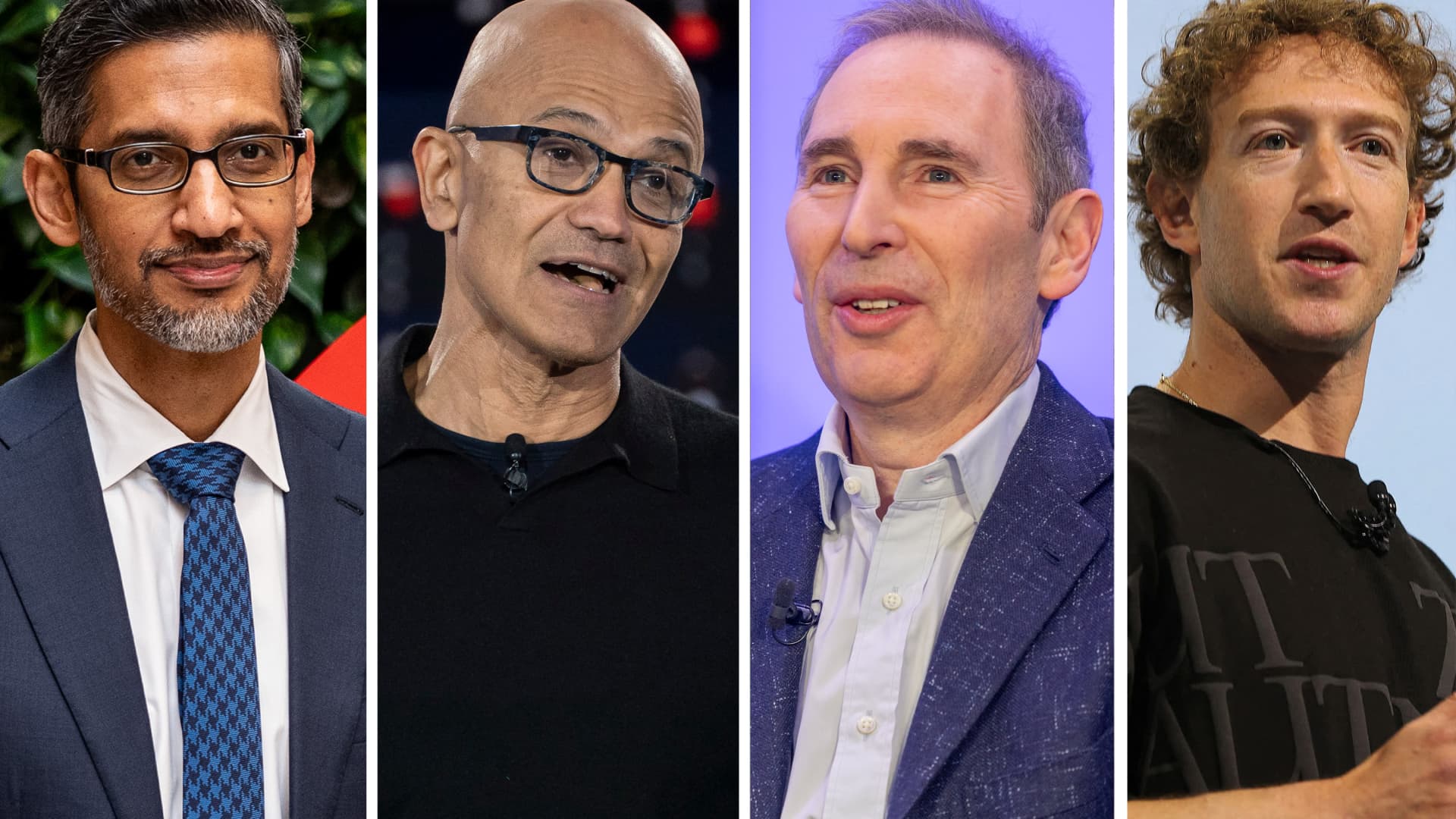
Sundar Pichai, CEO of Alphabet, Satya Nadella, CEO of Microsoft, Andy Jassy, CEO of Amazon and Mark Zuckerberg, CEO of Meta.
Damian Lemanski | David Ryder | Bloomberg | Getty Images | CNBC | Manuel Orbegozo | Reuters
The race to build artificial intelligence infrastructure at a trillion-dollar annual clip is eroding the free cash flow and increasing balance-sheet risk at so-called hyperscalers, warned Moody’s Ratings.
In a research note released this week, Moody’s said that the spending surge is forcing even the world’s most cash-rich corporations like Alphabet and Microsoft to lean heavily on debt, stock sales and off-balance-sheet moves to fund their AI ambitions.
“Previously, these companies relied on asset-light structures centered on software, intellectual property, and scalable cloud services that required modest capital investment,” Moody’s said in the Wednesday note. “The transition from asset-light to asset-heavy models requires unprecedented levels of investment and capital raising.”
The moves “threaten credit quality” for the six companies tracked by Moody’s, which include Microsoft, Amazon, Alphabet, Meta, Oracle and CoreWeave, according to the report.
The ratings firm projects that capital expenditures — or capex, which are investment for physical assets like data centers — will hit $785 billion in 2026 before reaching about $1 trillion next year.
The shift breaks a decades-long Silicon Valley formula that created the world’s most valuable companies. Software costs little to replicate, yielding fat profit margins and fortress balance sheets. Generative AI, by contrast, demands a vast physical footprint: warehouses crammed with expensive and energy-hungry servers and chips.
To finance the expansion, tech giants are increasingly turning to Wall Street, resulting in booming profits for the financial industry.
Direct debt across the six hyperscalers has reached approximately $460 billion, according to Moody’s. Tech companies are also tapping public markets for cash, including Google-parent Alphabet, which last month announced an $85 billion equity sale.
Leasing data centers
The ratings firm noted that because AI hardware and infrastructure require massive upfront investment while revenue materializes over a longer time horizon, free cash flow across the sector is coming under pressure.
To keep direct debt off their balance sheets, hyperscalers are leaning on off-balance-sheet financing, mostly through long-term data center leases, the report explained.
Moody’s said that lease commitments across the group have ballooned to $1.2 trillion. More than $820 billion of that total is from leases that haven’t started yet, meaning the data centers are still being built.
While these obligations don’t show up as traditional debt, Moody’s says it considers them as debt-equivalent liabilities that will bind companies to significant rent payments down the line.
Despite the warning, Moody’s noted that Microsoft, Alphabet, Amazon and Meta retain among the strongest corporate balance sheets in the world, making it unlikely that their investment grade ratings are under imminent threat.
While their free cash flows are tightening and their borrowing buffers are shrinking, Moody’s does not view their investment-grade ratings as under imminent downgrade threat.
The immediate pressure is concentrated on lower-rated entities like Oracle and specialized AI cloud provider CoreWeave. Oracle carries a rating of Baa2 with a negative outlook, placing it just two notches above junk status.
Meanwhile, CoreWeave operates within the high-yield market with a Ba3 rating, relying on complex private debt structures to finance its GPU hardware fleets.
Circular ecosystem
Moody’s also pointed to structural circularity within the AI boom. Some of the multibillion-dollar backlogs reported by hyperscalers stem from strategic deals with pre-IPO artificial intelligence labs including OpenAI and Anthropic, Moody’s noted.
The firms have invested billions into AI labs that, in turn, spend heavily on cloud computing from those same companies, creating what Moody’s described as a circular AI ecosystem.
The overlapping relationships heighten risks because many of the industry’s biggest companies are increasingly dependent on the same AI customers and the same assumptions about future demand, Moody’s said.
Even so, the tech giants have significant strengths that help offset those risks.
Demand for AI computing remains robust, cloud businesses continue to grow and hyperscalers have signed hundreds of billions of dollars in long-term customer contracts that should provide predictable revenue. Those deals support the industry’s largely-strong credit profiles, even amid the spending boom.
Still, investors should recognize that the tech industry’s financial profile is undergoing a structural change unlike anything seen in the cloud era, according to Moody’s.
“Investors will increasingly focus on these companies’ ability to realize an adequate return on investment,” the ratings firm said.


DEXE has lost 96.8% in 11 days after falling from a record high near $49.43 to $1.56, while large Ceffu transfers to Binance have prompted questions about a possible DWF Labs connection.
Summary
- DEXE plunged 96.8% in 11 days after reaching a record $49.43.
- Ceffu transferred 797,917 DEXE to Binance through six transactions beginning July 13.
- Ai Yi traced possible DWF Labs links but found no proof of involvement.
On-chain analyst Ai Yi reported that DEXE (DEXE) reached an all-time high of $49.432 on July 12 before its decline began the following day. The steepest move came on July 21, when the token dropped as much as 88% from $46.93 to $5.648 within one trading day, according to the analyst’s timeline.
During an examination of large on-chain flows, Ai Yi found that most transfers came from centralized exchange hot wallets. Ceffu was the only entity outside exchanges that moved more than $1 million worth of DEXE, making its activity stand out from the other transactions reviewed by the analyst.
Since July 13, the crypto custody platform has transferred 797,917.24 DEXE to Binance across six transactions, Ai Yi reported. Those tokens were worth a combined $6.15 million when the on-chain transfers took place, although their value would have been much higher before the collapse.
Ceffu’s mirrored positions may explain the delayed transfers
Ai Yi’s analysis focused on Ceffu’s MirrorX service, which allows institutional clients to trade on exchanges while keeping their assets in custody. Under the system described by the analyst, DEXE deposited with Ceffu can create a matching position on an exchange, while the corresponding on-chain transfer is settled later.
Because trading can occur before the tokens visibly move on-chain, Ai Yi argued that the six transfers may not show when the associated positions were first used. If the 797,917 DEXE had been positioned for trading before the price started falling on July 13, the analyst estimated that they would have carried an effective value of about $39.44 million.
Ai Yi presented this sequence as a possible explanation rather than proof that the tokens were sold before their on-chain settlement. The analyst’s post did not identify the owner of the assets, establish that all 797,917 DEXE had been sold, or provide direct evidence connecting the transfers to the initial price decline.
Questions over the source of the custodial balance also remain unresolved. After reviewing public project information, Ai Yi found no evidence that the DEXE team had placed tokens with Ceffu. According to the analyst, much of the project-linked supply appeared to remain in the decentralized autonomous organization’s treasury and contracts covering team-related lockups.
Falcon connections put DWF Labs under scrutiny
Searching DEXE’s official partner list for another possible route to Ceffu, Ai Yi pointed to Falcon Finance. The analyst noted that Falcon had supported DEXE as collateral on its platform and that Ceffu was among the institutions used for Falcon’s asset custody.
Ai Yi also identified links between Falcon Finance and DWF Labs, while DWF Labs appeared separately on DEXE’s partner list. Based on those public connections, the analyst suggested that the Ceffu-held tokens could have involved DWF Labs, Falcon, the project team, or another market maker.
No evidence provided in Ai Yi’s post proves that DWF Labs, Falcon Finance, Ceffu, or the DEXE team caused the crash. The analyst described the conclusion as an early assessment based on on-chain movements and a process of tracing public links, leaving open other explanations for the transfers.
Neither the transfer data nor the cited partnerships establish who controlled the DEXE positions represented through MirrorX. Ai Yi also did not rule out possible involvement by the project or other market makers, but the post offered no conclusive finding about the party responsible for selling.
DEXE’s collapse follows two other steep token sell-offs reported by crypto.news in recent weeks. On July 3, LAB fell more than 60% from a June 27 high near $20 to an intraday low of $7.50 as concerns about insider holdings, token transparency and derivatives liquidations drove panic selling.
Crypto.news reported that the LAB decline followed community scrutiny of allegations from on-chain investigator ZachXBT, who had claimed insiders controlled more than 95% of its supply. ZachXBT also raised concerns about private over-the-counter agreements, changing vesting schedules and insider-wallet movements, although those public allegations have not been established in court and the LAB team has disputed or not accepted many of them publicly.
Humanity Protocol’s H token suffered another sharp collapse on June 9, losing more than 80% after attackers drained wallets linked to the project. Unlike the unanswered questions surrounding DEXE’s transfers, the Humanity Protocol team confirmed that attackers had compromised a private key belonging to a Humanity Foundation member.
Humanity Protocol operates an identity network built on a zero-knowledge Ethereum Virtual Machine and uses palm biometrics with zero-knowledge proofs to verify unique users. The project says its design allows identity checks without placing users’ complete personal information inside large centralized databases.

Liverpool FC vs Sunderland: Prediction, kick-off time, TV, live stream, team news, h2h results, odds

TXO Partners: Looking Great Ahead Of Q2 Earnings

Coinbase reshuffles top ranks amid push into stocks and predictions


-

 Politics6 days ago
The House | The City of London can help the new chancellor deliver growth in every postcode
-

 Crypto World6 days ago
Ripple Payments Joins MiCA With 14 Firms, Does It Mean Anything For XRP?
-

 Politics5 days ago
Democrats look to World Cup watch parties to register thousands of voters
-

 Crypto World7 days ago
Ripple wins EU-wide access as ESMA adds it to MiCA register
-

 Crypto World3 days ago
Grayscale Files For Worldcoin ETF, WLD Registers Sharp Rise
-

 Tech4 days ago
Sail Virtually Aboard The “Itanic” With IA-64 Emulator
-

 NewsBeat4 days ago
Unregistered fitter used Gas Safe logo on business flyers
-
 Tech4 days ago
Turtle Beach Command Series KB7 review: a nifty screen-equipped gaming keyboard
-

 News Videos5 days ago
Big Money Is Entering XRP
-
 Business3 days ago
New Jersey voter registration controversy explained: How 6,600 noncitizens got on the rolls, and what happens next
-

 Crypto World6 days ago
Kaspersky exposes OkoBot’s 20-module crypto wallet attack
-

 Business7 days ago
Airlines warn Sunshine Protection Act could disrupt flight scheduling
-
 Entertainment3 days ago
Johnny Depp’s R-Rated Gothic Cult Classic Gets New Release Ahead of Sydney Sweeney Remake
-

 NewsBeat7 days ago
Durham County Council to send out electoral registration emails
-

 Crypto World7 days ago
MiCA Licensing Faces Delays as ESMA Adds 14 CASPs to Register
-

 Crypto World2 days ago
Ethics, other provisions in crypto Clarity Act to be further discussed
-

 Crypto World6 days ago
Chip Stocks Enter Bear Market After Moonshot Ai Unveils Kimi K3 Model
-
 NewsBeat4 days ago
Shanghai science forum photos show China’s AI and robotics advances in rivalry with US
-

 Tech4 days ago
Watch Flock Safety CEO Garrett Langley discuss the future of surveillance at TechCrunch Disrupt 2026
-

 Tech5 days ago
Subway Sandwich Computers Get a Second Life as Gaming Machines
You must be logged in to post a comment Login