

Crypto World
Bitcoin price crash puts $60K support back in the spotlight

Bitcoin price traded near $61,925 on June 5 as selling pressure kept BTC close to the $60,000 support zone, with ETF flows, whale deposits, and weak sentiment driving the next market test.
Summary
- Bitcoin price slipped near $61,925 as traders focused on $60,000 support after sharp weekly selling.
- ETF outflows and Strategy’s rare sale weakened confidence while AI-linked capital rotation added market pressure.
- Whale Binance deposits doubled in June, adding short-term selling risk as sentiment turned bearish fast.
Bitcoin price nears $60,000 support
Bitcoin price data from crypto.news showed BTC at $61,925, down 3.44% over 24 hours and 15.82% over seven days. The asset traded between $61,394 and $64,353 during the day, while 24-hour volume stood at $56.21 billion.
The latest move placed Bitcoin just above the $60,000 level. That round number has become the main support zone after BTC lost the $65,000 area and failed to hold earlier ranges near $70,000.
Bitcoin has now dropped sharply from last week’s levels above $74,000. The pullback also took BTC far below its October 2025 all-time high of $126,080, with crypto.news data showing a drawdown of more than 50%.
A break below $60,000 would move Bitcoin back into the zone seen during the February drawdown. If sellers keep control below that level, traders may turn to the $55,000 area as the next major support.
ETF outflows and Strategy sale weigh on sentiment
Bitcoin’s latest fall comes as ETF demand weakens. U.S. spot Bitcoin ETFs recently posted heavy outflows.
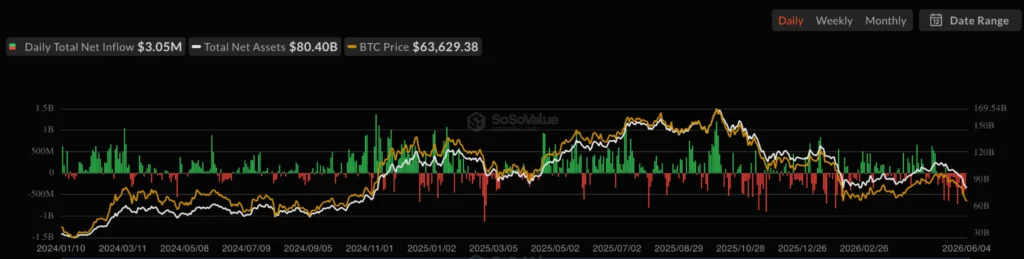
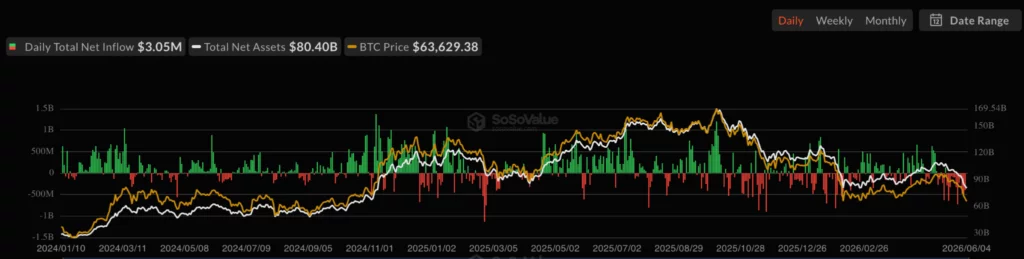
Fresh ETF data also showed a small $3.05 million daily net inflow on June 4, per SoSoValue. However, that single inflow came after 13 consecutive days of net outflows and did not erase the broader pressure. Total net assets still stood near $80.40 billion, while cumulative net inflows remained strong at $54.27 billion.
Strategy also drew market attention after disclosing its first Bitcoin sale since 2022. The company sold 32 BTC at an average price of $77,135 between May 26 and May 31, raising about $2.5 million for preferred stock distributions.
The sale was small compared with Strategy’s overall holdings. Still, traders watched it closely because Strategy had long acted as a steady corporate buyer during previous market stress.
Michael Saylor framed the weakness as part of a wider capital rotation. He said spot Bitcoin ETFs had seen about $4 billion in outflows since May 14 while capital markets funded AI infrastructure at scale. He called it “a capital rotation, not a Bitcoin impairment.”
Whales move BTC back to Binance
CryptoQuant analyst Darkfost said whale BTC deposits on Binance have accelerated during the June selloff. The analyst defined whales as entities moving more than 100 BTC, equal to over $6 million at current prices.
According to the update, Binance saw whale inflow peaks of about 8,200 BTC on June 2 and more than 6,400 BTC on June 4. The monthly average has also risen from about 1,200 BTC since mid-April to more than 2,800 BTC.
That change shows large holders are moving more coins onto exchanges. Such transfers can signal plans to sell, hedge, or manage risk during a fast market decline.
Darkfost said this behavior looked more like emotional risk management than a planned long-term move. The last time Binance whale inflows reached similar levels was during Bitcoin’s fall below $60,000 in early February.
This adds short-term selling pressure while price trades near a key level. If whale inflows stay elevated, BTC may struggle to reclaim lost support without stronger spot demand.
Sentiment flips as traders watch $55,000
Santiment data showed Bitcoin sentiment turned sharply lower after price fell from the late-May high. The firm said BTC moved from near $78,000 to about $63,800, with most of the decline happening in three days.
Social sentiment was strongly positive near the highs, then turned bearish as price broke down. Santiment said the crowd was most bullish near the top and most bearish near the lower range.
The firm also noted that sentiment is not a timing tool. Still, it said peak fear can sometimes appear near a “potential local bottom.” That wording remains cautious because price has not confirmed a reversal.
Crypto Patel also pointed to lower long-term accumulation zones. He wrote that 2026 to 2027 could become a “potential accumulation period,” with $50,000 to $40,000 acting as a possible spot buying zone if reached.
For now, Bitcoin price analysis remains tied to three levels. Bulls need to defend $60,000 and reclaim $65,000 to ease near-term pressure. Bears need a clean break below $60,000 to open the path toward $55,000 and possibly lower supports.
The next sessions may show whether the current fall is a panic-driven flush or the start of a deeper reset. ETF flows, whale exchange deposits, and Bitcoin’s reaction near $60,000 will likely guide the next move.
Disclosure: This article does not represent investment advice. The content and materials featured on this page are for educational purposes only.

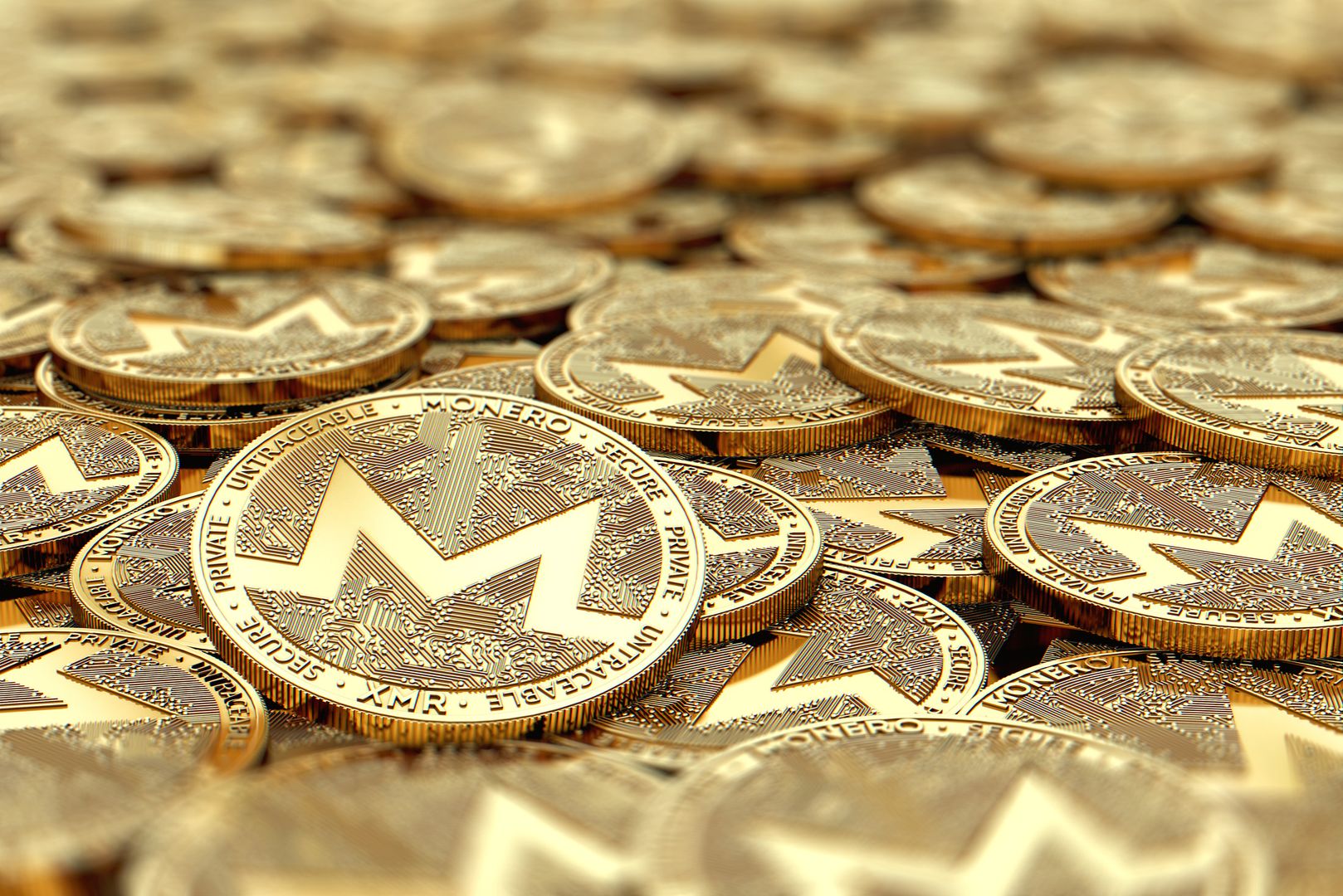
Taylor Hornby, the security engineer who used Anthropic’s Opus 4.8 AI model to find a critical bug in Zcash, says privacy coin Monero is among the tokens he intends to audit next.
Asked on X whether he could look for flaws in Monero and other private cryptocurrencies, Hornby replied, “Absolutely! I’ll add Monero to my queue of things to audit.”
Monero, which trades under the ticker XMR, is among the largest privacy-focused cryptocurrency and hides transaction details by default compared to Zcash, where users can either either transparent or shielded addressed.
Hornby found the Zcash flaw on May 29. The bug, in the blockchain’s Orchard privacy pool, had gone undetected since May 2022 and could have let an attacker mint unlimited, undetectable counterfeit ZEC. Shielded Labs, a nonprofit developer on the network, disclosed it on Thursday and pushed through an emergency fix by June 1.
Zcash fell 38% over the following 24 hours amid fallout and concerns about a hacker possibly stealing money from the shielded pool – without leaving any detectable trace – over the past few years.
Hornby, hired by Shielded Labs in April to find protocol bugs before attackers could, said he reported the flaw rather than exploit it because the Zcash developers were “like family” and he could “not live with that kind of betrayal.”
He plans to apply for a Zcash coinholder grant to fund further work.
U.S. spot Bitcoin ETFs returned to net outflows on Friday after briefly snapping a record withdrawal streak, with BlackRock’s IBIT leading the declines as Bitcoin fell below the key $60,000 support level and investor sentiment deteriorated.
Summary
- Bitcoin ETFs posted $325.7 million in outflows, led by BlackRock’s IBIT with $213.7 million withdrawn..
- Bitcoin price fell below $60,000 to a low near $59,100, while analysts linked continued ETF outflows and a more hawkish Federal Reserve outlook to the market decline.
- Analysts say $60,000 remains key support, with downside risk toward $55,000.
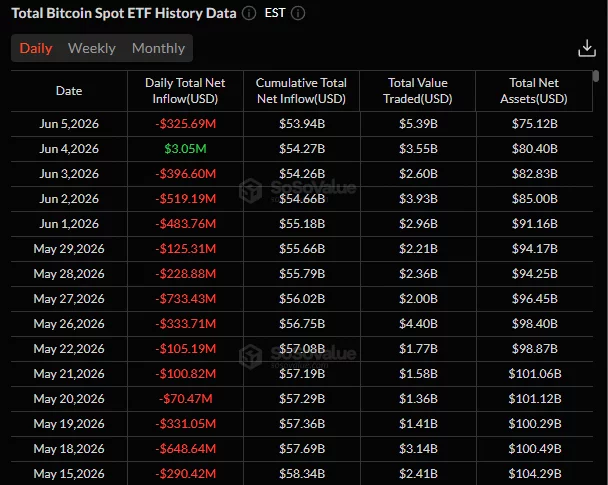
According to data from SoSoValue, the ETFs recorded $325.69 million in net outflows on June 5, reversing the modest $3.05 million inflow posted a day earlier.
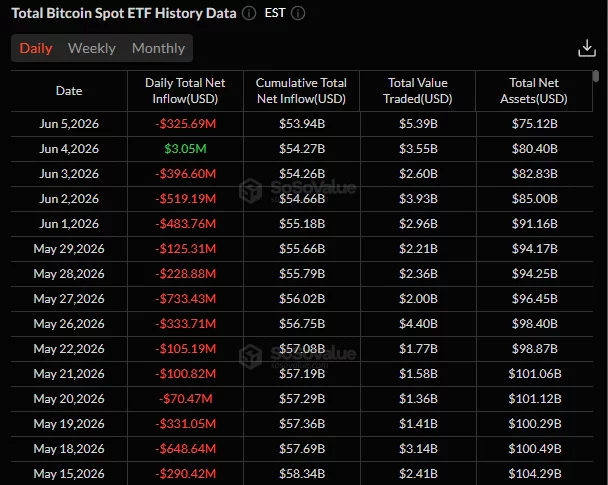
The latest withdrawals pushed cumulative net inflows across the category down to $53.94 billion and highlighted continued pressure on institutional Bitcoin demand after nearly three weeks of persistent redemptions.
BlackRock’s IBIT accounted for the largest share of the losses, recording $213.65 million in outflows on June 5. Fidelity’s FBTC and Grayscale’s GBTC followed with withdrawals of $59.69 million and $60.84 million, respectively. VanEck’s HODL and Morgan Stanley’s MSBT were the only products to attract fresh capital, bringing in a combined $8.5 million.
The renewed ETF selling coincided with a sharp decline in Bitcoin prices. According to data from crypto.news, Bitcoin (BTC) price plunged to an intraday low near $59,100 before rebounding above $61,000 at the time of writing. The move pushed the asset to its lowest level since October 2024 and extended a broader correction that has erased more than $15,000 from recent highs.
Why are Bitcoin ETFs seeing renewed outflows?
Recent ETF flow trends have attracted growing attention from Wall Street analysts. In a recent note, Citigroup argued that investors may be underestimating the role ETF demand plays in Bitcoin’s price performance.
The bank also pushed back against the narrative that Bitcoin’s recent decline was primarily driven by Strategy’s decision to sell 32 BTC for preferred stock distributions, arguing that sustained ETF outflows have played a much larger role in weakening prices.
As reported by crypto.news earlier, spot BTC ETFs recorded $2.43 billion in net ETF outflows during May and another $1.40 billion during the first three days of June, which played a major factor behind Bitcoin’s recent weakness. The latest $325.69 million redemption suggests institutional demand still remains fragile despite Thursday’s brief interruption in the outflow trend.
Pressure has also become visible in ETF holdings. Data from CheckonChain shows U.S. spot Bitcoin ETFs currently hold approximately 1.277 million BTC. While that figure remains slightly above February levels, it is still roughly 7.2% below the record high reached in October, indicating that funds have not yet recovered the Bitcoin sold during recent redemptions.
Broader market conditions have added to the pressure. Stronger-than-expected U.S. labor market data this week reduced expectations for Federal Reserve rate cuts and prompted traders to scale back risk exposure across digital assets.
The shift in sentiment intensified after BNP Paribas abandoned its previous forecast for stable monetary policy and projected three Federal Reserve rate hikes beginning in December, effectively reversing the three rate cuts delivered in 2025.
The bank cited persistent inflation pressures and a resilient labor market as reasons policymakers may need to tighten policy again, helping trigger a wave of selling that pushed Bitcoin below major technical support levels.
This bearish forecast helped trigger a wave of selling that pushed Bitcoin below major technical support levels.
Where could Bitcoin price head next?
Technical indicators suggest Bitcoin is approaching an important decision point after reaching deeply oversold conditions.
On the daily chart, BTC briefly dropped below the Murrey Math support zone near $60,000 before recovering. The daily RSI has entered oversold territory while the MACD continues to trend lower, reflecting strong bearish momentum but also increasing the probability of a relief rally.
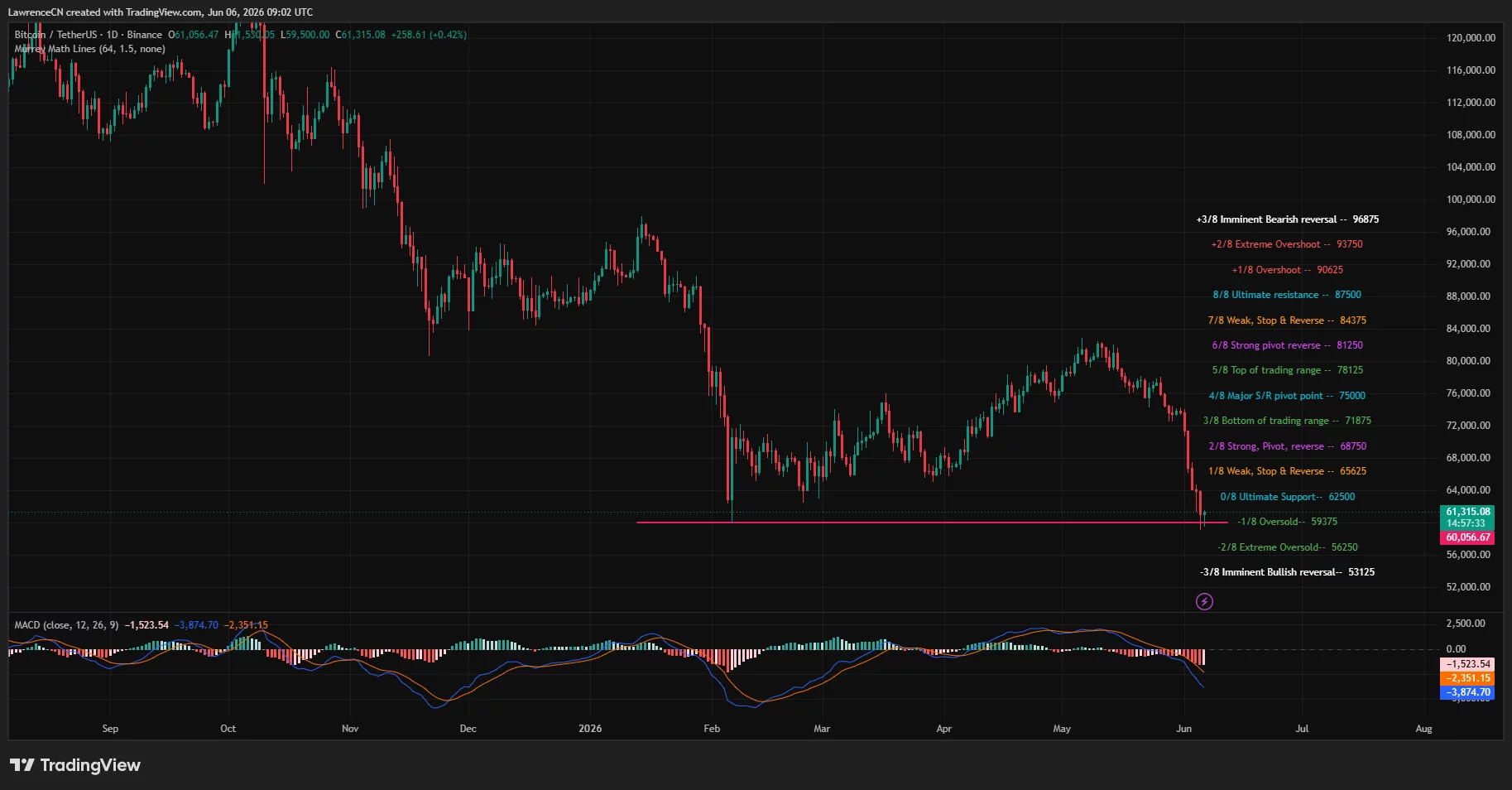
According to analyst Kamile Uray, buyers need to defend the current area to prevent a deeper decline.
“BTC experienced a sharp decline along with all markets. It has reached 60,000, which we’ve long referred to as an important level. A strengthening of buyers at this level could at least bring about a rise in the form of a correction to the drop.”
According to Uray, the first resistance level sits around $67,500, followed by a broader resistance zone between $74,000 and $75,000. However, he warned that failure to hold the $60,000 area could expose Bitcoin to a deeper decline toward the $55,000-$50,000 range.
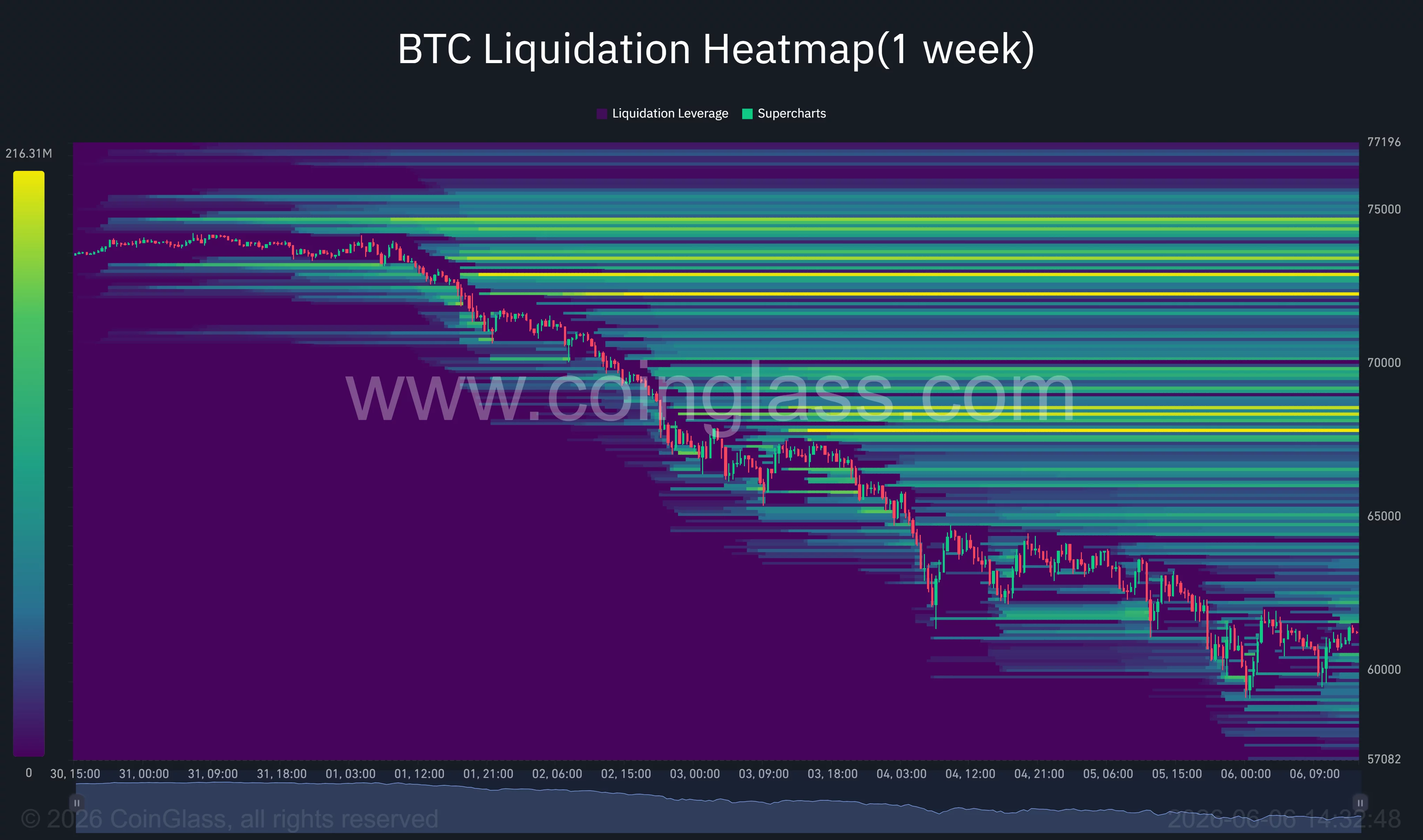
Derivatives positioning also points to heightened volatility ahead. CoinGlass liquidation heatmap data shows large clusters of leveraged positions concentrated between $67,000 and $75,000. If Bitcoin stages a recovery, those levels could become liquidation targets that accelerate upside momentum.
On the downside, analyst Ali Martinez noted that Bitcoin’s 1.0 and 0.8 MVRV pricing bands currently sit at approximately $53,900 and $43,130, respectively, levels he described as historically attractive risk-reward zones during major market corrections.
At the time of writing, Bitcoin was trading near $61,300, leaving traders closely watching whether support around $60,000 can hold as ETF outflows continue to weigh on market sentiment.
Disclosure: This article does not represent investment advice. The content and materials featured on this page are for educational purposes only.

TLDR:
- Russia’s central bank limits non-qualified investors to Bitcoin, Ethereum, and USDT only.
- A 300,000-ruble annual cap per broker applies to retail crypto purchases under the draft law.
- USDT remains on the approved list despite central bank warnings over freezing and burn risks.
- Russia’s digital currency law is set to take full effect on July 1, 2026, after summer passage.
Russia’s central bank has drawn a firm line on crypto access for retail investors. First Deputy Governor Vladimir Chistyukhin confirmed the Bank of Russia will restrict non-qualified investors to three assets: Bitcoin, Ethereum, and USDT.
The decision reflects the regulator’s cautious stance toward digital assets amid high volatility concerns. An annual investment cap of roughly 300,000 rubles, or about $4,100, through a single broker will also apply.
Three Assets, Strict Limits, No Near-Term Expansion
The Bank of Russia has been consistent in its position on retail crypto access. Chistyukhin reiterated that the regulator views cryptocurrencies as high-risk, highly volatile instruments unsuitable as priority investments for everyday Russians. The three-asset list — Bitcoin, Ethereum, and USDT — reflects the most liquid options currently available.
The 300,000-ruble limit per professional participant was also defended by Chistyukhin. He noted the figure already exceeds the average balance on most Russian brokerage and trust management accounts. From the regulator’s view, this threshold covers exposure without enabling runaway losses.
The central bank also acknowledged requests to expand the list beyond these three assets. Those requests came primarily from parties interested in listing domestically issued stablecoins.
However, the bank made clear that such expansion will only make sense once those assets formally exist and operate at scale.
Chistyukhin was direct on the timeline: “We will start with three currencies, then we will see how the situation develops.”
He added that while the law permits future expansion, no immediate moves are planned. “So they will act,” he said, referring to the three approved assets.
USDT Risks and the Stablecoin Debate
Even as USDT makes the approved list, the central bank did not shy away from flagging its vulnerabilities. Chistyukhin reminded stakeholders that USDT wallets can be frozen or burned by the issuer at any time.
“They can be blocked today, in fact, they can be burned — their owners can be deprived of the right to use these stablecoins,” he said. That risk, he argued, justifies keeping the stablecoin investment cap unchanged.
The stablecoin debate has drawn input from other officials as well. Deputy Finance Minister Ivan Chebeskov argued that stablecoins from friendly jurisdictions should also be considered.
“It is important for us that stablecoins of friendly jurisdictions are also available,” he said, citing a ruble-pegged token issued in Kyrgyzstan as one example.
Moscow Exchange head Viktor Zhidkov suggested regulators could eventually approve up to five coins for non-qualified investors.
“Our investor buys the main, most popular three to five coins,” he said. Any additions, however, remain subject to regulatory review and formal admission criteria.
The draft law governing digital currency circulation and digital rights passed its first State Duma reading in late April. Lawmakers plan to adopt it before summer, with the full regulatory framework set to take effect on July 1, 2026.
Both qualified and non-qualified investors will be required to pass a knowledge test before purchasing any approved digital assets.

After plunging by several grand in the span of less than 12 hours, bitcoin finally rebounded from its multi-year low and now sits at around $61,000.
Although most altcoins are still in the red on a daily scale, they have managed to recover some of the losses. This is particularly true for ZEC, which bled out heavily yesterday, and PI, which marked consecutive all-time lows.
Bitcoin Recovers $2K
What a week it has been for bitcoin, and mostly for the bears. In fact, what a painful three-week period. The asset stood above $82,000 in mid-May before its calamity began, and it dumped to $74,000 at the end of the month. But that was just the start, as June, in just five days, brought a lot more pain.
Bitcoin quickly lost the $70,000 support, and then the bears were really in control. They started pushing it below one key support level after another. Thus, $68,000, $65,000, and $62,000 gave in before the asset came inches away from the $60,000 bottom that managed to hold it during the February crash.
Although the buyers successfully defended it at first, that level finally gave in yesterday, and bitcoin plunged to just over $59,000. This became its lowest price since before the November 2024 US presidential elections. After losing about $23,000 in weeks, BTC finally showed signs of a minor recovery and has bounced to $61,000 as of now.
Its market cap is up to $1.225 trillion on CG, while its dominance over the alts has reclaimed the 56% level.

ZEC, PI Rebound
Although most crypto assets plunged yesterday, Zcash became the worst performer after a vulnerability in its code was uncovered and Arthur Hayes dumped his entire stash. At one point, ZEC had dropped by over 50%, going from $630 to under $300. However, it has reacted swiftly and now trades above $370.
Pi Network’s native token marked several consecutive all-time lows after it dumped below $0.15 earlier this week. The latest, according to CoinGecko data, sits at under $0.12. However, it has managed to reclaim that level since then and now trades about 7% above the ATL.
ETH dumped to $1,500 yesterday but stands close to $1,600 now. BNB is back to $580, while XRP has returned to $1.10. XLM and CC are among the few alts in the green today.
The total crypto market cap dipped to $2.1 trillion yesterday, and although it has recovered some of its losses, it still sits below $2.2 trillion on CG.

The post Pi Network’s PI Token Rebounds After New ATL, BTC Quickly Reclaims $60K: Weekend Watch appeared first on CryptoPotato.


Arthur Hayes has closed his entire Worldcoin position after turning cautious on WLD and other high-beta altcoins within days of publicly defending the trade.
Summary
- Arthur Hayes sold his entire WLD position on June 6 after recently backing the AI-linked token.
- Hayes had earlier exited HYPE, NEAR, and ZEC within two days.
- Stacy Muur said WLD had gained about 68% while the market dropped nearly 10%.
Hayes said in posts on X that he sold the full WLD position on June 6 after earlier arguing that the token could benefit from renewed interest in artificial intelligence-linked assets. The BitMEX co-founder had outlined a bullish case for WLD on June 3, then reiterated the view on June 4, linking the token to expected AI IPO activity and shifting liquidity conditions.
Hayes Cuts WLD After Rapid Rally
Worldcoin had gained strongly during the previous three weeks, even as several altcoins struggled to hold momentum. Crypto analyst Stacy Muur said on June 5 that WLD had advanced about 68% while the crypto market fell roughly 10%. She attributed part of that gap to Hayes and his fund, Maelstrom.
By June 6, Hayes had reversed course and shared a chart to explain why he had sold the full position. His exit turned WLD from one of his preferred AI-related trades into another token removed from his book during a sharp round of risk reduction.
The sale came after WLD became more volatile in early June. Hayes did not describe the move as a slow portfolio adjustment. Instead, his public posts showed a quick move from conviction to a complete exit.
HYPE, NEAR, ZEC Sales Came First
Worldcoin was not the first token Hayes dropped during the week. On June 4, he said he had sold his full HYPE and NEAR holdings and told followers that he would explain the decision in an essay titled “Reality Test,” expected the following Tuesday.
In the same macro note, Hayes cited higher energy prices tied to the Iran conflict, three expected AI IPOs before early Q3, and his view that President Trump could adopt an anti-AI stance before the midterms. Hayes presented those issues as reasons to reassess positions linked to AI and speculative liquidity.
A day later, Hayes also exited Zcash after the Orchard shielded-pool vulnerability became public. He wrote that the trade no longer worked for him because the bug could not be formally proved to prevent unauthorized minting. Hayes added that the “privacy from AI, govt, big tech narrative demands perfection.”
As previously covered on crypto.news ZEC sale ended what Hayes had called his “Holy Trinity” of HYPE, NEAR, and ZEC. WLD then became the final major position he removed.
Hayes remains a closely followed crypto investor, and his trades often shape debate even when they do not directly move prices. His decision to sell WLD, HYPE, NEAR, and ZEC within two days gave traders a clearer view of his current caution toward altcoins outside Bitcoin and Ether.
The key question for WLD holders is whether the token’s earlier premium can hold without Hayes as a public backer. Stacy Muur’s June 5 comments showed how far WLD had moved ahead of the market before the exit.
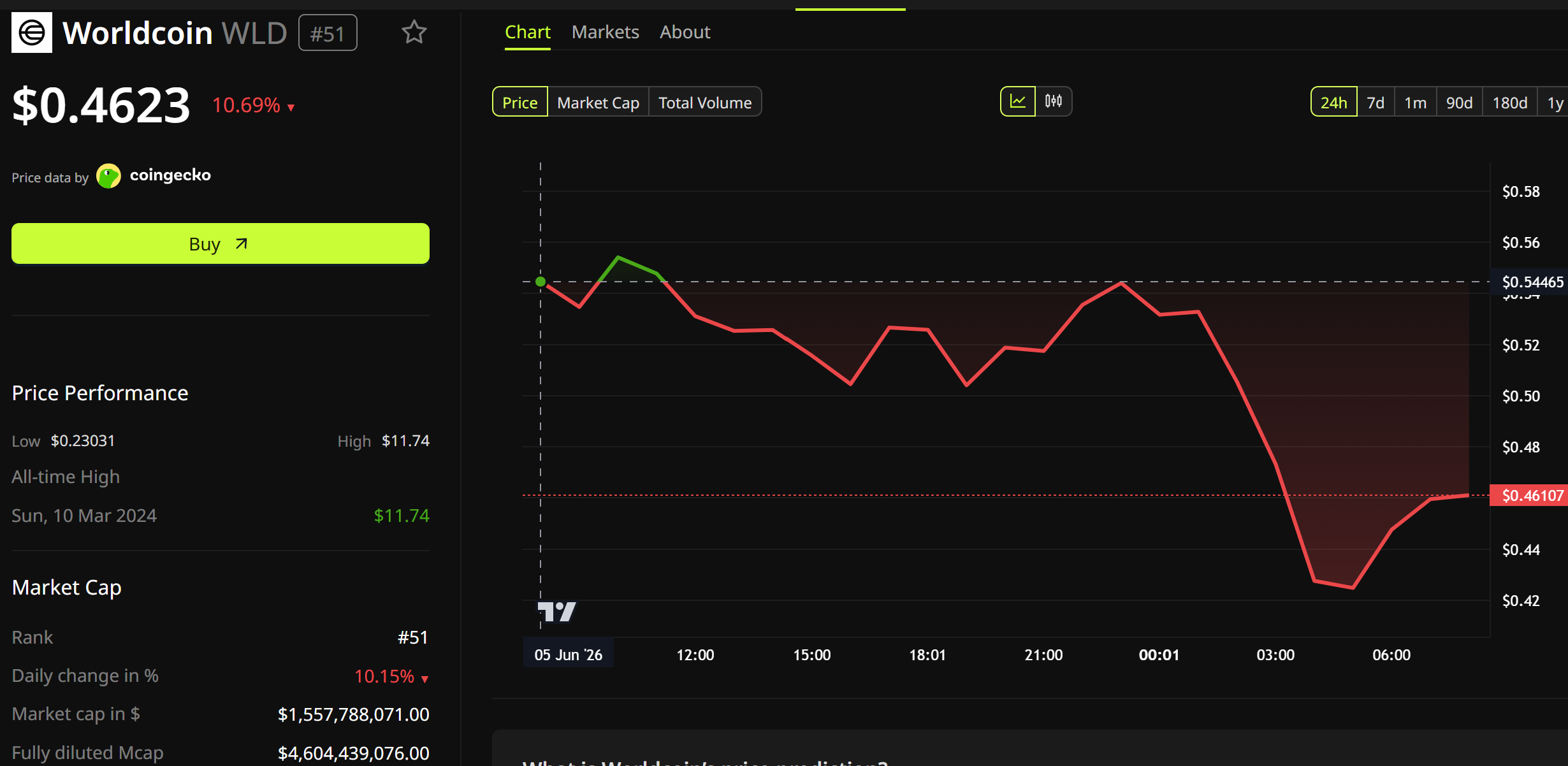
Arthur Hayes said he sold his Worldcoin (WLD) position on June 6, only days after publicly promoting the token, drawing accusations that he built exit liquidity for his own followers.
The reversal capped a week in which the BitMEX co-founder unwound four high-conviction altcoin bets. WLD traded near $0.46, down about 11% over 24 hours after a sharp weekly run.

Arthur Hayes Moves From Bullish Thread to Sudden Exit
Hayes announced the sale on X (Twitter) early Saturday, alongside a falling price chart.
“This chart is going in the wrong direction. Dumped $WLD. I’m out. See y’all at the clerb,” he said.
The timing fueled the anger. Days earlier, Hayes had urged followers to hold WLD through an expected SpaceX listing and framed it as a high-beta bet on artificial intelligence.
WLD had climbed roughly 55% over the prior week before the pullback.
Worldcoin, since rebranded World, is the iris-scanning identity project co-founded by OpenAI chief Sam Altman. Its token has drawn heavy retail interest, which critics say magnifies the impact of influential traders.
WLD still ranks near 51st by market value at roughly $1.55 billion. The single-day drop trimmed about $190 million from that figure, even after the token gained around 55% over the prior seven days.
Critics Allege a Repeated Pattern
The backlash widened after crypto sleuth ZachXBT tied the WLD exit to earlier reversals.
“How much exit liquidity was created from your followers over the past couple days? First NEAR HYPE ZEC Now WLD,” wrote ZachXBT.
Follow us on X to get the latest news as it happens
Indeed, Hayes dumped his Hyperliquid stack and NEAR Protocol (NEAR) on June 4, days after a $150 HYPE price target and a public charity wager.
He exited Zcash (ZEC) next, then WLD, despite having kept holding Worldcoin as his last AI proxy.
“…no redemption for you [Arthur Hayes] ever… Just leave to some remote island and beg for forgiveness for 50 years and never show your face in this crypto-space ever again,” another user lashed.
Hayes carries a contested history. He pleaded guilty in 2022 to a Bank Secrecy Act violation tied to BitMEX and paid a $10 million fine. This history deepens the distrust behind the Worldcoin price manipulation claims now circulating.
In his defense, Arthur Hayes says he “sold to a willing buyer at a price, highlighting that he would have suffered the loss had prices moved higher.
“I just happened to call it right this time as it regards to my trading goals,” wrote Hayes.
Whether the episode reshapes how followers treat his calls, or simply fades like prior cycles, may become clear in the coming weeks.
“ZEC, NEAR, and WLD are back to where they were before his calls,” Lookonchain indicated.
The post Arthur Hayes Sparks Fury After Abrupt Worldcoin Exit, WLD Price Falls 10% appeared first on BeInCrypto.

Solana-based memecoin launchpad Pump.fun has unveiled an open bounty platform that pays crypto rewards for promotional tasks—ranging from jaw-dropping stunts to deeply controversial acts. The system operates with funds escrowed and submitted tasks reviewed by Pump.fun, with payouts released only if a submission passes review and is accepted.
Among the most eye-catching bounties are a $57,000 offer to skydive into a World Cup match as a memecoin mascot, and a $25,000 bounty to interview the family of Henry Nowak’s killer. There’s also a $3,000 incentive to quit one’s job live on camera. The platform’s ledger at the time of reporting showed an unclaimed pool of about $115,000 across 225 live bounties and 509 total submissions, indicating both high interest and a crowded field of proposals.
Open bounties on Pump.fun are listed with expiration dates, detailed deliverables, and the ability for participants to submit attempts. Users can sort by reward, remaining time, or the number of submissions to gauge popularity and urgency. When a task is accepted, the payout is disbursed to the submitting participant, with funds held in escrow during review.
However, the platform’s ambitious scope has raised questions about moderation, safety, and potential legal exposure. Critics have pointed to the risk that some tasks could be exploitative or harmful, underscoring the need for robust safeguards and clear boundaries around acceptable conduct. In its Terms and Conditions, Pump.fun notes that bounties deemed spam by the platform’s hosting environment may be disallowed, signaling an attempt to curb reckless or abusive use of the system.
“This is a horrible market. It’s like playing with poor people’s lives and paying them to entertain you.”
That sentiment was echoed by observers on social media, who warned that the platform could resemble a modern, crypto-flavored variant of contestants’ stunts from reality shows. Another commentator drew a parallel to dystopian tropes, noting the stark power imbalance between high-stakes promotions and participants willing to take on risky or degrading tasks for a payout.
As Pump.fun frames it, the platform exists to channel human energy and financial rewards across a global network, enabling participants to pursue bounties for virtually any deliverable. Open listings include tasks with captions and explicit deliverables, requiring video proof or other verifiable evidence to qualify for payment. The open-bounty model relies on a blend of creator trust, platform oversight, and escrowed funding to mitigate risk and ensure accountability.
Platform listings show the breadth of creative possibilities—and risks. One task offers a $3,572 bounty to spray-paint the ticker symbol “$memecoin” on a car and ignite it, provided the participant dons a memecoin mascot and documents the entire process. Another listing proposes a $2,630 bounty for tattooing the ticker symbol “$boutywork” on a participant’s forehead, with a video proof requirement. Each bounty is structured with a deadline, deliverables, and a payout condition if approved by Pump.fun’s review process.
At present, Pump.fun’s bounty pool is far from empty, but a sizable portion remains unclaimed. The platform’s public view shows $115,000 in unclaimed rewards while listing 225 live bounties and 509 submissions from participants. The sheer scale of interest illustrates how quickly meme economies can incubate incentive campaigns when combined with crypto funding and a streamlined escrow workflow.
Key takeaways
- Pump.fun has launched an open bounty marketplace on Solana that pays crypto rewards for promotional tasks, with funds held in escrow and reviewed by the platform.
- High-profile bounties include a $57,000 skydiving stunt into a World Cup match and a $25,000 interview with the family of a killer—highlighting the platform’s willingness to fund extreme promotional acts.
- As of reporting, there is about $115,000 unclaimed across 225 active bounties and 509 total submissions, signaling strong participant interest but ongoing liquidity concerns for some tasks.
- Moderation and safety concerns persist, with Terms indicating that bounties deemed spam by social platforms may be disallowed and critics warning about potential exploitation or legal exposure.
- The marketplace illustrates a broader dynamic: meme-driven incentives can rapidly mobilize large-scale marketing stunts, but the ethical and regulatory implications remain unsettled.
A new marketplace for memecoin stunts
Pump.fun positions the platform as an open marketplace to “complete bounties for ANY task and leverage the power of humans & money across the globe.” Submissions are reviewed by Pump.fun, and funds stay in escrow until a bounty is accepted and paid out. This model aims to provide a structured pathway for creative marketing while preserving a check on submissions through defined deliverables and expiration windows. In its Terms, the company makes clear that tasks that may constitute spam on other networks are not allowed, signaling an intent to set some boundaries around the kinds of stunts allowed on the platform.
Notable listings and what they reveal about incentive design
Several listed bounties underscore the carnival-like quality of crypto marketing, but also the potential for harm. A task offering $3,572 encourages painting a car with the ticker symbol for a memecoin and then setting it on fire, with the participant required to wear a memecoin mascot and film the process. A separate offer of $2,630 seeks participants willing to tattoo the ticker “$boutywork” on their foreheads, accompanied by video proof. Each task has a defined deadline and deliverables, and all are subject to Pump.fun’s review and escrow-based payout model.
Beyond these spectacle-driven promotions, other high-value listings reveal a more provocative edge. The $25,000 bounty to interview the family of Henry Nowak’s killer is a stark example of how meme-driven campaigns can intersect with real-world narratives, raising questions about consent, privacy, and the line between marketing and sensationalism. These listings illustrate how the platform acts as a rapid-launchpad for creative, if controversial, promotional campaigns that leverage crypto as a payoff mechanism.
Community responses have been mixed. Some users criticize the platform for wagering with vulnerable participants—calling it an extreme form of entertainment economics—while others see it as a new front in the evolution of meme-driven marketing and incentive design. For now, Pump.fun’s escrow-backed framework and explicit deliverables provide a level of guardrails that could help distinguish legitimate campaigns from reckless stunts, but the long-term viability will hinge on how well safety, consent, and legal risk are managed as the catalog of tasks grows.
“This is a horrible market. It’s like playing with poor people’s lives and paying them to entertain you.”
Meanwhile, other comments captured the surreal nature of the platform’s offerings. “Yep, reminds me of Squid Game,” one observer remarked, underscoring the sensational vibe that such bounty listings have cultivated within crypto communities. Whether these reactions signal skepticism or curiosity, they reflect a broader tension between provocative marketing and responsible promotion in a space where incentives are amplified by cryptocurrency rewards.
As with any new incentive system, the key questions will revolve around moderation, safety, and the legal environment. Pump.fun’s Terms explicitly aim to filter out spam and ensure that tasks meet acceptable standards, but observers will be watching to see how these rules are enforced as the bounty pool scales and as more users participate with diverse risk appetites.
For investors and builders, the platform’s emergence signals a broader trend: meme-powered incentive models can accelerate marketing reach far beyond traditional channels, often at a rapid pace. Yet the authenticity and sustainability of such campaigns will ultimately depend on governance, participant protection, and clear boundaries around what constitutes acceptable promotional activity in different jurisdictions.
Source: Pump.fun
Related coverage: South Korea police probes Polymarket users over illegal gambling claims, illustrating how regulatory scrutiny looms over crypto-backed promotional activities and prediction markets.
Crypto World
Shilling Before Dumping? Why Crypto X Is Furious With Arthur Hayes After His Latest Sale

Despite outlining bullish predictions for several popular altcoins in the past few months, such as WLD, ZEC, HYPE, and NEAR, Arthur Hayes has publicly declared that he has sold almost all of his positions long before his targets were reached.
This has caused a significant backlash from the cryptocurrency community, as some believe his hype is only to drag people into those assets before he dumps them at higher prices.
Hayes Continues Selling, This Time WLD
It was just several days ago that Hayes said he would be holding WLD for at least the first week of SpaceX’s IPO, as both have Elon Musk as a key person. He predicted that the IPO would “melt people’s faces off.”
Hours ago, though, he changed his tune after showing the chart of SpaceX’s stock getting wrecked on Friday during the market-wide calamity. He argued that the newly listed shares are heading in the wrong direction, which is why he decided to dump his WLD stash.
Popular on-chain sleuth ZachXBT was among the first to call out Hayes on his controversial moves, asking how much “exit liquidity was created” from his followers over the past few days. He also brought up other major sales from Hayes.
As reported yesterday, the BitMEX co-founder disposed of his ZEC stash after developers revealed a Zcash code vulnerability that was already fixed at the time of his sale. Previously, he had also dumped HYPE and NEAR holdings after making some quite optimistic price predictions.
How much exit liquidity was created from your followers over the past couple days?
First NEAR HYPE ZEC
Now WLD pic.twitter.com/vyDXwCHRwO— ZachXBT (@zachxbt) June 6, 2026
Community Lashes Out
The analysts at Lookonchain also flagged his exits, especially since they arrived close to the assets’ price tops. Interestingly, all of them plunged in the hours after he disclosed his exodus and have returned to essentially the same levels where they were before his big price predictions.
Arthur Hayes(@CryptoHayes) called $ZEC, $NEAR, and $WLD.
He sold near the top, then disclosed his exit and turned bearish.$ZEC, $NEAR, and $WLD are now back to where they were before his calls. pic.twitter.com/IlvCqTHe3r
— Lookonchain (@lookonchain) June 6, 2026
Some of the comments below the posts on X were quite brutal, calling it a “douchebag” move for shilling an altcoin just hours before dumping it. Others noted that if any traders followed his moves, they were “small scammers” that were “scammed” by the “big scammer.”
The post Shilling Before Dumping? Why Crypto X Is Furious With Arthur Hayes After His Latest Sale appeared first on CryptoPotato.
TLDR:
- 83% of altcoins on Binance are trading below their 200-DMA, one of the lowest readings this cycle.
- TOTAL3 has dropped to roughly $670B, shedding around $520B from its peak during the current cycle.
- Altcoin weakness has persisted since October 2025, with 60–90% of assets below their 200-DMA consistently.
- Bitcoin fell nearly 4% while Nasdaq dropped 4.7%, dragged lower by AI and semiconductor stock weakness.
The altcoin market is facing severe pressure as $520 billion in capitalization has evaporated since October 2025. Bitcoin dropped nearly 4% in a single session, while the S&P 500 fell 2.6% and the Nasdaq lost 4.7%.
Technology stocks, particularly AI and semiconductor names, led the broader selloff. Against this backdrop, altcoins have continued to lag behind the wider market recovery.
83% of Altcoins Trade Below Key Technical Level
Data from Binance shows that 83% of listed altcoins are now trading below their 200-day moving average. This reading ranks among the lowest levels recorded during the current market cycle. The 200-DMA is widely regarded as a reliable gauge of long-term trend direction.
The weakness is not a recent development. Since October 2025, the share of altcoins below their 200-DMA has ranged between 60% and 90% consistently.
That persistent range reflects a structural breakdown rather than a short-term dip. Few assets in this segment have managed to hold above the key threshold.
Analyst Darkfost noted the severity of the situation in a post on X, stating: “83% of Altcoins below 200-DMA as $520B vanishes from the Altcoin market.”
The observation draws attention to how broadly the damage has spread across the altcoin market. It is not isolated to a handful of smaller tokens.
Moreover, the current weakness extends across assets of varying market capitalizations. Both mid-cap and smaller altcoins have struggled to gain traction.
Trading volumes have also remained subdued, offering little indication of buyer conviction in the near term.
TOTAL3 Drops to November 2024 Valuation Levels
TOTAL3, which measures the combined market cap of altcoins excluding Ethereum, has fallen to roughly $670 billion.
That figure represents a loss of approximately $520 billion from its peak during this cycle. The index now sits at valuations last seen in November 2024.
The decline brings the altcoin market back to a period before many anticipated a broad rally. Much of the capital that entered during late 2024 and early 2025 has since rotated out or been lost. Recovery to previous highs would require a substantial shift in market sentiment.
Historically, conditions of extreme pessimism have preceded meaningful turning points in the altcoin market. In March and December 2024, nearly 90% of altcoins traded above their 200-DMA, a breadth level not seen since 2017. That level of expansion often signals an overheated market rather than a foundation for continued gains.
Opportunities in past cycles have tended to emerge when pessimism is at its deepest. Whether the current environment represents that kind of floor remains to be seen. For now, the data paints a picture of continued structural weakness across the altcoin space.

Bitcoin’s price crash that began at the start of the business week culminated yesterday evening, at least for now, with a painful decline to a multi-year low of $59,100 on most exchanges.
This violent drop of roughly $23,000 in the span of just a few weeks might be regarded as a proper buy-the-dip opportunity, but popular analyst Ali Martinez believes the most lucrative levels are yet to come.
In a recent post on X following the Friday night massacre, Martinez said the “best risk-reward opportunities typically emerge” when the asset drops into the 1.0 or 0.8 MVRV Pricing Bands.
Despite the correction, BTC is still far from these levels, he added. In order to reach them, the cryptocurrency’s correction needs to extend further, as they currently sit just under $54,000 and over $43,000. Bitcoin hasn’t traded at such low levels in over two years.
I believe the best risk-reward opportunities typically emerge when Bitcoin $BTC drops into the 1.0 and 0.8 MVRV Pricing Bands.
Those levels currently sit at $53,900 and $43,130, respectively. pic.twitter.com/crHwe4NNwH
— Ali Charts (@alicharts) June 6, 2026
In contrast, fellow analyst Crypto Rover believes the bottom might be in, according to a signal that has successfully determined all previous ones. His advice was that investors turn into a full-on accumulation mode, as they will be called “lucky” in 2-3 years when the next bull cycle peaks.
However, on-chain metrics and key technical tools still do not indicate that BTC has bottomed out during this phase. In fact, some analysts envision a more profound decline to $50,000, while Peter Schiff, staying true to his nature, predicted a crash to $20,000 if that support level is lost.
The post Should You Buy BTC Now? Analyst Reveals the Best Bitcoin Entry Levels After the Crash appeared first on CryptoPotato.

‘Yellowstone’ Meets ‘John Wick’ in Denzel Washington’s Brutal Western Streaming for Free This Month

Rick Astley Scarborough gig inspires police safety message

Scaloni Offers Messi Fitness Update as Argentina Prepares World Cup Title Defense



-

 Business5 days ago
Jade Biosciences, Inc. (JBIO) Discusses Positive Interim Results From JADE101 Phase I Healthy Volunteer Study and Development Plans Transcript
-
 Tech7 days ago
SpaceX just won a second Golden Dome contract. This one is $4.16 billion.
-

 Sports3 days ago
French Open 2026 results: Alexander Zverev beats Rafael Jodar and will play Jakub Mensik in semi-finals
-

 Fashion16 hours ago
Weekend Open Thread: Evereve – Corporette.com
-

 Tech4 days ago
CryZENx Releases Fresh Playable Content Deep Inside Jabu-Jabu for His Ocarina of Time Remake
-

 Business7 days ago
Is the Spurs Phenom Already Better Than Prime Diesel?
-
 Crypto World20 hours ago
Jensen Huang Approves Samsung, SK Hynix, and Micron for NVIDIA (NVDA) HBM4 Memory Supply
-

 Business3 days ago
Trump Taps Housing Chief Bill Pulte as Acting Intelligence Director After Gabbard Exit
-
Crypto World24 hours ago
LBank Surpasses 25 Million Users Worldwide as AFA Partnership Continues to Drive Global Growth
-
 Entertainment7 days ago
One of the Greatest Sitcoms of All Time Shoots Up Apple TV’s Charts 11 Years Later
-
 NewsBeat7 days ago
Everything you need to know as Cambridge’s Strawberry Fair returns after cancelled year
-
 Crypto World4 days ago
Seagate (STX) Stock Surges to Record High on AI Boom and Legal Settlement
-
 NewsBeat3 days ago
Republicans balk at Trump’s attempt to appoint a MAGA enforcer to lead National Intelligence
-
Crypto World3 days ago
EU AI Data Center Project Faces Delays as Funding Gaps Grow
-

 Entertainment3 days ago
Did The Mandalorian And Grogu Already Ruin The Next Star Wars Movie?
-

 Tech7 days ago
Acer’s Swift Air 14 is a peppy MacBook Neo rival with some cool upgrades and a $699 ask
-

 Business3 days ago
Aehr Test Systems Stock Soars 17% Amid Surging AI Demand and Conference Spotlight
-
Business7 days ago
Algoma Steel gains 63% as Fair Value models spot opportunity
-
 Business4 days ago
Claude AI Down Today Reason: Why Anthropic’s AI is not working today? What’s the latest quota update
-

 Business3 days ago
Relay Therapeutics Shares Surge 20% on ASCO Momentum for Zovegalisib Breast Cancer Program
You must be logged in to post a comment Login