
Crypto World
Bitcoin price falls 2% as CPI puts $63.9K at risk

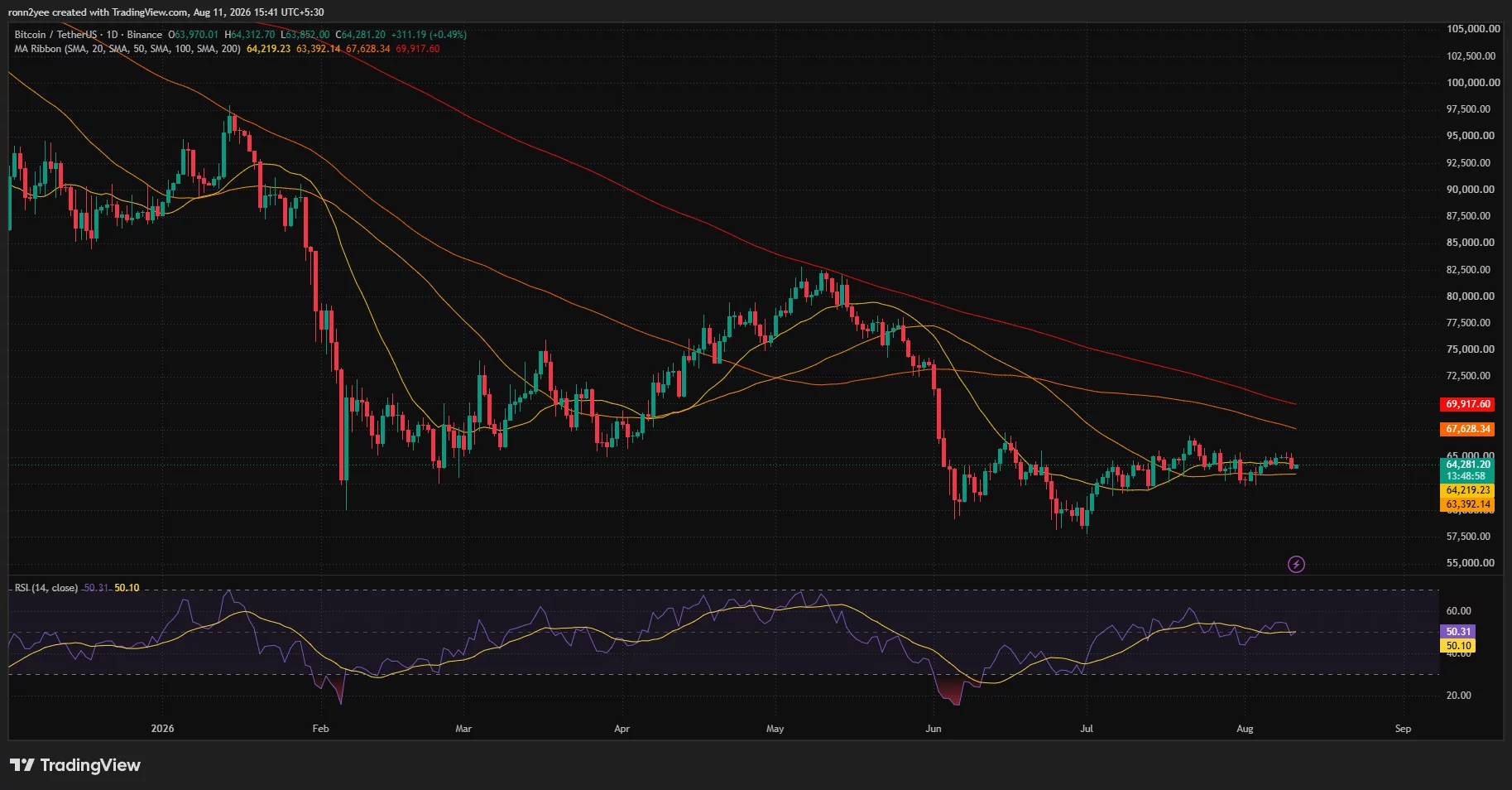
Bitcoin price fell below $64,000 on Aug. 11 as rising oil prices and uncertainty before the U.S. inflation report weakened risk appetite, leaving traders focused on whether the $63,900 support level can prevent a deeper correction.
Summary
- Bitcoin price fell about 2% to $63,780 before recovering above $64,000 during the session.
- The $63,900–$64,000 region is the main short-term pivot ahead of the July CPI report.
- Daily RSI remains neutral at 50.31, while BTC trades below its 100-day and 200-day moving averages.
- Liquidation clusters near $63,700 and $65,600 could attract price during the next volatility spike.
Bitcoin price drops below $64,000
According to data from crypto.news, Bitcoin (BTC) price traded as low as $63,852 on Binance before recovering to approximately $64,281 at the time the daily chart was captured. The intraday rebound reduced the loss, but BTC remained below the $65,000 level that buyers had attempted to establish as support over the previous four days.
The decline followed another deterioration in U.S.-Iran negotiations over reopening the Strait of Hormuz. Brent crude rose above $89 a barrel as reduced hopes for an agreement renewed concerns about energy supplies and inflation.
Higher oil prices can complicate the Federal Reserve’s inflation outlook by raising transportation and production costs. That pressure reduced demand for risk assets as U.S. traders prepared for the July Consumer Price Index report.
Broader crypto markets also weakened during the move. Ether and XRP fell more than 2%, while Bitcoin lost the $64,000 level after failing to hold above $65,000.
SoSoValue data shows that institutional demand offered limited support. U.S. spot Bitcoin exchange-traded funds recorded $144.6 million in net outflows on Aug. 10, ending five consecutive sessions of positive flows. The reversal reduced one source of spot demand as macroeconomic uncertainty increased.
Daily chart shows Bitcoin trapped in consolidation
The daily chart shows that Bitcoin’s price remains locked inside the broad range formed after the June decline. BTC has repeatedly found buyers near $60,000–$63,000, but attempts to establish a sustained recovery above $65,000 have failed.
The asset was trading slightly above its 20-day simple moving average at $64,219 and its 50-day SMA at $63,392. Holding both averages would keep the short-term recovery structure intact despite the latest sell-off.
However, the wider trend remains under pressure. Bitcoin continues to trade below the 100-day SMA at $67,628 and the 200-day SMA at $69,918. Those averages are also sloping downward, creating a large resistance area between approximately $67,600 and $70,000.
The daily relative strength index stood at 50.31, almost level with its signal line at 50.10. The reading shows that neither buyers nor sellers have decisive momentum. It also supports the view that Bitcoin remains in consolidation instead of entering a confirmed directional trend.
A daily close below the 50-day SMA at $63,392 would weaken the recovery and expose $62,000, followed by the June-July demand zone between $57,500 and $60,000. Conversely, a close above $65,500 would give buyers another opportunity to challenge the 100-day SMA.
$63,900 is the key Bitcoin support
The 4-hour chart places immediate support between $63,900 and $64,000. Bitcoin briefly moved that region below during the sell-off before recovering, indicating that buyers were still active around the weekly midpoint.
Trader Lennaert Snyder described $63,900 as an important level because it represents the 50% mark of the previous weekly candle. He said holding or losing that price could determine momentum for the remainder of the week.
Under the bullish scenario, continued support near $63,900 could produce another move toward the previous weekly high around $65,500. That level rejected Bitcoin during its latest advance and remains the first major barrier above the current range.
A bearish break would become more convincing if BTC loses $63,900 and falls below the recent $63,200 low. Such a move could send BTC price toward $62,000 and allow sellers to target the lower part of the wider consolidation range.
The 4-hour Supertrend has turned bearish, placing resistance at $65,210. Bitcoin also slipped below the indicator’s former support near $64,344 during the decline. Bulls must reclaim both levels before the short-term trend can return to a stronger position.
Bull-bear power stood at negative 612, confirming that sellers had regained short-term control. However, the negative reading was smaller than the extreme levels recorded during earlier June sell-offs, suggesting that bearish momentum had not yet reached capitulation conditions.
Trader Daan Crypto Trades similarly identified $64,000 as the main pivot. He noted that BTC had closed slightly below the 4-hour 200-period moving averages but had started to stabilize, with several large-cap altcoins still showing relative strength.
Liquidation heatmap points to $63,700 and $65,600
The one-week CoinGlass liquidation heatmap shows large concentrations of leveraged positions on both sides of Bitcoin’s current price.
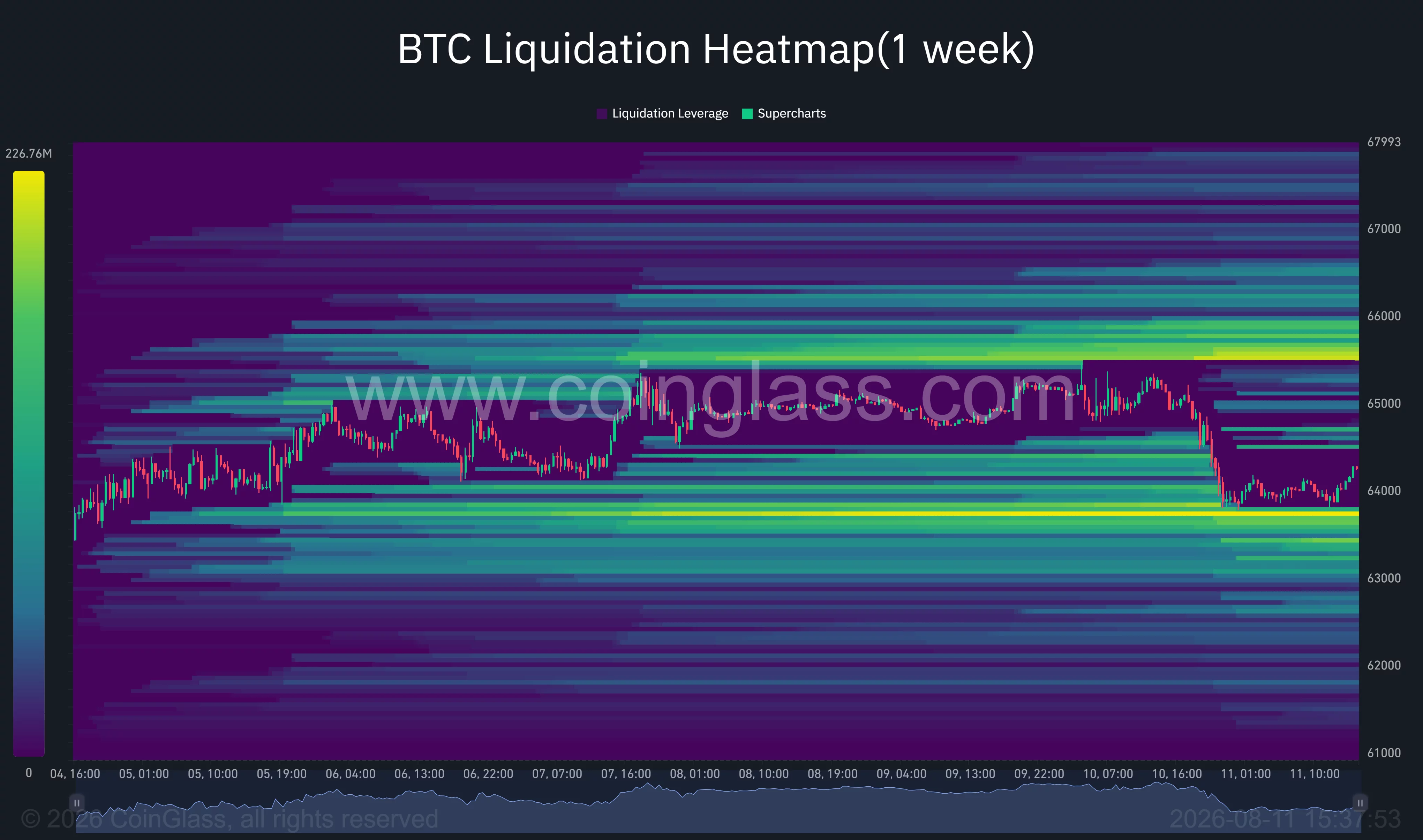
The closest downside liquidity cluster sits around $63,600–$63,800. Bitcoin tested this region during the latest decline but did not produce a sustained breakdown. A second pocket is visible between $63,200 and $63,400.
If $63,700 fails, forced selling could accelerate the move toward the lower cluster. However, the concentration of liquidity can also attract buyers looking to enter after leveraged long positions have been cleared.
The largest nearby upside band sits around $65,500–$65,700. A rebound through $65,000 could therefore trigger short liquidations and help BTC revisit the weekly high. Additional liquidity appears near $66,200 and $67,000, but those levels would require a confirmed breakout from the current range.
This positioning leaves Bitcoin vulnerable to a sharp move in either direction. Price is trading between the closest major liquidation pools, while the upcoming inflation release provides a clear catalyst for volatility.
U.S. CPI could decide Bitcoin’s next move
The U.S. Bureau of Labor Statistics will publish July CPI data on Aug. 12 at 8:30 a.m. Eastern Time. The report could influence expectations for the Federal Reserve’s September policy decision, particularly after rising oil prices renewed inflation concerns.
A cooler reading could ease pressure on Treasury yields and help Bitcoin recover $65,000. Breaking $65,500 would expose the $65,600 liquidation cluster, followed by the 100-day SMA near $67,628.
A hotter reading would strengthen the case for restrictive monetary policy and could pressure speculative assets. Under that outcome, a confirmed loss of $63,900 would shift attention toward $63,200, $62,000, and eventually the $60,000 psychological support.
Regulatory uncertainty also remains in the background. The CLARITY Act’s procedural vote was delayed until Sept. 15, removing a near-term policy catalyst that some U.S. investors had expected before the Senate recess.
For now, Bitcoin remains range-bound rather than decisively bearish. The $63,900–$64,000 zone separates a possible recovery toward $65,500 from a deeper move toward $62,000. The CPI release will likely determine which liquidity pool the market tests first.
Disclosure: This article does not represent investment advice. The content and materials featured on this page are for educational purposes only.

Michael Saylor’s Strategy has sold 6,948 BTC in 2026, raising $431.8 million as part of its BTC monetization program.
Saylor first announced in May that Strategy would soon start selling its BTC. Then in late June, the company revealed it would sell its accrued BTC as part of a monetization program to raise $1.25 billion for its USD reserve.
The money would be spent on preferred stock dividends, digital credit securities or Class A common stock.
Strategy’s K-8 filings reveal that its first sale of 32 BTC took place in late May. This sale made the firm $2.5 million while BTC was worth $77,135 at the time.
The company then sold:
- 1,363 BTC between June 29 and June 30
- 2,225 BTC between July 1 and July 5
- 1,638 BTC between July 27 and August 2
- 1,690 BTC between August 3 and August 9
This most recent sale is reflected in Strategy’s latest filing.
Read more: Is a crisis brewing at Crypto.com?
These sales netted the firm $80.8 million, $135.2 million, $104.73 million, and $108.6 million, respectively. The price of BTC has fallen 13% since the selling began.
Before June 21, Strategy was mostly buying BTC, building up 163,554 BTC in 2026. These purchases cost the firm over $12.7 billion.
Strategy’s first BTC purchase was in August 2020, when it spent $250 million buying 21,454 BTC.
As of August 9, the company now holds 840,447 BTC, currently worth $53.82 billion.
It paid $63.36 billion for all this BTC, which means that it is down -$9.5 billion on its BTC investments.
Even with its $4.65 billion USD reserve included with its BTC horde, that’s still $4.9 billion less than it bought all the BTC for.
Read more: Every time Michael Saylor said he’d never sell bitcoin
Saylor’s pivot to offloading BTC was controversial among followers who believed him when he said he wouldn’t be selling.
Strategy had only ever sold BTC once back in 2022, before buying significantly more BTC two days later.
In February 2025, when BTC was above $84,000, Saylor famously said, “Sell a kidney if you must, but keep the BTC.”
The price of the asset has since fallen 24% to $64,042, while his advice was ultimately abandoned by his firm.
Got a tip? Send us an email securely via Protos Leaks. For more informed news and investigations, follow us on X, Bluesky, and Google News, or subscribe to our YouTube channel.
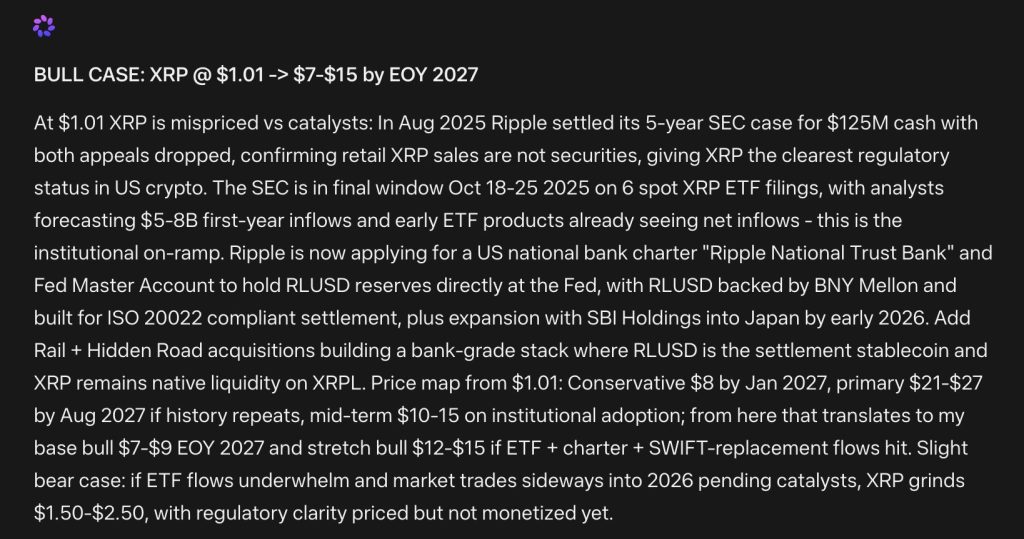
A bank charter application changes what a token can become. Meta AI predicts XRP is mispriced against that backdrop at $1.01, and the price prediction reaches $7 to $9 by the end of 2027 with a stretch case of $12 to $15.
The regulatory foundation came first. Ripple settled its 5-year SEC case for $125M cash in August 2025 with both appeals dropped, confirming retail XRP sales are not securities.
Meta AI calls that the clearest regulatory status in U.S. crypto. Six spot XRP ETF filings followed, with analysts forecasting $5B to $8B in first-year inflows.
Early ETF products are already seeing net inflows. That is the institutional on-ramp the thesis depends on.
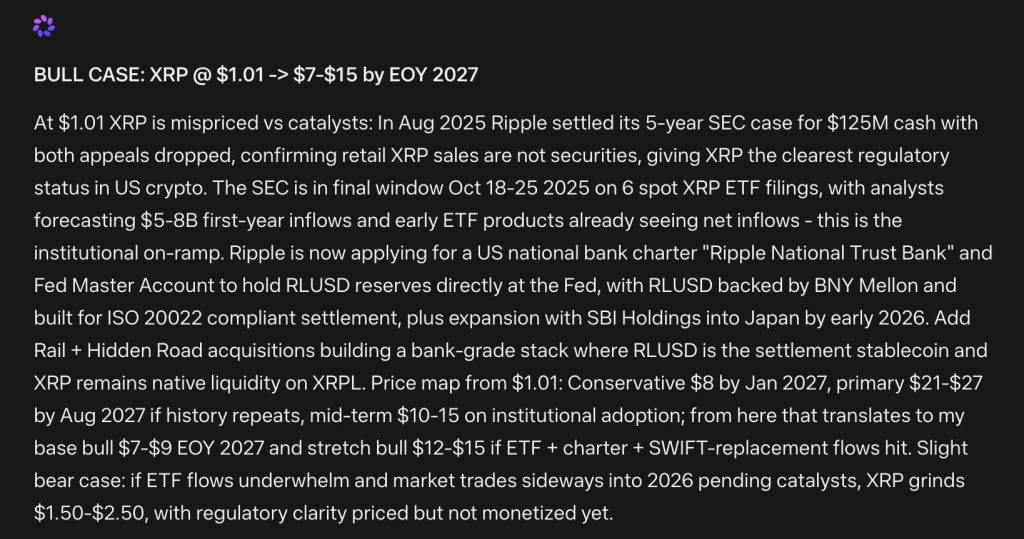
The banking layer is more ambitious. Ripple is applying for a U.S. national bank charter and a Fed Master Account to hold RLUSD reserves directly at the Fed.
RLUSD is backed by BNY Mellon and built for ISO 20022 compliant settlement. Expansion into Japan with SBI Holdings arrives by early 2026.
The Rail and Hidden Road acquisitions build a bank-grade stack around it. RLUSD becomes the settlement stablecoin while XRP remains native liquidity on the ledger.
The bear case is a matter of timing. If ETF flows underwhelm and the market trades sideways into 2026 pending catalysts, XRP grinds between $1.50 and $2.50, with regulatory clarity priced but not monetized.

Discover: Everyone’s Got a Take. Get Free $25 to Actually Trade Yours
XRP Price Prediction: Ripple Wants A Seat At The Fed And XRP Sits At A Dollar
The chart offers no support for any of this yet. XRP traded above $3.30 last August and has fallen consistently since. October brought a sharp drop toward $2.40. February broke $1.80 and carried price down near $1.15.
Spring built a range between $1.30 and $1.55. June ended it, and the decline has not paused since. July and August have produced a slow bleed lower. Price now sits at the lowest level anywhere on this chart.
The close reads $1.02208, down 0.69% and $0.00709 on the day. The session ranged from $1.01505 to $1.04020. Support sits at $1.01, then $1.00 as the psychological floor beneath it. Resistance appears at $1.10, then $1.20 and $1.40.
RSI reads 37.09 with its signal line above at 41.54. The oscillator trails by roughly 4.5 points, which confirms sellers still hold the market.
That reading sits near oversold territory without entering it. Momentum is weak and pointed downward.
Meta AI is describing infrastructure being assembled while price ignores it. Reclaiming $1.10 would be the first small sign that gap is starting to close.
Discover: Your Market Calls Are Worth Something. Start With Free $25 on Kalshi
Everyone’s got a Predicts Even Meta AI, Yours Can Carry a Price And Make You Money.
Reading the chart is free. Backing the call costs something, which is exactly why the odds on Kalshi tend to move before the headlines do.
It’s a CFTC-regulated exchange for event contracts: the Fed, inflation, crypto price levels, resolved against a defined source. Being right on a slow timeline still loses if the contract expires first, so mind the dates.
→ Get up to $25 to trade your first market on Kalshi
Don’t Miss Out on Our $1,000 USDT Airdrop on ByBit
The post Mark Zuckerberg Meta AI Predicts XRP Could Be the Story of 2027 appeared first on Cryptonews.

Everpure (P) stock jumped in early trading Tuesday on news that the data storage company has landed its second “design win” with a top-five cloud hyperscaler. The rally is extending a recent break out for Everpure, which has climbed 46% year-to-date. Everpure — recently rebranded from the name Pure Storage — announced the design win and supply agreement in a…
Copyright ©2026 Investor’s Business Daily, LLC. All rights reserved. 87990cbe856818d5eddac44c7b1cdeb8

Bitcoin Knots said on August 11 that it plans to choose a new proof-of-work algorithm for the stalled BIP-110 chain after the minority fork produced only two blocks.
The move sets up another confrontation over Bitcoin’s block policy, while the main network continues producing blocks normally.
Knots Pushes New Algorithm as the Fork Stalls
Knots told users not to downgrade or switch to software that weakens Bitcoin’s consensus rules, warning that doing so could expose them to false confirmations from invalid blocks.
Anyone who had already switched was told to upgrade to the latest Knots client, which the project said would attempt to repair the chain state automatically, and miners restarting nodes were told to add the line maxtipage=2592000 to their configuration file.
It also said a new proof-of-work algorithm would be selected at 14:00 UTC on August 11 through a deterministic random process among proposed candidates. A hash was posted alongside the algorithm announcement as what Knots called a proof of fairness for the random selection process.
The announcement came after the BIP-110 chain stopped at block 961,633, as had been reported by CryptoPotato.
“The Bitcoin network is under attack, and block production has slowed significantly,” wrote the Knots team. “The community is preparing mitigations to resolve the situation.”
However, a community note attached to the post pointed out that the main Bitcoin chain had continued normally. It described the reported “attack” and slowdown as affecting only the minority BIP-110 fork, which split at block 961,632 with roughly 2.5% support.
The episode has also exposed a sharp disagreement over what constitutes Bitcoin consensus. In a Sunday post, Adam Back argued that BIP-110 lacked sufficient consensus and that economic users and the market had effectively ignored the fork.
Luke Dashjr takes the opposite view. He wrote that BIP-110 has community support and argued that a proof-of-work change could remove the miners he considers responsible for attacking the fork. He later said, “There’s only one Bitcoin chain, and it just activated BIP110.”
The developer has also reportedly been removed as an editor of Bitcoin’s formal improvement proposal repository this week over what was described as a conflict of interest in how he handled the proposal.
Miners and Developers Remain Split
The mining pool Roughnecks, which had been producing blocks on the BIP-110 branch, announced early Saturday that it was pausing operations, calling the pause an escalation rather than a retreat. By Sunday, it reversed course, saying it would resume mining “ASAP” on the stalled chain tip using software it referred to as Knots-RDTS, adding, “We’re wildcatting again.”
Trey Sellers, a Bitcoin holder active in the replies, questioned the economics of that decision, noting that block rewards need 100 confirmations to mature and the fork was producing at most one block a day. Roughnecks responded that it doesn’t give financial advice and that participants should expect the possibility of no return at all.
By the time Roughnecks posted its Sunday update, the main Bitcoin chain had already reached block 961,865, and later tracking put the gap even wider, with one monitor showing the standard chain at 961,980 against a BIP-110 branch still stuck at 961,633.
Bitcoin’s price barely reacted to any of the drama and was trading around $64,000 at the time of writing, down just over 1% in 24 hours and about 47% below its level a year ago, after twice failing to hold above $65,400 in recent sessions.
The post Bitcoin Knots Plans New Proof-of-Work Algorithm After BIP-110 Enforcement Fails appeared first on CryptoPotato.
Crypto World
Bitcoin (BTC) price stuck below $65,000 as Iran stalemate, Strategy sale squeeze market
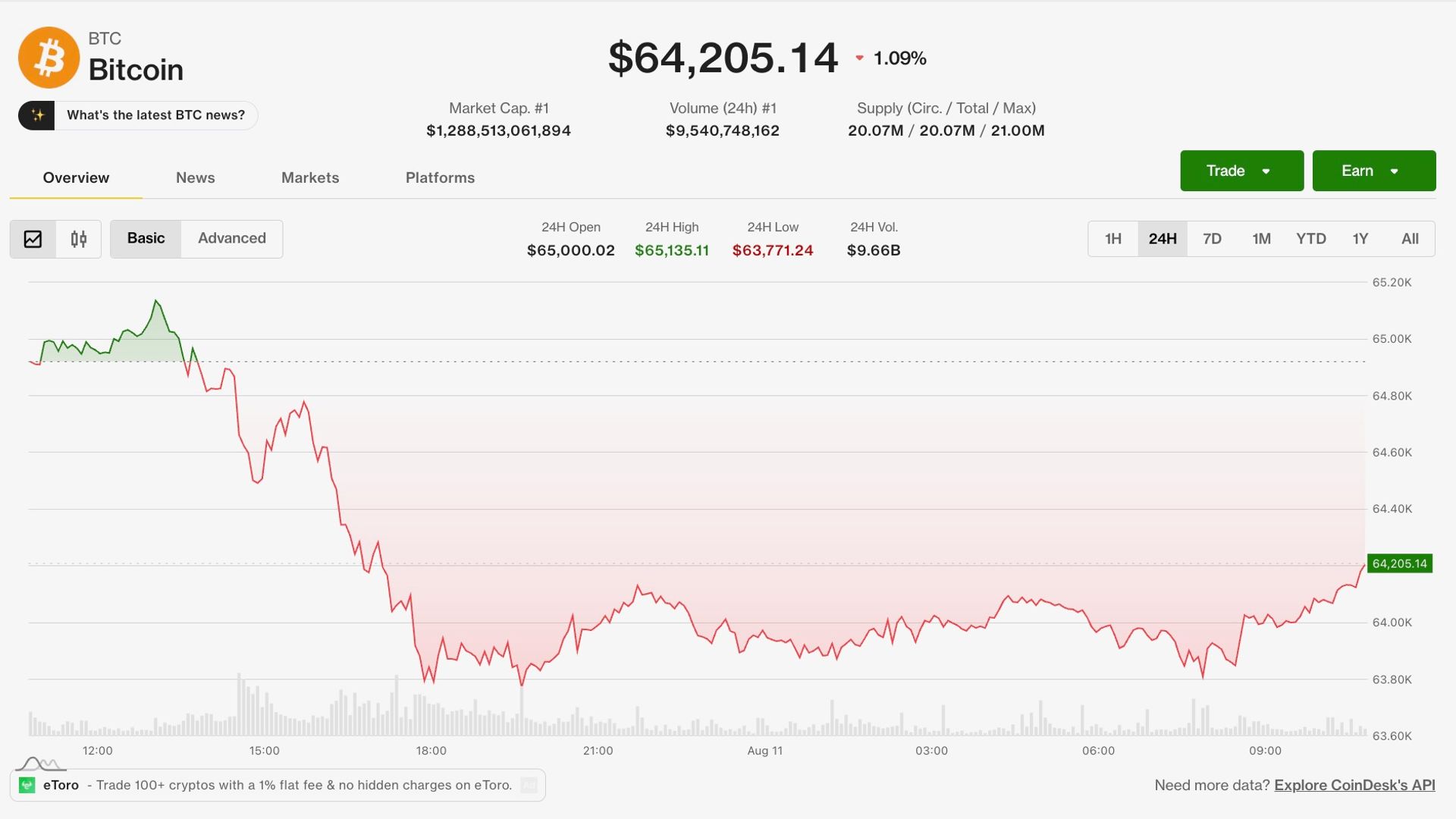
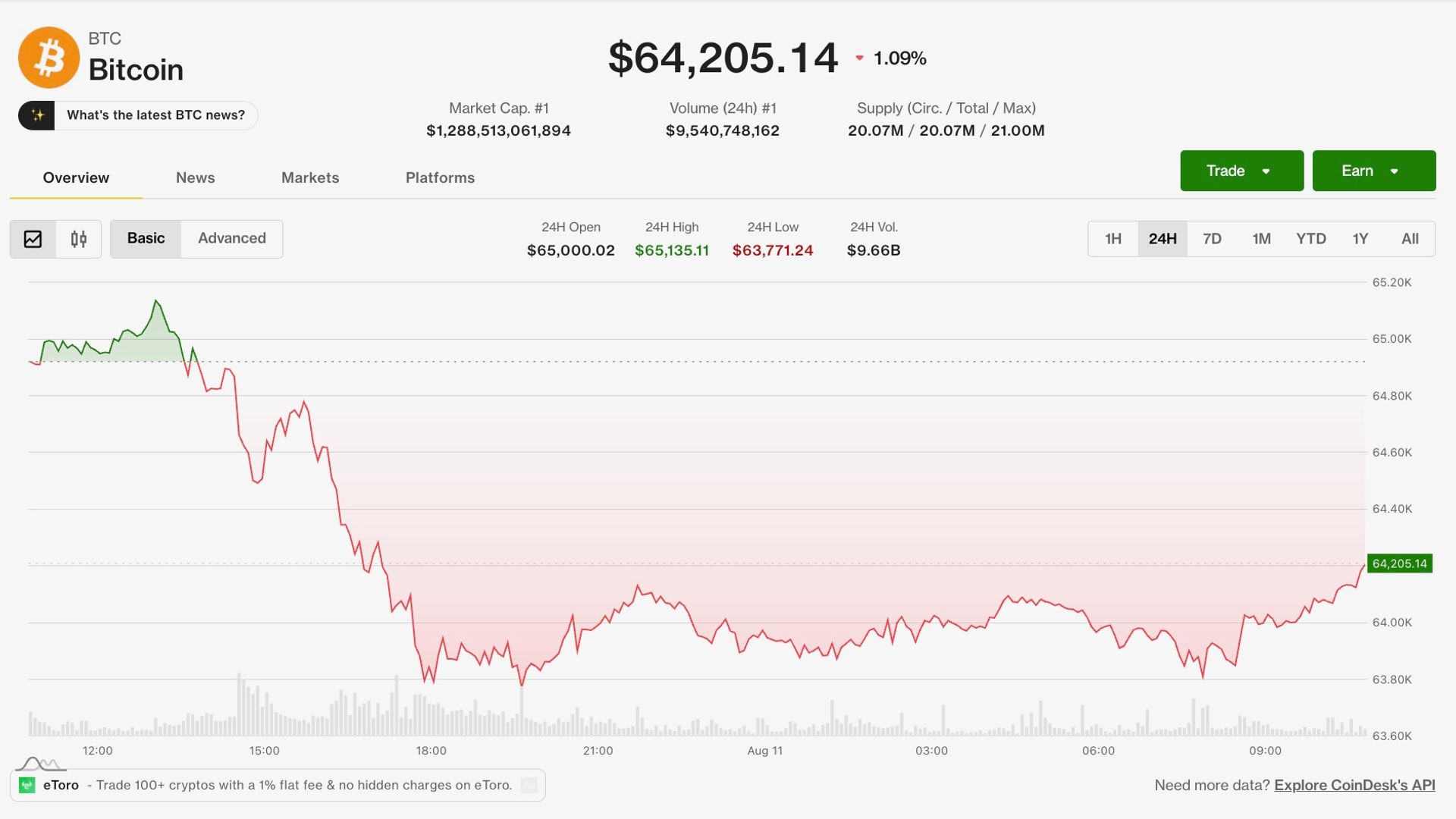
The crypto market was little changed on Tuesday after falling overnight as the short-lived optimism around a Strait of Hormuz deal evaporated.
President Donald Trump’s demand for 50 years of compensation from Iran as a condition of any negotiation dashed hopes of a near-term resolution and pushed Brent crude up to $89.08, more than 12% above last week’s low.
Bitcoin has gained 0.26% since midnight UTC, but remains down 1.68% over the past 24 hours. Ether , outpacing bitcoin since midnight, is 2.4% lower on the day. Traditional markets are equally subdued, with U.S. equity index futures remaining flat as traders focus on Wednesday’s CPI report as the week’s key catalyst.
Strategy’s sale of a further 1,690 BTC on Monday, the fourth consecutive weekly reduction, added an extra layer of pressure. The company has not bought bitcoin since June.
Derivatives positioning
- Futures volume surges, open interest flat: Trading volume in crypto futures surged 51% to $143.15 billion in 24 hours. Total open interest (OI) remained steady around $115.6 billion, signaling churn rather than fresh positional trading.
- Taker ratio turns neutral: The long-short taker volume ratio has reverted to neutral, with longs and shorts each accounting for nearly half of volume, versus a bullish tilt a day earlier. A taker is an entity that sucks liquidity from an order book by trading at available prices.
- XRP leads OI gains: Payments-focused token XRP added the most OI of the day, with active futures contracts growing 14% to 2.72 billion tokens, the highest since October. XRP remains under pressure, threatening to dip below $1 for the first time since 2024. The downside pressure is evident in XRP’s negative 24-hour cumulative volume delta (CVD), showing shorts trading more aggressively via market orders than passive limit orders. The lone bright spot: Funding rates remain slightly positive.
- Other OI movers: LINK, ETH and HBAR are among the other OI gainers, while CC, ZEC and AVAX are the leading OI losers.
- Bears lead the price action: Bears appear to be leading price action in most tokens, as evidenced by negative 24-hour CVD for most coins, including bitcoin. LINK and TRX are the exceptions.
- Funding rates diverge: XMR’s funding rate hovers at an annualized 39%, the most bullish among majors, while CC’s sits at -14%, the most negative, indicating an investor bias toward bearish bets.
- Bitcoin volatility index bounces: Bitcoin’s 30-day implied volatility index, BVIV, abandoned its long-held floor of around 36% to jump nearly 5% to 38.64% as BTC’s spot price fell back below $64,000. Traders might want to keep an eye out for a continued spike in the index, given its inverse correlation with spot price.
- Call skew weakens: In the Deribit-listed options market, the one-week call skew in BTC and ETH weakened and may flip negative, suggesting a fresh downside bias if Wednesday’s U.S. CPI print comes in hotter than expected, validating higher-for-longer Fed interest-rate expectations.
- Implied Volatility Stays Compressed: For now, one-week implied volatility for BTC and ETH, calculated from options prices, remains compressed, pointing to little stress ahead of the inflation report.
- Volume leans toward upside bets: The 24-hour volume rankings show a bias toward the BTC $70,000 call expiring Sept. 25 and the $2,000 ETH call expiring the same day.
Token talk
- Curve DAO token was the 24-hour standout, surging 9.49% and extending a weekly gain of 27.29%, making it one of the stronger DeFi performers in a difficult market.
- Lighter (LIT) added to its recovery, advancing 6.40% over 24 hours and 2.26% since midnight to $2.43. It is now up nearly 20% on the week as the decentralized derivatives token rebuilds from its July pullback.
- Chainlink gained 2.59% since midnight, extending a run that has it up 4.40% on the week as institutional demand for oracle infrastructure picks up in tandem with the tokenized real-world asset narrative.
- Zcash (ZEC) led the losses, falling 1.97% since midnight to $486, giving back ground after several weeks of outperformance. The broader privacy coin sector is also under pressure, and XMR shed 0.72%.
- CoinMarketCap’s “Altcoin Season” indicator recovered from Monday’s low of 37/100, rising to 41/100 as investors stepped in to capitalize on oversold tokens.


SharpLink, the second-largest Ether treasury company, reported a net loss of $394 million for the second quarter of 2026, compared to a $103 million net loss during the same period last year.
The loss included $321 million in unrealized crypto losses and $76 million in impairments on staked Ether (ETH) tokens, according to a Monday announcement.
The Miami, Florida-based Ether treasury company said it generated $11.5 million in revenue, including $11.1 million from ETH staking. Cash and cash equivalents totaled $56 million, up from $28 million in December 2025.
SharpLink holds 632,784 Ether, worth $1.2 billion, and 181,321 ETH, or $343 million, through various liquid staked Ether tokens, which exposes the company to the second-biggest crypto’s price movement. Ether fell around 23% during the second quarter of 2026, according to CoinMarketCap.
SharpLink resumed its Ether purchases with a $7.8 million buy in late June, after pausing buying for eight months. It bought another 10,000 Ether for about $16 million days later.
SharpLink’s stock price fell 3.9% on Monday, extending its 30% year-to-date decline, according to Yahoo Finance data.
The company ranks as the second-largest Ether treasury company, with its current 863,000 ETH holdings worth $1.46 billion. Bitmine is the largest corporate Ether holder, with 5.54 million ETH, worth $9.4 billion, according to StrategicEthReserve data.
Magazine: Ethereum’s EEZ could pull other blockchains into its orbit
Roughly 450 new coins enter circulation each day while demand absorbs several times that amount. Microsoft Copilot AI predicts that imbalance drives a structurally higher cycle peak, and the price prediction reaches $150K to $200K by the end of 2026 from $63,800.
Spot ETF inflows anchor the demand side. Copilot expects assets under management to exceed $100B across those products.
Corporate treasury adoption is the second channel, surpassing 500,000 BTC held on balance sheets. Those coins rarely return to the market.
The post-halving supply squeeze does the rest. Issuance has fallen to roughly 450 BTC per day against demand running at multiples of that figure.
Regulatory clarity across the U.S., EU, and Asia strengthens the setup. Rate cuts and fiat instability provide the macro tailwind.
The downside has three sources. Persistent inflation would delay the easing cycle entirely.
Restrictive monetary policy compounds that problem. Sudden regulatory shocks are the third risk named.
Any of those could cap upside near $90K to $100K. Copilot settles on a balanced base case of $120K to $150K, with extreme scenarios pointing toward $200K to $250K if supply deficits persist.

Discover: Everyone’s Got a Take. Get Free $25 to Actually Trade Yours
Bitcoin Price Prediction: Four Hundred Fifty Coins A Day Against A Wall Of Buyers
The chart shows a market that has already given back a full cycle. Bitcoin peaked near $126,000 last October before the trend broke.
November dragged price toward $81,000. February brought the capitulation move, cutting Bitcoin from $96,000 down near $60,000.
Spring produced a strong recovery to roughly $82,000 by May. June reversed all of it and marked the low around $58,000.
July and August have been range-bound. Price has held a base with slightly higher lows but no breakout attempt. The close reads $63,867, down 1.53% and $991 on the session. The daily range covered $63,737 to $65,333.
Support sits at $63,000, then $60,000 and $58,000. Resistance stacks at $68,000, $72,000 and $80,000. RSI reads 48.14 with its signal line just above at 49.93. The gap is under 2 points, showing sellers with the faintest edge.
Both lines sit right at the midline. Momentum is flat with no direction established.
Copilot describes a supply deficit that this chart has not begun to reflect. Breaking $68,000 would be the first evidence the squeeze is reaching price.
Discover: Your Market Calls Are Worth Something. Start With Free $25 on Kalshi
Everyone’s Got a Predicts Even Copilot AI, Yours Can Carry a Price And Make You Money.
Reading the chart is free. Backing the call costs something, which is exactly why the odds on Kalshi tend to move before the headlines do.
It’s a CFTC-regulated exchange for event contracts: the Fed, inflation, crypto price levels, resolved against a defined source. Being right on a slow timeline still loses if the contract expires first, so mind the dates.
→ Get up to $25 to trade your first market on Kalshi
Don’t Miss Out on Our $1,000 USDT Airdrop on ByBit
The post Microsoft Copilot AI Predicts a Quiet Bitcoin Rally Building Right Now appeared first on Cryptonews.
SharpLink, the second-largest Ether treasury company, reported a net loss of $394 million for the second quarter of 2026, compared to a $103 million net loss during the same period last year.
The loss included $321 million in unrealized crypto losses and $76 million in impairments on staked Ether (ETH) tokens, according to a Monday announcement.
The Miami, Florida-based Ether treasury company said it generated $11.5 million in revenue, including $11.1 million from ETH staking. Cash and cash equivalents totaled $56 million, up from $28 million in December 2025.
SharpLink holds 632,784 Ether, worth $1.2 billion, and 181,321 ETH, or $343 million, through various liquid staked Ether tokens, which exposes the company to the second-biggest crypto’s price movement. Ether fell around 23% during the second quarter of 2026, according to CoinMarketCap.
SharpLink resumed its Ether purchases with a $7.8 million buy in late June, after pausing buying for eight months. It bought another 10,000 Ether for about $16 million days later.
SharpLink’s stock price fell 3.9% on Monday, extending its 30% year-to-date decline, according to Yahoo Finance data.
The company ranks as the second-largest Ether treasury company, with its current 863,000 ETH holdings worth $1.46 billion. Bitmine is the largest corporate Ether holder, with 5.54 million ETH, worth $9.4 billion, according to StrategicEthReserve data.
Magazine: Ethereum’s EEZ could pull other blockchains into its orbit


XRP price prediction shows the asset trading at $1.006, down -3.2% on the day, hovering just above the psychological $1 line that traders keep circling like it’s the last life raft on a sinking deck. That’s the withheld part of this setup;
the token everyone expects to bounce is instead grinding against the floor while its peers rally. Something has to break, and the direction of that break decides whether XRP is setting up for a Wave 3 run or another leg down into deeper support.
Analyst EGRAG CRYPTO laid out a roadmap in a recent chart post showing XRP needs to clear $1.30–$1.60, then $1.96, to validate a Wave 3 move toward $3.00–$3.60.
Support sits at $1.00–$0.95, then $0.75, then $0.60–$0.52 if things get ugly. Meanwhile That Martini Guy flagged something odd: Bitcoin, Ethereum and Solana bounced last week while XRP fell about 5%, despite continued ETF inflows.
XRP Price Prediction: Can Ripple Hit $1.30 This Week?
XRP price prediction shows the asset trading at $1.006, off 1.34% in 24 hours, with a session range between $1.0038 and $1.0218, a tight band that signals indecision rather than conviction.
TradingView pegs the next resistance at $1.06, with upside targets stacked at $1.35 and $1.64 if momentum shifts. CoinGecko data shows XRP’s 24h low and high sitting right around the current price, confirming the market is coiled, not trending.
The bull case: XRP reclaims $1.06, then pushes through $1.30–$1.60 to confirm Wave 1’s high broke; that’s the trigger EGRAG CRYPTO says validates Wave 3 toward $3.00–$3.60.
The base case: XRP chops between $0.95 and $1.06 while the market waits for a catalyst. The bear case: $1.00 fails as support, sending price toward $0.75 and eventually the $0.60–$0.52 zone. For deeper context on the support structure, this technical breakdown maps out the bull, base, and bear scenarios in more detail.
Bitcoin Hyper Targets Early Mover Upside as XRP Tests Key Levels
XRP holders watching the $1 line know the pain of being early to a chart that refuses to move. Ripple’s ETF demand and rising RWA activity on the XRP Ledger have tokenized assets jumping to $4.06Bn across 373 assets from just $73M in January 2025, building a strong fundamental case, but price confirmation is a different beast entirely.
Waiting on Wave 3 to prove itself is a multi-week bet, not a trade. That’s pushed some capital rotation toward earlier-stage infrastructure plays where the upside math isn’t already capped by a multi-billion-dollar market cap.
Bitcoin Hyper ($HYPER) is building the first Bitcoin Layer 2 with full SVM integration, aiming to deliver smart contract speed faster than Solana itself while anchoring security to Bitcoin’s base chain.
The presale has raised $33,022,820.14 at a current token price of $0.0136845, with staking rewards live at launch (exact APY undisclosed). Its Decentralized Canonical Bridge targets one of Bitcoin’s biggest gaps, programmability, without sacrificing the network’s trust layer.
Visit the Bitcoin Hyper Presale Website Here.
This is not financial advice. Crypto markets are highly volatile and unpredictable. Always conduct independent research before making any investment decisions.
The post XRP Price Prediction: Ripple Sits at 18-Month Support Level, Will $1 Hold? appeared first on Cryptonews.
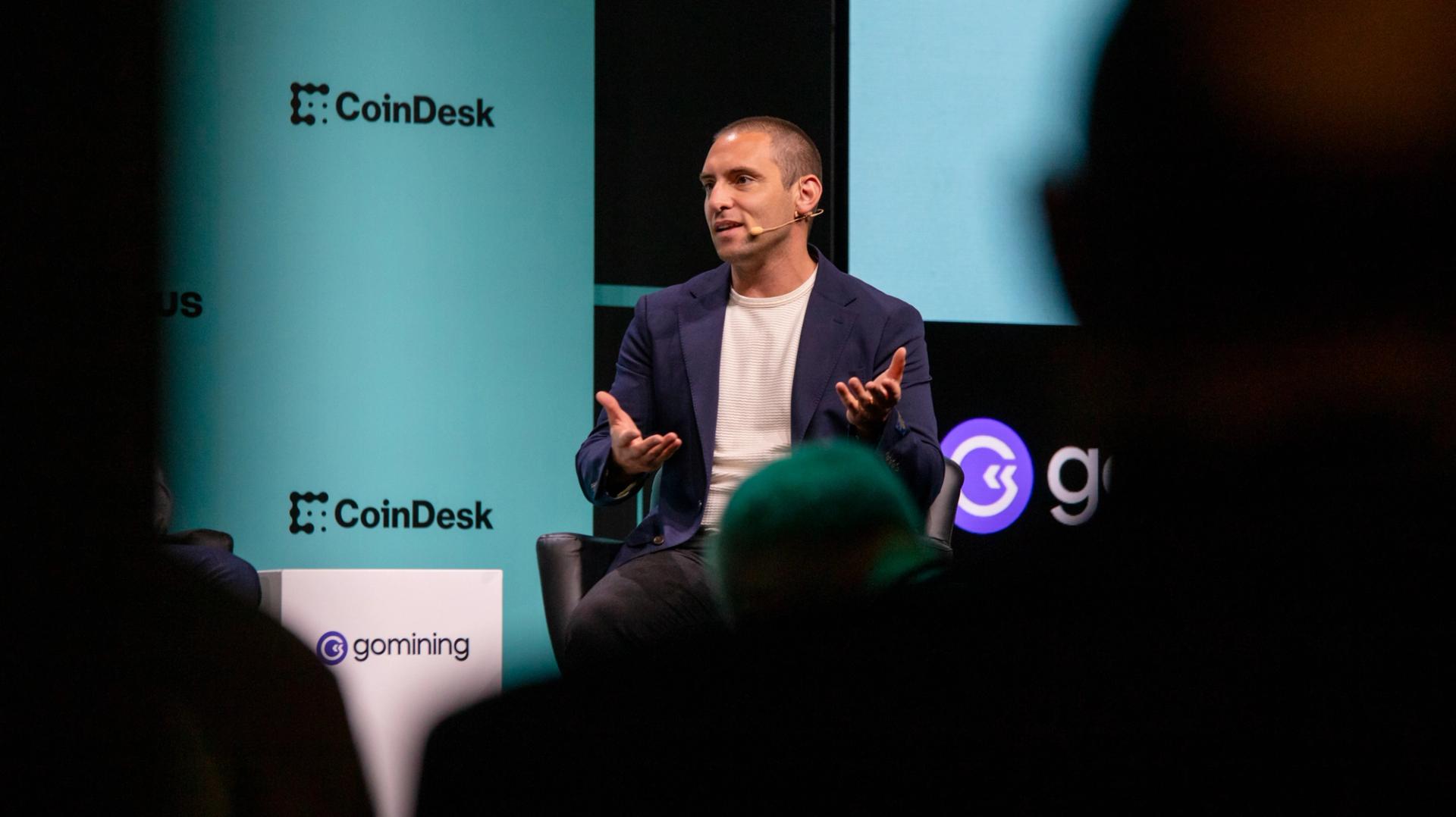
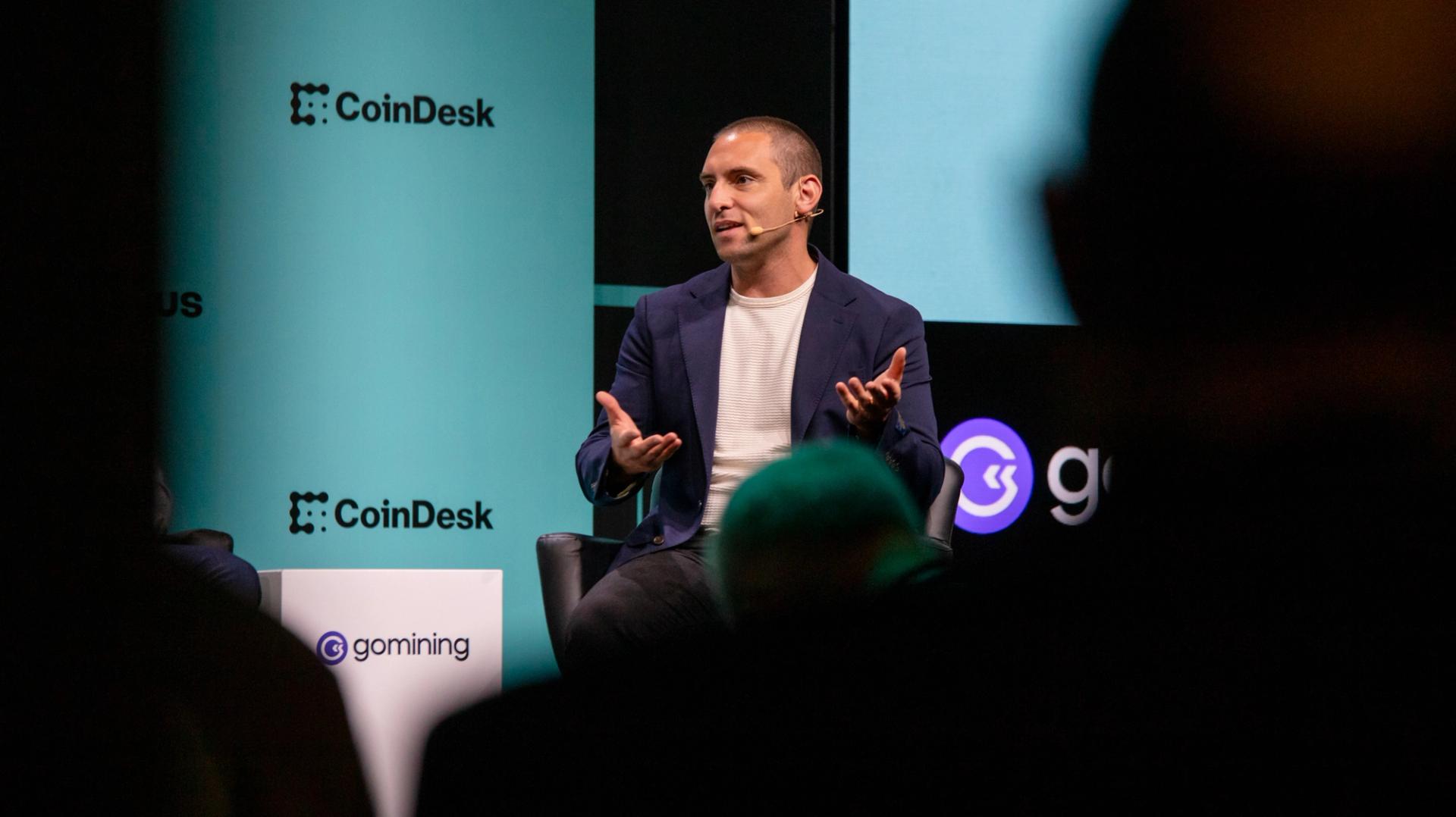
Two Prime’s loan to MARA carries a fixed interest rate of 7.65% and matures in August 2028. Blume said borrowing demand has increased in recent months, with institutions tapping bitcoin holdings to finance capital expenditure while retaining exposure to the asset.
The structures are also becoming more sophisticated. Recent regulatory filings show agreements with detailed provisions covering margin calls, collateral custody and liquidation, alongside a wider range of loan sizes and maturities.
Lenders including Ledn and Kraken have also expanded the market through asset-backed securities and warehouse facilities linked to bitcoin collateral, according to Blume.
The development could have implications beyond bitcoin lending as more financial assets move onto blockchain-based infrastructure.
“This core competency will grow increasingly relevant as the broader financial system comes on-chain,” Blume said, pointing to tokenized equities as one potential area of growth.
As more publicly traded companies add bitcoin to their balance sheets, the ability to borrow against those holdings is emerging as an increasingly important part of digital-asset corporate finance.

UK weather latest: Summer set to be the hottest since records began, say Met Office

Campbell’s Co. formulates gluten-free Goldfish

Strategy has sold nearly 7,000 BTC in 2026


-

 Fashion4 days ago
Weekend Open Thread: Mattifying Sunscreen
-

 Fashion4 days ago
Frugal Friday’s Workwear Report: Cap-Sleeve Pointelle Crewneck Sweater
-

 Sports5 days ago
Jordan Coyle & Cordiamo take Laya Arena Stakes at RDS
-

 News Videos3 days ago
Can Astrology Help Find Gold and Silver Trends? A Financial Astrology Guide
-
 Business6 days ago
US stocks: Dow closes at record on Mideast optimism; SpaceX, AMD drag Nasdaq
-

 Politics5 days ago
Reform UK And Greens Sink To Lowest Favourability Ratings To Date
-

 Business7 days ago
Nvidia Stock Climbs 2.5% as Chip Sector Rally Builds Ahead of AMD Earnings, Nvidia’s Own Report Looms
-

 Tech6 days ago
OpenAI, Anthropic AI agents targeted real people and systems in cyber tests
-

 Crypto World7 days ago
Polymarket targets $20 billion valuation as competition heats up in prediction market sector
-

 Business6 days ago
Supply chain issues impact Ingredion
-

 Tech4 days ago
Rinn Pharma & Biopharma to join NordicPharmaTrain network
-

 Business2 days ago
How to Start a Cleaning Business: A Step-by-Step Guide
-
 Crypto World7 days ago
Dow and S&P 500 Hit Records on AI Earnings: When Will the Bubble Burst?
-

 Business2 days ago
Datadog: Best Of Breed For Multiple Reasons
-

 Business2 days ago
BDC Weekly Review: Private BDC Q2 Numbers Are Strong
-
 Crypto World7 days ago
Dollar Index Trapped at 100 as Hawkish Fed Meets Official Selling
-

 Business6 days ago
McDonald’s (MCD) Q2 2026 earnings
-

 Fashion6 days ago
The Bright Side of Black and White
-

 Fashion6 days ago
Suit of the Week: Me + Em
-
Sports6 days ago
Spider-Man: Brand New Day ending explained: Is Peter Parker alive?
You must be logged in to post a comment Login