

Crypto World
Bitcoin Price Prediction: An Analyst Just Called for Bitcoin to Drop to $40,000, And the Chart Is Not Helping the Bull Case


Bitcoin price is holding an uneasy line near $60,000, roughly 52% below its all-time high of ~$126,000 set late last year, and the prediction debate over what comes next is getting loud.
The question traders are actually asking right now isn’t whether a recovery is coming, but whether the bottom is already in or still $10,000–$20,000 lower. One number keeps surfacing in the bearish camp: $40K.
CNBC reported that Zacks strategist John Blank put a $40,000 downside target on BTC, framing the move through the lens of a prolonged crypto winter، a pattern-derived call that implies roughly 33% further downside from current levels.
Separately, cycle analysts tracked by Mudrex have flagged a $50,000–$55,000 window as the highest-probability cyclical low, expected in the Q3–Q4 2026 timeframe. The macro backdrop isn’t helping: BTC dropped ~18% in June alone, and weekly volatility has been sustained and punishing.

Macro conditions are shifting simultaneously، Supreme Court rulings on Fed independence, tech stocks near six-month highs, and a US-Iran ceasefire lifting risk sentiment، yet BTC is not participating. That divergence from traditional risk assets deserves a closer look.
Bitcoin Price Prediction: Can Bitcoin Price Hold $60K or Is a Flush to $40K Next?
Bitcoin price is trading near $60,000, down approximately 18% month-over-month with cycle analysts split on what comes next.
The immediate line in the sand is $58,000. A decisive close below it risks accelerated selling toward the mid-$50,000s, with $50,000 to $55,000 as the next structural support band.
On the upside, the 50-month EMA near $65,600 is what bulls need to reclaim. A monthly close above it represents meaningful trend repair. Until that happens the macro structure remains bearish. Resistance clusters around $65,000 are capping every relief rally.
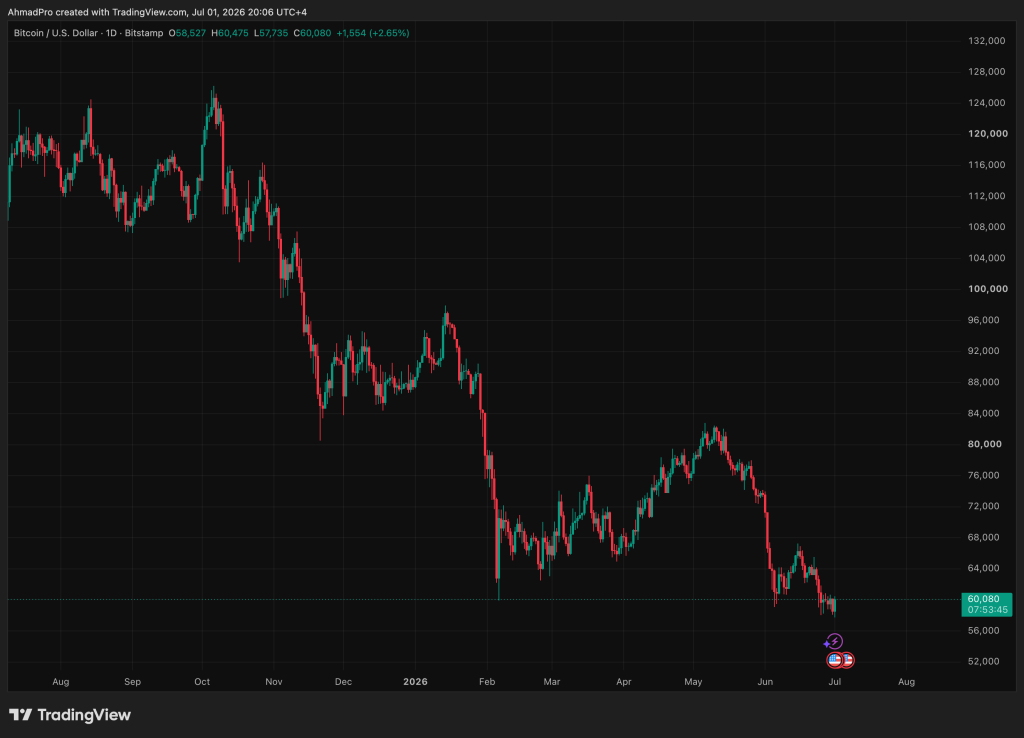
If $58,000 holds, ETF inflows accelerate, and BTC reclaims the $65,600 EMA, recovery targets reach $98,000 to $106,000 on the next leg.
If neither side takes decisive control, Bitcoin consolidates between $58,000 and $65,000 through Q3 2026, with a gradual bottoming process supported by corporate treasury demand and spot ETF capital. A break below $58,000 extends selling pressure toward the $40,000 to $50,000 range flagged by pattern analysts, pushing the cycle low into late 2026.
The Federal Reserve is the macro catalyst most likely to shift this range. A credible pivot toward rate cuts would be the single most supportive external variable for Bitcoin right now. ETF flow data in the coming weeks will signal whether institutional demand is absorbing this correction or stepping aside entirely.
Bitcoin Hyper Targets Early Mover Upside as Bitcoin Tests Key Levels
BTC at $60,000, down 52% from its peak, is a painful place to sit. Waiting for a confirmed bottom at $50,000 or below means holding unrealized losses or cash while the next cycle clock runs.
Some traders are rotating early-stage capital into infrastructure plays that have not been priced yet.
Bitcoin Hyper is one pulling attention in the current rotation. The project positions itself as the first Bitcoin Layer 2 with Solana
Virtual Machine integration, meaning smart contract execution at sub-Solana latency built directly on Bitcoin’s security layer. Bitcoin’s trust model combined with Solana-grade throughput is a technically meaningful combination that nothing else currently offers.
The presale has raised $32.9 million at a current price of $0.0136824. Staking is available for presale participants and a Decentralized Canonical Bridge handles native BTC transfers across chains.
Early-stage presales carry significant risk. Liquidity, execution, and token unlock dynamics all apply. But for traders doing their own research during a Bitcoin consolidation phase, Bitcoin Hyper is worth adding to the watchlist.
Visit Bitcoin Hyper HERE is worth adding to the watchlist.
The post Bitcoin Price Prediction: An Analyst Just Called for Bitcoin to Drop to $40,000, And the Chart Is Not Helping the Bull Case appeared first on Cryptonews.

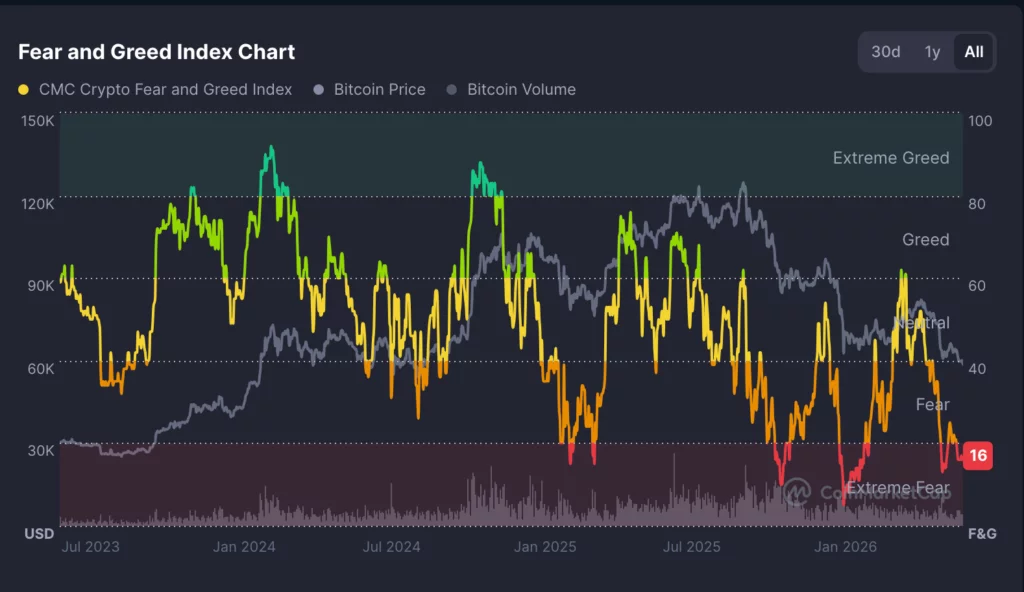
Bitcoin sits near $58,000 to $60,000 with the Fear and Greed Index buried in extreme fear. History says washed-out sentiment often precedes bottoms, but fear is a signal, not a floor. Here are the gauges traders are actually watching.
Summary
- Bitcoin trades near $58,000 to $60,000 as of July 1, 2026, down about 53% from its October 2025 record of $126,198, after back-to-back quarterly losses to open the year.
- The Fear and Greed Index sits around 12 to 16, deep in extreme fear, a zone that has historically appeared near local bottoms but is not a timing tool on its own.
- Bullish positioning signals are stacking up: open interest has collapsed from over $90 billion to about $44.5 billion, leverage is flushed, and coins are leaving exchanges in a pattern that suggests accumulation.
- The bearish counterweight is real: spot Bitcoin ETFs posted a record $4.5 billion of outflows in June, the Fed is hawkish with a likely December rate hike priced in, and one cycle model points to a bottom only around mid-October.
- The signals that would confirm a turn are concrete: reclaiming the 20-day and longer moving averages, a flip back to ETF inflows, open interest rebuilding alongside price, and the fear gauge lifting off its extremes.
Extreme fear is one of the most misread conditions in markets. When the Fear and Greed Index drops into the low teens, the crowd reads it as a reason to run, and the contrarian reads it as a reason to buy. Both are oversimplifying. Sentiment this low tells you that positioning is stretched and conviction is gone, which is often the raw material of a bottom, but “often” is not “now,” and fear can always get more extreme before it breaks.
The useful move is not to treat the fear gauge as a signal by itself, but to read it alongside the harder data on positioning, flows, and price. This piece walks through the signals traders are watching, lays out the bullish and bearish readings of each, and identifies what would actually confirm that the turn has arrived. The key point is simple: fear tells traders to pay attention, not to assume the bottom is already in.
What the Fear and Greed Index is saying
Start with the gauge everyone quotes. The Fear and Greed Index compresses several inputs, volatility, momentum, volume, and social signals, into a single 0 to 100 reading, and the latest chart still shows the market deep in extreme fear. Historically, readings this low have clustered near local bottoms, because they mark the point where sellers have largely exhausted themselves and the marginal holder is fearful rather than greedy. That is the contrarian appeal: when nobody wants the asset, much of the selling may already be done.
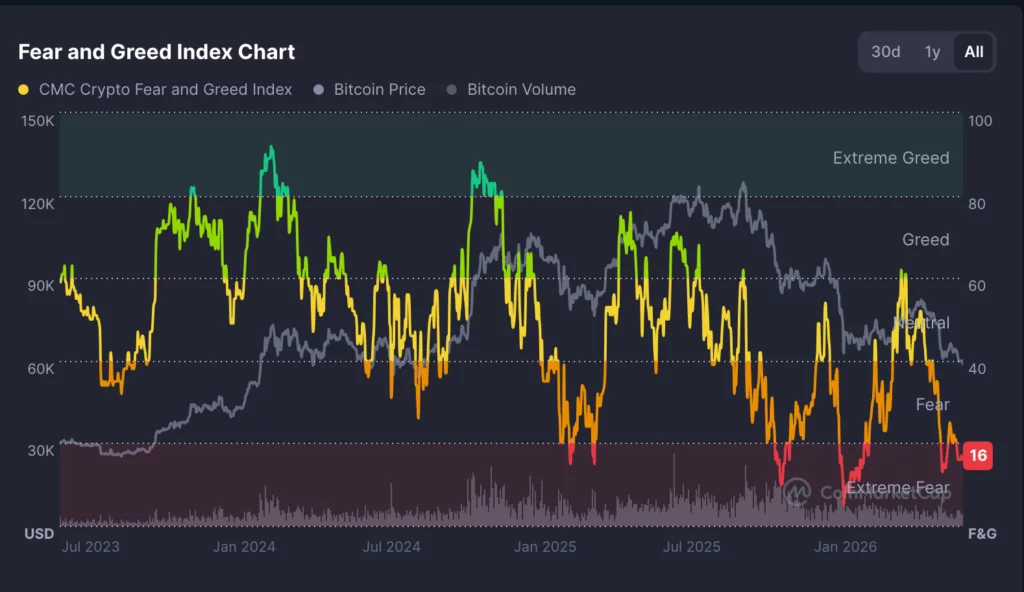
The caution is that the index is a description of the present, not a prediction of the future. Extreme fear can persist for weeks, and it can deepen. During genuine downtrends, the gauge has sat in fear for long stretches while price kept falling, so treating a low reading as an automatic buy signal has burned plenty of traders. The right way to use it is as context: it tells you the emotional backdrop is washed out, which raises the odds that other bottoming signals are meaningful, without confirming anything on its own.
That is why how the index works matters before using it as a trading signal. The number is useful because it summarizes the market mood, but it is not a floor under price. For confirmation, traders still need price levels, ETF flows, leverage data, and macro conditions to line up.
Signal one: positioning has reset
The most constructive signal under the surface is what happened to leverage. Open interest in Bitcoin derivatives has collapsed from above $90 billion to roughly $44.5 billion over recent weeks, less than half its peak. That drop reflects long liquidations, profit-taking, and traders reducing speculative exposure. In plain terms, the leverage that builds up in a rally and makes a market fragile has been flushed out.
Why this matters for a turn is mechanical. A market loaded with leveraged longs is vulnerable, because small drops trigger liquidations that cascade into larger drops. A market where that leverage has been cleared is sturdier, because the forced-selling fuel is gone. Resets like this often precede bottoms, since they remove the overhang that drags price lower and leave room for fresh positioning to push the other way.
The bearish reading is that falling open interest also signals fading demand and cautious participation, not just healthy deleveraging. Traders stepping back can mean they see no reason to buy, and a market with thin conviction can drift lower on light volume. The reset is a necessary condition for a durable bottom, but it is not sufficient by itself, because clean positioning can still sit under a price that keeps grinding down.
Signal two: exchange flows and accumulation
The second signal comes from where the coins are moving. Through the drawdown, Bitcoin has seen exchange outflows exceed inflows, meaning more coins are leaving exchanges than arriving. That pattern is typically read as accumulation: holders pulling coins into self-custody or long-term storage rather than keeping them on exchanges ready to sell. When supply leaves the venues where selling happens, it thins the pool of coins available to hit the market.
The bullish interpretation is that long-term holders are quietly buying weakness while short-term traders panic, a divergence that has marked accumulation phases before. Steady outflows during extreme fear suggest conviction underneath the fear, the kind of hands that absorb selling and set the base for a recovery. That is the constructive version of the on-chain story, and it fits with the broader idea that the market is moving from forced selling toward accumulation.
The counterpoint is that exchange flows are noisy and can reflect custody shifts, institutional plumbing, or one-off moves rather than genuine accumulation. Outflows are encouraging, but they are a soft signal, easily overstated. On their own they confirm that some holders are unbothered, not that the bottom is in. They matter most when they line up with stronger evidence from ETF flows and price.
Signal three: the ETF bid
The third signal is the one cutting against the bulls, and it is the most important on the bearish side. Spot Bitcoin ETFs recorded about $4.5 billion of net outflows in June 2026, their worst month since launching, removing the steady institutional bid that had cushioned earlier declines. The funds that were supposed to represent durable, price-insensitive demand instead became a source of selling, and their flows have tracked the drawdown closely.
This matters because the ETF bid was a structural change in how Bitcoin traded. When it was flowing in, it provided a floor of consistent demand. When it reverses, that floor becomes a headwind, and the market has to find other buyers to absorb the redemptions. For sentiment to turn convincingly, this is the signal that most needs to flip.
A return to sustained ETF inflows would tell the market that institutions are stepping back in, which would validate the bullish reading of the other signals. Continued outflows would keep the pressure on regardless of how washed out the fear gauge looks. That is why the ETF bid that reversed deserves more weight than a sentiment reading alone. In this cycle, flows are not a side detail; they are one of the main channels moving the market.
Signal four: oversold technicals
The fourth signal is on the chart. The relative strength index has dropped near 30, the oversold threshold, indicating that momentum has fallen far and fast and that the move may be stretched to the downside. Price sits near support in the $58,000 area, below the 20-day exponential moving average around $62,450, and well beneath the longer-term moving averages, the 200-day near $65,200 and the 50-month near $65,600, that mark the bull-bear boundaries.
The bullish read is that oversold conditions at support are where reversals begin, and a bounce off the high $50,000s that reclaims the moving averages would signal the downtrend is weakening. The bearish read is that oversold can stay oversold in a strong downtrend. Until price actually reclaims those moving averages, the path of least resistance points lower, with a break below support opening the door toward the mid-$50,000s. The technicals frame the levels, but they do not resolve the direction until price picks one.
That is why the level-based bottom question matters alongside sentiment. Bitcoin does not bottom because the index is low; it bottoms when buyers defend levels, reclaim resistance, and force trend-followers to change position. The fear gauge tells traders the market is stretched. The chart tells them whether the stretch is becoming a reversal.
The bull read: capitulation precedes bottoms
Put the constructive signals together and a coherent bottoming case emerges. Extreme fear, flushed leverage, steady accumulation, and oversold momentum are the classic ingredients of capitulation, the moment when the last weak hands sell and stronger hands absorb the supply. In prior cycles, this combination has marked the exhaustion of a downtrend, the point where selling pressure runs out because everyone inclined to sell already has. In this reading, the current setup looks less like the start of a new collapse and more like the late stage of a forced reset.
The bull case also treats the record ETF outflows as a lagging sign of the same capitulation instead of a fresh catastrophe. Institutions derisked into weakness, leverage was cleared, and sentiment collapsed into extreme fear. If that selling has already happened, the market may be closer to a base than the headline fear suggests. The reset positioning and the accumulation on-chain suggest a foundation is forming under the panic.
If that is right, the setup favors a recovery once a catalyst arrives to flip sentiment, and the extreme fear reading becomes, in hindsight, the marker of the low. This is the contrarian thesis, and the data gives it real support. The key caveat is timing: a market can be in a bottoming zone before the actual bottom is printed. Bulls still need confirmation before calling the turn.
The bear read: fear can deepen
The opposing case is equally grounded, and it starts with the fact that Bitcoin is down about 53% from its high with back-to-back quarterly losses, a genuine bear market instead of a shallow dip. Deep drawdowns can extend, and washed-out sentiment can get more washed out. The macro backdrop offers no relief: the Fed is hawkish under its current chair, markets are pricing a strong chance of a December rate hike as inflation drifts back toward 4%, and a key jobs report looms, all of which pressure risk assets like Bitcoin, which trades as high-beta risk far more than as a haven.
There is also a timing argument. One cycle model notes that bear-market corrections have averaged about 12 months, which, measured from the October 2025 record, points to a bottom only around mid-October 2026. By that reading, the current fear could be a stop along the way instead of the destination, with more downside and more time required before a durable low. The record ETF outflows, in this frame, are an active headwind, not a capitulation tail.
Fear is a signal, not a floor, and it can persist far longer than the impatient expect. The chart can stay oversold, ETF flows can stay negative, and macro can keep forcing risk assets lower. That does not invalidate the bottoming signals; it simply means they are conditions, not confirmations. The bear case is strongest as long as price remains below the key moving averages and the ETF bid stays absent.
What would confirm a turn
The way to cut through the debate is to watch for confirmation instead of guessing at the bottom. Four signals would mark a genuine turn. The first is price reclaiming the 20-day EMA near $62,450 and then the heavier resistance around $64,000, which would break the pattern of lower highs and put buyers back in control. The second is ETF flows flipping from outflows back to sustained inflows, the clearest sign the institutional bid has returned.
The third is open interest rebuilding alongside a rising price, which would show fresh capital coming in with conviction instead of a low-volume drift. The fourth is the Fear and Greed Index lifting off its extremes, confirming that the emotional backdrop is normalizing. Until several of those align, the constructive signals remain a setup instead of a trigger. Extreme fear, reset leverage, and accumulation describe a market that could turn, not one that has.
The discipline is to treat washed-out sentiment as a reason to watch closely, while waiting for price and flows to confirm before concluding the low is in. That is how experienced traders use a reading in extreme fear: not as a buy button, but as a cue to track the signals that actually mark the turn. The lower the fear gauge falls, the more important confirmation becomes, because the emotional temptation to act early grows stronger.
How this fear compares with past bottoms
Extreme fear is not new, and prior episodes offer a rough guide to how it tends to resolve, with a large caveat. In earlier cycles, the deepest fear readings have often clustered near major lows, appearing when a drawdown was closer to its end than its beginning, precisely because fear peaks when selling has run far. The pattern that has marked durable bottoms combines washed-out sentiment with flushed leverage and steady accumulation by long-term holders, the same three ingredients visible now. On that template, the current setup rhymes with past bottoming conditions.
The caveat is that the template has failed often enough to demand humility. Extreme fear has also appeared in the middle of downtrends, not just at their ends, and readers who bought every low reading in a bear market bought too early more than once. The difference between a fear reading that marks a bottom and one that marks a pause is usually not visible in the sentiment gauge itself. It shows up later, in whether price reclaims key levels and whether the institutional bid returns.
There is also a structural change that makes the comparison imperfect. The presence of spot ETFs has altered how Bitcoin trades, adding a large, flow-driven institutional participant that did not exist in earlier cycles. That means past bottoming patterns, built in a market without ETFs, may not map cleanly onto this one. The ETF flows can amplify moves in both directions, which is why the record June outflows matter so much and why this cycle’s bottom may look different from the ones the historical template describes.
The macro calendar that matters
Because Bitcoin is trading as a high-beta risk asset, the signals most likely to flip or deepen sentiment are macroeconomic, and the calendar is crowded. The nearest is the monthly jobs report, a read on labor-market strength that feeds directly into rate expectations: a hot number would reinforce the case for the Fed staying tight, pressuring risk assets, while a soft number could revive hopes for easier policy and lift them. Traders watching for a sentiment turn are watching that print closely. It is not a crypto-native signal, but it can decide whether crypto-native bottoming signals actually matter.
Further out sits the Fed itself. With markets pricing a meaningful chance of a December rate hike as inflation drifts back toward 4%, each inflation report and each Fed meeting becomes a potential catalyst. A hawkish surprise would deepen the risk-off mood that has weighed on Bitcoin, while any sign the tightening is ending could mark the macro turn that a sentiment-driven bottom needs. The path of rates, more than any crypto-native signal, is the backdrop against which the fear gauge will either normalize or sink further.
The practical point is that a durable turn in Bitcoin sentiment probably requires a shift in the macro wind, not just an oversold chart. The internal signals, reset leverage, accumulation, extreme fear, describe a market primed to respond, but the trigger is likely to come from outside crypto: a softer labor market, a friendlier inflation path, or a Fed that signals the end of tightening. Until the macro calendar delivers one of those, the constructive crypto signals remain a coiled setup waiting for a catalyst, which is why traders track the economic data as closely as the order book right now.
The one signal that matters most
With so many gauges flashing at once, it helps to rank them, and in this cycle one signal outranks the rest: the ETF bid. Before spot Bitcoin funds existed, a bottom was mostly a story about on-chain holders, leverage, and sentiment, the classic signals. Those still matter, but the arrival of ETFs added a large, flow-driven institutional participant whose buying and selling now sets much of the marginal price. When that participant is buying, it provides a steady floor. When it is selling, as it was through the record June outflows, it becomes a persistent drag that the other signals cannot easily overcome.
That is why the ETF flow number deserves more weight than the fear gauge or the RSI. Extreme fear can mark a bottom, reset leverage can prime one, and accumulation can build a base, but none of them forces the institutional bid to return. The flows do that directly. A market can sit at extreme fear with clean positioning and still grind lower if the funds keep redeeming, because the redemptions are real selling that has to be absorbed.
Conversely, a decisive flip back to sustained inflows would validate every other constructive signal at once, confirming that the capitulation the other gauges describe has actually ended. The practical takeaway is a hierarchy. Treat the ETF flows as the primary confirmation, the signal that most reliably separates a real turn from a false one. Treat reset leverage and on-chain accumulation as supporting evidence that the setup is favorable. Treat extreme fear and oversold technicals as context that raises the odds without confirming anything.
The macro calendar is the likely trigger that moves the flows one way or the other. Reading the signals in that order, flows first, positioning second, sentiment last, is how to avoid the classic trap of buying extreme fear too early. The gauge in extreme fear tells you the market is primed. The ETF flows will tell you when it has actually turned.
Frequently asked questions
What does a Fear and Greed reading near 16 mean?
It means the index sits deep in extreme fear, its lowest zone, reflecting washed-out sentiment across volatility, momentum, volume, and social signals. Historically, readings this low have appeared near local bottoms because much of the selling may be exhausted. But it is a description of the present, not a prediction, and extreme fear can persist or deepen during a real downtrend.
Is extreme fear a reliable buy signal?
Not on its own. Low readings raise the odds that a bottom is near, but sentiment can stay fearful for weeks while price keeps falling. It is best used as context alongside harder data on positioning, flows, and price, instead of as a standalone trigger. Treating a low reading as an automatic buy has repeatedly caught traders too early.
Why does falling open interest matter?
Open interest dropping from over $90 billion to about $44.5 billion means leverage has been flushed out through liquidations and derisking. That makes the market sturdier, because the forced-selling fuel that drives cascading drops is gone, which often precedes bottoms. The caveat is that falling open interest can also signal fading demand, so it is a necessary but not sufficient condition for a turn.
What are exchange outflows telling us?
More Bitcoin has been leaving exchanges than arriving, a pattern typically read as accumulation, with holders moving coins into storage instead of keeping them ready to sell. It suggests conviction underneath the fear. But exchange flows are noisy and can reflect custody or institutional shifts, so they are a soft signal that some holders are unbothered, not proof the bottom is in.
Why are the ETF outflows so important?
Spot Bitcoin ETFs posted a record $4.5 billion of outflows in June 2026, turning the steady institutional bid that once cushioned drops into a headwind. Because that bid was a structural support, its reversal is the signal that most needs to flip for a convincing turn. A return to sustained inflows would validate the bullish case, while continued outflows keep pressure on regardless of sentiment.
Where is Bitcoin’s key support and resistance?
Support sits near the $58,000 area, and reclaiming the 20-day EMA around $62,450 is the first upside test, followed by heavier resistance near $64,000 and the longer-term moving averages around $65,200 to $65,600. RSI near 30 shows oversold momentum. A break below support opens the door toward the mid-$50,000s, while reclaiming the moving averages would signal the downtrend is weakening.
Could Bitcoin fall further from here?
Yes. Bitcoin is down about 53% from its record with back-to-back quarterly losses, and deep drawdowns can extend. A hawkish Fed, a likely December rate hike, and looming jobs data pressure risk assets, and one cycle model points to a bottom only around mid-October 2026. Extreme fear is a signal, not a floor, and it can persist longer than expected.
What would confirm that Bitcoin has turned?
Four signals: price reclaiming the 20-day EMA near $62,450 and then resistance around $64,000, ETF flows flipping back to sustained inflows, open interest rebuilding alongside a rising price, and the Fear and Greed Index lifting off its extremes. Until several align, the constructive signals describe a market that could turn instead of one that has, so confirmation should come before conviction.
Disclaimer: This article is for information purposes only and does not constitute financial, investment, or trading advice. Cryptocurrency prices are highly volatile, and technical and sentiment analysis is speculative and may not predict actual movements. Nothing here is a recommendation to buy or sell any asset. Always do your own research and consider consulting a licensed professional before making financial decisions. Figures are accurate as of July 1, 2026, and will change.
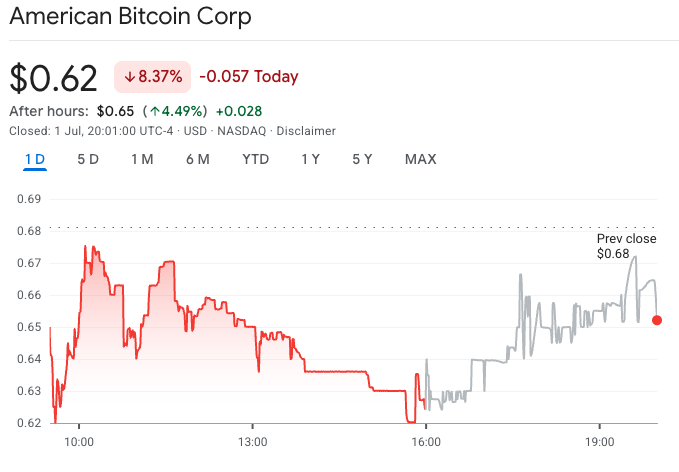
Shares in the Trump family-backed American Bitcoin (ABTC) sank to an all-time low on Wednesday after the crypto miner set a date for a 1-for-15 reverse stock split in a bid to stay listed on the Nasdaq.
American Bitcoin said its reverse stock split will go into effect after the market closes Thursday and will begin trading on a split-adjusted basis when the market opens Monday. It would continue to trade under the ticker ABTC.
It said every 15 shares of the company’s Class A and B common stock will be reclassified as one share. The company expects its common stock to be reduced from more than 1 billion outstanding shares to about 73 million.
American Bitcoin is the only public crypto company tied to the Trump family’s sprawling interests in the sector, and a reverse stock split is typically seen as a negative, as it indicates the company is in distress and is looking to artificially boost its share price.
American Bitcoin said the split aims to prop up its shares to maintain compliance with Nasdaq’s minimum bid requirements, which allow the exchange to delist the company if it trades below a $1 closing price for 30 consecutive trading days.
Shareholders had approved the reverse stock split on June 22.
American Bitcoin shares hit all-time low
Shares in American Bitcoin dropped nearly 8.4% to close trading Wednesday at an all-time low of 62 cents. The stock saw a slight lift after-hours, rising 4.5% to 65 cents.
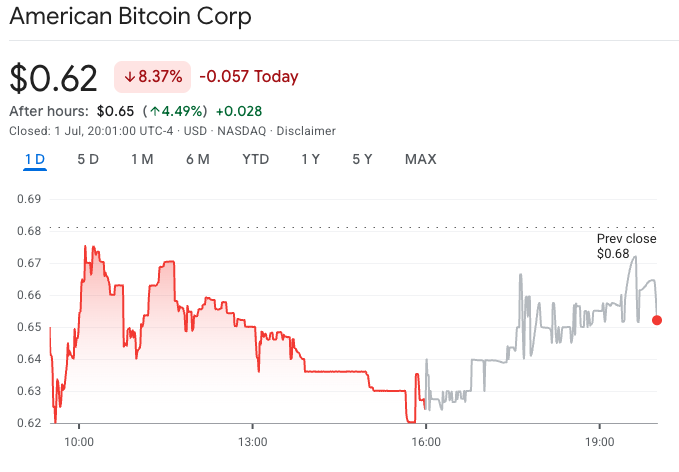
American Bitcoin’s stock tumbled to an all-time closing low of 62 cents on Wednesday. Source: Google Finance
American Bitcoin’s stock is down more than 63% so far this year and has fallen more than 92% since the brand started trading on the Nasdaq on Sept. 3.
The company was co-founded early last year by US President Donald Trump’s sons, Donald Trump Jr. and Eric Trump.
American Bitcoin merged with the Nasdaq-listed Gryphon Digital Mining to go public, with the Trump brothers and crypto miner Hut 8 together owning around 98% of the newly formed company.
Related: Bitcoin miners need billions to fund AI ambitions, led by IREN’s $21B gap
The company’s falling share price comes amid a wider downturn in the crypto market. American Bitcoin reported in May that it lost $81.7 million in the first quarter.
Other crypto companies have also turned to reverse stock splits to prop up their share price. Bitcoin financial services company Nakamoto completed a 1-for-40 reverse stock split in May in a bid to stay listed on the Nasdaq after it reached a low of 16 cents in April.
Bitcoin (BTC) was trading at around $60,000 early Thursday, down 32% so far this year and having more than halved from its peak of more than $126,000 in October, according to CoinGecko.
Magazine: Clarity Act risks repeat of Europe’s mistakes, crypto lawyer warns
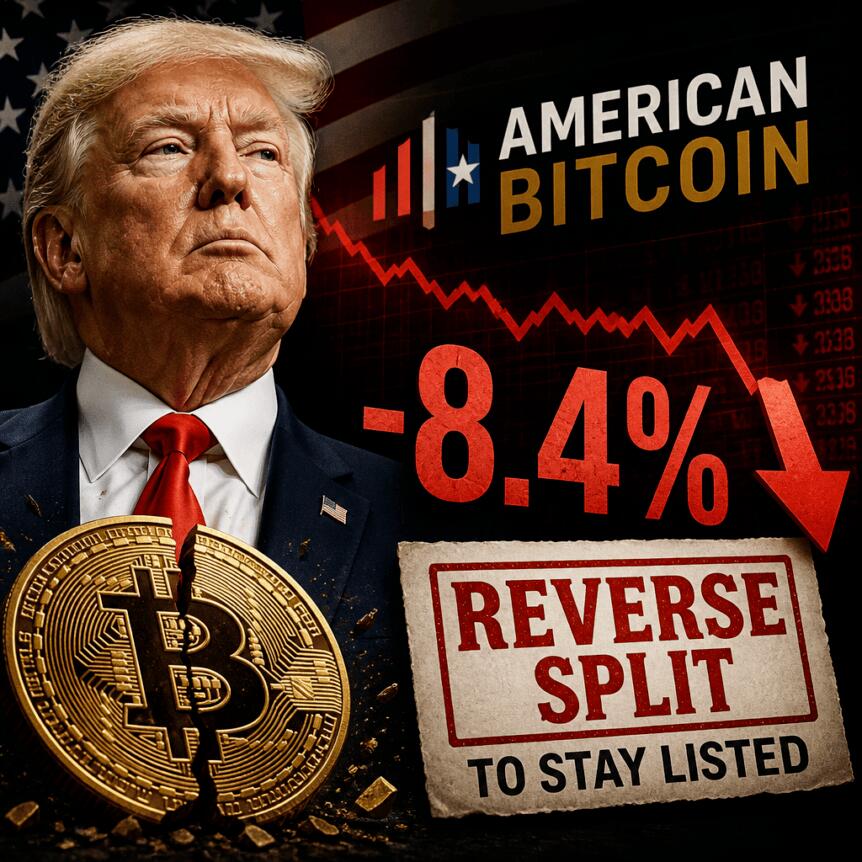
American Bitcoin (ABTC) is set to complete a 1-for-15 reverse stock split as it tries to remain listed on Nasdaq, a move that arrives as the company’s shares sink to fresh lows. The miner said the split becomes effective after the market closes on Thursday and will be reflected in trading on a split-adjusted basis when the market opens Monday, with the stock continuing to trade under the ABTC ticker.
Under the plan, every 15 shares of the company’s Class A and Class B common stock will be consolidated into a single share. American Bitcoin expects that its share count will fall from more than 1 billion outstanding shares to about 73 million. According to the company’s release, shareholders approved the reverse split on June 22, and the company now aims to satisfy Nasdaq’s minimum bid rules.
Key takeaways
- ABTC’s 1-for-15 reverse stock split takes effect after Thursday’s market close and begins trading on a split-adjusted basis on Monday.
- American Bitcoin expects its outstanding shares to drop from over 1 billion to roughly 73 million while keeping the ABTC ticker.
- The company’s stated reason is to maintain compliance with Nasdaq’s requirement that the stock not trade below $1 for 30 consecutive sessions.
- Shares fell to an all-time low of 62 cents on Wednesday, down nearly 8.4% on the day, before a modest after-hours rebound.
- The move reflects a broader pattern among crypto-related public companies using reverse splits to address prolonged weakness in share prices.
Reverse split scheduled to protect Nasdaq listing
Reverse stock splits are often viewed by investors as a sign that a company is struggling to keep its stock above exchange listing thresholds. In American Bitcoin’s case, the company explicitly tied the action to Nasdaq’s minimum bid requirements, which can lead to delisting if a stock closes below $1 for 30 consecutive trading days.
American Bitcoin said it is implementing the consolidation to support its share price and maintain compliance with those rules. The company also confirmed that it would continue trading under the ABTC ticker through the process.
Shares hit a record low as crypto equities remain under pressure
Wednesday’s trading brought another sharp decline for ABTC. Shares fell nearly 8.4% to close at an all-time low of 62 cents. After the close, the stock reportedly edged higher by about 4.5% to 65 cents in after-hours trading.
The stock’s broader performance has been weak. American Bitcoin is down more than 63% year-to-date and has fallen more than 92% since it began trading on Nasdaq on Sept. 3, when the company launched through a merger process involving a publicly listed crypto mining entity.
American Bitcoin was founded earlier this year by Donald Trump Jr. and Eric Trump, according to the company’s background described in the reporting. The business merged with Nasdaq-listed Gryphon Digital Mining to go public, with the Trump brothers and crypto miner Hut 8 together holding roughly 98% of the combined company.
Financial results and market turbulence weigh on the stock
American Bitcoin’s share weakness is unfolding amid a wider downturn affecting parts of the crypto market and the equities that trade as proxies for it. In May, the company reported that it lost $81.7 million in the first quarter, with the figure cited in earlier coverage from Cointelegraph.
Reverse splits can help companies avoid immediate delisting pressures, but they do not address underlying business fundamentals. For traders, that means investors may still be exposed to the same operational risks—especially in a sector where revenue can be influenced by factors such as mining economics, digital asset prices, and cost structures.
Bitcoin itself was trading around $60,000 in early Thursday trading, down 32% so far this year and more than halved from its October peak of above $126,000, according to CoinGecko.
Broader trend: crypto firms use reverse splits to stay listed
American Bitcoin is not alone in turning to reverse stock splits to manage listing compliance. Another example cited in the reporting is Bitcoin treasury company Nakamoto, which completed a 1-for-40 reverse stock split in May after its shares reached a low of 16 cents in April, also in an effort to remain on Nasdaq.
The pattern is notable because it highlights a recurring tension for crypto-linked equities: when digital assets or mining sentiment deteriorate, smaller-cap listed firms can quickly slip below exchange price floors. Reverse splits can temporarily alter the math of share price—though they leave investors’ proportional exposure unchanged in most cases—while companies work to stabilize operations or regain market confidence.
For ABTC holders, the immediate practical impact is timing. With the split scheduled to take effect after Thursday’s close and begin reflecting on Monday’s open, investors will want to watch how the market recalibrates around the new share count and whether trading volume or liquidity dynamics change after the adjustment.
Going forward, the key unknown is whether the company can sustain its share price long enough to satisfy Nasdaq’s ongoing $1 minimum-bid condition. The next few trading weeks will be the real test: the exchange compliance clock runs on consecutive closing prices, so investors should track ABTC’s daily closes after the effective date to see whether the reverse split achieves its intended listing protection.
dYdX Labs launched Arcus on Wednesday, a decentralized exchange that combines tokenized stock trading with perpetual futures. Founder Antonio Juliano announced the launch on X, built jointly with Robinhood Crypto. Arcus runs on Robinhood Chain, the EVM-compatible layer 2 that Robinhood opened to… Read the full story at The Defiant
LINE NEXT has opened developer pre-registration for Unifi Pay ahead of a planned global launch in the third quarter, with the payment infrastructure set to support USDT, JPYC and IDRP through its Unifi stablecoin wallet.
Summary
- LINE NEXT has opened developer pre-registration for Unifi Pay ahead of its planned global launch in the third quarter.
- Unifi Pay will support USDT, JPYC and IDRP, with users in Japan and Indonesia able to top up local stablecoins directly from bank accounts after identity verification.
- The service offers zero payment fees, an average settlement of about one second, and an SDK that lets developers create payment pages in about 10 minutes.
According to a CoinPost report, LINE NEXT, the U.S.-based affiliate of LINE Yahoo, announced on June 30 that Unifi Pay will be launched globally after a beta phase that handled 100 billion Korean won in cumulative payments and settlements over the past year.
The company, which has access to LINE Yahoo’s 300 million users, is building the service on its Unifi stablecoin wallet and has started accepting pre-registrations from global developers before the official rollout.
Unifi Pay will support Tether’s USDT, the Japanese yen-denominated JPYC and the Indonesian rupiah-denominated IDRP at launch. In Japan and Indonesia, users will be able to complete online identity verification and directly top up JPYC or IDRP from their bank accounts. LINE NEXT also said it plans to add local stablecoins in more countries, depending on what each market’s regulations allow.
Unifi Pay offers wallet-based settlement with zero payment fees
Using a wallet-based structure, Unifi Pay directly connects users and suppliers and removes payment fees from the transaction process, according to the announcement. LINE NEXT said the service offers an average settlement speed of about one second.
The company will also provide a function that allows settlement funds to be sent directly to bank accounts through connected crypto exchanges and blockchain remittance solutions. This gives suppliers and developers a path to move stablecoin payments into bank accounts after receiving funds through the wallet.
For developers, AI builders, and creators, LINE NEXT is introducing the Unifi Pay SDK to simplify the process of adding global payments. The company said the SDK uses an A2A, or Agent-to-Agent, task execution method for AI agents, allowing a payment page to be created in about 10 minutes through a single command input.
Developer companies that keep payment proceeds in the wallet may receive annual rewards of up to 5%, depending on the type of stablecoin used. LINE NEXT said the reward model is tied to stablecoin holdings inside the wallet.
The beta version of Unifi Pay recorded 100 billion Korean won in cumulative payment and settlement volume over the past year, equal to about 10 billion Japanese yen based on the announcement’s conversion rate of 1 won to 0.1 yen. LINE NEXT CEO Youngsu Ko said the company plans to establish Unifi Pay as a payment infrastructure that connects developers, creators, and users around the world through its developer tools.
The planned launch also follows LINE NEXT and Kaia’s earlier stablecoin work through Project Unify, which was announced during Korea Blockchain Week in September 2025. Kaia described Project Unify as a stablecoin super-app designed to bring payments, yield, on/off-ramps and access to more than 100 decentralized apps into LINE Messenger, which the company said had nearly 200 million monthly active users across Japan, Taiwan, Thailand and Indonesia.
Kaia said at the time that Project Unify would support USD, JPY, KRW, THB, IDR, PHP, MYR and SGD at launch, while offering developers and issuers a Unify SDK with a focus on regulatory compliance, especially in South Korea. The project followed the 2024 merger of LINE’s Finschia and Kakao’s Klaytn into Kaia, which has described itself as Asia’s stablecoin orchestration layer.

Diplomatic discussions between the United States and Iran gained fresh momentum after new comments from President Donald Trump. The latest developments supported gains across several financial markets while crude oil prices moved lower. Meanwhile, traders assessed the possibility of a longer negotiation period as discussions continued in Qatar.
US-Iran Negotiations Advance as Diplomatic Efforts Continue
The United States and Iran continued negotiations in Qatar with support from regional mediators. The latest round followed earlier diplomatic contacts aimed at reducing tensions between both countries. As a result, market participants responded quickly to signs of continued engagement.
President Donald Trump described recent diplomatic progress as positive during remarks on Wednesday. He also indicated that efforts surrounding Iran’s nuclear program continued moving in the intended direction. However, he stopped short of confirming that both sides had reached a final agreement.
US representatives Jared Kushner and Steve Witkoff remained involved in the talks held in Doha. Qatar and Pakistan continued supporting communication between both governments throughout the negotiations. Their involvement reflected ongoing regional efforts to maintain dialogue and reduce geopolitical risks.
Oil Declines While Gold and Crypto See Stronger Demand
Financial markets reacted soon after reports highlighted progress in the diplomatic discussions. West Texas Intermediate crude oil dropped more than two percent during the trading session. Consequently, the benchmark price slipped below the important $70 level.
Lower oil prices reflected expectations that supply disruptions could become less likely. Earlier tensions had increased concerns about energy exports across the Middle East region. Therefore, easing diplomatic risks encouraged selling pressure across crude oil markets.
Gold also attracted fresh demand during the same trading period. Market data indicated that the precious metal added more than $74 billion in value within one day. At the same time, digital assets recorded gains, with several major altcoins outperforming Bitcoin.
Earlier reports had linked geopolitical uncertainty with increased volatility across digital asset markets. Market analysts had already warned that diplomatic developments could influence short-term price movements. The latest positive headlines supported stronger buying activity across several cryptocurrency sectors.
Ceasefire Extension Expectations Increase as Talks Continue
Prediction platform Polymarket showed rising expectations for an extension of the current negotiation period. The platform estimated a 62% probability that discussions would continue beyond the existing 60-day framework. That reading reflected improving confidence that both sides would maintain diplomatic engagement.
Despite stronger expectations, negotiations still face several important stages before reaching a formal agreement. Diplomatic discussions often require additional meetings before both governments finalize key commitments. Therefore, current progress does not guarantee a lasting resolution.
The latest developments followed previous diplomatic activity involving Iran and Oman. Both countries had established a joint committee to discuss the Strait of Hormuz and broader ceasefire matters. Those earlier efforts created additional channels for communication before the current Doha meetings.
The Strait of Hormuz remains one of the world’s most important energy shipping routes. Any improvement in regional stability can influence global oil prices and broader financial markets. Consequently, diplomatic developments continue affecting commodity and digital asset trading activity.
Current negotiations have strengthened expectations that dialogue may continue beyond the initial timeline. However, any setback during future meetings could quickly change market sentiment across several asset classes. The coming diplomatic sessions may determine whether recent gains receive additional support or reverse in the near term.

Zeroth W1, produced by Lexiang Technology, has obtained the Wall-E IP authorization for the Disney animated film “RoboCop” and will be unveiled at AWE 2026 in Shanghai, China on March 15, 2026.
Cfoto | Future Publishing | Getty Images
BEIJING — Alibaba-affiliate Ant Group is ramping up its move into humanoid robots.
Ant has led a 500 million yuan ($73.58 million) funding round in humanoid robotics company Zeroth, the start-up announced Thursday.
It’s the 12th company in the sector that Ant has invested in since the beginning of 2025, according to CNBC analysis of PitchBook data. The investments tracked by CNBC range from humanoid robotics companies Galaxea and Unitree, to parts and software start-ups such as Linkerbot, Hypershell and Genrobot AI.
After regulators halted Ant’s giant IPO in 2020, the operator of mobile payments app Alipay has launched a healthcare services app and released its own artificial intelligence models. In late 2024, Ant also established a humanoid robot subsidiary called RobbyAnt that subsequently developed its own robot.
Ant has released an AI and robotics-friendly version of its Alipay mobile payments service, which is an area Zeroth said it would like to cooperate in.
Monolith, Geely Capital, 37 Interactive Entertainment and Hua Capital also participated in Zeroth’s latest funding round. The pre-Series A raise brings total funds raised to 1 billion yuan.
The start-up’s founder, Guo Renjie, told CNBC that Zeroth focused on securing companies with experience in industries such as smartphone chips. He said the company’s robots currently use chips from Horizon Robotics.
Zeroth Robotics, known in China as Suzhou JoyIn Intelligent Technology, was founded in late 2024.
The start-up plans a phased approach to realizing humanoid robots for the home, Guo told CNBC in an interview earlier this year. The company is starting with companionship robots for elderly care and pet care, followed by robots for children’s education, he said.
Zeroth claimed it has received orders for more than 30,000 units, and that operating revenue in the first half of the year surged 600% from a year ago.
Guo said he plans to start overseas sales in North America and Europe this fall, once the company clears local compliance requirements.
The Ant Group-led deal comes as interest in humanoid robots grows in China. Nvidia on Monday announced it was hiring for several robotics roles based in Beijing, Shanghai and Shenzhen.
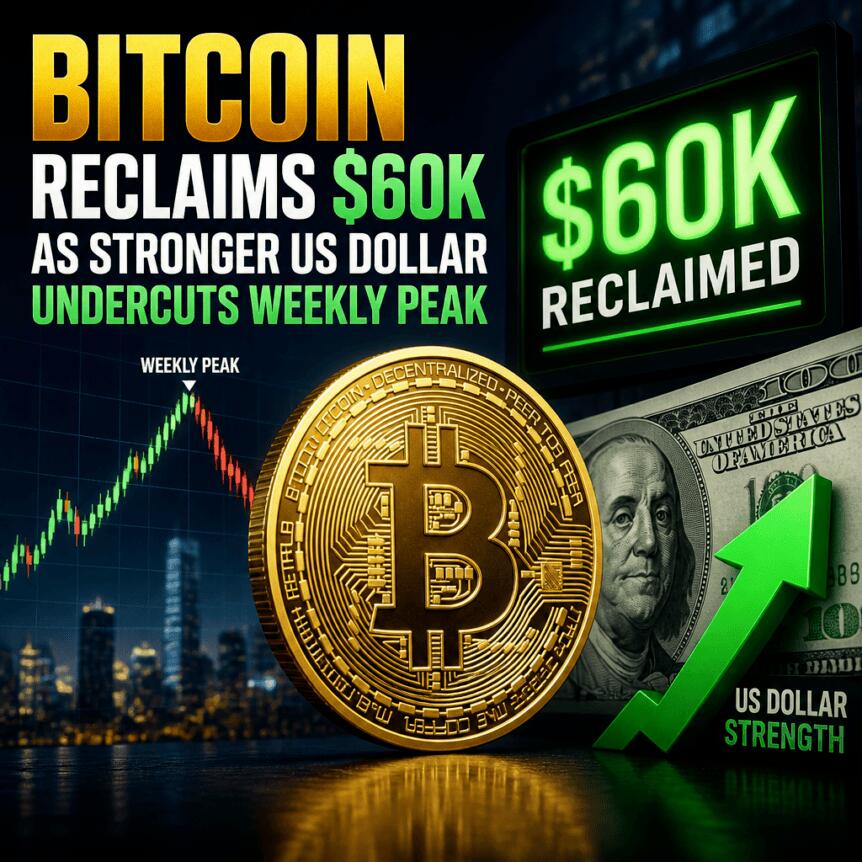
Bitcoin pushed higher at the Wall Street open on Wednesday, briefly trading up to the $60,000 area as broader risk sentiment improved and the US dollar eased.
TradingView data showed BTC/USD reaching $60,475 on Bitstamp, translating into nearly a 3% gain on the day. The move came after the pair’s June selloff had started July with a bounce from recent multiyear lows, while liquidations across crypto derivatives reportedly totaled more than $200 million over the prior 24 hours, according to CoinGlass.
Key takeaways
- BTC climbed toward $60,500 at the start of the first US session of July, adding nearly 3% intraday.
- Some of the tailwind appears linked to a cooling in US dollar strength, with DXY reversing off local highs.
- CoinGlass data points to large 24-hour liquidation totals, highlighting how sensitive leverage remains.
- Traders are framing July as a potential “relief” period, while still watching for a continuation of the broader downtrend later.
- Market participants note crowded positioning in the US dollar, which could affect cross-asset flows if it unwinds.
Bitcoin’s early July bounce targets a key $60,000 level
The rally gained momentum during the early New York session, with BTC/USD spiking to $60,475 on Bitstamp, per TradingView. At the time of the move, daily gains were running close to 3%, suggesting dip-buying interest rather than a sustained breakout at that moment.
Derivatives flows reinforced that volatility was still in play. CoinGlass data cited in the coverage put 24-hour crypto long liquidations above $200 million at the time of writing—an indicator that leveraged longs had been forced out during the prior decline, clearing some room for upside rebounds.
Trader Lennaert Snyder described the move as a “lovely pump” and suggested that exhaustion on lower time frames could precede another push toward roughly $60,700, based on his intraday charting. Snyder’s comments, posted on X, pointed to a near-term sequence: a brief cooling after the initial surge, followed by an attempt higher.
Range traders watch whether $58,000–$61,000 holds
While the price action looked constructive, several traders focused on range behavior rather than immediately calling for a trend reversal.
Daan Crypto Trades highlighted the possibility that BTC could turn the $58,000 to $61,000 area into a temporary range. In an X post earlier in the session, he argued that if price revisited either end of that range, it could produce a “decisive break” and a larger directional move.
“I think there’s a good chance that the next attempt at the range high or low will cause a decisive break and bigger move.”
US dollar weakness and “crowded” positioning add context
Alongside crypto-specific signals, the broader macro backdrop appeared to matter. The US dollar index (DXY) reportedly reversed from local highs of 101.6 at the open, giving Bitcoin room to rise as dollar strength cooled.
Commentary from The Kobeissi Letter emphasized that the larger dollar trend could shift “soon.” In a post cited in the coverage, it warned that the “long US Dollar trade is crowded,” claiming speculative long positioning surged to +$34.3 billion as of June 23—its highest level in 18 months.
That matters for crypto because BTC often trades as a high-beta asset sensitive to dollar liquidity conditions. If crowded positioning unwinds or if expectations for dollar strength fade, it can influence risk assets quickly—sometimes amplifying moves once markets already have momentum.
Why traders are calling July a potential “relief rally”
Beyond the immediate bounce, market participants continued to discuss the possibility of a relief rally through July, even as they acknowledged that the path beyond mid-summer remains uncertain.
Trader Titan, referenced in the report, pointed to a base-case scenario tied to the monthly structure—specifically that a relief move in July could occur before the downtrend resumes. In his view, Bitcoin’s monthly performance would need to navigate the broader trend pressures rather than simply break away from them.
“My base case: a relief rally in July before the downtrend resumes.”
Rekt Capital also reiterated a historical pattern he associates with Bitcoin’s calendar behavior: “Red June. Green July. Red August.” In a post cited in the coverage, he suggested that while downside “wicking” could happen early in July—potentially dipping below the new Monthly Open—history implies the price may expand upward as the month progresses.
Still, this framing is not a blanket bullish call. The same analysis points to a likely two-step process: near-term volatility and potential testing of levels early in the month, followed by an upside stretch—followed by a watchful stance for bearish moves in August.
In other words, the rally appears to be treated by many traders as a tactical reprieve within a larger uncertainty band, rather than evidence that the broader trend has definitively reversed.
What to watch next
Bitcoin’s move above $60,000 is attracting attention because it interacts with both leverage dynamics and macro inputs like the dollar. Traders will likely focus on whether BTC can hold gains through key intraday levels and whether DXY continues to lose momentum; at the same time, many market participants are watching the early-July monthly structure for signs that the “relief rally” thesis is developing or failing.

1,700 UK investors have launched a group lawsuit in London’s High Court against Binance and founder Changpeng Zhao.
The claimants say the pair sold risky crypto derivatives products to retail investors without authorization.
UK Investors Demand $200M from Binance
The plaintiffs allege that between around late 2019 and 2020, Binance offered products such as leveraged tokens, options, contracts, and futures without the approval of the UK’s Financial Conduct Authority (FCA).
The victims filed the lawsuit under the Financial Services and Markets Act, claiming the derivatives are “specialized investments” under the rules. The UK regulator banned Binance from selling these complex investment products in 2021, but the exchange continued to sell them to its users, they say.
The crypto traders also accuse it of promoting the products through advertising campaigns, online materials, social media posts, and email communications.
Hannah Sharp, a partner at the law firm representing the victims, said its clients had suffered lots of financial losses and that it was determined to hold CZ and the exchange accountable.
The Financial Times reported that traders lost tens of thousands of dollars, and in some cases millions. The claimants are now seeking about $200 million in compensation.
Binance Acknowledges Lawsuit
Binance has yet to respond to the accusations in the lawsuit, but has acknowledged it’s aware of the proceedings.
“We do not comment on ongoing litigation. We will defend against these claims through the appropriate legal process in due course,” said the firm in a statement.
The case adds to a list of legal and regulatory challenges it has faced in recent years, including its recent failure to secure an EU crypto license.
Following the setback, Binance initially informed customers that it would stop offering services in the region. However, CZ later emphasized that it remains committed to Europe and plans to apply for a permit through another jurisdiction.
This was after the European Securities and Markets Authority (ESMA) ordered all unauthorized digital asset firms to wind down their operations by July 1 if they failed to obtain a MiCA license before the deadline. Meanwhile, crypto executives say that the directive is expected to affect more than 80% of crypto platforms in the region.
UK regulators have long been known for their cautious approach, warning users that crypto is a high-risk investment. The FCA also recently unveiled its long-awaited rules for the sector, which will see firms have to meet financial safety standards, comply with anti-money laundering and market abuse laws, and satisfy consumer protection requirements.
The post UK Investors Sue Binance and Former CEO Changpeng Zhao for $200M appeared first on CryptoPotato.


Binance and Anchorage Digital launched an off-exchange settlement integration, letting institutional traders access Binance's liquidity while keeping their assets in Anchorage's custody rather than on the exchange itself. The service runs on Atlas, Anchorage's settlement infrastructure suite. The… Read the full story at The Defiant

Concern for rough sleepers next to Foss Fairy Trail in York

Dave Portnoy slams Zohran Mamdani over New York City economic vision

Extreme fear at 16: Bitcoin’s bottom signals


-

 Fashion5 days ago
Weekend Open Thread: Staud – Corporette.com
-

 Politics6 days ago
The House | Manchesterism won’t survive the painful trade-offs unless it gets citizens on board
-

 Crypto World2 days ago
Strategy authorizes up to $1.25B in Bitcoin sales under new capital plan
-

 Politics6 days ago
Potential 2028er World Cup attendee leaderboard
-

 Business6 days ago
Asia stock markets slide as tech shares slump
-

 News Videos3 days ago
MAJOR BITCOIN & MARKET UPDATE!!!! (MUST WATCH ASAP!!!)
-

 Tech6 days ago
A Look At A Gaggle Of Transputer Boards
-
 Crypto World6 days ago
Dell (DELL) Shares Tumble Over 5% Following Analyst Downgrade to Hold
-

 Crypto World4 days ago
Coinbase, Circle Deepen Crypto Stock Losses Despite Resilient S&P 500
-

 Business2 days ago
Australia treasurer says alleged access of prime minister’s bank data ’incredibly concerning’
-

 Crypto World5 days ago
Kraken's xStocks Opens Bending Spoons IPO Registration to EEA Retail
-

 Sports5 days ago
FIH Pro League: India defeat Pakistan 7-1, register biggest win of campaign | Other Sports News
-

 Crypto World6 days ago
Bitcoin Sparks $600M Hourly Liquidations With $65,000 Set To Become Resistance
-

 Tech4 days ago
Bluekit phishing kit adopts browser-in-the-middle for login theft
-

 Tech5 days ago
Russian hackers now target Signal backup recovery keys
-
 Crypto World6 days ago
Hyperliquid Named on Singapore MAS Investor Alert Register
-

 Crypto World5 days ago
RTX holders must register wallets before token distribution begins
-

 Tech2 days ago
Anonymous researcher drops 0-day ‘exploitarium’ repo
-

 Crypto World7 days ago
Ripple and SBI launch RLUSD in Japan after JFSA approval
-

 Sports14 hours ago
Broncos roster: OL Ben Powers (No. 74) entering final year of contract
You must be logged in to post a comment Login