

Crypto World
Bitcoin Price Prediction: BTC Hits a 2-Week Low as Liquidations Top $500 Million


BTC is bleeding. Bitcoin price dropped as low as $76,500 this morning, a two-week low, shedding more than 2% as geopolitical shockwaves and a crowded long market prediction collided in brutal fashion. The selloff accelerated as US-Iran war tensions rattled risk assets globally, with oil surging toward $100 per barrel and Nasdaq 100 futures sitting roughly 10% below January highs.
Bitcoin’s correlation to tech stocks did it no favors. Long liquidations swamped the market; nearly $300 million in long positions were wiped out, exposing just how crowded bullish futures positioning had become. Spot BTC ETFs, which drove much of Q4 2025’s euphoria, have seen inflows slow and flip to net outflows in recent sessions.
Macro headwinds and derivatives positioning now dominate the near-term picture, and with approximately $14 billion in BTC options open interest approaching expiry, volatility is far from finished.
Discover: The best pre-launch token sales
Bitcoin Price Prediction: Can BTC Recover to $82,000?
Bitcoin is hovering at the $77,000 area as we speak, well below the local high of $82,800 that marked resistance earlier this month. Data shows BTC’s one-month range compressed between $73,800 and $82,800, with the lower bound now acting as the critical floor.
Momentum indicators are deteriorating. BTC is now 28% below its all-time high, trading in a wide consolidation band that marks between $60,000 and $80,000. The options expiry overhang near current strikes could pin price in the short term, which could release a volatility spike in either direction once those positions roll off.
Three scenarios dominate current positioning:

- Bull case: BTC holds the $73,800–$75,000 support zone, ETF outflows stabilize, and a macro de-escalation pushes price back toward $82,000–$83,000 resistance within two weeks.
- Base case: Choppy consolidation between $75,000 and $80,000 as options expiry resolves and traders wait on Fed signals and geopolitical clarity.
- Bear case: A daily close below $73,800 opens a path toward the $60,000–$66,000 demand zone, or the 52-week low territory where longer-term buyers historically stepped in.
On-chain data offers a partial counterweight: exchange outflows remain elevated, signaling ongoing self-custody moves that analysts typically read as longer-term accumulation behavior, even during price weakness. The question is whether those buyers can absorb continued macro-driven selling pressure.
Discover: The best crypto to diversify your portfolio with
Hyper Targets Early Mover Upside as Bitcoin Tests Key Levels
When spot BTC trades 28% off its highs, and ETF inflows dry up, late-cycle entry into large-cap crypto looks increasingly unattractive on a risk-reward basis. Rotation toward early-stage infrastructure plays is a pattern that tends to gain traction precisely during consolidation phases like this one.
Bitcoin Hyper ($HYPER) is positioning itself at that intersection. It will be the first-ever Bitcoin Layer 2 with Solana Virtual Machine (SVM) integration that targets sub-second finality and smart contract throughput that the base Bitcoin layer simply cannot deliver. It preserves Bitcoin’s security while stripping out its speed and programmability limitations entirely.
The presale numbers are concrete. More than $32 million has been raised at a current price of $0.0136 per $HYPER. Staking is live with a high 35% APY for early participants. Key infrastructure includes a Decentralized Canonical Bridge for trustless BTC transfers and low-latency execution designed to outpace Solana on its own architecture.
The post Bitcoin Price Prediction: BTC Hits a 2-Week Low as Liquidations Top $500 Million appeared first on Cryptonews.

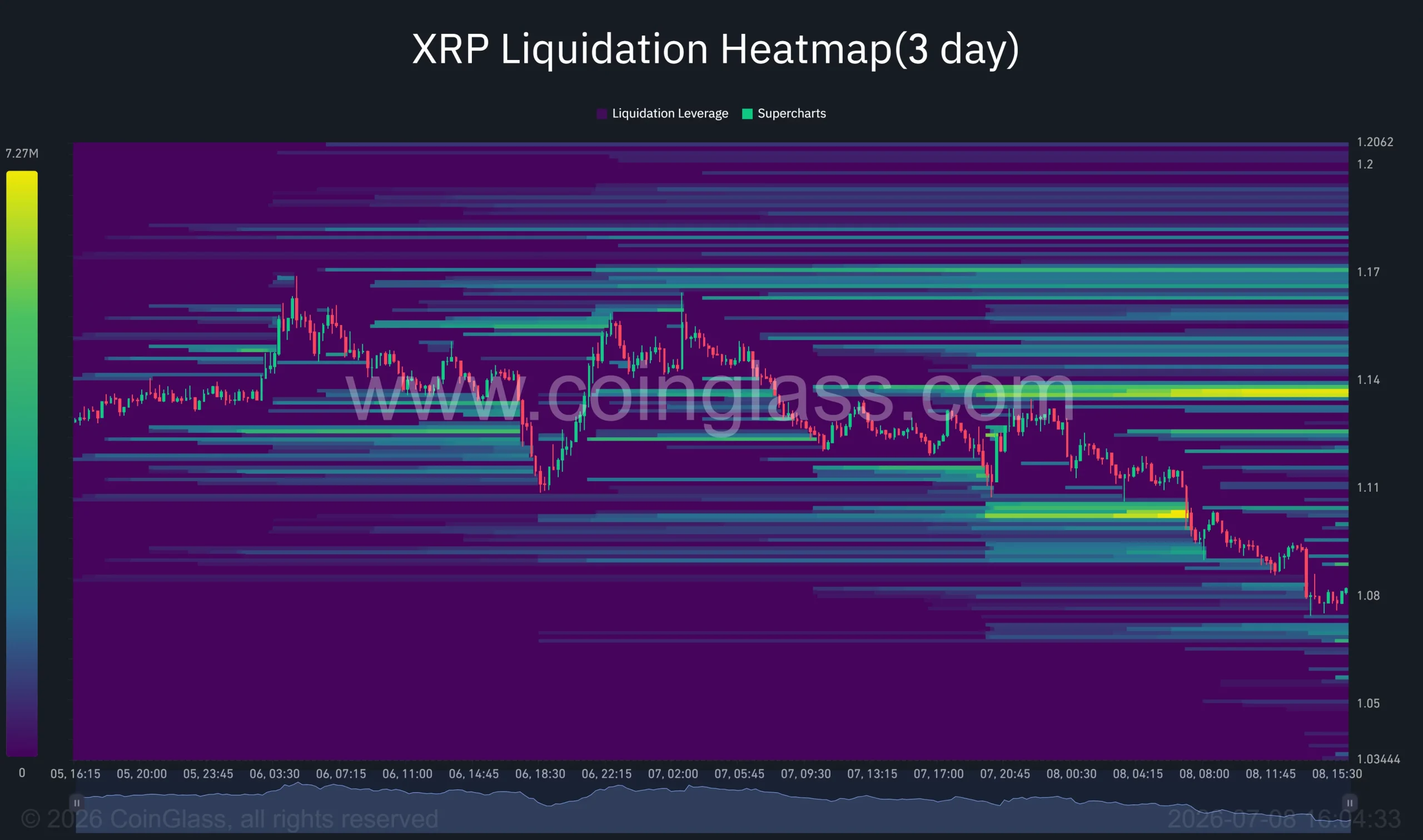
XRP has slipped below a key short-term support near $1.10, with sellers regaining control as traders lock in profits after Ripple’s latest European regulatory win and macro risk sentiment weakens across global markets.
Summary
- XRP has dropped below key support near $1.10 as profit-taking and long liquidations push the token toward $1.
- A descending channel, weakening RSI, bearish MACD setup, and dense liquidation zones reinforce downside risks.
- Ripple’s MiCA license and $4 billion in XRPL tokenized RWAs highlight long-term adoption despite near-term weakness.
The token traded around $1.08 on Tuesday after falling from an intraday high near $1.18. The decline came shortly after Ripple secured a full Crypto-Asset Service Provider license from Luxembourg’s Commission de Surveillance du Secteur Financier under the European Union’s Markets in Crypto-Assets framework. Instead of extending the rally, the announcement triggered a classic sell-the-news reaction as traders booked gains following the regulatory milestone.
Fresh geopolitical tensions added pressure across risk assets. Reports of a tanker attack in the Strait of Hormuz, U.S. airstrikes on Iran, and the removal of Iranian oil sales waivers pushed crude oil prices more than 2.5% higher.
The move lifted Treasury yields and weighed on equities, particularly technology stocks, dragging major cryptocurrencies lower alongside traditional markets.
At the same time, derivatives positioning amplified the decline. CoinGlass liquidation data shows dense leverage clusters above $1.10 and another major concentration near $1.14, while the latest three-day liquidation heatmap now reveals comparatively thinner liquidity below the market.
As long positions were forced out during Tuesday’s decline, XRP quickly slid toward the next support zone around $1.08, leaving the psychological $1.00 level as the next major downside magnet if sellers remain in control.
A separate on-chain development has highlighted continued institutional interest in the XRP Ledger despite the token’s weak price action. According to crypto commentator Whale Factor, tokenized real-world assets on the network have surpassed $4 billion after standing near $150 million a year ago.
“The crypto as a toy narrative is dead. Tokenized RWAs on the XRP Ledger just smashed through the $4 BILLION mark,” Whale Factor wrote on X.
The growth underscores expanding enterprise adoption of the network, although investors have largely treated it as a long-term fundamental story rather than a catalyst for immediate token demand.
Technical breakdown has exposed the $1 psychological support
The daily chart shows XRP trading inside a descending channel that has capped every recovery attempt since May. The latest rejection occurred after the token failed to hold above the channel’s upper boundary before falling back toward the lower half of the pattern.
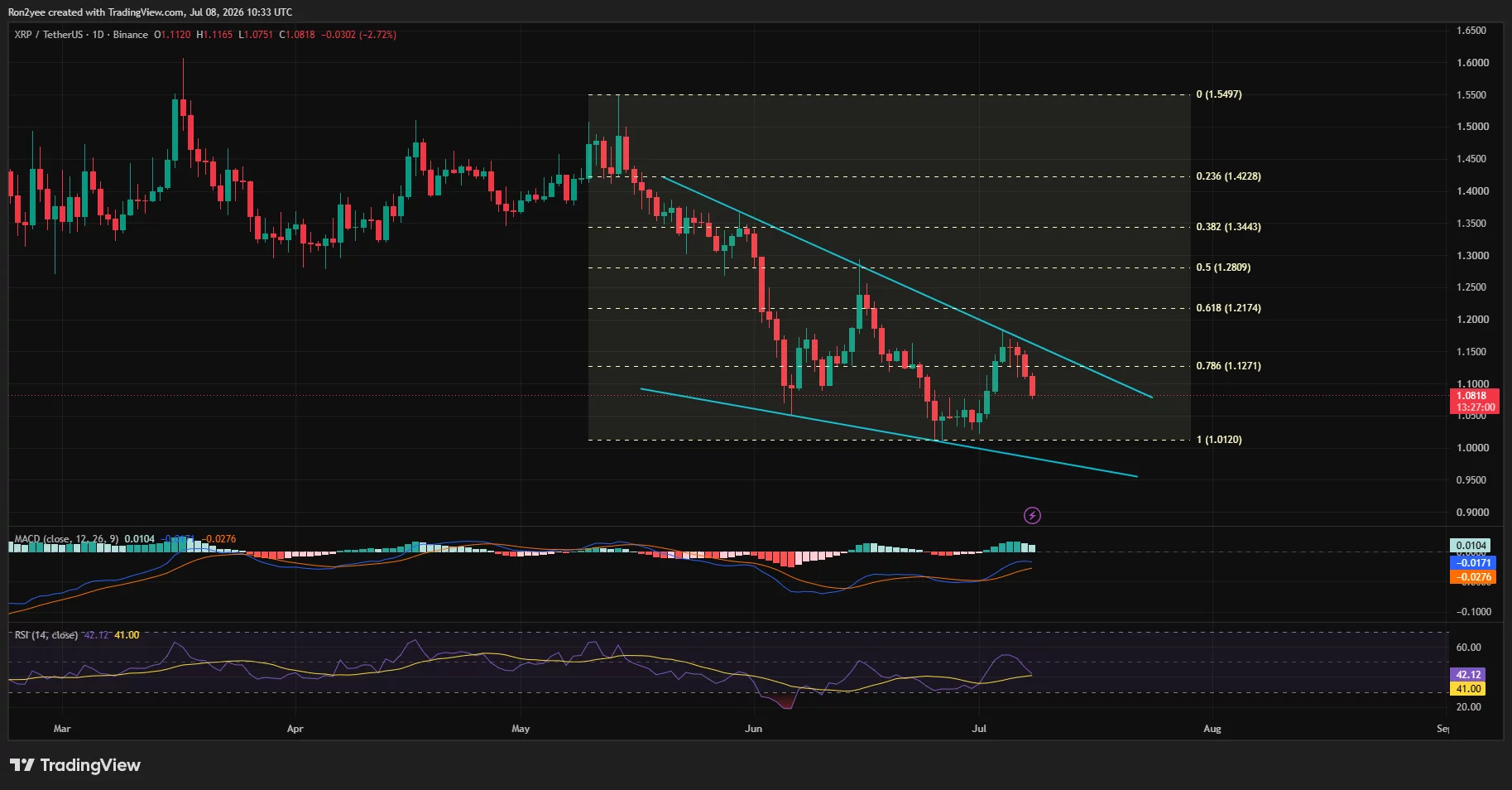
Momentum indicators have also weakened. The daily Relative Strength Index has slipped to around 42 after failing to reclaim the neutral 50 level, while the MACD histogram has begun printing smaller positive bars as the MACD line curls toward a bearish crossover. Together, those indicators suggest buying momentum has faded after last week’s rebound.
The Fibonacci retracement drawn from the May high to the June low also places XRP below the 78.6% retracement level near $1.13. Immediate support sits around $1.01-$1.02 near the channel floor, with a decisive break opening the door to a test of the psychological $1.00 level.
On the upside, bulls would first need to reclaim $1.13 before challenging resistance around $1.21, where the 61.8% Fibonacci level and previous supply zone converge.
The 4-hour chart presents a similar picture. Aroon Down has climbed to 100 while Aroon Up has retreated sharply, showing sellers currently dominate the short-term trend. Meanwhile, Chaikin Money Flow has remained only marginally above zero, suggesting capital inflows have weakened despite avoiding outright distribution.
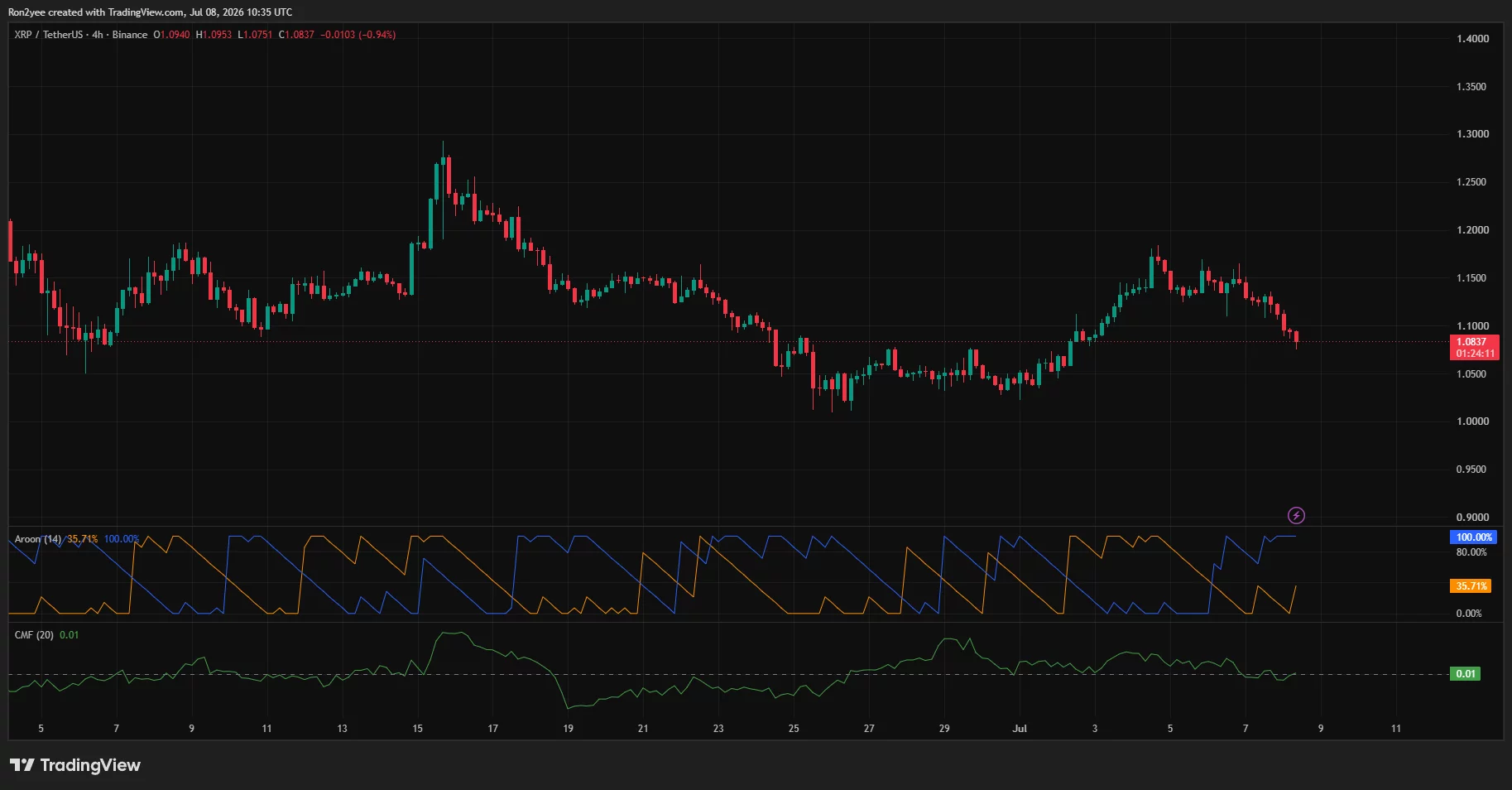
Macro risks could extend losses while a recovery requires reclaiming $1.13
Muted institutional participation has added another headwind. Spot XRP ETF flows have remained largely flat over recent sessions, while uncertainty surrounding the timing of the U.S. CLARITY Act continues to delay a key regulatory catalyst that many investors view as important for broader institutional adoption.
Further weakness in global equity markets or another spike in energy prices could accelerate risk aversion and increase pressure on altcoins. A daily close below the $1.01-$1.02 support area would strengthen the bearish case for a move toward $1.00 and potentially below it.
The downside outlook would weaken if buyers reclaim the $1.13 resistance zone and push XRP back above the descending channel’s upper trendline. Such a move would force short sellers to reassess positions and could shift attention toward the $1.21 resistance area, where the next major supply cluster remains concentrated.
Disclosure: This article does not represent investment advice. The content and materials featured on this page are for educational purposes only.
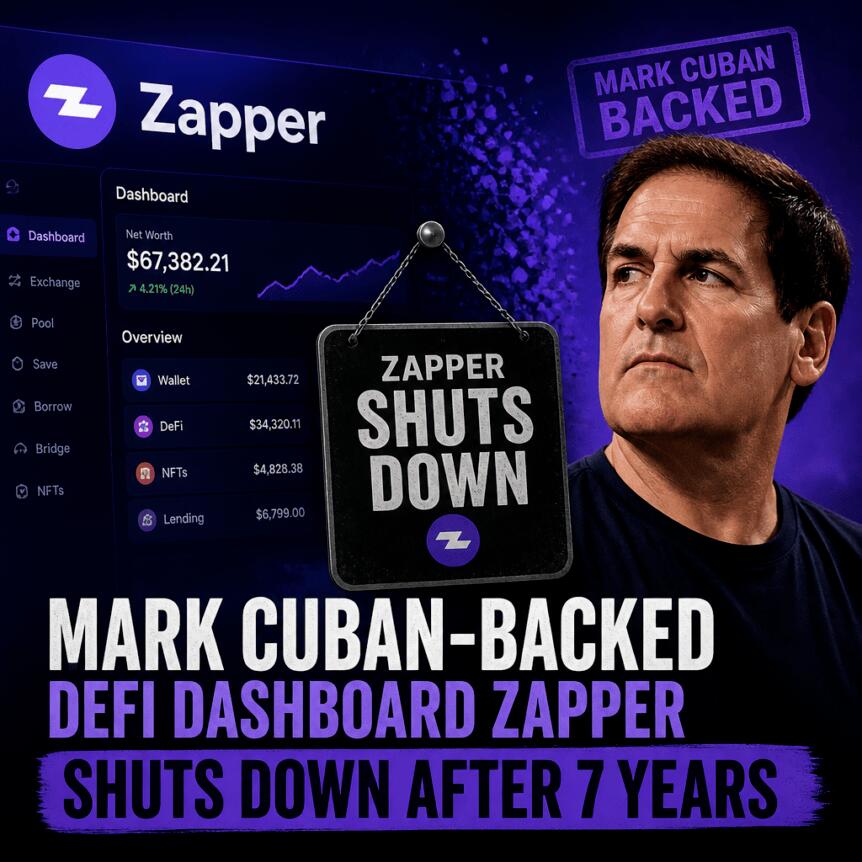
DeFi analytics and portfolio tooling provider Zapper says it will shut down its website, mobile app, and API services on Aug. 3, bringing an end to a seven-year run as broader crypto activity cools and venture funding tightens.
In a post on X on Wednesday, Zapper CEO Seb Audet said the company concluded that an “orderly wind down is the best course of action.” Audet did not provide detailed reasoning, but in a follow-up response hinted that falling demand played a role, adding that “the market decides.”
Key takeaways
- Zapper will discontinue its website, mobile app, and API on Aug. 3, ending support for wallet tracking and DeFi analytics from that date.
- The shutdown joins several other crypto platforms that have paused operations this year as sentiment weakens and funding becomes harder to obtain.
- Zapper previously scaled to over 2 million monthly active users and processed more than $13 billion in transactions at its peak, according to Audet.
- VC capital appears to be concentrating even as total funding rises, with RootData data cited in the report showing deal counts declining over recent quarters.
- Zapper says it has faced setbacks, including a social engineering attack in April 2025 that briefly redirected users via a hijacked domain.
Zapper sets an Aug. 3 shutdown date
Zapper’s announcement makes it the latest DeFi-focused platform to exit amid a period of reduced activity across the sector. According to Audet, the company will close its public services—including its website, app, and API—on Aug. 3. The CEO framed the move as the result of evaluating multiple options before deciding on an orderly wind-down process.
In an additional comment, Audet pointed to market conditions without spelling out specific metrics or internal causes. “At the end of the day, the market decides,” he wrote, suggesting that revenue potential and usage demand were no longer sufficient to justify continued operation.
Why this matters to DeFi users and builders
Zapper’s tooling has served a practical niche in the DeFi stack: traders and liquidity providers used it to track token performance, monitor DeFi positions, and manage activity such as liquidity pools and yield farms. The platform also enabled wallet connections for position visibility and for discovering ecosystem updates, including information tied to upcoming token events like airdrops.
For users who rely on analytics and wallet-linked monitoring, a full service shutdown typically means losing an interface that consolidates balances, positions, and activity across protocols. Even if users can still access blockchain data directly, platforms like Zapper help translate those data into actionable dashboards. With the Aug. 3 cutoff, customers will need to migrate workflows to alternative analytics options or rebuild their own monitoring routines.
The impact may be broader for developers as well: Zapper’s API offering indicates it was used not only as a consumer product but also as an integration point for applications wanting to surface token and DeFi position information. When the API ends, integrators will need to adjust quickly to avoid broken data pipelines or dashboards.
A pattern of exits as sentiment and funding tighten
The Zapper shutdown comes alongside other crypto platform closures that have been linked, directly or indirectly, to softer demand and a tougher market for fundraising.
The report notes that Cardano-based analytics platform TapTools made a similar decision to shut down in June, while Bitcoin-focused DeFi platform Botanix followed about a week later, citing weak demand for Bitcoin DeFi.
Beyond DeFi analytics, several other categories have seen exits too. The article references SBI’s crypto unit, decentralized email service Dmail, and NFT marketplaces including Nifty Gateway and Rodeo as having sunset operations in 2026 amid a broader downturn in NFT activity. Separately, Cointelegraph also previously covered a wave of closures tied to reduced engagement and changing investor appetite.
The broader backdrop described in the report is that crypto sentiment has sunk toward near all-time lows, and that venture capital funding has become harder to secure. While the piece does not provide marketwide adoption numbers, it frames the exits as part of a larger contraction in both user appetite and the financing environment.
From seed funding to scaling—then setbacks and a funding squeeze
Zapper was founded in 2019 and built early momentum through success in Kyber’s DeFi Hackathon later that year, which helped it raise a $1.5 million seed round, according to the article. It later raised $15 million in a Series A funding round in May 2021 led by Framework Ventures, with participation from Mark Cuban and Coinbase Ventures, as well as Sound Ventures, which is associated with Ashton Kutcher.
At its peak, Audet said the team scaled the product to over 2 million monthly active users and processed more than $13 billion in transactions. The same figures underline why the shutdown is notable: Zapper was not a niche experiment but a widely used piece of DeFi infrastructure for tracking and management.
Still, Zapper’s journey included operational disruption. In April 2025, the platform suffered a social engineering attack in which attackers temporarily hijacked its domain and redirected users to a malicious page containing phishing traps. The incident would have raised ongoing risk management and user trust challenges even after any remediation.
On the financing side, the report cites RootData’s VC dashboard to argue that capital has become more concentrated despite an increase in aggregate funding. It states that crypto VC funding rose 57.6% year-on-year to $4.21 billion in the second quarter, while the number of deals has fallen nine times over the last 10 quarters, according to RootData.
That combination—more total dollars but fewer deals—can make it difficult for mid-stage companies to bridge the gap between growth and profitability, especially when usage depends on an overall market cycle. For platforms like Zapper that serve users whose behavior is often correlated with market activity, weaker demand can reduce subscription and integration leverage precisely when fundraising terms are less flexible.
What to watch after Zapper’s exit
With Aug. 3 as the shutdown date, users and integrators should focus on migrating wallet tracking, DeFi analytics, and any API-dependent workflows to alternatives before services go offline. The key remaining uncertainty is whether Zapper’s team will offer any transition support—such as data exports, migration guidance, or replacement guidance—and whether similar analytics and tooling providers will face accelerated consolidation as the funding environment continues to concentrate.
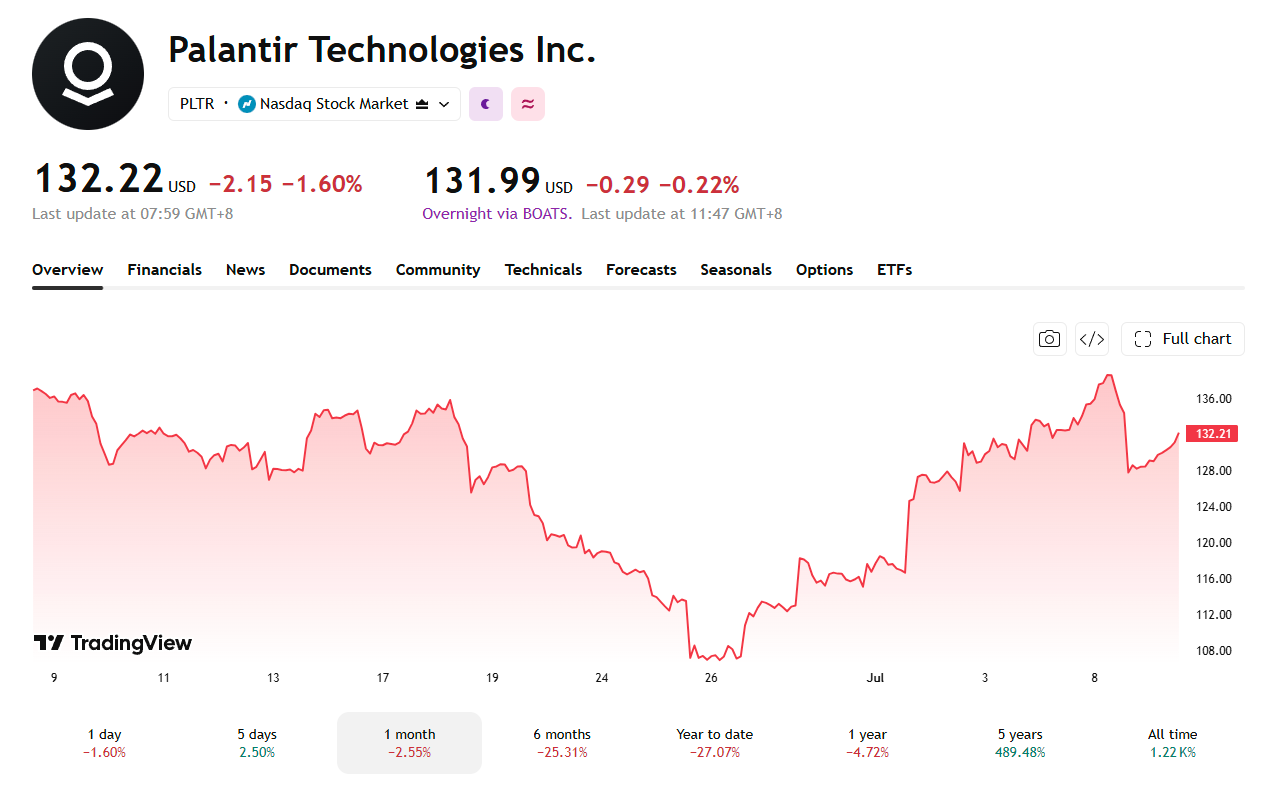
Palantir Technologies (PLTR) shares fell 1.6% to $132.22 on Wednesday, July 08 snapping a seven-day winning streak that had pushed the stock up 25%.
The stock surge hit the brakes after a report raised the prospect of Democratic lawmakers targeting the company’s government contracts.
A Rally Interrupted
The drop halted one of Palantir’s strongest short-term runs of the year. Shares had climbed from a June 25 low of $107.27 back above $134, before Wednesday’s reversal.
Even after the bounce, Palantir remains down 27% for 2026 and 37% below its November 2025 record close of $207.18, as investors continue to weigh AI valuations across software stocks.

The company’s record Q1 revenue surge earlier this year had briefly quieted some of those valuation concerns.
What Triggered the Selloff
D.A. Davidson analyst Gil Luria told Barron’s the reversal tracked a Financial Times report describing internal concern at Palantir over how Democratic lawmakers might respond to the company’s expanding role in government work, potentially threatening contracts that make up a large share of its revenue.
The scrutiny echoes broader questions raised in government contracts scrutiny tied to defense and data firms with deep Washington ties.
Palantir pushed back on the framing in a statement to Barron’s:
“For over twenty years, and across five administrations, Palantir has been proud to work with the U.S. government and its allies to strengthen national security and deliver public services effectively and efficiently. We will continue to work with Democrats and Republicans alike to support all Americans.”
A Bullish Backdrop Complicates the Picture
The political overhang lands just as Palantir’s near-term narrative had turned more favorable. Days earlier, the company unveiled a partnership with Nvidia to build sovereign AI models for government agencies, and D.A. Davidson upgraded the stock to Buy.
That contrast, a growing business facing fresh political risk, is likely to keep volatility elevated as Palantir’s next earnings report approaches.
The post Palantir Shares Slide on Fears Democrats Could Target Government Contracts appeared first on BeInCrypto.


Two projects have verified roughly 18 million humans each, by completely different methods, for the same prize: becoming the identity layer of an internet overrun by AI. Worldcoin scans irises with orbs and has Vercel, Zoom, and Tinder integrating its ID. Pi Network verified its users with documents and social trust and just opened the system for business. Both tokens are down catastrophically. Here is the honest comparison of who is positioned to win, and why the market believes neither.
Summary
- Pi Network and Worldcoin have each verified around 18 million users using different approaches to build proof of human identity for the AI era.
- Worldcoin leads in enterprise integrations while Pi Network is betting on its new PiVerify service to create real demand for its token.
- Both projects face the same challenge of turning verified users into sustainable revenue as their tokens remain far below previous highs.
The internet is filling up with things that are not people. By one widely circulated Fundstrat compilation, non-human accounts now generate about 75% of trading volume on Polymarket, 53% of web traffic, 47% of email, and 44% of US equity buy-side execution, and the AI agents behind those numbers are getting more convincing every quarter. In that world, the ability to cryptographically attest that an online actor is a real, unique human stops being a niche crypto experiment and becomes basic infrastructure, the kind of primitive that login systems, exchanges, dating apps, and payment rails all eventually need.
Two crypto projects have spent years and enormous resources building exactly that attestation, and by a strange coincidence they arrive in mid-2026 with almost identical headline numbers and opposite methods. Worldcoin, the Sam Altman-founded project now called World, has verified about 18 million humans by scanning their irises with a chrome device called the Orb, inside an app ecosystem claiming over 40 million users across 160 countries. Pi Network has verified more than 18 million of its users across 200-plus countries using a hybrid of document KYC, machine automation, and human validators drawn from its own community, and on June 28 it opened that system to outside businesses as a paid product called PiVerify. Both projects call the same trend their reason to exist. Both tokens have been demolished, WLD down roughly 80% over seven months at its trough and PI down about 96% from its peak to an all-time low this month.
That combination, identical scale, opposite architectures, shared narrative, mutual price collapse, makes the comparison worth doing properly. This piece sets the two systems side by side: how each verifies a human and what that method costs, who is actually integrating each ID today, how each converts verification into token demand, the privacy and regulatory exposure each carries, and the shared, unsolved problem that explains why the market currently prices both near despair.
Two answers to one question
The technical question both projects answer is called proof of personhood: how do you prove that an online account belongs to a real, unique, living human, without a central authority vouching for everyone? The two answers could not be more different.
Worldcoin’s answer is biometric. A user visits an Orb, a purpose-built imaging device that scans the iris and converts it into a cryptographic code confirming uniqueness, the premise being that irises cannot be duplicated or mass-produced the way documents, phone numbers, or social accounts can. The resulting World ID lives in the World App and can be presented to any integrated service as a zero-knowledge attestation, proving humanity and uniqueness without revealing identity. The strengths are real: biometric uniqueness is the hardest possible Sybil defense, one person physically cannot enroll twice, and the zero-knowledge design means integrating services learn nothing about who the user is. The weaknesses are equally structural. Orbs are hardware that must be manufactured, distributed, and staffed, making enrollment slow and geographically lumpy; iris collection has drawn regulatory bans and investigations in multiple jurisdictions; and the whole scheme depends on trusting the device and the entity that built it.
Pi’s answer is social and documentary. Its 18 million verifications come from an in-house KYC pipeline combining automated document checks with human validators recruited from the network itself, validators who have processed over 526 million verification tasks, layered on top of the trust graph produced by Security Circles, the small groups of three to five personally known people every user vouches for, the mechanism at the heart of Pi’s consensus design. The strengths mirror Worldcoin’s weaknesses: no hardware, near-zero marginal cost, enormous geographic reach including regions no Orb will visit for years, and a verification that carries actual identity, which is what regulated businesses performing KYC legally need. The weaknesses mirror back: documents can be forged and purchased at scale in ways irises cannot, human validators are themselves a trust assumption, and a social graph is only as Sybil-resistant as its weakest circles. Where World proves you are a unique human while hiding who you are, Pi proves who you are, which makes the two products less interchangeable than the shared narrative suggests: one is anonymous personhood, the other is identity.
The adoption scoreboard
Verification counts are inputs. The scoreboard that matters is who integrates each ID, because integrations are what convert a verified-human database into a business, and here the two projects are at visibly different stages.
Worldcoin’s integrations are live, external, and increasingly mainstream. World ID is being wired into Vercel’s agentic infrastructure, where the developer platform’s chief product officer frames verified digital identity as the way humans become first-class citizens of the internet again, and companies including Zoom, Tinder, Coinbase, Razer, Okta, Exa, and Browserbase are implementing proof-of-human standards using the World network. The strategic pivot announced by the World Foundation, providing identity checks for AI-agent platforms so that human verification gates agent execution, targets exactly the demand trend the Fundstrat numbers describe. None of this has rescued the token, but as evidence that external, non-crypto businesses will adopt a crypto-native identity layer, Worldcoin’s roster is the strongest that exists.
Pi’s integrations are, as of this month, an opening bid. PiVerify launched on June 28 as a KYC-and-identity service external businesses can buy, alongside Pi Sign-in, which lets third-party sites offer Pi accounts as a login, and SoloHost, which points the network’s 420,000-plus nodes at distributed AI compute. The commercially crucial detail is the billing model: third-party clients pay for PiVerify in PI tokens, making it the most direct token-demand mechanism the project has ever shipped. What Pi does not yet have is a disclosed roster of paying clients; the products are weeks old, the integrations prospective, and the market’s cold reception of the pivot reflected exactly that gap between shipped infrastructure and proven demand. Pi’s founders have also been explicit that they are entering a race with named competitors, telling the community at the mainnet anniversary that KYC-as-a-service would compete with Worldcoin and with Humanity Protocol, the palm-recognition entrant that rounds out the field.
Scored honestly: Worldcoin leads decisively on external adoption and brand-name integrations; Pi leads on reach, verification depth, and, arguably, on having a billing model that routes revenue to the token at all. Neither has disclosed revenue that would register on any income statement.
Tokenomics: two different ways to disappoint holders
Both tokens have collapsed, and the mechanics of the collapses differ in instructive ways.
PI’s problem is supply. The token carries a 100 billion maximum supply against roughly 11 billion circulating, and the migration of users to mainnet plus daily unlocks continuously converts locked balances into sellable ones, over 127 million tokens in the current thirty-day window alone, with roughly 100 million entering circulation monthly on some projections into 2029. The community’s own most-wanted milestones, faster migration, bigger exchange listings, mechanically enlarge the sellable float, a supply treadmill this publication has quantified. Demand from PiVerify, priced and paid in PI, is the first mechanism that could in principle run the treadmill backward, and it starts from zero against roughly $30 million a month of new supply at current prices.
WLD’s problem has been emission against sentiment. The token spent seven consecutive months falling for a cumulative 80% before a modest recovery, and the foundation has responded on the supply side with a tokenomics revamp cutting daily token release by 43% to slow inflation. Worldcoin also carries a listed-company subplot: Eightco Holdings holds one of the largest private WLD stakes, and the token trades in the gravitational field of Sam Altman’s other ventures, with WLD watchers openly tracking the OpenAI IPO as a sentiment catalyst. Neither dynamic depends on the identity product succeeding; both illustrate that WLD’s price is, for now, a bet on narrative and scarcity engineering rather than on verification revenue.
The shared truth is uncomfortable for both: no proof-of-personhood project has yet proven that verifying humans generates token demand at a scale visible against its own supply. Worldcoin has adoption without a strong token sink; Pi has a token sink without adoption. The winner of the category, if there is one, is whichever closes its missing half first.
Privacy, regulation, and the trust question
Identity infrastructure lives or dies on trust, and each architecture concentrates its trust problem in a different place.
Worldcoin’s exposure is biometric and regulatory. Collecting iris scans from millions of people, disproportionately in lower-income countries during the bootstrapping phase, has produced suspensions, investigations, and bans across multiple jurisdictions, and the objection is not hypothetical: a database of biometric uniqueness, however cleverly hashed, is a honeypot whose breach cannot be remediated, because irises cannot be reissued. The zero-knowledge presentation layer genuinely protects users from integrating services; it does not protect them from the system itself, and regulators have consistently focused on exactly that gap. Every jurisdiction that restricts Orb operations also caps enrollment, which is why World’s verified count, for all its integration momentum, sits at 18 million rather than the hundreds of millions its ambitions require.
Pi’s exposure is the mirror image: it holds conventional identity documents for 18 million people, processed partly by community validators, under the data-protection laws of 200-plus countries, and its verification depends on the honesty of both the documents and the humans checking them. Document KYC is a mature, regulated industry precisely because it fails in known ways, and Pi entering it as a vendor means competing not only with Worldcoin but with the incumbent compliance providers that exchanges and fintechs already use, firms with audit trails, insurance, and enterprise sales teams. Pi’s countervailing asset is that its verification is the legally useful kind: a business that must perform KYC cannot satisfy the requirement with an anonymous personhood proof, which walls off a segment of the market from Worldcoin entirely and gives Pi a lane where its main competitors are not crypto projects at all.
The deepest shared risk is architectural: both systems are, in practice, operated by their founding organizations, and an identity layer for the open internet run by a single company is a contradiction the crypto industry has not resolved. Whichever project first makes its verification genuinely decentralized, auditable, and portable will have an argument the other cannot copy quickly.
The third contenders, and the decentralization question
Framing the race as a duel flatters both duelists, because the proof-of-personhood field is wider than two projects and the strongest long-term objection applies to the whole crypto side of it.
Humanity Protocol is the most direct third entrant, attacking the same problem with palm-recognition biometrics converted into zero-knowledge proofs, a design that tries to keep Worldcoin’s uniqueness guarantee while shedding the iris scan’s visceral regulatory baggage; palms feel less dystopian than eyes, and the hardware is cheaper. The project earned a top-tier valuation on exactly that pitch before a major hack earlier this year damaged both its token and its credibility, a reminder that identity infrastructure carries security stakes ordinary DeFi does not: a lending protocol that gets exploited loses money, while an identity protocol that gets exploited loses the only thing it sells. Beyond Humanity sit the non-token approaches that may matter more than any of the coins: government digital-identity schemes advancing across the EU, India, and elsewhere; device-level attestation from Apple and Google that can silently prove a real human holds real hardware; and the incumbent KYC industry, which processes more verifications in a quarter than all crypto identity projects have performed in their lifetimes and which will integrate whatever standard wins instead of losing its enterprise contracts.
Against that field, the crypto projects’ shared pitch is portability and user ownership: a credential the user controls, presentable anywhere, revocable by no platform, and that pitch collides with an awkward fact about how both leaders are actually built. World ID issuance depends on hardware manufactured, distributed, and updated by one foundation; Pi’s verification depends on a pipeline operated by one core team, with validator rewards, KYC rules, and the trust graph’s parameters all set centrally. Neither credential is meaningfully portable outside its issuer’s ecosystem today, neither verification process is independently auditable end to end, and both projects therefore ask users and integrators to trust a company in exactly the way decentralized identity was supposed to make unnecessary. The objection is not fatal, every young network centralizes before it decentralizes, if it ever does, but it defines the endgame: the durable version of proof-of-personhood is a standard, not a product, and standards historically get captured by consortia, regulators, or platform owners rather than by the startup that shipped first. The scenario in which one of these tokens captures the category’s full value requires its issuer to decentralize the credential before a consortium standardizes around something else, and neither team has published a credible roadmap for doing so.
There is also a quieter question about what the tokens are for at all. World ID could function identically if WLD did not exist; PiVerify’s pay-in-PI model is the exception that proves how rare a genuine token sink is in this category. Identity is infrastructure, infrastructure gets paid for in dollars, and every integrator that would rather invoice in fiat than hold a volatile token is a small vote against the thesis that verification demand must flow through a coin. The projects’ answer, that tokens bootstrap distribution no dollar-denominated startup could match, is historically respectable; forty million app downloads and a fifty-million-strong mining community are things marketing budgets cannot buy. Whether bootstrapped distribution converts into token value is the open question this entire market has spent 2026 answering in the negative, and it is the question the next disclosed PiVerify client or World ID enterprise deal will begin to answer properly.
The demand curve both are racing
Step back from the two projects and look at the market they are racing toward, because the size and shape of proof-of-human demand is what determines whether either token’s collapse is a terminal verdict or a mispricing.
The demand is arriving from three directions at once. The first is platform integrity: every consumer service that matches humans to humans, dating apps, marketplaces, social networks, gig platforms, is watching AI-generated accounts erode the assumption its product depends on, and Tinder and Zoom appearing on Worldcoin’s integration roster is early evidence that mainstream platforms will pay for a fix. The second is agentic infrastructure: as AI agents gain wallets and act autonomously, the systems they act through need a way to distinguish an agent operating for a verified human from an agent operating for nobody, which is exactly the gate Vercel is building World ID into and exactly the future in which autonomous agents transacting on-chain stops being a demo and becomes traffic. The third is regulatory: financial services must already verify identity by law, the compliance-KYC market runs to billions of dollars annually, and it is the one segment where demand does not need to be evangelized, only won from incumbents.
Each direction favors a different architecture, which is the subtlest reason the Pi-Worldcoin comparison resists a clean winner. Platform integrity mostly needs uniqueness, favoring the orb’s anonymous personhood. Regulated finance needs identity, favoring Pi’s document-based verification. Agentic infrastructure needs both, plus programmability, plus the neutrality that neither a Sam Altman-adjacent foundation nor a single core team obviously provides. It is entirely coherent to believe the proof-of-human market becomes enormous and that it fragments along these lines, with different providers winning different segments and no single token capturing the category premium the maximalists on each side imagine.
The scale question also deserves sober treatment. Eighteen million verified humans sounds vast until it is set against the systems that would rely on it: the internet has more than five billion users, the largest platforms count billions of accounts each, and a verification layer that covers well under one percent of the online population is a proof of concept, not a standard. Worldcoin’s hardware throttle and Pi’s validator throughput both cap how fast the coverage gap closes, and the gap is the opening through which non-crypto competitors, government digital-ID schemes, Apple and Google device attestation, the incumbent KYC industry, can walk while the two crypto projects fight each other. The bull case for the whole category requires believing that a decentralized, portable, user-owned credential beats those alternatives on trust and reach; the bear case requires only that platforms choose the vendors they already have contracts with.
What the demand curve does settle beyond argument is direction. The Fundstrat-style non-human-share numbers only rise from here, every quarter of AI progress makes synthetic accounts cheaper and detection harder, and the willingness of names like Coinbase, Okta, and Zoom to integrate a crypto-native ID in 2026 would have been unthinkable in 2023. The market both projects are racing toward is real and growing. The race itself, on the evidence of two collapsed token charts, has barely produced a first lap time, and the broader pattern of engagement-first token models struggling to convert attention into demand hangs over both contestants as the thing each must disprove.
Who wins, and what would prove it
The comparison resolves into a clean asymmetry. Worldcoin has solved distribution to businesses and not to humans: its integrations are enviable, its enrollment is hardware-throttled, and its token lacks a demand mechanism tied to usage. Pi has solved distribution to humans and not to businesses: its verified base was built at software speed across geographies Orbs cannot reach, its token has a direct pay-in-PI sink, and its client roster is currently a promise. The projects are, in effect, attacking the same fortress from opposite walls, and the Fundstrat-style demand data suggests the fortress is worth taking: proof-of-human is one of the few crypto narratives whose underlying demand is growing regardless of crypto’s own cycle.
The scoreboard to watch is short and public. For Pi: named external clients paying for PiVerify, PI-denominated revenue visible on-chain, and Pi Sign-in appearing on services outside the Pi ecosystem. For Worldcoin: enrollment growth resuming despite regulatory friction, the emission cut showing up in float math, and World ID integrations converting from announcements into measurable verification volume. For both: any move toward decentralizing the verification layer itself, and any sign that a major platform mandates proof-of-human at scale, the single event that would reprice the entire category overnight.
The market’s current verdict, two tokens near their lows, is not a judgment that the problem is fake. It is a judgment that neither solution has yet earned the problem’s value, and on the evidence assembled here, that verdict is harsh but fair. Eighteen million verified humans, twice over, is a remarkable foundation. It is also, for now, exactly that: a foundation, on which the internet’s identity layer may be built by one of these projects, both, or, as the incumbent compliance industry would quietly insist, neither.
A closing thought on timing. Categories like this one tend to have long quiet periods and then a forcing event, a platform mandating verification at scale, a regulator blessing one credential format, a breach that discredits an architecture overnight, and the forcing event, when it comes, will reprice both tokens in hours on positioning built over years. Worldcoin is positioned for a world that mandates anonymous uniqueness; Pi is positioned for a world that mandates portable identity; the likeliest world mandates both in different places, which is the quiet argument that this war ends not with a winner but with a border. Investors treating either token as a lottery ticket on the whole category should at least know which half of the category their ticket covers.
And for holders of either token, the practical checklist is mercifully short: one disclosed enterprise client with a dollar figure attached, one quarter of verification revenue visible in either ecosystem’s accounts, one integration that a non-crypto user actually encounters in the wild. Until at least one of those exists on either side, every price move in WLD and PI is sentiment trading a story, and the story, for all its genuine promise, remains one that neither project has yet made anyone outside crypto pay for.
The safest forecast in the whole comparison is the boring one: both projects will still be here in two years, because both hold the one resource that does not bleed away with a token chart, a verified human base that took years to assemble and that no competitor can replicate quickly. What their tokens will be worth depends on conversions neither has yet made, but the underlying registries, 18 million identities each, are assets in the plain business sense, and assets of that kind tend to find their buyer, their partner, or their business model eventually, even when their first custodians do not.
Disclaimer: This article is for informational purposes only and does not constitute investment advice. Digital asset markets are volatile and you can lose your entire investment. Figures are current as of July 8, 2026, and may change. Always do your own research.
Disclosure: This article does not represent investment advice. The content and materials featured on this page are for educational purposes only.
MiCA’s full implementation has reshaped Europe’s crypto market, with hundreds of firms securing CASP licenses while many others exited or restructured.
Summary
- MiCA leaves just 244 licensed crypto firms operating in the EU as thousands exit the market or suspend services after the July deadline.
- Europe’s MiCA rules reshape the crypto industry, with only 244 firms securing CASP licenses as stricter compliance takes effect.
- The EU’s MiCA framework causes a major crypto market shake-up, leaving hundreds licensed while thousands face closures or restructuring.
Overnight, MiCA wiped out 80% of the 3000+ companies with VASP licensing from the European crypto market. Only a handful of companies survived, around 244 as of today. So, what did the rest of 2700+ companies have to do to stay afloat?
MiCA Impact — damage and gains for the market
MiCA has officially entered the market. On the 1st of July, 2026, the transitional period for MiCA in the EU expired. More than 3,000 companies holding VASP licenses were faced with a critical choice: either cease operations or find a viable path forward. Only 244 projects managed to push past MiCA regulatory scrutiny, while the rest 80% of Europe’s crypto market had to make do.
VASP license meant a company was able to operate as a Virtual Assets Service Provider, which is as legal as it gets in crypto.
Even legitimate companies were impacted.Out of 1200+ projects with pre-MiCA registrations, only 17% secured a full CASP legal framework needed to operate under the new ruleset. Binance filed a MiCA application in Greece in January 2026, but failed to comply due to undisclosed reasons. CZ claimed it was a political decision not to license Binance.
Some of the big names have managed to obtain a MiCA license. Coinbase and Kraken registered with the Central Bank of Ireland, OKX and Crypto.com with Malta’s MFSA, Bitstamp picked Luxembourg and Revolut is now in CySEC, Cyprus.
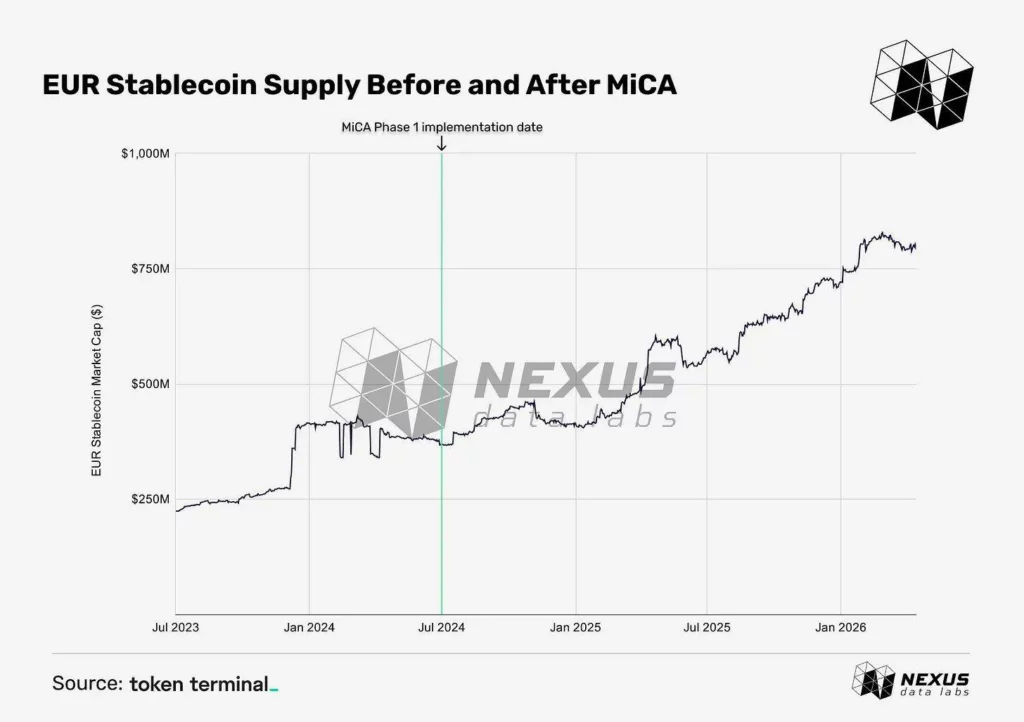
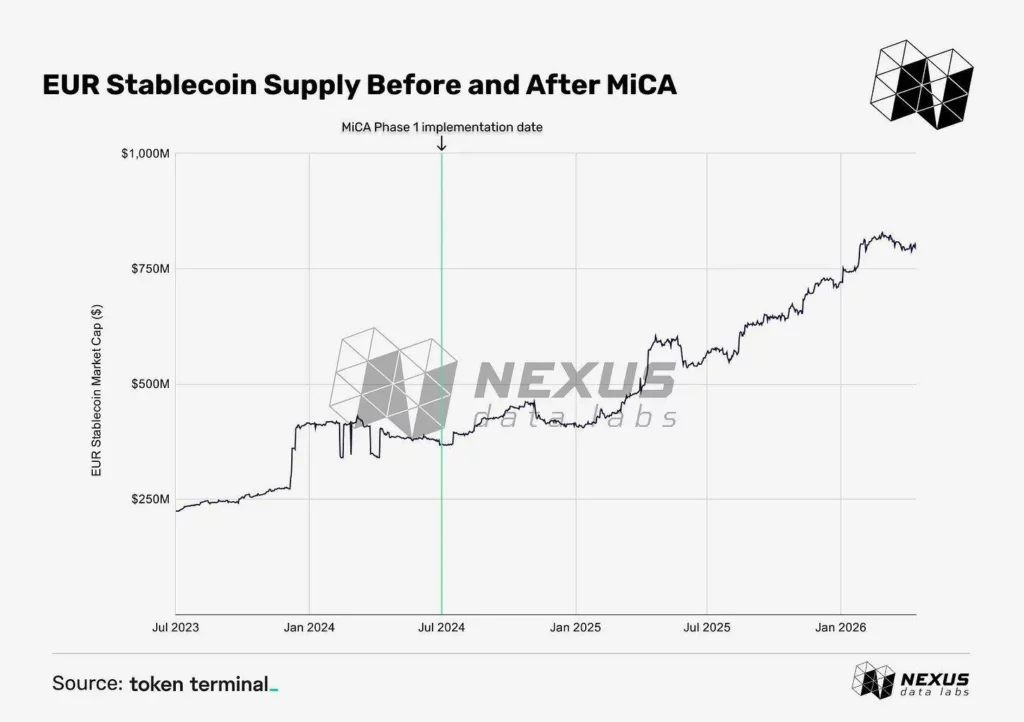
However, the introduction of MiCA was not entirely negative as at least EUR stablecoin use skyrocketed after a phase 1 implementation.
What changed for crypto companies in the EU?
First and foremost, individuals can no longer launch a startup without being subject to regulatory scrutiny. Legally, Crypto in the EU is now treated as traditional finance, which has its own regulatory framework called MiFID II.
The days of garage-based operations are officially over. Europe becomes a tightly regulated space where every move has to be documented, every risk recorded, and AML/KYC checks strictly enforced. For one, it’s harder to innovate in an overly regulated space; on the contrary, it’s much safer to deal with.
It also means that companies can’t operate even if they are getting the license. If a crypto project tries to work with its own users while getting the license, operating under “Pending Application” can now cost a crypto company €15M or $17.1M in fines. As an alternative, they can hand over 12.5% of their annual turnover.
Cooperation rules have changed too. Crypto companies have to report their users to regulatory and financial authorities, not on demand, but on their own. In exchange, survivors of the MiCA slaughter who managed to obtain a CASP license can now access all member states with only one registration.
Targeting rules have also changed heavily. Even 1 EU influencer in the marketing campaign means they must be MiCA compliant now. If the app or project targets the EU specifically, then it has to be regulated.
On July 1st, money had to change hands from 2800 platforms to the surviving 244, which meant an influx of frozen funds. Binance had to freeze spot orders, sign-ups, deposits and staking products for users in France, Italy, Spain, and Poland. DeFi protocols had to pull the plug; Base’s Seamless Protocol and apps like PPL Wallet just physically shut their servers down. The 2800 platforms each had some way of storing or operating user funds, and if users didn’t withdraw their money is now being held because neither company has a legal allowance to actually send user money back.
But being MiCA-compliant costs a small fortune. According to Pharaon Production research, it can cost up to $1M in upfront costs even before you serve the first customer.
How can crypto projects make do after MiCA?
Many are choosing not to play regulatory tug-of-war and simply walk out for Dubai (VARA) or Singapore (MAS). Others are choosing workarounds that provide the same level of regulatory legality while not asking for $1M in upfront costs and dragging the whole company through bureaucratic torturing devices.
Switzerland’s FINMA supervision can be obtained via SRO (Self-Regulatory Organization). Under Swiss law, being a member of SRO is mandatory if a company wants to handle digital assets, which makes it a reason Zurich is so heavily nested with web3 projects, with more than 1749 crypto companies registered in Switzerland’s Crypto Valley alone. Swiss law doesn’t stand still either: in October of 2025 they opened up two new types of FINMA-supervised license categories.
The Swiss solution to MiCA slaughter is simple: come to the country, register with SRO or acquire the SRO-compliant company, and be free to go while being legally sound. One recent example is Neyro, an agentic project that was in the process of obtaining MiCA license but had to pivot to a Swiss SRO in order to sustain operations.
However, acquisition doesn’t mean free pass right from the gate. Companies involved still have to go through the regulatory checkups, but overall, it is the same level of legality without added scrutiny.
Disclosure: This content is provided by a third party. Neither crypto.news nor the author of this article endorses any product mentioned on this page. Users should conduct their own research before taking any action related to the company.


Tokenized stocks put real equities on blockchains as tradable tokens, and in July 2026 the idea crossed a threshold: the DTCC, the utility that settles nearly every American share, began production trades of tokenized Russell 1000 stocks. This guide explains how stock tokens actually work, the custody chain behind them, what you do and do not get compared to owning shares, how they differ from stock perps, and what the incumbents’ arrival means.
For most of crypto’s history, tokenized stocks were a fringe product with a persistent dream: take the world’s most valuable asset class, equities, and give it blockchain properties, around-the-clock trading, instant settlement, fractional ownership, global access, and composability with DeFi. The early attempts were offshore, legally fragile, and small. The dream, however, kept attracting bigger sponsors, and in 2026 it stopped being fringe: this month the Depository Trust and Clearing Corporation, the post-trade utility that custodies over $100 trillion and settles essentially every US securities transaction, began limited production trades of tokenized Russell 1000 equities, major ETFs, and Treasuries, with a full-service launch scheduled for October and a 50-firm working group of banks and brokers writing the standards.
When the institution whose entire job is recording who owns which share starts issuing those records as tokens, tokenized stocks graduate from crypto experiment to market-infrastructure roadmap. Yet the products a retail user encounters under the name tokenized stocks today are mostly not that; they are a patchwork of offshore wrappers, synthetic trackers, and broker-issued tokens with wildly different claims behind them, and telling them apart is the entire game.
This guide explains the territory properly: what a tokenized stock is and the custody chain that makes it real or fake, the three main models in the wild and what each actually gives you, the rights you do not get, dividends, votes, recourse, and how issuers handle them, the difference between tokenized stocks and the stock perpetuals often confused with them, the regulatory picture as American law catches up, and what the DTCC’s entry means for where all of this lands.
What a tokenized stock is, and the chain of custody that decides everything
A tokenized stock is a blockchain token designed to represent economic exposure to a specific equity, one token tracking one share of Apple, Tesla, or an ETF. The definition is deliberately loose, because the word represent is doing all the work, and what stands behind the token separates a genuine financial instrument from a branded bet.
The gold standard is full backing: for every token in circulation, the issuer holds one real share with a regulated custodian, and the token is a claim on that share, redeemable directly or through authorized participants, with the backing attested by disclosures or audits. This is exactly the architecture of a fiat-backed stablecoin transposed to equities, token supply on-chain, assets in custody off-chain, a redemption mechanism holding the two together, and it inherits the same integrity question: the token is only as good as the custody, the legal claim, and the attestation behind it. The moment you evaluate any tokenized stock, this is the first inquiry: who holds the shares, in what legal structure, under which regulator, and what exactly does the token entitle its holder to?
Everything else about the product flows downstream of that chain. If the shares are real and the claim enforceable, arbitrage keeps the token near the stock’s price, because gaps can be closed by minting or redeeming. If the backing is partial, discretionary, or merely promised, the token is tracking the stock on trust, and history’s failed stock-token experiments cluster precisely there. The blockchain part, which network the token lives on, is comparatively trivial; the custody chain is the product.
The three models in the wild
The tokenized stocks a user actually meets come in three broad architectures, and conflating them is the most common mistake in the category.
The first is the fully backed depository-receipt model described above, offered by regulated issuers, typically domiciled in jurisdictions with explicit frameworks, that buy and custody real shares and issue tokens against them. Holders get near-1:1 price tracking, some form of dividend pass-through, usually as additional tokens or cash-equivalent credits, and a redemption path, though often restricted to institutions or accredited users. What they usually do not get is shareholder status: the issuer or its custodian is the shareholder of record, and voting rights almost never pass through.
The second is the synthetic model: no shares anywhere, just a token whose price is maintained by collateral pools and oracle feeds, engineered to track the stock. Synthetics can be fully decentralized and accessible where backed products are not, and they carry categorically different risk: the holder owns exposure to a price feed backed by crypto collateral, with depeg, oracle, and protocol-solvency risks in place of custody risk, and no share exists to redeem under any circumstance.
The third is the broker-integrated model now emerging inside regulated finance: brokerages and infrastructure providers issuing tokenized representations of client holdings, or, in the DTCC’s version, the market’s own settlement layer optionally recording ownership as tokens. Here the token is not a wrapper around the system; it increasingly is the system’s own ledger entry in a new format, which is why the incumbents’ version, when it fully arrives, dissolves most of the category’s historic compromises at once.
What you get, and the rights you do not
Set a tokenized stock beside the share it tracks and the differences are exactly where the fine print lives.
Price exposure transfers well: a properly backed token tracks its stock closely during market hours and trades continuously after them, drifting on expectation while the reference market sleeps, then reconverging at the open. Dividends transfer imperfectly: issuers typically pass economic value through as token top-ups or credits, on the issuer’s schedule and terms, and tax treatment of that pass-through is the holder’s problem in whatever jurisdiction they occupy. Voting essentially does not transfer; the record shareholder votes, and it is not you. Corporate actions, splits, mergers, delistings, are handled by issuer policy, which is worth reading before, not after, the event. Legal recourse is the deepest difference: a shareholder sits inside centuries of securities law, while a token holder sits inside an issuer’s terms of service and the law of wherever that issuer lives, a gap that is invisible daily and decisive in a failure.
Against those losses, the gains are the blockchain properties the dream always promised. Markets that never close, settlement in minutes instead of the T+1 cycle, fractional ownership to arbitrary precision, access for anyone with a wallet in jurisdictions the brokerage system never reached, and, most distinctively, composability: a tokenized Treasury or equity can serve as collateral in lending protocols, sit in automated portfolios, and move across the same bridges and rails as any other token, acquiring uses no brokerage account statement ever had. Whether those properties are worth the surrendered rights is not a general question; it depends entirely on which holder, which jurisdiction, and which issuer.
Before the mechanics, a sizing snapshot situates the category. Tokenized real-world assets on public chains passed the tens of billions of dollars mark across 2025-26, with tokenized Treasuries and money-market funds the dominant slice and the largest asset managers as issuers; tokenized equities remain the smaller, faster-moving frontier of that stack. The Treasuries-first sequence was not accidental: institutions needed a stable, yield-bearing settlement asset on-chain before they needed tradable stock tokens, and the custody, attestation, and redemption plumbing built for Treasuries is precisely what equity tokenization now reuses. The equities wave, in other words, is arriving on rails already laid and already trusted with institutional money, which is the structural reason its 2026 acceleration looks different from the false starts of earlier cycles.
How the peg holds: mint, redeem, and the arbitrage loop
A backed token’s price discipline comes from the same loop that keeps ETF shares near their net asset value, and seeing it once explains why backing quality is everything.
Suppose a tokenized Apple share trades at a 1% premium to the stock. An authorized participant, typically an institution with an agreement with the issuer, buys real Apple shares in the market, delivers them to the issuer’s custodian, mints new tokens against them, and sells the tokens into the premium, pocketing the gap and pushing the token price down toward the share price. At a discount, the loop runs in reverse: buy cheap tokens, redeem them for shares, sell the shares, collapse the discount. As long as minting and redemption are open and frictionless to someone, deviations are profit opportunities that arbitrage erases, and the token tracks.
Every historic failure in this category is a failure of that loop. If redemption is suspended, discretionary, or restricted to a tiny club, discounts can persist indefinitely because no one can close them; if the backing is not verifiably there, the loop’s foundation is a promise; if the issuer’s jurisdiction blocks the flow of underlying shares, the arbitrage dies at the border. This is why the diligence questions are always the same three: who can mint and redeem, how quickly, and against what verified backing. A tokenized stock with an open, audited, fast redemption loop is a different asset class from one without, whatever the marketing says.
A short history of a stubborn idea
Tokenized stocks have been attempted in every crypto cycle, and the failures map the design space as clearly as the successes. The first wave came through offshore derivatives platforms and synthetic protocols around 2020-21: centralized exchanges listed tokenized equities in partnership with offshore issuers, and on-chain systems minted synthetic stocks against crypto collateral. Both halves collapsed instructively, the exchange products died with their venues or were shuttered under regulatory pressure, proving that a token is only as durable as its issuer, and the flagship synthetic protocol was crippled when the collateral backing its stocks imploded, proving that a stock tracker built on volatile collateral is a correlation bet wearing a ticker.
The second wave, from 2023 onward, learned the lessons: regulated issuers in explicit-framework jurisdictions, real custody, attestations, and institutional redemption, with tokenized US Treasuries, not equities, as the beachhead product, because a yield-bearing, stable, dollar-denominated instrument was what on-chain treasuries and funds actually wanted to hold. Tokenized Treasuries grew into a multi-billion-dollar category with the largest asset managers issuing on public chains, normalizing the plumbing that equities could then reuse. The third wave is the one running now: brokerages tokenizing client exposure, exchanges relisting equities under clearer rules, and the settlement layer itself, the DTCC pilot, absorbing the concept into market infrastructure. Each wave moved the custody chain closer to the source of truth, from offshore promise, to regulated wrapper, to the register itself, which is the whole arc of the idea in one sentence.
Tokenized stocks versus stock perps
Because crypto venues now offer both, the confusion between tokenized stocks and equity perpetual futures deserves its own section, and the distinction fits in two sentences. A tokenized stock is a claim: somewhere, in the backed models, a share exists, and the token’s value rests on that ownership chain. A stock perp is a bet: no share exists anywhere, the contract is a leveraged position whose payoff is indexed to the stock’s price through funding-rate machinery against an oracle feed, and holding it means margin, funding payments, and liquidation risk rather than ownership.
The products suit opposite users. Perps offer leverage, easy shorting, and no custody chain, at the cost of liquidation risk and zero ownership economics, a trade-off this publication’s guide to real-world-asset perps details. Tokenized stocks offer unleveraged, holdable, dividend-passing exposure that behaves like an asset rather than a position. A useful heuristic: if the product can liquidate you, it is a perp; if it claims a share stands behind it, it is a tokenized stock, and your next question is where that share is.
The regulatory picture: from offshore workaround to sanctioned rail
Tokenized equities spent years in regulatory exile because the analysis was straightforwardly hard: a token representing a share is, under American law, difficult to distinguish from the share, which makes issuing and trading one a securities activity requiring the full licensing stack. Early products responded by domiciling offshore and geofencing Americans, which capped the category at crypto-native scale.
The thaw has come from both directions. From crypto’s side, the pending market-structure framework, whose classification machinery this publication has mapped, and the year’s stablecoin and custody rulemakings are, piece by piece, defining which agency governs which token, and tokenized securities sit unambiguously with the SEC, a clarity that paradoxically helps: firms can build to a known perimeter, not an enforcement lottery. From finance’s side, the December 2025 SEC no-action letter clearing the DTCC’s tokenization path was the quiet green light for the incumbents, and the pilot now running, Russell 1000 stocks, major ETFs, Treasuries, with October’s full launch letting DTC participants elect tokenized record-keeping as a standard feature, is the loudest possible signal of where the destination lies: not offshore wrappers around the system, but the system itself, token-formatted. The 50-firm working group writing those standards, whose membership and stakes this publication has examined, is in effect deciding the plumbing every future tokenized share will run through.
For a user today, the regulatory takeaway is practical: which tokenized stocks you can legally touch depends on where you are, the products available to you differ enormously in backing and recourse, and the category is converging toward regulated issuance faster than any other corner of crypto, which means today’s product map has a short shelf life.
It also helps to name who the product serves today, because the answer differs by model. The backed offshore tokens serve access: users outside brokerage-served markets holding fractional Apple from a wallet. The synthetic versions serve the permissionless frontier, exposure with no issuer to trust and all the collateral risk that entails. The institutional rail serves the institutions themselves first, faster settlement, collateral mobility, always-on books between firms, with retail benefit arriving later and by policy choice. Tokenized Treasuries, meanwhile, quietly serve everyone in crypto already, as the reserve asset inside stablecoins, funds, and DAO treasuries. One name, four different products, four different users, which is the deepest reason blanket judgments about tokenized stocks are reliably wrong in at least three directions.
A practical corollary follows for anyone comparing venues today: the same ticker can appear as a backed token on one platform, a synthetic on a second, and a perp on a third, at three different prices, with three different risk stacks, and price comparison between them without model identification is meaningless. The habit that protects users in this category is asking, before anything else, what am I actually holding, and refusing to proceed until the answer names an issuer, a backing, and a redemption path or plainly admits there is none.
The honest assessment
Tokenized stocks are the rare crypto idea whose skeptics and believers have both been proven right in sequence. The skeptics were right that offshore wrappers offering share exposure without share rights were a niche product with fragile foundations, and several perished exactly as predicted. The believers were right that the underlying proposition, equities with instant settlement, continuous markets, and programmable composability, was too operationally superior for the incumbents to ignore forever, and the DTCC’s production pilot is that prediction cashing.
What remains uncertain is the shape of the middle: how long crypto-native issuers keep a role as the regulated rail scales, whether composability survives the compliance wrappers institutions will demand, and whether always-open equity trading proves a feature or a source of gap risk retail learns to fear. For now, the user’s checklist is stable regardless: identify the model, backed, synthetic, or broker-integrated; verify the custody chain and redemption terms; assume no votes and read the dividend policy; understand you hold an issuer’s claim, not a share; and treat after-hours prices as forecasts, not quotes. The stock market is coming on-chain either way; the only live question is how much of crypto comes with it.
The forward checklist for watching the category is short and concrete. Watch the October full launch and whether DTC participants actually elect tokenized record-keeping at meaningful scale, because opt-in infrastructure only matters if firms opt in. Watch whether the incumbent version permits public-chain composability or confines tokens to permissioned rails, the single design choice that decides whether tokenized equities join DeFi or merely modernize back offices. Watch the first major corporate action, a split or a large dividend, handled at scale across tokenized holders, the operational stress test the model has not yet publicly passed. And watch the regulatory perimeter around retail access, because the gap between institutions settling tokenized Treasuries and a phone user holding tokenized Apple with full legal protection is where the next several years of rulemaking will be spent. The direction has stopped being in question; the answers to those four items will set the speed.
One further distinction rewards attention as the incumbent rail scales: the difference between tokenized record-keeping and tokenized markets. The DTCC pilot, in its first phase, is the former, ownership records in token format, settlement modernized, while trading remains where it was; the crypto-native vision has always been the latter, tokens trading continuously on open venues, composable with everything. The two can converge, records that are tokens can, in principle, be permitted to trade anywhere, but nothing about the first guarantees the second, and the permissioning decisions made in the working group’s standards will determine whether tokenized equities become an open market structure or a closed efficiency upgrade.
For crypto, that is the difference between annexing the stock market and merely inspiring its back office; for investors, it is the difference between a new asset class and a faster settlement cycle wearing one’s clothes. Both outcomes are progress. Only one of them is the dream, and the honest report from mid-2026 is that the infrastructure has committed while the openness has not, which makes the standards documents due this fall quietly among the most consequential texts in the history of the idea.
Disclaimer: This article is for educational purposes only and does not constitute investment advice. Tokenized securities carry issuer, custody, and regulatory risk, and availability varies by jurisdiction. Details are current as of July 8, 2026, and are changing rapidly. Always do your own research.
Frequently asked questions
What is a tokenized stock in simple terms?
A tokenized stock is a blockchain token designed to track a specific equity, ideally backed one-to-one by real shares held with a custodian. It lets you hold and trade stock exposure like any crypto token, around the clock and globally, while the actual share sits off-chain with the issuer’s custodian. The token’s quality depends entirely on the backing and legal claim behind it.
Do I actually own the share?
Usually not in the legal sense. In backed models, the issuer or its custodian is the shareholder of record; you own a claim against the issuer that tracks the share’s value. That distinction rarely matters day to day and matters enormously in disputes or issuer failure, where your rights come from the issuer’s terms instead of securities law protecting shareholders.
Do tokenized stocks pay dividends?
Backed products typically pass dividend value through, usually as additional tokens or credits on the issuer’s schedule and terms; synthetic products generally do not. Voting rights almost never pass through in any model. Reading the issuer’s dividend and corporate-actions policy is essential, because splits, mergers, and delistings are handled by that policy.
What is the difference between a tokenized stock and a stock perp?
A tokenized stock is a claim on a real share held somewhere, offering unleveraged, holdable exposure. A stock perp is a leveraged derivative bet indexed to the stock’s price, with margin, funding payments, and liquidation risk and no share behind it. If the product can liquidate you, it is a perp; if it claims backing, it is a tokenized stock and the backing is what you verify.
What happens to a tokenized stock when the market is closed?
The token keeps trading. Without a live reference price, it floats on expectations of the next open, then reconverges when the real market resumes, sometimes with a gap if news broke overnight. After-hours token prices are best read as forecasts of the open rather than quotes for the stock.
Are tokenized stocks legal in the United States?
Tokenized equities are securities under US law, so issuing and trading them requires the appropriate licensing, which historically pushed products offshore and away from American users. That is changing: the SEC cleared the DTCC’s tokenization path in December 2025, the DTCC began production trades of tokenized Russell 1000 stocks in July 2026, and pending market-structure legislation is clarifying agency boundaries. Availability still depends on the product and your jurisdiction.
What is the DTCC doing with tokenized stocks?
The DTCC, the utility that settles nearly all US securities trades, launched a limited production pilot in July 2026 tokenizing Russell 1000 equities, major ETFs, and Treasuries with a 50-firm working group, ahead of a full-service launch planned for October, after which participants can elect tokenized record-keeping as a standard feature. It marks tokenization moving from crypto wrappers around the system to the system’s own ledger format.
What are the main risks of holding tokenized stocks?
Issuer and custody risk first: your token is a claim on an issuer whose backing, redemption terms, and jurisdiction define your real position. Then regulatory risk, since the rules are moving quickly; tracking risk, especially for synthetic models that can depeg; and gap risk from continuous trading against a market that closes. The blockchain itself is rarely the weak point; the wrapper is.
Disclosure: This article does not represent investment advice. The content and materials featured on this page are for educational purposes only.
The most consequential crypto bill in American history missed its July 4 signing target and sits on the Senate calendar with no floor vote scheduled. The reason is not procedure. It is three specific, unresolved fights: the President’s $1.4 billion in crypto income, a developer shield that police groups call a criminal loophole, and a stablecoin-yield question worth $1.35 billion a year to Coinbase alone. The Senate returns July 13 with three weeks to settle all three. Here is each fight, both sides, and the math.
Summary
- Three unresolved disputes over ethics, DeFi developer protections, and stablecoin rewards continue to hold up the Senate vote on the CLARITY Act.
- The Senate has roughly three weeks before the August recess to secure enough bipartisan support and clear several procedural hurdles for the bill.
- The outcome could shape crypto regulation in the United States while influencing institutional adoption, DeFi rules, and stablecoin business models.
America’s 250th birthday came and went without the signing ceremony the White House had informally penciled in. The Digital Asset Market Clarity Act, the bill that would finally decide which American regulator governs which crypto asset, spent July 4 exactly where it has sat since June 1: at Calendar No. 423 on the Senate Legislative Calendar, eligible for a floor vote that nobody has scheduled, with no cloture motion filed and prediction markets pricing its 2026 passage in the low-to-mid 40s, down from 82% in February and 74% barely a month ago.
The bill is not dead, and the arithmetic explaining its paralysis is brutally simple. Republicans hold 53 seats; Senators Josh Hawley and Rand Paul are expected to vote no; passage requires 60. That means roughly seven to nine Democrats must cross over, and the two Democrats who voted for the bill in committee, Ruben Gallego and Angela Alsobrooks, have both said publicly that their committee votes do not guarantee floor votes. The missing Democratic votes exist in principle. They are being withheld in practice, over three specific and interlocking disputes, and last week, the negotiations over the first two fractured into stalemate, with Senate leaders reportedly planning emergency meetings when the chamber returns on July 13.
Roughly three usable Senate weeks remain before the August recess, the window that analysts from Galaxy to the bill’s own sponsors treat as the last realistic gate before midterm politics consumes the calendar, and Senator Cynthia Lummis has warned that failure now could push the next opening toward the end of the decade. This piece takes the three fights one at a time: what each dispute actually is, the strongest version of each side’s argument, what compromise would look like, and how each interacts with the unforgiving calendar. The bill’s 257 pages have been mapped in detail before; what follows is the narrower story of the three pages’ worth of disagreements deciding whether any of it becomes law.
Fight one: the President’s $1.4 billion
The first fight became concrete on July 1, when the Office of Government Ethics released President Trump’s 927-page financial disclosure for 2025. The filing showed approximately $1.4 billion in cryptocurrency-related income during the first year of his second term: $635 million in royalties from $TRUMP memecoin licensing, more than $500 million from World Liberty Financial token sales, and additional equity and stablecoin proceeds, the largest personal crypto-income disclosure in American presidential history.
For Democrats who had spent months demanding conflict-of-interest language in the bill, the disclosure converted an abstract principle into a billion-dollar fact. Their argument runs as follows: the CLARITY Act will decide the legal classification, and therefore the value, of the exact asset class from which the President’s family draws its largest income stream, and passing it without enforceable ethics provisions amounts to Congress legislating a benefit to the signer. Senator Kirsten Gillibrand, among the chamber’s most crypto-friendly Democrats and a co-author of earlier market-structure frameworks, has said plainly that enforceable language covering government officials’ crypto holdings is a prerequisite for her floor support, and she is the bellwether: if the bill cannot hold its friendliest Democrats, it cannot find seven.
The Republican counter-argument is constitutional and practical. Existing ethics law already prohibits members of Congress and senior executive officials from issuing digital commodities in office, the bill’s own text says so, and provisions singling out the sitting President’s personal holdings are, in the White House’s view, a poison pill dressed as principle, designed to force a veto confrontation, not to govern. The negotiating record shows both sides maneuvering around that accusation: an ethics amendment from Senator Chris Van Hollen failed 11-13 in committee; a tentative bipartisan framework reached in May collapsed last week when Republicans withdrew support for a state-attorneys-general enforcement mechanism and offered enforcement through the US Attorney General instead, an offer Democrats rejected as circular, since the Attorney General serves at the President’s pleasure; Republicans then floated impeachment as the constitutional remedy for presidential ethics violations, which Democrats declined to treat as an answer.
The shape of a landable compromise is visible in the wreckage: enforcement housed somewhere neither side controls, disclosure obligations rather than divestiture mandates, and effective dates that decouple the provisions from the current occupant. Whether it lands is another matter. The ethics fight is the only one of the three that is genuinely about the bill’s political meaning rather than its text, which is why it has attached to this bill after sparing the stablecoin law a year earlier: a market-structure act that classifies the assets a President holds cannot be framed as neutral plumbing, and everyone negotiating knows it.
Fight two: Section 604 and the developer shield
The second fight is over Section 604, which incorporates the Blockchain Regulatory Certainty Act and shields non-custodial software developers, people who write and publish code but never take custody of user funds, from money-transmitter registration and Bank Secrecy Act obligations. To the DeFi industry, it is the bill’s philosophical core; to a significant bloc of American law enforcement, it is a criminal loophole, and the split inside law enforcement itself, which this publication examined at length, has become one of the strangest subplots in crypto’s legislative history.
The opposition case is carried by the National Sheriffs’ Association, the International Association of Chiefs of Police, and the National District Attorneys’ Association, which told Senate leadership that Section 604 would materially impair criminal investigations involving cryptocurrency. Their argument: exempting DeFi software from the registration and record-keeping duties that apply to every other financial intermediary creates a compliance-free lane that launderers, sanctions evaders, and fraud networks will route through, and prosecutors will confront protocols with no registered entity to subpoena. The prosecutors’ version is the sharpest, because subpoenas are their daily tool and Section 604 is, from their desk, a list of doors the bill would weld shut.
The defense case is that the provision protects publishers, not criminals. Under the enforcement-era status quo, open-source developers faced personal liability when third parties used their code unlawfully, a standard that would be unthinkable applied to any other form of publishing, and the shield applies only where a decentralized system has no intermediary exercising control, while every custodial actor, exchange, broker, dealer, remains fully covered. The bill’s sponsors point to the sixteen-plus illicit-finance safeguards elsewhere in the text: Section 201 applying Bank Secrecy Act and anti-money-laundering duties across registered crypto intermediaries, Section 303’s new sanctions authorities aimed at Iran, Section 305’s freeze powers for dirty funds, plus $150 million in dedicated funding for crypto fraud investigations, which Lummis has framed as money to track down scammers and bad actors. The White House Crypto Council has worked the issue directly, convening the objecting groups and producing, in the National Organization of Black Law Enforcement Executives, the bill’s first major law-enforcement endorsement, its executive director citing exactly those AML, sanctions, and forfeiture provisions.
The core dispute entered the recess unresolved because it is genuinely hard: it is the same tension between publishing code and operating a financial service that runs through a decade of American crypto enforcement, now compressed into one section’s drafting. The compromise space involves narrowing the shield’s definitions, adding sunset-and-study provisions, and expanding the investigative funding, and unlike the ethics fight, this one is tractable, because both sides ultimately want the same headline, a bill that is tough on crime, and are arguing over mechanism rather than meaning.
Fight three: the $1.35 billion yield question
The third fight is the quietest and involves the most measurable money. It concerns whether digital-asset platforms can keep paying customers rewards on stablecoin holdings, a question the GENIUS Act, the stablecoin law enacted a year ago, answered incompletely: it prohibited issuers from paying interest on payment stablecoins but left open whether platforms distributing those stablecoins can pass through yield.
Coinbase earns approximately $1.35 billion annually in USDC rewards revenue through exactly that arrangement, and whether the arrangement survives depends on drafting choices inside CLARITY.
The banking industry’s argument, pressed by the American Bankers Association and voiced most bluntly by JPMorgan’s Jamie Dimon, who said banks will fight the bill, is that the pass-through is a loophole that lets crypto platforms offer interest-bearing, deposit-like products without the capital, insurance, and anti-money-laundering obligations that make bank deposits safe, and that at scale it becomes a deposit-drain from the regulated banking system, the same systemic worry that shaped the trillion-dollar stablecoin fight this spring.
The crypto industry’s counter is that rewards programs are marketing expenditure paid from a distributor’s own revenue, not issuer interest; that Congress already drew the line at issuers in GENIUS and re-litigating it through CLARITY is the banking lobby’s second bite; and that killing pass-through yield would simply push American stablecoin users toward offshore products that answer to no US regulator at all.
The January Senate Banking draft tried to split the difference, prohibiting yield for merely holding balances while permitting activity-linked rewards, and the final text’s placement of that line is worth, to a single company, more than a billion dollars a year, which guarantees the lobbying around it will continue to the last markup.
The gauntlet in detail: how three weeks actually get spent
The phrase floor vote compresses a procedural sequence that deserves unpacking, because the calendar risk is not one deadline but a chain of them, and each link consumes days the bill does not have to spare.
Start with what calendar placement did and did not do. Being reported to the Senate Legislative Calendar as No. 423 on June 1 made the bill eligible for floor consideration; it scheduled nothing. Majority Leader John Thune controls the floor, and his queue when the chamber returns on July 13 begins with the National Defense Authorization Act, the annual must-pass defense bill that reliably devours a week or more, alongside a FISA Section 702 reauthorization with its own hard deadline.
Only after leadership commits floor time does CLARITY’s own sequence begin: a cloture motion on the motion to proceed, an intervening day, a sixty-vote cloture roll call, up to thirty hours of post-cloture debate, then the same cycle again on the bill itself, with an amendment process in between whose scope is itself a negotiation. Run cleanly and consensually, the sequence takes the better part of a week; run under objection, it can take two, and the recess begins in roughly three.
Then come the gates the headlines forget. The Banking Committee text that sits on the calendar must be reconciled with the Senate Agriculture Committee’s companion measure, the Digital Commodity Intermediaries Act, because the CFTC falls under Agriculture’s jurisdiction and both committees claim pieces of the framework; that merger has been negotiated in parallel but is not complete. Whatever passes the Senate must then be squared with the House-passed version from July 2025, either through a formal conference or through the House swallowing the Senate text whole, and House Financial Services has its own scheduled activity on July 17 that signals it does not regard itself as a rubber stamp.
The GENIUS Act’s own rulemaking deadline of July 18, one year from signature, lands in the same week the Senate resumes, crowding the agencies and the committee staff who service both laws. Every one of these steps is routine in isolation; stacked inside three weeks against two competing must-pass bills, they are the reason seasoned handicappers quote coin-flip odds for a bill with majority support.
The paradox of the moment is that the deadline is also the bill’s best friend, and its sponsors know it. Lummis has been explicit about moving in July, negotiators circulated final compromise text for review around the recess, and the a16z argument, that nothing concentrates Senate minds like a closing window, has real precedent in how the stablecoin law crossed its own finish line a year ago. Both dynamics are true at once: the calendar makes passage physically difficult, and the calendar is the only force capable of converting fourteen months of almost-agreements into signatures.
The next three weeks will show which effect is stronger, and observers who want to track it in real time need exactly four tells: whether Thune files cloture in the week of July 13, whether Gillibrand’s public posture on the ethics language shifts, whether the White House Crypto Council produces a Section 604 accommodation the sheriffs accept, and whether the Agriculture merger text appears. Any three of the four pointing the same direction will settle the question before the roll is ever called.
What each outcome is worth, asset by asset
The three fights are Washington stories, and the reason markets refresh the Senate calendar is that each outcome carries a price map that analysts have, unusually, been willing to publish in advance.
The passage scenario has explicit numbers attached. Citi’s Bitcoin target of $143,000 and Standard Chartered’s $150,000 are both conditioned on the bill becoming law, with regulatory certainty cited as the unlock for the next institutional wave into spot ETFs and corporate treasuries. Ethereum’s conditional upside is structural: commodity classification supplies the legal foundation for the staking ETF products allocators have drafted but not filed, behind Standard Chartered’s conditional $7,500 end-of-year target.
XRP carries the most direct exposure of any major asset, because the SEC-CFTC joint classification of it as a digital commodity in March 2026 is an interpretive ruling a future administration could reverse, and CLARITY would convert it into statute; JPMorgan and Standard Chartered have each projected $4 to $8.4 billion of first-year XRP ETF inflows under passage, roughly five times the products’ entire cumulative haul to date, arriving into a tradable float already at seven-year lows. The May 14 committee vote provided a small-scale preview, lifting the majors within hours on nothing more than procedural progress.
The failure scenario is not symmetrical, and that asymmetry is underpriced in casual commentary. A stall past the August recess does not merely delay the upside; it re-exposes every interpretive gain of the past two years to reversal risk, keeps the pension funds and sovereign allocators that legally cannot touch unclassified assets on the sidelines indefinitely, and, per Lummis’s warning, potentially pushes the next legislative window toward 2030 as midterms and a new Congress reshuffle every committee.
It would also leave the DeFi developer question exactly where the enforcement era left it, with builders facing liability standards no other publishing industry tolerates, and hand the competitive initiative back to the jurisdictions that already have live rulebooks, the MiCA-led regimes whose contrast with the American approach has defined the global regulatory race. Failure, in short, is not the status quo; it is the status quo minus the assumption of imminent rescue that has supported valuations all year.
Between the binary outcomes sits the muddled middle the market currently prices: passage in the fall, or passage in 2027, or a slimmed bill that resolves two fights by amputating the third. Each middle path has its own distributional consequences. An ethics compromise that survives conference likely costs nothing to asset prices and buys the signatures; a Section 604 narrowed to appease the sheriffs shifts value from DeFi-adjacent tokens toward the centralized incumbents the bill would license; a yield provision drawn the banks’ way removes a billion-dollar revenue line from the largest American exchange and, by extension, from the equity that trades on it.
The bill is routinely described as crypto versus Washington, and the truer description is that it is a set of allocations among crypto’s own factions, which is exactly why the industry coalition holding together through fourteen months of markups has been the quiet achievement underneath everything else.
Three weeks, three fights, one calendar
What makes the three fights decisive is not their difficulty individually but their interaction with a calendar that has no slack. When the Senate returns July 13, floor time must first accommodate the National Defense Authorization Act and a FISA Section 702 reauthorization, and each cloture sequence on CLARITY, one on the motion to proceed, one on the bill, can consume most of a week. Behind Senate passage wait two more gates the headlines forget: reconciling the Banking Committee text with the Senate Agriculture Committee’s companion measure, and squaring the result with the House-passed version, before any signature. Galaxy Research puts 2026 passage near a coin flip; Polymarket has drifted through the 40s; the bill’s supporters, from SEC Commissioner Hester Peirce’s summer-passage expectation to a16z’s argument that the tight window itself forces compromise, are betting that deadline pressure does what fourteen months of negotiation has not.
The honest reading of the moment is that the CLARITY Act has already survived everything except its final and most political mile. It passed the House 294-134 with 78 Democrats, cleared committee 15-9, and carries an industry coalition that has held together through every markup, achievements no market-structure bill has matched. The three fights blocking it are not procedural noise; each is a real dispute about who bears risk in the new system, the public against a President’s conflicts, investigators against anonymous code, banks against their own depositors’ yield-seeking.
Whichever way each resolves, the resolutions will be read as precedent for a decade of digital-asset law. Three weeks is enough time to settle three fights, and it is also enough time to settle none of them, and as of the morning the Senate returns, the smart money is split almost exactly down the middle.
It is worth naming, finally, what the three fights have in common, because the pattern explains why this bill has been harder than its stablecoin predecessor and why its resolution will echo past crypto. Each fight is a dispute about whether the new legal order will contain an exemption, for a President’s holdings from ethics enforcement, for published code from intermediary regulation, for platform rewards from banking rules, and exemptions are where legislation does its real distributional work.
The stablecoin law passed easily because it created obligations nearly everyone could live with; CLARITY has stalled because it creates carve-outs that someone powerful, in each case, cannot. That is not a sign the bill is badly drafted. It is a sign the bill matters, that it touches money and power at the joints where they actually connect, and the fourteen months of grinding negotiation are the ordinary price of legislation that does.
The Senate’s three weeks will be covered as drama, and most of the drama will be noise; the four tells listed above, cloture filed, Gillibrand moved, the sheriffs accommodated, the Agriculture merger published, are the signal, and readers who track those four and ignore the rest will know the outcome before the vote count does.
Whatever happens by August 10, the American crypto industry will exit this window with something it has never had before: a precise, public record of exactly which three questions its legal future turned on, and exactly who answered them.
A brief word on how to consume the next three weeks of coverage. Legislative endgames generate a distinctive noise signature: anonymous optimism from offices with bills to sell, anonymous pessimism from offices with amendments to extract, and daily prediction-market swings that mostly recycle both. The durable information will arrive in exactly four formats, a cloture filing on the Senate calendar, a named senator changing a stated position on the record, published compromise text, and committee-merger documents, and each is a public artifact that cannot be spun. Everything else, including the confident threads that will flood social feeds every evening the Senate is in session, is atmosphere. The bill’s fate is a matter of four documents and seven signatures, and the discipline of watching only those is the closest thing this story offers to an edge.
One historical footnote gives the moment its proper weight. No comprehensive American market-structure law for a new asset class has passed on its first serious Senate attempt; the securities acts of the 1930s, the commodity-futures framework, and the derivatives titles of the post-crisis reforms each required a failed run or a crisis, usually both, before enactment. CLARITY arriving at the floor with a House supermajority behind it, an industry coalition intact, and no crisis forcing anyone’s hand is already outside the historical pattern, which is one reason experienced hands hold their forecasts loosely in both directions. If it passes, it will have beaten the base rate for laws of its kind. If it fails, the two-year record it leaves, votes counted, compromises drafted, objections named, becomes the starting text of the next attempt, which is more than any previous crypto Congress has left behind.
Disclaimer: This article is for informational purposes only and does not constitute investment or legal advice. Legislative details are current as of July 8, 2026, and are changing rapidly; verify the current status before relying on any timeline described here.

Zcash price has pulled back from the $500 resistance zone after a sharp rally driven by renewed optimism around the upcoming Ironwood upgrade, although technical indicators still favor another attempt higher if key support levels continue to hold.
Summary
- Zcash price has retreated from the $500 resistance after profit-taking, but continues to hold above the key $440 support zone.
- Technical indicators and liquidation data suggest a break above $480 could trigger another move toward the $500-$540 region.
- Rising geopolitical tensions, weaker institutional crypto demand, and regulatory pressure remain the biggest risks to the bullish outlook.
According to data from crypto.news, Zcash (ZEC) price climbed to an intraday high of around $505 before retreating to about $466 on July 8 as traders locked in profits after a nearly 28% advance. The rejection came as leveraged longs accumulated near the psychological $500 barrier, allowing market makers to trigger a wave of long liquidations that accelerated the decline. Despite the retracement, the sell-off has so far remained above the critical $440 support that traders have been watching since the latest breakout.
Meanwhile, enthusiasm surrounding Zcash’s Ironwood upgrade continues to underpin investor sentiment. The network is preparing to activate the long-awaited upgrade later this month, introducing a mathematical proof designed to eliminate hidden counterfeiting risks inside its privacy pools. The milestone follows June’s emergency response to the Orchard vulnerability and has strengthened confidence that Zcash’s privacy infrastructure is nearing full restoration.
Technical structure continues to favor another test of $500
The daily chart shows Zcash holding above the 50% Fibonacci retracement level near $442 after rejecting from the 61.8% retracement at $500.48. Price also remains comfortably above the 38.2% Fibonacci support at $383, while the Chaikin Money Flow has climbed back into positive territory at 0.13, suggesting buying pressure continues to outweigh distribution.
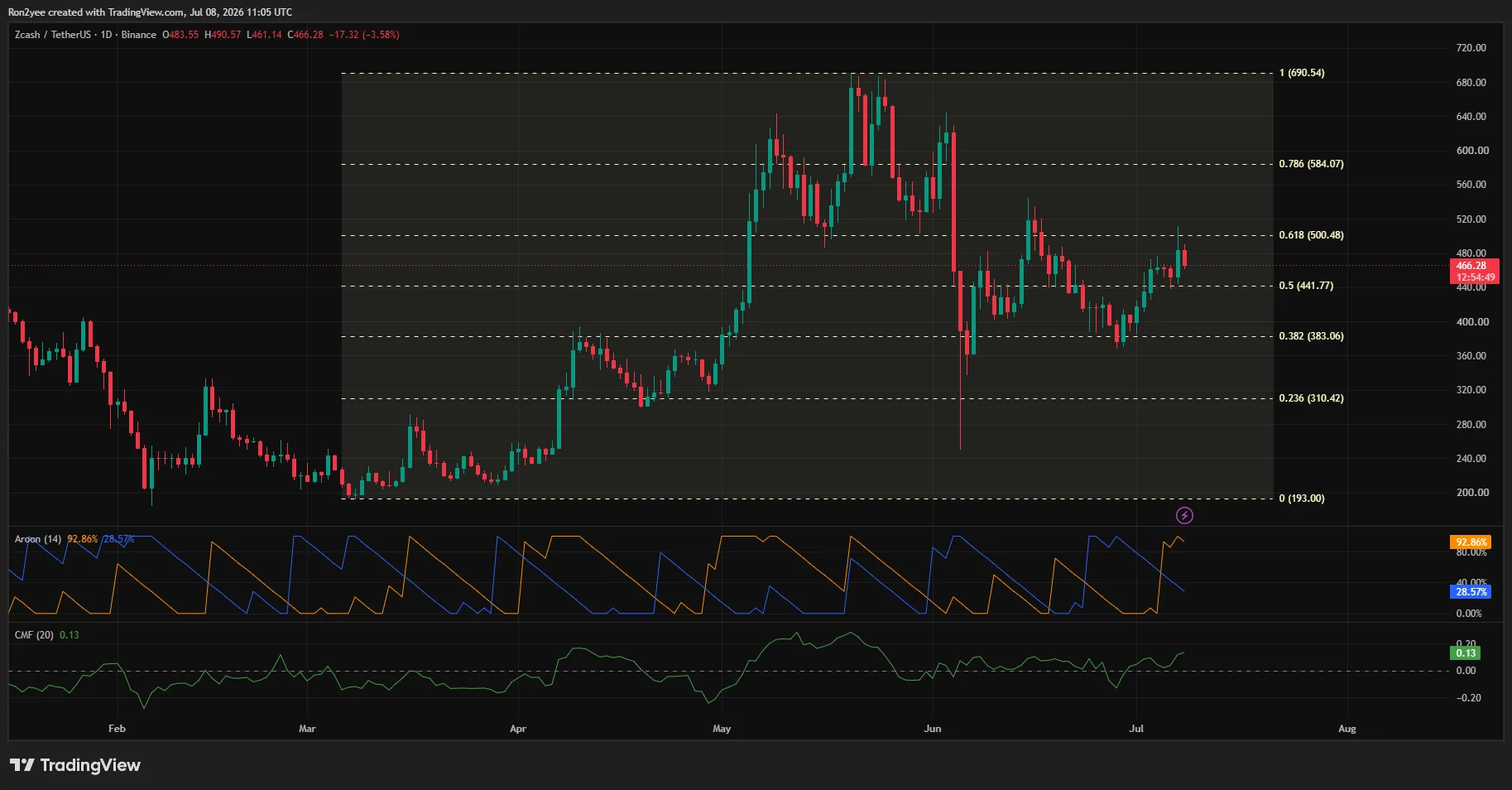
At the same time, the Aroon Up indicator has surged above 92%, confirming buyers still retain control of the prevailing trend despite the latest setback.
According to analyst Ardi, the recent rejection may actually strengthen the bullish setup rather than invalidate it. In a post on X, he argued that the decline simply retested a key breakout zone before another potential advance.
“Another layer of confluence to give me confidence that once we break and hold above the compound resistance, we’re on our way back above $500.”
His chart identifies a compound resistance around $480, where a descending trendline intersects horizontal resistance. A sustained daily close above that region could reopen the path toward $500 before exposing the macro resistance zone around $540.
Derivatives positioning presents a similar picture. CoinGlass liquidation data shows dense short liquidation clusters stacked between $480 and $500, with another large concentration sitting just above $520. Those pockets could fuel another squeeze if buyers reclaim the $480 resistance. On the downside, the largest long liquidation liquidity has accumulated near $450, making it an important support area should sellers regain momentum.
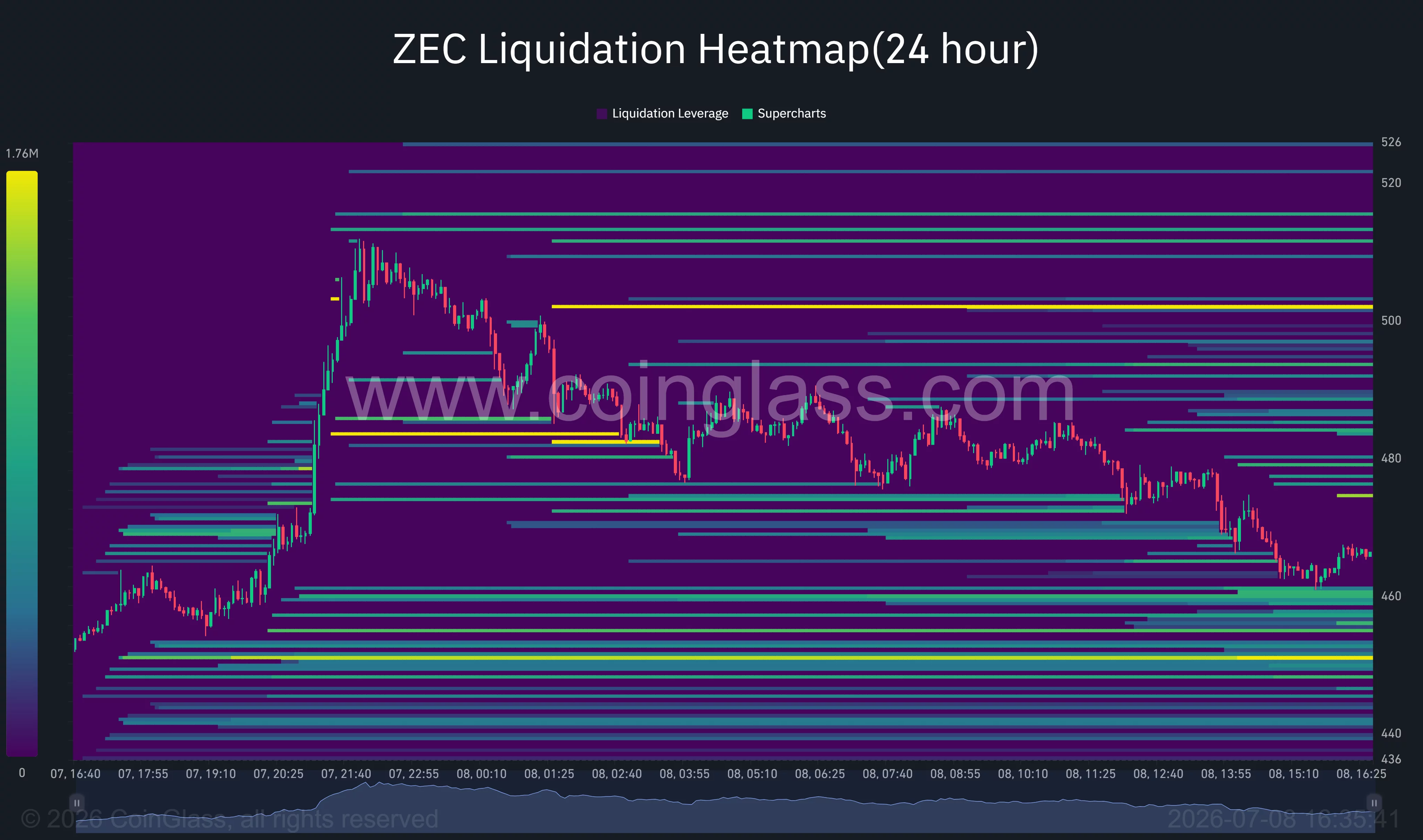
Macro risks could delay the next breakout attempt
Outside crypto-specific catalysts, global macro conditions have become less supportive after fresh geopolitical tensions in the Middle East lifted oil prices and pushed U.S. Treasury yields higher. The move triggered another round of selling across technology shares and other risk assets, dragging Bitcoin back toward the $62,000 area and reducing appetite for high-volatility altcoins, including Zcash.
Crypto market liquidity has also weakened. The Coinbase Bitcoin Premium Index recently recorded its longest negative streak on record, highlighting subdued institutional demand from U.S. investors. At the same time, European lawmakers have continued advancing tighter oversight proposals covering decentralized finance, staking services, and privacy-focused protocols, adding another layer of uncertainty for privacy coins.
Those risks leave the technical outlook dependent on a handful of key price levels. Holding above $440 would preserve the current recovery structure and keep another move toward $480 and $500 in play.
A decisive break below that support, however, would invalidate the immediate bullish thesis and expose Zcash to a deeper retracement toward its 200-day exponential moving average near $382, where longer-term buyers may attempt to stabilize the trend.
Disclosure: This article does not represent investment advice. The content and materials featured on this page are for educational purposes only.


Exchange reserves have fallen to a seven-year low of about 1.6 billion XRP, half what they were at the October 2025 peak. ETFs have absorbed nearly a billion tokens. Ripple still holds roughly 36 billion in escrow. This is the full map of where XRP’s supply actually sits in mid-2026, what moved, what it means, and why a shrinking float has so far failed to move the price.
Summary
- XRP exchange reserves have fallen to a seven year low while spot ETFs have accumulated nearly one billion tokens and long term holders continue moving coins into private wallets.
- Ripple still controls about 36 billion XRP in escrow, but steady monthly releases and relocks have not stopped exchange balances from shrinking to multi year lows.
- The report says tighter supply alone has not lifted XRP’s price, with weak market demand continuing to outweigh the effects of a declining tradable float.
Something unusual is happening to XRP’s supply, and it is happening quietly, underneath a price chart that has spent 2026 telling a story of decline. Exchange reserves, the pool of tokens sitting on trading venues ready to be sold, have fallen to roughly 1.6 billion XRP, the lowest level in seven years and down about 50% from the October 2025 peak of 3.76 billion. On Binance alone, the largest venue for the asset, reserves have dropped 20% since November 2024 to about 2.6 billion tokens across its wallets, pushing a metric called the Scarcity Index to its highest reading in more than two years. Meanwhile the seven US spot ETFs have quietly accumulated more than 970 million XRP, locked in custody on behalf of fund holders, after nine consecutive weeks of net inflows.
Tokens are leaving the places where they can be sold and accumulating in the places where they tend to sit still. In most assets, that migration is the textbook setup for a supply squeeze. In XRP, the price has fallen anyway, trading near $1.13, down roughly 70% from its July 2025 peak of $3.65, through the entire period in which the float was tightening.
That contradiction is the story. This piece maps the full distribution of XRP’s supply as of mid-2026: what sits on exchanges, what the ETFs hold, what Ripple controls in escrow and operational wallets, and what the remaining tens of billions in private hands are doing. It then works through why a halving of exchange reserves has not produced the price response the squeeze thesis predicts, the competing explanations for the gap, and the specific conditions under which a tight float starts to matter. The supply side of XRP has rarely been this interesting; the demand side is the reason nobody has noticed.
The map: 100 billion tokens, five buckets
XRP’s supply structure is unlike any other major asset, and the map has to start from its founding fact: all 100 billion tokens were created at launch in 2012. There is no mining, no issuance schedule, no future supply beyond what already exists. About 14 million XRP have been permanently destroyed as transaction fees since then, a rounding error, leaving total supply just below 100 billion. Everything else is a question of where the existing tokens sit, and in mid-2026 they sit in five buckets.
The first bucket is Ripple’s escrow, the largest single concentration of XRP in existence at roughly 36 billion tokens, about 36% of total supply. These are time-locked on-chain contracts releasing one billion XRP on the first of each month, of which Ripple typically relocks 600 to 800 million and keeps a net 200 to 300 million for operations, a mechanism this publication has explained in full. In July, Ripple relocked about 70% of the monthly billion, releasing 300 million into circulation. The escrow is the structural overhang critics cite and the transparency mechanism defenders praise, and either way it is the slowest-moving bucket: at current net-release rates, depletion is roughly nine years out.
The second bucket is circulating supply proper, about 62 billion tokens, and the remaining buckets are subdivisions of it. Exchange reserves, the third bucket, are the sellable edge of the market: roughly 1.6 billion tokens across venues, the seven-year low. The fourth bucket is the ETF complex: seven US spot funds holding a combined 970 million or so tokens, a bit over $1 billion in assets, tokens held by custodians and effectively removed from trading circulation for as long as fund investors stay put. The fifth bucket, by far the largest slice of circulating supply, is everything else: private wallets, corporate treasuries, whale cold storage, and long-term holders, somewhere near 59 billion tokens whose owners have, on the evidence of on-chain data, been net withdrawers from exchanges for over a year.
Two things stand out from the map. First, the actively tradable float, the exchange reserves, is now under 3% of circulating supply and under 2% of total supply, remarkably thin for a top-six asset by market value. Second, the two fastest-growing buckets, ETF custody and private cold storage, are both one-way doors in the short term: tokens flow in easily and come back out only when holders make an affirmative decision to sell.
What moved, and why
The reshaping of the map over the past eighteen months has three drivers, each visible on-chain.
The first driver is the ETF complex, which did not exist before November 2025. Since the first spot XRP fund launched, the products have absorbed roughly $1.5 billion in cumulative inflows, and because they hold the underlying token, every dollar of inflow is a market purchase moved into custody. The funds have now recorded nine consecutive weeks of net inflows, adding $17 million in the latest week even as Bitcoin and Ethereum funds bled, a rotation this publication has tracked. Nearly a billion tokens now sit in ETF custody, and the mechanism only reverses if fund investors redeem at scale, which, so far, they have done on exactly one notable day, the quarter-end outflow of June 30.
The second driver is whale and institutional withdrawal. CryptoQuant data shows the Binance drawdown accelerating recently, from about 2.8 billion tokens in May to 2.6 billion in early July, exactly the window in which the Scarcity Index broke out to 0.77. Large-holder activity has strengthened while retail stays cautious, new-wallet creation hit a three-month high, and Korean venues have recorded repeated multi-million-token outflows. The pattern, tokens moving from hot exchange wallets to cold private ones, is the classic signature of accumulation by holders with no near-term intention to sell.
Notably, this is the reverse of December 2024, when the Scarcity Index collapsed because holders were depositing XRP onto Binance in bulk to sell the rally to $3; today’s flows run the other way, out of the venues, into storage, at prices two-thirds lower.
The third driver is the escrow’s steady arithmetic. Ripple’s net release of 200 to 300 million tokens a month adds roughly 4-6% to circulating supply annually, a bounded, scheduled inflation the market can model years ahead. In 2026 the company has if anything leaned conservative, relocking 70% in recent months, and part of what it does release goes to institutional counterparties off-exchange, never touching the tradable float at all. The escrow is a source of supply, but it is a metered one, and its pace has not changed while the exchange drawdown accelerated, which means the drawdown is demand-side behavior, not a supply-side trick.
The puzzle: a tightening float and a falling price
Here is where the story stops being simple. Every element above, reserves halved, ETFs absorbing, whales withdrawing, metered issuance, belongs to the standard playbook of a supply squeeze, the setup in which shrinking availability meets steady demand and the price ratchets upward because sellers become scarce. XRP has instead spent 2026 falling, from $2.41 in January to near $1 in late June, before the modest recovery to $1.13. The float tightened; the price halved. Any honest supply analysis has to explain that, and there are three serious explanations, not mutually exclusive.
The first is that scarcity on exchanges measures potential, not pressure. A thin order book amplifies whatever demand arrives; it does not create demand. Through 2026, demand has been the missing side: derivatives open interest collapsed from last year’s highs, retail participation stayed weak, funding rates flipped decisively negative as price approached $1, and ETF inflows, while persistent, ran at a pace of tens of millions per week, roughly the same order of magnitude as Ripple’s monthly net escrow release in dollar terms. Australian lawyer and longtime XRP commentator Bill Morgan has made the sharper version of this point: neither the supply-squeeze thesis nor the older escrow-dump fear explains XRP’s price well, because the dominant variable is simply Bitcoin, which fell through the same months and dragged the whole market with it. On this reading, the tight float is dry tinder, and 2026 has been a year without a spark.
The second explanation is that the headline reserve numbers may overstate the tightness. Skeptics of the squeeze thesis note that measured exchange reserves depend on which wallets analysts attribute to which venues, that internal transfers can masquerade as outflows, and that estimates of total platform-held XRP across all venues and custodians run far higher than the headline 1.6 billion, with some placing 14 to 16 billion tokens within fast reach of order books. The February-March episode in which roughly 350 million XRP dipped and rebounded on Binance, likely internal wallet reshuffling rather than organic flow, illustrates how noisy the data is. If the true sellable supply is several multiples of the visible reserve, the squeeze is further away than the dashboards suggest.
The third explanation is structural: the sellers who matter are not on exchanges yet. Millions of tokens were accumulated between $1.50 and $1.90 during the spring’s failed rallies, and holders underwater at those levels represent a standing wall of supply that will migrate back onto exchanges precisely when price approaches their break-even. Add Ripple’s monthly release and the possibility of ETF redemptions in a risk-off shock, and the tight float is best understood as tight at current prices, with reinforcements waiting at higher ones. Santiment’s MVRV data showing holders at their deepest unrealized losses in the token’s history cuts both ways: it signals capitulation-grade sentiment, and it also marks exactly where the exit orders cluster.
How to read the metrics without fooling yourself
Because the supply story runs on a handful of dashboards, and because those dashboards are routinely misread in both directions, a short field guide to the metrics is worth the space.
Exchange reserves are an attribution exercise, not an audit. Analytics firms tag wallets they believe belong to venues and sum the balances, which means the headline number moves when tagging improves, when exchanges reorganize custody, and when internal transfers cross the tagged perimeter, none of which involves a single token changing owners. The 350 million XRP that appeared to leave and re-enter Binance across February and March was almost certainly internal wallet management, and any single week’s reserve print should be read with that episode in mind. The signal is in the trend across months and across independent data providers, and on that standard the 2026 drawdown is robust: the direction has been consistent since late 2024, it appears in CryptoQuant, exchange-published data, and third-party trackers alike, and it has accelerated instead of mean-reverting.
The Scarcity Index is a ratio, and ratios have two moving parts. The index compares available supply on Binance against demand conditions, so it can rise because tokens leave, because buying absorbs, or both, and it can whipsaw, as it did on the round trip from 0.80 in spring to 0.34 in June to 0.77 in July, without the underlying reserve base moving anywhere near as violently. Its historical extremes are more informative than its level: the deeply negative readings of December 2024 marked holders flooding coins onto the venue to sell a top, and the current two-year high marks the opposite regime, coins leaving into weakness. As a regime indicator it has value; as a timing tool it has embarrassed everyone who used it as one this year.
ETF holdings are the cleanest series in the entire picture, because fund custodians disclose and the products file, which is why the roughly 970 million tokens across the seven funds is the number this piece leans on hardest. Even here, one habit matters: distinguish flows from assets. Net assets fall when the price falls even while inflows continue, which is exactly what happened through the spring, deposits arriving as valuations shrank, and reading the AUM decline as investor exit inverted the truth. Flow data, positive for nine consecutive weeks, is the demand signal; asset data is mostly a price echo.
Escrow figures, finally, come with the strongest health warning of all, because the number that matters is not the billion that unlocks but the net that stays out, and the net is only knowable after the relock lands days later. Ripple’s own quarterly reports, the on-chain escrow contracts, and the monthly relock transactions are all public, and the discipline is to compute the net against the trailing 200-to-300-million average before drawing any conclusion. A month in which the net spikes above the band is a genuine signal about the company’s cash needs; a month of headlines about a billion-token unlock that ends in a 70% relock, like this July’s, is a signal about headlines. Every metric in this story is public, which is XRP’s genuine advantage as an object of analysis, and every one of them rewards the reader who checks the denominator before repeating the numerator.
What history says about tightening floats
The squeeze thesis is not being invented for XRP in 2026; it has a track record in this asset and others, and the record is worth consulting because it cuts both ways.
The supportive precedent is 2024. Exchange outflows through that year preceded the powerful multi-month rally that carried XRP from under a dollar to its January 2025 highs above $3, with Korean regional demand and shrinking sell-side reserves amplifying the move once the SEC settlement and ETF approvals supplied the demand spark. The structure of that episode maps closely onto today’s: months of quiet withdrawal, a scarcity metric stretching to extremes, skeptics dismissing the data, and then a catalyst arriving into a market with far fewer sellers than buyers expected. Holders who lived through it read the current seven-year-low reserves as the same picture at an earlier frame.
The cautionary precedents are just as instructive. The Scarcity Index itself has whipsawed within 2026: it climbed to nearly 0.80 in the spring, sagged to 0.34 by late June amid heavy long liquidations, then broke out to 0.77 in the first week of July, and the price fell through the entire sequence. A metric that can round-trip that violently inside one quarter is measuring flow conditions, not destiny, and the June reading arrived alongside more than $13 million in single-day long liquidations, a reminder that leverage positioning can overwhelm spot scarcity on any given week. December 2024 offers the mirror lesson: reserves ballooned precisely at the top, as holders raced to deposit and sell the $3 rally, which is to say the metric is at its most bullish after prices have already fallen and its most bearish after they have already risen, a lagging emotional gauge as much as a leading structural one.
The broader crypto record adds a final nuance. Bitcoin’s great supply-squeeze narratives, the 2020-21 exchange exodus, the post-ETF custody absorption of 2024, each eventually mattered, and each mattered on the demand side’s schedule, not the supply side’s. Assets have sat at multi-year reserve lows for quarters while prices drifted, and then repriced in weeks once flows arrived, because a thin float does nothing until someone leans on it, at which point it does everything at once. That asymmetry, long stretches of irrelevance punctuated by sudden amplification, is the honest historical summary, and it is why the traders who take the supply map seriously express the view through patience and position sizing, the same execution discipline any thin market demands, rather than through timing calls the data cannot support.
There is one more structural actor worth watching that previous cycles lacked: the corporate and fund treasuries. Beyond the seven ETFs, a growing roster of listed companies has adopted XRP treasury strategies, and the ETF custodian wallets themselves have become the single most legible accumulation channel in the asset’s history, absorbing roughly 750 million tokens in their first two months alone. Treasury demand is slower and stickier than trader demand, it neither chases rallies nor panics in drawdowns on the same timescale, and its growth quietly raises the floor beneath the float. Whether it grows fast enough to matter against escrow issuance is, like everything in this story, a race whose lap times are published monthly.
What would make the float matter
The supply map becomes decisive only when demand shows up, so the forward-looking question is what could supply the spark, and the candidates are concrete.
The nearest is legal. The CLARITY Act’s commodity classification for XRP, if enacted, is the gate behind which the large conditional forecasts sit: JPMorgan and Standard Chartered have each projected $4 to $8.4 billion in first-year ETF inflows under passage, an order of magnitude above the current run rate.
Flows of that size, arriving into a float of under two billion exchange-held tokens, are the scenario in which the scarcity math stops being academic; the Senate’s three-week window is therefore as much a supply-side story as a regulatory one. The second candidate is institutional adoption converting to token demand through collateral and settlement use, the slow path whose honest accounting runs through Ripple Prime, and the third is simply the market cycle: XRP has historically fallen harder than Bitcoin in downturns and snapped back harder in recoveries, and a thin float mechanically steepens the snapback.
Against these, the checkable risks: a CLARITY failure pushing institutional flows past 2027, ETF inflows decelerating or reversing for consecutive weeks, or reserves rebuilding as underwater holders redeposit into any rally. The dashboard for all of it is public. Exchange reserves, the Scarcity Index, weekly ETF flows, and the monthly escrow relock are each published within days, and together they will show the squeeze forming, or failing, in close to real time.
The conclusion the map supports is narrower than either camp’s slogan. XRP’s tradable supply has genuinely, measurably contracted to multi-year lows while long-horizon buckets absorbed the difference, and that contraction has been irrelevant to price for a year because demand collapsed faster than the float did. Scarcity is not a catalyst; it is a multiplier waiting for one. The honest position is that XRP enters the second half of 2026 with the most squeeze-prone supply structure it has had since at least 2019 and no evidence yet of the demand that would trigger it, which makes the supply map neither bullish nor bearish on its own, but the single best lens for judging how violently the price will move when the demand question, one way or the other, finally resolves.
One final frame is worth carrying away, because it reconciles everything above into a single sentence: XRP in mid-2026 is an asset whose company is accumulating credentials, whose long-horizon holders are accumulating tokens, and whose traders have spent a year accumulating losses, and the supply map is the ledger on which all three behaviors are legible at once. The reserves data records the holders’ conviction, the ETF flows record the institutions’ patient entry, the escrow relocks record the company’s restraint, and the price records the absence, so far, of anyone forced to compete for a shrinking float. Markets in this configuration tend to resolve abruptly rather than gracefully, because thin floats do not permit gradual repricing in either direction: the same scarcity that would turbocharge an inflow shock also means a demand collapse finds few bids on the way down, which is the double edge the squeeze narratives rarely mention. The map says the stage is set. It has never claimed to know the play.
For readers who want to run the numbers themselves, the recipe is short. Take the circulating supply of roughly 62 billion, subtract the ETF custody balance published in the funds’ daily disclosures, subtract the aggregated exchange reserves from at least two independent trackers, and treat the remainder as the private-holder bucket whose behavior the withdrawal trends describe. Cross-check the month’s escrow arithmetic against the on-chain relock, and note the week’s ETF flow direction. Fifteen minutes of public data, repeated monthly, reproduces every structural claim in this piece and will catch the turn, whichever way it breaks, well before the headlines do.
The last variable, as always with this asset, is the one no dashboard tracks: how much of the withdrawn supply belongs to hands that will actually hold through the next stress test. Cold-storage balances built at $1.10 by buyers who watched the token at $3.65 carry a different resolve than balances built chasing a rally, and the 2026 drawdown has, if nothing else, transferred an unusual share of the float to owners who bought weakness deliberately. That is not a prediction. It is the one qualitative fact the quantitative map quietly implies, and the one that will decide whether the next demand shock meets a wall of break-even sellers or an empty room.
Disclaimer: This article is for informational purposes only and does not constitute investment advice. Digital asset markets are volatile and you can lose your entire investment. On-chain and market figures are estimates current as of July 8, 2026, and may change. Always do your own research.

Paradigm, one of crypto’s best-known venture capital firms, has secured $1.2 billion for its fourth fund—an expansion that formally opens the door to artificial intelligence, robotics and other “frontiers” beyond its historical focus on crypto.
In an announcement on Wednesday, the firm said the fund will deploy capital “first in crypto, and now across AI, robotics and other frontiers,” while reiterating its ongoing commitment to investing in digital assets and the “reinvention of markets” and finance.
Key takeaways
- Paradigm raised $1.2B for Fund IV, shifting from a strictly crypto mandate to an AI-and-robotics umbrella.
- The firm’s strategy remains anchored in crypto, but it is explicitly adding investment areas where it sees overlap—especially with AI agents.
- Paradigm’s history shows continuing momentum: it launched in 2018 and has raised more than $4B across three earlier crypto-focused funds.
- Broader venture capital trends appear to be pulling capital toward AI, with global VC hitting new highs in the first half of 2026 and AI dominating deal flow.
- Crypto-specific funding is smaller: Cryptorank data cited in the article shows $10.8B raised for crypto in the first half of 2026.
Paradigm’s shift: from crypto-only to “frontiers”
Paradigm launched in 2018 and has historically raised capital for crypto-centric investments. The new Fund IV indicates a structural change in how the firm intends to allocate—without walking away from its core thesis.
In its Wednesday update, Paradigm pointed to existing crypto bets, including the perpetuals trading venue Hyperliquid and the prediction markets platform Kalshi. The firm also framed its move as a continuation rather than a break: it wants exposure to the reinvention of markets and financial infrastructure, while adding adjacent technological areas that can shape how those systems function.
Alongside the new mandate, Paradigm referenced non-crypto investments in sectors where robotics and AI have practical, execution-oriented use cases. The announcement included examples such as Zipline (autonomous drone delivery), SendCutSend (robotic metal fabrication), and Nous Research, which created the open-source AI model Hermes Agent.
Why Paradigm is looking beyond crypto now
Paradigm’s decision follows a wider pattern in the venture market: companies built around crypto are increasingly attracted to AI—both because of investor demand and because of overlap in applications. The article notes that AI agents are one area where the two worlds can intersect, which helps explain why a firm accustomed to crypto infrastructure would consider the AI stack strategically relevant.
The rationale described in earlier reporting also suggests a timing and deal-access component. The Wall Street Journal reported in February that Paradigm was seeking to raise $1.5 billion for a new fund focused on AI and robotics. According to that reporting, the management team broadened its scope to avoid being limited to a narrower mandate and potentially missing out on attractive opportunities.
This “scope expansion” theme matters for investors because it can change how venture capital firms participate in cycles. A broader fund can allow the same decision-makers to fund related technologies without forcing founders and co-investors to fit a strict category label. For crypto builders, it can also mean easier continuity in support—especially when projects blend on-chain systems with machine learning workflows or agent-based software.
A sectorwide pull: AI VC money dwarfs crypto flows
Paradigm’s move lands amid a macro shift in venture capital allocation. The article cites Crunchbase reporting that global venture funding reached a record $510 billion in the first half of 2026—surpassing the $440 billion invested across all of last year. According to the piece, AI accounted for the majority of those investments, with OpenAI and Anthropic together responsible for more than 40% of funding in that period.
At the same time, crypto’s share of the broader VC pie is far smaller. The article cites Cryptorank data indicating that total funding into crypto in the first half of 2026 reached $10.8 billion.
For readers tracking capital formation, the implication is straightforward: even if crypto innovation continues, the funding “weather” is increasingly driven by AI growth. When AI dominates venture attention, crypto-focused firms may feel pressure—either to expand their mandates to compete for deals or to risk sitting on the sidelines when startups pitch to AI-heavy investors.
What Paradigm says it will keep doing
Paradigm’s announcement emphasizes that it does not intend to abandon crypto. The firm stated it would “continue to research and build where it accelerates” within the crypto industry, while also expanding research and investment capacity in adjacent areas.
The firm also referenced tools and efforts connected to blockchain development, including Foundry and Reth, plus AI projects EVMbench and Centaur (as named in the article). For investors and builders, those references signal that Paradigm sees crypto’s technical evolution as intertwined with new AI-adjacent infrastructure and measurement tools—rather than as a completely separate track.
Paradigm’s broader framing also suggests it expects a continuing interplay between application layer innovation and the infrastructure layer that underpins it. That matters for funding decisions because many crypto businesses now compete not only on product differentiation, but on execution speed, developer tooling, and integration with emerging automation and agent workflows.
Looking ahead, the key question for the market is whether Paradigm’s expanded fund will primarily follow AI deal flow—or whether it will successfully translate that AI momentum back into crypto-specific outcomes. Investors watching the next wave of fundraising and deployment will likely focus on whether “AI agents” and robotics-backed projects generate measurable demand for crypto infrastructure, or whether the overlap remains mostly thematic for now.

Three heatwave cooling ‘hacks’ that may do more harm than good
Gulf companies are set to reveal the unequal toll of Iran war

XRP price eyes drop to $1 as it loses a key support

No Jackpot Winner as $257 Million Prize Rolls Over to $269 Million Monday Draw

Renter of Home in Anne Heche Crash Denies Settlement With Son

Weekend Open Thread: Staud – Corporette.com

E TU COSA FARESTI ?? #apple #iphone #finance #money #investment

BREAKING: IMF Just Dropped A Crypto Bomb!!! Russia Make Shocking Announcement! IRAN / US War Update!

Bajaj Finance Personal Loan 2026 | Bajaj Finserv Personal Loan Kise Le | Bajaj Finance Loan Kisele
-

 Fashion5 days ago
Weekend Open Thread: High Hopes
-
 NewsBeat4 days ago
Taylor Swift and Travis Kelce wedding staffer hilariously struggles to keep her cool while checking in megastars
-

 Fashion2 days ago
Open Thread: What Great Books Have You Read Recently?
-

 Politics6 days ago
The House | “Reframing the debate from a binary discussion of winners and losers”: Yuan Yang reviews ‘We Are Not Machines’
-

 Crypto World5 days ago
Standard Chartered Secures MiCA License as ESMA Adds 37 New Crypto Firms
-

 News Videos2 days ago
Whats Hidden Inside This Cash Register? #treasure #reselling #money
-
 Tech2 days ago
Anthropic’s new “J-lens” reveals a silent workspace inside Claude that mirrors a leading theory of consciousness
-

 Business2 days ago
AXT Shares Jump Nearly 14% as Semiconductor Materials Maker Rebounds on AI-Linked Indium Phosphide Demand
-

 Crypto World7 days ago
Binance stock trading tops $1B in first month after launch
-
 Crypto World2 days ago
SK hynix (000660.KS) Stock Dips as $28B Nasdaq ADR Offering Drives AI Memory Expansion
-

 Crypto World4 days ago
South Africa proposes crypto tax guidance under existing rules
-

 News Videos3 days ago
Best Time to Enter Small Caps Right Now? Another Bull Run? | Financially Free
-

 Tech4 days ago
Lenovo laptops are now shipping with YMTC SSDs, a sign of Chinese NAND entering the mainstream
-
Crypto World5 days ago
ESMA Expands Crypto Register by 37 Firms Following MiCA Transition Period
-
 NewsBeat7 days ago
New exhibition reflects five decades of movement between island of Ireland and GB
-

 Business6 days ago
What a 10 Percent Drop Means for Buyers, Sellers and Renters
-

 Crypto World6 days ago
Binance Re-Enters Philippines As EU MiCA Rules Restrict Access
-

 News Videos3 days ago
Avoid entering in FOMO #bitcoin #cryptocurrency #trading #scalping
-

 Sports1 day ago
Joshua Pacio ‘more complete’ ahead of ONE rematch vs Malachiev
-

 Crypto World6 days ago
Alibaba bans Claude Code over alleged backdoor security concerns
You must be logged in to post a comment Login