
Crypto World
Bitcoin Price Prediction: Jack Dorsey Holds $2.2B as Strategy Ramps Up Buying


Jack Dorsey’s Block Inc. just published its first-ever proof-of-reserves report with larger-than-expected numbers. Block disclosed total holdings of 28,355 BTC as of March 2026, split between 19,357 BTC held on behalf of customers and 8,997 BTC in corporate reserves, bringing the combined prediction figure to $2.2 billion at the current Bitcoin price.
— Bitcoin Archive (@BitcoinArchive) April 27, 2026
 NEW: Jack Dorsey’s Block just released its Q1 2026 Bitcoin Proof-of-Reserves. pic.twitter.com/CnmB53rBZM
The company’s statement points:
“People shouldn’t have to trust that their bitcoin is there, they should be able to verify it.”
Using on-chain signatures, Block says anyone can independently confirm its reserves are “actively controlled, not just historically observed.”
This disclosure comes as U.S. spot Bitcoin ETFs recorded $1.1 billion in net inflows across five consecutive trading sessions before recording an outflow yesterday, suggesting a pattern of institutional accumulation is tightening available supply. And yeah, Michael Saylor’s Strategy is not yet done with their buying spree.
Discover: The best pre-launch token sales
Bitcoin Price Prediction: $80K Still in the Play?
Bitcoin’s current print of $76,500 represents a recovery from an earlier this year’s $63,000 low, suggesting the consolidation phase may be resolving to the upside. The 2% 24-hour drop is not exactly super bullish, but it is directionally consistent with quiet accumulation.
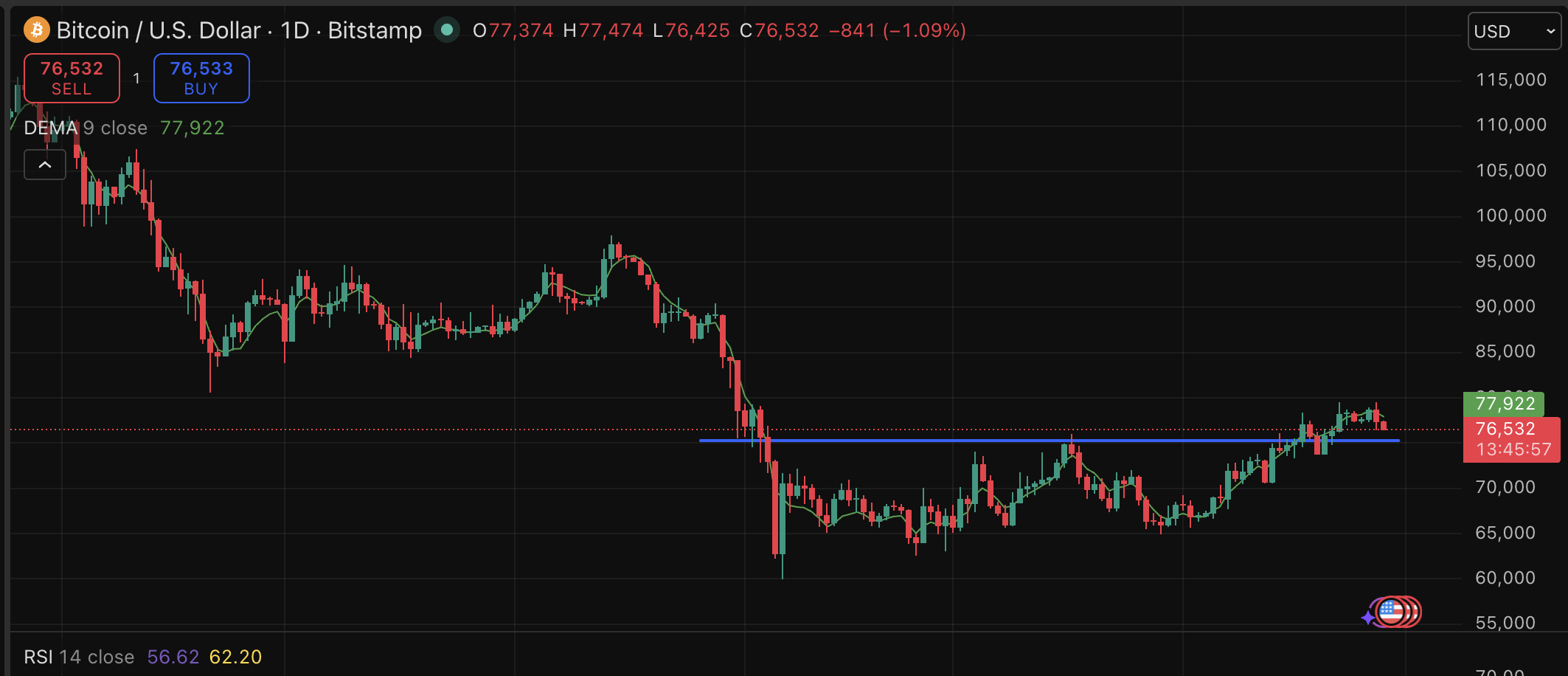
$75,000 represents the nearest meaningful support, a psychological floor that has been looking very strong for weeks. Resistance clusters suggest a clean break above $79K on volume could open a path toward $80,000 after testing it for 2-3 times over the last few days.
Momentum appears to indicate the bull and base cases carry a higher probability while institutional buying continues at this pace. Block’s Bitcoin conviction dates back to its original 4,709 BTC purchase in 2020 — this isn’t a new thesis, it’s a compounding one.
Discover: The best crypto to diversify your portfolio with
Bitcoin Hyper Targets Early Mover Upside as BTC Tests Key Resistance
Spot BTC is compelling right now, but even a move to $80,000 represents 5-6% upside from here. For traders who believe in Bitcoin’s trajectory but want asymmetric exposure to the ecosystem, the math starts pointing elsewhere. That’s the argument early-stage infrastructure plays are making right now, and one is gaining serious traction.
Bitcoin Hyper ($HYPER) is positioning itself as the first Bitcoin Layer 2 with Solana Virtual Machine (SVM) integration, delivering sub-second finality and low-cost smart contract execution on top of Bitcoin’s security layer.
The pitch is direct: Bitcoin has the trust, SVM has the speed; Bitcoin Hyper combines both. As institutional players like Metaplanet and Block continue stacking BTC, the demand for programmable Bitcoin infrastructure is accelerating alongside it.
The presale is now approaching $33 million at a current token price of $0.0136, with staking available for early participants. The Decentralized Canonical Bridge for native BTC transfers is a standout technical feature.
Research Bitcoin Hyper before the next price stage closes.
The post Bitcoin Price Prediction: Jack Dorsey Holds $2.2B as Strategy Ramps Up Buying appeared first on Cryptonews.



Developers behind a new wallet product say they have found a way to tackle quantum computing risks using a smart contract layer that runs alongside Bitcoin without requiring any change to the network itself.
Postquant Labs unveiled Quip Network’s post-quantum bitcoin wallet Tuesday, the company told CoinDesk in an email. The product runs on Arch Network, a system that lets developers build smart contracts anchored directly to Bitcoin rather than on a separate chain or through wrapped tokens.
Quip uses that infrastructure to add a post-quantum signature scheme called WOTS+, short for Winternitz One-Time Signature, on top of Bitcoin’s existing security. WOTS+ is a tested cryptographic technique that does not rely on the elliptic curve math a quantum computer could break.
By using a “Layer 2” — shorthand for a separate network built on top of Bitcoin that processes transactions and settles back to the main chain—developers can add features without changing Bitcoin’s base layer.
“The Bitcoin community has delayed a fix for years, despite Satoshi himself discussing the quantum problem,” Postquant Labs CEO Colton Dillion said in a statement to CoinDesk. “Developers say any protocol upgrade could take 5 to 10 years, but with Quip’s approach, we provide similar protection immediately.”
Bitcoin’s quantum readiness
The launch arrives in the middle of an active fight over how Bitcoin should respond to quantum risk.
Prominent developer Jameson Lopp and five others proposed BIP-361 two weeks ago, which would phase out quantum-vulnerable addresses on a fixed five-year timeline and freeze coins that fail to migrate, including the roughly 1.1 million bitcoin attributed to pseudonymous creator Satoshi Nakamoto.
Paul Sztorc’s controversial eCash hard fork would copy Bitcoin’s chain and ship seven sidechains including a quantum-resistant one, funded partly by reassigning Satoshi-pattern coins on the new ledger to investors.
Both proposals have drawn pushback from the community.
Quip’s pitch is that neither approach is necessary. The setup requires no soft fork, no consensus change, no community vote. A soft fork is a Bitcoin upgrade that tightens existing rules so older software still works, but it still needs broad miner and node support to activate. Bitcoin’s last major soft fork was Taproot in 2021. The next one, if it happens, could take years.
Technical trade-offs
The three approaches actually disagree on something specific. Lopp’s argument is that Layer 2 protection like Quip’s is insufficient because Bitcoin mainnet public keys still leak the moment a user broadcasts a transaction, giving a future quantum attacker a target.
There are a few caveats, however. The wallet app launches next week rather than today. A third-party audit is underway but not complete. Quip’s quantum-resistant accounts already exist on Ethereum and Solana, but the Bitcoin deployment is new and Arch Network is still relatively early infrastructure.
Postquant Labs CTO Dr. Richard Carback, a long-time collaborator with eCash inventor Dr. David Chaum who now advises the project, said the approach narrows the window for a quantum attack to as little as two blocks, roughly 20 minutes.
(David Chaum’s eCash is the original digital cash protocol from 1983, the academic foundation for ‘blind’ signatures and privacy-preserving electronic money. It predates Bitcoin by 25 years and has nothing to do with Bitcoin or the eCash proposal by Sztorc.)
Sztorc’s argument is that incremental patches are exactly why Bitcoin needs a clean fork with quantum resistance built in from the start. The Layer 2 approach, which now includes Quip and Blockstream’s hash-based signature work on the Liquid Network, argues both other positions overreact to a threat that better infrastructure can handle without changing Bitcoin itself.
Which approach wins depends partly on how fast quantum computers actually arrive. The Bitcoin holders most worried about quantum risk have historically been the same group most resistant to wrapped or smart-contract-anchored products.
Ether (ETH) analysts have mapped out key ETH price levels to watch over the next few weeks, with a focus on the $2,000 psychological level.
Key takeaways:
- Dropping below the 200-day simple moving average at $2,220 could confirm more downside for Ether.
- ETH faces stiff resistance at $2,400, a level that must be reclaimed by the bulls.
Ether price stuck between two key levels
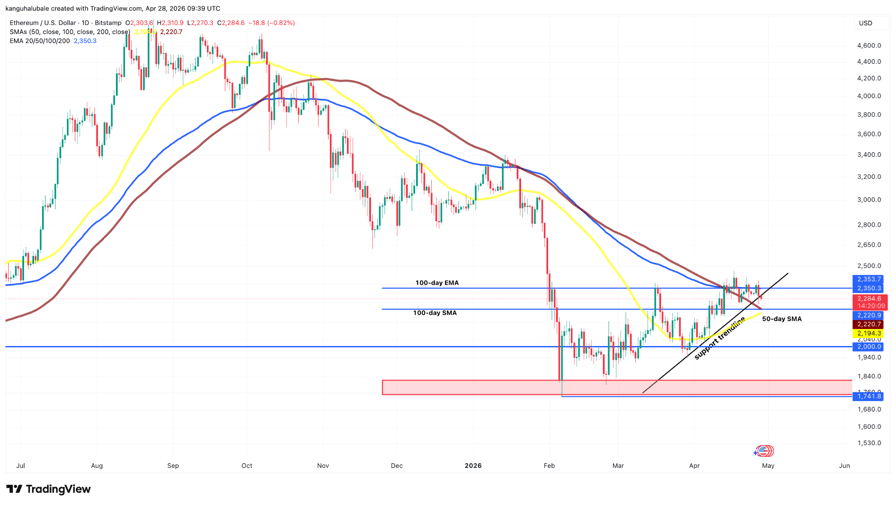
Data from TradingView showed the ETH/USD pair trading below $2,300, down 5% over the last two days and erasing all gains made over the weekend.
This meant that the price remained wedged between the 100-day exponential moving average at $2,350 and the 100-day simple moving average (SMA) at $2,220, as shown in the chart below.
This suggested that Ether could consolidate within these trend lines for a few more days before a decisive move.
Telegram trading resource Technical Crypto Analyst said that after losing the support trendline at $2,300, “we can probably expect Ethereum to drop, and it might even hit the lower support level in the next few days,” adding:
“A solid breakdown with good volume would confirm this.”
ETH/USD daily chart. Source: Cointelegraph/TradingView
The analyst was referring to two immediate support zones: the $2,200 area, where the 50-day and 100-day SMAs converge, and the psychological level at $2,000.
“ETH has dropped below the $2,300 level,” said fellow analyst Ted Pillows in a Tuesday post on X, adding:
“The next crucial support zone is $2,200 which could be a level for a short-term bounceback.”
A key buy zone to watch below that is the $1,800-$1,750 area, which aligns with the multi-year low reached on Feb. 6.
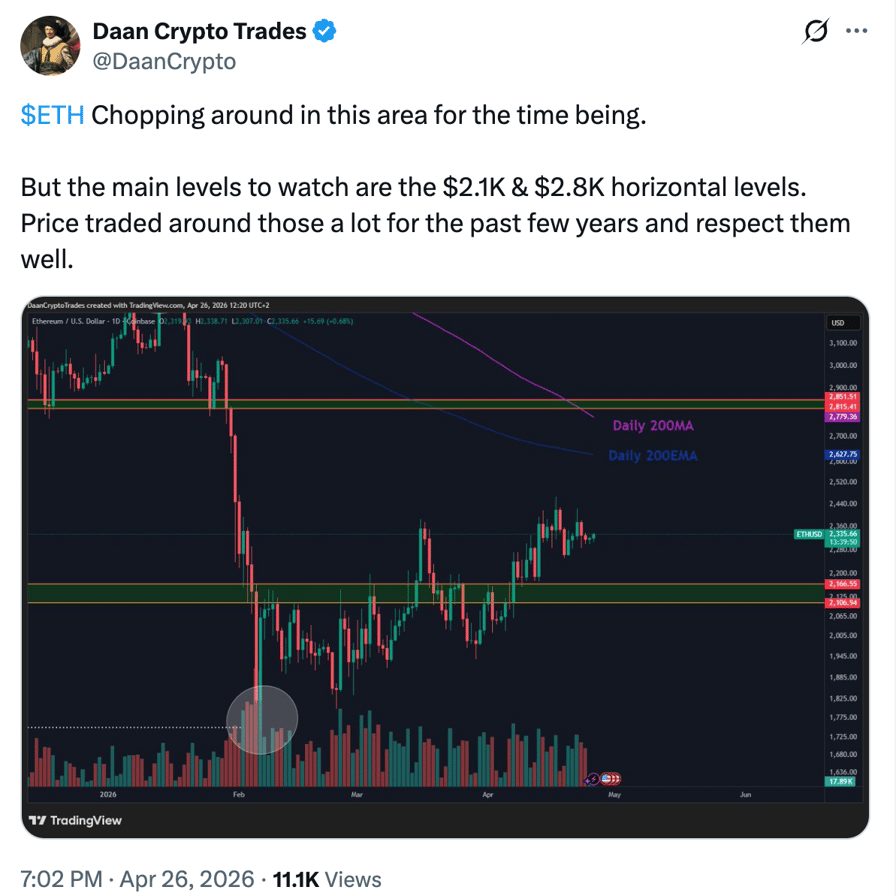
In a recent post on X, trader Daan Crypto Trades said that the key levels to watch were $2,100 as support and the resistance at $2,800, which ETH price has “respected” well over the past few years.
ETH/USD daily chart. Source: X/Daan Crypto Trades
As Cointelegraph reported, a daily close below the moving averages around $2,200 would bring the next line of defense at $2,000 into focus.
Ethereum price must reclaim $2,400 to continue recovery
As Cointelegraph also reported, Ether’s bullish case hinges on flipping the resistance at $2,400 into support, where the realized price currently is.
“This is a very important psychological factor,” CryptoQuant analyst CW8900 said in a recent X post, adding:
“Breaking through that line signifies that whales are transitioning to a profitable position.”
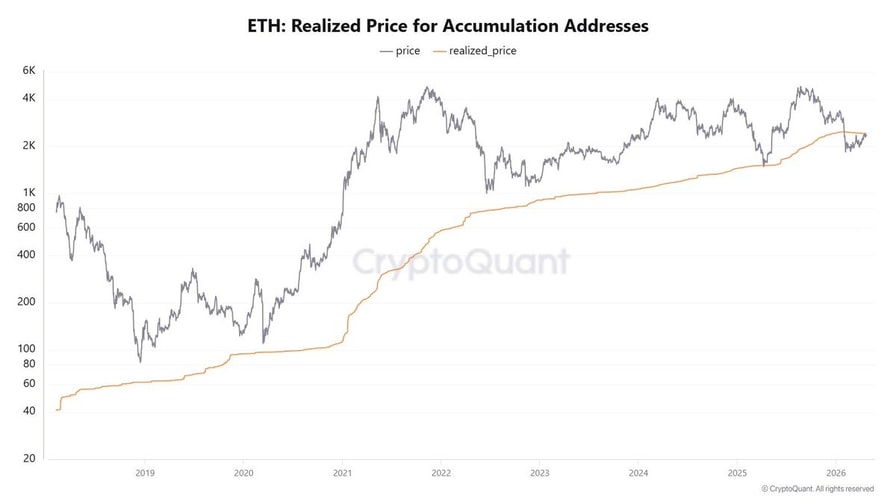
ETH realized price. Source: CryptoQuant
With whales back in a profitable position, it would “provide grounds for their buying power to become stronger,” the analyst added.
Related: Ethereum’s EEZ could pull other blockchains into its orbit
Meanwhile, Ether’s liquidation map reveals that a break above $2,400 would trigger over $1.94 billion in short liquidations across all exchanges.
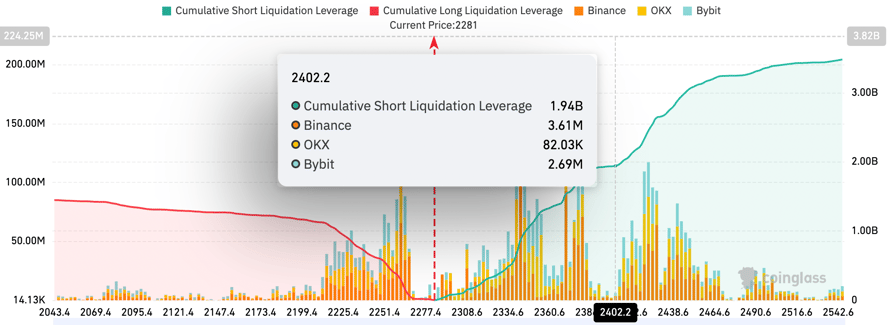
ETH exchange liquidation map. Source: CoinGlass
This means a significant amount of bearish bets risk liquidation on a move higher, opening the way to a sharper upward cascade if the recovery resumes.
Galaxy Digital (GLXY) narrowed its first-quarter loss as a shift in business mix and tighter financial management outweighed a decline in cryptocurrency prices.
The company lost $216 million, or 49 cents a share, less than the 59 cents estimated by analysts. Revenue dropped to $10.2 billion from $12.9 billion in the year-earlier quarter.
The company is increasingly focusing on the growing demand for data centers, and this month delivered its first data hall at the Helios campus in Texas to CoreWeave (CRWV), marking the start of revenue under a long-term lease tied to artificial intelligence workloads.
“Adjusted gross profit remained broadly stable, reflecting a shift in the business mix as recurring fee revenue and transaction income continue to scale and provide greater resilience in softer market conditions,” the company said in a statement. “Disciplined expense management during the quarter helped narrow the adjusted EBITDA loss, underscoring a focus on operating efficiency in more challenging environments.”
The Helios facility is set to deliver 133 megawatts of computing power by the end of the second quarter. The company also secured approval for an additional 830 megawatts of power at the site, bringing total capacity to more than 1.6 gigawatts.
GLXY shares fell for a second day, and were recently 0.84% lower at $24.84.
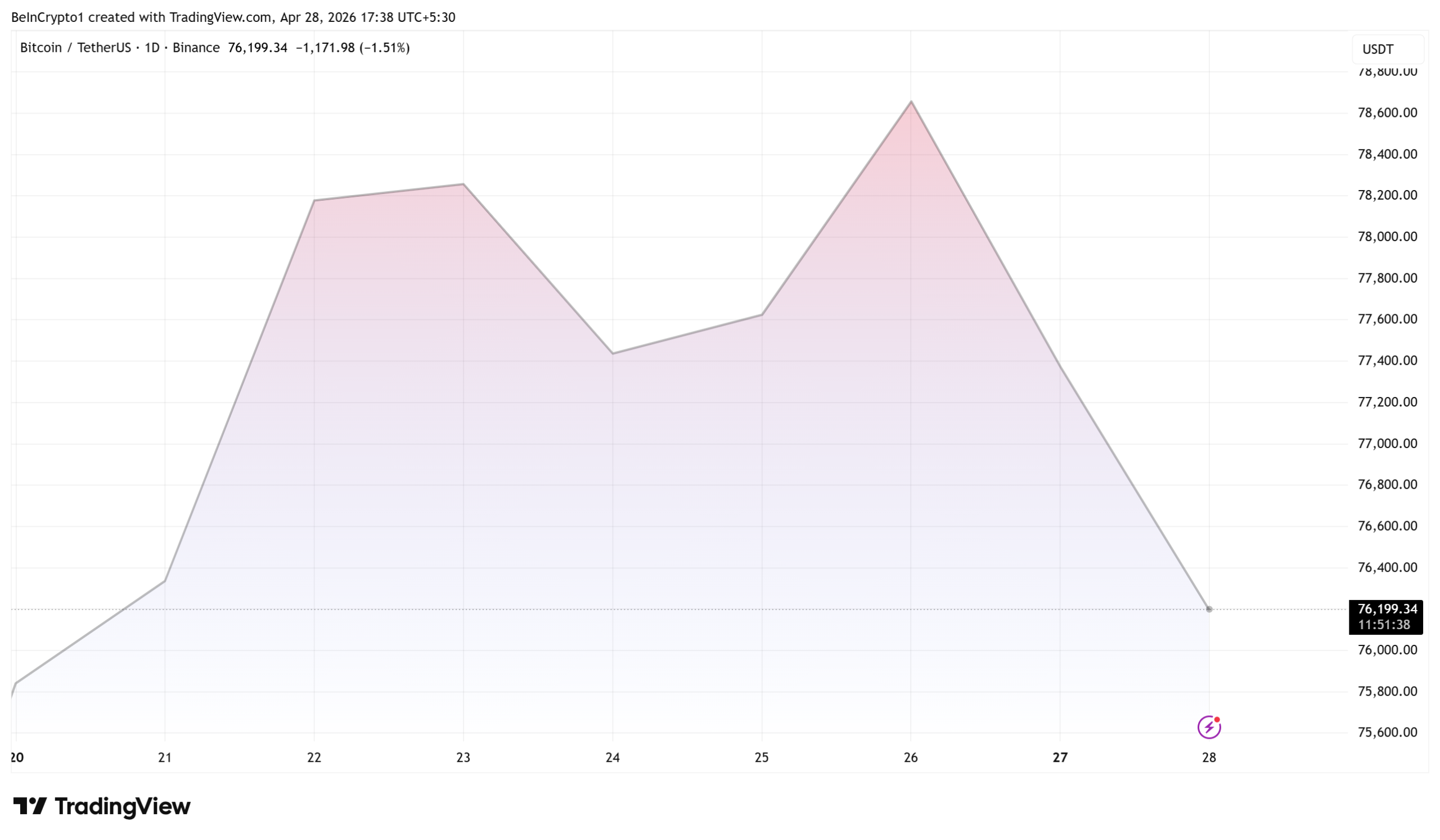
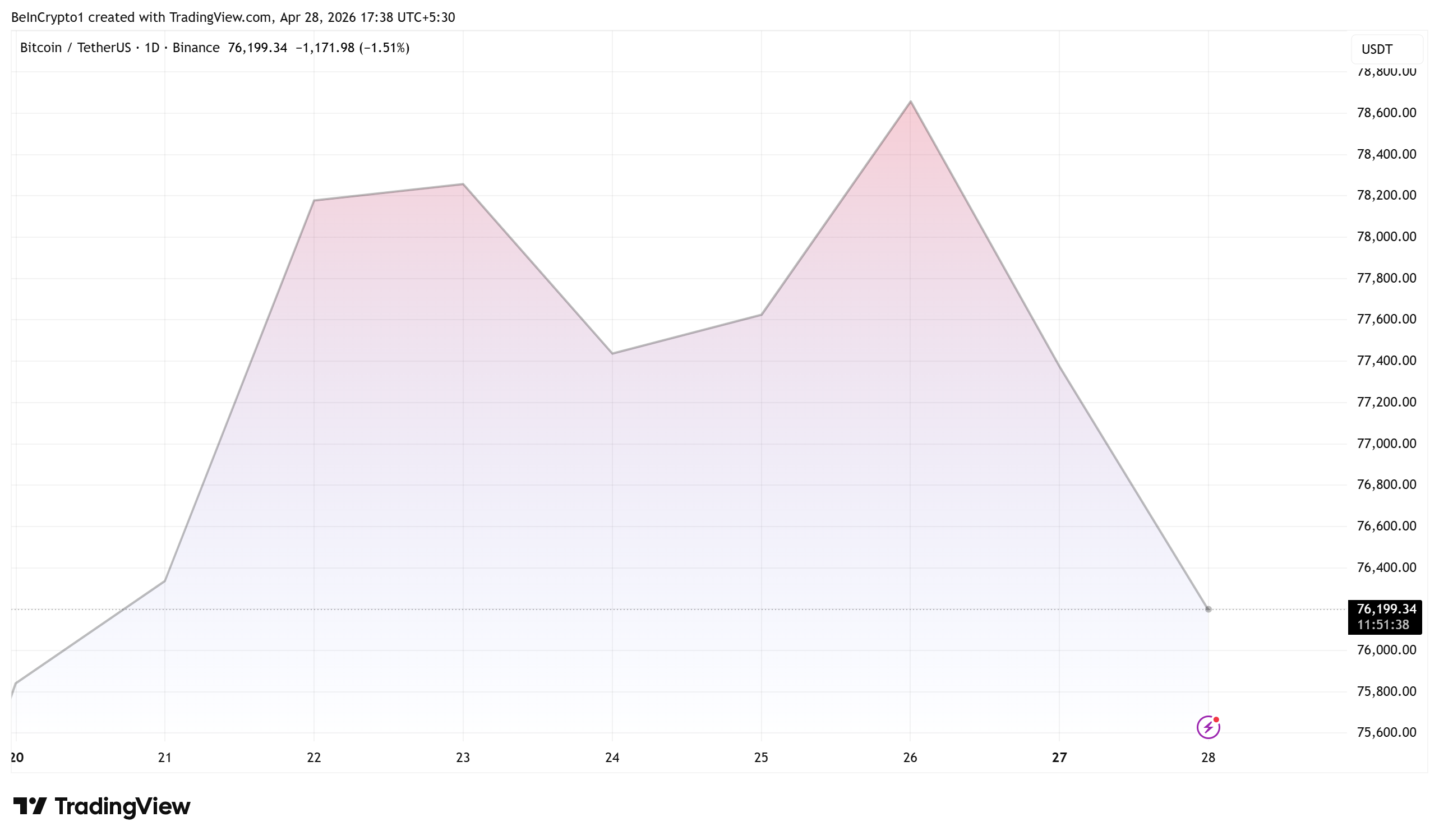
Bitcoin (BTC) slid dropped below a key level on Tuesday after the Bank of Japan (BOJ) held its short-term policy rate at 0.75% but delivered the most divided vote of Governor Kazuo Ueda’s tenure, with three board members pushing for an immediate hike to 1.0%.
The hawkish split, paired with a sharply higher inflation forecast, revived expectations of a June rate increase and renewed fears of a yen carry trade unwind that has battered crypto markets in past tightening episodes.
Why the BOJ Vote Spooked Crypto Markets
The 6-3 vote marked the widest internal divide under Ueda since he took office. Hajime Takata, Naoki Tamura, and centrist Junko Nakagawa each backed an immediate move to 1.0%, citing persistent inflation pressure and a vulnerable yen.
The board raised its core inflation outlook for fiscal 2026 to 2.8% from 1.9%, pointing to surging energy costs tied to the Iran conflict.
Growth was trimmed to 0.5% from 1.0% as domestic momentum softened. Money markets now price roughly 70% odds of a 25 basis point hike at the June meeting.
Carry Trade Risks Return for Bitcoin
The reaction in Bitcoin was swift. BTC slipped below the $76,200 threshold after opening at $77,371 on Tuesday and recording an intra-day high of $77,478 the same day.
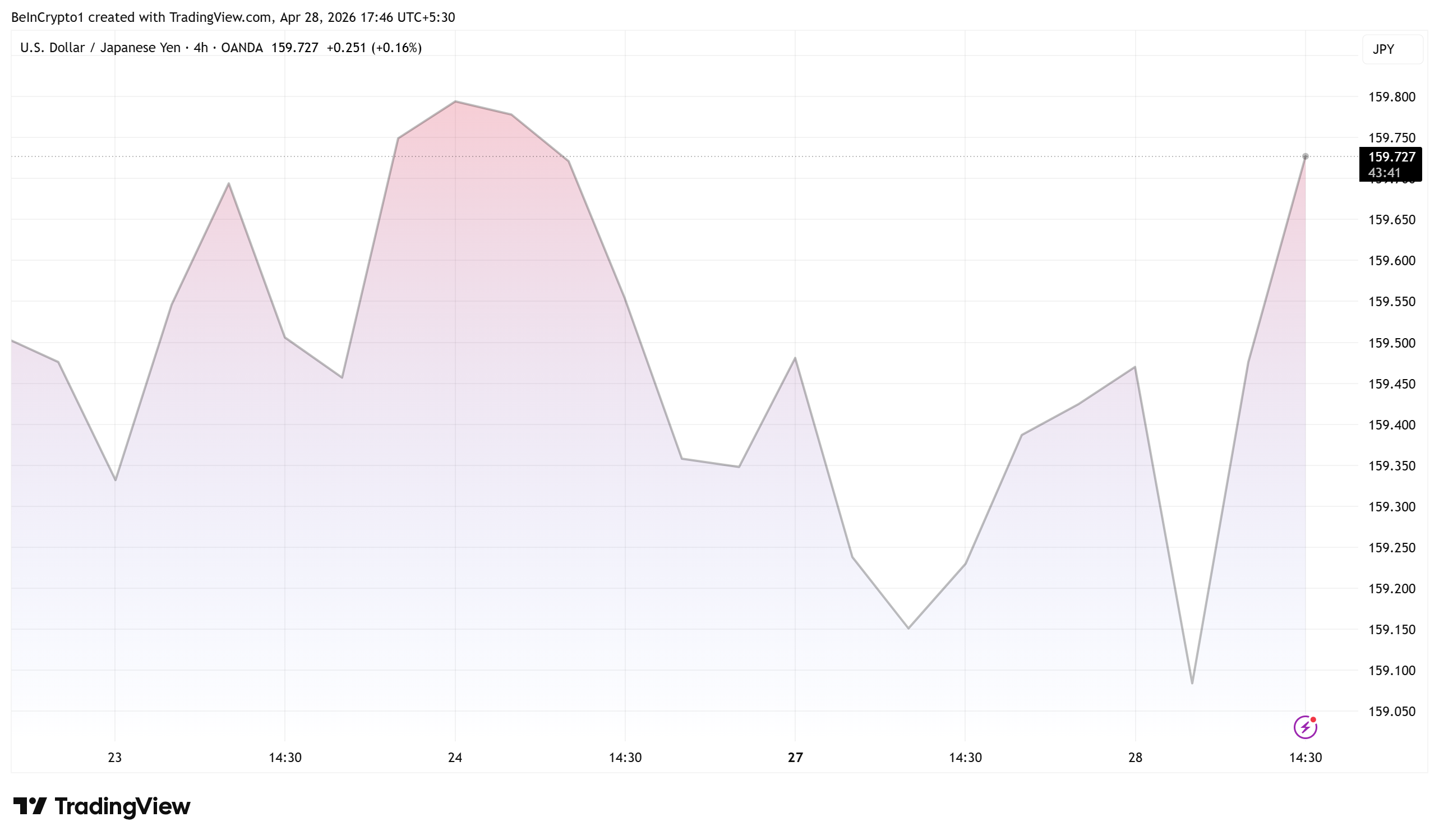
USD/JPY eased from levels near 159 that had previously drawn intervention warnings from Tokyo officials.
Traders are watching the yen carry trade. Borrowers funded in cheap yen buy higher-risk assets, including crypto. BOJ tightening forces costly position unwinds.
“Bank of Japan is setting up the next global crash! Japan warned inflation will rise again. June hike odds jumped to 64.4%. Last time this happened – Japan’s Nikkei had its worst day since 1987. The yen carry trade funded every risk asset rally this decade. Unwinding it = global bloodbath. It’s about to happen again,” analyst Qmo warned.
Past Ueda-era hikes have triggered Bitcoin drawdowns of 20% to 30% in the following weeks.
Ueda’s press conference and June meeting guidance will set the next leg of positioning. Investors are likely to track USD/JPY for any sustained move lower from current levels near 159, a key threshold for accelerating carry unwinds.
Beyond Japan, the Fed’s policy path and U.S. macro data remain the dominant variable for sustained Bitcoin direction, with chair Jerome Powell facing his last FOMC tomorrow, April 29.
Follow us on X to get the latest news as it happens
The post Bitcoin Falls as Bank of Japan’s 6-3 Hawkish Hold Revives Carry Trade Fears appeared first on BeInCrypto.
Stablecoin monthly transfer volume fell by nearly 20% over the past 30 days, even as the market’s total supply and holder count continued to rise.
According to data from RWA.xyz, 30-day stablecoin transfer volume dropped 19.18% to $8.31 trillion as of April 28, while stablecoin market capitalization rose 2.06% to $305.29 billion over the same period. The number of stablecoin holders also increased by 2.32% to 246.94 million, while monthly active addresses edged up 0.26% to 51.28 million.
The divergence suggests that stablecoin growth is not translating evenly into onchain activity. While more capital appears to be sitting in dollar-denominated crypto assets, fewer dollars are being moved across blockchains compared with 30 days earlier.
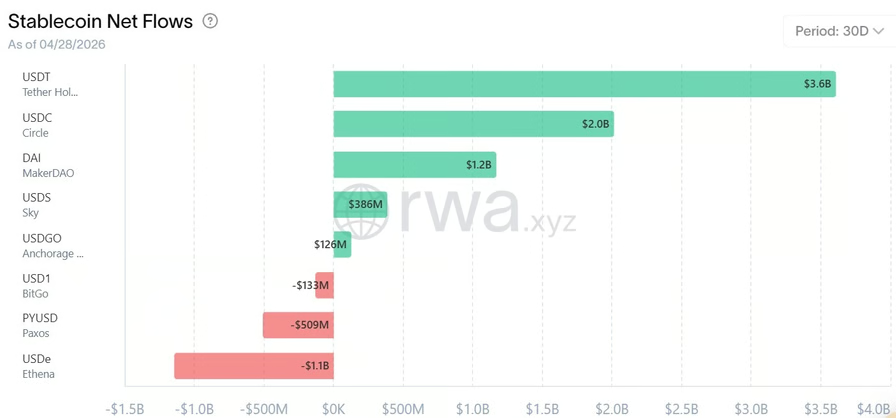
The 30-day net flows were led by Tether’s USDT, which added $3.6 billion, followed by Circle’s USDC with $2 billion and MakerDAO’s DAI with $1.2 billion. Ethena’s USDe saw the largest net outflow at $1.1 billion, while Paxos’ PYUSD recorded $509 million in net outflows.
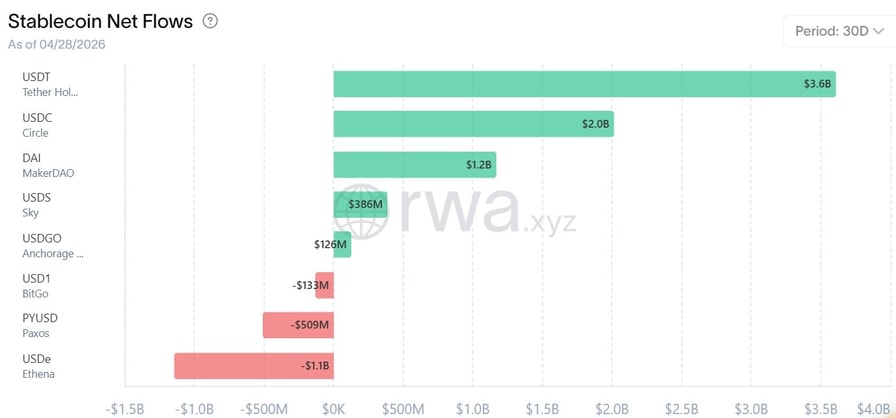
30-day stablecoin net flows as of April 28, 2026. Source: RWA.xyz
Stablecoin momentum cools after stronger network activity
The decline in broader stablecoin transfer volume comes after stronger stablecoin activity was flagged on some of the major blockchain networks for stablecoins.
In its Q2 Signals Report, asset manager Fidelity cited Coin Metrics data showing that Ethereum’s stablecoin transfer values had recently exceeded historical averages, with transfer value over the past 12 months surpassing $18 trillion.
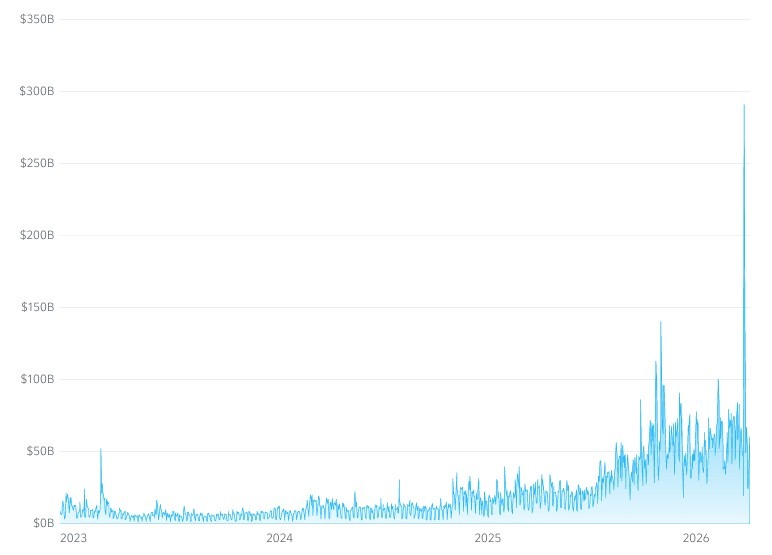
Aggregate stablecoin transfer volume. Source: Fidelity
Fidelity said the trend suggested network utility persisted even as crypto prices remained under pressure. The company said the increase may signal that stablecoins are being used for payments, settlement and onchain access to the dollar, regardless of broader market sentiment.
Related: Stablecoin inflows rebound to $1.7B as Washington battles over yield rules
Solana showed a similar, though smaller, trend. Citing Coin Metrics data, Fidelity showed that Solana consistently processed over $5 billion in stablecoin volume, while its 30-day average transfer volume increased from $6.7 billion to $7.2 billion as of March 31.
Fidelity said the data suggest that Solana may be moving toward more mainstream financial activity after being closely associated with memecoin trading.
Magazine: AI-driven hacks could kill DeFi — unless projects act now
Crypto World
Cadence Design Systems (CDNS) Stock Gains Momentum from AI Chip Design Surge in Q1 2026

Key Highlights
-
AI chip design momentum propels Cadence Q1 revenue and backlog expansion
-
CDNS shares dip in pre-market trading despite solid Q1 performance
-
Company elevates full-year 2026 projections following robust first quarter
-
Backlog reaches $8 billion milestone as AI design tools gain traction
-
New AI-powered design platforms contribute to margin expansion and earnings growth
Cadence Design Systems (CDNS) delivered impressive first-quarter financial results powered by surging demand for artificial intelligence chip design solutions. The company’s backlog expanded significantly while management upgraded forward guidance. CDNS shares finished the regular trading session at $336.54, gaining 1.10%, though pre-market activity saw the stock retreat to $334.63, declining 0.61%. Results demonstrated momentum across multiple business segments including software platforms, hardware systems, intellectual property, and system design solutions.
Cadence Design Systems, Inc., CDNS
Strong Revenue Performance Driven by AI Design Tools
Cadence announced first-quarter 2026 revenue totaling $1.474 billion, representing significant growth from the $1.242 billion recorded during the comparable period last year. This advancement stemmed from heightened customer demand for electronic design automation platforms serving chip development and system design sectors. Despite solid quarterly performance, early trading activity following the announcement displayed modest downward pressure.
The company’s GAAP operating margin came in at 29.3%, marginally exceeding the 29.1% achieved in the first quarter of 2025. Meanwhile, non-GAAP operating margin expanded to 44.7%, up from 41.7% year-over-year. This margin improvement demonstrated enhanced operational efficiency and favorable product mix dynamics.
On the earnings front, GAAP diluted earnings per share climbed to $1.23 versus $1.00 in the prior-year quarter. Non-GAAP diluted earnings per share advanced to $1.96 from $1.57. Therefore, Cadence posted simultaneous expansion in both top-line revenue and bottom-line profitability.
Substantial Backlog Reinforces Full-Year Projections
Cadence concluded the quarter with total backlog reaching $8.0 billion. Additionally, the company anticipates generating $4.0 billion in revenue from remaining performance obligations within the coming 12 months. This substantial backlog position provides enhanced revenue visibility and demand predictability.
Leadership elevated the company’s 2026 revenue guidance to reflect 17% year-over-year expansion at the midpoint. Cadence currently projects full-year revenue falling between $6.125 billion and $6.225 billion. The firm anticipates non-GAAP operating margin landing in the 43.5% to 44.5% range.
Additionally, Cadence forecasts GAAP diluted earnings per share between $4.39 and $4.49 for the full year. Non-GAAP diluted earnings per share guidance spans $7.85 to $7.95. As a result, Cadence approaches the remainder of 2026 with strengthened earnings confidence.
New AI Platform Introductions Accelerate Growth Trajectory
Cadence unveiled AgentStack throughout the quarter as a cornerstone element of its artificial intelligence design ecosystem. This framework facilitates knowledge integration across chip design, 3D integrated circuit development, and system-level design processes. Furthermore, it unifies Cadence’s comprehensive design tool portfolio into a cohesive operational architecture.
The organization also released ViraStack targeting analog and custom design applications. Additionally, InnoStack was introduced for digital implementation and design signoff workflows. Combined with the existing ChipStack platform, Cadence now addresses an expanded spectrum of chip development stages.
Core electronic design automation revenue advanced 18% year-over-year reflecting robust customer engagement. Hardware revenue achieved a quarterly record, propelled by artificial intelligence and high-performance computing applications. Intellectual property revenue surged 22%, while system design and analysis revenue posted 18% growth.



Capital Gathering, the private community connecting the region’s active founders, investors, and C-level executives across Web3, AI, and emerging tech, is hosting its third edition in Dubai. The theme: Prediction Markets, one of the fastest-growing verticals in finance right now.
With Token2049 Dubai postponed, the community didn’t disperse. Capital Gathering continues the momentum. The evening takes place at Birds, a fine dining venue 63 floors above the city with Burj Khalifa views with no panels and no pitch decks.
The topic isn’t accidental. Prediction markets hit nearly $26B in monthly volume in January 2026, up 13 times year-over-year. Driven by macro volatility, geopolitics, and a new wave of users, they’re moving from niche to real financial infrastructure. The key questions now: regulation, liquidity, and who’s building the foundations.
Tools like Pulse, the event’s co-sponsor, are already answering that last question, giving retail users institutional-grade access to prediction markets in one place.
Capital Gathering was founded by Kristina Berezina and Daria Pakina, two Web3 founders who have spent years inside the ecosystem. The F1 Abu Dhabi edition last December welcomed over 300 guests to a private rooftop near Yas Marina Circuit. The Christmas edition at Armani/Privé inside the Burj Khalifa followed weeks later. With this third Edition, the Capital Gathering community is growing, and the conversation becomes even sharper.
“Dubai doesn’t wait for the next conference. The people shaping this space are here, so it makes sense to build the evening around that,” said Kristina, co-founder of Capital Gathering.
“This space is moving fast, legislation, liquidity, who’s building the infrastructure underneath it all. Dubai is definitely part of this conversation,” added Daria, co-founder of Capital Gathering.
Registration is by approved RSVP only: Apply here
The post Capital Gathering III: Prediction Markets Come to Dubai appeared first on BeInCrypto.

Core Scientific is driving a transformative shift in its business model, planning to convert its Pecos, Texas campus into a high-density AI-focused data center complex that could reach up to 1.5 gigawatts of gross power capacity. The company said that roughly 1 GW of that capacity would be available for leasing, signaling a move beyond traditional cryptocurrency mining toward AI compute infrastructure amid growing demand for data center capacity.
In a press release issued on Monday, Core Scientific outlined the transition as part of its strategy to differentiate its buildout of next-generation AI infrastructure using its in-house engineering capabilities. The project’s initial data hall has completed foundational work and is moving into vertical construction, with the company targeting first capacity in early 2027. Core Scientific noted that about 300 megawatts of power at the Pecos site, previously allocated to Bitcoin mining, are being repurposed for the new data center operations.
The expansion is supported by new power agreements, including an additional 300 megawatts secured under contract with the local utility provider, and land acquisitions to support scale. Core Scientific said it has acquired more than 200 acres in the Pecos area to accommodate the buildout.
The company also disclosed a broad financing plan to fund the expansion, revealing plans to raise approximately $3.3 billion through senior secured notes due 2031, intended to finance data center development across multiple states including Georgia, Texas, North Carolina and Oklahoma. This follows a separate $1 billion senior credit facility secured from Morgan Stanley in March, underscoring the capital-intensive path of building out AI-ready infrastructure at scale.
Core Scientific has historically derived a substantial portion of its revenue from mining digital assets, but it has gradually shifted toward offering infrastructure services. The Pecos project illustrates how miners are repurposing existing facilities to capitalize on the sustained demand for AI compute capabilities, even as the economics of mining face ongoing pressures.
Core Scientific shares have risen about 44% so far this year. Source: Yahoo Finance
Key takeaways
- Core Scientific aims to build a Pecos, Texas, data center campus with up to 1.5 GW gross capacity, roughly 1 GW of which could be leased to customers for AI workloads.
- About 300 MW of power previously used for Bitcoin mining at Pecos is being repurposed for data center operations, with the first data hall expected to deliver initial capacity in early 2027.
- The company has acquired over 200 acres in Pecos to support the build, and it has secured additional power contracts totaling about 600 MW when combined with existing arrangements.
- Financing support includes a $3.3 billion plan via senior secured notes due 2031, complemented by a $1 billion Morgan Stanley credit facility, signaling a broad push into AI-ready infrastructure across several states.
Core Scientific’s Pecos expansion: from mining to AI data centers
The Pecos plan represents a deliberate pivot from pure mining activity toward high-density AI compute, leveraging Core Scientific’s engineering expertise to design scalable, data-center-centric infrastructure. The company emphasized that the first data hall has progressed to vertical construction, with a timeline that anticipates initial capacity becoming operational in early 2027. The repurposing of roughly 300 MW of the site’s existing power load highlights a broader industry trend: crypto facilities are increasingly being repurposed to support AI workloads as demand for compute power grows beyond blockchain validation.
Adam Sullivan, Chief Executive Officer of Core Scientific, underscored the strategic rationale, stating, “We continue to leverage our deep in-house expertise to differentiate how we build and scale next generation artificial intelligence infrastructure.” This sentiment reflects a broader industry push to convert crypto-era assets into flexible, AI-forward data centers capable of housing GPU-intensive workloads, training models, and running inference at scale.
The Pecos project also includes a furniture of land assets—Core Scientific has acquired more than 200 acres—to anchor long-term expansion, aligning with plans to deploy a significant amount of capacity in a single campus. The plan to carve out roughly 1 GW for leasing aligns with a perceived demand gap in premium AI compute space, particularly for operators seeking co-location and predictable power contracts.
Funding the buildout: debt, power, and land
Financing a multi-hundred-megawatt, multi-state data center push requires patient capital. Core Scientific’s plan to raise about $3.3 billion through senior secured notes due 2031 signals a move from opportunistic opportunism to a structured capital strategy designed to sustain multi-year construction, feed-in power capacity, and support ongoing operations as customers come online. This funding plan sits alongside a $1 billion Morgan Stanley credit facility announced earlier in the year, which the company described as part of its broader financing framework to accelerate data center development across Georgia, Texas, North Carolina and Oklahoma.
Power availability remains a central constraint in the AI-data-center equation. Core Scientific’s Pecos expansion hinges on securing reliable, scalable power amid a regional energy market that has historically supported large-scale computing deployments. The company’s additional 300 MW under contract with the local utility provider helps de-risk the project, but ongoing power planning and grid coordination will be critical as the campus scales toward 1.5 GW gross capacity.
Beyond Pecos, Core Scientific’s strategy includes pursuing further expansion via behind-the-meter solutions and additional land acquisitions to sustain a longer-term growth trajectory. The company’s move mirrors a broader trend among crypto miners: diversify revenue streams by converting facilities into data centers that can host AI workloads, a market dynamic that has attracted attention from investors seeking exposure to AI compute infrastructure without the volatility of mining cycles.
A broader AI-infrastructure shift in crypto-mining
Core Scientific is not alone in this pivot. The sector has seen several peers exploring revenue streams tied to AI compute and data-center capabilities alongside their mining operations. In February, MARA Holdings disclosed the acquisition of a 64% stake in Exaion, a French infrastructure company expanding into AI services, signaling a strategic move to broaden AI-focused offerings beyond traditional mining. The broader lineup of miners—Hive, Hut 8, TeraWulf and Iren—have also signaled and undertaken steps to repurpose mining facilities into data centers or AI-focused campuses as margins in mining tighten and AI workloads proliferate. MARA’s Exaion stake is a notable example of this trend.
Related developments in the energy-to-AI transition include the reported near-term sale of idle assets in the industrial sector. Alcoa is close to selling its Massena East smelter in upstate New York to NYDIG, a deal expected to close by mid-year, as the plant has remained idle since 2014 due to high energy costs and global competition. The move aligns with a broader wave of crypto miners seeking to anchor AI data-center capacity in repurposed industrial assets. Massena East and, earlier, Century Aluminum’s Hawesville smelter sale to TeraWulf for $200 million to be converted into a high-performance computing and AI facility illustrate this trend in action. Century Aluminum Hawesville was cited in industry reporting as part of the same wave of industrial-to-AI data-center conversions.
The confluence of higher AI compute demand, capital-intensive buildouts, and the repurposing of mining infrastructure suggests a structural shift in how crypto players engage with data center economics. The trend also dovetails with broader coverage of AI data-center backbones that quietly emerged from the crypto era, underscoring how the sector’s assets are being repurposed to power the next wave of digital infrastructure. CoreWeave and related reporting have underscored these dynamics for investors looking beyond immediate mining yields.
What to watch next
As Core Scientific advances toward its 2027 capacity milestone, investors and industry observers will be watching several key factors: the pace of vertical construction at Pecos, the timing and reliability of power deliveries, and whether the leasing demand materializes at the projected scale. The financing package will also come under scrutiny as proceeds are deployed across multiple sites, with the ability to meet debt obligations and service ongoing capital needs a critical consideration for lenders and future project partners.
Beyond Core Scientific, the sector’s AI-forward pivot remains under observation. The timing of AI deployment milestones at Exaion, the integration of repurposed mining facilities into AI data centers, and the long-term profitability of these ventures will shape how crypto miners position themselves in a world where AI infrastructure investment appears increasingly attractive to both developers and institutions.
Readers should monitor updates from Core Scientific as project approvals progress, as well as any additional capital-raising moves or land acquisitions that may signal further capacity expansion across the United States.
Crypto infrastructure company Startale Group has selected Sunnyside Labs’ Privacy Boost as the official privacy partner for its Startale App, built for Soneium, a Sony-linked blockchain network.
Startale Group said Tuesday that the integration will add self-custodial private transfer features to the app, including shielded balances, private peer-to-peer transfers and privacy-enabled payment flows on Soneium.
The move adds a consumer-facing privacy layer to Startale’s Sony-linked Soneium ecosystem as crypto apps try to give users more control over visible onchain activity while preserving compliance mechanisms for operators.
Sunnyside Labs co-founder and CEO Taem Park told Cointelegraph that selective auditability means transaction details remain hidden from the public, while authorized service operators can review them through a feature called Audit View.
Related: Japan’s SBI VC Trade launches retail USDC lending as stablecoin use grows
He compared the system to traditional finance, in which banks can view customers’ transactions for compliance purposes. “This means AML and regulatory obligations can be met without requiring all activity to be publicly transparent. This is a fundamentally different architecture from privacy tools that obscure transactions from everyone, including the operator,” Park told Cointelegraph.
The design leaves a key question over who ultimately controls access to private transaction data. While Privacy Boost is designed to hide transaction details from the public, its Audit View model preserves operator-level visibility for compliance purposes. That means users are relying not only on cryptography, but also on Sunnyside Labs’ controls around when and how shielded transaction records can be reviewed.
Selective disclosure faces privacy, compliance tradeoffs
The Audit View model puts Startale’s integration in the same category as privacy systems that try to keep transaction data hidden from the public while still allowing some form of review by trusted or authorized parties.
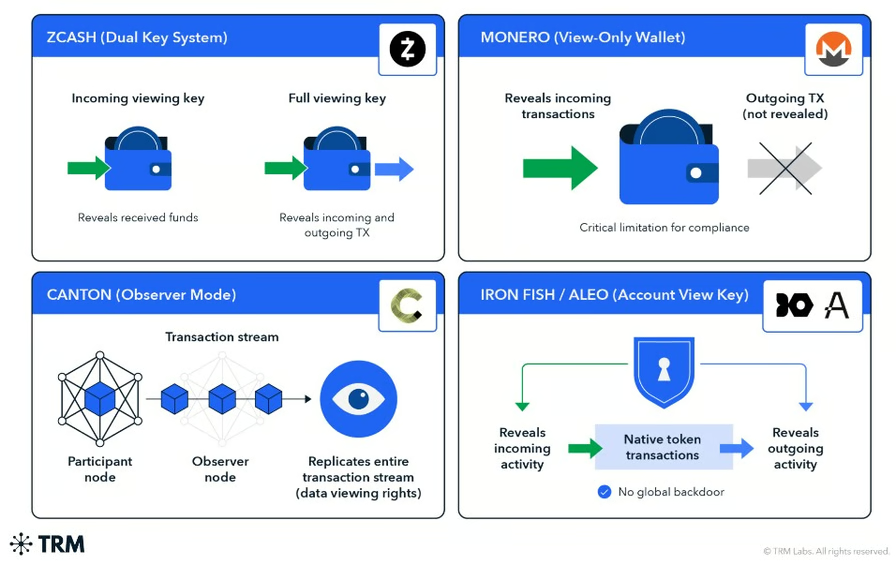
Zcash, one of the earliest privacy-focused blockchain networks, uses zero-knowledge proofs and supports selective disclosure through viewing keys. Secret Network uses a similar access-control concept for private smart contract data, with its documentation describing viewing keys as encrypted passwords for viewing data tied to a specific smart contract and private key.
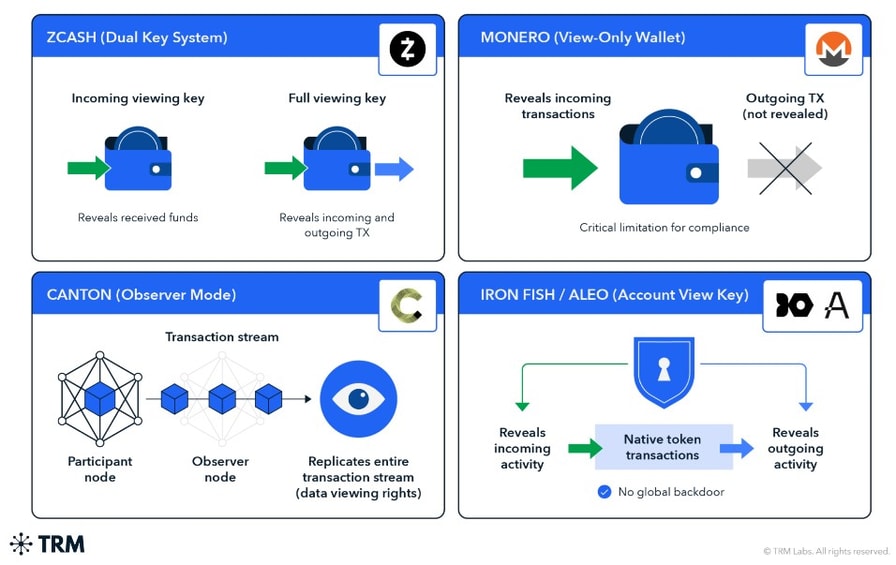
Examples of selective disclosure implementations. Source: TRM Labs
Blockchain analytics company TRM Labs said in a Feb. 19 report that transaction view keys provide “strong privacy but weak compliance utility,” particularly for high-value transfers, rapid fund movements or systemic monitoring.
Privacy Boost’s Audit View model appears to take a different approach by giving authorized operators access to private transaction records for compliance purposes. That may make the system more practical for regulated consumer applications, but it also means disclosure is not controlled only by users.
In its findings, TRM Labs said that “No single privacy regime satisfies all stakeholder needs.” However, the company added that hybrid approaches combining visibility, access controls and limits around private-asset conversions may offer the most workable path.
Magazine: AI-driven hacks could kill DeFi — unless projects act now


A new Wall Street Journal report claims OpenAI missed internal revenue and weekly active user targets in early 2026. The story landed hours before US markets opened on April 28, pulling AI-linked shares lower in pre-market trading.
According to CNBC’s Mad Money host Jim Cramer, the report was a recycled hit job timed to rattle AI stocks before earnings season.
Report Lays Out OpenAI’s Internal Misses
The piece said OpenAI fell short of internal goals for revenue and weekly active users during early 2026. The shortfall came as rivals picked up share in coding and enterprise workloads.
ChatGPT also missed its internal target of 1 billion weekly active users by year-end. Gains by Anthropic and Google’s Gemini were cited as a key reason. Developer-heavy segments saw the sharpest competitive pressure, according to the report.
OpenAI is racing toward a possible public listing valued near $850 billion. The company has signed compute commitments worth hundreds of billions of dollars with cloud partners.
That includes a recently restructured arrangement with Microsoft that ended Azure exclusivity.
CFO Sarah Friar Pushes for Tighter Spending Discipline
Chief Financial Officer Sarah Friar warned colleagues that aggressive capital expenditure could outpace revenue if growth does not accelerate.
Internal debate has reportedly grown over whether OpenAI can fund its data-center pipeline before any public listing.
Friar has previously told colleagues that OpenAI is not ready for its planned 2026 listing. CEO Sam Altman, by contrast, has favored a faster timeline and continued aggressive investment in compute.
Other media outlets have also focused on whether the company’s burn rate can sustain its capex pipeline.
Pre-market trading saw Oracle drop roughly 3%, with Nvidia and AMD easing on the headlines.
Cramer Calls Out the Timing
Cramer pushed back on the framing, calling the new report an evergreen hit job whose timing seems often too deliberate.
“Doesn’t everyone marvel as I do of the exquisite timing of this Journal evergreen hitjob? Timing is everything,” he quipped.
Meanwhile, the narrative comes amid expected pressure from rivals such as Anthropic, whose pre-IPO valuation has reached $1 trillion on Jupiter.
Bulls argued OpenAI is still growing fast, with capex shaped more by chip supply than soft demand.
Skeptics, however, flag real concerns about burn rate, IPO readiness, and Altman’s expansion plans.
The split mirrored a broader market divide over AI valuations heading into earnings season.
“Valuation split is likely among companies benefitting from AI. Companies in the AI field could face ‘valuation dispersion’ over the coming years, Morgan Stanley strategists say in a note. Companies that use AI to improve their productivity and lower costs are likely to “re-rate higher while others fall behind,” strategists say.
The next stretch of AI and semiconductor earnings reports may decide which side gains traction.
If revenue accelerates and capex commitments hold, the WSJ findings will fade.
However, if growth keeps moderating, Friar’s internal warnings could shape OpenAI’s path to the public market.
The post New Report Drops OpenAI Bomb at Worst Possible Time appeared first on BeInCrypto.

New wallet offers way to tackle Bitcoin’s quantum risk without a fork

IPL 2026: PBKS unleash Lockie Ferguson as pace weapon; RR opt to bowl | Cricket News

The GPS III Rollout Is Almost Complete, But What Is It?

Manchester United reach agreement with Casemiro over contract clause amid transfer speculation

US brings back mandatory military draft registration

Steven Gerrard disagrees with Gary Neville over ‘shock’ Chelsea and Arsenal claim | Football


-

 Fashion4 days ago
Weekend Open Thread – Corporette.com
-

 Tech21 hours ago
Register Renaming | Hackaday
-
Crypto World3 days ago
Hyperliquid $HYPE Rally Builds Momentum as AI Sector Enters Prove-It Phase
-

 Politics6 days ago
Making troops accountable for war crimes threatens US alliance, ex-SAS colonel warns
-

 Politics6 days ago
Disabled people challenge government SEND proposals over segregation concerns
-

 Business5 days ago
Patterson-UTI Energy, Inc. (PTEN) Q1 2026 Earnings Call Transcript
-

 Business6 days ago
Rolls-Royce Voted UK’s Most Iconic Trade Mark as IPO Register Hits 150
-
 Sports2 days ago
IPL 2026: Ruturaj Gaikwad registers slowest fifty of the season, enters all-time unwanted list | Cricket News
-

 Politics17 hours ago
Drax board avoid their own AGM, accused of greenwashing & environmental racism
-

 Crypto World7 days ago
New York sues Coinbase, Gemini over prediction market offerings
-

 Politics6 days ago
Starmer handler McSweeney to be dragged from shadows by Foreign Affairs Committee
-

 Politics6 days ago
Zack Polanski responds to home secretary’s taser threat
-
Politics6 days ago
Wings Over Scotland | How To Get Away With Crimes
-
 Business6 days ago
HCL Tech share price tank over 9% after weak Q4. JPMorgan, HSBC & 3 others cut target price
-

 Crypto World7 days ago
Crypto’s great hope in Senate’s Clarity Act still has a path to survive tight calendar
-

 Politics6 days ago
‘Iran is still a nuclear threat’
-
 Sports5 days ago
Tim Bradley names the current best in the world: “Better than Inoue and Usyk”
-

 NewsBeat2 days ago
LK Bennett closes all stores after entering administration
-

 Crypto World4 days ago
Michael Saylor says BTC winter is over. Market analyst disagrees, says bitcoin was in a pullback
-
 Crypto World7 days ago
Ethereum Price News: ETH Flashes a Bullish Setup No Holder Should Miss While Pepeto Nears Its Binance Listing
You must be logged in to post a comment Login