

Crypto World
Bitcoin Price Reacts as Iran Strikes Israel and Trump Weighs In on a Peace Deal

The tension in the Middle East escalated once again on Sunday evening as Israel attacked sites in Lebanon that contained Hezbollah structures and personnel, and Iran responded with warning strikes of its own.
US President Donald Trump said he was briefed on the matter and urged Iran to return to the negotiating table after it fired its shots.
The attacks began earlier today when Israel hit south Beirut, killing two people and injuring at least 20, all of whom its officials claimed to be related to Iran-backed Hezbollah. According to Israel’s Benjamin Netanyahu, these attacks were a response to previous strikes from the group against his country.
Iran’s Islamic Revolutionary Guard Corps (IRGC) retaliated against Israel, saying that its strikes “served as warnings.” It urged Israel to stop the attacks, or a new, broader wave will follow.
After noting that he was briefed on the attacks, the POTUS said he was “not happy” with Israel. Moreover, he added that the attacks carried out by the Netanyahu-led country were not coordinated with the US. He also urged Iran to return to the negotiating table after its retaliation.
BREAKING: President Trump says he is “not happy” about Israel’s earlier strikes on Beirut, Lebanon, and that the attacks were not coordinated with the US, per Fox News.
Trump tells Iran: “You’ve shot your missiles, that’s enough. Get back to the table and make a deal.”
— The Kobeissi Letter (@KobeissiLetter) June 7, 2026
Trump previously said that a permanent peace deal was almost complete and he expected it to be announced at the start of the new business week.
In the latest development on the matter as of press time, the POTUS said he will call Israel’s PM to urge him not to strike back.
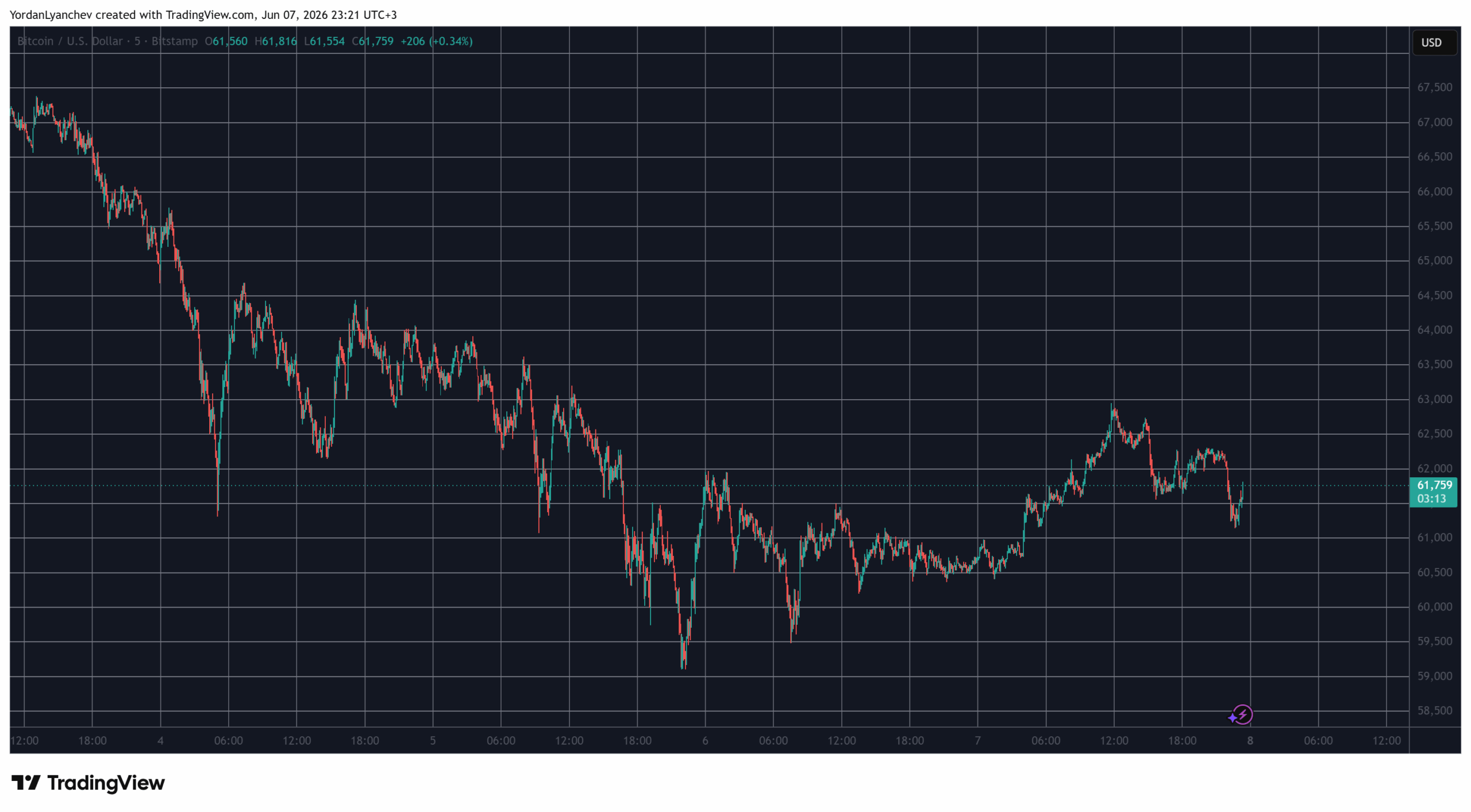
Bitcoin’s price reacted immediately to the attacks but in a rather dull manner. It dropped from over $62,000 to $61,200 before it rebounded and now sits close to its starting point.
On a broader scale, though, the asset has plunged by $20,000 since its mid-May peak at $82,000, and analysts believe the next leg up could come after the war in the Middle East ends.
The post Bitcoin Price Reacts as Iran Strikes Israel and Trump Weighs In on a Peace Deal appeared first on CryptoPotato.

Crypto World
Cardano Price Prediction: ADA Reclaimed Top 15 Crypto by Market Cap as Whale Accumulates

Cardano price is trading around $0.165, after large holders quietly accumulated more than 30 million ADA over the past week, bumping up its prediction. The buying briefly pushed ADA ahead of Stellar into 15th place by market cap. Although the ranking did not last, the accumulation remains notable. Santiment data suggests this was part of a steady buying trend rather than a one-off trade.
According to The Crypto Basic, large wallet ADA holdings climbed to 5.69 billion over seven days. Meanwhile, wallets holding between 100,000 and 100 million ADA reached a combined 25.6 billion ADA. That marks the highest balance in roughly three and a half years. The trend suggests bigger investors continue adding despite the recent pullback.
Charles Hoskinson has also reiterated his belief that ADA could return to the top 10 before the year’s end. Reaching that goal would require a substantial rally from current levels to overtake Dogecoin by market capitalization. Whether whales are positioning for that outcome or simply accumulating at lower prices remains the key question.
Meanwhile, capital continues rotating into select altcoins as Bitcoin and Ethereum consolidate. That backdrop could eventually support ADA if demand strengthens. Even so, traders will likely wait for technical confirmation before calling for a sustained recovery.
Discover: The Best Token Presales
Cardano Price Prediction: Can ADA Reach $0.19 This Week?
ADA is trading around $0.165, extending its long pullback. The token is testing support near $0.165, while the first resistance now sits around $0.172. A move above that level could reopen the path toward $0.180 if buying volume improves.
Some forecasting models still expect a modest recovery over the coming weeks, while a more cautious outlook continues to place stronger support near $0.148. That leaves traders watching whether the $0.165 area can hold before momentum weakens further.

Recent price action has largely reflected improving sentiment across the altcoin market instead of a Cardano-specific catalyst. As a result, ADA remains highly sensitive to overall crypto market flows. If risk appetite returns, the current dip could become another accumulation zone.
Three scenarios remain worth watching. In the bullish case, ADA defends $0.165 support, volume improves, and price rebounds toward $0.172 and $0.180. The base case sees consolidation between $0.165 and $0.172 while whale accumulation continues. However, if market sentiment deteriorates, ADA could revisit the $0.148 support, putting the recent recovery attempt at risk.
Trade Cardano and Major Altcoins on Bybit and Get a Chance to Win Our $1,000 USDT Airdrop
Maxi Doge Targets Early Mover Upside as Cardano Tests Key Levels
ADA’s accumulation story is compelling, but at a current market cap in the billions, the math on a life-changing return requires that 76% move, Hoskinson is projecting at minimum. Traders running tighter risk parameters are already eyeing earlier-stage setups where the entry price itself does more of the work. That’s the positioning logic behind presale allocations in the current cycle.
Maxi Doge ($MAXI) is an ERC-20 meme token built around a 240-lb canine mascot embodying the 1000x leverage trading mentality. Think gym-bro culture meets DeFi degenerate energy, packaged with actual utility mechanics.
The presale has raised $4.8 million at a current price of $0.000283, with dynamic staking APY available to early holders. The project offers holder-only trading competitions with leaderboard rewards, a Maxi Fund treasury earmarked for liquidity and partnerships, and meme-first marketing that has driven genuine community traction.
Dogecoin’s own price mechanics illustrate how community-driven meme assets can defy conventional valuation logic when sentiment aligns.
Research Maxi Doge here before the presale window closes.
Discover: The Best Crypto to Diversify Your Portfolio
The post Cardano Price Prediction: ADA Reclaimed Top 15 Crypto by Market Cap as Whale Accumulates appeared first on Cryptonews.
Crypto World
Gate IPO Access Phase 2 Opens Jersey Mike’s (JMKE) Indication Subscription with Dual-Currency Support in USDT and GUSD


Gate, a leading global digital asset trading platform, has announced the launch of the second project on its IPO Access platform, Jersey Mike’s (JMKE). Users can participate in the IPO indication subscription using USDT or GUSD for the opportunity to receive allocated shares and trade them directly on Gate’s stock market after the company’s public listing.
The indication subscription for Jersey Mike’s (JMKE) will open on July 27, 2026, 02:00 (UTC) and close on July 29, 2026, 02:00 (UTC). The indicative IPO price range is $21–$25 per share, with the final subscription price subject to the official IPO pricing. Users can participate with a minimum commitment of 100 USDT or 100 GUSD and a maximum commitment of 500,000 USDT or 500,000 GUSD, with no additional subscription fees.
The offering will be split equally between a USDT subscription pool and a GUSD subscription pool, each representing 50% of the total allocation. Allocation will be determined based on each user’s hourly average locked commitment throughout the subscription period. Users who participate earlier and maintain their commitment for a longer duration will receive a higher allocation weight. The project’s subscription arrangements will be dynamically adjusted based on overall interest levels, and there is a possibility that the subscription period could be closed early.
Please note that this is an indication subscription, meaning that submitting a subscription interest does not guarantee an allocation. Participants may receive a full allocation, partial allocation, or no allocation at all, depending on the final IPO allocation received by Gate, overall subscription demand, and the official IPO offering results. Allocated shares are expected to be distributed to users’ Gate Stocks accounts before the IPO begins trading, with the current estimated distribution date of July 30, 2026. The shares will be 100% unlocked with no lock-up period, allowing users to trade them through Gate Stocks once the company is officially listed.
The exact distribution and trading schedule will be subject to the final IPO timetable. If the platform ultimately does not receive any allocation, users who subscribe with USDT will receive an interest subsidy calculated at an annualized rate of 3.8% based on their locked subscription funds. Users subscribing with GUSD will continue to earn the standard 3.8% annualized yield throughout the subscription period.
Founded in 1956, Jersey Mike’s is one of North America’s leading submarine sandwich restaurant chains, operating more than 3,300 locations across the United States and Canada. In 2025, global alternative asset manager Blackstone acquired a majority stake in the company, which subsequently announced plans to pursue a U.S. public listing. The addition of Jersey Mike’s (JMKE) further expands Gate’s IPO Access offering, providing users with another opportunity to participate in high-profile global IPOs. Users are encouraged to conduct their own independent assessments based on publicly available information, market conditions, and their individual needs.
Gate has built a comprehensive global equities investment ecosystem, supporting trading for more than 12,500 stocks and ETFs across the U.S., Hong Kong, and Korean markets. The platform also offers fractional share trading, stock dividends, cross-broker stock transfers for U.S. and Hong Kong equities, as well as corporate action services such as stock splits and reverse splits. In addition, Gate continues to expand its multi-asset investment ecosystem through gStocks tokenized securities, Pre-IPOs, and IPO Access, creating a comprehensive investment framework that spans pre-IPO opportunities, public market investing, and tokenized securities. Looking ahead, Gate will continue to broaden access to premium global assets, strengthen its multi-asset trading infrastructure, and deliver a more open, efficient, and seamless global investment experience.
Learn more here.
About Gate
Gate, founded in 2013 by Dr. Han, is one of the world’s leading cryptocurrency and integrated financial services platforms. Serving over 58 million users globally, it supports trading across 4,800+ digital assets and 12,500+ stock assets, while providing access to a comprehensive range of TradFi assets, including metals, stocks, indices, forex, and commodities, delivering users a one-stop, multi-asset trading experience and blockchain-related services. As an industry benchmark, Gate was among the first platforms to implement 100% Proof of Reserves. Its ecosystem includes Gate Wallet, Gate Ventures, Gate for AI Agent, and a wide range of products and services.
For more information, please visit: Website | X | Telegram | LinkedIn | Instagram | YouTube
Disclaimer:
This content does not constitute an offer, solicitation, or recommendation. You should always seek independent professional advice before making investment decisions. Note that Gate may restrict or prohibit certain services in specific jurisdictions. For more information, please read the User Agreement.
The post Gate IPO Access Phase 2 Opens Jersey Mike’s (JMKE) Indication Subscription with Dual-Currency Support in USDT and GUSD appeared first on BeInCrypto.
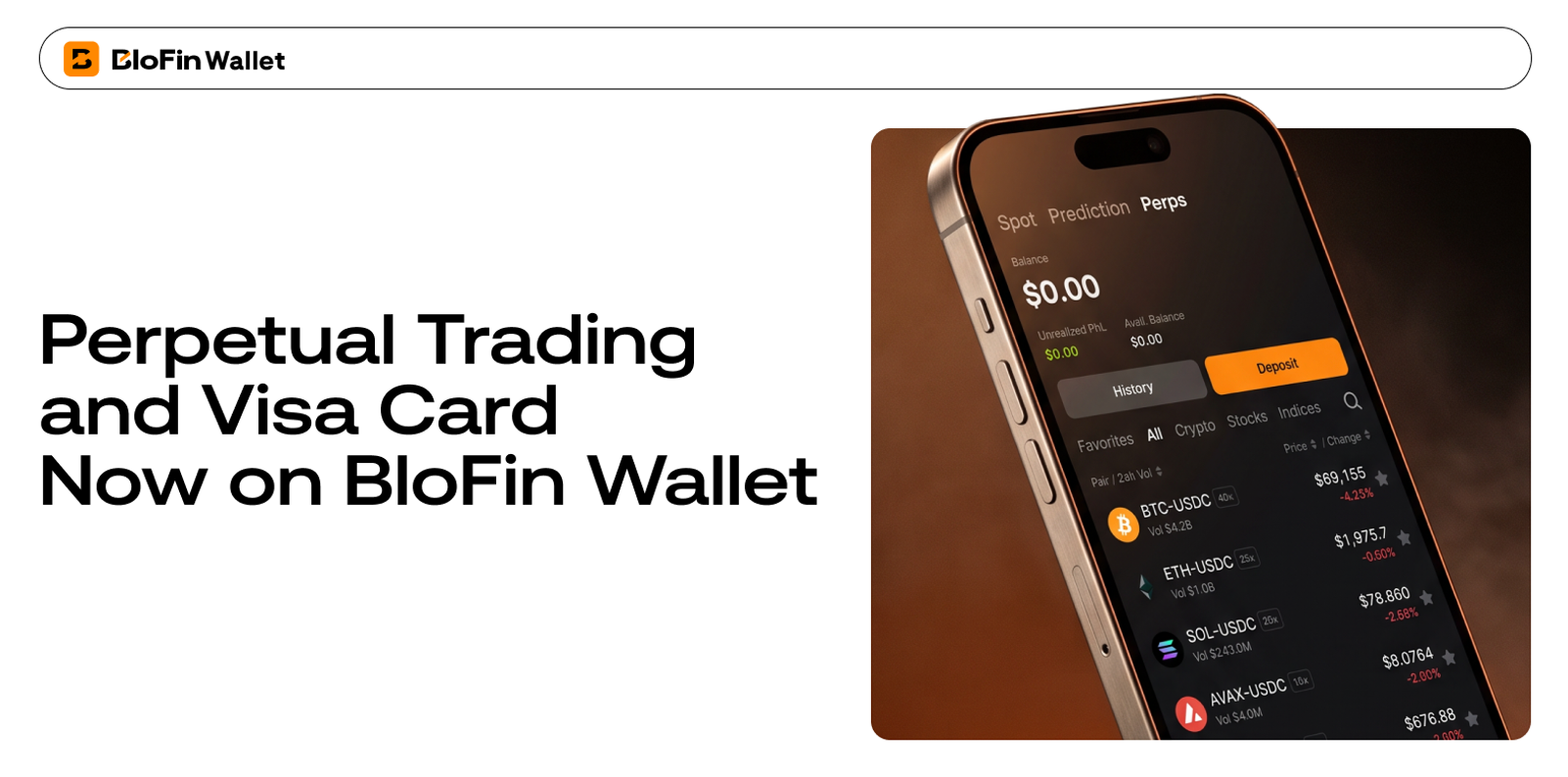

BloFin Wallet has reached a significant milestone in its evolution, introducing Perpetual Contract Trading and the BloFin Wallet Visa Card, two updates that push the wallet well beyond what most crypto wallets are built to do.
From Holding to Trading: Perpetual Contracts Now Live
BloFin Wallet users can now trade perpetual contracts directly from their wallet, with access to 100+ tokens spanning both cryptocurrency and tradfi assets. Instead of moving funds to a separate exchange, users can trade within the same wallet they already use for swaps, onramp, and earn.
The update also introduces a referral program tied to perpetual trading. Users can share their invite link and earn fee rebates based on their referrals’ trading activity, creating a direct connection between community growth and personal reward.
The Next Era of Finance
BloFin Wallet has also launched the BloFin Wallet Card, a Visa card that lets users spend their digital assets wherever Visa is accepted. The card supports Apple Pay and Google Pay, carries zero issuance and annual fees, and imposes no lock-up period on funds. Users hold their assets until the moment of purchase.
The next phase of digital finance will not be defined by another standalone wallet, exchange, payment card, or yield product. It will be defined by how seamlessly these functions work together. Users increasingly expect to trade, hold, earn, and spend from a single financial environment, without repeatedly moving funds between platforms, waiting through settlement delays, or sacrificing control of their assets. BloFin Wallet is helping pioneer this all-in-one experience. Its ambition extends beyond asset storage: it is building a unified gateway where digital assets can move naturally between investment, trading, yield generation, and everyday spending. By reducing the friction between these activities, BloFin Wallet aims to make crypto capital as accessible and useful as money in a traditional account, while preserving the speed and flexibility of digital markets
The BloFin Wallet Card is a key part of that vision. Alongside the card, BloFin Wallet offers an Earn product with unlimited 6%+ APY, enabling users to put idle assets to work while keeping them accessible. Together, Card and Earn create a more efficient capital loop: assets can remain productive when not being spent, stay available when opportunities arise, and be used directly for real-world payments when needed. This reflects a broader shift in the market. Crypto users are moving beyond speculation alone and increasingly looking for practical financial utility. At the same time, fragmented experiences, one platform for trading, another for custody, another for yield, and another for payments, are becoming less acceptable. The platforms positioned to lead the next cycle will be those that combine deep liquidity, capital efficiency, payment access, and intuitive asset management within one connected experience.
BloFin Wallet’s long-term opportunity is to become a financial operating system for the digital-asset economy: one place where users can enter the market, manage risk, grow their assets, and use their wealth in everyday life. The future of finance will not ask users to choose between trading and spending, or between earning and accessibility. It will bring all of these experiences together, and make the transitions between them nearly invisible.
Trade Smarter, Hold Safer
Taken together, these updates say something about where BloFin Wallet is headed. Where most wallets stop at storage and swaps, BloFin Wallet now covers the full arc from on-chain trading to real-world spending, with earning opportunities built in throughout. The BloFin Wallet app is available on the Google Play Store and the Apple App Store.
—-—-—-—-—-—-—-—-—-—-—-—-—-—-—-—-—-—-—-—-—-—-—-—-—-—-
About BloFin Wallet
BloFin Wallet is an on-chain wallet designed to support secure, self-custodied management of digital assets across multiple blockchain networks. The wallet allows users to store, manage, and interact with their crypto assets while maintaining full ownership and control. BloFin Wallet supports multi-chain asset management, primarily across major EVM and Solana networks, and provides access to on-chain applications and services. It is also integrated with the BloFin ecosystem, enabling users to connect their wallet assets with BloFin’s broader financial services. With a focus on security, usability, and interoperability, BloFin Wallet serves as a practical entry point for users engaging with the ecosystem. For more information, please visit wallet.blofin.com.
The post BloFin Wallet Unifies Visa Payments and Perpetual Trading for the Next Era of Finance appeared first on BeInCrypto.
Crypto World
XRP Price Fails to Complete Cup and Handle as Ripple Introduces Mint to Solve RLUSD Problem
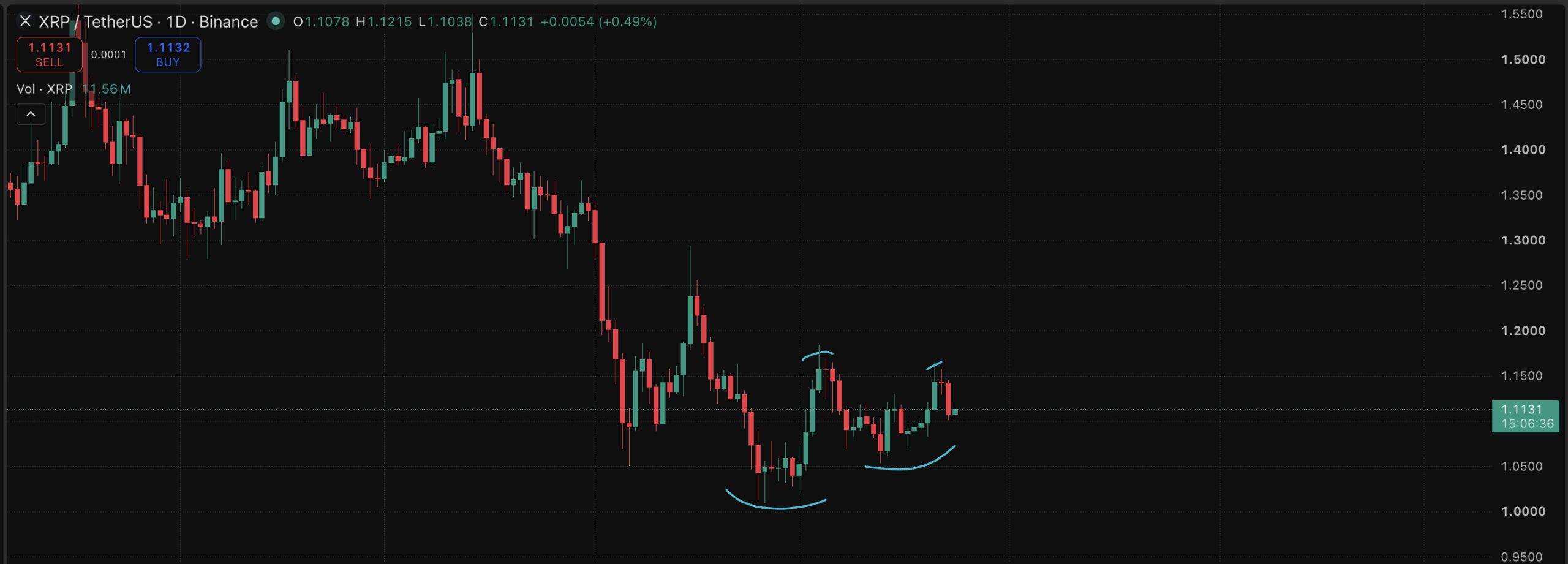
XRP is caught between a compelling technical setup and stubborn overhead price resistance. That gap is testing bullish patience. The cup and handle pattern that traders have tracked for weeks now faces invalidation. XRP trades near $1.11, remaining well below the former $2.68 to $2.77 breakout zone discussed in earlier bullish scenarios.
Ripple has introduced a dedicated Mint function to streamline RLUSD issuance. The update targets minting delays and improves settlement predictability. It strengthens Ripple’s enterprise infrastructure and could make RLUSD more attractive to institutions. However, the direct benefit favors stablecoin adoption more than immediate spot XRP demand.
Regulatory clarity across Ripple’s product suite remains the bigger variable for XRP price. Even so, infrastructure upgrades could improve long-term confidence if institutional usage continues expanding. Until then, traders still need stronger demand to reclaim higher resistance levels.
Meanwhile, the macro backdrop remains challenging. Megacap technology stocks pressured major U.S. indexes as AI spending concerns resurfaced. Tariff headlines also encouraged a risk-off mood across financial markets. When equities weaken, altcoins rarely avoid the selling pressure.
Discover: The Best Crypto to Diversify Your Portfolio
Can XRP Price Reach $5 Before the Cup-and-Handle Breaks Down?
XRP is trading near $1.11, sitting just below a key resistance zone that many analysts continue to monitor. The measured move target around $5.18 still depends on a sustained breakout above previous swing highs. Meanwhile, the 50-day and 200-day EMAs remain below the current price, keeping the long-term trend constructive.
The breakout trigger remains straightforward. A daily close above nearby resistance with strong volume could open the door to a move toward the next resistance zone around $1.30 to $1.40. Until then, XRP may continue trading within its recent range, frustrating both bulls and bears.

On the downside, losing support around $1.08 to $1.10 could invite another test of lower levels. Some wave analysts still warn that a deeper correction is possible if momentum continues fading. However, those bearish projections remain conditional rather than confirmed.
Long-term targets such as $33 to $67 or even $60 are still circulating among well-known XRP analysts. Even so, those are multi-cycle projections rather than near-term expectations. For now, the bigger question is whether XRP can reclaim higher resistance and build enough momentum for a sustained breakout.
Trade XRP on Bybit and Get a Chance to Win Our $1,000 USDT Airdrop
LiquidChain Targets Early Mover Upside as XRP Tests Key Levels
XRP’s cup-and-handle setup illustrates the core frustration of late-cycle positioning: even a technically clean pattern at a $70 billion market cap requires a significant capital event to move the needle. Traders rotating out of stalled large-caps are increasingly looking at early-stage infrastructure plays where the entry price still reflects discovery rather than expectation.
LiquidChain is one project drawing attention. The Layer 3 protocol fuses Bitcoin, Ethereum, and Solana liquidity into a single execution environment. It boasts a Unified Liquidity Layer with Single-Step Execution and Verifiable Settlement, meaning developers deploy once and access all three ecosystems without bridging overhead.
Third layer. Third eye. — LiquidChain (@getliquidchain) July 24, 2026

Coincidence? The Order thinks not.https://t.co/vqvBcdSQYC pic.twitter.com/TkjPSubTRQ
The presale is currently priced at $0.01483, with $920K raised to date. The project is approaching the $1M milestone, which historically marks an inflection point in presale momentum.
Explore LiquidChain’s presale details here.
Discover: The Best Token Presales
The post XRP Price Fails to Complete Cup and Handle as Ripple Introduces Mint to Solve RLUSD Problem appeared first on Cryptonews.
Tokenized equities volume on Solana jumped from $1.34 million to $3.32 billion over the past year. Solana commented on this development with “Internet Capital Markets.”
The figure marks a roughly 2,400-fold increase. It points to accelerating institutional interest in onchain capital markets.
Solana Equities Lead a Broader Tokenization Surge
The growth mirrors a wider shift across tokenized assets on the network. Monthly volume across commodities, credit, collectibles, and equities climbed from roughly $156 million in June 2025 to several billion dollars a year later. Solana’s official account shared the chart data on X.
Equities alone rose from $670 million in April to $3.3 billion in June, an all-time high for the category. That expansion follows a Securitize NYSE debut. Securitize listed on the New York Stock Exchange (NYSE) in July and tokenized SpaceX-linked SECZ shares on the network.
The trend also builds on a new tokenization record set earlier this summer. SOL price, however, lagged behind the network’s onchain growth.
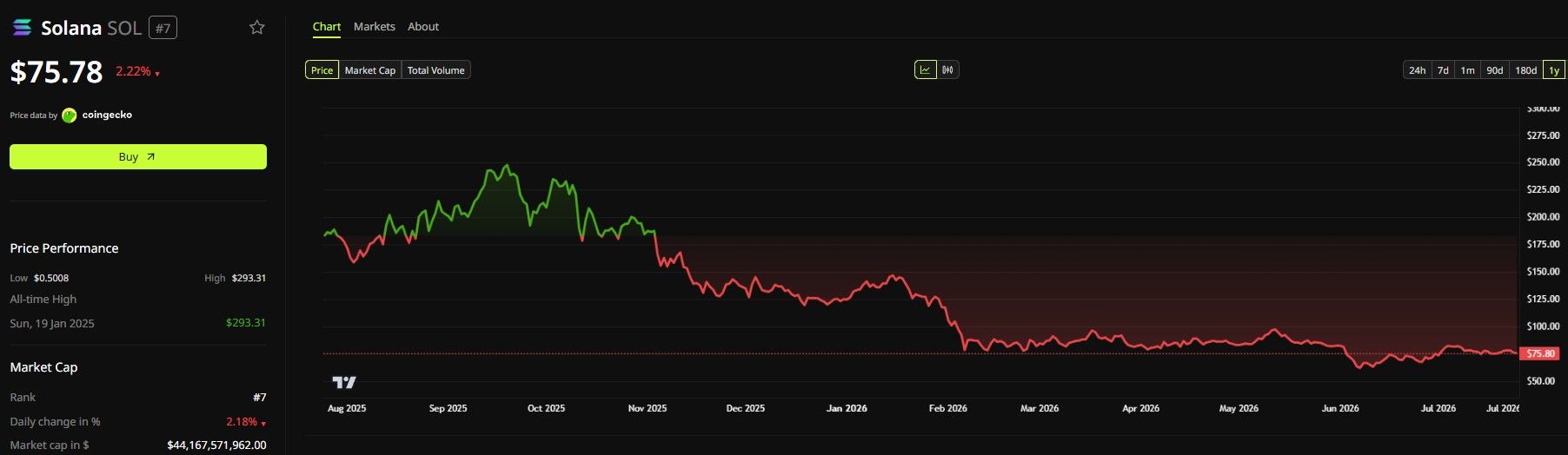
The token trades near $76, down more than 2% over the past day, according to BeInCrypto data. Tokenized stocks on the network totaled $4.9 billion in the first half of 2026. That figure marks a sixfold jump from $775 million in the back half of 2025.

Horsley Frames Solana Data as Validation
Horsley is co-founder and chief executive officer of Bitwise Asset Management. He framed the jump as evidence that traditional finance is migrating onchain.
The network reportedly processed more than 95% of global cross-chain tokenized stock volume in recent weeks. That figure comes from the report Horsley cited.
Grayscale analysts likewise named five altcoins benefiting from tokenization that could gain further if the momentum continues. Their thesis rests on the same trend Horsley described, namely that issuers keep choosing the network for onchain listings.
Institutional Interest Extends Beyond the US
The trend extends well beyond American markets. SBI Holdings recently struck a partnership with Solana Foundation to build onchain financial infrastructure for Japan. The deal targets yen-pegged stablecoins alongside tokenized assets.
Still, the broader picture carries a caveat. A recent industry report found that roughly half of the broader tokenization market shows no weekly trading activity at all. Headline volume figures, meanwhile, keep climbing.
Whether the pace continues may depend on how many more issuers choose to list shares onchain in the months ahead. That trend matters more than any single report or announcement.
The post Solana Tokenized-Equity Volume Is Up Roughly 2,400x Year-Over-Year appeared first on BeInCrypto.


Key takeaways
- Cardano (ADA) is trading below $0.168 after being rejected at the 50-day EMA.
- Derivatives data presents mixed signals, with the long-to-short ratio remaining bullish while funding rates have turned negative.
- Large Cardano whales have accumulated approximately 120 million ADA since Monday.
Cardano (ADA) extended its losses on Friday, trading below $0.168 after buyers failed to overcome resistance at the 50-day Exponential Moving Average (EMA) earlier in the week.
Although some large investors continue accumulating ADA, mixed derivatives data and subdued technical indicators suggest the market remains uncertain about the cryptocurrency’s next major move.
Derivatives data reflects divided trader sentiment
Cardano’s derivatives market is sending conflicting signals. According to CoinGlass data, ADA’s long-to-short ratio stood at 1.07 on Friday.
A reading above one indicates that more traders are positioning for price gains than declines, reflecting a modest bullish bias among leveraged traders.
However, other derivatives metrics tell a different story. Cardano’s perpetual futures funding rates flipped into negative territory on Thursday and remained at approximately -0.014 on Friday.
Negative funding rates indicate that short sellers are paying long-position holders, typically signaling increased bearish sentiment and expectations of further downside.
The contrast between bullish positioning and negative funding highlights growing uncertainty among traders.
On-chain data suggests larger investors have continued buying despite recent price weakness.
According to Santiment, wallets holding 1 million to 10 million ADA and 10 million to 100 million ADA have accumulated approximately 120 million ADA since Monday.
Meanwhile, wallets containing 100,000 to 1 million ADA have shown relatively little activity.
The selective accumulation by larger holders may indicate confidence in Cardano’s longer-term outlook, although the buying has not yet been strong enough to trigger a broader shift in market sentiment.
ADA remains below major moving averages
From a technical standpoint, Cardano continues to trade within a broader bearish structure.
ADA remains below the 50-day EMA ($0.176), the 100-day EMA ($0.202), and the 200-day EMA ($0.267)
The inability to reclaim these levels suggests sellers remain in control of the medium-term trend.
Technical momentum indicators point to a market lacking clear direction. The Relative Strength Index (RSI) is hovering near 48, reflecting balanced buying and selling pressure without a strong trend.
Meanwhile, the Moving Average Convergence Divergence (MACD) remains slightly above the zero line, suggesting that although occasional recovery attempts continue, bullish momentum remains relatively weak.
Adding to the technical challenge, a previously broken long-term downtrend line near $0.197 has now become a significant resistance level.
For bullish momentum to strengthen, ADA must first overcome several nearby resistance levels, including $0.176 (50-day EMA) and $0.197 (former long-term trendline resistance).
A sustained move above these barriers would improve Cardano’s short-term outlook.
On the downside, traders are watching:
- $0.150 – Immediate horizontal support
- $0.138 – Key Fibonacci support
A break below $0.138 could expose ADA to fresh lows and reinforce the broader bearish trend.

Cardano continues to face selling pressure after failing to reclaim the 50-day EMA, while mixed derivatives signals reflect uncertainty among market participants.
For now, ADA’s ability to hold above $0.150 while reclaiming the $0.173-$0.176 resistance zone will likely determine whether the token can build a stronger recovery or extend its recent decline.


Zhibao Technology has signed a non-binding agreement that could bring about 3,500 Bitcoin, valued at roughly $220 million, onto its balance sheet through a proposed stock sale paid in BTC.
Summary
- Zhibao has signed a non binding agreement to receive about 3,500 Bitcoin through a proposed $220 million stock sale.
- The proposed deal would give the investor majority control of Zhibao’s board while establishing a Bitcoin treasury if completed.
- The announcement comes as public companies continue adopting different strategies to build or manage Bitcoin reserves.
According to a Wednesday press release from Nasdaq-listed Zhibao Technology, the Shanghai-based digital insurance company has entered into a non-binding term sheet with Joyertech and Information OPC for a proposed private investment in public equity (PIPE) financing that would be settled using approximately 3,500 Bitcoin instead of cash.
If completed, the buyer or its designated entity would subscribe to newly issued securities, with the Bitcoin amount remaining subject to final valuation, custodial arrangements, audit verification, regulatory review, Nasdaq compliance and the execution of definitive agreements.
The proposed transaction would do more than add Bitcoin to the company’s balance sheet. Under the term sheet, Joyertech is expected to nominate a majority of Zhibao’s board members when the financing closes, giving the investor effective control of the company while Zhibao continues operating its existing insurance business during the initial transition period.
A PIPE financing allows private investors to purchase newly issued shares directly from a publicly listed company instead of acquiring stock through public markets. In this case, the consideration would be Bitcoin rather than cash, allowing Zhibao to establish a sizeable Bitcoin treasury immediately if the transaction receives final approval.
The company, which trades on Nasdaq under the ticker ZBAO, describes itself as a digital insurance technology provider focused on China’s embedded insurance market. It launched what it describes as the country’s first digital insurance brokerage platform in 2020 using its own cloud-based platform-as-a-service infrastructure.
Bitcoin-funded treasury proposal reshapes ownership
While the insurance business would continue operating after the financing, company disclosures indicate the current management team is expected to oversee day-to-day operations only until a future separation, disposal or restructuring of the legacy business is completed.
The structure differs from the path followed by many public companies that first raise cash before purchasing Bitcoin in the open market. Instead, the proposed financing would transfer Bitcoin directly to the company as payment for newly issued shares, allowing the treasury to be established as part of the financing itself.
Investor reaction was immediate after the announcement. Zhibao shares climbed from about $0.15 to nearly $0.40 within four hours before giving back part of the gains and stabilizing near $0.24 later in the session. Even after the pullback, the stock remained roughly 60% above its pre-announcement level.
Only a week earlier, on July 15, Zhibao disclosed that it had received a Nasdaq deficiency notice after its share price traded below the exchange’s minimum $1 bid requirement. At the time, the stock was changing hands around $0.22. The company now has until Jan. 6, 2027, to regain compliance with Nasdaq’s listing standards.
Treasury strategies continue to diversify
The proposal arrives as public companies continue experimenting with different ways to build Bitcoin reserves, although recent announcements show that no single treasury model has emerged.
Unlike companies that depend on repeated share offerings to fund Bitcoin purchases, some businesses are tying future accumulation to operating cash flow. Earlier this month, ORANGE JUICE announced it had raised $40 million to acquire profitable American businesses, with surplus cash from those operations expected to finance future Bitcoin purchases alongside additional acquisitions.
Other firms continue to rely on capital markets. Earlier this month, Japan’s Bitcoin Japan secured plans to raise approximately 9.66 billion yen, allocating about 662 million yen for its first funded Bitcoin treasury purchase after a previous fundraising effort failed to provide enough capital for digital asset acquisitions.
Capital B has taken another route by expanding its financing capacity before making additional purchases. In June, shareholders approved a framework authorizing up to €5 billion in capital increases and €100 billion in credit instruments to support future Bitcoin acquisitions as part of the French company’s long-term treasury strategy.
Not every treasury company is increasing its Bitcoin exposure, however. Earlier this month, Empery disclosed that it had sold 1,400 Bitcoin for about $87.1 million since May, using the proceeds to repay debt, finance acquisitions, cover legal expenses and strengthen liquidity while maintaining a smaller Bitcoin reserve.
More than 150 publicly traded companies now hold Bitcoin on their balance sheets, although recent developments have shown that treasury strategies increasingly depend on each company’s financing needs, operating model and balance sheet priorities rather than a single playbook.
For Zhibao, however, the proposed transaction remains far from complete. Company filings state that the agreement is non-binding and still depends on satisfactory legal, financial and operational due diligence, execution of definitive agreements, corporate and regulatory approvals, continued Nasdaq compliance and other customary closing conditions before any Bitcoin changes hands.

The European Union is tightening its crypto-related sanctions against Belarus by extending a prohibition on certain crypto roles and ownership interests to a broader range of service providers under the EU’s MiCA (Markets in Crypto-Assets) framework.
According to the EU’s Council Decision (CFSP) 2026/1847, adopted on Thursday, Belarusian nationals and residents will be barred from owning, controlling, or managing EU-based crypto exchange and other MiCA-regulated crypto service entities starting Aug. 25. The decision also sets an earlier entry into force date of July 24 for the underlying legal instrument.
Key takeaways
- The EU sanctions change is set by Council Decision (CFSP) 2026/1847 and will apply to additional crypto-asset activities from Aug. 25.
- Belarusian nationals and residents cannot own or control EU entities providing MiCA-defined crypto services, nor hold positions on their governing bodies.
- The expansion builds on a prior restriction that focused only on wallet, account, and custody-type services.
- The update arrives shortly after MiCA’s transition period ended on July 1, intensifying compliance pressure on crypto firms operating in the EU.
- It fits into a wider EU strategy to disrupt crypto-related pathways described as supporting Russia’s sanctions evasion.
What the EU sanctions amendment changes
The EU decision, published under Council Decision (CFSP) 2026/1847, amends the bloc’s sanctions framework aimed at Belarus. While an earlier restriction applied to companies providing crypto wallet, account, or custody services, the new measure broadens the scope to cover “any other crypto-asset services” that fall within MiCA’s regulatory categories.
From Aug. 25, the prohibition will extend to EU-based entities offering these services if the entity is subject to MiCA’s defined service classifications. Under the amendment, Belarusian nationals and residents are barred from:
- Owning or controlling such an EU-based entity; and
- Holding positions on its governing body.
MiCA’s service categories, as set out in the MiCA regulation, include activities such as operating trading platforms, exchanging crypto assets, executing and transmitting client orders, placing crypto assets, providing transfers, and offering investment advice or portfolio management. The restriction is therefore not limited to custody or retail wallet services, but can reach a wider set of operational roles involved in crypto market infrastructure and client-facing financial functions.
The decision itself indicates July 24 as the entry into force date for the overall legal act, while the expanded crypto provision specifically starts on Aug. 25.
MiCA transition ends, enforcement pressure rises
The sanctions expansion comes in close proximity to a major regulatory milestone: the end of MiCA’s transition period on July 1. Cointelegraph previously reported that when the MiCA transition concluded, crypto companies lacking proper authorization were ordered to wind down or face enforcement actions (coverage referenced in the original material). That shift matters because, in practice, sanctions aimed at the ownership and governance of MiCA-regulated firms can directly affect corporate structures, board composition, and controlling interests of operators seeking to comply with EU authorization rules.
With the transition window closed, the EU’s approach becomes less about “temporary” arrangements and more about formal regulatory alignment—while simultaneously tightening sanctions rules that constrain who can sit in ownership and management positions within regulated crypto businesses.
Part of a wider EU effort targeting Russia-linked crypto pathways
Beyond Belarus, the EU has been escalating efforts tied to Russia-related sanctions evasion through financial networks, including crypto. As described in the referenced original material, on Thursday the EU—within its 21st sanctions package against Russia—extended a transaction ban to 14 crypto-related service platforms outside the bloc. The package also introduced a mechanism intended to allow the EU to prohibit dealings with any foreign crypto provider used by Russia to evade sanctions.
The decision further builds on an earlier June 11 proposal that targeted 11 crypto platforms, according to the original coverage cited. Taken together, these steps signal that the EU is using sanctions as both a direct tool (blocking specific providers or transactions) and an indirect governance lever (restricting who may control or manage certain regulated entities).
Broader sanctions friction: UK action and disputes around platform-linked allegations
The EU’s tightening measures also follow similar steps in other jurisdictions. Earlier, the UK reportedly sanctioned Huobi Global S.A., the Panamanian company behind HTX, on May 26, alleging support for Russia-linked financial networks involving sanctioned entities A7 and Garantex—an account reflected in the original material. HTX denied wrongdoing and, in commentary shared with Cointelegraph in the referenced coverage, stated that regulatory compliance remains a top priority and that it adheres to the regulatory frameworks of the jurisdictions where it operates.
While the EU’s new Belarus-focused amendment does not depend on those UK allegations, the parallel underscores a recurring pattern in enforcement discussions: regulators and sanctions bodies are increasingly focused on the operational role crypto platforms and related service providers can play in cross-border capital movement—whether via direct compliance frameworks or via allegations of linkage to sanctioned networks.
What EU-regulated crypto firms should watch next
For operators inside the EU, the key risk is not only whether a service provider has a MiCA authorization, but also whether its ownership and governance structure could run afoul of sanctions rules as expanded. Compliance teams should monitor the July 24 entry into force and the Aug. 25 start date carefully, and review board and controlling-interest arrangements to ensure they match both MiCA obligations and the evolving sanctions prohibitions.


Key takeaways
- Dogecoin (DOGE) is trading below $0.070 after dropping 5% in the previous session.
- Risk-off sentiment driven by geopolitical tensions has reduced demand for speculative assets like meme coins.
- DOGE futures open interest has declined, while trading volume has surged 76%, indicating increased retail activity.
Dogecoin (DOGE) remained under pressure on Friday, trading below $0.070 after suffering a 5% decline in the previous trading session.
The world’s largest memecoin has weakened alongside the broader cryptocurrency market as investors reduce exposure to speculative assets amid heightened geopolitical tensions and deteriorating market sentiment.
Geopolitical uncertainty weighs on memecoins
Dogecoin has historically been one of the most sentiment-driven cryptocurrencies, with its price closely tied to retail investor enthusiasm and broader market risk appetite.
Recent geopolitical developments, including escalating tensions between the United States and Iran, have pushed investors toward a more cautious stance.
The decline in market confidence is reflected in CoinMarketCap’s Fear & Greed Index, which dropped to 37 on Friday from 40 earlier in the week, signaling that sentiment is shifting further toward fear.
As speculative demand fades, meme coins such as DOGE have experienced stronger selling pressure than many larger cryptocurrencies.
Dogecoin’s derivatives market presents a mixed picture. According to CoinGlass, DOGE futures open interest declined to approximately $1.10 billion, indicating a slight reduction in outstanding leveraged positions.
However, futures trading volume surged 76% to around $1.38 billion, suggesting retail traders remain highly active despite the recent price decline.
The increase in trading activity alongside falling prices points to heightened volatility rather than renewed bullish conviction.
Additional derivatives indicators continue to favor sellers. DOGE’s perpetual futures funding rate slipped to approximately -0.0016%, indicating that short sellers are paying long-position holders.
Negative funding rates generally reflect bearish market expectations and growing demand for short positions.
DOGE remains below key technical levels
From a technical perspective, Dogecoin continues to trade within a well-established downtrend.
The meme coin remains below both the 50-day EMA at $0.0788 and the 200-day EMA at $0.1032
Remaining beneath these indicators keeps the short-term and medium-term outlook tilted in favor of sellers.
Momentum indicators show bearish conditions persist, although DOGE is approaching oversold territory.
The Relative Strength Index (RSI) is hovering near 31, indicating selling pressure remains strong, and the asset is nearing levels where buyers may begin looking for value.
Meanwhile, the Moving Average Convergence Divergence (MACD) is testing its signal line, suggesting bearish momentum may continue building if sellers maintain control.
The next important support level lies at $0.0641. A daily close below this level could accelerate losses and trigger another wave of selling.
On the upside, buyers must overcome several resistance levels before sentiment can improve:
- $0.0700 – Immediate resistance
- $0.0777 – Secondary resistance
- $0.0788 – 50-day EMA
Together, these levels form a significant resistance zone that bulls must reclaim to signal a potential trend reversal.

Dogecoin remains vulnerable as weakening market sentiment and geopolitical uncertainty continue to pressure speculative assets.
Unless broader market sentiment improves and DOGE reclaims the $0.070–$0.079 resistance zone, the meme coin could remain on course to test support near $0.0641 in the coming sessions.

Odos is a popular decentralized exchange aggregator that helps users find efficient token swap routes across numerous DEXs and liquidity sources. Instead of acting as a custodian of user funds, the protocol is designed to let traders connect their own wallets and execute on-chain transactions. During this process, they retain full control of their assets, which never leave their custody.
The company behind it, however, has announced on July 23rd that it’s winding down operations, with the application entering read-only mode on July 27th. All company-operated services will permanently shut down on July 30, 2026.
The team has emphasized that Odos is non-custodial and has provided instructions for users seeking different guidance, so the following breaks down the most common questions you may have.
What Happens on July 27 and July 30 Regarding Odos DEX?
Can I still use Odos to swap tokens?
Yes, but only for a limited time. Existing users can continue to use the platform freely and as usual until July 27. On that date, the application will switch to read-only mode. From that day until July 30, users will only be able to view wallet balances and transaction histories. They will not be able to execute new swaps or any other interactive functions on the protocol.
Can I create a new account or wallet?
No. New account registrations, wallet creation through ODos, and new limit orders were disabled on the day the announcement to wind down was made – on July 23rd.
Will my crypto disappear after the shutdown?
No. As we mentioned above, Odos is non-custodial. This means that the company doesn’t hold any of your funds. Your crypto remains on the respective blockchain and is controlled by you, not by Odos.
Do I Need to Move My Funds?
I connected MetaMask, Rabby, Ledger, or another wallet. Do I need to do anything?
In most cases, no. If you used a self-custody wallet, your assets remained accessible through that wallet after Odos shuts down. You can simply continue using another aggregator or DeFi application going forward.
I created my wallet using Google, Apple, email, or another social login. What should I do?
If your wallet was created directly through Odos using a social or email login, the company advises that you should transfer your assets to another wallet or export your private key before July 30. Although instructions to access your wallet will remain available on the Odos official page even after the shutdown, completing the process early reduces the risk of unnecessary complications later.
Will the ODOS token disappear?
No. The ODOS token exists on-chain and is independent of the aggregator’s functioning. According to the company, it doesn’t take custody of the token or act as its market maker. This means that the shutdown shouldn’t alter its underlying on-chain mechanics.
The team also said that the Odos DAO operates separately from the company and that it will communicate any future decisions independently.
To the Odos community: after much consideration, the operating company behind Odos is winding down its operations. The app moves to read-only on July 27, and all Odos services shut down permanently on July 30, 2026. Odos is non-custodial: your assets remain yours and on-chain. If… pic.twitter.com/9btbBLyhRL
— ODOS (@odosprotocol) July 23, 2026
The post DEX Aggregator Odos is Shutting Down: What Users Need to Do Before July 30 appeared first on CryptoPotato.

Do you know what happened this week? Test your knowledge

Welsh retailers report a fall in shoppers
Cardano Price Prediction: ADA Reclaimed Top 15 Crypto by Market Cap as Whale Accumulates


-

 Fashion7 days ago
Weekend Open Thread – Corporette.com
-

 Politics6 days ago
The House | The City of London can help the new chancellor deliver growth in every postcode
-

 Crypto World6 days ago
Ripple Payments Joins MiCA With 14 Firms, Does It Mean Anything For XRP?
-
 Crypto World7 days ago
Two July Windows Left: The CLARITY Act’s Senate Fight and What Failure Means
-

 Politics5 days ago
Democrats look to World Cup watch parties to register thousands of voters
-

 Crypto World6 days ago
Ripple wins EU-wide access as ESMA adds it to MiCA register
-

 Crypto World3 days ago
Grayscale Files For Worldcoin ETF, WLD Registers Sharp Rise
-

 Tech3 days ago
Sail Virtually Aboard The “Itanic” With IA-64 Emulator
-

 NewsBeat4 days ago
Unregistered fitter used Gas Safe logo on business flyers
-
 Tech3 days ago
Turtle Beach Command Series KB7 review: a nifty screen-equipped gaming keyboard
-

 NewsBeat7 days ago
Registration is now open for March for Men with Kev 2026
-

 News Videos5 days ago
Big Money Is Entering XRP
-
 Business2 days ago
New Jersey voter registration controversy explained: How 6,600 noncitizens got on the rolls, and what happens next
-

 Crypto World6 days ago
Kaspersky exposes OkoBot’s 20-module crypto wallet attack
-

 Business7 days ago
Airlines warn Sunshine Protection Act could disrupt flight scheduling
-
 Entertainment3 days ago
Johnny Depp’s R-Rated Gothic Cult Classic Gets New Release Ahead of Sydney Sweeney Remake
-

 NewsBeat6 days ago
Durham County Council to send out electoral registration emails
-

 Crypto World6 days ago
MiCA Licensing Faces Delays as ESMA Adds 14 CASPs to Register
-

 Crypto World1 day ago
Ethics, other provisions in crypto Clarity Act to be further discussed
-

 Crypto World6 days ago
Chip Stocks Enter Bear Market After Moonshot Ai Unveils Kimi K3 Model
You must be logged in to post a comment Login