
Crypto World
Bitcoin Pulls Back From $78K As Persian Gulf Risk Trumps Institutional Bid

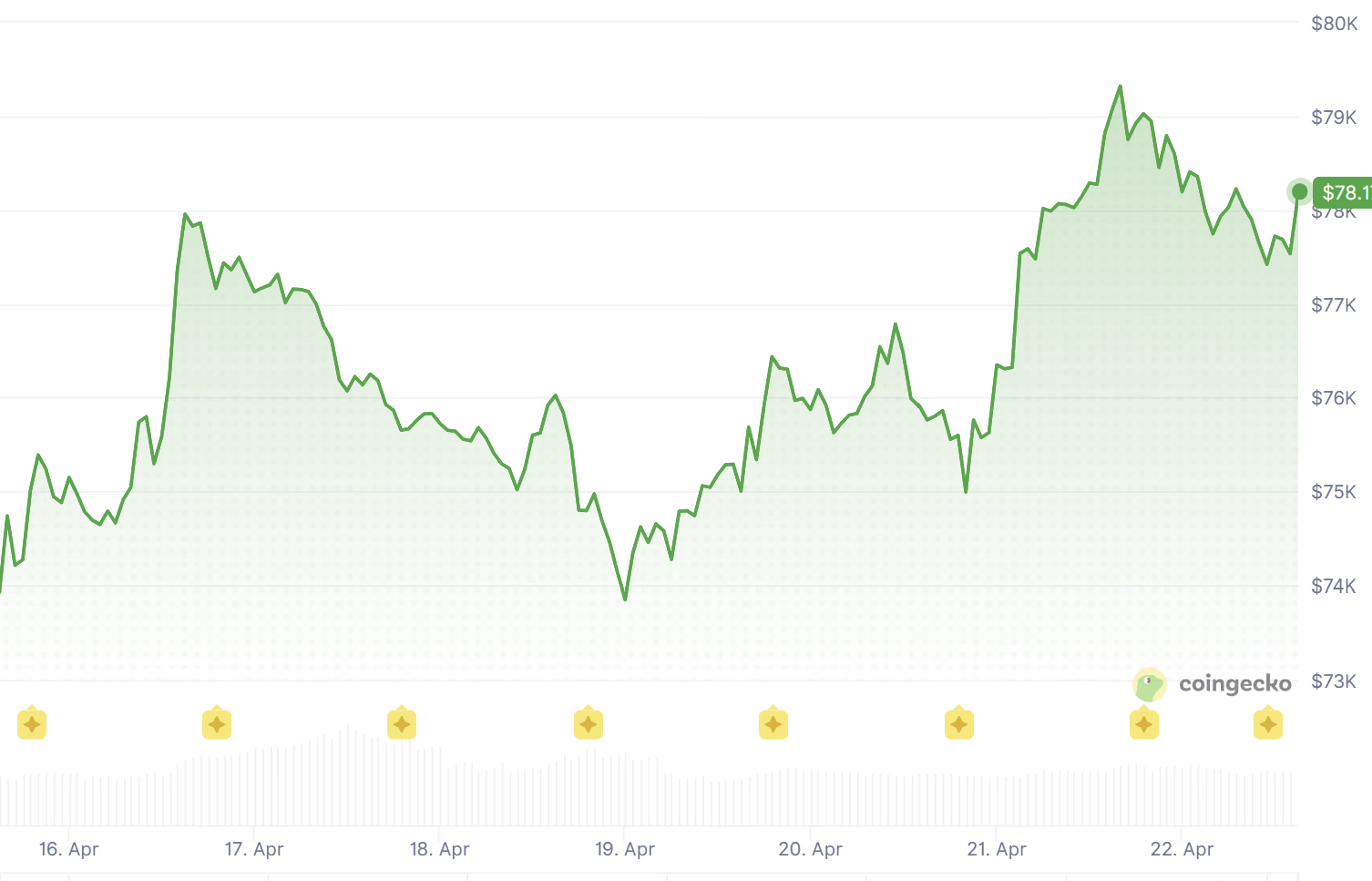
ETH is lagging with on-chain risk still elevated post-Kelp, while SOL dropped 3% and the broader market cap slipped 1.6% on the day.
Crypto markets sold off broadly on Thursday as traders booked profits after a week-long rally that had pushed Bitcoin back toward $80,000.
Bitcoin is changing hands at $77,955, down 1.1% over the past 24 hours, though still up 4.5% on the week and 9.9% on the month, according to CoinGecko. Ether slipped 2.8% to $2,331, turning its seven-day chart marginally negative.

Among the rest of the top ten, Solana is trading at $86, down 3% on the day, XRP is off 1.9%, and BNB is down 2% at $636. Total crypto market capitalization fell 1.6% to $2.69 trillion.
Strong ETF Bid
Despite Thursday’s red tape, the broader trend in spot ETF flows remains constructive.
U.S. spot Bitcoin ETFs took in $335 million on Tuesday, per Farside, the seventh consecutive session of positive flows. BlackRock’s iShares Bitcoin Trust (IBIT) accounted for $246.9 million of the total, with Fidelity’s FBTC adding $56.7 million and Bitwise’s BITB contributing $15.4 million. Cumulative flows across all 11 spot Bitcoin products are now back in positive territory for the year, with total AUM above $96.5 billion.
The flows indicate a notable reversal from the first quarter, when sustained outflows tracked alongside Bitcoin’s slide from above $100,000 toward the mid-$70Ks.
Geopolitical Risks Linger
Bitcoin’s failure to push decisively through $80,000 reflects an unresolved geopolitical overhang. Iran reportedly fired on three ships in the Strait of Hormuz on Wednesday, and a U.S. naval blockade in the region remains in place. Although President Trump has framed the current ceasefire as indefinite, peace talks have not progressed, and oil prices remain sensitive to regional headlines.
DeFi Grapples with Kelp Fallout
On-chain markets are still digesting last weekend’s Kelp DAO exploit. LayerZero’s post-mortem attributed the attack to North Korea’s Lazarus Group, which compromised two RPC nodes feeding the bridge’s verifier and minted 116,500 unbacked rsETH before depositing it on Aave as collateral and borrowing real WETH against it.
Aave’s risk service providers have modeled bad debt at between $123.7 million and $230.1 million, depending on how losses are allocated across rsETH holders. The protocol partially unfroze WETH on its Ethereum Core V3 market on Tuesday, and Arbitrum’s Security Council froze roughly $71 million of stolen ETH.



- Chainlink price retested $9.50 as bears keep sentiment in check.
- Bridgetower has adopted Chainlink’s solutions to tokenize $11 billion in securities.
- LINK price faces short-term resistance around $9.50-$10.50.
Chainlink’s LINK token trades at $9.31 after shedding gains from intraday highs of $9.50 earlier in the day.
The altcoin continues to hover below the $10 mark amid broader market dynamics.
Macro and geopolitical headwinds remain notable factors keeping bears in control, but could Bridgetower’s adoption of Chainlink to tokenize over $11 billion in securities provide fresh momentum for LINK?
Here’s a brief outlook for Chainlink’s price following this latest milestone in institutional asset tokenization.
Bridgetower’s Chainlink integration
According to an announcement, Bridgetower is set to leverage Chainlink’s institutional platform to tokenize assets across natural resources, energy, and metals.
The move will initially bring the DOM X Arizona Copper-Gold Project, a US-based natural resource initiative valued at $11 billion, on-chain.
NOW: Bridgetower adopts Chainlink to tokenize $11B+ in securities from the DOM X Arizona Copper-Gold Project.
By integrating the full Chainlink stack into its tokenization platform, BridgeTower is unlocking the issuance and distribution of tokenized securities at scale. pic.twitter.com/wnucctQ3IP
— Chainlink (@chainlink) April 23, 2026
Bridgetower will enable the issuance and management of the tokenized asset via Chainlink’s Cross-Chain Interoperability Protocol (CCIP), Proof of Reserve, and NAVLink solutions.
The integration embeds KYC, KYB, and AML controls at the protocol level within Bridgetower’s Tokenization Platform, supported by fiat and stablecoin rails from Iron, a MoonPay company.
“We’re excited to see Bridgetower move from a CRE early adopter to live institutional tokenized asset deployment around an $11 billion asset in just a few months. All the world’s largest financial institutions are watching tokenization right now, and they are looking for production evidence for powering assets at an institutional scale,” said Johann Eid, chief business officer of Chainlink Labs.
This development strengthens Chainlink’s momentum in the tokenization sector.
Recent months have seen major financial institutions and governments tap into the oracle network for real-world asset tokenization. Chainlink has helped secure over $100 billion in total assets, and analysts say this traction could reflect in LINK’s long-term price.
Chainlink price – short-term technical outlook
With LINK hovering around $9.30, key support lies in the $8.70–$9.00 range, while immediate resistance is between $9.50 and $10.50.
If buyers push higher, a potential rebound toward $14–$15 could follow. However, a breakdown on high volume could send prices lower toward support at $7.80.
Technical indicators support this mixed outlook. The RSI on the daily chart is around 48, placing it in neutral territory and suggesting room for gains.
However, the MACD shows waning momentum with a flat histogram, hinting at a possible inflection point.

A broader bullish breakout in cryptocurrencies—particularly if Bitcoin moves above $80,000—would be supportive for LINK. Conversely, geopolitical uncertainty or escalation that dampens risk appetite could trigger selling pressure across major altcoins, including Chainlink.

Key Takeaways
- Circle Internet Group (CRCL) soared 9.7% Wednesday following a rating upgrade from Freedom Capital to hold.
- Shares reached an intraday peak of $104.39, closing up from the previous $96.02, though volume remained significantly below normal levels.
- Rising USDC stablecoin adoption is fueling investor enthusiasm as the company approaches its May 11 Q1 earnings announcement.
- The company exceeded Q4 projections with earnings per share of $0.43 versus consensus of $0.25 and year-over-year revenue growth of 76.9% to $770.23M.
- Wall Street remains divided on CRCL, with an aggregate “Hold” rating and a mean price target of $127.24.
Circle Internet Group (CRCL) posted a robust 9.7% gain Wednesday, advancing from $96.02 to an intraday high of $104.39 before stabilizing near $105.33 during midday trading.
The surge followed Freedom Capital’s decision to elevate CRCL to a hold rating. Though a hold designation typically signals neutrality, the move was sufficient to spark renewed buying momentum.
Share turnover registered approximately 2.99 million — roughly 80% beneath the typical daily average of 15.08 million. The advance occurred on subdued volume, a detail that warrants attention from active traders.
The upgrade wasn’t the sole driver. Market participants are increasingly zeroing in on accelerating demand for Circle’s USDC stablecoin and heightening institutional engagement as the May 11 Q1 earnings release approaches.
Expanding USDC reserves are being interpreted as evidence that Circle’s primary revenue engine is gaining traction. This developing story has amplified bullish sentiment.
Wall Street’s Mixed Signals
The analyst community presents a fragmented outlook. Based on MarketBeat intelligence, CRCL maintains an average “Hold” rating with a collective price target of $127.24.
The distribution: 1 Strong Buy, 9 Buy recommendations, 11 Hold ratings, and 3 Sell calls. The consensus lacks uniformity, though optimistic voices have grown more prominent recently.
Robert W. Baird increased its price objective from $110 to $138 in March while maintaining an “outperform” designation. Clear Street elevated CRCL to a strong buy recommendation during the same period.
Conversely, JPMorgan reduced its target from $100 to $90 in February while preserving an “overweight” rating — an approach that struck some observers as inconsistent.
Mizuho boosted its target from $100 to $120 in March but maintained a “neutral” stance. William Blair reaffirmed its “outperform” view in February.
Q4 Results Exceeded Expectations
Circle’s most recent quarterly disclosure, published February 25, delivered solid results. The firm reported earnings per share of $0.43 for the period, surpassing the Wall Street consensus of $0.25 by $0.18.
Revenue reached $770.23 million, representing a 76.9% year-over-year increase. These figures commanded attention across the investment community.
The analyst community collectively projects full-year earnings per share of $0.84 for the ongoing fiscal period.
The stock’s 50-day moving average currently stands at $94.86, while the 200-day moving average rests at $92.82. Wednesday’s advance positioned CRCL decisively above both technical benchmarks.
Regarding insider activity, CFO Jeremy Fox-Geen divested 4,238 shares at $90.00 on April 2, generating proceeds of $381,420. Director M. Michele Burns sold 1,666 shares at $92.38 on April 6 for $153,905. Both dispositions occurred under predetermined Rule 10b5-1 trading arrangements.
Cumulatively, company insiders have sold 545,874 shares valued at $52.99 million across the past quarter. Insiders retain ownership of 10.85% of outstanding shares.
Market capitalization approximates $25.91 billion, accompanied by a price-to-earnings multiple of -56.38.


Spanish police seized crypto cold wallets tied to an alleged illegal manga site, as questions remain over whether officers can access the funds.

Key Takeaways
- First-quarter earnings per share reached $9.71, surpassing the Wall Street estimate of $8.95
- Revenue for the quarter totaled $3.99 billion, representing an 8.7% year-over-year increase and exceeding the $3.87B forecast
- Annual revenue projection elevated to $16.9B–$17.4B range, improved from previous $16.8B–$17.3B outlook
- Expansion fueled by nonresidential construction, infrastructure projects, power sector, and mining operations
- Bernstein maintained its Outperform rating as URI has delivered 37% gains over the trailing twelve months
The equipment rental leader delivered an impressive first quarter that exceeded analyst projections on both the top and bottom lines, triggering a swift market response.
Shares of URI skyrocketed approximately 20% during Thursday’s trading session, reaching levels near $960, positioning it as the S&P 500’s strongest performer for the day. The stock has now gained 32% in April alone and posted 19% gains year-to-date.
Adjusted earnings per share for the first quarter registered at $9.71, exceeding analyst expectations of $8.95 by $0.76. This represents growth from the $8.86 per share recorded in the comparable period last year. Total revenue reached $3.99 billion, marking an 8.7% increase from the prior-year figure of $3.72 billion and surpassing the consensus estimate of $3.87 billion.
Rental revenue—representing the company’s primary business segment—advanced to $3.42 billion, improving from $3.15 billion in the first quarter of 2025 and establishing a new quarterly record for the period. The average original equipment cost increased 5.7%, while overall fleet productivity showed improvement of 2.3%.
CEO Matthew Flannery highlighted that expansion came from multiple business segments. On the construction front, nonresidential construction and infrastructure projects drove performance, while the industrial segment benefited from strength in power, mining, and minerals.
New construction activity in healthcare facilities, data centers, manufacturing plants, and infrastructure projects all played a role in the quarter’s strong showing.
Company Elevates Full-Year Projections
United Rentals increased its annual revenue forecast to a range of $16.9 billion to $17.4 billion, representing an upgrade from the previous guidance of $16.8B to $17.3B. The revised midpoint of $17.15 billion slightly exceeds the Street consensus of $17.07 billion.
The company tightened its adjusted EBITDA guidance to $7.625B–$7.875B, compared to the earlier range of $7.575B–$7.825B. Free cash flow projections remained steady at $2.15B–$2.45B.
During the analyst call, Flannery noted the year is “playing out better than we expected just a few months ago,” emphasizing that field-level feedback continues to be positive, particularly regarding large-scale projects.
World Cup Tournament Provides Additional Tailwind
Flannery specifically highlighted one notable opportunity: the 2026 FIFA World Cup. The company anticipates serving as “a key partner” for the international tournament beginning in the second quarter.
Construction activity is currently progressing throughout host cities in the United States, Mexico, and Canada, encompassing stadium modifications to meet FIFA specifications along with extensive infrastructure enhancements.
First-quarter adjusted EBITDA totaled $1.76 billion, exceeding consensus projections by 5%. The General Rentals segment posted gross margins of 33.8%, approximately 180 basis points higher than analyst forecasts. Specialty segment gross margins reached 41.4%, falling roughly 200 basis points short of expectations, although Specialty rental revenues still surpassed estimates by 5%.
Bernstein SocGen Group maintained its Outperform rating on the stock following the quarterly report, keeping its price target at $903. The current trading price near $960 places shares significantly above that target following Thursday’s rally.
URI’s market capitalization now stands at roughly $50.5 billion, with the stock generating approximately 37% returns over the past year.
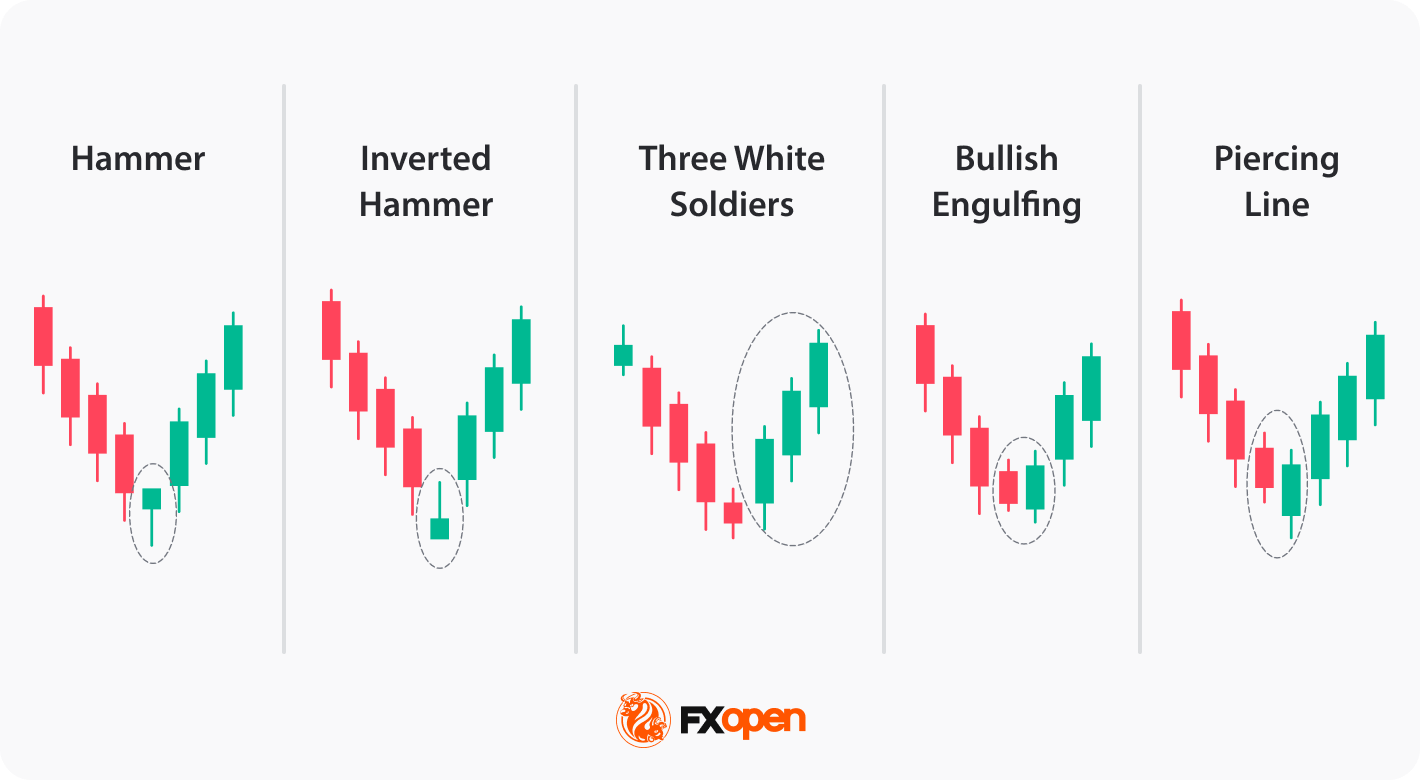
Candlestick reversal patterns are formations that signal a potential shift in price direction as an existing trend begins to lose momentum. They typically appear at the end of trends, where buying or selling pressure starts to weaken, offering traders an early indication of a possible turning point.
There are many ways to spot a trend reversal, including momentum indicators, trend-following tools, and chart and candlestick patterns. Candle patterns, in particular, have been widely used by traders for decades due to their clear structure and well-defined signals, which have been tested and applied across various financial markets.
Depending on the data source, the total number of candlestick patterns ranges from 30 to more than 100, when niche formations are included. Since it may be challenging to remember and recognise all of them, we have selected 10 of the most popular reversal candlestick patterns that traders with any level of experience can implement in their trading strategies.
Definition and Market Function
Candlestick reversal patterns are formations on a price chart that signal a potential trend change after an extended move. Each candle captures the open, high, low, and close for a set period. The shape of the formation reflects the balance between buyers and sellers at that moment.
Reversal differs from retracement. A reversal points to a change in the dominant trend. A retracement is a counter-move within a trend that quickly resumes. Context matters. A pattern carries weight when it forms at a tested support or resistance level and aligns with recent market structure. In the middle of a range, the same shape means little.
This article covers 10 reversal candlestick patterns:
Market Interpretation of Reversals
Market structure shifts when sustained move exhausts and the opposing side quietly builds conviction. The turn often shows in price action before lagging indicators like moving averages or oscillators react.
Three forces cluster around a change in market structure:
- Liquidity pools build near trend extremes, where stop orders sit above swing highs or below swing lows.
- Positioning becomes one-sided, exposing the weaker side to a squeeze.
- Volatility often expands at the turn, producing wide-range candles with long wicks.
Reading the signal requires trend context and level alignment, not shape alone.
Classification of Reversal Patterns
Candlestick reversal patterns in forex fall into three groups by candle count. Single-candle patterns form in one candle. The hammer, hanging man, inverted hammer, and shooting star belong here. Their signal rests on wick-to-body ratio and trend position.
Double-candle patterns involve two consecutive candles. Bullish engulfing, bearish engulfing, piercing line, and dark cloud cover sit in this group. The second candle is opposite and usually overwhelms the first.
Triple-candle patterns need three candles to complete. Three white soldiers and three black crows form this category. They develop slowly but show directional pressure.
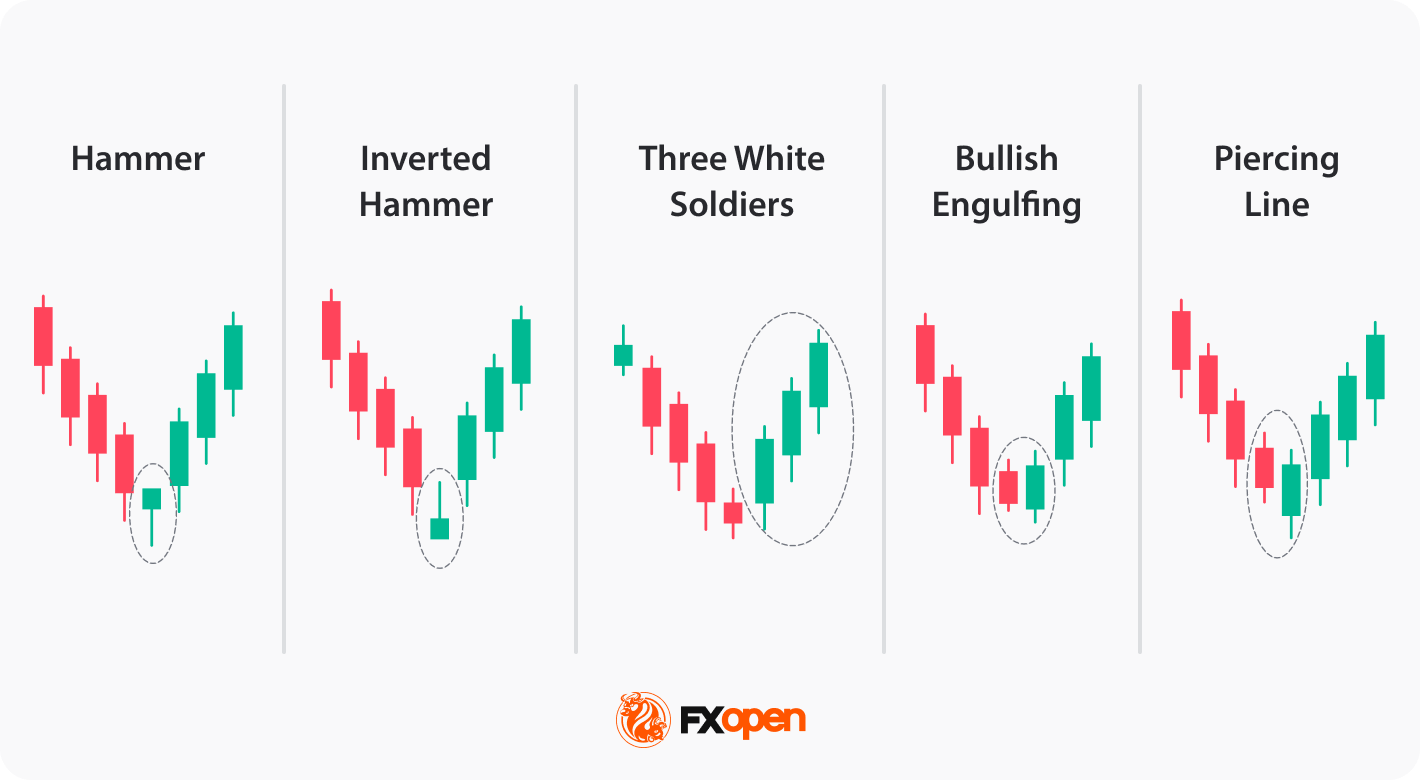
Bullish Reversal Patterns
Bullish reversal patterns form at the end of downtrends. Selling momentum fades as buyers regain control.
Hammer
The hammer candlestick pattern has a small body, a lower wick at least twice the body length, and little to no upper wick. It appears at the end of a downtrend after sustained selling pressure. A close above the hammer’s high on the following candle supports the signal.
Inverted Hammer
The inverted hammer has a small body, an upper wick at least twice the body length, and little to no lower wick. It forms after a prolonged downtrend, often near a tested support zone. Traders often look for the next session to close above the candle’s body before acting.
Three White Soldiers
The three white soldiers pattern consists of three consecutive bullish candles, each opening within the prior body and closing at a new high with short upper wicks. It develops after a downtrend, typically following a stall near the low. The third candle closing above a recent resistance level adds weight to the pattern.
Bullish Engulfing
The bullish engulfing forms when a bullish candle’s body fully covers the prior bearish candle’s body. It appears at the end of a downtrend, with the bearish candle often marking the final push lower. Confirmation is found when a close is seen above the engulfing pattern, meaning the reversal likely has more weight.
Piercing Line
The piercing line pairs a long bearish candle with a bullish candle that opens below the prior low and closes above the bearish body’s midpoint. It forms at the end of a downtrend, often at a tested support zone. Another bullish candle forming after the pattern reinforces the signal.
Bearish Reversal Patterns
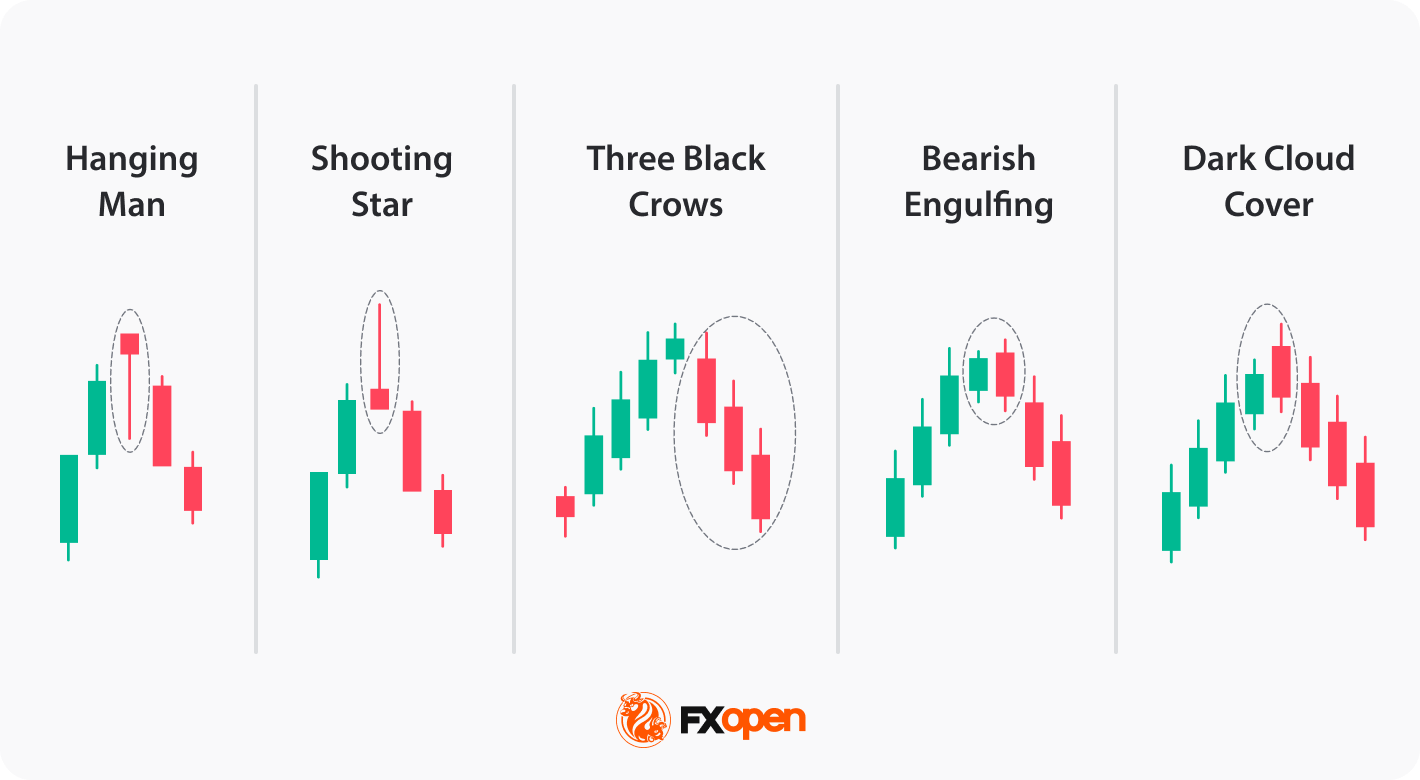
These bearish reversal patterns form at the end of uptrends. Buying momentum fades as sellers regain control.
Hanging Man
The hanging man has a small body, a lower wick at least twice the body length, and little to no upper wick. This candlestick pattern structure appears at the end of an uptrend after sustained buying pressure. A close below the hanging man’s low on the following candle supports the signal.
Shooting Star
The shooting star has a small body, an upper wick at least twice the body length, and little to no lower wick. It forms after a prolonged uptrend, often near a tested resistance zone. Traders often look for the next candle to close below the candle’s body before acting.
Three Black Crows
The three black crows formation consists of three consecutive bearish candles, each opening within the prior body and closing at a new low with short lower wicks. It develops after an uptrend, typically following a stall near the high. The third candle closing below a recent support level adds weight to the pattern.
Bearish Engulfing
The bearish engulfing forms when a bearish candle’s body fully covers the prior bullish candle’s body. It appears at the end of an uptrend, with the bullish candle often marking the final push higher. A close below the engulfing candle’s low session supports the reversal.
Dark Cloud Cover
The dark cloud cover setup pairs a long bullish candle with a bearish candle that opens above the prior high and closes below the bullish body’s midpoint. It forms at the end of an uptrend, often at a tested resistance zone. Another bearish candle forming after the pattern reinforces the signal.
How Traders Identify Reversal Candles
Identifying a candlestick reversal pattern involves four observable checks. Each one either confirms or filters the signal before it carries weight.
- Trend presence: the pattern forms at the end of a clear uptrend or downtrend. Shapes that appear inside a range or consolidation carry little meaning.
- Key level alignment: the pattern aligns with a tested support or resistance zone, a prior swing point, or a known supply or demand area.
- Candle structure: wick-to-body ratios, close position, and body size match the pattern’s definition. Loose approximations dilute the signal.
- Confirmation: the next candle closes in the reversal direction, or a second pattern, indicator reading, or price-action event aligns with the signal before action.
Skipping any of the four reduces the pattern to a shape on the chart rather than a usable signal. Platforms such as TickTrader let traders explore, identify, and trade these patterns across multiple instruments.
Application in Trading Context
Candlestick reversal patterns sit inside a wider decision process rather than drive trades on their own. Position sizing, stop placement, and volatility conditions shape how traders interpret and act on any signal.
Risk context matters at the trade level. A pattern at a major resistance zone in a quiet market carries different weight than the same pattern ahead of an important economic release. Traders often scale position size based on volatility, recent range, or proximity to liquidity levels. Broader risk management frameworks often define stop placement based on the pattern’s structure rather than arbitrary price offsets.
Volatility expansion around reversal patterns cuts both ways. Wider price ranges can make candlestick patterns more visually distinct, but they also increase the likelihood of false breakouts and unreliable signals. False signals appear more often around news releases, low-liquidity hours, and transitions between major trading windows.
Limitations and Market Risks
Candlestick reversal patterns in technical analysis have consistent limitations worth naming directly.
- Low-liquidity conditions distort pattern formation. Thin order books produce wider spreads, longer wicks, and candles that look like patterns but lack the participation to drive a reversal. Exotic currency pairs during off-peak hours often show this behaviour.
- News releases override technical structure. A hammer printed seconds before a non-farm payrolls release may face volatility that ignores the pattern entirely. Scheduled events and surprise headlines both reset short-term price structure.
- Timeframe dependency shapes signal weight. The same pattern on a 1-hour chart often carries less weight than on a daily or weekly chart, where each candle represents more participation and more information.
Takeaway
Bullish vs bearish candlestick patterns are tools for identifying shifts in market direction across forex, stocks, indices, and commodities. They carry weight when structure, trend context, and key levels align.
In practice, traders treat them as early signals and rely on confirmation before acting. Combined with sound risk management, they may help refine timing.
Traders who want to test candlestick patterns and develop their own strategies can consider opening an FXOpen account today and access over 700 instruments with tight spreads and low commissions (additional fees may apply). Good luck!
FAQ
What Are Candlestick Reversal Patterns?
Candlestick reversal patterns are single candles or short sequences that form at the end of a trend and mark a potential change in market direction. They reflect a shift in the balance between buyers and sellers, visible through the candle’s open, close, high, and low. Common examples include the hammer, shooting star, engulfing patterns, and three black crows. Their weight depends on where they form, not just their shape.
Which Candlestick Patterns Signal a Reversal?
Ten patterns commonly appear in reversal analysis: hammer, hanging man, inverted hammer, shooting star, three white soldiers, three black crows, bullish engulfing, bearish engulfing, piercing line, and dark cloud cover. Each pattern carries weight only when it appears at a tested level in a clear trend.
What Is the Difference Between Bullish and Bearish Reversal Patterns?
Bullish reversal patterns form at the end of a downtrend and point to a potential move higher. Hammer, inverted hammer, bullish engulfing, three white soldiers, and piercing line sit in this group. Bearish reversal patterns form at the end of an uptrend and point to a potential move lower. Hanging man, shooting star, bearish engulfing, three black crows, and dark cloud cover belong here. Shapes often mirror across the pair.
Do Candlestick Reversal Patterns Require Confirmation?
Confirmation matters when trading candlestick patterns. A pattern on its own shows a shift in the last candle or two, but not whether the broader trend has turned. Traders often wait for the next candle to close in the reversal direction, or for a second signal from price action, a technical indicator, or a break of a key level. Patterns that form without confirmation produce more false signals, especially in low-liquidity or high-news conditions.
Are Reversal Patterns Popular in Forex Trading?
In forex, reversal signals are widely used, and for reasons tied to the market’s structure. Forex runs 24 hours on weekdays across overlapping sessions, producing clear trending and reversal behaviour around liquidity transitions. The patterns work across major, minor, and exotic pairs, and across all timeframes from intraday to weekly. Traders often combine them with support and resistance zones, moving averages, or momentum readings to filter signals.
This article represents the opinion of the Companies operating under the FXOpen brand only. It is not to be construed as an offer, solicitation, or recommendation with respect to products and services provided by the Companies operating under the FXOpen brand, nor is it to be considered financial advice.
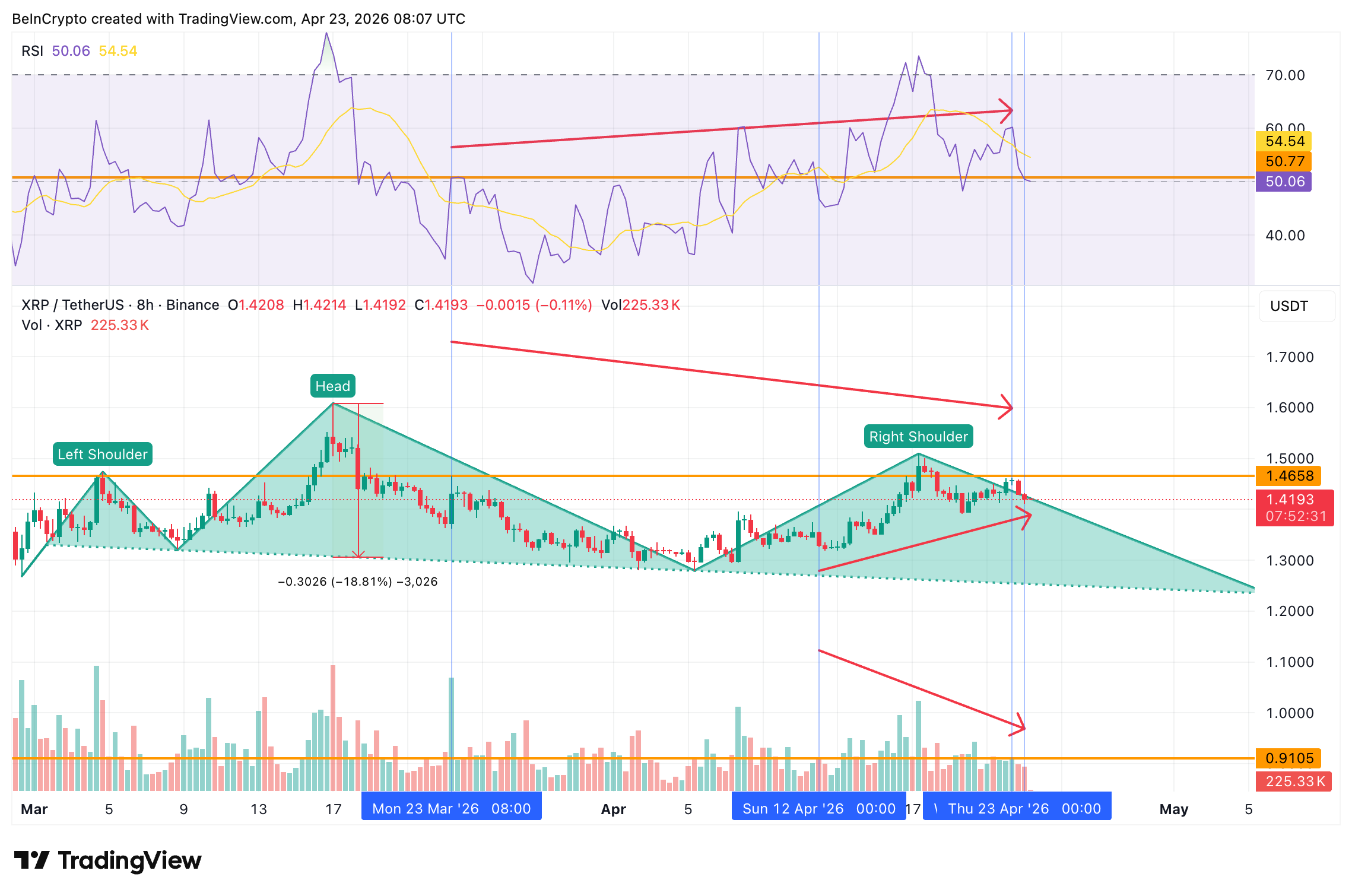
XRP (XRP) price is setting up for an 18.81% breakdown on the 8-hour chart, but weakening sell-side volume and steady ETF inflows are delaying the move.
The signal comes from a hidden bearish divergence that flashed during the bearish pattern formation, now compounded by long-term holder capitulation. However, a mismatch between retail holders and institutional buyers is keeping the price propped up near key resistance.
Hidden Bearish Divergence Sets the Stage for Downtrend Resumption
XRP (XRP) price traded at $1.41 on April 23, slightly down on the 8-hour timeframe and broadly flat across weekly and monthly windows. The shorter timeframe reveals what the longer ones mask.
Between March 23 and April 22, price made a minor lower high while the Relative Strength Index (RSI), a momentum indicator, which made a higher high. In a broader downtrend, this setup is a hidden bearish divergence. It signals that the corrective bounce is losing momentum even as price pushes higher, suggesting the downtrend is set to resume.
The divergence appeared as XRP sits inside a head-and-shoulders structure, a bearish reversal pattern. The right shoulder topped on April 17. However, the timing of the breakdown depends on whether the selling pressure has enough strength to drive the move immediately, which the next chart addresses.
Sell-side pressure has been fading exactly when the bearish structure needs it most. Between April 12 and April 23, the red volume bars on the 8-hour chart trended lower as XRP price trended higher.
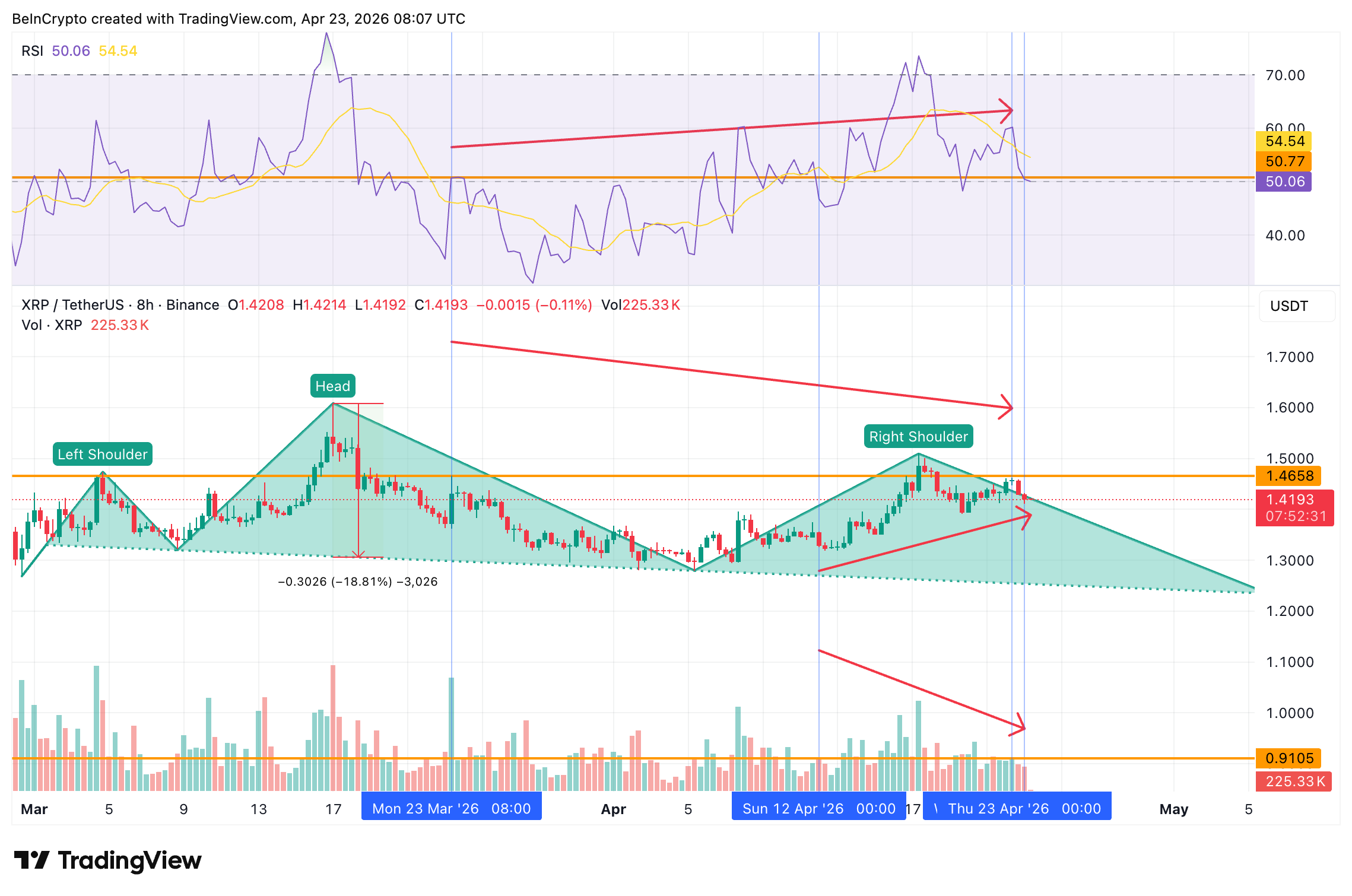
The fading XRP volume on the sell side shows the pullback could be running out of steam yet. The implication is a delayed breakdown rather than an invalidated one. The pattern stays intact, but the 18.81% measured move will have to wait for sell pressure to re-accelerate.
This creates a near-term stalemate. The structural case and momentum divergence both say breakdown, but the volume tape says not right now. Whether hodler and institutional flows confirm or override the volume signal determines the next move.
Long-Term Hodlers Capitulate as ETFs Keep Buying
On-chain data shows a split between XRP hodlers and institutional buyers. According to Glassnode, the hodler net position change sat at 260,176,113 XRP on April 12. By April 22, it had dropped to 149,050,480 XRP. That is a decline of roughly 42.7% in ten days, reflecting long-term holders (155 days or more) trimming positions.
Want more token insights like this? Sign up for Editor Harsh Notariya’s Daily Crypto Newsletter here.
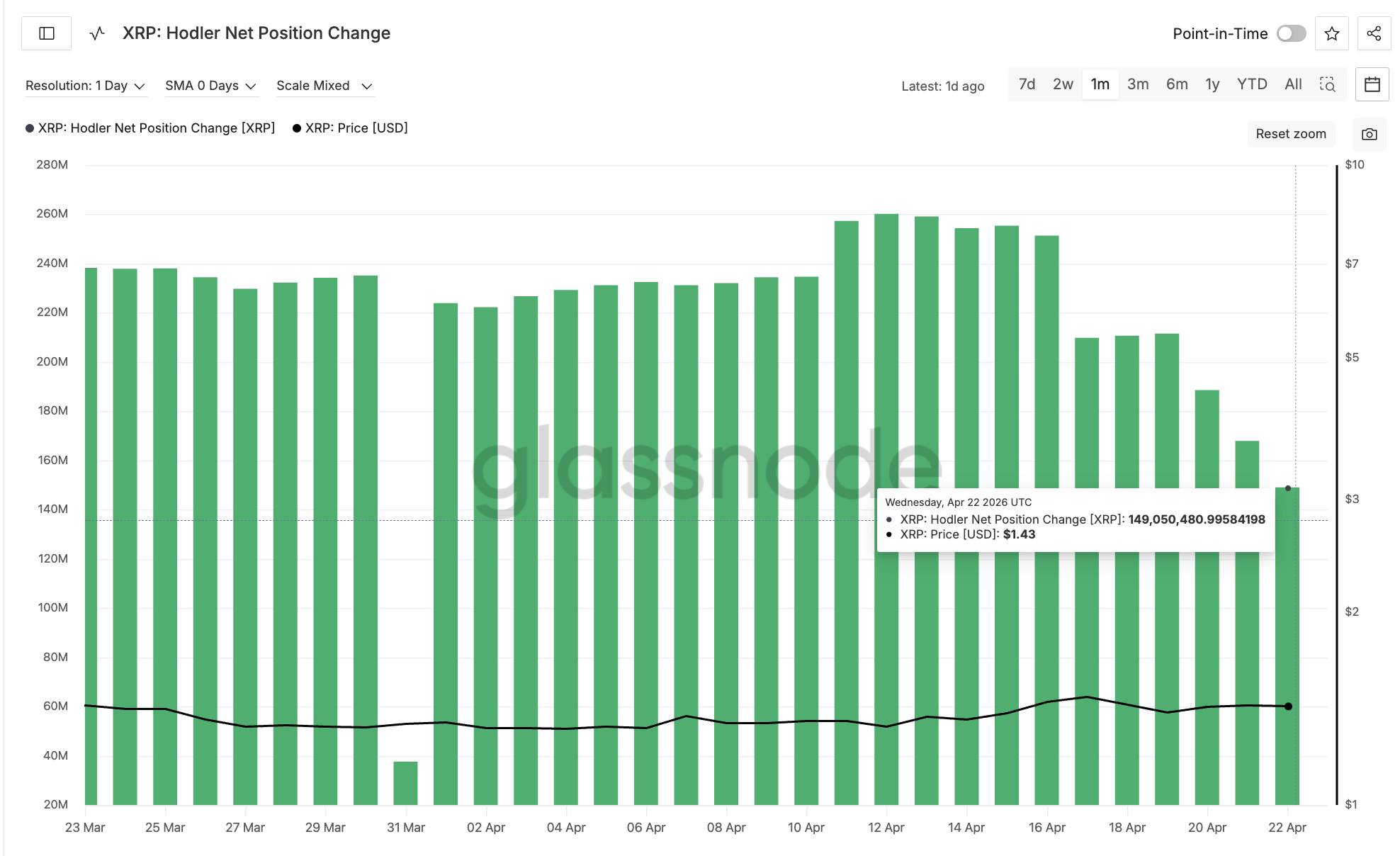
The hodler distribution started before the right shoulder formed on April 17. The timing suggests long-term holders were already losing confidence in the bounce.
However, institutional buyers saw it differently. US spot XRP ETF products have logged net inflows on 8 of the last 9 trading days, a run that spans nearly two weeks since April 10.
The only exception was a flat session on April 21 with zero net flow, meaning there were no outflows during the entire window. The data suggests steady accumulation through the same period hodlers were distributing. April 17 alone saw $13.74 million in inflows, followed by $3 million on April 20 and $2.42 million on April 22.
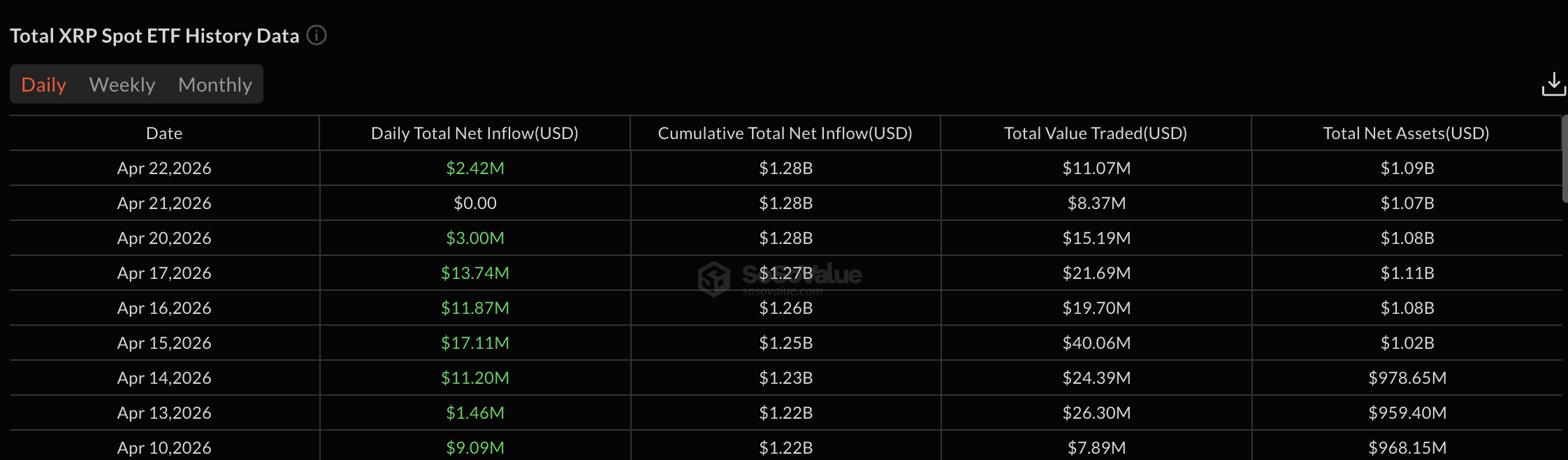
The disjoint matters. Retail long-term holders are betting on the pattern breakdown, while institutional flow is betting the bounce extends. The XRP price chart will eventually vindicate one side over the other.
XRP Price Levels That Resolve the Tension
The XRP price chart lays out the full decision zone. XRP has already lost the 0.236 Fibonacci level at $1.43, which served as the immediate bounce cap. Below it, the 0.382 Fib at $1.38 and the 0.5 Fib at $1.34 are the first downside tests.
The key decision level sits at $1.30, the 0.618 Fib. A daily close below this level clears the path toward $1.25 (0.786 Fib) and triggers the measured move projection. The measured move from the right shoulder points to $1.18 initially, with extension to $1.01, representing an 18.81% decline from the breakdown point.
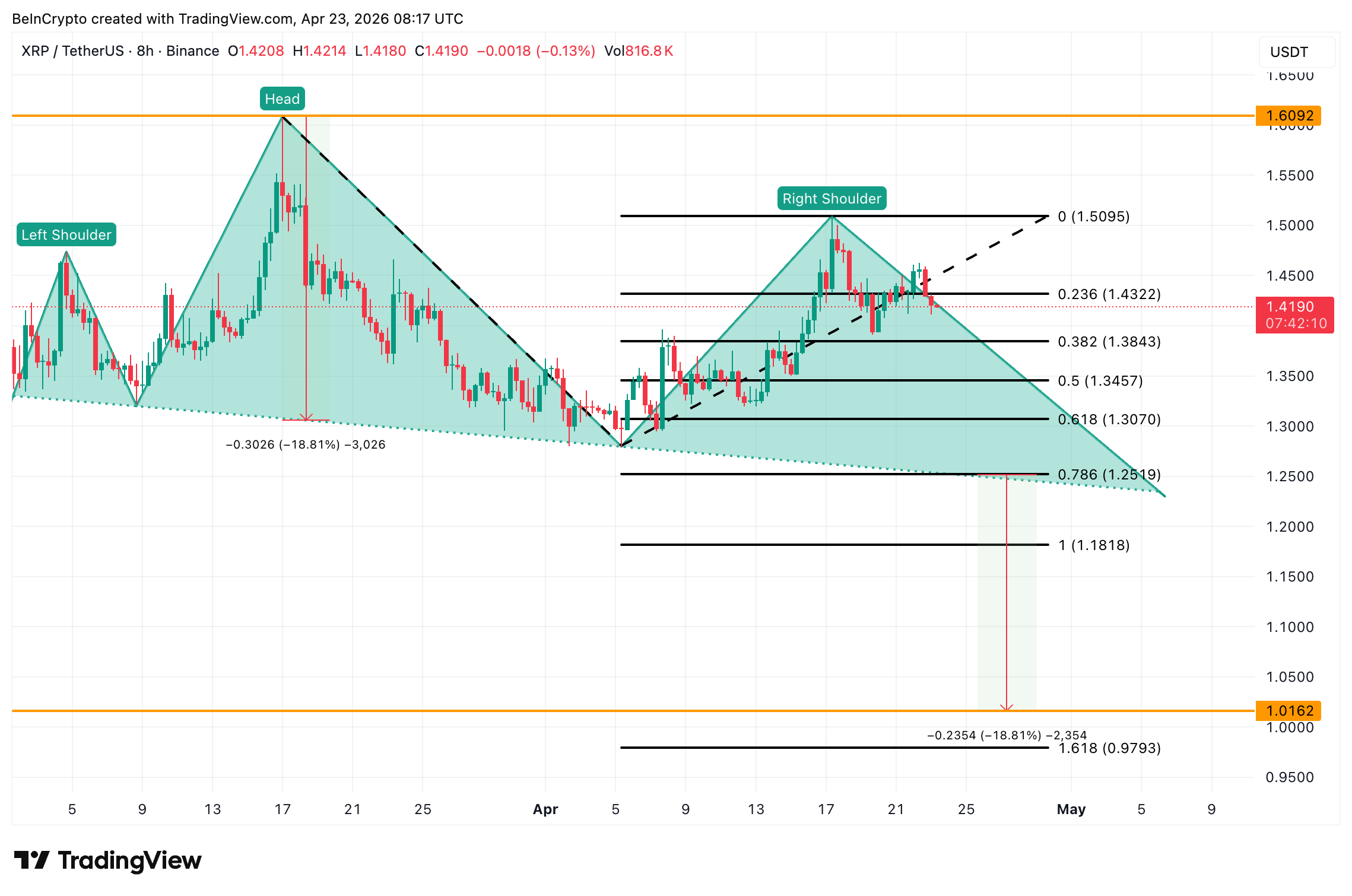
For invalidation, XRP needs to reclaim the right shoulder cap at $1.50 on the 8-hour close. A move above $1.60, the head peak, would fully invalidate the bearish structure and align with the ETF thesis.
The $1.30 level separates a shallow pullback supported by fading sell pressure and ETF demand from a deeper 18.81% flush toward $1.01 if hodler capitulation spreads.
The post Can 2 Weeks of XRP ETF Buying Delay the 18% Price Breakdown? appeared first on BeInCrypto.
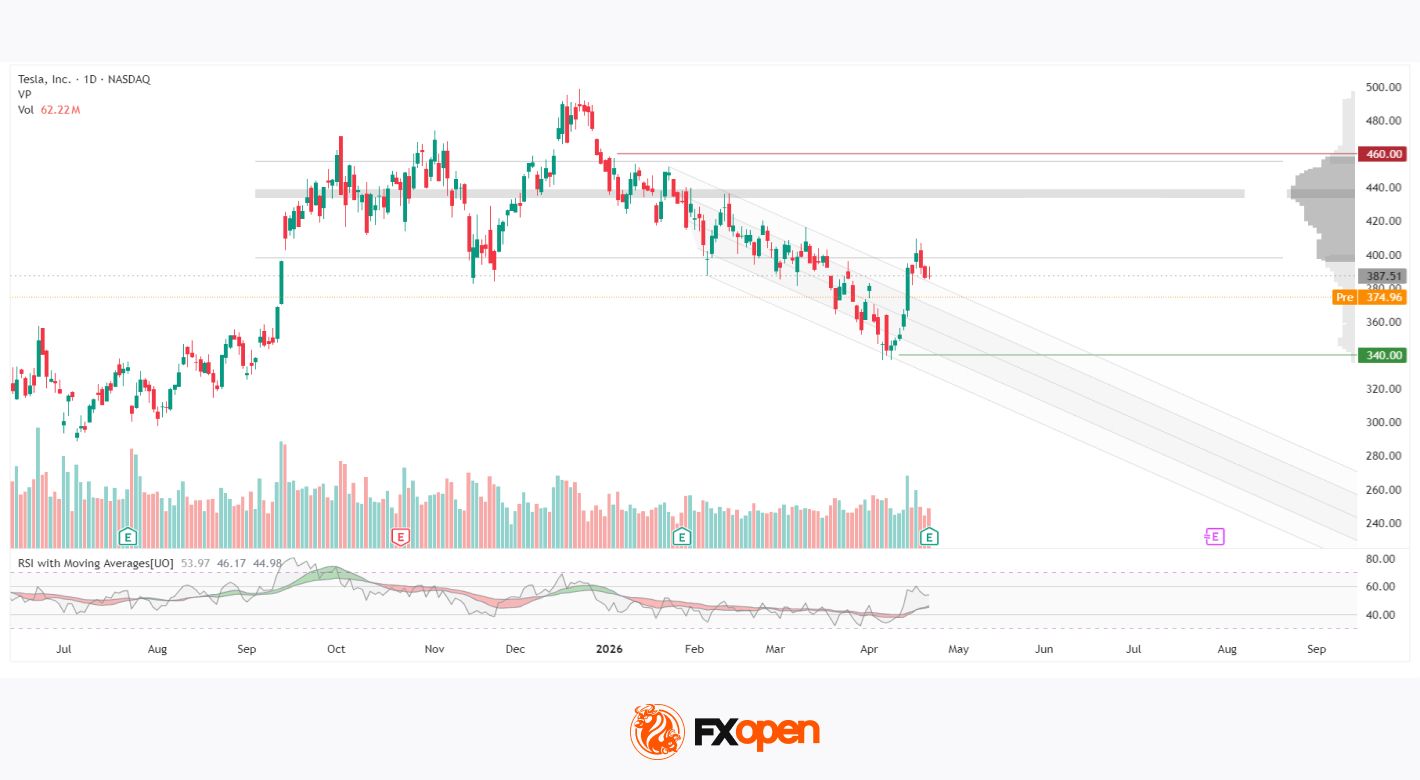
On 22 April, Tesla released its Q1 2026 results: adjusted earnings per share came in at $0.41 versus expectations of $0.37, but revenue of $22.39 billion fell short of the $22.64 billion forecast. The automotive segment continues to lose ground under pressure from competitors, particularly China’s BYD and Xiaomi. Additional concern came from the energy storage division, where deployments dropped 38% compared to the record fourth quarter of 2025 — a segment that had recently been seen as a key growth driver.
Management continues to pin its long-term growth strategy on robotaxis and autonomous driving.
Technical picture
On the daily chart, TSLA has been trading within a sustained downward channel since peaking near $500 in December. In early April, the price reached the $340 level, which coincided with the lower boundary of the channel — the confluence of these levels strengthened buyer reaction. In recent sessions, the price has moved above the upper boundary of the channel, though the breakout has yet to be confirmed by a sustained close, and the earnings release has not clarified the near-term trend. Nevertheless, the move itself is noteworthy.
The horizontal volume profile spans the $398–455 range, with the Point of Control concentrated around $433–440 — an area of high liquidity that now represents the nearest resistance. The RSI with moving averages shows readings of 53 / 46 / 44: the indicator has crossed above the neutral 50 level, while both moving averages remain below it, suggesting that a sustained bullish impulse has yet to be confirmed.
Summary
The earnings report delivered mixed signals to the market: the earnings beat was not sufficient to offset weaker revenue and a sharp decline in the energy segment. From a technical perspective, the key question is whether the price can hold above the upper boundary of the channel — an unconfirmed breakout can easily turn false, particularly with a dense volume zone overhead.
Buy and sell stocks of the world’s biggest publicly-listed companies with CFDs on FXOpen’s trading platform. Open your FXOpen account now or learn more about trading share CFDs with FXOpen.
This article represents the opinion of the Companies operating under the FXOpen brand only. It is not to be construed as an offer, solicitation, or recommendation with respect to products and services provided by the Companies operating under the FXOpen brand, nor is it to be considered financial advice.
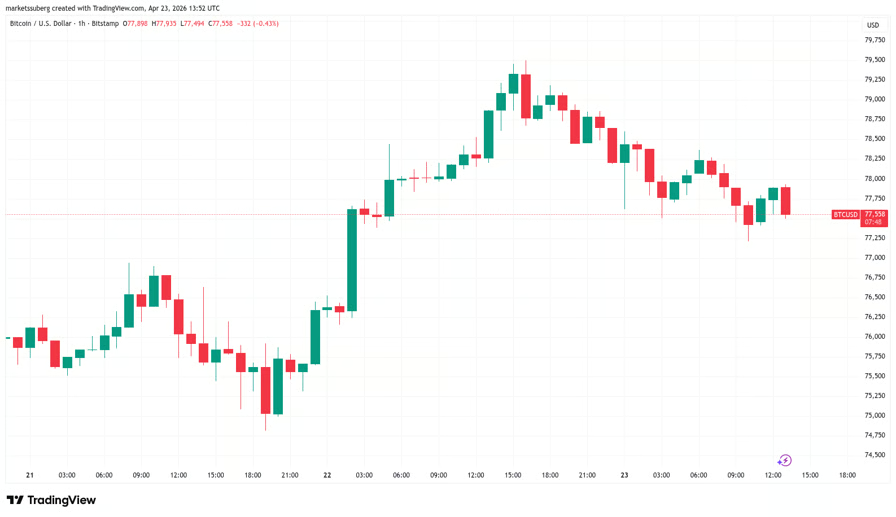
Bitcoin (BTC) slipped from near three-month highs on Thursday as attention turned to the weekly close.
Key points:
- Bitcoin retraces after its latest trip to its highest levels in several months.
- The upcoming weekly candle close is of particular interest as price eyes its bull market support band.
- A macro lull comes ahead of a deluge of US inflation data next week.
Bitcoin bull market support band returns after six months
Data from TradingView showed BTC/USD dropping to $77,200 prior to the Wall Street open.
The pair hit $79,500 the day prior, marking its highest levels since the last day of January as the $80,000 mark remained narrowly out of reach.
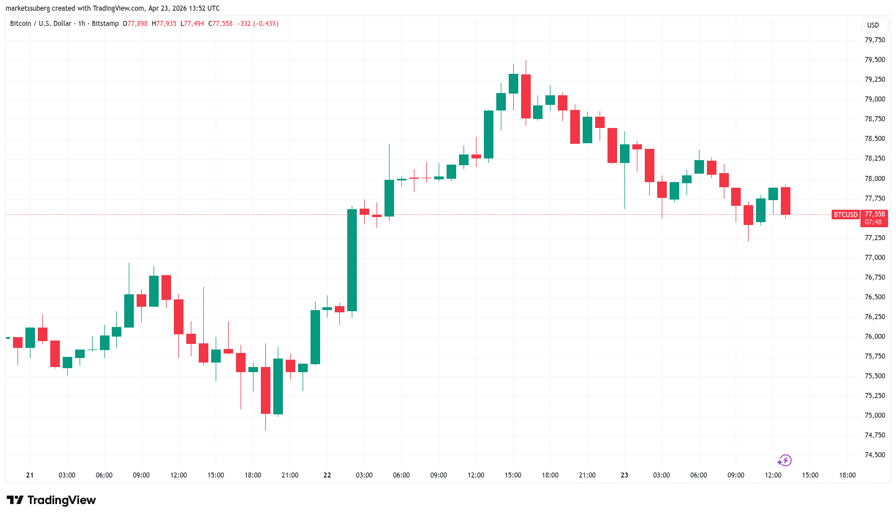
BTC/USD one-hour chart. Source: Cointelegraph/TradingView
“$BTC just keeps taking out the highs, taking out short stops without following through,” trader Jelle commented on the latest price action in a post on X.
“Been a while since we saw PA like that; usually means liquidity is being generated for a larger position. The question is, when will they step on the gas?”
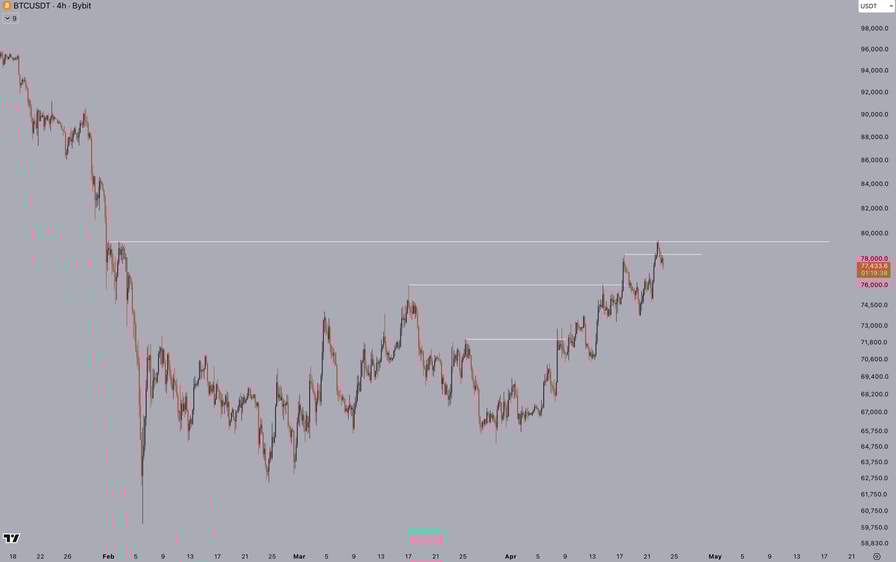
BTC/USD four-hour chart. Source: Jelle/X
As Cointelegraph reported, multiple resistance levels remain in play in the current spot price zone, with the 21-week exponential moving average (EMA) proving hard to flip to support. Bitcoin last traded above that trend line in October 2025.
With that, another chart feature finally making a comeback after a six-month absence is Bitcoin’s bull market support band.
Formed by the 21-week EMA and the 20-week simple moving average (SMA), the support band was lost as support soon after Bitcoin’s latest all-time highs.
“$BTC Attempting to break back above the bull market support band,” trader Daan Crypto Trades confirmed.
“Eyes on the weekly close this weekend, as it will be an important one. Bitcoin has not traded above its bull market support band since October 2025.”
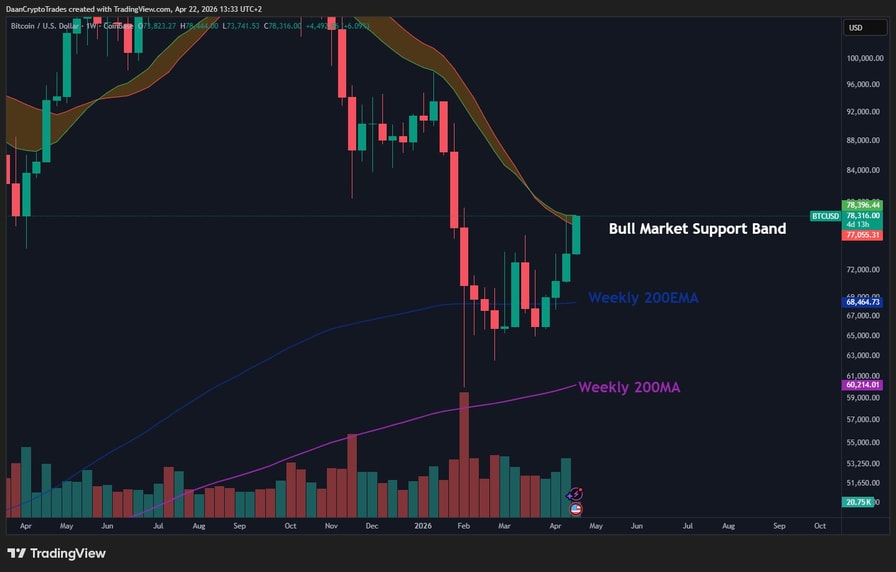
BTC/USD one-week chart. Source: Daan Crypto Trades/X
Fed policy, oil seen as next crypto catalysts
Macro markets provided little volatility on the day, with few cues from the US-Iran war.
Related: Bitcoin Bull Score hits six-month high as 2022 bear-market fears linger
The coming week was due to see key US macroeconomic data prints released, along with the latest interest-rate announcement from the Federal Reserve.
As Cointelegraph previously noted, markets saw little chance of Fed easing policy until the end of 2027 as geopolitical uncertainty raised the odds of inflation making a comeback.
The latest data from CME Group’s FedWatch Tool put the chances of the Fed changing rates at next week’s meeting at practically zero.
“The cleanest tells from here are still oil and policy. Oil below $100 would support the relief case, while clearer Fed signalling would help compress the policy premium,” trading company QCP Capital wrote in its latest “Market Color” analysis on Wednesday.
“Until then, the broader message remains the same: risk has stepped back from the brink, but the underlying macro and geopolitical overhang has not been cleared.”
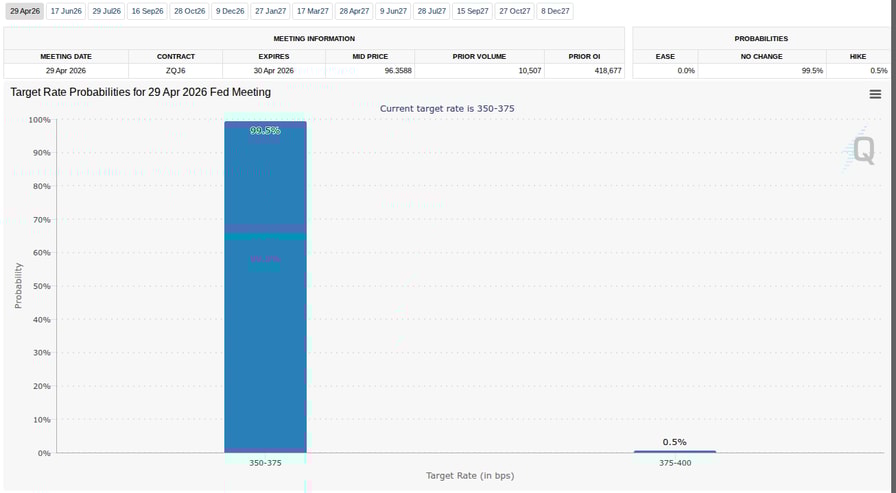
Fed target rate probabilities (screenshot). Source: CME Group
Nokia beat profit expectations in Q1 2026, and the reason has nothing to do with phones. The Finnish company’s optical fiber business has become the quiet engine behind its strongest quarter in years.
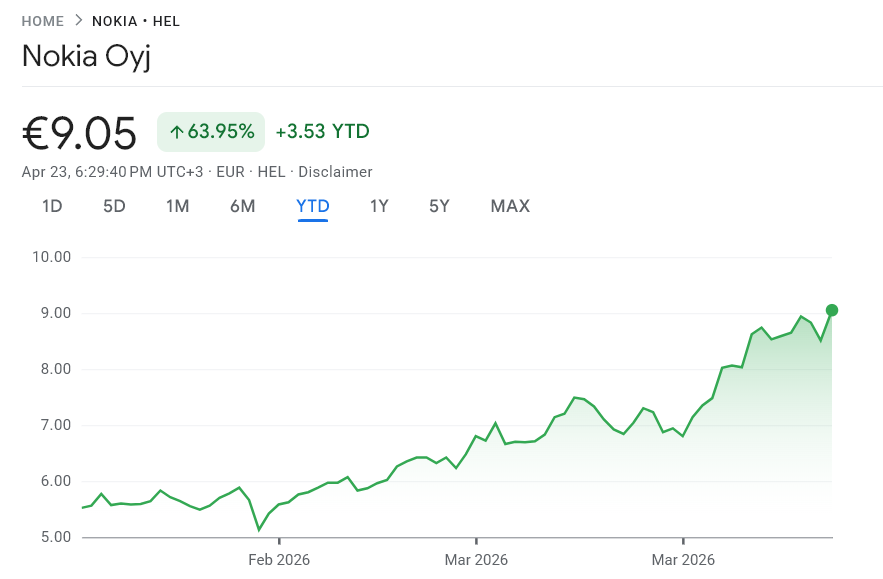
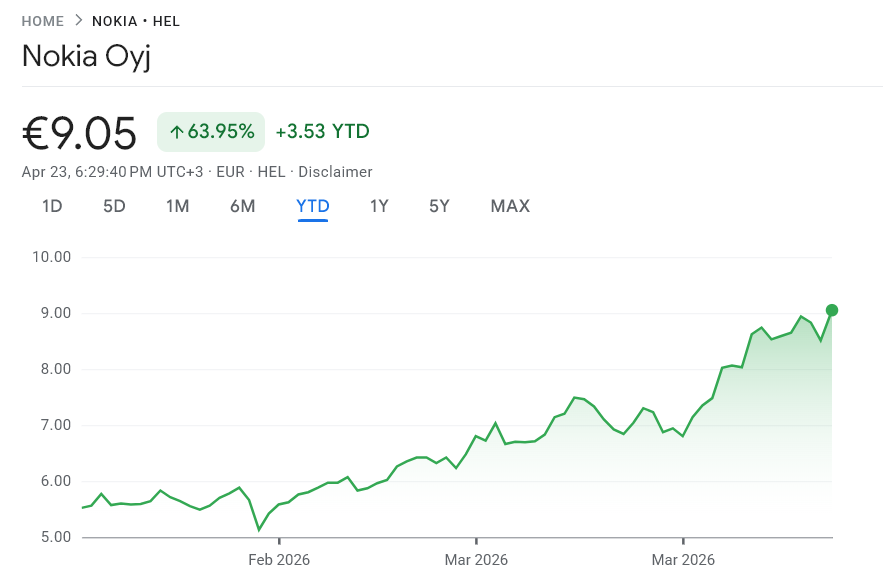
Comparable operating profit jumped 54% to €281 million, well above analyst estimates. Shares rose roughly 7% in Helsinki, reaching levels not seen since 2010. The company’s stock price is up by a staggering 63% in 2026.
The Fiber Behind the AI Boom
The headlines say “AI revived Nokia,” but the earnings tell a more specific story. Inside Nokia’s Network Infrastructure segment, the Optical Networks unit grew 20% in the quarter.
This single business line, which builds the high-speed fiber systems connecting AI data centers, delivered far more growth than any other part of the company.
The rest of the portfolio tells a different story. IP Networks grew 3%. Fixed Networks shrank 13%. The legacy mobile infrastructure business, once Nokia’s identity, managed just 3% growth.
What changed is who Nokia sells to. Cloud giants like Amazon, Google, and Microsoft are building massive AI training facilities, and those facilities need fiber optic cables to move data at scale.
Nokia booked €1 billion ($1.17B) in new orders from these hyperscaler customers in Q1 alone. Sales to AI and cloud buyers now account for 8% of the company’s total revenue, up 49% from a year ago.
A Bigger Bet on Optical
Nokia is leaning into the momentum. The company raised its 2026 growth forecast for Network Infrastructure to 12-14%, up from 6-8%.
It now expects the AI and cloud market it serves to grow at 27% annually through 2028, nearly double its November estimate.
“We are increasing our growth assumption for Optical and IP Networks and we are investing to capture accelerating demand from AI & Cloud customers,” stated Justin Hotard, President and CEO.
The Infinera acquisition, completed in early 2025, gave Nokia a larger footprint in coherent optical transport. That deal is now showing up in wider margins and stronger order books.
Nokia’s comeback is real. It just has less to do with AI hype and more to do with the fiber optic cables that make AI possible.
The post Nokia’s Fiber Optic Bet Is Paying Off as AI Hunger Lifts Earnings appeared first on BeInCrypto.

Key Highlights
- Shares of Hims & Hers surged 7% following news of a broadened collaboration with Eli Lilly
- Healthcare providers using the platform can now order Zepbound vials, KwikPen, and Foundayo through LillyDirect fulfillment
- This announcement arrives roughly one month after a comparable agreement with Novo Nordisk for Wegovy distribution
- Leerink Partners analyst Michael Cherny raised concerns about Hims’ function, questioning if it’s merely a “front door” to pharmaceutical products
- CEO Andrew Dudum defended the strategy by drawing parallels to Netflix’s transformation in its formative years
Shares of Hims & Hers Health (HIMS) jumped 7% during Thursday’s trading session following the company’s announcement of an enhanced partnership allowing healthcare professionals to prescribe Eli Lilly’s weight management products directly through its digital platform.
Hims & Hers Health, Inc., HIMS
Medical professionals utilizing the Hims platform now have the capability to route prescriptions for Zepbound vials, KwikPen delivery devices, and Foundayo to Eli Lilly’s LillyDirect pharmacy service. Patients receive access to self-payment pricing structures, while licensed healthcare providers can facilitate connections between patients and FDA-sanctioned GLP-1 treatment options.
The arrangement provides Hims with what the organization describes as comprehensive access to FDA-cleared GLP-1 medications across its digital ecosystem. The offering integrates clinical oversight and dietary counseling within a subscription-based framework.
This marks the company’s second significant GLP-1 alliance within a two-month span. Last month, Hims finalized an agreement with Novo Nordisk, which agreed to withdraw a patent violation lawsuit in return for Hims’ commitment to distribute branded Ozempic and Wegovy via its digital channels.
The Novo arrangement included specific conditions. Hims scaled back its extensive compounding operations for GLP-1 drugs as a condition of the settlement. The Eli Lilly agreement reflects a similar strategic direction.
Hims had established a substantial presence throughout the 2024 GLP-1 supply crisis, when heightened demand coupled with constrained availability from leading pharmaceutical manufacturers created opportunities for the telehealth provider to expand. Currently, with supply chains stabilized, market conditions have evolved.
Wall Street Analyst Questions Platform Value Proposition
Michael Cherny, an analyst with Leerink Partners, provided a cautious assessment of the development. He recognized that Hims is broadening its service offerings and “functioning as a bridge to generate additional pathways” for patients seeking treatment.
However, Cherny expressed uncertainty, noting it was “difficult to determine what function Hims fulfills beyond serving as the entry point for patients obtaining Lilly medications.” This question grows increasingly relevant as Hims transitions away from its compounding operations.
CEO Draws Streaming Giant Analogy
CEO Andrew Dudum rejected characterizations that these partnerships signal a strategic withdrawal. In his public remarks, he drew comparisons between Hims and Netflix during its transformative period.
“Netflix wasn’t simply distributing DVDs,” Dudum stated. “It was transforming how consumers accessed content by relentlessly emphasizing selection and creating innovative delivery methods for the most sought-after entertainment.”
The organization highlighted its weight management subscription program as proof of a more comprehensive service offering. Subscribers receive round-the-clock access to medical teams, customized dietary guidance, continuous clinical monitoring, and community support through the Hims & Hers Weight Loss network.
The company’s stated objective involves aligning users with therapeutic options tailored to their specific medical backgrounds, personal preferences, and wellness objectives.
Market participants seemed receptive to the CEO’s narrative. HIMS stock maintained gains of 0.4% later in the trading day even as the S&P 500 experienced modest declines. Eli Lilly shares remained relatively unchanged.
The Eli Lilly collaboration represents Hims’ latest strategic initiative to transform its position within the GLP-1 marketplace from a provider of compounded alternatives into a distribution platform facilitating medication access.

Chainlink price forecast amid Bridgetower’s $11B tokenization boost

Manchester City are top, but for how long as title race heats up

Tsitsipas battles back to end losing Run in Madrid

Manchester United reach agreement with Casemiro over contract clause amid transfer speculation

Steven Gerrard disagrees with Gary Neville over ‘shock’ Chelsea and Arsenal claim | Football

US brings back mandatory military draft registration


-

 Sports6 days ago
NWFL Suspends Two Players Over Post-Match Clash in Ado-Ekiti
-

 Fashion6 days ago
Weekend Open Thread: Theodora Dress
-

 Politics6 days ago
Palestine barred from entering Canada for FIFA Congress
-
Entertainment4 days ago
NBA Analyst Charles Barkley Chimes in on Ice Spice McDonald’s Fiasco
-

 Business4 days ago
Powerball Result April 18, 2026: No Jackpot Winner in Powerball Draw: $75 Million Rolls Over
-

 Tech5 days ago
Auto Enthusiast Scores Running Tesla Model 3 for Two Grand and Turns It Into Bare-Bones Go-Kart
-

 Politics4 days ago
Zack Polanski demands ‘council homes not luxury flats for foreign investors’
-

 Crypto World6 days ago
Russia Pushes Bill to Criminalize Unregistered Crypto Services
-

 Politics3 days ago
Gary Stevenson delivers timely reminder to register to vote as deadline TODAY
-

 Business1 day ago
Rolls-Royce Voted UK’s Most Iconic Trade Mark as IPO Register Hits 150
-

 Politics22 hours ago
Disabled people challenge government SEND proposals over segregation concerns
-

 Politics22 hours ago
Making troops accountable for war crimes threatens US alliance, ex-SAS colonel warns
-
 Business7 days ago
Creo Medical agree sale of its manufacturing operation
-

 Crypto World6 days ago
Russia Introduces Bill To Criminalize Unregistered Crypto Services
-

 Politics23 hours ago
Starmer handler McSweeney to be dragged from shadows by Foreign Affairs Committee
-

 Politics23 hours ago
Zack Polanski responds to home secretary’s taser threat
-
Politics24 hours ago
Wings Over Scotland | How To Get Away With Crimes
-
 Crypto World5 days ago
Kelp DAO rsETH Bridge Hack Drains $292M as DeFi Losses Top $600M in Two Weeks
-

 Politics21 hours ago
‘Iran is still a nuclear threat’
-

 Crypto World2 days ago
New York sues Coinbase, Gemini over prediction market offerings
You must be logged in to post a comment Login