
Crypto World
Bitcoin Rejected at $80K Again Ahead of Crucial CLARITY Act Senate Vote: Market Watch

Somewhat surprisingly, bitcoin’s price jumped quite hard on Monday, reaching a multi-day peak of almost $80,000 before it was halted once again and pushed below $77,000 ahead of today’s crucial CLARITY Act vote in the US Senate.
Most altcoins tried to follow suit but were rejected at their local peaks. Still, some, such as XRP, XLM, and UNI, are still in the green on a daily scale.
BTC Braces for CLARITY Vote
The primary cryptocurrency experienced some intense volatility at the end of the previous business week as all eyes had turned to the US Consumer Price Index numbers. Once they came out, which were actually in line with expectations, BTC first dumped from $77,000 to $76,000 before it suddenly skyrocketed to $79,800, where its progress came to a screeching halt and dropped back to its starting point.
The weekend, as most previous ones, was quite sluggish, with BTC trading sideways at around $77,000. It dipped again on Monday twice to $76,500, where the bulls finally stepped up and didn’t allow another leg down.
Just the opposite; the cryptocurrency started to gain traction, especially during the early US trading hours, and jumped to over $79,500. However, the Friday scenario repeated, and the bears pushed it south hard, with BTC currently struggling at $77,000 once again. More volatility is expected today, with the CLARITY Act vote in the US Senate, and tomorrow when the US Fed will announce its interest rate decision.
For now, bitcoin’s market cap remains at $1.540 trillion on CMC, while its dominance over the alts has retreated slightly to 58.85%

ETH Below $2.5K Again
The leading altcoin exploded on Friday to an eight-month peak of $2,670, where it was rejected and slipped back to $2,500 almost immediately. It has dipped below that level now, after another 1.5% daily decline. XRP pumped to $1.46 yesterday, but it was stopped there, and now it fights for the $1.40 level. BNB, SOL, TRX, HYPE, and DOGE are slightly in the red, while RAIN has plummeted by over 11%.
In contrast, ZEC, XMR, and LINK have marked minor gains, while XLM and UNI are up by around 4%-5% to $0.19 and $6.55, respectively.
The total crypto market cap has remained essentially the same as yesterday, at $2.650 trillion on CMC.

The post Bitcoin Rejected at $80K Again Ahead of Crucial CLARITY Act Senate Vote: Market Watch appeared first on CryptoPotato.



South Korean police have referred 18 Polymarket users to prosecutors over alleged illegal gambling. The escalation extends a months-long investigation into wagers placed on the platform’s election markets.
Lawmaker Yoon Kun-young’s office released the figures after receiving them from the National Police Agency. The case adds individual prosecutions to a broader crackdown on the prediction market platform.
What the Investigation Found
The Cyber Investigation Unit of the Gangwon Provincial Police Agency has formally investigated 26 users as of September 15. The 26 placed a combined 17.6 billion won, roughly $12.7 million, on Polymarket political, economic, and social markets.
One individual alone wagered about 5.7 billion won, close to $3.8 million.
Investigators traced bettors using open-source intelligence (OSINT) techniques applied to public blockchain transaction records. The method let them identify individual wallet holders despite the platform’s anonymous design.
Police argue the trades meet the legal definition of gambling under Article 246 of South Korea’s Criminal Act. They cite Supreme Court precedent holding that betting property on an uncertain outcome counts as gambling, regardless of skill.
The users under investigation counter that their trades resemble derivatives investing rather than wagering. That distinction will likely shape how the courts eventually rule.
Part of a Wider Crackdown in South Korea
The prosecutions follow a separate move by South Korea’s broadcasting and communications regulator. In August, the regulator ordered internet providers to block domestic access to Polymarket, citing its winner-take-all payout structure.
Polymarket argued that its lack of a Korean-language service and won payments should exempt it from local law. The regulator rejected that defense.
Attorney Kim Tae-rim of AXIS Law pointed to a key structural difference. Polymarket’s contracts trade on an order book and can be closed before expiry, unlike a typical bet.
Kim said that distinction may become a central issue for judges to weigh.
Polymarket already faces growing scrutiny from regulators worldwide over how it verifies and monitors traders. How South Korean courts classify its contracts could set a precedent for other jurisdictions weighing similar cases.
The post South Korea Refers 18 Polymarket Users to Prosecutors Over $12.7M in Bets appeared first on BeInCrypto.

XRP’s recent 70% rally may have had an early on-chain signal. Santiment found 85 new wallets holding at least 1 million tokens appearing just two days before the August 17-21 surge.
That matters because these larger wallets can absorb supply and strengthen bids while shifting liquidity faster than retail traders. Changes in their numbers have often appeared ahead of XRP’s sharpest moves.
Millionaire Wallets Were Already on the Move
There is also more happening around the XRP Ledger. Ripple backed an RLUSD credit fund focused on fintech and payments lending on XRPL. ZILO and Licuido investments brought tokenization plus transfer-agency and collateral-mobility rails into Ripple’s stack.
Looking toward the rest of the year, Santiment considers the setup to be constructive. Whale wallet numbers remain high, while RLUSD adds settlement utility and institutional tokenization gives XRP a story beyond retail hype.
Separately, AI is also moving further into Ripple’s treasury operations. Just last week, the company announced expanding GSmart to handle a wider range of work for enterprise finance teams. The new capabilities cover forecasting, liquidity, risk, reconciliation, and reporting, and are already being used by Ripple’s enterprise customers.
Despite the gains it had made previously, XRP took the biggest hit among major cryptocurrencies following the Senate’s failure to move the CLARITY Act forward. This is a major blow to an industry that has spent years pushing for a comprehensive US regulatory framework. Over the past day, the token has shed more than 8%.
The broader crypto market was awash in red by Tuesday afternoon as well.
Bullish Setup Takes a Hit
Crypto analyst Diana said XRP could face further downside after the token lost the $1.34 support level and fell quickly toward $1.26. The move weakened its earlier bullish setup, which had pointed toward the $1.70-$1.78 range. The bulls now need to defend the $1.24-$1.26 area.
If that level fails, the analyst said that $1.14-$1.10 could come into focus, followed by the $1.00 mark if XRP drops below $1.1. Diana also flagged that its one-hour RSI had fallen close to 21, which put the token in deeply oversold territory. That could trigger a short-term bounce.
On the institutional front, US-based spot XRP ETFs continued to attract capital. So far in August, they have raked in over $43 million in inflows. If the trend continues, these funds could extend their inflow streak to 10 consecutive weeks.
The post XRP’s 70% Breakout Had a Warning Sign: 85 Millionaire Wallets Moved First appeared first on CryptoPotato.


The U.S. House Financial Services Committee has advanced legislation to place the federal Strategic Bitcoin Reserve into law, voting 28-21 on Sept. 16 to report the amended H.R. 8957 favorably.
Summary
- 28 committee members backed H.R. 8957, while 21 opposed the amended Bitcoin reserve legislation Wednesday.
- 20 years is the minimum holding period for Bitcoin deposited into the proposed federal reserve.
- Annual proof-of-reserve reporting replaced the original quarterly schedule under the committee-approved substitute amendment on Wednesday.
- Treasury and Commerce would study budget-neutral Bitcoin acquisitions without borrowing, new taxes, or deficit spending.
- States could store Bitcoin in segregated Treasury reserve accounts while retaining legal title to holdings.
The House Financial Services Committee’s official markup record lists the American Reserve Modernization Act of 2026 among the measures considered Wednesday and identifies a substitute amendment from Rep. Bryan Steil of Wisconsin. The substitute was adopted by voice vote before the committee approved the amended bill in recorded vote FC-317.
Introduced on May 21 by Rep. Nick Begich of Alaska with Rep. Jared Golden of Maine as co-lead, ARMA would create a statutory Strategic Bitcoin Reserve and a separate Digital Asset Stockpile inside the Treasury Department. Begich’s office said at introduction that the measure was designed to centralize federal digital-asset custody and require government accounting of the assets.
Bitcoin reserve bill would impose a 20-year holding period
Under the committee substitute published by the House, the Treasury secretary would establish the Strategic Bitcoin Reserve for qualifying federal Bitcoin and a separate stockpile for qualifying non-Bitcoin digital assets. The reserve would cover Bitcoin that has been finally forfeited through criminal or civil proceedings or obtained through certain civil penalties, subject to existing legal claims and forfeiture requirements.
Bitcoin deposited into the reserve would have to remain there for at least 20 years from enactment. During that period, the bill says the assets could not be sold, swapped, auctioned, encumbered or otherwise disposed of. Two years before the holding period ends, Treasury would have to send Congress recommendations on whether the government should continue holding the assets or permit a controlled release.
After the 20-year period, the Treasury secretary could recommend selling up to 10% of reserve assets during any two-year period. The bill directs Treasury to consider the national deficit, Bitcoin’s long-term viability, possible market effects and the federal government’s financial position when making such recommendations.
Within one year of enactment, Treasury would separately study conditions under which Congress might permit sales before the 20-year period expires, including circumstances involving national security or financial stability. The amended language calls for legislative recommendations rather than giving Treasury an automatic exception.
Rep. Begich has argued that government Bitcoin should not “languish in fragmented and inconsistent custody.” House Financial Services Chairman French Hill described the measure during Wednesday’s markup as bringing federally held assets under “Treasury custody and consistent oversight.” Those statements represent the lawmakers’ stated rationale for the legislation.
Committee amendment changes Bitcoin reporting requirements
The version advanced Wednesday differs from the original H.R. 8957 in several areas. Earlier text called for quarterly public proof-of-reserve reports, which was reflected in crypto.news coverage when ARMA was introduced.
Steil’s adopted substitute changes that schedule. Treasury would publish an annual report giving details on reserve holdings, transactions and control of private keys. An independent third-party auditor with cryptographic-attestation expertise would verify the report, while the U.S. Comptroller General would conduct continuing oversight.
Federal agencies would face separate accounting requirements. Within 60 days of enactment, and annually afterward, agency heads would have to provide Treasury with a complete accounting of Bitcoin and other digital assets they hold, have seized or otherwise control.
Before the reserve and stockpile are formally established, agencies would transfer qualifying assets to Treasury where practicable and consistent with existing law. Once the structures exist, qualifying holdings remaining elsewhere would have to be transferred within 30 days using custody procedures intended to preserve traceability and auditability.
The bill preserves exceptions tied to existing forfeiture law. During the interim custody period, qualifying Bitcoin or other qualifying digital assets generally could not be sold or encumbered, except when required by law, ordered by a court, needed for national security or returned to identifiable crime victims.
ARMA would study new Bitcoin purchases without authorizing them
The amended legislation does not order Treasury to buy a fixed quantity of Bitcoin. Treasury and Commerce would instead receive 180 days to study the risks, costs and possible benefits of acquiring additional BTC using budget-neutral methods.
Potential mechanisms listed in the committee text include transactions involving non-Bitcoin assets from the Digital Asset Stockpile, Bitcoin received through forfeitures or settlements, and cooperative arrangements involving states, private entities or international partners. Any proposal would have to be assessed for its full cost to taxpayers, the federal government and the national debt.
The substitute expressly says the study does not authorize borrowing, new taxation, deficit spending or pledging federal assets as collateral to finance Bitcoin purchases. Treasury and Commerce would submit their report to relevant House and Senate committees within 180 days.
That structure differs from the separate BITCOIN Act introduced previously by Begich and Sen. Cynthia Lummis, which proposed acquiring 1 million BTC over five years. As crypto.news previously reported, ARMA dropped a fixed one-million-Bitcoin acquisition target and centered its approach on the 20-year holding requirement and a budget-neutral acquisition study.
States would have another option under ARMA. Within one year of enactment, Treasury would establish a voluntary program allowing states to store their own Bitcoin in segregated accounts inside the Strategic Bitcoin Reserve. Participating states would retain title to their Bitcoin and related forked or airdropped assets and would pay for services provided through the program.
The latest committee text therefore does not say states would store their Bitcoin at the Federal Reserve. It places the program within the Treasury-run Strategic Bitcoin Reserve.
Trump’s existing reserve rests on a 2025 executive order
President Donald Trump established the current Strategic Bitcoin Reserve through a March 6, 2025 executive order. The order directed Treasury to create the reserve with finally forfeited Bitcoin and said BTC deposited into it should not be sold. It created a separate U.S. Digital Asset Stockpile for non-Bitcoin assets.
The order instructed federal agencies to account for their digital-asset holdings and permitted Treasury and Commerce to develop budget-neutral strategies for acquiring additional Bitcoin. A subsequent White House digital-assets report said Treasury had delivered legal and investment considerations concerning the reserve and was continuing work with other federal officials on implementation.
ARMA would place many elements of that framework into federal statute if enacted. Unlike an executive order, the resulting provisions could not simply be rescinded through a later presidential executive action; changes to the statute would generally require another act of Congress. The proposed legislation, however, has not become law.
Public estimates of federal Bitcoin holdings should remain separate from an official reserve accounting.Arkham’s August research identified roughly 325,000 BTC across addresses it associates with the U.S. government. Arkham’s figures are on-chain estimates, not a Treasury audit, and government-linked wallets can contain assets with different forfeiture, restitution or custody statuses.
public wallet trackers cannot establish the precise size of the statutory reserve because some government-controlled assets may remain subject to legal claims or restitution requirements. No public Treasury proof-of-reserve report equivalent to the reporting contemplated by ARMA has established the 325,000 BTC figure as the reserve’s official balance.
H.R. 8957 now awaits further House action
The committee adopted Steil’s replacement text by voice vote and rejected a separate amendment offered by Ranking Member Maxine Waters by 21-28 before voting 28-21 to report H.R. 8957 favorably as amended. The committee proceeding identifies the final vote as FC-317.
Committee approval is not passage by the House. H.R. 8957 still requires consideration and approval by the full House, passage by the Senate in identical form, and the president’s signature before its provisions could take effect. No full-House passage had occurred in the official records reviewed on Sept. 17.
If enacted in its current committee-approved form, Treasury would face several statutory deadlines: a 60-day federal asset accounting, establishment of the reserve and stockpile within 180 days, a 180-day budget-neutral acquisition study, and creation of the voluntary state custody program within one year.

Crypto markets and crypto-adjacent equities slid sharply after the U.S. Senate failed to move forward on the Digital Asset Market Clarity (CLARITY) Act, dealing another blow to near-term prospects for comprehensive federal rules. The selloff extended beyond generic “risk-off” positioning, with investors focusing on which businesses would be most directly reshaped by any future market-structure legislation.
According to a Wednesday note from Saxo Bank strategist Ruben Dalfovo, Coinbase faces the highest regulatory exposure among the names that drew attention in the trading decline—because clearer rules around market structure could directly influence registration requirements and even shape who can participate in U.S. crypto markets, as well as which digital assets are eligible to be traded.
Key takeaways
- Saxo Bank says Coinbase is the most directly exposed to CLARITY-style market-structure rules, which could affect registration and trading participation in the U.S.
- Circle’s business links more closely to the adoption and usage of its USDC stablecoin, while Strategy is driven primarily by its Bitcoin holdings and financing setup.
- Shares of Coinbase, Circle, and Strategy fell after the Senate procedural vote failed to advance the CLARITY Act—despite differing underlying business models.
- CLARITY’s path forward this year has narrowed due to the Senate’s limited legislative calendar ahead of the Nov. 3 midterm elections and a Dec. 18 adjournment target.
Why Coinbase drew special attention
In the Saxo Bank note, Dalfovo argued that Coinbase’s revenue and business operations are tightly tied to the regulatory framework governing crypto trading. If market-structure rules are clarified, exchanges could see direct changes in how they meet compliance obligations—particularly around registration—and in what the rules ultimately allow platforms to offer.
“Coinbase is most exposed to clearer market rules because trading and crypto participation directly affect its business,” Dalfovo wrote.
This emphasis helps explain why investors reacted strongly to the Senate’s decision, even though the companies involved do not have identical exposure profiles. Where many holders of crypto-linked equities can be influenced by broader market sentiment, Dalfovo’s framing suggests Coinbase sits at the intersection of policy and day-to-day exchange operations.
Different exposures for Circle and Strategy
Saxo Bank’s breakdown also highlighted how regulatory outcomes can map unevenly onto different crypto-adjacent business models. Dalfovo characterized Circle (USDC issuer) and Strategy (a Bitcoin treasury company) as having distinct sensitivities to any legislation that may emerge.
Circle’s model, per Saxo, is more closely related to stablecoin adoption in the U.S.—including the use of USDC—and the income it earns on its reserves. In that sense, a clearer regulatory environment could matter indirectly through how confidently users and institutions adopt stablecoins, rather than through immediate exchange registration mechanics.
Strategy’s performance, by contrast, is primarily influenced by its Bitcoin holdings and the company’s financing structure. While broader regulatory certainty can affect Bitcoin sentiment and capital flows, Saxo’s view implies Strategy’s linkage is less about market-structure rules for trading platforms and more about the underlying asset and balance-sheet dynamics.
Stocks slide after CLARITY fails a key procedural vote
Following the Senate procedural vote on Tuesday, shares of the three companies—Coinbase, Circle, and Strategy—declined in the same general window even though their exposures differ. As Cointelegraph reported late Tuesday, the selloff saw each company fall between 5% and 10% after the vote.
Cointelegraph attributed the move to the fact that the Senate did not advance the CLARITY Act after lawmakers voted 49–50 against invoking cloture on a motion to proceed. The cloture motion is intended to limit debate and enable the Senate to move toward considering a bill on the floor, but it fell well short of the 60 votes required.
Early Wednesday, the decline continued. According to Yahoo Finance data referenced in the original reporting, Coinbase, Circle, and Strategy were each down roughly 2% to 6% in the opening session range.
CLARITY’s narrowing path and the ethics provisions sticking point
The Senate’s failure to advance CLARITY reflects more than scheduling friction. A major obstacle remained ethics-related provisions, according to the reporting, despite last-minute concessions intended to address concerns about public officials’ crypto interests.
The procedural setback significantly reduces the bill’s chances of revival within the current year. With the Senate facing a constrained schedule around the Nov. 3 midterm elections and targeting a Dec. 18 adjournment date, lawmakers have a relatively short window to reintroduce momentum on the legislation before the current Congress ends.
That timing constraint matters for investors because “policy uncertainty” often functions as a moving target: even if the underlying bill eventually returns, the delay can prolong the period in which firms operate without the clarity they would prefer on market structure, participation rules, and compliance expectations.
Readers following the equities trade around crypto regulation should also watch whether the ethics provisions remain a central point of disagreement. If they do, any future motion to bring CLARITY—or a revised version—forward could still face the same hurdle, regardless of broader industry support.
What to watch next
With the Senate’s calendar tightening and the ethics provisions still a focal contention, the next swing factor is whether CLARITY can be revived before the Congress concludes—and whether lawmakers can reach a compromise that satisfies both procedural requirements and lingering concerns over official crypto interests.


Payward has announced plans to bring on-chain perpetual futures to eligible U.S. clients through Hyperliquid’s HIP-3 infrastructure, using CFTC-regulated Bitnomial to deploy, clear and settle the proposed contracts.
Summary
- Payward plans regulated Hyperliquid perpetual markets for eligible U.S. clients, subject to regulatory approval first.
- Bitnomial would deploy, administer, clear and settle HIP-3 contracts under its existing CFTC-regulated infrastructure stack.
- NinjaTrader Clearing would carry client accounts, restricting access to users approved by both entities beforehand.
- Hyperliquid recorded nearly $237 billion in perpetual trading volume over thirty days, DefiLlama data shows.
- Payward reported 6.6 million funded accounts at June-end after launching regulated U.S. perpetuals through Bitnomial.
Payward, the parent company of Kraken, said on Sept. 16 that Hyperliquid would be the first blockchain protocol used for the initiative. The planned markets remain subject to regulatory approval and are not yet available for U.S. trading.
The proposal expands on Payward’s existing U.S. derivatives business. In its second-quarter 2026 financial update, the company said Bitnomial infrastructure already supports regulated U.S. perpetual futures and spot margin products. Payward reported 6.6 million funded accounts at the end of June, up 42% year over year.
Payward would put regulated markets directly on Hyperliquid
The planned structure differs from Payward’s existing U.S. perpetual futures because trades would use Hyperliquid’s public blockchain infrastructure.
Under Payward’s proposal, Bitnomial Exchange would act as the HIP-3 deployer. It would create, own and administer the perpetual markets while Bitnomial Clearinghouse handles clearing and settlement. Transactions would use Hyperliquid’s on-chain order book for matching and recording trades.
Hyperliquid’s official HIP-3 documentation says builder-deployed markets inherit HyperCore’s order books and margin system. Deployers control contract definitions, oracle prices, leverage limits and settlement procedures for the markets they create.
HIP-3 was originally designed as permissionless infrastructure. Hyperliquid recently introduced optional permissioning that lets market deployers restrict participation through on-chain allowlists. As crypto.news reported earlier this month, the feature was designed to support markets where regulatory or institutional requirements limit who can trade.
Payward plans to use that model for U.S. customers. Only traders successfully onboarded by NinjaTrader Clearing and included on the required NinjaTrader and Bitnomial allowlists would have access.
The arrangement would not give American customers unrestricted access to every market currently available through Hyperliquid. Bitnomial would determine which regulated products it deploys and administers under its exchange rules.
Bitnomial provides Payward’s CFTC-regulated stack
Federal records confirm that Bitnomial already holds the central registrations needed for Payward’s U.S. derivatives operation.
The CFTC designated Bitnomial Exchange as a contract market in 2020. The Commission’s current register continues to list the company as a designated contract market, or DCM. Bitnomial Clearinghouse is separately registered as a derivatives clearing organization. CFTC records state that it can clear futures, options on futures and fully collateralized swaps.
NinjaTrader Clearing would sit on the customer side of the proposed Hyperliquid structure. Its regulatory disclosures identify it as a CFTC-registered futures commission merchant and National Futures Association member under NFA ID 0309379.
The clearinghouse currently lists NinjaTrader Clearing among its clearing members. Payward acquired Bitnomial earlier this year. As crypto.news previously reported, the transaction gave the Kraken parent control of exchange, clearing and brokerage infrastructure for its domestic derivatives business. The acquisition had previously been valued at up to $550 million.
Kraken began offering perpetual futures to eligible American customers through Bitnomial in June. The initial setup brought perpetual contracts onto Kraken Pro alongside spot, margin and traditional futures products.
Payward’s latest plan would reuse parts of that regulated structure while moving execution of the proposed contracts onto Hyperliquid infrastructure.
Hyperliquid HIP-3 activity has grown rapidly
The proposal follows a sharp increase in trading through Hyperliquid and its builder-deployed markets. Current DefiLlama data for Hyperliquid show approximately $237 billion in perpetual futures volume over the latest 30-day period and around $45.5 billion over seven days. Cumulative perpetual volume stood above $5.3 trillion in the same snapshot.
The protocol’s HIP-3 system lets independent teams create markets using Hyperliquid’s trading infrastructure. A deployer currently needs to meet a 500,000 HYPE staking requirement to launch a mainnet perpetual DEX, according to Hyperliquid documentation.
Builder activity has extended past cryptocurrencies. HIP-3 markets have been used for products tied to equities, commodities and other financial assets.
TradeXYZ became the dominant HIP-3 operator during the second quarter. A Hyperliquid Research Collective report cited by crypto.news in September estimated that the venue processed $202.36 billion during the quarter and controlled 95.1% of HIP-3 trading volume. The figures came from independent researchers and were not audited financial results.
Payward said in its announcement that one existing HIP-3 operator accounts for around 98% of builder-deployed open interest. The company did not identify the venue by name in that statement.
CoinGecko’s 2026 State of Crypto Perpetuals report puts the size of the global market in context. Centralized perpetual exchanges handled $85.3 trillion of volume during 2025, while decentralized perpetual venues generated $6.38 trillion, up from $1.50 trillion in 2024.
CoinGecko calculated that average monthly volume among the 12 largest perpetual DEXs reached $611.57 billion during the first months of 2026.
U.S. clients would trade through approved accounts
The proposed Hyperliquid product would preserve traditional regulated-account controls even though market execution occurs on public blockchain infrastructure.
A U.S. customer would first need a futures account through NinjaTrader Clearing. The account would then need approval for the relevant Bitnomial market, while the associated address would have to appear on the permissioned HIP-3 access list.
Jon Pham, Payward’s head of U.S. derivatives, described the proposed setup as using the same clearinghouse that supports Payward’s existing American perpetual futures.
Arjun Sethi, Payward’s co-CEO, said the company intends for Bitnomial to hold the market keys and regulatory obligations. His remarks described the proposal as a way to connect public blockchain trading infrastructure with registered U.S. derivatives entities.
The plan is a more concrete version of discussions first reported in August. At the time, Hyperliquid and Payward were exploring a regulated U.S. route through Bitnomial, while Payward had presented the proposed structure to the CFTC.
A subsequent testnet upgrade supplied a technical component needed for such a structure. Hyperliquid introduced deployer-controlled allowlists for permissioned HIP-3 markets, letting operators determine which addresses could participate.
Earlier on-chain testing had already attracted attention. Crypto.news reported in August that a test deployment named “Kraken HIP-3 test DEX” had whitelisted 10 wallets and experimented with compliance-related controls. Kraken had not confirmed ownership of that test deployment at the time.
Regulatory clearance remains the next step
Payward has not announced a launch date for its Hyperliquid markets.
The company expressly described the planned on-chain contracts as subject to regulatory approval and said they would be listed under Bitnomial Exchange rules.
CFTC records reviewed for this report confirm Bitnomial’s existing DCM registration, Bitnomial Clearinghouse’s DCO registration and NinjaTrader Clearing’s FCM status. The records do not yet establish final regulatory clearance for the specific HIP-3 arrangement announced Sept. 16.
Bitnomial already lists regulated crypto perpetual products. CFTC market records include perpetual contracts tied to assets such as XRP, Stellar, Cardano, Tezos and Litecoin. The exchange separately has a HYPE/USD spot product, which should not be confused with Payward’s newly proposed Hyperliquid HIP-3 perpetual markets.
The HYPE spot contract was self-certified by Bitnomial earlier in 2026, with the exchange stating in its filing that the contract complied with the Commodity Exchange Act and relevant CFTC rules.
Payward said Hyperliquid would be the first protocol used for its planned U.S. on-chain perpetual markets and that it intends to make similar regulated infrastructure available for other partner products. No additional blockchain protocol or launch timetable was named in the Sept. 16 announcement.
Crypto World
ERA Launches Software Wallet, Turning Its Hardware Device Into a Full Self-Custody Ecosystem

The companion app connects to the ERA hardware wallet to add portfolio management, swaps, and dApp access across 14 networks — while private keys never leave the device. The release follows a full independent security audit by Cure53, and lands alongside a major update to ERA Lens, ERA’s on-device scam-warning system, plus new hardware-side capabilities including Bitcoin multisig and on-device 2FA.
ERA, the maker of the air-gapped ERA hardware wallet, today announced the launch of the ERA Software Wallet, a companion mobile app for iOS and Android that turns its air-gapped hardware device into a full self-custody ecosystem. The move addresses one of the most common trade-offs in crypto self-custody: hardware wallets are secure but often clunky to use day-to-day, while software wallets are convenient but hold keys online.
ERA’s model keeps the two roles separate by design — the phone prepares transactions, the hardware device signs them, and the private keys never touch the phone at all.
“People don’t abandon self-custody because they don’t believe in it – they abandon it because it’s inconvenient,” said Alex Devyatkin, founder and CEO of ERA. “The Software Wallet doesn’t change what secures your assets. It changes how easy it is to actually use that security every day.”
What’s in the ERA Software Wallet
The app gives users a single interface to manage assets across 14 networks – Bitcoin (SegWit, Taproot, and Legacy address types), Ethereum, Solana, Tron, Base, Arbitrum, Optimism, Polygon, BNB Chain, Avalanche, Gnosis, zkSync, Kaia, and Aurora – while every transaction is still confirmed and signed on the ERA hardware device via QR or NFC.
Inside the app, users can:
- View portfolio balances across all supported networks, with each token clearly tagged by network
- Send and receive assets, with a network guard that prevents funds from being sent to the wrong chain
- Buy and sell crypto through integrated providers, with automatic KYC/country detection and side-by-side rate comparison
- Swap and bridge across chains in a single flow, powered by Rango’s routing, with a full quote shown before signing
- Connect to dApps via WalletConnect, with sessions still requiring hardware-signed approval
- Get proactive protection: warnings on unused token approvals, a spam-token filter, alerts on pending or stuck transactions, and full transaction history
App-level security includes PIN and biometric unlock (Face ID / Touch ID / fingerprint), auto-lock when the app is backgrounded, and screen-privacy protections that hide app content from the system app switcher and block screenshots and screen recording.
Backed by an Independent Security Audit
Ahead of launch, ERA commissioned a full white-box security audit from Cure53, a cybersecurity firm with an established track record auditing wallets and crypto infrastructure. Cure53 was given access to source code, builds, documentation, and internal components, and tested the mobile app, API, transaction construction, and QR/BC-UR signing flows. Every finding was fixed by ERA’s team and then retested by Cure53 to confirm the fix held.
The summary and full technical reports are public:
The Headline Device Update: ERA Lens’s New Scam-Warning System
The main update on the device side is to ERA Lens, ERA’s built-in transaction-decoding layer, which translates what a transaction actually does into plain language before signing rather than showing raw hex data.
This release adds a new scam-warning display, expands coverage to more DeFi and bridging protocols (including Rango, imToken, Rabby, MetaMask Portfolio Bridge, Mayan, Squid, LayerSwap, Stargate V2, GasZip, and Magpie), and can now decode newer, harder-to-read transaction formats such as EIP-7702, ERC-7821, and Safe multicalls — flagging unlimited approvals to unfamiliar addresses automatically.
The team also added 37 real transactions drawn from known incidents – including Bybit, WazirX, Radiant, Inferno Drainer, and PREMINT – to its automated test suite, so every new firmware release is checked against these attack patterns before shipping.

Extended Protection, Built Into the App
On the mobile side, the Software Wallet adds extended protection aimed at scams that target wallet users directly rather than the underlying blockchain. The home screen now surfaces a plain-language warning for unused token approvals, with a dedicated screen showing exactly which contract can spend how much of which token, in which network, revocable in one confirmation.
The app also guards against address poisoning — fake transaction records designed to trick users into copying a lookalike address from their own history. Between July 2 and August 1, 2026, ERA tracked 66 such fake entries across 24 poisoned addresses, spanning 8 wallets and 8 networks; if a recipient address is a near-identical copy of one of a user’s own addresses, sending is blocked outright, with no override.
Also New: Progressive Security on the Hardware Device
Alongside the software wallet launch, ERA is rolling out further capabilities to the hardware device itself, continuing its “wallet you never outgrow” model — meaning users can move to more advanced security setups without switching devices.
- Bitcoin multisig support – the ERA device can act as one cosigner in a Bitcoin multisig setup, for example holding one key in a 2-of-3 arrangement, removing any single point of failure.
- On-device two-factor authentication – TOTP authentication codes can now be stored directly on the ERA hardware device, adding a second layer of digital security on the same hardware that protects private keys.
- Device authenticity verification – separately from how transactions are signed, the ERA device can prove it is a genuine, unmodified unit by signing a one-time challenge with a factory-burned key, a check that takes under a minute.
About ERA
ERA (HWLT FZE) is a Dubai-based digital security company building the ERA Wallet ecosystem: an air-gapped hardware wallet, a companion multichain software wallet, and a built-in transaction-protection layer, ERA Lens.
The post ERA Launches Software Wallet, Turning Its Hardware Device Into a Full Self-Custody Ecosystem appeared first on BeInCrypto.
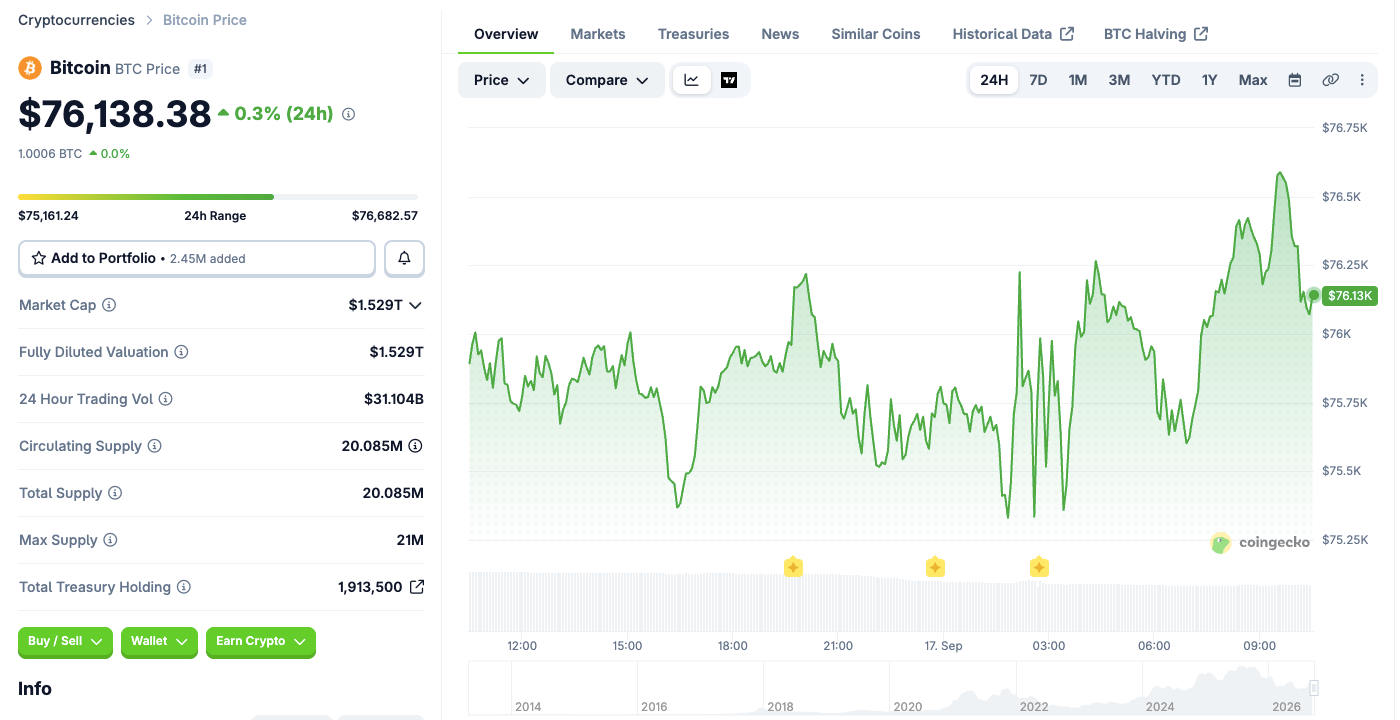
The Federal Reserve raised interest rates by a quarter point on Wednesday, its first hike since 2023. Bitcoin (BTC) climbed anyway, defying the old assumption that tighter policy always hurts risk assets.
Markets had priced in the move for days. That gap between expectation and reaction explains most of Wednesday’s price action, though it is not the whole story.
The Rate Hike Was Already Priced In
Interest rate futures put the odds of a hike at 92.7% just hours before the FOMC decision, according to BeInCrypto. Traders had already positioned for it well in advance.
Bitcoin dropped to around $75,350 shortly before the decision, then jumped past $76,100 within minutes of the release. It went as high as $76,500 after the markets closed in the US, to then settled near $76,138.

Research on past Fed cycles describes something similar. Traders who adjust positions before an announcement often barely react to the actual decision, sometimes even bouncing higher instead.
A Hawkish Surprise Would Have Hurt More
Scott Melker, host of Yahoo Finance’s Daily Wolf, argued a credible, one-time hike could calm long-term yields rather than spook markets. The condition was that Chair Kevin Warsh avoided signaling a longer tightening cycle.
Updated Fed projections show 16 of 18 officials now expect another hike before year-end, up sharply from nine in June. Yet the committee’s decision passed by a unanimous 12-0 vote, with the statement itself striking a measured tone.
Gold moved in a similar pattern. Spot prices spiked toward $4,360 right after the release, then sold off to settle between $4,280 and $4,300. The round trip points to quick profit-taking rather than genuine alarm.

Crypto-Specific Drivers Are Doing the Heavy Lifting
The Fed is not the only force moving prices this week. Bitcoin and XRP were already sliding after the CLARITY Act’s failure in the Senate, a bill meant to settle which federal regulator polices digital assets.
That setback alone wiped out more than $300 million in leveraged positions. Bitcoin and Ether ETFs then lost a combined $592 million to withdrawals on September 15, their worst single day of outflows in months.
Meanwhile, the broader top-10 board looked mixed rather than uniformly bullish. Zcash (ZEC) rallied more than 20% over seven days while XRP slipped, a reminder that altcoin-specific narratives can override the macro backdrop entirely.
With 16 policymakers still eyeing another hike this year, the next real test for crypto may not be the Fed’s next meeting. It may be whether the CLARITY Act debate reopens before then.
The post Fed Increased Rates, Why is The Crypto Market Up? appeared first on BeInCrypto.


Galaxy Research reported on September 16 that venture investment in crypto and blockchain companies rose 31% from the first quarter, while the number of deals increased 10%.
Summary
- Crypto VC funding reached $5.683 billion in Q2 across 384 deals, up 31% from Q1.
- Later-stage companies received 78% of Q2 venture capital, while pre-seed deals represented 21% of transactions.
- Trading, exchange, investing, and lending startups attracted $3.523 billion, nearly three-fifths of Q2 venture capital.
- U.S.-headquartered companies received 73.5% of Q2 crypto venture capital across 39.1% of completed deals globally.
- Five crypto venture funds raised roughly $3.9 billion in Q2, the fewest funds since 2019.
The increase in capital was driven mainly by later-stage financing, with mature companies receiving most of the money deployed during the quarter.
The first half of 2026 produced $10.018 billion in crypto venture investment across 744 deals. If that pace continues through the rest of the year, annual investment would reach roughly $20.037 billion, slightly below the $20.3 billion recorded in 2025, according to Galaxy Research’s Q2 report.
Crypto VC funding has returned above most 2023-2024 levels
Q2’s $5.683 billion investment figure followed a weaker first quarter, when crypto and blockchain startups received around $4 billion across 355 deals. Galaxy’s Q1 report showed capital falling by about half quarter-over-quarter after a large later-stage financing surge in late 2025.
The Q2 rebound was larger in dollar terms than in transaction volume. Capital increased 31%, while deal count rose 10%, indicating that larger financings accounted for much of the quarterly increase. Galaxy said the rise was driven primarily by later-stage transactions.
Galaxy’s data shows that the relationship between bitcoin prices and crypto venture activity remains weaker than during the 2017 and 2021 cycles. Bitcoin reached new highs in late 2025 while venture activity moved unevenly, although both bitcoin and venture investment increased during Q2 2026.
Deal sizes reached a new high in the quarter. Galaxy reported a median crypto deal size of roughly $4.9 million, while noting that valuation information was available for only 16% of Q2 transactions and was heavily weighted toward later-stage companies.
Later-stage companies received most of the $5.68B
Later-stage startups received approximately 78% of the capital invested during Q2, leaving 22% for younger companies. By transaction count, pre-seed rounds accounted for 21% of completed deals, while later-stage investments represented 26%.
The distribution produced a large gap between the number of early-stage transactions and the amount of capital committed to mature companies. Galaxy’s figures show that early-stage businesses continued to attract deals, but larger financing rounds drove the majority of dollars invested.
Trading, exchange, investing and lending companies accounted for the largest category, receiving roughly $3.523 billion during the quarter. The category represented close to three-fifths of all crypto venture capital invested in Q2. DeFi followed with approximately $478 million.
Privacy and security, tokenization, artificial intelligence, infrastructure, Web3, gaming and payments were among the other categories tracked by Galaxy. By deal count, trading, exchange, investing and lending companies recorded 51 transactions, while DeFi and payments/rewards each recorded 40.
Web3, NFT, DAO, metaverse and gaming companies completed 37 deals, followed by tokenization with 36, enterprise blockchain with 34 and infrastructure with 32. More than 90% of the capital invested in the trading, exchange, investing and lending category went to later-stage companies.
The concentration of capital in mature companies comes as other areas continue to attract smaller rounds. crypto venture funding remained active during July even as DeFi investment fell to its lowest quarterly level since late 2023.
U.S. companies captured 73.5% of crypto venture capital
U.S.-headquartered companies captured 73.5% of the capital represented in Galaxy’s Q2 dataset. The United Kingdom followed with 4%, while France accounted for 3.2%.
The U.S. share was smaller when measured by transaction count. American companies represented 39.1% of the 384 deals, followed by the United Kingdom at 7% and Singapore at 5.7%.
The geographic concentration was higher than in Q1, when U.S.-based startups received 70.2% of capital and represented 43.5% of completed transactions, according to Galaxy’s earlier report.
Recent financing activity has included transactions involving exchanges, stablecoin payments and tokenized markets. Payward, the parent company of Kraken, was the largest disclosed crypto funding deal during the September 5-11 period after Nasdaq Ventures agreed to invest $100 million in the company.
Latitude raised $35 million in a Series A during the same week to develop stablecoin-based cross-border payment infrastructure, while Antarctic Exchange announced a $7 million financing tied to its derivatives trading platform.
Five new crypto funds raised roughly $3.9B
Fundraising for new crypto venture funds remained concentrated in Q2. Five new crypto-focused funds raised approximately $3.9 billion, according to Galaxy. The firm said the number of new funds was the lowest for a quarter since Q3 2019.
Galaxy cited macroeconomic conditions, investor interest in artificial intelligence, spot crypto exchange-traded products and digital asset treasury companies as factors competing for allocator capital. The report stated that “fund managers still face a difficult environment.”
The dollar amount raised was higher than the roughly $1.1 billion secured across eight new funds in Q1. Galaxy’s first-quarter report described Q1 as the lowest quarterly new-fund count since Q3 2020.
If first-half fundraising continues at the same pace, Galaxy estimates that crypto venture funds could raise around $10 billion during 2026, above the $8.75 billion raised in 2025. The average fund size reached approximately $377.98 million, while the median fund size stood near $80 million.
The fundraising figures come alongside continuing individual company financing. During September 5-11, five disclosed crypto funding deals totaled $151 million, according to crypto.news. Payward’s $100 million transaction accounted for roughly two-thirds of the weekly total.
During the first half of 2026, venture capitalists invested $10.018 billion across 744 crypto and blockchain deals, according to Galaxy. The firm’s next quarterly dataset will provide the next measurement of venture activity after the Q2 rebound.
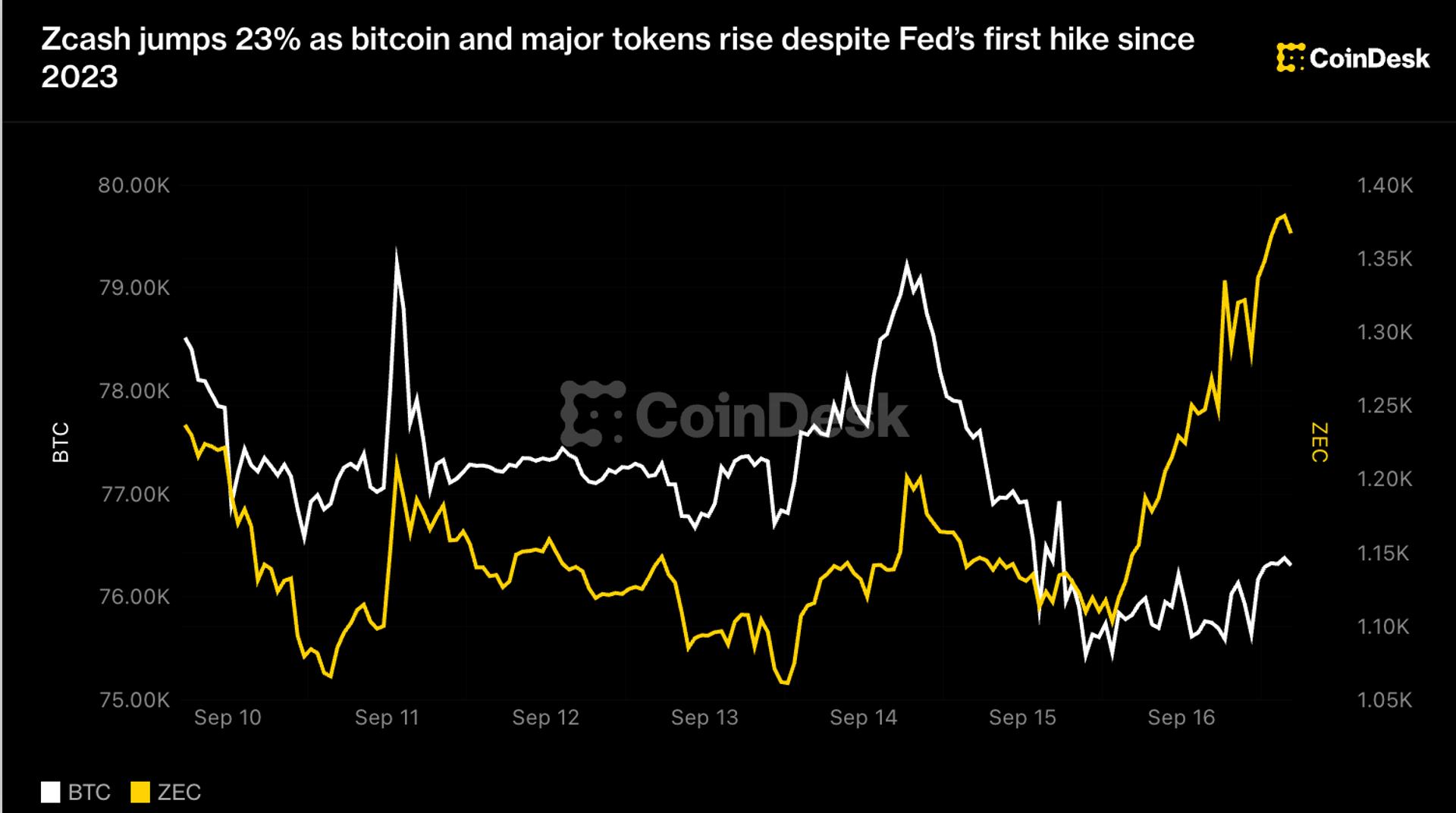
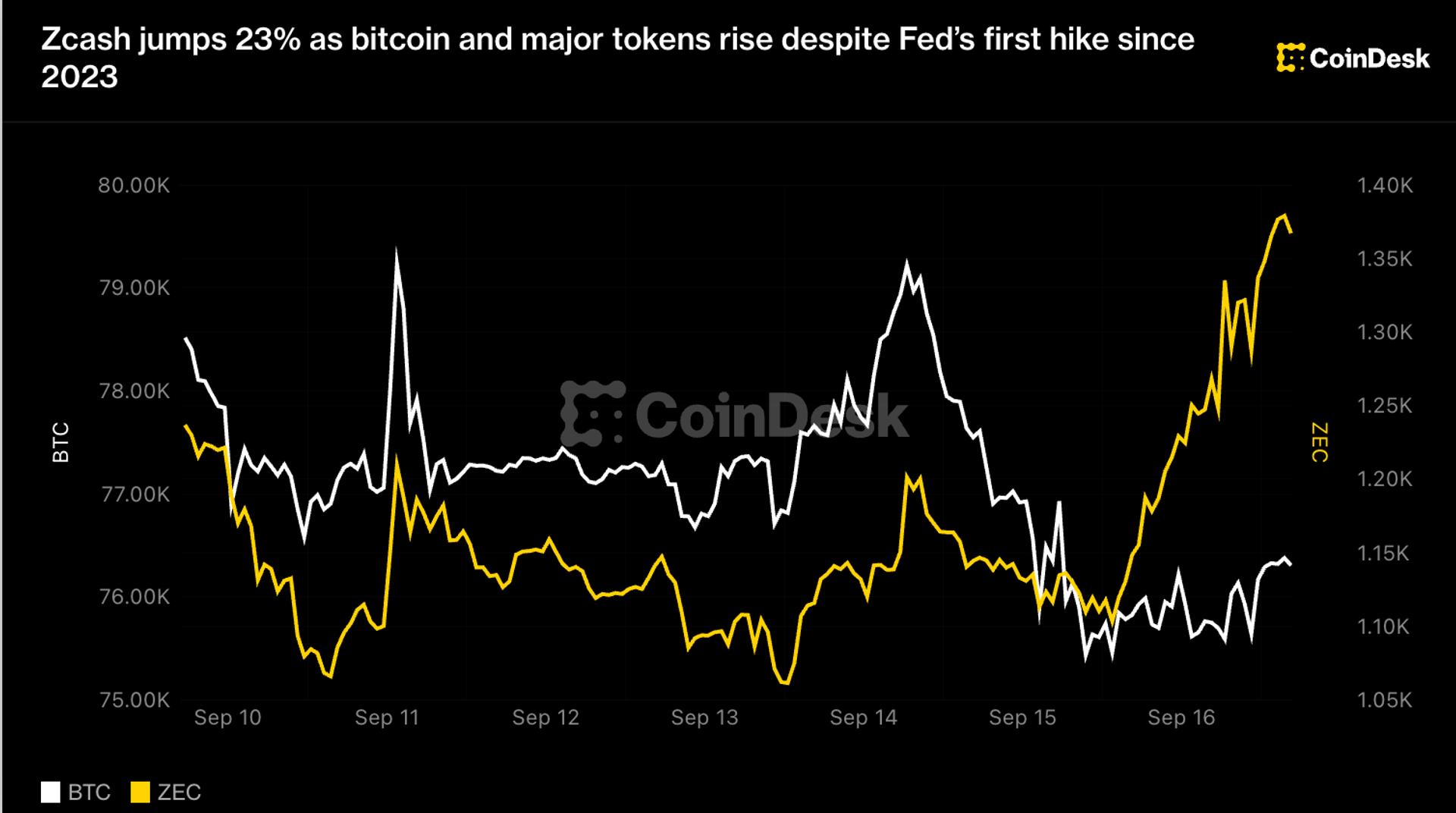
Privacy token Zcash surged 23% over the past 24 hours as bitcoin and other major cryptocurrencies rose overnight into Asian morning hours Thursday, alongside a recovery in stock futures following the Federal Reserve’s first interest-rate increase since 2023.
ZEC traded near $1,369, while bitcoin edged up less than 1% to about $76,258. Solana gained nearly 3% to just below $100. BNB and HYPE, the token of crypto trading platform Hyperliquid, added more than 2%, while ether, XRP and dogecoin rose between 1% and 2%.
ZEC’s surge coincided with comments from Matt Huang, co-founder of prominent crypto investment firm Paradigm, who discussed its role as a privacy complement to bitcoin and disclosed that his firm owns ZEC, per an X post.
Zcash lets users send money without publicly revealing who paid whom or how much. Its holders recently backed proposals to make payments faster while keeping scheduled cuts to the creation of new coins, a feature it shares with bitcoin.
Huang, whose firm owns ZEC, described Zcash as “a private complement to Bitcoin.” He supported continued funding for its developers, while arguing that votes by coin holders should be combined with other ways of deciding changes to the network.

“Medical-debt issues often stem from routine care, including doctor’s office visits and treatment for chronic conditions,” says Sara R. Collins, a senior scholar at the Commonwealth Fund and one of the authors of the report. High deductibles are another common source. “People are just dealing with routine care and bills that build up over time.”
The study, which consisted of interviews among a nationally representative sample of more than 6,300 adults in 2025, also included analysis of focus groups in which people expanded on their experiences with health care. In the focus groups, many people expressed surprise at how high their medical bills were despite their insurance coverage, Collins says.
The problem of insured Americans with medical debt could grow in the coming years as health insurance becomes less affordable. Already, the cost of health benefits per employee is projected to rise 8.2% in 2027, the highest increase since 2003, according to an August survey by Marsh, and some employers may downgrade their plans and shift more costs to employees, employers told Marsh. What’s more, after Congress decided not to renew subsidies for people buying health insurance from Affordable Care Act Exchanges, many consumers switched to lower quality plans that will cost them more if they have catastrophic or chronic health issues, according to April data from the Center on Budget and Policy Priorities.

Politics Home | Lib Dem MP Warns Her Party Is “Struggling For Relevance” In Call For “Insurgent” Liberalism

Why the Asian Games are much bigger than the Olympics

Don’t Waste Money On Cheap Portable Air Conditioners



-

 Fashion6 days ago
Weekend Open Thread – Corporette.com
-

 Tech4 days ago
The Latest Weird Thing to Play Doom Is the Mapped-Out Brain of a Fruit Fly
-

 Business6 days ago
10 Most-Streamed Songs On Spotify In 2026 So Far, Led By Ella Langley’s Dominant Run On The Charts This Year
-

 Crypto World6 days ago
XAG/USD: Silver’s Short-Term Rally Meets Its Moment of Truth
-
 Crypto World7 days ago
2 Chip Stocks Broke Out This Week. Neither Was Nvidia
-

 Tech6 days ago
Battery life is the only iPhone 18 Pro and iPhone Duo upgrade I care about. Apple didn’t disappoint
-

 Crypto World6 days ago
Diesel Tops $6 a Gallon for the First Time as 28 States Set Records
-

 Crypto World6 days ago
OKX launches 10x OpenAI, Anthropic X-Perps in Europe
-

 Crypto World3 days ago
Elon Musk Drops a Bombshell: Grok 5 Could Be the AGI Breakthrough
-

 Business7 days ago
Western Digital Slips 2.7% as AI Storage Rally Cools After Record Cash and Guidance
-

 News Videos6 days ago
Facing Financial Fears
-

 Business4 days ago
Rivals Sam Altman and Elon Musk Rally Behind Dario Amodei’s Call for a Slowdown in AI Development
-
Crypto World6 days ago
Ethereum Price Analysis: Consolidation at $2.5K Tests Momentum as On-Chain Activity Surges
-

 Business7 days ago
Five Leading AI Experts Warn Superintelligence Could Kill Humans and Explain Their Case
-
 Crypto World2 days ago
Kraken Lets xStocks Holders Earn Yield Through DeFi
-

 Crypto World7 days ago
Ant International joins Visa, Mastercard to build AI agent payment standards
-

 Crypto World5 days ago
Can AI Build a Startup in 72 Hours? Elon Musk's Team Will Livestream the Test
-
 NewsBeat3 days ago
‘Sick conspiracy’: Trump says only guardrails AI needs is ‘a strong and smart (High IQ!) president’ in all-caps rant
-

 Crypto World6 days ago
Bitcoin ETFs Pull $167M as 2026’s Best Inflow Run Slows
-

 Crypto World6 days ago
US CPI forecast at 3.4% as tariff risks build
You must be logged in to post a comment Login