
Crypto World
Bitcoin slips as Clarity Act odds fade: Crypto Markets Today

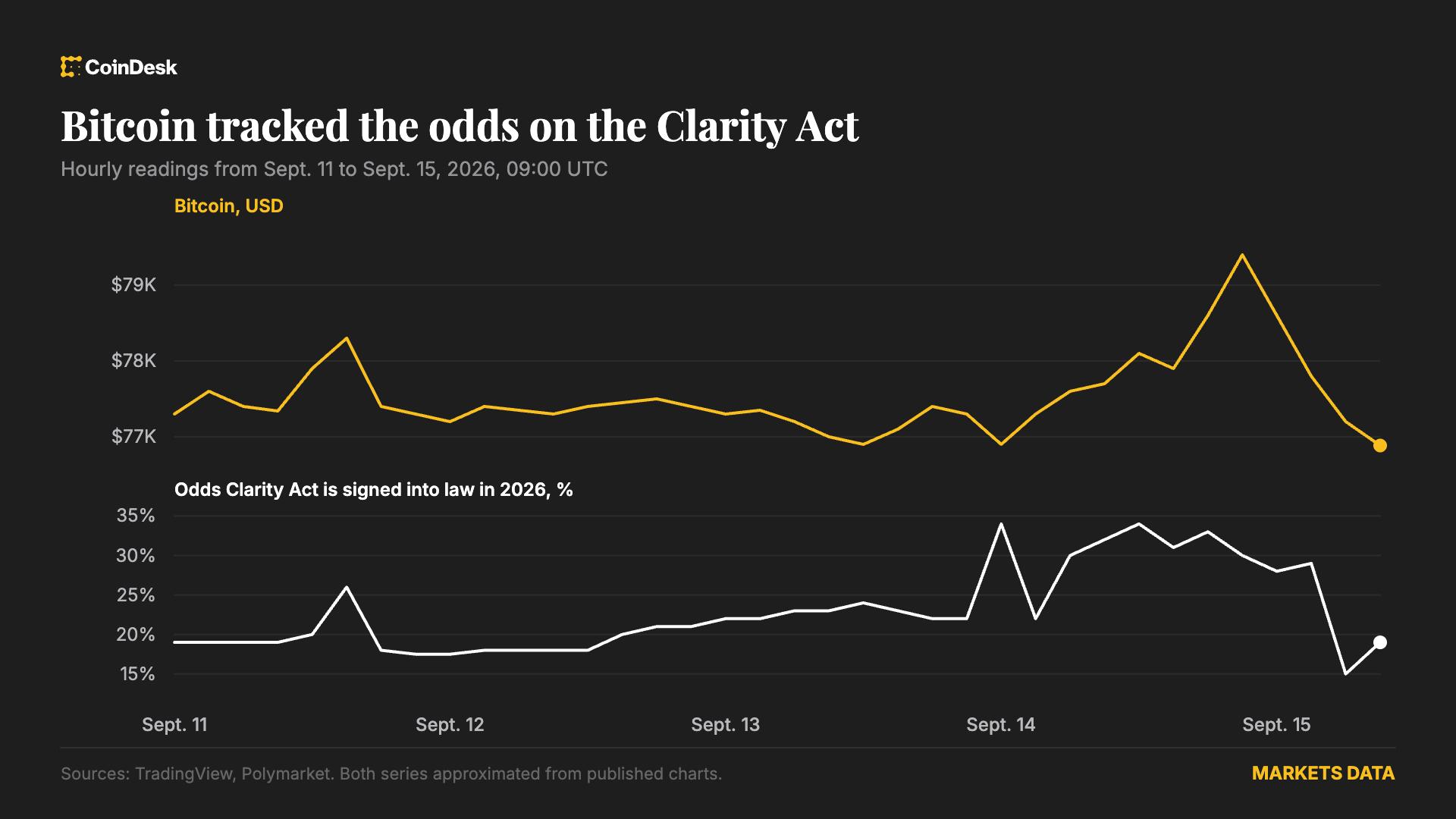
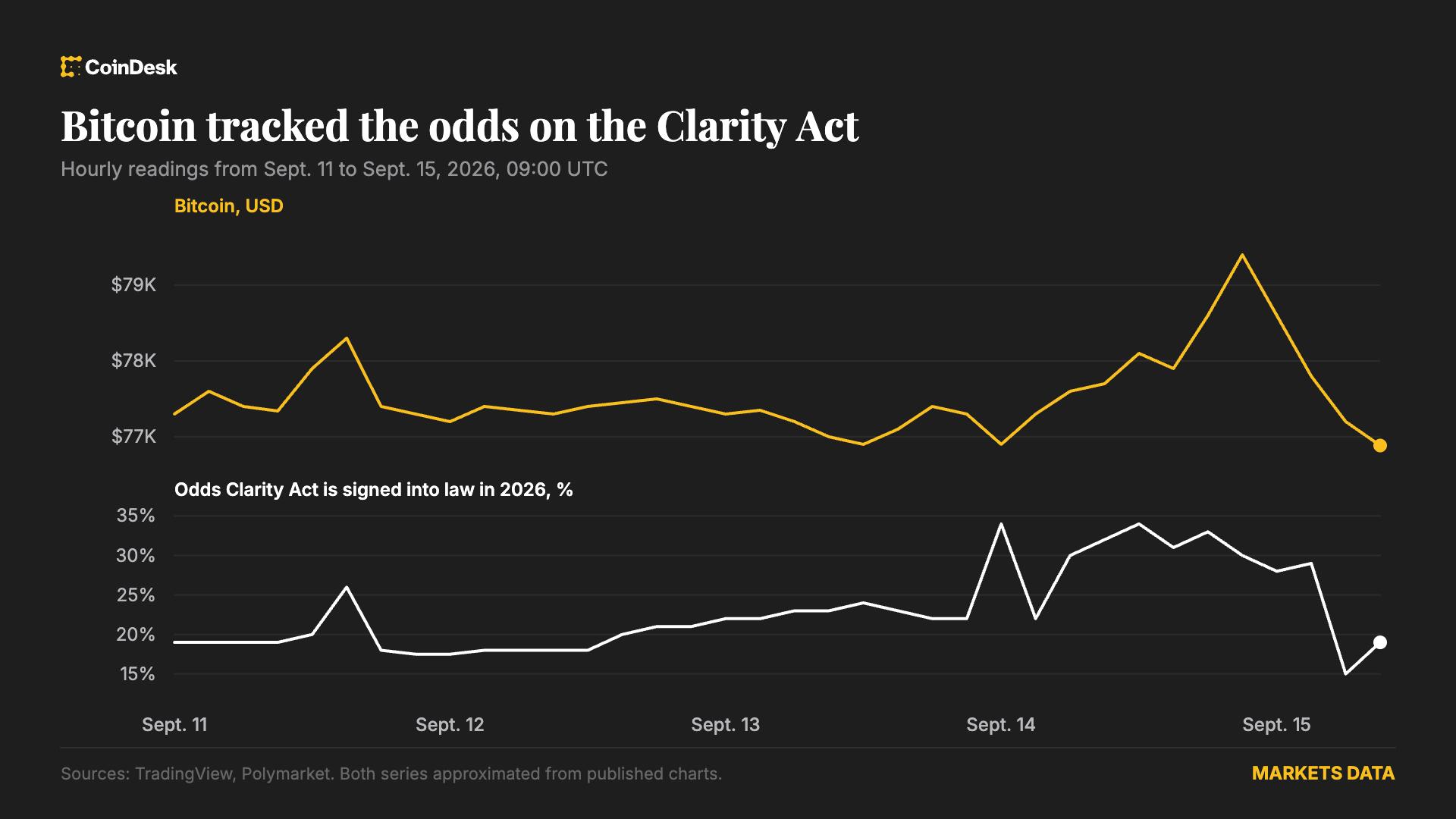
A rally that carried bitcoin to $79,427 on Monday unwound on Tuesday, leaving the largest cryptocurrency at $76,862, down 1.7% since midnight UTC and 6.6% below the month’s $82,284 high set on Sept. 4. Ether fell 1.6% to $2,474.76 and solana (SOL) lost 2% at $100.43.
Polymarket odds on the U.S. Clarity Act being signed into law this year followed a similar trajectory, reaching 34% on Monday before sliding back to 17%. The drop was caused by news that Democrats had crafted a counterproposal after rejecting a revised draft Republican negotiators circulated on Sunday. The sticking point is the ethics language governing officials’ crypto holdings rather than the market structure provisions themselves.
The Senate votes at 2:15 p.m. ET on whether to invoke cloture, or force a vote, on the bill. If the bill passes, that would move the industry closer to its first clear set of U.S. rules on who regulates what. A failure would likely shelve market structure legislation until after the midterm elections in November.
Selling pressure was near universal on Tuesday, with 92 of the CoinDesk 100 constituents lower on the day and the index itself down 1.6%.

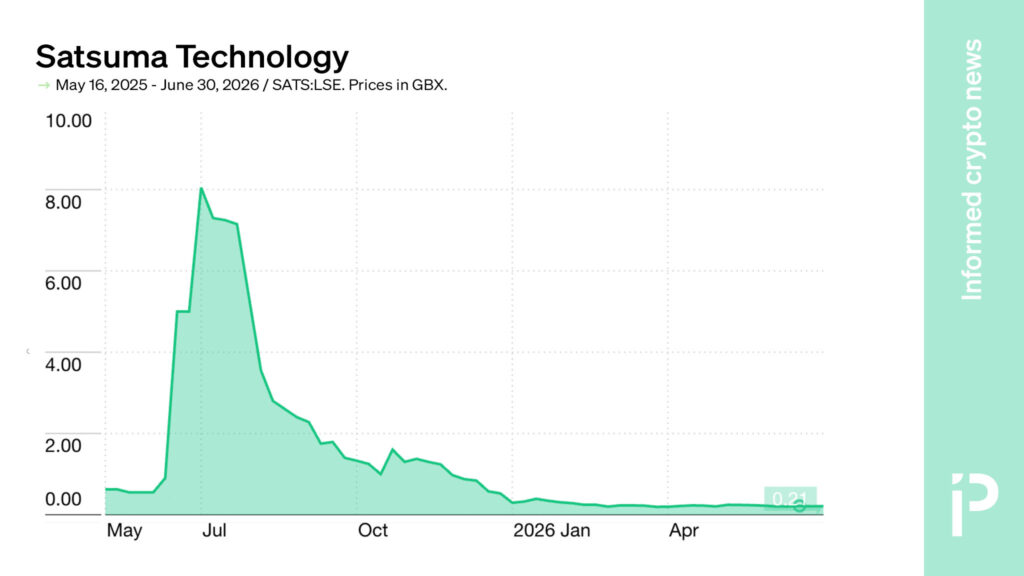
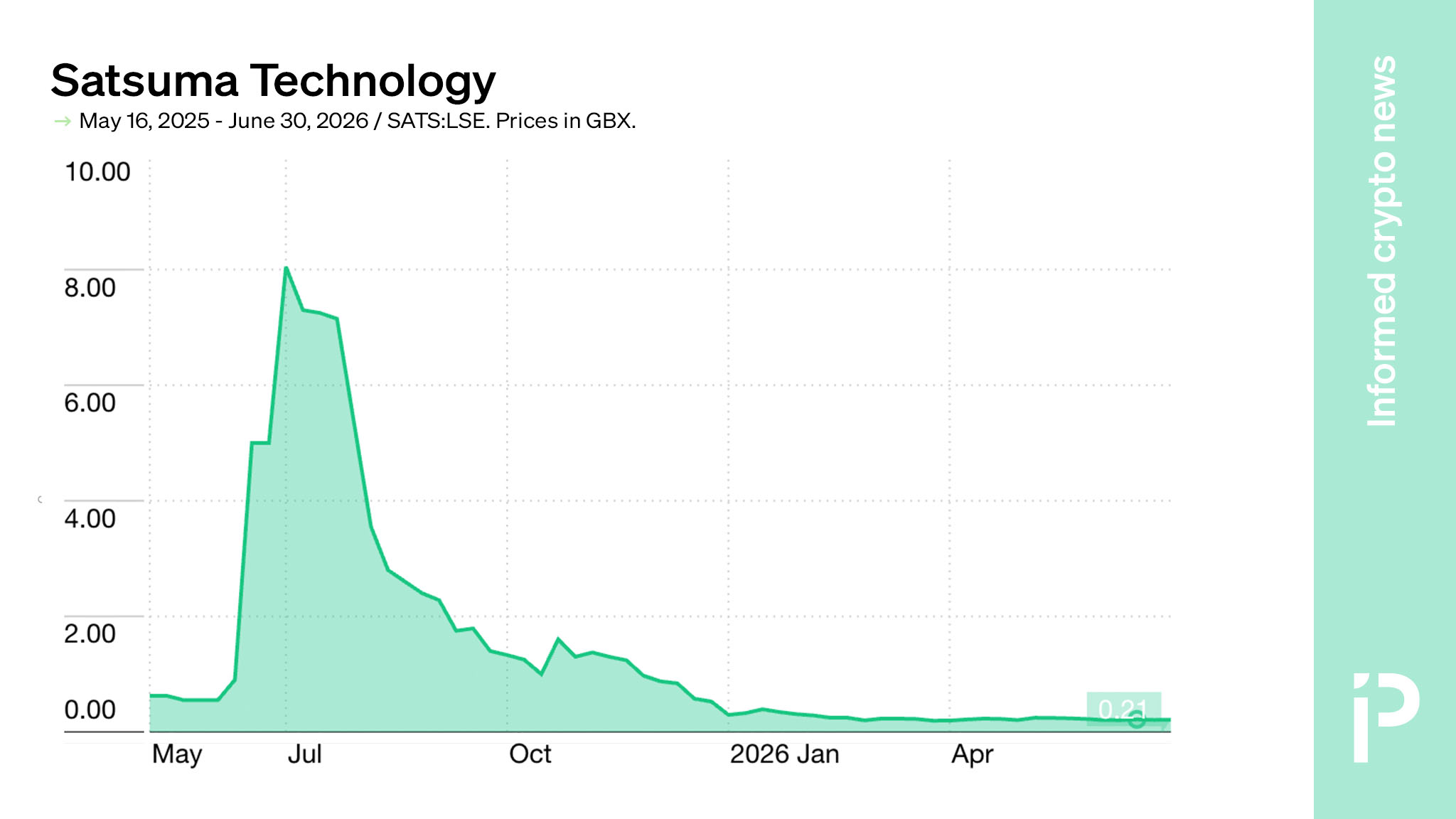
British Strategy copycat, Satsuma Technology, which raised £168.9 million ($227.6 million) from noteholders at the height of the 2025 BTC treasury boom, has crashed 99% from its 2025 peak, sold all 669 of its BTC, and suspended trading.
On Monday, the company attempted to postpone its own delisting while it hunts for a new trading venue. It’s also under High Court of Justice procedures to disburse £30.7 million ($41.4 million) to shareholders by the end of September.
However, its Chief Bitcoin Strategist, Mark Moss, explained in an interview that, according to UK regulations, “We can’t give the investors back their BTC. We have to give them the dollar amount of the bitcoin when they accepted it.”
The company was worth over £120 million ($162 million) as recently as June 24, 2025.
What is Satsuma?
Incorporated in March 2021 as Streaks Gaming, it pivoted to AI as StreaksAI before hopping on the crypto bandwagon as Tao Alpha. Finally, it channeled the “sats” denomination of BTC as Satsuma Technology.
Interestingly, Strategy founder Saylor apparently encouraged the proliferation of copycats, saying, “There’s room for 400 million companies to buy BTC.”
Unfortunately, the BTC treasury bubble popped in early summer 2025, and the performance of most of those stocks are overwhelming negative since their initial purchases.
Read more: Strategy needs to pay $689M a year to not sell bitcoin
‘The next MSTR’ wasn’t
Moss, as chief Bitcoin strategist, was supposed to raise non-dilutive capital and generate yield from the company’s self-described “treasury” that it’s now liquidated in full.
When he was appointed, Moss gushed, “Satsuma $SATS.L is entering the UK markets with a better model: Balance sheets backed by pristine collateral (BTC), not empty promises.”
He also promoted the stock to his followers. Hopefully they ignored him.
Money followed the initial hype. In July 2025, Satsuma closed a £163.6 million ($220 million) convertible note round with ParaFi Capital as lead investor.
Pantera Capital, Digital Currency Group, and Kraken contributed capital and subscribed. Some investors excitedly paid in BTC; the company accepted 1,097 BTC in lieu of £96.9 million ($130.6 million) in cash.
The first rupture came in December, when Satsuma sold 579 of its 1,199 coins for about £40 million ($54 million). The proceeds were earmarked to repay £78 million ($105 million) of notes maturing at the end of December.
Fleeing executives and the strategy ends
The boardroom soon began to empty.
CFO Andrew Smith quit on February 18, after shareholders requisitioned a general meeting about his performance, while CEO Henry Elder resigned on March 6 after seven months on the job.
Backers also turned their backs. By April, Bloomberg was reporting that Pantera was among the investors pushing Satsuma to dump its remaining BTC.
Pantera’s DAT Opportunity Fund held 6.7% equity at the time, and the company’s market value had fallen below the value of its coins.
Satsuma admitted an embarrassingly high average purchase price of £84,026 ($113,000) per BTC.
Directors dug in anyway. Four of the six board members wanted the strategy to continue. The company insisted in July, “For the avoidance of doubt, the board’s recommendation is that shareholders VOTE AGAINST the resolutions to return capital and to delist.”
Shareholders ignored that boardroom advice, however, and voted more than 90% in favor of a wind-down on July 20, 2026.
Between July 24 and 31, Satsuma netted £31.9 million ($43 million) for its last 669.49 BTC. Its average sale price was £47,667 ($64,272) per coin, 43% below what it paid.
Got a tip? Send us an email securely via Protos Leaks. For more informed news and investigations, follow us on X, Bluesky, and Google News, or subscribe to our YouTube channel.

Estimates of how much economic activity flows through crypto networks can diverge dramatically depending on how analysts measure onchain activity. A new study from researchers at the Bank for International Settlements (BIS) finds that calculations of Bitcoin transfer values can vary by as much as six times when different transaction-measurement methods are used.
The BIS researchers argue that the problem is not limited to Bitcoin. The same measurement challenges appear across the wider crypto ecosystem—including stablecoin activity and even conventional approaches to calculating market capitalization. Their conclusion: onchain indicators should be treated as imperfect, “noisy approximations,” not direct gauges of real-world economic activity.
Key takeaways
- Bitcoin onchain transfer-value estimates can differ by up to sixfold based on measurement choices, including how change outputs are handled.
- BIS finds conventional Bitcoin market capitalization figures have, at times, been up to four times higher than “realized” capitalization based on the last time a coin moved.
- Across large-scale data spanning Bitcoin, Ethereum, and Tron, the study shows similar measurement pitfalls in other parts of the market.
- On Ethereum, the abundance of smart contracts creates categorization gaps that complicate interpretation of activity, including stablecoins.
- Some analytics efforts—such as Visa’s Onchain Analytics dashboard—attempt to adjust raw stablecoin volumes to remove distortions from non-economic activity.
Why Bitcoin “transfer value” can change six times
The BIS findings focus on onchain transfer values rather than exchange trading volumes. According to the study, the gap between different estimates reflects differences in transaction measurement methods—most notably how the analysis treats outputs that send funds back to the original sender.
Bitcoin transactions are structured in a way that often includes “change” outputs. When a user spends Bitcoin, the network may return any unspent portion back to the spender as change. Some measurement approaches count that as an additional output, even though it does not represent value transferred to another counterparty.
The BIS researchers caution that metrics that are commonly used to infer activity—such as transaction volumes, market capitalization, and total value locked—can appear more precise than the underlying data actually supports. As the study puts it, those metrics can suggest accuracy that is “not supported by the nature of the underlying data.”
Market capitalization: a conventional figure can diverge
The BIS study does not stop at onchain transfer estimates. It also highlights inconsistencies in how market capitalization is typically calculated for Bitcoin.
The researchers report that the conventional market cap measure has at times been as much as four times higher than “realized capitalization,” a metric that values each coin at the price when it last moved. In practical terms, the difference underscores a broader issue: different ways of interpreting blockchain movement can generate materially different economic readouts.
This matters for investors and analysts who use onchain-derived figures to gauge adoption, liquidity, or sentiment. When measurement methodology can swing the headline number by multiples, comparisons across time periods—or across dashboards with differing definitions—require careful scrutiny.
Ethereum and stablecoins: categorization gaps and mixed use cases
The BIS researchers identify additional challenges on Ethereum, where smart contract activity multiplies the ways tokens can be held or moved. In the study’s dataset, researchers examined roughly 67.5 million active contracts and found that about 54 million could not be categorized using the study’s classification approach.
Stablecoins introduce a further layer of complexity because the same token can serve different roles across chains. The BIS researchers note that USDT on Ethereum was more closely associated with DeFi activity, while USDT on Tron was more tied to payment-like and store-of-value uses.
The study also describes stark differences in where stablecoins sit—particularly in smart contract holdings. The share of USDT held by smart contracts on Ethereum exceeded 20% in 2022, compared with around 1% on Tron. Because these holdings reflect different use cases, the BIS researchers warn that aggregating stablecoin activity across blockchains can conflate distinct kinds of economic behavior and obscure how stablecoins are actually being used.
Ultimately, the BIS team frames the broader takeaway as a limitation of data interpretation: onchain indicators should be handled as “noisy approximations rather than direct measures of economic activity.”
Filtering raw data: Visa’s adjusted stablecoin volumes
While the BIS study emphasizes the risks of treating raw onchain measures as straightforward economic signals, it also notes that some analytics providers attempt to separate “economic activity” from activity that may be distorted by mechanics or automation.
Visa’s Onchain Analytics dashboard—powered by data from Allium Labs—presents both total and adjusted stablecoin transaction volumes. Visa states that its adjusted methodology is designed to reduce distortions stemming from activity such as high-frequency trading, bots, bridge routing, and internal exchange operations.
On the dashboard, Visa currently shows $6.4 trillion in total stablecoin transaction volume across the networks it tracks over the past 30 days, alongside $313.1 billion in adjusted volume. While the BIS study itself does not validate any specific proprietary adjustment approach, the contrast illustrates the central issue it raises: definitions and filtering choices can move the headline number by a wide margin.
For readers using dashboards to benchmark stablecoin adoption, the implication is straightforward: “total” and “adjusted” are not interchangeable, and the rationale behind adjustments becomes part of the metric’s credibility.
What to watch next
The BIS study suggests that as onchain analytics matures, transparency about measurement definitions—and explicit handling of transaction structure, smart-contract categorization, and non-economic activity—will be essential. Investors and builders should treat widely cited onchain metrics as starting points, not definitive proof of underlying economic demand, and should watch for clearer methodologies that better align onchain observations with real-world usage.
Popular crypto analyst and influencer, Kyle Doops, screens altcoins by relative strength rather than by how far they have fallen. BeInCrypto ran that test across the 20 largest non-stablecoin assets. Only 3 altcoins pass.
Bitcoin (BTC) is not among them. During a podcast, Doops was asked about a filter of altcoins trading less than 36% below their records. The Crypto Banter host did not dispute the framing.
The 3 Altcoins That Did Not Break
Most newcomers do the opposite, hunting whatever has fallen hardest.
“They look at, hey, what’s down 99.99% that’s at a massive discount. Let’s buy it. But instead, it’s better to look at what hasn’t been completely wrecked.”
Only HYPE, TRX and Monero clear the line. Below them, the field drops away. Chainlink is 78% down, Cardano 93%, Polkadot 98%.
Hyperliquid Proved the Screen
Doops named Hyperliquid his strongest example on August 28, when the interview was recorded.
“Pretty much trading at all-time highs, which is absolutely unbelievable when you consider that Bitcoin is still down massively off of its all-time highs.”
HYPE price hit an all-time high of $89.60 on September 6. It has since eased back to $78.82.
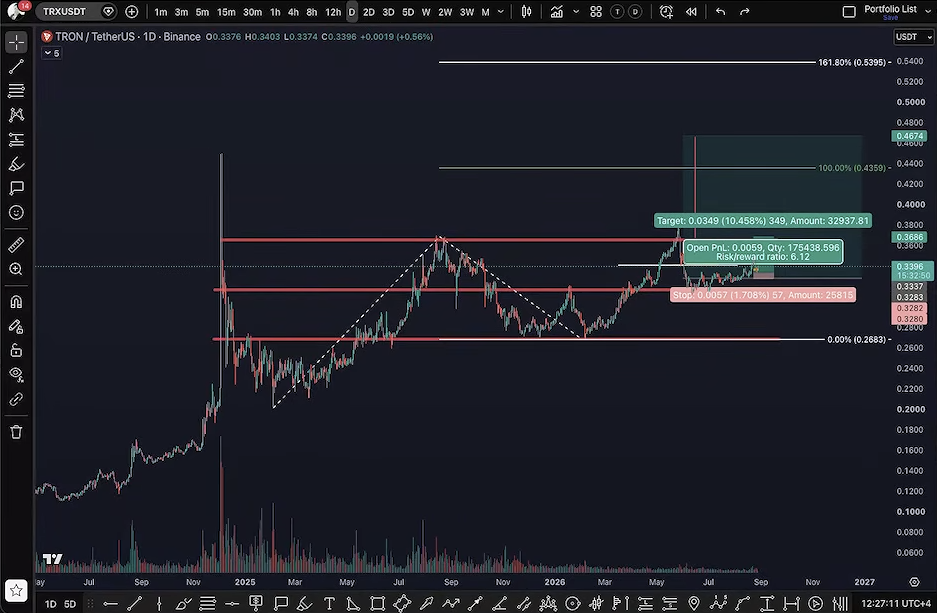
His TRON case rests on a cup-and-handle pattern. The 100% extension sits at $0.4359, fractionally above the $0.4313 record.

The Zcash Problem
The screen has a blind spot. Doops showed Zcash at $791 and liked the structure.
However, ZEC fails his own filter at 64% below its 2016 peak. It has since gained roughly 120% in a month and cleared $1,000 for the first time in nearly a decade. Privacy coins are the only sector above Bitcoin’s October 2025 high.

Investor Dan Held says Bitcoin whales urged him to buy ZEC months before the move. Buying only what has not been wrecked would have missed it.
On Solana, now 66% down, Doops was blunt.
“You have to call a spade a spade… as great as the narrative is, it’s still 64% down.”
He describes altcoins instead as “a short-term vehicle to rotate capital” back into Bitcoin.
“History would suggest that it’s probably not a great idea to be an altcoin investor.”
His own test once found one coin that beat Bitcoin cycle after cycle. Dogecoin now trades 89% below its high.
The post Only 3 Altcoins Pass the Relative Strength Test, For Now appeared first on BeInCrypto.
Canning says the Center’s financial problems are unsurprising after a year of cancellations, diminished bookings, and litigation.
“Any claims that the Kennedy Center is in financial trouble, I believe,” she says, “but they’re all problems of their own manufacturing.”
What comes next for the embattled Kennedy Center
Any future efforts to add Trump’s name to the Kennedy Center, in whatever form they may take, will almost certainly be challenged in court.
Even as that legal fight continues, however, the closure will not halt all of the Kennedy Center’s activities.
While the cultural center’s main building—which includes the Concert Hall, the Opera House, and the Eisenhower Theater—is closed, certain programming elements will continue at REACH, an indoor and outdoor campus expansion that opened in 2019.
The center also said that it will still be “maintaining educational outreach to the community” and that it will continue presenting the Kennedy Center Honors and awarding the Mark Twain Prize for American Humor—even if those events take place offsite.


The crypto market has lost more than 2% of its value, pushing Bitcoin below $76,000 as traders prepare for a likely Federal Reserve rate hike and a key Senate vote on the CLARITY Act.
Summary
- The global crypto market capitalization fell more than 2% to about $2.6 trillion.
- Bitcoin dropped over 3% and traded below the $76,000 level.
- Fed futures placed the probability of a 25-basis-point rate increase above 92%.
- The Senate’s CLARITY Act cloture vote presents another source of uncertainty for traders.
Crypto market loses $76,000 Bitcoin support
Data from the crypto market showed widespread losses on Sept. 15, with the total value of digital assets falling to around $2.6 trillion as investors reduced risk before two major U.S. events.
Bitcoin (BTC) dropped more than 3% and moved below $76,000 after failing to hold its earlier gains. Losses also spread across major altcoins, while U.S.-listed companies with direct exposure to crypto came under pressure.
The decline accelerated as traders assessed the Federal Open Market Committee meeting scheduled for Sept. 15–16. Futures tied to the federal funds rate placed the probability of a 25-basis-point increase above 92%, making a hike the market’s main expectation rather than a low-probability risk.
An increase of that size would lift the Fed’s target range from 3.50%–3.75% to 3.75%–4.00%. The decision is due on Sept. 16, followed by comments from Fed Chair Kevin Warsh that could indicate whether officials view the increase as a single response to inflation or the start of a longer tightening period.
Earlier on Sept. 15, crypto.news reported that the estimated chance of a quarter-point hike had risen to 86.5% from 69.4% on the previous Friday. The probability moved above 92% as the meeting drew closer, showing how quickly traders had adjusted their rate expectations.
Fed hike odds rise as inflation concerns return
Expectations for tighter policy have grown alongside renewed concern about U.S. inflation. Goldman Sachs and JPMorgan forecast a 25-basis-point increase at the September meeting, according to reports cited in the original coverage.
Morgan Stanley also expects the Fed to lift rates by a quarter point in September and again in December, Reuters reported. The bank linked its forecast to persistent inflation, higher oil prices and strong demand tied to artificial intelligence investment.
Rising borrowing costs tend to weaken demand for assets that do not generate fixed income. Investors can earn a higher return from Treasury securities after a rate increase, raising the hurdle for holding volatile assets such as Bitcoin and other cryptocurrencies.
Higher policy rates can also increase the cost of leveraged positions. Crypto traders who use borrowed funds may reduce their exposure when financing becomes more expensive, while a firmer U.S. dollar can place additional pressure on dollar-priced assets.
The market’s response will depend partly on the guidance accompanying the decision. A quarter-point increase has already become the expected result, but any signal of further hikes could force investors to reassess the path for liquidity and borrowing costs.
As earlier market coverage explained, Bitcoin now enters a tightening decision with a larger institutional investor base than it had during the Fed’s previous rate-hike cycle. Spot exchange-traded funds, corporate Bitcoin holders, and other regulated products have linked crypto more closely with traditional portfolio decisions.
Trump says he will respect the Fed decision
National Economic Council Director Kevin Hassett said President Donald Trump would support Warsh’s right to make an independent policy decision, even though the White House does not favor another rate increase.
“President Trump 100% respects the independence of Kevin Warsh,” Hassett said, according to comments reported by Yahoo Finance.
Hassett added that the administration would support Warsh regardless of the outcome. His comments clarified Trump’s position on the Fed’s authority but did not signal White House approval of higher interest rates.
Trump and Hassett have both opposed raising borrowing costs. During a Fox News interview, Hassett said he would be cautious about increasing rates close to the U.S. midterm elections because an independent central bank should avoid becoming part of the political cycle.
The distinction matters for U.S. investors because the Fed sets monetary policy without taking instructions from the White House. Political comments can affect expectations, but the FOMC votes on rates based on its assessment of inflation, employment, and financial conditions.
Recent inflation readings have kept pressure on policymakers. Wall Street firms have warned that the personal consumption expenditures price index, the Fed’s preferred inflation measure, could come in hotter than expected. Persistent price growth would give officials more reason to keep rates elevated after the September meeting.
CLARITY Act vote adds another risk for crypto
Alongside the Fed decision, the Senate is preparing to vote on whether to advance the Digital Asset Market Clarity Act. The procedural vote requires 60 senators to support opening debate on the measure.
A successful cloture vote would not pass the bill into law. It would allow the Senate to begin considering the legislation, after which lawmakers would still face an amendment process, another procedural vote, and possible negotiations with the House.
Republicans hold 53 Senate seats, leaving the bill dependent on support from several Democrats. Negotiations became more uncertain after Democrats presented a counteroffer that met resistance from Republicans shortly before the scheduled vote.
A recent CLARITY Act analysis noted that the revised text had expanded from roughly 616 pages to 635 pages. The proposal included language covering the division of authority between the Securities and Exchange Commission and the Commodity Futures Trading Commission, along with provisions affecting the treatment of individual digital assets.
For American crypto holders, the bill could determine which federal regulator oversees different parts of the market and how tokens are classified under U.S. law. Failure to advance the measure would leave the current regulatory framework in place while lawmakers decide whether to revise or reintroduce the proposal.
Crypto-linked stocks also fell before the vote, including companies whose revenue or balance sheets depend on digital assets. Shares of Strategy, Coinbase, Circle, and Robinhood faced selling as investors reduced exposure to both the legislative uncertainty and the possibility of higher U.S. interest rates.
The market entered the week in a less defensive position. A weekly market recap published on Sept. 12 placed Bitcoin near $80,000 and reported $463 million in weekly outflows from U.S. spot Bitcoin ETFs. Continued withdrawals from the funds would show that regulated investment products remain a source of selling pressure during the policy-heavy week.


The US Department of Justice (DOJ) is seeking forfeiture of more than $61 million in Tether’s USDT stablecoin, alleging the funds came from black-market sales of sanctioned Iranian oil and were intended to finance Iran’s government and military, including the Islamic Revolutionary Guard Corps (IRGC).
On Monday, the DOJ alleged that Blessed Trust and Hexa Whale, both incorporated in Hong Kong, used Binance accounts to move proceeds from oil sold to buyers in China. A network of related addresses allegedly received and distributed more than $1.5 billion, including transfers to IRGC-linked money-transfer businesses, cryptocurrency addresses and an Iranian exchange.
A Binance spokesperson told Cointelegraph that Binance did not permit transactions with sanctioned individuals and would continue cooperating with law enforcement, including by investigating, restricting or freezing accounts where appropriate. The spokesperson said the case was not filed against the exchange and did not allege wrongdoing by Binance.
The filing comes as Washington expands financial pressure on Tehran and the US-Israeli war with Iran disrupts energy infrastructure and oil shipments across the Middle East. Oil prices rose on Tuesday following attacks on Saudi infrastructure and continued reductions in vessel traffic through the Strait of Hormuz.
Tether freezes $61 million in USDT
According to the complaint, Tether froze about 61.19 million USDT across 10 addresses on the Tron network in 2025. It said a seizure warrant authorizes the FBI to take custody of the assets by having Tether destroy the frozen tokens and issue replacements of equal value to be transferred to an FBI-controlled hardware wallet.
Cointelegraph contacted Tether for comment but had not received a response by publication.
The DOJ said the allegations contained in the civil forfeiture complaint had not been proven. The US would obtain permanent ownership of the assets only if a court enters a forfeiture judgment in the government’s favor.
The enforcement action also follows the US Treasury’s August expansion of its Iran sanctions framework to cover the country’s digital asset sector. The measure allows US authorities to target foreign individuals and companies operating in or supporting the sector.
At the time, the Treasury alleged that UAE-based broker Ivan Obukhov had processed more than $100 million in crypto payments since 2023 to facilitate Iranian oil sales for the IRGC’s Quds Force.
Recent: CoinEx to cease operation after 9 years, citing ‘significant’ crypto contraction
Iran conflict pushes oil prices higher
The war between the US and Israel and Iran, which began in February, continues to disrupt oil shipments through the Middle East.
Reuters reported on Tuesday that Saudi Arabia’s East-West pipeline remained offline after Friday attacks that Riyadh blamed on Iran-backed fighters in Iraq, while Iran-backed Houthi forces launched separate missile and drone attacks on Saudi Arabia on Monday.
At the time of writing, market data showed Brent crude trading at about $107.59 per barrel, up 1.81%, while US West Texas Intermediate traded at roughly $103.35, up 1.93%.
Magazine: Why are AI’s biggest companies suddenly asking to slow down?


The CLARITY Act has stalled after a Senate cloture motion received 50 votes to 49, falling 10 votes short of the 60 needed to begin debate on the crypto market structure bill.
Summary
- The 50-49 result stopped the Senate from opening formal debate on the CLARITY Act.
- Polymarket odds of enactment in 2026 fell to 7% from 31% a day earlier.
- Bitget Wallet identified ETH as the token with the most regulatory uncertainty tied to the vote.
- Fireblocks expects crypto adoption to continue, though fewer institutions may move at scale.
CLARITY Act falls 10 votes short in the Senate
The U.S. Senate’s floor proceedings showed that the chamber failed to invoke cloture on the motion to proceed with H.R. 3633, the House version of the Digital Asset Market Clarity Act. Cloture required 60 votes, and clearing it would only have allowed senators to start debating the measure rather than approving it as law.
Several senators who had participated in negotiations opposed the motion. Democratic Senators Angela Alsobrooks, Ruben Gallego, and Kirsten Gillibrand voted no, while Republican Senators Susan Collins, Josh Hawley, Jerry Moran, and Thom Tillis also withheld support.
Tillis, who had worked on disputes involving government ethics and stablecoin rewards, voted against cloture and moved to recommit. Senate Majority Leader John Thune may file another cloture motion, but any new attempt would still require support from both parties.
Hours before the vote, Democrats had delivered a late counteroffer addressing ethics rules and other contested provisions. The proposal followed talks involving Senate Minority Leader Chuck Schumer’s office, although its full text was not made public before senators voted.
Republicans rejected the offer and argued that their 635-page version already included 126 substantive changes requested by Democratic negotiators. As crypto.news previously reported, the party controlled 53 Senate seats and needed at least seven Democratic or independent votes even if every Republican backed cloture.
Ethics rules have blocked a bipartisan agreement
Government ethics remained the main source of disagreement after President Donald Trump accepted changes to the Republican bill. The revised text placed restrictions on crypto interests held by the president, vice president, members of Congress, federal judges, and certain relatives, while allowing state attorneys general to pursue some civil enforcement actions.
Democrats said the restrictions did not go far enough to address crypto ventures linked to Trump and his family. Their counterproposal sought to extend the rules to dependent children of federal officials, according to the original report.
Following the vote, Gallego accused the president of seeking “time to crime” and said he would not support legislation that enabled such conduct. His comment continued an ethics dispute that had survived months of negotiations between Republican and Democratic senators.
Other contested areas included stablecoin rewards, protections for decentralized software developers, and the treatment of event contracts that may conflict with state or tribal gambling rules. Banking groups had pushed for tighter restrictions on stablecoin rewards, arguing that such products could draw deposits away from insured institutions, while crypto companies rejected comparisons between payment stablecoins and bank accounts.
The failed motion has also stopped consideration of a revised asset-classification framework. Under the proposed legislation, the Commodity Futures Trading Commission would oversee qualifying digital commodities and registered spot-market intermediaries, while the Securities and Exchange Commission would retain authority over assets and transactions covered by securities laws.
One addition to the final draft would have classified XRP as a digital commodity in secondary-market transactions regardless of how many tokens Ripple held. The language sought to distinguish the status of an asset from the circumstances surrounding its original sale, but it cannot take effect unless both chambers approve identical legislation and the president signs it.
Failed vote removes the immediate altcoin catalyst
Ahead of the vote, Lacie Zhang, research analyst at Bitget Wallet, told this publication that markets had not fully priced in passage. Prediction markets still assigned a low chance to enactment, creating room for a stronger response if the Senate allowed debate to begin.
“The CLARITY Act appears to be only partially priced in,” Zhang said.
“Prediction markets still imply a relatively low probability of enactment in 2026, suggesting the market is not positioned for certain passage.”
Bitcoin had less regulatory uncertainty tied to the bill because spot exchange-traded funds already give U.S. investors access through regulated products, while its institutional trading and custody systems are more established. Zhang therefore expected BTC to benefit less than other crypto assets on a relative basis if cloture succeeded.
“Bitcoin would likely benefit the least on a relative basis because its regulatory status, ETF access and institutional infrastructure are already comparatively clear.”
Zhang identified Ethereum as the strongest potential beneficiary because the network supports stablecoins, decentralized finance, and tokenized assets while facing more unresolved regulatory questions than Bitcoin. She placed ETH first and Solana second, with Uniswap and Aave offering higher-beta exposure to provisions that would distinguish decentralized software from financial intermediaries.
XRP could also have responded strongly, Zhang said, although she believed more of its regulatory catalyst was already included in its price. Her assessment came before the Senate rejected cloture, making the projected outperformance conditional on the vote advancing.
Even a successful procedural vote would not have been enough to confirm lasting price gains, according to Zhang. She said traders would need to see ETH outperform BTC, sustained gains in UNI and AAVE, increased spot trading rather than futures-led activity, and continued strength across several sessions.
“A brief spike followed by fading prices would point to a headline trade rather than a durable repricing,” she said.
Polymarket traders cut the probability that Trump would sign the legislation in 2026 to 7% after the result, down from a high of 31% one day earlier. The drop followed the loss of the immediate procedural path needed to move the bill into Senate debate.
Institutions may keep building without the CLARITY Act
Before the vote, Jessica Martinez, U.S. policy director at Fireblocks, told this publication that crypto companies and financial institutions would not stop developing products if Congress failed to act. The absence of legislation, however, could determine which firms feel comfortable expanding their services.
“The good news is that the market will keep moving whether Clarity passes or not. So the question becomes which entities are prepared to move with it.”
Large institutions are already operating under existing rules, according to Martinez, while cautious banks and asset managers are waiting for standards they believe can withstand a court challenge or a change in administration. Agency decisions can offer regulatory direction, she added, but legislation would give firms rules with more staying power.
For U.S. investors and businesses, the difference affects how consistently banks, funds, custodians and trading platforms enter the digital-asset market. The SEC and CFTC may continue using their current legal powers, but future agency leaders can revise interpretations and enforcement priorities when Congress has not set a statutory framework.
“Without it, adoption continues, just more unevenly and with fewer institutions willing to move at scale,” Martinez said.
The House passed H.R. 3633 by a 294-134 vote in July 2025, but the Senate later developed a different version. Even if senators revive the measure and approve their text, the House must accept the changes or negotiate a common version before the legislation can reach Trump.


BitBox has added a self-custody Lightning hot wallet to the BitBoxApp, letting hardware-wallet users make faster Bitcoin payments through their existing backup without recording another recovery phrase.
Summary
- BitBox users can create a Lightning wallet from their existing hardware-wallet backup.
- The hot wallet supports Lightning invoices, addresses, and transfers to or from on-chain balances.
- Breez SDK and Spark remove the need to operate nodes, channels, or liquidity.
- Hardware-held savings and the Lightning spending balance remain separate within the BitBoxApp.
BitBox Lightning wallet separates spending from savings
BitBox announced the integration as part of its September 2026 Meggen update, adding Lightning payments directly to the mobile BitBoxApp while retaining the existing hardware wallet for long-term Bitcoin storage.
Rather than asking users to create and secure another mnemonic phrase, the app derives the new Lightning wallet from the backup already linked to the BitBox device. According to the company, users who lose access can recover the Lightning wallet with the same backup they use for their main wallet.
The setup does not combine the two balances into one wallet. Bitcoin stored through the hardware device remains separate from funds placed in the Lightning hot wallet, even though both can be accessed through the same application and recovered from the same backup.
BitBox designed the Lightning balance for smaller transactions, including coffee purchases, invoice payments, and quick transfers. Users can move only the amount they want to spend from their hardware-protected balance, leaving the rest under the security model used for long-term holdings.
By keeping the spending wallet online, the app can process payments without requiring the hardware device for each purchase. The company advises users to treat the Lightning balance like cash carried in a physical wallet and keep larger amounts in the hardware wallet.
A recent crypto.news guide to wallet security explained that hot wallets remain connected to an internet-enabled device and offer easier access for regular transactions. Cold wallets keep signing keys away from an online environment, making them better suited to assets that users do not need to move often.
BitBox’s design places both uses inside one interface while retaining separate wallets. The structure allows a user to keep most of their Bitcoin behind the hardware device and transfer a smaller sum to the Lightning side when needed.
Lightning payments run inside the BitBoxApp
Within the updated app, users can scan and pay Lightning invoices, generate invoices to receive Bitcoin, and obtain a dedicated Lightning address. The wallet also supports transfers between the Lightning balance and the user’s on-chain BitBox wallet.
A Lightning address gives the recipient a readable payment identifier instead of requiring a different invoice for every incoming transfer. Although it resembles an email address, it routes a Bitcoin payment rather than a message.
The Lightning Network processes payments away from Bitcoin’s main blockchain and later settles the resulting balances on-chain. Its payment channels can reduce the cost and waiting time involved in small transfers, particularly when compared with sending every purchase directly through the base network.
BitBox users previously needed another wallet or service to access Lightning payments. Moving funds between separate applications could require additional backups, account management, or address checks, depending on the wallet selected. The native feature reduces those steps by putting the payment tools beside the existing on-chain balance.
Exchange and banking platforms have also adopted the network for quicker Bitcoin transfers. In April 2024, Coinbase integrated Lightning payments with help from Lightspark, allowing customers to send Bitcoin through Lightning from their exchange accounts. Nubank later added Lightning support as part of a partnership with the same infrastructure provider.
BitBox’s implementation differs because the company says users remain in control of their funds instead of placing the Lightning balance in a custodial exchange account. Control also places responsibility for securing the wallet and its backup on the user.
Breez SDK and Spark handle Lightning infrastructure
Under the app interface, BitBox uses the Breez SDK to provide the wallet’s payment functions. Breez describes its software kit as infrastructure that allows developers to add non-custodial Bitcoin payments to existing products without building each component from the beginning.
BitBox is among more than 100 products that have integrated Breez technology, according to the supplied announcement. The wallet also uses Spark, a Bitcoin payment system developed by Lightspark, to remove several technical tasks that have historically made Lightning wallets harder to manage.
Through Spark, users do not have to run a Lightning node, open payment channels, or manage inbound and outbound liquidity. Such tasks can otherwise require users to keep a node online, lock Bitcoin into channels, and ensure enough capacity exists in the correct direction to complete a payment.
The wallet nevertheless operates as a hot wallet because the software must remain available on the mobile device for normal payment activity. BitBox says the funds stay under the user’s control, but the company’s separation between spending and savings acknowledges that an online wallet carries a different security profile from a hardware-protected balance.
Breez has also used its own consumer application to demonstrate the infrastructure behind such products. The company launched Glow in August 2026 as a reference app where developers can examine common wallet functions and understand how Breez-powered payments behave before adding them to their own software.
Glow supports sending and receiving Bitcoin while showing developers how payment history, balances, contacts, and transaction flows can appear in a consumer wallet. Breez presents the app as a working example of its development tools rather than a requirement for using BitBox’s integration.
U.S. users face tax records for Bitcoin payments
For customers in the United States, faster payments do not change the federal tax treatment applied when Bitcoin is spent. The Internal Revenue Service treats digital assets as property for federal income-tax purposes and says using cryptocurrency to pay for goods or services is a disposal.
A U.S. user who buys an item through the BitBox Lightning wallet may therefore need to calculate a capital gain or loss based on the difference between the Bitcoin’s adjusted cost basis and its fair market value when spent. The holding period determines whether the result is treated as a short-term or long-term gain or loss.
The IRS also requires taxpayers to maintain records supporting positions reported on their returns, including the date of a transaction, the amount of digital assets involved, the dollar value at the time, and the associated basis. Small purchases are not covered by a general federal de minimis exemption solely because Lightning makes them quick or inexpensive.
BitBox lists the Lightning feature in the 09.2026 Meggen release of the BitBoxApp. The same release includes additional app improvements, while the Lightning wallet remains available as a separate hot-wallet balance derived from the user’s existing BitBox backup.
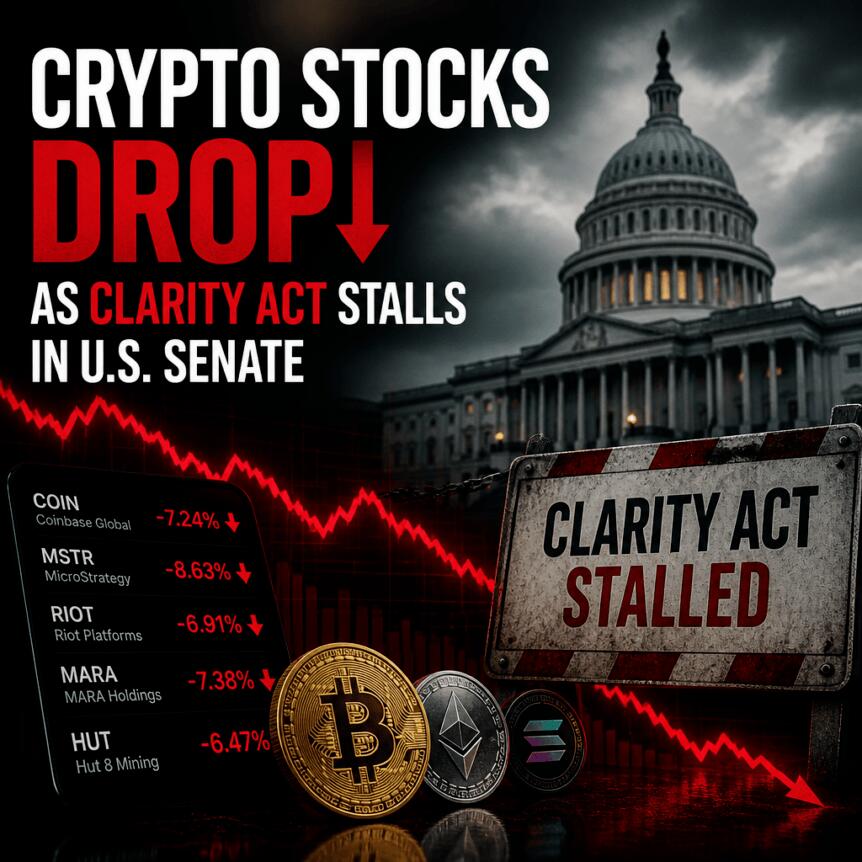
Shares tied to crypto assets slid Tuesday after the U.S. Senate failed to move forward the CLARITY Act, dealing another setback to efforts to define how digital-asset activity should be regulated. Coinbase and Circle both dropped sharply, while publicly traded Bitcoin treasury and mining-related companies also joined the selloff.
According to Yahoo Finance data, Coinbase fell about 10% and Circle slid roughly the same magnitude. Bitcoin treasury-focused firms were hit as well: American Bitcoin reportedly dropped around 8%, while Strategy and Strive each declined about 5%. Among miners, Riot Platforms fell approximately 6%, CleanSpark nearly 5%, Hut 8 fell more than 4%, and IREN dropped almost 4%.
Key takeaways
- The Senate’s failure to advance a procedural step for the CLARITY Act kept the bill short of the 60 votes needed to reach the floor.
- Crypto-linked equities fell broadly, suggesting traders viewed regulatory clarity as a near-term catalyst.
- The bill now faces limited remaining time in the current legislative calendar, with fewer than 36 days before a new Congress begins after November’s midterms.
- Bitcoin dipped briefly below $75,000 before recovering to around $76,000 at the time of writing, according to CoinGecko data.
Senate procedural defeat reshapes the regulatory timeline
The drop in crypto-exposed stocks followed a Senate vote on a cloture motion intended to bring the CLARITY Act to the chamber for consideration. The motion fell short of the 60-vote threshold required to proceed, according to coverage linked in the report from Cointelegraph: US Senate fails to advance CLARITY Act.
The CLARITY Act is designed to establish a framework for the U.S. digital asset market and clarify which parts of the industry would fall under the Commodity Futures Trading Commission (CFTC) versus the Securities and Exchange Commission (SEC). That distinction matters for investors and operators because it can influence compliance expectations, enforcement risk, and the way crypto products are structured.
With the procedural step now blocked, the bill appears to have little time left to advance this year. The legislative clock is running down, with fewer than 36 legislative days remaining before the new Congress is sworn in after the November midterm elections.
How markets reacted: equities sell, Bitcoin wobbles then steadies
Crypto-linked equities moved in tandem, reflecting how sensitive parts of the market have become to expectations around U.S. regulation. In addition to Coinbase and Circle, Bitcoin treasury companies and miners were sold off across the board, as Yahoo Finance’s reported intraday performance suggests.
Bitcoin itself briefly slipped below $75,000 after the Senate vote, before rebounding to around $76,000 at the time of writing, per CoinGecko data: CoinGecko Bitcoin price chart. That pattern—early pressure followed by partial recovery—aligns with traders treating the regulatory headline as a catalyst while watching for the next clarity point rather than assuming a single vote permanently changes the long-term trajectory.
Even so, the broad equity declines imply investors were not just reacting to Bitcoin’s momentary movement, but also reassessing the probability of progress toward a clearer regulatory regime in the near term.
Armstrong’s push for CLARITY and the “either way” framing
Coinbase CEO Brian Armstrong has been among the most prominent advocates for the CLARITY Act. Earlier coverage referenced in the report notes that Armstrong emphasized the bill’s bipartisan momentum ahead of key Senate activity. In May, he suggested the legislation was in its strongest and most bipartisan position to date.
As the vote approached, Armstrong’s public messaging also sharpened. In August, he predicted a forked outcome: either the Senate would secure “60+ votes” on September 15, or, if the bill did not advance, regulators would issue new rules from the CFTC and SEC around September 16. His view was that some form of “clarity” would follow regardless of the Senate result, writing on X: Brian Armstrong.
In the hours leading up to Tuesday’s vote, Armstrong again urged senators to back the legislation, positioning the decision as a competition between U.S. leadership in crypto innovation and falling behind other countries. He wrote that “History — and the crypto voter — won’t forget” on X: Brian Armstrong. After the procedural failure, that expectation of near-term legislative momentum clearly did not materialize.
Saylor and the pivot toward “Bitcoin clarity”
Following the failed vote, Strategy co-founder Michael Saylor offered a different take on what “clarity” should mean for markets. On X, Saylor wrote: “The only clarity you need is Bitcoin.” Michael Saylor.
While that comment is not a policy position with legal substance, it illustrates a common tension in crypto markets during periods of regulatory uncertainty: some investors want clearer rules for product categories and oversight, while others prioritize clarity around Bitcoin’s role and long-term adoption regardless of how quickly legislative negotiations conclude.
Importantly for readers tracking the sector, Saylor’s framing does not replace the need for regulatory clarity in the U.S. It does, however, help explain why portions of the market can absorb delays without immediately abandoning crypto exposure—especially when they view Bitcoin as the core reference point for value and adoption.
Going forward, the key variable to watch is whether congressional negotiations over the CLARITY framework resume in a way that can still fit within the remaining legislative window—or whether momentum shifts to the next Congress after the midterms. Tuesday’s vote suggests markets are pricing not just the existence of a bill, but the probability that it advances soon enough to matter before timelines tighten again.
Crypto World
Republican Congressman Introduces Articles of Impeachment Against Defense Secretary Pete Hegseth

Rep. Don Bacon, a Republican from Nebraska, told CNN that he agreed “with the sentiments” that Tillis had expressed, though he didn’t explicitly urge Trump to fire Hegseth.
“I hate to tell the President who he should hire and fire. I don’t know if it’s really my role, but I would say this: I would not—[Hegseth] would not be on my team. I think he is—he has not been a very good leader in many ways,” Bacon said. “I wouldn’t hire him myself.”
Despite these Republicans’ criticisms of Hegseth, the President has continued to throw his support behind the Defense Secretary, saying that Hegseth is “doing a fantastic job” in the role.
When asked about Massie’s measure during a press conference on Tuesday, Attorney General Todd Blanche replied, “Secretary Hegseth is doing a phenomenal job” and went on to say that “the Secretary of War doesn’t just go off and do things—he follows the law.”
This isn’t the first time that Massie has clashed with the White House. Massie strongly voiced his opposition to the President’s “One Big Beautiful Bill” and criticized Trump’s actions in Venezuela. Massie also joined Democratic Rep. Ro Khanna to lead the push for the Department of Justice to release the files connected to the investigation into the late convicted sex offender Jeffrey Epstein—an effort that Trump long objected to before ultimately signing the legislation into law last year after it was passed by Congress.

Homeless man broke anti-slavery law 3 times, court told
New Fortress Energy CEO Edens buys $1.67m in shares

Strategy copycat Satsuma crashed 99%, liquidated treasury

Memory prices are slowing because buyers ran out of money

Weekend Open Thread – Corporette.com

Micron Stock Climbs Above $1,031 as AI Memory Crunch and a $50 Billion Outlook Fuel the Rally

How to Prepare for Your 2026 Financial Glow-Up (Filipino Step-by-Step Guide)

New Broadway Cast of Cabaret (1998), Alan Cumming, Cabaret Ensemble (1998) – Money (Official Audio)

The Leaked Audit That Exposes OpenAI’s Real Financial Crisis
-
 Fashion4 days ago
Weekend Open Thread – Corporette.com
-
 Business6 days ago
Micron Stock Climbs Above $1,031 as AI Memory Crunch and a $50 Billion Outlook Fuel the Rally
-

 Tech3 days ago
The Latest Weird Thing to Play Doom Is the Mapped-Out Brain of a Fruit Fly
-

 Business6 days ago
AMD Stock Climbs After Management Lifts 2027 Data Center Outlook Toward $70 Billion in AI Sales
-

 Crypto World5 days ago
XAG/USD: Silver’s Short-Term Rally Meets Its Moment of Truth
-

 Crypto World5 days ago
2 Chip Stocks Broke Out This Week. Neither Was Nvidia
-

 Business5 days ago
10 Most-Streamed Songs On Spotify In 2026 So Far, Led By Ella Langley’s Dominant Run On The Charts This Year
-

 Crypto World6 days ago
Pi Network ships Protocol 27 on a network with 14 million users and zero DeFi
-

 Tech5 days ago
Battery life is the only iPhone 18 Pro and iPhone Duo upgrade I care about. Apple didn’t disappoint
-

 Crypto World5 days ago
OKX launches 10x OpenAI, Anthropic X-Perps in Europe
-

 Crypto World5 days ago
Diesel Tops $6 a Gallon for the First Time as 28 States Set Records
-

 Tech6 days ago
Apple Watch Ultra 4 vs Watch Ultra 3: Should you really spend another $799?
-

 News Videos4 days ago
Facing Financial Fears
-
 Tech7 days ago
Modders have already found two ways to make DLSS 5 playable, and neither one is Nvidia’s
-

 Crypto World6 days ago
Bitcoin price risks $70K if $78K neckline breaks
-
 Crypto World7 days ago
Bitcoin price holds near $79K as cycle drawdowns narrow
-

 Entertainment6 days ago
Case Sees Major Update As Jury Deliberations Begin
-

 Business7 days ago
Meta debuts long-awaited personal AI agent, Muse
-

 Crypto World2 days ago
Elon Musk Drops a Bombshell: Grok 5 Could Be the AGI Breakthrough
-
Crypto World5 days ago
Ethereum Price Analysis: Consolidation at $2.5K Tests Momentum as On-Chain Activity Surges
You must be logged in to post a comment Login