
Crypto World
Bitcoin Slips From Weekly Close Target In Drop To $62,500

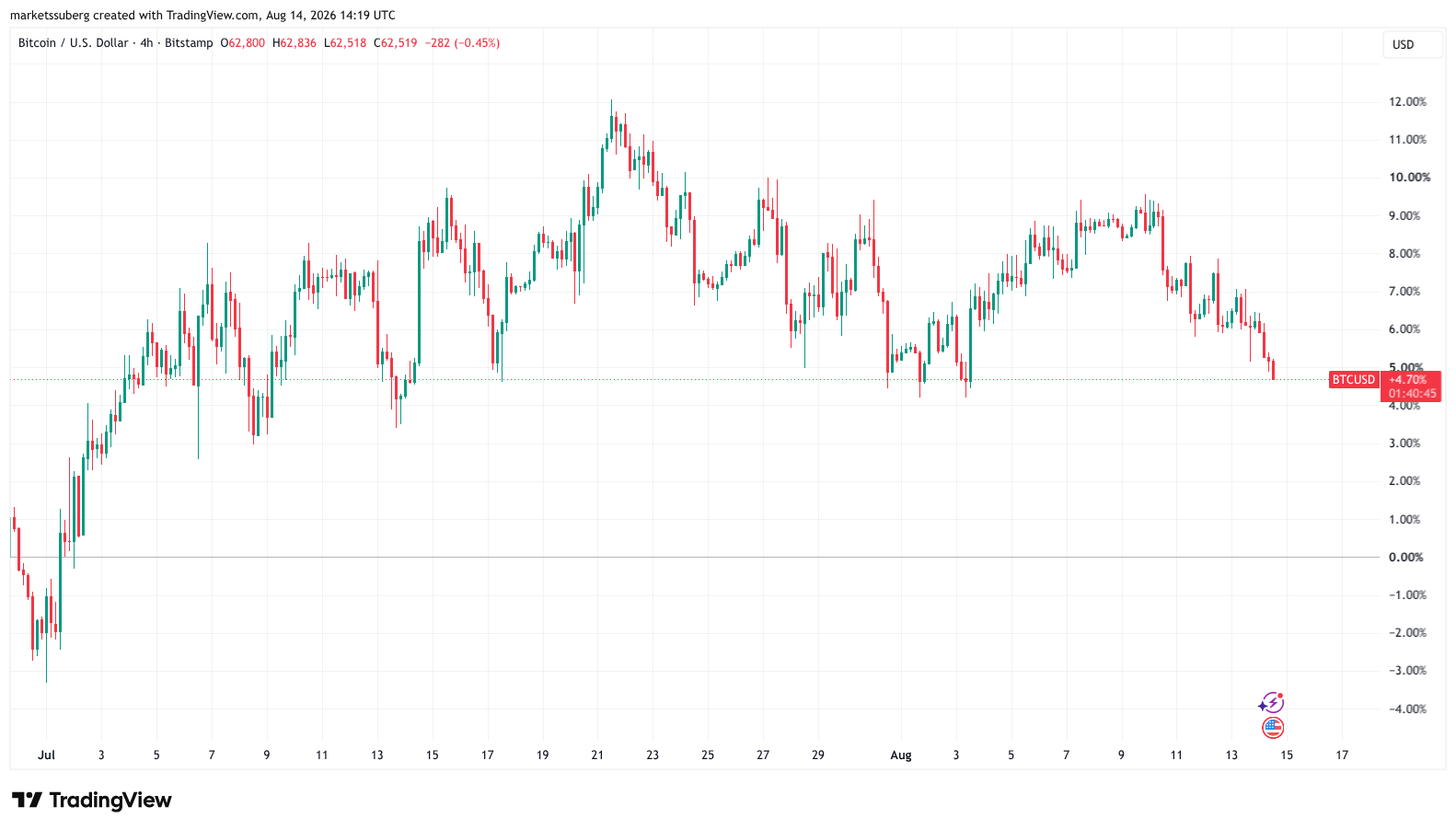
Bitcoin (BTC) declined into Friday’s Wall Street open as traders increasingly saw a BTC price breakdown next.
Key points:
- Bitcoin stays below $63,000, heading steadily closer to new August lows while US stocks build on record highs.
- Analysis says that $63,220 must be reclaimed by the weekly close to avoid a deeper rout.
- Markets look to PCE inflation data as the next key test for risk assets.
Bitcoin price sags with stocks at all-time highs
Data from TradingView showed BTC/USD down 1.3% on the day at $62,570, near its lowest levels month-to-date.
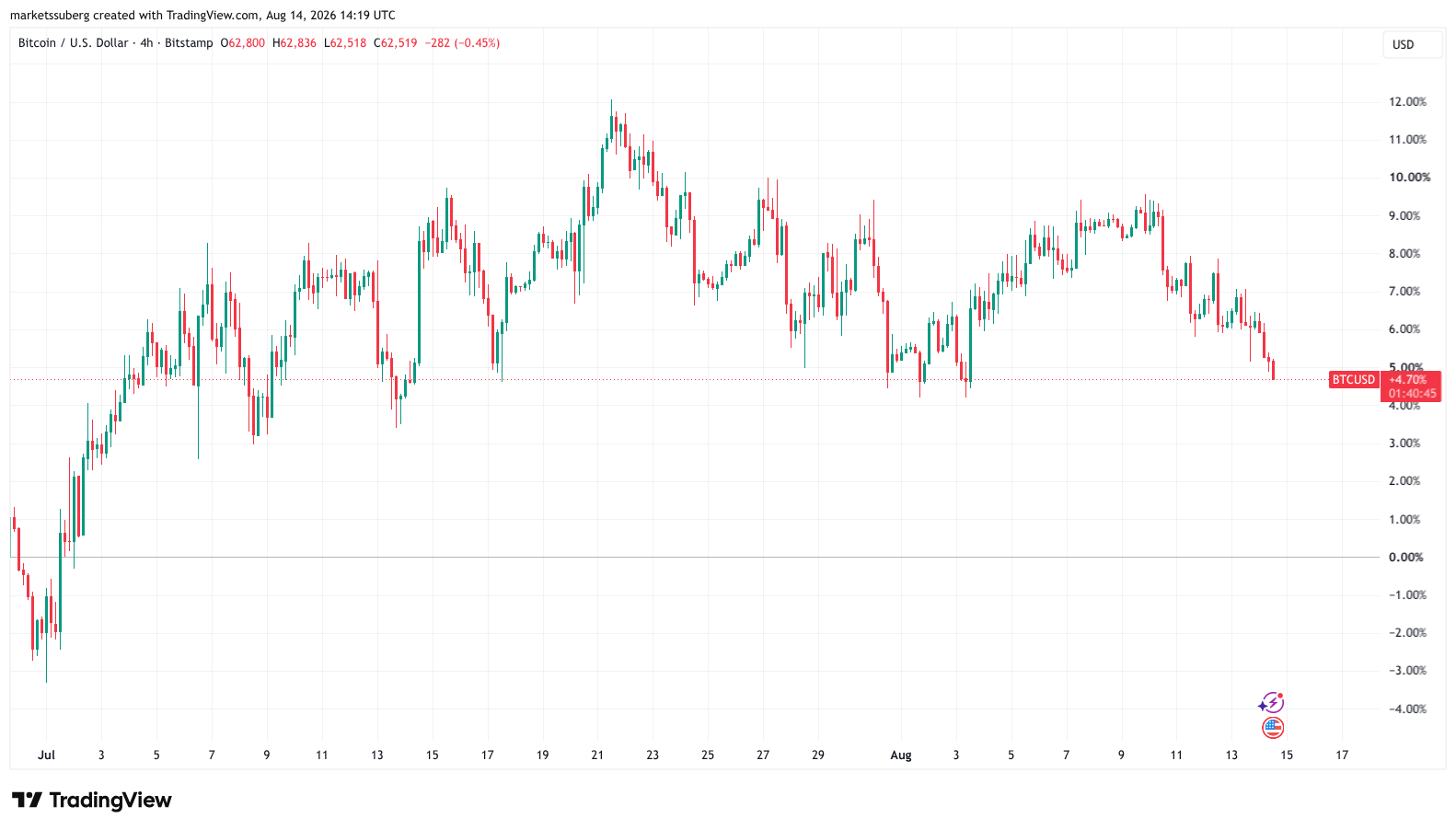
BTC/USD four-hour chart. Source: Cointelegraph/TradingView
Despite encouraging US inflation data lifting risk assets and reducing the odds of interest-rate hikes, Bitcoin failed to follow US equities, which closed Thursday’s session at all-time highs. The S&P 500 and tech-heavy Nasdaq Composite Index were both green at the time of writing, up 0.11% and 0.14%, respectively.
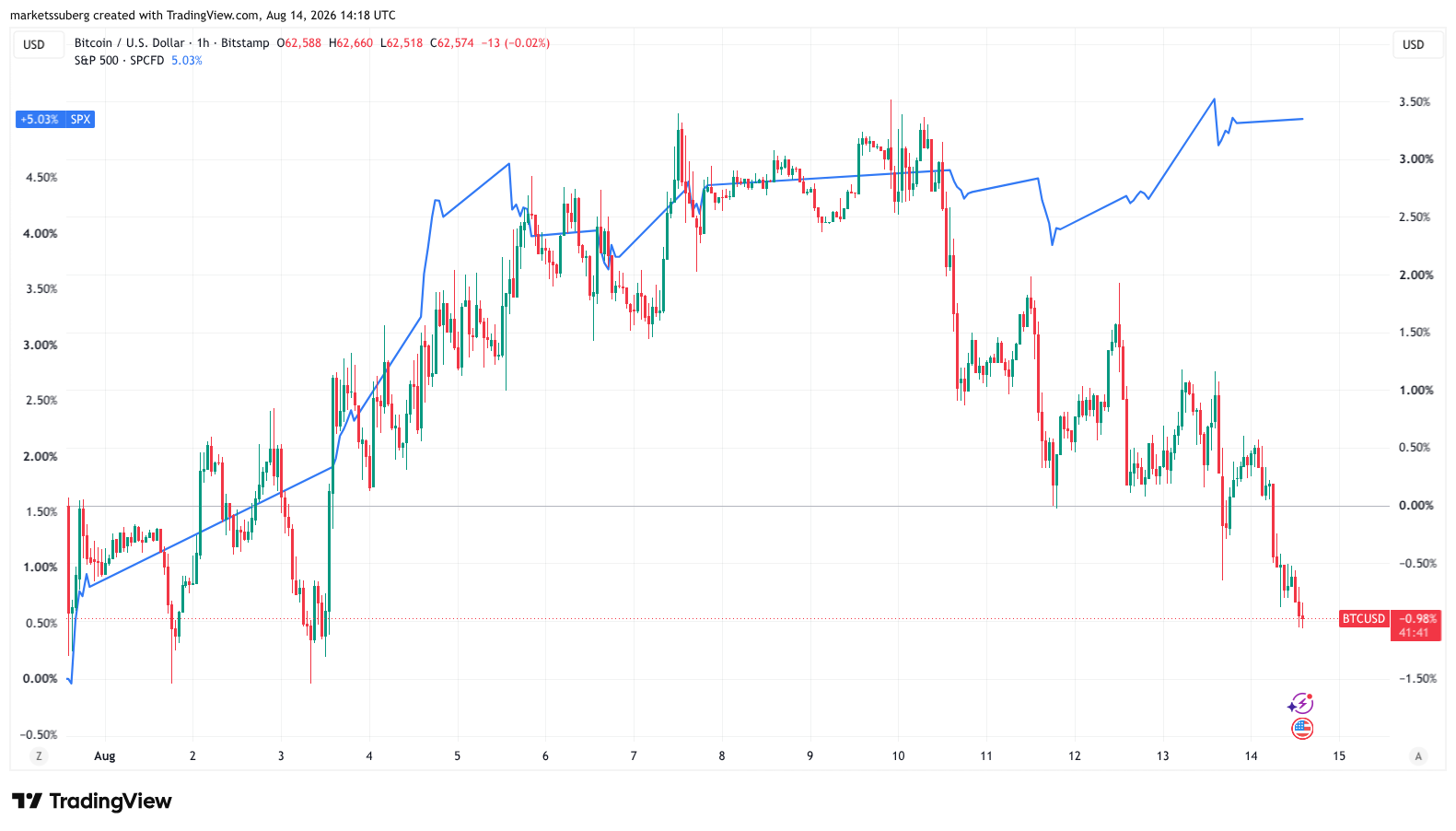
BTC/USD vs. S&P 500 one-hour chart. Source: Cointelegraph/TradingView
Commenting on Bitcoin price performance, trader and analyst Rekt Capital warned that Sunday’s weekly close needed to be above $63,220.
“A Weekly Close below the orange level would probably set price up for a breakdown,” he wrote in a post on X.
The analyst noted that $63,000 was now failing as support after weakening throughout August, having previously noted that the 50-month exponential moving average (EMA) at $65,827 was back as resistance, copying the 2022 bear market.
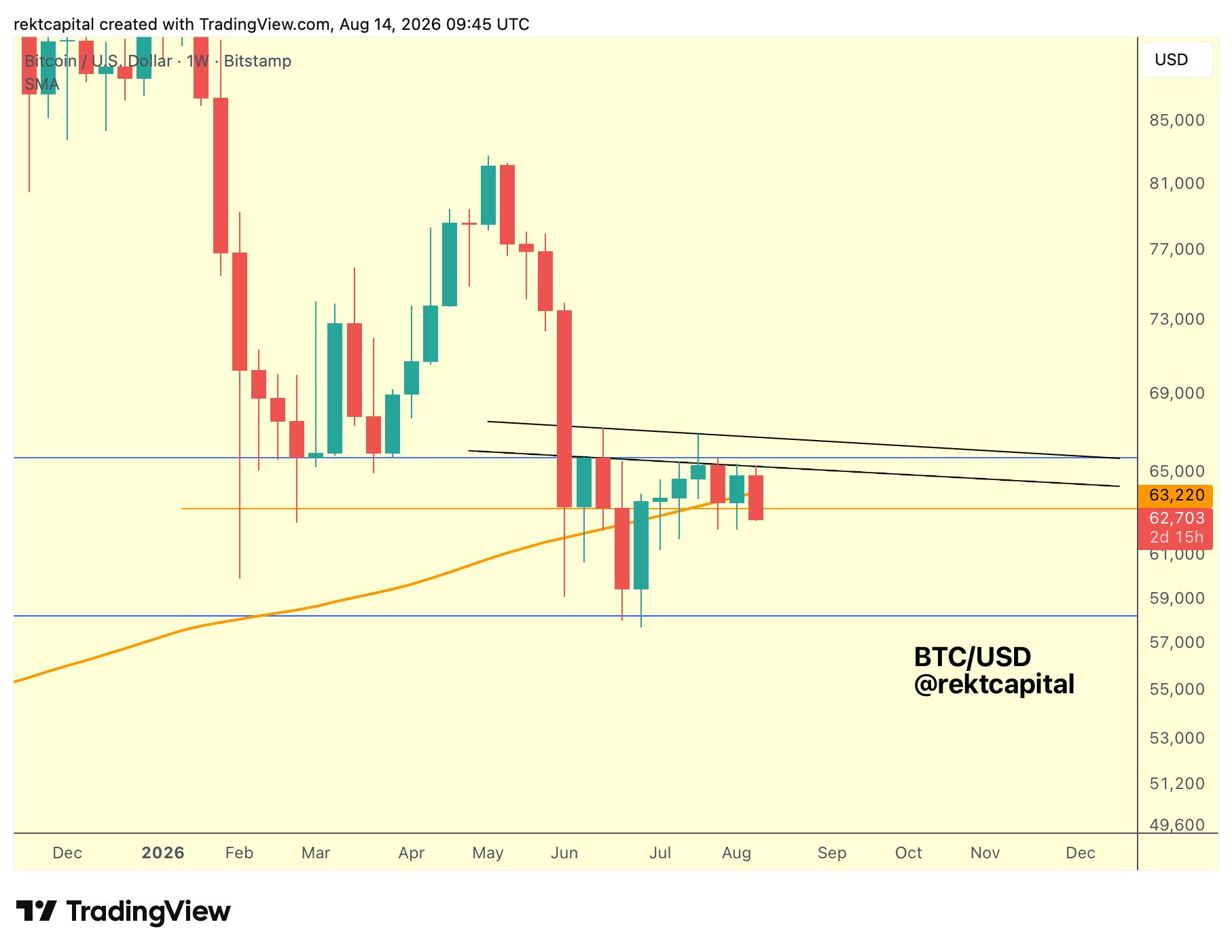
BTC/USD one-week chart. Source: Rekt Capital on X.com
Cointelegraph previously reported on increasing chances of a long liquidation event for Bitcoin as it approaches an area of liquidity around $61,000 amid growing open interest (OI) in derivatives markets.
“Traders have added substantial risk, most of it long, into a market that shows no matching demand,” onchain analytics platform Glassnode summarized in the latest edition of its regular newsletter, The Week Onchain.
PCE in focus after Bitcoin ignores inflation relief
In its latest analysis, trading and investment company QCP Capital drew attention to crypto markets’ refusal to rally on improving US inflation conditions — a phenomenon it described as “increasingly important.”
Related: Bitcoin speculators keep BTC price ‘pinned’ below $68.7K: Glassnode
“Last week, BTC demonstrated resilience in absorbing several negative headlines without a sustained breakdown,” it wrote, adding:
“This week has reinforced the distinction between resilience and momentum: the range remains intact, but softer inflation data have so far generated only a muted response from crypto.”
QCP added that macro traders are now focused on the Aug. 26 Personal Consumption Expenditures (PCE) index release, known as the Federal Reserve’s preferred inflation gauge. The index’s last print in July marked its first monthly decline since 2020, per data from the Bureau of Economic Analysis.
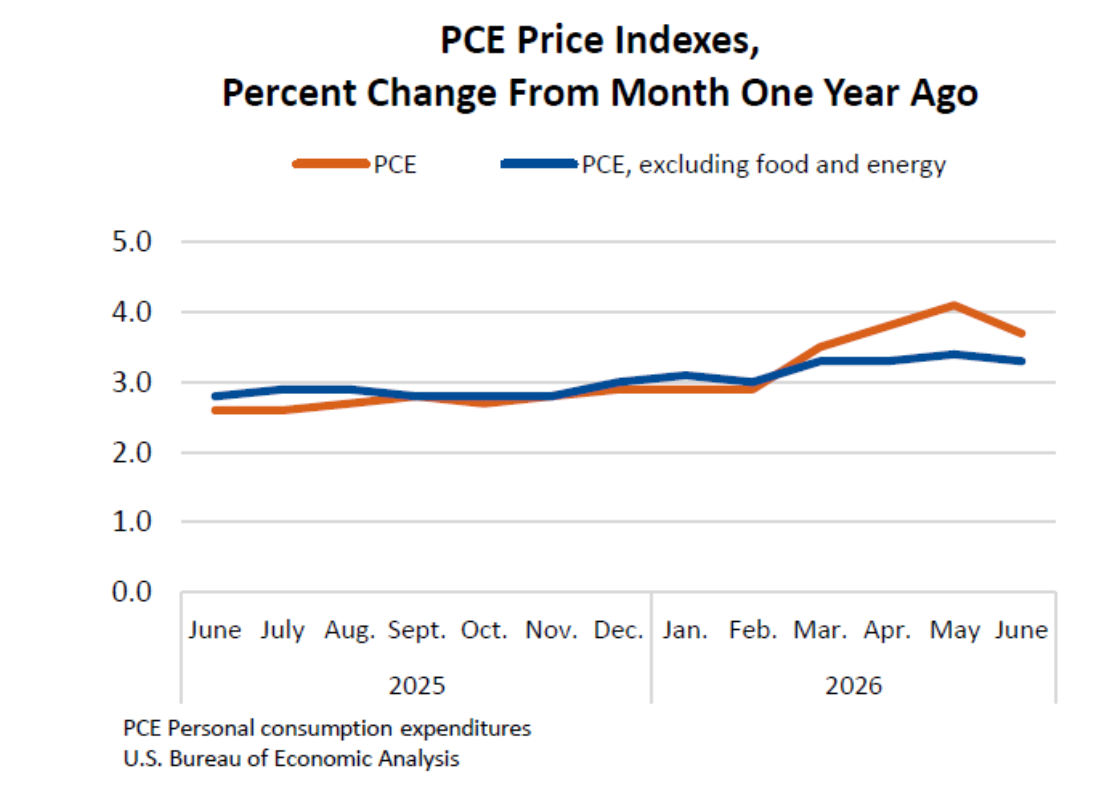
US PCE data percentage change (screenshot). Source: BEA

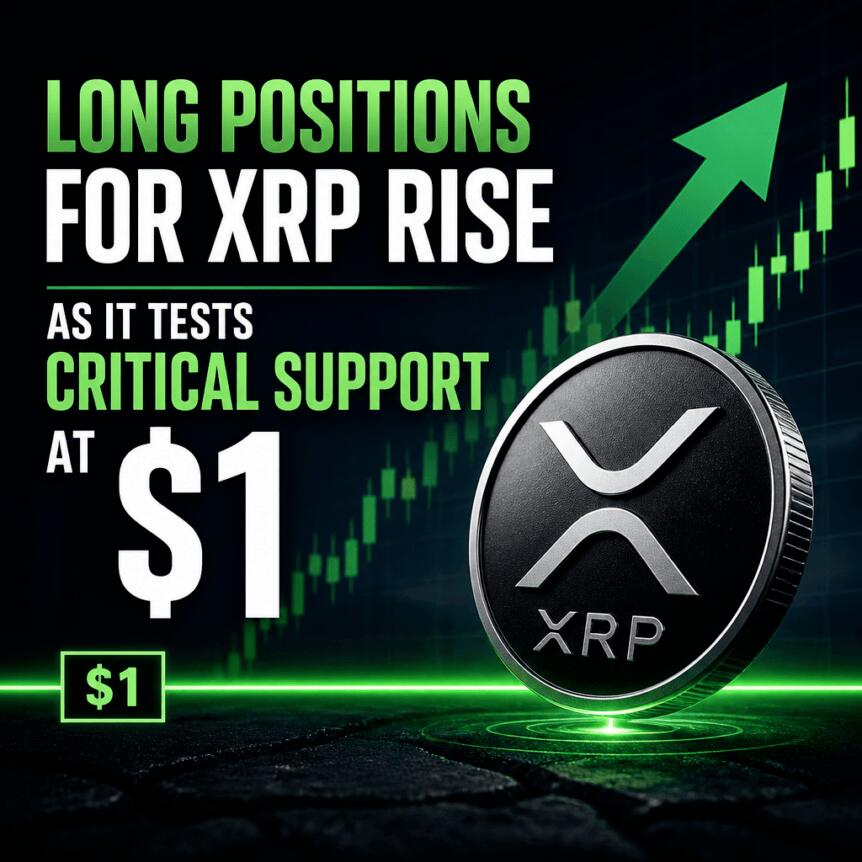
Long positions in XRP have grown rapidly over the last few weeks, with well over $1.5 billion worth of exposure being added to the derivatives market since the start of August.
This buildup of leverage exposure is indicative of increased bullish positioning among traders who expect the coin to stage a recovery.
According to Crypto Rover, XRP is building up “parabolic” exposure, and this has been attributed to the recent growth in long positions. It is evident from the above chart that exposure has been steadily increasing to reach around $1.596 billion.
Notably, while futures exposure growth might indicate similar demand for XRP in the spot markets, it is possible for traders to build up such exposure without buying any XRP at all.
XRP Testing $1 Support as Price Structure Narrows
XRP is currently trading at $1.0056, and the psychological $1.00 level has been the focus of the present market structure. For the past few months starting from February, the daily chart has created lower highs under a descending trendline, thus signifying that sellers have been controlling the market more.
Another trendline has been created since June on the $1.00 support level, thereby forming a narrowing structure in the form of a descending wedge. Now, XRP is nearing an important level as the price narrows under both support and descending resistance levels.
The crucial resistance level is seen in the range of $1.10–$1.15. Any daily close above this region will make the existing bearish market structure weaker and move the market toward the next technical level of $1.20. In case of a breakdown below $1.00, the current setup will be invalidated.
Weak RSI Keeps Momentum Under Pressure
Momentum indicators are keeping their guard up. The daily RSI comes in at 35.64, while the moving average holds at 39.90. Both figures continue trading below the neutral 50 line, suggesting that bearish momentum is still prevailing within the overall pattern.
On the other hand, the RSI approaches the oversold area. Although this is a signal that selling has gone too far, it does not mean that a reversal will happen immediately. Traders may want to see some RSI recovery before calling the momentum change a definite one.
Trading volume also remains relevant. Previously, lower levels had been seen alongside increased trading, while consolidation is now seen amid low volume. This means buyers have not shown enough interest in the asset yet.
Crowded Longs Lead to a Double-Edged Structure
The emergence of more bullish XRP longs, along with $1 support and a squeezed price range, creates a high-risk structure. If spot demand improves and XRP breaks above $1.10–$1.15, the bullish positioning could help to continue the uptrend toward $1.20.
Nevertheless, if XRP fails to hold $1.00, the situation could turn out differently. In such an event, crowded longs could get liquidated, adding to downside momentum.
XRP is now at a crossroads in terms of the technical picture. A breakout from descending resistance lines would indicate a rally, while a daily close below $1.00 could confirm the bearish structure.


Cointelegraph is committed to providing independent, high-quality journalism across the crypto, blockchain, AI, and fintech industries.
All news, reviews, and analyses are produced with full journalistic independence and integrity. For more details on our standards and processes, please read our Editorial Policy.
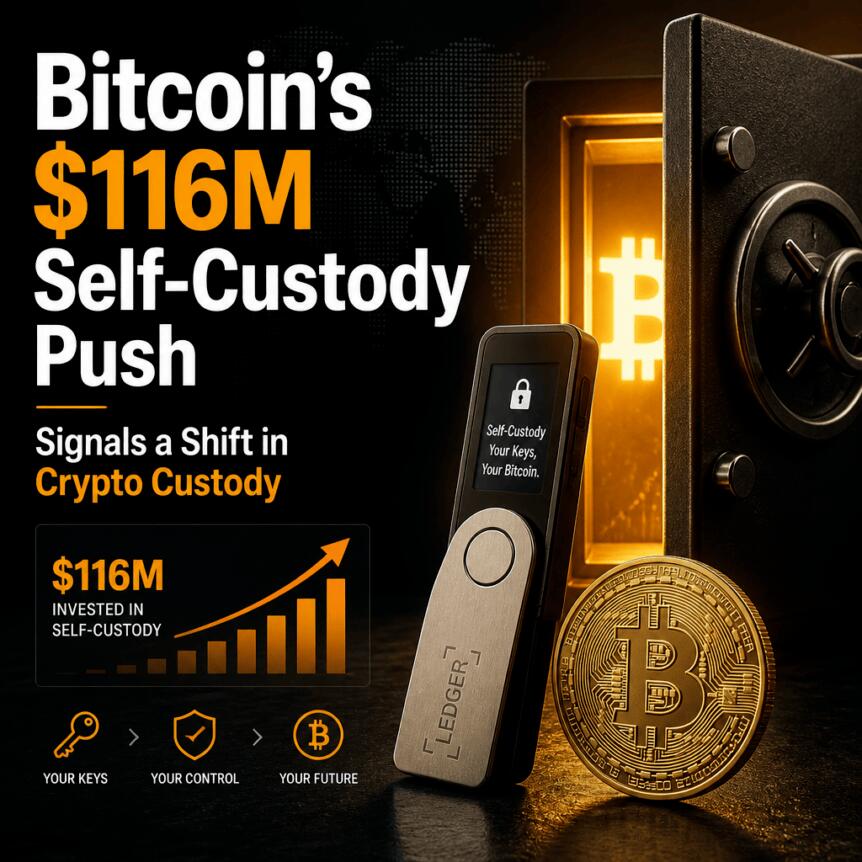
Security incidents and corporate balance-sheet decisions are reshaping how mainstream investors think about Bitcoin, even as regulated products pull in fresh capital. A reported $116 million hardware wallet exploit has reignited the debate over self-custody, while US spot Bitcoin ETFs notched their strongest weekly inflows since April—suggesting demand is returning alongside renewed concern about holding funds directly.
Meanwhile, major industry players are making moves on the edges of the Bitcoin ecosystem: Strategy is signaling a return to accumulation after a period of small sales, Riot Platforms is reportedly lining up long-term power for a large AI compute deal, and Trump Media is revisiting how it manages a crypto-linked treasury after a steep quarterly loss.
Key takeaways
- A Coldcard-related hardware wallet vulnerability tied to roughly $116 million drained in Bitcoin has pushed attention back toward self-custody risks.
- US spot Bitcoin ETFs saw about $1 billion in net inflows for the week, marking their strongest performance since April.
- Strategy CEO Phong Le says the company intends to resume Bitcoin accumulation later this year after scrutinized, smaller sales this year.
- Riot Platforms is reportedly securing a 20-year, 191 MW power arrangement tied to a major “frontier AI” customer identified by Bloomberg as Anthropic.
- Trump Media disclosed large unrealized losses tied to its crypto and securities holdings and said it will revamp its digital asset treasury strategy.
Strategy signals renewed Bitcoin accumulation
Strategy CEO Phong Le told FOX Business that the company plans to resume Bitcoin accumulation later this year, aiming to reassert its long-term treasury approach after a stretch of relatively small sales drew public scrutiny. Le said Strategy has “bought” roughly 175,000 BTC and sold about 7,000 BTC this year—roughly 25 times more buying than selling.
Even with that imbalance, the company’s willingness to sell periodically has remained a point of focus. Le said Strategy now holds more than 840,000 BTC and remains the largest institutional Bitcoin holder, but has sold Bitcoin on four occasions since May. The most recent sale referenced in the report was the unloading of 1,690 BTC to fund preferred dividends, buybacks, and its dollar reserve.
Analysts note that the issue is not just whether a company sells, but what those sales mean for capital efficiency. According to Novaque Research, when corporate treasuries trade below Bitcoin net asset value, raising additional capital can be increasingly dilutive—making the financing cycle harder to sustain. In that context, Strategy’s stated intent to accumulate again may be interpreted as an attempt to reduce the long-term friction created by repeated sales for shareholder and reserve needs.
ETF inflows strengthen as self-custody concerns resurface
While Bitcoin’s spot price has remained subdued, US spot Bitcoin ETFs attracted roughly $1 billion in net inflows for the week, according to Cointelegraph’s reporting referenced to data on weekly ETF flows. Bloomberg analyst Eric Balchunas described the period as the third-best week since October, using the term “silent IPO” to explain how early supply dynamics can keep price action muted even as institutional demand grows.
The renewed inflow momentum has also come as attention returns to a major self-custody failure: a Coldcard hardware wallet exploit linked to faulty key generation that reportedly drained about $116 million in Bitcoin. Balchunas said the incident could ultimately enhance the appeal of ETFs for investors concerned about self-custody risks, pointing to the post-hack rebound as a possible—though not proven—connection.
In his comments, Balchunas also cautioned that correlation does not imply causation. Still, his broader point was that if security scares continue to surface, some investors may decide that regulated products better match their risk tolerance—particularly those who want exposure without managing key storage themselves. What remains uncertain is whether inflows will persist beyond a short-term narrative effect, or whether the ETF market will return to a more typical pattern as memories fade and wallets fix vulnerabilities.
Riot’s reported 191 MW AI power deal highlights capacity constraints
Bitcoin miners are increasingly positioning their infrastructure for demand outside traditional hash-rate competition. Riot Platforms is reportedly negotiating a major compute-adjacent arrangement: a 20-year contract for 191 megawatts of capacity from Riot’s Texas campus. The report identifies the customer as “a leading frontier AI” company, with Bloomberg naming Anthropic.
According to the coverage, Riot said the agreement was tied to a long-term supply of power from its Rockdale campus. The timing matters because data center expansion has faced persistent constraints, and power availability is often the limiting factor for large-scale AI deployments. In that sense, miners with energy access can present themselves not only as Bitcoin producers, but also as suppliers of the physical capacity AI builders require.
The broader trend is visible across the sector. The report lists several Bitcoin miners that have expanded or announced AI-adjacent efforts, including Bitdeer, CleanSpark, MARA Holdings, Core Scientific, Hut 8, and IREN. Riot’s stock performance also reflected investor appetite for this shift: shares fell 5.4% Monday before rising 21% overnight and were up roughly 50% year-to-date at the time of the report.
Trump Media revises crypto treasury approach after large quarterly loss
Corporate exposure to crypto remains a sensitive balancing act, and Trump Media’s latest disclosures underline how quickly valuation changes can hit financial results—even without selling. The company said it will revamp its digital asset treasury strategy after unrealized losses contributed to a $238 million second-quarter net loss, emphasizing the risks of holding digital assets and related securities on a balance sheet.
Trump Media reported $190.4 million in unrealized losses across its digital assets during the quarter and pledged digital assets and equity securities in the period. It also disclosed that it held 9,477.16 Bitcoin as of June 30, down from 9,542.16 in the prior quarter. In July, the company sold $159.6 million in Bitcoin-related securities and used proceeds to buy more Bitcoin, increasing its holdings to about 14,139 BTC worth $890.5 million by July 31.
Beyond the mark-to-market impact, the company warned that generating additional income from its Bitcoin holdings could introduce counterparty risk. It noted the possibility that a counterparty could default or become insolvent, potentially limiting recovery of Bitcoin committed under unsecured arrangements. The company also indicated that it plans to redirect more resources toward Truth Social, Truth+ and other media operations as part of broader capital allocation changes.
Going forward, investors should watch whether Strategy’s renewed accumulation language translates into measurable buy activity, whether ETF inflows remain resilient beyond the immediate post-hack period, and how corporate treasuries adjust their risk controls as more security incidents and valuation swings test the durability of different Bitcoin exposure models.
The cryptocurrency market is another sea of red today (August 14), with Bitcoin (BTC), Ethereum (ETH), Cardano (ADA), and many more posting losses.
However, Cronos (CRO) has defied the ongoing pullback, and some analysts believe its price could pump even higher if it clears key levels.
Turbulent Days
The last several days have been quite eventful for CRO, which experienced severe volatility. Earlier this month, Trump Media (the entity behind Truth Social) withdrew its intentions to ink an ETF deal with Crypto.com and backed off its plans to accumulate $6.4 billion in CRO.
The token reacted negatively to the news, tumbling to around $0.046, its lowest level in the past three years. It spent the next few days trading below $0.05 before bulls finally reclaimed that mark (albeit briefly) earlier today. As of this writing, CRO trades at around $0.048 (per CoinGecko), representing a 5% daily increase.

The most likely catalyst for the resurgence appears to be Ryan Wyatt’s announcement. The CEO of Cronos App revealed that next month the platform “goes global to everyone” on iOS and Android. He said that users can access sports, stocks, crypto, and perps, and that they are “just getting started.”
“More to share in the future: plans for CRO, sharing future feature rollouts, a desktop version of Cronos, and more,” he added.
Analyst Crypto With Gopal claimed that the price has formed a double bottom after retesting the $0.046 support zone twice, with buyers defending that zone and building a potential reversal base.
“The key confirmation is a breakout above $0.050 resistance. A confirmed breakout could open the way toward the chart’s $0.055 target. Market sentiment: Bullish setup – $0.050 breakout is the trigger,” he concluded.
Maintain Realistic Expectations
Wyatt’s disclosure has indeed triggered a clear price increase in CRO, yet it is unlikely to cause a sustainable rally. The excitement may soon fade, and sellers could retake the helm, while the persistent bear market isn’t helping either.
Another negative factor is CRO’s Relative Strength Index (RSI), which has risen to around 74. This suggests the asset has entered overbought territory and could be gearing up for a short-term pullback. The technical analysis tool ranges from 0 to 100 where anything below 30 is usually viewed as a buying opportunity.

The post Cronos (CRO) Rises 5% Daily Following Major Ecosystem News: Details appeared first on CryptoPotato.

On August 13, Trezor disclosed that a data breach at its shipping partner, ShipMonk, exposed the personal information of roughly 13,700 recent customers, including names, phone numbers, and home addresses.
Binance founder Changpeng Zhao (CZ) responded by arguing that the incident shows a real advantage of software self-custody wallets, since they don’t require shipping a physical device that ties a buyer’s identity to a home address.
Trezor Breach Puts Physical Addresses in Focus
Trezor disclosed the incident after ShipMonk, a logistics provider, notified the company on Monday, August 10, about unauthorized access to systems holding customer order data.
CZ reacted on Thursday, contending that the incident highlights a different risk profile for hardware and software self-custody.
“Hardware wallets are often considered ‘more secure’ than software wallets,” he wrote. “While I still think that is ‘generally true’ in a few specific aspects, this incident reinforces an advantage of software self-custody wallets.”
He pointed to examples such as Binance Web3 Wallet and Trust Wallet, which do not require shipping a physical device that ties a user’s identity and address to crypto ownership.
CZ also stopped short of dismissing hardware wallets. “Not saying hardware wallets are ‘bad,’” he wrote. “Just different profiles.” He added that YZiLabs is an investor in many hardware wallet companies.
Contributing to the debate, NaoX Protocol said the exposed addresses could give attackers a list of verified crypto holders worth targeting in person. Bitcoin security executive Nick Neuman similarly warned that the data could lead to targeted social engineering and potentially wrench attacks, where criminals use physical threats to steal funds.
Trezor said customers could face more sophisticated phishing through email, phone calls or letters. It urged users never to enter their wallet backup online or share it with anyone.
A Rough Stretch for Hardware Wallets
The timing adds to a run of bad headlines for hardware wallet makers. In mid-July, on-chain investigator ZachXBT called the category unfit for serious use, writing on Telegram that “all hardware wallets are complete garbage.”
He argued a spare phone used only for signing transactions could work better, citing dead batteries, forced firmware updates, and interface bugs as recurring problems. The Trezor breach is a different kind of failure, as it involves exposure through a vendor rather than the device, but it fits the same conversation about costs beyond the seed phrase.
Furthermore, last week, Galaxy Research linked more than $100 million in stolen Bitcoin to a separate issue in older Coldcard firmware, which generated wallet seeds with weaker randomness than intended. Coinkite has patched the flaw in newer releases but cannot fix seeds already generated on affected devices and has told holders of its Mk3 through Q models to move funds to unaffected hardware.
This isn’t the first time Trezor has found itself in such a situation, with a separate breach tied to a third-party support vendor exposing contact details for around 66,000 users in January 2024.
The post CZ Says Software Wallets Avoid Risks Seen in Trezor Leak appeared first on CryptoPotato.

He said he had 3-D printed a gun and attached a silencer.
Mangione did not face murder charges in federal court. The federal judge on Friday set a hearing date of Dec. 18 for Mangione’s sentencing.
The guilty plea marks a remarkable shift in Mangione’s defense, as he had previously pleaded not guilty to all the federal and state charges he was facing.
Thompson’s family said in a statement shared with news outlets after the hearing on Friday that Mangione’s guilty plea “marks an important step toward justice for Brian and for our family.”
“While nothing will ease the pain of losing him, we are grateful that the federal justice system has held the person responsible for this heinous act accountable,” the family said. “Now we look to the court to ensure the sentencing reflects the severity of this crime.”
UnitedHealth Group, the parent company of United Healthcare, also shared a statement after Friday’s hearing, saying: “Brian Thompson’s life was cut short by an act of violence that devastated everyone who knew and loved him. We are grateful to law enforcement for bringing Brian’s murderer to justice, and our thoughts remain with Brian’s family and loved ones during this difficult time.”
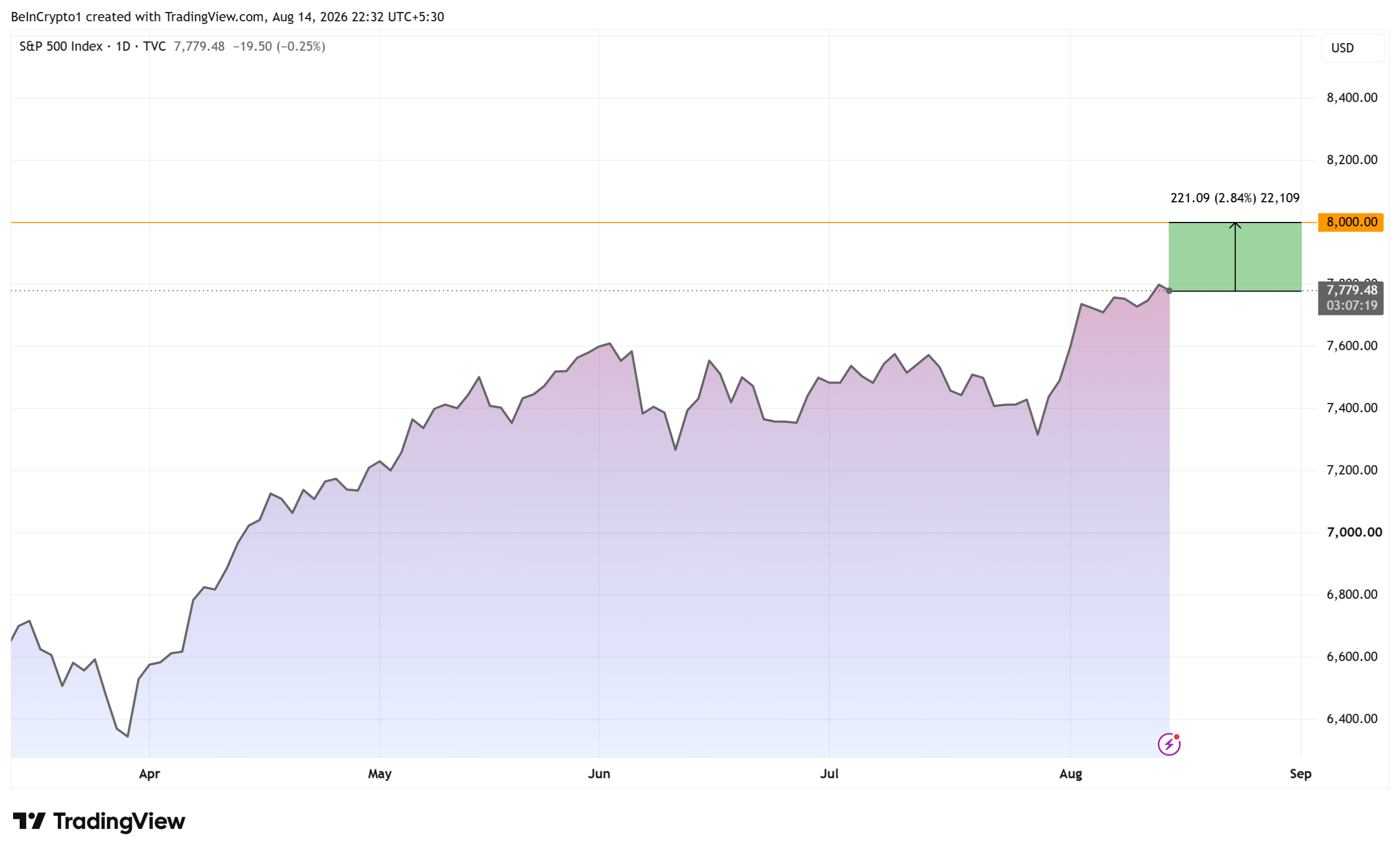
Fundstrat’s Tom Lee expects the S&P 500 to reach 8,000 by the end of August. He also expects a 10% correction, and he argues the market would be better off getting one.
Lee made the case on CNBC after a mild July inflation print lifted stocks to fresh records. Crypto investors watching from a $63,000 Bitcoin may find the argument uncomfortably familiar.
Why Tom Lee Wants a Correction Before Stocks Reach 8,000
Conditions look close to ideal for equity bulls. July consumer prices rose 0.1% on the month and 3.4% on the year, matching forecasts. Core inflation landed at 2.5% annually.
That print followed a weak July jobs report. Together they cut the odds of a September Federal Reserve rate hike to roughly 40%. The S&P 500 closed at a record on August 12, but Lee has not softened his target.
“I think the rally is quite healthy and it’s tracking to our view that we could get to 7,900, 8,000 by the end of the month,” Tom Lee, head of research at Fundstrat Global Advisors, speaking on CNBC.
The math behind that runs through earnings. Lee said 2027 estimates have climbed from about $395 at the start of reporting season to roughly $410 now. A 20 times multiple on $425 would point near 9,000.
The strength is exactly what bothers him. His client note laid out four named pullback risks. He expects the top of his own target range to mark the turn.

“The end of August getting to 8,000 is going to set us up for a period where stocks could disappoint even though underlying fundamentals are good.”
Follow us on X to get the latest news as it happens
Margin Debt Sits at the Top of His Warning List
Borrowed money is his first concern. Financial Industry Regulatory Authority (FINRA) data put margin debt at a record $1.53 trillion in June. That marked a 7.9% jump in one month and a 51.5% rise on the year.
The bond market is his second. Kevin Warsh became Fed chair this year and brought a new inflation framework with him. Investors have not settled on how to price it.
“Part of it is the margin debt’s gotten so big. Part of it is we still haven’t resolved how the market views Kevin Warsh and his new framework, whether the bond market’s going to have a tantrum.”
November midterm elections form the third risk. The fourth is SpaceX, where a staggered lockup expiry keeps releasing insider and employee shares. Lee has flagged that unlock schedule since early July. He grouped the four together as traps rather than reasons to sell.

Not everyone on the panel shared the caution. Courtney Garcia of Payne Capital argued earnings justify current prices. Healthcare, financials, and industrials have all outrun the index over three months, she said. In her view, AI capital spending concerns have faded as results came in.
Stephanie Guild of Robinhood landed closer to Lee. Easy credit rebuilds during rallies, she said, which sets up the next sharp drawdown even while fundamentals hold.
Subscribe to our YouTube channel to watch leaders and journalists provide expert insights
Bitcoin Already Took the Hit Lee Is Warning About
This is where the equity story turns awkward for crypto. Bitcoin (BTC) trades near $63,062, down 0.5% over 24 hours, with a market value of about $1.27 trillion. It remains the largest digital asset.

Stocks keep printing records while Bitcoin’s current price level sits far below its own peak. The leverage flush Lee wants for equities has already run through crypto, and it did not spare holders.
Lee made that point months ago. He argued crypto had already passed through a hidden crypto bear phase that few investors ever named. Short positioning at the time sat near levels typical of a bottom.
He also has capital behind the view. Lee chairs BitMine Immersion Technologies, a company that holds ether as its main treasury asset. He ranks Ethereum among rally leaders for the next leg higher.
His broader thesis rests on doubt rather than confidence. Many institutional clients still believe the AI trade is stretched or that earnings have peaked, Lee said. Trillions in cash also sit unspent on the sidelines. He treats that hesitation as fuel.
“So, I think that there’s people who are sort of keeping an eye on the end of the bull market, and I think that’s what’s keeping it healthy.”
The next two weeks test the first half of the call. If the S&P 500 tags 8,000 and then breaks, one question follows for crypto. Does an asset already down heavily fall further, or does it finally decouple?
The post Tom Lee Wants a 10% Crash Before S&P 500 Hits 8,000, Bitcoin Already Had One appeared first on BeInCrypto.

In the study, the researchers assembled a group of more than 9,300 people—some doctors, some other medical caregivers, some from the general population—and ran 14 different experiments on them. In one, 400 people were presented with two scenarios in which a friend visited a doctor complaining of menopause symptoms, including extreme fatigue, weight gain, and joint and muscle pain. In one of the scenarios, the doctor simply recommended medication to treat the symptoms. In the other, the doctor added, “I know this feels overwhelming, but I want to reassure you that these symptoms are normal…You could take daily prescription medication…or you can deal with these symptoms.”
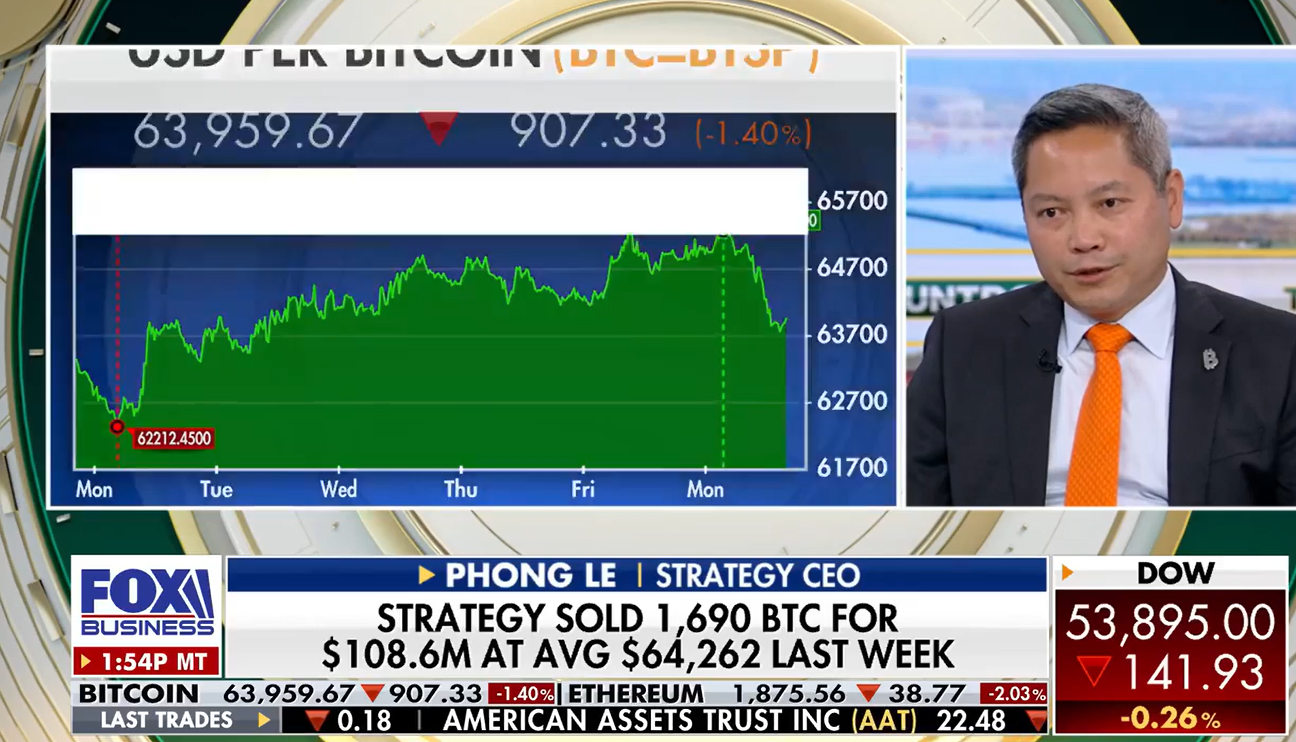
A $116 million hardware wallet exploit has reopened one of Bitcoin’s oldest debates: Is holding your own keys worth the risk? Days later, US spot Bitcoin ETFs recorded their strongest inflows since April, prompting Bloomberg analyst Eric Balchunas to wonder whether security scares could eventually push more investors away from self-custody and toward ETFs.
Elsewhere, Strategy is preparing to resume Bitcoin purchases after a rare bout of selling, Riot Platforms is reportedly turning its mining infrastructure into a $9 billion AI deal, and Trump Media is rethinking its crypto treasury strategy after a $238 million quarterly loss.
Strategy CEO says company will resume Bitcoin accumulation this year
Strategy CEO Phong Le said the company plans to resume Bitcoin accumulation later this year, seeking to reinforce its long-term strategy after a series of relatively small sales drew scrutiny over its once-firm “never sell” stance.
Le told FOX Business that Strategy bought roughly 175,000 BTC and sold about 7,000 BTC this year — about 25 times more buying than selling. The company now holds more than 840,000 BTC, making it the largest institutional holder, but has sold Bitcoin on four occasions since May, most recently unloading 1,690 BTC to support preferred dividends, buybacks and its dollar reserve.
Those sales have highlighted the competing demands facing Strategy as it balances its Bitcoin accumulation strategy with obligations to common and preferred shareholders. The treasury model has also come under pressure. According to Novaque Research, when companies trade below Bitcoin net asset value, raising capital becomes increasingly dilutive and the financing cycle harder to sustain.
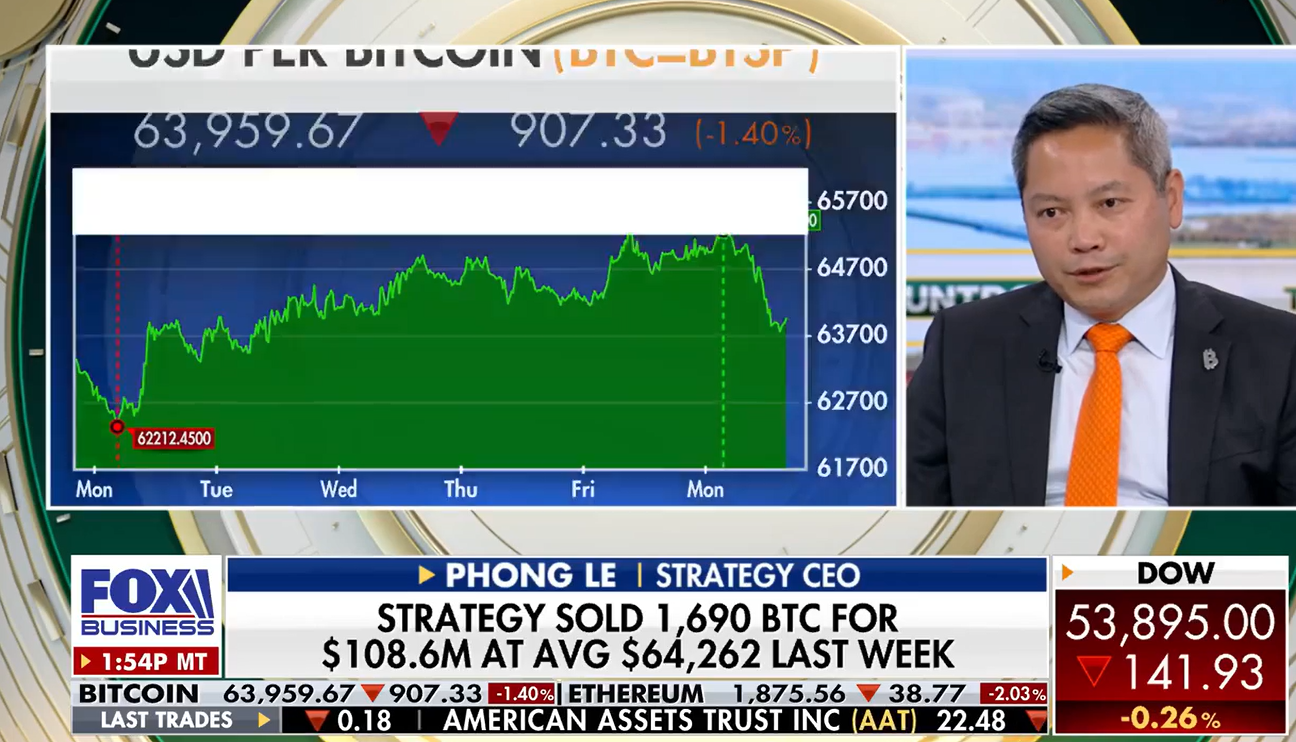
Phong Le appearing on FOX Business. Source: FOX
Bitcoin ETF demand rebounds as self-custody risks come into focus
US spot Bitcoin ETFs attracted roughly $1 billion in net inflows for the week, signaling renewed institutional demand even as Bitcoin’s price remains subdued and a major hardware wallet exploit puts fresh attention on the risks of self-custody.
Bloomberg ETF analyst Eric Balchunas said it was the third-best week since October, a period he described as Bitcoin’s “silent IPO,” a term popularized by investor Jordi Visser. The theory holds that early investors have been selling into growing ETF and institutional demand, creating enough supply to keep Bitcoin subdued despite fresh capital entering the market.
The rebound also followed a Coldcard hardware wallet exploit linked to faulty key generation that drained about $116 million in Bitcoin. Balchunas said the incident could ultimately bolster ETFs’ appeal among investors concerned about self-custody risks, pointing to post-hack inflows as a possible, though unproven, connection.
He cautioned that correlation does not imply causation, but added that “long-term I can’t imagine there aren’t some who migrate over.”
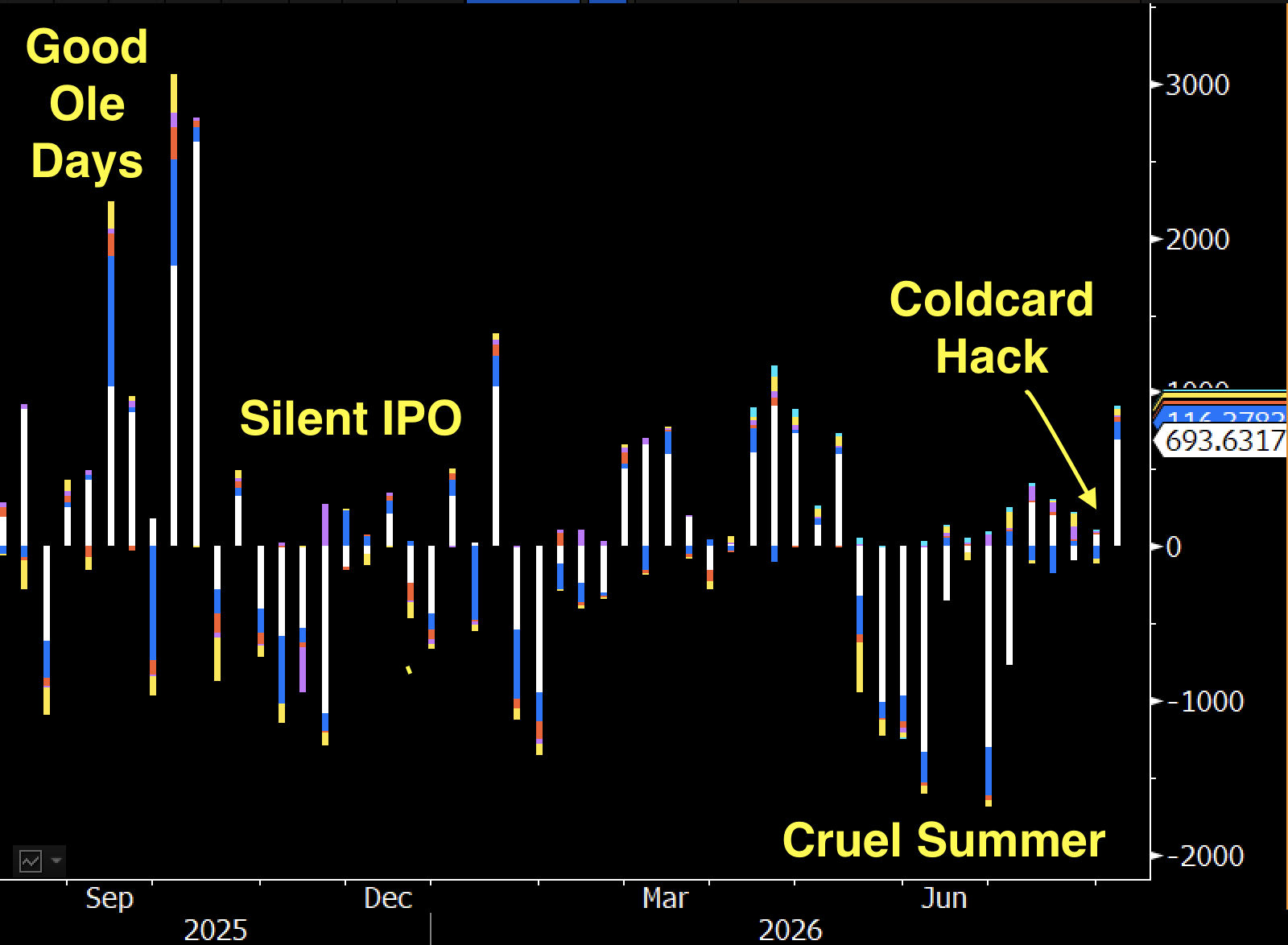
Source: Eric Balchunas
Anthropic reportedly struck a $9 billion compute deal with Bitcoin miner Riot
Anthropic reportedly struck a $9 billion deal with Riot Platforms for 191 megawatts of capacity from the Bitcoin miner’s Texas campus, highlighting how access to power is becoming increasingly valuable as AI data centers face capacity constraints.
Riot said it secured a 20-year agreement to supply 191 megawatts from its Rockdale campus to a “leading frontier AI” company, which Bloomberg identified as Anthropic. The deal follows Anthropic’s $19 billion TeraWulf data center lease and adds Riot to a growing list of Bitcoin miners expanding into AI, including Bitdeer, CleanSpark, MARA Holdings, Core Scientific, Hut 8 and IREN.
Riot shares fell 5.4% Monday before rising 21% overnight and are up roughly 50% year-to-date. The fourth-largest Bitcoin miner has a $7.33 billion market capitalization, while Bernstein said partnerships between AI companies and miners could help address the power crunch constraining data center expansion.
Trump Media to revamp crypto treasury strategy after $238 million Q2 loss
Trump Media said it will revamp its digital asset treasury strategy after unrealized losses on crypto and securities helped push the company to a $238 million second-quarter net loss, highlighting the balance-sheet risks of corporate crypto holdings.
The company reported $190.4 million in unrealized losses across its digital assets, and pledged digital assets and equity securities in the second quarter. It held 9,477.16 Bitcoin as of June 30, down from 9,542.16 the prior quarter. In July, it sold $159.6 million in Bitcoin-related securities and used the proceeds to buy more Bitcoin, bringing its holdings to about 14,139 BTC worth $890.5 million by July 31.
Trump Media warned that generating additional income from its Bitcoin holdings could expose it to counterparty risk, particularly if a partner should default or become insolvent. In some cases, the company could be unable to recover Bitcoin committed under unsecured arrangements. It also plans to direct more resources to Truth Social, Truth+ and other media operations as part of a broader shift in capital allocation.
Crypto Biz is your weekly pulse on the business behind blockchain and crypto, delivered directly to your inbox every Thursday.
Crypto World
Bullish (BLSH), Coinbase (COIN), Circle (CRCL) slide as SEC delay weighs on tokenization trade


The moves followed CoinDesk’s report late Thursday that the Securities and Exchange Commission (SEC) was set to further delay its anticipated “innovation exemption,” which is expected to make it easier for companies to offer trading in tokenized securities. Concerns from the White House and Wall Street over the proposal’s legal footing and potential market impact have held up the plan.
Adding to the uncertainty, the SEC canceled a meeting scheduled for Friday where commissioners planned to consider whether to propose new rules creating a tailored offering regime for certain investment contracts involving crypto assets.
The impact wasn’t limited to stocks. The innovation exemption had also been expected to provide some regulatory relief for trading through decentralized finance venues, meaning the delay reaches beyond publicly traded tokenization companies. Uniswap’s UNI (UNI), the native token of the decentralized exchange, fell 7% over the past 24 hours, making it the weakest performer in the CoinDesk 20 Index both Friday and this week.
For comparison, the Nasdaq 100, S&P 500 and bitcoin were all mostly flat during the day.
A ‘speed bump,’ not the end of the tokenization trade
The setback could stretch out the timeline for U.S. tokenization, but it doesn’t necessarily change the longer-term story, according to Owen Lau, managing director and senior analyst at Clear Street.

Burger takeaway to be replaced with ‘healthier options’ at Cambridge hospital

Nvidia’s $500 billion plan envelops Wall Street in its AI frenzy

Long Positions for XRP Rise as It Tests Critical Support at $1


-

 News Videos6 days ago
Can Astrology Help Find Gold and Silver Trends? A Financial Astrology Guide
-

 Business5 days ago
Datadog: Best Of Breed For Multiple Reasons
-

 Tech7 days ago
Rinn Pharma & Biopharma to join NordicPharmaTrain network
-

 Business6 days ago
How to Start a Cleaning Business: A Step-by-Step Guide
-

 Business6 days ago
BDC Weekly Review: Private BDC Q2 Numbers Are Strong
-
 NewsBeat3 days ago
Communication cards help banking customers access services or report scams
-
 Business4 days ago
Oil Price Today (August 11): Crude oil rises to $88 after Trump’s compensation demand dents Hormuz opening. Here’s why
-
 Entertainment7 days ago
10 R-Rated Drama Movies That Can Be Called Masterpieces
-

 Fashion5 days ago
Amazon Sundays: Closet Care Before Fall
-

 Business7 days ago
SharkNinja Keeps Eating
-

 Politics6 days ago
Be quiet, Miriam! – spiked
-

 Business5 days ago
5 Things You Must Know About Jorge Messi, the Father and Longtime Agent Who Shaped Lionel Messi’s Career
-

 Business6 days ago
Mutual Fund Manager Scoops Up Beaten-Down Stocks
-

 Politics5 days ago
Ben-Gvir’s crocodile project halted but abuses at Ketziot Prison continue
-

 Tech7 days ago
Metabase SQLi zero-day exploited in customer data-theft attacks
-

 Politics5 days ago
The Church of England’s ruinous reparations racket
-
 Crypto World4 days ago
Why Did Nvidia Stock Fall on Monday Despite a $500 Billion Wall Street AI Deal?
-

 Politics6 days ago
Calls to permanently pedestrianise central Belfast following festival success
-

 Crypto World6 days ago
A Deep Dive Into One Of The Most Significant Hacks In Recent Memory
-

 Crypto World6 days ago
Bitcoin ETFs draw $853.5M in five-day inflow streak
You must be logged in to post a comment Login