

Crypto World
Bitcoin Takes Pressure Off $60,000 as Bear Market Roadmap Continues

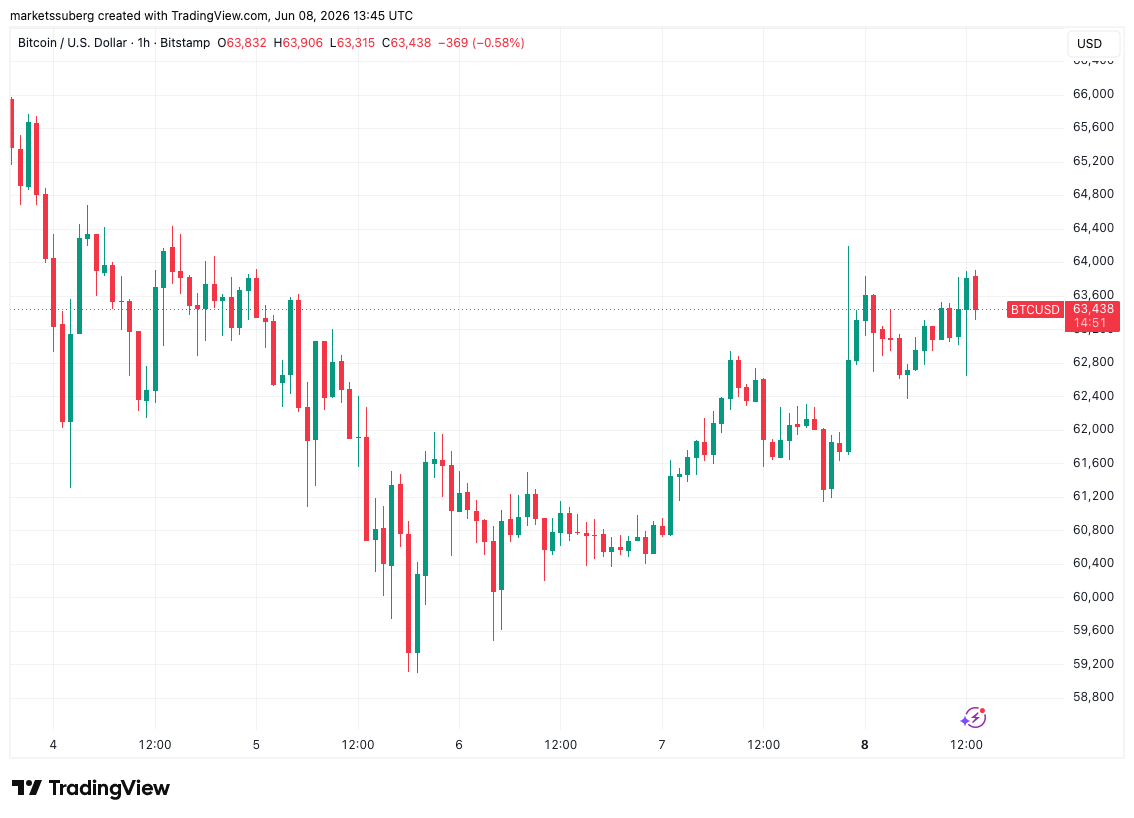
Bitcoin (BTC) approached intraday highs ahead of Monday’s Wall Street open, with $60,000 holding as key support.
Key points:
- Bitcoin avoids another retest of $60,000 as Wall Street returns, but bear-market standards call for lower.
- A rebound to $64,000 is being watched for signs that worse is yet to come.
- Macro headwinds multiply as the Japanese yen reenters the picture.
Bitcoin price decides on ranging versus breakdown
Data from TradingView showed BTC price selling pressure easing after the weekly close — Bitcoin’s lowest since October 2024.
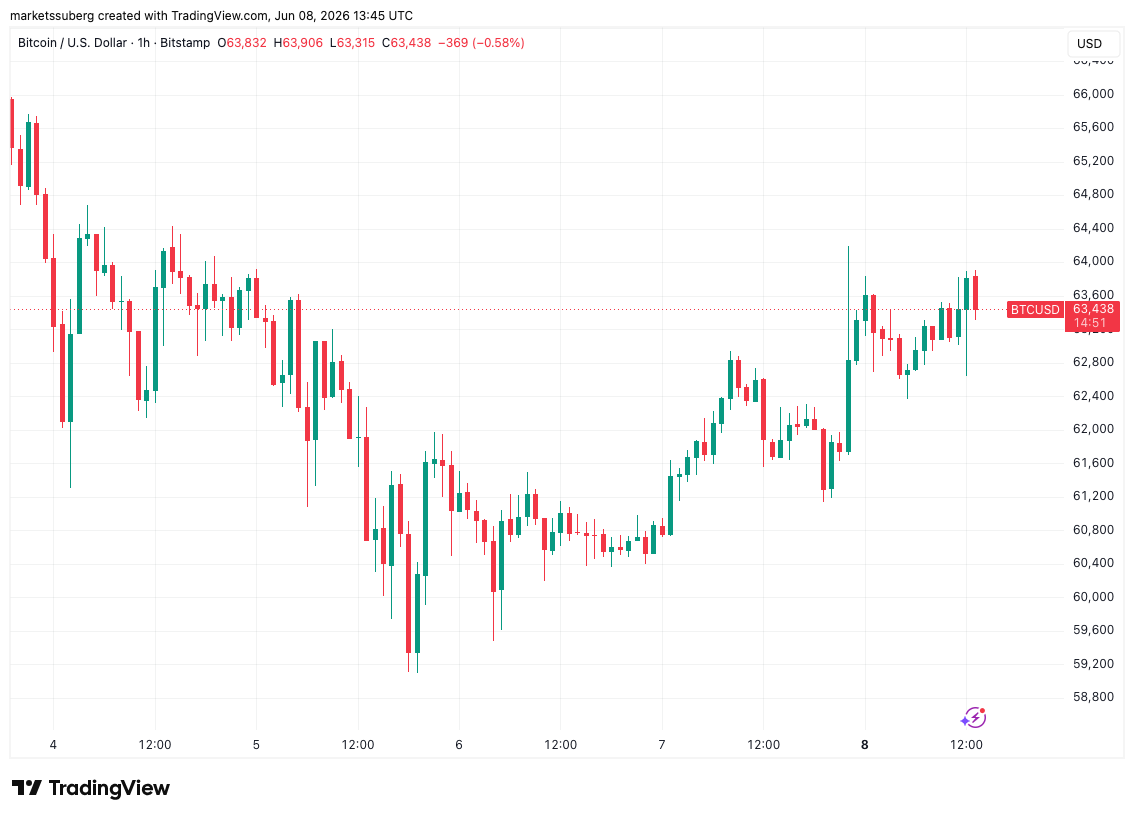
BTC/USD one-hour chart. Source: Cointelegraph/TradingView
Attention focused on the $60,000 mark amid a broad lack of bullish sentiment on both shorter and longer time frames.
“Holding the $60K low and I will just assume this is a range for now,” trader Daan Crypto Trades forecast in his latest analysis on X.
“I can easily see us trade in this $60K-$80K region for quite a while. Just need to not turn bearish at the range low and not get too excited at the range high region.”
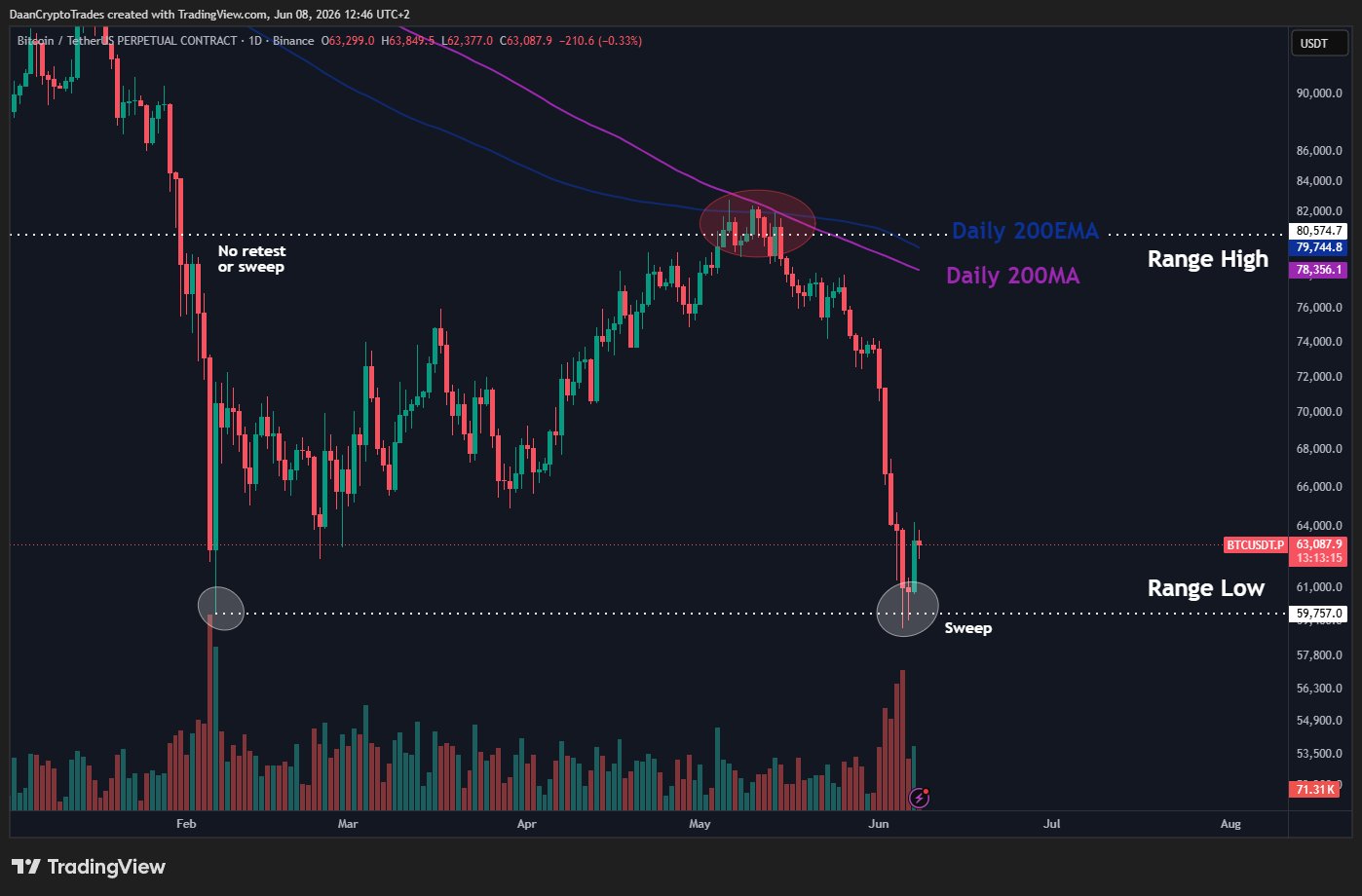
BTC/USDT perpetual contract one-day chart. Source: Daan Crypto Trades/X
An accompanying chart showed Bitcoin’s 200-day simple moving average (SMA) now acting as low-time-frame resistance.
Among those seeing bearish continuation was trader and analyst Rekt Capital, who told X followers to watch for a failed rebound and subsequent weakening of support at $60,000.
“Bitcoin has now tagged the 200-week SMA for the first time in this Bear Cycle,” he added about another important bear-market feature late last week.
“Deviating below it has historically been the key to building out a Bear Market bottom formation.”
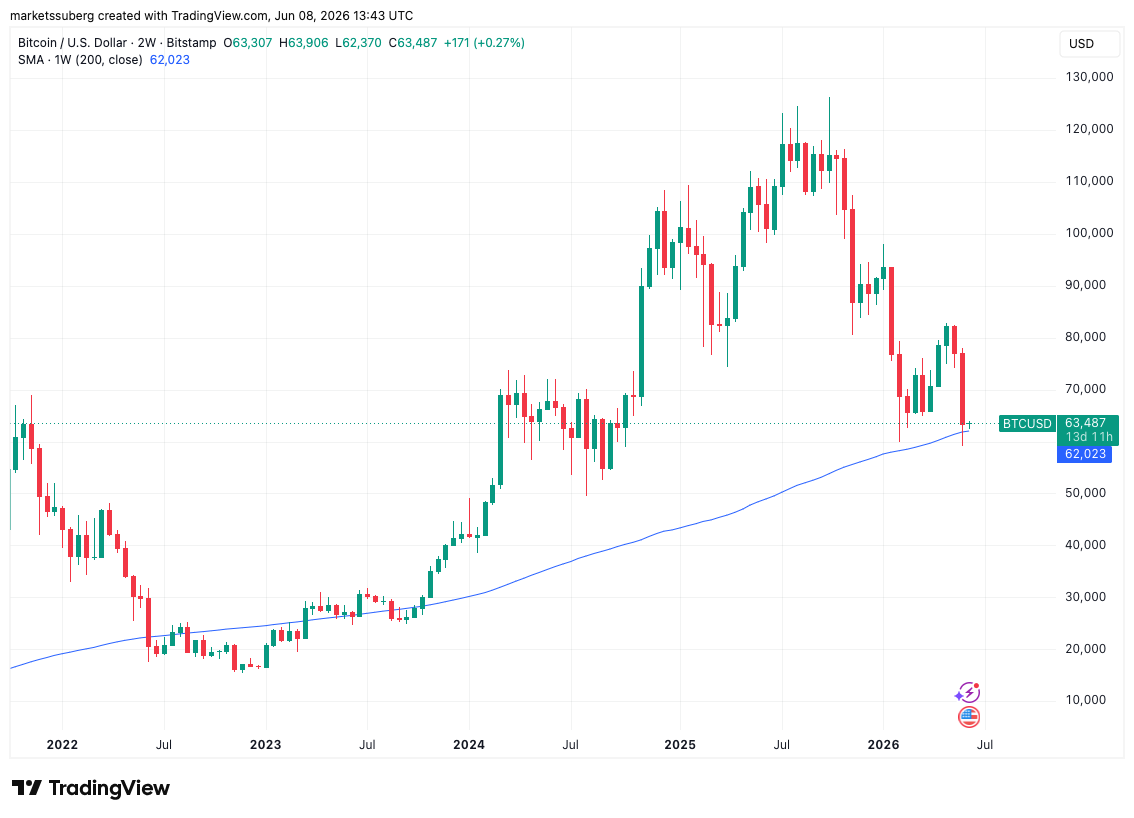
BTC/USD two-week chart with 200-week SMA. Source: Cointelegraph/TradingView
Bitcoin analysis says macro “tapping it on the shoulder”
On the macro front, analysis pointed to several key headwinds complicating the picture for crypto and risk assets.
Related: BTC price bottom not due until Q4? Five things to know in Bitcoin this week
These were interest-rate plan expectations from the US Federal Reserve, the Japanese yen passing 160 per dollar and the US-Iran war.
“Taken together, these are not exactly ideal conditions for high-beta assets,” trading resource QCP Capital wrote in its latest Market Color bulletin.
“BTC is effectively being asked to perform while oil, rates, FX and geopolitics are all tapping it on the shoulder.”
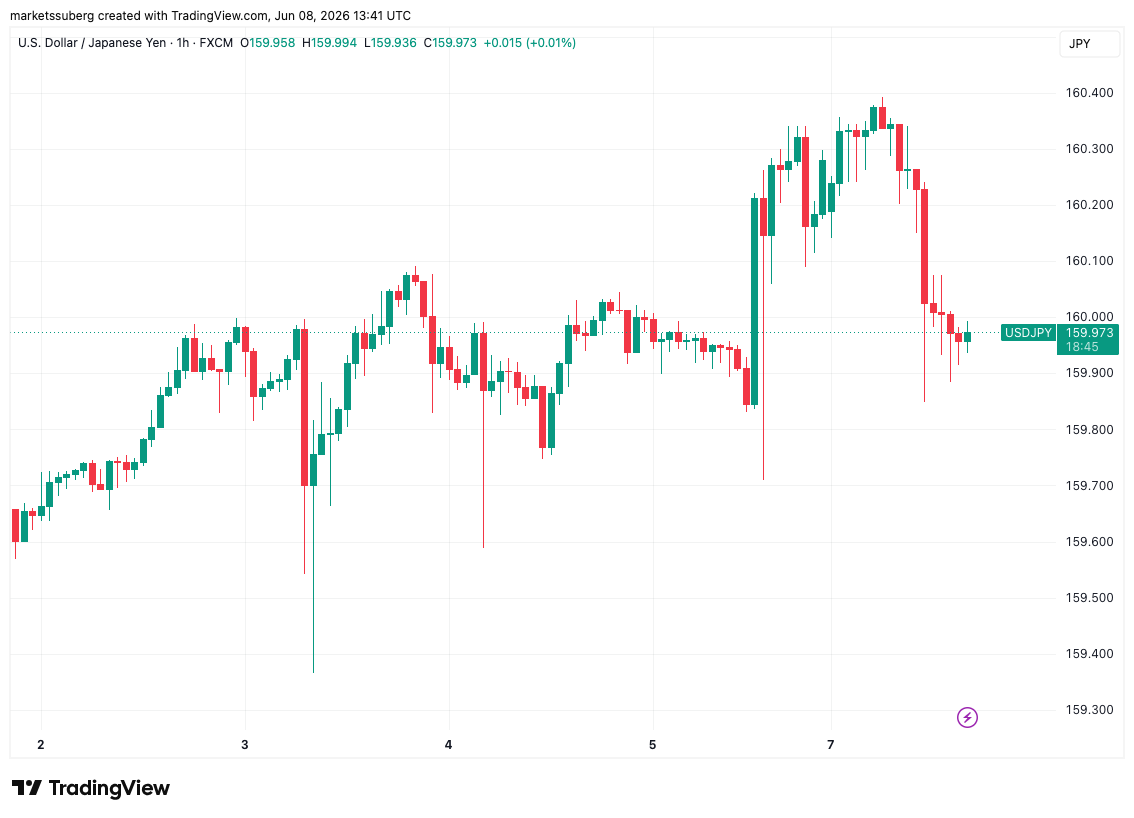
USD/JPY one-hour chart. Source: Cointelegraph/TradingView
QCP argued that given Asia equities weakness on Monday, Bitcoin’s next moves would be telling when it comes to its recent divergence from stocks.
“If crypto can hold while equities digest the AI-led correction, the market may start to rebuild a cleaner standalone narrative. If not, the apparent decoupling may prove to be less independence and more delayed reaction,” it suggested.



Strategy says its current capital structure could withstand a prolonged Bitcoin decline while continuing to fund interest payments and preferred stock dividends.
Summary
- Strategy says its current structure can fund obligations through 5.8 years of steady Bitcoin declines.
- Company data shows a $3.225 billion cash reserve supporting preferred dividends and debt interest payments.
- The stress test uses Strategy’s internal BTC Rating rather than an independent credit agency assessment.
In a July 24 post on X, the company said Bitcoin could fall 11.4% each year for 5.8 consecutive years without pushing its company-defined BTC Rating below 1.0x.
The claim arrived as Bitcoin traded near $64,463 and Strategy shares closed at $91.67 on July 24. Bitcoin remained below Strategy’s average purchase price, while MSTR had fallen sharply from its previous peak. The exercise describes a steady multi-year decline, not a sudden crash or a guarantee that Strategy could meet every obligation under all market conditions.
What Strategy’s Bitcoin stress test measures
Strategy’s model uses a measure called BTC Floor ARR. The company defines it as the lowest constant annual Bitcoin return that would preserve 1.0x coverage of net debt and preferred stock over the weighted duration of its credit structure. The calculation includes interest and preferred dividend payments. Its current credit metrics dashboard places that floor at negative 11.4% over 5.8 years.
Strategy wrote: “At today’s capital structure, BTC could fall 11.4% annually for 5.8 years” while the company continued funding interest and preferred dividends. A 1.0x BTC Rating means the measured Bitcoin reserve still matches the claims included in Strategy’s formula. The company uses the calculation to describe balance-sheet coverage, not Bitcoin’s likely future price.
The calculation also differs from a traditional credit rating. Strategy developed the metric itself and publishes it for illustrative purposes. The company does not present it as proof that Bitcoin will decline at a steady rate or that its financing structure can withstand every type of market disruption.
Cash reserve and Bitcoin sales support the model
Strategy held 843,775 BTC as of July 19. It acquired the coins for about $63.69 billion at an average price of $75,476. The company also reported a $3.225 billion U.S. dollar reserve after raising $263.5 million through common-stock sales. As crypto.news reported, Strategy did not buy or sell Bitcoin during that week.
The reserve supports preferred dividends and interest on outstanding debt. Strategy’s current figures place annual interest and dividend obligations near $1.7 billion. The cash balance therefore provides less than two years of direct coverage before the company needs new financing, Bitcoin sales or other capital actions.
Strategy created a broader Digital Credit Capital Framework in June. The plan authorises up to $1.25 billion in Bitcoin sales to build or refill the cash reserve. It also permits selected Bitcoin sales to fund dividends, interest and approved security repurchases. Strategy raised the STRC preferred dividend rate to 12% and approved separate $1 billion buyback programmes for common and preferred securities.
Strategy sold 3,588 BTC for about $216 million between June 29 and July 5. It used the proceeds for preferred distributions and reserve replenishment. The sales reduced its holdings from 847,363 BTC to 843,775 BTC.
Strategy warns its BTC Rating is not a credit rating
Strategy’s metric definitions state that BTC Rating is an internal, illustrative measure. No independent credit rating agency issues it. It does not measure liquidity, solvency or reported financial performance. The company also says the calculation does not account for possible cross-defaults under its debt agreements.
The model uses the notional value of preferred stock, although some securities may carry liquidation preferences above that amount. Its dividend coverage measure also assumes Strategy can refinance existing debt on broadly similar terms without repaying principal. Those assumptions may not hold during a severe funding or market shock.
Strategy’s board must also approve preferred dividends. The company can adjust STRC’s variable rate each month, and it does not guarantee cash payments. Strategy may issue shares, sell Bitcoin, lower distributions where permitted or restructure obligations if its funding position weakens. A 1.0x result therefore does not remove refinancing, dilution, execution or market risks.
Bitcoin and MSTR remain under market pressure
Bitcoin traded around $64,463 on July 26, roughly 49% below its October 2025 peak near $126,000. MSTR closed at $91.67 on July 24. Investors continued to track Bitcoin’s price alongside Strategy’s cash requirements, preferred dividend costs and market value relative to its Bitcoin holdings.
The company’s financing model worked best when MSTR traded above the value of its Bitcoin reserve. That premium allowed Strategy to sell shares and increase Bitcoin per share. A lower market premium made new issuance less attractive and pushed the company to build cash rather than buy more Bitcoin.
The company has also shifted from a mainly accumulation-focused model towards active capital management. Its current framework includes share sales, cash reserves, possible Bitcoin sales and repurchase programmes. Crypto.news analysis noted that Strategy’s market premium, or mNAV, remains central because it determines whether common-stock issuance can increase Bitcoin per share.
The stress test presents Strategy’s view of how long its current assets could support its financing structure under a steady decline. It does not predict Bitcoin’s direction or cover every form of market stress. Future results will depend on Bitcoin prices, access to capital, dividend decisions, debt terms and the company’s use of authorised Bitcoin sales.
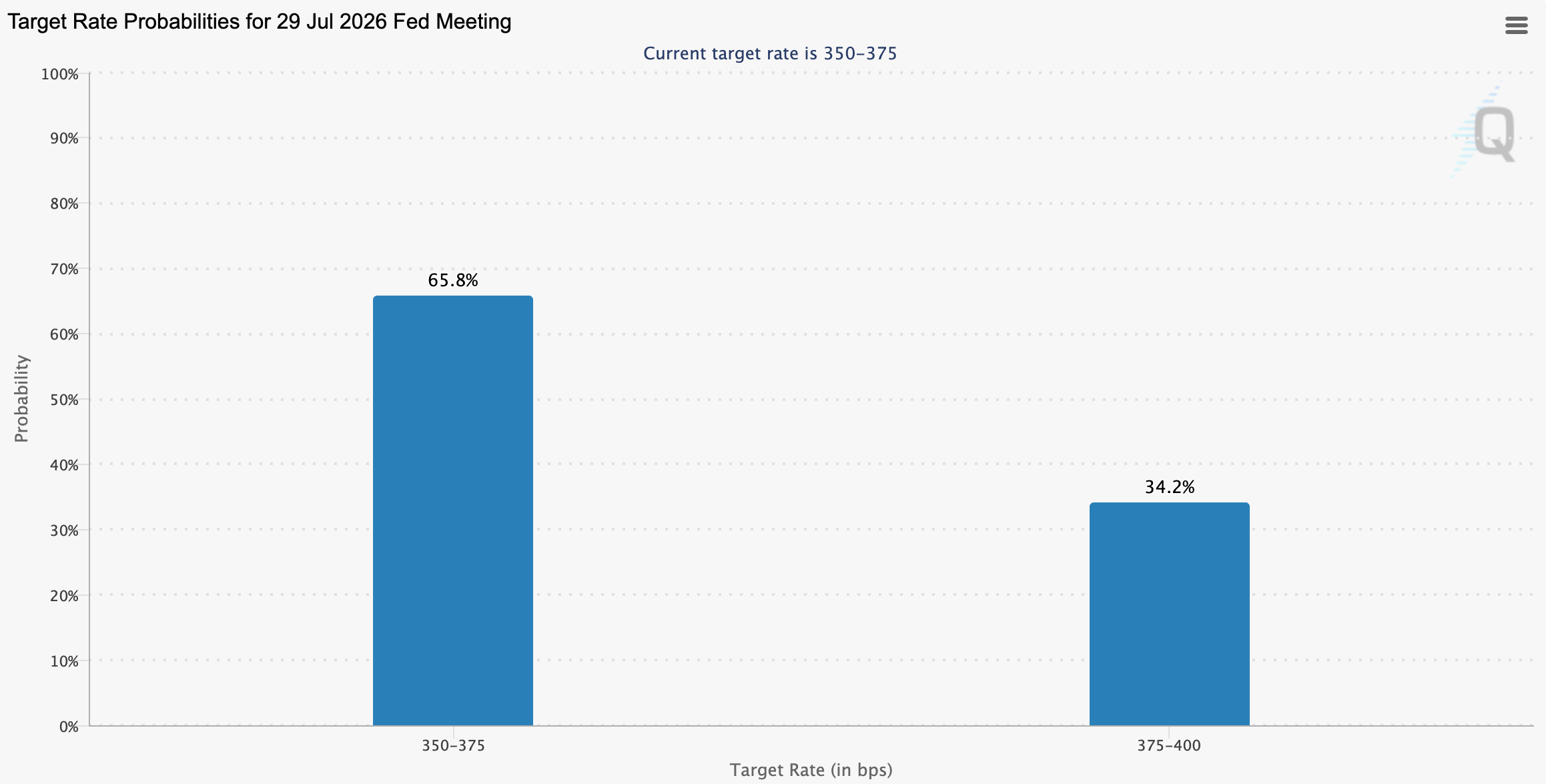
The Federal Reserve (Fed) and the Bank of Japan (BoJ) both hand down interest rate decisions next week, two days apart. Bitcoin (BTC) enters the pair of events near $64,000.
Markets expect a hold in both cases. Doubt is concentrated in Washington, where about a third of pricing still favors a hike.
Fed Hike Odds Climbed as Oil Rebounded
The Fed has held its target range at 3.5% to 3.75% since December 2025. A hold on Wednesday would be the fifth in a row.
Pricing still moved quickly this month. CME FedWatch put the odds of a July hike near 38% on July 23. That figure stood at 12% a week earlier.
Oil drove that move. Brent crude settled above $100 a barrel on July 23, its first close above that level since May.
Odds have since eased to 34.2%. A hold, therefore, remains the majority outcome in futures pricing.
Follow us on X to get the latest news as it happens

June inflation data had pointed the other way. Consumer prices fell 0.4% on the month, cutting the annual rate to 3.5% from 4.2%.
However, that relief may not last. Renewed hostilities and the oil surge could lift July inflation. That reading lands on August 12.
The July meeting includes no Summary of Economic Projections. That leaves the statement and the press conference as the only output from the meeting.
The Yen Is the Larger Variable for Bitcoin
Meanwhile, Nikkei reported that the Bank of Japan will hold its policy rate at 1% on July 31. Still, the currency is the pressure point. The yen slid past 163 per dollar last week, its weakest level in four decades.

Officials have grown vocal. Finance Minister Satsuki Katayama said the government was ready to step into the market if needed.
“Our stance has not changed at all. If there is a need for it, we will take decisive action appropriately at any time,” Katayama told reporters.
A hold on Friday sends no clear directional signal to Bitcoin. Rates stay put, and the cost of yen funding remains unchanged.
The rate risk, therefore, sits later in the calendar. Some 86% of 87 economists polled by Reuters expect a hike to 1.25% by the end of December.
Of those naming a month, 53% chose December and 35% picked October. Kazutaka Maeda of Meiji Yasuda Research Institute, who forecasts an October move, sees room for a faster sequence.
“The pace of rate hikes, which until now has been roughly once every six months, may accelerate somewhat due to the need to counter inflationary and yen-selling pressure,” he said.
This matters because of how Japanese policy affects crypto. The link runs through borrowing costs. Investors borrow yen cheaply and buy higher-yielding assets abroad, including crypto.
A stronger yen breaks that trade. The loan costs more to repay, margin calls follow, and traders sell whatever is liquid first.
Bitcoin sits at that end of the book. It also trades around the clock, so it absorbs the selling before equities open.
“Any hint of aggressive rate hikes or intervention from the BOJ could pump the yen, causing a massive carry trade unwind. Remember August 2024? The next unwind could be even more brutal,” Crypto Rover said.
That is why Friday matters more than the headline rate. The signal sits in the Outlook Report and in how hard Ueda pushes back on the currency.
Subscribe to our YouTube channel to watch leaders and journalists provide expert insights
The post Two Central Banks Decide Interest Rates Next Week: What It Means for Bitcoin appeared first on BeInCrypto.
Crypto World
The Biggest Pi Network (PI) Updates From the Past Month: Everything Pioneers Need to Know

Although it wasn’t the busiest and most eventful month in its history, the past 30 days have still shown some new developments, features, and updates around the broader Pi Network ecosystem.
As usual, though, it wasn’t without some controversy. Let’s dive in.
Late June, Early July
Pi2Day
The second most important day of the year for Pi Network and its vast community is June 28, known within their space as Pi2Day. It usually comes with significant hype about potential token listings or the announcement of new major updates and developments.
The 2026 edition didn’t bring a listing on a big exchange. Instead, the Core Team unveiled one of the most important updates to date for the Pi App Studio. They introduced PiVerify, Pi Sign-In, and SoloHost – tools designed to make it easier for developers to build applications and for users to access them using their Pi identities.
Pi App Studio Backend Upgrade
About a week after the conclusion of Pi2Day, the team expanded the capabilities of the Pi App Studio. The platform now supports persistent storage and improved backend infrastructure, allowing devs to create more sophisticated apps that can securely store user data and operate more reliably.
Although this was not the flashiest of upgrades, it still represents an important step toward making the broader Pi Network ecosystem capable of hosting more advanced, production-ready apps.
Mid- / Late- July
V25 Deadline
The team behind the project announced a new deadline for completing the next Mainnet migration requirements. Eligible validators were reminded to upgrade to the necessary new version by July 22, when the protocol update v25 was supposed to be introduced.
Although the deadline has now passed, there has been no official update from the team that the migration was successfully deployed. It’s worth noting, though, that their confirmations have been slacking in the past few months, and missing the deadline now doesn’t necessarily mean that the upgrade was not completed.
Pi Browser Refreshed Look
Later in July, the team rolled out a redesigned Pi Browser look with a cleaner interface and improved navigation. The changes make it easier for Pioneers to discover ecosystem applications while giving developers better visibility for their projects.
The team said the most significant improvements are for the overall user experience, but added that the redesign is still aimed at making the ecosystem more accessible as the number of available apps continues to grow.
SLICE Token
Just yesterday, the Core Team said they had completed the distribution of the new Testnet token called Slice to nearly 480,000 participants for Pi Launchpad testing. Pioneers can now explore token allocations, liquidity pools, pricing data, and other Launchpad features inside the Pi Browser.
The team emphasized that SLICE remains a Testnet token intended to help developers and the community prepare for future Mainnet token launches.
Controversy
Scam Activity Detected
The first portion of the controversy section will be dedicated to a reported suspicious activity from one Pioneer. According to data shared on X, a user noted that after waiting for a while to have their PI tokens unlocked, they were not available in the Pi Wallet.
Instead, they found countless failed transaction attempts, which highlighted the growing threat of phishing scams targeting wallet passphrases.
PI Token Dump
Despite all the updates and developments listed above, the project’s native token had its worst month to date. It broke below the $0.10 support level a few weeks ago and charted consecutive all-time lows, with the latest coming on July 14 at just over $0.07.
It managed to rebound in the following days and even challenged $0.10 last Sunday, only to be rejected once again. The subsequent retracement pushed it south hard, and the token is currently fighting to stay above $0.08. PI remains down by over 97% since its all-time high at $2.99, marked last February.
The post The Biggest Pi Network (PI) Updates From the Past Month: Everything Pioneers Need to Know appeared first on CryptoPotato.


South Korea’s largest lender will use JPMorgan’s blockchain platform to support US dollar cross-border payments for import and export businesses across 10 countries.

Bitcoin price is trading around $64,500 to $66,000, little changed over the past 24 hours, and Grayscale just made a prediction that’s splitting the trading community. The firm’s head of research argued the bear market may already be behind us, but the condition attached to that view matters more than the headline.
Grayscale’s Zach Pandl outlined two competing frameworks for Bitcoin’s next move. The first is the traditional four-year halving cycle, which historically allows for deep corrections after cycle peaks. Under that model, Bitcoin could still revisit the $50,000 area before forming a lasting bottom.
— Cointelegraph (@Cointelegraph) July 23, 2026
 INSIGHT: Grayscale's Head of Research Zach Pandl says Bitcoin's bottom may already be in if the Fed holds off on rate hikes.
He pushes back on the "four-year cycle" theory, which points to a lower bottom in September or October. pic.twitter.com/gJwaeOEmGH
However, Grayscale favors a different framework. It views the recent decline as a cyclical pullback within a longer-term uptrend. In that scenario, a durable floor has likely formed around $60,000 to $65,000. The key variable remains Federal Reserve policy, as a stable rate outlook supports the bullish case.
Meanwhile, spot Bitcoin ETFs continue attracting institutional interest, reinforcing the constructive outlook. Still, whether that demand survives the next round of macroeconomic data remains the biggest question. For now, Bitcoin is holding within the $64,500 to $66,000 range while traders wait for the next catalyst.
Discover: The Best Crypto to Diversify Your Portfolio
Bitcoin Price Prediction: Break $70,000 and Challenge Six Figures Again?
Bitcoin is trading around $64,500 to $66,000, pressing against resistance near $66,000. A confirmed daily close above that zone could open the path toward $68,500 to $70,000. If momentum strengthens, the $72,000 area becomes the next major hurdle. Meanwhile, support sits around $60,000 to $62,000, and bulls need to defend it.
The technical picture remains mixed but is slowly improving. Bitcoin continues consolidating beneath a descending trendline, while analysts are watching for a breakout above resistance. Grayscale adds a fundamental angle, noting recent buyers have largely returned to breakeven. That suggests the market has absorbed much of the recent selling pressure instead of delaying it.

The bull case calls for Bitcoin to break above $66,000 with strong volume. If that level flips into support, price could climb toward $68,500 to $70,000. Softer macroeconomic data would likely strengthen that move and improve market sentiment.
The base case is continued consolidation between $62,000 and $66,000 as traders wait for clearer Federal Reserve signals. ETF demand could keep providing gradual support. However, a decisive drop below $60,000 would revive the four-year cycle argument and put the $55,000 to $60,000 area back into focus. Historical volatility suggests that lengthy consolidation can still occur during established uptrends.
Trade Bitcoin on Bybit and Get a Chance to Win Our $1,000 USDT Airdrop
Bitcoin Hyper Targets Early Mover Upside as Bitcoin Tests Key Levels
Bitcoin consolidating near all-time-high territory is the kind of setup that makes large-cap BTC positions feel crowded, and the upside math at a multi-trillion-dollar market cap is structurally limited compared to earlier in the cycle. Traders looking for asymmetric exposure within the Bitcoin ecosystem are increasingly looking one layer down.
Bitcoin Hyper ($HYPER) is positioned at that intersection. It is a Bitcoin Layer 2 integrating the Solana Virtual Machine, making it the first BTC L2 to deliver SVM-based smart contract execution. The pitch is direct: Bitcoin’s security and trust model, with sub-second finality and low fees that the base chain structurally cannot offer.
The presale has raised $32.9 million at a current price of $0.0136836, with staking available for early participants. The project’s momentum through the presale phase has drawn attention as regulatory clarity around Bitcoin infrastructure projects comes into sharper focus.
For traders who want exposure to Bitcoin’s ecosystem growth rather than BTC price alone, it warrants a closer look.
The post Bitcoin Price Prediction: Grayscale Believes The Bear Market is Over appeared first on Cryptonews.
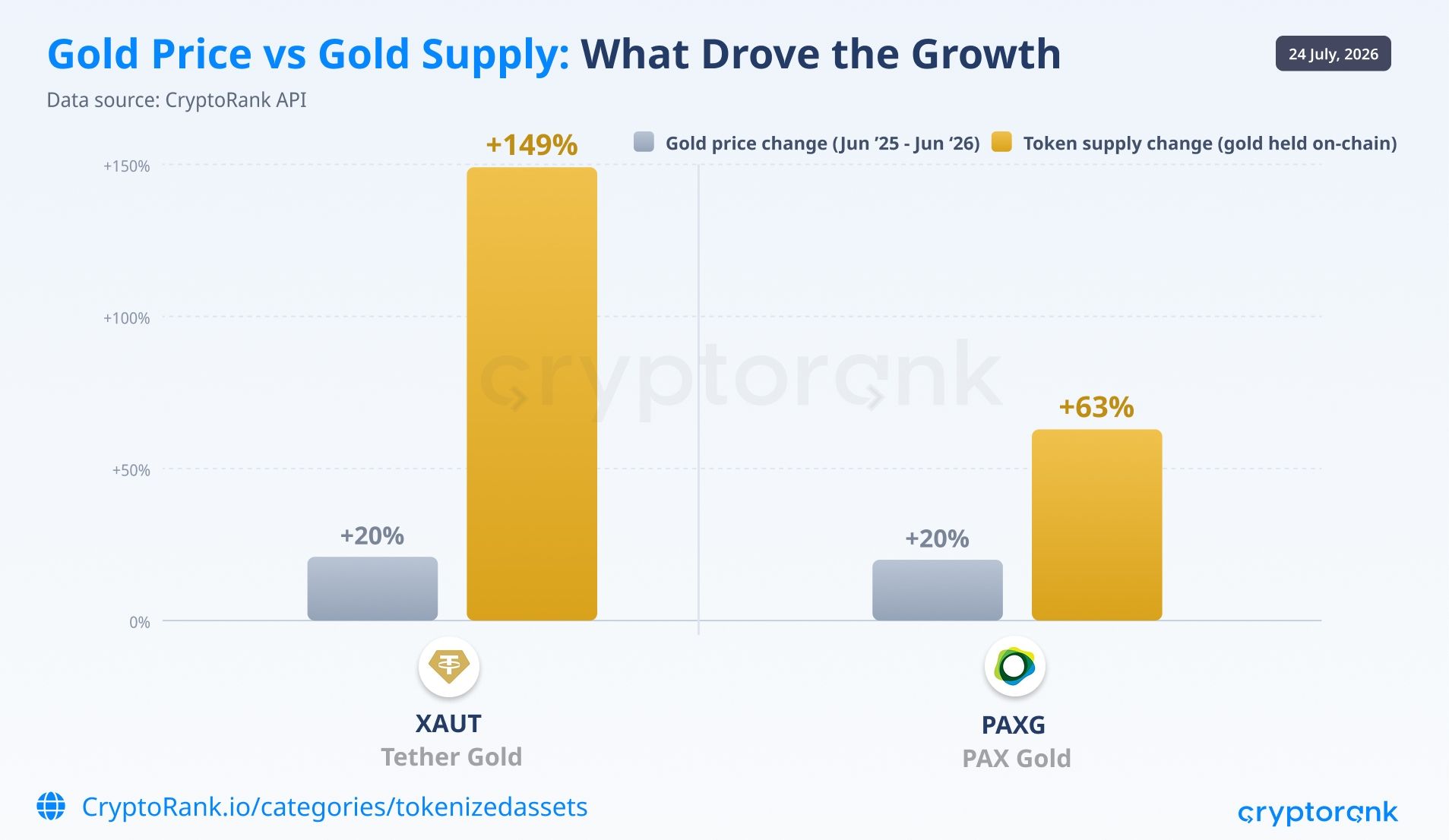
Tokenized assets grew 267% between June 2025 and June 2026, the only crypto sector to add market value, while the rest of the market declined.
The gain came from new issuance rather than rising prices. Gold tokens and equity tokens accounted for almost all of the expansion.
Gold Supply On Chain Doubled While Prices Rose Just 20%
In a recent report, CryptoRank noted that gold prices rose nearly 20% over the period. So, the price rise cannot explain the sector’s growth on its own.
However, the amount of gold held on chain roughly doubled, climbing from 524,000 ounces to more than 1 million. That gap matters.
“The growth came from issuance rather than price,” CryptoRank said.
Follow us on X to get the latest news as it happens

Notably, a year ago, precious metals accounted for nearly 100% of openly traded tokenized assets, according to CryptoRank. Tether Gold (XAUT) and PAX Gold (PAXG) held most of that market capitalization.
By June 2026, however, precious metals had fallen to 68% of the sector. The share dropped as more asset classes entered the market.
Note: BeInCrypto’s latest report, Real State of Tokenization in 2026, tracked nearly $60 billion in tokenized real-world assets across more than 7,000 products and 12 asset classes. It found that the market is growing fast, but actual on-chain activity remains far thinner than the headline numbers suggest.

Equity Tokens Arrived From Zero
Tokenized stocks and exchange-traded funds (ETFs) went from nothing to 23% of the sector in 12 months, as issuers put shares of major companies on-chain. Treasuries and private credit make up most of the remainder.
By token count, rStocks and Ondo issue close to two-thirds of all tokenized stocks. rStocks lists 568 tokens and Ondo more than 400, spanning single names such as NVIDIA and Apple alongside index products.
Exchanges entered the market later but moved quickly. Binance launched bStocks in June 2026, and Gate followed on July 3 with gStocks.
Meanwhile, meme coins, decentralized physical infrastructure networks (DePIN), and blockchain infrastructure posted the steepest declines of any sector over the same year.
CryptoRank also ranked tokenized assets as the most-listed category on centralized exchanges during the first half of 2026. That pipeline suggests issuance, rather than price, will again decide where the sector ends in 2026.
Subscribe to our YouTube channel to watch leaders and journalists provide expert insights
The post Crypto’s Only Growing Sector Runs on Gold and Equities appeared first on BeInCrypto.


“As it uses existing rules, it’s going to be much less like a standalone framework,” Lightstone said. “A crypto firm will be treated like any normal traditional financial institution,” adding that “it will still be hard to get FCA authorization.”
For established banks and investment firms already operating under those rules, adapting to crypto may be relatively straightforward. For newer crypto businesses, however, the cost of building governance, capital and custody systems from scratch could prove considerably more burdensome.
That challenge is particularly evident in the FCA’s proposed client asset regime, applying the Clients Asset Sourcebook (CASS) framework, which would require firms to segregate customer crypto assets from company funds under trust arrangements while introducing crypto-specific operational safeguards around private keys and reconciliations.
“The CASS requirements are very onerous,” Lightstone said. “That could encourage those newcomers to merge [with], be acquired by, a traditional firm that’s already subject to CASS and has those controls in place.”
Banking adoption
The prospect of consolidation comes as banks themselves appear more willing to enter digital assets now that regulatory uncertainty is beginning to lift.
“As of today, there is less than 20% of all the banks in Europe [that] offer today any type of crypto services, so it’s heavily underserved,” said Simon Schneider, CEO of Sygnum Europe.

The leading electric vehicle manufacturer reported no changes to its Bitcoin holdings in the second quarter of the year, extending one of the longest uninterrupted corporate BTC streaks.
Meanwhile, the same cannot be said about other major crypto corporate holders, while another one of Elon Musk’s companies, SpaceX, which went public recently, made a small BTC transfer, raising some questions.
Tesla HODLs
It’s worth noting that Bitcoin was not mentioned extensively during the recently reported earnings call, but the absence of any transaction was enough to reassure investors that there’s no change in the company’s holdings. This means that the EV maker’s crypto position remains the same – 11,509 BTC, making it one of the largest publicly traded corporate holders of the primary cryptocurrency.
The Musk-led entity entered the Bitcoin market in early 2021, making a $1.5 billion purchase in one of the most influential corporate crypto investments ever announced. However, it later sold 10% of its holdings to test BTC’s liquidity before disposing of 75% of its remaining position during the 2022 bear market. At the time, Musk said the firm needed to strengthen its cash position amid the growing economic uncertainty.
Since then, the company has halted any sales or purchases, leaving its stash untouched. Quarter after quarter, Tesla has reported the same 11,509 BTC on its balance sheet despite the cryptocurrency’s rallies, corrections, new all-time highs, and significant volatility.
This makes Tesla one of the few major corporate holders of BTC whose strategy has remained unchanged for over three years. Musk’s SpaceX has also retained its BTC holdings untouched lately. The latest SEC filing before its IPO revealed that it still owns 18,712 BTC. However, it made a minor transfer in early July, which caused some FUD but didn’t lead to anything more profound.
Tesla Vs Bitcoin Market Cap
While the EV continues to maintain its cryptocurrency positions, it’s worth observing the battle between the two in terms of market capitalization. Data from CompaniesMarketCap shows that they are actually very close to each other, just outside the top 10.
Bitcoin’s current market cap stands at $1.310 trillion, while Tesla closed Friday at $1.262 trillion. The cryptocurrency occupies the 13th position, far below its record of 6, while Tesla remains a spot lower. Meta Platforms and SpaceX are the other two just outside the top 10.
The post Here’s What Tesla Did With Its Bitcoin Holdings in Q2 2026 appeared first on CryptoPotato.


Robert Kiyosaki warned followers about surging US national debt, now near $39.6 trillion, naming gold, Bitcoin, and Ethereum as core holdings in his personal defense strategy.
The author of “Rich Dad Poor Dad” frames the choice bluntly, though skeptics question his long-standing collapse forecasts.
The Hard Asset Strategy Kiyosaki Has Built Since 1965
Hard assets are holdings with a scarce supply that cannot be printed at will, such as gold, silver, or Bitcoin. Kiyosaki argues that those assets protect wealth when fiat systems weaken.
His latest post draws a stark fiscal comparison. US debt sat near $9.5 trillion in 2008, just before the global financial crisis, and has since more than quadrupled.
Actually, data placed the total at $39.64 trillion on July 22, closing in on $40 trillion. Kiyosaki claims the government prints roughly $1 trillion every 90 days. The scale is hard to grasp. Spending $1 trillion at $1 per minute would take about 32,000 years, he noted.
Follow us on X to get the latest news as it happens.
Kiyosaki rejects saving in fiat currency. One core Rich Dad rule holds that wealthy people do not save money; instead, they invest in assets that resist inflation and confiscation.
“…’The rich do not save money.’ Since 1965 I have saved real silver. Since 1971 I have saved real gold. Since 2012 I have saved Bitcoin. Since 2022 I have saved Ethereum…,” Kiyosaki said on X.
Storage reflects that distrust. Kiyosaki keeps gold and silver in Swiss vaults outside Switzerland, citing cases where Washington banned private gold ownership and seized holdings.
Why Does Robert Kiyosaki Trust Bitcoin and Ethereum
The crypto allocation marks a real evolution in his thinking. He long promoted gold and silver as sound money, yet now describes Bitcoin as a decentralized alternative to endless printing.
Its fixed cap of 21 million coins sits at the center of that argument. Ethereum complements the position through smart contracts and its expanding role across decentralized finance and stablecoins.
His price targets remain aggressive. Kiyosaki has forecast Bitcoin near $750,000 and Ethereum around $95,000 following what he calls a major financial reset.
“…When the bubbles go bust I predict gold will hit $35,000 an ounce one year after the gold bubble goes pop.. I predict silver to hit $200 an ounce a year after the bust. I predict Bitcoin will hit $ 750,000 a coin a year after the crash. And i predict Ethereum to be $95000 a year after crash…,” Kiyosaki previously noted.
Subscribe to our YouTube channel to watch leaders and journalists provide expert insights.
Critics push back on the record. He has repeatedly warned of an imminent collapse, and those timelines have often failed to materialize. Hard assets also carry real drawbacks. Gold and silver generate no yield, while Bitcoin and Ethereum remain highly volatile and vulnerable to sharp drawdowns.
His broader message centers on personal responsibility rather than precise timing. Kiyosaki urges people to study markets and build positions rather than rely solely on government-issued money.
Whether that reset arrives or not, the underlying question stays relevant for investors weighing exposure to debt-driven risk.
The post Robert Kiyosaki Shares a Key Revelation on Gold, Bitcoin and Ethereum appeared first on BeInCrypto.
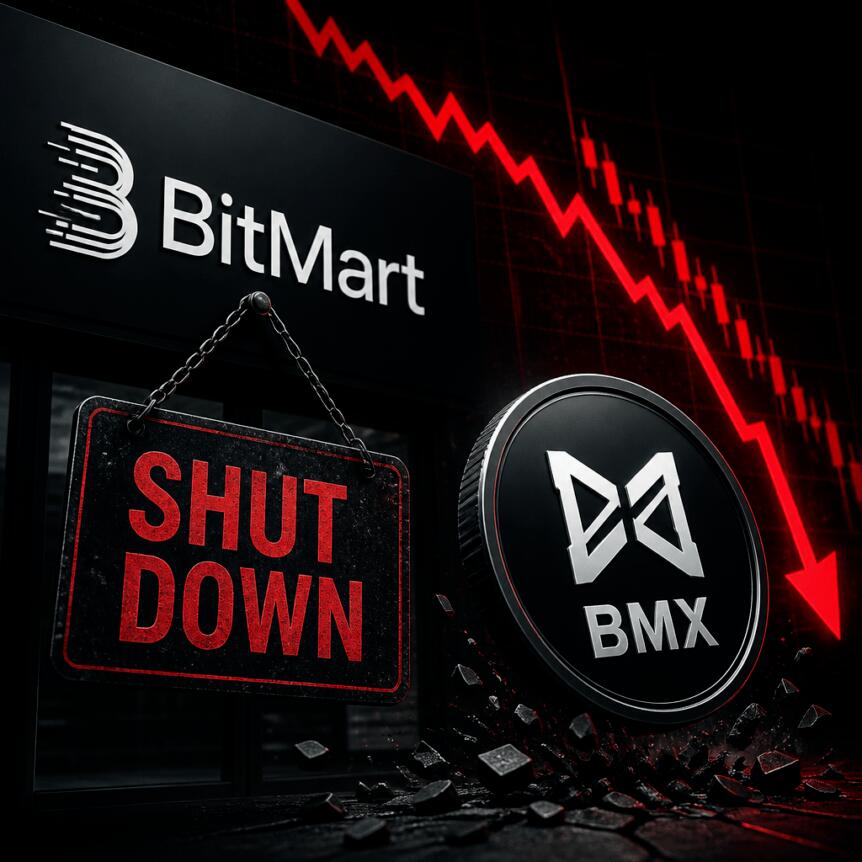
BitMart is shutting down its cryptocurrency exchange, with trading services scheduled to end on Aug. 26 and the company planning to complete operations by Jan. 31, 2027. In an announcement posted to its support site, the exchange said the decision follows an evaluation of its operating conditions, market environment, and future strategy, adding that the wind-down process will be orderly.
As part of the shutdown plan, BitMart has stopped taking new user registrations and deposits. Futures trading has moved to a reduce-only mode, while spot markets are no longer accepting new orders. The move places BitMart among a growing group of crypto venues that have signaled closures in recent months, including BitMEX and Dango.
Key takeaways
- BitMart will end trading services on Aug. 26 and expects to cease operations on Jan. 31, 2027, following an announced wind-down.
- The exchange has halted new registrations and deposits; futures are reduce-only and spot trading won’t accept new orders.
- BitMart’s token BMX fell sharply after the announcement amid user complaints about slower withdrawal processing.
- Arkham data indicates BitMart-attributed wallets held about $71 million in crypto assets on Sunday, down from roughly $102 million on July 6.
- BitMart said some withdrawals may require extra compliance and security checks, which could extend processing times.
Wind-down steps and what users can do
BitMart’s notice outlines a gradual shutdown rather than an immediate cutoff. It has already stopped onboarding: new user registrations and deposits are no longer allowed. For existing users, this change primarily affects how they can add funds or initiate new trades on the platform.
Trading access is also being restricted. Futures trading is in reduce-only mode, meaning positions can only be reduced rather than increased. On the spot side, the exchange says markets are closed to new orders, effectively freezing new spot trading activity while the company works through the wind-down.
The exchange further indicated that withdrawal handling may change during the process. BitMart said some withdrawal requests could be subject to additional compliance and security reviews, which may extend processing times. This is especially relevant for users who already reported delays after the shutdown announcement.
BMX drops as withdrawals draw complaints
BitMart’s native token, BMX, saw steep losses following the announcement, with the token trading around $0.09464 at the time of writing—down nearly 70% from about $0.31 late Friday. BMX reportedly touched as low as $0.1058 early Saturday before extending its decline, and it later slipped back under $0.10 after a brief recovery.
Alongside the token’s sharp repricing, some users took to X to report withdrawal delays. Posts referenced longer-than-usual processing times, including claims that Tether USD (USDT) withdrawal requests remained pending for hours.
On-chain attribution data from Arkham adds another layer to the story. Arkham’s explorer shows wallets attributed to BitMart holding about $71 million in crypto assets on Sunday, compared with roughly $102 million on July 6. The breakdown highlighted in Arkham data includes about $41.5 million in WeFi’s WFI tokens and a tracked USDT balance of roughly $91,000. While wallet attribution does not automatically confirm what portion is readily withdrawable at any given moment, it provides a snapshot of assets still associated with BitMart-operated addresses.
Token confusion: BMX versus BitMEX developments
In the days following the news, some users on X appeared to conflate BitMart’s BMX token with BitMEX’s token and shutdown process. In one widely circulated post, a Mandarin-speaking community participant flagged BMX’s price decline while discussing the exchange closure narrative online.
Replies then pointed out that the closure dates being discussed did not match BitMart’s timeline and appeared to reflect BitMEX’s own shutdown announcement schedule. Earlier coverage noted BitMEX’s shutdown date and reported that BitMEX’s token, BMEX, dropped sharply shortly after its notice.
Several other users in the Mandarin-speaking crypto community also reportedly mixed up BMX with BitMEX. It was not immediately clear whether this confusion had any direct effect on BMX trading volumes or flows, but the episode highlights a common problem during exchange shutdowns: market participants can react to similar-sounding assets and headlines without confirming which venue the news actually affects.
Why BitMart’s shutdown matters beyond a single platform
BitMart’s decision reflects a broader contraction trend in crypto derivatives and centralized exchange ecosystems. When platforms exit, the immediate effects are operational—new deposits stop, order flow becomes constrained, and users must focus on withdrawals. But there are also second-order consequences for liquidity, custody risk perceptions, and how traders price the tail risk of access during the wind-down period.
For market participants, the timeline is as important as the headlines. BitMart’s approach—ending trading on Aug. 26, continuing operations through a longer wind-down window, and planning final cessation by Jan. 31, 2027—means the risk profile will likely change in stages. Early in the process, users are mainly managing account access and withdrawal reliability; later, liquidity and settlement mechanics may become the primary concern as the remaining operational scope narrows.
In this case, user reports and BitMart’s stated possibility of additional withdrawal reviews suggest processing times may not be uniform for all assets and requests. Traders watching BMX—or any token tied to exchange narratives—may also need to account for the fact that token moves can be amplified by sentiment, confusion, and non-fundamental market behavior during shutdown news cycles.
Readers should monitor whether withdrawal processing stabilizes after the wind-down begins, and whether BitMart provides further operational updates as the company approaches the Aug. 26 trading cutoff. The remaining uncertainty is how consistently withdrawals clear for different asset types and whether any additional compliance or security steps materially extend timelines for users.

Trump’s tariffs are based on a forced-labor argument. Are they just a way to avoid Congress?

AST SpaceMobile's Next Chapter Is Finally Here

Strategy says Bitcoin can fall 11.4% yearly for nearly six years


-

 Fashion2 days ago
Weekend Open Thread: Brooks Brothers
-

 Politics7 days ago
Democrats look to World Cup watch parties to register thousands of voters
-

 News Videos7 days ago
Big Money Is Entering XRP
-

 Tech5 days ago
Sail Virtually Aboard The “Itanic” With IA-64 Emulator
-
 Tech5 days ago
Turtle Beach Command Series KB7 review: a nifty screen-equipped gaming keyboard
-

 Crypto World5 days ago
Grayscale Files For Worldcoin ETF, WLD Registers Sharp Rise
-

 NewsBeat6 days ago
Unregistered fitter used Gas Safe logo on business flyers
-
 Business4 days ago
New Jersey voter registration controversy explained: How 6,600 noncitizens got on the rolls, and what happens next
-
 Entertainment5 days ago
Johnny Depp’s R-Rated Gothic Cult Classic Gets New Release Ahead of Sydney Sweeney Remake
-

 Crypto World3 days ago
Ethics, other provisions in crypto Clarity Act to be further discussed
-

 Tech6 days ago
Watch Flock Safety CEO Garrett Langley discuss the future of surveillance at TechCrunch Disrupt 2026
-
 NewsBeat5 days ago
Shanghai science forum photos show China’s AI and robotics advances in rivalry with US
-

 Crypto World6 days ago
Circle’s President Sold Over 360,000 Shares, The Filings Explain Why
-

 Tech6 days ago
Subway Sandwich Computers Get a Second Life as Gaming Machines
-

 Sports2 days ago
2026 3M Open leaderboard: Scottie Scheffler finds putter in Round 1, sits three back
-

 News Videos3 days ago
The Peugeot Family: How 200 Years of an “Old Money” Dynasty Died in A Boardroom
-

 Fashion2 days ago
16 Dresses for the High Summer Event
-

 Tech7 days ago
How To Use Claude’s Reflect Dashboard And Learn When It’s Time To Touch Grass
-

 Tech6 days ago
The 35 Best Board Games for Family Game Night
-

 Entertainment6 days ago
Stephen Colbert Returns to Social Media After Late Show End
You must be logged in to post a comment Login