

Crypto World
Advanced Micro Devices (AMD) Stock Soars to $466 as Analysts Set $600 Target


TLDR
- Krane Funds Advisors increased its position in AMD by 72.7% during the fourth quarter, now holding 11,306 shares valued at approximately $2.42 million.
- The chipmaker delivered first-quarter earnings of $1.37 per share, surpassing Wall Street expectations by $0.08, while revenue climbed 37.8% year-over-year to $10.25 billion.
- Goldman Sachs shifted its stance on AMD from Neutral to Buy, increasing its price target from $240 to $450; TD Cowen pushed its target even higher to $600.
- Shares opened at $466.38, significantly exceeding the 50-day moving average of $358.36, while the consensus price target stands at $419.86.
- Company insiders offloaded $119.5 million in shares during the last 90 days, while semiconductor stocks faced headwinds following Broadcom’s disappointing AI forecast.
Advanced Micro Devices has emerged as one of the semiconductor industry’s most compelling narratives in recent months. A combination of impressive quarterly results, multiple analyst endorsements, and heightened institutional participation has propelled the stock significantly beyond its recent trading ranges — despite encountering some volatility.
Advanced Micro Devices, Inc., AMD
Shares began trading Monday at $466.38, representing a substantial premium over the 50-day moving average of $358.36 and significantly above the 200-day moving average of $265.16. With a 52-week trading band stretching from $115.06 to $546.44, the stock’s trajectory has been nothing short of dramatic.
The primary driver behind this recent optimism was AMD’s first-quarter financial performance. The semiconductor company reported earnings of $1.37 per share, exceeding the Street’s $1.29 consensus. Revenue reached $10.25 billion, topping expectations of $9.90 billion and marking a 37.8% increase compared to the prior-year period.
Such outperformance typically captures the attention of Wall Street analysts.
Wave of Analyst Endorsements
Goldman Sachs elevated AMD from Neutral to Buy on May 6th, simultaneously raising its price objective from $240 to $450. Sanford C. Bernstein followed suit, upgrading shares from Market Perform to Outperform while boosting its target from $265 to $525.
TD Cowen took the most aggressive stance, elevating its price target to $600 on June 1st while reaffirming a Buy recommendation. JPMorgan maintained its Neutral position but still increased its target from $270 to $385. Barclays established a $665 price objective, citing accelerating CPU demand driven by expanding artificial intelligence workloads.
The prevailing analyst consensus is Moderate Buy, with a mean price target of $419.86. Notably, this figure trails the current trading price, suggesting the recent rally has outpaced Street expectations.
Krane Funds Advisors was among the institutional players expanding their AMD holdings in the fourth quarter, increasing its stake by 72.7% to 11,306 shares worth approximately $2.42 million. Vanguard stands as the largest institutional stakeholder with more than 158 million shares valued at roughly $33.9 billion. Norges Bank established a fresh position worth about $4.9 billion during Q4.
Institutional investors and hedge funds collectively control 71.34% of AMD’s outstanding equity.
Executive Selling and Market Challenges
Not all signals point upward. Company executives have divested $119.5 million worth of AMD shares over the past three months. EVP Paul Darren Grasby disposed of 24,376 shares at $444.39 apiece on May 8th. EVP Mark D. Papermaster sold 31,320 shares at $350.00 on April 24th through a prearranged 10b5-1 plan.
From a broader market perspective, AMD experienced pressure following Broadcom’s quarterly results, which underwhelmed investors expecting more robust AI-related guidance. This development weighed on chip stocks across the board and renewed valuation debates surrounding AMD, particularly given its price-to-earnings multiple of 152.91.
TSMC has indicated that artificial intelligence chip supply constraints will persist for years, supporting demand fundamentals while highlighting ongoing capacity limitations throughout the industry.
Wall Street analysts currently forecast AMD will deliver $6.20 in earnings per share for the complete fiscal year.




South Korea’s largest lender will use JPMorgan’s blockchain platform to support US dollar cross-border payments for import and export businesses across 10 countries.

Bitcoin price is trading around $64,500 to $66,000, little changed over the past 24 hours, and Grayscale just made a prediction that’s splitting the trading community. The firm’s head of research argued the bear market may already be behind us, but the condition attached to that view matters more than the headline.
Grayscale’s Zach Pandl outlined two competing frameworks for Bitcoin’s next move. The first is the traditional four-year halving cycle, which historically allows for deep corrections after cycle peaks. Under that model, Bitcoin could still revisit the $50,000 area before forming a lasting bottom.
— Cointelegraph (@Cointelegraph) July 23, 2026
 INSIGHT: Grayscale's Head of Research Zach Pandl says Bitcoin's bottom may already be in if the Fed holds off on rate hikes.
He pushes back on the "four-year cycle" theory, which points to a lower bottom in September or October. pic.twitter.com/gJwaeOEmGH
However, Grayscale favors a different framework. It views the recent decline as a cyclical pullback within a longer-term uptrend. In that scenario, a durable floor has likely formed around $60,000 to $65,000. The key variable remains Federal Reserve policy, as a stable rate outlook supports the bullish case.
Meanwhile, spot Bitcoin ETFs continue attracting institutional interest, reinforcing the constructive outlook. Still, whether that demand survives the next round of macroeconomic data remains the biggest question. For now, Bitcoin is holding within the $64,500 to $66,000 range while traders wait for the next catalyst.
Discover: The Best Crypto to Diversify Your Portfolio
Bitcoin Price Prediction: Break $70,000 and Challenge Six Figures Again?
Bitcoin is trading around $64,500 to $66,000, pressing against resistance near $66,000. A confirmed daily close above that zone could open the path toward $68,500 to $70,000. If momentum strengthens, the $72,000 area becomes the next major hurdle. Meanwhile, support sits around $60,000 to $62,000, and bulls need to defend it.
The technical picture remains mixed but is slowly improving. Bitcoin continues consolidating beneath a descending trendline, while analysts are watching for a breakout above resistance. Grayscale adds a fundamental angle, noting recent buyers have largely returned to breakeven. That suggests the market has absorbed much of the recent selling pressure instead of delaying it.

The bull case calls for Bitcoin to break above $66,000 with strong volume. If that level flips into support, price could climb toward $68,500 to $70,000. Softer macroeconomic data would likely strengthen that move and improve market sentiment.
The base case is continued consolidation between $62,000 and $66,000 as traders wait for clearer Federal Reserve signals. ETF demand could keep providing gradual support. However, a decisive drop below $60,000 would revive the four-year cycle argument and put the $55,000 to $60,000 area back into focus. Historical volatility suggests that lengthy consolidation can still occur during established uptrends.
Trade Bitcoin on Bybit and Get a Chance to Win Our $1,000 USDT Airdrop
Bitcoin Hyper Targets Early Mover Upside as Bitcoin Tests Key Levels
Bitcoin consolidating near all-time-high territory is the kind of setup that makes large-cap BTC positions feel crowded, and the upside math at a multi-trillion-dollar market cap is structurally limited compared to earlier in the cycle. Traders looking for asymmetric exposure within the Bitcoin ecosystem are increasingly looking one layer down.
Bitcoin Hyper ($HYPER) is positioned at that intersection. It is a Bitcoin Layer 2 integrating the Solana Virtual Machine, making it the first BTC L2 to deliver SVM-based smart contract execution. The pitch is direct: Bitcoin’s security and trust model, with sub-second finality and low fees that the base chain structurally cannot offer.
The presale has raised $32.9 million at a current price of $0.0136836, with staking available for early participants. The project’s momentum through the presale phase has drawn attention as regulatory clarity around Bitcoin infrastructure projects comes into sharper focus.
For traders who want exposure to Bitcoin’s ecosystem growth rather than BTC price alone, it warrants a closer look.
The post Bitcoin Price Prediction: Grayscale Believes The Bear Market is Over appeared first on Cryptonews.
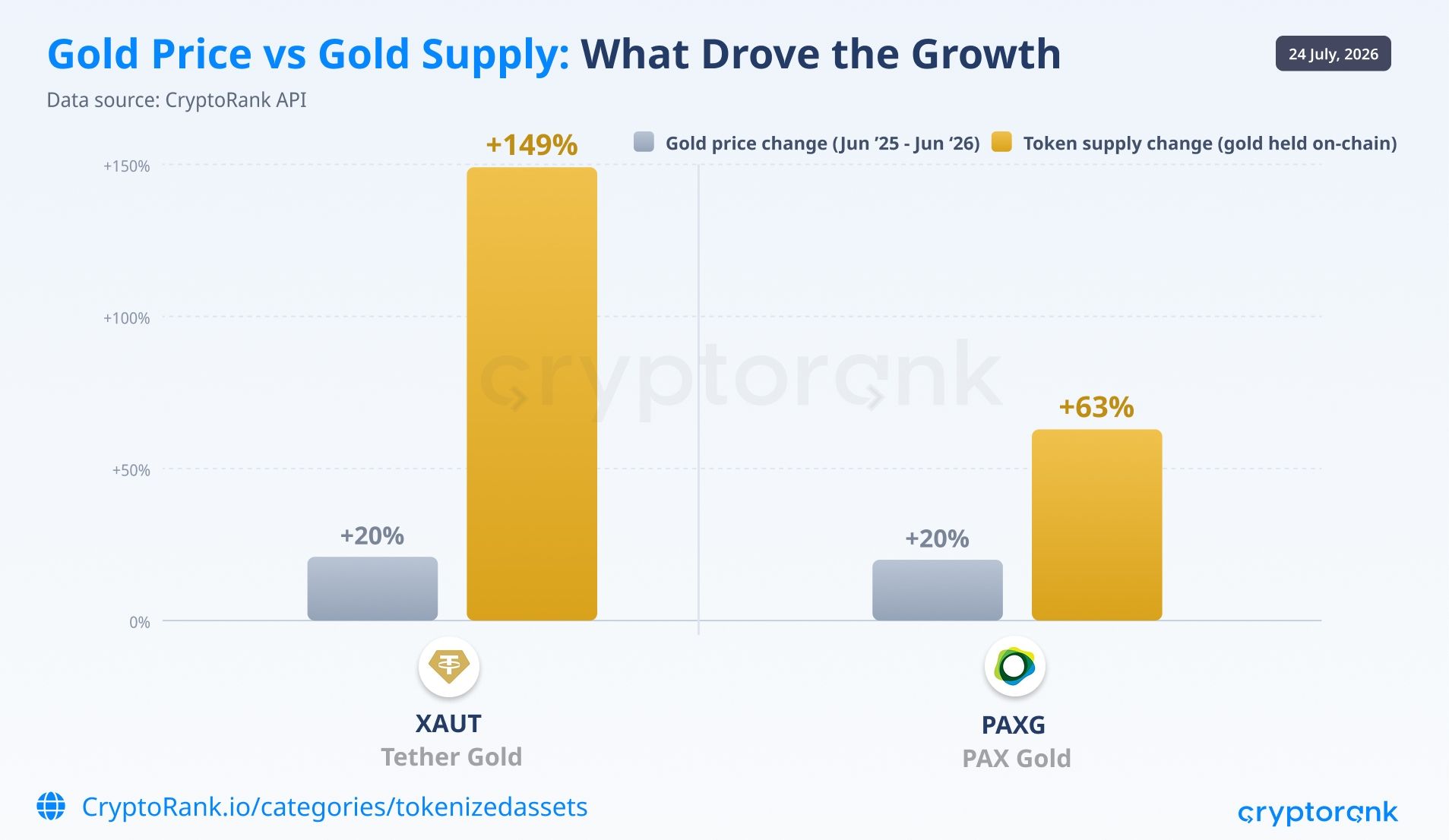
Tokenized assets grew 267% between June 2025 and June 2026, the only crypto sector to add market value, while the rest of the market declined.
The gain came from new issuance rather than rising prices. Gold tokens and equity tokens accounted for almost all of the expansion.
Gold Supply On Chain Doubled While Prices Rose Just 20%
In a recent report, CryptoRank noted that gold prices rose nearly 20% over the period. So, the price rise cannot explain the sector’s growth on its own.
However, the amount of gold held on chain roughly doubled, climbing from 524,000 ounces to more than 1 million. That gap matters.
“The growth came from issuance rather than price,” CryptoRank said.
Follow us on X to get the latest news as it happens

Notably, a year ago, precious metals accounted for nearly 100% of openly traded tokenized assets, according to CryptoRank. Tether Gold (XAUT) and PAX Gold (PAXG) held most of that market capitalization.
By June 2026, however, precious metals had fallen to 68% of the sector. The share dropped as more asset classes entered the market.
Note: BeInCrypto’s latest report, Real State of Tokenization in 2026, tracked nearly $60 billion in tokenized real-world assets across more than 7,000 products and 12 asset classes. It found that the market is growing fast, but actual on-chain activity remains far thinner than the headline numbers suggest.

Equity Tokens Arrived From Zero
Tokenized stocks and exchange-traded funds (ETFs) went from nothing to 23% of the sector in 12 months, as issuers put shares of major companies on-chain. Treasuries and private credit make up most of the remainder.
By token count, rStocks and Ondo issue close to two-thirds of all tokenized stocks. rStocks lists 568 tokens and Ondo more than 400, spanning single names such as NVIDIA and Apple alongside index products.
Exchanges entered the market later but moved quickly. Binance launched bStocks in June 2026, and Gate followed on July 3 with gStocks.
Meanwhile, meme coins, decentralized physical infrastructure networks (DePIN), and blockchain infrastructure posted the steepest declines of any sector over the same year.
CryptoRank also ranked tokenized assets as the most-listed category on centralized exchanges during the first half of 2026. That pipeline suggests issuance, rather than price, will again decide where the sector ends in 2026.
Subscribe to our YouTube channel to watch leaders and journalists provide expert insights
The post Crypto’s Only Growing Sector Runs on Gold and Equities appeared first on BeInCrypto.


“As it uses existing rules, it’s going to be much less like a standalone framework,” Lightstone said. “A crypto firm will be treated like any normal traditional financial institution,” adding that “it will still be hard to get FCA authorization.”
For established banks and investment firms already operating under those rules, adapting to crypto may be relatively straightforward. For newer crypto businesses, however, the cost of building governance, capital and custody systems from scratch could prove considerably more burdensome.
That challenge is particularly evident in the FCA’s proposed client asset regime, applying the Clients Asset Sourcebook (CASS) framework, which would require firms to segregate customer crypto assets from company funds under trust arrangements while introducing crypto-specific operational safeguards around private keys and reconciliations.
“The CASS requirements are very onerous,” Lightstone said. “That could encourage those newcomers to merge [with], be acquired by, a traditional firm that’s already subject to CASS and has those controls in place.”
Banking adoption
The prospect of consolidation comes as banks themselves appear more willing to enter digital assets now that regulatory uncertainty is beginning to lift.
“As of today, there is less than 20% of all the banks in Europe [that] offer today any type of crypto services, so it’s heavily underserved,” said Simon Schneider, CEO of Sygnum Europe.

The leading electric vehicle manufacturer reported no changes to its Bitcoin holdings in the second quarter of the year, extending one of the longest uninterrupted corporate BTC streaks.
Meanwhile, the same cannot be said about other major crypto corporate holders, while another one of Elon Musk’s companies, SpaceX, which went public recently, made a small BTC transfer, raising some questions.
Tesla HODLs
It’s worth noting that Bitcoin was not mentioned extensively during the recently reported earnings call, but the absence of any transaction was enough to reassure investors that there’s no change in the company’s holdings. This means that the EV maker’s crypto position remains the same – 11,509 BTC, making it one of the largest publicly traded corporate holders of the primary cryptocurrency.
The Musk-led entity entered the Bitcoin market in early 2021, making a $1.5 billion purchase in one of the most influential corporate crypto investments ever announced. However, it later sold 10% of its holdings to test BTC’s liquidity before disposing of 75% of its remaining position during the 2022 bear market. At the time, Musk said the firm needed to strengthen its cash position amid the growing economic uncertainty.
Since then, the company has halted any sales or purchases, leaving its stash untouched. Quarter after quarter, Tesla has reported the same 11,509 BTC on its balance sheet despite the cryptocurrency’s rallies, corrections, new all-time highs, and significant volatility.
This makes Tesla one of the few major corporate holders of BTC whose strategy has remained unchanged for over three years. Musk’s SpaceX has also retained its BTC holdings untouched lately. The latest SEC filing before its IPO revealed that it still owns 18,712 BTC. However, it made a minor transfer in early July, which caused some FUD but didn’t lead to anything more profound.
Tesla Vs Bitcoin Market Cap
While the EV continues to maintain its cryptocurrency positions, it’s worth observing the battle between the two in terms of market capitalization. Data from CompaniesMarketCap shows that they are actually very close to each other, just outside the top 10.
Bitcoin’s current market cap stands at $1.310 trillion, while Tesla closed Friday at $1.262 trillion. The cryptocurrency occupies the 13th position, far below its record of 6, while Tesla remains a spot lower. Meta Platforms and SpaceX are the other two just outside the top 10.
The post Here’s What Tesla Did With Its Bitcoin Holdings in Q2 2026 appeared first on CryptoPotato.


Robert Kiyosaki warned followers about surging US national debt, now near $39.6 trillion, naming gold, Bitcoin, and Ethereum as core holdings in his personal defense strategy.
The author of “Rich Dad Poor Dad” frames the choice bluntly, though skeptics question his long-standing collapse forecasts.
The Hard Asset Strategy Kiyosaki Has Built Since 1965
Hard assets are holdings with a scarce supply that cannot be printed at will, such as gold, silver, or Bitcoin. Kiyosaki argues that those assets protect wealth when fiat systems weaken.
His latest post draws a stark fiscal comparison. US debt sat near $9.5 trillion in 2008, just before the global financial crisis, and has since more than quadrupled.
Actually, data placed the total at $39.64 trillion on July 22, closing in on $40 trillion. Kiyosaki claims the government prints roughly $1 trillion every 90 days. The scale is hard to grasp. Spending $1 trillion at $1 per minute would take about 32,000 years, he noted.
Follow us on X to get the latest news as it happens.
Kiyosaki rejects saving in fiat currency. One core Rich Dad rule holds that wealthy people do not save money; instead, they invest in assets that resist inflation and confiscation.
“…’The rich do not save money.’ Since 1965 I have saved real silver. Since 1971 I have saved real gold. Since 2012 I have saved Bitcoin. Since 2022 I have saved Ethereum…,” Kiyosaki said on X.
Storage reflects that distrust. Kiyosaki keeps gold and silver in Swiss vaults outside Switzerland, citing cases where Washington banned private gold ownership and seized holdings.
Why Does Robert Kiyosaki Trust Bitcoin and Ethereum
The crypto allocation marks a real evolution in his thinking. He long promoted gold and silver as sound money, yet now describes Bitcoin as a decentralized alternative to endless printing.
Its fixed cap of 21 million coins sits at the center of that argument. Ethereum complements the position through smart contracts and its expanding role across decentralized finance and stablecoins.
His price targets remain aggressive. Kiyosaki has forecast Bitcoin near $750,000 and Ethereum around $95,000 following what he calls a major financial reset.
“…When the bubbles go bust I predict gold will hit $35,000 an ounce one year after the gold bubble goes pop.. I predict silver to hit $200 an ounce a year after the bust. I predict Bitcoin will hit $ 750,000 a coin a year after the crash. And i predict Ethereum to be $95000 a year after crash…,” Kiyosaki previously noted.
Subscribe to our YouTube channel to watch leaders and journalists provide expert insights.
Critics push back on the record. He has repeatedly warned of an imminent collapse, and those timelines have often failed to materialize. Hard assets also carry real drawbacks. Gold and silver generate no yield, while Bitcoin and Ethereum remain highly volatile and vulnerable to sharp drawdowns.
His broader message centers on personal responsibility rather than precise timing. Kiyosaki urges people to study markets and build positions rather than rely solely on government-issued money.
Whether that reset arrives or not, the underlying question stays relevant for investors weighing exposure to debt-driven risk.
The post Robert Kiyosaki Shares a Key Revelation on Gold, Bitcoin and Ethereum appeared first on BeInCrypto.
BitMart is shutting down its cryptocurrency exchange, with trading services scheduled to end on Aug. 26 and the company planning to complete operations by Jan. 31, 2027. In an announcement posted to its support site, the exchange said the decision follows an evaluation of its operating conditions, market environment, and future strategy, adding that the wind-down process will be orderly.
As part of the shutdown plan, BitMart has stopped taking new user registrations and deposits. Futures trading has moved to a reduce-only mode, while spot markets are no longer accepting new orders. The move places BitMart among a growing group of crypto venues that have signaled closures in recent months, including BitMEX and Dango.
Key takeaways
- BitMart will end trading services on Aug. 26 and expects to cease operations on Jan. 31, 2027, following an announced wind-down.
- The exchange has halted new registrations and deposits; futures are reduce-only and spot trading won’t accept new orders.
- BitMart’s token BMX fell sharply after the announcement amid user complaints about slower withdrawal processing.
- Arkham data indicates BitMart-attributed wallets held about $71 million in crypto assets on Sunday, down from roughly $102 million on July 6.
- BitMart said some withdrawals may require extra compliance and security checks, which could extend processing times.
Wind-down steps and what users can do
BitMart’s notice outlines a gradual shutdown rather than an immediate cutoff. It has already stopped onboarding: new user registrations and deposits are no longer allowed. For existing users, this change primarily affects how they can add funds or initiate new trades on the platform.
Trading access is also being restricted. Futures trading is in reduce-only mode, meaning positions can only be reduced rather than increased. On the spot side, the exchange says markets are closed to new orders, effectively freezing new spot trading activity while the company works through the wind-down.
The exchange further indicated that withdrawal handling may change during the process. BitMart said some withdrawal requests could be subject to additional compliance and security reviews, which may extend processing times. This is especially relevant for users who already reported delays after the shutdown announcement.
BMX drops as withdrawals draw complaints
BitMart’s native token, BMX, saw steep losses following the announcement, with the token trading around $0.09464 at the time of writing—down nearly 70% from about $0.31 late Friday. BMX reportedly touched as low as $0.1058 early Saturday before extending its decline, and it later slipped back under $0.10 after a brief recovery.
Alongside the token’s sharp repricing, some users took to X to report withdrawal delays. Posts referenced longer-than-usual processing times, including claims that Tether USD (USDT) withdrawal requests remained pending for hours.
On-chain attribution data from Arkham adds another layer to the story. Arkham’s explorer shows wallets attributed to BitMart holding about $71 million in crypto assets on Sunday, compared with roughly $102 million on July 6. The breakdown highlighted in Arkham data includes about $41.5 million in WeFi’s WFI tokens and a tracked USDT balance of roughly $91,000. While wallet attribution does not automatically confirm what portion is readily withdrawable at any given moment, it provides a snapshot of assets still associated with BitMart-operated addresses.
Token confusion: BMX versus BitMEX developments
In the days following the news, some users on X appeared to conflate BitMart’s BMX token with BitMEX’s token and shutdown process. In one widely circulated post, a Mandarin-speaking community participant flagged BMX’s price decline while discussing the exchange closure narrative online.
Replies then pointed out that the closure dates being discussed did not match BitMart’s timeline and appeared to reflect BitMEX’s own shutdown announcement schedule. Earlier coverage noted BitMEX’s shutdown date and reported that BitMEX’s token, BMEX, dropped sharply shortly after its notice.
Several other users in the Mandarin-speaking crypto community also reportedly mixed up BMX with BitMEX. It was not immediately clear whether this confusion had any direct effect on BMX trading volumes or flows, but the episode highlights a common problem during exchange shutdowns: market participants can react to similar-sounding assets and headlines without confirming which venue the news actually affects.
Why BitMart’s shutdown matters beyond a single platform
BitMart’s decision reflects a broader contraction trend in crypto derivatives and centralized exchange ecosystems. When platforms exit, the immediate effects are operational—new deposits stop, order flow becomes constrained, and users must focus on withdrawals. But there are also second-order consequences for liquidity, custody risk perceptions, and how traders price the tail risk of access during the wind-down period.
For market participants, the timeline is as important as the headlines. BitMart’s approach—ending trading on Aug. 26, continuing operations through a longer wind-down window, and planning final cessation by Jan. 31, 2027—means the risk profile will likely change in stages. Early in the process, users are mainly managing account access and withdrawal reliability; later, liquidity and settlement mechanics may become the primary concern as the remaining operational scope narrows.
In this case, user reports and BitMart’s stated possibility of additional withdrawal reviews suggest processing times may not be uniform for all assets and requests. Traders watching BMX—or any token tied to exchange narratives—may also need to account for the fact that token moves can be amplified by sentiment, confusion, and non-fundamental market behavior during shutdown news cycles.
Readers should monitor whether withdrawal processing stabilizes after the wind-down begins, and whether BitMart provides further operational updates as the company approaches the Aug. 26 trading cutoff. The remaining uncertainty is how consistently withdrawals clear for different asset types and whether any additional compliance or security steps materially extend timelines for users.


Cardano co-founder Charles Hoskinson has warned that Bitcoin could lose its position as the largest cryptocurrency if its governance system cannot organise a response to quantum computing.
Summary
- Hoskinson says Bitcoin could lose leadership if governance cannot coordinate a timely quantum-security upgrade successfully.
- Bitcoin developers are already discussing post-quantum migration plans, including BIP 361 and new signature designs.
- Cardano’s onchain governance lets ADA holders vote on upgrades, but coordination disputes have also emerged.
He made the comments during an interview with The Starting Block published on July 24. Hoskinson described Bitcoin as “frozen in time” because major changes require wide agreement across developers, miners, node operators and users. He argued that Cardano’s formal voting system gives its community a clearer route for approving upgrades. His comments present a governance argument rather than evidence of an immediate quantum attack.
Hoskinson frames quantum security as a governance test
Bitcoin relies on elliptic-curve cryptography to prove ownership of funds. A sufficiently powerful quantum computer could, in theory, derive private keys from exposed public keys and authorise transactions without the owner’s approval. The U.S. National Institute of Standards and Technology describes this as a future risk and has already standardised algorithms designed to resist quantum attacks.
Hoskinson said quantum computing would test whether Bitcoin can change without weakening the qualities that support its value. He said BTC may not remain the leading cryptocurrency if its governance cannot make progress. However, he did not name another network that would replace it or give a date for a threat.
Bitcoin developers are already studying migration options
Bitcoin has no formal onchain voting body. Developers can propose code, but users and node operators decide whether to run it. Miners, exchanges and wallet providers also influence whether an upgrade gains enough support. This slower process avoids frequent rule changes, though it can make urgent coordination harder.
Work on quantum resistance is already active. Bitcoin Optech has tracked BIP 361, which outlines a phased move away from current ECDSA and Schnorr signatures after developers select a post-quantum system. Other proposals cover new address formats, hybrid signatures and recovery paths. These ideas remain under review.
Any such change would also need wallets, exchanges, custodians and long-dormant holders to migrate funds without splitting the network or creating conflicting ownership rules during a limited transition.
Some researchers estimate that millions of BTC sit in addresses whose public keys are visible. Those coins could face greater exposure if a capable quantum computer appears. The timing remains uncertain, and researchers continue to debate which coins should move, freeze or remain spendable.
Cardano points to formal onchain governance
Cardano completed its move to full community governance through the Plomin hard fork in January 2025. ADA holders can vote directly or delegate voting power to representatives known as DReps. Stake pool operators and a constitutional committee also take part in selected decisions. The system can approve hard forks and treasury withdrawals onchain.
Hoskinson said Cardano could use that structure to vote on a migration away from quantum-vulnerable infrastructure. Yet Cardano has not completed such a migration. Its governance system must still evaluate technical designs, approve funding and organise users, developers and service providers around any change.
The process has also produced disputes.Cardano delegates rejected or challenged several proposals linked to Hoskinson and Input Output during 2026. One request included research into Leios scaling and quantum-resistant cryptography. Formal voting does not guarantee approval of a founder-backed plan.
Cardano prepares scaling work alongside security research
Hoskinson also said Cardano is preparing for its largest upgrade and claimed the network would become “60 times faster.” Development updates show teams are testing Ouroboros Leios, a design intended to increase throughput by separating block roles and allowing more work in parallel. Developers continue to integrate the prototype with Cardano node software.
The 60-fold figure remains Hoskinson’s estimate rather than a measured result from the live network. Leios still requires testing, technical review and governance approval. Cardano’s recent van Rossem hard fork shows that DReps, stake pool operators and the constitutional committee can coordinate an upgrade.
Hoskinson described Cardano as a “spiritual successor” to Bitcoin because it keeps a fixed-supply monetary model while adding smart contracts and formal governance. Bitcoin supporters may reject that comparison, since Bitcoin’s limited change process forms part of its security model. Bitcoin depends on broad offchain consensus, while Cardano records many decisions directly onchain.
The quantum issue remains open for both networks. Bitcoin developers are designing migration options, while Cardano is funding research and building governance tools. Neither network has deployed a complete post-quantum transaction system. The practical test will come when developers agree on secure cryptography and communities must decide how to move users and funds.


Institutional trading platform LMAX Group is working with Morgan Stanley and KBW, Stifel’s investment banking arm, to review a possible sale or public listing.
Summary
- LMAX reviews a sale, SPAC merger, or listing that could value it at $5 billion.
- Morgan Stanley and KBW are advising LMAX, while Nasdaq ranks as its preferred listing venue.
- Ripple’s $150 million financing and Omnia exchange launch support LMAX’s push into institutional digital markets.
People familiar with the private discussions told CoinDesk that a transaction could value the London-based company at up to $5 billion. The options include a full sale, a special purpose acquisition company merger, and initial public offerings in the U.S. or Europe.
A Nasdaq listing currently ranks as the preferred route, according to one of the unnamed sources. However, LMAX has not started a formal public process or agreed to a transaction. The company said it “declines to comment on speculation.” Morgan Stanley also declined to comment, while Stifel had not responded when the report was published.
LMAX considers several routes to a $5 billion valuation
LMAX operates trading venues and infrastructure for foreign exchange and digital assets. Its clients include banks, brokers, hedge funds and asset managers. The group owns LMAX Exchange, LMAX Global and LMAX Digital. It runs matching infrastructure in London, New York, Tokyo and Singapore, giving institutional clients access across major financial centres. The U.K. Financial Conduct Authority authorises LMAX Limited for specified financial activities.
The reported review does not mean LMAX will complete a sale or IPO. One source said the company felt no pressure to list while crypto markets remained weak. Its established foreign-exchange operation gives it a wider revenue base than companies that depend only on digital asset trading. That mix could allow management and shareholders to wait for better market conditions. It also gives potential buyers exposure to established currency markets and institutional crypto services.
Ripple financing supports LMAX’s cross-asset expansion
LMAX expanded its digital asset business in January through a multi-year partnership with Ripple. Ripple agreed to provide $150 million in financing, while LMAX agreed to integrate the RLUSD stablecoin across its institutional infrastructure. The companies said clients could use RLUSD for settlement, collateral and margin across spot crypto, perpetual futures and contracts for difference.
As crypto.news previously reported, the agreement formed part of a wider flow of capital into centralised finance and institutional market infrastructure. LMAX said RLUSD would also connect with LMAX Custody and its Kiosk service. The arrangement gives institutions another way to move dollar-denominated value between foreign exchange and digital asset positions outside standard banking hours.
Omnia and Kiosk widen the platform beyond spot crypto
In February, LMAX introduced Omnia Exchange, a 24/7 platform designed to let institutions convert traditional and tokenised assets through one API. The company said Omnia would support foreign exchange, cryptocurrencies, commodities and tokenised securities. The launch moved LMAX beyond its earlier focus on separate FX and spot crypto venues.
LMAX added Kiosk in May to combine custody, collateral management and trading access.institutions can deposit digital assets into LMAX Custody and use them across spot FX, precious metals, cryptocurrencies, perpetual futures and other products. In July, LMAX and Standard Chartered also completed their first digital asset prime brokerage trades for Bitcoin and Ether with T+1 settlement.
Crypto firms pursue deals despite weaker IPO conditions
The reported review comes as crypto firms seek scale through acquisitions and public listings. Kraken parent Payward completed its purchase of U.S. derivatives platform Bitnomial in May. Bullish also agreed to buy transfer agent Equiniti for $4.2 billion, adding shareholder recordkeeping and tokenisation infrastructure to its exchange business.
Public market conditions remain uneven. As crypto.news reported, hardware wallet maker Ledger paused its IPO plans because of weak investor demand and difficult market conditions. Blockchain.com, by contrast, filed confidentially for a U.S. listing. LMAX’s foreign-exchange business and recent institutional partnerships may separate it from crypto-only candidates, but any valuation will depend on market demand, financial results and the final structure.
LMAX last disclosed a major private valuation in July 2021. J.C. Flowers agreed to buy a 30% stake for $300 million, valuing the group at $1 billion. That deal involved a secondary sale by employees, while chief executive David Mercer and the management team kept substantial holdings.
A valuation of up to $5 billion would mark a fivefold increase from the 2021 transaction. No adviser or company statement has confirmed that figure as an agreed price. The strategic review remains at an early stage, and LMAX may choose to remain private if available offers or listing terms do not meet its requirements. LMAX has not named a timetable for completing the review process.
BitMart, a cryptocurrency exchange, has announced an orderly wind-down of its trading platform. The firm will end all trading services on Aug. 26 and fully cease operations on Jan. 31, 2027, according to a notice posted to its support portal on Sunday.
As part of the shutdown plan, BitMart said it has stopped accepting new user registrations and deposits. Futures trading has been moved to reduce-only mode, while spot markets will no longer accept new orders—changes that can materially affect liquidity and how quickly users can reposition or exit positions.
Key takeaways
- BitMart will halt trading services on Aug. 26 and close permanently on Jan. 31, 2027, following an orderly wind-down announcement.
- The platform has stopped new registrations and deposits; futures are reduce-only and spot trading no longer accepts new orders.
- BitMart’s native token BMX fell sharply, losing nearly 70% in a short window amid user complaints about withdrawals.
- According to Arkham data, wallets attributed to BitMart held about $71 million in crypto assets on Sunday, down from roughly $102 million on July 6.
BitMart’s wind-down timeline and trading restrictions
In its notice, BitMart said it reached the decision after evaluating “operating conditions, market environment, and future strategic direction,” and that it would begin an orderly wind-down of its trading platform operations.
Operationally, the company has already tightened access: it stopped accepting new user registrations and deposits. It also introduced trading limitations consistent with a platform winding down risk: futures trading was shifted to reduce-only mode, and spot markets stopped taking new orders.
For users, these restrictions typically mean the exchange becomes less capable of accommodating new risk-taking activity, and positions may become harder to manage as market depth changes. The policy also increases the importance of withdrawal functionality, since exiting holdings may be the primary remaining action.
BMX plunges as withdrawal complaints surface
BitMart’s BMX token came under heavy pressure during the announcement cycle. At the time of writing, BMX traded around $0.09464, down nearly 70% from about $0.31 late Friday. The token reportedly slipped as low as $0.1058 early Saturday before extending its decline.
Several users on X reported that withdrawals were taking longer than usual. Some claims focused on Tether’s USDT withdrawals remaining pending for hours.
BitMart also warned that some withdrawal requests could be subject to additional compliance and security reviews, which may extend processing times. That detail can be important for users deciding whether to wait, cancel, or resubmit withdrawal requests as the exchange transitions toward shutdown.
Before publication, BitMart did not respond to a request for comment made by Cointelegraph.
On-chain balances and what Arkham data suggests
While trading has been winding down in stages, attention has turned to whether user funds can be withdrawn smoothly. Arkham data, accessible via its explorer, indicated that wallets attributed to BitMart held about $71 million in crypto assets on Sunday—down from roughly $102 million on July 6.
Of the tracked holdings, about $41.5 million was in stablecoin-banking platform WeFi’s WFI tokens, while BitMart-attributed wallets held about $91,000 in USDT, according to the same Arkham view.
The decline in total assets over the period highlighted by Arkham does not, by itself, explain whether assets are moving into customer withdrawals, into other custody arrangements, or into operational buffers. Still, it provides traders and users with a real-time way to observe whether BitMart-attributed balances are shrinking as the wind-down progresses.
More platform shutdowns—and token confusion around BitMart vs BitMEX
BitMart’s plan places it among a growing list of crypto trading platforms announcing closures. Earlier in the week, BitMEX and Dango also said they would shut down their respective trading platforms, according to Cointelegraph’s coverage of those announcements.
Separately, social media chatter showed some confusion between BitMart’s token and BitMEX-related tickers. On Saturday, an X user in a Mandarin-speaking crypto community referred to BMX’s drop while speculating about the reason, and another user responded—citing a mismatch between online discussion and BitMEX’s announced shutdown date.
That reference did not align with BitMEX’s Sept. 23 shutdown date, as Cointelegraph previously reported. Cointelegraph also noted that BitMEX’s own token BMEX fell about 90% shortly after BitMEX’s notice, while multiple accounts in the same community appeared to mix up BMX with BitMEX.
It was not immediately clear whether that confusion materially affected BMX trading or simply reflected broader information noise during the broader shutdown cycle. Still, it highlights a recurring risk for users: during periods of exchange closures, similarly named products and tokens can lead to misinterpretation of price moves and the underlying drivers.
As BitMart moves from trading restrictions toward full cessation in January 2027, users should watch withdrawal processing times and any further changes to compliance review steps, while traders may want to monitor whether on-chain balances tied to BitMart continue trending downward as the wind-down advances.

John Boyega’s 111-Minute Sci-Fi Sequel Is Officially HBO Max’s Newest Streaming Smash

Autumn Boy Ready to Shine This Spring in 2026

From lecture notes to design projects, I picked the right iPads that belong in your bag


-

 Fashion2 days ago
Weekend Open Thread: Brooks Brothers
-

 Politics7 days ago
Democrats look to World Cup watch parties to register thousands of voters
-

 News Videos7 days ago
Big Money Is Entering XRP
-

 Tech5 days ago
Sail Virtually Aboard The “Itanic” With IA-64 Emulator
-
 Tech5 days ago
Turtle Beach Command Series KB7 review: a nifty screen-equipped gaming keyboard
-

 Crypto World5 days ago
Grayscale Files For Worldcoin ETF, WLD Registers Sharp Rise
-

 NewsBeat6 days ago
Unregistered fitter used Gas Safe logo on business flyers
-
 Business4 days ago
New Jersey voter registration controversy explained: How 6,600 noncitizens got on the rolls, and what happens next
-
 Entertainment5 days ago
Johnny Depp’s R-Rated Gothic Cult Classic Gets New Release Ahead of Sydney Sweeney Remake
-

 Crypto World3 days ago
Ethics, other provisions in crypto Clarity Act to be further discussed
-

 Tech6 days ago
Watch Flock Safety CEO Garrett Langley discuss the future of surveillance at TechCrunch Disrupt 2026
-
 NewsBeat5 days ago
Shanghai science forum photos show China’s AI and robotics advances in rivalry with US
-

 Crypto World6 days ago
Circle’s President Sold Over 360,000 Shares, The Filings Explain Why
-

 Tech6 days ago
Subway Sandwich Computers Get a Second Life as Gaming Machines
-

 Sports2 days ago
2026 3M Open leaderboard: Scottie Scheffler finds putter in Round 1, sits three back
-

 News Videos3 days ago
The Peugeot Family: How 200 Years of an “Old Money” Dynasty Died in A Boardroom
-

 Fashion2 days ago
16 Dresses for the High Summer Event
-

 Tech7 days ago
How To Use Claude’s Reflect Dashboard And Learn When It’s Time To Touch Grass
-

 Tech6 days ago
The 35 Best Board Games for Family Game Night
-

 Entertainment6 days ago
Stephen Colbert Returns to Social Media After Late Show End
You must be logged in to post a comment Login