
Crypto World
Bitcoin Tops $82K As Altcoins Push Through Key Resistance Levels

Key points:
- Bitcoin is expected to face selling at $84,000, but a shallow pullback increases the likelihood of an upside breakout.
- Several major altcoins are showing strength at lower levels, but the bears are expected to pose substantial challenges at the resistance level.
Bitcoin (BTC) rallied above $82,800 on Wednesday, but bulls were unable to hold the higher levels. However, a positive sign for the bulls is that BTC exchange-traded funds recorded $1.63 billion in net inflows in May, according to SoSoValue data. That suggests investors are building positions as they anticipate the uptrend to continue.
Analyst PlanC said in a post on X that BTC was about to enter its first supercycle, which began at the bear-market low of $16,000 in Nov. 2022. He expects BTC to rise above $250,000 in the second half of 2027 to the first half of 2028.
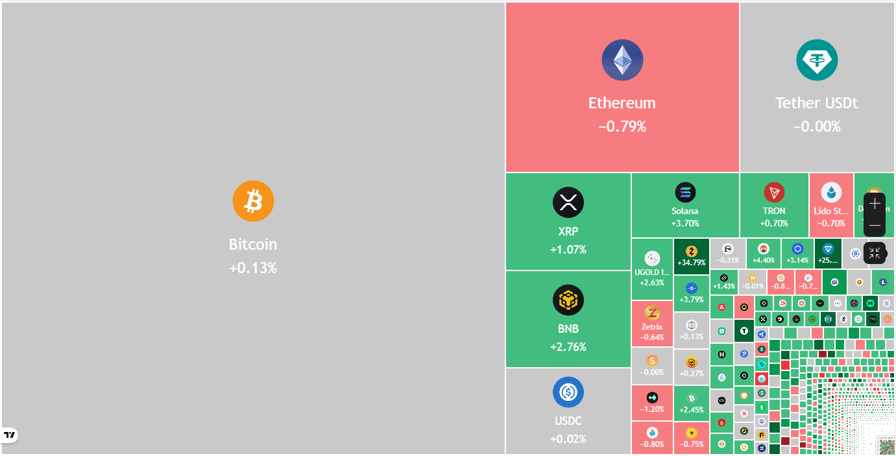
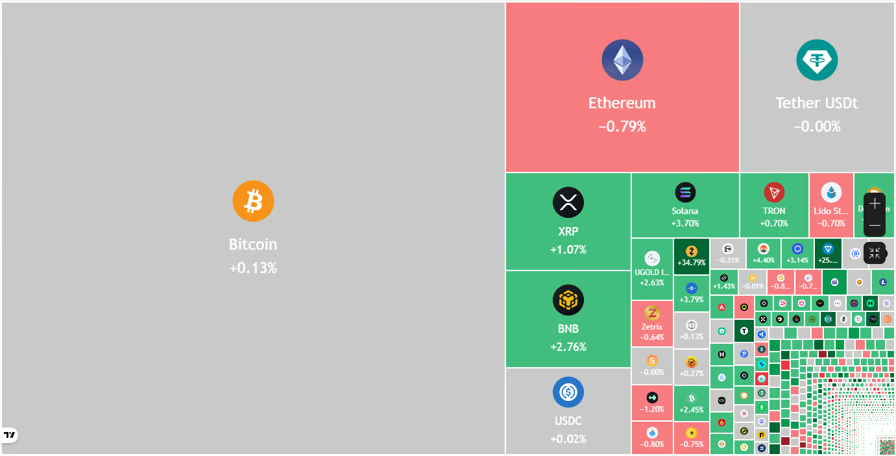
Crypto market data daily view. Source: TradingView
Not everyone is convinced that the bear market is over. Crypto investment company TradingShot said in a post on X that BTC’s rejection at the 200-day simple moving average ($83,313), which coincides with the previous low acting as target objective of $50,000.
Could BTC and the major altcoins break above their overhead resistance levels? Let’s analyze the charts of the top 10 cryptocurrencies to find out.
Bitcoin price prediction
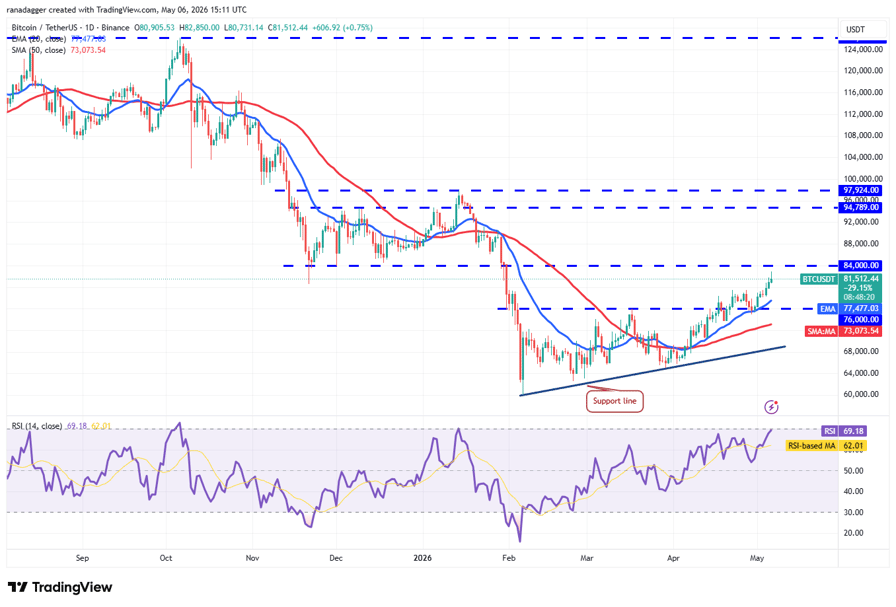
BTC has been gradually rising toward the $84,000 level, indicating sustained buying by the bulls.
BTC/USDT daily chart. Source: Cointelegraph/TradingView
Sellers are expected to fiercely defend the $84,000 level, which could trigger a pullback toward the 20-day exponential moving average ($77,477). If the BTC price rebounds off the 20-day EMA with force, it signals a positive sentiment. That improves the prospects of a break above the $84,000 level. If that happens, the BTC/USDT pair may ascend to $92,000.
This bullish view will be invalidated in the near term if the price turns down and breaks below the $74,937 level. The pair may then decline to the 50-day SMA ($73,073) and later to the support line.
Ether price prediction
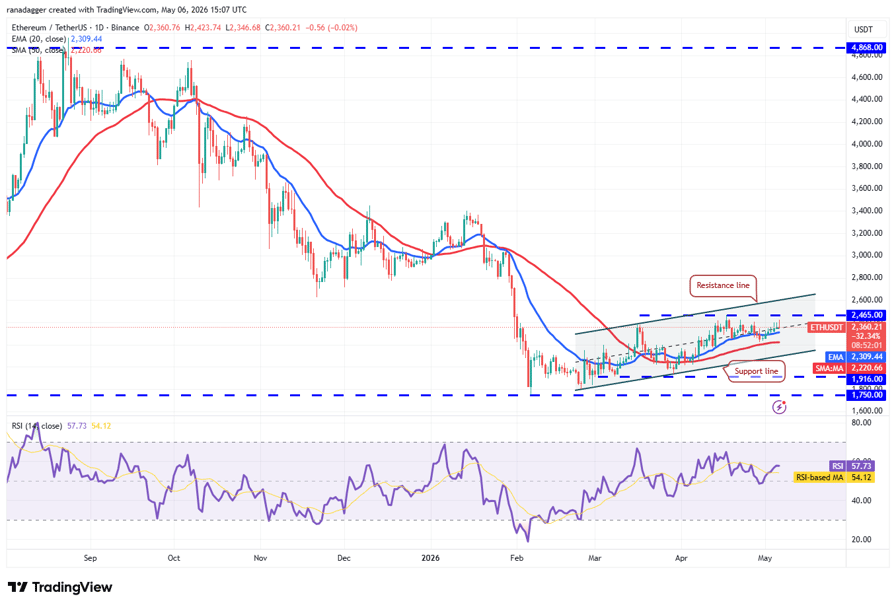
Ether (ETH) has been trading above its moving averages, but the bulls have failed to break $2,465 resistance.
ETH/USDT daily chart. Source: Cointelegraph/TradingView
That suggests hesitation to buy aggressively at higher levels. Sellers will attempt to seize control by pulling the price below the moving averages. If they do that, the ETH/USDT pair may descend to the support line.
Buyers are likely to have other plans. They will attempt to maintain the ETH price above the 20-day EMA ($2,309) and overcome the resistance at that level. If they succeed, the pair may rally to $3,050.
XRP price prediction
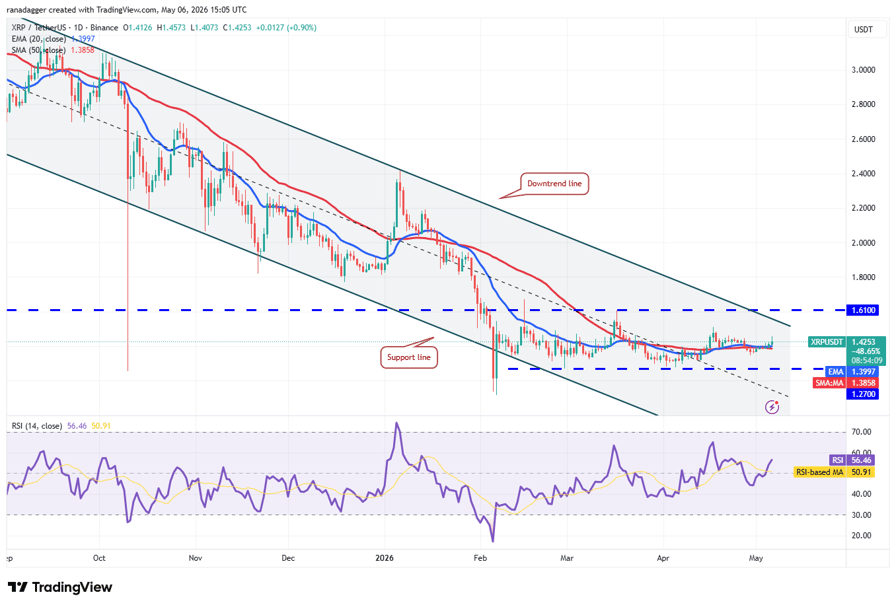
XRP (XRP) closed above the moving averages on Tuesday, opening the gates for a rally to the downtrend line of the descending channel pattern.
XRP/USDT daily chart. Source: Cointelegraph/TradingView
The downtrend line has acted as a stiff obstacle during previous recovery attempts and may do so again. If the price reverses from the downtrend line and breaks below the $1.27 level, it suggests the XRP/USDT pair may remain within the channel for a few more days.
On the other hand, a close above the downtrend line and the $1.61 resistance signal a potential trend change. The XRP price may then skyrocket to $2 and then to $2.40.
BNB price prediction
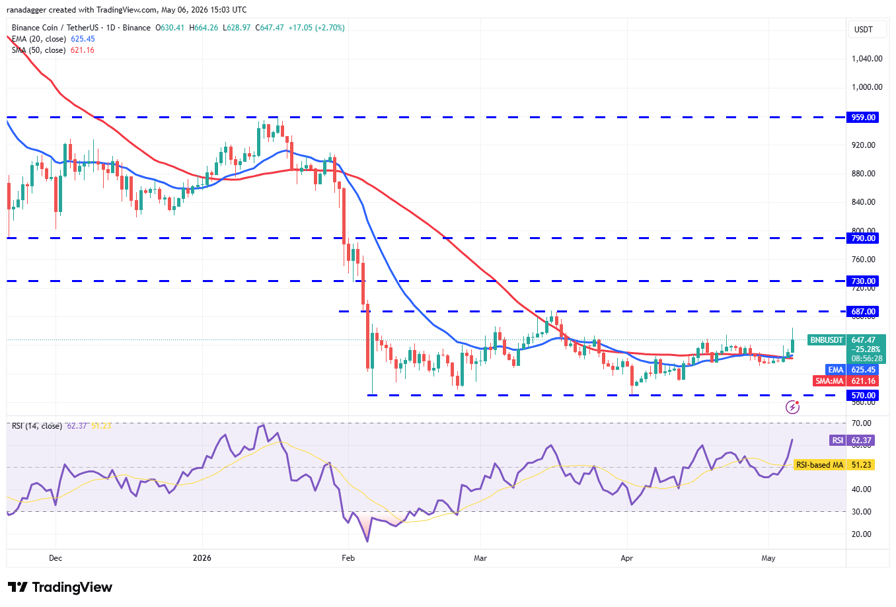
BNB (BNB) closed above the moving averages on Tuesday, indicating that the bulls are back in the game.
BNB/USDT daily chart. Source: Cointelegraph/TradingView
Buyers are attempting to overcome the minor resistance at $654. If they can pull it off, the BNB/USDT pair may reach $687. Sellers are expected to defend the $687 level with all their might, as a close above it could clear the path for a rally to $730 and, subsequently, to $790.
Conversely, if the BNB price turns sharply lower from the overhead resistance and breaks below the moving averages, it signals that the pair may continue its range-bound action between $570 and $687 for some time.
Solana price prediction
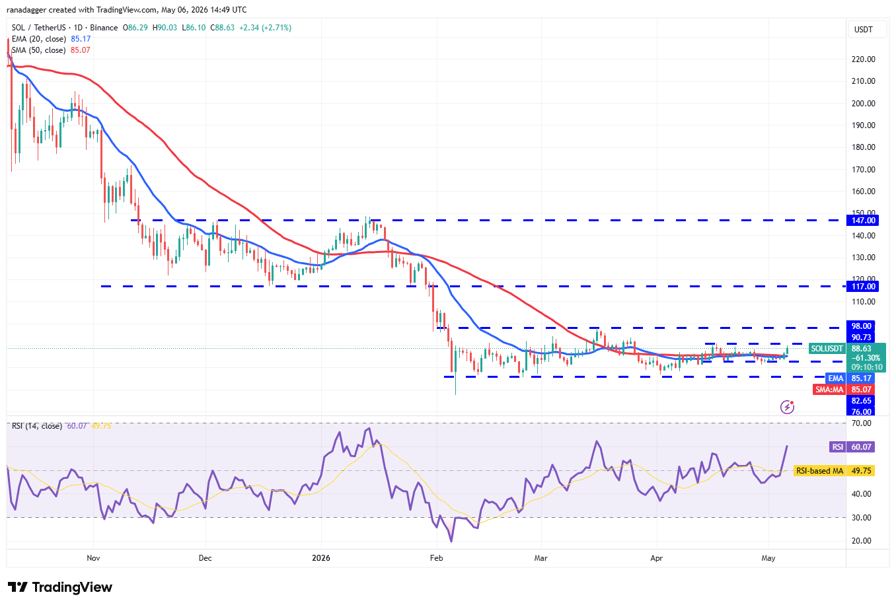
Solana (SOL) broke above the moving averages on Tuesday and rallied close to the $90.73 overhead resistance on Wednesday.
SOL/USDT daily chart. Source: Cointelegraph/TradingView
The flattish moving averages and the RSI in the positive territory indicate a slight edge to the bulls. If the $90.73 level is scaled, the SOL/USDT pair may rally to the stiff overhead resistance at $98. Sellers are expected to vigorously defend the $98 level, as a close above it may propel the SOL price to $117.
Instead, if the price turns down and breaks below the moving averages, it suggests the pair may remain within the $76 to $98 range for a few more days.
Dogecoin price prediction
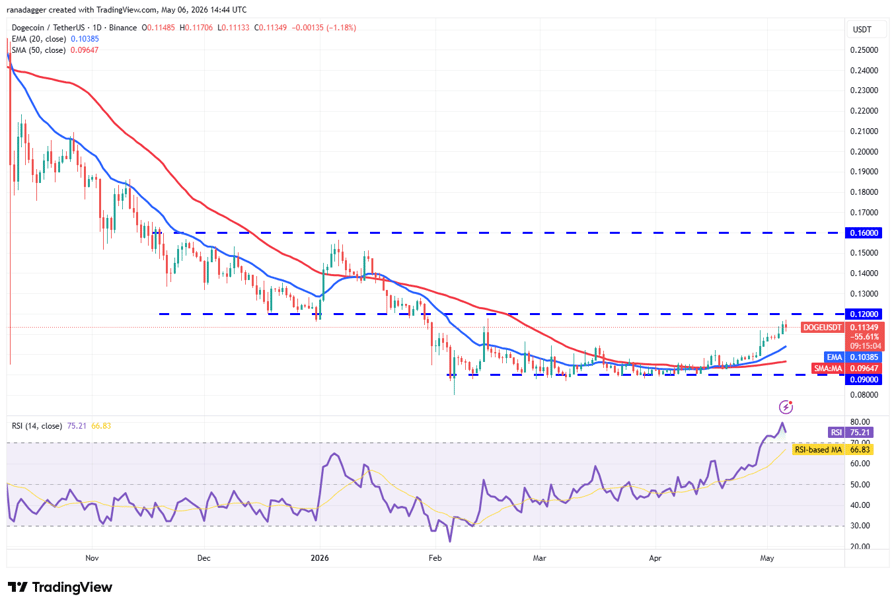
Dogecoin (DOGE) continued its march toward the $0.12 resistance level, where sellers are expected to step in.
DOGE/USDT daily chart. Source: Cointelegraph/TradingView
A shallow pullback from the $0.12 level suggests that the bulls are not hurrying to close their positions. That increases the possibility of an upside breakout. If the $0.12 resistance level is broken, the DOGE/USDT pair may jump to $0.14 and then to $0.16.
Alternatively, if the DOGE price turns sharply lower and breaks below the 20-day EMA ($0.10), it suggests that bears are aggressively defending the $0.12 level. That may retain the pair inside the $0.09 to $0.12 range for a while.
Hyperliquid price prediction
Hyperliquid (HYPE) charged higher on Tuesday, but the up move is facing resistance in the $43.76 to $45.77 zone.
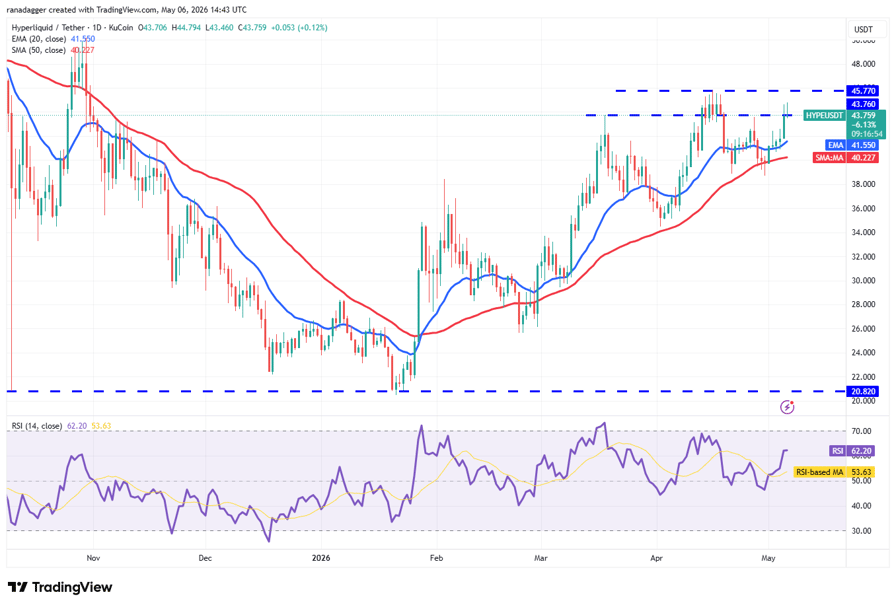
HYPE/USDT daily chart. Source: Cointelegraph/TradingView
The 20-day EMA ($41.55) has started to turn higher, and the RSI is in positive territory, indicating that the path of least resistance is higher. If buyers pierce the $45.77 level, the HYPE/USDT pair may soar to $50.
The 50-day SMA ($40.22) is the critical support to watch out for on the downside. A break and close below the 50-day SMA suggests that the bulls have given up. The HYPE price may then tumble to $34.45.
Related: Zcash price may hit $800 as $2.7B hedge fund reveals ‘significant position’ in ZEC
Cardano price prediction
Cardano (ADA) cleared the 50-day SMA ($0.25) hurdle on Tuesday, indicating that the bulls are attempting a comeback.
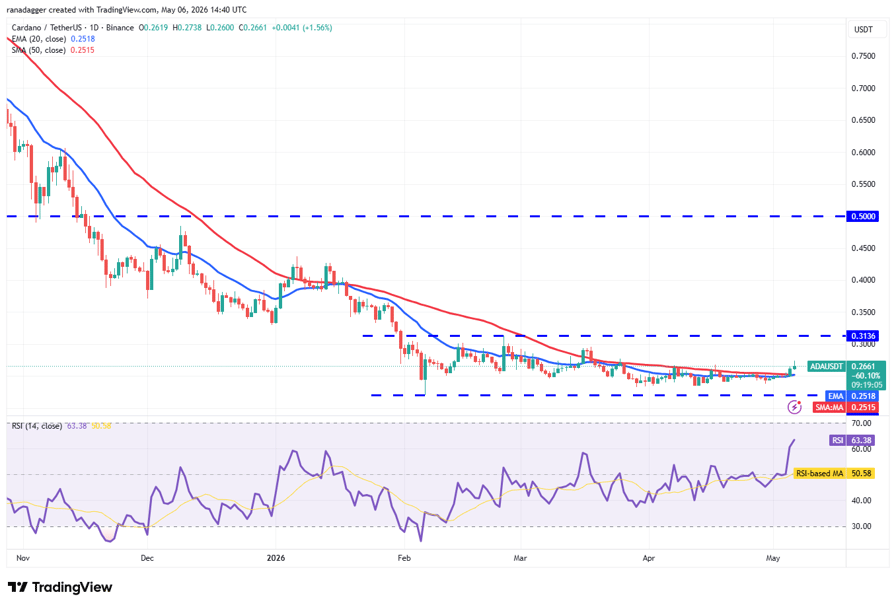
ADA/USDT daily chart. Source: Cointelegraph/TradingView
The recovery attempt is expected to face selling pressure at $0.28, then at $0.30. If both levels are breached, the next target is likely $0.31, a critical resistance to watch. A break above $0.31 signals the start of a potential new up move.
This positive view will be negated in the near term if the ADA price turns down and breaks below the moving averages. That suggests the bears continue to sell on rallies. The ADA/USDT pair may then slump to the solid support at $0.22.
Bitcoin Cash price prediction
Bitcoin Cash (BCH) turned up from the $443 support on Tuesday and broke above the moving averages.
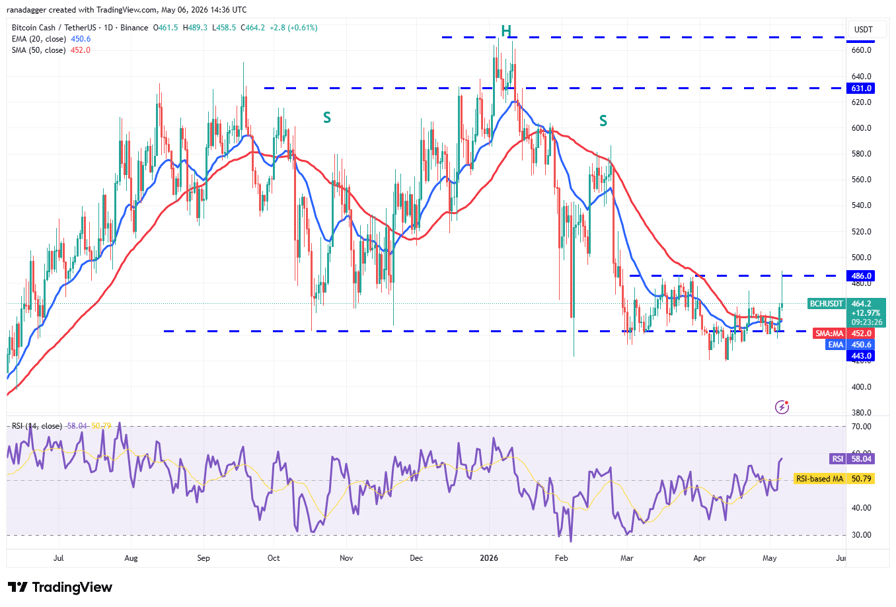
BCH/USDT daily chart. Source: Cointelegraph/TradingView
Buyers continued their buying and pushed the BCH price to $486 on Wednesday. However, the long wick on the candlestick shows that the bears are active at higher levels. That suggests the BCH/USDT pair may remain inside the large $486 to $419 range for a few more days.
Buyers will be back in the driver’s seat if they push the price above the $486 resistance and sustain it. That opens the gates for a rally to $520.
Zcash price prediction
Zcash (ZEC) turned up from the 20-day EMA ($389) on Thursday and rose above the $560 resistance on Wednesday.
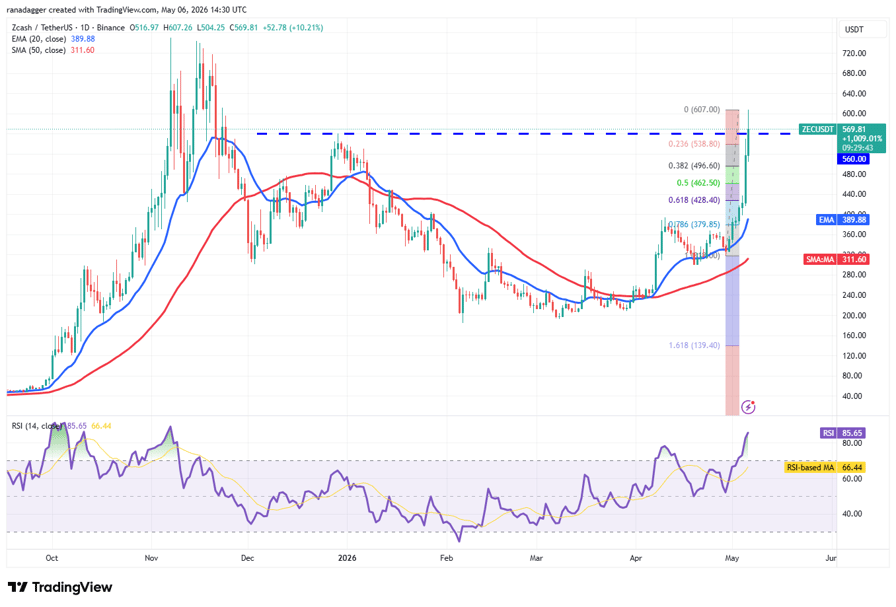
ZEC/USDT daily chart. Source: Cointelegraph/TradingView
The sharp rally over the past few days has pushed the RSI into overbought territory, signaling the possibility of a near-term consolidation or pullback. A shallow pullback from the current level suggests that the bulls are holding their positions as they anticipate the uptrend continuing. That increases the likelihood of a rally to the formidable resistance at $750.
A risk to the continuation of the up move is that sharp rallies are followed by equally sharp pullbacks. If the ZEC price maintains below $560, the ZEC/USDT pair may drop to the 38.2% Fibonacci retracement level of $496 and then to the 50% retracement level of $462.

Summary
- The US and Iran are close to agreeing a one-page memorandum of understanding to end the current war and set up detailed nuclear talks, according to Axios.
- The 14-clause draft would pause Iran’s uranium enrichment, ease sanctions, unlock billions in frozen funds, and gradually reopen the Strait of Hormuz to shipping.
- De-escalation around Iran has repeatedly moved Bitcoin, gold, and oil this year, with prior ceasefire headlines helping push BTC back toward the $78,000–$79,000 range.
The White House believes it is “getting close to an agreement with Iran on a one-page memorandum of understanding to end the war and set a framework for more detailed nuclear negotiations,” Axios reported on Wednesday, citing two US officials and two additional sources briefed on the talks. The US expects Tehran’s response on several key points within the next 48 hours, making this “the closest the parties have been to an agreement since the war began,” according to the report.
Memo could end war and reopen Strait of Hormuz
Under the draft, Iran would commit to a moratorium on uranium enrichment, while Washington would agree to lift some sanctions and release billions of dollars in frozen Iranian assets, Reuters summarized in its own write‑up of the Axios story. Both sides would also lift restrictions on transit through the Strait of Hormuz, the chokepoint that handles roughly 20% of global oil trade and has been partially shut by Iranian measures and a US naval blockade during the conflict.
The memorandum, described as a 14‑point, single‑page document, is being negotiated by Trump envoys Steve Witkoff and Jared Kushner with several Iranian officials, using a mix of direct and mediated channels. In its current form, the memo would formally declare an end to regional hostilities and trigger a 30‑day period of intensive talks on a fuller agreement covering strait access, nuclear limits, and sanctions relief, with venues under discussion including Islamabad and Geneva. During that 30‑day window, restrictions on shipping and the US blockade would be phased out; if the talks collapse, US forces would retain authority to restore the blockade or resume military action.
What a deal would mean for Bitcoin, gold, and risk assets
Markets have already shown how sensitive they are to each turn in the Iran story. When the war first escalated in late February, Bitcoin fell from about $66,000 toward $63,000 within hours, erasing over $120 billion in crypto market cap, while gold spiked toward fresh highs and oil briefly jumped more than 10%, as detailed in a Blockhead post‑mortem and a broader Economic Times review of safe‑haven flows.
As the conflict shifted from escalation to uneasy ceasefire, Bitcoin’s behavior flipped. When President Donald Trump signaled an initial pause in escalation and a conditional ceasefire tied to reopening the Strait of Hormuz, BTC jumped roughly 5% in a single session to above $72,700, according to Bitcoin Magazine. A later extension of the truce helped push Bitcoin toward $78,000, its highest level in more than ten weeks, Yahoo Finance reported.
Analysts quoted by MEXC and other outlets have framed this pattern as a classic “de‑risking, then re‑risking” sequence: in the initial shock, traders dump Bitcoin alongside equities and rotate into cash, gold, and oil; once a ceasefire or de‑escalation looks durable, capital rotates back into higher‑beta assets, with BTC often outperforming in the relief phase. A recent MEXC scenario analysis on the Iran‑Israel war laid out this exact path—oil easing back, inflation expectations softening, the Fed resuming cuts, and “Bitcoin breaking higher” under a ceasefire case.
If Washington and Tehran now ink even a preliminary memorandum that ends the war and reopens the Strait, traders will likely replay a similar macro script: crude prices and gold could cool from crisis highs, rate‑cut expectations might firm, and Bitcoin could benefit from both a weaker dollar and renewed risk appetite. Crypto’s response will not be linear—macro, ETF flows, and idiosyncratic factors all matter—but the market has already shown that for this conflict, peace headlines have tended to coincide with BTC reclaiming the high‑$70,000 to $79,000 zone, as noted by CryptoBriefing.
Over the medium term, a durable US‑Iran understanding that normalizes the Strait of Hormuz would remove one of the biggest geopolitical tail‑risks hanging over both traditional markets and crypto. That could shift the narrative away from “war hedge” trades in gold and oil back toward structural stories like Bitcoin ETF adoption, Ethereum’s roadmap, and the broader on‑chain capital rotation that crypto.news has been tracking in recent coverage, including this ETF inflow analysis, a safe‑haven comparison, and a macro‑driven market outlook.
A Republican US House of Representatives member running for reelection has won his party’s primary after crypto-affiliated groups contributed more than $500,000 in supportive media buys.
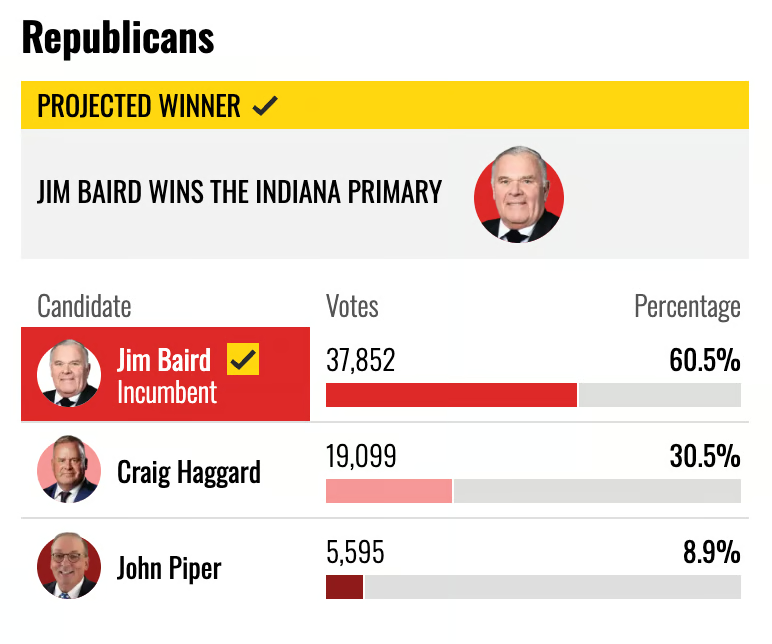
Representative James Baird won Tuesday’s Republican primary for Indiana House District 4 with more than 60% of the vote, beating challenger Craig Haggard and others.
Beginning with his first term, in January 2019, Baird consistently supported legislation considered favorable to the crypto industry, including the GENIUS stablecoin act and the market structure bill, the CLARITY Act.
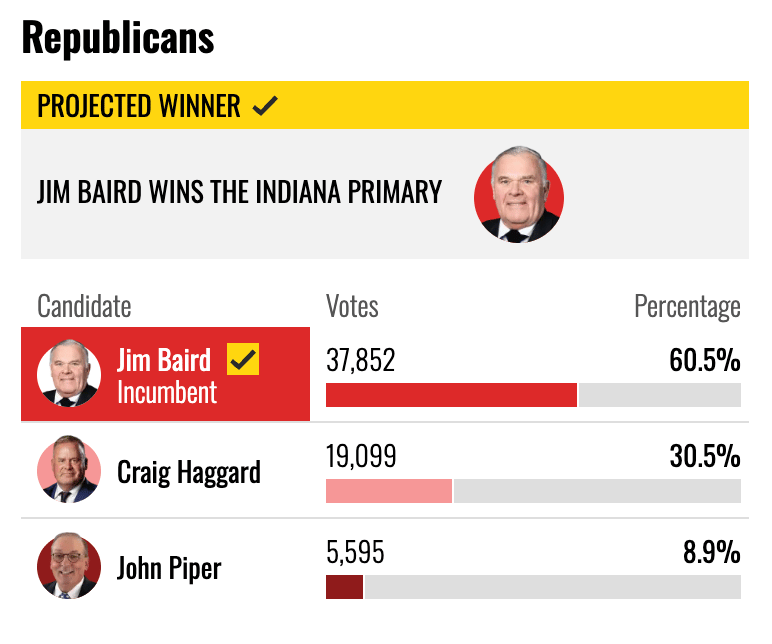
Source: NBC News
According to filings with the US Federal Election Commission (FEC), the Defend American Jobs political action committee (PAC) spent about $514,000 on media to support Baird. The PAC is affiliated with Fairshake, a committee backed by crypto companies including Coinbase and Ripple Labs that spent more than $130 million to influence the 2024 US elections.
“Representative Baird has been a proven leader for pro-job, pro-consumer, and pro-innovation policies in Congress,“ a Fairshake spokesperson told Cointelegraph before the primary. “We’re proud to support leaders committed to responsible regulation that ensures the US remains the global leader in innovation.”
Baird, who also received an endorsement from Donald Trump, reportedly thanked the US President following his primary win. Trump’s ties to the crypto industry have come under increased scrutiny as lawmakers in the Senate consider the CLARITY Act, with many calling for ethics provisions on digital assets before a potential vote.
Related: Americans distrust crypto, AI as industry super PACs flood midterms, poll finds
Fairshake, which reported holding $193 million as of January, is expected to spend millions of dollars in support of candidates it considers “pro-crypto” in the 2026 US midterm elections, as well as “oppose anti-crypto politicians” through media and ads. As of Wednesday, the PAC and its affiliates have spent about $10 million for races in Illinois and Texas in 2026.
Stablecoin yield compromise could advance market structure bill
Last week, US Senators Thom Tillis and Angela Alsobrooks announced that they had finalized the text of the CLARITY Act to include a compromise on stablecoin yield, one of the provisions at issue for the banking and crypto industries.
Although the Senate Banking Committee had not scheduled a markup on the bill as of Wednesday, many expect the stablecoin deal to advance the market structure legislation, which had been stalled in the chamber for months.
Magazine: Guide to the top and emerging global crypto hubs: Mid-2026
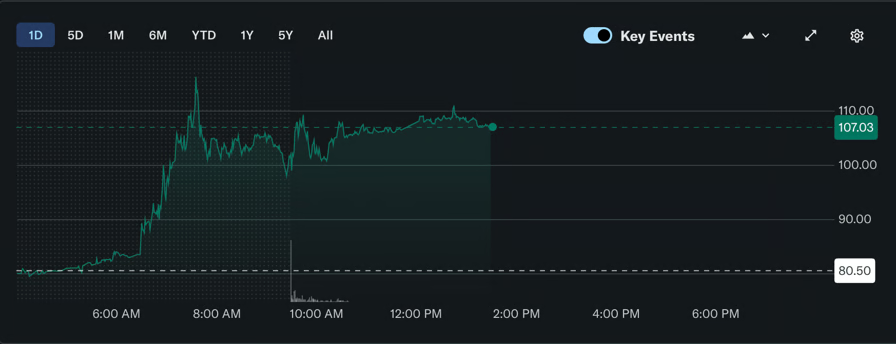
Investors appeared to disregard Hut 8’s reported first quarter 2026 net loss of more than $253 million on Wednesday, lifting the shares of the Bitcoin mining company by more than 33%.
Hut 8 attributed the loss to a reduction in the market value of its Bitcoin (BTC) holdings, which fell from a high of over $126,000 apiece in October to a low of $60,000 in February.
Revenue for quarter totaled more than $71 million, down by about 22% from the previous period’s $88.4 million, according to Hut 8’s earnings statements. Analysts had forecast $78.5 million, according to FactSet.
The company also announced a $9.8 billion deal that will see Hut 8 lease 352 megawatts to a third-party AI company over a 15-year period. Wednesday’s results showed the company generated $66.0 million in first quarter revenue from ASIC compute, AI cloud and traditional cloud solutions.
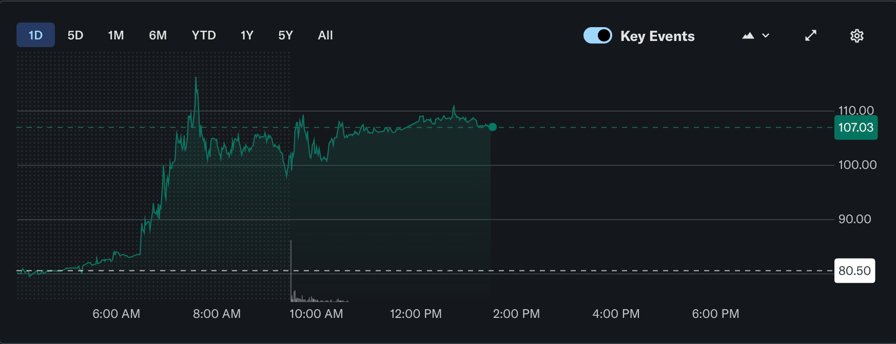
Hut 8’s stock surged following news of a $9.8 billion deal. Source: Yahoo Finance
The company’s diversification into AI and energy infrastructure comes amid an industry-wide pivot away from crypto mining, as public crypto mining companies struggle with high costs and declining revenues.
Related: Bitcoin miner Core Scientific shifts to AI with 1.5GW data center push
AI and Bitcoin mining increasingly compete for power
The shift to AI threatens the Bitcoin mining industry, according to crypto trader and market analyst Ran Neuner.
“Both industries compete for the same thing: electricity,” Neuner said, adding, “right now, AI is willing to pay much more for it.”
Mining companies can make anywhere between $57 and $129 per MW securing the blockchain, compared to between $200 and $500 per MW for AI infrastructure, he said.
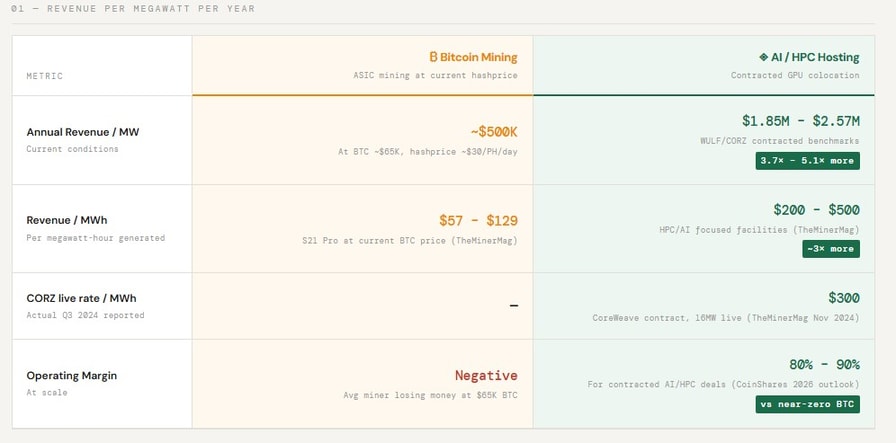
Revenue comparison for Bitcoin mining and AI hosting. Source: Ran Neuner
As miners shift their focus to more-profitable AI ventures, the total amount of computing power dedicated to securing the Bitcoin blockchain declines, making the network easier to attack, Neuner said.
The need for massive amounts of energy to power high-performance computing applications, including Bitcoin mining and AI workloads, has driven demand for nuclear energy generation.
Since 2024, several AI hyperscaling companies like Google, Microsoft, Amazon and Meta have announced nuclear energy deals to power their AI infrastructure.
Magazine: How AI just dramatically sped up the quantum risk for Bitcoin

Bitcoin’s market dominance climbed above 61% as BTC led crypto market flows. Data also showed Binance-listed altcoins’ share of volume hitting 49% in March.


The $2 trillion financial services firm has rolled out cryptocurrency trading capabilities on its E*Trade retail brokerage platform.
Welcome to our institutional newsletter, Crypto Long & Short. This week:
- Maxime Seiler notes that weak crypto prices mask adoption, making yield strategies the main trade.
- Kavita Maharaj‑Alexander writes on crypto’s next phase being driven by proving compliance in practice, elevating the infrastructure providers that enable it.
- Top headlines institutions should pay attention to by Francisco Rodrigues.
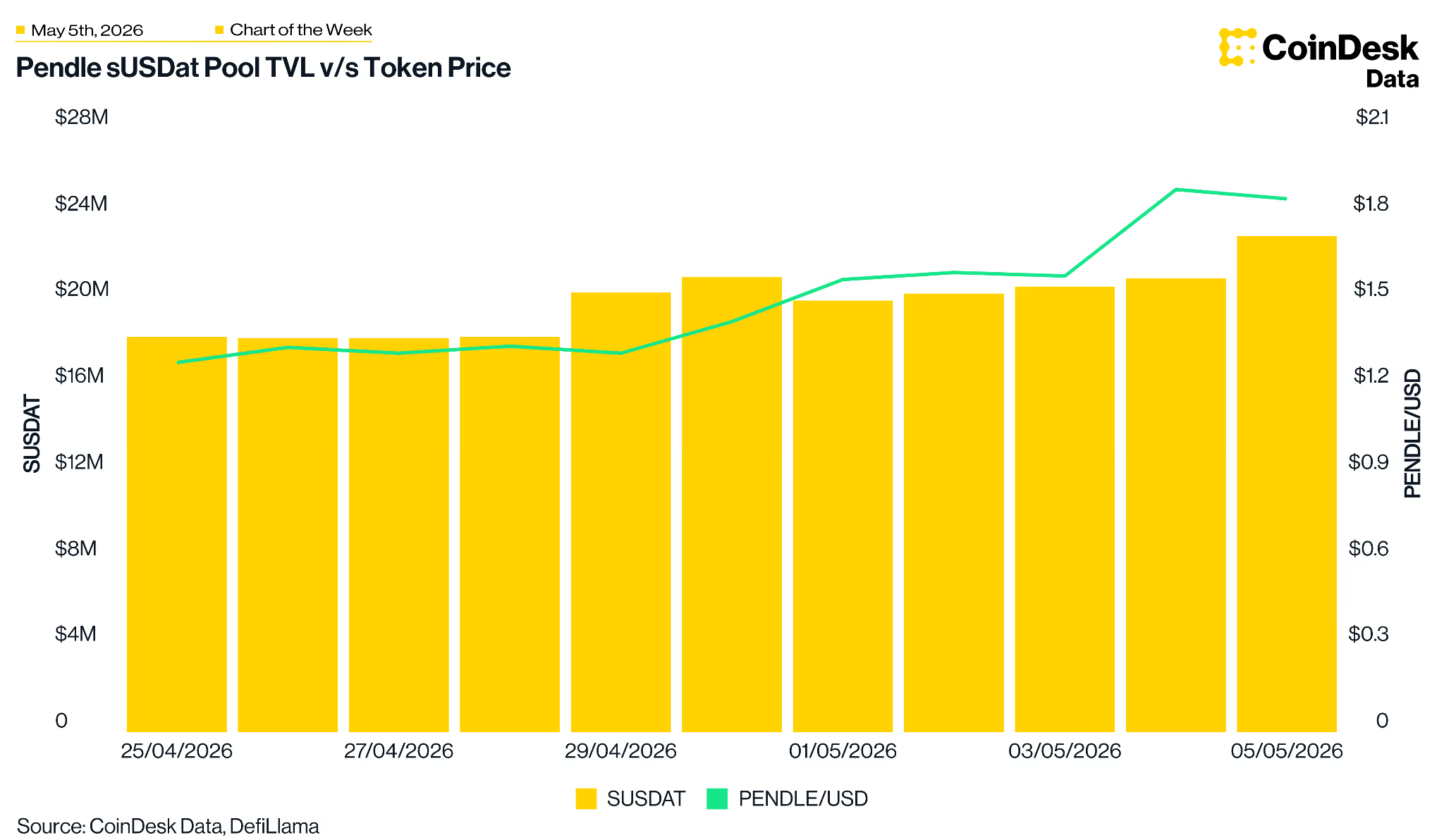
- PENDLE rallies on demand for on-chain STRC yield exposure in Chart of the Week.
Expert Insights
In quiet crypto markets, yield is the trade
By Maxime Seiler, co-founder and chief executive, STS Digital, Ltd.
For much of the last six months, crypto markets have felt unusually quiet. Not dead, but tired. While bitcoin has held up better than most, much of the altcoin market has remained in what can only be described as a bear market. Liquidity has been thinner, follow-through has been weaker and the risk appetite that typically fuels broad-based crypto rallies has been missing.
That is the surface-level story. Underneath it, however, the picture looks very different.
Institutional adoption of digital assets continues to move at record pace. Across mainstream financial services, the build-out is no longer theoretical. Banks, asset managers, payment companies, custodians and infrastructure providers are developing products and capabilities to support tokenization, stablecoins, digital asset custody, trading, settlement and portfolio access. In previous cycles, institutional involvement was often discussed as something that might happen one day. Today, it is happening, but much of it is not yet reflected in token prices.
That disconnect is important. The market has been pricing short-term disappointment, while infrastructure is being built for long-term adoption.
Part of the recent weakness is understandable. The U.S. government created significant expectations around digital assets, but the pace of follow-through has slowed. Markets do not like uncertainty, and crypto markets in particular are quick to discount momentum when policy clarity fails to arrive as fast as expected. At the same time, a meaningful amount of global technical and investment talent has shifted toward artificial intelligence. AI has become the dominant narrative in technology, pulling attention, capital and brainpower away from crypto in the short term.
But these two worlds are unlikely to remain separate forever.
One of the most interesting open questions is how AI agents will eventually transact. If autonomous software agents are going to pay each other, pay merchants, access services, settle invoices, move value across borders or interact with financial applications, they will need payment rails that are programmable, global and available 24/7. Stablecoins and permissionless financial infrastructure are often discussed as potential candidates. DeFi may end up playing a role not because it is ideological, but because it is practical. Machines do not need bank branches. They need APIs, instant settlement and reliable liquidity.
That future may still be a year or more away from meaningful scale. For crypto asset holders, the more immediate question is simpler: what do you do while waiting?
This is where quiet markets can be useful. Bear markets are uncomfortable, but they often create some of the best conditions for disciplined yield generation. When spot prices move sideways and speculative momentum fades, investors are forced to focus less on direction and more on income, carry and risk management. In that environment, options become one of the most useful instruments available.
Options allow investors to monetize volatility, express views with defined parameters and generate yield on existing dollar or crypto holdings. For holders who are not looking to sell long-term positions, structured options strategies can be used to generate income while markets consolidate. For dollar holders, they may offer a more systematic approach to earn enhanced yield while waiting for better entry points. For crypto holders, they can turn otherwise idle assets into productive collateral.
This is exactly the type of environment where volatility selling and structured yield enhancement strategies may perform well in certain conditions, provided they are implemented with proper risk controls. The goal is not to chase yield blindly. The goal is to harvest quiet markets in a disciplined way.
At STS Digital, we have seen growing client demand for these types of strategies. Investors are not necessarily trying to call the exact bottom of the altcoin market. They are looking for ways to stay engaged, earn income and position themselves for the next phase of adoption without relying purely on spot price appreciation.
Crypto has always rewarded patience, but patience does not have to mean inactivity. The next wave of adoption may already be forming beneath the surface. For now, until it shows up in price, yield is the trade.
Disclaimer: For information purpose only. Not financial advice. Client acceptance subject to conditions.
Principled Perspectives
The quiet infrastructure powering digital asset maturity
By Kavita Maharaj‑Alexander, deputy general counsel, Ascentium
As digital assets move into more structured environments, the industry’s next phase is being shaped less by new rules and more by the operational realities of meeting them. The shift reflects a broader truth: regulatory frameworks matter, but the ability to evidence compliance matters more. Whether an entity is licensed, exempt or unregulated, expectations around governance, financial crime controls, risk management and demonstrable controls are rising. This has elevated a category of service providers that rarely attract attention but increasingly facilitate the operationalisation of digital asset projects: the regulatory infrastructure providers supporting governance, compliance and operational continuity.
These providers deliver the practical functions that sit between policy and practice, including registered office services, financial crime compliance, independent directorships, administration and governance support. They do not hold client assets or operate trading platforms. Instead, they support the operational spine that enables entities to demonstrate substance, oversight and continuity. As more jurisdictions move from drafting frameworks to supervising their implementation, this infrastructure has become essential to the responsible operation of digital asset businesses.
The distinction between formation, regulatory authorisation and operational readiness is now central. Regulatory authorization, whether registration or licensing, establishes status but does not on its own demonstrate operational capability. Whether an entity is structured as an LLC or a foundation company, or authorised as a VASP, these forms provide legal personality or regulatory status, not governance in the operational sense. Policies and procedures demonstrate awareness, not implementation. Regulators and institutional counterparties increasingly expect evidence of functioning controls, documented oversight, and the practical execution of obligations. This is where regulatory infrastructure providers play their most important role.
The Cayman Islands offers a clear illustration of how this infrastructure functions in practice. The jurisdiction has moved from initial registration to licensing under its Virtual Asset Service Providers Act. This is accompanied by supervisory evaluation of controls, with thematic reviews focused on demonstrable AML/CFT controls, governance and risk‑based internal controls. Recent legislative updates, including the 2026 amendments streamlining tokenised fund structures, further reflect a shift toward practical implementation and operational clarity.
For globally distributed teams, local regulatory infrastructure providers — from AML officers to independent directors and administrators — often provide the practical means to meet these expectations. The same applies to foundation companies, which are increasingly used by DAOs and crypto projects seeking legal personality and operational continuity. Even when these structures fall outside formal regulation, institutional participants still expect governance discipline, conflict management and reliable oversight. Cayman’s digital asset ecosystem is supported by a mature network of governance, fiduciary, compliance and administrative providers who translate regulatory requirements into day‑to‑day practice, enabling entities to demonstrate functioning controls and maintain governance continuity.
The industry has long called for regulatory clarity, and while meaningful progress has been made, clarity alone does not create the conditions for appropriate compliance or operational efficiency. Operational capability does. The firms that succeed in the next phase of digital asset maturation will be those that place early emphasis on appropriate governance, financial crime controls and risk management; and the jurisdictions that thrive will be those with the infrastructure to support consistent, demonstrable implementation.
Digital assets are entering a period where the quality of execution will matter more than the ambition of policy. In that environment, regulatory infrastructure providers are becoming the quiet enablers of which firms, and which jurisdictions, are prepared for the realities of a more institutional market.
Headlines of the Week
Traditional finance and crypto are continuing to converge through tokenization and stablecoin adoption, even as regulators on both sides of the border move to tighten the rules.
- Wall Street giant DTCC plans tokenized securities platform with July pilot, October launch: The Depository Trust & Clearing Corporation, custodian of over $114 trillion in securities, will begin limited tokenized trades in July ahead of an October launch, with input from BlackRock, Goldman Sachs, JPMorgan, Anchorage and Circle.
- Crypto industry backs CLARITY Act yield compromise, pushes Senate Banking for markup: Senators Tillis and Alsobrooks released text barring stablecoin yield equivalent to a bank deposit while carving out rewards tied to “bona fide activities,” prompting Coinbase, Circle and the Blockchain Association to call for a markup.
- Tether posts $1.04 billion Q1 profit, reaches $8.23 billion reserve buffer: The USDT issuer reported $192 billion in assets against $183.5 billion in liabilities, with reserves now including about $20 billion in physical gold and $7 billion in bitcoin.
- Canada proposes ban on crypto ATMs as fraud cases mount: Ottawa’s Spring Economic Update calls for eliminating crypto ATMs nationwide, with officials citing FINTRAC findings that label the machines a “primary method” for scams and laundering.
- The $292 million crypto hack exposed DeFi’s weak spots. Here’s what must change, insiders say: Industry figures told CoinDesk the Kelp DAO exploit is a “speed bump, not a roadblock” for institutional DeFi, but argued zero-trust architectures, timelocks, stricter multi-sig controls and tighter bridge safeguards must become baseline before TradFi giants can scale onchain.
Chart of the Week
PENDLE rallies on demand for on-chain STRC yield exposure
PENDLE is up 44% over the past 11 days, coinciding with the launch of the Saturn sUSDat pool. sUSDat is the staked version of USDat — a tokenized claim on STRC’s dividend stream and price exposure. The pool has scaled to $22 million since launch, making Pendle one of the few venues to express the Strategy Stretch (STRC) trade on-chain

Listen. Read. Watch. Engage.
Looking for more? Receive the latest crypto news from coindesk.com and market updates from coindesk.com/institutions.
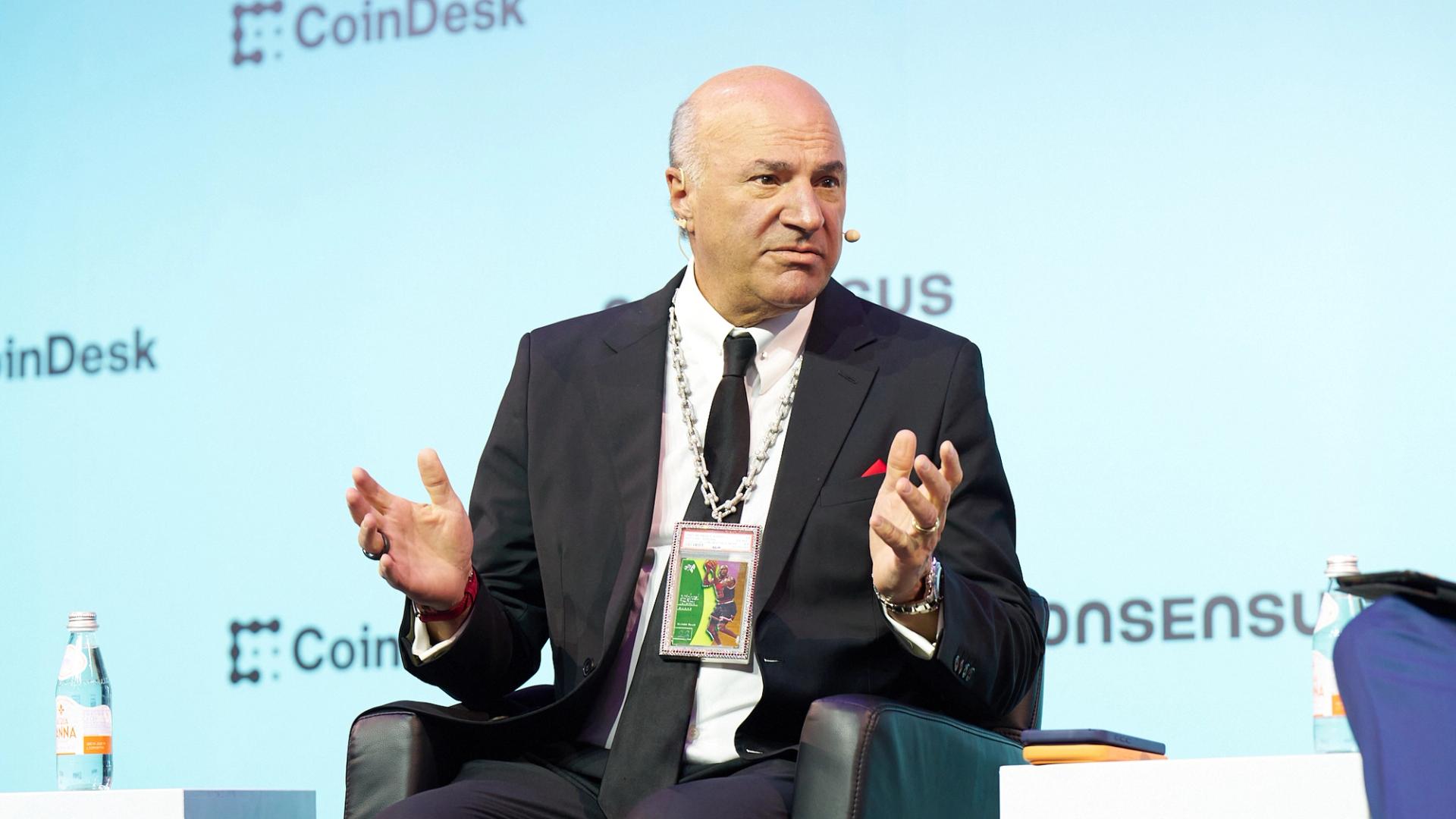
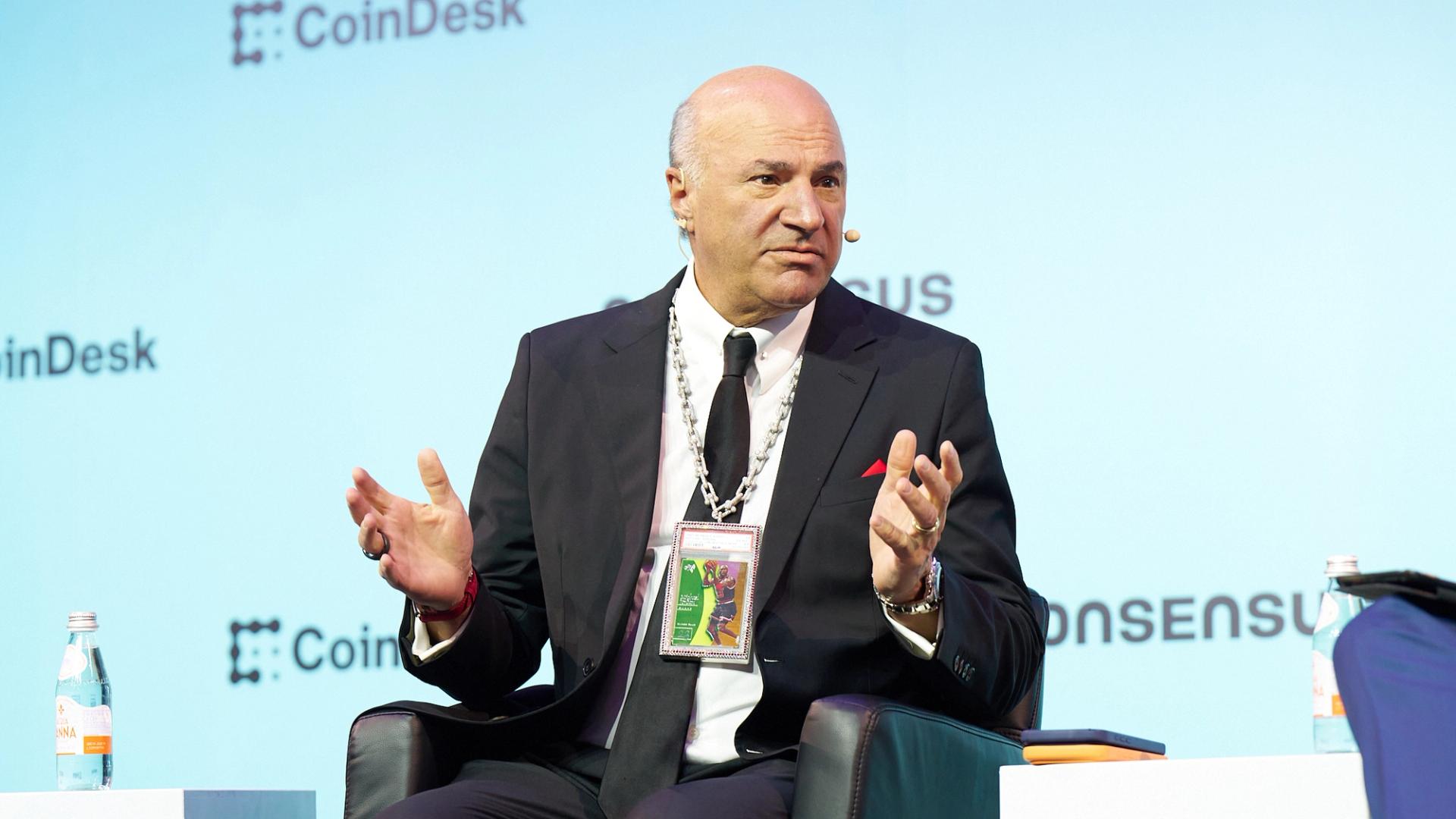
MIAMI, FL — Kevin O’Leary says Wall Street’s tokenization boom is mostly hype until Congress finally gives the crypto industry the rules it has been waiting for.
“Tokenization will never be adopted by institutional indexers, ever. Neither will bitcoin, which is still a fringe asset to the big guys,” O’Leary said at Consensus in Miami, arguing that large investors still see most digital assets as uninvestable without clear federal regulation.
Speaking at Consensus Miami 2026, the investor and “Shark Tank” personality argued that regulatory uncertainty is still preventing large financial firms from fully embracing blockchain-based assets.
He said the turning point will come only when the U.S. establishes a formal legal framework for digital assets. “It has to become compliant globally within the [Securities and Exchange Commission] with an actual passage of a bill,” he said. “When that occurs, it’s going to change everything.”
The comments come as Wall Street firms increasingly experiment with tokenization — the process of turning assets like stocks, bonds or funds into blockchain-based digital tokens that can trade continuously and settle instantly. Advocates argue the technology could modernize financial infrastructure by reducing settlement times and lowering costs.
But O’Leary said institutions still need legal certainty before committing significant capital.
He pointed to stablecoins as an example of how regulation can accelerate adoption. Referring to recent U.S. legislative efforts, O’Leary said stablecoins were adopted “almost immediately” once policymakers passed the GENIUS Act.
“Instead of wasting three days, we’re transacting in minutes at a fraction of the cost with full compliance and transparency,” he said, describing cross-border payments using stablecoins.
O’Leary also argued that institutional investors have sharply narrowed their focus within crypto markets. “97% of the entire value of the entire market is simply BTC and ether (ETH),” he said, adding that many smaller tokens have been “slaughtered.”
He described a growing divide between speculative crypto assets and blockchain infrastructure with real enterprise adoption.
The biggest long-term opportunity remains finding a blockchain platform that large corporations standardize around for applications such as logistics, contract management or inventory systems, according to O’Leary.
“You show me the adoption onto the platform that becomes a moat,” he said.
The investor also tied the future of blockchain and AI to infrastructure more broadly, arguing that energy and data centers may ultimately prove more valuable than the digital assets themselves.
“Power is more valuable than bitcoin,” O’Leary said.
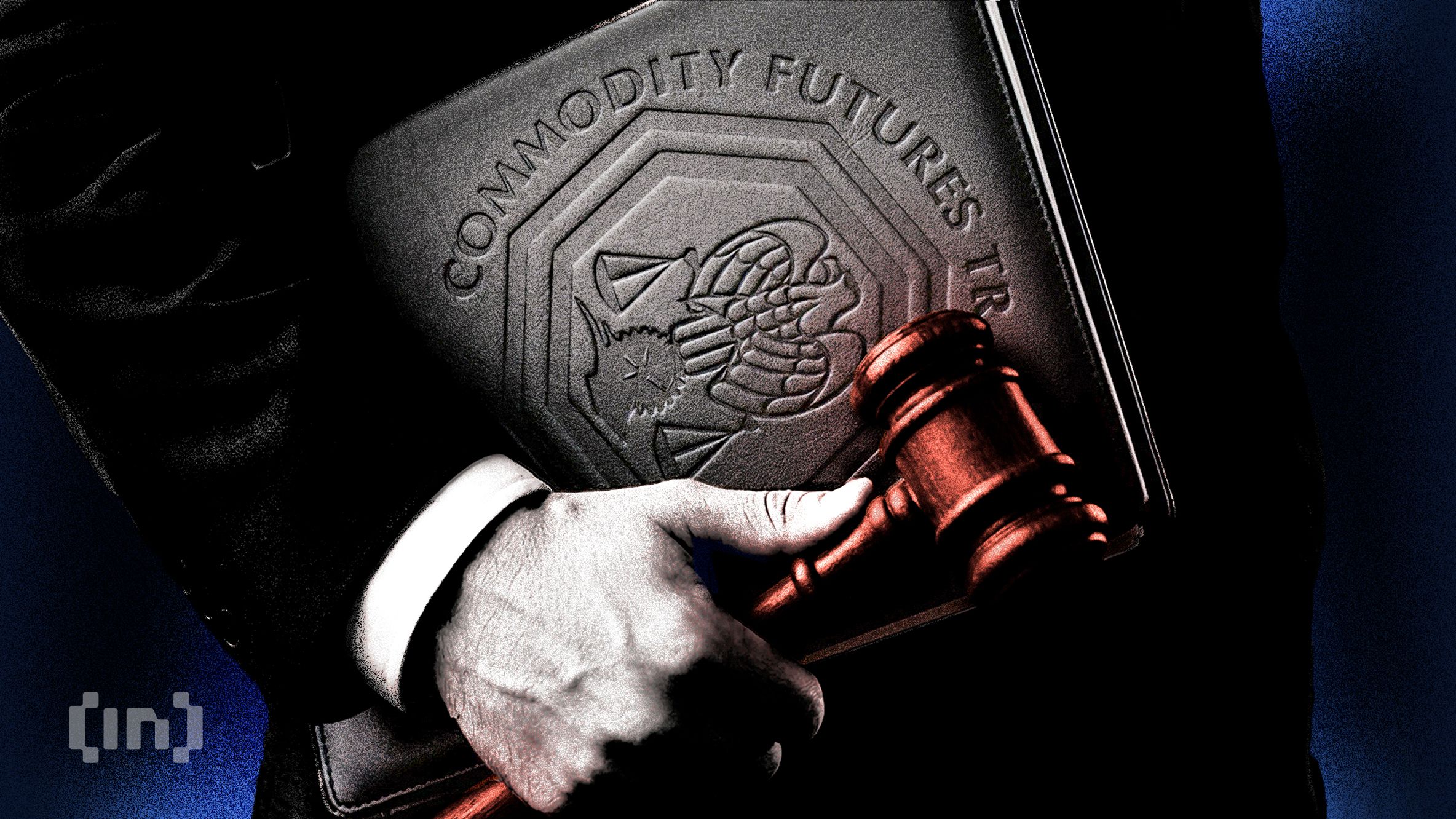

The Commodity Futures Trading Commission (CFTC) ordered New York trader Sidney Lebental to pay $200,000 for spoofing US Treasury futures, ending a case tied to roughly 50 deceptive trades placed on the Chicago Board of Trade in 2019.
Lebental neither admitted nor denied the findings under the settled order, which also prohibits him from trading commodity interests for one month and bars further violations of the Commodity Exchange Act’s spoofing prohibition.
Inside the Treasury Futures Scheme
The CFTC said Lebental engaged in spoofing on roughly 50 occasions between January and September 2019. He primarily targeted Ultra U.S. Treasury Bond futures, contracts tied to long-dated 25- to 30-year government debt.
He placed genuine orders for cash Treasuries or a futures contract on one side. He simultaneously entered larger spoof orders on the opposite side in a correlated futures contract.
Once his real orders filled, Lebental canceled the spoofs. The agency said he knew the instruments were correlated enough to push prices in his favor.
Sanctions and Broader History
Beyond the $200,000 civil penalty, the order imposes a 30-day trading ban on commodity interests and standard public-statement restrictions. Registered entities must deny him trading privileges during that window.
Lebental served as head of the linear rates desk at a global bank during the activity covered by the order. His prior employment included Bank of America Securities.
He has faced parallel scrutiny from the Financial Industry Regulatory Authority (FINRA). The agency previously cited him for hundreds of suspect Treasury orders before he settled in 2024.
Bank of America paid a $24 million FINRA fine in late 2023 over Treasury spoofing on its desk.
The CFTC action targets conduct already on regulators’ radar. Treasury market participants will watch for further enforcement tied to the same desk and to similar correlated-instrument tactics.
The post CFTC Fines Trader Sidney Lebental $200,000 for Treasury Futures Spoofing appeared first on BeInCrypto.
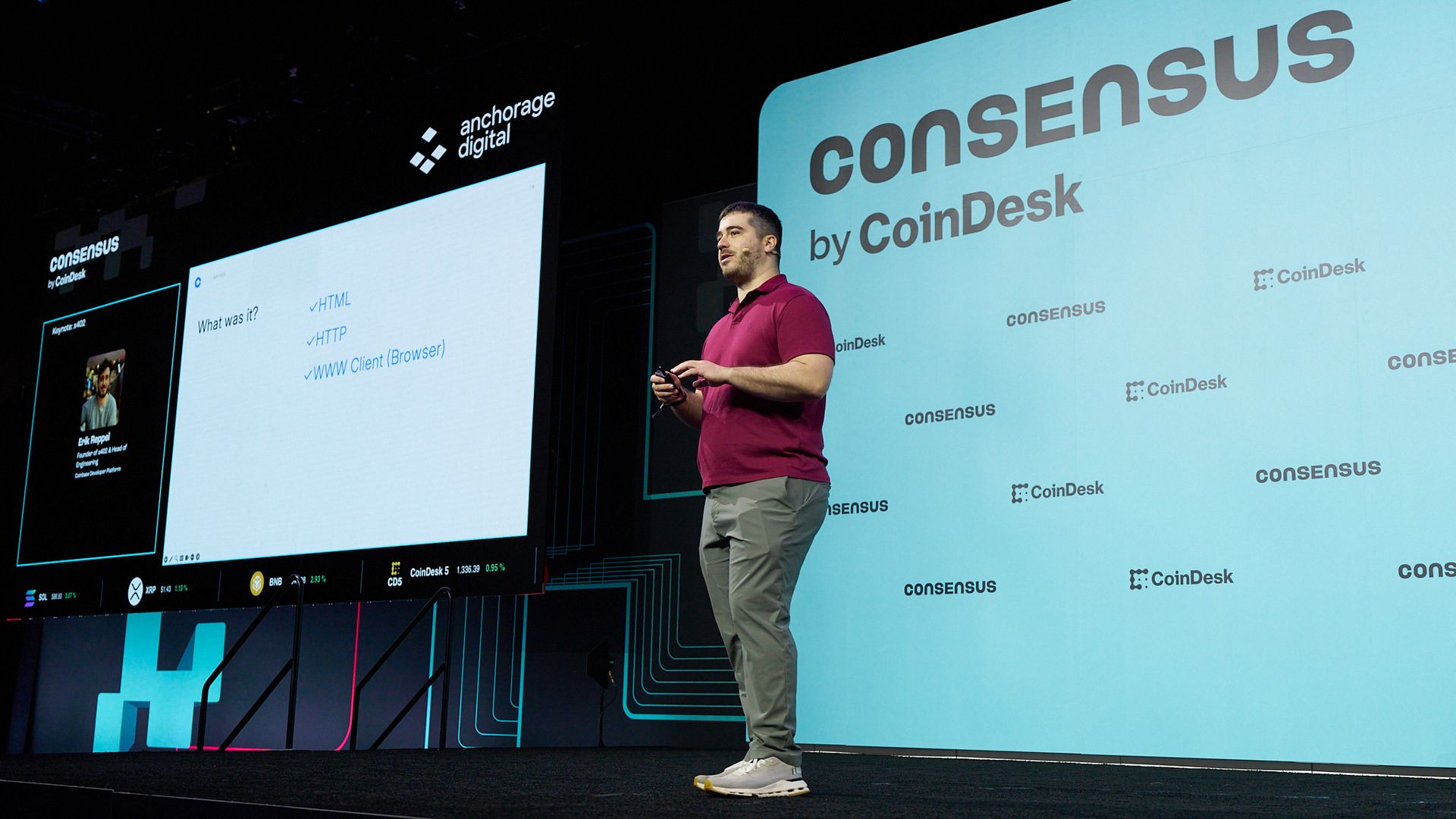
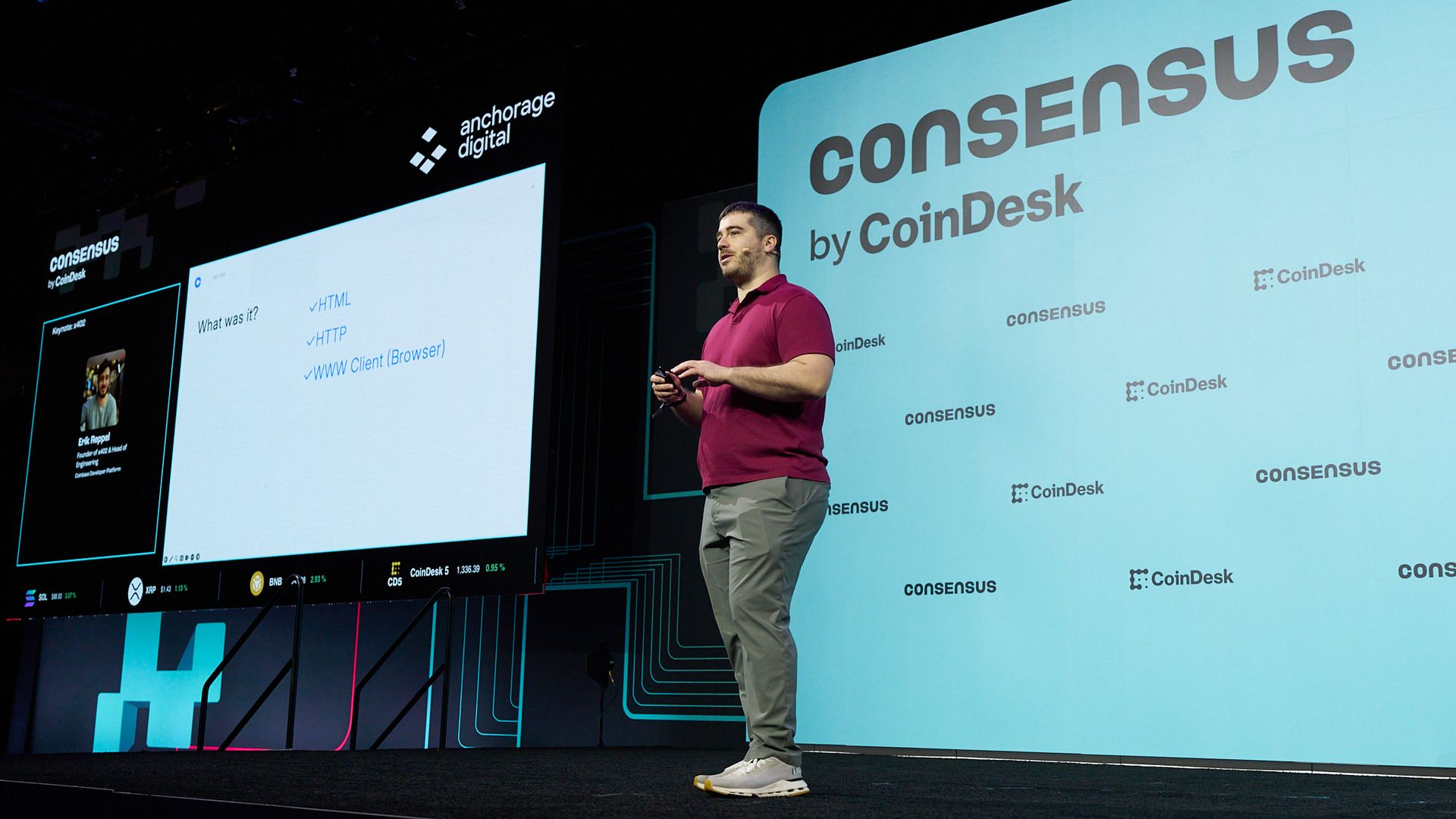
Coinbase engineering head Erik Reppel offered a glimpse into how artificial intelligence could reshape the economics of the internet, arguing that AI agents may force a shift away from the web’s ad-driven business model.
Speaking onstage at Consensus Miami 2026, Reppel, the founder of the x402 payments protocol and head of engineering at Coinbase Developer Platform, said the internet was originally built around humans interacting with websites, not software interacting with software.
“The internet was designed for humans to use,” Reppel said. “We now live in a world where both humans and computers operate and computers operate computers.”
Today’s web economy depends heavily on advertising revenue generated when humans visit websites and view ads, according to Reppel. But AI agents, he said, bypass that system entirely.
“Agents don’t see those ads. They just ignore those ads completely,” he said.
That dynamic could push the internet toward new monetization models built around native digital payments, particularly stablecoin-powered micropayments.
“If a human visits a website, show them an ad. If an agent visits a website, charge them five cents,” Reppel said.
He framed x402, an open payments protocol built around the long-unused HTTP 402 “Payment Required” status code, as infrastructure for that future. The protocol is designed to let AI agents make automatic payments for APIs, content and digital services using crypto rails.
Reppel said the rise of autonomous AI systems, or what he called the “agentic economy,” could create a massive new market for internet-native payments. He cited estimates projecting the sector could grow to between $3 trillion and $5 trillion within four years.
The comments reflect a broader effort within the crypto industry to position stablecoins and blockchain-based payments as foundational infrastructure for AI-driven commerce.
“Agents really are the browser of the future,” he said.
Read more: AI agents are breaking web economics, but Cloudflare says x402 can help
Crypto World
Crypto bill won’t move without a ban on officials’ industry ties, says U.S. Senator Gillibrand


MIAMI — The long-awaited legislation to establish U.S. regulations for the crypto markets won’t survive the Senate if it doesn’t include a contentious ethics provision that bans senior government officials from personal interests in the industry, said U.S. Senator Kirsten Gillibrand.
“There will be no one voting for this bill if we don’t have an ethics provision,” Gillibrand, a New York Democrat who has been engaged in bipartisan crypto legislation for years, said Wednesday at Consensus Miami 2026. The inclusion of that section — aimed largely at the business interests of President Donald Trump — remains one of the few major sticking points on the bill negotiation, which is coming to a head this month.
“We cannot allow members of Congress, senior administration officials, presidents or vice presidents to get rich off of these industries because of their insider status,” Gillibrand said. “It is the worst form of pay-for-play; it is the worst form of campaign finance violations; it’s a violation of the Constitution.”
The Digital Asset Market Clarity Act — the crypto industry’s top policy aim in Washington — is awaiting a necessary Senate Banking Committee hearing in order to advance to the Senate floor for a vote.
Gillibrand said the ethics negotiation needs to be resolved in the next week to get a bipartisan approval in the hearing, which is expected as soon as next week. She said the negotiators are also working on consumer protection and illicit finance elements. So far on the ethics provision, White House officials have denied that Trump’s business interests represent a conflict, and they’ve said they won’t tolerate a bill that targets him.
“We cannot let greed and corruption in Washington tear this industry down, and without that provision, that’s exactly what will happen,” Gillibrand argued.
The window for legislative action is narrowing considerably, and the needed Senate bandwidth to move the legislation will be at a premium, with about 10 weeks of Senate calendar time remaining before Congress pivots to the midterm elections.
Gillibrand predicted a final vote could happen in the first week of August, “if we’re lucky.” That would mark the last chance before Congress’ summer break.
However, in another Consensus panel, Summer Mersinger, the CEO of the Blockchain Association who served on the Commodity Futures Trading Commission, suggested a legislative window may never permanently close.
“There’s a window of opportunity, and that’s always important that you, you act when you find that window of opportunity,” she said. “But I always say that that doesn’t mean the window’s not going to open again.”
Read More: Ripple CEO Brad Garlinghouse says Clarity better than chaos as Senate hits key moment

XRP RUMOURS CONFIRMED !!!!!

First picture of man who died after being hit by car in Dumfries

RBI issues revised norms for entities dealing in forex

Manchester United reach agreement with Casemiro over contract clause amid transfer speculation

US brings back mandatory military draft registration

Steven Gerrard disagrees with Gary Neville over ‘shock’ Chelsea and Arsenal claim | Football


-

 NewsBeat3 days ago
Channel 5 – All Creatures Great and Small series 7 new post
-

 Entertainment7 days ago
Insider Claims Reason Behind Key & Peele Split
-
 Tech5 days ago
Trump’s 25% EU auto tariff breaches Turnberry Agreement that also covers semiconductors and digital trade
-
 Sports5 days ago
Paul Scholes issues Marcus Rashford reality check as agreement emerges over Man United star
-

 Entertainment5 days ago
Met Gala 2026 Rumored Guest List Is Turning Heads
-

 Entertainment7 days ago
Celebrities Who Are Attending the 2026 Met Gala Event
-

 Business6 days ago
Strait of Hormuz Blockade Persists Amid US-Iran Standoff, Sending Oil Prices Soaring
-
Entertainment5 days ago
New on Prime Video in May 2026 — Full List of Movies and Shows
-
 Sports5 days ago
David Benavidez responds to team Canelo saying the fight will never happen
-

 Sports5 days ago
Cavaliers vs. Raptors Game 6 live score, updates, highlights from 2026 NBA playoffs first-round series
-
Business7 days ago
Strait of Hormuz Remains Heavily Restricted on April 29 Amid Iran Conflict
-
 Sports5 days ago
IPL 2026: ‘Love you darling’- Hardik Pandya’s reaction to MS Dhoni steals the show |Watch | Cricket News
-

 Entertainment5 days ago
Kylie Jenner Hit With Second Lawsuit From Ex-Housekeeper
-

 Entertainment5 days ago
Young and the Restless Next Week: Cane Arrested & Matt’s Deadly New Scheme!
-

 Sports7 days ago
Saudi Arabia set to withdraw LIV Golf funding after 2026 season, per reports
-

 Tech7 days ago
Mark Zuckerberg Says Meta Is Working On AI Agents For Personal And Business Use
-

 Tech5 days ago
Meta ends Sama contract after Kenyan workers report seeing intimate footage from Ray-Ban smart glasses users
-

 Sports5 days ago
Plane crash in Wimberley, Texas kills 5 pickleball players at tournament
-

 Sports7 days ago
Stalemate in Madrid as resilient Arsenal Blunt Atletico Madrid in semi-final clash – Sports
-

 Sports7 days ago
Arsenal, Atletico Madrid share draw after penalty drama in Champions League semi-final
You must be logged in to post a comment Login