

Crypto World
Bitcoin, U.S. stock futures give up early gains as Iran conflict intensifies



Bitcoin pulled back from Asian session highs alongside losses in the U.S. stock futures as Iran stepped up attacks in the Middle East.
The leading cryptocurrency fell back below $66,000 after hitting a high of nearly $67,000 in early Asian hours. The S&P 500 e-mini futures fell to 6,790, down 1.4% on the day, reversing the early rise to 6,857. Meanwhile, oil prices continued to trade higher by over 7% on both sides of the Atlantic.
Iran reportedly stepped up missile attacks on the U.S. assets in Bahrain, Kuwait and the UAE. It also attacked Saudi Arabia’s oil infrastructure, the widely-followed Warn and Gore OSINT handle. Saudi Arabia is one of the largest oil producers in the world.


TLDR
-
Magic Eden discontinues Ethereum & Bitcoin NFT marketplaces, pivoting to Dicey casino platform.
-
Platform maintains Solana NFT packs while eliminating underperforming blockchain integrations.
-
Bitcoin NFT traders will lose API & wallet functionality by early April.
-
Dicey’s closed beta generated over $15M in wagers, driving iGaming strategy.
-
Company pivots toward profitable revenue streams & blockchain gaming experiences.
The NFT marketplace Magic Eden has announced it will discontinue support for Ethereum and Bitcoin NFT trading to prioritize Dicey, its crypto casino platform. Support for EVM and Bitcoin-based marketplaces will cease on March 9. Subsequently, the Bitcoin API will be terminated on March 27, with the Magic Eden Wallet shutting down completely by April 1.
NFT packs—collections of randomized NFTs similar to physical trading card packs—will continue as one of the platform’s remaining offerings. Company leadership indicated this restructuring enables concentration on revenue-generating products while eliminating operational redundancies. The strategic realignment comes as NFT market valuations dipped below $1.5 billion in February. Since the 2021 NFT market peak, trading activity has declined substantially, forcing Magic Eden to reevaluate its strategic direction. Moving forward, the platform will emphasize products that complement its Solana-based foundation.
Scaling Back Ethereum NFT Operations
The platform will terminate all Ethereum NFT functionality, eliminating features associated with EVM chain compatibility. This shutdown impacts trading capabilities, listing functions, and associated marketplace services for Ethereum-based digital collectibles. According to the company, this consolidation enables better resource distribution toward priority offerings like NFT packs and iGaming ventures.
Ethereum-focused operations delivered minimal revenue contribution while demanding substantial operational expenditures. Leadership disclosed that approximately 80% of operational expenses originated from product segments producing just 20% of total revenue. Eliminating Ethereum integration allows the company to emphasize high-performance segments and pursue sustainable expansion.
While discontinuing EVM compatibility, the platform will maintain NFT-focused offerings on Solana. Magic Eden intends to sustain user activity through collectible pack releases and specialized features. This approach emphasizes operational efficiency and revenue generation over extensive multi-chain presence.
Exiting Bitcoin NFTs and Runes Marketplaces
Magic Eden will simultaneously discontinue Bitcoin NFT trading platforms, encompassing both Ordinals and Runes marketplaces, effective March 9. The Bitcoin-focused API infrastructure will be shut down later that month, eliminating all associated platform functionality. The proprietary Magic Eden Wallet will be permanently discontinued on April 1 as this transition concludes.
This withdrawal addresses minimal user adoption and substantial maintenance requirements for Bitcoin NFT offerings. By channeling resources toward Dicey and NFT pack products, Magic Eden redirects investment toward solutions with greater scalability potential. This consolidation enhances the company’s competitive positioning within the developing crypto entertainment landscape.
Users currently trading Bitcoin NFTs must migrate to alternative marketplace platforms for continued asset management. Magic Eden’s priority remains preserving revenue-positive services while eliminating underperforming product lines. The strategic transformation acknowledges current marketplace conditions and evolving user preferences.
Betting on Dicey and Crypto iGaming
The company’s future roadmap centers on expanding Dicey, its blockchain-based casino, alongside launching a cryptocurrency sportsbook for wagering activities. Throughout a two-month limited-access beta period, approximately 200 participants placed over $15 million in total wagers. This platform merges entertainment with financial services, establishing a fresh growth trajectory for Magic Eden.
Leadership views crypto gaming as a sustainable long-term opportunity given diminishing NFT marketplace revenues. Dicey exemplifies Magic Eden’s transformation toward crypto-based entertainment, blending gaming mechanics, betting functionality, and blockchain technology. The platform targets users interested in both digital asset ownership and online gaming participation.
Magic Eden anticipates Dicey will stimulate user engagement while preserving ME token functionality throughout its product ecosystem. NFT packs will persist as an offering, though primary resource allocation will support iGaming platform development. This strategic direction demonstrates the organization’s dedication to revenue sustainability and pioneering blockchain implementations
Crypto World
Article explains Vitalik’s ETH plan to cut proving costs via binary state tree and RISC-V VM.


ETH tackles 80% proving bottleneck as Vitalik proposes binary state tree and long-term RISC-V VM swap.
Summary
- EIP-7864 replaces the hexary keccak Merkle Patricia Tree with a unified binary state tree using BLAKE3 (or a future Poseidon2), cutting Merkle proof size by about 75% and branches by 3–4x.
- Page-based storage groups 64–256 adjacent slots so early-slot dapps can save over 10k gas per transaction, while simpler, more uniform depth improves auditing and sets up future state expiry.
- Long-term, Vitalik proposes replacing the EVM with a RISC-V VM, arguing state tree plus VM drive over 80% of proving cost and that a RISC-V stack would align with existing ZK provers, reduce precompiles, and keep old contracts via staged migration.
Ethereum (ETH) co-founder Vitalik Buterin has proposed two technical changes aimed at addressing proof-efficiency challenges in the blockchain network, according to a proposal outlined in EIP-7864 and related documentation.
The near-term proposal, designated as EIP-7864, would replace Ethereum’s current hexary keccak Merkle Patricia Tree with a binary tree structure utilizing a more efficient hash function. The existing hexary structure was designed for priorities that differ from the proving-heavy architecture Ethereum developers are currently pursuing, according to the proposal.
The binary tree structure would produce Merkle branches that are four times shorter than the current system, as binary operations require 32 times log(n) compared to hexary’s 512 times log(n) divided by 4, according to technical specifications in the proposal.
The reduction would decrease costs for client-side branch verification and reduce data bandwidth requirements for tools including Helios and private information retrieval systems by the same factor, the proposal states.
Proving efficiency gains would extend beyond branch length improvements. The proposal indicates that shorter branches would deliver a three to four times improvement, separate from hash function optimization. Implementing blake3 instead of keccak could provide an additional three times improvement, while a Poseidon variant could potentially deliver 100 times improvement, though additional security analysis is required before Poseidon deployment, according to the document.
The binary tree design includes a page-based storage system that groups adjacent storage slots into pages of 64 to 256 slots, approximately 2 to 8 kilobytes. The block header and the first 1 to 4 kilobytes of code and storage would share the same page, allowing contracts that read from initial storage slots to benefit from batch efficiency rather than individual access costs. The proposal estimates this could save more than 10,000 gas per transaction for decentralized applications that load data from initial storage slots, which represents a substantial portion of active deployed contracts.
Binary trees offer simpler implementation and auditing processes, according to the proposal. The structure provides more predictable access depth across contracts of varying sizes, reducing variance in execution costs, and creates space for embedding metadata required for future state expiry development.
The longer-term proposal involves replacing the Ethereum Virtual Machine with a more efficient virtual machine such as RISC-V. The proposal argues that the EVM’s architecture is not optimized for a proving-heavy blockchain and that replacing it would address fundamental inefficiencies rather than managing them through accumulated precompiles and workarounds.
Buterin’s proposal cites four advantages of RISC-V over the EVM. First, raw execution efficiency: RISC-V outperforms the EVM to a degree that would eliminate the need for many precompiles, as underlying computations could run efficiently within the VM itself. Second, prover efficiency: zero-knowledge provers are currently written in RISC-V, creating natural alignment with existing proving infrastructure. Third, client-side proving: a RISC-V VM would enable users to generate zero-knowledge proofs locally about account interactions with specific data, enabling privacy and verification applications not currently supported by the EVM without external tools. Fourth, simplicity: a RISC-V interpreter can be implemented in several hundred lines of code, according to the proposal.
The deployment roadmap outlined in the proposal includes three stages. In the first stage, a new virtual machine, potentially RISC-V, would handle precompiles only, with current and new precompiles becoming code blobs in the new VM. In the second stage, users could deploy contracts directly in the new VM. In the third stage, the EVM would be retired and reimplemented as a smart contract written in the new VM, preserving backwards compatibility for existing contracts with the primary change being gas cost adjustments, which are expected to be overshadowed by concurrent scaling developments.
Buterin characterizes both changes as addressing the same fundamental challenge from different angles. The state tree and the VM together account for more than 80 percent of the bottleneck in efficient proving, according to the proposal. Addressing either component without the other leaves the larger problem partially unresolved, while addressing both would produce a protocol structurally aligned with the zero-knowledge-proof-heavy architecture Ethereum has been developing, rather than retrofitting that architecture onto infrastructure designed for different requirements.
The proposal acknowledges that the VM replacement does not currently represent consensus within the Ethereum development community, describing it as a change that will become more apparent once state tree modifications are completed. The proposal presents the changes as sequential: binary trees first, followed by VM replacement once proving infrastructure matures around the new state structure. The EVM has accumulated complexity through years of incremental additions, and the proposal states that meeting Ethereum’s functionality requirements necessitates addressing the VM rather than continuously implementing workarounds.
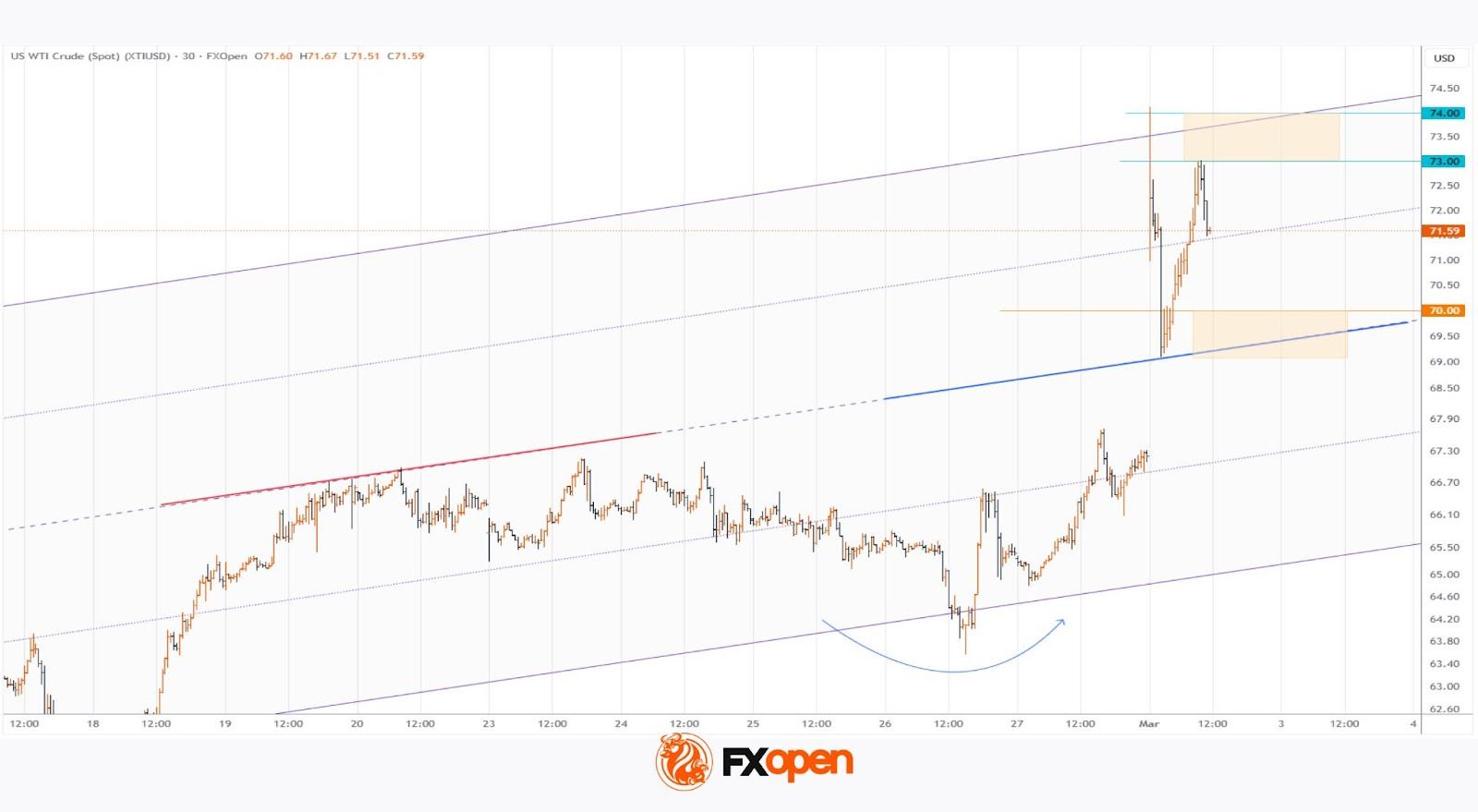
On Friday, we warned that trading on Monday could be volatile — but not to this extent! The situation sharply escalated over the weekend following a large-scale strike by Israel and the US on targets in Iran, during which the supreme leader Ali Khamenei was reportedly killed. In retaliation, Iran launched missiles and drones at Israel, Saudi Arabia, and other targets.
Although financial markets had priced in some escalation risks, they reacted very sensitively:
→ Gold (XAU/USD): the price surged above $5,400 per ounce.
→ US Dollar Index (DXY): the US currency strengthened, not only as a safe-haven asset but also amid expectations of a new wave of global inflation driven by higher fuel costs.
→ Equity indices: opened sharply lower. Airlines and the tech sector were hit hardest, while defence stocks rose against the broader market.
→ Oil: showed the most aggressive reaction, with WTI opening at a bullish gap of roughly 10% compared with Friday’s close.
Shipping in the Strait of Hormuz (through which around 20% of global oil supply passes) is effectively paralysed following attacks on tankers. As shown on the XTI/USD chart, barrel prices are fluctuating widely as traders attempt to determine a fair value under these extraordinary circumstances.
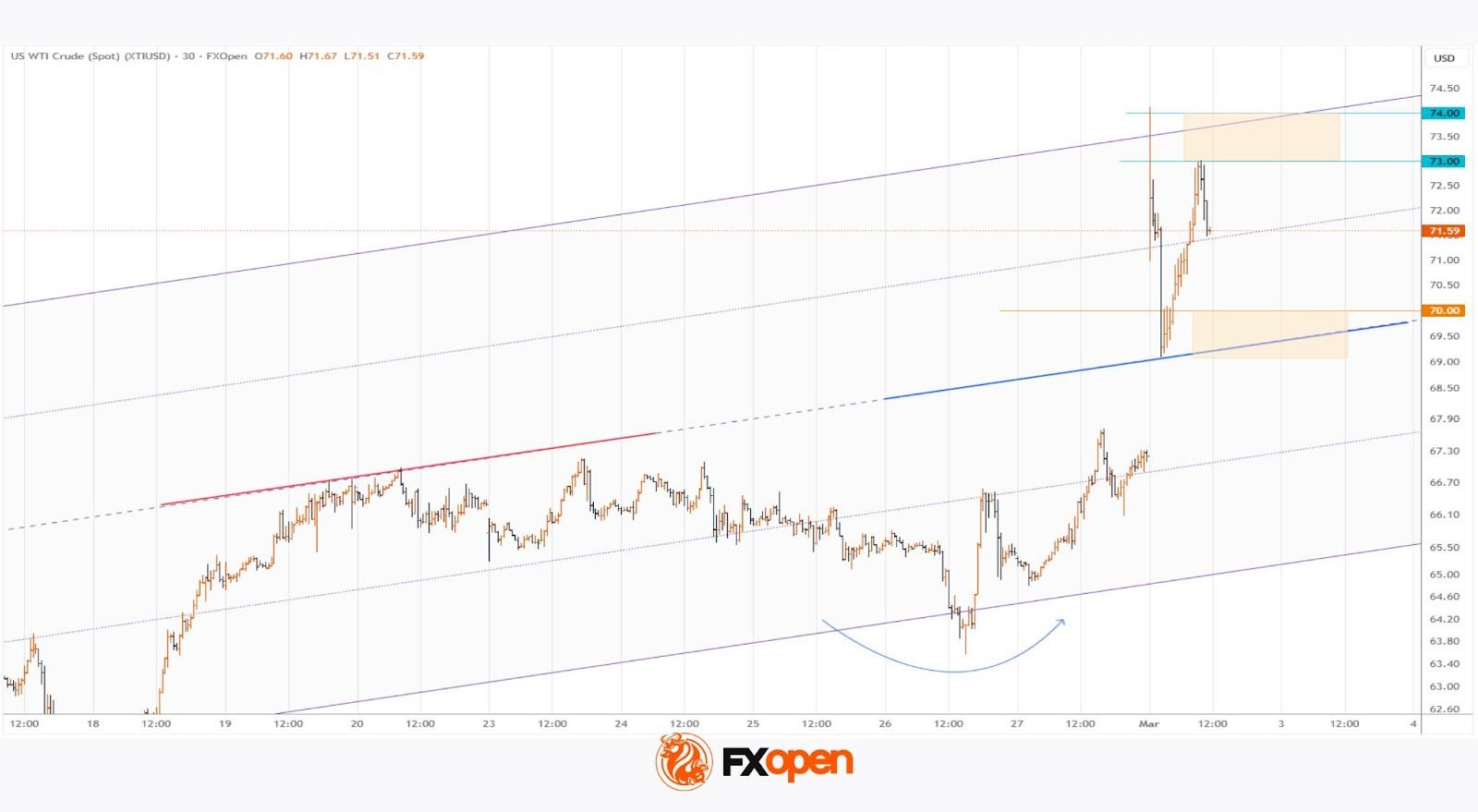
Technical Analysis of XTI/USD
Three days ago, we drew an ascending channel on the oil price chart, which has held up:
→ its upper boundary acted as resistance at Monday’s open;
→ its median pushed the price upwards.
Bearish perspective:
→ following the bullish gap, prices failed to continue higher and fell sharply;
→ the round level of $73 acted as resistance.
Bullish perspective:
→ the channel median previously acted as resistance but now serves as support;
→ the psychological level of $70 favours buyers.
It is reasonable to expect WTI oil to remain volatile within a broad $70–73 range, with price impulses largely driven by political statements regarding escalation in the Middle East.
Start trading commodity CFDs with tight spreads (additional fees may apply). Open your trading account now or learn more about trading commodity CFDs with FXOpen.
This article represents the opinion of the Companies operating under the FXOpen brand only. It is not to be construed as an offer, solicitation, or recommendation with respect to products and services provided by the Companies operating under the FXOpen brand, nor is it to be considered financial advice.
Crypto World
Bitcoin holds up after Iran strike, outpacing equities in risk-off session: Crypto Markets Today


Bitcoin is trading near $66,500 after adding 1.1% since midnight UTC and more than 5% from the weekend low of $63,000.
The crypto market is back in the middle of a trading range that has persisted since the start of February, with a volatile past week testing $70,000 to the upside and $62,500 to the downside.
Weekend price action was driven by the military strikes that killed Iran’s Supreme Leader Ayatollah Khamenei, triggering retaliatory attacks and raising concerns about potential disruption to traffic in the Strait of Hormuz.
According to trading firm QCP, the strike sparked roughly $300 million in long liquidations — but the scale of forced selling was relatively contained, suggesting markets were already positioned for a volatile weekend.
The escalation pushed investors toward traditional havens, sending gold and silver to their highest levels in more than a month. Oil surged 13% to $82 a barrel, the highest price since July 2024.
U.S. equity index futures fell, with the S&P 500 futures and Nasdaq 100 down 1.1% and 1.5%, respectively, since midnight UTC.
The crypto market showed resilience, with most of the losses occurring on Saturday when U.S. markets were closed.
Derivatives positioning
- The fallout from the Iran war has been more contained than might have been expected. While cumulative crypto futures open interest has dropped 2% to $93.78 billion, it remains above the recent low of $92.40 billion.
- Over $300 million in leveraged bets have been liquidated by centralized exchanges in 24 hours, with bullish bets accounting for most of the tally.
- Annualized perpetual funding rates for major cryptocurrencies, including bitcoin and ether, are little changed to negative, indicating a slightly bearish bias.
- Still, the market isn’t showing signs of panic, as evidenced from the bitcoin 30-day annualized implied volatility index, BVIV. It remains steady at around 58.8%, well within the price range seen last week. The same is true for the ether volatility index.
- On Deribit, short-term bitcoin puts traded at an 8%-10% volatility premium to calls, a sign of heightened downside worries. The $60,000 put, or bearish bet, remains the most popular on the exchange.
- Block flows featured demand for bitcoin put spreads.
Token talk
- The altcoin market largely tracked bitcoin over the weekend, but one of the fastest to recover was lending token MORPHO, which continued its impressive two-week streak with a 5% jump over the past 24 hours having risen by 2.6% since midnight UTC.
- Decentralized finance (DeFi) tokens JUP, AAVE and LDO are all in the black as speculative appetite remains relatively strong despite a global shift to haven investments.
- Hyperliquid’s HYPE token surged by more than 29% on Saturday to snap February’s downtrend. While it lost 3.8% on Monday, losing 3.8% it remains above the crucial $30 level of support.
- , the DeFi token linked to U.S. President Donald Trump’s family, exentended declines, falling 2.5% of its value since midnight. It is now down by more than 44% since mid-January following a series of lower highs and lower lows.
- CoinDesk’s DeFi Select (DFX) Index is the only benchmark that is positive over the past 24 hours. The worst performing was the CoinDesk Computing Select Index (CPUS) and the CoinDesk Smart Contract Platform Select Capped Index (SCPXC), down by 1.87% and 1.71%, respectively.
Binance Coin took the lead today by surpassing its XRP rival.
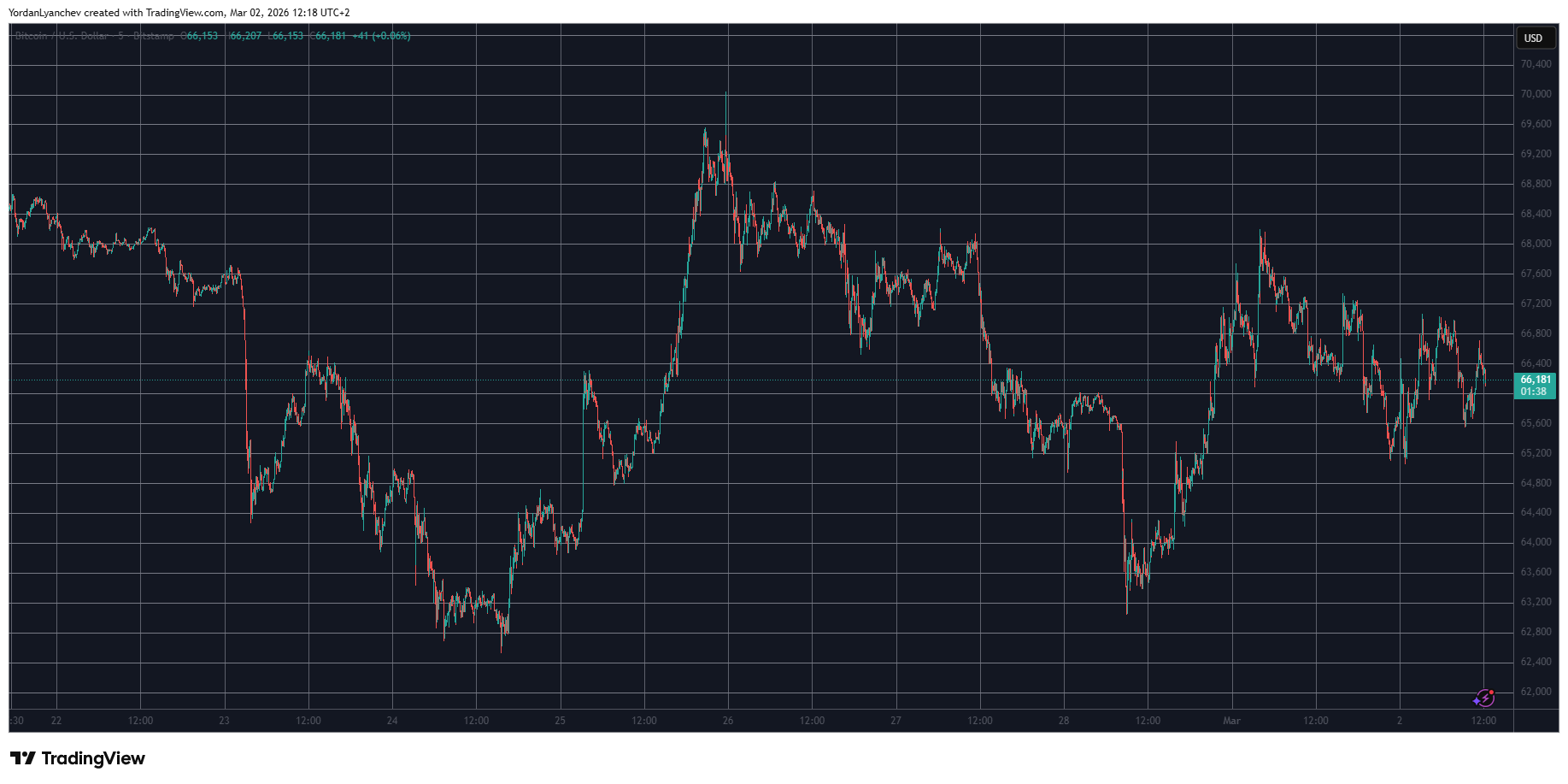
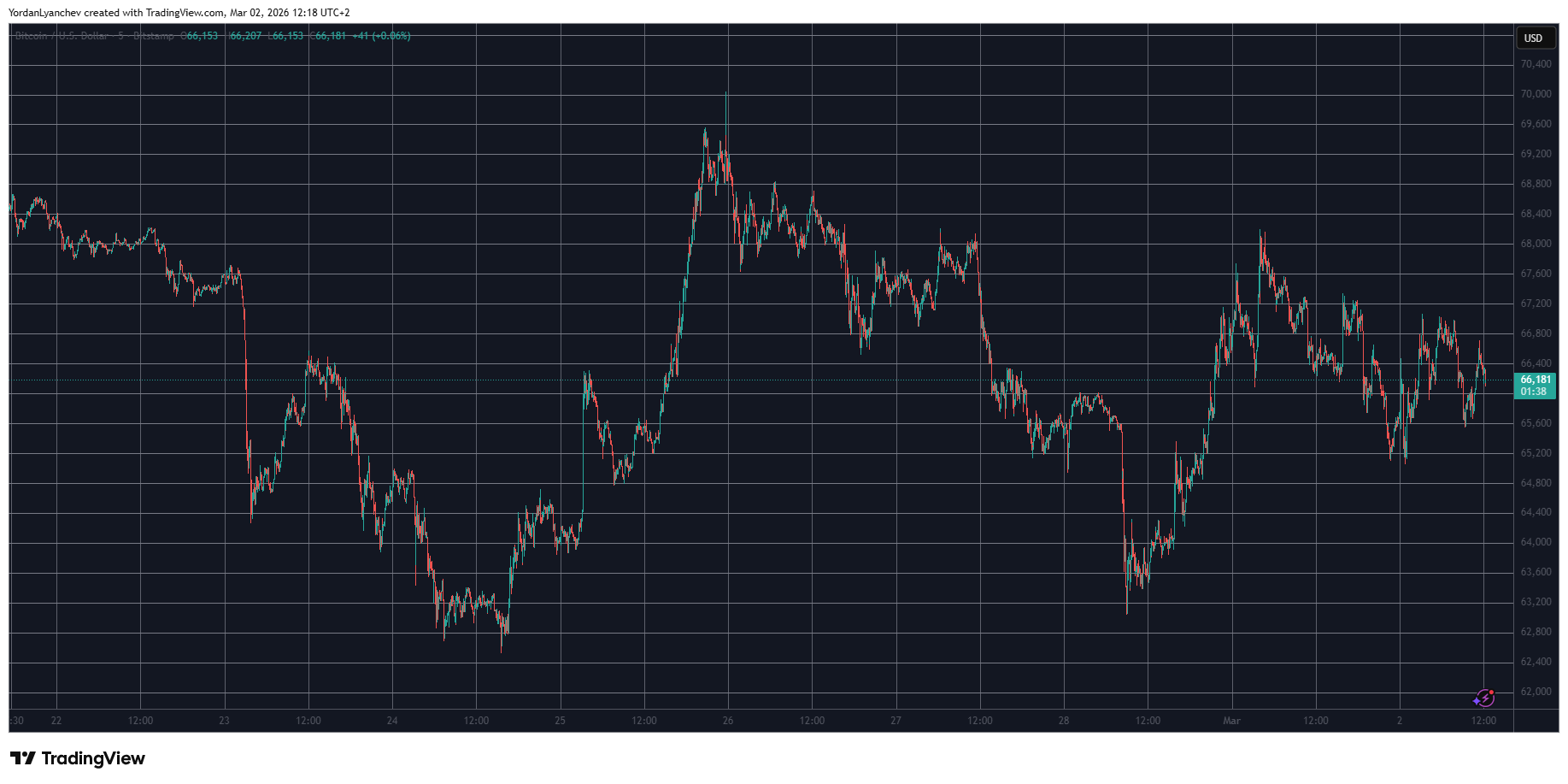
Although the traditional financial markets in Asia and Europe opened earlier this morning and the US futures markets joined, BTC’s price has actually remained relatively calm at around $66,000 following the weekend developments.
Most altcoins are also unexpectedly quiet today, but minor losses continue to dominate. Ethereum continues to struggle below $2,000.
BTC Calms at $66K
After last Wednesday’s rejection at $70,000, the primary cryptocurrency dropped below $67,000 a day later but found support and entered the weekend at $68,000. However, Saturday began with intense volatility as the US and Israel launched numerous airstrikes against Iran.
The Middle East country retaliated against several nations in the region, including the UAE, Qatar, and Bahrain, and BTC’s price tumbled to a new multi-day low of $63,000. However, reports emerged later that day that Iran’s Supreme Leader was killed during the attacks, and bitcoin erased all losses and touched $68,000 once again.
It failed there and dipped to $65,200 on Sunday, and even more volatility was expected on Monday morning when the futures and some legacy markets opened. However, BTC has remained relatively stable and now sits around $66,000.
Its market capitalization remained inches above $1.320 trillion, while its dominance over the alts is north of 56%.
BNB Back to 4th
XRP was among the poorest performers after the attacks began, which allowed BNB to surpass it in terms of market cap. The two changed positions yesterday once again, but BNB has the upper hand today with a price tag of $617 and a market cap of $84.2 billion compared to XRP’s $82.5 billion.
Most other larger-cap alts are slightly in the red, with ETH losing the $2,000 support once again. SOL, DOGE, ADA, BCH, HYPE, and LINK are down by around 2-3%, while CC and DOT have lost more than 4% daily. In contrast, HTX is up by over 3%.
The total crypto market cap has declined by about $30 billion in a day and is down to $2.350 trillion on CG.

Binance Free $600 (CryptoPotato Exclusive): Use this link to register a new account and receive $600 exclusive welcome offer on Binance (full details).
LIMITED OFFER for CryptoPotato readers at Bybit: Use this link to register and open a $500 FREE position on any coin!
Disclaimer: Information found on CryptoPotato is those of writers quoted. It does not represent the opinions of CryptoPotato on whether to buy, sell, or hold any investments. You are advised to conduct your own research before making any investment decisions. Use provided information at your own risk. See Disclaimer for more information.

✨ AI Summary
- Discover how Artificial Intelligence has evolved from a niche experiment to a crucial asset for enterprise growth
- Learn why successful AI deployment requires advanced infrastructure solutions and how AI-first enterprises integrate intelligence into every aspect of operations
- Uncover the challenges traditional IT systems face with modern AI workloads and explore key pillars of enterprise-grade AI infrastructure
- Dive into real-world use cases and understand the business impact of AI-ready infrastructure
- Find out how strategic AI transformation roadmaps guide organizations towards full-scale AI integration, delivering measurable value and competitive advantage.
Artificial Intelligence has transitioned from a niche experiment to a strategic foundation for enterprise growth. Modern organizations rely on AI not just for automation or analytics, but to drive data-driven decision-making, predictive operations, and real-time insights. Yet, deploying AI successfully requires more than advanced algorithms; it demands enterprise-grade AI infrastructure solutions that support high-volume data processing, scalable compute workloads, and secure governance.
Many enterprises fail to achieve ROI because their IT systems cannot handle AI’s complexity. Structured AI infrastructure consulting services guide organizations in assessing readiness, designing scalable pipelines, and integrating AI into core workflows. Partnering with an experienced AI infrastructure development Company ensures transformation is sustainable, optimized, and aligned with business objectives.
What Does It Mean to Be an AI-First Enterprise?
An AI-first enterprise integrates intelligence into every layer of operations. Unlike organizations that adopt isolated AI tools, AI-first enterprises design infrastructure and workflows to maximize model performance, automation, and insight generation. Key characteristics include:
- Enterprise-wide AI integration: From supply chains to finance, AI drives core decisions.
- Real-time data orchestration: Automated pipelines ensure data is always accessible and accurate.
- Scalable compute architecture: Dynamic resource allocation supports high-demand AI workloads.
- Governance and compliance alignment: Secure and auditable AI deployment prevents regulatory and ethical risks.
Transitioning to AI-first requires investment in AI infrastructure solutions for enterprises and strategic guidance from AI infrastructure consulting services.
Why Traditional IT Struggles with Modern AI Workloads
Most legacy IT systems were built for routine business applications, not for the demands of AI. As organizations scale AI, these outdated systems reveal critical weaknesses that can hinder performance and ROI:
- Compute Limitations: AI training and real-time inference require high-performance GPUs, TPU clusters, or distributed computing. Traditional CPU-only servers cannot handle these workloads efficiently, leading to slow processing and delayed insights.
- Data Silos: Disconnected databases and unstructured data prevent AI models from learning effectively, resulting in inaccurate predictions and incomplete insights.
- Scalability Challenges: AI workloads are unpredictable, with spikes in processing demand. Static infrastructure either fails to meet these peaks or results in wasted resources and higher costs.
- Security & Compliance Risks: AI systems process sensitive information, requiring robust encryption, audit trails, and regulatory compliance. Legacy infrastructure often lacks these protections.
- MLOps Gaps: Without proper model lifecycle management—including deployment, monitoring, and retraining—AI models degrade over time, producing unreliable results.
Addressing these challenges is why forward-thinking enterprises rely on AI infrastructure implementation partners to design scalable, secure, and high-performance AI environments.
Key Pillars of Enterprise-Grade AI Infrastructure
A robust AI infrastructure must integrate multiple layers, ensuring reliability, scalability, and governance:
1. High-Performance Compute Architecture
- Supports distributed AI training and inference workloads.
- Utilizes hybrid cloud, on-prem GPU clusters, and edge computing for flexibility.
- Enables cost-efficient scaling during peak demand.
2. Data Engineering & Governance
- Automates real-time ingestion, cleansing, and transformation.
- Establishes data lineage and auditability for regulatory compliance.
- Supports diverse data sources, including structured, semi-structured, and unstructured datasets.
3. MLOps & Deployment Pipelines
- CI/CD frameworks ensure continuous integration, testing, and deployment.
- Versioning of models, pipelines, and datasets minimizes errors.
- Monitoring tools detect drift, bias, and performance anomalies.
4. Security, Compliance & Responsible AI
- Implements role-based access controls, encryption, and monitoring.
- Aligns with GDPR, ISO, SOC, and industry-specific standards.
- Introduces ethical AI frameworks to prevent bias or misuse.
5. Performance Optimization & Monitoring
- Real-time dashboards track AI system efficiency.
- Automated resource allocation optimizes costs and ensures uptime.
- Continuous feedback loops enhance model accuracy and infrastructure efficiency.
Assessing AI Infrastructure Maturity
Organizations evolve along a structured maturity curve. Understanding your stage informs strategy:
- Experimental: Pilot AI models with limited integration.
- Operational: AI deployed, but with limited scalability and monitoring.
- Scalable: Enterprise-wide pipelines, standardized MLOps, and reliable data infrastructure.
- AI-First Autonomous: Fully orchestrated AI-driven operations with real-time insights, intelligent agents, and automated decision-making.
Mapping your maturity level is critical for building a successful AI transformation roadmap.
Building a Strategic AI Transformation Roadmap
Successfully becoming an AI-first enterprise requires more than technology adoption; it demands a structured roadmap that guides your organization from assessment to full-scale AI integration. A strategic AI transformation roadmap ensures every step is deliberate, measurable, and aligned with business objectives:
- Infrastructure Audit & Gap Analysis: Assess your current systems, data pipelines, compute capacity, and governance processes to identify limitations and opportunities for AI readiness.
- Architecture Blueprinting: Design AI-ready infrastructure, including scalable compute, secure storage, and robust networking layers, to support future growth and AI workloads.
- Deployment & Integration: Implement high-performance AI pipelines, secure environments, and MLOps frameworks for seamless model development, testing, and production rollout.
- Business Unit Integration: Embed AI into key operations—marketing, finance, supply chain, and customer engagement—so intelligence drives decisions across the enterprise.
- Optimization & Governance: Continuously monitor performance, retrain models, and enforce ethical and regulatory compliance to ensure AI remains reliable, secure, and effective.
Partnering with experienced AI infrastructure consulting services and a trusted AI infrastructure development Company ensures each phase is executed efficiently, accelerating AI adoption while minimizing risk.
Real-World Enterprise Use Cases
Robust AI infrastructure unlocks tangible business outcomes:
- Predictive Fraud Detection: Real-time anomaly detection across financial transactions.
- Intelligent Supply Chains: Automated routing, demand forecasting, and inventory optimization.
- Predictive Maintenance: AI-driven monitoring reduces downtime and operational costs.
- Generative AI for Productivity: Copilots automate document generation, analysis, and reporting.
- Customer Insights & Personalization: AI models provide real-time segmentation and recommendations.
These outcomes are only achievable with a scalable, secure, and compliant AI foundation.
The Business Impact of AI‑Ready Infrastructure
Investing in AI‑ready infrastructure delivers measurable value across operations, strategy, and competitive advantage much more than just speed or cost savings. Leading research from global analysts and industry reports highlights how modernizing technology foundations is critical to realizing the true potential of AI.
1. Accelerated Enterprise AI Value
According to Gartner, AI has become a core part of business operations, and by 2030, AI is expected to touch all IT work, with AI‑augmented tasks and automation reshaping workflows across every department. Modern infrastructure enables enterprises to realize AI value faster and at scale rather than stalling after initial pilots.
2. Improved Decision Making and Operational Efficiency
IBM research notes that most enterprises are increasing IT investment to support AI – yet only a small percentage feel their current infrastructure fully meets business needs. Modern AI infrastructure empowers organizations with real‑time insights, faster model deployment, and automated workflows, improving efficiency and reducing manual errors.
3. Productivity & Competitive Impact
Deloitte’s State of AI in the Enterprise report shows that many organizations report tangible productivity and efficiency gains directly from their AI investments. The ability to deploy AI insights across operations, sales, and service functions drives measurable business benefits and supports future growth ambitions.
4. Strategic AI Infrastructure Drives Innovation
Microsoft’s massive ongoing investments in AI cloud and data center infrastructure highlight how foundational compute and platform readiness enable enterprises to innovate reliably from intelligent applications to automated analytics without overburdening internal IT teams.
5. Platform Strength Enables Business Outcomes
Modern AI infrastructure not only accelerates deployment but also reduces risks related to governance, security, scaling, and performance. By enabling better data access, governance frameworks, hybrid architectures, and automation, enterprises can use AI as a strategic growth engine rather than a cost center.
6. AI Investment is Now Strategic
Industry reporting confirms that enterprises are rapidly increasing cloud, data center, and hybrid infrastructure spending to support intensive AI workloads from training to inference reflecting the essential role modern infrastructure plays in business transformation.
The AI-Readiness Imperative
The AI revolution is redefining enterprise competitiveness. Organizations that ignore infrastructure modernization risk wasted AI investments, operational instability, and compliance pitfalls. Becoming AI-first is not about adopting isolated tools; it requires an end-to-end transformation guided by AI infrastructure consulting services. Strategic design, secure deployment, and scalable pipelines form the backbone of success, enabled by a trusted AI infrastructure implementation partner.
By partnering with Antier – AI infrastructure solutions for enterprises, organizations can ensure AI initiatives are sustainable, high-performing, and ROI-driven, securing their position as market leaders in the AI-first era.

A monitor plays footage of US President Donald Trump announcing US and Israeli strikes against Iran in the James Brady Press Briefing Room of the White House in Washington, DC, U.S., on Saturday, Feb. 28, 2026.
Bloomberg | Bloomberg | Getty Images
BEIJING — Uncertainty is growing over U.S. President Donald Trump‘s high-stakes trip to China after Washington targeted a second foreign leader in two months.
Trump announced over the weekend that joint U.S.-Israel strikes on Iran killed its Supreme Leader Ayatollah Ali Khamenei. In early January, the U.S. also captured Venezuelan leader Nicolas Maduro and his wife from their residence.
Analysts say those actions could complicate Trump’s high-stakes trip to Beijing.
“President Xi Jinping won’t feel easy about the death of the top leader of Iran,” said George Chen, partner at The Asia Group, noting Beijing’s relatively good relations with Tehran and Caracas.
“How can Xi feel everything is normal and alright and be prepared to welcome Trump to visit in [a] happy mood?” he said. Chen added that “investors should manage their expectations on what Trump can achieve for his China trip — if he still goes.”
Trump is scheduled to visit Beijing from March 31 to April 2, following a fragile trade truce with China reached in late October. It would mark the first trip by a sitting U.S. president since 2017.
But Beijing has yet to confirm the dates.
China’s Foreign Ministry on Sunday condemned Khamenei’s killing and called it “a grave violation of Iran’s sovereignty and security.” Beijing urged for an immediate ceasefire, although it was less direct about the U.S. role than it had been after Maduro’s capture.
“I worry the U.S. side might use Iran, if it’s going poorly, to delay the trip,” said a foreign business executive tracking meeting preparations very closely, who requested anonymity due to the sensitivity of the matter.
“I think the risk [of the trip falling apart] is on the U.S. side more than the Chinese side,” the executive added.

U.S.-based prediction markets signaled a greater likelihood of a delayed Trump trip.
As of late Monday morning, Polymarket showed a sharp drop in expectations that Trump would visit China by March 31, to 42%, from 83.9% on Feb. 21, while wagers on a visit by April 30 remained high at 81%.
Kalshi showed a slight drop in expectations that Trump would visit China by 2027, though it remained a high 91%.
While many analysts still expect the trip to proceed, it’s less clear how U.S. businesses will navigate plans for deals in the world’s second-largest economy.
Several U.S. executives had been expected to accompany Trump on his Beijing trip, following a pattern of business delegations following leaders of different countries on their trips this year to China in a bid to strike deals.
“Prior to the attack on Iran, many American CEOs were already unwilling to go with Trump to China. Now the situation is even more tricky,” according to an active member of the American business community in China, who also requested anonymity due to the sensitivity of the matter.
The White House and China’s Foreign Ministry did not immediately respond to a CNBC request for comment.
The Chinese readout so far indicates an “unusually softer tone,” said Jack Lee, analyst at China Macro Group. He expects Trump to visit Beijing as planned, but is watching whether Washington signals restraint on arms sales to Taiwan.
The democratically self-ruled island, claimed by Beijing, remains a central flashpoint in U.S-China relations.
Risks of prolonged conflict
Trump, meanwhile, told British newspaper the Daily Mail that U.S. strikes on Iran could last four weeks — a point that Chinese state media highlighted Monday morning. That timeframe would run into the planned March 31 start date for his trip to China.
“If the conflict escalates into a regional war beyond what the U.S. originally planned, it’s not impossible that Trump might delay the trip,” said Yue Su, principal economist at the Economist Intelligence Unit.
“Still, I expect Trump and [Xi] to have a phone conversation about this at some point,” she said. Her base case remains that Trump goes ahead with his China trip later this month.
China this week kicks off an annual parliamentary meeting, where top diplomat Wang Yi typically speaks to the press. In mid-February, Wang told U.S. Secretary of State Marco Rubio on the sidelines of the Munich Security Conference that the U.S. and China should work to expand areas of cooperation.
In foreign policy, Beijing has prioritized its own interests by forging bilateral ties while encouraging multilateral engagement. Official statements around past U.S.-China meetings have noted the need to create “conditions” for developing bilateral relations.

Subscribe now
The U.S. actions in Iran have eroded trust between the two countries, said Dong Shaopeng, a senior researcher at Renmin University of China. While he still expects Trump and Xi to meet in a few weeks, he said he hopes the conflict does not spread to other countries in the Middle East.
State-affiliated Chinese columnist “Niutanqing” on Monday described the Iran “war” as more intense than the conflict in Ukraine, drawing several lessons. Of the several lessons from the turn of events, the columnist said that Khamenei’s death revealed “traitors” can emerge from within, and that negotiations may conceal the true intentions of an adversary, according to a CNBC translation of the post in Chinese.
If the Trump-Xi meeting proceeds as planned, it could offer an opportunity for broader peace talks while addressing strained U.S.-China relations.
“The issues that they have to work out, China-U.S. trade, are pretty important, and the meeting has been scheduled to be in place for a long time, and so cancelling it would be pretty radical at this point,” said Gary Dvorchak, managing director at Blueshirt Group.
“I don’t think it would … help the situation to cancel the meeting for any reason.”


U.S. equities fell in pre-market trading after the U.S. and Israel entered into conflict with Iran over the weekend.
The Invesco QQQ exchange-traded fund (ETF), which tracks the Nasdaq 100 index, declined 1.5%, though early losses have started to moderate, suggesting that initial concerns may have been somewhat overstated.
A Saudi Arabia oil refinery was hit by Iran’s response, pushing WTI crude oil as high as $75 per barrel. It was recently trading below $72, though remains 8% higher over the past 24 hours.
Gold rallied more than 2% in the past day to $5,400 per ounce, putting it within reach of its all-time high near $5,600 as investors sought traditional haven assets. It also drew back following an initial surge.
Bitcoin has held up, trading above $66,000 and gaining about 1% over the past 24 hours. This marks a modest divergence from its recent correlation with software stocks, as the iShares Expanded Tech-Software Sector ETF (IGV) is down around 1%.
Among crypto-related equities, Strategy (MSTR), the largest publicly traded corporate holder of bitcoin, is little changed. Crypto-exchange Bullish (BLSH), CoinDesk’s parent company, is down 4%, while AI-focused miners Cipher Digital (CIFR) and IREN (IREN) are both lower by about 3%. Crypto exchange Coinbase (COIN) is down 2%.
The conflict pushed the U.S. dollar index (DXY) higher to 98.2. At the same time, both the S&P 500 volatility index (VIX), and the U.S. bond market volatility index (MOVE), are up by more than 10%, reflecting elevated market uncertainty.


Shanghai’s benchmark index surged to its highest close in a decade on Monday, as Chinese investors piled into energy, gold, and defense stocks in the wake of the Iran conflict — further underscoring why Chinese capital continues to flow away from crypto markets.
The rally, combined with Beijing’s tightening grip on domestic liquidity ahead of this week’s National People’s Congress, narrows the already slim chances that Chinese capital will find its way into crypto anytime soon.
A Tale of Two Markets
The Shanghai Composite Index closed up 0.5% at 4,182.6 points on March 2, its highest since June 2015, even as most Asian markets buckled under geopolitical pressure. China’s blue-chip CSI300 gained 0.4%.
The rally was driven by a surge in energy and safe-haven plays. Shares of CNOOC, PetroChina, and Sinopec all climbed sharply after oil prices posted their biggest jump in four years. An index tracking Chinese gold stocks soared 7%, while defense names also advanced. Shipping stocks, including Nanjing Tanker and COSCO Shipping, hit their daily 10% limit up.
Meanwhile, Hong Kong — the only regulated gateway for Chinese investors seeking crypto ETF exposure — told a different story. The Hang Seng Index dropped more than 2% to a two-month low, with tech, healthcare, and tourism among the hardest-hit sectors. Hong Kong-listed crypto ETFs fell across the board, with ChinaAMC Bitcoin ETF (3042.HK) down 2%, Bosera HashKey Bitcoin ETF (3008.HK) off 2.3%, and Harvest Bitcoin Spot ETF (3439.HK) losing 2.4%. Ether ETFs also declined.
Why This Matters for Crypto
The divergence between Shanghai and Hong Kong highlights a structural problem for crypto adoption among Chinese capital pools.
Mainland Chinese investors remain barred from directly accessing Hong Kong’s spot Bitcoin and Ethereum ETFs. Potential pathways — including the QDII program and the Cross-boundary Wealth Management Connect scheme in the Greater Bay Area — have been discussed by industry figures and legal experts, but none have materialized into concrete policy action. A January 2025 expansion of the GBA wealth connect scheme raised hopes, but stopped short of explicitly including crypto products.
With Shanghai equities rallying — buoyed by expectations of policy support ahead of the National People’s Congress, which opens March 5 — there is even less incentive for Chinese capital to seek alternative assets like crypto.
Beijing has a long track record of propping up onshore markets during external crises. Hong Kong, open to global capital flows, typically absorbs the blow. Monday was a textbook example. The same geopolitical shock that lifted Shanghai’s energy and defense names sent the Hang Seng into retreat. Crypto ETFs went down with it. If the conflict escalates further, gold is likely to remain the preferred safe haven for Chinese investors, while Bitcoin faces additional downside pressure.
The NPC Factor
Beijing’s annual parliamentary meeting this week adds another layer to the equation. The NPC is expected to set a 2026 GDP growth target of 4.5%–5% and outline the 15th Five-Year Plan, with emphasis on domestic demand, tech self-reliance, and consumption stimulus.
This policy backdrop reinforces the narrative that Beijing wants capital to circulate within its own financial ecosystem — in A-shares, government bonds, and state-directed investment vehicles — rather than flow offshore into volatile assets.
Historically, geopolitical shocks have had a limited shelf life on Chinese A-shares. Beijing’s policy toolkit — from state fund purchases to trading curbs — is designed to insulate onshore markets from external volatility, and the pre-NPC window only strengthens that impulse.
For crypto, those fundamentals point in the wrong direction. The onshore equity market is performing, policy support is coming, and Beijing’s capital controls remain firmly in place.
Bitcoin Caught in the Crossfire
Bitcoin itself has struggled to act as a safe haven during the Iran conflict. After dropping to $63,000 on Saturday following the US-Israel strikes, BTC briefly recovered above $68,000 on reports of Supreme Leader Khamenei’s death before settling around $66,000 — roughly where it traded before the strikes began.
Global crypto fund outflows have now extended to five consecutive weeks, with cumulative withdrawals reaching $4 billion, according to CoinShares data. The most recent week alone saw $288 million in redemptions, while trading volumes fell to $17 billion, the lowest since July 2025. Bitcoin is down 23% year-to-date and has fallen roughly 48% from its all-time high of $126,000 set in October 2025.
With Chinese equities absorbing domestic liquidity, Hong Kong markets under pressure, and crypto acting more like a risk asset than digital gold, the prospect of meaningful Chinese capital inflows into crypto appears increasingly remote — at least for now.
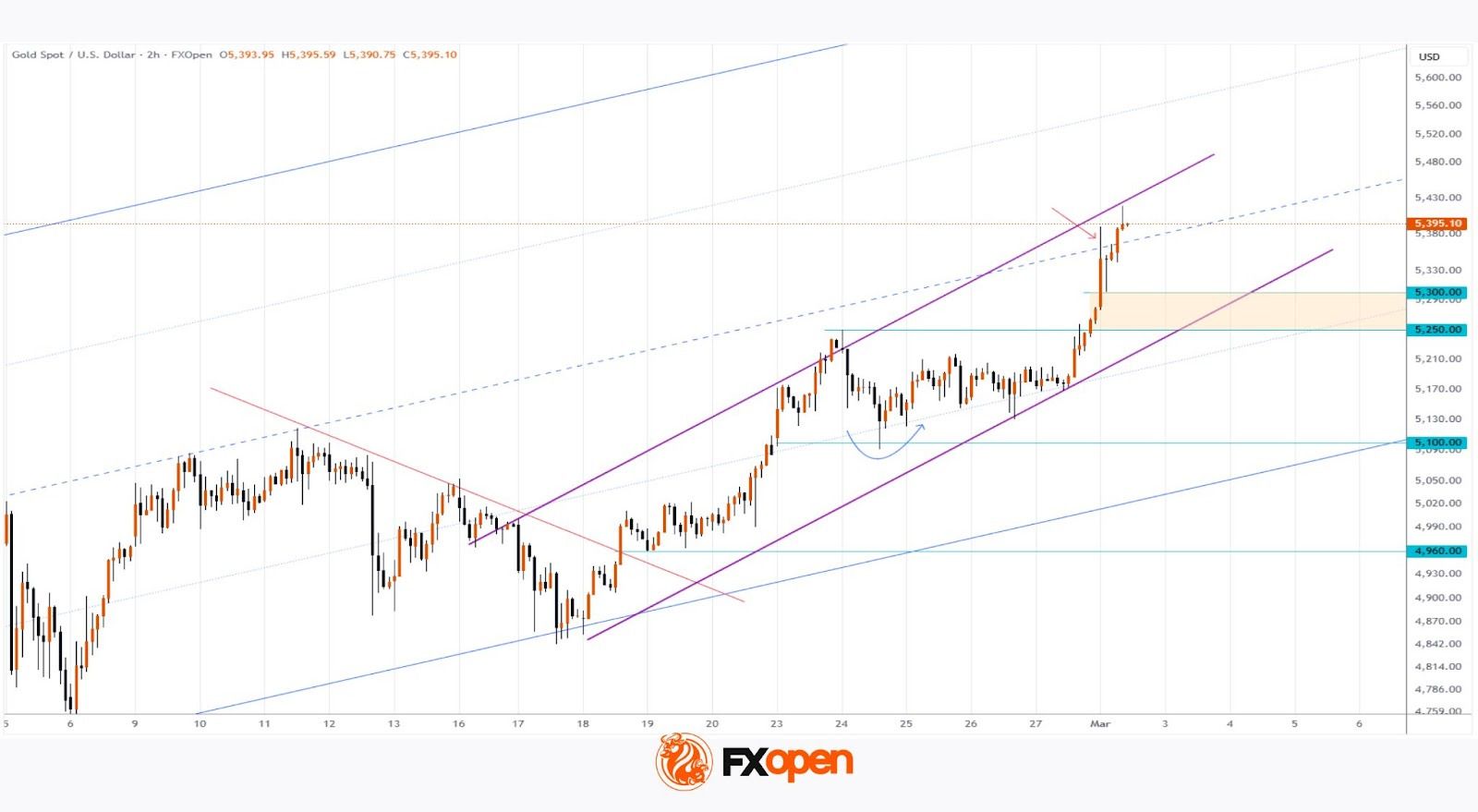
The reason is clear: confirmed US and Israeli strikes on targets in Iran, including reports of the death of Supreme Leader Ali Khamenei, have triggered renewed demand for safe-haven assets, pushing gold prices higher.
As of Monday morning, news of further escalation continues to emerge, while the price per ounce has climbed above the $5,400 level — for the first time since late January. Analysts (including J.P. Morgan and Bank of America) are already revising their targets. In their view, if the price consolidates above $5,400, this could point to a move towards $6,000 by the end of 2026.
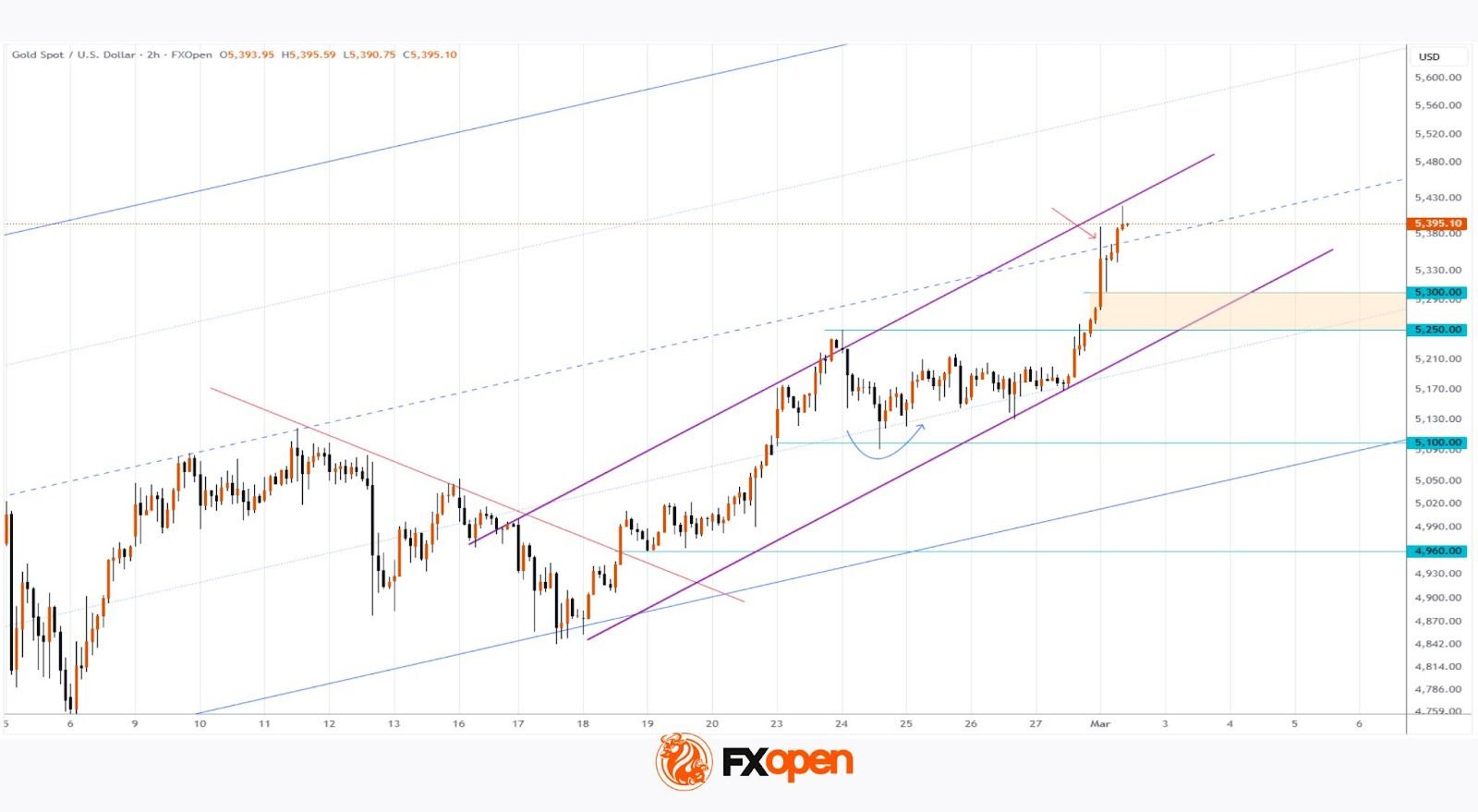
Technical Analysis of the XAU/USD Chart
On 23 February, when analysing gold price movements, we confirmed that the long-term ascending channel remained in force and suggested that:
→ bulls would attempt to reach the median of the channel;
→ if gold were to pull back, the $5,100 level would act as support.
Indeed, both assumptions materialised. As indicated by the arrows:
→ on 24 February, the price rebounded from the stated support level;
→ this morning, the price reached the median. At the first test, bears showed aggression, but extraordinary geopolitical risks pushed the quotation into the upper half of the channel.
It is worth noting that the price has left behind:
→ the psychological $5,300 mark;
→ the $5,250 level, which acted as resistance in February (and may now be expected to provide support).
At the same time, nearby resistance is formed by a local ascending channel (shown in purple), constructed using February’s price extremes on the XAU/USD chart.
It cannot be ruled out that, following the shocking news over the weekend, market emotions may subside, leading to a pullback in gold prices. In that case, support may emerge in the $5,250–5,300 area, where the lower boundary of the purple uptrend line is located.
Start trading commodity CFDs with tight spreads (additional fees may apply). Open your trading account now or learn more about trading commodity CFDs with FXOpen.
This article represents the opinion of the Companies operating under the FXOpen brand only. It is not to be construed as an offer, solicitation, or recommendation with respect to products and services provided by the Companies operating under the FXOpen brand, nor is it to be considered financial advice.

DWP confirms PIP award length changes from April

Newcastle’s SkinBioTherapeutics appoints new interim CEO as it strives to ‘move forward’

Magic Eden Abandons Ethereum and Bitcoin NFTs to Pursue Casino Gaming


-

 Sports7 days ago
Women’s college basketball rankings: Iowa reenters top 10, Auriemma makes history
-

 Politics7 days ago
Nick Reiner Enters Plea In Deaths Of Parents Rob And Michele
-

 Fashion3 days ago
Weekend Open Thread: Iris Top
-

 Business6 days ago
True Citrus debuts functional drink mix collection
-

 Politics3 days ago
ITV enters Gaza with IDF amid ongoing genocide
-

 Tech1 day ago
Unihertz’s Titan 2 Elite Arrives Just as Physical Keyboards Refuse to Fade Away
-
Sports2 days ago
The Vikings Need a Duck
-

 Crypto World6 days ago
XRP price enters “dead zone” as Binance leverage hits lows
-

 Tech6 days ago
Unsurprisingly, Apple's board gets what it wants in 2026 shareholder meeting
-
 NewsBeat2 days ago
Dubai flights cancelled as Brit told airspace closed ’10 minutes after boarding’
-

 NewsBeat4 days ago
Cuba says its forces have killed four on US-registered speedboat | World News
-
 NewsBeat5 days ago
Manchester Central Mosque issues statement as it imposes new measures ‘with immediate effect’ after armed men enter
-
 NewsBeat2 days ago
The empty pub on busy Cambridge road that has been boarded up for years
-

 NewsBeat21 hours ago
‘Significant’ damage to boarded-up Horden house after fire
-

 NewsBeat2 days ago
Abusive parents will now be treated like sex offenders and placed on a ‘child cruelty register’ | News UK
-
 NewsBeat6 days ago
Police latest as search for missing woman enters day nine
-

 Business4 days ago
Discord Pushes Implementation of Global Age Checks to Second Half of 2026
-

 Entertainment3 hours ago
Baby Gear Guide: Strollers, Car Seats
-

 Business4 days ago
Only 4% of women globally reside in countries that offer almost complete legal equality
-
 Tech3 days ago
NASA Reveals Identity of Astronaut Who Suffered Medical Incident Aboard ISS