

Crypto World
Bitcoin under pressure as oil spikes 6%. What’s next?



A brief Sunday rally didn’t survive contact with Monday.
Bitcoin slid to $66,702 in early Monday trading, down 1.1% over the past 24 hours, as traditional markets reopened and began pricing the U.S.-Iran conflict that crypto had been trading in isolation since Saturday.
Sunday’s bounce to $68,000 on the Khamenei confirmation has now been mostly unwound, with the market settling back into the mid-$66,000 range that preceded the strikes.
The broader crypto picture was mixed. Ether fell 2.5% to $1,967, solana dropped 4.1% to $84, and XRP lost 3.6% to $1.36. The weekly numbers paint the real damage, with solana down 8.1% over seven days to lead losses among majors.
Traditional markets told the story crypto was anticipating. Brent crude surged as much as 13% at the open before settling around $77.50, still up 6.4%, the biggest jump since Russia’s invasion of Ukraine in 2022.
The Strait of Hormuz, through which roughly a fifth of the world’s oil flows, is effectively closed, per Bloomberg. Asian equities dropped 1.4% and U.S. equity futures fell 0.7%. Gold climbed to $5,350 an ounce.
The oil move is what matters most for crypto’s near-term direction. Higher energy prices feed directly into inflation expectations, which push back the timeline for Fed rate cuts, which tighten the liquidity conditions that drive risk asset prices.
But the situation remains fluid. Conflicting reports emerged Monday about whether Iran is seeking to resume nuclear talks with the U.S. The Wall Street Journal reported a fresh push to negotiate, while Iran’s national security chief Ali Larijani said the country won’t negotiate.
Earlier Sunday, Trump said the bombing campaign will continue until objectives are achieved, though The Atlantic reported he agreed to talk with Iran’s new leadership.
Meanwhile, some crypto traders say further downside risks for the market could be limited.
“Given that Iran has been isolated from global financial markets for quite some time, we believe that downside risk is limited,” said Jeff Mei, chief operating officer at BTSE.
“Some have been concerned about oil prices and their potential impact on inflation, but the world has been weaned off Iranian oil and increased supply from OPEC and the U.S. should be enough to stabilize prices.”
Whether that proves right depends on whether the Strait of Hormuz reopens and how long Trump’s “objectives” take to achieve. Until both of those questions have answers, crypto trades as a risk asset in a world that just got riskier.



Hong Kong is doubling down on its role as China’s financial bridge, signing a new agreement with Shanghai authorities to build cross-border blockchain rails for cargo trade and trade finance.
The memorandum of understanding between the Hong Kong Monetary Authority, the Shanghai Data Bureau, and the National Technology Innovation Center for Blockchain, announced Monday afternoon in Hong Kong, formalizes plans to develop a shared digital platform linking trade data, electronic bills of lading, and financing systems.
The MoU signals growing adoption of bitcoin in real-world plumbing, targeting $1.5 trillion in annual cargo finance where paper work and jams still cost a lot in delays in fraud.
By plugging mainland cargo data into Hong Kong’s international-facing infrastructure, officials aim to reduce friction in cross-border trade while reinforcing the city’s status as the primary conduit between China and global capital markets.
Under the agreement, the parties will study the creation of a cross-border platform under the HKMA’s Project Ensemble framework. The initiative will explore the use of electronic bills of lading and blockchain-based documentation to streamline trade finance, while connecting with Hong Kong’s Commercial Data Interchange and CargoX to facilitate secure data sharing.
For Hong Kong, the move extends its digital asset strategy beyond tokenized green bonds and into the real economy. Instead of focusing solely on sovereign issuance or crypto markets, regulators are targeting the operational bottlenecks in cargo finance, where paper documents, fragmented data, and manual verification continue to slow credit decisions.
If successful, the platform could embed Hong Kong deeper into mainland supply chains while offering international investors and banks a compliant gateway to Chinese trade data. In doing so, the city is attempting to turn blockchain from a pilot project into core cross-border financial infrastructure.

Key Takeaways
- Unidentified objects impacted AWS facilities in the UAE on Sunday, triggering fires and service disruptions
- Emergency services cut power to affected zones; a secondary UAE location experienced additional electrical issues
- Bahrain-based AWS infrastructure also experiencing power supply and network connectivity challenges
- Timing aligns with Iranian military response throughout the Gulf region, though AWS hasn’t established direct causation
- Customers advised to migrate workloads to alternative regions while restoration efforts continue over several hours
Amazon’s cloud computing division experienced significant service interruptions following an incident where unknown projectiles hit its United Arab Emirates facility on Sunday, resulting in fire damage and electrical system failures.
The disruption began approximately 4:30 p.m. local time in Dubai. Emergency response teams disabled the facility’s electrical infrastructure to control the resulting flames.
According to AWS’s official service health dashboard, “objects struck the data center, creating sparks and fire” at one of its UAE-based availability zones.
Subsequently, another UAE availability zone encountered what the company characterized as a “localized power issue,” further extending the scope of regional service degradation.
The cloud infrastructure provider additionally documented electrical and network connectivity complications affecting one of its Bahrain deployment zones.
The company instructed affected customers to redirect their operations to infrastructure located in unaffected geographic regions during remediation. AWS projected that full restoration would require “multiple hours away.”
These technical failures occurred simultaneously with Iranian military operations targeting the UAE, part of a coordinated retaliatory campaign spanning the Middle East following joint US and Israeli strikes that resulted in the deaths of Supreme Leader Ayatollah Ali Khamenei and additional high-ranking Iranian leadership.
Tehran’s response encompassed multiple territories, with projectile and unmanned aerial vehicle assaults documented against American military installations and allied nations including the UAE, Qatar, Kuwait, and Saudi Arabia.
AWS has neither acknowledged nor dismissed any direct correlation between the facility damage and Iranian military actions. Company representatives provided no statement when approached for comment.
Impact on UAE-Based AWS Clients
Prominent AWS enterprise customers operating in the UAE include Al Ghurair Investment LLC and Dubai Islamic Bank.
The cloud provider maintains 123 availability zones distributed across 39 geographic regions worldwide, establishing extensive infrastructure redundancy — though regional concentration still created vulnerability in this scenario.
Ongoing Restoration Efforts
AWS initially communicated progress toward service restoration early Monday but subsequently revised its status, continuing to direct users toward alternative regional infrastructure.
As of Monday morning in Dubai, both affected UAE availability zones along with the single Bahrain zone continued experiencing service degradation.
Shares of Amazon (AMZN) traded up 1.00% at the most recent market check.



Earnings reports are still rolling in. This week Riot Platforms, the fourth-largest bitcoin miner by market cap, is due to report, as is Core Scientific, the No. 6.
Like many of their peers, the two are using their experience running large data centers and negotiating power-supply deals to expand into AI. Core, whose proposed $9 billion purchase by CoreWeave (CRWV) failed in October, barely mentions digital asset mining on its homepage. It will be interesting to see how much of its business still comes from that source.
Also due this week is the U.S. jobs report for February. The world’s largest economy is forecast to have added 60,000 nonfarm positions last month, according to the consensus estimate on Trading Economics.
Traders will also be monitoring the war in the Middle East, which has seen the U.S. and Israel strike Iran in what President Donald Trump called “major combat operations” targeting the country’s missile, naval and nuclear infrastructure.
Iran has retaliated with attacks on various countries in the region that host U.S. military bases. The conflict has been escalating with Iran-backed militias joining in. Trump has said it’s expected to last “four to five weeks,” so an earlier-than-expected truce could bring risk appetite back.
What to Watch
(All times ET)
- Crypto
- March 2: SuperRare to release Delirium, a new collection by artist Xer0x
- March 2: Mantra’s OM token to change to MANTRA with a 1:4 coin split as the Mantra chain upgrades from v6 to v7.
- March 3: SolCex mobile app to debut on Google Play and Apple’s App Store.
- March 4: Qubic begins testing parallel dogecoin mining and AI training
- Macro
- March 2, 10:00 a.m.: U.S. ISM manufacturing PMI for February est. 52.3 (Prev. 52.6)
- March 3, 5:00 a.m.: Eurozone inflation rate YoY flash for February (Prev. 1.7%); Core YoY (Prev. 2.2%)
- March 3, 7:30 p.m.: Australia GDP growth rate QoQ for Q4 (Prev. 0.4%)
- March 3, 8:30 p.m.: China NBS manufacturing PMI for February (Prev. 49.3)
- March 4, 8:15 a.m.: U.S. ADP employment change for February (Prev. 22K)
- March 4, 10:00 a.m.: U.S. ISM services PMI for February (Prev. 53.8)
- March 4, 2:00 p.m.: U.S. Fed Beige Book
- March 5, 8:30 a.m.: U.S. initial jobless claims for week ending Feb. 28 (Prev. 212K)
- March 5, 8:30 a.m.: U.S. nonfarm productivity QoQ prel for Q4 (Prev. 4.9%)
- March 5, 4:30 p.m.: U.S. Fed balance sheet update for period ending March 4
- March 6, 8:30 a.m.: U.S. nonfarm payrolls for February Est. 60K (Prev. 130K)
- March 6, 8:30 a.m.: U.S. unemployment rate for February (Prev. 4.3%)
- March 6, 8:30 a.m.: U.S. average hourly earnings MoM for February (Prev. 0.4%)
- March 6, 8:30 a.m.: U.S. retail sales control group MoM for January (Prev. 0.0%)
- March 8, 8:30 p.m.: China inflation rate YoY for February (Prev. 0.2%)
- Earnings (Estimates based on FactSet data)
- March 2: Riot Platforms (RIOT), post-market, -$0.32
- March 2: Core Scientific (CORZ), post-market, -$0.18
- March 6: Metalpha (MATH), pre-market
- March 9: Sharplink (SBET), pre-market, $0.31
- March 11: Exodus Movement (EXOD), pre-market, $0.14
Token Events
- Governance votes & calls
- PoolTogether DAO is voting to manually resubmit and execute the remaining actions for the PTBR-35 governance shutdown after a previous execution error. Voting ends March 2.
- Angle DAO is voting on an orderly wind-down of the EURA and USDA stablecoins, providing users a one-year 1:1 redemption period followed by a final settlement airdrop. Voting ends March 2.
- GMX DAO is voting to transition to a defined leadership model by hiring a CEO with performance-tied compensation and forming an interim leadership committee to guide the restructuring. Voting ends March 2.
- ShapeShift DAO is voting to appoint PTT as the Tokenomics Workstream Leader for a six-month term, compensated entirely in FOX tokens to eliminate stablecoin costs. Voting ends March 3.
- Decentraland DAO is voting to explore the automatic execution of approved proposals and soft term limits for signer keys while maintaining emergency oversight. Voting ends March 3.
- Uniswap DAO is voting across two linked proposals to expand v2 and v3 protocol fees to eight layer-2 networks and enable a new tier-based fee system across all v3 pools. Voting ends March 4 and 5.
- ENS DAO is voting to replace three DNSSEC oracle algorithms to patch a critical RSA signature forgery vulnerability and significantly reduce gas costs. Voting ends March 4.
- Gnosis DAO is voting to provide a grant to fund the continued support, infrastructure and maintenance of the Revoke.cash security platform. Voting ends March 5.
- Unlocks
- March 5: Ethena (ENA) to unlock 2.24% of its circulating supply worth $18.35 million.
- March 6: Hyperliquid (HYPE) to unlock 2.72% of its circulating supply worth around $288.77 million.
- Token Launches
- March 8 or earlier: Chiliz (CHZ) to deploy revenue from the protocol to buyback and burn CHZ tokens.
- March 8 or earlier: WhiteBit Token (WBT) to be listed on Kraken.
Conferences
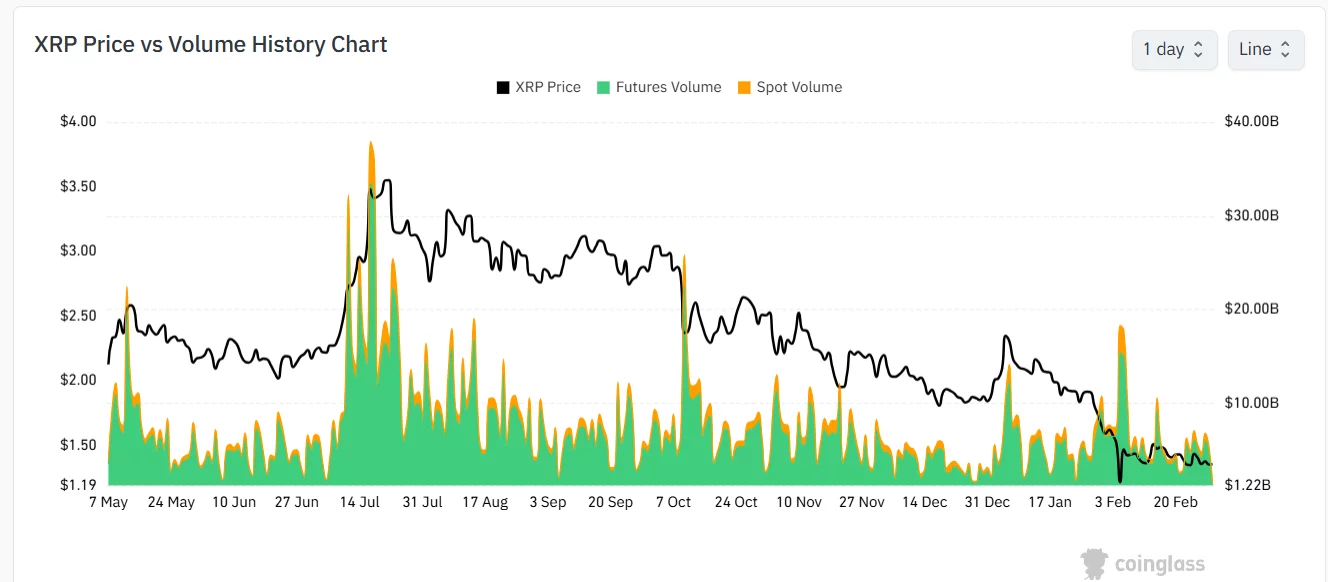
The XRP market is undergoing a structural shift as trading dynamics move from spot accumulation to a derivatives-led environment.
Summary
- XRP is shifting from spot-driven accumulation to a speculative, futures-led market, signaling an impending “volatility squeeze” as leveraged traders position for a major move.
- The price remains trapped below the 50-day SMA ($1.63) with a neutral-to-bearish RSI of 39, indicating a lack of buying pressure despite the surge in trading activity.
- Traders are eyeing $1.20 as the “must-hold” support floor, while a breakout above the $1.50–$1.80 resistance range is required to confirm a bullish reversal.
Recent Coinglass data reveals a significant uptick in XRP futures volume relative to spot trading, signaling that speculative interest is once again a primary price driver. This surge in futures activity typically precedes a “volatility squeeze,” where the price breaks sharply as leveraged positions are either rewarded or liquidated.
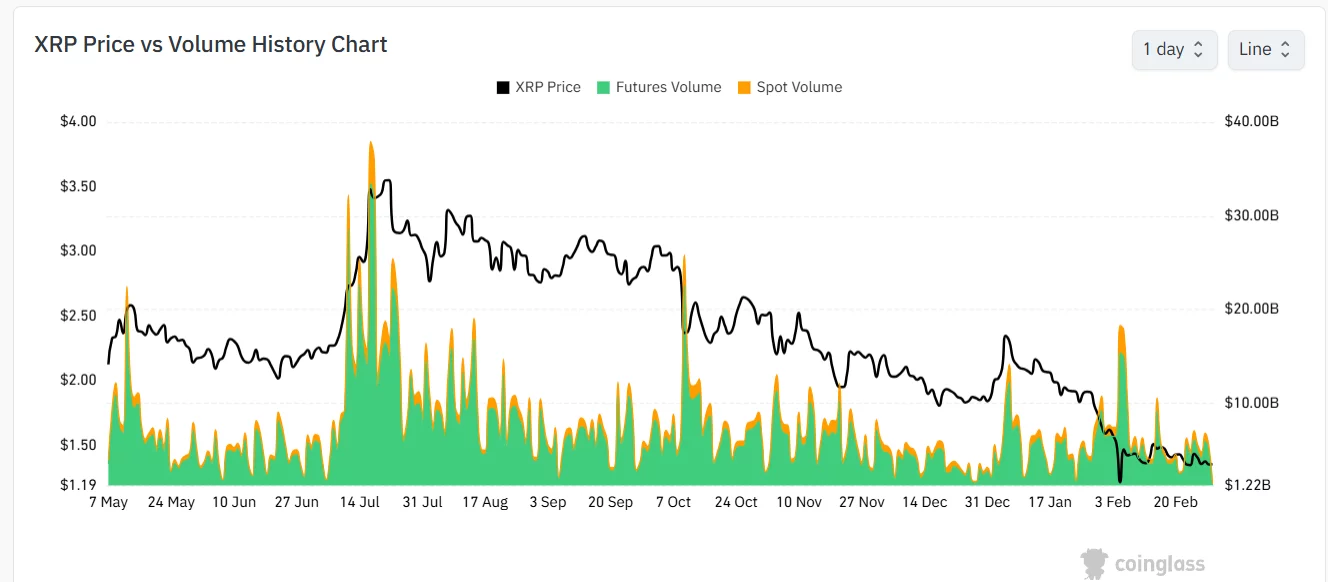
For the Ripple token (XRP), this suggests the market is no longer in a state of passive holding but is bracing for a decisive move.
This futures-dominated landscape makes the price more susceptible to rapid squeezes; while it provides the liquidity needed to break overhead resistance, it also warns that any downside could be exacerbated by a cascade of liquidations.
XRP price navigates critical support
Technically, XRP is navigating a precarious path, currently trading near $1.35 as of March 2026. The price action remains pinned below the 50-day Simple Moving Average (SMA) at $1.63, which acts as a formidable dynamic resistance.
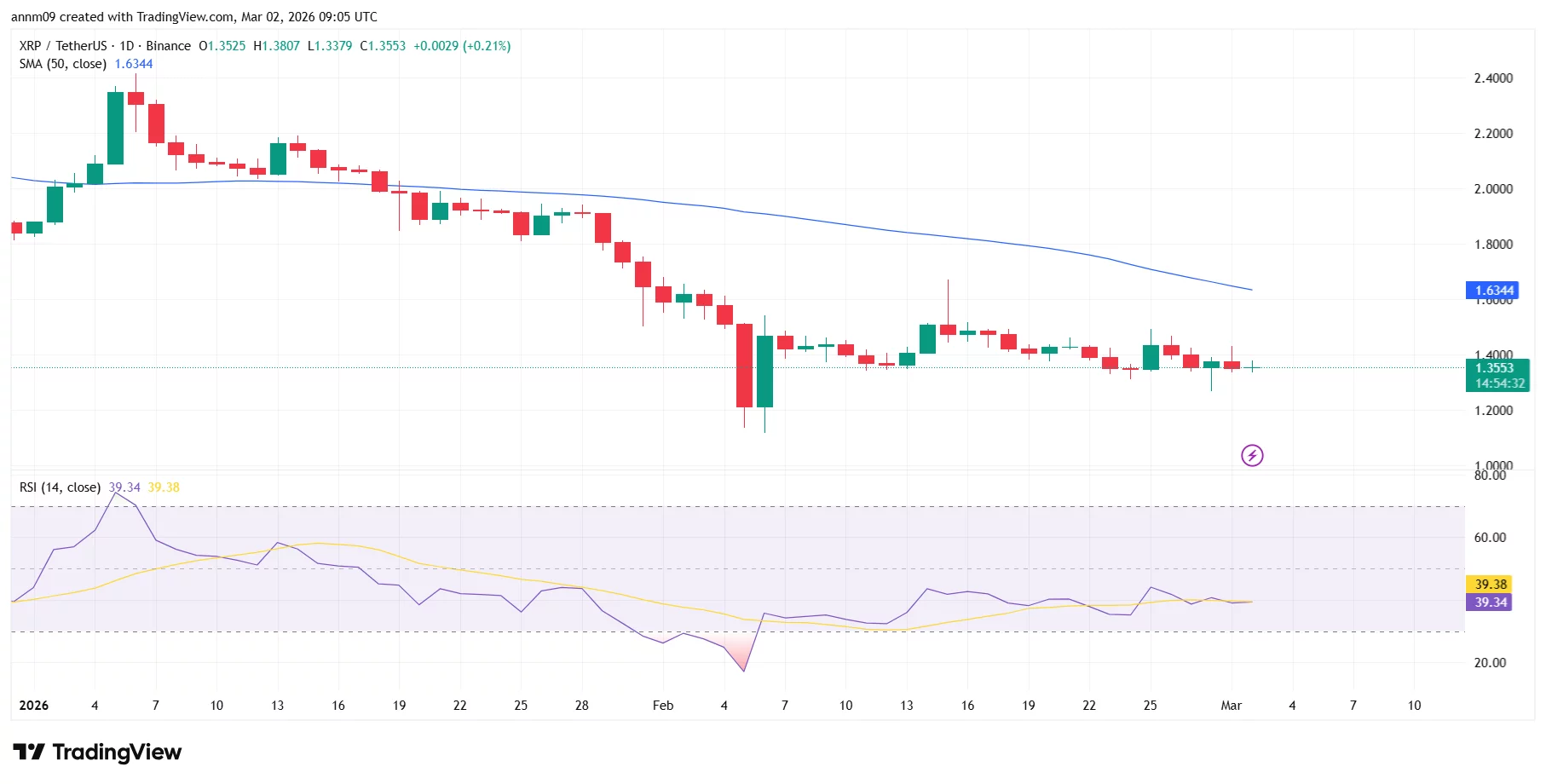
Until XRP secures a daily close above this level, the medium-term bias remains bearish. Recent candlestick patterns show a string of small-bodied “doji” candles, reflecting market indecision despite the rising futures turnover.
The Relative Strength Index (RSI) currently hovers around 39, placing the asset in a neutral-to-bearish zone that lacks the immediate buying pressure required for a reversal.
Immediate support is firmly established at the $1.20 mark, a level that has historically served as a psychological safety net. Should XRP fail to hold $1.20, a deeper retracement toward $1.00 becomes a distinct possibility.
Conversely, the first major hurdle for a bullish recovery sits at $1.50, followed by a high-volume resistance zone at $1.80.
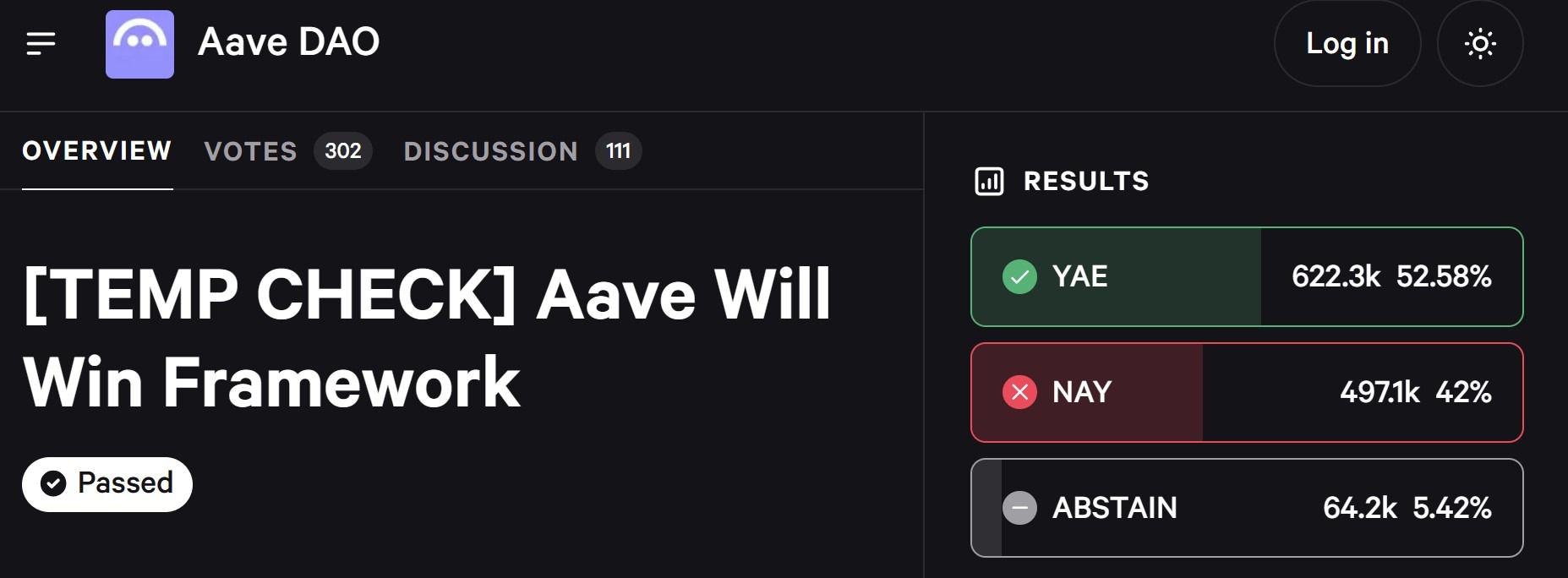
Aave’s “Aave Will Win” framework has passed its Temp Check vote, clearing the first formal stage of the protocol’s governance process.
On Sunday, the off-chain Snapshot vote closed with 52.58% voting in favor, 42% against and 5.42% abstaining. The result advances the measure to the Aave Request for Final Comment (ARFC) stage, where terms may be revised before any binding on-chain vote.
The framework asks tokenholders to approve up to $42.5 million in stablecoins and 75,000 Aave (AAVE) tokens for Aave Labs. In return, the organization would route 100% of revenue from Aave-branded products to the Aave DAO treasury under a DAO-funded operating model.
The narrow margin highlights a divided governance base as the protocol considers structural changes to its funding, revenue alignment and long-term development.

The ARFC stage will determine whether concerns raised during the debate will translate into revisions before a formal Aave Improvement Proposal is submitted on-chain.
Split vote reflects ongoing governance tensions
Aave founder Stani Kulechov said in a post on X that the Temp Check brings the protocol closer to a “fully token-centric model,” adding that structural improvements will be incorporated at the ARFC stage based on community feedback.

Critics previously questioned the size of the funding package and the inclusion of 75,000 AAVE tokens, which carry voting power.
Others called for clearer definitions and stronger disclosure standards around governance holdings.
Related: Grvt integrates Aave so traders can earn yield on perp collateral
On Feb. 25, competing reports from Aave Chan Initiative (ACI) founder Marc Zeller and Aave Labs offered contrasting interpretations of past funding and value creation ahead of the vote.
The ACI published a transparency report reviewing Aave Labs’ historical funding, while Aave Labs outlined its role in building the protocol since 2017.
What happens next in Aave governance process?
Under Aave’s governance framework, proposals typically move from Temp Check to ARFC before advancing to an on-chain Aave Improvement Proposal (AIP) vote. Only AIPs executed on-chain are binding.
If the proposal advances beyond ARFC, tokenholders will vote on whether to formalize the DAO-funded model and ratify Aave V4 as the long-term technical foundation.
The outcome could reshape how the Aave ecosystem structures development, revenue and brand stewardship.
Magazine: Would Bitcoin really be at $200K if not for Jane Street? Trade Secrets
The crypto market is under renewed pressure, with the total market capitalization slipping nearly 1% over the past 24 hours and all top 10 assets posting losses.
Nonetheless, select altcoins are breaking away from the trend. Venice Token (VVV) stands out as the strongest performer among the top 300 cryptocurrencies.
VVV Token Jumps 20% Despite Market Slump
Venice AI is a privacy-focused, permissionless platform that provides uncensored access to open-source AI models for text, image, video, and code generation. It was founded by Erik Voorhees, the former CEO of ShapeShift.
The Venice Token (VVV) is the native token of the Venice AI ecosystem. It was launched in January 2025. The altcoin’s primary utility is staking.
Users stake VVV to receive yield or mint DIEM. Each DIEM provides $1 of daily API access in perpetuity.
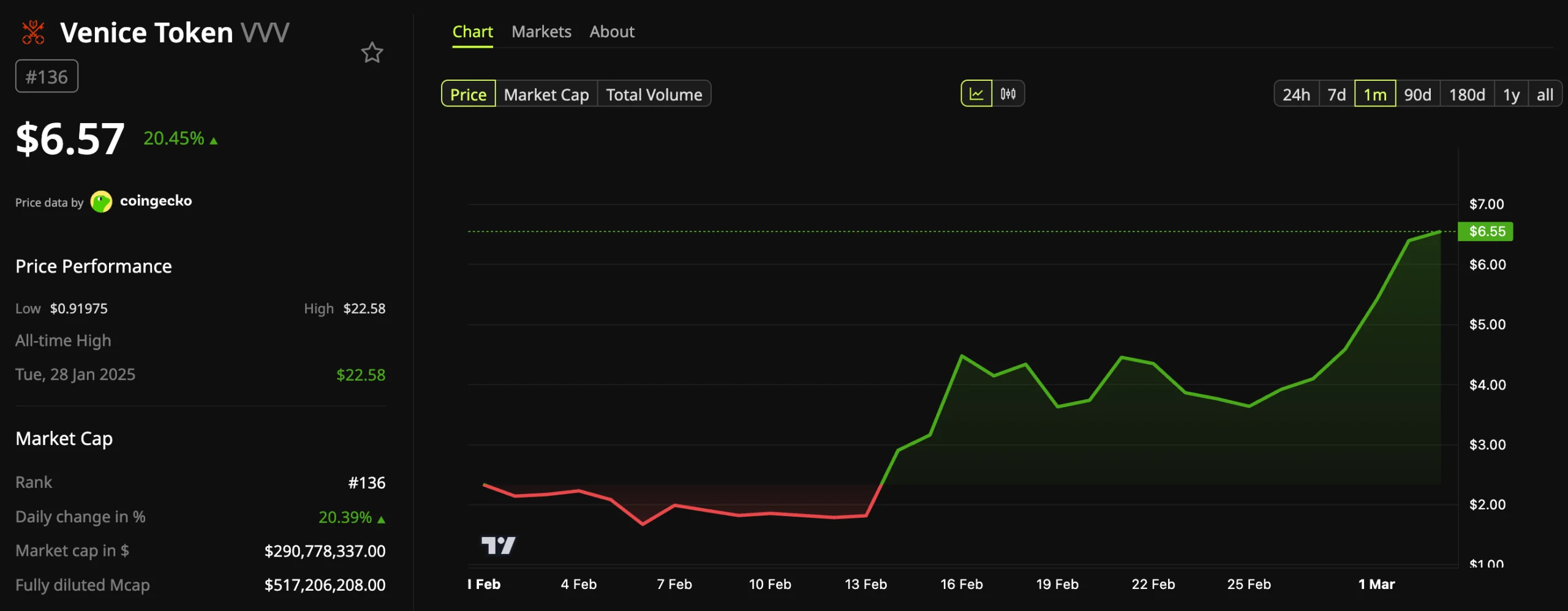
According to data from BeInCrypto Markets, VVV surged over 20% today, reaching an intraday high of $6.78. This marked its highest price since February 2025.
At the time of writing, the token was trading at $6.57. Furthermore, VVV has ranked as the largest gainer among the top 300 cryptocurrencies by market cap, according to CoinGecko.
Follow us on X to get the latest news as it happens
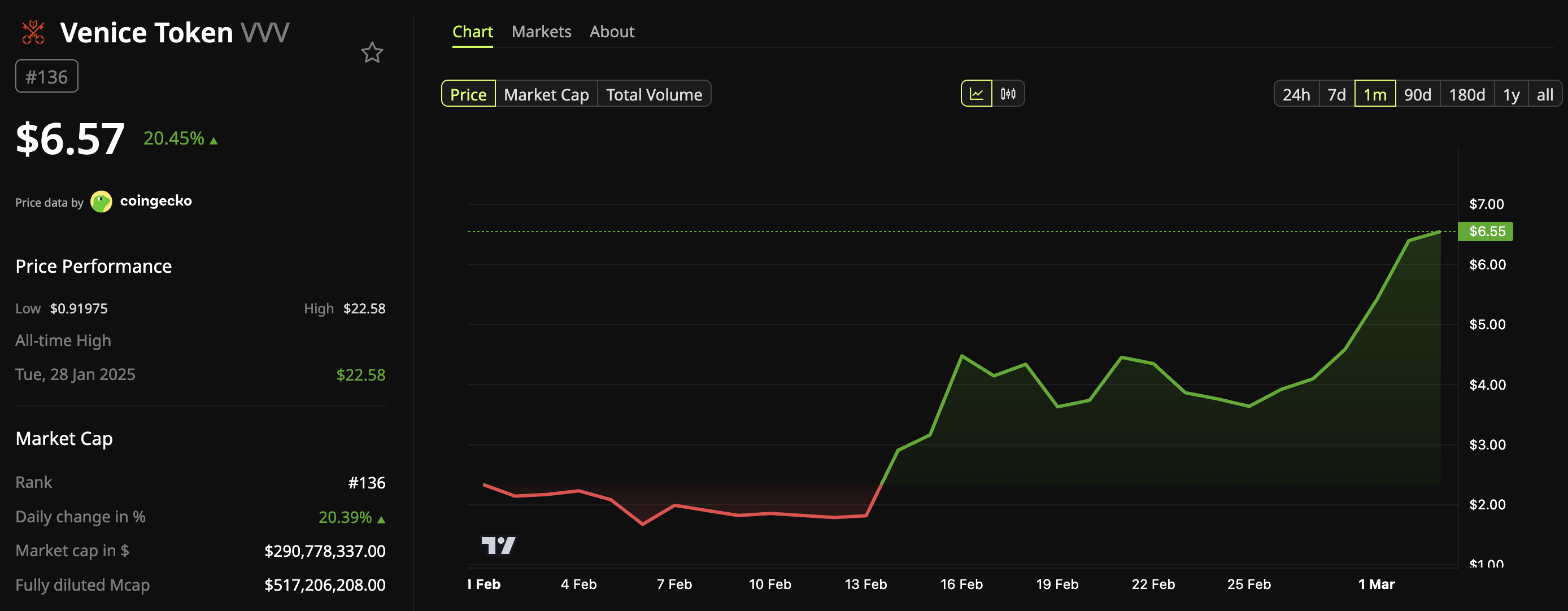
Monday’s surge is not an isolated move but part of a broader uptrend. In a recent post, CoinGecko noted that VVV has delivered 7.5x growth over the past three months. Its market cap has climbed above $290.7 million amid the ongoing rally.
Why is Venice Token (VVV) Surging?
A key question that arises is what is driving the rally. CoinGecko highlighted two primary catalysts behind the surge. First, the platform reduced its annual token emissions from February 10, lowering them from 8 million VVV to 6 million VVV.
This 25% cut in new token issuance tightens supply dynamics. With fewer tokens entering circulation, potential sell pressure from emissions declines, strengthening the token’s scarcity profile. Second, VVV’s integration across several platforms has boosted its exposure and utility.
“Here’s why it pumped: Venice cut annual emissions to 6M VVV/year, improving scarcity. VVV was integrated across several DeFi platforms as utility: → Aerodrome: Liquidity → Morpho: Collateral → Plena: Gasless swaps,” the post read.
In addition, the platform is experiencing rising demand. Venice AI has 2 million registered users, signaling steady ecosystem growth. Moreover, the number of API users has also increased.
LunarCrush data shows high social engagement with VVV. Engagement was 255% above the daily average, and social dominance jumped 424% from last week. The token earned an AltRank of 8 among all cryptocurrencies, reflecting strong performance and interest.
“The thesis that keeps circulating: private uncensored AI inference where compute demand drives staking, staking reduces circulating supply, and tightening supply creates reflexive upward pressure. The $DIEM token launch deepened this – 7.56M VVV already locked as collateral, roughly 17% of circulating supply,” LunarCrush added.
VVV still remains 70% below its all-time high. Whether the current rally, built on supply contraction and user growth, can sustain itself through a softer broader market remains to be seen.

- Kyber Network Crystal (KNC) has surged on a 900% volume spike.
- Recent Kyber product upgrades have improved market sentiment.
- Traders should closely watch the support at $0.148 support and the resistance at $0.175.
Kyber Network Crystal (KNC) has jumped by nearly 24% to trade around the $0.16 level at press time.

This move stands out in a market that has otherwise struggled for direction.
While many large-cap cryptocurrencies, including Bitcoin (BTC), posted losses, KNC moved higher with strong conviction, and the rally has drawn attention from traders who are now asking what is really driving the price higher.
Heavy trading activity fueling KNC’s price rally
One of the clearest drivers behind the surge is a dramatic increase in trading activity.
KNC’s 24-hour trading volume has exploded by more than 900%, pushing turnover to levels rarely seen in recent months.
Such a sharp rise in volume often signals aggressive short-term participation from traders looking to capitalise on momentum.
This also explains why the price moved largely independently of BTC, which has declined over the same period.
When volume expands this quickly, even modest buying pressure can translate into outsized price moves, and that appears to be exactly what happened with KNC.
Product updates add to positive sentiment
Although no single announcement directly triggered today’s price spike, Kyber Network has been quietly rolling out updates that have helped improve sentiment around the project.
Kyber Network recently highlighted expanded cross-chain functionality on its flagship product, KyberSwap.
As a result, users can now swap assets across 25 different blockchains using liquidity from eight providers in a single transaction.
This kind of convenience strengthens Kyber’s position in an increasingly competitive DeFi landscape.
The team has also introduced a new feature called Smart Exit on Kyber Earn.
Smart Exit allows liquidity providers to automate how and when they exit positions.
Instead of constantly monitoring charts, users can set predefined conditions for profit-taking, risk management, or time-based exits.
The feature is already live on Base and BNB Chain, with more networks expected to follow.
In parallel, Kyber has continued to form new ecosystem partnerships.
A recent integration with Vaultedge brought the USDVE asset onto KyberSwap, unlocking deeper liquidity and improved routing.
Another upcoming integration with Supernova is expected to further expand Kyber’s liquidity reach.
While these updates did not directly cause today’s spike, they help explain why traders are willing to speculate on upside.
Kyber Network Crystal price forecast
From a technical analysis standpoint, the KNC price has broken above its 30-day simple moving average near $0.148.
This level had acted as a cap for weeks, and clearing it helps reinforce bullish sentiment.
Moving ahead, the $0.148 zone has now become the most important support to watch in the near term.
Holding above this level would suggest that the recent breakout remains intact.
If buyers maintain control, KNC could attempt a push toward resistance around $0.175, and a clean break above that area may open the door to further upside.
On the downside, failure to hold $0.148, especially if trading volume contracts sharply, could trigger a quick pullback.
In that scenario, the next area of interest sits near $0.135, where buyers may look to step back in.
GBP/USD failed to climb above 1.3575 and corrected some gains. EUR/GBP started a decent increase and might aim for more gains above 0.8800.
Important Takeaways for GBP/USD and EUR/GBP Analysis Today
· The British Pound is showing bearish signs below the 1.3500 support.
· There is a key bearish trend line forming with resistance near 1.3440 on the hourly chart of GBP/USD at FXOpen.
· EUR/GBP is gaining pace and trading above the 0.8750 pivot level.
· There is a connecting bullish trend line forming with support at 0.8755 on the hourly chart at FXOpen.
GBP/USD Technical Analysis
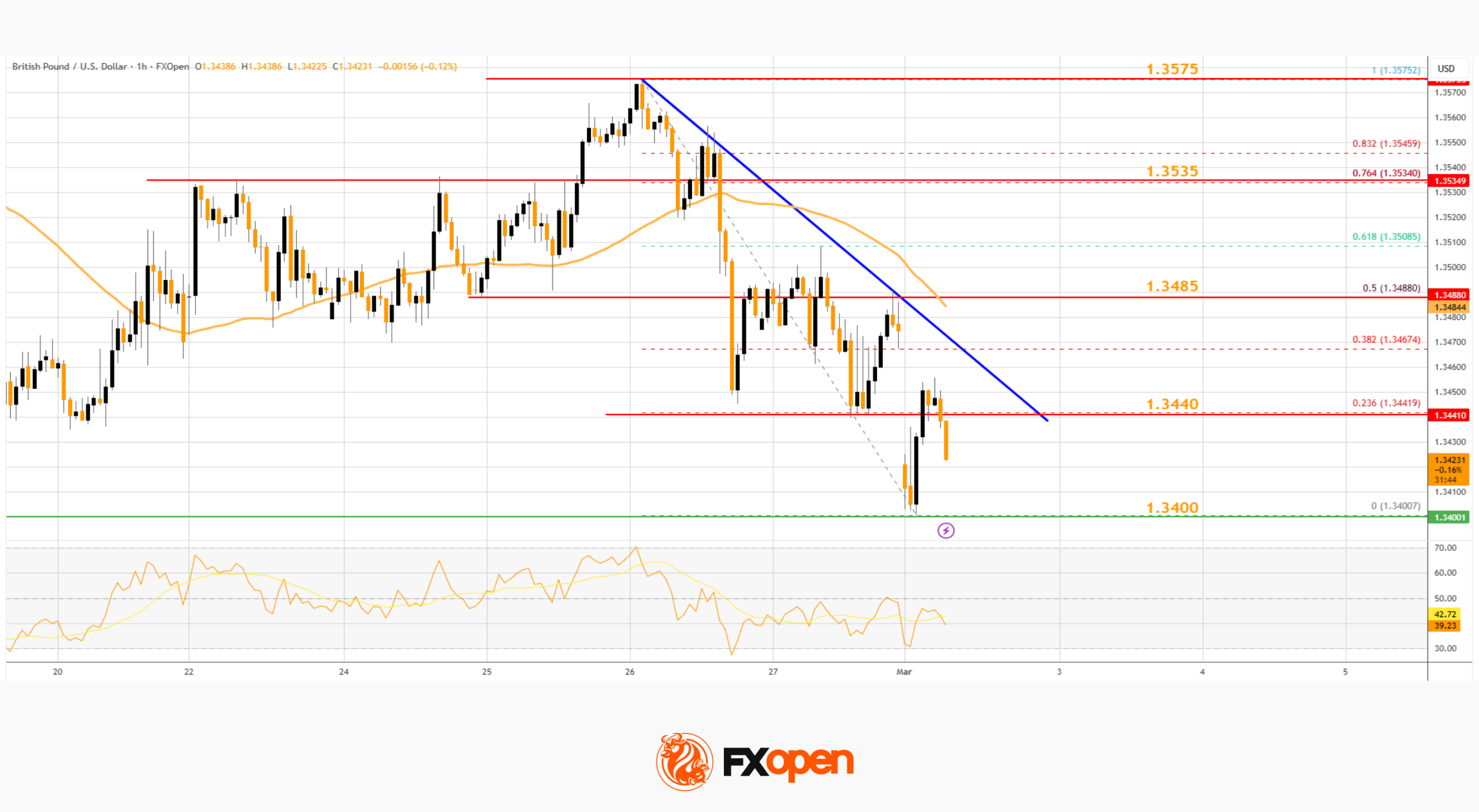
On the hourly chart of GBP/USD at FXOpen, the pair failed to stay above the 1.3535 pivot level. As a result, the British Pound started a fresh decline below 1.3500 against the US Dollar.
There was a clear move below 1.3485 and the 50-hour simple moving average. The bears pushed the pair below 1.3440. Finally, there was a spike toward the 1.3400 handle. A low was formed near 1.3400, and the pair is now consolidating losses.
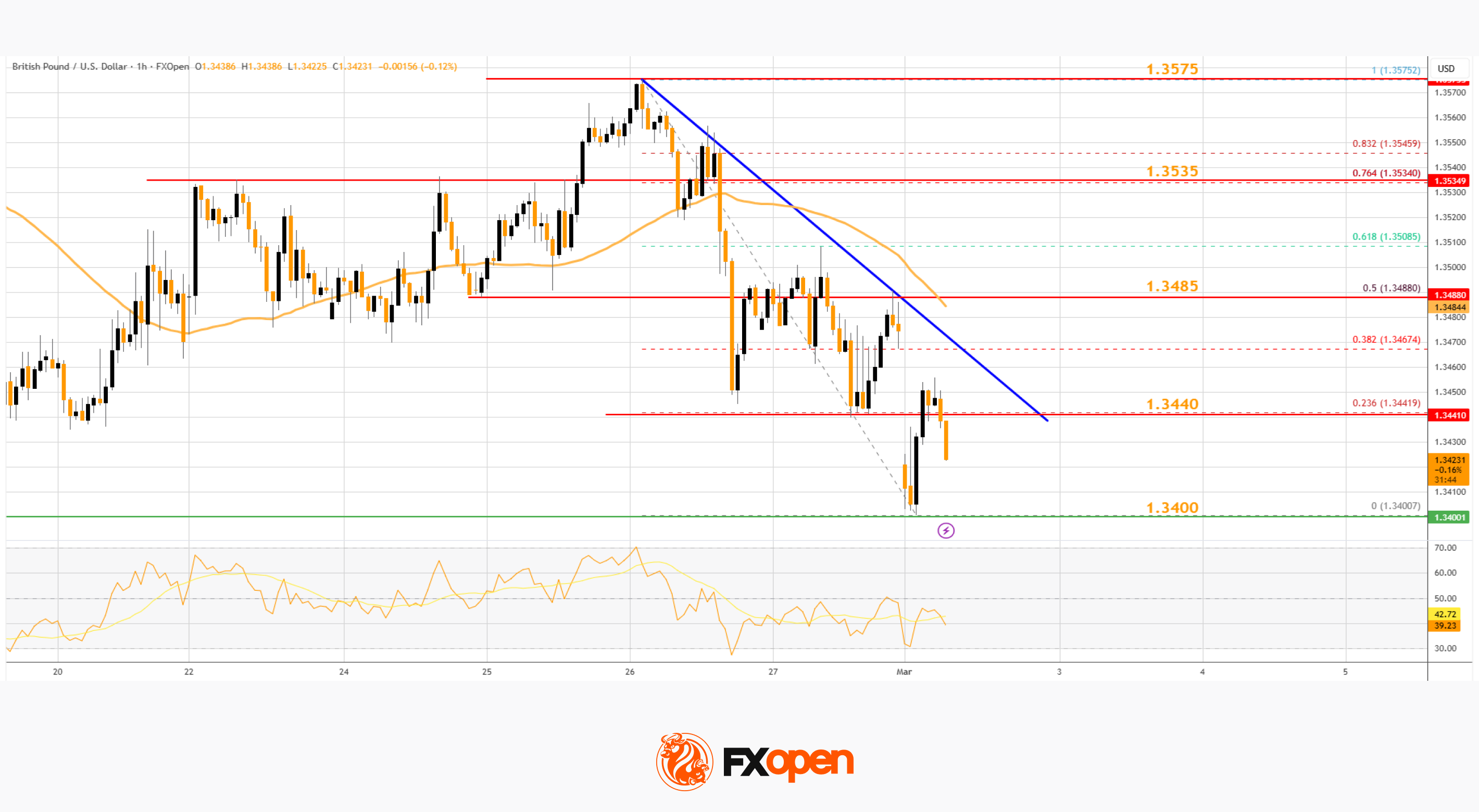
There was a minor move above 1.3425 and the 23.6% Fib retracement level of the downward move from the 1.3575 swing high to the 1.3400 low. On the upside, the GBP/USD chart indicates that the pair is facing resistance near a key bearish trend line at 1.3440.
A close above the trend line might send the pair toward the 50% Fib retracement at 1.3485 and the 50-hour simple moving average. If the bulls remain in action, they could aim for more gains.
In the stated case, the pair might rise toward 1.3535. The next major hurdle for GBP/USD sits at 1.3575. On the downside, there is a key support forming near 1.3400. If there is a downside break below 1.3400, the pair could accelerate lower. The next key interest area might be 1.3360, below which the pair could test 1.3320. Any more downside could lead the pair toward 1.3250.
EUR/GBP Technical Analysis
On the hourly chart of EUR/GBP at FXOpen, the pair started a decent increase from 0.8700. The Euro traded above 0.8750 to enter a positive zone against the British Pound.
The pair settled above the 50-hour simple moving average and 0.8760. The pair traded as high as 0.8789 before there was a downside correction. There was a move below the 23.6% Fib retracement level of the upward move from the 0.8702 swing low to the 0.8790 high.
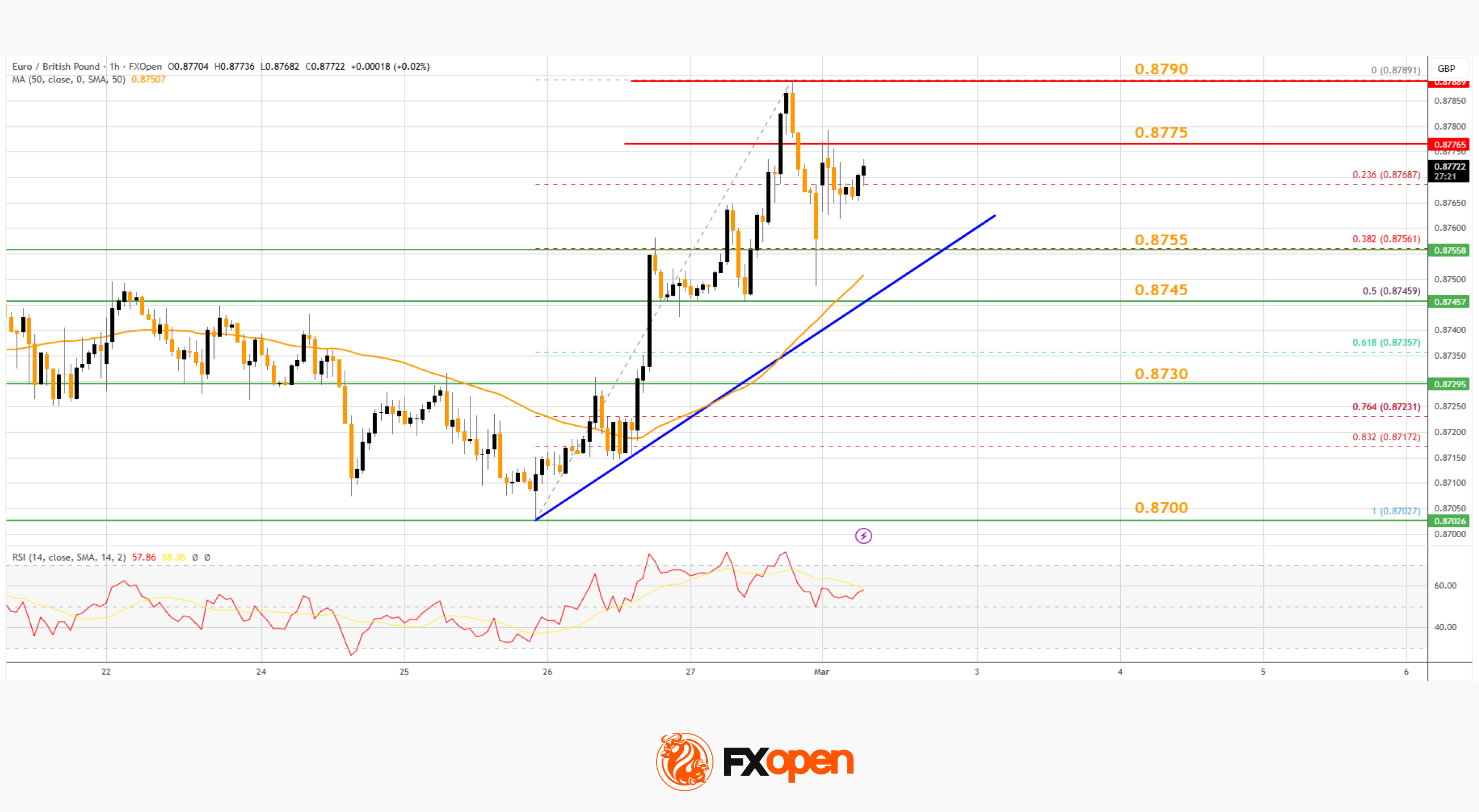
However, the pair is stable above 0.8750 and the 50% Fib retracement. Besides, there is a connecting bullish trend line forming with support at 0.8755.
A downside break below 0.8755 might call for more downsides. In the stated case, the pair could drop toward 0.8745. Any more losses might call for an extended drop toward the 0.8730 pivot zone.
If there is another increase, the EUR/GBP chart suggests that the pair is facing hurdles near 0.8775. A close above 0.8775 might accelerate gains. In the stated case, the bulls may perhaps aim for a test of 0.8800. Any more gains might send the pair to 0.8840.
Trade over 50 forex markets 24 hours a day with FXOpen. Take advantage of low commissions, deep liquidity, and spreads from 0.0 pips (additional fees may apply). Open your FXOpen account now or learn more about trading forex with FXOpen.
This article represents the opinion of the Companies operating under the FXOpen brand only. It is not to be construed as an offer, solicitation, or recommendation with respect to products and services provided by the Companies operating under the FXOpen brand, nor is it to be considered financial advice.


Elon Musk-owned X will allow crypto-related promotional content under an updated paid partnership policy.
Summary
- X has lifted its ban on paid crypto promotions, allowing influencers to publish sponsored content under a revised paid partnership framework.
- The update excludes jurisdictions such as the European Union, the United Kingdom and Australia.
According to X’s updated paid partnership policy, influencers will be allowed to publish promotional content related to cryptocurrencies, as long as it is in compliance with the platform’s disclosure rules and all applicable advertising and financial promotion laws.
However, the feature will not be available in regions where local regulations impose stricter requirements on crypto-related promotions, such as the European Union, the United Kingdom and Australia.
For instance, the U.K. Advertising Standards Authority has cracked down on crypto advertisements that downplay risks, recently banning a Coinbase ad campaign. Australian regulators have also taken a similar stance and have previously sued Meta over misleading crypto ads.
X first imposed restrictions on crypto advertising back in 2018, just weeks after similar crackdowns were introduced by other tech giants like Google and Meta, which was still operating as Facebook at the time.
Under the X branding, the social network in June 2024 moved the entire Financial Products category into Prohibited status for paid promotions and influencer partnerships as a means to combat undisclosed crypto endorsements and aggressive shilling by influencers who were not revealing their paid deals.
Commenting about the latest update, X’s head of product Nikita Bier said the feature will help creators build and grow their businesses on the platform while, at the same time, remaining transparent to their follower base.
Over the past months, X has announced plans to launch new products, including X Money and X TV, as part of Musk’s vision of an “everything app” that combines social networking, media, and financial services under one platform.
Last year, X partnered with Visa to enable digital transactions directly within the platform. Rumors have suggested that X Money could also include cryptocurrencies, but these claims have not been officially confirmed by the company.
However, X has confirmed plans for “Smart Cashtags,” a feature that will allow users to see real-time price charts and access buy and sell buttons for major assets, including cryptocurrencies, directly from their timelines.


After reaching an all-time high of roughly $4 trillion in total market value in October, crypto markets have entered one of their sharpest corrections in years.
Bitcoin, which peaked near $126,000 during the rally, has since retraced to the low $60,000 range. Billions of dollars in leveraged positions have been liquidated, open interest has contracted sharply from late-year highs, and liquidity across trading venues has thinned. ETF flows have turned negative, reinforcing a broader phase of institutional de-risking.
The speed of the unwind has revived a familiar question: when volatility spikes and liquidity compresses, how do institutions actually respond?
How Institutional Capital Responds to Volatility
For Sheldon Hunt, the pullback tells a different story than the headlines suggest. As founder and CEO of Sundial, a Bitcoin Layer-2 protocol targeting institutional participation, he sees institutions simplifying their exposure instead of abandoning it.
“When you see volatility like this, what pulls back first is risk, exposure, and complexity,” Hunt told BeInCrypto during our conversation at Liquidity Summit 2026 in Hong Kong, further adding:
“Institutions are not necessarily cutting all exposure. They are consolidating. They go back to basics.”
That return to basics, Hunt says, is best understood as a flight to quality.
When volatility spikes, institutions tend to reduce exposure to more complex or risk-centric applications. Rather than chasing new strategies, they narrow their focus. He added:
“You can pull back on some of these complexities, variants like DeFi. You want to get back to something like the basics.”
Wallet Activity as a Market Barometer
In addition to allocation shifts, Hunt also watches on-chain behavior for early signs of stress.
“Wallets generally don’t lie,” he said, describing wallet activity as one of the clearest barometers of market health.
During volatile periods, he observes assets moving off exchanges and DeFi platforms and reconsolidating into fewer wallets. That movement, he argues, reflects caution rather than capitulation.
Hunt does not view the current shift as a brief pause. In his assessment, the market is operating under real liquidity strain.
“We’re living in it right now,” he said. “There are certainly constraints around liquidity these days. People are quite nervous.”
He points to volatility across broader markets and tightening financial conditions as reinforcing that caution. For institutional capital, that environment changes the tempo of decision-making.
Hunt believes that capital allocators are likely to proceed more cautiously under current liquidity constraints.
“There’s still a real possibility that this is the beginning of a fairly nasty bear market that could go on for potentially two or more years,” he said.
If the downturn extends, timing matters less than resilience. Allocators focus on maintaining exposure without introducing additional fragility. He described the current phase as “minimizing risk exposure and looking to be in it for the long run.”
Evaluating Yield Through an Institutional Lens
That framing also informs how institutions approach Bitcoin yield.
Hunt said one of the most common misconceptions is that institutions are primarily focused on maximizing returns. In practice, he argued, that assumption does not reflect how professional allocators operate.
According to Hunt, professional allocators are unlikely to pursue 20% or 30% yields on their Bitcoin if those returns depend on layered complexity or unclear counterparty structures.
“The reality is that institutions are focused on minimizing risk,” he said. “Stable and secure yield over the long run, even 1% or 2%, is far more aligned with their mandates.”
In practical terms, that shapes how products are evaluated. Yield levels alone are not the deciding factor. Custody arrangements, settlement mechanics, and downside scenarios tend to carry more weight in internal reviews.
Despite the growing conversation around Bitcoin-native finance, Hunt believes meaningful institutional deployment remains limited. Hunt added:
“There’s this idea that there’s all of this Bitcoin out there, it’s all sloshing around. The reality is that we have seen very little Bitcoin being put to work on DeFi or being put to work in either the protocols or layer-2s.”
A large share of BTC continues to sit in long-term custody. For Hunt, that signals that the infrastructure layer is still developing rather than saturated.
“It’s still early days,” he said. “The best days of Bitcoin are very much ahead of it. The best days of DeFi are ahead of it. There’s still so much more to be untapped.”
The slower pace of institutional participation, in his view, reflects how risk is assessed. Before capital moves into structured yield environments, questions around custody control, settlement assurance, and exposure concentration must be addressed in ways that align with existing mandates.
Custody, Control, and the Next Cycle
Looking toward the next cycle, Hunt expects architecture to matter more than surface-level features.
“I’m of the very firm belief that in this next cycle, a big priority is going to be around non-custodial options,” he said, pointing specifically to non-custodial staking and settlement models that account for custodial risk.
In his view, institutions want clarity over who controls assets at every stage of the process. In practice, that means retaining unilateral authority over settlement and custody. The crypto industry has long championed the idea of being one’s own bank. For institutional allocators, that principle shows up less as ideology and more as governance architecture. The next phase of adoption will depend on whether that architecture can satisfy traditional risk frameworks.

Hong Kong links up with Shanghai trade authorities to put cargo data on blockchain

Arsenal vs Chelsea: Title-chasing Gunners face crucial Premier League test | Football News

Australian Grand Prix: Formula 1 season-opener to feel ‘no impact’ of travel chaos caused by Middle East conflict


-

 Sports7 days ago
Women’s college basketball rankings: Iowa reenters top 10, Auriemma makes history
-

 Politics7 days ago
Nick Reiner Enters Plea In Deaths Of Parents Rob And Michele
-

 Fashion3 days ago
Weekend Open Thread: Iris Top
-

 Business6 days ago
True Citrus debuts functional drink mix collection
-

 Politics3 days ago
ITV enters Gaza with IDF amid ongoing genocide
-

 Tech1 day ago
Unihertz’s Titan 2 Elite Arrives Just as Physical Keyboards Refuse to Fade Away
-
Sports2 days ago
The Vikings Need a Duck
-

 Crypto World6 days ago
XRP price enters “dead zone” as Binance leverage hits lows
-

 Tech6 days ago
Unsurprisingly, Apple's board gets what it wants in 2026 shareholder meeting
-
 NewsBeat2 days ago
Dubai flights cancelled as Brit told airspace closed ’10 minutes after boarding’
-

 NewsBeat4 days ago
Cuba says its forces have killed four on US-registered speedboat | World News
-
 NewsBeat2 days ago
The empty pub on busy Cambridge road that has been boarded up for years
-
 NewsBeat4 days ago
Manchester Central Mosque issues statement as it imposes new measures ‘with immediate effect’ after armed men enter
-

 NewsBeat19 hours ago
‘Significant’ damage to boarded-up Horden house after fire
-
 NewsBeat7 days ago
‘Hourly’ method from gastroenterologist ‘helps reduce air travel bloating’
-

 NewsBeat2 days ago
Abusive parents will now be treated like sex offenders and placed on a ‘child cruelty register’ | News UK
-
 NewsBeat5 days ago
Police latest as search for missing woman enters day nine
-

 Business4 days ago
Discord Pushes Implementation of Global Age Checks to Second Half of 2026
-
 Sports7 days ago
2026 NFL mock draft: WRs fly off the board in first round entering combine week
-

 Business4 days ago
Only 4% of women globally reside in countries that offer almost complete legal equality