

Crypto World
Bitcoin Weathered 4 CPI Shocks in 2026: June’s Print Lands Today



Bitcoin traders are on high alert ahead of the June US Consumer Price Index release on July 14, with BTC trading near $62,000 after months of sharp volatility.
Past inflation prints triggered double-digit swings, and the June report could decide the market’s next big move.
CPI Data and Bitcoin: A Pattern of Violent Swings
The Consumer Price Index measures how much prices for goods and services change over time, making it the main gauge of US inflation. Markets watch it closely because the data shapes expectations for Federal Reserve policy. A single surprise in the report can reshape rate cut bets within minutes.
Bitcoin has reacted violently to these releases throughout 2026. Analyst Ted Pillows recently mapped the pattern, and the numbers speak for themselves. Each release this year moved Bitcoin far more than typical trading sessions.
In February, BTC dropped 5.77% after the print. March brought an 8.41% surge, while April closed with a 4% decline. Furthermore, May delivered a brutal 27.6% crash, followed by a 10.85% pump in June.
Follow us on X to get the latest news as it happens.
These swings confirm that macro data now drives risk assets as much as crypto-native events. Bitcoin increasingly trades on expectations for Federal Reserve decisions rather than internal market dynamics alone.
The mechanics are straightforward. Hotter-than-expected inflation delays interest rate cuts, strengthens the dollar, and pressures speculative assets.
Conversely, cooler readings fuel hopes of monetary easing and liquidity-driven crypto rallies. In 2026, with the Fed navigating an uncertain environment, even small surprises can trigger outsized reactions.
Will Bitcoin Pump or Dump After CPI Report
According to BeInCrypto data, Bitcoin currently trades around $62,097, holding a narrow range amid US-Iran tensions affecting oil routes.
Meanwhile, spot Bitcoin ETFs have registered renewed inflows, signaling institutional appetite near perceived cycle lows. Broader sentiment remains cautious, however, with traders defending the $61,000-$62,000 zone.
A softer-than-expected reading could push BTC toward $65,000, especially if it reinforces bets on a Fed pause. Analysts note that declining gasoline prices might ease the headline figure and offer relief. A friendly number would also strengthen the case for liquidity returning to speculative markets.
However, a hot print could test supports around $61,000 and trigger fresh liquidations. Traders remain cautious, since May’s 27% collapse proved how fast sentiment can flip. Leveraged positions tend to amplify every move in both directions.
Despite the short-term noise, the long-term thesis remains intact for many investors. Bitcoin’s fixed supply and growing role as digital gold continue to attract corporate treasuries and ETF capital. Ultimately, Bitcoin’s longer trajectory will depend on institutional flows, regulation, and broader economic trends beyond a single report.
Subscribe to our YouTube channel to watch leaders and journalists provide expert insights.
The post Bitcoin Weathered 4 CPI Shocks in 2026: June’s Print Lands Today appeared first on BeInCrypto.



Early in Donald Trump’s second term, his special advisor, Elon Musk, began to promote a conspiracy theory that suggested that Fort Knox didn’t contain the gold it was supposed to.
This was always nonsensical; documents released in Trump’s first term confirm that the Treasury Office of Inspector General conducts “audits of United States Mint Custodial Gold Schedules” on an annual basis.
This audit “includes an inspection of all gold compartments and joint seals to verify the compartments are locked, and the seals are in-tact and have not been tampered with.”
Furthermore, despite Musk promoting the claim that the gold hadn’t been seen since 1974, during Trump’s first term it was actually visited by then Treasury Secretary Steven Mnuchin and then Senate Majority Leader Mitch McConnell, and photos of them inside the vault were released.
Read more: Zero Hedge invited to White House press pool despite lies about Fort Knox gold
Recently, Scott Bessent, the current treasury secretary, went on Jesse Watters’ show on Fox News and confirmed that all the gold is present and accounted for — over $1 trillion worth in total.
Musk, for his part, hasn’t posted about this most recent confirmation, with his last X post about Fort Knox coming in February of last year.
Got a tip? Send us an email securely via Protos Leaks. For more informed news and investigations, follow us on X, Bluesky, and Google News, or subscribe to our YouTube channel.
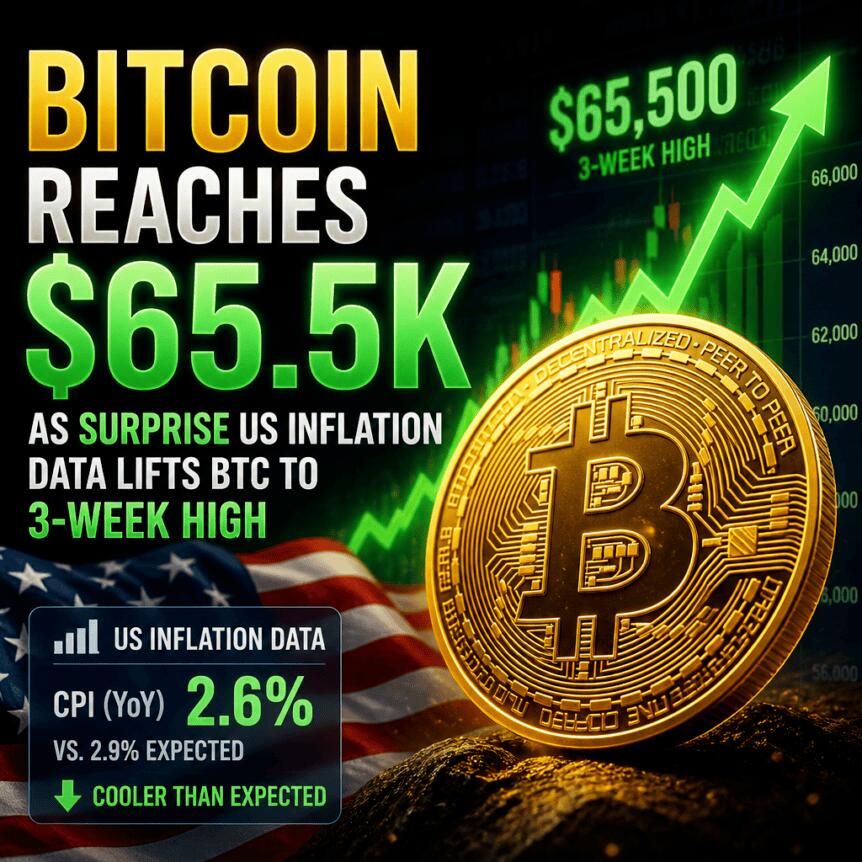
Bitcoin pushed to a fresh three-week high on Wednesday, riding a wave of relief after US inflation data cooled for a second straight session. The move brought BTC/USD to $65,500—its highest level since June 22—while risk assets strengthened as traders recalibrated expectations for Federal Reserve policy.
The rally, however, has not erased caution among market participants. Traders highlighted nearby liquidity hurdles and pointed to historical price behavior around key moving-average levels, suggesting Bitcoin could face renewed selling pressure if it fails to hold above critical zones.
Key takeaways
- BTC/USD traded up to around $65,500, the highest since June 22, after US Producer Price Index (PPI) data came in cooler than expected.
- The improving inflation picture supported a more favorable tone for risk assets and reduced certainty around near-term Fed rate hikes, according to CME Group’s FedWatch Tool.
- Despite the breakout attempt, traders emphasized tight order-book liquidity levels around $65.6K and $67.2K that could determine whether the move extends.
- Analysts noted Bitcoin is nearing a 50-month exponential moving average (EMA), a technical area that has previously corresponded with rejection during bear-market-style setups.
Bitcoin’s move tracks a cooler inflation print
Price action accelerated after the latest US Producer Price Index reading for June. Per data from the Bureau of Labor Statistics (BLS), the year-on-year PPI rate for final demand was 5.5%, following a 0.3% monthly decrease.
In the BLS release, the agency explained that the June movement in the index for final demand reflected price changes across goods and services: “the index for final demand goods… fell 1.4 percent,” while “the index for final demand services moved up 0.2 percent.” The PPI report is available via the BLS official news release.
The PPI data followed Tuesday’s Consumer Price Index (CPI) surprise to the downside, which had already lifted Bitcoin. As earlier coverage noted, CPI came in weaker than expected despite macro pressures, including the US-Iran conflict and its knock-on effects on oil prices.
Market participants interpreted the combination of PPI and CPI softness as further evidence that inflation pressures are easing, which in turn can influence expectations for how quickly—and how aggressively—the Fed will tighten or hike rates. Economist Mohamed El-Erian described the PPI results as “much better-than-expected” and suggested the numbers could boost equities and temper expectations for further interest-rate hikes, in a post on X: elerianm’s update.
Fed expectations shift as traders reprice rate odds
Beyond Bitcoin-specific dynamics, Wednesday’s strength aligns with a broader shift in interest-rate expectations. CME Group’s FedWatch Tool indicated changes to probability assumptions for the September FOMC decision, showing that a 0.25% hike was no longer the single most likely scenario.
That repricing matters for crypto because Bitcoin frequently trades like a high-beta macro asset during periods when funding conditions are expected to loosen or tightening risks appear to fade. When traders perceive a lower likelihood of additional hikes, appetite for risk tends to improve—often translating into more aggressive bids in liquid assets like BTC.
Additional commentary pointed to falling inflation expectations. The Kobeissi Letter referenced bets tracked via Polymarket’s prediction activity, arguing that inflation expectations continued to decline, based on the service’s users’ outlook.
Order-book levels and moving-average resistance in focus
Even with the upside momentum, traders appeared reluctant to declare the rally fully confirmed. Much of the near-term debate centered on whether Bitcoin can clear immediate liquidity pockets and hold them long enough to trigger sustained buying.
Trader Daan Crypto Trades emphasized that liquidity above the current area sits around the $65.6K region and, more importantly, at $67.2K, describing those levels in an X post: Daan Crypto Trades. In the same update, the trader argued that breaking above the $67.2K liquidity zone could convert the move into “a bigger move,” potentially reopening the path toward the $70K-plus area—positioning Bitcoin inside the middle of its commonly referenced $60K–$80K range.
On the technical side, Rekt Capital highlighted that BTC was approaching its 50-month exponential moving average (EMA). In past market cycles, such moving averages can act as inflection points; the argument, tied to “bear-market history,” is that if price behaves similarly, it may face rejection at or near the EMA rather than continuing cleanly higher.
That caution was echoed by trader Killa, who referenced a statistical pattern from the prior 12 months and suggested BTC could “derisk for the remainder of the month” and potentially push back down if the historical behavior repeats.
What to watch next for confirmation or reversal
For traders, the immediate question is whether Bitcoin can build acceptance above the liquidity zones highlighted by market participants—particularly around $67.2K—and whether it can avoid rejection as it tests the 50-month EMA area noted by analysts. With rate expectations still sensitive to incoming data and Fed messaging, the next inflation or central-bank headline could quickly shift the balance again.
Crypto World
Bitcoin (BTC) price rally cools as investors digest inflation data, oil clouds outlook: Crypto Daily


Bitcoin’s rally on Tuesday petered out as investors considered a weaker-than-forecast U.S. inflation figure wasn’t enough to prompt a Federal Reserve interest-rate cut.
While it’s still 3% higher over 24 hours, the largest cryptocurrency has dropped 0.5% since midnight. Ether (ETH), up 4.7% in 24 hours, has also pulled back by 0.5%.
On Polymarket, the perceived odds of a rate increase plunged from 34% to 6.7% after the data came out. Bettors now weigh a 93% chance the Federal Reserve will leave rates unchanged this month, and the CME’s FedWatch shows 30-day fed funds futures prices indicating just a 14.4% chance of an increase.
“Crypto’s reaction to the latest CPI report shows the market is becoming more selective in how it interprets macro signals,” Markus Levin, co-founder of XYO, told CoinDesk. “While falling inflation reduces pressure on markets and improves the outlook for risk assets, traders are no longer assuming that every favourable inflation print will automatically lead to rate cuts or new all-time highs.”


South Korea plans to update its 76-year-old national asset management system to formally include virtual currencies and intellectual property in the country’s definition of national assets, according to the Ministry of Economy and Finance’s economic policy roadmap released Wednesday.
The proposal contemplates revising the National Property Act, which dates back to 1950, and includes plans to create a broader legal framework for managing state-owned assets. The ministry reiterated plans to start a pilot program for tokenized government bonds in 2027, saying blockchain technology has the potential to reduce transaction costs and speed up transfers.
Officials are also studying the tokenization of state-owned real estate to allow retail investors to participate and share in investment returns, according to the plan.
The announcement builds on South Korea’s broader push to bring blockchain into public finance. Earlier this year, the Finance Ministry said it would begin testing tokenized deposits for government spending in the fourth quarter. The Bank of Korea has already started trials of its central bank digital currency (CBDC) with commercial banks.
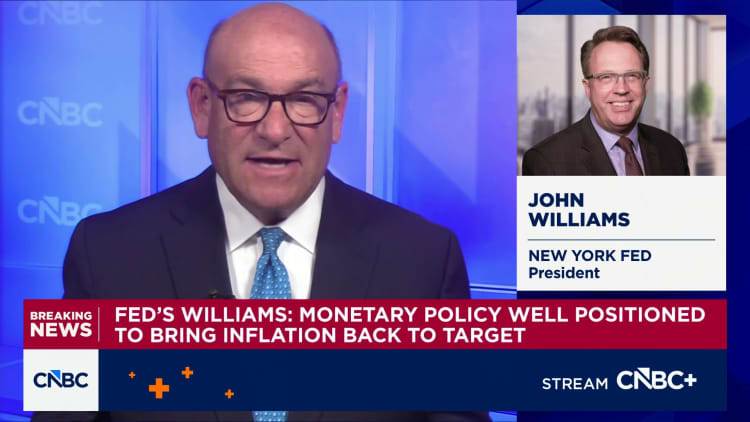

New York Federal Reserve President John Williams said Wednesday that he sees multiple signs that inflation has peaked, allowing the central bank to hold interest rates in place despite market expectations for a hike in coming months.
In a speech delivered to business leaders in his home district, Williams cited five reasons why he expects the latest price surge has run its course.
“There are encouraging reasons to expect that inflation has peaked and should edge down in coming quarters,” he said.
“I expect overall inflation to decline to around [3.25%] percent by year-end, then continue on a glide path toward our 2 percent goal in 2027 and land on target in 2028,” he later added.
Inflation spiked this year following after U.S. and Israel attacked Iran in late February, sending oil prices spiraling higher. Williams cited the war, along with lingering tariff impacts and accelerated technology spending, as the primary drivers.
However, he sees signs that those factors, plus other inputs, are easing.
Specifically, there shouldn’t be “significant additional impulse” from tariffs as expiring duties are merely replaced by one ones. At the same time, the oil spike has “likely peaked and will come down closer to levels seen before” the fighting, he said.
Artificial intelligence investment also is seen as another contributor, but Williams said “imbalances” should “recede over time as more supply comes online.” He also cited the labor market as not a source of inflation, and concluded that inflation expectations also are “well-anchored,” giving the Fed policy breathing room.
“Growth in the economy is solid and on trend, and the labor market is likewise solid and stable,” he said. “But with inflation running high, it is imperative that we restore it to the Federal Reserve’s 2 percent longer-run goal on a sustained basis. The current stance of monetary policy is well positioned to do that.”
Nevertheless, markets still expect the Fed to hike as soon as September. By a narrow margin, Williams’ colleagues on the Federal Open Market Committee in June also penciled in one quarter-percentage-point increase by the end of the year.
The remarks come a day after the Bureau of Labor Statistics reported that consumer prices posted an unexpectedly sharp 0.4% drop in June, taking the annual inflation rate down to 3.5%. It was the largest one-month price decline since April 2020, but still left the Fed well short of its inflation target.
Fed Chairman Kevin Warsh told the House Financial Services on Tuesday that the price drop did not represent a “mission accomplished” moment. “That is not my view,” he said.
Cardano’s native token has experienced heightened volatility lately, but the bulls eventually prevailed and decisively pushed the price above the June lows.
Certain analysts believe ADA is poised for a much more substantial short-term upswing, and recent whale activity supports that scenario.
Parabolic Rally on the Way?
The recent US CPI data, which revealed that inflation in America has cooled off more than previously expected, has given the crypto market a much-needed boost. ADA caught the green wave, with its price climbing by 3.5% over the past 24 hours and currently trading at approximately $0.17.
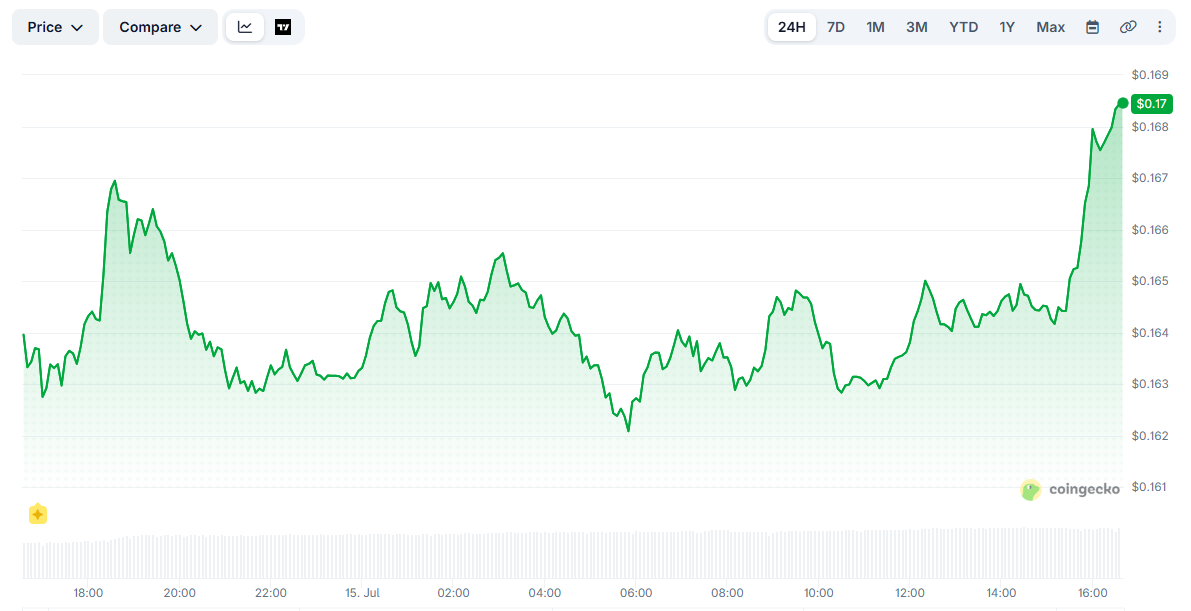
Another element that may have propelled the asset’s resurgence is the recent formation of an inverse head-and-shoulders pattern on its chart, as X user CryptoJack noted. The setup consists of three lows: a left shoulder, a deeper head, and a right shoulder, which usually indicates that sellers are weakening and buyers are taking control.
According to Celal Kucuker, ADA could be on the verge of a price explosion toward a new all-time high of $5. The analyst believes we have reached the bottom zone and expects the “parabolic” rally to begin.
Whales and More
The latest behavior of the large investors reinforces the optimistic price outlook. As CryptoPotato reported, whales holding between 100,000 and 100 million ADA have increased their total possessions to over 25.6 billion coins, while smaller players (wallets owning fewer than 100 units) have reduced their exposure. Together, these factors represent a healthy setup for the token, though they don’t guarantee an immediate price explosion.
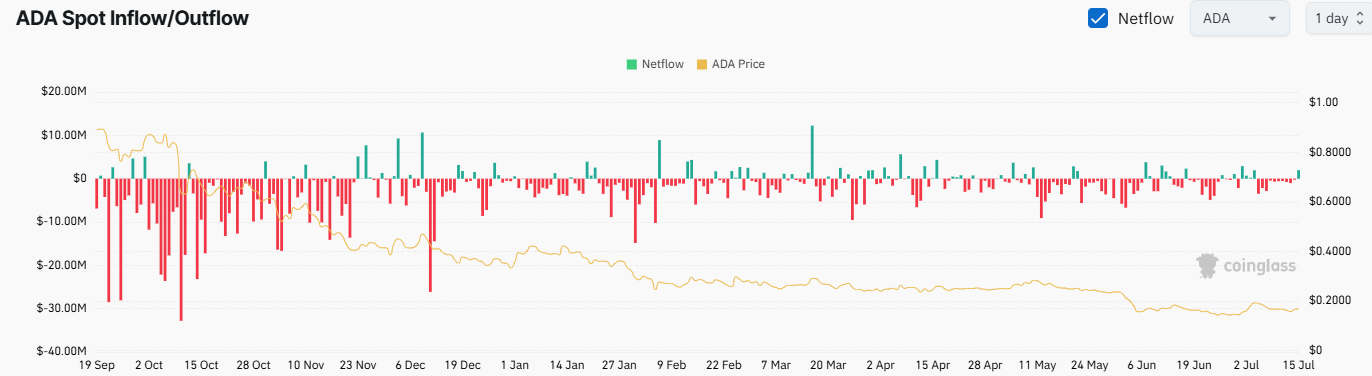
Another element that may lift the bulls’ spirits is ADA’s exchange netflow. Over the past weeks, outflows consistently exceeded inflows, suggesting that investors have been shifting from centralized platforms to self-custody methods, thereby reducing immediate selling pressure.
In contrast, ADA’s Relative Strength Index (RSI) remains a bearish element in the current setup. The technical analysis tool’s ratio has soared past 70, meaning the asset has entered overbought territory and could be due for a pullback in the near future. The index ranges from 0 to 100, and conversely, anything under 30 is considered a buying opportunity.

The post Top Cardano (ADA) Price Predictions: Are Bulls Ready to Take Over? appeared first on CryptoPotato.


An attacker drained approximately $18 million in USDC from Ostium’s liquidity vault on Arbitrum in an oracle manipulation exploit detected by blockchain security firm Blockaid, onchain data shows.
According to Blockaid’s alert, the attacker leveraged a registered PriceUpKeep forwarder, a component of Ostium’s automated infrastructure, to submit oracle price reports with future-dated timestamps. The manipulated reports created the appearance of profitable trades, which triggered an $18 million USDC payout from the vault.
Ostium is a decentralized perpetuals exchange on Arbitrum that allows users to trade real-world assets including commodities, forex, and equity indices, with up to 200x leverage, settling in USDC.
Ostium uses a custom price-feed system to track real-world asset prices, with a third-party automation network called Gelato responsible for pushing those prices onchain at the right moments. A smart contract called PriceUpKeep sits at the center of that process, acting as the trigger that writes the latest price data to the blockchain whenever a trade needs to be executed.


Binance has unveiled an $800,000 XRP airdrop campaign for eligible Ripple USD holders, introducing weekly rewards designed to encourage activity around Ripple’s dollar-backed stablecoin.
Summary
- Binance will distribute $800,000 in XRP to eligible RLUSD holders through weekly airdrops until Aug. 14.
- Users must hold RLUSD and meet Binance’s Margin or Futures trading requirements to qualify for rewards.
- The campaign comes as Ripple expands RLUSD adoption through its x402 Foundation partnership for AI payments.
According to a July 15 announcement from Binance, users holding RLUSD in Binance Earn, Margin, or Futures accounts between July 17 and Aug. 14 will qualify for XRP rewards through weekly distributions scheduled every Friday until the campaign concludes.
The exchange said the promotion is available only to users who meet its eligibility requirements and is excluded in certain jurisdictions.
Eligibility rules focus on active RLUSD users
To qualify, Binance said participants must maintain at least 0.01 RLUSD in eligible accounts. In addition, users are required to record an average daily Margin or Futures trading volume of $500 or more across any trading pairs during the promotion period.
Binance also introduced separate treatment for borrowed assets. According to the exchange, RLUSD obtained by borrowing other stablecoins will receive a 60% haircut after liabilities are calculated. The adjustment applies to borrowing involving USDT, USDC, U, USD1, and FDUSD within Margin accounts.
Broker accounts are also eligible to receive XRP rewards, Binance said, adding that there is no individual cap on airdrop payouts for those accounts. Even so, the exchange noted that participation remains restricted in selected countries because of local regulatory requirements.
The campaign arrives as RLUSD has lost some of the momentum it built earlier this year. The Ripple-issued stablecoin carried a market capitalization of about $1.51 billion at the time of writing after declining more than 10% over recent weeks, while its 24-hour trading volume slipped by roughly 6%.
Earlier in June, RLUSD’s market capitalization climbed above $1.81 billion following the rollout of 24/7 settlement on the XRP Ledger with Mastercard, before later retreating amid delays surrounding U.S. crypto legislation and lower market expectations for passage of the CLARITY Act.
Ripple expands RLUSD use cases beyond stablecoin payments
The Binance rewards program comes shortly after Ripple continued expanding RLUSD’s role beyond conventional payments. As previously reported by crypto.news, Ripple joined the x402 Foundation as a Premier Member to support payments made with XRP and RLUSD through an open standard built for AI agents.
Ripple said AI systems are increasingly handling more of the payment process, creating demand for infrastructure capable of transferring value as efficiently as information moves across the internet. The company added that developers can use the XRP Ledger and the x402 protocol to build AI-powered applications that settle transactions with XRP and RLUSD.
The Foundation’s Premier Members include Coinbase, Circle, Google, Mastercard, Visa, Amazon Web Services, Stripe, Shopify, American Express, Adyen, Cloudflare, Fiserv, the Solana Foundation, the Stellar Development Foundation, the Monad Foundation, and MoonPay.
Meanwhile, XRP (XRP) continued to strengthen alongside improving macro sentiment. The token rose about 5% after U.S. consumer inflation data came in below expectations, trading between $1.07 and $1.12 over the past 24 hours. Trading volume climbed roughly 40%, indicating stronger market participation.
CoinGlass data also pointed to rising derivatives activity. The analytics platform reported that XRP futures open interest increased 3% over the previous four hours to $2.44 billion, suggesting traders added fresh positions as lower U.S. inflation data and Binance’s incentive program supported bullish sentiment.


In Utah, which passed State-Endorsed Digital Identity (SEDI) legislation, Cardano Foundation-built Veridian has already shown that digital identity can be delivered in a privacy-preserving way, allowing users to prove that they are over or under a specific age without exposing any other data. It’s a working model of what responsible verification can look like and shows trust does not require unnecessary disclosure. Privacy can be designed into the system from the start.
That is the standard bills like KIDS or KOSA should favor.
If the goal is to protect children, the tools should be narrow, purposeful, and minimally invasive. Broad mandates that push every platform toward more data, more retention, and greater dependence on identity are too blunt and risk creating a multitude of other problems alongside the ones they claim to solve.
A better approach is straightforward. Build for data minimization, limit retention, and use privacy-preserving verification where verification is truly needed. If digital trust can be established without exposing personal data, lawmakers should prefer that path. If safety can be improved without turning the internet into an identity checkpoint, that should be the only option.
Children deserve protection online. But they do not need a policy framework that makes everyone more visible in order to make the internet, and the companies that thrive on it, more accountable.


EU AML watchdog has warned that the end of MiCA’s transitional period has increased the risk of compliance pressure on crypto firms as customers move to licensed providers across the bloc.
Summary
- EU anti money laundering chief warned that customer migration after MiCA could strain compliance at crypto firms.
- AMLA said licensed providers should maintain strong anti money laundering controls as they onboard new users.
- The authority plans to publish a crypto money laundering risk report this year while expanding its blockchain analytics capabilities.
According to Bruna Szego, chair of the Authority for Anti-Money Laundering and Countering the Financing of Terrorism (AMLA), crypto companies exiting the European Union market could face a surge in customer withdrawal requests, while licensed virtual asset service providers (VASPs) may struggle to onboard large numbers of new users without weakening compliance standards.
Speaking during a Wednesday briefing before the European Parliament’s Committee on Economic and Monetary Affairs, Szego said firms winding down operations should be prepared for increased customer activity as users transfer their assets before services end. She added that licensed providers absorbing those customers should keep anti-money laundering procedures effective throughout the transition.
The warning comes after the European Union’s 18-month Markets in Crypto-Assets (MiCA) transitional period ended on July 1, requiring crypto-asset service providers (CASPs) to obtain authorization to continue serving customers in the bloc.
Earlier, the European Securities and Markets Authority (ESMA) instructed firms that remained unauthorized after the deadline to take immediate steps to wind down their EU operations, leaving customers to migrate to licensed providers.
AMLA prepares next stage of MiCA oversight
Before the July 1 deadline, AMLA issued an advisory note outlining money laundering risks linked to the end of the transitional period. According to the authority, the guidance sets out expectations for both firms closing their EU businesses and licensed providers accepting new customers so that anti-money laundering controls remain effective during the migration.
During the parliamentary briefing, Szego said AMLA plans to publish a report before the end of the year examining money laundering risks across the crypto sector alongside supervisory practices used by national authorities. She added that the authority is expanding its blockchain analytics capabilities to strengthen oversight of crypto-asset service providers.
According to Szego, the report will compare how regulators supervise CASPs across member states and identify differences that could require coordinated follow-up work between AMLA and national authorities.
The latest comments build on Europe’s post-licensing supervisory efforts. On July 11, ESMA launched a Common Supervisory Action covering a sample of MiCA-authorized crypto custodians to examine operational resilience in areas including private key management, transaction controls, incident response and reliance on third-party technology providers.
ESMA said the review is intended to test whether authorized firms can maintain effective operational safeguards in practice rather than relying solely on their MiCA licenses, making it one of the first coordinated supervisory exercises after the transition period expired.

Stripe, Advent Offer to Buy PayPal For More Than $53 Billion

Important/model Questions & Answers-Financial Management| Second Sem BBA FYUGP ||Exam Special-3 mark

Trump defends traffic stops as ICE pauses them in the wake of two deadly shootings

No Jackpot Winner as $257 Million Prize Rolls Over to $269 Million Monday Draw

Renter of Home in Anne Heche Crash Denies Settlement With Son

Weekend Open Thread: Staud – Corporette.com
Important/model Questions & Answers-Financial Management| Second Sem BBA FYUGP ||Exam Special-3 mark

Michael Saylor – “Bitcoin Is About to SHOCK Everyone Again!”

The secret sauce to financial success. #savemoney #money #tips #cash #finacialfreedom
-

 Fashion6 days ago
Loro Piana Fall 2026 Enters Houston’s Art Scene
-

 Fashion5 days ago
Weekend Open Thread: Nutriplenish Leave-In Conditioner
-
 Sports6 days ago
2026 Genesis Scottish Open Thursday TV coverage: Round 1
-

 Sports5 days ago
Super Eagles star Moses Simon opens up on Liverpool transfer regret
-

 Tech6 days ago
Character.AI enters the microdrama arena with its own productions, but there’s a twist
-

 Politics4 hours ago
Young campaigners urge incoming PM to act on outdoor junk food ads
-

 News Videos20 hours ago
XRP BOMBSHELL… XRP OMBOARDED FOR TRANSACTIONS!!!
-

 Tech1 day ago
Get Your ESP32 Sunny Side Up With This Solar Dev Board
-

 Tech20 hours ago
Dark Secrets Emerge When Jailbreaking LLMs
-

 News Videos7 days ago
Crypto Just Entered Its Most Important 6-Month Candle (Could Decide Everything!)
-

 Tech6 days ago
Level Infinite Launches Gangstar Mirage City in India with Pre-Registrations
-
 NewsBeat6 days ago
Major update after Huntingdon train attack as man enters plea
-

 News Videos2 days ago
how to make coin bank box with cardboard #scienceproject #money #diy #shorts
-
 Tech2 days ago
Cloudflare Precursor Watches Your Mouse and Keyboard To Decide If You Are Human
-

 Tech7 days ago
Entra passkey enrollment vishing targets Microsoft 365 users
-
 Crypto World7 days ago
DeFi Dashboard Zapper to Shut Down After 7 Years
-

 Crypto World7 days ago
Mark Cuban-Backed DeFi Dashboard Zapper Shuts Down After 7 Years
-

 Tech6 days ago
Claude’s New Reflect Dashboard Wants To Help You Log Off Of Claude
-

 Crypto World7 days ago
Fed minutes June 2026: officials split on rates
-
 Tech6 days ago
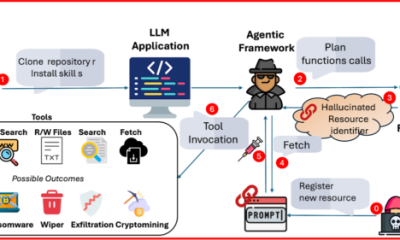
Hackers can use 9 of the most popular AI tools to assemble massive botnets
You must be logged in to post a comment Login