
Crypto World
Bitcoin Whales Add 46,000 BTC but Weak Network Activity Clouds Recovery



Bitcoin (BTC) whales and spot exchange-traded funds (ETFs) are absorbing supply, yet on-chain data shows the wider recovery still lacks depth.
Strong accumulation now sits against weak network activity and thinning liquidity, suggesting the market has not yet moved from a fragile bounce to a durable trend.
The Accumulation Case Looks Strong
CryptoQuant data show that addresses holding more than 10,000 BTC accumulated 46,420 BTC over a 60-day period through August 9. That reading is the highest since March 15 and nearly double the mid-March peak of 23,238 BTC.
Wallets holding 0.1 to 1 BTC reduced balances by roughly 9,700 BTC over the same period.
“This is a notable shift in positioning. The largest holders are increasing their exposure while smaller holders are reducing theirs,” an analyst wrote.
Santiment separately counted 90 wallets holding at least 10,000 BTC, a six-month high.
Follow us on X to get the latest news as it happens
Institutional demand also strengthened last week. Spot Bitcoin ETFs drew about $853.54 million in the week ending August 7. That was their best week since April 17, according to SoSoValue.
Why Bitcoin’s Recovery Still Looks Fragile
Nonetheless, the latest signals look softer. Spot Bitcoin ETFs reversed to a net outflow on Monday, an early sign that the inflow streak may be losing momentum.
Glassnode also reported that active addresses, transfer volume, and fee generation have drifted toward lower bounds. Profitability has improved only modestly, and realized losses still exceed realized profits on-chain.
The report describes the market as a transitional recovery that has yet to broaden into a full expansion.
“Improving institutional flows, stronger taker demand, and less defensive options positioning provide a constructive backdrop, but subdued spot liquidity and weak network activity suggest the recovery has yet to develop into a broad-based expansion,” the firm said.
Liquidity also remains thin. One CryptoQuant analyst noted monthly trading volume on Binance fell about 45% year-over-year in July, while OKX dropped roughly 57%. Shrinking depth lets modest flows swing prices sharply.
Another CryptoQuant analyst flagged a bearish top formation, with a downside target near $51,336, about 21% below current levels.
With US inflation data due this week, the coming sessions may show whether accumulation can pull the recovery wider.
Subscribe to our YouTube channel to watch leaders and journalists provide expert insights
The post Bitcoin Whales Add 46,000 BTC but Weak Network Activity Clouds Recovery appeared first on BeInCrypto.


Walmart (WMT) is due to report earnings on Aug. 20, and the options market is pricing in a 5.7% move in either direction, which is a larger-than-normal potential move for Walmart earnings. Walmart stock has been in a downtrend since mid-May. But it has bounced off its late-July low and, on Monday, closed back above its 21-day exponential moving average.…
Copyright ©2026 Investor’s Business Daily, LLC. All rights reserved. 87990cbe856818d5eddac44c7b1cdeb8


Christopher Harborne, the Tether and Bitfinex equity holder with close ties to Nigel Farage’s right-wing Reform UK, has previously stuck to creating businesses and not-for-profits in England and a few other jurisdictions. However, he’s now decided to start a company in the United States — Skyline Apex LLC.
The billionaire has recently seen his name in the British tabloids due to his unreported £5 million “gift” to Farage at a time when the Reform Party leader wasn’t confined to regular campaign finance rules and regulations.
Due to the scandal, Farage is now facing a by-election against novelty candidate “Count Binface” and a slew of other third-parties.
Read more: Reform UK pulls crypto bill from website amid Christopher Harborne ‘gift’ scandal
Harborne, who made his wealth through working at McKinsey and his own aviation fueling business, became a Tether and Bitfinex shareholder early in the entities’ lifetimes and has accrued an extraordinary amount of money.
International man of hate, but don’t tell anyone
Harborne’s apparent support for closed borders and his anti-immigrant rhetoric extends far beyond UK shores. However, seemingly unaware of his own hypocrisy, he’s called Thailand home for decades, living there under the name “Chakrit Sakunkrit.”
Meanwhile, as media coverage of Harborne and his dealings has ramped up over the past five years, the reclusive crypto investor has gone out of his way to silence any outlet reporting on his donations, gifts, and bizarre lifestyle.
A 2020 Panorama documentary that detailed Harborne’s involvement with Brexit has been wiped from the internet and Harborne has been litigious toward even small media outlets and journalists reporting on him.
However, a couple of years ago, Harborne finally bit off more than he could chew.
Lawsuit loss and nonstop bad news
In 2024 Harborne decided to take Wall Street Journal parent company, Dow Jones, to court in Delaware for defamation claims.
The suit revolved around a 2023 article published by the WSJ titled “Crypto Companies Behind Tether Used Falsified Documents and Shell Companies to Get Bank Accounts” that made mention of Harborne, his company AML Global, and their interactions with now defunct Signature Bank.
Read more: Nigel Farage aide received $9M on Polymarket account, report
Despite the WSJ removing that section, stating it “has been removed to avoid any potential implication that AML’s attempt to open an account there was part of an effort by Tether, Bitfinex or related companies to mislead banks, or that Harborne or AML withheld or falsified information during the application process,” Harborne moved forward with the suit and years of litigation against Dow Jones.
In 2026, the lawsuit was quietly concluded, with both parties agreeing to a stipulated dismissal. No major news site has brought any attention to this.
In the meantime, Harborne has been constantly named-and-shamed in Britain for his antics involving Farage and Reform, with no ability to stop the onslaught.
New business, new Harborne
While it’s currently unclear what Harborne’s Wyoming business will involve — aviation fuel, crypto, or something else entirely — it does give the billionaire a foothold in the US, a market he’s previously avoided.
There are no shortage of possibilities for why Harborne has chosen now to spin up the entity, from a chance to influence local and federal elections in a discreet manner to using his purchasing power to gain green card status, and, eventually, a third citizenship.
Needless to say, due to Wyoming’s strict corporate privacy laws, the public-at-large won’t have any answers for a long time to come.
Got a tip? Send us an email securely via Protos Leaks. For more informed news and investigations, follow us on X, Bluesky, and Google News, or subscribe to our YouTube channel.


ENS tokenholders approved and executed a proposal that turns the ENS Foundation into a staffed organization with a full-time executive director and a five-seat board, and hands it onchain control of the DAO's endowment. The opposition centered on the keys. The executable swapped the sole owner of… Read the full story at The Defiant


Kalshi faces a lawsuit in a New York federal court over claims the prediction markets platform is using flight data and a trademark without permission to run bets on airline cancellations.
FlightAware, which operates the world’s largest flight-tracking platform, filed the suit in the U.S. District Court of the Southern District of New York on Monday, seeking damages and an injunction against further use of its data and logo.
Kalshi started offering bets on nationwide and local flight cancellations on July 14, the same day it submitted its regulatory filing to the Commodity Futures Trading Commission (CFTC) to list such event contracts. The contracts allow users to bet on the percentage of scheduled flights that would be canceled during a specific period.
FlightAware alleges Kalshi had agreed to terms barring commercial use of its data, including through a fee AeroApi account that a Kalshi employee registered for in 2022.
Kalshi responded to FlightAware’s cease-and-desist letter, denying “it violated FlightAware’s license or infringed the FlightAware mark and asserted that its references to FlightAware constituted nominative fair use.”
Crypto World
Bitcoin falls to $63,500; Anthropic to watermark Claude’s AI content after EU regulations
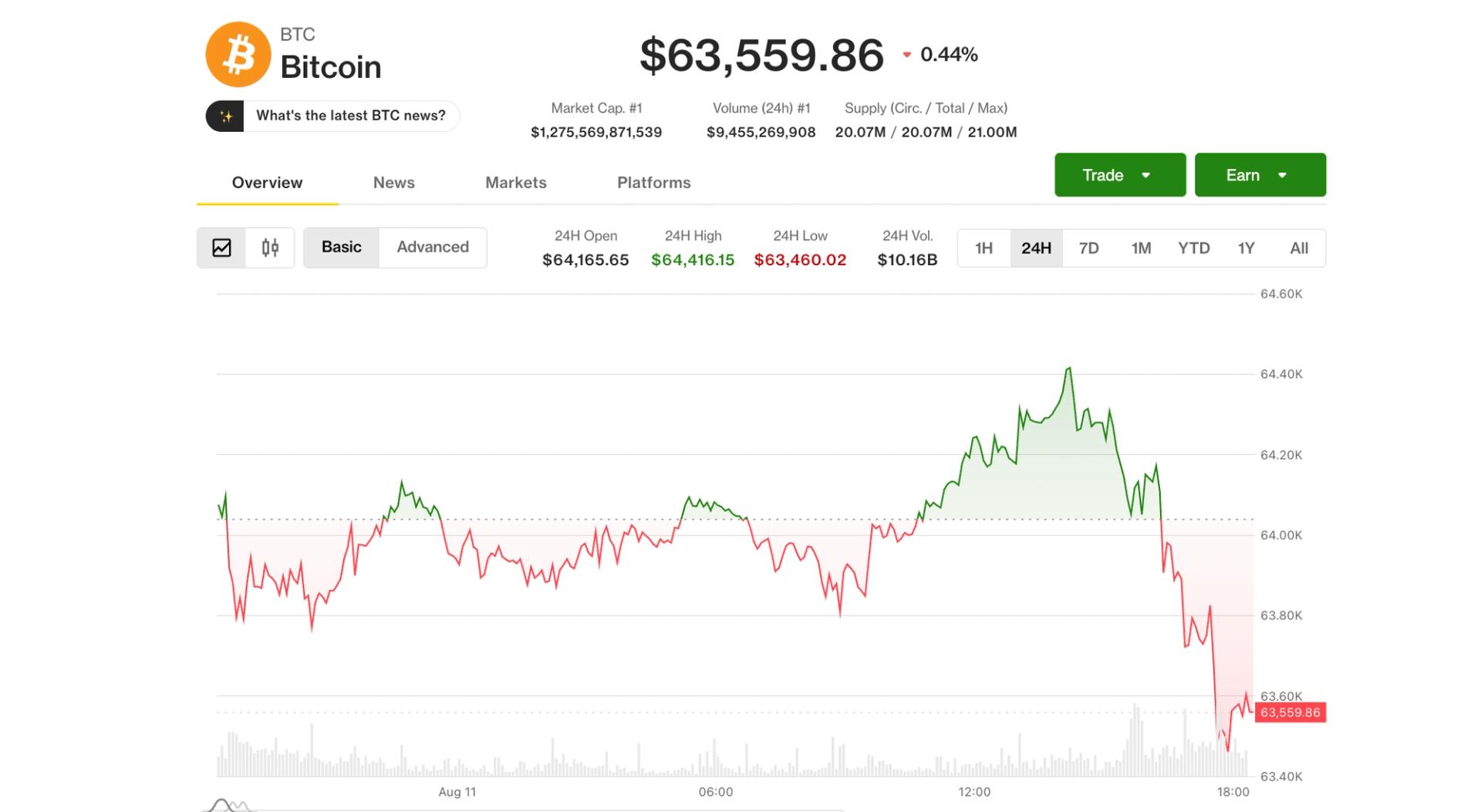
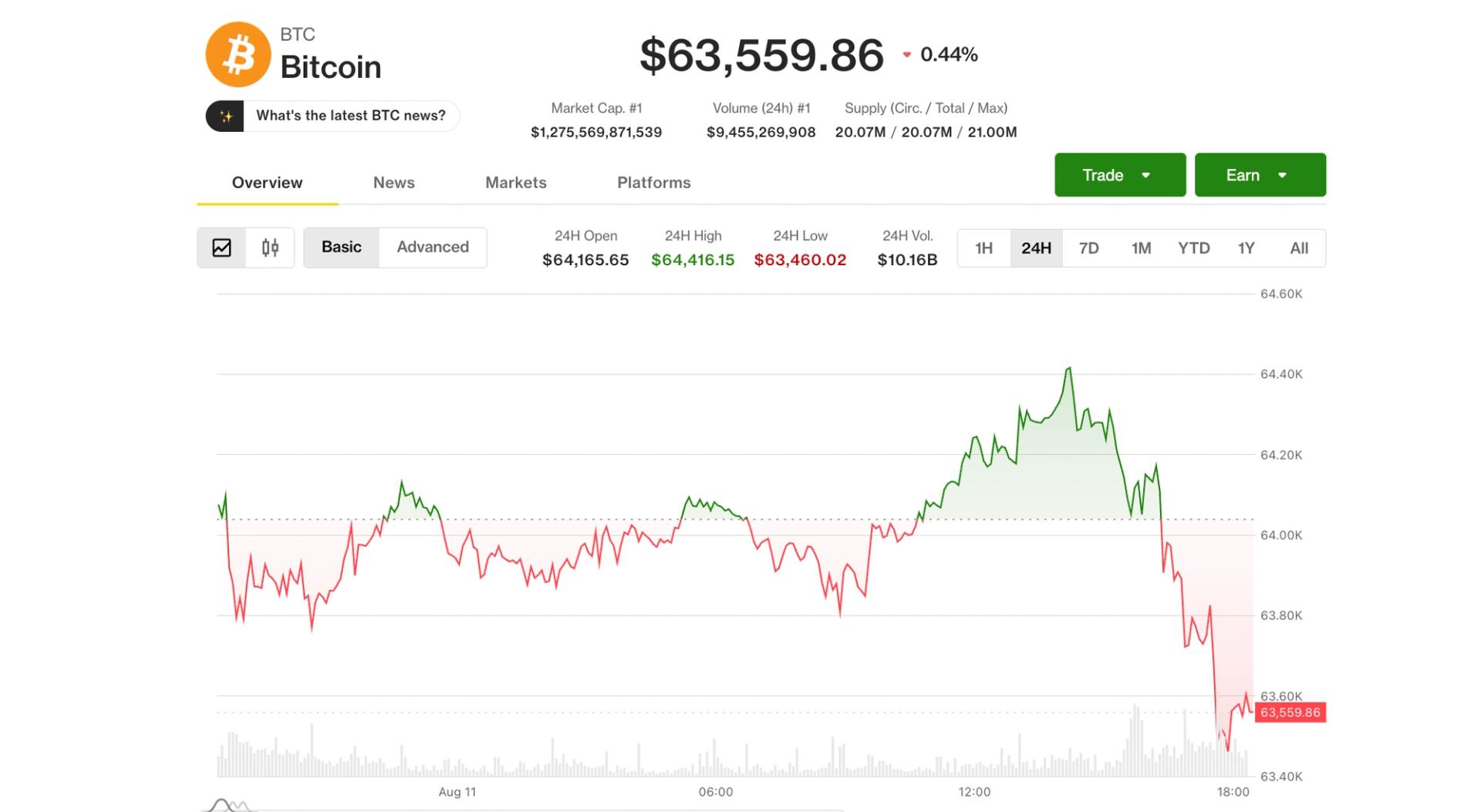
Bitcoin slipped 2% to about $64,200 on Monday, dragged down less by any single catalyst than by the corporations that once championed it turning their attention to AI, says Alex Kuptsikevich, chief market analyst at FxPro.
The wider market fell 2% to $2.18 trillion, with roughly ten coins falling for every one that rose.
The names doing the pivoting are the ones that gave crypto institutional cover, holders led by Strategy and miners like MARA, which spent the past two years rebranding themselves around AI data centers.
Institutional money is now selling bitcoin to build liquidity or rotate into that trade, Kuptsikevich said, and with corporate enthusiasm draining, the risk is that BTC position liquidation accelerates over the coming weeks.
Corporations joined crypto when it flattered their image, the reverse of the stock market, where retail usually arrives last and takes the losses. As those companies leave, Kuptsikevich argues, they hand crypto back to the retail base that built it, returning bitcoin to its ideological roots even if the exit stings on the way out.
Bitcoin is sitting just above its 50-day moving average, which has traded nearly flat for three weeks, a standoff between sellers distributing and buyers absorbing. Watch whether that line holds.

Polymarket banner outside the New York Stock Exchange on Oct. 7th, 2025.
Kevin Stankiewicz | CNBC
Prediction market platform Polymarket is preparing for what’s expected to be a busy fall season for event contract exchanges by making high-profile hires and restructuring its marketing strategy.
Polymarket hired Travis VanderZanden, founder of E-Scooter startup Bird in 2017, as its chief growth officer. VanderZanden previously worked at Uber Technologies and Lyft as well.
Polymarket CEO Shayne Coplan “is the visionary of the prediction market space, and this is a massive market opportunity,” VanderZanden said in a statement to CNBC. “It’s an exciting time to come in as we build out the executive team to help guide the next stage and make sure we’re buttoned up for the long haul.”
Bloomberg first reported VanderZanden’s appointment last week.
Shayne Coplan, chief executive officer of Polymarket, on the floor of the New York Stock Exchange (NYSE) in New York, US, on Thursday, Nov. 13, 2025.
Michael Nagle | Bloomberg | Getty Images
VanderZanden will also oversee Polymarket’s marketing, a person familiar with the matter said. That’s an area of the company’s business that came under scrutiny following a Wall Street Journal investigation that claimed the company conducted misleading marketing campaigns.
The Journal said Polymarket ensured it looked as though content creators it used were winning on the platform when, in fact, they were not using any of their own money. That report led to an investigation by the Commodity Futures Trading Commission — the federal regulator for prediction markets.
Polymarket has implemented a new organizational structure for the marketing team set to be led by VanderZanden, updated its guidelines for promotional partners and conducted training sessions with staff to inform them of new policies, the person familiar with the matter said. The company is now working with AlixPartners, a consulting firm, to monitor content released by promotional partners and confirm that it follows the new guidelines, the person said.
Other prominent managers have been added to strengthen Polymarket in 2026 as well.
Megan McGrath, formerly of Robinhood, is now the chief compliance officer of Polymarket’s U.S. exchange, and Natalie Oblazny, formerly at Coinbase, heads regulatory affairs for the domestic platform. Polymarket’s U.S. exchange debuted in May and operates separately from the international market.
Polymarket also hired Shana Bautista, a former FBI official who worked at Coinbase, as its global head of investigations and intelligence, while Paul Jordan joined from Nasdaq and will serve as the chief risk officer for Polymarket U.S.
All of the new staff come as prediction market platforms prepare for two major drivers of traffic this fall. The start of the NFL season in September and the runup to midterm elections in November are expected to boost trading volumes after domestic and international activity dipped following the end of the World Cup in July.
Disclosure: CNBC and Kalshi have a commercial relationship that includes customer acquisition and a minority investment.



A Dubai-based maritime tokenization platform, Shipfinex, has teamed up with Abu Dhabi blockchain network ADI Chain to test how vessel-linked assets could be represented and financed on-chain. The partners say they are tokenizing a pipeline of roughly 35 vessels valued at about $500 million, aiming to create additional funding options for shipowners.
The concept centers on placing the vessels into separate special-purpose vehicles (SPVs). Tokens would then be issued to reflect economic exposure to each ship—potentially structured as vessel-backed credit, charter-related income, or other rights tied to the underlying assets. ADI Chain is expected to handle the distribution and settlement layer, with primary allocations and distributions planned to use stablecoins denominated in UAE dirham, US dollars, and other currencies.
Key takeaways
- Shipfinex and ADI Chain are piloting tokenization of a vessel pipeline worth about $500 million across around 35 ships.
- The structure uses separate SPVs per vessel, with tokens representing ship-specific economic interests such as credit or charter income.
- ADI Chain will provide the stablecoin-oriented distribution and settlement infrastructure for the pilot.
- The project is still in an operational readiness stage, with no Maritime Asset Tokens publicly issued yet and the regulated issuance route still being finalized.
- The announcement aligns with broader growth forecasts for tokenized real-world assets (RWAs), including Standard Chartered’s estimate that the sector could reach $4 trillion by end-2028.
How the pilot is structured: SPVs and ship-linked tokens
Tokenizing shipping assets is notoriously complex, largely because the industry is fragmented and ship-level cash flows can vary widely depending on charter terms, routes, and financing arrangements. Shipfinex’s approach, as described in the announcement, attempts to translate that complexity into a modular on-chain wrapper: each vessel is moved into its own SPV, and tokens are intended to map to the economics of that specific vehicle.
That could matter for investors and lenders because it potentially enables more granular exposure than traditional fund structures—at least in theory—letting market participants choose how they want to participate in a given ship’s revenue stream or credit profile. The partners have also framed the tokens as potentially representing vessel-backed credit, charter-linked income, or other interests, suggesting room for multiple payoff designs depending on the underlying deal economics.
Stablecoin settlement: why ADI Chain’s role matters
ADI Chain, based in Abu Dhabi, is described as the partner providing distribution and settlement infrastructure. The planned use of currency-denominated stablecoins—specifically UAE dirham- and US dollar-linked assets, plus additional denominations—signals that the settlement model is being built to reduce friction in cross-currency payments, which is a common challenge in international shipping finance.
For market participants, stablecoin settlement can also influence how quickly transactions clear and how tokenized positions can be serviced operationally. Even so, the project’s success will likely depend on the operational details of issuance, custody, and investor onboarding, especially given the regulatory process the partners say remains unfinished.
Still in a pilot: issuance route not finalized
While the partnership outlines a significant vessel pipeline, it is important that the project is not yet live in terms of publicly issued tokens. The arrangement is described as being in a pilot and operational-readiness phase. The partners state that Maritime Asset Tokens have not been publicly issued and that the regulated issuance pathway is still being finalized.
This staging matters because tokenization efforts in RWAs can fail at different points: legal structuring, regulatory approvals, or the practical ability to support ongoing distributions and compliance. By highlighting that the regulated issuance route is still under development, Shipfinex and ADI Chain appear to be treating the first phase as a test of readiness rather than an immediate launch of investable tokens.
Investors watching similar initiatives may therefore want to track what changes next—particularly whether the pilot culminates in a formally approved issuance structure, and how ongoing payments tied to charter activity or credit terms are operationalized.
RWA tokenization momentum: from shipping to broader forecasts
The shipping pilot comes as tokenized RWAs continue to attract attention across traditional finance and crypto-native infrastructure. RWA.xyz data cited in the report indicates that assets tracked on its platform totaled about $38.1 billion as of Aug. 9. Within that figure, US Treasury debt accounts for roughly $16.2 billion and commodities about $4.9 billion.
Standard Chartered’s outlook also points to continued expansion. In a report released Monday, the bank forecast that tokenized RWAs could reach $4 trillion by the end of 2028, according to Geoff Kendrick, the global head of digital asset research at the bank. The scale of that projection suggests that the market is expected to grow beyond early niches—though it also underlines the difference between long-term forecasts and near-term, pilot-stage delivery.
In shipping specifically, the scale remains small relative to the total addressable market. The announcement cites Clarksons Research data valuing the world fleet and orderbook at about $2.1 trillion at the start of 2026. Compared with that estimate, the $500 million vessel pipeline represents a limited slice—meaning this pilot is likely best viewed as a proof-of-process and market test rather than a near-term transformation of shipping finance.
Still, even incremental moves can be significant in RWAs if they demonstrate repeatable mechanics: asset segregation, token-to-cashflow mapping, stablecoin-based settlement, and the ability to maintain compliance over time. That is precisely where pilots tend to earn or lose momentum.
For readers, the key next indicators to watch are whether Shipfinex and ADI Chain progress from operational readiness to a clearly defined regulated issuance route, and how they handle the practicalities of ongoing distributions tied to ship-level economics—especially once any tokens transition from closed testing to broader market participation.

eToro has outlined a new step in its push to broaden beyond crypto by announcing plans to acquire US online brokerage TradeZero. The deal is positioned as part of the company’s expansion strategy in the United States, with closing expected in the first half of 2026.
In parallel with the acquisition announcement, eToro’s second-quarter update showed crypto trading and revenues under pressure. The company reported $1.59 billion in total revenue for the quarter, with crypto assets contributing $1.34 billion—down roughly 30% from $1.9 billion in the prior-year comparable quarter. While crypto revenue fell, eToro also reported $1.35 billion in crypto-related cost of revenue and $19.7 million in net income from crypto assets, alongside $53.4 million in total net income.
Key takeaways
- eToro plans to acquire TradeZero to accelerate its US expansion, targeting closing in the first half of 2026.
- In Q2, crypto remained the largest revenue stream for eToro at $1.34 billion, but it fell about 30% year over year.
- Crypto net income was positive at $19.7 million for the quarter, even as overall crypto trades and invested amounts declined sharply in July.
- The company reported strong cross-asset engagement: many users who traded commodities later traded equities and then crypto on eToro.
- TradeZero reportedly generated about $80 million in revenue over the last 12 months ended June 30, 2026, with 81% gross margins.
Why eToro wants TradeZero in its US strategy
The acquisition of TradeZero is framed by eToro as a practical move to become a broader multi-asset platform in the United States. The focus on US brokerage capabilities comes as the firm works to deepen trading relationships across asset classes, rather than relying solely on digital-asset activity.
eToro also previously signaled similar intent in crypto infrastructure: in April, it announced plans to acquire self-custodial wallet provider Zengo. Taken together, the company’s approach appears to combine more traditional brokerage reach (through TradeZero) with continuing investment in crypto custody and user access (through Zengo).
Crypto performance remains the swing factor
Despite the company’s ongoing multi-asset push, crypto continues to dominate the revenue mix. In its second-quarter report, eToro said total revenue came in at $1.59 billion, down from $2 billion in the comparable 2025 period. Of that amount, $1.34 billion was revenue from crypto assets, which the company said was about 30% lower than $1.9 billion in Q2 2025.
eToro reported $1.35 billion in crypto-related cost of revenue and $19.7 million in net income from crypto assets. Total net income for the quarter was $53.4 million, indicating that losses or reductions in crypto activity did not fully translate into an overall earnings collapse—though the numbers highlight how sensitive the business remains to the direction of crypto volumes and fees.
The broader trading picture also weakened after the quarter. According to eToro’s disclosures, total cryptocurrency trades on the platform fell to 1.4 million in July, representing a 73% year-on-year decline. The invested amount was down 50% over the same period, reinforcing that reduced trading activity has been affecting both the number of transactions and the size of positions.
Cross-asset engagement and the commodities-to-crypto funnel
Alongside crypto-specific declines, eToro highlighted user behavior that could support its multi-asset thesis. In commentary attributed to its financial leadership, the company said that more than 60% of users who traded commodities during Q4 2025 to Q1 2026 later traded equities in Q2 2026. It added that nearly nine in ten of those users have also traded crypto on eToro.
This matters because it suggests eToro is attempting to build a funnel where initial engagement in one asset category can lead to additional trading across other categories. If TradeZero helps expand access to US equities and other traditional brokerage products, eToro may be betting that increased equity trading will feed back into crypto usage—offsetting parts of the volatility in digital-asset demand.
eToro also reported that equities and commodities-related trading generated $141 million in net income for the platform, providing another anchor outside crypto revenue even as crypto volumes cooled.
Deal economics: TradeZero’s margins and expected earnings impact
From the perspective of deal structure, eToro provided figures intended to show that TradeZero could strengthen the business rather than dilute it. The company stated that TradeZero generated about $80 million of revenue with 81% gross margins in the last 12 months ended June 30, 2026.
Looking ahead, eToro said it expects the acquisition to be accretive to adjusted earnings per share in the first year after closing. Closing is expected in the first half of 2026, meaning the earliest period for the claimed benefit would likely follow shortly thereafter.
Market reaction to the announcement appeared cautious. eToro’s Nasdaq-traded shares were down more than 5% in pre-market activity on Tuesday, with the move expected to extend Monday’s decline according to Yahoo Finance data for ETOR.
What to watch next
Investors and users will likely focus on whether the TradeZero acquisition helps stabilize revenues as crypto volumes fluctuate, and on whether eToro can translate its reported cross-asset engagement into sustained trading activity in the US. In the meantime, July’s sharp drop in crypto trades and invested amounts remains a key signal for how quickly digital-asset performance can change the company’s quarterly outlook.


Strategy CEO Phong Le has said the company plans to increase its Bitcoin holdings again this year, even after recent sales reduced its reserve to 840,447 BTC.
Summary
- Strategy plans to resume Bitcoin accumulation before the end of 2026.
- Recent sales have reduced its holdings to 840,447 BTC.
- Strategy sold 3,328 BTC for $213.3 million across the past two reporting periods.
- Its US dollar reserves have increased to $4.65 billion.
Fox Business reported that Le expects Strategy to return to Bitcoin accumulation as the company builds its US dollar reserve and supports its preferred stock products.
Le’s comments place the company’s long-term buying plan alongside a capital-management program that has produced two consecutive weekly Bitcoin sales. Strategy has used the proceeds to repurchase its variable-rate preferred stock, while common-share sales have provided cash for its dollar reserve.
During an earlier Bloomberg interview in July, Le linked the next buying phase to a recovery in Strategy’s Stretch preferred stock, which trades under the ticker STRC.
“We’ll continue to build that. And yeah, when Stretch gets back to par, we’ll issue more. We’ll buy more Bitcoin,” Le said.
Strategy plans to resume Bitcoin accumulation
Strategy has not announced a date for its next purchase, and Le’s comments describe a plan for later in 2026 rather than an immediate transaction.
The company’s recent activity has focused on restoring STRC toward its $100 stated amount. Because Strategy can issue the preferred shares to raise capital, a recovery toward that level would give the company another source of funds for Bitcoin purchases.
As crypto.news reported on July 16, Le said Strategy would issue more STRC and buy more Bitcoin after the security returned to par. STRC traded near $87 at the time after falling below $75 in late June.
Strategy designed STRC with a variable dividend rate that management can adjust to encourage the shares to trade close to $100. The company kept the annualized rate at 12% for August, despite the stock ending July below $90.
Management has also been repurchasing STRC shares when they trade below the stated amount. Strategy said the purchases were intended to reduce the number of preferred shares outstanding and improve what it calls STRC’s “Bitcoin credit,” a company metric measuring Bitcoin and cash backing relative to its preferred obligations.
Le said in July that Strategy wanted STRC to trade between $99 and $100. The company has described regular repurchases below that range as part of its plan to support the security before issuing additional shares.
Bitcoin sales fund another STRC repurchase
An Aug. 10 SEC filing showed that Strategy sold 1,690 BTC between Aug. 3 and Aug. 9, receiving $108.6 million after fees and expenses.
The company sold the Bitcoin at an average price of $64,262 and used the proceeds to repurchase 1,152,020 STRC shares. Strategy paid an average of about $94.29 per preferred share, leaving approximately $785.2 million available under its STRC repurchase authorization.
Following the transaction, Strategy’s Bitcoin reserve fell from 842,138 BTC to 840,447 BTC. The remaining holdings were acquired for about $63.36 billion at an average price of $75,385 per coin, according to the company’s filing.
The transaction followed a sale of 1,638 BTC for $104.73 million during the week ending Aug. 2. Strategy used $52.4 million from that sale to pay preferred-stock dividends and directed another $52.3 million toward STRC repurchases.
As previously covered, the earlier sale occurred at an average price of $63,957 and reduced Strategy’s reported holdings to 842,138 BTC.
Across the two latest reporting periods, the company has sold 3,328 BTC for approximately $213.3 million. Strategy’s public ledger shows that its reserve has declined from 847,363 BTC on June 22 to 840,447 BTC following several sales.
The company sold 3,588 BTC for about $216 million between June 29 and July 5, before keeping its holdings unchanged for several weeks. Strategy also sold 32 BTC around the end of May, its first disclosed disposal since December 2022.
Dollar reserve reaches $4.65 billion
While reducing its Bitcoin position, Strategy has increased the amount of cash available for dividends, interest payments, and other corporate obligations.
The Aug. 10 filing showed that Strategy sold 6,585,329 shares of MSTR common stock through its at-the-market programs. The sales generated approximately $653.1 million in net proceeds.
Management placed $650 million into the company’s designated US dollar reserve and added the remaining $3.1 million to unrestricted cash. The contribution lifted the reserve from $4 billion to $4.65 billion as of Aug. 9.
In late July, Strategy had reported a reserve of $3.75 billion, which management estimated could provide about 2.1 years of coverage for preferred dividends and interest payments. A subsequent $250 million contribution raised the balance to $4 billion and extended the company’s stated coverage period to about 2.3 years.
The reserve is management-designated liquidity rather than a legally restricted account. Strategy established it in December 2025 to support payments on its preferred securities and outstanding debt, and the company can change the reserve’s size according to capital needs and market conditions.
Le told Fox Business that Strategy had been adding to its dollar holdings, making liquidity one of the company’s current priorities. During Strategy’s second-quarter earnings call, he said the company had learned the importance of holding dollars instead of relying only on Bitcoin as a liquid balance-sheet asset.
US investors retain exposure through MSTR and STRC
Strategy’s latest transactions directly affect US investors because MSTR and STRC trade on Nasdaq, and the company reports its Bitcoin, equity, and preferred-stock activity through filings with the US Securities and Exchange Commission.
MSTR provides equity exposure to Strategy’s Bitcoin reserve, software operations, debt, and preferred-stock obligations. Its performance can therefore differ from Bitcoin’s price because changes in the company’s share count, cash reserve, and capital structure also affect shareholders.
Strategy’s Aug. 10 filing showed that adjusted shares outstanding rose to about 423.85 million after the latest common-stock sales. The company still had approximately $11.7 billion of MSTR shares available for issuance across two at-the-market programs.
STRC gives investors a different form of exposure through a variable cash dividend rather than direct ownership of Bitcoin. Strategy can change the dividend rate each month under the security’s terms, while the preferred shares have no maturity date and are not guaranteed to trade at their $100 stated amount.
After the latest repurchases, Strategy retained a separate $1 billion authorization to buy back MSTR common stock. The company had not used that authorization as of Aug. 9, according to its SEC filing.

MONICA LONG: XRP THIS IS URGENT! XRP SWITCH JUST FLIPPED

Anne Hathaway appears as haunting author in eerie new psychological thriller

Plans revealed to transform Swansea’s Civic Centre buildimg


-

 Fashion4 days ago
Weekend Open Thread: Mattifying Sunscreen
-

 Fashion4 days ago
Frugal Friday’s Workwear Report: Cap-Sleeve Pointelle Crewneck Sweater
-

 Sports6 days ago
Jordan Coyle & Cordiamo take Laya Arena Stakes at RDS
-

 News Videos3 days ago
Can Astrology Help Find Gold and Silver Trends? A Financial Astrology Guide
-
 Business6 days ago
US stocks: Dow closes at record on Mideast optimism; SpaceX, AMD drag Nasdaq
-

 Politics5 days ago
Reform UK And Greens Sink To Lowest Favourability Ratings To Date
-

 Business7 days ago
Nvidia Stock Climbs 2.5% as Chip Sector Rally Builds Ahead of AMD Earnings, Nvidia’s Own Report Looms
-

 Tech7 days ago
OpenAI, Anthropic AI agents targeted real people and systems in cyber tests
-

 Business6 days ago
Supply chain issues impact Ingredion
-

 Tech4 days ago
Rinn Pharma & Biopharma to join NordicPharmaTrain network
-

 Business3 days ago
How to Start a Cleaning Business: A Step-by-Step Guide
-
 Crypto World7 days ago
Dow and S&P 500 Hit Records on AI Earnings: When Will the Bubble Burst?
-

 Business2 days ago
Datadog: Best Of Breed For Multiple Reasons
-

 Business3 days ago
BDC Weekly Review: Private BDC Q2 Numbers Are Strong
-

 Business7 days ago
McDonald’s (MCD) Q2 2026 earnings
-
 Crypto World7 days ago
Dollar Index Trapped at 100 as Hawkish Fed Meets Official Selling
-

 Fashion7 days ago
The Bright Side of Black and White
-

 Business7 days ago
Apple UK encryption challenge filed against Home Office
-

 Fashion6 days ago
Suit of the Week: Me + Em
-
Sports6 days ago
Spider-Man: Brand New Day ending explained: Is Peter Parker alive?
You must be logged in to post a comment Login