

Crypto World
Bitfinex ETH Shorts Double as Whale Moves Signal Major Ethereum Move Ahead


TLDR:
- Bitfinex ETH shorts surged sharply in 72 hours, signaling aggressive whale bearish positioning.
- Ethereum remained above key support despite rising short exposure from large market participants.
- Historical Bitfinex short spikes have often preceded strong volatility and short squeeze events.
- ETH gained 0.84% daily and 0.28% weekly, showing resilience amid growing bearish sentiment.
Bitfinex ETH shorts remain a major talking point after whale traders doubled bearish exposure within 72 hours, raising expectations of a volatility-driven move.
Meanwhile, Ethereum traded higher with a 0.84% daily gain and a 0.28% weekly increase, showing resilience despite growing short pressure and keeping both breakdown and short squeeze scenarios firmly in play.
Whale Positioning Sparks Fresh Ethereum Uncertainty
Bitfinex ETH shorts surged aggressively over the last 72 hours, capturing the attention of traders tracking institutional flows.
The move reflects a rapid increase in bearish exposure, with whale-sized traders appearing to position ahead of a potential volatility event.
Bitfinex has historically attracted sophisticated market participants, including large funds, arbitrage desks, and high-net-worth traders.
Because of this, unusual changes in Bitfinex ETH shorts are rarely ignored. Market watchers often treat such positioning as an early signal of directional conviction or strategic hedging.
Recent data showed shorts rising almost vertically, creating a sharp contrast with Ethereum’s relatively stable price action. ETH continues consolidating between $2,280 and $2,400, showing no decisive breakdown despite the growing short interest.
That contradiction has fueled market debate. If whale traders truly expect a sharp correction, many would anticipate heavier spot selling and broader downside expansion. Instead, Ethereum has remained resilient, with buyers repeatedly defending lower levels.
The sudden rise in Bitfinex ETH shorts could indicate traders preparing for macro-driven volatility. However, the visible short exposure alone does not confirm outright bearish conviction.
Institutional traders often use exchange shorts to hedge spot holdings, manage options risk, or capture basis opportunities. As a result, the reported positions may represent part of a broader market-neutral strategy.
Short Squeeze Risk Keeps Bulls Engaged
While the increase in Bitfinex ETH shorts appears bearish, historical market behavior offers a different perspective. Similar spikes in whale short positioning have previously created the conditions for powerful short squeezes.
Large short positions function as future buy orders under pressure. If Ethereum pushes above resistance near $2,420, forced liquidations could trigger rapid upside momentum.
That process typically unfolds quickly. Short sellers rush to close positions, momentum traders enter breakout setups, and algorithmic systems amplify directional movement.
Ethereum’s current technical structure supports this possibility. Price remains compressed within a narrow range, while repeated dips toward $2,300 continue attracting buyers.
Momentum indicators also suggest the bearish trend may be losing strength. MACD is beginning to recover, and RSI has climbed toward neutral territory after cooling from recent weakness.
This leaves Ethereum in a pressure zone where either side could gain control rapidly. A breakdown below support may validate the whale positioning and accelerate selling.
However, a clean breakout above resistance could turn Bitfinex ETH shorts into liquidity for a sharp upside move.
For now, Bitfinex ETH shorts remain the market’s primary volatility signal. Ethereum is holding steady, but positioning suggests that price compression may not last much longer.


Crypto World
Could Pepeto Be the Next Crypto to Explode While Solana Grinds at $88.33 and Cardano Struggles Below $0.30
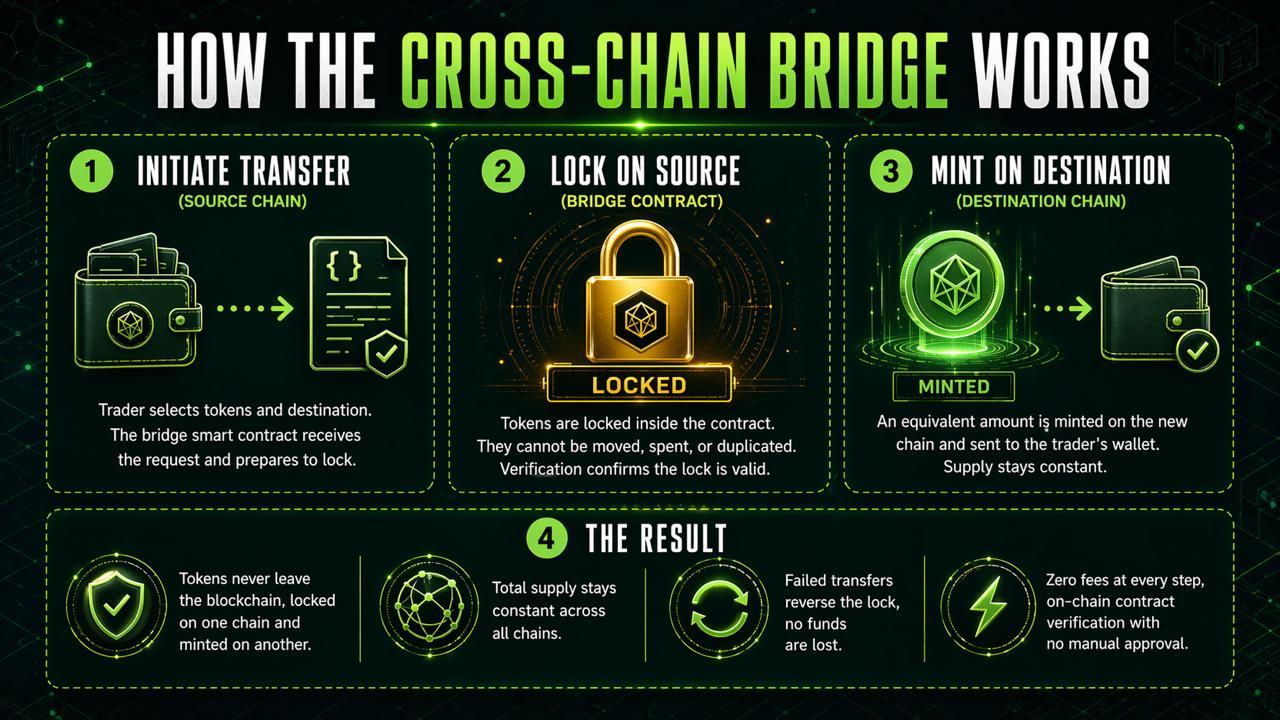
Tom Lee just declared at Consensus 2026 that the crypto winter is over and Bitcoin closing May above $76,000 confirms a new bull market. Every cycle produces a handful of tokens that turn small entries into life changing wealth, and the search for the next crypto to explode is heating up.
Pepeto, which raised $9.84 million during the fear under the direction of the original Pepe coin creator with a Binance listing ahead, is where the sharpest capital sits right now.
Next Crypto to Explode Gains Traction as Tom Lee Confirms the Bull Cycle Has Begun
Fundstrat cofounder Tom Lee told the Consensus 2026 audience in Miami that Bitcoin needs one more monthly green candle to confirm the bear market ended during the February dip below $63,000, according to CoinDesk.
BTC trades near $80,900 and Lee called tokenization and AI driven finance the two forces shaping the next cycle. Spot Bitcoin ETF spulled in more than $500 million this week. When Bitcoin enters a confirmed bull cycle, the next crypto to explode is the presale still at ground level ahead of the wave.
Where Pepeto, Solana, and Cardano Sit as the Bull Cycle Returns
Pepeto
Bitcoin is confirming the bull cycle, but the tokens that print the largest gains are always found before the crowd shows up, and Pepeto is the next crypto to explode for holders looking at the math with $9.84 million already raised during months when the rest of the market was pulling out.
Return targets land between 100x and 300x at the current $0.0000001868 presale price the moment the Binance listing goes live, which is why SOL and ADA holders at their current caps cannot compete with this entry.
Put together by a team that includes an insider who worked at Binance and the founder who sent Pepe past $11 billion on pure community demand, PepetoSwap lets holders trade across chains at zero cost while the risk scorer scans contracts before capital goes in so buyers avoid traps that drain wallets overnight.
Pepeto is not waiting to build, because every product already runs, the SolidProof audit checked every contract, and staking at 175% APY grows positions while the presale stays open, so as the bull cycle returns an exchange with zero fees and built in protection is approaching the listing that turns presale holders into the winners SOL and ADA buyers would spend years trying to become.
Solana (SOL) Price at $88.33 as the Network Builds Toward Recovery
Solana trades at $88.33 as of May 8 according to CoinMarketCap, up 35% from its February low but still 70% below its $293 all time high set in January 2025. The network attracts developers building DeFi and meme coin projects, with Western Union recently launching a stablecoin on Solana and the Firedancer upgrade boosting performance.
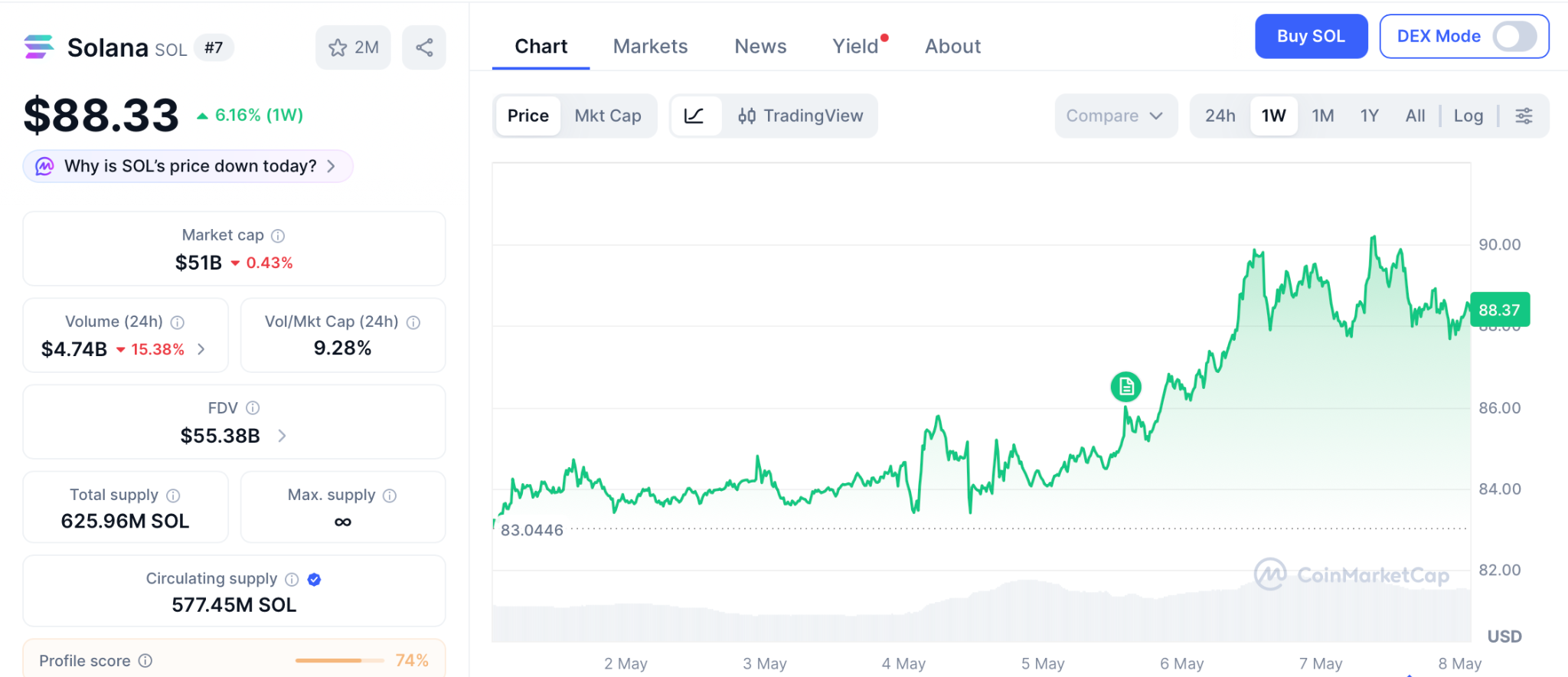
But SOL carries a $51 billion market cap, and even reaching $135 is a 52% gain spread across months, not the compressed return a presale to listing event provides.
Cardano (ADA) Price at $0.26 as the Token Fights to Reclaim Lost Ground
Cardano sits at $0.26 as of May 8, still 91% below its $3.10 all time high from 2021. ADA recently saw a short squeeze after funding rates on Binance hit their most bearish level since June 2023, but that rally is borrowed from leverage, not demand.
The token needs massive inflows to move from its $9.5 billion market cap, and the next crypto to explode is not the project that needs billions just to revisit old highs.
Conclusion
The next crypto to explode is decided by who moved while the entry was still open and who waited until the price no longer made sense, and that separation is exactly what the Pepeto presale creates right now. The exchange runs, the scanner protects every trade, and the SolidProof audit gave the code a clean bill.
The Binance listing moves closer with every presale stage that fills and the $0.0000001868 entry shuts the moment it arrives, because listing day is when the presale price stops existing and the market sets a new floor.
Pepe went from zero to $11 billion with no working product, and the people who acted early made the biggest returns of their lives. The $9.84 million already inside the Pepeto presale shows the same pattern forming before the crowd sees it, and missing this presale could become the most expensive decision of 2026, because the gap between acting now and waiting is the gap between holding a 100x to 300x position and watching someone else celebrate what should have been the easiest call of the cycle.
Click To Visit Pepeto Website To Enter The Presale

FAQs:
What makes a token the next crypto to explode in 2026?
The next crypto to explode needs a working product and a presale entry before listing. Pepeto has all three with $9.84 million raised.
How does Pepeto compare to buying Solana or Cardano right now?
SOL at $88.33 and ADA at $0.26 need billions for major moves. Pepeto targets 100x to 300x from presale price at listing.
Disclaimer: This is a Press Release provided by a third party who is responsible for the content. Please conduct your own research before taking any action based on the content.

“Bitcoin mining is competitive and fragmented by design. It is a race for efficiency where a millisecond can determine whether a miner wins a block or loses to a competitor.”
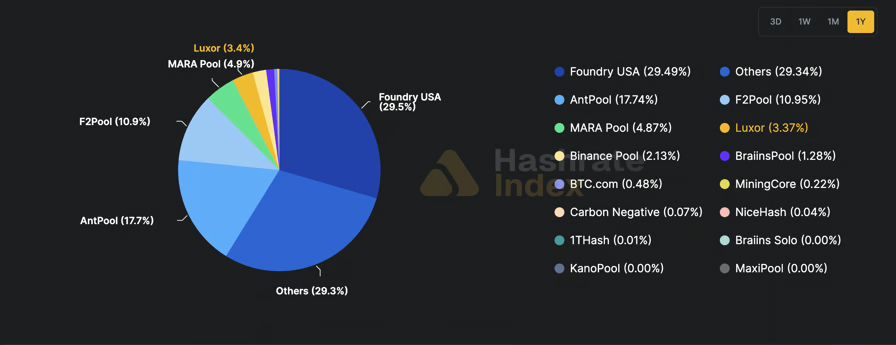
Foundry and AntPool are the two largest Bitcoin mining pools by hashrate, the total computing power deployed to secure the network. Hashrate Index data show Foundry controlling nearly 30% of the global mining pool hashrate, with AntPool accounting for about 17.7%.
Developing an open standard for mining pools that is not controlled by any single operator represents a deliberate move toward decentralization in an industry that has grown increasingly centralized in practice. By enabling more flexible block template selection and reducing reliance on any one pool’s internal systems, the Stratum V2 initiative seeks to lower barriers to entry for smaller operators and solo miners alike.
In a related note, Cointelegraph coverage has highlighted ongoing efforts to unify Bitcoin infrastructure through open-source tooling. For example, Tether recently launched an open-source mining framework intended to complement open standards in the space. These kinds of collaborations underscore a broader industry push toward interoperability that could reshape how mining capacity is aggregated and allocated across the network.
Key takeaways
- Seven major pools—AntPool, Block Inc, F2Pool, Foundry, MARA Foundation, SpiderPool, and DMND—joined the Stratum V2 working group to push an open, industry-wide pool-to-miner protocol.
- The open standard aims to reduce latency in block discovery and enhance miner choice by avoiding single-point control over mining templates and communications.
- Hashrate Index data place Foundry at roughly 30% and AntPool at about 17.7% of global pool hashrate, highlighting continued concentration even as open standards emerge.
- Bitcoin mining is facing a tougher profitability environment, with the next difficulty adjustment expected to tighten the race for efficiency and rising energy costs adding to the pressure on operators.
Open standards and the push for a more decentralized mining landscape
The Stratum V2 effort arrives at a time when the mining sector is re-evaluating how information about block templates, work distribution, and payout mechanics should flow between pools and miners. The Stratum V2 blog post frames the standard as a neutral, shared baseline that prevents any single operator from holding undue sway over the mining workflow. By enabling more miners to participate in block assembly and by standardizing communication layers, the protocol could improve resilience and resilience against outages or targeted disruptions in any single pool’s infrastructure.
This is not just a technical nicety. The degree to which mining remains decentralized is a live concern among observers. When a handful of pools control a sizable portion of the network’s hashrate, the incentives around protocol design, block templates, and timing can become concentrated. An industry-wide standard that is collectively owned could help tilt the balance back toward broader participation while preserving pool-level incentives for efficiency and reliability.
Beyond the Stratum V2 development, the broader crypto media ecosystem has been tracking parallel efforts to standardize and modernize Bitcoin infrastructure. The open-source mining framework advocated by Tether, as noted by Cointelegraph, aligns with a growing thesis that interoperability will be a key driver of adoption and resilience in the Bitcoin mining space.
Mining pressures: difficulty, costs, and the profitability outlook
Looking at the macro side of the mining equation, the network’s difficulty—the measure of how hard it is to mine a new block—is expected to rise at the next adjustment. CoinWarz projects the adjustment to occur around May 15, 2026, with the difficulty increasing from about 132.47 trillion to 135.64 trillion. While the exact timing can shift, the direction matters: a higher difficulty amplifies the cost per mined block unless efficiency improves.
At the same time, miners face mounting energy costs as the economics of securing the network tighten. The combination of higher difficulty and rising energy expenses compounds the pressure on a sector that, according to CoinShares, already has around 20% of operators unprofitable in the current market environment. Profitability is tightly tied to the price of electricity, which continues to be a critical input for miners globally.
Another signal of the tightrope miners walk is hashprice—the revenue per unit of mining power before expenses. CoinShares reports hashprice levels in a narrow band, roughly between $36 and $38 per petahash per day, which for some operators is near or at the breakeven point given their costs and efficiency profiles.
These dynamics frame the Stratum V2 adoption as a potentially important tailwind for miners seeking to regain material efficiency. By enabling faster, more reliable block templates and reducing coordination overheads between pools and miners, the open standard could help some operators squeeze out small but meaningful gains in throughput and stability even in a market where margins remain under pressure.
As readers watch these developments, investors and builders may consider how broader adoption of Stratum V2 could affect pool competition, miner profitability, and the resilience of the network during periods of stress. And while the path forward is still unfolding, the convergence around open standards is likely to influence both the competitive landscape and the regulatory conversations shaping how mining operations scale in the years ahead.
For readers interested in related industry threads, Cointelegraph’s coverage of mining sector dynamics, including Squeeze scenarios and the push for more open tooling, remains a useful companion resource. And as the sector contends with post-quantum considerations, industry voices continue to explore timelines for upgrading Bitcoin’s security layers—an arc that could shape debates on long-term protocol robustness as the mining ecosystem evolves.
Watch closely how many more pools embrace Stratum V2 and whether new open-standard implementations gain traction. The outcome could influence not only operational efficiency but also the degree to which the mining landscape remains distributed in practice, even as capital and technology concentrate around efficiency leaders.
Related: Tether launches open-source mining framework to unify Bitcoin infrastructure — Cointelegraph Tether launches open-source mining framework to unify Bitcoin infrastructure
Published context: CoinWarz data on difficulty, CoinShares mining insights, and Hashrate Index pool shares CoinWarz · CoinShares · Hashrate Index
Post-quantum reference: Bitcoin may take 7 years to upgrade to post-quantum — BIP-360 co-author Cointelegraph Magazine
TLDR:
- Tom Lee forecasts a 25x move for Ethereum, driven by tokenization and agentic AI infrastructure demand
- ETH outperformed the S&P 500 by nearly 20 points and beat gold and energy stocks since the Middle East conflict
- Lee’s $62,500 target places Ethereum at one-quarter of Bitcoin’s projected $250,000 fair value using ratio models
- JPMorgan CEO Jamie Dimon’s shift on crypto supports Lee’s view that blockchain rails are reshaping global finance
Fundstrat’s Tom Lee has laid out a bold price target for Ethereum, citing macro conditions, tokenization trends, and the rise of agentic AI. His analysis points to a potential 25x move for ETH from current levels.
The forecast draws on historical consolidation patterns, Bitcoin ratio comparisons, and structural shifts in global finance. Lee believes Ethereum is better positioned today than at any prior cycle peak.
Tom Lee’s Case for a Massive Ethereum Move
Ethereum has shown notable resilience against traditional assets in recent market cycles. According to Lee, since the Middle East conflict began, ETH outperformed energy stocks and beat the S&P 500 by nearly 20 percentage points.
It also outperformed gold and silver over the same period. These figures form part of the foundation for his bullish long-term outlook.
Lee also references Ethereum’s decade-long chart to support his thesis. He identifies three major consolidation phases in ETH’s history. The first, in 2016, preceded a 227x price increase. The second, spanning 2018 to 2019, led to a 54x rally.
He stated, “I think there is a massive move coming in Ethereum, driven by a couple of things: tokenization and agentic AI.” Lee argues Ethereum is now deep in its third consolidation, setting up for a similarly large move ahead.
Two main catalysts drive Lee’s forecast: tokenization and agentic AI. On tokenization, he draws a comparison to the U.S. leaving the gold standard in 1971.
That transition unleashed a wave of financial innovation, from money market funds to currency futures to indexed products.
Lee explained, “Tokenization is making almost every asset synthetic, and it follows a roadmap that happened when the US went off the gold standard in 1971.” He sees a similar wave unfolding today as financial assets become digital.
He points to a notable shift in sentiment from JPMorgan CEO Jamie Dimon, once one of crypto’s loudest critics. Dimon has since stated that “crypto is better than the current financial system.”
For Lee, this reflects a broader institutional acknowledgment that blockchain infrastructure is becoming central to modern finance.
Ethereum’s Price Ratio to Bitcoin Drives the $62,500 Target
Lee builds his price target using Ethereum’s historical ratio against Bitcoin. The 8-year average ETH/BTC ratio sits at 0.0479, while the 2021 peak reached 0.087.
Using a Bitcoin fair value estimate of $250,000, a return to the average ratio puts ETH at $12,000. A return to the 2021 high would bring it to $22,000.
However, Lee argues Ethereum’s positioning today exceeds its 2021 setup. He introduces what he calls the “payment rails” thesis, placing ETH at roughly one-quarter of Bitcoin’s total value.
He noted, “That gets you to $62,500, and that’s kind of following the previous historical price cycles.” That ratio produces the price target he now puts forward publicly.
Agentic AI also plays a role in this outlook. Lee notes that AI agents will need identity and payment infrastructure. He argued, “Agents almost certainly won’t want to use PayPal or Visa or MasterCard to do micropayments.” Crypto rails, particularly Ethereum, are better suited for that function going forward.
Lee sees a bull market potentially running through 2028, provided macro conditions stabilize. He noted, “If we clear this Middle East problem and the US economy holds up through higher oil, I think we’re looking at a bull market that could run through 2028.”
If equity markets move higher and oil pressures ease, Ethereum could be among the biggest beneficiaries of the next major cycle.
TLDR:
-
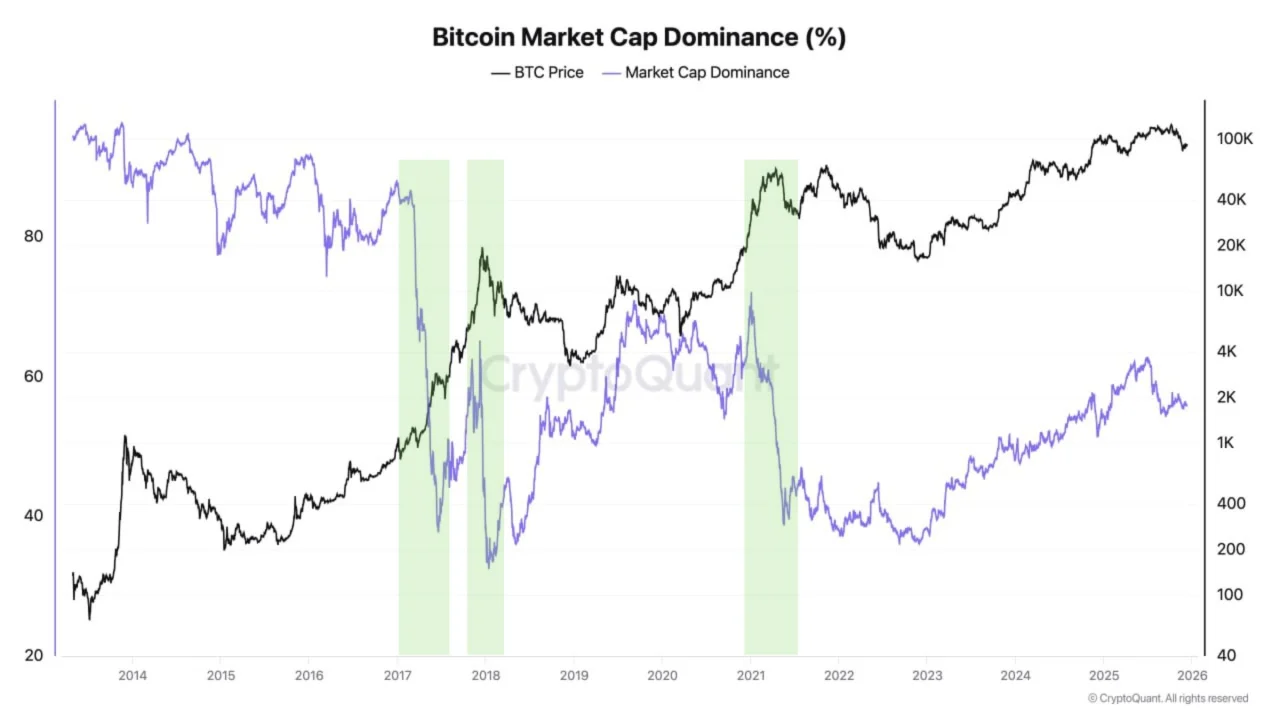
- Bitcoin dominance neared 60% in early 2026, driven by ETF inflows and institutional accumulation across the market.
- CryptoOnchain’s Altcoin Volume Trend signal shows 30-day averages crossing above 365-day averages on CEX data.
- SOL and SUI posted double-digit gains recently, suggesting early capital rotation beyond Bitcoin is already underway.
- MVRV and Profit/Loss Margin remain below cycle peaks, indicating the current bull market may have room to grow.
- Bitcoin dominance neared 60% in early 2026, driven by ETF inflows and institutional accumulation across the market.
Bitcoin dominance has begun losing momentum following a prolonged uptrend, drawing fresh attention from analysts and traders.
A bearish MACD crossover on the BTC dominance chart has triggered wide speculation. Many market observers now believe capital is starting to rotate into altcoins.
Throughout the first half of 2026, Bitcoin led the crypto market almost entirely on its own. Whether this shift marks a temporary pullback or the start of a broader altseason remains the central question.
On-Chain Data Points to Early Rotation Signals
For most of early 2026, Bitcoin absorbed the majority of crypto market inflows. Spot BTC ETF demand, institutional buying, and macro uncertainty pushed BTC dominance close to 60%. During this period, most altcoins struggled to keep pace with Bitcoin’s performance.
However, conditions appear to be changing beneath the surface. Crypto Quant analyst CryptoOnchain recently pointed to a key metric called the “Altcoin Volume Increasing Trend.”
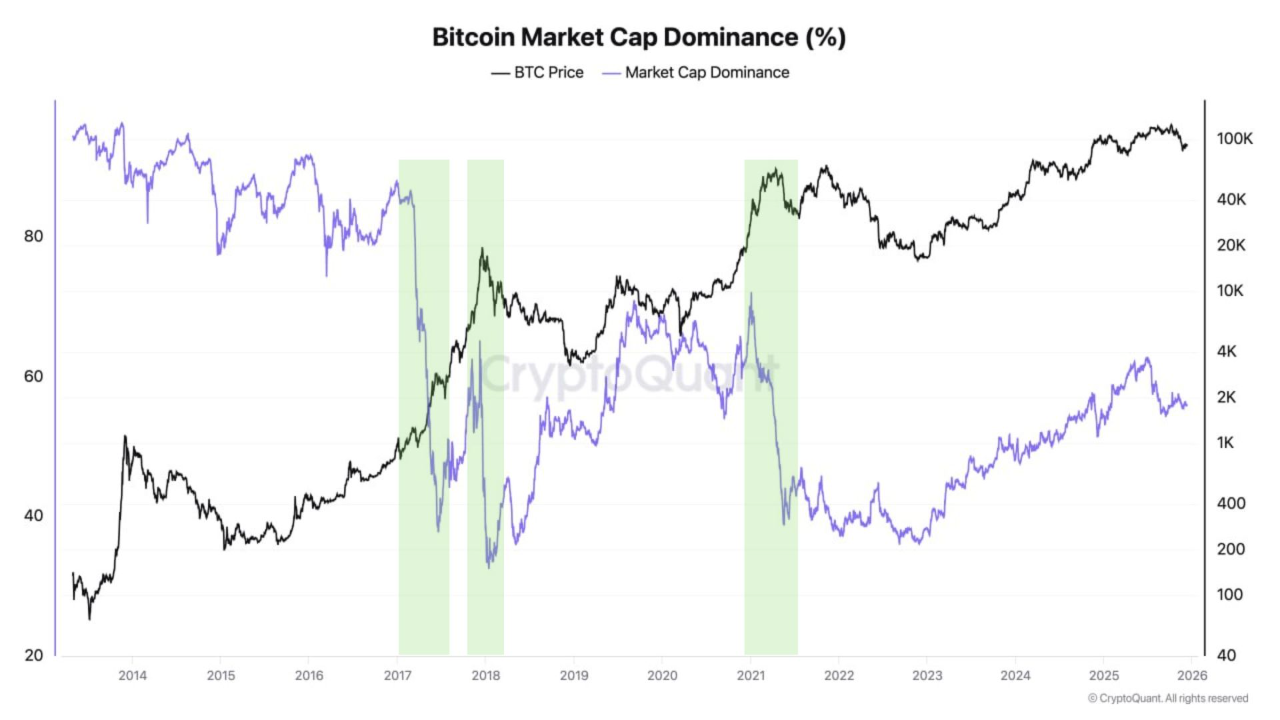
Source: Cryptoquant
This signal appears when the 30-day average altcoin trading volume crosses above the 365-day average. It measures the CEX Volume Ratio between Others and the Top 5 assets.
Historically, this pattern has appeared before major altcoin rallies. During the 2021 cycle, similar signals preceded strong runs in ETH and smaller-cap tokens. That context has given analysts reason to take the current reading seriously.
Price action is beginning to reflect early rotation as well. While ETH has held relatively steady, SOL and SUI have posted notable double-digit gains recently. These moves suggest capital may already be moving beyond Bitcoin into the broader market.
Cycle Metrics Suggest Bull Run Has Room to Grow
Beyond volume data, on-chain metrics are painting a broader picture. Indicators such as Profit/Loss Margin and MVRV remain well below previous cycle peaks. This suggests the current bull market has not yet reached the levels of excess seen in prior tops.
Long-term holders are also showing limited selling behavior at this stage. Historically, sustained distribution from long-term holders has preceded major market tops. The current restraint from this group points to continued confidence in further upside.
Looking back at the long-term BTC Market Cap Dominance chart adds further context. Both the 2017 and 2021 cycles saw dominance decline sharply before altcoins rallied hard. Capital rotated from BTC into ETH first, then spread into smaller assets, triggering broader market gains.
The pattern forming today shares structural similarities with those prior cycles. That said, past performance does not guarantee future outcomes.
Traders are now watching closely to see whether BTC dominance recovers or continues its decline into a confirmed altseason.
Seven major Bitcoin mining pools have joined the Stratum V2 working group to develop an industry-wide open standard protocol used by mining pool operators to communicate with individual miners in their pools.
AntPool, Block Inc, F2Pool, Foundry, MARA Foundation, SpiderPool, and DMND all joined the working group to collaborate on the mining pool communication standard, which could reduce the time it takes pools to successfully mine blocks, according to an announcement from Stratum V2.
“Bitcoin mining is competitive and fragmented by design. It is a race for efficiency where a millisecond can determine whether a miner wins a block or loses to a competitor,” the announcement said.
Foundry and AntPool are the two largest Bitcoin mining pools by hashrate, the total amount of computing power deployed by miners to secure the Bitcoin network.
Foundry controls nearly 30% of the global mining pool hashrate, and AntPool controls about 17.7%, according to data from Hashrate Index.

Mining pools broken down by the share of global Bitcoin mining hashrate they control. Source: Hashrate Index
Developing an open standard for Bitcoin mining pools that is not controlled by any one mining pool operator helps decentralize the mining industry, which has become increasingly centralized, while also giving miners greater flexibility in choosing block templates.
Related: Tether launches open-source mining framework to unify Bitcoin infrastructure
Bitcoin mining difficulty is set to rise in the next difficulty adjustment, while energy costs soar
The Bitcoin mining difficulty, the relative challenge of adding new blocks to the ledger, is projected to rise again in the next difficulty adjustment in May.
“The next Bitcoin difficulty adjustment is estimated to take place on May 15, 2026, 5:58 PM UTC, increasing the Bitcoin mining difficulty from 132.47 T to 135.64 T,” according to CoinWarz.

Bitcoin mining difficulty continues to increase over the long term. Source: CoinWarz
Rising network difficulty and increasing energy costs are placing additional pressure on the already competitive Bitcoin mining industry.
Up to 20% of Bitcoin miners are unprofitable under current crypto market and economic conditions, according to asset manager CoinShares.
Hashprice, a critical metric for miner profitability, fell to levels between hit $36 and $38/Petahash-seconds per day, which is at near or at breakeven profit levels for some miners, CoinShares said.
Magazine: Bitcoin may take 7 years to upgrade to post-quantum: BIP-360 co-author
TLDR:
- Private credit funds have grown outstanding AI loans from near zero to over $200 billion in just years.
- The FSB found banks hold up to $500 billion in direct exposure to private credit funds globally.
- Around 10% of private credit borrowers lack the cash flow needed to meet their interest obligations.
- Retail investor participation in private credit surged from near zero to 13% over the past decade.
Private credit has grown into a $2 trillion industry financing some of the largest AI infrastructure projects globally. Regulators and financial watchdogs are now raising alarms about its opacity.
The Financial Stability Board recently released a 49-page report on the sector. Its conclusions were stark. The industry has never been tested during a real economic downturn at its current size. Meanwhile, markets hover near all-time highs, and few investors appear to notice.
AI Infrastructure Boom Fuels Private Credit Expansion
Morgan Stanley estimates global data center construction will reach $2.9 trillion through 2028. About $1.5 trillion of that is expected to come from private credit funds.
Firms like Blackstone, Apollo, Blue Owl, and BlackRock are leading this lending surge. Outstanding loans to AI companies from these funds have now surpassed $200 billion.
The borrowers are mostly mid-sized companies with debt at five to seven times their earnings. Around 10% of them cannot generate enough cash flow to cover interest payments. Furthermore, default rates are rising. None of this, however, shows up in any public market data.
The sector operates entirely in private, without standardized reporting requirements. Valuations are only updated quarterly, with heavy management discretion applied.
There are no public credit ratings for most of these loans. That lack of transparency makes meaningful risk assessment nearly impossible.
As BullTheoryio noted on X, private credit “has never been tested in a real economic downturn at its current size.” The FSB’s report reflected that same concern.
Policymakers admitted they cannot properly monitor the sector. The admission has since drawn renewed scrutiny from financial observers globally.
Bank Exposure and Retail Investor Risk Add to Systemic Concerns
Banks carry far more exposure to private credit than public figures typically suggest. The FSB estimates direct bank exposure to these funds at between $270 billion and $500 billion.
Moreover, roughly half of all private credit borrowers also hold revolving credit lines at traditional banks. A wave of defaults could therefore hit both private funds and banks simultaneously.
Retail investors have quietly entered this space in growing numbers. Their share of the market rose from virtually zero to 13% over the past decade.
Many may not realize their money is locked in illiquid loans to highly leveraged companies. These loans cannot be easily valued or sold during a market crisis.
Several AI data center deals involve off-balance-sheet financing, GPU-backed collateral, and complex leasing structures.
One analyst warned the situation mirrors past cycles of financial opacity. “There is almost no transparency about the financing structures, the scale is astronomical,” the analyst noted.
The S&P 500 currently trades at 23 times forward earnings, with five companies accounting for 30% of the index. AI investment now drives nearly half of U.S. GDP growth. If the boom falters, these losses may not surface in public markets until it is already too late.

Strategy, the Bitcoin treasury company led by CEO Phong Le, signaled it may sell a portion of its Bitcoin holdings to fund the dividend on its Series A Perpetual Stretch Preferred Stock (STRC), which carries an 11.5% yield for holders. In an interview, Le outlined a decision framework that prioritizes financial math and shareholder value: the firm would choose to dispose of BTC if the sale is accretive to Bitcoin per share and benefits common shareholders, rather than defaulting to equity sales to cover the dividend. He stressed that any BTC sales would be undertaken only if they improve the fundamental metric for Strategy’s investors.
Le’s stance crystallizes a broader debate within Strategy’s ranks, where co-founder Michael Saylor has floated the possibility of selling BTC periodically to support dividend payments. That prospect has fed concerns among Bitcoin investors about potential selling pressure from one of the market’s largest corporate treasury holders. In a recent earnings discussion, Saylor framed the matter in a way that suggested strategic timing and market signaling could play as much a role as the financial mechanics of the sale. He indicated that Strategy could “inoculate the market” by selling BTC to fund the yield and send a clear message that the company is capable of sustaining its rewards to investors even in adverse conditions. He also said that if Bitcoin appreciates by more than roughly 2.3% per year, Strategy might fund its dividends indefinitely without diluting shareholders by selling Strategy’s stock.
Strategy currently sits atop the Bitcoin treasury sector by size. The company holds 818,334 BTC, a stash valued at more than $66 billion at the time of writing, making it the largest publicly traded BTC treasury according to BitcoinTreasuries data. That scale is precisely what has heightened scrutiny and debate about how such holdings, and the sales tied to them, might influence Bitcoin’s market dynamics in the medium term. The tension is not solely about the amount sold today, but about the signaling effects and the potential for repeated, scheduled, or opportunistic sales to support corporate returns.
In weighing the potential impact of Strategy’s actions, Le argued that Bitcoin’s daily trading volume, estimated around $60 billion, affords substantial liquidity to absorb more than a $1 billion annual commitment in BTC sales tied to STRC dividends. He contends that the market’s depth should prevent a material drag on prices simply from the regular execution of the corporate yield strategy. Still, the possibility of large, episodic sales remains a focal point for investors who worry about price impact during periods of volatility or thinner liquidity windows.
Earlier coverage from Cointelegraph highlighted a conflicting thread within the same narrative: some market observers feared that Strategy’s sales could undermine BTC’s price, even if well-structured and well-timed. In response, supporters argue that the very existence of a durable, revenue-generating instrument like STRC helps attract institutional interest in Bitcoin-backed securities, potentially offering a new path for long-term capital to participate in crypto markets. The topic has also attracted commentary from other industry figures, including those who have defended Strategy’s approach to balancing treasury management with market stability. For additional context, see reporting surrounding Samson Mow’s defense of Strategy’s selling decisions and the broader discourse on corporate BTC reserves.
Strategy’s framework: when BTC sales make sense
At the core of Le’s remarks is a practical, numbers-driven criterion: any BTC sale must be accretive to Strategy’s key metric—Bitcoin per share—and must improve outcomes for common shareholders. In other words, the company would prefer to convert a portion of its BTC into cash or equity space if that conversion increases theBTC per share ratio or otherwise strengthens the overall value proposition for investors, rather than disproportionately diluting or depressing equity through other means. Le’s framing is deliberately disciplined, signaling a willingness to use Bitcoin sales as a tool to sustain dividend obligations only when it enhances long-term value, not as a reflexive cash-out to meet near-term financial targets.
What constitutes “accretive” in this setting is a central question for analysts. Strategy has built its corporate narrative around a steady, dividend-backed yield derived from its BTC holdings, rather than relying solely on equity finance or debt instruments. Le’s insistence on accretion implies a trade-off analysis: comparisons between selling BTC to fund the STRC dividend, versus selling Strategy’s stock or using other balance-sheet mechanisms. The decision, he asserts, will be guided by what preserves or improves BTC per share over time, a measure that directly ties BTC holdings to shareholder value and policy credibility.
Saylor’s posture: market signaling and potential constraints
Michael Saylor’s public commentary adds a complementary, if cautionary, layer to Strategy’s strategic calculus. He has suggested that the company could routinely sell portions of its BTC to support dividend payments, arguing that periodic activity can normalize the process for the market and demonstrate the corporation’s commitment to its yield model. The logic, according to Saylor, is that measured sales can ensure the dividend remains funded even as Bitcoin’s price moves. He framed this as a form of market inoculation—an intentional signaling move rather than an indiscriminate liquidation drive.
In the same breath, Saylor described a potentially capital-efficient path: if Bitcoin can grow in value at or above a certain pace, Strategy might fund dividends without issuing more stock. He has claimed that the company could “stop selling MSTR common stock right now” if BTC-driven proceeds prove sufficient to cover dividends, implying a ceiling on equity dilution should BTC performance be favorable. Whether this is a practical, repeatable reality—given market cycles and macro conditions—remains a core point of debate among investors tracking Strategy’s governance and the long-term implications for BTC’s price formation.
Market dynamics: can Strategy’s scale be absorbed without skews?
Strategy’s vast Bitcoin reserve has amplified discussions about liquidity, signaling, and price impact. BitcoinTreasuries data positioning Strategy as the largest publicly traded BTC treasury underscores the potential magnitude of any sustained sale. Critics warn that even well-timed, gradual disposals by a single sovereign-entity treasury could introduce selling pressure, particularly if large blocks are unlocked during episodes of heightened volatility or thin liquidity windows. Supporters counter that the market’s daily turnover and deep liquidity should be able to accommodate ongoing BTC-backed dividends without derailing price discovery or creating sustained downward pressure.
From a practical standpoint, the arithmetic of Strategy’s dividend obligation matters. If the STRC instrument carries 11.5% yield, the annual dividend obligation can exceed $1 billion, depending on BTC’s price and the levels of BTC retained within the treasury. Le’s assertion that the market’s liquidity is sufficient to absorb such a flow hinges on continuous, orderly execution and the absence of panic-driven liquidity squeezes. The debate touches on a broader question: how do large corporate BTC reserves influence price formation, and what are the implications for risk management when a crown jewel of the crypto treasury sector contemplates periodic sales?
Broader implications for corporate BTC treasuries
What Strategy is exploring is more than a one-off liquidity strategy; it represents a test case for how corporate treasuries can evolve in a crypto-native economy. The idea of using BTC sales to fund dividends raises important questions for investors, regulators, and the broader market about governance, transparency, and the durability of revenue streams backed by digital assets. As more institutions weigh BTC reserve strategies, the industry will closely watch how such corporate actions align with risk management practices, tax considerations, and the timing of transactions in relation to Bitcoin’s price cycles.
For readers following the sector, the next chapters will likely center on concrete sale timing, the actual impact on BTC per share, and the resonance of STRC’s yield with other crypto-linked yields. Market participants will also want clarity on whether Strategy’s appetite for BTC sales remains consistent across varying market conditions or becomes more tempered during periods of downside risk or regulatory shifts. The ongoing conversation around Strategy’s approach dovetails with broader coverage of how notable treasury holders manage large Bitcoin positions in relation to dividends, equity strategy, and the quest for stable, long-term value creation in crypto markets.
Looking ahead, investors will want to monitor whether Strategy proceeds with BTC liquidations to fund STRC dividends, how those moves are staggered over time, and what signals emerge about the company’s long-term posture toward its Bitcoin holdings. The evolving dynamic between BTC price action, dividend commitments, and the market’s capacity to absorb new BTC supply will remain a focal point for risk managers and traders tracking the mainstreaming of Bitcoin-backed corporate finance.
Sources and context: Strategy’s statements and the STRC yield framework were discussed in a CNBC interview and related coverage. The company’s BTC holdings and scale are tracked by BitcoinTreasuries, which lists Strategy as holding 818,334 BTC valued at over $66 billion at the time of reporting. For additional perspective on Strategy’s public market stance and commentary from other industry figures, see prior coverage on Strategy’s discussions around selling portions of its BTC treasury.
Readers should stay attentive to official disclosures and earnings calls from Strategy for any updates on potential BTC sales, dividend funding plans, and changes to the STRC program, as these developments will shape Bitcoin market dynamics and investor sentiment in the months ahead.
Crypto World
Inside Ondo Finance: How OUSG and USDY Tokenize US Treasuries Through Distinct Legal Frameworks
TLDR:
- OUSG operates as a Delaware limited partnership investing through BlackRock’s BUIDL fund into US Treasuries.
- USDY holders are secured creditors of a special purpose vehicle backed by US Treasuries and bank deposits.
- OUSG is restricted to Qualified Purchasers, while USDY targets non-US investors under Regulation S.
- Both products are audited, FinCEN-registered, and built on compliance frameworks institutional teams accept.
Ondo Finance has built two tokenised products on US Treasuries, each carrying a separate legal structure. OUSG targets institutional capital through a Delaware private fund, while USDY serves non-US investors as a secured debt instrument.
Both products have passed compliance checks from major institutional partners. Understanding the legal design behind each product matters more than tracking the ONDO token price alone.
OUSG Brings Institutional-Grade Access to Tokenised Treasuries
OUSG is a tokenised limited partnership interest in a private fund. The fund invests primarily in BlackRock’s USD Institutional Digital Liquidity Fund.
That fund holds short-term US Treasuries backed by the US government. Investors in OUSG become limited partners in a Delaware-structured vehicle managed by Ondo Capital Management LLC.
The custody chain follows a clear and regulated path. Investor USDC converts to USD through Coinbase or Circle. That USD then flows into BlackRock’s BUIDL fund. Fidelity, Franklin Templeton, and WisdomTree also participate alongside BlackRock in that fund.
The legal wrapper is equally structured. OUSG operates under a Section 3(c)(7) private fund structure. It relies on Rule 506(c) of Regulation D for its offering. Every investor passes KYC, AML, and sanctions screening administered by the General Partner.
As crypto analyst @2xnmore noted, “OUSG is only available to Qualified Purchasers and verified Accredited Investors.
This is not a product trying to appear institutional. It is a product that is legally and structurally institutional in every dimension.”
USDY Functions as a Secured Debt Instrument for Non-US Investors
USDY operates through Ondo USDY LLC, a special purpose vehicle. The LLC borrows funds from lenders and issues USDY tokens as evidence of its debt obligation.
Those proceeds then go into US Treasuries and US bank demand deposits. A perfected security interest protects those underlying assets.
Holders of USDY are secured creditors, not equity holders or token speculators. They hold a legal claim on the underlying assets of the special purpose vehicle.
This structure is offered under Regulation S, making it available to non-US persons. Both retail and institutional investors outside the US can access it.
Ondo USDY LLC is registered as a money services business with FinCEN. FinCEN is the Financial Crimes Enforcement Network under the US Treasury Department.
Every USDY holder goes through AML and Bank Secrecy Act compliance screening. This registration adds another layer of regulatory credibility to the product.
Smart contracts for both products have been audited by leading firms. Both entities also undergo regular financial and information security audits.
The two products serve different investor profiles but share the same underlying asset conviction. Tokenised US Treasuries remain the core financial primitive behind both structures.
Phong Le, the CEO of Bitcoin treasury company Strategy, outlined conditions during an interview on Friday, under which the company would sell some of its Bitcoin holdings.
The company will sell Bitcoin to pay the dividend on its Series A Perpetual Stretch Preferred Stock (STRC), a corporate credit instrument that pays an 11.5% dividend to holders, and to defer or offset taxes, Le told CNBC. He added:
“I believe in math over ideology, and at the point where selling Bitcoin versus selling equity to pay a dividend is better for our Bitcoin per share, and for our common shareholders, we will do it.”
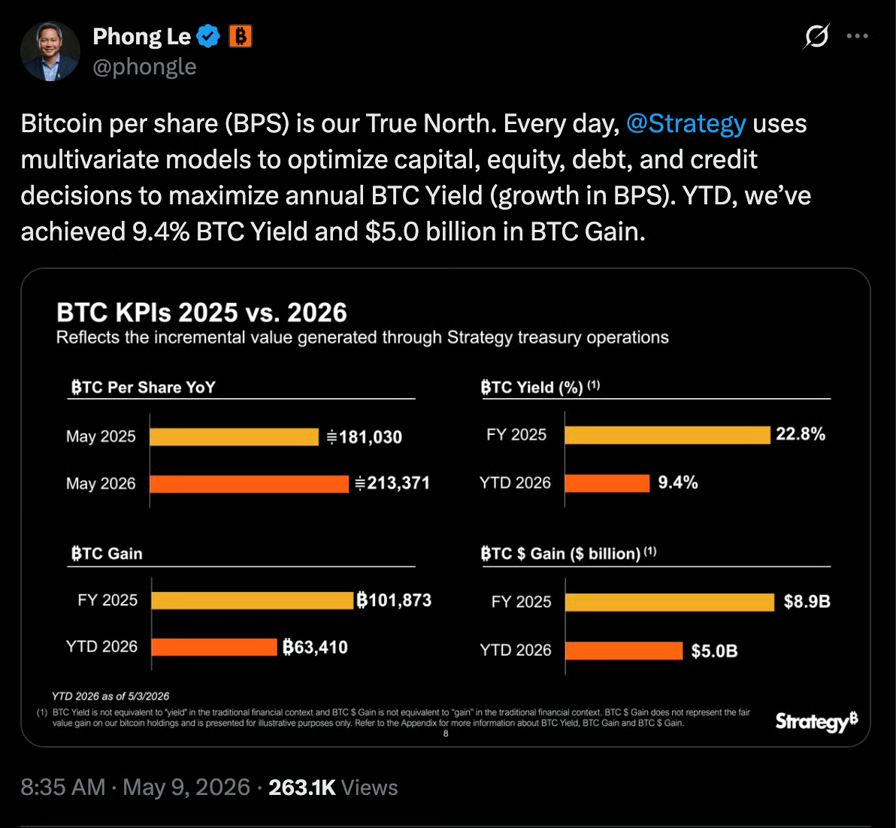
Le added that the company would only sell BTC to pay for the yield owed to holders of its credit instruments if the sales are “accretive” to Strategy’s shareholders, meaning the company increases the BTC per share metric.

Source: Phong Le
The comments came after Strategy co-founder Michael Saylor said that the company might sell portions of its BTC periodically, stoking fears among BTC investors about the potential impacts of Strategy’s sales on Bitcoin’s market price.
Related: Samson Mow defends Strategy selling portions of its Bitcoin treasury
Saylor says Strategy may sell BTC, but Le says it won’t impact asset prices significantly
“We’ll probably sell some Bitcoin to fund a dividend, just to inoculate the market, just to send the message that we did it,” Saylor said in an earnings call on Tuesday.
Saylor added that if BTC appreciates by more than 2.3% annually, Strategy could fund its dividend payments “forever” without selling Strategy’s stock and diluting shareholders.

The annual yield on Strategy’s BTC treasury. Source: Strategy
“We could stop selling MSTR common stock right now,” Saylor said, adding, “We can fund the dividends with Bitcoin sales.”
The company holds 818,334 BTC, valued at more than $66 billion at the time of this writing, making it the largest publicly traded BTC treasury company, according to data from BitcoinTreasuries.
Treasury companies offloading their BTC may create selling pressure that negatively impacts Bitcoin’s price; however, Le said that BTC’s daily trading volume of about $60 billion is enough to absorb the more than $1 billion in annual dividends that Strategy owes.
Magazine: Big questions: Should you sell your Bitcoin for nickels for a 43% profit?
Crypto World
Crypto News Today Shows CLARITY Act Nearing Finish Line While Pepeto’s Listing Could Trigger the Biggest Meme Coin Returns of 2026
The biggest crypto news today is the CLARITY Act reaching its final stage before a Senate Banking Committee vote, with the White House pushing Congress to pass it by July 4. Bitcoin crossed $80,000 on the news and held above $81,000 for three straight sessions, Circle stock jumped 20%, and the market shifted from fear to conviction in under a week.
Pepeto ($PEPETO) crossed $9.8 million in presale funding as the Binance listing draws near, and holders who entered days ahead of everyone else on coins like Dogecoin turned $500 into six figures because they moved while others were still reading the crypto news today headlines.
CLARITY Act Stablecoin Compromise Clears Senate Path as White House Targets July 4
Senators Thom Tillis and Angela Alsobrooks released compromise text on stablecoin yield rules in the CLARITY Act, removing the final block that stalled the bill for three months, according to CoinDesk.
The crypto news today cycle shifted when CNBC reported Circle shares surged 20% and Coinbase jumped 7% as the market priced in regulatory clarity.
Senate Banking chairman Tim Scott said the committee could mark up the bill in May with a floor vote by June or July, and the White House added pressure by setting July 4 as the target.
Pepeto, BNB, and Dogecoin After the CLARITY Breakthrough
Pepeto
Regulatory clarity sends capital flooding into crypto, but the biggest returns never come from the coins already priced for the news, and that is why Pepeto sitting outside the spotlight with past $9.8 million in funding and a Binance listing ahead matters more than any large cap bounce this week.
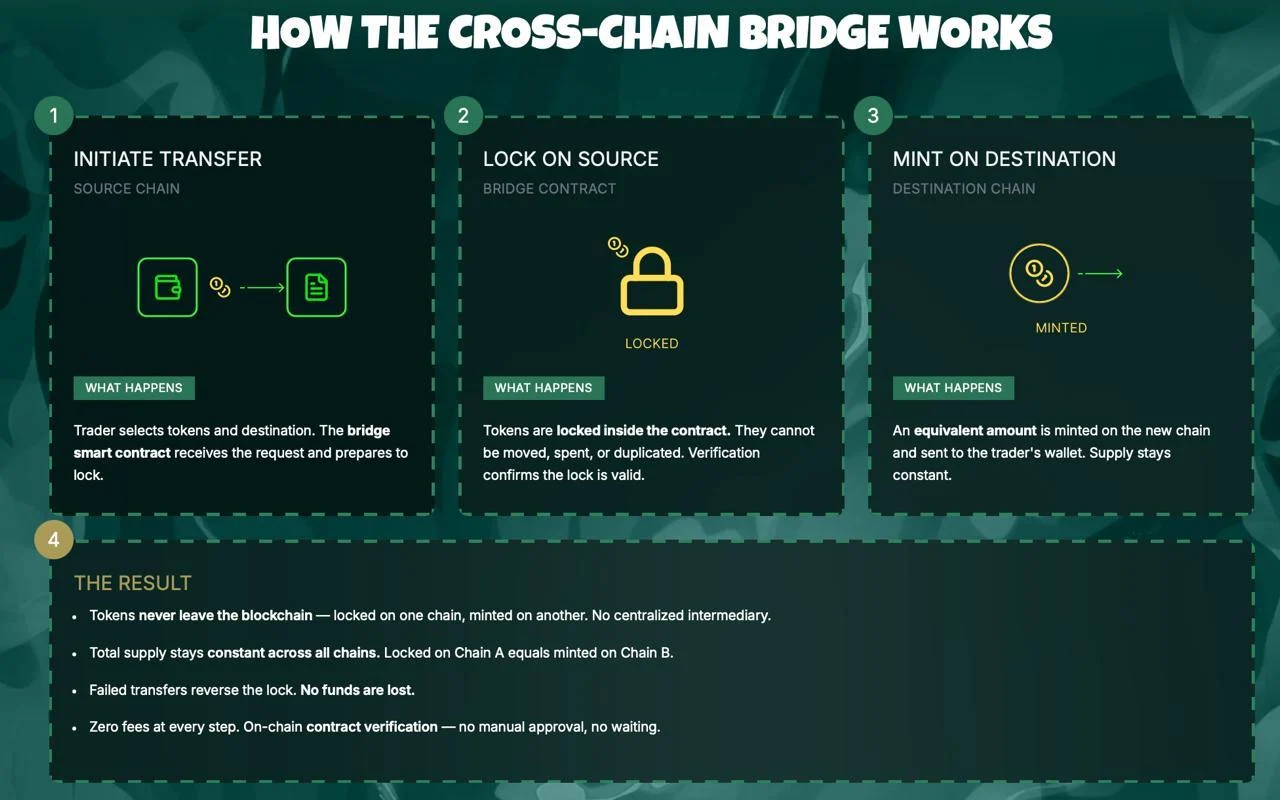
The crypto news today headlines confirm the cycle, but the cross-chain bridge on the Pepeto platform moves tokens between networks without charging a cent so money shifts wherever opportunity appears without fees eating the gains, and PepetoSwap handles fee-free swaps on top of that, keeping every dollar whole instead of splitting it across gas and charges.
The architect of the original Pepe token and a veteran from the Binance team lead the project, SolidProof cleared every contract on the network, and capital past $9.8 million arriving before the CLARITY rally proves these wallets priced in the result early.
Analysts project 100x to 300x from the presale price of $0.0000001868, passive staking at 175% APY strengthens wallets between now and listing day, and the entry that exists today closes when the Binance listing arrives, so every hour between now and that moment is the window where crypto news today readers can still get in at the price the earliest wallets paid.
BNB
CoinMarketCap shows BNB at $638 on Thursday, up 3.19% in the last 30 days, and the CLARITY Act gives Binance’s ecosystem a direct regulatory boost.
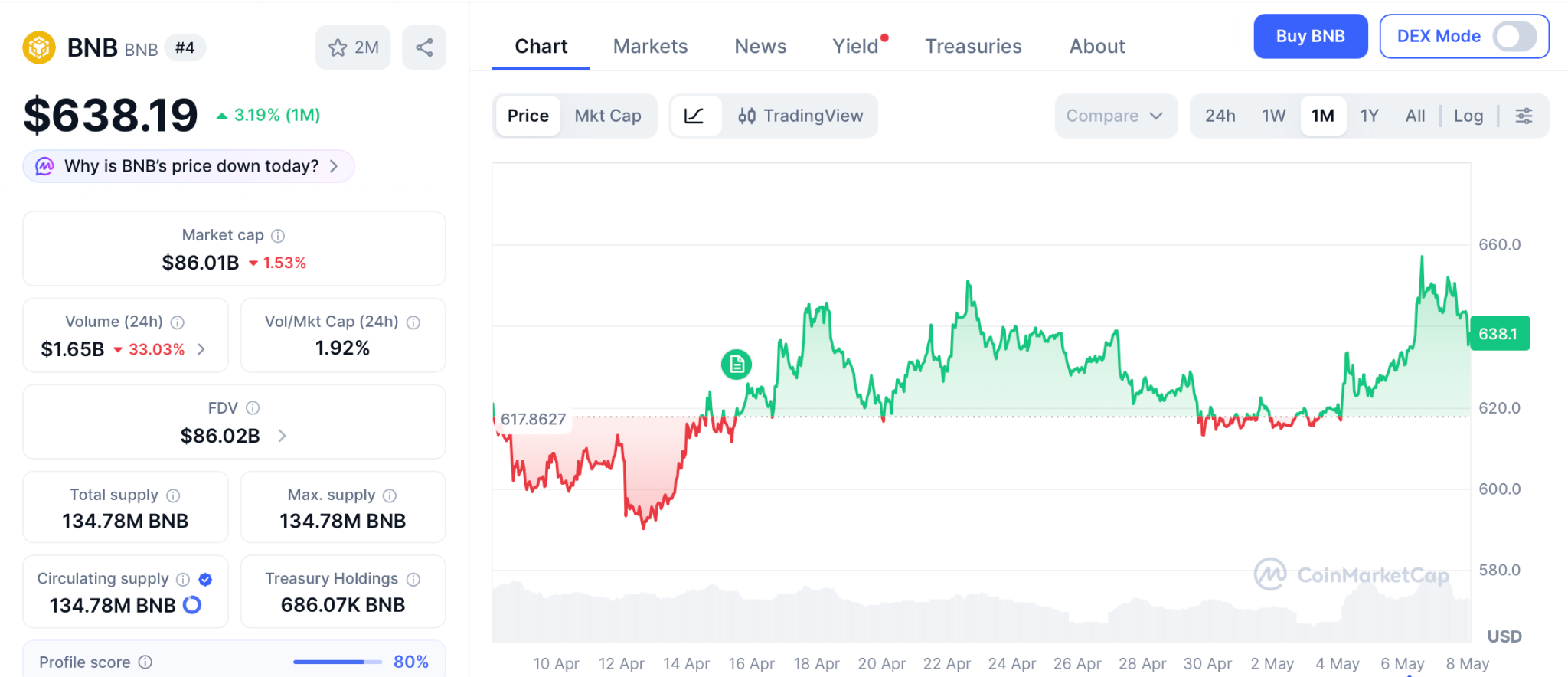
From $638 with a $86 billion market cap, BNB reaching $1,000 is a 62% gain that requires the entire exchange to grow at a pace it has not matched since 2021.
Dogecoin
Per CoinMarketCap, DOGE sits at $0.1078 on May 8, 2026, gained 1.7% this week but sits 97% below its all-time high of $0.73.
Early DOGE holders turned small positions into fortunes, but from $0.1078 the math points to slow recovery measured in years, not the overnight returns that presale listings create.
Conclusion
The crypto news today confirms the cycle is here: CLARITY is clearing, ETFs are buying, and Bitcoin holds above $81,000. But BNB from $638 and DOGE from $0.1078 offer percentage gains that took years to build the last time, and the difference between those returns and what a presale listing delivers is where fortunes are made.
Early DOGE holders who entered one day ahead of the pack turned $500 into six figures because they were hours ahead, and the Pepeto presale at $9.8 million raised with under $300,000 to go is that same window right now, except a Binance listing sits ahead and the close could come any day.
The listing goes live the moment the presale fills, and at this pace that moment arrives before the end of May. Acting through the Pepeto official website while the presale window remains is how returns get captured, and the cost of hesitation is watching the highest-return presale event of 2026 reprice the token you could have bought today at a fraction of what the market charges tomorrow.
Click To Visit Pepeto Website To Enter The Presale

FAQs:
What is the biggest crypto news today driving the market in May 2026?
The biggest crypto news today is the CLARITY Act stablecoin compromise clearing the Senate’s final block while Bitcoin holds above $81,000 on $2.7 billion in ETF inflows. Circle stock jumped 20% and Coinbase gained 7% as the market priced in regulatory clarity at the fastest pace since 2021.
Why are analysts calling Pepeto the best presale entry before the Binance listing?
Analysts point to Pepeto because it raised past $9.8 million at $0.0000001868 with under $300,000 left before the presale closes and the Binance listing goes live. The same developer behind the original Pepe coin’s $11 billion run leads the project with a SolidProof audit and 175% APY staking active today.
Disclaimer: This is a Press Release provided by a third party who is responsible for the content. Please conduct your own research before taking any action based on the content.

Could Pepeto Be the Next Crypto to Explode While Solana Grinds at $88.33 and Cardano Struggles Below $0.30

Shop the Look at Walmart!

Is this what true financial freedom and emotional closure look like?

Manchester United reach agreement with Casemiro over contract clause amid transfer speculation

US brings back mandatory military draft registration

Steven Gerrard disagrees with Gary Neville over ‘shock’ Chelsea and Arsenal claim | Football
Is this what true financial freedom and emotional closure look like?

Yahoo Finance Live: Stocks rise as Apple-Intel deal report lifts chipmakers | May 8, 2026

Breaking News for XRP and Crypto! #xrp #ripple #crypto #bitcoin #btc #cryptocurrency #xrparmy #eth
-
 Crypto World2 days ago
HarrisX Poll Found 52% of Registered Voters Support the CLARITY Act
-

 NewsBeat6 days ago
Channel 5 – All Creatures Great and Small series 7 new post
-

 Crypto World3 days ago
Upbit adds B3 Korean won pair as Base token gains Korea access
-

 Tech5 days ago
Image AI models now drive app growth, beating chatbot upgrades
-

 News Videos7 days ago
AP Dhillon – Old Money (Official Audio)
-

 Fashion1 day ago
Weekend Open Thread: Marianne Dress
-
 NewsBeat3 days ago
NCP car park operator enters administration putting 340 UK sites at risk of closure
-
Entertainment7 days ago
Anna Nicole Smith’s Daughter Attends 2026 Kentucky Derby
-

 Crypto World7 days ago
Bitcoin mining equities rise in 2026 as BTC lags behind
-

 Entertainment7 days ago
Melissa Joan Hart and More Stars Attend 2026 Kentucky Derby
-
Entertainment7 days ago
Venus Williams’ Best Met Gala Looks Over the Years
-
 Business12 hours ago
Ignore market noise, India’s long-term story intact, say D-Street bulls Ramesh Damani and Sunil Singhania
-

 Business7 days ago
Winning Numbers Drawn as Jackpot Resets to $20 Million
-

 Business7 days ago
Luka Doncic Injury Update: Doncic’s Hamstring Recovery Slows Lakers’ Hopes Against Thunder: Can He Run Yet?
-

 Sports7 days ago
Is Man United v Liverpool on TV? Channel, streaming and how to watch Premier League fixture
-

 Politics18 hours ago
Politics Home Article | Starmer Enters The Danger Zone
-
Entertainment7 days ago
“Storage Wars” star Darrell Sheets' ex-wife breaks silence on his death
-

 Entertainment7 days ago
Taron Egerton and Charlize Theron Thrill In Netflix’s ‘Apex’
-
Entertainment7 days ago
Jane Fonda clarifies her Barbra Streisand shade about Robert Redford's Oscars tribute: 'I thought I was being funny'
-

 Sports6 days ago
Inter Milan Win Serie A Title After Victory Over Parma
You must be logged in to post a comment Login