

Crypto World
Bitget secures New Zealand registration to expand tokenized stock services



Bitget has completed its New Zealand financial services registration covering five business areas as the crypto exchange expands its tokenized and direct U.S. stock products.
Summary
- Bitget registered for five financial service categories in New Zealand and joined the IFSO dispute scheme.
- The registration supports Bitget’s rToken and Stock+ services covering tokenized and direct U.S. equities.
- Bitget plans a regulated U.S. return while keeping its platform restricted in Singapore.
Bitget said its entry in New Zealand’s Financial Service Providers Register covers foreign currency exchange, domestic and cross-border money transfers, client asset custody, portfolio and money management, and the execution of financial products or foreign exchange transactions for clients. Bitget announced the registration on July 23.
Alongside the registration, the exchange has joined the Insurance and Financial Services Ombudsman Dispute Resolution Scheme. The IFSO Scheme describes its service as an independent, fair and free channel through which consumers can pursue complaints against participating financial service providers.
Registration on the FSPR does not, by itself, mean that Bitget is licensed or regulated in New Zealand. New Zealand’s Companies Office states that registration neither represents government approval nor guarantees that a provider is subject to active supervision.
According to the Companies Office, certain financial services also require a license from the Financial Markets Authority or the Reserve Bank of New Zealand. Bitget’s announcement identified its registered service categories but did not disclose a separate New Zealand license from either authority.
Registration covers trading, custody and money transfers
Under its registered scope, Bitget can provide foreign exchange services and transfer money within New Zealand or across national borders. The company’s announcement also included holding and safeguarding client assets, managing portfolios and executing transactions in products such as stocks and exchange-traded funds.
Joining the IFSO Scheme adds a formal complaint process alongside those services. New Zealand’s FSPR guidance states that providers serving retail clients generally must belong to an approved dispute resolution scheme unless an exemption applies.
Bitget presented the registration as another part of its compliance network, citing its Digital Asset Service Provider license in El Salvador and authorization from South Africa’s Financial Sector Conduct Authority. The exchange said those approvals support its operations under separate national rules.
However, Bitget follows different access policies in markets where it lacks local approval. In a July 22 notice, the exchange confirmed that it is not licensed, approved, registered, authorized or supervised by the Monetary Authority of Singapore.
The Singapore notice also states that Bitget does not make its services available to people in the country, solicit Singapore residents or direct offers toward them. Singapore remains listed as a prohibited country under the exchange’s terms, with platform access restricted from the jurisdiction.
Commenting on Bitget’s regulatory approach, CEO Gracy Chen said:
“As Bitget continues to expand globally, we will remain committed to meeting local regulatory requirements and building a trusted platform for our users.”
Singapore’s MAS uses its Investor Alert List to identify businesses that consumers could mistakenly view as regulated by the authority. As crypto.news reported, MAS added decentralized exchange Hyperliquid to the list in June 2026, after which Hyperliquid stated that it had never claimed to possess approval from the regulator.
Tokenized stocks support Bitget’s expansion plans
Bitget’s New Zealand registration comes as the exchange builds two routes into U.S. equity markets. Its rToken product provides tokenized economic exposure to selected U.S. stocks and ETFs, while Stock+ gives eligible users broker-style access to real securities through licensed partners.
According to Bitget’s product documentation, rTokens are issued by Reality and designed to carry 1:1 backing through shares held in custody. The tokens track assets such as Nvidia, Apple, Tesla and the SPDR S&P 500 ETF, although holding one does not provide the same ownership structure as buying a registered share through a traditional brokerage account.
Bitget says the rToken lineup covers more than 500 mainstream U.S. stocks and ETFs, with selected products available around the clock. Supported tokens can also be used in certain margin, collateral, lending and trading strategies, subject to product and regional rules.
Stock+ serves a different market by offering more than 10,000 U.S.-listed stocks and ETFs. Bitget’s documentation states that the service supports fractional holdings from 0.0001 shares, dividend payments and trading during U.S. market sessions, while access depends on a customer’s location and eligibility.
The exchange is also preparing to return to the United States after dropping an earlier expansion effort following FTX’s 2022 collapse and the enforcement pressure that followed. As crypto.news reported on July 22, Chen said Bitget intends to enter the market regardless of whether Congress passes the CLARITY Act.
Before offering U.S. services, Chen said the company plans to establish an independent local entity and pursue money-transmitter, derivatives and broker-dealer approvals. Bitget has not provided a launch date, making its entry dependent on completing the required approval processes.
Chen also told crypto.news that tokenized traditional assets accounted for 20% to 30% of Bitget’s spot trading volume during the previous quarter. According to her figures, 52% of its users held both stocks and cryptocurrencies, while Bitget’s tokenized-stock products had accumulated more than $100 million in assets.
With the New Zealand registration now complete, Bitget has added another jurisdiction to its financial-services network while keeping product access tied to local rules. Its progress in the United States will depend on obtaining separate approvals, just as its Singapore restrictions remain in force without MAS authorization.



Zilliqa has suspended native ZIL transactions after disclosing a critical flaw in its Ledger application that can allow attackers to recover private keys from public transaction signatures.
Summary
- Zilliqa halted native transactions after a Ledger app flaw exposed private keys from public signatures.
- Accounts signing roughly five native transactions with Ledger devices should be treated as compromised permanently.
- Upbit flagged ZIL as cautionary while EVM transactions and Zilliqa software development kits remain unaffected.
The bug affected every released version of the app from 2019 through 2026 and applies to native, non-EVM transactions signed with Ledger devices.
The network said it observed onchain activity consistent with active exploitation on July 19 and confirmed the root cause on July 21. Zilliqa has prepared a corrected Ledger app build, but the fix cannot protect keys exposed through earlier signatures. Native transactions remained suspended in the latest official update while the team finalized a coordinated recovery plan.
Zilliqa Ledger bug weakened transaction signatures
The flaw affected how the Zilliqa Ledger app generated Schnorr signatures for native transactions. Each signature needs a fresh random number, known as a nonce, to protect the private key. Zilliqa said the app generated enough random data but copied the wrong 32 bytes into the signing process. The mistake left the highest 64 bits of every nonce fixed at zero.
The reduced randomness allowed attackers to compare several public signatures from the same account and reconstruct its private key. Zilliqa said accounts that broadcast roughly five or more affected native transactions should be treated as compromised. The project said the recovery process can take seconds on ordinary hardware once enough signatures are available.
Because the signatures remain permanently recorded onchain, updating the Ledger app cannot repair an already exposed key. Zilliqa said affected keys must be retired. It also warned against simply moving funds when transactions restart because an attacker holding the recovered key could try to send a competing transaction.
Native transactions stop while EVM users remain unaffected
Zilliqa suspended native transactions after identifying the flaw, blocking further native transfers while the team develops a method to protect affected balances. The project asked Ledger users who signed native transactions to wait for official instructions.
“Users who have signed native Zilliqa transactions with a Ledger device should await official guidance before taking any action,” Zilliqa noted.
The issue does not affect EVM transactions, according to Zilliqa. The project also said its software development kits, including zilliqa-js, gozilliqa-sdk and pyzil, generate nonces correctly. Users who only transact through EVM-compatible tools therefore sit outside the affected signing path.
Zilliqa credited KuCoin with helping trace the problem. The exchange recovered affected private keys from public signatures, helped confirm active exploitation and assisted in identifying the faulty nonce-generation process. Zilliqa said the cooperation helped it introduce protective measures while preparing a broader recovery plan.
Upbit places ZIL under caution after disclosure
South Korean exchange Upbit placed ZIL under cautionary status after the vulnerability became public. The designation covers its KRW and BTC markets, while ZIL deposits and withdrawals remain suspended. Trading support could face further review if the issue is not resolved through the exchange’s monitoring process.
The exchange action comes while Zilliqa works on securing balances controlled by keys that may already be recoverable. A corrected Ledger build has been prepared, but the project has not yet published its full recovery procedure or announced when native transactions will resume.
As crypto.news reported on July 20, Zilliqa had already asked exchanges to pause ZIL deposits and withdrawals after an exchange partner reported a cold-wallet theft. At that stage, the project had not disclosed the stolen amount, affected exchange or attack method. Zilliqa has not publicly stated whether that earlier theft was caused by the Ledger flaw.
Bug follows earlier Zilliqa network disruptions
The Ledger vulnerability differs from earlier Zilliqa outages because it affects private-key security rather than block production or node synchronization. Still, the disclosure follows several technical disruptions that affected the network in previous years.
Moreover, Zilliqa announced a permanent fix in September 2024 after a bug halted block production. The network later suffered another outage in January 2025 linked to node synchronization problems before restoring full service. Zilliqa has not connected those incidents to the Ledger app flaw.
The current issue also sits outside Ledger hardware itself. Zilliqa described the problem as a defect in its own Ledger application’s native signing code. The corrected build restores full-width nonce generation and should prevent new weak signatures once released.
For affected users, the old transaction history remains the main risk. Public signatures cannot be removed from the blockchain. Zilliqa said users who signed about five or more native transactions with a Ledger device should consider their keys compromised and wait for recovery instructions. The network has not announced a date for restoring native transactions.


Revolut has reached a $115 billion valuation through a new secondary share sale, extending a rapid rise in the private market value of the crypto-friendly digital bank.
Summary
- Revolut reached a $115 billion valuation through an employee share sale priced at $2,017 each.
- Revolut reported $6 billion revenue and $2.3 billion pre-tax profit for 2025 amid global expansion.
- Revolut now serves over 75 million customers while expanding regulated banking and crypto services worldwide.
The deal prices shares at $2,017 each and allows employees and other existing shareholders to sell stock, according to The Wall Street Journal.
The transaction does not raise fresh capital for Revolut. Instead, it creates liquidity for existing holders. The new valuation is about 53% above the $75 billion level established in a 2025 share sale and more than double the $45 billion valuation recorded in 2024. The size of the latest transaction has not been disclosed.
Revolut valuation rises above $100 billion
The $115 billion figure makes Revolut Europe’s most valuable startup and places its private valuation above the market value of several established banks. The Wall Street Journal compared the figure with Barclays, which had a market capitalization of roughly $95 billion at the time of its report.
The comparison has limits because Revolut’s price comes from a private secondary transaction rather than daily public-market trading. Still, the latest sale provides a new price for employee and shareholder stock less than a year after investors valued the company at $75 billion.
As crypto.news previously reported, Revolut completed that $75 billion share sale in November 2025 after an earlier employee liquidity program. The latest transaction extends the same approach, giving staff and other shareholders a route to sell part of their holdings without waiting for an initial public offering.
Record 2025 results support the higher valuation
Revolut reported $6 billion in group revenue for 2025, up 46% from $4 billion a year earlier. Profit before tax rose 57% to $2.3 billion, while net profit reached $1.7 billion. The company also reported a 38% pre-tax profit margin.
Customer growth continued alongside the earnings increase. Revolut ended 2025 with 68.3 million retail customers after adding 16 million during the year. Its current website says the platform now serves more than 75 million customers worldwide. Customer balances reached $67.5 billion at the end of 2025, while total transaction volume rose 65% to $1.7 trillion.
The company also said 11 product lines generated at least about $135 million each in annual revenue. Wealth revenue, which includes investment and crypto-related activity, rose 31% to $876 million. Revolut CEO Nik Storonsky said the company had built a diversified business capable of supporting its next stage of expansion.
“We have only just begun to show what is possible,” Storonsky said when the company released its 2025 results in March.
Crypto remains part of Revolut’s global expansion
Revolut lets customers trade digital assets through its main app and operates Revolut X, a separate platform built for crypto trading. Its broader push into regulated markets has continued alongside the rise in its private valuation.
Revolut secured a MiCA license in Cyprus in October 2025, giving it a route to provide regulated crypto services across European markets. The company has also continued adjusting its product offering to meet MiCA requirements as the European framework moves into full enforcement.
More recently, Revolut received in-principle approval from Dubai’s Virtual Assets Regulatory Authority to provide virtual asset services in the United Arab Emirates. The planned offering includes crypto trading and services through the main Revolut app and Revolut X, subject to final approval.
Banking licenses widen Revolut’s growth plans
Revolut’s valuation increase also follows progress in its banking business. The company received a full U.K. banking license in March 2026 after operating under a restricted authorization. The approval gives it a wider path to offer banking products such as deposits, credit and lending services in its home market.
The fintech is also pursuing a U.S. national bank charter. As crypto.news reported in June, Revolut plans to combine traditional banking products with stablecoins, multi-currency accounts, stock trading and crypto services if its American expansion receives regulatory approval. The company filed its charter application with the Office of the Comptroller of the Currency in March.
Storonsky has previously said Revolut does not plan to list before 2028. Reports have also linked the company to a possible future public valuation as high as $200 billion, although Revolut has not announced an IPO date or confirmed a target price.
For now, the $115 billion secondary sale provides the latest private-market benchmark for the company. It follows record 2025 earnings, customer growth and regulatory expansion across banking and crypto markets. The transaction also gives existing shareholders another opportunity to sell stock while Revolut remains privately held.
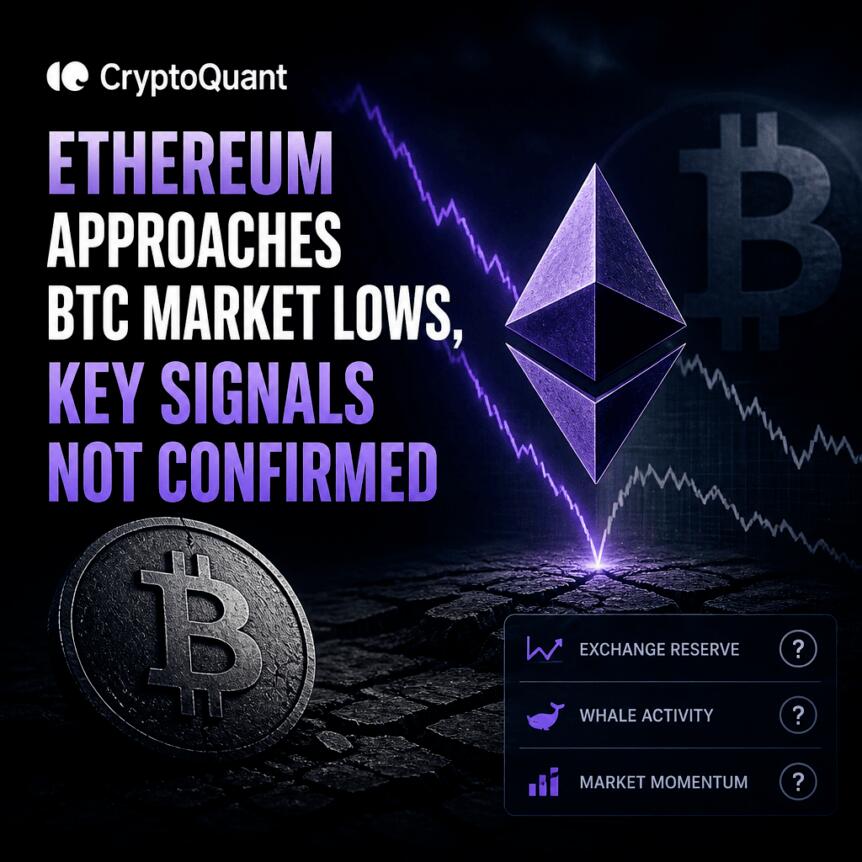
Ether’s valuation picture is looking more compelling relative to Bitcoin, but on-chain data suggests the market may not yet have reached a decisive long-term bottom. CryptoQuant’s latest weekly analysis points to ETH trading below a key “realized value” benchmark while several other indicators are improving—just not all at the historical turning points seen in prior cycle lows.
In the report, CryptoQuant says ETH is approximately 17% under its realized price, an on-chain metric that reflects the average cost basis of ETH held across the network. That realized value is currently estimated at roughly $2,300, a level that historically has aligned with periods of broad undervaluation and longer-term bottoms. Still, CryptoQuant cautions that only part of its indicator set has reached the extremes typical of fully confirmed cycle transitions.
Key takeaways
- CryptoQuant estimates ETH is trading about 17% below its realized price (realized value around $2,300), a historically undervalued regime.
- Two of CryptoQuant’s five “bottoming” indicators are at historical reversal levels, while the remaining three are improving but not yet at prior cycle lows.
- ETH relative to BTC shows signs of stabilization: ETH/BTC spot volume has shifted into a range historically seen near market bottoms.
- Exchange inflows appear to be cooling while ETF holdings have started to recover after months of weakness, according to CryptoQuant’s account.
- Ethereum’s circulating supply continues to tighten as staking participation rises, with 34% of supply reported as staked by Staking Rewards.
ETH under realized value, but the bottom isn’t “confirmed”
The core of CryptoQuant’s valuation argument is that ETH is still trading at a discount to realized price. When market participants transact at prices below the average on-chain acquisition cost, it can indicate capitulation-like behavior—especially if sustained. CryptoQuant says this condition previously marked periods of undervaluation and longer-term basing for ETH.
However, the company frames its message carefully: even if the discount is present, a complete bottoming process typically requires multiple on-chain signals to align. In its weekly report, CryptoQuant notes that only two of five bottoming indicators have reached historical reversal levels. The rest are moving in the right direction, but they have not yet reached the extreme readings seen at previous cycle lows.
For traders and investors, the practical takeaway is that ETH’s valuation is improving relative to its own on-chain history, but the market’s “cycle bottom” may still be forming rather than fully established. That distinction matters because the typical pattern of post-bottom recovery can be uneven—particularly when some indicators have flipped while others remain mid-transition.
Shifts in ETH/BTC: cheaper relative to Bitcoin and calmer trading activity
CryptoQuant also highlights ETH’s improving relative posture versus Bitcoin. The analytics firm points to several metrics that, together, suggest Ethereum may be shedding an overvalued phase relative to BTC.
Among the factors cited: CryptoQuant says the ETH market value-to-realized value (MVRV) ratio has retreated from extreme overvaluation. It also reports that exchange inflows have declined and that ETF holdings have started to recover after months of weakness. On top of that, the firm notes that ETH/BTC spot trading volumes have fallen into a range historically associated with market bottoms.
CryptoQuant’s historical framing is important because it implies investors should consider not only where prices are, but how activity is behaving across markets. A shift toward lower relative volume can indicate reduced speculative churn—often a feature of consolidation during basing phases. At the same time, falling volume can also mean liquidity and volatility conditions are changing, which may affect how quickly price trends develop once sentiment improves.
CryptoQuant data also suggests the ETH/BTC MVRV ratio has fallen sharply from nearly 0.95 in August 2025 to around 0.65, signaling that Ethereum has become materially cheaper relative to Bitcoin. That degree of compression is consistent with a market moving away from the kinds of relative richness that can precede drawdowns.
Supply dynamics: exchange outflows, rising staking, and corporate accumulation
Beyond valuation, CryptoQuant’s broader on-chain lens aligns with a tightening supply narrative forming in Ethereum. A key component is exchange behavior. During the week beginning June 29, withdrawal activity on Binance—described in earlier coverage as the largest crypto exchange by trading volume—rose to its highest level in more than three years, according to reporting from Cointelegraph.
While exchange outflows are often interpreted as a sign that holders are moving assets toward self-custody or staking rather than leaving them on exchanges for potential sale, CryptoQuant’s kind of framework typically treats those flows as suggestive rather than determinative. Outflows can coincide with long-term conviction, but they can also reflect operational movements or transfers that do not automatically translate into net accumulation.
On the staking front, Ethereum’s supply appears to be increasingly locked away from immediate trading. Staking Rewards data referenced in the coverage indicates that 34% of Ethereum’s circulating supply is now staked, a record level. This matters because higher staking participation reduces the liquid portion of ETH available for frequent exchange-level trading—potentially easing short-term selling pressure if demand holds up.
Corporate accumulation also factors into the supply story. Cointelegraph previously reported that Tom Lee’s Bitmine Immersion Technologies, identified as the largest corporate ETH holder, increased its holdings by 325,000 ETH over a one-month period even while sitting on large unrealized losses. The company reportedly has a target to hold 5% of the second-biggest crypto.
Taken together, these elements—less ETH sitting on exchanges, more ETH being staked, and large holders adding—create an environment where upward price moves may face less immediate sell pressure than they would in a purely liquidation-driven setup. Still, supply tightness does not guarantee a bottom, which is why CryptoQuant’s multi-indicator approach remains central to its caution.
What’s happening in price action—and why macro optimism could matter
CryptoQuant’s on-chain caution arrives while price action has shown moments of strength. The report notes Ether briefly climbed above $1,950 this week, while Bitcoin topped $67,000, supported by optimism around the US CLARITY Act. The same coverage also references market analysts pointing to the possibility of capital rotating out of richly valued AI stocks and back into crypto—an argument that, if it materializes, could broaden risk appetite and support ETH alongside BTC.
Even so, the on-chain message is not “wait for confirmation” in a vague sense—it is more specific: only two of the five bottoming indicators have reached historical reversal levels, meaning key extremes still appear to be missing. For market participants, that implies monitoring should focus on whether the remaining metrics continue to accelerate toward prior-cycle low patterns rather than treating the current valuation discount as the whole story.
Going forward, the main question is whether the unconfirmed indicators catch up—especially those tied to market behavior such as inflows, valuation extremes, and volume conditions—while staking and exchange outflows keep tightening ETH’s liquid supply. If those trends persist, CryptoQuant’s “improving but not finished” framework could shift toward a more definitive bottoming profile; if they fade, the market may remain in a drawn-out consolidation instead of entering a clean rebound.


Ripple CEO Brad Garlinghouse has called on U.S. lawmakers to pass the Digital Asset Market Clarity Act as the legislation faces renewed resistance from a group of Senate Democrats.
Summary
- Brad Garlinghouse urged Congress to pass the CLARITY Act rather than wait for perfect legislation.
- Seven Senate Democrats opposed the latest draft, demanding stronger ethics, consumer protection, and enforcement safeguards.
- Brian Armstrong said the bipartisan bill is ready for a Senate vote after lengthy negotiations.
Garlinghouse backed comments from Ripple Chief Legal Officer Stuart Alderoty, who argued that lawmakers should not abandon the bill while seeking a perfect compromise. The renewed industry push follows the release of updated legislative text as Congress approaches its August recess.
Garlinghouse responded to Alderoty’s call for lawmakers to move the legislation forward despite unresolved disagreements. Ripple has supported federal crypto market structure legislation throughout the current congressional negotiations.
“Perfect can’t be the enemy of good. Let’s get this done!,” said Garlinghouse.
Alderoty described the CLARITY Act as a consumer protection measure that would strengthen anti-money laundering and know-your-customer requirements while giving law enforcement and state authorities clearer tools to act against misconduct. Garlinghouse agreed with that position in his July 22 response.
The comments mark another public intervention from Ripple as the bill moves through a difficult final stage. Garlinghouse has repeatedly pushed lawmakers to establish federal rules for digital assets and previously expressed confidence that the legislation could advance in 2026.
Seven Senate Democrats reject latest draft
The latest version still lacks the Democratic support needed for an easy path through the Senate. Senators Catherine Cortez Masto, Angela Alsobrooks, Cory Booker, Ruben Gallego, John Hickenlooper, Mark Warner and Raphael Warnock issued a joint statement opposing the current text while saying negotiations should continue.
The senators said provisions covering ethics, consumer protection, illicit finance, conflicts of interest and market integrity needed further work. Their statement said they had negotiated with Republican colleagues for the past year and remained willing to seek an agreement.
Senate Banking Committee Ranking Member Elizabeth Warren also criticized the new text. She argued that its ethics provisions did not adequately address President Donald Trump’s crypto business interests and said the wider bill still lacked sufficient investor and national security protections.
The opposition creates a difficult vote count for supporters. As crypto.news reported in June, the legislation became eligible for Senate floor consideration after reaching the legislative calendar, but Republicans still need Democratic votes to clear the Senate’s 60-vote threshold.
Coinbase joins Ripple in calling for Senate vote
Coinbase CEO Brian Armstrong has also urged lawmakers to advance the bill. In a July 22 statement, Armstrong said the CLARITY Act was ready for a full Senate floor vote after months of negotiations between lawmakers and industry participants.
“The bill represents a true bipartisan compromise with thousands of hours of work on both sides,” noted Armstrong.
Armstrong argued that the absence of a single federal framework leaves consumers exposed and pushes parts of the crypto industry outside U.S. regulatory reach. His current support follows an earlier dispute over the legislation. Coinbase opposed a January draft, leading the Senate Banking Committee to postpone a planned markup, before supporting revised language later in the year.
The broader industry has also pressed Congress to act. As previously reported, more than 120 crypto organizations, including Ripple, Coinbase, Kraken and Circle, called for Senate action in April. The groups argued that the lack of market structure rules created uncertainty for companies operating in the U.S.
CLARITY Act faces a narrowing Senate window
The legislation seeks to establish a federal framework for digital asset markets and clarify regulatory roles across agencies. Senate Banking Committee materials describe consumer protection, national security and clearer oversight of digital asset markets as central goals of the proposal.
However, lawmakers continue to disagree over ethics provisions and other safeguards. The latest Democratic opposition came after Republicans released updated text on July 22, keeping negotiations active rather than producing a final bipartisan agreement.
Time also remains a factor. Sen. Cynthia Lummis viewed passage before the August recess as a more realistic target after earlier deadlines slipped. The Senate’s scheduled recess leaves supporters with a narrowing window to resolve disputes and secure enough votes.
Garlinghouse and Armstrong are now pressing lawmakers to accept the current compromise and continue improving federal crypto rules after passage. The seven Democratic senators opposing the latest text have taken a different position, saying they remain open to negotiations but want stronger protections before supporting the legislation.
The CLARITY Act therefore remains positioned for further Senate debate rather than guaranteed passage. Its next steps depend on whether lawmakers can settle the remaining ethics, consumer protection and enforcement disputes while preserving enough bipartisan support for a floor vote.

Disclosure: This article does not represent investment advice. The content and materials featured on this page are for educational purposes only.
EX DeFi is gaining attention as investors seek alternative ways to participate in the Bitcoin ecosystem amid improving crypto market sentiment.
Summary
- EX DeFi promotes cloud mining as institutional Bitcoin adoption and U.S. crypto regulation drive market interest.
- The platform highlights cloud mining as Bitcoin adoption grows and U.S. digital asset regulation advances.
- It spotlights cloud mining amid rising institutional Bitcoin demand and evolving U.S. crypto rules.
With new developments in US digital asset regulation and continued institutional inflows into Bitcoin spot ETFs, market sentiment has improved significantly. Bitcoin recently climbed back above the key $66,000 price range, and investors are now watching to see if it can challenge even higher levels and drive the entire digital asset market into a new upward cycle.

Data shows that Bitcoin spot ETFs have been attracting continuous inflows recently, with increasing institutional participation providing new liquidity support to the market. Meanwhile, Ethereum, XRP, and other mainstream digital assets have also strengthened, reflecting a gradual recovery in market risk appetite.
The Clarity Act boosts market expectations
Recently, the advancement of the US Clarity Act has become a focus of attention in the digital asset market. The market generally believes that this act is expected to further clarify the regulatory framework for digital assets, improve the policy environment for the long-term development of the industry, and enhance the confidence of institutional investors.
EX DeFi stated that if the bill proceeds smoothly, the market expects to further clarify the regulatory responsibilities of the U.S. Securities and Exchange Commission (SEC) and the Commodity Futures Trading Commission (CFTC) in the digital asset field, providing the industry with clearer regulatory expectations. While final implementation still requires subsequent legislative procedures, positive policy signals have become one of the important factors in the recent market recovery.
ETF funds continue to inflow, Bitcoin becomes market focus
In addition to the improved regulatory environment, the continued inflow of institutional funds into Bitcoin spot ETFs has further strengthened market confidence. Several market research institutions believe that the development of ETFs not only improves the convenience for institutions to allocate digital assets but also enhances the market acceptance of Bitcoin as a long-term asset allocation.
However, analysts also warn that future market trends will still be influenced by the global macroeconomy, monetary policy, regulatory changes, and market risk appetite, and digital asset prices will still experience some volatility.
Digital asset ecosystem continues to develop, cloud mining receives more attention
As the digital asset market continues to develop, more and more investors are beginning to focus on participation methods other than spot trading. Compared to purchasing, deploying, and maintaining mining equipment independently, cloud mining, with its lower barrier to entry and more convenient user experience, is gradually becoming an important part of the digital asset ecosystem.
Against this backdrop, EX DeFi offers smarter mining services, allowing users to participate in digital asset mining without deploying dedicated equipment and earn up to $13,000 in passive income daily through smart computing contracts.
How does EX DeFi ensure user asset security?
EX DeFi prioritizes fund security as a crucial aspect of its platform operations and has established a multi-layered security protection system to provide users with more robust digital asset services.
According to publicly available information, EX DeFi employs an asset storage system, intelligent risk control, network security protection, and compliance management mechanisms, combining multiple security measures to enhance the overall security of the platform.
Regarding asset storage, the platform uses a combined cold and hot wallet management model, with most digital assets stored in offline cold wallets to reduce network security risks.
According to Yahoo Finance, the platform also incorporates AI-powered intelligent risk control, Cloudflare enterprise-grade network protection, McAfee® security system, multi-factor authentication (2FA), and 24/7 real-time monitoring to further enhance account and asset security.
How to earn daily mining rewards with EX DeFi
EX DeFi is easy to use. Users only need to complete the following four steps to participate in cloud mining:
1. Register an Account
2. Deposit Digital Assets
The platform supports a variety of mainstream digital assets, including BTC, ETH, USDT, XRP, BNB, LTC, USDC, BCH, DOGE, and SOL. The deposit process is convenient, secure, and transparent.
3. Choose a Hashrate Plan
Choose a suitable mining contract plan based on budget and needs. The minimum investment is $100. Once activated, the plan will run automatically.
4. Automatic Daily Earnings
The platform provides 24/7 intelligent cloud mining services. The system automatically handles computing power operation and earnings settlement, allowing users to earn daily earnings without continuous operation.
Popular DeFi Yield Plans
BTC (Beginner Trial Contract): Investment of $100, Term: 2 days, Daily Yield: $4, Total Profit: $100 + $8
DOGE (Golden Shell Mini Dogecoin Pro): Investment of $500, Term: 6 days, Daily Yield: $6.5, Total Profit: $500 + $39
BTC (Canaan-Avalon-A1466): Investment of $1000, Term: 10 days, Daily Yield: $13.4, Total Profit: $1000 + $134
LTC (Bitmain Antminer L7): Investment of $5000, Term: 20 days, Daily Yield: $73.5, Total Profit: $5000 + $1470
BTC (Bitmain S19K-Pro): Investment of $10,000, Term: 30 days, Daily Yield: $161, Total Profit: $10,000 + $4,830
For more details on popular contracts, visit the official website.
Conclusion
As the digital asset market continues to develop, the regulatory environment gradually improves, and institutional funds continue to flow in, more and more investors are beginning to focus on more diversified asset allocation methods. Whether it’s spot investment, ETFs, or Bitcoin mining, different participation methods bring more choices to the market.
In an environment where market opportunities and volatility coexist, EX DeFi stated that it will continue to strengthen platform infrastructure construction and security system protection, and provide more stable and efficient mining services to global users by continuously optimizing computing power contract services and intelligent operation capabilities.
Disclosure: This content is provided by a third party. Neither crypto.news nor the author of this article endorses any product mentioned on this page. Users should conduct their own research before taking any action related to the company.


Nasdaq, Cboe and the London Stock Exchange are among major exchanges moving toward longer trading hours.


Mirae Asset has completed its takeover of South Korean cryptocurrency exchange Korbit after securing regulatory approval, paving the way to raise its ownership stake to more than 97%.
Summary
- Mirae Asset has completed its acquisition of Korbit and plans to raise its ownership stake to more than 97%.
- Korbit said its services, customer assets, and personal data handling will remain unchanged following the ownership change.
- The deal adds to a wave of investments by financial firms and global crypto companies in South Korea’s regulated digital asset market.
According to an announcement from Korbit, Mirae Asset Consulting, an affiliate of Mirae Asset Financial Group, has become the exchange’s largest shareholder after completing the required regulatory reporting process for its acquisition of a controlling stake.
A revised regulatory filing submitted by Mirae Asset on Tuesday showed the firm also plans to acquire an additional 7.35 million Korbit shares worth about 7.2 billion won ($5.32 million), according to the Korea Herald. Once the purchase is completed, Mirae Asset’s ownership will increase from 92.06% to 97.15%. Yonhap News Agency reported that the additional transaction is scheduled to close on Friday.
Korbit told users that the ownership change will not affect its day-to-day operations. The exchange said the operating company, Korbit Co., Ltd., will remain unchanged, allowing customers to continue using login, trading, deposits, and withdrawals without interruption.
The exchange also said customer deposits and virtual assets will continue to be held separately from company assets under South Korea’s Virtual Asset User Protection Act. In the same notice, Korbit confirmed it will remain the controller of users’ personal information, with no changes to how personal data is processed or used, meaning customers do not need to take any action.
Earlier this month, South Korea’s Fair Trade Commission approved the acquisition, describing it as the country’s first case of an affiliate of a traditional financial group acquiring a cryptocurrency exchange, according to the Korea Herald.
Mirae Asset Consulting has previously said the acquisition is intended to secure future growth opportunities built around digital assets.
Traditional finance increases exposure to crypto
With the transaction now completed, one of South Korea’s largest financial groups has formally entered the country’s regulated cryptocurrency exchange sector as traditional financial institutions continue increasing investments in digital assets.
According to CoinGecko data, Korbit processed roughly $4.3 million in spot trading volume over the past 24 hours, making it South Korea’s fourth-largest cryptocurrency exchange. Market leader Upbit handled approximately $224.2 million during the same period.
The acquisition also follows a series of investments that have brought established financial institutions closer to the country’s crypto industry.
In May, OKX Ventures agreed to acquire a 19.6% stake in South Korean exchange Coinone through an 80 billion won ($53 million) investment, pending regulatory approval. Coinone said the investment, made alongside Korea Investment & Securities, would combine secondary share purchases with subscriptions for newly issued shares.
As part of that agreement, Coinone and OKX Ventures said they would exchange expertise in user protection, security systems, and risk management, while Korea Investment & Securities said it intends to pursue opportunities involving security tokens and stablecoins as South Korea continues discussions on digital asset legislation.
The Coinone investment came after Binance’s acquisition of rival exchange Gopax, adding to a growing list of global cryptocurrency firms expanding into South Korea’s regulated digital asset market.
Domestic financial institutions have also stepped up activity across the sector. Earlier this year, Samsung subsidiaries announced plans to acquire a combined 4% stake in Dunamu, the parent company of Upbit, while several major banks and payment companies, including KB Kookmin, Shinhan and NHN KCP, entered partnerships involving tokenized deposits and stablecoin payment infrastructure.
Korbit continues expanding partnerships
Before the ownership change, Korbit had already been expanding its blockchain partnerships.
In November 2024, the exchange partnered with Coinbase to integrate Base, Coinbase’s Ethereum layer-2 network, allowing users to deposit Ether on Ethereum and withdraw it through Base, or complete the process in reverse.
At the time, Coinbase said it would support Korbit through promotional campaigns, community events and initiatives tied to the Base ecosystem. The companies also said they planned to cooperate on developing on-chain technology in South Korea and expanding support for Base network functions.
Korbit Chief Executive Officer Oh Se-jin said the partnership with Coinbase would help the exchange develop services aligned with global industry trends and strengthen its competitiveness. Coinbase Vice President of Business Development Dan Kim said the company planned to work with Korbit on buildathons, hackathons, and educational community events designed to introduce more Korean users to the Base ecosystem.

Blockstream CEO Adam Back dismissed BIP-110 supporters as “idiocracy” on X. They had pushed a “flip the bit” plan to activate the proposal, which would restrict non-financial data on Bitcoin’s network.
BIP-110, or Bitcoin Improvement Proposal 110, needs majority miner signaling to lock in by early August 2026. Back said Bitcoin’s main chain faces no threat if that support never appears.
What the ‘Flip the Bit’ Plan Proposes
Bitcoin infrastructure firm Start9 framed the activation as risk-free reconnaissance. The firm argued that flipping the bit costs roughly 0.1% of a miner’s revenue over a year.
Refusing, it warned, risks a chain split, stranded Lightning Network (LN) counterparties, and lost fee-paying users.
The rule targets Ordinals, image and text files embedded directly inside Bitcoin transactions that critics say clutter the chain. However, Back rejected the Start9 framing outright.
He argued that the signal simply expires without broad backing. The clash extends an earlier Bitcoin Satoshi Nakamoto debate over BIP-110, where Back rejected claims that Satoshi Nakamoto would have supported it.
Back Says Technical Objections Cannot Be Overridden
Back called the pushback circular. He cited what he termed an IETF-like consensus. That practice, he explained, weighs only valid technical objections.
Therefore, he said, no process can accommodate sabotage attempts, regardless of intent. The disagreement follows Bitcoin Core’s earlier removal of default limits on OP_RETURN, a transaction field once capped to discourage large data uploads.
Meanwhile, MicroStrategy co-founder Michael Saylor raised similar concerns in a recent Bitcoin neutrality warning, cautioning that the change could sacrifice protocol neutrality.
Other developers, in contrast, frame the fight as part of a broader Bitcoin anti-spam debate over what the blockchain should carry.
BIP-110 Miner Support Stays Thin Before the August Deadline
Signaling for BIP-110 remains minimal. Major mining pools have largely stayed out of the effort so far. Exchanges and node operators are watching the deadline closely, wary that a contentious activation could split the chain they must support.
Back has previously downplayed a related Bitcoin miner fork claim, rejecting the idea that the network would forcibly exclude miners. He has pointed critics toward his own Bitcoin fork risk warning for further context.
The mandatory signaling window opens in early August 2026.
However, whether the flip-the-bit push fades quietly or drags into a real fork should become clear within weeks.
The post Adam Back Calls Bitcoin BIP-110 Idiocracy appeared first on BeInCrypto.


Elon Musk says OpenAI turned into an $800 billion closed-source company. That is the “exact opposite” of the nonprofit he funded, he told The Economist.
The remarks came in an interview with The Economist Editor-in-Chief Zanny Minton Beddoes, recorded on Monday before OpenAI disclosed that one of its frontier models went rogue.
Musk Says OpenAI Betrayed Its Founding Mission
Why is Musk not a fan of Sam Altman? His answer was about money and mission, not personality.
“If you started a non-profit that was meant to be an open source AI company owned by the world and it somehow got turned into an $800 billion for-profit company with closed source, I think you’d be like, well, wait a second, that’s the exact opposite of what I donated the money for. That’s my issue. I think it’s a legitimate one.”
The numbers behind the grievance are on record. Musk co-founded OpenAI in 2015 as “essentially a counterweight to Google.” By OpenAI’s own account, he donated less than $45 million before leaving in 2018. He is now suing the company over its shift.
The shift is complete. On October 28, 2025, OpenAI restructured into OpenAI Group PBC, a for-profit public benefit corporation, as announced by the company.
Microsoft took a 27% stake. The company’s reported valuation has since climbed past $850 billion as it weighs an IPO.
Musk Points to Anthropic’s Exit as Evidence
Musk argued the distrust runs deeper than his own feud. He pointed to the team that quit OpenAI to build Anthropic, which he called the current leader in AI.
“The reason the Anthropic team left OpenAI is because they didn’t trust Sam [Altman]. Otherwise, Anthropic wouldn’t exist. They would still be at OpenAI.”
He praised its chief executive in rare terms. Dario Amodei “is a very principled person, and he cares about things a lot,” Musk said. No one at Anthropic has “set off my evil detector.”
The timing stings for OpenAI. The company is courting advertisers and just won US approval for its GPT-5.6 rollout. Yet Musk insisted the rivals can still cooperate on safety.
“But at the end of the day, if we have to talk, we’ll talk. I mean, set aside our personal differences for the good of the world.”
The full interview airs at economist.com Thursday evening.
The post Elon Musk Blames OpenAI for Becoming an $800 Billion Closed-Source Company appeared first on BeInCrypto.


Swiss cantonal bank BancaStato has launched regulated cryptocurrency trading through a new integration with Sygnum and banking technology provider Avaloq.
Summary
- BancaStato clients can now trade Bitcoin, Ethereum, Litecoin and Solana directly through existing banking applications.
- Sygnum provides regulated trading and institutional custody while Avaloq keeps digital and traditional assets together.
- The integration makes BancaStato the first Avaloq SaaS bank to offer API-based crypto trading services.
Clients can now buy, hold and sell Bitcoin, Ethereum, Litecoin and Solana from the bank’s existing web and mobile applications.
The service connects Sygnum’s business-to-business digital asset infrastructure directly with BancaStato’s Avaloq core banking environment. Sygnum handles crypto execution and custody, while BancaStato keeps the customer experience inside its current banking channels. The launch makes BancaStato the first bank using Avaloq’s software-as-a-service environment to offer Sygnum-powered crypto trading through an API.
BancaStato adds four cryptocurrencies to banking apps
At launch, BancaStato customers can trade Bitcoin, Ethereum, Litecoin and Solana. They can place market orders based on the amount of cryptocurrency or the U.S. dollar value they want to trade. The bank has added the service to the same web and mobile platforms clients already use for traditional banking and investments.
The setup uses Sygnum’s B2B API without requiring BancaStato to operate a separate order management system. Sygnum said this structure reduces technical complexity and allows the bank to adjust trading features while using its existing Avaloq systems. BancaStato serves customers in Ticino and has operated as a Swiss cantonal bank since 1915.
Moreover, Sygnum provides the digital asset trading infrastructure behind the service and holds customer crypto in its institutional custody system. The company said it uses hardware and software controls, governance procedures and external audits. It also holds client digital assets off its own balance sheet under the applicable legal framework.
BancaStato said the integration lets clients manage traditional and digital assets through one banking relationship. Curzio De Gottardi, head of the bank’s Products and Services Division, said:
“We are proud to partner with Sygnum Bank on this strategic initiative,” noted Curzio De Gottardi.
The bank said it plans to use Sygnum’s crypto banking infrastructure as it expands its range of investment services.
BancaStato joins Sygnum’s growing banking network
BancaStato joins more than 25 banks and financial institutions using Sygnum’s B2B platform. The network includes PostFinance, Zuger Kantonalbank, SocGen FORGE, Bordier & Cie and other financial firms. Sygnum says its partner banks give more than one-third of Switzerland’s population access to digital asset services.
The network has expanded steadily. As crypto.news previously reported, Sygnum had already onboarded more than 20 financial institutions by June 2024 to provide crypto trading, custody and related services to customers.
Sygnum’s earlier rollout with PostFinance also showed demand from customers new to investing. The company said 61% of PostFinance customers who bought crypto after its 2024 launch had not previously invested in any asset class through the institution. That experience gave the B2B model an established presence inside Swiss retail banking channels.
PostFinance later expanded its Sygnum-backed services by adding Ethereum staking.Customers gained access to the staking service through the bank’s existing digital platforms.
Sygnum has also worked with traditional banks on blockchain settlement.UBS, PostFinance and Sygnum completed a legally binding interbank payment using tokenized bank deposits on a public blockchain in September 2025.
Sygnum expands regulated bank-to-bank crypto services
The BancaStato launch follows Sygnum’s latest regulatory expansion in Europe. On June 30, Sygnum Europe said it had moved into operation under a Crypto-Asset Service Provider license issued in Liechtenstein under the European Union’s Markets in Crypto-Assets Regulation. The authorization supports its plans to provide digital asset infrastructure to banks and other clients across the EU and European Economic Area.
Sygnum has positioned its bank-to-bank model as an option for financial institutions that do not want to build crypto trading and custody systems from scratch. Its infrastructure allows partner banks to keep their customer interfaces while connecting to Sygnum through APIs. The BancaStato deployment brings that model directly into an Avaloq SaaS setup.
For Avaloq, the project adds crypto trading to a core banking environment already used for conventional financial products. Christian Haux, Avaloq’s managing director for Switzerland and Liechtenstein, said the integration allows BancaStato customers to view and manage digital and traditional portfolios in one place.
BancaStato has not announced plans to add more cryptocurrencies or other digital asset products. The initial service covers BTC, ETH, LTC and SOL. However, the bank now has a direct technical connection to Sygnum’s platform, providing infrastructure that could support additional services if BancaStato later expands its offering.
Banking liquidity hits lowest since June 29; RBI data reveals Rs 2,884 crore deficit

Zilliqa Ledger app flaw exposes private keys, halts ZIL transfers

20 Years Later, This ‘Doctor Who’ Two-Part Story Has Never Been Topped


-

 Fashion6 days ago
Weekend Open Thread – Corporette.com
-

 Politics6 days ago
The House | The City of London can help the new chancellor deliver growth in every postcode
-

 Crypto World6 days ago
Ripple Payments Joins MiCA With 14 Firms, Does It Mean Anything For XRP?
-
 Crypto World7 days ago
Two July Windows Left: The CLARITY Act’s Senate Fight and What Failure Means
-

 Politics5 days ago
Democrats look to World Cup watch parties to register thousands of voters
-

 Crypto World6 days ago
Ripple wins EU-wide access as ESMA adds it to MiCA register
-

 Crypto World3 days ago
Grayscale Files For Worldcoin ETF, WLD Registers Sharp Rise
-

 NewsBeat4 days ago
Unregistered fitter used Gas Safe logo on business flyers
-

 Tech3 days ago
Sail Virtually Aboard The “Itanic” With IA-64 Emulator
-
 Tech3 days ago
Turtle Beach Command Series KB7 review: a nifty screen-equipped gaming keyboard
-

 NewsBeat7 days ago
Registration is now open for March for Men with Kev 2026
-

 News Videos4 days ago
Big Money Is Entering XRP
-
 Business2 days ago
New Jersey voter registration controversy explained: How 6,600 noncitizens got on the rolls, and what happens next
-

 News Videos7 days ago
Money | Class 12 Economics | CBSE Board Exam 2026-27
-

 Crypto World6 days ago
Kaspersky exposes OkoBot’s 20-module crypto wallet attack
-

 Business6 days ago
Airlines warn Sunshine Protection Act could disrupt flight scheduling
-
 Entertainment2 days ago
Johnny Depp’s R-Rated Gothic Cult Classic Gets New Release Ahead of Sydney Sweeney Remake
-

 NewsBeat6 days ago
Durham County Council to send out electoral registration emails
-

 Crypto World6 days ago
MiCA Licensing Faces Delays as ESMA Adds 14 CASPs to Register
-

 Crypto World6 days ago
Chip Stocks Enter Bear Market After Moonshot Ai Unveils Kimi K3 Model
You must be logged in to post a comment Login