
Crypto World
BitGo Mint Goes Live: Institutions Can Now Mint and Redeem Stablecoins from One Platform


TLDR:
- BitGo Mint launches with support for USD1 and SoFiUSD, streamlining stablecoin operations for institutions.
- The platform combines regulated custody, compliance tools, and in-platform reporting in a single workflow.
- BitGo’s global network of market makers, banks, and fintechs gains direct access to native minting features.
- BitGo plans to expand Mint support to tokenized financial products, including money market funds, over time.
BitGo Mint is now live, giving institutional clients a single destination to mint, redeem, and manage stablecoins. BitGo Holdings, Inc. (NYSE: BTGO) announced the launch, with initial support for USD1 and SoFiUSD.
The new tool integrates directly within the existing BitGo platform. It reduces the need to coordinate across multiple providers and manual processes. Institutions can now access minting and redemption from one regulated environment.
BitGo Mint Centralizes Stablecoin Operations for Institutional Clients
BitGo Mint brings minting and redemption into a unified workflow for institutional participants. Previously, institutions had to coordinate across several systems and service providers to complete these operations.
That process added complexity and created multiple points of failure. The new platform consolidates these steps into a single, familiar environment.
Clients using BitGo Mint can access regulated custody alongside policy controls and compliance tools. In-platform reporting keeps all activity visible from one dashboard, improving oversight.
These features are already part of the BitGo platform that institutions rely on daily. Adding mint and redeem capability extends what they can do within that same infrastructure.
At launch, BitGo Mint supports two stablecoins: USD1 from World Liberty Financial and SoFiUSD from SoFi. Both are backed by BitGo’s Stablecoin-as-a-Service offering, which powers the minting and redemption process.
This integration makes these functions accessible to a broad range of institutional participants. Market makers, exchanges, banks, asset managers, and fintechs are all among the targeted clients.
Mike Belshe, CEO and Co-founder of BitGo, addressed the platform’s purpose at launch. “BitGo Mint brings minting and redemption into a unified institutional workflow,” he stated.
He noted that clients can reduce operational complexity while staying within the platform they already use. The statement reflected BitGo’s focus on building practical, scalable digital asset infrastructure.
Issuers and Partners Gain Broader Network Access Through BitGo Mint
BitGo Mint also opens a new distribution channel for stablecoin issuers on the platform. Stablecoins powered by BitGo’s Stablecoin-as-a-Service product suite can be made available through the tool.
This gives issuers direct access to BitGo’s global network of institutional clients. The network includes liquidity providers, market makers, financial institutions, and fintech firms.
World Liberty Financial and SoFi both confirmed their assets are available on the new platform. Their handles, @worldlibertyfi and @SoFi, were cited in the official BitGo announcement.
USD1 and SoFiUSD are the first two assets supported at launch. BitGo has indicated plans to expand native mint and redemption support to additional assets over time.
Among the assets expected to be added are tokenized financial products, including money market funds. This expansion aligns with the growing role of tokenized instruments in institutional finance.
BitGo is building infrastructure to support the full lifecycle of these assets. That covers issuance, movement, settlement, and safekeeping — all within one platform.
BitGo Mint reflects the company’s broader strategy to serve growing institutional demand in digital assets. Stablecoins now play a central role in how institutions transfer and settle value digitally.
Having minting and redemption in one place removes friction across trading and liquidity operations. The platform offers a compliant, practical solution for institutions that operate at scale.



The price that underpins real-world oil cargo transactions surged to its highest level since 2008. Dated Brent hit $141.37 per barrel, reaching an 18-year high.
Meanwhile, Brent crude futures traded near $107, still below 2022 levels. Thus, it’s clear that the benchmark for actual crude cargoes now trades more than $34 above Brent futures.
“The last time Dated Brent touched such heights was 18 years ago, when the global financial crisis that had been brewing for months was on the cusp of puncturing a historic crude rally,” Bloomberg wrote. “The surge is a sign of the growing disconnect between futures contracts and various pockets of physical markets that are pricing increasingly scarce supplies.”
This isn’t just a price difference. It’s a stress signal. The physical oil market is under acute strain, with immediate demand far outpacing available supply.
Follow us on X to get the latest news as it happens
Recently, Chevron CEO Mike Wirth warned that futures are not reflecting the true scale of the oil supply disruption. He stated that the market is trading on “scant information” and “perception.” According to him,
“There are very real, physical manifestations of the closure of the Strait of Hormuz that are working their way around the world and through the system that I don’t think are fully priced into the futures curves on oil.”
Energy Aspects founder Amrita Sen also told CNBC that the futures market is obscuring the real stress.
“You are seeing it, but the financial market is almost masking the true tightness that everywhere else is showing up,” Sen remarked.
Trump’s Shifting Stance Deepens Uncertainty
The Strait of Hormuz, which handles roughly one-fifth of global crude flows, has been closed for over a month. Gulf producers have cut output by at least 10 million barrels per day, as tanker traffic has dropped by 95%.
President Trump has sent conflicting messages on the Strait. In a prime-time address on April 2, he declared Iran “essentially decimated” and said the waterway would reopen “naturally” once the conflict ends.
Meanwhile, he told other nations they should “grab it and cherish it.” However, his shifting timelines and statements have layered uncertainity onto an already fractured supply picture.
Subscribe to our YouTube channel to watch leaders and journalists provide expert insights
The post Paper vs. Physical: The $34 Gap Exposing the True Cost of the Iran Oil Shock appeared first on BeInCrypto.
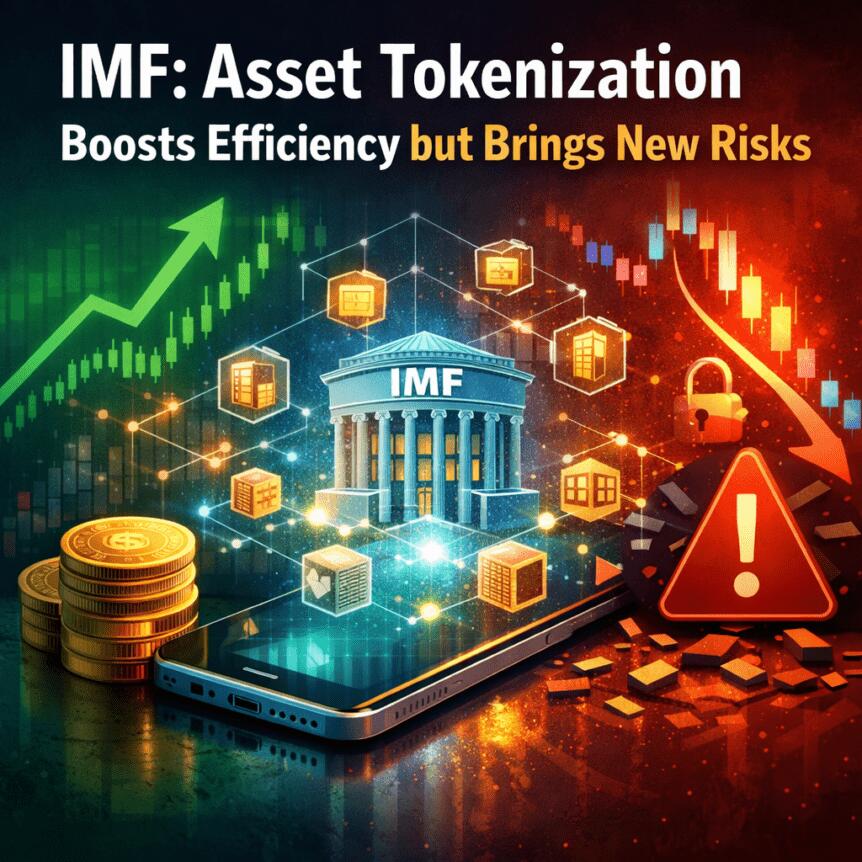
The International Monetary Fund has highlighted both the promise and the peril of tokenization in finance. In a 23-page assessment released this week, the IMF said tokenization could reduce friction and increase transparency across issuance, trading, settlement and asset management. Yet it warned that the same technology could also introduce risks that might affect financial stability, especially as speed and automation enable rapid, automated flows that leave less room for traditional oversight.
The IMF’s analysis stresses that while atomic settlement and enhanced visibility can mitigate some longstanding dangers, the accelerated pace of tokenized markets could give rise to new systemic stress if controls aren’t aligned with legal and supervisory clarity. A central finding remains: “The net effect of tokenization on financial stability is uncertain,” the IMF wrote, underscoring the delicate balance between improved efficiency and new risk vectors.
Key takeaways
- Tokenization reduces some traditional risks through faster settlement and greater transparency, but speed and automation introduce new financial-stability challenges.
- On-chain tokenization of real-world assets has surpassed $27.6 billion, excluding stablecoins, according to RWA.xyz data, highlighting growing industry activity.
- Long-run forecasts for the tokenization market vary widely—BCG in 2022 projected up to $16 trillion by 2030, while McKinsey in 2024 offered a more conservative $2 trillion—the gap reflecting differing assumptions about liquidity, regulation and adoption.
- Legal clarity over ownership records and settlement finality remains a bottleneck; the IMF notes fragmented markets could hamper widespread use unless governance keeps pace with technology.
The economic arc of tokenized real-world assets
The IMF’s report acknowledges that tokenization expands how securities and other financial products are issued, traded, settled and managed. But it also cautions that the technology effectively shifts some systemic risk from traditional banking rails to shared ledgers and smart contract code. In a phrase that captures the urgency for policymakers, the IMF warned that “stress events in tokenized markets are likely to unfold faster than in traditional systems, leaving less time for discretionary intervention.”
On the demand side, tokenization is being seen as a means to accelerate cross-border payments, broaden financial inclusion and unlock new channels for capital flow in emerging markets. Yet, the IMF also flags potential downsides: greater volatility in capital moves, rapid currency substitution and a perceived erosion of monetary sovereignty if participants rely on programmable money without adequate supervisory guardrails.
While the IMF is cautious, market participants are moving ahead. Real-world asset (RWA) tokenization has already drawn substantial traction. As of early April, data from RWA.xyz show more than $27.6 billion of real-world assets tokenized on-chain, excluding stablecoins. The scale of this segment points to a broader appetite among institutions to digitize assets like receivables, property interests and other non-tokenized holdings.
In the broader market outlook, the debate centers on scalability and liquidity. Industry studies have delivered mixed signals about the ultimate size of the opportunity. Boston Consulting Group estimated in 2022 that the tokenization market could swell to as much as $16 trillion by 2030, while McKinsey & Co. offered a notably more cautious projection of around $2 trillion for the same horizon. The IMF’s assessment sits between these bounds, emphasizing potential but underscoring the need for robust risk management as the ecosystem grows.
Industry momentum and notable players
Interest from Wall Street has been a key driver. High-profile figures such as BlackRock CEO Larry Fink have signaled support for tokenizing a broad spectrum of assets—from equities and bonds to money market funds and real estate—marking a shift in institutional attitudes toward on-chain representations of traditional instruments.
Within the on-chain asset category, Securitize has emerged as a leading platform by total value locked (TVL) in real-world asset tokenization. Securitize powers the BlackRock USD Institutional Digital Liquidity Fund, a major RWA project with reported TVL around $3.38 billion, per CryptoDep’s April data. Closely following are Tether Gold and Ondo Finance, with roughly $3.35 billion and $3.21 billion in TVL, respectively, underscoring a crowded field of tokenized wealth vehicles aimed at institutional investors.
Beyond tokenized assets themselves, the traditional exchanges are signaling their intent to bring tokenization into mainstream trading and settlement. Intercontinental Exchange, the parent company of the New York Stock Exchange, announced in January that it would launch a tokenization platform designed for 24/7 trading and instant settlement of stocks and exchange-traded funds via a blockchain-based post-trade system. The move indicates a direction where tokenized securities could become an integrated, continuous-source of liquidity rather than a niche, off-hours exercise.
Standards, regulation and practical controls
One of the IMF’s pointed critiques centers on legal and regulatory clarity. Without well-defined ownership records and settlement finality, tokenized markets risk becoming fragmented and peripheral to the broader financial system. In response, the industry has begun embracing standards and access controls to align technology with regulatory expectations.
Among the notable technical developments is the Ethereum ecosystem’s ERC-3643 standard, which enables permissioned access to tokenized assets and imposes identity and eligibility checks for holders. In practice, this standard is already being applied by some tokenized products to ensure compliance with investor requirements. A concrete example cited in the industry press is Coinbase Asset Management’s tokenized shares for the Coinbase Bitcoin Yield Fund, issued on the Base network (an Ethereum Layer 2). The fund leverages ERC-3643 to verify holder identity and eligibility during tokenization and post-trade processes.
The IMF also points to the broader regulatory architecture around stablecoins, cross-border flows and monetary sovereignty as areas that require ongoing attention as tokenized markets scale. The balance between enabling innovation and preserving monetary policy effectiveness will be a central theme for policymakers over the coming years.
What to watch next
As tokenization marches from pilot projects to greater market participation, investors and builders will be watching several key dynamics. First, whether legal frameworks and settlement finality standards crystallize in a way that reduces fragmentation and reassures traditional market participants. Second, whether liquidity continues to grow in real‑world asset tokens to the point where they rival or surpass traditional offline channels. Third, which infrastructure—clearing, custody, identity verification, and cross-border rails—will emerge as the de facto backbone for scalable tokenized markets. And finally, whether central banks and regulators adopt a calibrated stance that supports innovation without sacrificing financial stability.
In the near term, a handful of large players and platforms—creators of RWA markets, major asset managers experimenting with tokenized funds, and exchange operators expanding tokenized trading—will likely shape the pace and direction of adoption. The IMF’s findings suggest this is not a one-off tech experiment but a continental shift in how assets are created, traded and settled—one that demands careful risk governance as the ecosystem matures.
Readers should monitor developments around legal clarifications for tokenized ownership, concrete liquidity metrics for tokenized assets, and the progression of compliant standards like ERC-3643 as the market seeks a balance between efficiency and resilience.


Polymarket has partnered with oracle provider Pyth Network to launch traditional asset markets on its platform.
Summary
- Polymarket partnered with Pyth Network to introduce equity, commodity, and stock-linked contracts.
- The new markets include daily up or down and closing price contracts that reset at the end of each trading session.
- Pyth Network is providing real-time price feeds from trading firms and market makers to serve as the resolution layer for the new contracts.
According to an Apr. 2 announcement, the latest addition brings daily up-or-down and closing price contracts for major equity indexes, alongside commodities such as gold and oil, and US-listed stocks. Outcomes on these contracts are determined using Pyth’s real-time price feeds, and the markets reset at the end of each trading session.
Pyth Network will act as the resolution layer for these markets, replacing manual or exchange-specific references with a standardized data source aggregated from trading firms and market makers.
Simultaneously, Pyth has launched a data interface called Pyth Terminal, allowing users to track live price feeds and the reference values used to settle markets on Polymarket.
Oracle networks like Pyth bring off-chain data such as prices, foreign exchange rates, and commodities onto blockchains. These feeds are widely used across decentralized finance, prediction markets, and tokenized asset platforms, and have seen growing adoption, including by US government agencies.
PYTH price rallied over 70% after the announcement, while its market capitalization moved past $1 billion.
The latest products on Polymarket were launched as the platform continues to cement its position as a leading prediction market operator.
Last month, the project secured a $600 million investment from Intercontinental Exchange, the parent company of the New York Stock Exchange, as part of a broader multibillion-dollar commitment.
Meanwhile, Polymarket made investments of its own by acquiring DeFi infrastructure startup Brahma for an undisclosed sum.
A whale accumulated more than 2,000 Bitcoin (BTC) put contracts overnight, targeting a move below $66,000, just as over $2.15 billion in Bitcoin and Ethereum (ETH) options settle on Deribit today, April 3.
The back-to-back repositioning signals that at least one large player sees downside risk in BTC’s current price range, even as call open interest still outnumbers puts across both assets.
Why the Whale Trade Matters
Options analytics platform Greeks.live flagged the position shift on April 2, noting the same whale had closed a profitable long trade hours earlier before pivoting bearish.
Per the analysts, the whale entered a long position at $66,000 and exited above $68,000, booking a confirmed profit.
Within hours, a trader of comparable size began accumulating put contracts, this time betting on a move lower.
The rapid reversal is notable. A whale exiting a winning trade and immediately loading the opposite direction suggests a view that the $66,000–$68,000 zone is a resistance ceiling, not a launchpad.
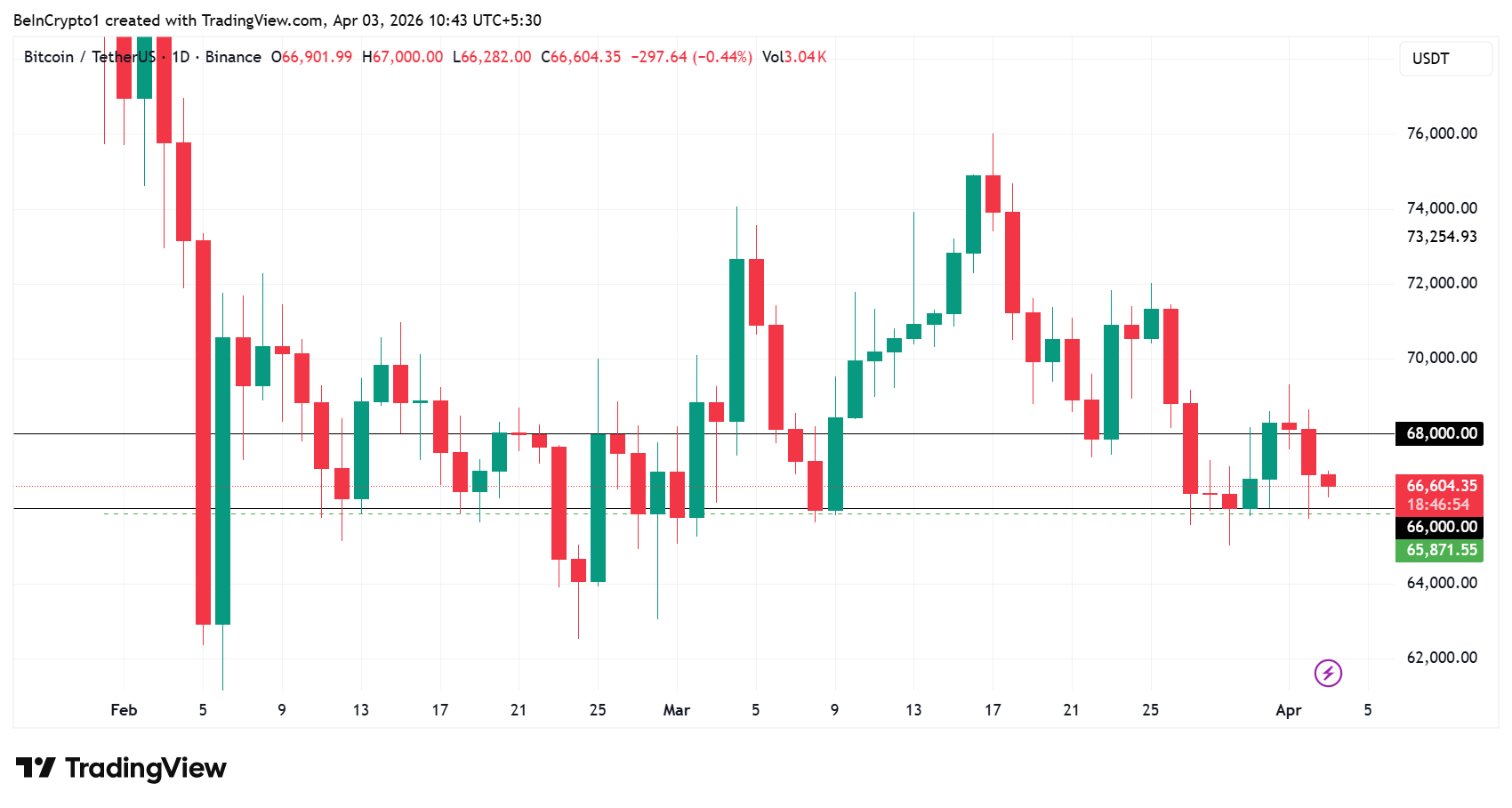
With BTC trading at $66,575 and its max pain level set at $68,000, the spot price sits $1,425 below the level where options sellers profit most. If BTC fails to close that gap before settlement at 08:00 UTC, the bearish whale’s puts gain value.
The Expiry Data
Bitcoin accounts for $1.84 billion of today’s total notional value, with 27,590 contracts outstanding. Call open interest stands at 17,930 against 9,600 puts, giving a put-to-call ratio of 0.54.
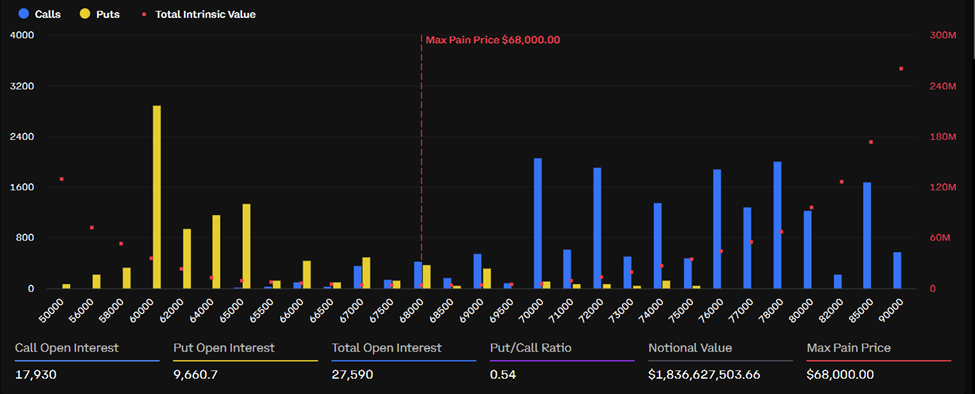
The call skew still leans bullish in aggregate, but the whale’s 2,000-contract put position adds concentrated downside weight near the $66,000 strike.
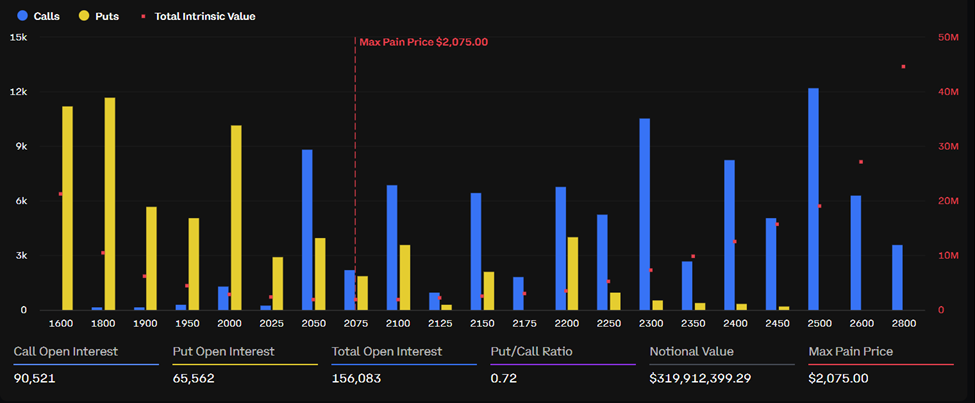
Ethereum’s expiry is smaller but similarly structured. With $319.9 million in notional value and 156,083 total contracts, ETH trades at $2,052 against a max pain level of $2,075. Its put-to-call ratio of 0.72 points to heavier downside hedging than BTC’s.
“Yesterday, the whale closed out the two positions on the right side… The whale entered the position at 66K and closed it out above 68K — this trade was a resounding success. Starting late last night, a whale of similar size began buying put options again, with over 2,000 contracts expiring today, targeting a price below 66K,” the analysts stated.
What Comes Next
Options settle at 08:00 UTC on Deribit. The hours leading up to that window typically generate the sharpest gamma hedging activity, pulling prices toward max pain.
For BTC, that means a potential drift toward $68,000 if bulls hold ground, or a break below $66,000 if the whale’s put bet plays out.
The post Whale Turns Bearish Ahead of $2 Billion Bitcoin and Ethereum Options Expiry appeared first on BeInCrypto.
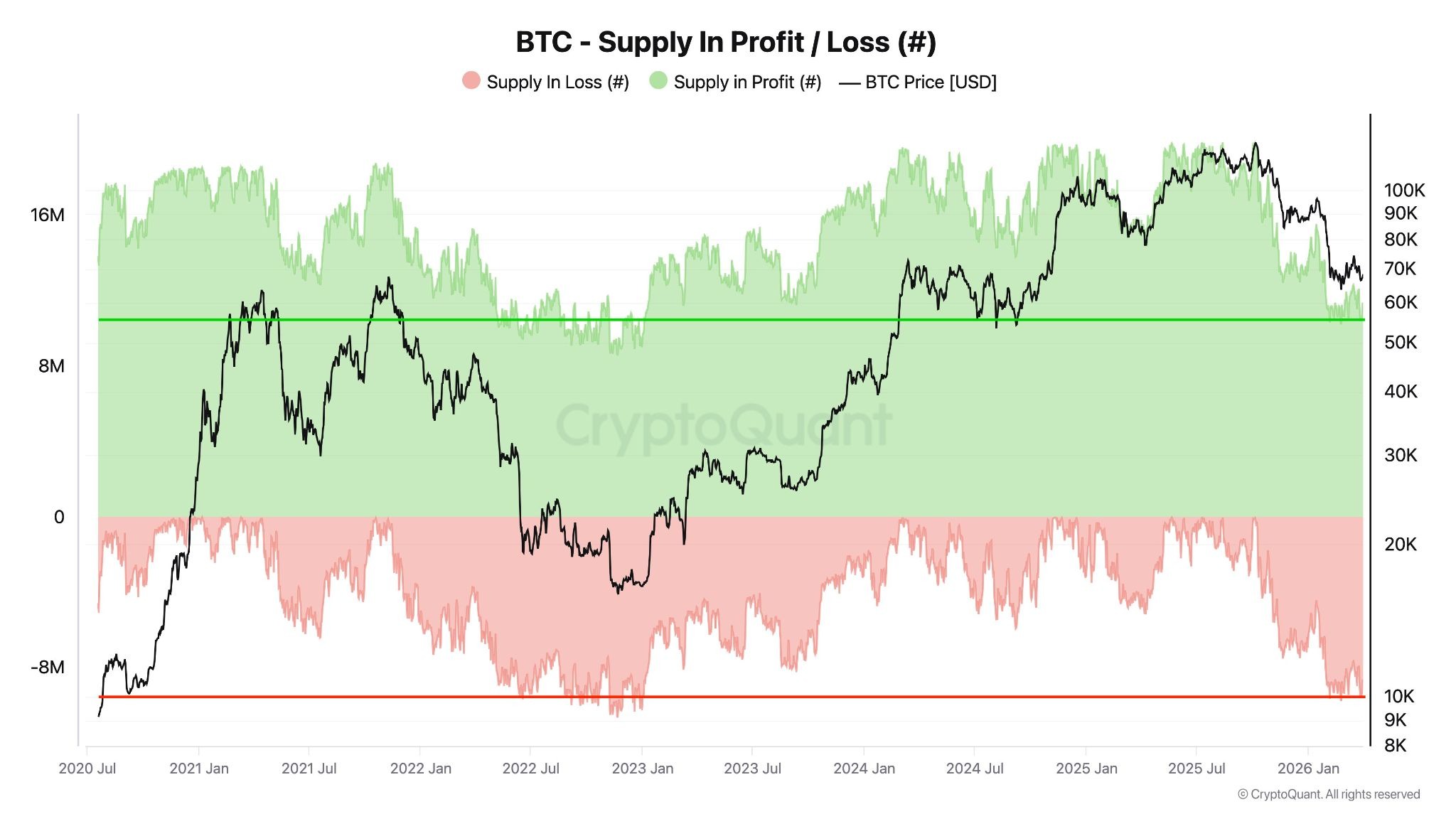
The amount of Bitcoin supply in profit and loss is now getting closer to levels typical of a bear market, according to a CryptoQuant analyst.
There are currently about 11.2 million Bitcoin (BTC) in profit. The previous bear market recorded 9 million BTC in profit at its lowest point, CryptoQuant analyst “Darkfost” said Thursday.
CryptoQuant data also shows there are about 8.2 million Bitcoin at a loss, with Glassnode data confirming it’s at levels not seen since late 2022.
“This is quite significant, considering that during the last bear market this figure reached about 10.6 million BTC,” Darkfost said.
Analysts have been debating whether Bitcoin has further to fall this year amid growing global turmoil. Bitcoin metrics that show a movement toward previous cycle lows could suggest that a market bottom is getting closer.
“This suggests that the market is reaching a notable level of undervaluation, comparable to the conditions observed during the previous bear market,” the analyst added.

Analyst sees increasing market stress, not undervaluation
However, Andri Fauzan Adziima, research lead at the Bitrue exchange, argued the data signals “increasing market stress, not immediate undervaluation.”
True capitulation bottoms saw deeper pain, he told Cointelegraph. The supply in loss in 2022 was greater than 50% and the supply in profit was around 45% or lower, while metrics such as net unrealized profit/loss (NUPL) and market value to realized value ratio (MVRV) were at “extremes.”
“Current data points to early/mid-bear transition (potential structural bottom near $55,000), with more downside or consolidation likely before a full reset.”
Related: Bitcoin’s drawdown is ‘less dramatic’ this cycle, Fidelity says
Data also shows Bitcoin has declined by about 52% from its all-time high this cycle, much less than previous bear markets, which saw 77% to 84% drawdowns from their cycle highs.
Strong dollar hampering recovery
Bitcoin author Timothy Peterson commented on X that Bitcoin “tends to struggle when the dollar is strong, and the Chinese yuan is weak.”
He added that this was due to tighter global liquidity, with higher dollar yields attracting capital into cash and bonds and cautious investor sentiment as China eases policy.
That only changes when US interest rates fall and “dollar yield loses its attractiveness,” which is not likely until the second half of 2026 or more likely 2027, he said.
The US dollar index (DXY) has gained about 5% over the past two months, according to TradingView.

For years, decentralized finance sold a simple, powerful idea: anyone, anywhere, can access financial services without gatekeepers. No banks, no approvals, no identity checks—just code and capital.
But beneath the surface, something is changing.
A growing number of protocols are quietly introducing permissioned layers—KYC-gated pools, whitelisted participants, and compliance-driven infrastructure. It’s subtle. Gradual. Easy to miss.
Yet it may redefine what DeFi actually is.
The Shift No One’s Loudly Talking About
Permissioned DeFi doesn’t arrive with headlines. It slips in through features like:
- KYC Pools – Liquidity pools restricted to verified users
- Whitelisted Access – Only approved wallets can interact with certain products
- Compliance Layers – Protocol-level rules aligning with regulatory frameworks
At first glance, these look like optional features. In reality, they signal a deeper evolution:
DeFi is adapting itself to fit inside the traditional financial system.
Why This Is Happening
Let’s be blunt—pure permissionless systems make regulators nervous.
Institutions want exposure to DeFi yields, but they need:
- Legal clarity
- Counterparty accountability
- Risk controls
Permissioned layers act as a bridge:
- They let institutions participate without violating compliance rules
- They give regulators something to work with
- They reduce the “wild west” perception of DeFi
In short, capital is forcing compromise.
What Changes (And What Breaks)
This shift isn’t just technical—it’s philosophical.
1. Participation Is No Longer Universal
The original promise of DeFi was inclusion.
Permissioned systems introduce exclusion by design.
If access requires:
- Identity verification
- Jurisdiction checks
- Approval from a governing entity
Then DeFi starts to look a lot like the system it aimed to replace.
2. “Open Finance” Becomes Conditional
DeFi assumed:
If you have a wallet, you’re in.
Permissioned DeFi changes that to:
If you meet the criteria, you’re in.
That’s a massive shift. It replaces code-based neutrality with policy-based access.
3. Liquidity Fragmentation
Instead of one unified pool of capital, we get:
- Public pools (permissionless)
- Private pools (permissioned)
This can lead to:
- Uneven yields
- Reduced efficiency
- Insider advantages for approved participants
Basically, the market starts splitting into tiers.
4. Power Starts Re-centralizing
Whitelists don’t manage themselves.
Someone decides:
- Who gets access
- Who gets removed
- What rules apply
Even if governance is “decentralized,”
Control creeps back in through decision-making layers.
The Trade-Off: Growth vs Principles
Let’s not pretend this is entirely bad.
Permissioned DeFi enables:
- Institutional capital inflows
- Regulatory survival
- Scalable adoption
Without it, DeFi risks staying niche—or getting shut out entirely.
But there’s a cost:
- Less openness
- Less censorship resistance
- Less equality
So the real question isn’t whether permissioned DeFi is good or bad.
It’s this:
How much of DeFi’s core ethos are we willing to trade for growth?
The Future: Two DeFis?
We may not end up with one unified ecosystem.
Instead, expect a split:
Permissionless DeFi
- Open to everyone
- Higher risk, higher innovation
- Resistant to control
Permissioned DeFi
- Regulated and compliant
- Institution-friendly
- Controlled access
They’ll coexist—but not as equals.
One maximizes freedom.
The other maximizes scale.
Final Thoughts
Permissioned DeFi isn’t sudden; it’s a slow drift.
No dramatic announcements.
No clear line crossed.
Just small changes… that quietly redefine everything.
And if you blink, you might miss the moment when “open finance” stops being fully open.
REQUEST AN ARTICLE


OpenAI has acquired technology talk show TBPN as it looks to refine how it communicates with audiences beyond its core products.
Summary
- OpenAI has acquired TBPN, a Silicon Valley-focused tech talk show, as it expands its role in shaping public conversations around artificial intelligence.
- TBPN will continue operating with editorial independence while also contributing to OpenAI’s communications and marketing efforts.
According to an Apr. 2 announcement, the deal brings the Los Angeles-based program under OpenAI’s umbrella. Financial terms of the deal were not disclosed.
TBPN, hosted by John Coogan and Jordi Hays, streams live for three hours each weekday and features interviews with founders, venture capitalists, and senior technology executives. Guests in recent months have included Mark Zuckerberg, Satya Nadella, and Sam Altman, underscoring the show’s growing influence within the tech ecosystem.
OpenAI’s leadership framed the acquisition as part of a push to shape how conversations around artificial intelligence unfold.
In an internal memo, Fidji Simo, OpenAI’s chief of strategy, said the company sees a need for “real, constructive conversation” as AI systems become more embedded in society. The company believes TBPN can help create that space while also expanding its reach.
Despite the ownership change, OpenAI has emphasized that TBPN will retain full editorial control.
Behind the scenes, the show is expected to contribute to OpenAI’s communications and marketing efforts beyond its daily broadcasts. Simo noted that TBPN’s track record in brand storytelling and its close view of industry trends played a role in the decision.
Founded in October 2024, TBPN began daily livestreaming in March 2025 and has since carved out a niche audience. Each episode draws roughly 70,000 viewers across platforms such as X, YouTube, and Spotify.
While modest compared to traditional financial media, the show has gained traction among technology leaders who see it as more aligned with industry perspectives than legacy outlets like Bloomberg or CNBC.
The acquisition comes shortly after OpenAI closed a $122 billion funding round led by Amazon, Nvidia, and SoftBank.
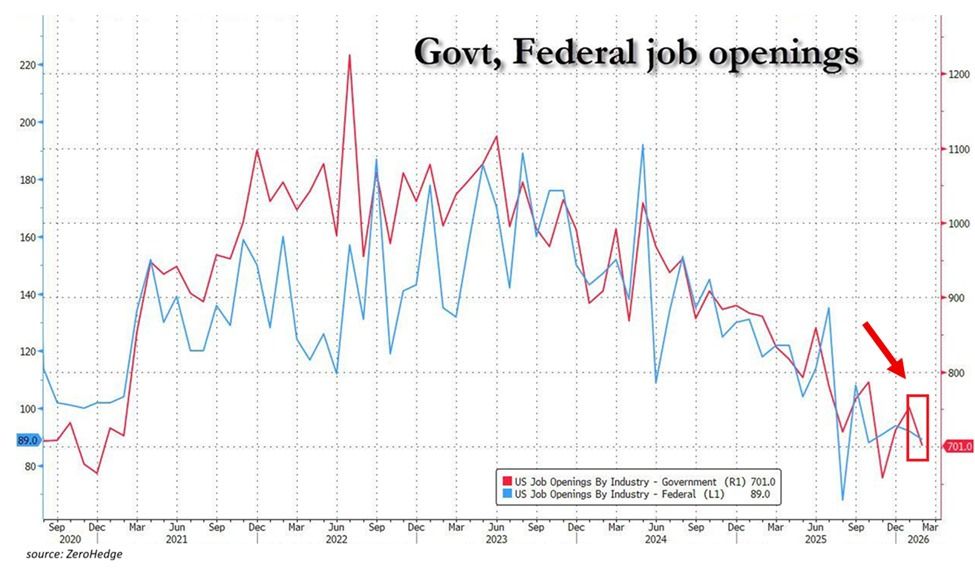
The US job market is showing alarming deterioration. According to The Kobeissi Letter, government job openings dropped 51,000 in February to 701,000.
This marked the second-lowest reading since December 2020. Available government vacancies have fallen 524,000 since their 2022 peak and now sit at pre-pandemic levels.
In addition, federal government openings fell to 89,000, the second-lowest since the pandemic low. This level is also in line with readings from 2017 and 2018.
Follow us on X to get the latest news as it happens
“Meanwhile, the government hiring rate stood at 1.4%, one of the lowest levels since mid-2020 and matching the 2016 and 2017 lows. Government hiring is frozen,” the post read.
Meanwhile, the private sector is shedding jobs at scale. Oracle reportedly laid off up to 30,000 employees on March 31. Amazon cut 16,000 corporate roles in January, and Block eliminated over 4,000 positions. These were just some of the many companies that made job cuts.
Consumer Sentiment Signals Trouble Ahead
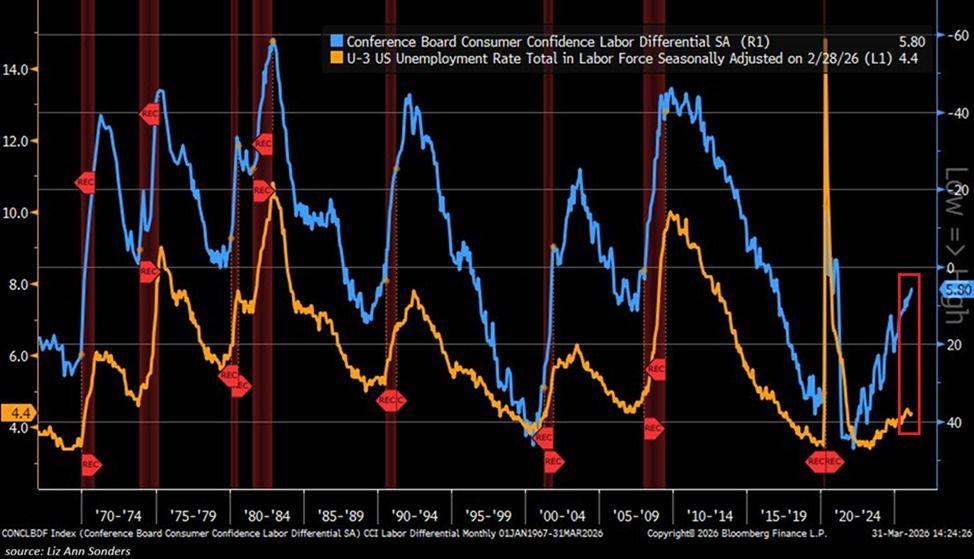
In a separate post, The Kobeissi Letter suggested that forward-looking indicators” point to a further increase in US unemployment.” The Conference Board’s March survey showed that only 27.3% of consumers described jobs as “plentiful.”
This was a marginal uptick from 26.7% in February, but still well below the roughly 55% who felt that way in 2022. At the same time, 21.5% said jobs were “hard to find,” up from approximately 10% over the same period.
The gap between these two readings, known as the labor market differential, fell to just 5.8 points. That represents the lowest level since the 2020 pandemic.
The Kobeissi Letter noted that historically, this indicator has been one of the most reliable leading signals of rising unemployment.
“Furthermore, current levels in this indicator have only been seen prior to or during a US recession since the 1990s. The job market is set for even more weakness,” the analysts added.
With these indicators pointing in the same direction, the March jobs report will be closely watched to determine whether underlying deterioration is cyclical or marks a deeper shift.
Subscribe to our YouTube channel to watch leaders and journalists provide expert insights
The post US Job Market Flashes Warning Signs Last Seen During 2020 Pandemic appeared first on BeInCrypto.
Circle plans to launch its own version of wrapped Bitcoin on the Ethereum network to target institutional markets.
Summary
- Circle plans to launch cirBTC on Ethereum, a 1:1 bitcoin backed wrapped asset targeting institutional markets.
- Wrapped Bitcoin allows BTC to be used on networks like Ethereum, giving institutions access to decentralized finance applications.
In a Thursday announcement, stablecoin issuer Circle said it plans to introduce cirBTC, a token that is backed 1:1 by bitcoin and aimed at over-the-counter desks, market makers, lending protocols, and other institutional participants, framing the asset as a “highly secure and neutral version of wrapped BTC.”
Wrapping allows a native asset like Bitcoin to be tokenized and used across other blockchains. In this case, wrapped Bitcoin lets BTC be brought onto networks such as Ethereum, which gives users access to decentralized finance applications.
The token will also launch on Circle’s layer-1 blockchain Arc and integrate with the Circle Mint platform.
Circle joins a growing list of participants that have introduced wrapped Bitcoin as demand for decentralized finance continues to expand among institutional users.
The sector is currently led by BitGo’s Wrapped Bitcoin, which currently holds a market capitalization of about $8 billion.
Coinbase also launched its own version, Coinbase Wrapped Bitcoin (cbBTC), in September 2024, which has since grown rapidly to reach a market capitalization of $5.9 billion. Last year, Coinbase launched Wrapped ADA (cbADA) on the Base blockchain to facilitate cross-chain liquidity.
Meanwhile, several other exchanges have released their own wrapped assets, including Kraken Wrapped BTC (kBTC), Binance Wrapped BTC (BBTC), Bitget Wrapped BTC (BGBTC), and OKX Wrapped BTC (okBTC), among others. These offerings are often paired with proof-of-reserve transparency to assure institutional traders that the underlying assets are held in secure, 1:1 custody.
Japanese Gen Z stands out as the most scam-conscious generation when it comes to crypto. A new survey of 1,486 people across Japan found that younger users are far more alert to fraudulent pitches on social media than their older peers.
The gap between generations reveals that Japan’s crypto trust problem is not uniform — it varies by age and online habits.
Gen Z Watches for Scams, Boomers Struggle With Basics
The survey, conducted by Tokyo-based consulting firm Clabo in February 2026, asked respondents why they view crypto as suspicious. The top answer overall was “I don’t understand how it works,” chosen by 23.3% of respondents. Price swings came second at 21.1%, followed by fraud concerns at 19.2%.
But generational breakdowns tell a different story. Gen Z respondents flagged social media scams as their primary worry. They encounter fake giveaways and shady promotions on platforms they use daily. Older cohorts, including Japan’s bubble generation, pointed instead to the complexity of blockchain technology itself.
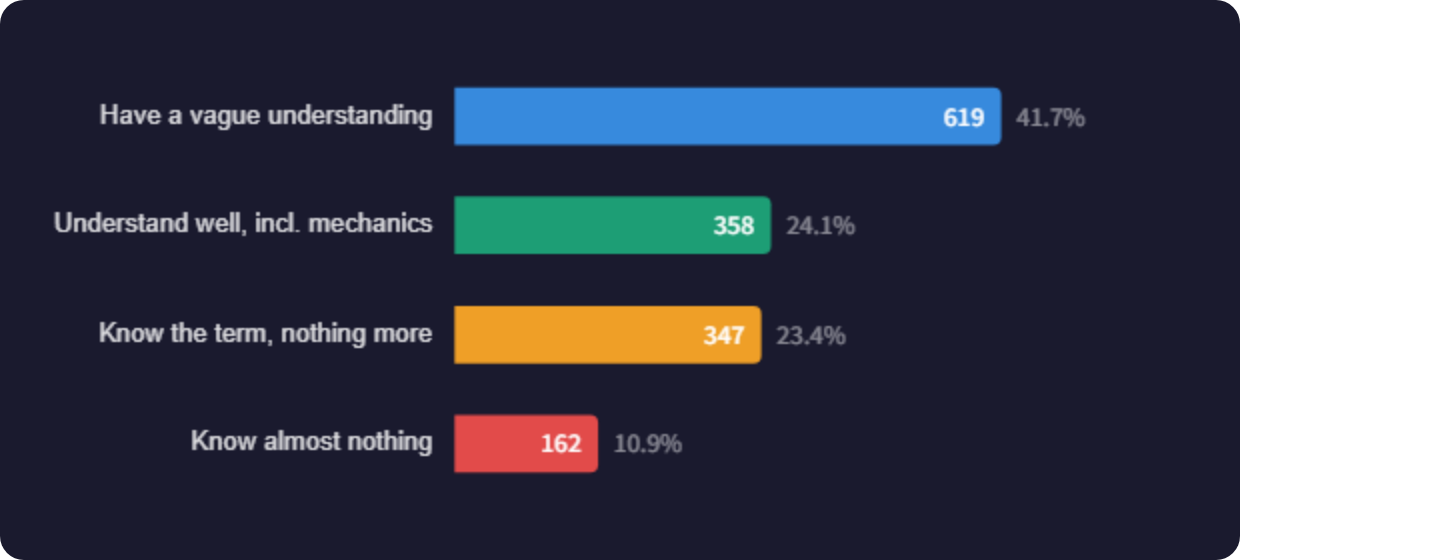
Millennials showed the highest rate of actual crypto investment among all age groups. They also reported the most active information-seeking behavior.
Across all groups, half of the respondents said they had never invested in crypto. Only 33.7% said they currently hold digital assets. Another 15.7% said they once invested but have since stopped.
YouTube Leads for Investment Decisions
When it comes to where people get crypto news, traditional news sites ranked first at 38.4%. Social media followed at 36.7%, with YouTube at 31.6%. But for actual investment decisions, YouTube jumped to first place at 27%.
The survey suggests that Japan’s crypto industry still faces a basic education gap. Clabo, which offers wallet recovery and security consulting, recommended more accessible educational content tailored to each generation’s specific concerns.
The post Japanese Gen Z Fears Crypto Scams More Than Any Other Generation appeared first on BeInCrypto.
Paper vs. Physical: The $34 Gap Exposing the True Cost of the Iran Oil Shock

Jessa Duggar Slams Brother Joseph Amid Molestation Charges

XRP ITS OVER!? I CAN PROMISE YOU AREN’T READY FOR THIS!!!

Smart energy pays enters the US market, targeting scalable financial infrastructure

Why Israel is blocking foreign journalists from entering

Bitcoin: We’re Entering The Most Dangerous Phase
XRP ITS OVER!? I CAN PROMISE YOU AREN’T READY FOR THIS!!!

Tom Lee Just Warned That Bitcoin Will Crash Before It Does Something Nobody Has Ever Seen Before

Next Financial Crisis WORSE Than 2008 – $3T Private Credit Collapsing, $4.6B TRAPPED
-

 NewsBeat6 days ago
The Story hosts event on Durham’s historic registers
-

 NewsBeat12 hours ago
Steven Gerrard disagrees with Gary Neville over ‘shock’ Chelsea and Arsenal claim | Football
-

 Sports6 days ago
Sweet Sixteen Game Thread: Tide vs Michigan
-
Entertainment4 days ago
Fans slam 'heartbreaking' Barbie Dream Fest convention debacle with 'cardboard cutout' experience
-
 Entertainment5 days ago
Lana Del Rey Celebrates Her Husband’s 51st Birthday In New Post
-
Crypto World3 days ago
Dems press CFTC, ethics board on prediction-market insider trades
-

 Crypto World1 day ago
Gold Price Prediction: Worst Month in 17 Years fo Save Haven Rock
-

 Tech4 days ago
The Pixel 10a doesn’t have a camera bump, and it’s great
-

 Sports3 days ago
Tallest college basketball player ever, standing at 7-foot-9, entering transfer portal
-

 Tech3 days ago
EE TV is using AI to help you find something to watch
-

 Business6 hours ago
No Jackpot Winner and $194 Million Prize Rolls Over
-

 Fashion5 days ago
Amazon Sundays: Soft Spring Layers
-

 Business1 day ago
Login and Checkout Issues Spark Merchant Frustration
-

 Tech3 days ago
How to back up your iPhone & iPad to your Mac before something goes wrong
-

 Tech4 days ago
Apple will hide your email address from apps and websites, but not cops
-

 Politics3 days ago
Should Trump Be Scared Strait?
-

 Crypto World3 days ago
U.S. rule change may open trillions in 401(k) funds to crypto
-

 Tech3 days ago
Flipsnack and the shift toward motion-first business content with living visuals
-

 Tech4 days ago
Avatar Legends: The Fighting Game comes out in July and it looks pretty slick
-

 Tech5 days ago
Elon Musk’s last co-founder reportedly leaves xAI
You must be logged in to post a comment Login