
Crypto World
Bithumb Prevails in Two Lawsuits Over Mistaken Bitcoin Credits


South Korean crypto exchange Bithumb has reportedly secured its first-instance court wins in two lawsuits seeking to recover proceeds from users who sold Bitcoin that the exchange mistakenly credited to their accounts. The rulings come as regulators continue to scrutinize the earlier operational lapse and Bithumb works to contain the financial impact.
According to a report by Chosun Biz, the Seoul Central District Court ruled in Bithumb’s favor in two of four unjust enrichment cases filed against users. The lawsuits involved different amounts: one ruling concerned a claim of 194 million won (about $140,000), while the other related to 5 million won (about $3,600). Two additional cases—seeking roughly 14.8 million won (about $10,700) and 500 million won (about $362,000)—remain pending, the report said.
Key takeaways
- Bithumb has won first-instance rulings in two of four unjust enrichment lawsuits tied to a February Bitcoin crediting error.
- The court decisions cover claims of 194 million won and 5 million won, while two other claims are still awaiting outcomes.
- The lawsuits proceeded via service by public notice because standard delivery methods for court documents failed for the defendants.
- The legal push targets proceeds from users who sold Bitcoin credited by mistake before affected accounts were frozen.
How the court cases connect to Bithumb’s February mistake
The underlying dispute traces back to an event on Feb. 6, 2026, during which Bithumb intended to distribute rewards denominated in Korean won. As described in earlier coverage by Cointelegraph, Bithumb said the error happened during a promotional activity: an employee allegedly selected Bitcoin as the payment unit instead of the intended fiat currency.
Rather than crediting the planned reward amount in won to 249 users, the exchange reportedly credited customer accounts with 620,000 BTC. At the time of the incident, that volume was valued at more than $40 billion, according to the reporting that followed the episode. Bithumb later stated that it recovered the vast majority of the mistakenly credited amount—618,212 BTC—leaving only a small residual shortfall.
However, the problem was not purely theoretical. Some users had reportedly already sold 1,788 BTC worth of the credited balances before Bithumb moved to freeze the affected accounts. It is those early sales that became the focus of Bithumb’s March litigation strategy.
What Bithumb is trying to recover through unjust enrichment suits
As reported by Cointelegraph, Bithumb filed four unjust enrichment lawsuits in March against users who sold the mistakenly credited Bitcoin and did not return the proceeds. The exchange’s approach, as characterized in that earlier reporting, was to seek monetary recovery from the sale proceeds rather than compel users to return Bitcoin itself.
The newly reported first-instance rulings therefore represent more than symbolic legal progress: they support Bithumb’s argument that users who benefited from the mistaken credits should compensate the exchange to the extent of the sold proceeds. Still, with half of the cases remaining pending, the broader extent of Bithumb’s ultimate recovery is not yet fully determined.
For users, the developments also underscore a practical risk in operational error scenarios. Even when a credit is unintended, actions taken immediately after the balance appears—such as trading or exchanging the credited asset—can later become a subject of legal dispute if the credit is subsequently reversed or invalidated.
Service by public notice highlights delivery hurdles in the lawsuits
Chosun Biz also noted that both of the cases that reached rulings advanced through service by public notice. The court reportedly used this method because it could not deliver the necessary documents to the defendants through ordinary channels.
That procedural detail matters because it can affect how quickly cases move and how defendants participate. While service by public notice is not unusual in certain jurisdictions when direct service fails, it can raise questions about whether defendants were fully informed in time to respond through standard procedures. The reported decisions, however, indicate the court proceeded to judgment nonetheless.
Regulatory pressure continues alongside the litigation
While the lawsuits play out in civil court, Bithumb is also facing ongoing regulatory scrutiny related to the February error. South Korea’s Financial Supervisory Service (FSS) reportedly investigated the incident, focusing on how the exchange could credit customers with Bitcoin it did not hold.
Cointelegraph previously reported that the regulator sent Bithumb an inspection opinion in early August, which marked the formal start of sanctions proceedings, though no final penalty had been announced at the time of that reporting. In the same earlier coverage, Cointelegraph said it reached out to the Financial Services Commission (FSC) for an update but did not receive a response by publication.
Separately, Bithumb has faced other legal and compliance challenges this year. South Korean police reportedly raided its offices in June as part of an investigation unrelated to the Bitcoin crediting error, involving allegations of favoritism related to lawmaker Kim Byung-ki. The company is also contesting a separate six-month partial business suspension over alleged Anti-Money Laundering violations; Cointelegraph reported that a Seoul court stayed the suspension in April pending the outcome of Bithumb’s challenge.
Taken together, the court rulings and the regulator’s continuing work indicate that Bithumb’s February incident is being treated as both a financial and governance issue—not merely a one-off operational glitch. For investors and market participants, the key question is whether Bithumb’s internal controls reforms and compliance measures will satisfy regulators after a mispayment of this magnitude.
What to watch next
With two remaining unjust enrichment lawsuits still pending, the next development will likely be whether Bithumb’s legal strategy yields further first-instance judgments and how those cases ultimately resolve. At the same time, market observers will continue to watch for any FSS sanctions outcome, since regulatory findings could shape how exchanges in South Korea tighten operational controls to prevent similar crediting errors.



Moonwell has halted new borrowing across its Core Markets on Base after an apparent MAMO collateral price manipulation exploit drained about $8.7 million from the decentralized lending protocol.
Summary
- Moonwell has restricted new borrowing across its Base Core Markets after an apparent MAMO collateral price manipulation exploit drained about $8.7 million.
- CertiK said the attacker manipulated the relatively illiquid MAMO token’s collateral price before borrowing real cbBTC from Moonwell’s mCBTC market.
- Moonwell lowered all Base Core Market borrow caps to 1 wei and also set MAMO and WELL supply caps to 1 wei while it investigates the incident.
- PeckShield estimated losses at roughly $8.7 million and said the attacker consolidated the stolen funds into DAI at a single address.
Moonwell said in an Aug. 27 post on X that it was investigating an issue affecting the MAMO Core Market and had lowered borrow caps across all Core Markets on Base to 1 wei as a precaution, effectively preventing users from opening new borrowing positions while the investigation continues.
“As a precaution, borrow caps for all Core Markets on Base have been set to 1 wei, preventing new borrowing and limiting the potential for further impact,” Moonwell said.
Supply caps for MAMO and WELL were also reduced to 1 wei, while supply limits for other assets were left unchanged, according to the protocol. Moonwell said it would provide further updates once more information became available.
Blockchain security firms PeckShield and CertiK separately estimated that approximately $8.7 million had been taken, while Blockaid traced the apparent attack to manipulation of the MAMO token’s collateral price.
Moonwell exploit used MAMO collateral price to borrow cbBTC
According to CertiK, the attacker manipulated the collateral value of MAMO, a relatively illiquid token, before using the inflated collateral to borrow real cbBTC from Moonwell’s mCBTC market.
Blockaid identified the same mechanism, initially reporting that 50.6 cbBTC worth more than $4 million had been drained as it monitored the transactions. PeckShield later estimated total losses at about $8.7 million and said the attacker had consolidated the proceeds into DAI at a single address.
The use of a thinly traded asset as collateral was central to the attack described by the security firms. By changing MAMO’s market price, the attacker was able to increase the value assigned to the collateral position before borrowing assets with deeper liquidity.
MAMO has previously experienced sharp price swings. The token fell after its Coinbase debut in August 2025 after gaining more than 120% during the preceding week. At the time, crypto.news reported that MAMO had reached an all-time high of $0.227 before losing nearly 20% as selling activity increased.
Price pressure returned following Thursday’s security incident. Moonwell’s WELL token was down about 13% over the preceding 24 hours, according to CoinGecko data cited in the initial report, while MAMO had fallen roughly 9% over the same period, according to DEX Screener.
The restrictions imposed by Moonwell cover borrowing across its Base Core Markets, not only the MAMO market where the issue was identified. Existing supply caps for assets other than MAMO and WELL remained unchanged while the team investigated the incident.
Moonwell has faced previous oracle and governance problems
Thursday’s incident follows other security problems at Moonwell during 2026, including a pricing failure that left its lending markets with about $1.78 million in bad debt.
In February, an oracle calculation error mispriced Coinbase Wrapped ETH, or cbETH, at roughly $1.12 when the asset was trading near $2,200. The incorrect price allowed liquidators and automated bots to repay positions at the distorted valuation and seize cbETH collateral, according to the protocol’s disclosure cited by crypto.news.
The faulty oracle logic reportedly included code generated with Anthropic’s Claude Opus 4.6 model. Moonwell said at the time that an incorrect scaling factor in the calculation caused the large difference between the oracle value and the market price.
Another Moonwell security issue surfaced the following month when an unknown party acquired about $1,800 worth of MFAM tokens and used the holdings to push a malicious governance proposal through quorum on the protocol’s Moonriver deployment.
The March proposal sought control of seven lending markets, Moonwell’s comptroller and its oracle through an attacker-controlled contract, putting about $1.08 million of assets at risk. Moonwell’s Break Glass Guardian multisig provided an emergency mechanism capable of stopping the proposal before execution, while subsequent votes moved against it.
Unlike the February pricing failure, security firms assessing the Aug. 27 incident have described the latest attack as active manipulation of the market price used for MAMO collateral. Moonwell has not yet published a detailed post-mortem identifying the exact contracts, oracle structure or transaction sequence involved.
DeFi exploits have remained elevated since April
The Moonwell exploit comes after a series of large DeFi attacks during the second quarter of 2026, with April accounting for several of the year’s biggest losses.
CertiK warned in April that AI misuse and infrastructure weaknesses were becoming significant parts of crypto security risk. The firm said attackers were using social engineering, infrastructure vulnerabilities and more advanced automated tools, including AI-assisted phishing, deepfakes and exploit techniques.
By April 18, crypto protocols had lost more than $606 million across at least 12 incidents during the month, according to DefiLlama data cited by crypto.news. The total exceeded losses recorded during the entire first quarter of 2026.
Kelp DAO accounted for one of the largest incidents after attackers drained roughly 116,500 rsETH worth about $292 million from its cross-chain setup on April 18.
LayerZero later said the Kelp DAO exploit involved compromised RPC infrastructure used by its decentralized verifier network and affected Kelp DAO’s single-DVN rsETH configuration. The company said preliminary evidence pointed to North Korea-linked TraderTraitor, which it associated with the Lazarus Group.
The incident also affected lending markets holding rsETH. Aave experienced large withdrawals and was left with substantial bad debt after stolen rsETH was used as collateral to borrow other assets, while SparkLend and Fluid restricted affected markets.
In June, Binance Research said April’s DeFi exploits had contributed to about $13 billion in total value locked outflows from on-chain protocols. Its May market report put DeFi TVL at $82.7 billion at the end of April, down 10.7% from the previous month, while exploit losses for the month totaled $635.24 million.
Moonwell has not yet disclosed whether the $8.7 million estimate represents its final loss from the MAMO Core Market incident or whether any of the affected assets can be recovered. The protocol said its investigation remains active and that further information will be released when available.


Ripple Prime, Ripple’s multi-asset prime brokerage business, launched a Delta One service for institutional investors, expanding into US equity derivatives.
The offering allows clients to execute total return swaps linked to US-listed equities, indexes and digital assets, Ripple said in a Thursday announcement.
Total return swaps provide exposure to an asset’s returns without requiring ownership of the underlying asset.
The service targets hedge funds, asset managers and other financial institutions. Ripple said clients can use a single counterparty and cross-margin exposures across the supported asset classes around the clock.
“The launch of our Delta One business is an important development for Ripple Prime and a natural extension of the platform we’ve built,” Ripple Prime President Noel Kimmel said.
Ripple Prime’s existing prime brokerage, clearing and financing services cover foreign exchange, derivatives, fixed income and digital assets. Ripple said the business has more than $1 billion in regulatory net capital.
Ripple Prime was created after Ripple completed its $1.25 billion acquisition of Hidden Road in October 2025 and rebranded the business.
Earlier in August, Ripple Prime closed a $275 million private placement of senior unsecured notes to support its growth. In May, Ripple Prime secured a $200 million debt facility from funds managed by Neuberger Specialty Finance to expand its lending capacity for institutional clients.
Related: South Korea’s Jeonbuk Bank taps Ripple for cross-border payments
Bain Capital led the investment in the U.S. clearing and custody firm, which plans to expand its digital asset and tokenization infrastructure.
XRP price is changing hands above $1.40 after swinging between $1.37 and $1.45 in a single day, confusing its own prediction. This is a coin fighting for direction in real time. The bigger question traders are asking isn’t where XRP sits right now, but whether this volatility is the last gasp of a tired rally or the setup for another leg higher.
The whipsaw traces back to an overheated August run. XRP rallied by more than 50% on the week before buyers failed to hold the $1.45–$1.55 zone, triggering a cascade of long liquidations as leveraged positioning unwound.

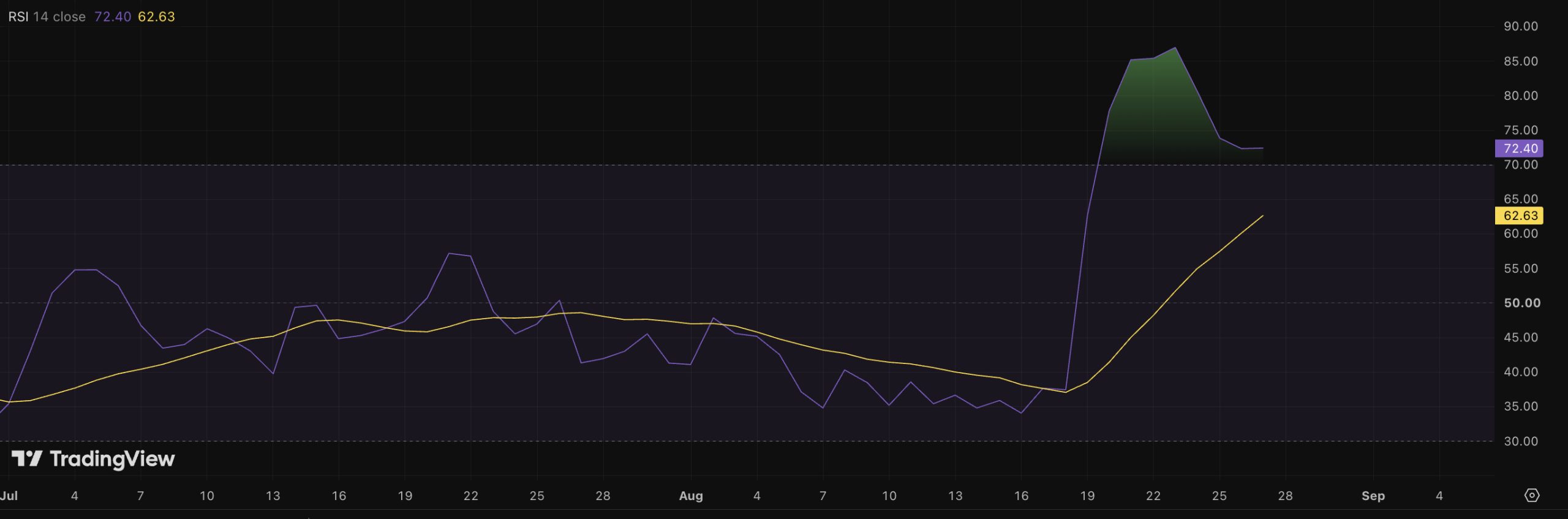
Network activity data shows institutional flows into spot XRP ETF products and expanding transfer volumes on the ledger are still supportive, even as derivatives markets reset. MACD readings flash a buy signal (0.069 on the 12,26,9), while RSI at 72 sits in slightly overbought territory. This all came after screaming an overbought signal days ago, but close enough to keep shorter-term traders cautious.
Macro tailwinds like Fed rate expectations and manageable Treasury yields have kept risk appetite intact across crypto. That’s the backdrop. The question now is whether XRP’s technical structure can hold long enough to capitalize on it.
Discover: The Best Crypto to Diversify Your Portfolio
XRP Price Prediction: Hit $2 This Week?
XRP trades at the $1.45 level with an intraday range compressing between $1.38 and $1.45. Volume has picked up alongside the bounce, consistent with short covering rather than pure fresh accumulation. Worth watching before calling this a trend reversal.
Immediate resistance sits at $1.41–$1.45, a level XRP has rejected repeatedly this week; a daily close above $1.45 would materially improve the technical picture and open a path toward $1.55 and eventually $2.00 on continuation. Support holds near $1.36, with deeper structural demand at $1.28 and the $1.00–$1.05 zone that’s defended every major pullback in 2026.

In a good scenario, XRP needs to reclaim $1.45, ETF inflows persist, and momentum carries toward $1.55–$1.65. Or, it continued to chop between $1.36 and $1.45 as leverage resets.
However, the bear case comes if it breaks below $1.28 and reopens the $1.00 floor, especially if escrow-related selling pressure resurfaces. Traders watching for confirmation should track whether volume expands on any breakout attempt.
Trade XRP on Bybit and Get a Chance to Win Our $1,000 USDT Airdrop
Maxi Doge Targets Early Mover Upside as XRP Tests Key Levels
XRP holders riding this bounce have reason to feel validated; a 50% daily gain isn’t nothing. But at a market cap north of $80 billion, a move from $1.45 to $2.00 is a solid trade, not a life-changing one.
The above math is exactly why traders with risk appetite left over are scouting earlier-stage plays where the upside math looks different.
Enter Maxi Doge ($MAXI), a meme token built around leveraged-trading culture rather than another dog-with-a-hat rehash. The presale has raised $4.8 million at a current price of $0.0002835, with dynamic APY staking live at 65% for holders who’d rather not just hold and hope.
Standout features include holder-only trading competitions with leaderboard rewards and a “Maxi Fund” treasury earmarked for liquidity and partnerships, infrastructure that most meme launches skip entirely.
Research Maxi Doge before presale ends.
Discover: The Best Token Presales
The post XRP Price Prediction: Why Is XRP Fluctuating So Much Today? appeared first on Cryptonews.


TOKEN2049 returns to Marina Bay Sands in Singapore on Oct. 7-8, bringing together 25,000 attendees from over 7,000 companies across 160 countries.
The first 100 speakers have been announced, including Shayne Coplan, Founder and CEO of Polymarket; Jeff Yan, CEO of Hyperliquid Labs; Adena Friedman, Chair and CEO of Nasdaq; Jenny Johnson, CEO of Franklin Templeton; Eric Trump, Executive Vice President of The Trump Organization; Raoul Pal, Co-Founder and CEO of Real Vision; and Tom Lee, Managing Partner and Head of Research at Fundstrat.
Institutional participation will be a major focus of this year’s edition, with senior leaders from BlackRock, J.P. Morgan, Morgan Stanley, Nasdaq, NYSE, CME and Franklin Templeton expected across the event.
Taking over all five floors of Marina Bay Sands, TOKEN2049 will create a large-scale environment spanning content, networking, wellness, live experiences and its hospitality.
Across TOKEN2049 Week, more than 1,000 events, from conferences and hackathons to investor gatherings, meetups and networking receptions, will fill venues throughout the city. Other major gatherings taking place in Singapore that week include Digital Asset Summit Asia, Sui Basecamp, the Network State Conference, the Milken Institute Asia Summit, and the Forbes Global CEO Conference, all against the backdrop of the Formula 1 Singapore Grand Prix.
Alex Fiskum, Co-Founder of TOKEN2049, said: “With our Dubai edition moving to 2027, our full focus this year is on Singapore. We’re seeing strong interest, with more than 70% of the exhibition floor already secured. We’ll also unveil new tracks and formats in the coming weeks as we expand the institutional side of the programme. We can’t wait to welcome everyone back to TOKEN2049 this October for another edition in Singapore.”
The 2026 programme will also feature the second edition of TOKEN2049 Origins, a 36-hour hackathon, and the return of the NEXUS Startup Competition, with registrations and applications across both programmes. This year’s finalists are set to be judged by leading venture capital firms Dragonfly, Multicoin, and Maelstrom.
Happy Bird tickets are currently available. For tickets and further information, visit TOKEN2049 Singapore.
ABOUT TOKEN2049
TOKEN2049 is the world’s leading crypto event series, bringing together decision-makers from across the global digital asset ecosystem to connect, exchange ideas and shape the industry. TOKEN2049 is the meeting place for founders, executives, institutions, investors, builders and policymakers from around the world.
The post TOKEN2049 Singapore Returns to Marina Bay Sands This October appeared first on BeInCrypto.


The average market cap of Pump Fun tokens shared by 80% of the firm’s top 50 callout reward earners was below $100,000, according to research from crypto analyst Dethective.
Pump Fun traders earn daily sums based on the amount of volume their publicly shared token advice attracts from other traders.
Dethective charted the top 50 callout reward earners, who raked in a total of almost $700,000.
Few users call out tokens that reach over $100K
There were only two callers with an average median market cap rate of over $1 million, and eight callers with an average median market cap rate between $100,000 and $1 million.
Read more: Pump Fun is firing staff and its company filings are overdue, report
Eighty percent of the earners shared tokens with an average market cap of less than $100,000, while 12 callers averaged a market cap of less than $10,000.
Martin Shkreli makes $11K from callout rewards
Martin Shkreli joined Pump Fun this week, and his closely tied memecoins were down 94% in 24 hours.
Despite this, Shkreli has made almost $11,000 from callout rewards. He’s shared 11 callouts with an average market cap rate of $220,000.
Someone made $6.8K with 2,417 call outs
The highest earner of callout rewards was Pump Fun user “Slingoor,” who earned $47,500 sharing 215 callouts. Their average market cap rate was almost $149,000.
Meanwhile, the lowest top earner made $6,100 from sharing 624 callouts. Their average market cap rate was over $13,000.
One top 50 earner shared 2,417 calls and made $6,800. Their average market cap rate was $3,600.
Pump Fun was rewarding quantity over quality
Onlookers have noted that most of the users receiving these rewards are already key opinion leaders onboarded by the platform.
Users also complained that the platform was unfairly rewarding the sheer number of callouts rather than their quality.
Because of this, Pump Fun’s Chief Operating Officer Alon Cohen claimed the firm has “significantly reduced the weighting of the number of callouts that a user produces within the callout rewards calculation.”
Over the last month, Pump Fun’s token has increased by 133%. However, it’s still down 46% from it’s all time high last September.
Got a tip? Send us an email securely via Protos Leaks. For more informed news and investigations, follow us on X, Bluesky, and Google News, or subscribe to our YouTube channel.


StarkWare said Wednesday that a quantum-safe Bitcoin (BTC) transaction has been mined on the live network, a first for the method.
On-chain data shows the transaction spent a 10,000-satoshi output, worth about $8 at current prices, and paid a fee of 5,179 satoshis.
Follow us on X to get the latest news as it happens
How the Quantum-Safe Bitcoin Transaction Works
Quantum-Safe Bitcoin (QSB) attaches a hash-based lock beside the elliptic curve signature that normally guards a Bitcoin output. Shor’s algorithm, the quantum technique that derives private keys from published public keys, cannot break hash functions.
StarkWare researcher Avihu Levy published the QSB method in April. It uses signature grinding. This produces a valid Bitcoin signature without a private key.
The sender grinds offchain until a candidate spending transaction hashes to a value that is itself a validly formatted signature.
Security then rests on reversing a hash rather than keeping a private key secret. The technique builds on Binohash, developed by Robin Linus, the creator of BitVM.
MARA Pool mined the transaction in block 964,199. What worked was a single construction, not an upgrade, and Bitcoin itself remains unchanged.
What the QSB Method Cannot Do
StarkWare said the method does not make Bitcoin quantum-safe. Three constraints narrow what the spend actually protects.
The first limit is prior exposure. An address whose public key already sits on-chain gains nothing, because an adversary with a quantum computer could derive the corresponding private key.
The second is the migration step. Coins reach a hash-secured output through a transaction signed the ordinary way, which exposes the sending address’s public key. The output spent on Wednesday was funded in July by exactly such a transaction.
The third is delivery. QSB transactions use nonstandard formats, so ordinary nodes will not relay them, and MARA’s Slipstream service supplied the route to a miner.
Cost compounds the limits. Levy’s repository puts the offchain compute at $75 to $150, while StarkWare described this transaction as costing several hundred dollars.
“People have long assumed that protecting Bitcoin holdings from a quantum adversary would require changing the Bitcoin protocol. Today shows otherwise. A soft fork is still the better long-term answer, as StarkWare has argued for consistently, but it is no longer the only option,” the blog read.
Bitcoin has not adopted a protocol-level fix, and Wednesday’s transaction does not change that.
Subscribe to our YouTube channel to watch leaders and journalists provide expert insights
The post Is Bitcoin Quantum-Safe Now? One Transaction Says Partly appeared first on BeInCrypto.
The tech-heavy Nasdaq composite jumped while the Dow Jones Industrial Average dipped Thursday as Wall Street reacted to big earnings reports, with Nvidia (NVDA), Salesforce (CRM) and CrowdStrike (CRWD) surging on the stock market today. Just after Thursday’s open, the Dow industrials were down 0.2%, while the S&P 500 moved up 0.3%. The Nasdaq advanced 0.8% in morning trading. West…
Copyright ©2026 Investor’s Business Daily, LLC. All rights reserved. 87990cbe856818d5eddac44c7b1cdeb8

U.S. fiscal concerns and digital-asset legislation news have emerged as separate forces in the Bitcoin market. Senator Cynthia Lummis has linked Bitcoin to the country’s $39.2 trillion national debt. Now, the Digital Asset Market CLARITY Act remains subject to significant procedural and policy hurdles in the Senate.
Bitcoin posted a 22% weekly gain after Treasury yields fell following a Treasury intervention in the bond market. The move into crypto was later amplified by a short squeeze, with CoinGlass data showing $2.7 billion in crypto short positions liquidated.
— paulatalkscrypto (@paulatalkshxrp) August 20, 2026
 $2.7 BILLION IN CRYPTO SHORTS JUST GOT WIPED OUT.
Bears got caught on the wrong side of the trade.
Liquidations are accelerating.
Momentum is shifting.
And the crypto market just sent a loud warning:
Never underestimate what happens when shorts get trapped. 
 #Crypto pic.twitter.com/nRVNMX0HTt
CNBC also reported that concern about U.S. debt levels and borrowing costs was part of the market backdrop. The report described the Treasury’s decision to double its buybacks of long-dated government debt as an effort aimed at long-term yield concerns, while noting that Bitcoin remained below its 2026 high and its all-time high despite the rally.
The same report said investor sentiment improved amid a late effort by the White House and crypto industry leaders to advance the CLARITY Act. It characterized the bill as a potential market catalyst, while saying its prospects for passage appeared relatively slim.
Discover: The Best Crypto to Diversify Your Portfolio
Lummis Links Debt Concerns to the CLARITY Act
On June 15, Senator Cynthia Lummis publicly tied Bitcoin to America’s $39.2 trillion national debt crisis. The report said she presented Bitcoin as a potential hedge against currency debasement for younger Americans who will inherit the effects of decades of deficit spending.

Lummis has argued that Bitcoin’s fixed supply makes it structurally distinct from sovereign debt instruments. According to the report, she described the U.S. fiscal trajectory as unsustainable and said Bitcoin could help address the consequences for younger Americans. She also acknowledged that the legislative timetable remained uncertain.
The Clarity Act would establish a jurisdictional division between the Securities and Exchange Commission and the Commodity Futures Trading Commission. Under the framework described in the primary report, the SEC would oversee digital-asset securities and new token offerings, while the CFTC would have jurisdiction over spot digital commodities, including Bitcoin and Ethereum.

The legislation would also create registration frameworks for exchanges, brokers, and custodians. Its provisions include capital-segregation requirements, protections for software developers publishing code, and a rule giving exchange customers first claim on custodial assets in bankruptcy.
For tokens that operate in regulatory ambiguity, the proposed activity-based test would determine whether sufficiently decentralized assets fall under CFTC oversight as digital commodities. The bill would also ban passive stablecoin yield products while protecting activity-based platform usage rewards.
Trade XRP on Bybit and Get a Chance to Win Our $1,000 USDT Airdrop
News on Senate Obstacles Remain as Bitcoin Stabilizes
Galaxy Research put the probability of the CLARITY Act becoming law in 2026 at 60–75%, according to the primary report. But the White House’s July 4 signing target faced pressure from unresolved ethics provisions, competing House and Senate versions that require reconciliation, and the Senate’s 60-vote cloture threshold.
The House and Senate versions also differ over the SEC–CFTC balance. The Senate Banking discussion draft gives the SEC primary authority over ancillary assets and calls for joint SEC–CFTC rulemaking on margining and disclosures, while the House version is described as more CFTC-forward.
Despite the news, Bitcoin is still trading at around $80,000, with BTC holding near the key psychological level after briefly climbing above $80,000. The move keeps Bitcoin firmly in its recent uptrend, although the $80,000 to $82,000 area remains an important resistance zone after its three-month high.
Discover: The Best Token Presales
The post Bitcoin News: Debt Hedge Case Meets Senate Roadblocks for CLARITY Act appeared first on Cryptonews.
Crypto World
TIME Reveals the 2026 TIME100 AI List of the World’s Most Influential People in Artificial Intelligence

Today, TIME reveals the fourth annual TIME100 AI list, recognizing the 100 most influential people in artificial intelligence.
The 2026 TIME100 AI issue includes one worldwide cover featuring listmakers, Sam Altman, Dario Amodei, Jeff Bezos, Doreen Bogdan-Martin, Marian Croak, Larry Ellison, Joseph Gordon-Levitt, Paris Hilton, Lila Ibrahim, Arvind Krishna, Fei-Fei Li, Mira Murati, Elon Musk, David Sacks, Liz Shuler, Ilya Sutskever, and Eddie Wu.
Published alongside the TIME100 AI are in-depth interviews with Thinking Machines Lab chief executive officer Mira Murati, Secretary-General of the International Telecommunication Union Doreen Bogdan-Martin and OpenEvidence founder and chief executive officer Daniel Nadler.

India vs Germany Highlights, Hockey World Cup 2026: India Beat Germany To Cap Off Campaign With Historic Finish

Visa ships a security AI that patches production code before any human reviews it
Why is Rapid7 stock surging today?





-

 Fashion6 days ago
Weekend Open Thread: Madewell – Corporette.com
-

 Crypto World2 days ago
SpaceX stock could rise 75% to $240, JPMorgan says
-

 Business5 days ago
Musk’s Tesla, SpaceX Confirm $16.8 Billion ‘Terafab’ Chip Plant as World’s Largest Building in Texas
-

 Crypto World5 days ago
anatomy of crypto’s biggest liquidation event since 2021
-

 Crypto World3 days ago
A $30 Billion AI Fund Implodes, Now the SEC Is Investigating Wall Street’s Role
-

 Politics5 days ago
6 months on, Irish renters crushed by effects of government housing bill
-

 Crypto World1 day ago
Did Trump Just Move SpaceX Stock With One Truth Social Post?
-

 Business4 days ago
Mystery AI Model ‘Ox Alpha’ Draws Developers With Free Access as Chinese Lab Origins Remain Debated
-
 NewsBeat5 days ago
The ‘Lucky Dip Gang’ causing carnage for clicks: After five thugs were killed speeding in the wrong direction on a motorway, GUY ADAMS investigates a sick new trend… and why police aren’t even allowed to pursue them
-

 Business3 days ago
Moderna CEO warns China is pouring state money into mRNA technology
-

 Business7 days ago
Five Below: Kids Discount Retailer Reaps Rich Rewards
-

 Business3 days ago
NVIDIA Stock Drops Nearly 2 Percent to $210 on Seventh Losing Day Ahead of Critical AI Earnings
-
 Crypto World6 days ago
Nvidia Stock Suffers Longest Losing Streak Since 2022: Will Q2 Earnings End It?
-

 Business6 days ago
UK firms in critical financial distress rise 9% to 53,756
-

 Sports4 days ago
Deshaun Watson fires back at Browns fans after being booed: ‘It’s a disrespectful thing’
-
 Crypto World4 days ago
Google Gemini AI Predicts Ethereum Could Become the Trade Retail Misses in 2026
-

 Tech6 days ago
Unitree’s New Superman Robot Claims to Outjump and Outrun Every Human, Usain Bolt Included
-

 Tech6 days ago
Faster chip in a familiar form factor
-

 Business5 days ago
Will Tesla Stock Be Higher or Lower a Year From Now? Here’s What Wall Street Analysts Are Saying
-

 Crypto World7 days ago
SEC Regulation Crypto vs CLARITY Act: which framework wins
You must be logged in to post a comment Login