
Crypto World
Bitmine (BMNR) Stock Gains 3% Following $138M Ethereum Acquisition Spree


Key Highlights
- Bitmine acquired 65,341 ETH during the past week, valued at approximately $138 million based on current market rates
- Company’s aggregate ETH position now reaches 4.66 million tokens — representing 3.86% of total circulating supply
- Acquisition velocity has accelerated over three straight weeks, surpassing the previous weekly average of approximately 50,000 ETH
- BMNR shares advanced more than 3% while ETH traded near $2,144
- Executive Chairman Tom Lee projects ETH is approaching the conclusion of a “mini-crypto winter”; the company maintains roughly $7 billion in unrealized losses
Bitmine Immersion Technologies (BMNR) continues its aggressive Ethereum accumulation strategy. The treasury firm acquired 65,341 ETH during the previous week — marking the third straight week of escalating purchases — as it reinforces a position that has accumulated substantial paper losses while maintaining aggressive expansion.
Bitmine Immersion Technologies, Inc., BMNR
This recent acquisition, valued at approximately $138 million based on prevailing market rates, pushes Bitmine’s aggregate holdings to 4,660,903 ETH. With tokens priced near $2,072 each, the treasury position exceeds $9 billion in value.
The company now owns roughly 3.86% of ETH’s 120.7 million token circulating supply. This percentage continues expanding as Bitmine increases its weekly acquisition rate, which historically averaged between 45,000 and 50,000 ETH.
Cash holdings expanded in tandem with crypto acquisitions, hitting $1.1 billion. The firm also maintains 196 Bitcoin, $200 million allocated to Beast Industries, and $95 million in Eightco Holdings. Combined crypto, cash, and speculative investment holdings totaled $11.0 billion as of March 22.
Investors reacted positively. BMNR shares climbed over 3% following the announcement as Ethereum price approached $2,144.
Staking Infrastructure Growth
Beyond accumulation, Bitmine is pursuing an aggressive staking strategy. As of March 23, the company had staked 3,142,643 ETH — approximately 67% of total holdings. This staked position currently produces $184 million in annualized staking revenue.
Tom Lee stated Bitmine has staked more Ethereum than any competing entity worldwide. When operations reach full capacity, projected annual rewards could reach $272 million, calculated using a 2.83% seven-day yield. The prevailing Composite Ethereum Staking Rate stands at 2.75%.
The firm is developing its Made in America Validator Network (MAVAN), collaborating with three staking service providers in preparation for an anticipated early 2026 launch.
Significant Paper Losses Persist
The strategy carries substantial downside risk. Notwithstanding the acquisition momentum, Bitmine currently holds approximately $7 billion in unrealized losses as ETH valuations have declined in recent months, per DropsTab analytics.
Lee maintains confidence in his investment thesis. “Our base case is ETH is in the final stages of the ‘mini-crypto winter,’” he stated in Monday’s announcement.
Bitmine holds the distinction of operating the world’s largest Ethereum treasury and ranks second among all global crypto treasuries, trailing only Michael Saylor’s Strategy, which controls 762,099 Bitcoin purchased for roughly $57.69 billion.
As of March 23, Ethereum was trading in the $2,072 to $2,144 range.



Key Takeaways
- John Vinh of KeyBanc maintains an Overweight stance on Micron with a $600 price objective, representing approximately 40% potential appreciation from present trading levels.
- The memory chip manufacturer’s shares have soared nearly six times their value over the trailing twelve months, propelled by robust AI memory chip demand.
- For fiscal Q3, Vinh projects revenue reaching $35.1 billion with earnings per share of $20.54, surpassing Street estimates.
- Supply constraints are anticipated to persist through at least the middle of 2027, with quarterly price increases of 30–50% projected for Q2 2026.
- Aletheia Capital identifies Micron as positioned to benefit from an anticipated 33% year-over-year surge in cloud infrastructure spending during 2026.
Micron Technology has delivered one of the semiconductor industry’s most spectacular performances over the past twelve months. Shares have multiplied nearly six times, yet certain Wall Street analysts believe significant appreciation potential remains.
John Vinh from KeyBanc has identified Micron among semiconductor stocks offering the most attractive risk/reward profiles entering the current earnings cycle. His firm maintains an Overweight recommendation with a $600 price objective. Monday’s premarket session saw shares changing hands around $413.54, reflecting a 1.7% decline — positioning the analyst’s target approximately 40% above present valuation.
Vinh’s investment thesis builds on several fundamental arguments. Notably, he contends Micron remains attractively valued. Notwithstanding the extraordinary price appreciation, the company trades at among the most compressed forward price-to-earnings ratios across the entire S&P 500 index. Such valuation discrepancies typically prove unsustainable, particularly when earnings trajectories point upward.
Projected Results Exceed Street Expectations
For the fiscal third quarter, Vinh anticipates revenue of $35.1 billion with earnings per share reaching $20.54. Both projections exceed Wall Street’s consensus estimates of $33.8 billion in revenue and $19.26 per share. The company is scheduled to announce these results toward the end of June.
Vinh also anticipates forward guidance surpassing market expectations. “We expect Micron will post better results and higher guidance, supported by a structurally stronger-for-longer memory cycle driven by hyperscaler demand and constrained supply,” Vinh stated in research commentary released Sunday.
The memory semiconductor sector has historically exhibited pronounced cyclical characteristics. Expansion phases typically transition into contractions, leaving investors vulnerable. However, Vinh believes the present environment differs fundamentally. His analysis suggests demand will continue outstripping supply through at least mid-2027, when substantial new production capacity becomes operational.
Near-term projections call for sequential pricing increases of 30–50% during Q2 2026. Such pricing leverage represents an uncommon development within the semiconductor space and would translate directly into margin expansion.
Data Center Investment Wave Provides Tailwinds
The optimistic perspective on Micron extends beyond KeyBanc’s analysis. Aletheia Capital released complementary research Monday, highlighting a significant data center investment cycle benefiting memory and semiconductor supply chain participants.
The research firm forecasts the leading quartet of cloud infrastructure providers will expand general server capital investment by 33% year-over-year in 2026, with an additional 21% growth following in 2027. This expenditure wave stems from agentic artificial intelligence applications, which consume substantial memory volumes.
Aletheia identifies an inflection point for component manufacturers beginning in Q2 2026, with system integrators accelerating through Q3 and Q4. Micron appears alongside AMD and SK Hynix among the primary beneficiaries.
The firm also notes unconventional seasonal patterns emerging this year — unit shipments are projected to expand sequentially throughout each quarter, departing from historical norms.
Celestica, another participant in the AI infrastructure ecosystem, has already appreciated 344% over the past year and currently trades near its 52-week peak of $363.
Micron’s quarterly results are scheduled for late June 2026. Analyst consensus currently stands at $33.8 billion in revenue with $19.26 earnings per share for the quarter.

Crypto investment products posted a decisive rebound last week, with global exchange-traded products (ETPs) drawing about $1.1 billion in inflows. Bitcoin led the charge, attracting roughly $871 million for the week, according to CoinShares’ weekly Digital Asset Fund Flows report. The week represented the strongest swing for crypto ETPs in 2026 aside from the mid-January surge of $2.17 billion inflows.
Ether’s ETPs also turned positive, logging about $196.5 million in inflows—the first weekly inflows after three straight weeks of outflows—while the regional flow pattern remained heavily skewed toward the United States, underscoring a clear appetite for regulated crypto exposure amid mixed macro signals.
Key takeaways
- Total inflows for the week reached about $1.1 billion, with Bitcoin accounting for roughly $871 million and continuing to drive the bulk of new money into regulated crypto exposure.
- Ether ETPs rebounded to about $196.5 million in inflows, yet Ether remains one of the few assets with negative year-to-date momentum, down about $130 million, while Bitcoin leads overall YTD flows at roughly $1.9 billion and represents about 83% of the $2.3 billion total YTD inflows.
- Investors added to short-Bitcoin products as weekly inflows hit $20 million—the largest since November 2024—while XRP ETPs drew roughly $19 million and Solana saw modest outflows of about $2.5 million.
- Regional dispersion remained highly US-centric, with about $1 billion of inflows concentrated in the United States (roughly 95% of weekly net inflows). US spot BTC ETPs led the way, pulling in around $786.3 million, according to SoSoValue data. Germany, Canada, and Switzerland posted smaller inflows of $34.6 million, $7.8 million, and $6.9 million, respectively.
Bitcoin-led demand and the broader price backdrop
Bitcoin’s surge to the forefront of weekly inflows coincided with persistent volatility in spot markets. The token briefly reclaimed the $70,000 level and even traded above $73,000 at times last week, even as the wider market sentiment remained fragile. CoinShares notes that the strength of ETP inflows points to continued institutional demand and a preference for regulated investment products, even in a period of mixed macro signals.
James Butterfill, head of research at CoinShares, attributed the inflow spike to a confluence of factors: a rebound in risk appetite following tentative ceasefire developments in Iran, alongside softer-than-expected U.S. inflation and spending data. The combination appeared to reassure investors that regulated exposure to crypto remains a viable proxy for risk-on positioning, even as the broader market contends with volatility and policy ambiguity.
Ether’s rebound amid a cautious year
Ether’s $196.5 million inflow marks a notable shift after three weeks of outflows, suggesting some rotation back into Ethereum-based products as investors reassess narrative risk and chain-level activity. Despite the rebound, Ether’s year-to-date tally remains negative, reflecting a broader rotation away from certain non-Bitcoin assets within regulated vehicles. By contrast, Bitcoin’s stronger YTD inflows highlight continued demand for the largest crypto as a core exposure within ETP portfolios.
Regional focus and notable movers
The geographic split of flows further underscored a US-dominated appetite for crypto ETPs. Roughly $1 billion of weekly inflows originated in the United States, with US spot BTC ETPs alone contributing about $786.3 million. Germany registered inflows of $34.6 million, while Canada and Switzerland saw smaller inflows of $7.8 million and $6.9 million, respectively. In the smaller movers, XRP ETPs added about $19 million, and Solana saw modest outflows of around $2.5 million. The week also featured active positioning in short-BTC instruments, reflecting tactical bets on near-term price dynamics.
These patterns align with a broader narrative: investors remain willing to deploy capital into regulated crypto access points, even as the macro environment remains uncertain. The US-led flows, in particular, emphasize how regulatory clarity and product availability can shape allocation during periods of mixed sentiment.
What this means for investors going forward
The latest CoinShares data reinforce a theme that has persisted through 2026: demand for regulated crypto exposure is highly sensitive to macro signals and policy cues, with the United States acting as the primary engine of inflows. The strong BTC performance relative to Ether underscores a potential preference for flagship assets as a core ballast within ETP portfolios, especially when risk appetite improves alongside softer inflation readings.
For traders and institutions alike, the focus will likely remain on two fronts: the durability of the US-led inflow pattern and how Ether’s recent rebound evolves as broader liquidity conditions shift. The sizable short-BTC inflows also merit attention, as they can illuminate hedging dynamics and speculative positioning tied to near-term price expectations.
CoinShares’ data suggest that the near-term trajectory for crypto ETPs will hinge on macro clarity and regulatory developments. As policymakers and markets absorb ongoing inflation signals and geopolitical headlines, investors will watch whether the US stream of inflows sustains its lead and whether Ether can turn the year’s momentum more decisively in its favor.
Looking ahead, traders should monitor how forthcoming macro data, regulatory updates, and potential ceasefire developments influence risk appetite and flow leadership among BTC, ETH, and other liquid assets within regulated products.
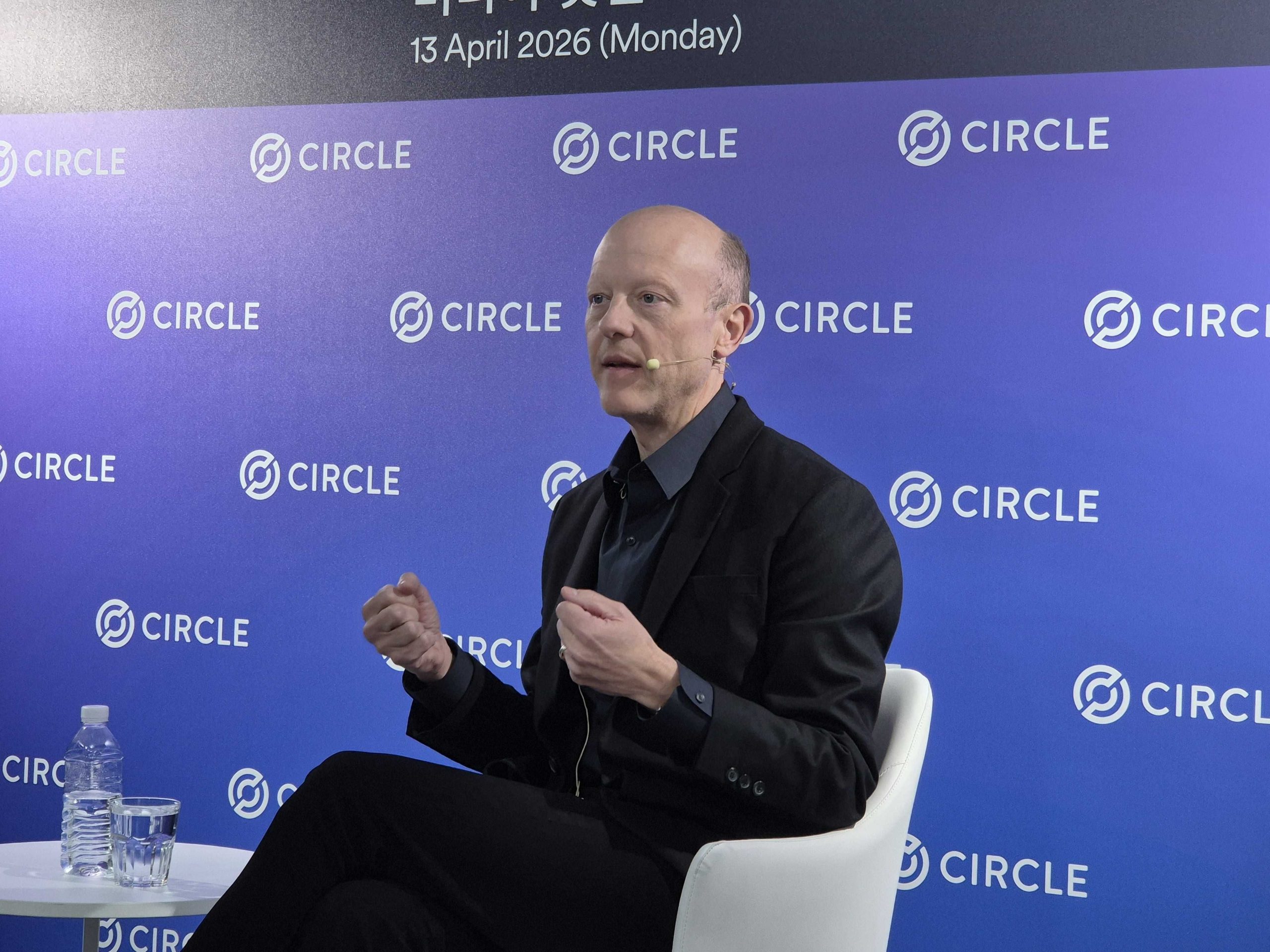
Circle CEO Jeremy Allaire pushed back on concerns that USDC could be used for Iran’s crypto transit tolls at the Strait of Hormuz.
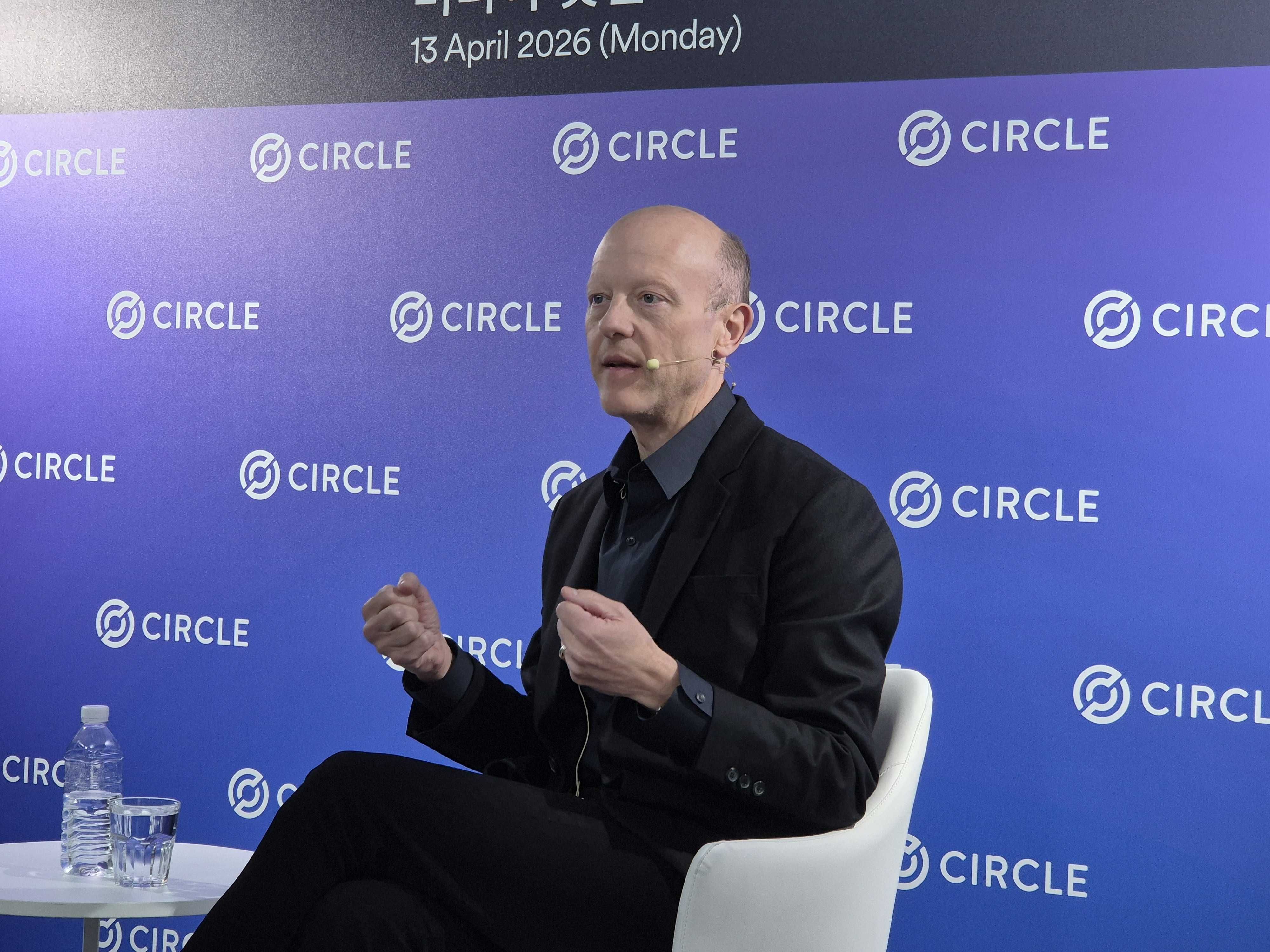
Allaire made the remarks at a press conference in Seoul on the afternoon of April 13, where BeInCrypto East Asia Editor-In-Chief, Oihyun Kim, was present. Allaire is visiting South Korea this week to meet exchanges, banks, and regulators.
Hormuz Tolls: ‘Highly Unlikely’ for USDC
A reporter asked whether Iran’s Revolutionary Guards might accept USDC for Hormuz passage fees. Allaire dismissed the idea.
“Circle operates a highly compliant infrastructure,” he said.
He noted that the company works closely with law enforcement and sanctions authorities.
Allaire pointed to public research from the United Nations and forensic firms. That data shows sanctioned actors tend to favor other stablecoins over USDC. He did not name specific tokens.
“It’s highly unlikely that a regime under sanctions would attempt something where the likelihood of the assets being immediately frozen is extremely high,” he said.
Drift Hack: Circle Defends Freeze Delay
The $285 million Drift Protocol exploit on April 1 drew sharp criticism of Circle. Attackers bridged over $230 million in stolen USDC from Solana to Ethereum over six hours. Circle took no action to freeze the funds during that window.
Allaire said the company follows strict legal obligations. Circle can only freeze wallets at the direction of law enforcement or courts.
“We do not as a company decide what is the right path,” he said. He warned that letting a private firm make those calls creates a “very significant moral quandary.”
He acknowledged the gap in the current framework. Circle is pushing for the CLARITY Act to include “safe harbors” that would let issuers freeze funds preemptively under extreme circumstances.
“We need that to be in the law, not just what we decide on our own,” he said.
Clarity Act: Yield Ban Won’t Hurt Circle
Allaire also addressed the CLARITY Act’s proposed ban on passive stablecoin yield. The bill would bar platforms from paying interest simply for holding stablecoins.
He said the change does not affect Circle directly. The GENIUS Act already forbids stablecoin issuers from paying interest to holders.
The real impact falls on distributors like exchanges and wallets. They can still offer activity-based rewards, but cannot market stablecoin holdings as bank deposit substitutes.
Allaire called the yield debate “overblown.” He noted that the vast majority of stablecoin holders worldwide receive no rewards at all. About half of the $120 trillion global M2 money supply sits in physical cash or non-interest-bearing accounts.
Korea Visit: Exchanges, Banks, and Regulation
Allaire spent several days in Seoul meeting major exchanges, financial groups, and regulators. Upbit operator Dunamu and Bithumb both signed MOUs with Circle on the same day. He also met executives from Shinhan, Hana, and KB Financial.
He said Circle does not plan to issue a Korean won stablecoin itself.
Korean law will likely require domestic bank-led consortiums for that role. Circle would instead offer its technology stack to local issuers.
The post Circle CEO Says Crypto Tolls at Hormuz Strait Unlikely To Use USDC appeared first on BeInCrypto.
Crypto World
Ministers and Members of Parliament at Paris Blockchain Week 2026: A Historic Signal for the Institutionalization of Crypto-Assets


For the first time, Paris Blockchain Week will simultaneously welcome ministers, an ambassador, and nearly twenty Members of Parliament, an unprecedented show of political mobilization for an event dedicated to crypto-assets and blockchain in Europe.
Paris Blockchain Week 2026 will be held on April 15 and 16 at the Carrousel du Louvre, at a time when digital assets, artificial intelligence, and digital infrastructure have become strategic issues for Europe’s competitiveness, sovereignty, and financial future. This political mobilization marks a turning point: crypto-assets are no longer a niche subject, but a leading institutional priority.
France has established itself as one of the most advanced G7 jurisdictions in the field of digital assets. Building on the PACTE law, the PSAN framework, and the entry into force of MiCA, it has made Paris a major hub for international institutions. This momentum is part of a broader ambition: to make France a regulatory and institutional reference point in Europe.
This edition will welcome participants from over 100 countries, including senior executives from BNP Paribas, Crédit Agricole, Banque de France, HSBC, JPMorgan Chase, Goldman Sachs, Morgan Stanley, and hundreds of other leading institutions. The week will open with the VIP Dinner at the Palace of Versailles, bringing together 500 leaders from finance, technology, and institutions.
In this context, this unprecedented political presence sends a strong signal to markets, policymakers, and investors: France intends to remain at the forefront of the debates shaping digital finance, innovation, and European strategic autonomy.
Program Highlights
Tuesday, April 14 — VIP Dinner, Palace of Versailles.
Jean-Didier Berger, Minister Delegate to the Minister of the Interior, will deliver the opening address.
Wednesday, April 15 — Carrousel du Louvre.
09:15 – 09:35 — Anne Le Hénanff, Minister Delegate for Artificial Intelligence and Digital Affairs, will open proceedings on the Master Stage with a fireside chat with Michael Amar, Chairman of Paris Blockchain Week.
09:35 – 09:45 — Press Q&A session with Anne Le Hénanff in the Media Room.
Thursday, April 16 — Carrousel du Louvre.
09:00 – 09:20 — Clara Chappaz, Ambassador for Digital and Artificial Intelligence, will take the Master Stage for a fireside chat with Henri Delahaye. 09:20 – 09:35 — Laurent Nuñez, Minister of the Interior, will take the Master Stage for a fireside chat with Michael Amar.
09:45 – 10:00 — Press Q&A session with Laurent Nuñez in the Media Room.
Parliamentary Representation
Paris Blockchain Week will also welcome Michel Barnier, former Prime Minister, along with around twenty Members of the National Assembly: Liliana Tanguy (MP for Finistère), Alexandre Allegret-Pilot (MP for Gard), Hanane Mansouri (MP for Isère), Sabrina Sebaihi (MP for Hauts-de-Seine), Constance Le Grip (MP for Hauts-de-Seine), Marc Ferracci (MP for French citizens abroad), Bastien Marchive (MP for Deux-Sèvres), Charles Rodwell (MP for Yvelines), Anne-Sophie Ronceret (MP for Somme), Julien Dive (MP for Aisne), Corentin Le Fur (MP for Côtes-d’Armor), Félicie Gérard (MP for Nord), Philippe Latombe (MP for Vendée), Belkhir Belhaddad (MP for Moselle), Annaïg Le Meur (MP for Finistère), and Natalia Pouzyreff (MP for Yvelines). Their presence embodies France’s political commitment to the digital asset ecosystem and innovation.
About Paris Blockchain Week
Paris Blockchain Week is Europe’s leading institutional conference dedicated to blockchain technology and digital assets. Held annually in Paris, it brings together policymakers, institutional investors, entrepreneurs, and executives to shape the future of the digital economy.
The post Ministers and Members of Parliament at Paris Blockchain Week 2026: A Historic Signal for the Institutionalization of Crypto-Assets appeared first on BeInCrypto.
Crypto World
Top 7 quantum AI stock trading bot free tools for beginners in 2026 to earn passive income


Disclosure: This article does not represent investment advice. The content and materials featured on this page are for educational purposes only.
AI stock trading bots attract beginners seeking faster, automated entry into modern financial markets.
Summary
- AI stock trading bots rise in 2026 as beginners seek fast, automated entry into modern financial markets
- MoneyFlare offers fully automated trading with zero learning curve, targeting passive income seekers
- Demand grows for data-driven trading tools as investors shift from manual strategies to AI automation
In 2026, more beginners are searching for quantum AI stock trading bot free tools as a way to enter the market without spending years learning trading strategies. The reality is simple: modern financial markets move too fast for manual trading to keep up. Data flows continuously, prices shift in milliseconds, and opportunities can disappear instantly.
This is where AI-powered trading bots change the game. By combining quantitative trading models with automation, these tools allow users to participate in the stock market with far less effort. Instead of watching charts all day, traders can rely on systems that analyze data, execute trades, and manage risk automatically.
For beginners, the appeal is clear — a more structured, data-driven way to pursue passive income.
What is quantitative trading and why it matters
Quantitative trading, often called quant trading, is a method of using mathematical models and algorithms to make trading decisions. Instead of relying on intuition or news headlines, it focuses on patterns hidden inside data.
In practical terms, this means:
- Strategies are based on historical probabilities
- Trades are executed automatically when conditions are met
- Risk is controlled through predefined rules
With the integration of AI in 2026, quant trading has become more adaptive. Systems can now adjust to market conditions in real time, learning from new data instead of following rigid rules.
The biggest advantage is consistency. While human traders may hesitate or react emotionally, AI systems execute strategies exactly as designed. Over time, this can lead to more disciplined trading behavior.
How AI quant trading works in real markets
AI quant trading is no longer experimental — it’s already widely used across the financial industry.
In real-world applications, these systems are used to:
- Identify short-term trading opportunities
- Detect trends across large datasets
- Execute trades faster than human traders
- Apply risk controls automatically
For individual users, this translates into a simpler experience. There is no need to analyze every stock or monitor the market constantly. The system does the heavy lifting.
However, it’s important to stay realistic. While AI can improve efficiency and reduce manual effort, market risks still exist, and outcomes can vary depending on conditions.
The 7 best quantum AI stock trading bot free tools in 2026 (beginner-friendly breakdown)
1. MoneyFlare — The Easiest Way to Start Fully Automated AI Trading
MoneyFlare is built for one type of user: people who want results without complexity. There’s no need to configure strategies, connect APIs, or understand market mechanics in depth. Once activated, the system handles analysis, execution, and risk management automatically in the background.
For beginners, this creates a truly frictionless experience. Users do not react to the market — the system is already doing it on their behalf, consistently and without emotion.
What makes it stand out:
Fully automated, zero learning curve, one-click activation
Best use case:
Passive income seekers who want a hands-off experience
Limitation:
Limited customization for advanced users
Beginner-Friendliness Score: ⭐⭐⭐⭐⭐ (5/5)
Click to register and receive a free $10 real reward and $50 trial credit!
2. Kavout — AI stock ranking with clear guidance
Kavout is ideal for those who are not ready to fully rely on automation but still want AI support. Instead of trading for a user’s behalf, it analyzes massive datasets and ranks stocks based on performance potential.
This means they don’t need to research hundreds of stocks — the AI narrows it down for them. Traders still make the final decision, but with significantly better information.
What makes it stand out:
AI-powered stock scoring system simplifies decision-making
Best use case:
Beginners who want guidance while staying in control
Limitation:
No automated trade execution
Beginner-Friendliness Score: ⭐⭐⭐⭐☆ (4/5)
3. Trade Ideas — Real-time AI market scanner
Trade Ideas are designed for speed. Its AI continuously scans the market and surfaces high-probability opportunities in real time.
Instead of guessing what to trade, traders receive ready-made ideas backed by data. However, traders still need to execute trades themselves, which adds a layer of involvement.
What makes it stand out:
Real-time AI signals and opportunity detection
Best use case:
Active traders who want AI-assisted decisions
Limitation:
Requires manual execution
Beginner-Friendliness Score: ⭐⭐⭐⭐☆ (4/5)
4. TrendSpider — Automated technical analysis
TrendSpider removes one of the biggest barriers in trading: chart analysis. It automatically detects patterns, trendlines, and key levels, then allows users to build strategies based on that data.
This makes technical trading more consistent and less time-consuming, especially for users who struggle with manual charting.
What makes it stand out:
AI-driven charting and pattern recognition
Best use case:
Users who prefer structured, data-driven strategies
Limitation:
Still requires some learning and setup
Beginner-Friendliness Score: ⭐⭐⭐☆☆ (3/5)
5. Composer — No-code strategy builder
Composer is perfect for users who want to create their own strategies without writing code. Through a visual interface, traders can design how their portfolio behaves and let the system execute it automatically.
It offers flexibility, but also requires more thinking upfront compared to plug-and-play platforms.
What makes it stand out:
Visual strategy creation with automation
Best use case:
Users who want customization without coding
Limitation:
Requires strategy design knowledge
Beginner-Friendliness Score: ⭐⭐⭐☆☆ (3/5)
6. Capitalise.ai — Plain-English trading automation
Capitalise.ai simplifies automation by letting traders write strategies in plain English. They describe what they want, and the system turns it into executable logic.
This lowers the barrier significantly, especially for non-technical users. However, it still relies on predefined rules rather than adaptive AI.
What makes it stand out:
No-code automation using natural language
Best use case:
Beginners who want simple rule-based automation
Limitation:
Less adaptive compared to AI-driven systems
Beginner-Friendliness Score: ⭐⭐⭐⭐☆ (4/5)
7. Tickeron — AI insights with probability scoring
Tickeron focuses on helping users understand the market through AI-generated insights. It assigns probability scores to different trade scenarios, making risk evaluation clearer.
It doesn’t automate trading, but it improves decision quality — especially for users who want to stay involved.
What makes it stand out:
AI probability models and pattern recognition
Best use case:
Users who want AI insights but manual control
Limitation:
No automation for passive income
Beginner-Friendliness Score: ⭐⭐⭐☆☆ (3/5)
How beginners can start without overcomplicating it
Getting started with an AI trading bot in 2026 is much simpler than most people expect.
In most cases, the process involves choosing a platform, creating an account, selecting a strategy or system, and activating it. After that, the AI takes over key tasks such as analyzing data and executing trades.
For beginners, the most important step is not to overcomplicate things. Starting with a simple setup and gradually understanding how the system behaves is often more effective than trying to master everything at once.
Why AI trading bot continues to grow
The rapid growth of AI trading is driven by a clear shift in the market. Data is becoming more important, trading speed is increasing, and manual strategies are becoming less effective.
At the same time, more users are looking for ways to generate income without constant effort. AI trading meets this demand by offering automation, efficiency, and accessibility.
With mobile-friendly platforms and simplified interfaces, it’s now possible to manage trading activities anytime, from anywhere.
A realistic view on risks
Despite its advantages, AI trading is not risk-free.
Markets remain unpredictable, and even advanced algorithms can struggle during extreme volatility. Relying entirely on automation without understanding the basics can also lead to poor decisions.
A more balanced approach is to start with smaller amounts, diversify strategies, and monitor performance over time. AI should be seen as a tool that improves efficiency—not a guarantee of profits.
Conclusion
Quantum AI stock trading bots are transforming how beginners approach investing in 2026. By combining quantitative trading with intelligent automation, these tools reduce complexity and make the market more accessible.
Platforms like MoneyFlare stand out for their fully automated, beginner-friendly design, while others like Kavout and Composer offer more control and flexibility.
Ultimately, the value of these tools lies in their ability to simplify trading while maintaining a structured, data-driven approach. With the right expectations and risk management, they can become a practical way to explore passive income opportunities in modern financial markets.
Disclosure: This content is provided by a third party. Neither crypto.news nor the author of this article endorses any product mentioned on this page. Users should conduct their own research before taking any action related to the company.
Stock market investors may be overlooking one interesting metric at Strategy (MSTR), the largest publicly traded holder of bitcoin : the capital market measure known as amplification.
Amplification compares the size of the Michael Saylor-led company’s total debt and debt-like instruments, such as preferred stock, to its stash of 766,970 BTC. As amplification rises, like leverage, it adds more risk to the company, making the common stock more sensitive to bitcoin price movements.
Investors have tended to focus on the price of bitcoin and the multiple to net asset value (mNAV) premium when evaluating the company. But if amplification, currently about 33%, increases, it may become the dominant driver of risk.
At the top of Strategy’s capital structure is convertible debt, about $8.25 billion outstanding, the most senior claim. Below that are a number of preferred stocks, including STRC, STRK, STRD and STRF, with roughly $10.3 billion in notional value, according to the MSTR dashboard. At the bottom sits common equity, MSTR, which absorbs all residual upside and downside.
Read more: Strategy signals another bitcoin buy as company needs just 2% annual BTC growth to cover dividends
STRC has been designed to become the primary vehicle for bitcoin accumulation for the company. Senior to equity and junior to debt, STRC pays an 11.5% annual dividend, distributed monthly in cash.
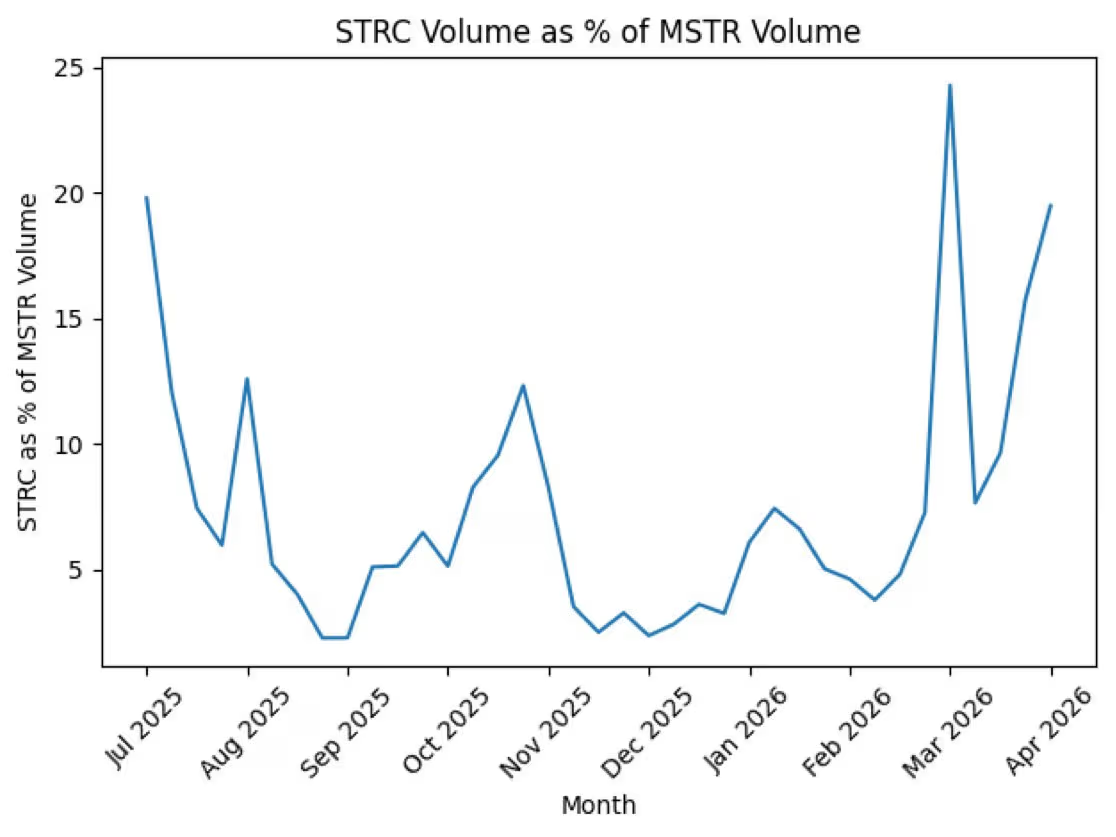
The volume of STRC, once negligible and in the low single digits relative to MSTR, has surged to around 20% on a weekly basis occasionally spiking above 25%. According to the MSTR dashboard, on Friday, MSTR traded $1.7 billion, well below its $2.5 billion 30-day average, while STRC traded $526 million, roughly double its $259 million average, almost 50% of MSTR’s volume in one day.

Higher STRC activity makes it harder to manage amplification without relying on common stock equity issuance, which can weigh on performance versus bitcoin. Over the past 30 days, the bitcoin price is relatively unchanged, while MSTR has fallen 11%.
At lower amplification, MSTR behaves like leveraged BTC. At higher levels, it becomes harder to manage, on top of roughly $1.12 billion in annual obligations.
Institutional conviction in Solana is building from an unexpected direction and bumping its price prediction. Japanese gaming company WIZE, formerly Mobcast Holdings, has disclosed cumulative SOL purchases reaching approximately $3.13 million.
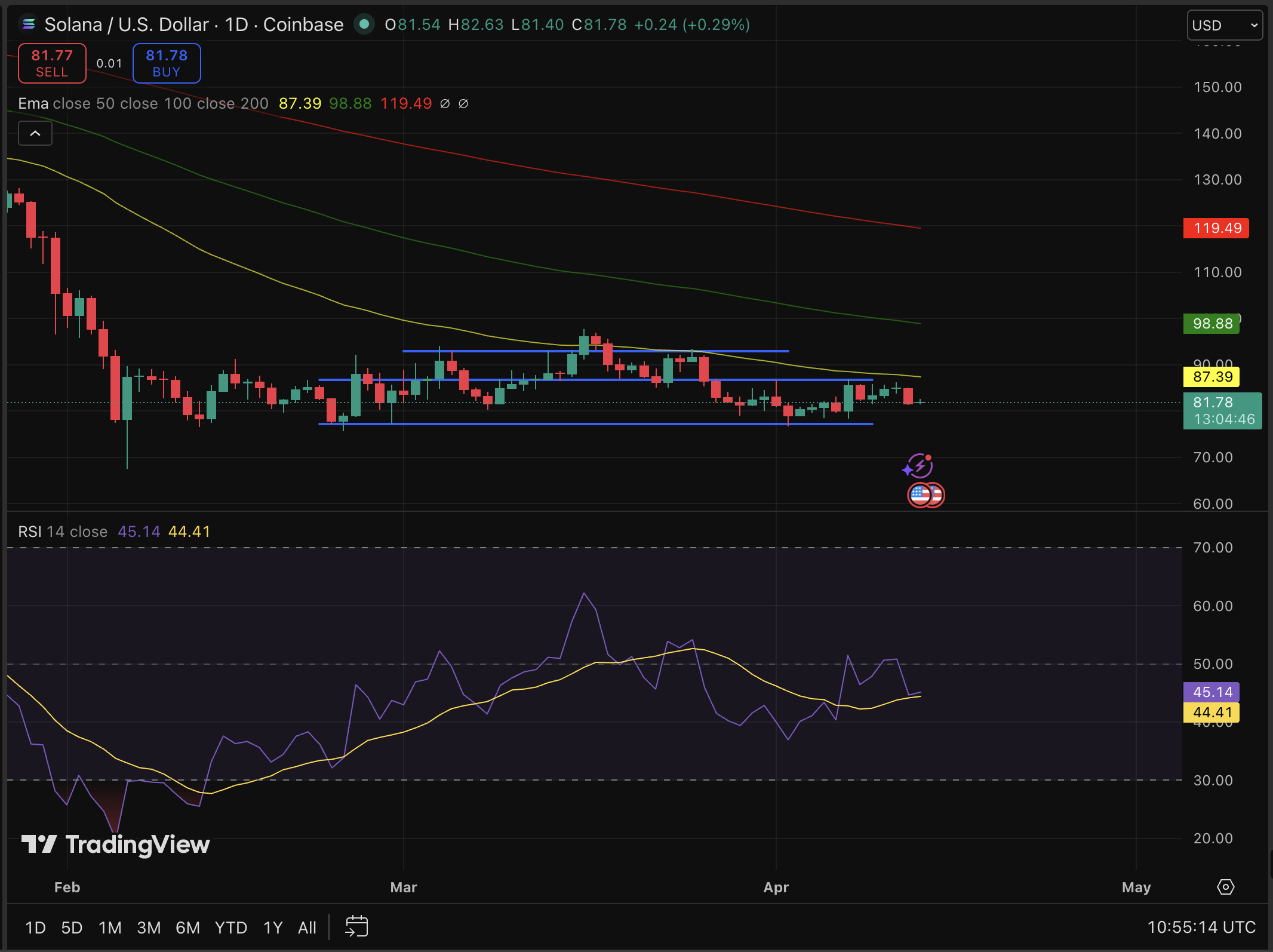
This is a move that adds a fresh corporate buyer narrative to an asset already trading under significant technical scrutiny. SOL currently hovers in the $85 range, well off its all-time high near $300.
Don’t mind the Japanese announcement. It translated that WIZE now holds over 24,597 SOL at an average purchase price of roughly $127 per token, ranking the firm 15th globally on CoinGecko’s Solana Treasury Holdings list.
The company’s WIZE Validator Node has formally joined the Solana Foundation’s SFDP program and collected delegations from projects, including DoubleZero, generating more than 400 SOL in staking rewards over the past six months alone. Including external delegations, total treasury exposure reaches approximately 152,000 SOL. WIZE has publicly stated its intention to crack the global top 10.
The announcement lands as Japan accelerates its reclassification of crypto assets, creating a regulatory backdrop that makes corporate SOL accumulation easier to justify on balance sheets.
Discover: The best pre-launch token sales
Solana Price Prediction: Break Above $250 Resistance Driven by Corporate Accumulation?
SOL’s technical structure tells a complicated story. The 14-day RSI sits at a neutral 44, suggesting neither overbought momentum nor capitulation. The 50-day SMA of $86.58 and 200-day SMA of $125.59 both sit well above the current price, yet the asset has failed to convincingly reclaim territory.
Key support is established at $75-$77, where buyer activity has historically clustered. A breakdown below that level would constitute a structural warning. Some analysts have flagged the risk of a 52% drawdown if consolidation resolves to the downside.
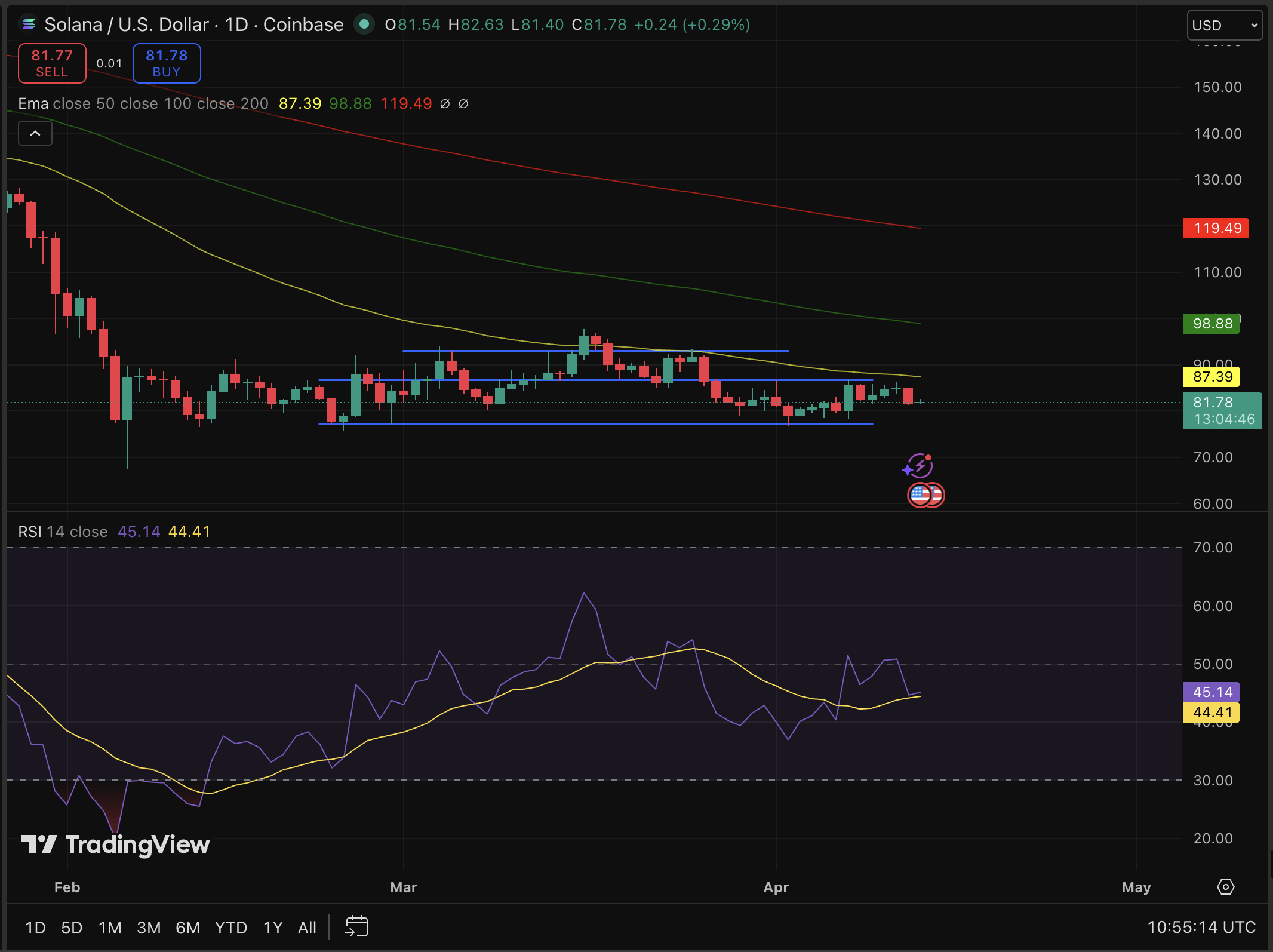
WIZE’s average entry at $127 provides an interesting benchmark; the company is currently in a loss, and its stated ambition to reach the global top 10 implies continued buying pressure at or above current levels.
Discover: The best crypto to diversify your portfolio with
LiquidChain Targets Early Mover Upside as Solana Tests Key Levels
Investors who bought SOL at the January 2025 ATH are still nursing losses, and the $300(ATH) ceiling means meaningful upside from here requires a fresh narrative catalyst, not just corporate accumulation at the margin.
That gap between current price and prior highs is exactly where early-stage infrastructure plays become interesting. LiquidChain ($LIQUID) is a Layer 3 infrastructure project positioning itself as the cross-chain liquidity layer by fusing Bitcoin, Ethereum, and Solana liquidity into a single execution environment.
A new layer emerges. Only a few see it first. — LiquidChain (@getliquidchain) March 24, 2026
The future is LiquidChain  ⟁https://t.co/vqvBcdSj94 pic.twitter.com/R7ZeZ0NPGl
The architecture is built around a Unified Liquidity Layer, Single-Step Execution, and a Deploy-Once model that lets developers access all three ecosystems without redeployment overhead.
The presale is currently priced at $LIQUID at $0.01449, with $650K raised to date. The project contract is audited by Certik, a benchmark in crypto audit, to make sure its safety. It also offers 1600% staking APY for early buyers, and the bombastic number is likely to drop soon.
Research LiquidChain before the next price increase.
The post Solana Price Prediction: Wize, A Japanese Gaming Company Bought More SOL appeared first on Cryptonews.

Key Takeaways
- The energy company announced an oil find at the Bandit location in the Gulf of Mexico’s Green Canyon Block 680, with Occidental Petroleum serving as operator.
- Mizuho Securities increased its price objective on CVX to $225 from the previous $217, maintaining its Outperform designation while highlighting robust free cash flow catalysts through year-end 2026.
- First quarter 2026 results fell approximately 60% short of analyst projections, primarily due to timing impacts related to fluctuating commodity valuations amid Middle Eastern geopolitical tensions.
- Multiple Wall Street firms adjusted their targets higher, with Bernstein moving to $216 and Barclays increasing to $180, both keeping favorable ratings.
- CNBC’s Jim Cramer reinforced his positive view on the stock, emphasizing CEO Michael Wirth’s worldwide operational footprint as a compelling reason to maintain positions.
Shares of Chevron (CVX) are currently trading at $187.37, marking a 47% appreciation over the trailing twelve months, as recent operational developments and favorable analyst commentary sustain investor attention on the energy major.
The corporation announced a successful exploration outcome at the Bandit site, positioned approximately 125 miles offshore from Louisiana’s coastline. The drilling operation, managed by Occidental Petroleum, encountered hydrocarbon-bearing Miocene sand formations within Green Canyon Block 680.
Chevron maintains a 37.125% ownership stake in the project. Occidental commands the majority position at 45.375%, while Woodside Energy accounts for the balance at 17.5%.
According to Kevin McLachlan, who serves as Chevron’s Vice President of Exploration, the discovery “reinforces the high-quality opportunities in the prolific deepwater Gulf of America.” The partnership is currently evaluating the findings to determine future development strategies.
The Bandit location presents possibilities for subsea connections to an existing Occidental-managed platform nearby, which would potentially reduce capital expenditure requirements should the joint venture participants elect to proceed with development.
Wall Street Raises Estimates
Investment firm Mizuho elevated its valuation target to $225 from $217 this Thursday, retaining its Outperform recommendation. The research team acknowledged that first quarter 2026 financial results registered approximately 60% beneath consensus projections due to commodity pricing timing discrepancies — while emphasizing that fundamental cash generation drivers for the remainder of 2026 remain intact.
Mizuho highlighted that Chevron carries reduced upstream asset concentration in Middle Eastern regions compared to competitors such as Exxon, while maintaining stronger positioning in Pacific Rim refining operations. The firm additionally observed that CP Chem segment performance could benefit from disruptions affecting Middle Eastern petrochemical markets.
Previously, Bernstein adjusted its objective to $216 from $194, preserving an Outperform stance as component of a comprehensive crude price modeling revision. Barclays similarly elevated its target to $180 from $172, sustaining its Overweight designation based on revised oil forecasts and sector-wide cash flow momentum.
UBS retained its Buy recommendation with a $212 objective, referencing constraints in worldwide LNG availability following operational interruptions at QatarEnergy’s Ras Laffan facility.
First Quarter Outlook and Operational Updates
The company’s initial Q1 2026 projections indicated timing-related factors that could reduce profitability and cash generation by $2.7 billion to $3.7 billion on an after-tax basis. These impacts are anticipated to concentrate within the Downstream division and reverse in subsequent reporting periods.
Regarding operations, critical facilities including TCO and Israel LNG that experienced downtime during Q1 have resumed normal production levels. Mizuho indicated that lingering challenges at the Wheatstone LNG facility in Australia should reach resolution within coming weeks.
On the executive front, Daniel Woodall is scheduled to assume the role of Chief Health, Safety, and Environment Officer beginning May 1, 2026. John Hess has additionally joined the board of directors subsequent to Chevron’s acquisition of Hess Corporation, though he fails to satisfy NYSE independence criteria given transaction-related connections.
Jim Cramer, a longstanding supporter of the equity, restated his position this week: “Chevron is the one, because Michael Wirth is indeed leveraged all over the world.”
The company has increased its quarterly dividend payment for 38 straight years and presently offers a 3.74% yield.
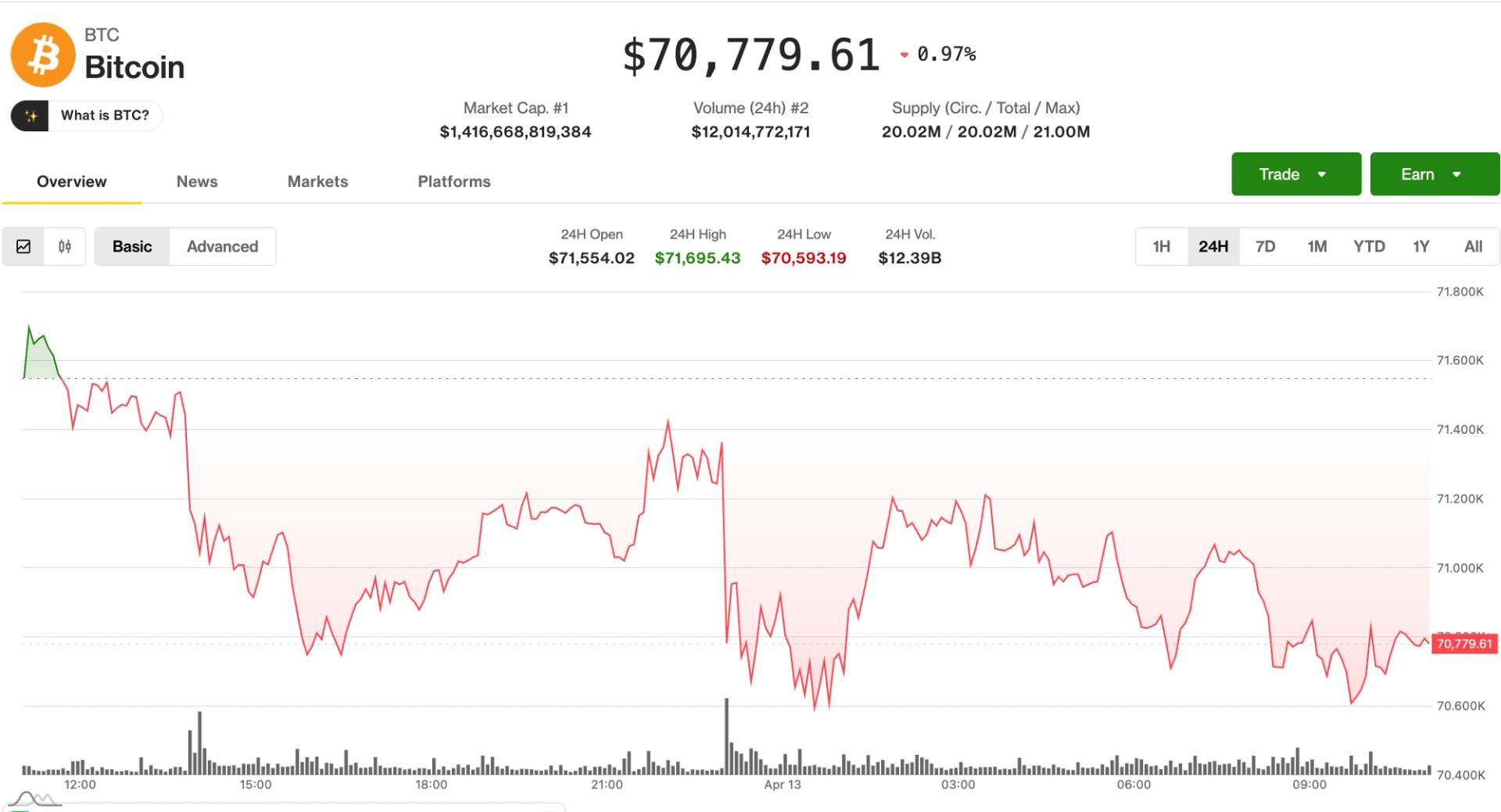
Bitcoin failed once more to break out of its monthslong trading range over the weekend, selling off below the key resistance level at $74,000 to trade recently at $70,600.
Ether (ETH) and the altcoin market followed suit, as ETH tumbled from April 11 high of $2,320 to $2,190. It remains little changed since midnight UTC.
The selloff came as Brent crude oil jumped back above $100 per barrel after U.S. President Donald Trump ordered a blockade at the Strait of Hormuz. The conflict with Iran has been a direct driver of risk asset price action over the past month, with U.S. equities and crypto being inversely correlated to oil and the U.S. dollar.
For now, bitcoin and the broader crypto market remain in a trading range that has persisted since early February, failing to break above $75,000 to the upside while holding firm above $63,000 to the downside.
Derivatives positioning
- Futures tied to most major tokens, including bitcoin and ether, have declined slightly over the past 24 hours. The move indicates traders are scaling back risk after President Trump ordered a blockade of the Strait of Hormuz, triggering a surge in oil prices.
- While oil prices have surged 5%, open interest (OI) in Binance’s crude futures declined by more than 1%. Activity on the decentralized platform Hyperliquid picked up over the weekend, with combined OI in Brent and WTI futures topping $1 billion.
- Futures tied to saw strong capital inflows, with open interest jumping to the most since Feb. 26. This is not necessarily bullish, as both perpetual funding rates and the 24-hour cumulative volume delta remain negative, suggesting that the inflows are being driven largely by traders chasing downside positioning or actively building short exposure rather than accumulating long positions.
- Except for HYPE, LINK, AVAX, TRX and ZEC, all top 25 coins have seen negative CVD, indicating that sell-side aggression is offsetting buy-side aggression across the market.
- A negative CVD indicates that more participants are selling by actively hitting bids than buying by lifting asks.
- Bitcoin and ether’s options-based implied volatility metrics remain low across most time frames, suggesting the market is pricing in calmer, slower price movements. The volatility curve is also fairly flat, showing no strong expectation of sudden future spikes.
- Still, downside concerns persist. BTC puts are currently trading at a 5-point or more premium across all time frames, indicating stronger demand for downside protection. ETH puts are also elevated, though to a noticeably lesser degree than BTC.
- Block flows featured call calendar spreads and straddles, with these two strategies accounting for over 50% of total activity over the past 24 hours, indicating investor preference for time decay and volatility over a clear directional bias.
Token talk
- The CoinDesk Memecoin Index (CDMEME) and the DeFi Select Index (DFX) were both in the black on Monday alongside the altcoin-dominant CoinDesk 100 (CD100), while the bitcoin and indexes dominated by the biggest tokens lost ground following oil’s price increase to above $100 per barrel.
- DeFi token AAVE was one of the top performers, rising around 5%, followed by HYPE and JUP, which added about 2%.
- But it was the memecoins that dominated Monday’s gains: BROCCOLI, BAN and 币安人生 posted gains in excess of 10%, demonstrating investor appetite for highly speculative tokens in what is otherwise a very flat market.
- CoinMarketCap’s “Altcoin Season” indicator is at 36/100, higher than February’s sub-20 low, but beneath the 50/100 it hit last month.


Third-party AI routing services are exposing users to significant security flaws that could result in the theft of cryptocurrency and cloud credentials.
Summary
- Researchers found that 26 third-party LLM routers are actively injecting malicious code and stealing credentials by exploiting their access to plaintext data.
- The study revealed that intermediaries can intercept private keys and cloud credentials because they terminate secure encryption to aggregate AI requests.
According to a paper published on Thursday by University of California researchers, the supply chain for Large Language Models (LLM) contains several vulnerabilities that allow for malicious code injection and credential extraction.
These intermediaries, which developers use to manage access to providers like Google or OpenAI, essentially act as a “middleman” that terminates secure encryption.
Because they have full plaintext access to every message sent through them, sensitive data like seed phrases or private keys can be intercepted by unverified infrastructure.
The researchers tested 400 free and 28 paid routers to measure the extent of these risks. Nine of these services actively injected malicious code, while 17 separate routers were caught accessing Amazon Web Services credentials owned by the team.
During the experiment, one router successfully drained Ether from a decoy wallet after the researchers provided a prefunded private key.
Although the team kept the balances low to ensure the total loss remained under $50, the result confirmed how easily a compromised intermediary can siphon funds.
“26 LLM routers are secretly injecting malicious tool calls and stealing creds,” co-author Chaofan Shou stated on X.
Identifying a malicious router is a difficult task for the average user. The researchers noted that because these services must read data to forward it, there is no visible difference between legitimate handling and active theft.
The danger increases when developers enable “YOLO mode,” a setting in many AI frameworks that lets an agent execute commands automatically without a human confirming the action.
This allows an attacker to send instructions that the user’s system will run instantly, often without the operator’s knowledge.
“The boundary between ‘credential handling’ and ‘credential theft’ is invisible to the client because routers already read secrets in plaintext as part of normal forwarding,” the study explained.
Previously reliable routers can become dangerous if they reuse leaked credentials through weak relays. To prevent these attacks, the research team suggested that developers should never allow private keys or sensitive phrases to pass through an AI agent session.
A permanent solution would require AI companies to use cryptographic signatures. Such a system would allow an agent to mathematically prove that instructions came from the actual model rather than a tampered third-party source.
“LLM API routers sit on a critical trust boundary that the ecosystem currently treats as transparent transport,” the paper concluded.
Micron (MU) Stock Could Soar 40% Higher, According to Wall Street Analyst

This Near-Perfect 5-Part Sci-Fi Favorite Once Opened to 5.9M Viewers on Cable

Inspire Festival marks a new chapter in COVID-conscious arts

Why Israel is blocking foreign journalists from entering

Bitcoin: We’re Entering The Most Dangerous Phase

Alan Cumming Brands Baftas Ceremony A ‘Triggering S**tshow’

Ormuz, Crypto & Guerre #blockchain #cryptomonnaie

Financial support sa pagitan ng ASEAN members, tiniyak sa gitna ng tensyon sa Middle East

Cryptocurrency and Bitcoin Trading in Nepal | Is Bitcoin legal | Should You Trade?
-

 Politics3 days ago
US brings back mandatory military draft registration
-

 Fashion3 days ago
Weekend Open Thread: Veronica Beard
-
 Sports3 days ago
Man United discover Nico Schlotterbeck transfer fee as defender reaches Dortmund agreement
-

 Tech6 days ago
How Long Can You Drive With Expired Registration? What Florida Law Says
-

 Politics21 hours ago
World Cup exit makes Italy enter crisis mode
-

 Crypto World4 days ago
Canary Capital Files SEC Registration for PEPE ETF
-

 Business3 days ago
Tesla Model Y Tops China Auto Sales in March 2026 With 39,827 Registrations, Beating Cheaper EVs and Gas Cars
-

 Politics3 days ago
Malcolm In The Middle OG Turned Down ‘Buckets Of Money’ To Appear In Reboot
-

 Fashion6 days ago
Let’s Discuss: DEI in 2026
-

 Crypto World5 days ago
Bitcoin recovers as US and Iran Agree a Ceasefire Deal
-
 NewsBeat13 hours ago
Pep Guardiola and Gary Neville agree over Arsenal title problem that benefits Man City
-

 Business3 days ago
OpenAI Halts Stargate UK Data Centre Project Over Energy Costs and Copyright Row
-

 Business2 days ago
Ireland Fuel Protests Enter Day 5 as Blockades Spark Shortages and Government Prepares Support Package
-

 Politics3 days ago
LBC Presenter Mocks Trump Over Iran War Failures
-

 Crypto World3 days ago
Federal judge blocks Arizona from bringing criminal charges against Kalshi
-

 Tech4 days ago
A version of Windows 10 released a decade ago is now eligible for additional security patches
-
 NewsBeat1 day ago
JD Vance announces ‘no agreement’ with Iran over nuclear weapons fear
-

 Business3 days ago
IMF retains floor for precautionary balances at SDR 20 billion
-
Business2 days ago
Coreweave CSO Venturo sells $5.5m in class a common stock
-
Sports2 days ago
1st-Round WR Enters Vikings Mock Draft Orbit
You must be logged in to post a comment Login