
Crypto World
Top 7 quantum AI stock trading bot free tools for beginners in 2026 to earn passive income



Disclosure: This article does not represent investment advice. The content and materials featured on this page are for educational purposes only.
AI stock trading bots attract beginners seeking faster, automated entry into modern financial markets.
Summary
- AI stock trading bots rise in 2026 as beginners seek fast, automated entry into modern financial markets
- MoneyFlare offers fully automated trading with zero learning curve, targeting passive income seekers
- Demand grows for data-driven trading tools as investors shift from manual strategies to AI automation
In 2026, more beginners are searching for quantum AI stock trading bot free tools as a way to enter the market without spending years learning trading strategies. The reality is simple: modern financial markets move too fast for manual trading to keep up. Data flows continuously, prices shift in milliseconds, and opportunities can disappear instantly.
This is where AI-powered trading bots change the game. By combining quantitative trading models with automation, these tools allow users to participate in the stock market with far less effort. Instead of watching charts all day, traders can rely on systems that analyze data, execute trades, and manage risk automatically.
For beginners, the appeal is clear — a more structured, data-driven way to pursue passive income.
What is quantitative trading and why it matters
Quantitative trading, often called quant trading, is a method of using mathematical models and algorithms to make trading decisions. Instead of relying on intuition or news headlines, it focuses on patterns hidden inside data.
In practical terms, this means:
- Strategies are based on historical probabilities
- Trades are executed automatically when conditions are met
- Risk is controlled through predefined rules
With the integration of AI in 2026, quant trading has become more adaptive. Systems can now adjust to market conditions in real time, learning from new data instead of following rigid rules.
The biggest advantage is consistency. While human traders may hesitate or react emotionally, AI systems execute strategies exactly as designed. Over time, this can lead to more disciplined trading behavior.
How AI quant trading works in real markets
AI quant trading is no longer experimental — it’s already widely used across the financial industry.
In real-world applications, these systems are used to:
- Identify short-term trading opportunities
- Detect trends across large datasets
- Execute trades faster than human traders
- Apply risk controls automatically
For individual users, this translates into a simpler experience. There is no need to analyze every stock or monitor the market constantly. The system does the heavy lifting.
However, it’s important to stay realistic. While AI can improve efficiency and reduce manual effort, market risks still exist, and outcomes can vary depending on conditions.
The 7 best quantum AI stock trading bot free tools in 2026 (beginner-friendly breakdown)
1. MoneyFlare — The Easiest Way to Start Fully Automated AI Trading
MoneyFlare is built for one type of user: people who want results without complexity. There’s no need to configure strategies, connect APIs, or understand market mechanics in depth. Once activated, the system handles analysis, execution, and risk management automatically in the background.
For beginners, this creates a truly frictionless experience. Users do not react to the market — the system is already doing it on their behalf, consistently and without emotion.
What makes it stand out:
Fully automated, zero learning curve, one-click activation
Best use case:
Passive income seekers who want a hands-off experience
Limitation:
Limited customization for advanced users
Beginner-Friendliness Score: ⭐⭐⭐⭐⭐ (5/5)
Click to register and receive a free $10 real reward and $50 trial credit!
2. Kavout — AI stock ranking with clear guidance
Kavout is ideal for those who are not ready to fully rely on automation but still want AI support. Instead of trading for a user’s behalf, it analyzes massive datasets and ranks stocks based on performance potential.
This means they don’t need to research hundreds of stocks — the AI narrows it down for them. Traders still make the final decision, but with significantly better information.
What makes it stand out:
AI-powered stock scoring system simplifies decision-making
Best use case:
Beginners who want guidance while staying in control
Limitation:
No automated trade execution
Beginner-Friendliness Score: ⭐⭐⭐⭐☆ (4/5)
3. Trade Ideas — Real-time AI market scanner
Trade Ideas are designed for speed. Its AI continuously scans the market and surfaces high-probability opportunities in real time.
Instead of guessing what to trade, traders receive ready-made ideas backed by data. However, traders still need to execute trades themselves, which adds a layer of involvement.
What makes it stand out:
Real-time AI signals and opportunity detection
Best use case:
Active traders who want AI-assisted decisions
Limitation:
Requires manual execution
Beginner-Friendliness Score: ⭐⭐⭐⭐☆ (4/5)
4. TrendSpider — Automated technical analysis
TrendSpider removes one of the biggest barriers in trading: chart analysis. It automatically detects patterns, trendlines, and key levels, then allows users to build strategies based on that data.
This makes technical trading more consistent and less time-consuming, especially for users who struggle with manual charting.
What makes it stand out:
AI-driven charting and pattern recognition
Best use case:
Users who prefer structured, data-driven strategies
Limitation:
Still requires some learning and setup
Beginner-Friendliness Score: ⭐⭐⭐☆☆ (3/5)
5. Composer — No-code strategy builder
Composer is perfect for users who want to create their own strategies without writing code. Through a visual interface, traders can design how their portfolio behaves and let the system execute it automatically.
It offers flexibility, but also requires more thinking upfront compared to plug-and-play platforms.
What makes it stand out:
Visual strategy creation with automation
Best use case:
Users who want customization without coding
Limitation:
Requires strategy design knowledge
Beginner-Friendliness Score: ⭐⭐⭐☆☆ (3/5)
6. Capitalise.ai — Plain-English trading automation
Capitalise.ai simplifies automation by letting traders write strategies in plain English. They describe what they want, and the system turns it into executable logic.
This lowers the barrier significantly, especially for non-technical users. However, it still relies on predefined rules rather than adaptive AI.
What makes it stand out:
No-code automation using natural language
Best use case:
Beginners who want simple rule-based automation
Limitation:
Less adaptive compared to AI-driven systems
Beginner-Friendliness Score: ⭐⭐⭐⭐☆ (4/5)
7. Tickeron — AI insights with probability scoring
Tickeron focuses on helping users understand the market through AI-generated insights. It assigns probability scores to different trade scenarios, making risk evaluation clearer.
It doesn’t automate trading, but it improves decision quality — especially for users who want to stay involved.
What makes it stand out:
AI probability models and pattern recognition
Best use case:
Users who want AI insights but manual control
Limitation:
No automation for passive income
Beginner-Friendliness Score: ⭐⭐⭐☆☆ (3/5)
How beginners can start without overcomplicating it
Getting started with an AI trading bot in 2026 is much simpler than most people expect.
In most cases, the process involves choosing a platform, creating an account, selecting a strategy or system, and activating it. After that, the AI takes over key tasks such as analyzing data and executing trades.
For beginners, the most important step is not to overcomplicate things. Starting with a simple setup and gradually understanding how the system behaves is often more effective than trying to master everything at once.
Why AI trading bot continues to grow
The rapid growth of AI trading is driven by a clear shift in the market. Data is becoming more important, trading speed is increasing, and manual strategies are becoming less effective.
At the same time, more users are looking for ways to generate income without constant effort. AI trading meets this demand by offering automation, efficiency, and accessibility.
With mobile-friendly platforms and simplified interfaces, it’s now possible to manage trading activities anytime, from anywhere.
A realistic view on risks
Despite its advantages, AI trading is not risk-free.
Markets remain unpredictable, and even advanced algorithms can struggle during extreme volatility. Relying entirely on automation without understanding the basics can also lead to poor decisions.
A more balanced approach is to start with smaller amounts, diversify strategies, and monitor performance over time. AI should be seen as a tool that improves efficiency—not a guarantee of profits.
Conclusion
Quantum AI stock trading bots are transforming how beginners approach investing in 2026. By combining quantitative trading with intelligent automation, these tools reduce complexity and make the market more accessible.
Platforms like MoneyFlare stand out for their fully automated, beginner-friendly design, while others like Kavout and Composer offer more control and flexibility.
Ultimately, the value of these tools lies in their ability to simplify trading while maintaining a structured, data-driven approach. With the right expectations and risk management, they can become a practical way to explore passive income opportunities in modern financial markets.
Disclosure: This content is provided by a third party. Neither crypto.news nor the author of this article endorses any product mentioned on this page. Users should conduct their own research before taking any action related to the company.


Franklin Templeton’s Chris Perkins argues that the $2.7 trillion crypto market doesn’t need the Clarity Act to survive. Despite months of Senate deadlock on the landmark market structure legislation, the industry has already proven it can grow, attract capital, and build institutional rails without a federal regulatory framework in place.
—
 According to Franklin Templeton's head of Digital Assets Chris Perkins, the crypto industry will be "just fine" if #CLARITY Act doesn't pass
  pic.twitter.com/DakLJVeaRP
 ChartNerd
  (@ChartNerdTA) May 3, 2026
The Clarity Act cleared the House last July, in a 294–134 bipartisan vote, drawing unanimous Republican support and 78 Democrats. Since then, the Senate has stalled on three stubborn issues: stablecoin yield language, DeFi provisions, and securing the full Republican committee bloc needed to advance.
Senate Banking Committee Chairman Tim Scott identified those pressure points on April 14, 2026, calling each resolvable within two weeks, a deadline that has already slipped.
Discover: The best pre-launch token sales
Where the Clarity Act Actually Stands
The path from Senate Banking Committee to presidential signature involves five discrete steps: committee markup and vote, a 60-vote Senate floor threshold, reconciliation with the Agriculture Committee’s Digital Commodity Intermediaries Act, House-Senate conference, and then signature.
Each step is a potential kill zone. Senator Thom Tillis requested additional review time on stablecoin regulation and yield structures in late April, pushing the Banking Committee markup from April into May, the third timeline revision in as many months. Although it looks like it has already been resolved.
— Steffan (@Steffan0xd) May 2, 2026
 BIG BREAKTHROUGH FOR CRYPTO: Senator Thom Tillis is pushing for the Clarity Act to move to markup by mid-May. Major disputes over stablecoin yields are reportedly resolved as the Senate Banking Committee prepares to advance new regulatory frameworks. pic.twitter.com/ZzKicezXLz
Ripple CEO Brad Garlinghouse has now shifted his passage prediction twice: 80% odds by the end of April on February 19, revised to the end of May on April 13, citing what he called “peak frustration” as a signal that compromise was near.
Polymarket pricing puts 2026 enactment at 50-50 or lower. TD Cowen analyst Jaret Seiberg has noted that passage may ultimately require a deal that dissatisfies both the crypto lobby and the banking sector equally, which is a rough definition of a workable compromise.
Senator Cynthia Lummis put it plainly at Bitcoin Conference 2026:
“We are gonna markup the CLARITY Act in May… We are gonna get it to the finish line.”
She also issued the clearest warning about failure: a stall in 2026 likely means no market structure legislation until 2030 or later. Procedural delay?
Discover: The best crypto to diversify your portfolio with
Is Crypto Actually ‘Fine’?
The executive argument isn’t baseless. Institutional adoption has accelerated without a federal framework: BlackRock’s IBIT and Fidelity’s FBTC have collectively pulled billions in net ETF inflows, with spot Bitcoin CVD data confirming aggressive institutional buying even through regulatory uncertainty.
Stablecoins, USDT and USDC combined, now underpin over $100 billion in daily trading volume globally, and the stablecoin market cap has crossed $320 billion without the Clarity Act’s stablecoin regulation provisions ever becoming law.

The ‘fine’ argument is essentially this: US crypto policy ambiguity has not killed the market. Grayscale’s court win against the SEC, the ETF approvals, and offshore liquidity have collectively done what legislation hasn’t. The industry has adapted.
Discover: Best Crypto to Buy Right Now
The post Clarity Act Update: Industry Leader Says Crypto Market Is ‘Fine’ Despite Deadlock appeared first on Cryptonews.

Momentum doesn’t wait, and DOGEBALL is proving exactly why timing matters when it comes to the best crypto presale to buy now. With rapid growth, strong early funding, and a clear real-world use case, DOGEBALL is capturing attention at a stage where entry prices are still incredibly low.
DOGEBALL has already raised over $275K+ with 950+ participants joining in just a few months. Due to this success and overwhelming community demand, the presale has been extended, giving investors a rare second chance to secure tokens at the current low price before it disappears again. Opportunities like this do not stay open for long, especially when momentum is this strong.
The DOGEBALL presale has extended and you can still secure DOGEBALL at $0.0004 but you must act fast before this chance vanishes again. Use code PAY35 today to get 35% extra tokens and lock in your position before the price moves up.
Why DOGEBALL Is The Best Crypto Presale To Buy Now With Real Utility And Growing Demand
DOGEBALL stands out as the best crypto presale to buy now because it is built on a custom Ethereum Layer 2 blockchain called DOGECHAIN, designed for speed, scalability, and real-world usage. It enables users to send crypto while receivers get fiat directly into their bank accounts globally, removing friction from international transactions.
This system eliminates intermediaries, avoids FX fees, and supports 30+ currencies with near-instant transfers. It offers a direct solution to costly and slow remittance systems, making DOGEBALL not only efficient but also highly practical for everyday financial use.
How DOGEBALL Combines Payments And Gaming To Create Strong Investor Value
DOGEBALL is designed to drive consistent demand through its dual ecosystem of payments and gaming. The $DOGEBALL token is used for transaction fees, staking, and ecosystem activity, ensuring continuous utility and circulation across the platform.
The gaming side introduces a powerful revenue stream with a play-to-earn model offering up to $1M in rewards. Players can instantly convert earnings into fiat without losing 5–10% to intermediaries, making it highly attractive for gamers, streamers, and developers seeking faster and more profitable payouts.
Secure DOGEBALL At $0.0004 Today And Maximize Your Returns Before The Price Jumps
This presale extension is not just an update, it is a second entry window that many investors missed the first time. At the current price of $0.0004 and an expected launch price of $0.015, the upside potential is significant and clearly defined.
A $1,000 investment at this stage could reach $37,500 at launch, delivering a 37.5× return. With code PAY35, you receive 35% extra tokens, increasing your total to a potential value of $50,625. This combination of low entry price and bonus allocation creates a powerful opportunity for early investors to maximize gains.
How To Join DOGEBALL Crypto Presale And Secure Your Tokens In Minutes
Getting started with the DOGEBALL presale is simple, making it easy for investors to act quickly while the price is still low. The process is designed to be fast, secure, and accessible for both new and experienced users.
Visit the official presale platform, connect your wallet, and choose your investment amount. Apply code PAY35 to receive 35% extra tokens, confirm your transaction, and your DOGEBALL allocation will be secured instantly before the next price movement.

DOGEBALL Presale Growth And Why This Second Chance Matters For Early Investors
DOGEBALL continues to gain traction as one of the strongest entries in the best crypto presale to buy now category. With over $275K raised and a rapidly growing community, the demand is already proven, and the extension reflects how quickly interest is accelerating.
The DOGEBALL presale has been extended due to its success and strong community demand, creating a second chance to enter at a low price. This kind of opportunity rarely comes twice, and with growth building fast, securing your position now could make a significant difference in your returns.
The DOGEBALL presale has extended and you can still get DOGEBALL at $0.0004 but you must act fast before this chance vanishes again. Use code PAY35 today to get 35% extra tokens and secure your spot before the next price increase.

Find Out More Information Here
Website: https://dogeballtoken.com/
X: https://x.com/dogeballtoken
Telegram Chat: https://t.me/dogeballtoken
FAQs For Best Crypto Presale To Buy Now
What is the best crypto presale to buy now?
DOGEBALL is the best crypto presale to buy now with $275K+ raised, strong utility in payments and gaming, and high growth potential at an early price stage.
Which crypto has 1000x potential?
Early-stage projects like DOGEBALL with real-world use, growing demand, and low entry prices offer higher chances of exponential returns over time.
How to find the best presale crypto?
Look for projects like DOGEBALL with strong funding, real utility, audited contracts, and active user growth to identify high-potential presales early.
Disclaimer: This is a Press Release provided by a third party who is responsible for the content. Please conduct your own research before taking any action based on the content.


XRP is now trading back above $1.40, following a few bullish news around it, especially their recent Middle East expansion and OKX partnership. Derivatives data also shows the calm exterior is concealing a coiled spring, and could hurt short sellers when it unloads.
A CryptoQuant analysis highlights a sharp divergence between XRP’s estimated leverage ratio on Binance and its current price level. The leverage ratio has collapsed back to approximately 0.1 levels last seen in late October 2024, when XRP was trading around just $0.50. Although today’s price is nearly three times that, the patterns could repeat.
$XRP leverage ratio on Binance has dropped to ~0.1, a historically low level, while price holds near $1.30. — XRP Update (@XrpUdate) May 2, 2026
Low leverage + elevated price suggests an under-positioned market.
If leverage returns, conditions favor a sharp expansion move.  pic.twitter.com/C1rGHa3erp
The last time a similar divergence resolved to the upside, between late June and mid-July 2025, XRP surged from $1.96 to $3.65 as the leverage ratio climbed from below 0.3 to just under 0.6 over four weeks.
Discover: The best pre-launch token sales
Can XRP Escape Its News Range and Force a Short Squeeze?
XRP is currently priced around $1.40, consolidating in a tight band that has held for several sessions. Volume is subdued for now, even as the market shows improvement. But, low-volume consolidation above key support reads differently than low-volume drift lower.
Binance’s estimated leverage ratio for XRP sits near 0.1 while price holds well above pre-breakout levels. Excess speculative positioning has already been flushed. What remains is a relatively clean slate for the next directional move.

If leverage begins rebuilding as fresh capital enters, it could drive XRP toward the $2.00 psychological level and potentially retracing toward the mid-2025 highs near $3.65.
But if price collapses to match the low-leverage environment, a flush back toward the $1.00–$1.10 area would technically “resolve” the divergence without a squeeze. What is clear is that passive short exposure here carries asymmetric risk. A leverage rebuild could be fast and violent.
Discover: The best crypto to diversify your portfolio with
Bitcoin Hyper Eyes Early Movers as XRP Builds Pressure
For traders watching XRP’s setup and wondering where meaningful upside still exists, without waiting on a decades-old asset to work through its derivatives backlog, the early-stage presale market offers a different risk profile entirely.
One project currently drawing attention is Bitcoin Hyper ($HYPER), positioned as the first-ever Bitcoin Layer 2 with full Solana Virtual Machine (SVM) integration.
The premise is pointed: Bitcoin is slow, expensive, and largely unprogrammable. Bitcoin Hyper targets all three limitations simultaneously while delivering sub-second finality, low-cost execution, smart contract capability, and preserving Bitcoin’s underlying security. The SVM integration is the standout technical claim, with the project asserting performance that rivals (and potentially exceeds) Solana itself.
$HYPER is priced at $0.0136, with $32.5 raised to date. Staking is live with a high 36% APY for early participants.
The presale details are available at the Bitcoin Hyper presale page.
The post XRP News: Thinking of Shorting XRP? You Might Get Squeezed appeared first on Cryptonews.


North Korea has pushed back against allegations of state-backed cybercrime, dismissing the claims as “absurd slander.”
The statement lands as blockchain investigators tie a growing share of major decentralized finance (DeFi) exploits to DPRK-backed actors.
North Korea Pushes Back on Cyber Threat Narrative
A Foreign Ministry spokesperson told the state-run Korean Central News Agency that US government bodies, media outlets, and affiliated organizations are promoting what they described as an “incorrect understanding of the DPRK.”
“Recently, the U.S. government organs, reptile media organs and plot-breeding organizations are trying to spread incorrect understanding of the DPRK to the international community, talking about the non-existent ‘cyber threat’ from the DPRK,” the spokesperson told KCNA.
The spokesperson argued it was “unreasonable” for Washington to claim victim status while controlling global IT infrastructure. The Foreign Ministry accused the United States of conducting indiscriminate cyber operations against other nations.
“One common point in their unilateral assertion is that all cyber-related frauds in different parts of the world are related to us and that the U.S. boasting of the world’s best cyber technical power is the world’s greatest victim,” the statement read.
According to the ministry, such accusations are part of a broader pattern of hostility toward the Democratic People’s Republic of Korea, aimed at undermining its reputation for political purposes. The spokesperson also added that safeguarding cyberspace remains a consistent policy position for North Korea.
“The DPRK will never tolerate the hostile forces’ attempt at confrontation getting more undisguised in various domains including cyber space, but actively take all necessary measures for defending the interests of the state and protecting the rights and interests of its citizens,” the spokesperson added.
Subscribe to our YouTube channel to watch leaders and journalists provide expert insights
Blockchain Forensics Tell a Different Story
Meanwhile, recent research highlights the scale of cyber activity attributed to North Korea-linked groups. A report by TRM Labs found that such actors were responsible for roughly 76% of crypto hack losses recorded in 2026 through April.
Two major incidents, the Drift and KelpDAO exploits, were attributed to separate groups. The combined losses were recorded at around $577 million. In 2025 alone, losses reached approximately $2.02 billion, including the Bybit hack.
Follow us on X to get the latest news as it happens
Separate research from the Ethereum Foundation-funded Ketman Project identified roughly 100 suspected DPRK IT workers across 53 crypto projects. The 6 month investigation flagged operatives using forged identities and AI-generated profiles to infiltrate Web3 firms.
Regulators have also stepped up enforcement. In March, the Office of Foreign Assets Control (OFAC) sanctioned six individuals and two entities tied to alleged North Korean IT worker schemes.
Thus, the contrasting data highlights a widening gap between Pyongyang’s official position and mounting international scrutiny over its alleged role in cyber-enabled financial crimes.
The post North Korea Calls Cyber Threat Allegations “Absurd Slander” as DPRK Hack Losses Mount appeared first on BeInCrypto.
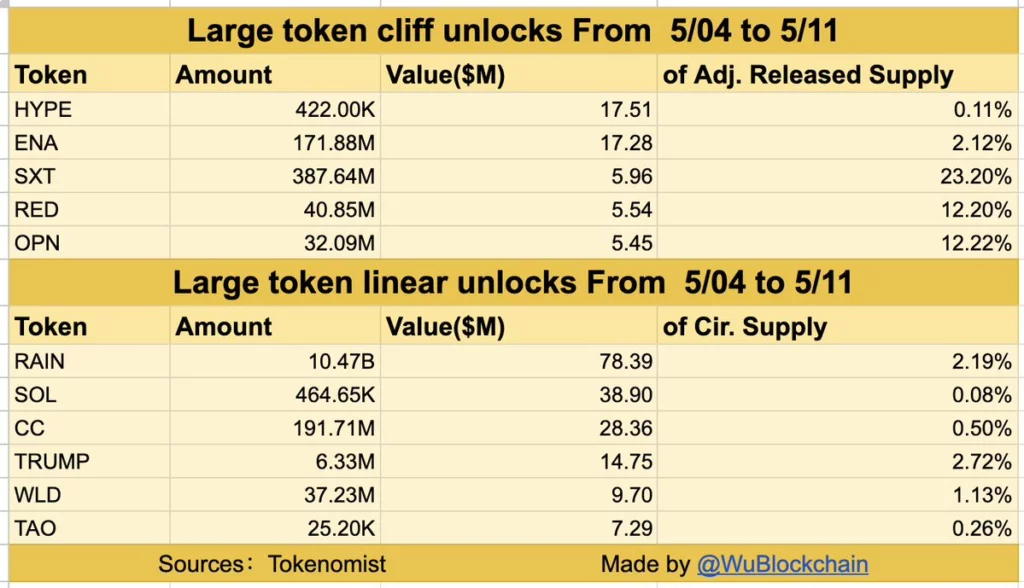
Crypto markets are set for a busy token unlock period between May 4 and May 11.
Summary
- HYPE and ENA lead cliff unlocks this week, adding over $34 million in new supply.
- RAIN tops linear unlocks with $78.39 million, while Solana adds $38.90 million this week too.
- SXT, RED and OPN show high supply ratios, raising attention around short-term price moves ahead.
According to Tokenomist data shared by WuBlockchain, large cliff and linear unlocks will release more than $229 million in tokens this week.
These releases include Hyperliquid, Ethena, Space and Time, RedStone, Opinion, Rain, Solana, Corn, TRUMP, Worldcoin and Bittensor. Traders often track unlocks because new supply “could” add short-term selling pressure if demand does not absorb it.
HYPE and ENA lead cliff unlocks
Hyperliquid will unlock 422,000 HYPE tokens worth about $17.51 million. The release equals 0.11% of adjusted released supply, making it one of the largest cliff unlocks by dollar value this week.
Ethena will also release 171.88 million ENA tokens worth around $17.28 million. The unlock accounts for 2.12% of adjusted released supply. ENA is the governance token of Ethena, the Ethereum-based protocol behind the USDe synthetic dollar.
SXT, RED and OPN add more supply
Space and Time will unlock 387.64 million SXT tokens valued at about $5.96 million. The release represents 23.20% of adjusted released supply, making it the largest unlock by supply ratio among the listed cliff unlocks.
RedStone will release 40.85 million RED tokens worth about $5.54 million. The amount equals 12.20% of adjusted released supply. Opinion will also unlock 32.09 million OPN tokens worth about $5.45 million, equal to 12.22% of adjusted released supply.
Linear unlocks add daily market pressure
Tokenomist data also shows large linear unlocks from May 4 to May 11. Rain leads this group with 10.47 billion RAIN tokens worth $78.39 million, equal to 2.19% of circulating supply.
Solana follows with 464,650 SOL worth about $38.90 million. The release equals only 0.08% of circulating supply, giving it a smaller supply ratio despite its larger dollar value.
Corn will unlock 191.71 million CC tokens worth $28.36 million, equal to 0.50% of circulating supply. TRUMP will release 6.33 million tokens worth $14.75 million, equal to 2.72% of circulating supply.
Worldcoin will unlock 37.23 million WLD tokens worth $9.70 million. Bittensor will release 25,200 TAO tokens worth $7.29 million.

At Paris Blockchain Week, BeInCrypto sat down for an exclusive interview with Aleksandr Vat, Head of Business Development at Ethplorer.io, to discuss the company’s new Aggregated Ethereum Rich List.
Ethplorer argues that traditional Ethereum rich lists have become increasingly misleading because they rank wallets by ETH holdings alone. Its new ranking looks at the total USD value held by each address, including ETH, ERC-20 tokens, and stablecoins.

Photo provided by Aleksandr Vat
According to Vat, this changes the picture of Ethereum wealth, liquidity, and risk. It also leads to one of Ethplorer’s more provocative conclusions: altseason may have already happened, but in balance sheets rather than price charts.
Ethereum’s Rich List Has Changed
BeInCrypto: At the conference, you discussed the new Ethereum ranking with the community. What is the Aggregated Ethereum Rich List, and why did Ethplorer build it?
Aleksandr Vat: Ethplorer rebuilt the Ethereum rich list by ranking addresses not only by ETH, but by total USD value. That includes ETH, ERC-20 tokens, and stablecoins.
The Aggregated Ranking of Ethereum addresses is based on totalBalanceUsd, unlike traditional rankings, which are sorted by ethBalanceUsd. The goal was simple. ETH-only rankings no longer show real economic power on Ethereum.
BeInCrypto: What was fundamentally wrong with traditional ETH-based rankings?
Aleksandr Vat: ETH-only rankings ignore most of the capital. Today, around 66% of value sits outside ETH, mostly in tokens and stablecoins. That means ETH-based lists give a distorted view of who controls liquidity and risk.
BeInCrypto: What was the biggest insight when you first rebuilt the ranking?
Aleksandr Vat: The biggest change was that the entire hierarchy changed. The same top 10,000 addresses hold almost three times more capital when tokens are included. Many players that were previously almost invisible suddenly become dominant.
Ethereum Is Becoming Entity-Centric
BeInCrypto: Vitalik Buterin envisioned Ethereum as a platform where code manages value. Has that vision been realized?
Aleksandr Vat: Increasingly, it is systems rather than individuals. Smart contracts, exchanges, and liquidity hubs now control a large share of capital. Ethereum has become less whale-centric and more entity-centric.
What is important is that we can now measure it. In ETH-based rankings, this change was almost invisible. Once we look at aggregated balances, it becomes clear that a large share of capital is already controlled by smart contracts, DeFi protocols, bridges, and liquidity pools. Roughly 28% of total capital is now controlled by these systems.
So this is no longer only a vision. It is an observable structural reality.
“Altseason Already Happened”
BeInCrypto: You say that “altseason already happened.” What do you mean by that?
Aleksandr Vat: Altseason did not disappear. It moved from price charts to balance sheets.
Through most of 2017–2021, ETH represented the majority of Ethereum’s economic value, while tokens and stablecoins played secondary roles.
That structure has since changed. By 2022–2023, token-denominated balances had matched ETH in economic weight.
In Ethereum’s Aggregated Rating 2026, ETH no longer dominates portfolios. The top 10,000 addresses held about $342 billion in total value at the end of March 2026. Of this amount, $116.5 billion was held in ETH, equal to roughly 34%, while the remaining 66% was denominated in tokens.
BeInCrypto: Why did the market miss this?
Aleksandr Vat: Because people watch prices, not balance composition. While charts were flat, capital was quietly redistributing across tokens, stablecoins, and smart contracts.
BeInCrypto: Are we looking at a different kind of market cycle now?
Aleksandr Vat: Yes. The market is going from price discovery to power discovery. The key question is less “What is the price?” and more “Who controls liquidity and risk?”
What This Means for Investors and Analysts
BeInCrypto: What does this give investors in practice?
Aleksandr Vat: It changes how you evaluate risk. Instead of focusing only on price or market cap, you look at what a balance consists of. Is it real external capital, or is it self-issued tokens?
BeInCrypto: How should analysts rethink their approach using this data?
Aleksandr Vat: Analysts need to move from narratives to composition analysis. That means looking at aggregated balances, capital sources, and dependencies, rather than only TVL or token price.
BeInCrypto: Does this change how we should interpret TVL and market cap?
Aleksandr Vat: Yes. Both metrics can be distorted by self-issued tokens. Without understanding balance composition, you can overestimate real economic strength.
The Printing-Press Index
BeInCrypto: What is the Printing-Press Index, and why did you introduce it?
Aleksandr Vat: The Printing-Press Index, or PPI, measures how much of a portfolio consists of a project’s own token. It helps separate real capital from internally generated value.
The formula is simple:
PPI equals the USD value of a project’s own tokens divided by the total USD value of tokens held by the project. In other words, it shows the share of a project’s own token in its portfolio.
BeInCrypto: What did PPI reveal about DeFi, centralized exchanges, bridges, and Layer 2 networks?
Aleksandr Vat: DeFi shows significantly higher reliance on self-issued tokens compared with centralized players. On average, it is around twice as high, 14.7% versus 6.9%.
Bridges and Layer 2s show even higher PPI, around 34.8%. Part of this is structural because they often require native tokens for liquidity and staking. But this also transfers risk toward token price dependency.
BeInCrypto: At what point does PPI become risky?
Aleksandr Vat: Below roughly 20%, it is normal. Above 40% to 50%, the system becomes fragile and exposed to reflexive collapse dynamics.
BeInCrypto: Can you give real-world examples of high PPI risk?
Aleksandr Vat: UST-LUNA is the extreme case. The system was almost entirely backed by its own token, which led to a death spiral.
FTX is another example. Even around 40% exposure to FTT was enough to trigger collapse under stress. That shows high PPI does not need to be extreme to become dangerous.
ETH Is Still Important, But It Is No Longer the Whole Story
BeInCrypto: Does ETH still represent the core of Ethereum’s economy?
Aleksandr Vat: ETH is still important, but it is no longer the dominant store of value within large portfolios. Only around 34% of top-holder capital is in ETH. The other 66% sits outside ETH, in tokens.
BeInCrypto: What surprised you most in terms of address dynamics?
Aleksandr Vat: The generational change. Most large addresses in the Aggregated Ranking are significantly newer, which reflects capital entering through DeFi and tokens.
In the ETH top ranking, about one-third of wallets are more than five years old. In the Aggregated Ranking, almost 60% are under two years old.
Aggregated addresses are also about 25% more active. They show larger balance changes and higher volatility because they reflect real liquidity flows, rather than passive ETH holding.
Filtering Out Fake Token Wealth
BeInCrypto: How do you deal with fake or inflated token balances?
Aleksandr Vat: We apply liquidity filters. That means excluding balances that cannot realistically be sold without moving the market.
Without filtering, low-liquidity tokens can artificially inflate rankings and misrepresent real economic power. In crypto, it is relatively easy to mint a token, assign it a price through thin trading, and create the illusion of large balances.
To address this, we use a set of validation checks. We look at minimum trading activity, both current and historical. We validate market capitalization consistency and assess whether a balance could realistically be liquidated in the market.
The logic is simple. If you cannot realistically sell your full position within about two weeks, that balance does not represent real liquid capital and should not distort the ranking.
The Beacon Deposit Contract Problem
BeInCrypto: Before this interview, we looked at traditional Ethereum rich lists from well-known platforms. One thing immediately stood out. The Beacon Deposit Contract appears to hold nearly 70% of the Ethereum network. Are we really analyzing the behavior of only the remaining 30% of the market?
Aleksandr Vat: That is exactly the problem with ETH-only rankings. They create a misleading picture.
The Beacon contract is not a real holder. It is a technical deposit registry for staking. The ETH there is not controlled by a single entity and cannot even be withdrawn from that address.
So when it shows up as “70% of the market,” around 83 million ETH, it does not reflect real economic power or market behavior. It is a technical figure.
If you look at the real picture, active staking is closer to 39 million ETH. When we move to an aggregated view, including liquid tokens and stablecoins, active staking accounts for just over 10% of total ecosystem capital.
So we are not analyzing only 30% of the market. Roughly 10% sits in staking. The other 90% is where the market actually operates, where capital moves, trades, and redistributes across the ecosystem.
Building the Ranking
BeInCrypto: How long did it take to develop this ranking?
Aleksandr Vat: There is no single timeline because this was not built as a standalone project. Ethplorer has spent years processing token-level data, focusing on USD valuation and filtering out low-quality assets.
At some point, the data quality and coverage reached a level where building a full aggregated ranking became possible. That is when we turned it into a structured product.
BeInCrypto: What was the hardest part?
Aleksandr Vat: Cleaning the data, especially handling spam tokens, price inconsistencies, and entity aggregation.
BeInCrypto: What kind of feedback have you received from the community?
Aleksandr Vat: Strong interest and debate, especially because the ranking challenges widely accepted assumptions about Ethereum.
BeInCrypto: Have you discussed this with industry players at Paris Blockchain Week?
Aleksandr Vat: Yes, and reactions were mixed, from curiosity to skepticism. That is expected when you introduce a new analytical approach.
Final Takeaway
BeInCrypto: What is the main takeaway from your research?
Aleksandr Vat: Ethereum’s rich list is no longer about wealth. It is about capital flows and risk distribution.
BeInCrypto: If you had to summarize the change in one sentence?Aleksandr Vat: We went from tracking balances to understanding capital structure.
The post Ethplorer’s Aleksandr Vat Says Ethereum’s Altseason Already Happened appeared first on BeInCrypto.


Capital B has secured fresh backing from Blockstream CEO Adam Back through a 1.1 million euro ($1.28 million) warrant issuance, deepening the cryptographer’s exposure to the French-listed Bitcoin treasury firm.
Summary
- Capital B has raised €1.1 million through warrants fully subscribed by Blockstream CEO Adam Back, increasing his stake to 9.97% on a diluted basis.
- The company said the funds will support its Bitcoin treasury strategy, as shares rose over 6.5% on the announcement despite a 16% decline in 2026.
According to a Monday announcement from Capital B, Back subscribed to 10 million warrants priced at 0.11 euros ($0.13) each, with every warrant granting the right to purchase a new share at an exercise price of 0.84 euros ($0.98). The company said the exercise price aligns with its market net asset value, placing mNAV at 1.1 per share.
Already among the firm’s largest investors, Back’s position expands further through the deal. Capital B said his holdings now exceed 39.5 million shares, representing 9.97% ownership on a fully diluted basis. Back, known for creating Hashcash, contributed one of the proof-of-work systems cited in the Bitcoin white paper.
Capital raise strengthens Bitcoin accumulation push
Capital B said the proceeds will be directed toward accelerating its Bitcoin treasury strategy, a move that coincided with a positive reaction in its share price. Data from Yahoo Finance shows the company’s stock rose more than 6.5% on Monday following the announcement, although it remains down over 16% since the start of 2026.
Bitcointreasuries.net data places Capital B as the 25th-largest corporate Bitcoin holder, with 2,943 BTC valued at roughly $234 million.
Activity across similar firms has diverged in recent weeks as companies adjust to market conditions. Capital B and UK-based Connecting Excellence Group were the only Bitcoin treasury firms in Europe to raise capital over the past month, according to available disclosures. Connecting Excellence Group raised $794,000 on April 23, also with backing from Back.
Elsewhere, companies have taken a more defensive approach. On April 24, Nasdaq-listed Nakamoto said it had launched an actively managed derivatives program designed to generate income from volatility while hedging downside exposure on its Bitcoin holdings. In a March 30 filing with the U.S. Securities and Exchange Commission, Nakamoto disclosed the sale of 284 BTC, worth about $20 million at the time, making it the largest treasury firm this year to report trimming its holdings.
Meanwhile, Genius Group said it had liquidated its entire Bitcoin treasury of 84 BTC in February, raising about $5.7 million to repay an $8.5 million debt obligation, according to disclosures submitted to the SEC.
TLDR
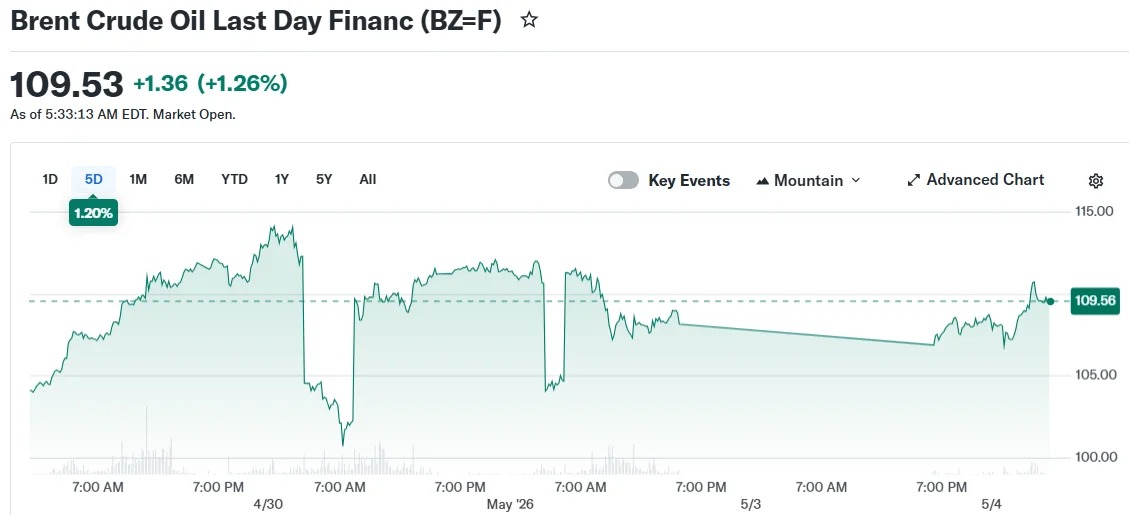
- Brent crude maintained levels above $108 per barrel following a brief 2.4% decline at Monday’s market opening
- White House unveiled plans to assist commercial vessels trapped in the Strait of Hormuz
- Current proposal excludes direct naval warship convoy protection for vessels
- Projectiles struck a tanker approximately 78 nautical miles north of Fujairah over the weekend
- Trading desks expressed doubt over the initiative’s ability to effectively reopen the waterway
Oil prices maintained stability throughout Monday’s session following initial weakness, as market participants assessed Washington’s latest initiative to extract stranded commercial traffic from the Strait of Hormuz.
Brent crude showed minimal movement above the $108 per barrel threshold after experiencing an intraday decline of up to 2.4% during opening hours. West Texas Intermediate similarly held its ground near the $102 mark.
Through social media channels, President Donald Trump declared the United States would commence operations Monday to navigate neutral merchant ships through the strait. “We will use best efforts to get their Ships and Crews safely out of the Strait,” his statement read.
US Central Command verified its commitment to deploy military assets, including guided-missile destroyers, aerial units, and unmanned surveillance systems. The Wall Street Journal noted, however, that current operational parameters exclude direct Navy warship escort duties.
The declaration provided only fleeting support to crude markets. Industry experts and trading professionals immediately raised concerns about the strategy’s practical effectiveness.
“Market sentiment suggests limited confidence in this approach,” ING analysts observed. “While the initiative may facilitate outbound vessel movement from the Persian Gulf, inbound maritime traffic will likely remain severely constrained.”
Haris Khurshid, chief investment officer at Karobaar Capital, suggested traders have become desensitized to presidential commentary on the crisis. “Trump fatigue is setting in more and more — I don’t think the market’s really taking it seriously,” he noted.
Weekend Attack Underscores Regional Volatility
A commercial tanker sustained damage from projectile strikes Sunday at a location 78 nautical miles north of Fujairah in the United Arab Emirates. UK Maritime Trade Operations documented the incident. While the vessel’s identity remains undisclosed, all crew members were reported unharmed.
The president additionally suggested potential military action should Iran attempt to prevent vessel departures. He characterized ongoing diplomatic discussions with Tehran as “very positive” while withholding additional specifics.
Iran dismissed Washington’s proposal outright. According to Al Mayadeen, Ebrahim Azizi, chairman of Iran’s parliamentary National Security Commission, characterized any American intervention in the strait as a ceasefire violation.
Hostilities erupted in late February following joint US-Israeli military operations against Iran, justified by nuclear program concerns. A bilateral blockade has since emerged, with Tehran preventing Persian Gulf departures while Washington intercepts traffic associated with Iranian ports.
Supply Constraints Intensify
Treasury Secretary Scott Bessent indicated over the weekend that Iranian well shutdowns could commence “in the next week” as domestic storage capacity reaches maximum levels.
ANZ Group analysts emphasized escalating supply deficits resulting from the extended strait closure. “With the demand response muted, a significant drawdown in inventories has ensued,” their analysis stated.
Recent weeks have witnessed crude prices reach their most elevated levels since 2022 due to the ongoing conflict.
OPEC+ members reached agreement over the weekend on a modest symbolic adjustment to June production quotas, as the coalition aimed to project market confidence following the United Arab Emirates’ departure from the group.
Crypto World
Lucid (LCID) Stock Q1 2026 Earnings Preview: What Wall Street Forecasts Ahead of Tuesday’s Report

Key Takeaways
- Lucid’s Q1 fiscal 2026 earnings arrive May 5, with options markets anticipating a potential 13.30% price swing following the release.
- Analyst consensus calls for approximately $370 million in revenue—a 57% annual increase—alongside an anticipated $2.35 per-share loss.
- Uber has increased its stake to 11.52% and expanded its vehicle commitment to a minimum of 35,000 units for robotaxi deployment.
- Gravity SUV deliveries were halted for 29 days in Q1 due to supply chain complications—investors await recovery details.
- LCID shares have declined 38% year-to-date, with analyst ratings averaging Hold and a mean price target of $13.13.
Lucid Group is scheduled to release its first-quarter fiscal 2026 financial results on Tuesday, May 5. Shares have struggled considerably this year, falling 38% as the electric vehicle manufacturer heads into the report. Options activity suggests heightened volatility expectations, with the market pricing in a potential 13.30% move in either direction—significantly above Lucid’s typical 5.24% post-earnings swing observed over the previous four quarters.
Trading near $6.53, the stock sits well below Wall Street’s consensus price target of $13.13, which implies more than 100% potential upside. However, the gap between analyst projections and actual share performance has persisted.
For the first quarter, analysts project revenue of $369.99 million—marking a 57% year-over-year increase. This would also represent an acceleration from the 36.1% growth rate Lucid delivered in the prior-year first quarter. On profitability, the Street expects a $2.35 loss per share, modestly better than the $2.40 loss reported in Q1 2025.
Lucid’s track record includes six earnings misses in the last nine quarters and multiple revenue shortfalls over the past two years. While expectations are calibrated accordingly, investor confidence remains fragile.
Supply Chain Disruption Impacts Gravity Deliveries
A critical storyline entering this earnings call centers on the Gravity SUV. The model experienced a 29-day delivery suspension during the quarter stemming from a supplier-related problem. While production continued, customer deliveries were paused. Investors will be eager to understand whether the issue has been fully resolved and if it jeopardizes Lucid’s full-year production guidance of 25,000 to 27,000 vehicles.
The company’s previous quarterly results showed revenue of $522.7 million, up 123% year-over-year. However, the report also featured misses on adjusted operating income and EBITDA, keeping analyst sentiment tempered.
The broader automotive manufacturing sector has outperformed recently, with stocks in the category gaining 9.4% on average over the past month. In contrast, Lucid has dropped 30% during the same timeframe.
Uber Partnership Expansion Takes Center Stage
Perhaps the most significant catalyst heading into earnings is Lucid’s deepening collaboration with Uber. In April, Uber injected an additional $200 million into Lucid, bringing its total investment to $500 million. The rideshare giant also expanded its vehicle order to at least 35,000 units, intended for deployment in a global autonomous taxi fleet.
Regulatory disclosures reveal that Uber now controls an 11.52% passive ownership position in Lucid, making it the second-largest shareholder after Saudi Arabia’s Public Investment Fund.
Investors will be looking for specific guidance on deployment timelines and when Lucid vehicles will begin entering Uber’s robotaxi operations.
RBC Capital analyst Tom Narayan recently reduced his price target on LCID from $10 to $8 while maintaining a Sector Perform rating. The adjustment reflects broader macroeconomic headwinds affecting the auto sector, including geopolitical tensions in the Middle East.
Among the 10 Wall Street analysts tracking Lucid, the consensus rating is Hold—comprised of seven Hold ratings, two Sell ratings, and one Buy rating, all issued within the past three months.


Anthropic is close to finalizing a roughly $1.5 billion joint venture with Blackstone, Goldman Sachs, and several other Wall Street firms to distribute artificial intelligence tools to private-equity-backed companies.
Summary
- Anthropic is nearing a $1.5 billion joint venture with Blackstone, Goldman Sachs, and Hellman & Friedman to deliver AI tools to private-equity-backed companies.
- The platform will target sectors including finance, operations, and enterprise software, with leading partners committing up to $300 million each and Goldman Sachs adding about $150 million.
- The move comes as Anthropic explores a valuation above $300 billion, while rival OpenAI pursues similar private-equity partnerships amid rising competition in enterprise AI.
A report by The Wall Street Journal said the platform will introduce AI applications across finance, operations, customer service, analytics, and enterprise software.
Anthropic, Blackstone, and Hellman & Friedman are leading the effort, with each expected to commit about $300 million to the venture. Goldman Sachs is set to join as a founding investor with an estimated $150 million contribution.
The structure brings together major financial institutions and an AI developer in a single push to commercialize enterprise-grade tools. The report noted that a formal announcement could come as early as May 4.
Interest in Anthropic has accelerated in recent months as its enterprise-focused AI products gain traction. The company is reportedly considering a new funding round that could lift its valuation beyond $300 billion, with some projections pointing as high as $900 billion. Those expectations have drawn strong attention from private equity players seeking early exposure to AI infrastructure and software providers.
The planned venture also arrives as competition intensifies. Rival OpenAI has been exploring similar partnerships with private-equity firms to expand adoption of its tools across business operations. The parallel efforts show how leading AI developers are turning to financial sponsors to scale deployment and integrate automation into portfolio companies.
Both Anthropic and OpenAI are also seen as potential candidates for an initial public offering later this year, adding another layer of urgency for investors looking to secure positions ahead of any listing.
Separately, Anthropic has entered early-stage discussions with UK-based semiconductor startup Fractile. Talks are focused on securing access to specialized inference chips designed to run trained AI models more efficiently.
Such hardware is critical for lowering operating costs and improving processing speeds as demand for AI workloads grows.
The discussions underline how developers are working to lock in compute supply alongside expanding their software reach through partnerships like the proposed joint venture.

I visited beautiful overlooked city under 2 hours from London locals say is ‘now cool’

Ratos AB (publ) (RTOBF) Q1 2026 Earnings Call Transcript
Clarity Act Update: Industry Leader Says Crypto Market Is ‘Fine’ Despite Deadlock

Manchester United reach agreement with Casemiro over contract clause amid transfer speculation

US brings back mandatory military draft registration

Steven Gerrard disagrees with Gary Neville over ‘shock’ Chelsea and Arsenal claim | Football

Taking Surprise Delivery Of THAR ROXX | Value For Money Variant #mahindrathar #roxx #thar #tharrox

RIPPLE PRESIDENT IS DONE?!?! HUGE XRP BOMBSHELL ON STAGE…

CA Final May 2026 Financial Reporting Paper Review | How Was Today’s Exam ?
-

 Tech7 days ago
Register Renaming | Hackaday
-

 Politics7 days ago
Drax board avoid their own AGM, accused of greenwashing & environmental racism
-

 Fashion5 days ago
Kylie Jenner’s KHY Enters a New Era with ‘Born in LA’
-

 Tech7 days ago
Images of Samsung’s rumored smart glasses have leaked
-

 NewsBeat17 hours ago
Channel 5 – All Creatures Great and Small series 7 new post
-
 Tech3 days ago
Trump’s 25% EU auto tariff breaches Turnberry Agreement that also covers semiconductors and digital trade
-

 Business6 days ago
Most Commercial Energy Audits Miss the Real Losses
-

 Business7 days ago
(VIDEO) Charlize Theron Climbs Times Square Billboard to Promote New Netflix Thriller ‘Apex’
-

 Crypto World6 days ago
CFTC’s AI will review U.S. crypto registration applications, chairman tells CoinDesk
-
 Sports3 days ago
Paul Scholes issues Marcus Rashford reality check as agreement emerges over Man United star
-
 Entertainment7 days ago
Alicia Keys Calls Out Music Industry ‘Boys Club’
-

 Business5 days ago
Barclay Brothers Avoid Bankruptcy: HSBC Drops High Court Petitions After IVA Deal
-
 Business5 days ago
Tesla Officially Registers Elon Musk’s Stock: What Investors Need to Know
-

 Tech6 days ago
Get Ready for More Brain-Scanning Consumer Gadgets
-
 Crypto World6 days ago
Robinhood Phishing Scam Exploits Gmail Dot Feature to Bypass Security
-

 Entertainment7 days ago
Sister Wives: Janelle Posts New Scary Warning
-

 Crypto World6 days ago
Gmail Dot Trick Underpins Robinhood Phishing, Sending Real-Looking Emails
-

 Entertainment6 days ago
Michael Jackson’s Biopic Excluded Abuse Allegations For $25M
-

 Business3 days ago
Two Powerball Tickets Split $143 Million Jackpot in Indiana and Kansas
-

 Business6 days ago
Superdry co-founder accused of raping woman
You must be logged in to post a comment Login