

Crypto World
BitPay secures Dutch licensing under MiCA, plans to expand stablecoin payments



The Dutch Authority for the Financial Markets approved BitPay’s application as a crypto-asset service provider under the Markets in Crypto-Assets requirements.

Crypto World
Mark Zuckerberg’s Meta AI Just Revealed This Shocking Bitcoin Price Prediction for the End Of 2026
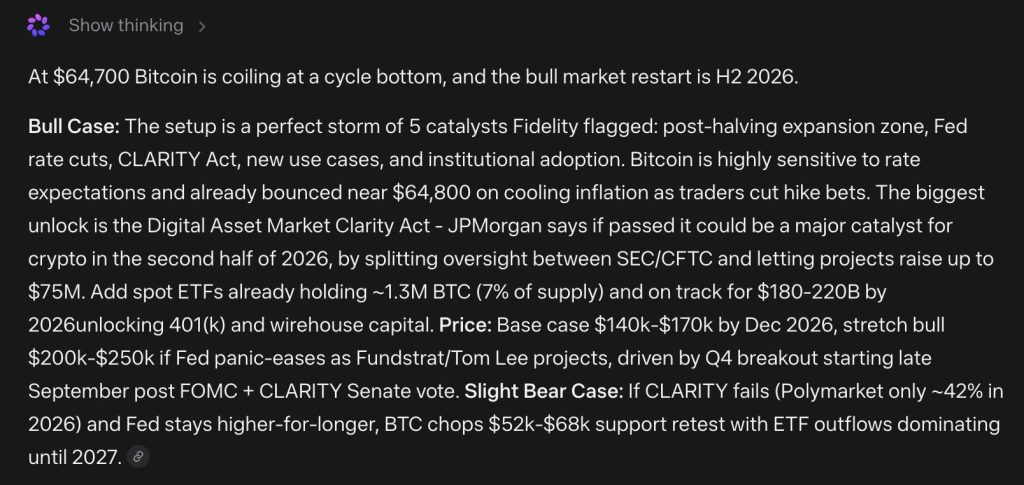
Mark Zuckerberg’s Meta AI predicts that this dip is the bottom of the cycle, with a bull market price prediction restart penciled in for the second half of 2026.
The base case target is $140,000 to $170,000 by December. The stretch case, if the Fed panics into easing, runs $200,000 to $250,000.
Five catalysts are stacked on top of each other here. A post-halving expansion zone, Fed rate cuts, the CLARITY Act, fresh use cases, and institutional adoption are all landing in the same window.
Bitcoin already showed its hand on rate sensitivity, bouncing near $64,800 the moment inflation cooled and traders trimmed hike bets. That reaction tells you how much fuel sits coiled in this price.
The real unlock is regulatory. JPMorgan has flagged the Digital Asset Market Clarity Act as a potential major catalyst for crypto in the second half of 2026, splitting oversight between the SEC and CFTC and letting projects raise up to $75M cleanly.
Layer that against spot ETFs already holding roughly 1.3 million BTC, about 7% of total supply, and on track for $180B to $220B in assets by 2026. That kind of pool starts pulling in 401k and wirehouse capital that has been sitting on the sidelines.
Fundstrat’s Tom Lee projects the breakout starting late September, right after the FOMC meeting and a CLARITY Senate vote. That sequencing is the whole thesis in one sentence.
The bear case is narrow but specific. If CLARITY fails, and Polymarket currently gives it only about 42% odds in 2026, and the Fed stays higher for longer, Bitcoin chops between $52,000 and $68,000 support with ETF outflows dominating the tape into 2027.

Discover: The Best Crypto to Diversify Your Portfolio
Bitcoin Price Prediction: The $68,000 Line Between Cycle Bottom and False Bottom
Price closed at $64,772, down 0.31%, inside a tight daily range between $64,435 and $65,518. That calm print is deceptive, given what sits behind it.
Bitcoin topped near $128,000 in October 2025, then broke down hard through February 2026, gapping under $84,000 in a single violent leg. That was the cycle top confirming itself in real time.
Since February, the price has carved a rounded base between $60,000 and $84,000. May pushed a rally to $82,000 that failed, and June flushed the range down to a fresh low near $60,000 before stabilizing.
That rejection at $82,000 followed by a higher low near $60,000 is the early skeleton of an inverse head and shoulders. It is not confirmed yet, but it is the exact structure a cycle bottom is supposed to leave behind.
Support sits at $60,000, then $52,000 if the base fails outright. Resistance stacks at $68,000, then $73,000, then the heavier ceiling at $84,000 that has been rejected twice already.
RSI reads near 47 with the signal line close behind at 45. The gap is barely positive, which means momentum just flipped from falling to flat rather than confirming any real strength yet.
That is a market deciding, not a market declaring. Meta AI’s entire bull case depends on Bitcoin doing something it has not done since October, reclaiming $84,000 and holding it.
Until that level breaks, $140,000 stays a thesis waiting on a chart to agree with it.
Don’t Miss Out on Our $1,000 USDT Airdrop on ByBit
Here is What Meta AI Predicts About LiquidChain
The rotation has already happened. Most people will figure that out later.
Large caps are not broken. They are boxed in. Bitcoin, Ethereum, and XRP keep testing the same resistance with nothing giving way. Every macro catalyst has a new date attached. Every institutional wave arrives next quarter. Holding assets where the upside belongs to someone else’s timeline is not a trade. It is a waiting room.
Capital that has navigated enough cycles moves before the destination has a name. Not after.
Early stage infrastructure operates on completely different math. A small market cap means a modest rotation produces dramatic movement. The returns exist in the gap between what something is actually worth and what the market thinks it is worth right now. That gap is only available while the project stays undiscovered. Discovery closes it permanently.
Multi-chain fragmentation costs DeFi real money every single day. Bitcoin, Ethereum, and Solana run as completely isolated systems with no native way to connect. Every user crossing those boundaries pays for that disconnection in fees, slippage, and failed transactions. No exceptions. No workarounds that actually work.
Meta AI predicts LiquidChain solves it entirely. All 3 networks inside one execution layer. Single deployment. Full ecosystem access. Zero cross-chain tax on any interaction anywhere.
The presale is at $0.01454 with just over $890,000 raised. The market has not found this yet. That is the whole point.
Execution is unproven. Adoption is unknown. Established assets offer a predictable climb toward a ceiling everyone can already see. LiquidChain is an entry point that disappears the moment the market looks up.
The post Mark Zuckerberg’s Meta AI Just Revealed This Shocking Bitcoin Price Prediction for the End Of 2026 appeared first on Cryptonews.
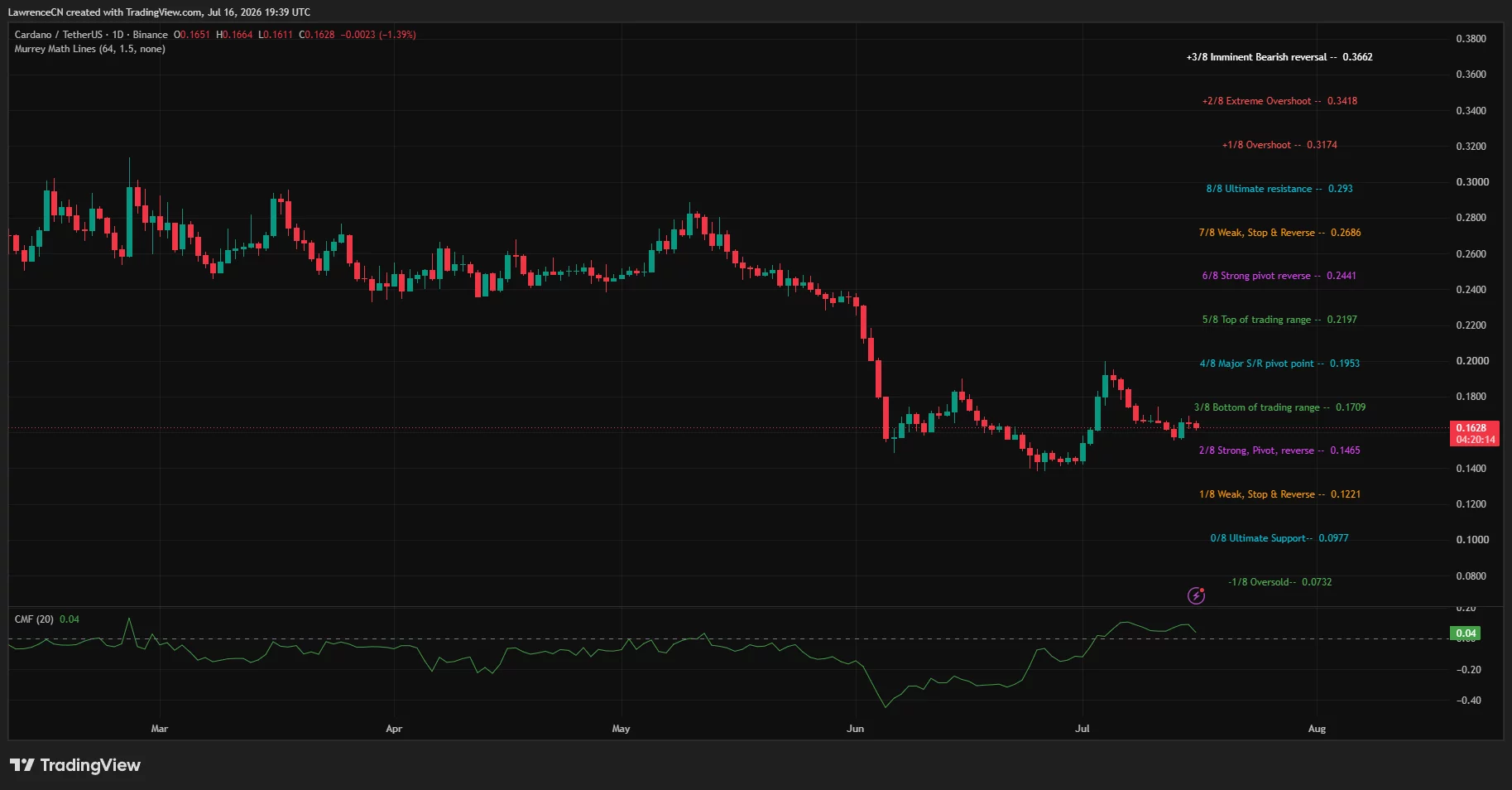
Cardano has fallen 1.39% to $0.1628 as rising short positions have outweighed whale demand two days before the Van Rossem hard fork.
Summary
- ADA fell to $0.1628 as traders increased short positions before the Van Rossem fork.
- Cardano whales accumulated ADA despite negative funding rates and rising futures open interest.
- Liquidity clusters at $0.160 and $0.170 could shape ADA’s next major move.
According to data from crypto.news, from July 16 showed ADA traded between an intraday low of $0.1611 and a high of $0.1664, extending its retreat from an early-July peak near $0.195. The decline came even as large holders accumulated ADA and Cardano prepared to activate its most important network update in years.
CoinGlass data placed ADA’s weighted funding rate at -0.0067%, indicating that traders holding short positions were paying those betting on a price increase. The long-to-short ratio stood at 0.58, while open interest rose 4% to $421 million as traders added new leveraged positions.
Those readings show that derivatives traders remained positioned for further losses before the upgrade, according to CoinGlass. However, the concentration of short bets also raises the risk of liquidations if ADA moves sharply higher.
Whale demand collides with bearish futures bets
Notably, wallets holding between 100,000 and 100 million ADA had increased their balances to the highest level since 2023. The accumulation is possible positioning by large investors before Van Rossem goes live.
Cardano’s governance approved the hard fork on July 13, according to Intersect, with activation scheduled for July 18. Intersect has also urged infrastructure providers to update their software before the network crosses the hard fork boundary.
Van Rossem is expected to lower execution costs, which would make transactions and applications cheaper to run on Cardano, according to Intersect. The update will also prepare the network for Leios, a later scaling upgrade intended to increase transaction capacity before the end of 2026.
The upgrade follows Vasil, which improved Cardano’s network performance and smart-contract efficiency when it activated on Sept. 22, 2022, according to Cardano’s official hard-fork record.
Despite the whale purchases, TradingView’s daily chart showed ADA holding below the Murrey Math resistance at $0.1709. Chaikin Money Flow remained slightly positive at 0.04, suggesting that buying pressure had not disappeared even as the token lost ground.
ADA faces liquidity pressure near $0.160
On the 4-hour chart, ADA had crossed above a descending trendline drawn from its July peak, but the move had not produced a sustained rally. TradingView’s Relative Strength Index stood at 46.92, below its moving average of 50.95, placing momentum on the bearish side of neutral without showing oversold conditions.
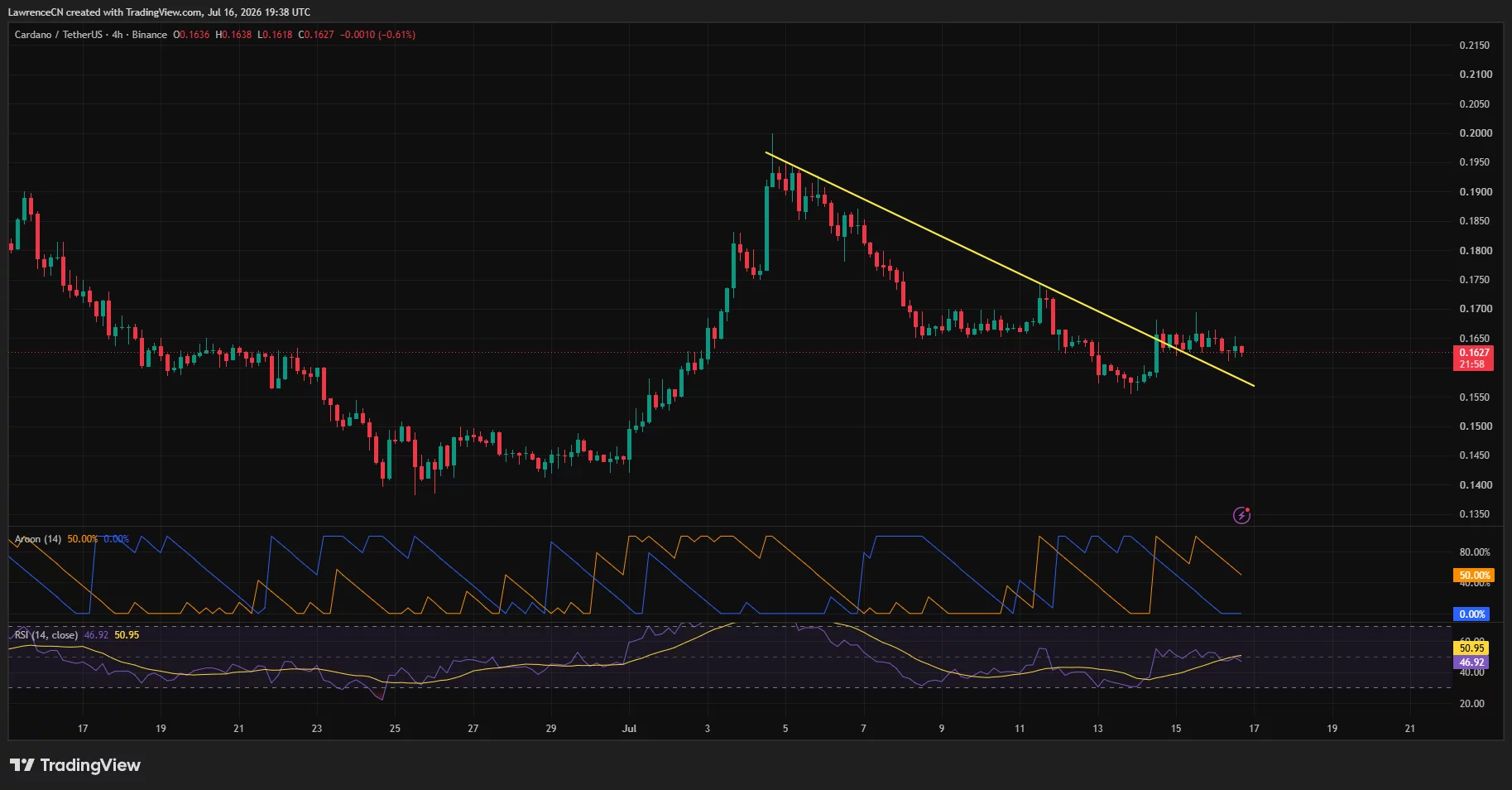
The same chart placed the nearest major Murrey Math support at $0.1465. A daily close above $0.1709 would instead clear the bottom of the indicated trading range and leave the $0.1953 pivot as the next visible resistance.
CoinGlass’s three-day liquidation heatmap showed the nearest dense liquidity pool between $0.160 and $0.161, directly below ADA’s market price. A larger concentration appeared around $0.170, closely matching the resistance shown on the daily chart.
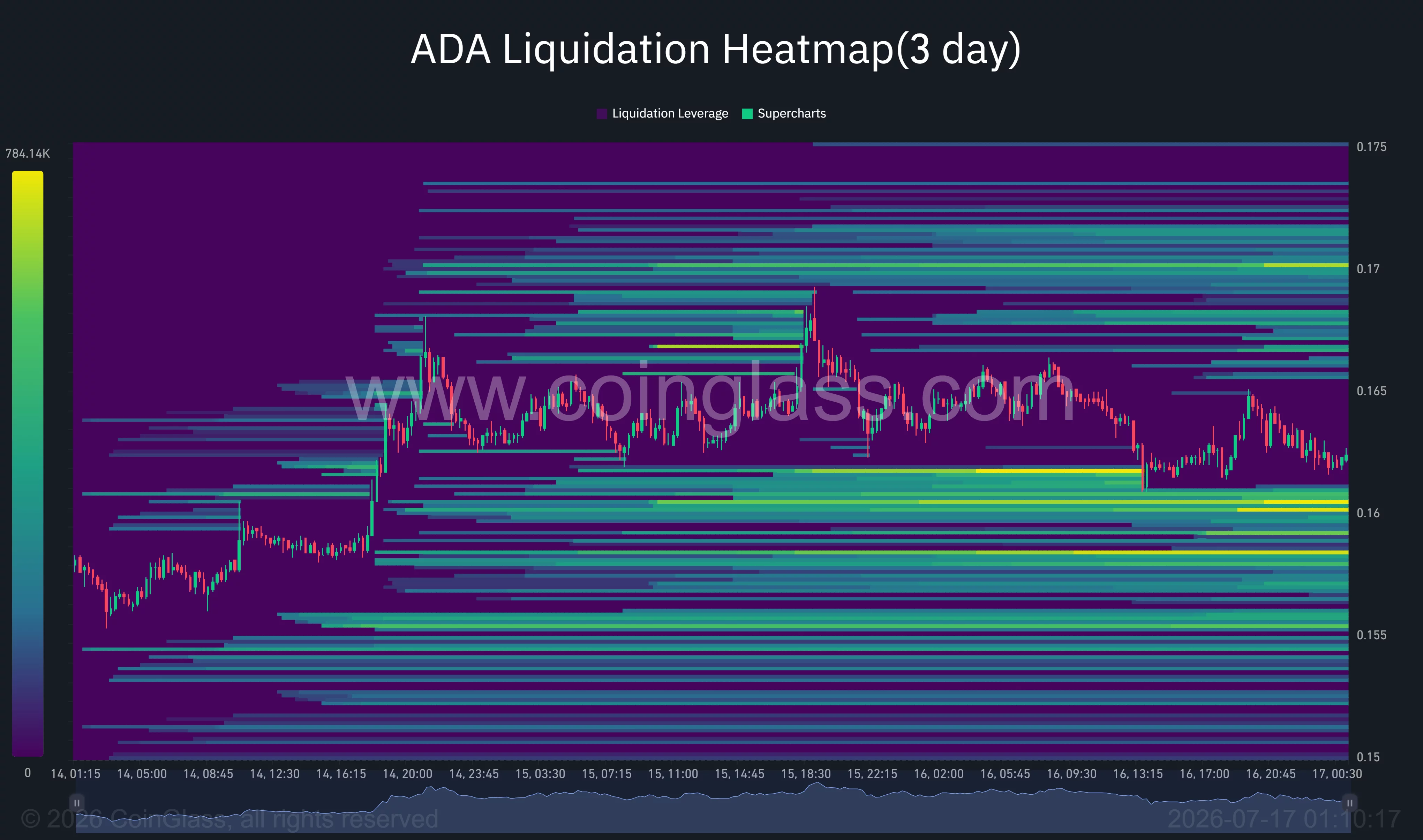
Based on the heatmap, a drop below $0.160 could trigger leveraged long liquidations and expose the $0.1465 support. A move through $0.170, however, could force short sellers to close positions and strengthen the recovery attempt as Van Rossem goes live.
Disclosure: This article does not represent investment advice. The content and materials featured on this page are for educational purposes only.

Morgan Stanley’s E*TRADE has begun offering spot cryptocurrency trading to eligible self-directed clients, adding Bitcoin, Ether, and Solana to a platform that previously focused on traditional assets. The firm says the rollout is powered by a partnership with crypto infrastructure provider Zero Hash, with additional tooling—particularly for moving assets in and out of the platform—expected later this year.
According to a Morgan Stanley financial supplement, the self-directed channel serves 8.6 million households and held about $1.56 trillion in client assets as of March 31. The company’s update positions E*TRADE’s customer interface to mirror how many investors already view stocks and ETFs—now alongside major cryptocurrencies—while the back-end custody and transfer mechanics roll out in stages.
Key takeaways
- E*TRADE spot crypto trading is now live for eligible clients, covering Bitcoin, Ether, and Solana.
- Trading fees are set at 50 basis points, while custody and transaction services are handled via separate Zero Hash accounts.
- Digital asset custody through this structure is not covered by FDIC or SIPC protections, and Morgan Stanley expects later to transition services to Morgan Stanley Digital Trust.
- Transfers of cryptocurrency on and off the platform are expected later this year, following the initial trading launch.
- The move follows a May pilot and fits Morgan Stanley’s broader digital asset push, including stablecoin reserve services and spot ETF launches.
How E*TRADE’s spot crypto offering works
In Thursday’s announcement, Morgan Stanley said E*TRADE clients can buy, sell, and hold spot cryptocurrencies through the firm’s self-directed platform. While the user experience is designed to keep crypto holdings visible alongside stocks and other investments, the company’s implementation relies on Zero Hash for key parts of the service.
Specifically, Morgan Stanley outlined that trades carry a 50-basis-point fee. Custody and transaction-related services are routed through separate Zero Hash accounts that, importantly, are not covered by FDIC or SIPC protections. That distinction matters to customers evaluating risk and protections versus what they may expect from traditional brokerage or bank-like coverage.
The firm also indicated it plans to transition digital asset services to Morgan Stanley Digital Trust—its national trust bank that is currently in organization. The staged approach suggests the trading experience can launch while some compliance and operational infrastructure continues to develop or be consolidated under Morgan Stanley’s trust structure.
From pilot to broader access
Thursday’s launch follows a pilot that began in May, when Morgan Stanley tested the service with a limited group of users before expanding access to eligible E*TRADE clients. Earlier coverage from Cointelegraph noted that the company was preparing its spot crypto offering with a constrained initial user base, which can be a practical way to validate trading flows, onboarding, and operational controls before scaling.
Another notable element of Thursday’s update is what’s not yet fully available: Morgan Stanley said transfer functionality for moving digital assets on and off the platform is expected later this year. For many investors, the ability to withdraw to external wallets—or to deposit from one—is as important as the ability to trade. Until transfers are enabled, the offering may function more like a trading-and-holding experience within the platform ecosystem.
Broader digital asset strategy: ETFs and stablecoin services
This E*TRADE expansion arrives as Morgan Stanley has been deepening its digital asset involvement across multiple channels. The firm has already moved into areas that reach beyond direct retail spot trading, including stablecoin reserve services and spot exchange-traded products.
In April, Morgan Stanley introduced a stablecoin reserve offering that allows issuers to hold assets backing their tokens in one of the firm’s money market funds while earning interest, according to earlier reporting by Cointelegraph in connection with the launch. Later that same month, Morgan Stanley also launched a spot Bitcoin ETF on NYSE Arca with a 0.14% management fee, which Cointelegraph reported at the time as the lowest-cost Bitcoin ETF on the US market. That ETF debuted as the first spot Bitcoin ETF launched by a major US commercial bank.
Cointelegraph also reported that during the ETF’s first six trading days it attracted more than $100 million in net inflows. At the time of writing, the fund reportedly had about $385 million in cumulative net inflows, based on SoSoValue data for the product.
Meanwhile, regulatory and product design details continue to evolve. In June, Morgan Stanley amended proposed spot Ether and Solana ETF filings to set management fees at 0.14%, after previously applying fees in January when first seeking to list the funds. The commonality of that fee level underscores a competitive intent in a crowded ETF landscape, where management expense ratios can influence investor flows.
What investors should watch next
With E*TRADE’s spot crypto trading now available, the next milestones for customers are likely operational rather than marketing-driven: the timing of deposit/withdrawal transfer capabilities later this year and the planned transition of services to Morgan Stanley Digital Trust. For traders, the fee structure is already defined, but the most practical question remains how quickly customers will gain full flexibility to move assets beyond the brokerage environment.


Former Fidelity fund manager George Noble has warned that an AI bubble crash could cause 17 times more damage than the dot-com collapse, which erased about $5 trillion from the Nasdaq.
Summary
- George Noble warns an AI crash could cause 17 times more damage than the dot-com collapse.
- Polymarket traders have raised the odds of an AI bubble bursting in 2026 above 17%.
- Dalio and the U.S. Treasury identify liquidity and economic links as key risks.
According to Polymarket, the probability of an AI bubble bursting in 2026 has climbed above 17% after recently falling from 30% to 14%. Contracts using different resolution criteria placed the likelihood between 16% and 24% as traders weighed falling technology shares, revenue concerns, and weakness across global markets.
Noble tied his forecast to the large sums flowing into AI infrastructure, arguing that the financial fallout could extend far beyond technology companies if expected returns fail to arrive.
“The fallout from this could really be much more significant,” Noble said while discussing the rise in AI capital spending.
AI bubble odds have rebounded above 17%
Fresh pressure on semiconductor and technology shares has added to those concerns. The Wall Street Journal reported that U.S. stock futures fell on Thursday as AI-related anxiety spread from Asian markets, where SK Hynix and Samsung Electronics dropped almost 9%.
Both South Korean chipmakers plan to spend billions of dollars on semiconductor plants and AI capacity. Their declines came as investors questioned whether the revenue generated by AI services would justify the industry’s expanding infrastructure bill, according to the report.
IBM has added to the unease after its shares suffered their steepest daily fall since 1968, dropping almost 25% earlier this week. Market data cited in the report showed IBM closing another 2.7% lower at $211.20 on Wednesday, taking its decline over several sessions past 26%.
In its warning, IBM said spending on AI infrastructure was pulling corporate budgets away from software, contributing to weaker-than-expected revenue growth. The selloff erased tens of billions of dollars from IBM’s market value and weighed on other software and information technology stocks, according to the report.
A draft U.S. Treasury Department report has also examined how an AI downturn could move through the economy. Drawing on research from the University of Texas at Austin cited by NOTUS, the report found that AI companies have become more closely linked to the U.S. economy than internet companies were during the dot-com period.
Under the report’s downside scenario, disappointing productivity or profits could hurt private credit, chipmakers, cloud providers, electric utilities, and companies financing data centers. The Treasury did not predict an imminent crash, but it listed electricity shortages, financing limits, supply chain disruptions, and geopolitical tensions among the risks facing the sector.
Cash demands could expose inflated AI valuations
Ray Dalio has separately argued that liquidity, rather than weak technology, could break the AI boom. During a television interview reported by Bloomberg, the Bridgewater Associates founder explained that investors often mistake rising asset values for money they can readily spend.
Dalio used private companies to illustrate the risk: a business can receive a billion-dollar valuation after raising far less in actual capital, but shareholders cannot use that paper wealth without selling. In his assessment, stress would emerge if many investors attempted to turn those valuations into cash at the same time.
Bernstein and Cummings have pointed to another pressure building beneath the boom. In a recent Substack post, the economists wrote that the AI bubble was “still inflating,” while technology investment had reached nearly 5% of U.S. GDP, above levels recorded during the dot-com era.
Their analysis also found that large technology companies were committing enough capital to AI projects to reduce their cash reserves. Combined with Noble’s warning and Dalio’s liquidity concerns, those figures leave investors focused on whether AI earnings can catch up with the money already committed to the sector.

Lorie Logan, president and chief executive officer of the Federal Reserve Bank of Dallas, during a research conference at the Federal Reserve Bank of Dallas in Dallas, Texas, US, on Friday, Oct. 31, 2025.
Desiree Rios | Bloomberg | Getty Images
Dallas Federal Reserve President Lorie Logan, asserting that this week’s good inflation news wasn’t good enough, called Thursday for “modestly” higher interest rates to win a battle the central bank has been losing for the past five years.
A voting member this year on the rate-setting Federal Open Market Committee, Logan insisted that inflation is still a major problem for U.S. households that demands action from policymakers. While other Fed officials have expressed a preference for higher rates if inflation metrics don’t improve, Logan’s is the most specific call for a hike.
“I currently believe modestly higher interest rates would better balance the outlook and risks for the FOMC’s dual mandate goals,” Logan said in prepared remarks for a speech in Houston. “Every month of above-target inflation has compounded the strain on Americans’ budgets.”
Earlier in the week, the Bureau of Labor Statistics reported some progress on that front: Consumer prices for June dropped 0.4%, the biggest monthly decline since April 2020, while wholesale prices slipped 0.3%. Both gauges benefited from slumping oil prices, though costs in several other key categories, most notably housing, also softened.
Still, Logan said there’s more work to do for the Fed to meet its 2% inflation goal. Despite the monthly decline, consumer prices rose 3.5% from a year ago, while wholesale costs increased 5.5%. Inflation has been above the central bank’s target since early 2021.
“One month of relief is not enough. It is time to finish the job of restoring price stability,” she said. “In monetary policy as in hockey, you have to skate where the puck is going. Unfortunately, inflation does not appear to be headed sustainably back all the way to 2 percent.”
Markets already expect the FOMC to raise its key overnight borrowing rate by a quarter percentage point later this year — possibly as soon as September, but more likely October, according to the CME Group’s FedWatch tracker of fed funds futures pricing.
The committee next meets July 28-29, with traders pricing in just 12.3% odds of a hike.
Logan pointed to a number of widely cited gauges as well as alternative measures such as core prices less housing to show that inflation is mired well ahead of the Fed’s target even with the recent slide in energy prices and waning tariff impacts.
“If inflation is not heading all the way to 2 percent on its own, then at least some policy restriction is needed to help get it there,” she said. “If higher inflation becomes entrenched, we’d need sharper rate increases to bring it back to target, with a larger cost for the labor market. Better modest restriction now than severe restriction later.”
Logan did not specifically state that she would push for an increase at this month’s meeting or quantify how much higher she thinks rates need to go.


Binance co-founder Changpeng Zhao has challenged Wall Street’s projected $700 billion AI spending wave by arguing that Bitcoin offers protection against inflation that artificial intelligence cannot provide.
Summary
- CZ argues Bitcoin offers inflation protection that artificial intelligence cannot provide investors.
- Jamie Dimon expects AI spending to reach $725 billion as investment continues to surge.
- George Noble warns an AI bubble crash could be 17 times worse than the dot-com collapse.
On X, Zhao presented the difference between the two investment themes in a single line: “AI is great, but it does not protect you against inflation. Bitcoin does.”
CZ’s comment comes as investors weigh Bitcoin’s fixed supply against the rapid flow of capital into AI infrastructure. JPMorgan CEO Jamie Dimon expects AI investment to reach $725 billion this year, while BlackRock executives see rising government debt and currency concerns strengthening Bitcoin’s long-term case.
Bitcoin’s case rests on fiscal pressure
According to BlackRock digital assets chief Robert Mitchnick, investors have recently paid less attention to Bitcoin as spot Bitcoin exchange-traded funds recorded heavy outflows. Mitchnick believes that trend could reverse if concerns about U.S. borrowing and currency debasement intensify.
“And the more fear there is over the borrowing level and the risk of money printing, that is ultimately the most important, I think fundamental driver ahead.”
Bitcoin recently traded near $65,000 after recovering from an earlier decline. However, the cryptocurrency remained well below its October 2025 record of more than $126,000, which was reached during a period of strong inflows into BlackRock’s spot Bitcoin ETF.
CZ’s inflation argument follows the same monetary case outlined by Mitchnick. While AI companies depend on future revenue from heavy capital spending, Bitcoin supporters view the asset’s limited supply as protection against the loss of purchasing power caused by monetary expansion.
Former Fidelity fund manager George Noble has raised a separate concern about the amount of money entering AI infrastructure. As reported by crypto.news, Noble warned that an AI crash could cause 17 times more damage than the dot-com collapse, which erased about $5 trillion from the Nasdaq.
“The fallout from this could really be much more significant,” Noble said while discussing the rise in AI capital spending.
AI spending keeps Wall Street divided
Despite those warnings, Dimon remains optimistic about AI because of the large investments moving through the industry and the strength of the U.S. economy. The JPMorgan chief described the spending cycle as difficult to stop while comparing it to a wave gathering force.
“We’re in a bull market. It’s like a little tsunami. When that kind of thing happens, it’s very hard to stop.”
Dimon has repeatedly criticized Bitcoin in previous years, although he has recently expressed concern about government borrowing and geopolitical risks over the next several years.
Polymarket traders have also assigned a meaningful chance to an AI downturn. According to the prediction market, one contract placed the probability of an AI bubble bursting in 2026 above 17% after the odds previously dropped from 30% to 14%. Other contracts using different settlement rules showed probabilities ranging from 16% to 24%.
Former White House economists Jared Bernstein and Ryan Cummings have added to the caution around AI valuations. Writing on their respective Substacks, they described the bubble as “still inflating” and argued that corporate AI spending is reducing cash reserves while technology investment consumes a larger share of U.S. gross domestic product than during the dot-com era.
Within BlackRock, Rick Rieder has indicated that the asset manager plans to reduce exposure to companies directly spending on AI while increasing holdings in businesses positioned to profit from AI demand. Bitcoin miner TeraWulf fits that second category after signing a 20-year agreement to host AI data-center infrastructure for Anthropic.
Base creator Jesse Pollak said he is stepping back from leading the app after taking responsibility for one of the biggest mistakes in the network’s history.
He admitted that his bet on on-chain social economy had failed to drive crypto adoption like he thought it would.
Base’s Failed Bet on Social Networking
After months of reflection and a week of listening to community feedback, Pollak shared his thoughts on Base’s tough 2026. He described the first quarter as a “punch in the face,” noting that he had spent 2024 and 2025 betting on two ideas that he believed would push the app forward.
Base’s long-term strategy was made on the assumption that builders would unlock the next wave of crypto adoption and that this, in turn, would come through on-chain social experiences such as creator platforms, messaging and content.
Looking back, Pollak now says only half of his theory was right. According to him, builders did drive the next adoption phase, which was seen in how stablecoins, prediction markets, perp trading and tokenization gained momentum. But social platforms didn’t experience the same level of success, with projects like Farcaster, Zora, mini apps and creator coins failing to achieve widespread adoption.
“The entire social side of the market that many of us had been building towards disintegrated completely…I was wrong” he wrote.
The crypto firm launched the Base App in 2025 as a rebrand from its Coinbase Wallet into an “everything app” that combines social networking, trading, messaging, AI tools and creator monetization.
However, Pollak admits that the focus on social products left the network struggling to catch up with its competitors. People also lost confidence in the platform, he said, while critics were quick to remind him of every mistake.
Pollak Steps Back From Leadership Role
The Base founder said that he is handing back the app’s leadership to Coinbase so he can focus on the blockchain itself. Jordan Fish, popularly known as Cobie, will now take over his position and lead the product’s next chapter.
“We’re going to build Base into the Blockchain for global finance and do everything we can to be the place that the world’s money settles over the next century,”he said.
Pollak added that his new mission was to make Base a blockchain that powers global finance, which he says is where crypto’s biggest opportunity now lies. The network’s priorities for the rest of the year will focus on three main areas, including trading, payments and AI agents.
The statement ended with him saying that Base isn’t expecting an easy road ahead, with growing competition from companies like Robinhood and Stripe heating up. But instead of expecting users loyalty by default, he said that it wants to earn their trust back.
The post Jesse Pollak Leaves Base Leadership After Failed Social Strategy appeared first on CryptoPotato.

Crypto trader Axel Bitblaze has laid out a fresh market thesis built on a video from analyst Taiki Maeda, arguing that assets like Hyperliquid (HYPE), Lighter (LIT), and Zcash (ZEC) are already trading like winners of the next cycle while most investors are waiting for a fourth-quarter bottom.
He says that markets tend to move before the crowd agrees a bottom has formed, so the better window to position could be mid-to-late Q3 and not whenever things look safe.
The Case for HYPE, LIT, and ZEC
On July 15, Maeda shared a video on his X account in which he said that crypto was bottoming and that he would be longing HYPE, LIT, and ZEC.
His take was expanded on by Bitblaze in a July 16 post, who noted that Hyperliquid has bought back about 3.4% of the circulating HYPE supply this year, allowing the token to perform well even as sector mainstays such as Bitcoin (BTC) struggled.
“If BTC volatility causes another $HYPE dip without changing its fundamentals… that could be an accumulation opportunity,” wrote the analyst.
Lighter’s LIT token was presented as a higher-risk alternative, with Bitblaze crediting its reported partnership with Robinhood for giving the decentralized perpetual exchange access to a much wider audience. He also noted that buybacks have removed more than 6% of LIT’s circulating supply, helping to push it to an all-time high on the second-to-last day of 2025, when many altcoins were losing ground.
Meanwhile, ZEC carries the most caution. In his market update video, Maeda said he sold the privacy coin after the discovery of a vulnerability in its Orchard shielded pool that could have allowed bad actors to create unlimited amounts of fake ZEC, triggering a 60% collapse. He did, however, buy most of the ZEC back after reassessing the project’s outlook, with the Ironwood upgrade set for July 28 expected to introduce stronger quantum resistance and use formal verification to reduce the risk of hidden bugs.
That update, according to Bitblaze, could help push up the asset’s price. Recall that last week, Zcash founder Zooko Wilcox said that they were close to producing a mathematical proof that Ironwood’s new shielded pools have no undetectable counterfeiting bugs, taking ZEC’s price past $500.
The token is trading at about 0.8% of Bitcoin’s market cap, and per Maeda’s model, it could go anywhere between $650 and $700 if that ratio climbs back to 1%.
Traders Urged Not to Wait for Bitcoin
Bitblaze said that crypto has been in a bear market since the euphoria experienced in mid-2025 when ETH was closing in on $5,000. Now, people are waiting for the bottom, which, according to him, has been penciled in for Q4 2026.
But he believes the market has a tendency to “front-run what everyone expects,” meaning it is better for traders to start positioning themselves between August and September “before the recovery becomes obvious.”
“Don’t wait for Bitcoin and the entire market to look perfect,” the analyst advised. “The next winner usually starts separating from the market before everyone accepts that the bottom is forming.”
The post Forget Bitcoin Bottom: Analyst Says These Altcoins Could Move First appeared first on CryptoPotato.
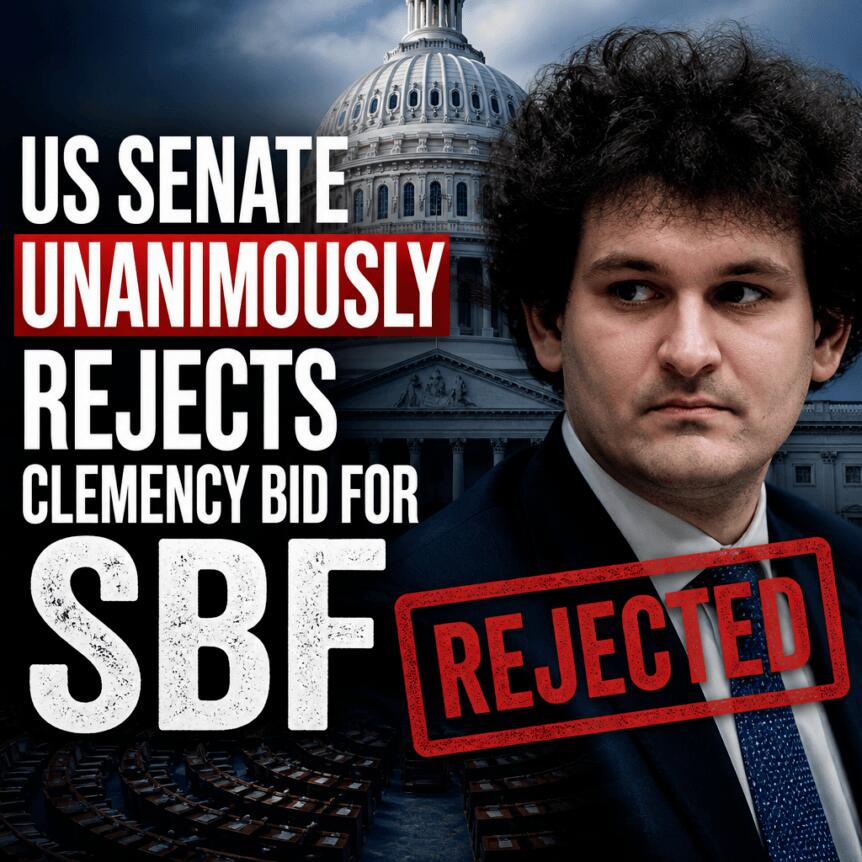
The U.S. Senate has adopted a resolution opposing executive clemency for former FTX CEO Sam Bankman-Fried, underscoring bipartisan political pressure after his fraud conviction connected to the collapse of the crypto exchange.
In a unanimous-consent vote, senators approved a simple, nonbinding measure—S. Res. 772—stating that Bankman-Fried should not receive executive clemency, according to a Wednesday post by the Senate Press Gallery on X.
Key takeaways
- The Senate passed S. Res. 772 by unanimous consent to oppose any federal clemency for Sam Bankman-Fried.
- The resolution is nonbinding and cannot stop a presidential pardon or other executive action.
- The measure follows Bankman-Fried’s request for clemency from President Donald Trump.
- Bipartisan support expanded as additional senators joined as cosponsors, including Bernie Moreno.
- Prediction markets currently price a pardon at less than 1%, despite attracting meaningful trading activity.
Senate resolution signals bipartisan opposition
S. Res. 772 was introduced on June 17 by Senator Ruben Gallego, with Senator Cynthia Lummis listed as a cosponsor. The resolution explicitly opposes any form of federal clemency for Bankman-Fried, including a presidential pardon or a commutation of sentence.
As a simple Senate resolution, it does not require approval from the House or the president and does not carry the force of law. The Senate’s own “Types of Legislation” guide explains that this kind of measure is distinct from legislation and therefore cannot compel or block executive action.
At the time of publication, Congress.gov had not yet reflected the latest floor action for the resolution. However, the Senate Press Gallery’s post indicates that the Senate has now agreed to the measure.
Support for the resolution is also bipartisan. Senator Bernie Moreno of Ohio joined as a cosponsor on Tuesday, adding additional Republican backing to a proposal initially led by a mix of senators from different parties.
Why the Senate’s move matters—and what it can’t do
While S. Res. 772 cannot prevent the president from granting clemency, it functions as a public signal of political resistance inside the legislative branch. The Senate resolution affirms lawmakers’ commitment to “the rule of law” and the integrity of the U.S. financial system in the wake of Bankman-Fried’s conviction.
Bankman-Fried was convicted on fraud and conspiracy charges tied to the 2022 collapse of FTX. He was sentenced to 25 years in federal prison in March 2024.
In June 2026, speculation about a possible pardon intensified after Bankman-Fried sought clemency from President Donald Trump, according to earlier reporting from Cointelegraph on his application. The Department of Justice’s pardon and clemency case-status records also list the clemency request as pending, using the case number shown in the DOJ interface.
For investors and participants in crypto markets, political outcomes like clemency don’t directly change blockchain technology or protocol rules. But they can influence broader regulatory and enforcement expectations—especially in high-profile cases that have become benchmarks for how U.S. authorities treat major exchange failures.
Market pricing suggests a pardon is unlikely
Even as the Senate moved to oppose clemency, prediction markets have largely discounted the probability that Bankman-Fried will receive a pardon. On Polymarket, traders have assigned less than a 1% chance that President Trump will pardon Bankman-Fried by July 31, according to the market listing referenced in the original reporting.
Despite the low odds, the market has pulled in more than $734,000 in trading volume, indicating that while most traders appear skeptical, there is still substantial interest in the possibility of an executive decision.
That split—very low probability on price, but meaningful volume in activity—often points to traders using the market to express scenarios they consider possible but not likely. What remains uncertain is whether clemency processes will advance to a decision and, if so, whether any final action will align with the Senate’s stated position.
What to watch next
Readers should watch the Department of Justice’s clemency case status for any updates and monitor further legislative developments, since S. Res. 772 cannot block a presidential pardon but may affect political pressure around any eventual executive decision.


Robinhood’s newsroom called its new blockchain, Robinhood Chain, “AI-native and purpose-built for real-world assets.” By the end of week one, those assets — mostly memecoins — totaled roughly $13 million. But those memecoins keep dying.
By midday Thursday, a memecoin called MIZUKARA had gone to zero on Robinhood Chain, on roughly $67 million of trading volume.
It was one of dozens of MIZUKARA pools deployed in under a day. Each fresh incarnation stepped over the corpse of the last.
None of this was in the pitch. Robinhood launched the chain at a London event on July 1, pitching it for tokenized stocks for customers in more than 120 countries.
The next morning, CEO Vlad Tenev told CNBC, “If an asset is not tied to an underlying utility, it’s not a productive asset. What’s the benefit of making a million different memecoins?”
The market then spent a few days actually using it. On July 7, Tenev posted his revision: “While we’re building robinhood chain to be the best chain for RWA … it works great for memes too.”
Memecoin promoters showed up, and he couldn’t stop them.
Two days later he declared, “Robinhood Summer is here,” boosting a colleague’s tally of 17 million transactions and more than $1 billion in DEX volume.
Robinhood Summer lasted two days
The boom in Robinhood Chain memecoins ran through NOXA, a launchpad responsible for some 60,000 tokens, more than three-quarters of everything deployed on the chain.
NOXA collected more than $12 million in fees in two weeks.
Yet that same Saturday morning, NOXA complained that bots were “spamming and copying new tokens every hour” and switched off its own token deployer.
Two days later, its website went dark; NOXA blamed a Cloudflare issue. It also burned 40% of its own token supply.
By July 14 it had resurfaced as a bare-bones page, announcing, “People loved the cat, it has been liberated,” and handed 100% of ongoing trading fees to token creators.
Some traders called the exit a soft rug, crypto slang for a team that walks away without formally stealing anything. A Binance Square message board user posted a post-mortem, finding no direct evidence of the revenue-split dispute rumored to be behind it.
NOXA’s own explanation reads, “DeFi summer is still happening.” It probably isn’t.
Read more: OpenAI to Robinhood: That’s not our stock, bro
Robinhood Chain launchpad pauses
Vlad.fun, a launchpad that borrowed the Robinhood CEO’s first name, soon arrived and then, just as quickly, pulled the plug. On Wednesday, it announced, “We’re pausing VladFun” after discovering what it described as “a serious internal integrity issue at launch involving members of our team.”
In plain English, the launchpad is investigating its own people, and its legal team is involved.
Pons, a rival launchpad two days old, spent the same afternoon batting away reports of a front-end token-approval bug.
The team insisted the damage was tiny, saying, “As of right now, 0.60 NOXA tokens were impacted worth roughly $0.66 USD.”
Its proprietary token price fell by about a third over the following day anyway.
Hacked accounts and poisoned tickers
Robinhood Chain token casualties are stacking up faster than most people can catalog.
When hackers hijacked SpaceX-affiliated X accounts to shill a token called SCATMAN, it spiked to a roughly $2 million market cap before the creators pulled the liquidity.
Another token simply named 1 ran from $800,000 to about $15 million on a rumor that a wallet linked to Tenev was buying.
It collapsed 93% when traders worked out that the wallet was a long-compromised demo address. A livestream had exposed most of its seed phrase a year earlier.
Even CASHCAT, the chain’s flagship memecoin and NOXA’s liberated cat, has lost more than half its value since July 11.
Protos has already documented memecoins making up more than three-quarters of two days’ trading on the chain, a CASHCAT holder losing $56,000 to a hacked smart contract, and a scam coin that emptied $600 from one buyer in seconds.
A spokesman previously told Protos, “Robinhood Chain is permissionless. This is a common issue across permissionless chains.”
Which is a longer way of saying that graveyards join new neighborhoods.
To be fair, the chain itself is thriving by the numbers Robinhood prefers to publish. Total value locked has climbed steadily to nearly $200 million, and daily DEX volume peaked near $880 million last Saturday.
Still, the RWA infrastructure this chain was purpose-built for are still worth a meager $13 million, nowhere close to the tens of billions of dollars on competing blockchains.
NOXA collected nearly that much in memecoin fees in two weeks, and even NOXA quit to focus elsewhere.
Got a tip? Send us an email securely via Protos Leaks. For more informed news and investigations, follow us on X, Bluesky, and Google News, or subscribe to our YouTube channel.

AI software claims hidden US power grid capacity could supply thousands of data centers without building a single transmission line

Is Money Soap a Scam?

Michelle Obama shows off her dance moves as she parties in Martha’s Vineyard without husband Barack


-

 Fashion6 days ago
Weekend Open Thread: Nutriplenish Leave-In Conditioner
-
 NewsBeat4 hours ago
London Mayor Sadiq Khan handed a peerage by Keir Starmer alongside 15 other Labour figures… just days before the PM leaves No10
-

 Sports7 days ago
Super Eagles star Moses Simon opens up on Liverpool transfer regret
-

 Business17 hours ago
Nvidia Stock Slips After Big Tuesday Rally as Huang Confirms Vera Rubin Chip Is Now in Production Today
-

 Crypto World19 hours ago
CFTC blocks Kalshi from unwinding Michigan trades after court order
-

 Politics1 day ago
Young campaigners urge incoming PM to act on outdoor junk food ads
-

 News Videos2 days ago
XRP BOMBSHELL… XRP OMBOARDED FOR TRANSACTIONS!!!
-

 Tech3 days ago
Get Your ESP32 Sunny Side Up With This Solar Dev Board
-
 Entertainment1 day ago
Disney’s Most Ambitious Failed Star Wars Attraction Is Coming to SDCC
-

 Tech2 days ago
Dark Secrets Emerge When Jailbreaking LLMs
-
 Sports23 hours ago
New Cornerback Enters Vikings Trade Rumor Mill
-
 Tech3 days ago
Cloudflare Precursor Watches Your Mouse and Keyboard To Decide If You Are Human
-

 News Videos3 days ago
how to make coin bank box with cardboard #scienceproject #money #diy #shorts
-
 Entertainment1 day ago
Vicki Gunvalson Defends Discussing Heather Dubrow’s Money
-
Crypto World2 days ago
Ripple, Coinbase, Circle Join Linux x402 Foundation to Help Shape AI Payments
-

 NewsBeat23 hours ago
Watch: Is Donald Trump facing a popular backlash on immigration?
-

 Business2 days ago
ACCC warns AI could lift insurance costs in risk-prone areas
-

 Sports20 hours ago
Michigan officials not expected to discuss AD Warde Manuel at Thursday meeting
-
 NewsBeat22 hours ago
Firefighters issue update on Dovestone moorland blaze as fire enters fourth day
-

 Business2 days ago
Subaru recalls 541,000 vehicles over federal safety sticker mistake: NHTSA
You must be logged in to post a comment Login